




Abstract
Ethnographic research of controversies with divisive sides provides valuable insight into how controversies are enacted, their heterogeneities, and how relations between sides shape interwoven identities. However, the methodology raises specific challenges for researchers, and there is a lack of insight on how to do multi-sided ethnographies. This article considers how to undertake multi-sided ethnography by reflecting on my own research into the bovine Tuberculosis controversy in England, in which I did fieldwork with people shooting badgers and people undertaking direct action against the shooting of badgers. These reflections are framed around the challenges of negotiating uneven terms of access with and between oppositional groups, negotiating a researcher's role as a knowledge resource between groups, and negotiating a researcher's own emotions and safety in highly charged contexts. I propose that it is key for researchers to hold non-aligned positions in the controversies being studied and to navigate critical distance with participants to manage these challenges. Researchers need to be both an ‘insider’ and ‘outsider’ with all participant groups to maintain a degree of access across multiple sides of a controversy. Finally, I provide practical recommendations for how to undertake multi-sided ethnographies of controversies.
It's 23:30 on a cold October night in South West England. I’m stood in a grass field with Peter and Sam who are tracking and shooting badgers as part of the badger cull. The badger cull was licenced by the English Government as a practice to manage the spread of the disease bovine Tuberculosis in cattle. Peter has shot a badger and we are carrying it back to the truck, parked in a farmyard, to then dispose of the carcass. As we head back to the truck, a car drives slowly past on the nearby road. Peter and Sam run to the hedge to hide in case the car belongs to cull saboteurs. Sam mutters ‘don’t stop at the gate, don’t stop at the gate’. The car drives past and does not see us. Relief floods through all of us. Peter says that their reaction might be over the top, but he does not want cull saboteurs to spot them. Why? Well if saboteurs become aware of this shooting ground then they would continuously monitor it, meaning Peter and Sam would likely be unable to shoot here anymore. Covert operations are needed. We get into the truck and put the carcass on top of some cardboard on the back seat. As we drive out the farmyard, we see a car parked at a nearby church and two people flashing torchlights across a nearby field. Sam speeds up – these could be cull saboteurs. Silence and tension fill the truck. Sam pulls onto a major road where there is another car in a layby. It suddenly pulls out and follows us. Sam speeds up and tells me to ‘hide the carcass in the footwell’. He follows the road around a bend and then immediately makes a quick turn onto a minor road, using just his clutch so that the brake lights aren’t visible to the saboteurs in the car that is following us. He turns his lights off entirely when we are 20 metres down the minor road and we wait in silence hoping we are not spotted. The car speeds past on the main road. Sam has lost them.
Since the 1970s, a controversy has developed between the UK Government, farmers, vets and wildlife groups about the role of badgers in spreading the disease bovine Tuberculosis (bTB) to cattle and how this is managed. The controversy has intensified since 2011 with the English Government's decision to license the culling of badgers as a means to control the disease.
Controversies are characterised by open confrontation about forms of knowledge and forms of expertise between sides (Whatmore, 2009). They are heterogeneous, made in different ways by different sides. A multi-sided ethnography enables a researcher to trace how versions of the controversy are enacted and embrace the sense of dislocation between these versions (Jasanoff, 1997). Compared to a single-sided ethnography of a controversy, the methodology broadens the relational network being examined, thereby broadening understanding of how a controversy comes into being and how it is enacted. Furthermore, many sides of a controversy identify themselves in relation to the other side. By working with multiple sides, the methodology provides a deeper understanding of the complex relations between sides, and therefore sides’ different relational identities. Controversies may be underpinned by fundamental ontological conflict or antagonisms, which cannot be overcome. Instead of ‘solving’ the controversy, in the long run, a multi-sided ethnography can help to re-make relations and potentially alter the controversy going forward.
Despite this value of multi-sided ethnography, there is a lack of published material where the research engages with multiple sides in a controversy, particularly using face-to-face methods such as participant observation. There is an even greater paucity of methodological insight on how to do ethnography with multiple sides in an on-the-ground controversy. The ‘how’ of doing multi-sided ethnography in controversy is not straightforward, with various accessibility, ethical, safety and analytical concerns. In the face of such opposition as shown in the extract above, how can, and should, a researcher work with both Peter and Sam and anti-cull saboteurs to explore the badger culling controversy? This lack of insight into doing multi-sided ethnography poses a barrier to ethnographers of on-the-ground controversies, who may be unsure how to do the research in such opposing and entangled networks; it certainly posed a barrier to me when embarking on my own research into bTB and badger culling.
This article addresses that barrier by providing methodological insight from my own multi-sided ethnography of the controversy around bTB. In England, bTB is conventionally described as an infectious bacterial disease of cattle which can be carried by – and transmitted between – other mammals such as camelids, deer, humans and badgers (Godfray et al., 2013). The controversy around how to manage bTB in badgers first developed in the 1970s when a badger was found infected with bTB, and subsequently the Government instigated culling badgers in their setts using cyanide gas. Since then, multiple culls have been undertaken, and on-the-ground protests have occurred with the aim of disrupting badger culling. In this article, I use the term ‘on-the-ground controversy’ to refer to physical, in-the-field action between people for and against badger culling. Much research, including my own, suggests that groups involved in the bTB controversy are not homogeneous and binary, for or against badger culling (see Cassidy, 2019; Phoenix, 2020; Sandover et al., 2018). However, in the on-the-ground controversy of badger culling, many people hold binary positions as either for or against the act of badger culling. After all, people are in the field to undertake or to sabotage badger culling.
The long-running controversy around bTB reignited in 2011 with the re-introduction of badger culling and an on-the-ground conflict between people killing badgers and people opposing the killing in the fields of South West England. I worked with people who were paying to have badgers killed on their land, others who were shooting badgers, and others who were undertaking direct action against the killing of badgers (Phoenix, 2020; Marr et al., 2022). Through undertaking a multi-sided ethnography, I aimed to investigate what culling was for those on different sides of the controversy and how the disease was constructed through practice. My research provides a case through which I share methodological insights around the need to negotiate critical distance (Hayward and Cassel, 2019) with different sides of a controversy.
In the next section, I review the development of multi-sided ethnography and note that there has been little methodological analysis of this approach in the academic literature. Drawing on notions of ‘insider’ and ‘outsider’ roles, I introduce the concept of critical distance and the challenges of negotiating critical distance between sides in a controversy. I contrast this approach with ethnography that involves the researcher trying to immerse themselves in one subject's position. The majority of this article is structured around personal reflections on methodological tensions between negotiating insiderliness and critical distance to: gain and maintain access with participants; manage a researcher's role as a knowledge resource to all sides; and, care for a researcher's well-being and safety. I conclude by offering suggestions about how to undertake multi-sided ethnographies, and how to study controversies. In doing so, the article contributes to the limited methodological discussions around doing multi-sided ethnographies to investigate controversies.
Multi-sided ethnography
Ethnography is traditionally undertaken in anthropology to understand another way of life from the subject's point of view (Miner, 1956). Polish anthropologist Malinowski is widely considered to be a ‘founding father’ of ethnography when, after the First World War broke out, he ‘interned’ on the Trobriand Islands in the Pacific and had no contact with other Europeans. Since then, ethnography always involves a certain degree of researcher ‘immersion’ in the field of study. Many of the most renowned ethnographic studies involve the researcher immersing themselves into the lives of one group of people or culture, and then drawing on this detail to comment on wider societal issues. Examples include: the Chicago School ethnographies, most of which focused on a particular group's everyday interactions, such as those of African Americans and Jews, in urban settings to examine race relations (Wirth, 1927; Park, 1928); Willis’ (1977) ethnography ‘Learning to Labour’ followed 12 working class ‘lads’ from a school in Birmingham to explore class relations; Bourgois and Schonberg's (2009) ethnography of heroin injectors and crack smokers on the streets of San Francisco; and, Skeggs’ (1997) feminist ethnography of women's working-class cultures. Ethnographies such as these, that follow one group or ‘side’, provide rich descriptions of the lives of marginalised groups and often provide a challenge to societal norms and ways of living.
This methodological approach to understanding different ways of life was transposed into the Sociology of Scientific Knowledge and thereafter Science and Technology Studies (STS) research via what came to be called the ‘laboratory studies’ and ‘controversy studies’ in the 1970s and 1980s. Many of these studies focused on the resolution of controversies by investigating ‘the social and political interests of the actors’ (Jasanoff, 2019: 2). In doing so, ethnographers made the strange familiar and the familiar strange by immersing themselves in conflicts over the technological and scientific design of experiments, and the interpretation of natural and social phenomena (Bijker, 1995; Bijker et al., 1987; Knorr Cetina, 1981; Latour, 1987; Latour and Woolgar, 1979; Lynch, 1985). Their work inspired science studies ethnographers who more closely followed on-the-ground networks to look in more detail at the relationships between actors and the materials they interact with (Latour, 2005), and the public and political implications of scientific knowledge in society (Law, 2004; Mol, 2002; Moser, 2008). This approach incorporates multi-sited ethnography (Marcus, 1995), and to a lesser extent multi-sided ethnography through ‘following the flows of humans and “non-humans” in and across a particular field’ (Larsen, 2008: 154). I have chosen to use the term ‘multi-sided ethnography’ because it likely seems familiar to ethnographers due to its similarity with multi-sited ethnography, and therefore has a high chance of being adopted.
The term ‘multi-sided’ ethnography is rarely used. When it is used, it often refers to ethnographies across physical and virtual sites such as internet cafes (Larsen, 2008). I extend the use of the term in this article to draw attention to it as a methodology for investigating and working with multiple sides of an issue. Viewed in this way, some researchers have undertaken multi-sided ethnographies to account for different perspectives on a particular meaning, object, or identity (see Anstell and Vogel, 2006; Herring, 2019; Hughey, 2012; Tonnaer, 2012; Woods, 1997). However, multi-sided ethnographies undertaking extensive face-to-face research of on-the-ground controversies are more limited in number (see, e.g. O’Mahony, 2020; Satterfield, 2002). 1 Ginsburg (1998) undertook an ethnography revolving around an abortion clinic in Fargo, North Dakota. Her work explores both sides of the controversy, providing first-hand insight into the debate between people with both pro-life and pro-choice viewpoints, and the similarities between these oppositional groups. In addition, Tsing's (2004) multi-sited and multi-sided ethnography of global connection shows how business practices and local empowerment came to fashion the rainforests of Indonesia. By doing ethnography with multiple sides of different debates in a global chain, Tsing shows how cultural frictions can lead to new arrangements of global chains. These studies show the value of immersing oneself into contentious networks to gather rich insight into lived experiences and to understand how knowledge and expertise are produced and enacted by different groups. Importantly, a multi-sided ethnography is not a failure if a researcher does not speak to all sides. A multi-sided ethnography must be feasible and focused, so an ethnographer should aim to speak to multiple sides to gauge different views in the controversy and to draw an edge to their networks.
The limited number of studies using this multi-sided approach is amplified further in the paucity of methodological guidance on how to do multi-side research in a controversy. For me, the most relevant research is Whatmore et al.'s multi-sided participatory research on the flooding controversy in Pickering, Yorkshire. The team undertook participatory research to provide an opportunity for willing local people and academics to be jointly involved in producing a public intervention for flood risk management in the local area (Lane et al., 2011). Whilst providing useful insight into doing research with multiple groups amid a controversy, Whatmore et al.'s research is participatory rather than ethnographic and consequently is undertaken with the explicit aim of improving the situation under investigation (Landström et al., 2011; Whatmore and Landström, 2011) rather than aiming to gain insights about lived practices as they unfold in social settings.
The challenges posed in trying to work with different groups in controversy may be why insights into multi-sided ethnographic methodological approaches are so limited. As a caveat, on the one hand, multi-sided ethnography can be beneficial to understanding on-the-ground controversies, and on the other hand, I consider the approach to be unsuitable for some research scenarios where a reliably symmetrical approach (see next section), informant format and researcher safety may not be achieved. In the case of bTB, the on-the-ground controversy surrounding badger culling has led to wariness between people shooting badgers and cull saboteurs, and this caution extends to researchers. The secrecy of culling means few researchers are in a position to gain the trust of people involved in the badger cull, let alone undertake in-depth participant observation with people directly involved in badger culling on the ground. Thus, the researcher must negotiate critical distance with participants to gain access and retain access to different sides.
Critical distance
The concept of distance in ethnography is not new – all ethnography is about the spectrum of distance. Conventionally, this distance is between the field and the desk, and between ‘insider’ and ‘outsider’ roles with participants and cultures (Merton, 1972). The insider role refers to the need for qualitative researchers to be immersed in networks to enable them to ‘get inside’ the field of inquiry (Hammersely and Atkinson, 1983). It is vital to develop trusting relationships with participants and ‘fit in’ to their everyday routines so as to observe their practices (Bonner and Tolhurst, 2002). Alongside this, the outsider role is required to establish sufficient distance from participants in order to make sense of the observations and be able to critique findings (Hammersely and Atkinson, 1983).
Many ethnographers recognise that the insider/outsider dichotomy is too crude because positioning is context-dependent, often multiple, requires interrogation and depends on how the researcher is perceived by others (Britton, 2020; Dwyer and Buckle, 2009; Obasi, 2014; Soni-Sinha, 2008). In the case of a multi-sided ethnography of controversy, the researcher must negotiate the spectrum of critical distance in being both an insider and outsider with each group, and between groups, dependent on the setting. I adopt Hayward and Cassel's (2018: 3) definition of critical distance as: Some separation between the researcher and the researched and that that separation has a critical purpose. Here we are using the term critical in two ways: first, meaning something of importance and second, as involving some kind of reflection. However, our contention is that the researcher and the researched can never be completely separate, therefore understanding separation and distance within the research process is something that needs to be managed.
Hayward and Cassel (2019) argue that critical distance is required to ensure other academics trust the research findings to accurately represent the world being studied. Whilst I do not agree with the essentialist position of being able to accurately represent the world (see Law and Lien, 2012 for reasons why), the concept of requiring a spectrum of distance bears added significance in the context of working in/between multiple groups in a controversy. A controversy is characterised by open confrontation about forms of knowledge and forms of expertise, and therefore to portray a controversy from different sides, a researcher cannot become overly invested in any one perspective or group. When collecting data and writing up my findings, I employed a ‘symmetrical approach’ (Bloor, 1976) by providing explanations from all sides of the controversy and explaining all knowledge practices in the same terms. Critical distance helped me to employ this symmetrical approach in data collection and therefore to critically present the controversy in a way that did not assume any view was true or false, right or wrong. 2 To do so, I employ a technique derived from cinematics known as the Rashomon effect (Heider, 1988; Rashomon, 1950), in which I account for differing versions of events as socially constructed realities with differing levels of stability (Suchman, 2000).
I now turn to reflect on the challenges of establishing and maintaining critical distance I faced whilst doing a multi-sided ethnography. Through doing so, I aim to provoke considerations of this methodology, help raise awareness as to what challenges other researchers may face, and provide some guidance for how to deal with these challenges. My reflections are broadly themed into three parts: negotiating uneven terms of access with different groups; negotiating my role as a knowledge resource; and negotiating my emotional well-being and safety.
Negotiating uneven terms of access
From September 2016 to November 2016, I undertook fieldwork in a Gloucestershire badger cull zone with farmers, vets, cull saboteurs, cull protestors, cull companies and contractors. I chose to work in the Gloucestershire cull zone as I had established connections in the area from fieldwork I previously conducted in 2013. 3 During this 2013 fieldwork, I undertook 17 semi-structured interviews with farmers, vets, wildlife groups and anti-cull protest groups. I relatively easily secured consent to undertake interviews with people, although many only agreed to do phone interviews so they could remain unidentifiable and anonymous. I returned to Gloucestershire for my doctoral research in 2016, and this time aimed to extend my methods to include participant observation with a range of groups on different sides of the controversy. In particular, I wanted to undertake participant observation of those shooting badgers, those protesting against the badger cull, those undertaking direct action against the killing of badgers, and on-farm activities (Table 1). I was granted approval for this project by the Lancaster University Ethics Committee (FL18044). 4 I have used pseudonyms for all participants in this article to preserve anonymity.
Fieldwork undertaken in the Gloucestershire badger cull zone, 2016.
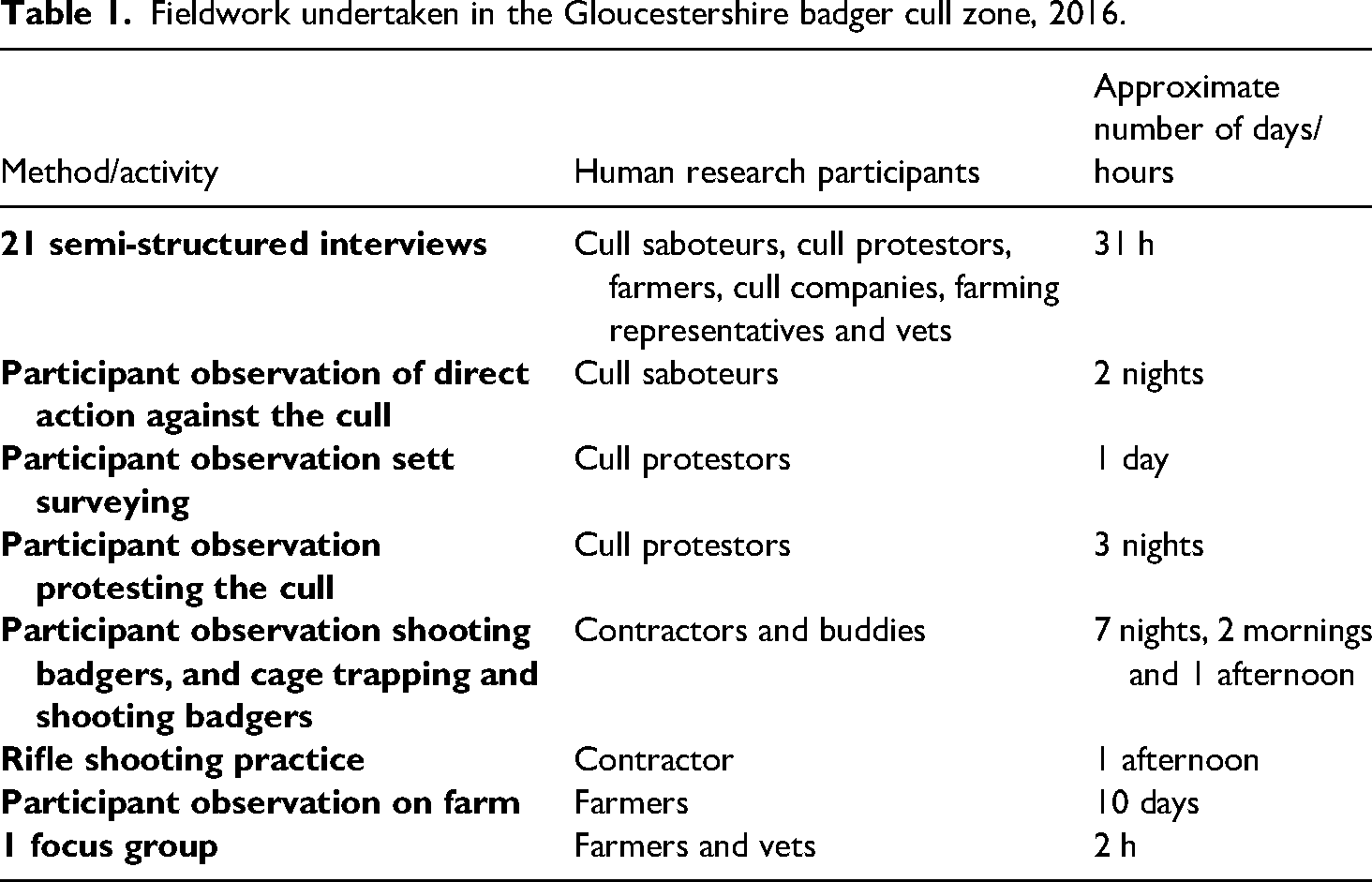
Contractors are licenced people cage trapping and shooting badgers, and/or carrying out controlled shooting of badgers at night. Buddies support contractors, generally by using thermal imagery to spot badgers. Cull companies secure farmers’/landowners’ permission to shoot badgers on their land, charge farmers/landowners for this service, secure a licence for culling, and pay contractors to shoot badgers. Cull protestors undertake lawful activities to disrupt the cull, for example, watching setts and walking footpaths at night where they think contractors may be present. Cull saboteurs undertake direct action to disrupt the badger cull by causing material damage. I define this broadly to include intimidating farmers, trespassing and destroying cages.
Prior to going to Gloucestershire, like Woods (1997) in relation to fox hunting, I created a stakeholder map of relevant organisations and people I knew in the Gloucestershire cull zone. I sourced contact details from social media, my pre-existing networks and the farming press. On entering the culling fields, the unevenness of my access to different groups became apparent. Compared to the phone interviews in 2013, it was much more difficult to secure access to participants and their consent for in-person research methods in 2016, and my access varied between and with each group. Reflecting on their research in a halfway house, Lehnerer (1996) outlines how acceptance by one group can lead to exclusion by another. In an on-the-ground controversy where sides are pitched against each other, being an insider with one group means being an outsider to oppositional groups. I therefore had to carefully negotiate critical distance between myself and the groups being studied to gain and retain access to all sides. Here follows three sub-sections about gaining and maintaining access to pro-cull groups, gaining and maintaining access to anti-cull groups, and negotiating the uneven terms of access between these groups.
Gaining and maintaining access to farmers, contractors and vets
On arrival in Gloucestershire in 2016, I initially revived contact with a ‘gatekeeper’ for the veterinary and farming professions by phone and we agreed to meet. I informed him over a cup of tea that I would like to undertake participant observation and interviews with people involved in shooting badgers. He paused and then invited me to a skin test on his client's farms. The skin test is undertaken at regular intervals on cattle to diagnose if any cattle are infected with bTB. It tests for cattle's immune response to M. bovis, the causative agent of bTB, by injecting the animal with tuberculin and measuring changes in skin thickness. Cattle that react to the skin test are compulsorily slaughtered. During the test, he invited me to take part in a pregnancy diagnosis of a heifer. Wearing arm-length latex gloves, I inserted my arm into the heifer's rectum to perform the pregnancy diagnosis. According to the vet, this act showed I was ‘not afraid to get stuck in’ on the farm, thereby strengthening our relationship and earning his respect.
On reflection, I deem this heifer pregnancy diagnosis experience to have been a ‘rite of passage’ for access into the Badger Cull company. I had requested to meet the vet's clients and he therefore wanted to be sure that I was competent on the farm and able to handle myself in a variety of on-farm situations. I accepted the vet's ‘terms and conditions’ to enter the group for the benefit of my research. The vet subsequently put me in touch with more of his farmer clients, the cull company and contractors.
The vet advised me to establish communication with people involved in, and supportive of, badger culling (the cull company, farmers, vets, buddies and contractors) before informing them that I was also undertaking research with people opposing badger culling. On his advice, I sent the former group a brief email describing my research and that I grew up on a farm to show I had practical knowledge of agricultural systems. I followed this up with a phone call in which I informed them of my research with people opposing badger culling. Many members of the cull company, farmers and contractors were concerned that I could be passing on information about their practices to cull saboteurs. I reassured them by referring to the confidentiality statements in the consent form and by referencing my 2013 fieldwork; in 2013, some people involved in the cull told me sensitive information about the badger cull, none of which was leaked to saboteurs or protestors as they feared.
I also reached out to local organisations in the area that were involved in culling, and for whom the vet was not a gatekeeper. Whilst respecting anonymity, I hinted at who I had spoken to (by role not by name) within organisations in order to build trust. For example, I told a National Farmers Union county advisor that I had spoken with other National Farmers Union county advisors. In doing so I built my network through referrals and associations.
To my benefit, the tight-knit community involved in and supportive of badger culling meant my name was quickly shared. In some cases, farmers were also buddies and contractors involved in shooting badgers. Therefore building relationships with farmers was vital to gaining consent to directly observe the practices of culling. During the day, I went onto farms to participate in skin testing with vets and farmers (Figure 1). I often undertook the role of ‘scribe’ on the skin test, finding animal IDs in paperwork and writing down their skin thickness, thereby speeding up the testing process by relieving the vet or farmer of a monotonous task. My role as scribe often saw me positioned adjacent to the crush – a strong stall or cage for holding livestock safely and securely – and, dependent on the layout, I often released the neck yoke – a bar around an animal's neck used to catch the animal and hold them ‘stock still’ – to let cattle in and out of the crush (Figure 1). Two farmers who allowed me to do participant observation of skin testing were also contractors (licenced to shoot badgers as part of the cull) and after the skin tests invited me to go out with them to shoot badgers. As described by Adler and Adler (1987) regarding membership roles in field research, these vets and farmers deemed me to be credible and trustworthy due to my affiliation with agriculture, for example, my ability to partake in skin tests and undertake a pregnancy diagnosis. My competency here opened up opportunities to undertake participant observation of badger shooting.
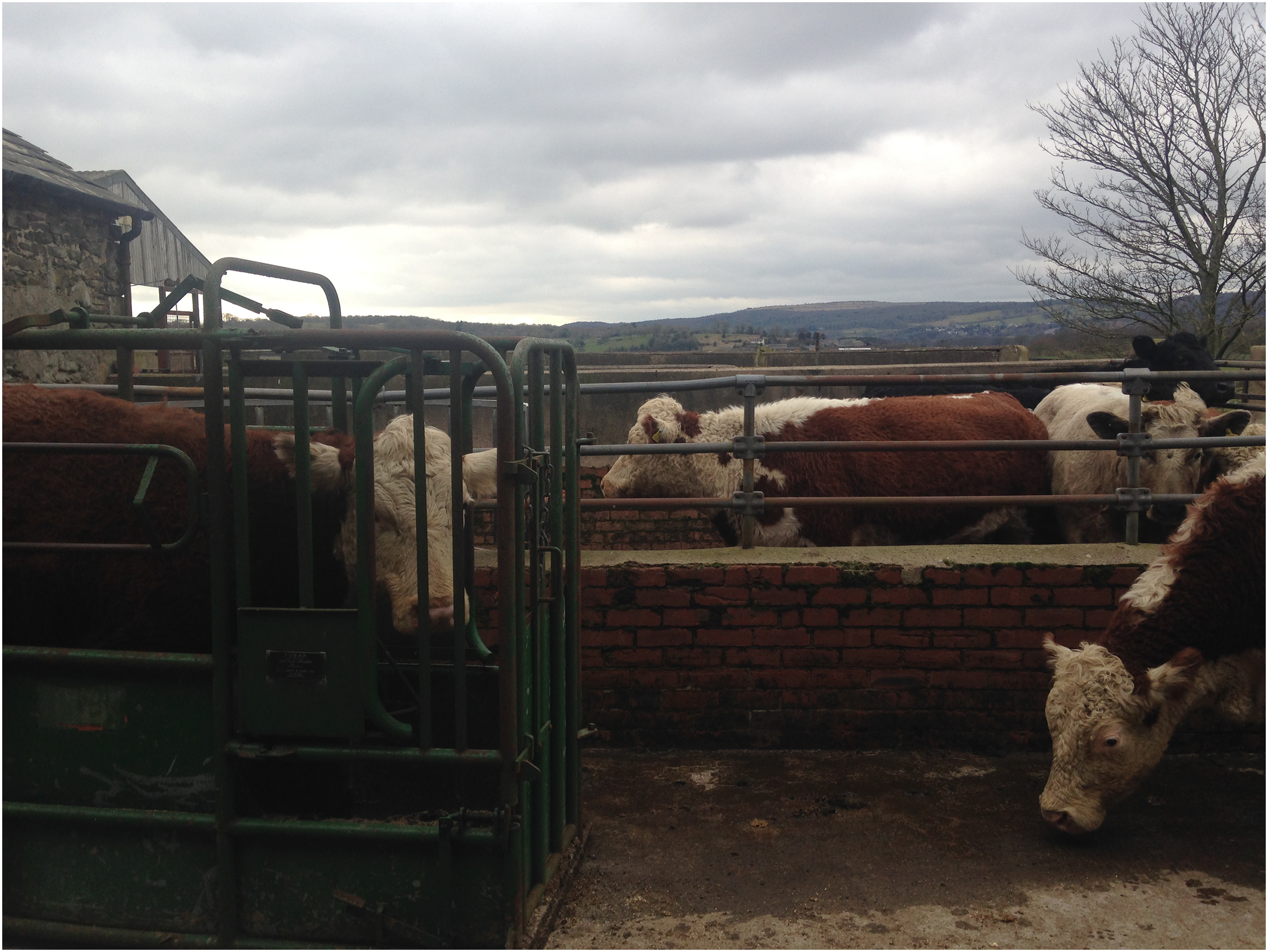
Cattle in a crush for the skin test (Phoenix, 2016).
At the end of the fieldwork, I wanted to retain access to participants for possible future fieldwork. I went to a contractor and cull organiser's house when the cull ended for a celebration. We ate together, drank together, and I described my emerging findings. I felt like I was thanking these people for their kindness and companionship, and consolidating a relationship to possibly use in future fieldwork. Ethnography inherently depends on developing meaningful relationships and therefore it is extremely difficult, if not impossible, for ethnographers to be fully detached. To manage my investment in participants, I adopted the advice of Labaree (2002) in his review of the dilemmas of being an insider participant observer. I regularly reflected and questioned my sense of familiarity with participants to stop myself from becoming a full insider and to try to maintain symmetry in my field notes about this controversial issue.
Gaining and maintaining access to protestors and saboteurs
To gain access to anti-cull groups, I initiated contact through email and phone calls to the umbrella groups. I had undertaken interviews with some of these groups in 2013 and so word quickly spread that I was in the area. In initial and follow-up phone calls, I made it clear that I was also undertaking fieldwork with the cull company, contractors, farmers and vets. Four groups protesting against the badger cull agreed to take part in my research and invited me to go on night-time walks in the cull zone. After establishing a relationship with these protest groups, I slowly began to build relationships with saboteurs undertaking direct action against the badger cull. One saboteur told me they had checked my Facebook account before agreeing to let me undertake fieldwork with them in the cull zone. They mentioned that they had checked my online friends and saw that I had a few friends in the protester community (from my fieldwork in 2013). They rang these protestors to gain information about me and this boosted my credibility in the community.
Rural saboteur groups in England are poorly represented in research, likely due to the difficulties of securing permission to do research with them as they do not want details of their often unlawful direct action to be in the public domain. 5 Given the high levels of trust required to be part of these unlawful activities and my lack of personal experience being a saboteur, the space available to me to negotiate my insiderness was far more restricted than in the case of the vet gatekeeper. Therefore, previous connections proved vital to build relationships with saboteurs and develop a level of insiderliness. However, many saboteur groups did not take part in my research because they were concerned that I would share information about their anti-cull activities with supporters of the badger cull. Maintaining access to a limited number of saboteurs required constant effort on my part. I frequently reassured all participants of the confidentiality statements in the consent form and, if requested, went through my field notes with participants at the end of each night and gave them the ability to delete notes that they did not want in my research. Sabatours asked me to delete or reword notes on three occasions, all of which related to underground activities that they did not want the cull companies and police to know about; no pro-cull participants asked to review my field notes or delete/reword anything I had written down. Other times saboteurs explicitly told me not to make any notes if something sensitive occurred or was said. I always respected their concerns and the conditions of the consent and deleted the information. This collaborative approach to delineating the boundaries of data collection meant I retained access to these groups. To ensure my research included and maintained a symmetrical representation of multiple sides of the controversy, I limited participants to only editing my field notes and not to analysis or writing.
Unevenness of access
Gaining and maintaining access to different sides is likely to be uneven when doing a multi-sided ethnography, largely dependent on the researcher's level of insiderliness with the groups in question. For example, I could show competency on a farm due to my upbringing, but could not show competency in being a saboteur as I had no direct experience of this. My relatively high degree of insiderliness with farmers and vets gave me a cache of trust when undertaking fieldwork. I did not have such a high amount of trust in anti-cull groups, especially saboteurs, so the terms of access were more difficult to negotiate.
When a researcher's ability to access different groups is uneven, a staged approach to building relationships can help to make a multi-sided ethnography possible. For example, my ways of being and relationships formed from my 2013 fieldwork provided an important foundation on which to gain access to all groups and a level of trust. Still, some groups were nervous about working with me because they were concerned that I would share sensitive information between groups (see next section). To help gain access to these groups, I developed networks of contacts within each group. Reflective on Hannerz (2003: 209), I entered into a ‘translocal network of relationships’ in which the ‘identification of common acquaintances’ between myself and participants helped overcome some participant's nervousness about working with me as their friends, colleagues and acquaintances considered me to be credible. This staged approach to building credibility with gatekeepers, meeting contacts, building trust, and then undertaking interviews and participant observation with them took an extensive amount of time and patience. However, I consider the development of staged relationships to be important for undertaking close participatory methods in on-the-ground controversies. The staged approach establishes rapport between a researcher and a side of a controversy, therefore opening up opportunities for the researcher to be vetted for within the side (dependent on the researcher's actions). For me, this opened up the possibility of engaging with more sensitive groups and activities that were almost impossible to access in a first research encounter and, significantly, I was able to do this with multiple sides simultaneously. I found the insights that I gleaned from working within and between sides to be richer and more substantive than I gathered during my 2013 fieldwork.
Unevenness of access also means a degree of compromise is inherent in the data collection process. In some situations, researchers will likely have personal compromises they are able and willing to make for the sake of research, and in other situations, the researcher may have limited compromises available to them. For example, I considered my limited access to saboteur groups as a delicate privilege and I was aware that I could become a full outsider at any point. Maintaining access and consent required much more work compared to my activities with the cull company, for example, deleting field notes at their request. In the case of a multi-sided ethnography of a controversy, a researcher needs to aim to open up enough space to become an insider with opposing groups and at the same time not align oneself with a particular side's views. Each situation is uneven and requires a different negotiation of critical distance between the researcher and participants. The space available in which to create distance is informed by the researcher’s positionality with the group in question.
Negotiating my role as a knowledge resource
Undertaking research with opposing groups meant I was sometimes ‘fished’ for information about ‘the other side’. The following extract is from an interview with a badger cull saboteur about the number of badgers killed inside the cull zone. At the point of the interview, the cull was in its fifth week and a text message had been sent to people involved in the badger cull regarding the number of badgers needing to be killed in the final week of the cull (each area received a cull licence for six weeks): ‘We’re expecting them to get just a little bit more than their minimum target, if it ends at 6 weeks’. ‘And why are you expecting that?’ ‘We’ve had intelligence supposedly that says they’re 50 [badgers] off their minimum target and they’ve got a week to go. They will meet it’. ‘Right ok’. ‘Is it true?’ ‘[Laughing] I can’t tell you that!’ ‘Well you’ve gone bright red so I’m taking it as good intel!’
The saboteur told me that someone involved in the cull had received the text message and shared the information with the local anti-cull groups. I knew the text message had been sent out because I had been with a contractor the day before who had shown me the message and its content. I abided by confidentiality to not share any information about the text, but seemingly could not hide the shock from my face.
During fieldwork, I also became increasingly concerned about my possible role as a knowledge resource related to giving away contractors’ locations when shooting. In 2014 and 2015, saboteurs had placed Geographical Positioning System (GPS) trackers on contractors’ vehicles to track their movements. Saboteurs would go to the location of the vehicle and disrupt the contractors before they had the chance to shoot. As a result of this experience, some cull organisers and contractors became worried that cull saboteurs may have attached a GPS tracker to my car. In addition, saboteurs often jested with me that putting a GPS tracker on my car would be a great way of getting information about the location of farms that were involved in the badger cull. After hearing about practices of intimidation from various farmers (see next section), I became suspicious that my car and I could be enabling violence by passively providing saboteurs with GPS locations of farms involved in the cull. I therefore checked my car after every night spent with saboteurs. Three farmers also checked my car for a GPS tracker when I arrived at their property. I did not tell them that saboteurs had joked with me about putting a tracker on my car as I thought the humour would be lost on them and their fear of it being true would restrict my access to these participants. Although I never found a GPS tracker, my fear of being tracked and enabling violent practices meant I never took my car on a shoot, instead leaving it on the contractor's property.
Researchers are conventionally regarded as collectors of information and producers of knowledge. However, in multi-sided ethnographies of on-the-ground controversies, researchers are also a resource to participants as a possible source of information about another side. Through working with multiple sides and being positioned in the middle of the badger culling controversy, I was not only studying the controversy, but also ensnared by and stickily entangled in it (Cassidy, 2019). There was ambiguity in my research about who was getting information from whom as some participants tried to fish me for information about the other side. My potential role as an informant through which groups could achieve their ends, some violently, was perhaps part of the reason I was able to secure access. When being fished, I put critical distance between myself and the participant to maintain the trust of the other side. On the one hand, this distance may have risked my access to saboteurs who wanted information. On the other hand, it could have bolstered my trustworthiness in a non-aligned position. Researchers constantly need to be sensitive and tactful, in other words, to play the diplomat (see Stengers, 2006), to limit their role as a knowledge resource and therefore maintain critical distance with all groups.
I played the diplomat by adopting a non-aligned position in the controversy. During fieldwork, I was frequently asked ‘Are you pro or anti-badger culling?’ In their ethnographic research on mountaintop removal in Virginia and industrial pig production, Scott (2010) and Blanchette (2020), respectively, describe how they were asked the similar question of ‘which side are you on’. Scott tells how the dualistic, reductionist logic places people into categories and leads to dead ends in thoughts. Similarly, the dualistic ‘pro and anti’ badger culling divide does not allow for diversions of viewpoints in the bTB controversy. In response to this question, I said that I refused to define myself in the polarised categories of ‘pro’ and ‘anti’. This response helped me to adopt a position that, while refusing to align with any group, was less threatening to them than an oppositional stance, and therefore enabled me to maintain some critical distance from which I could analyse the practices I witnessed. However, not aligning myself with the groups I worked with could, at times, render precarious my insider position. Some participants questioned my response and we then had extensive conversations around the ‘pro’ and ‘anti’ framing in the controversy at large, and in the on-the-ground controversy of badger culling. On reflection, I consider some groups may have seen benefit in my non-aligned position as they saw value in being part of multi-sided research and being portrayed as doing different actions with badgers rather than simply pro or anti cull. For example, some badger cull saboteurs asked me to describe them as badger protectors as they wanted to be portrayed as pro-badger rather than anti-cull. I think this conceived benefit for participants being able to tell versions of ‘their truth’ to someone non-aligned in the controversy was a factor in me not losing consent and, to my knowledge, not having participants reduce the extent of information that they told me.
Negotiating my emotions and safety
Critical distance is also required in ethnographic research of a controversy for a researcher's own emotional well-being and safety. In my fieldwork, I sometimes found the physical and emotional violence of the controversy challenging. In an interview, a farmer and cull company director, Graham, told me about his experiences of sabotage from an anti-cull group: ‘The first few days of the first cull [in 2013], the cows were going berserk with these people shining torches everywhere and all these voices, and the cows pricked up their ears and went charging up and down, so I was getting pretty uptight, “you’re not coming in here, it's not a legal footpath”, and then we had the police here, we had police here every night of the cull, every single night’. ‘It sounds difficult’. ‘Steve [founder of an anti-cull group] was here on that drive and told me what he was going to do to my kids, and I had the policeman right behind me, five yards behind me, and I turned to […] the policeman and I said, “when the fuck does this become aggravated trespass?”. I was being hunted’. ‘I’m sorry’. ‘They identified some farmers, landowners, contractors or whatever, and they were sat outside the school gate giving the wives abuse to try and get the guys to have so much pressure at home, saying “we’re not doing this, we’re not culling”. They wrote to Brian [part of the cull company] with details of the classes his kids are in at school, what clubs they do [after school], what times the clubs finish and that they will pick up his children from school if he doesn’t pull out the cull’. ‘I’m so sorry’.
Interviews like this were difficult. I tried to manage my emotions in the interview and then release my emotions afterwards when on my own. After the interview with Graham, I drove to a local church and cried in my car for 20 minutes. I was upset by the violence that Graham had described, and felt unable to fully share my emotions due to the interview setting, my desire to maintain critical distance with Graham and my need to continue to work with saboteurs who may have been involved in these actions. My emotional response to hearing Graham's and others’ stories could be so strong that I was concerned about how they could come to bear on my ongoing research and relationships with those who I was told had inflicted such violence. Like Clark (2017) in her fieldwork with survivors of war rape and sexual violence, I found it important to have an hour's pause between such instances and any further fieldwork in order to decompress and recharge. I would note my emotions and try to hold their sway on my work in check as I continued to explore this controversy. Moreover, in fieldwork with saboteurs and contractors, I tried not to agree or disagree with their views and actions and instead listened with respect and deep attention (Luker, 2008). In doing so I was not allowing myself to fully emotionally invest in the experiences of particular people or groups, maintaining my critical distance for the sake of a more symmetrical reading of the controversy.
Often, like Ellis in her ethnography of a fishing community (Ellis, 1986, 1995) I did not fully bring my emotions, and therefore my self, into my research for the sake of accessing what I considered to be ‘good’ ethnographic data. For example, when asked to take part in the pregnancy diagnosis detailed earlier in the article, I had a moment's hesitation considering whether I wanted or needed to do this, and I then said yes. My research felt more important to me than my apprehension. I knew that refusing to do the pregnancy diagnosis would have severely restricted my access to the cull company, as the vet – who was an important gatekeeper – may not have considered me to be credible. Drawing on her ethnographic experience and the way she has included and excluded herself in her research, Ellis suggests that ethnography should include ‘researcher's vulnerable selves, emotions, bodies and spirits’ (Ellis, 1999: 669). I recognise that I put a significant distance between my emotions and my actions in the field for the sake of securing access to participants. Again, this distance in the field afforded me a more symmetrical reading of the controversy.
In writing this article, I realised that my work in a rural controversy also put me at risk of violence. Most days I went onto farms with men I did not know, and many nights I was alone in the countryside with men shooting badgers. To manage risks to my safety, I set up a system with my trusted individuals where I would text them when entering a field site with a time I was meant to leave, and then text them when I left. We had an escalation process in place if I did not text them within 1 hour of the time I said I would leave. This system lasted for two days and then I stopped texting the trusted individuals as I did not feel my personal safety was at risk. In hindsight I consider this to have been a foolish decision as no friends, family or colleagues knew where I was each day and each night. Why was I not concerned for my own personal safety? Again, my upbringing on a farm with two brothers means I am used to being in rural spaces that are masculine and male-dominated. I have a dry sense of humour and a high level of confidence that I consider helps me to feel respected and on an equal footing with men when in traditionally masculine spaces, such as farms and fields. My character traits and familiarity with these spaces likely contributed to me not feeling unsafe in these situations when other researchers likely would have been concerned for their safety. Perceptions of safety are highly personal and closely related to one's identity (Office for National Statistics, 2021). Therefore, the degree of critical distance and the safety procedures implemented are dependent on the researcher and the context they are working in.
Conclusion
Multi-sided ethnographies provide insight into how controversies are enacted, their heterogeneities, and how relations between sides shape interwoven identities. This methodology has the potential to help sides to empathise with one another, re-make relations and potentially re-make the controversy going forward. Despite the value of the methodology, it is difficult to undertake and there is a lack of methodological insight on how to do them. I felt compelled to write this article based on my research experiences to guide and encourage others who want to pursue multi-sided ethnographies of on-the-ground controversies. I have shared my personal experiences of some of the challenges of working with divisive sides, and my conviction of the need to negotiate critical distance with participants and have a non-aligned position.
Undertaking research with opposing groups simultaneously to a large degree rests on a researcher's ability to hold a non-aligned position in a controversy. A researcher's degree of access to each group is premised on a degree of distance from other groups. Negotiation of distance is vital to ensure research accounts for and reflects different perspectives, and is not over-determined by one perspective of the controversy. This distance requires constant maintenance. On the one hand, this means limiting the development of personal relationships, the sharing of physical space, and information shared with groups to maintain access to multiple sides. On the other hand, this negotiation of critical distance gives legitimacy to a researcher's non-aligned position and therefore enables access. Critical distance is inherently both limiting and enabling in a multi-sided ethnography, and this constant tension needs to be negotiated by the researcher.
Of course, this research is contextual to myself, to the participants and to the research topic. Whilst necessarily personal, this article points towards the following five challenges and practical recommendations for ethnographers doing multi-sided research:
It is difficult to access different sides of a controversy. A stakeholder map can help us to understand key gatekeepers to different sides, and guide who to engage with and when. Access to certain groups may require a staged approach, with relationships developed over time and with multiple members of a group. Each of us needs to open up enough space to become an insider with different groups, which requires a different amount of work dependent on the group themselves, and the researcher's positionality with the group in question. Negotiation of distance with participants is unstable and continuously navigated in the field. When doing research in a controversy, our actions with one side may alter our position with different sides; an act to retain access to one group may cause another group to lose trust in us and choose to stop taking part in the fieldwork. Fieldwork requires constant negotiation to simultaneously become an insider with opposing groups, and not to align oneself with a particular side's views. We must retain critical distance between groups and play the diplomat to keep groups involved and to ensure our analytical criticality with all sides. We may need to compromise on parts of our research to secure and retain access to different groups, for example, my compromise in allowing saboteurs to delete field notes. To help make informed compromises in unexpected encounters, consider what compromises we are willing and not willing to make in advance of fieldwork. Working in the middle of a controversy means we can become a knowledge resource to all sides, about all other sides. We must navigate this role to maintain research confidentiality and to lessen our role in enabling violence between sides. As with my experience with GPS trackers, care and practical steps should be implemented to avoid being an enabler of violence where possible. An on-the-ground controversy likely entails disagreement, and the nature of participant observation means a researcher is likely to be embroiled in this, and impacted by this, to some degree. I negotiated critical distance with the violence of the badger culling controversy to preserve my own emotional well-being and safety. We should consider risks to our vulnerable selves before entering the field and implement effective management systems dependent on those risks. I recommend regularly reflecting on our reactions to violence to ensure we retain integrity in fieldwork and protect ourselves.
Using the multi-sided ethnography methodology and negotiating critical distance enables ethnographers to do research with opposing sides in the conflict, show how controversies are being enacted on the ground and provide a way for people with antagonistic views to empathise with one another. I hope my portrayal of the importance of this methodology, my accounts of the challenges I faced and the practical recommendations I provide in this article inspire other ethnographers to consider doing multi-sided ethnography in their topic area.
Footnotes
Acknowledgements
Thank you to all the participants who took part in this research. I thank two anonymous reviewers, Steve Hinchliffe and colleagues at Exeter University for commenting on earlier versions of this article.
Declaration of conflicting interests
The author(s) declared no potential conflicts of interest with respect to the research, authorship, and/or publication of this article.
Funding
The author(s) disclosed receipt of the following financial support for the research, authorship, and/or publication of this article: This work was supported by the Economic and Social Research Council (grant number 1539516, ES/W006804/1).

Notes
Author biography
Jessica Phoenix is an ESRC Postdoctoral Research Fellow in geography at the University of Exeter, EX4 4RJ, UK. Her research interests include public knowledge controversies, relationships between scientific knowledge and policymaking, and the making of disease realities through practice.