



Abstract
This paper investigates the ethnographic researcher's positionality and its role in sensemaking within the research process. Using autoethnographic data of the first author - a black female West African (Yoruba) scholar in a Western organizational context, we adopt a critical sensemaking approach to make sense of the researcher's field experience. We propose a conceptualization of the researcher's positionality as one that is entwined in the field, being an active interaction of the researcher's formative context with her sensory capabilities. We demonstrate how openness to the researcher's entwined positionality generates interpretive frames of reference and uncovers nuances in the sensemaking process, which widens the scope for reflexivity. We offer a methodological roadmap for engaging entwined positionality in reflexive practice and contribute to the body of research which challenges the idea of the detached researcher; thus, we respond to the growing calls for integrating the elements of a researcher's positionality into research in a way that enhances reflexivity.
Positionality in research has been conceptualized as the researcher's stance in relation to the field and is informed by a multiplicity of factors that underpin the researcher's view of the world (Cunliffe & Karunanayake, 2013; Empson, 2013) and consequently how access challenges are navigated (Brown, 2011; Cunliffe & Alcadipani, 2016), the choice of what to study (Sobre-Denton, 2012), and the analytic and theorizing process (Cohen et al., 2009). These studies highlight personal attributes and variables (e.g., age, ethnicity, gender, class location) that inform the frames of reference through which the researcher perceives and is perceived in the field. From a sensemaking perspective, frames of reference are involved in the interpretation of a person's experiences, but it is unclear in the literature how these frames of reference might interact with regard to the researcher's positionality (Berger, 2013). Additionally, although studies indicate practical difficulties in fieldwork (Berger, 2013; Suarez Delucchi, 2018), there is a dearth of methodological guidance for researchers on how they can be reflexive from the perspective of their positionality, particularly in ethnographic fieldwork which is often associated with a learning-by-doing ethic (Hammersley & Atkinson, 2007). Approaches to reflexivity tend to consider responses to influences of the wider social context on the research and the researcher. These often pay less attention to the personhood of the researcher in the sensemaking process (De Rond et al., 2019; Wacquant, 2015) and the “interactive effects of researcher position and sociocultural context on reflexivity” (Berger, 2013, p. 13).
Reflexivity is particularly salient in qualitative research, as it allows the researcher to demonstrate methodological trustworthiness, transparency, and rigor in the process of drawing inferences from data and the grounds upon which theorized explanations are selected (Harley & Cornelissen, 2020; Pratt et al., 2020). The reasoning process, as opposed to a set of protocols offers a way to demonstrate rigor (Harley & Cornelissen, 2020) and this approach is particularly suited to autoethnographic research, where the researcher's emotions, struggles, ambiguities, and tensions are involved in the research but can be accessed through reflexive engagement with data (Cunliffe, 2009; Ellis & Bochner, 2000; Empson, 2013; Yousfi & Abdallah, 2020) and self-introspection (Ellis, 1991).
Studies suggest that there are influences on the interpretive process from the wider context within which a researcher operates such as race (Brown, 2011; Fernando et al., 2019), gender (Sobre-Denton, 2012), power structures (Cunliffe & Alcadipani, 2016), cultural factors (Keikelame, 2018; Suarez Delucchi, 2018) and social discourses (Egharevba, 2001) among others. Growing consensus regarding the role of the researcher's sensory capabilities in contributing to sensemaking also provides further impetus for investigating the researcher's positionality (De Rond et al., 2019; Hansen & Trank, 2016; Wacquant, 2015; Yousfi & Abdallah, 2020). We recognize that these categorizations do not imply hard boundaries. Cultural factors for instance may be an identifying dimension as a result of a researcher's membership of a broader cultural grouping but may also include internalized values and norms. However, we acknowledge the uniqueness of these dimensions of positionality and the nature of their effects on the researcher. This is particularly the case for ethnography in which the researcher as a person is also the research instrument (Cunliffe, 2009). Autoethnographic research further strengthens this position as it brings to the fore the intimate world of the researcher (Ellis, 1991; Empson, 2013), allowing for mindful engagement with the research process, illuminating the researcher's positionality and revealing how it plays out in the field of study (Ellis & Bochner, 2000).
A researcher's positionality is also influenced by membership in academic communities of practice and dominant research traditions (Cohen et al., 2009). Established protocols in qualitative research methods have provided useful guidance to researchers (Eisenhardt, 1989, 2019; Gioia, 2019; Yin, 2009), but their widespread adoption has resulted in a tradition of formulaic methodological templates (Köhler et al., 2019). Researchers on ORM's feature topic - Templates in Qualitative Research Methods - express growing concerns and are unanimous in their summing-up of how qualitative research in management studies tend to miss the opportunity for methodological innovation as a result of intellectual pressures to conform to these published “templates” (Lê & Schmid, 2020; Pratt et al., 2020; Zilber & Zanoni, 2020). These templates are viewed as though they were inherently designed to satisfy the requirements of journal editors and reviewers (Köhler et al., 2019). These research traditions are able to shape research(ers) by reinforcing practices, sometimes in unintentional yet limiting ways. As one way of addressing these trends to conform to templates, we explore researcher positionality as offering opportunities for novelty through the researcher's interpretive process. In particular, we illuminate the dimensions of researcher positionality and the role of sensemaking in engaging these dimensions as frames of reference for researcher reflexivity.
In this paper, we argue that a “holistic” view of the researcher requires that we consider the various frames of reference available as resources for sensemaking from a standpoint of researcher positionality. We show the interactions in the dimensions of the researcher's positionality which make up what we refer to as entwined positionality. Building on Unger’s (1987) formative context, Wacquant’s (2015) carnal sociology, and De Rond et al.’s (2019) embodied sensemaking, we define entwined positionality as an interpretive space which takes into consideration the combined role of the researcher's sensory capabilities and elements of the formative context in providing frames of reference for sensemaking. This is particularly prominent for ethnographers going into a “foreign” field as a growing body of ethnographic research shows (Albu & Costas, 2018; Brummans & Hwang, 2018; Caronia, 2018), although equally relevant for researchers in a familiar field (Yousfi & Abdallah, 2020). An unfamiliar context serves a methodological purpose as it provides an important incorporation of critical distance into the research design (Fine & Hallett, 2014). However, it simultaneously poses a challenge for the sensemaking process and sets the scene for the emergence of ambiguities for the ethnographic researcher (Sherif, 2001).
Ethnographers as research instruments are not inanimate, but human (social) beings who possess a history of experiences and interpretive frames predicated upon membership of some broader social, cultural, racial or intellectual grouping (Cunliffe & Karunanayake, 2013; Sanday, 1979). They are able to socially interact with the research setting through processes of negotiating access, building relationships, data collection and interpretation by drawing on these resources during the research process. Through reflexivity, explanatory concepts for making sense of observations can be developed from data, the literature or from the researcher's own interpretive frames (Hammersley & Atkinson, 2007). Following the first author's ethnographic research in a post-acquisition context, we draw upon fieldnotes, analytical memos, emotional recall, and conversations with coauthors to understand how entwined positionality plays out. We focus on frames of reference afforded by entwined positionality as providing opportunities to enrich the reasoning process for methodological rigor through reflexivity (Ellis, 1991; Harley & Cornelissen, 2020). This approach does not only speak to ethnography but also to intersectionality research, where the compounded effects of intersecting social categories on researchers and research participants are illuminated and reveal potential disadvantages for particular groups (Brown, 2011; Crenshaw, 1991; Sobre-Denton, 2012). To organize this paper, we first examine the literature on sensemaking and organizational ethnography, highlighting the dimensions of researcher positionality. We then explore the arguments in the literature to understand the “who” involved in ethnographic sensemaking and develop a conceptual framework. Following this, we present our autoethnographic methodological approach, which also offers a methodological roadmap as part of our contribution. We then present our reflexive analysis of vignettes to demonstrate entwined positionality in the interpretive process. The paper concludes with a discussion of the arguments raised and the implications for research.
The Researcher's Positionality as Integral to Ethnographic Sensemaking
Sensemaking as introduced by Karl Weick was primarily conceptualized to explain how organizational members through on-going conversations with one another make sense of their environment often during periods of dramatic or significant change (Ericson, 2001; Miles, 2012; Teulier & Rouleau, 2013; Weick, 1979). It has been associated with times of crisis as members of organizations attempt to make sense of new or emerging events which may pose threats to their identity, for example during downsizing (Watson, 2006) or critical incidents (Louis, 1980; Morrison & Robinson, 1997; Nelson et al., 2017; Warwick-Giles et al., 2017; Weick, 1988). In these cases, the event triggers a need to re-define the self or maintain a particular positive affective and cognitive state of the self (Weick, 1995).
Organizational sensemaking emphasizes consensual group accounts of meaning making within a frame of reference which facilitates a collective interpretation of events and guides subsequent actions. However, Weick (1995) also places the primary locus of sensemaking first at the level of the individual where observed cues and frames of reference are connected. Sensemaking at the individual level is thus triggered when significant (and one might argue, insignificant) events are experienced. When such cues are placed into a frame of reference, the person is able to achieve an understanding of the event and explain observations. The meaning created is then able to influence current or future actions (Miles, 2012). This mainstream view of sensemaking considers how an unconscious stock of assumptions around language, symbols, past experiences, and existing predispositions contribute to framing how individuals retrospectively make sense of events in organizations (Louis, 1980; Weick, 1995), particularly encounters with discrepancies in their experience and the cues which trigger a need for explanations (Louis, 1980).
Research on sensemaking is well established and has looked at organizational (Gioia & Chittipeddi, 1991; Warwick-Giles et al., 2017), team (Guiette & Vandenbempt, 2013; Kraft et al., 2015) and individual levels (Diochon & Nizet, 2019; Jansen & Shipp, 2019). Studies have also shown that sensemaking is tied to who people are and shapes how they interpret events or enact them (Ivanova & Torkkeli, 2013; Watson, 2009; Winkler, 2017). Weick (1995) advances a plurality of the self, shown in the emergence of different definitions of the self in changing situations. He suggests that a plurality of the self gives advantage to an observer as it allows for understanding events from different perspectives. This may not be without its own problems as confusion may result from ambiguity in interpretations which may in turn generate distortions to a previously consistent conception of the self (see Weick, 1995, p. 14).
In relation to the individual, the role of power structures (Franks, 2002; Helms Mills et al., 2010), temporal dimensions (Jansen & Shipp, 2019; Sandberg & Tsoukas, 2020), sensory capabilities (Cunliffe & Coupland, 2012; De Rond et al., 2019; Wacquant, 2015), and formative contexts (see Unger, 1987) in sensemaking offers us a way to further explore researcher positionality. In Unger’s (1987) view, historical explanations of societies and social structures constitute the formative context which is essentially assumed to shape in restrictive ways the conditions within which humans exist. Although Unger (1987) recognizes the free will humans have to recreate their desired contexts, the implication is that human experiences and therefore sensemaking occur within wider social structures and discourses that potentially shape the individual's frame of reference (see Helms Mills et al., 2010). For example, historical societal discourses around race, culture, gender and so on form part of the social structure and therefore provide frames which could inform sensemaking (Maher & Tetreault, 1993). In other words, they influence “individual enactment of meaning…” so that “…the analysis of sensemaking needs to be explored through, and in relationship to, the contextual factors of structure and discourse in which individual sensemaking occurs” (Helms Mills et al., 2010, pp. 189–190). Cunliffe (2009) echoes this critical perspective and argues the need for ethnographers to consider the “historical, political, economic, cultural and social silences, and to the modes of oppression and pretension that might be present” (Cunliffe, 2009, p. 228). The feminist perspective on positionality lends credence to this view by arguing how positionality shapes social discourse, consequently influencing what becomes salient and what gets suppressed (Maher & Tetreault, 1993). It further expands on inequalities in power relations by drawing attention to the researcher's positionality as not being rigid or fixed, but as one which can sometimes move to helpless positions or be caught in between (Franks, 2002). Sensemaking can therefore be enriched when the researcher reflexively considers these movements or changes. These critical approaches to sensemaking are sensitive to and account for the impact of the wider social context within which research is conducted (Helms Mills, 2003; Helms Mills et al., 2010).
Other scholars adopt an inward perspective and approach sensemaking as an embodied activity, illuminating the researcher's body as a tool in the sensemaking process (De Rond et al., 2019; Hansen & Trank, 2016; Wacquant, 2015). Wacquant’s (2015) ideas on carnal sociology offer a critical perspective of the “internal world” of the human as a soulish being. This perspective takes the human as possessing an inward “structure” from which the individual operates, reasons, makes sense of phenomena, and takes action. It considers the sensory capabilities and emotional propellers within the body as forces that shape action. Here, the individual possesses an internal grasp of the social world which underpins their responses to experiences. Wacquant (2015) conceptualizes this internal world of the human as possessing six elements: (1) sentient - capable of having and expressing feelings; (2) suffering - vulnerable to external social forces and judgement of others, being in a world of unfulfilled desires and the inevitable journey towards death; (3) skilled - having the capacity and dexterity to act competently; (4) sedimented - having his/her senses, skills, experiences and know-how deposited over a period of time; (5) situated - being located and influenced in a physical and social space with all elements (6) structured - having all the elements integrated in one individual as they grow through time. Wacquant's carnal sociology argues this human as “producing multidimensional, polychrome accounts of social life that seize life as it actually unfolds” (Wacquant, 2015, p. 4).
From this perspective, an ethnographic researcher can be seen as a “vulnerable observer” who is not only writing about an experience but has lived it as a suffering being. Methodologically, it is “the operant capacity to feel, think, and act like a Whatever among the Whatevers” (Wacquant, 2015, p. 7, Author's italics). Similarly, De Rond et al. (2019) argue that whereas most sensemaking accounts tend to position the concept as a cognitive process, the body should not be considered as “dumb” and only a sense receiver from the mind but as a mindful participant in the human experience. Here, the authors deploy Wacquant’s (2015) notion of carnal sociology to underpin their analysis of an adventure into the Amazon waters in which their bodies were equally involved in making sense of their entire experience. Sensemaking is thus presented as being both of the body and from the body. De Rond et al. (2019) emphasize the body's capacity to engage with its environment in a way that allows it to “sense” at the visceral and emotional level and to act accordingly. This shows “the importance of the body not simply in service of the mind, but also as a means of acting into sense” (De Rond et al., 2019, p. 1,970) as it interacts with the environment.
In other words, through sensory capabilities that are the embodied dimensions of its positionality, the carnal self is able to offer particular interpretations of its experiences in sensemaking. Additionally, influences of power, gender, race, and so on, which we have alluded to earlier as constituting the formative context of the sensemaker, also impact on issues of identity. The argument being that the individual who is involved in sensemaking has an identity that is constructed and or shaped by his/her formative context (Helms Mills et al., 2010). For Helms Mills et al. (2010), identity construction is at the heart of the sensemaking process, influencing how other elements of the sensemaking process are operationalized. They argue that sensemaking involves the projection of one's identity into the larger environment and seeing it “reflected back” in a way that allows individuals to “understand what is meaningful in their own identities” (Helms Mills et al., 2010, p. 188) and to analyze the power relationships reflected. Critical sensemaking therefore draws on the wider social structures and discourses as well as the identity and sensory capabilities of the individual sensemaker in order to attribute meaning to experiences or observations (De Rond et al., 2019; Yousfi & Abdallah, 2020).
Understanding the Ethnographer as the “who” of Sensemaking
Ethnographic accounts typically reveal outcomes of the researcher's sensemaking from an iterative process of experiencing, collecting, and analyzing data during fieldwork (Dalton, 1959; Van Maanen, 2011; Van Maanen & Barley, 1984). The ethnographer is equipped with methodological tools and techniques for making sense of observations and participants’ experiences (Cassell & Symon, 2004; Cunliffe, 2009). These include gathering and recording observations and other forms of data from a range of sources, following ethical guidelines for the selection and use of data as well as making decisions about what to extract or exclude (Hammersley & Atkinson, 2007). But beyond these methodological tools, studies suggest that sensemaking also integrates retrospective and prospective reflections on experiences which allow for insightful interpretative accounts (Ager, 2011; Allbon, 2012). This involves a fluid back and forth movement across the past, present and future in the sensemaking process (Empson, 2013; Jansen & Shipp, 2019; Sandberg & Tsoukas, 2020). This dynamic sensemaking process allows a researcher to draw on the totality of his or her being, including emotions (Empson, 2013; Hansen & Trank, 2016; Yousfi & Abdallah, 2020). This point is particularly relevant for ethnographic research because the ethnographer's identity is constituted by historical, cultural, intellectual, social and role dimensions (Schwartz-Shea & Yanow, 2009; Stets & Burke, 2000) and therefore sensemaking is informed by multifaceted influences embedded within the totality of the researcher's life experiences. Yousfi and Abdallah (2020) from this perspective highlight emotions as serving a dual purpose; as a methodological resource and as a critical tool for identity work.
Additionally, some studies within the identity literature assume an enduring aspect of a person's identity (Dean et al., 2012; Dutton et al., 1994; Sparks & Shepherd, 1992). Here, identity is “understood as a core aspect of (individual or collective) “selfhood” or as a fundamental condition of social being, “identity” is invoked to point to something allegedly deep, basic, abiding, or foundational” (Brubaker & Cooper, 2000, p. 7, Authors’ emphasis). Consequently, a researcher may draw on some element of their personhood that is “deep, basic, abiding, or foundational” for sensemaking in the field. Within different domains of life experiences, the cultural dimension is foundational to the development of a person as a homo socialis, as cultural patterns are typically taught to new members of a society (Geertz, 1973; Kroeber, 1963). This indicates the social basis that underpins the development and transmission of value systems. This dimension plays an early role through the socialization process in delineating the researcher's social categories, thus shaping the researcher's social identity and understanding of the world (Stets & Burke, 2000). We show one aspect of these core or abiding cultural elements through the invocation of Yoruba proverbs by the first author in this paper. These cultural proverbs espouse values such as reflective thought, practical wisdom, balance, prudence, and modesty inter alia that guide virtuous behavior and uphold the harmonious interactions between the self and the larger community (Abimbola, 1975; Bascom, 1969) while also functioning as a sensemaking tool (Outila et al., 2019, 2020).
The Yoruba cultural group are a people with rich heritage spanning several centuries, as indicated by early documented materials (Adediran, 1984; Akintoye, 2014; Laitin & Watkins, 1986). From the position of having a common language and sense of history, Adediran (1984) identifies the Yoruba as a “single cultural group” (p. 70) although characterized by a collection of various sub-groups with peculiarities which also extend to differences in dialect. However, the various sub-groups share a sense of common heritage and self-applied appellation, with a unifying identity (as a large cultural group). As a result, “one could not expect a rigid conformity to what may be regarded as the ‘Yoruba type’” (Adediran, 1984, p. 70) in a narrow sense. Yoruba culture is rich in philosophical ideas and these are often embedded and expressed in practices, symbols, values, historical sagas, ceremonies and everyday exchanges between members of the cultural group (Abimbola, 2006). With a strong oral tradition, language is a significant aspect of Yoruba culture, serving as a medium for the transmission of historical and cultural values, sometimes expressed in cryptic forms, to celebrate past achievements or reinforce traditional beliefs (Akintoye, 2014). In this latter sense, the use of proverbs is a notable aspect of speech which not only represents part of the linguistic tradition but forms part of the “communal and individual consciousness and subconsciousness” (Agwuele, 2004, p. 325) of the Yoruba.
We can therefore see the salience of the “who” of sensemaking as a product of lived experiences which have become sedimented (Wacquant, 2015). As a sedimented being, the ethnographer is therefore able to draw on various elements that inform “who” they are to make sense of events in the field, including racial, cultural or socio-economic identities (Brown, 2011; Sobre-Denton, 2012). We argue that these elements constitute frames of reference, which transcend methodological tools and techniques and allow for a nuanced interpretation of experiences. Contributions to understanding the “who” in sensemaking also come from intersectionality research which explores people situated at the intersection of different dimensions of identity (Cho et al., 2013; Crenshaw, 1991; Rosette et al., 2018; Windsong, 2018). Crenshaw (1991) argues that a person's social location makes their experience “qualitatively different” from that of other persons (see p. 1,245). This notion of positionality considers it as the overlap of markers of a person's identity (e.g. gender, race, social class, etc.). For example, a black woman's identity sits at the intersection of gender and race and therefore has a specific positionality. Feminist perspectives describe these markers as contributing to ascribed positionality, which in some cases bears resemblance to a person's perception of themselves (Franks, 2002).
For an ethnographic researcher, we can expect this social location to shape their actual experience in the field (Cunliffe & Karunanayake, 2013). Therefore we argue that the researcher's positionality is not only the result of an overlap of social markers of identity but also includes the individual's capacity to sense and respond to experiences (De Rond et al., 2019; Hansen & Trank, 2016; Wacquant, 2015). Sensemaking is thus both embodied and influenced by wider contextual elements. That is, the researcher draws on resources in the interaction of social, historical, economic, cultural, racial, and other contextual elements of the wider formative context as well as his/her own sensory capabilities (i.e., the researcher's entwined positionality), which inform an individual's sensemaking in a particular context. When sensemaking is conceived of in this way, its outcome is enriched with the researcher's own sensory capabilities (Wacquant, 2015) in addition to social factors in the environment that may be visible (race, gender, etc.) or invisible (social silences, modes of oppression, reactions of study participants to the researcher etc.).
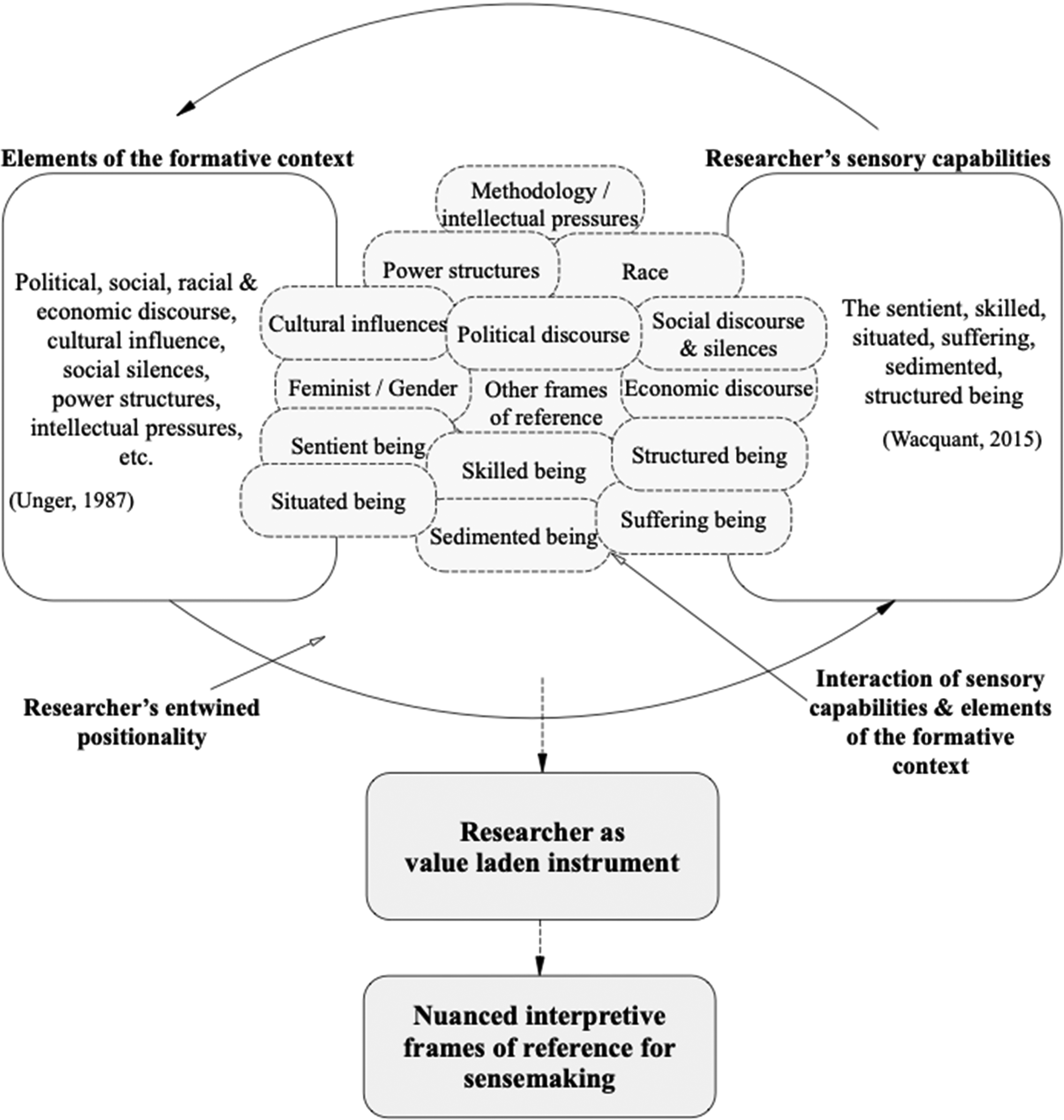
Studies in the area of organizational ethnography indicate the positionality of the ethnographer and speak to the importance of a variety of positional influences on research (Albu & Costas, 2018; Brown, 2011). As shown in Figure 1, these positional influences are drawn from the formative context (Unger, 1987) and the researcher's sensory capabilities (Wacquant, 2015), both interacting to produce frames of reference through which observations are interpreted. There are studies which refer to notions such as “home” or “at-home” ethnography (Alvesson, 2009; Malm, 2018; McAllum, 2018; Suarez Delucchi, 2018), cultural hybridity (Brummans & Hwang, 2018), multiple selves or social identities (Cnossen, 2018), fluctuating positionality (Caronia, 2018) and transnational diversity (D’Souza & Pal, 2018). These studies highlight the nuances in the positionality of the researcher, including membership of intellectual traditions and the attendant methodological implications, i.e. familiarity with the organizational context and methodological norms that ground the researcher within an academic “home”. We expand on the arguments raised by demonstrating the interactions in the positional influences and how they generate nuanced frames of reference.
The “who” of sensemaking.
Recognizing the diversity of cultures, Brummans and Hwang (2018) offer cultural hybridity in their call for research which considers a combination of perspectives in fieldwork which can enable the practice of “radical reflexivity”. In our view, a nuanced perspective such as one provided by the interpretive frames of reference from the researcher's entwined positionality, offers deeper reflexivity, as consideration is given to the formative context and also the sensory capabilities of the researcher. By entwined positionality, we do not mean Cnossen’s (2018) idea of multiple selves which emerge performatively across different contexts. We use entwined to connote the interaction of the researcher's visceral responses with the formative context within which sensemaking occurs. This allows for a more rigorous approach to the reasoning process of the researcher in drawing inferences from observed data (Harley & Cornelissen, 2020).
Ethnographic accounts are implicitly underpinned by a particular view of the world through which the researchers’ experiences are filtered (Cunliffe, 2009; Ybema et al., 2009). There are three premises upon which this argument is based. First, worldviews differ across social groups and are shaped by socialization, life experiences and one's internal responses, resulting in specific positioning (see Ivanova & Torkkeli, 2013; Köhler et al., 2012; Weick, 1995). In other words, the researcher's interpretive frame of reference is underpinned by a stock of experiences which have been ingrained over time and have become a part of the researcher's positionality. Second, the researcher in ethnography is the research instrument through which data can be filtered, not value-free, such as we have in the physical sciences (Patton, 2002; Sanday, 1979). Recognizing that the researcher is a person who is not value-neutral has epistemological implications. Trying to carry out research that is value-free would be akin to “a type of “schizophrenia”“ (Mies, 1983 cited in Deutsch, 2004, p. 885) because it silences the reality of the researcher's personhood. Third, sensemaking provides the initial filter in the interpretive process for a researcher (Hammersley & Atkinson, 2007; Weick, 1995). It is therefore central to the process of data collection and paves the way for reflexive interpretation of data. Sensemaking therefore is methodologically a fundamental aspect of ethnographic research because it represents the first step in the process of filtering data emerging from the researcher's engagement with the field, given that the researcher is seen as the research instrument (Hammersley & Atkinson, 2007; Ybema et al., 2009). That is, the researcher, who we have argued possesses entwined positionality, reflexively deploys his/her frames of reference as a value-laden instrument for interpreting experiences in the field.
Our Methodological Approach
In examining the intimate experience of the first author of this paper, we deploy autoethnography as the appropriate method as it aims to draw out personal vulnerabilities when a researcher engages participants in the field while also committing to theoretical analysis of the researcher's sensemaking process (Anderson, 2006; Fernando et al., 2019). In autoethnography, the researcher carries the reader “from an outer, public sphere to a private, inner core” (Jones, 2013, p. 748) but also offers an inside-out dynamic in which the researcher's own experiences are analyzed in relation to the wider social context. Autoethnographic accounts are typically a personal narrative positioning the researcher as the object of study and sometimes include autobiographical data drawn from a range of sources such as emotional recollections of the author (Ellis & Bochner, 2000), research diaries and field notes which “intentionally or unintentionally, offer information about the structure, dynamics and function of the consciousness of the author” (Vickers, 2007, p. 224).
Autoethnography opens the door into this deeper world of the researcher's unique sensemaking process; it shows the inner struggles of the researcher and how they have coped with situations during which there was loss of meaning (Ellis & Bochner, 2006). It moves ethnography away from the study of “others” as research subjects to that which looks at the researcher's own personal journey and produces an account that is both evocative and analytical. Autoethnography has been the method of choice for various studies in which sensemaking as a concept is invoked. These include studies on workplace bullying (Vickers, 2007), gender discrimination and white privilege (Sobre-Denton, 2012), work-life dynamics (Cohen et al., 2009), identity research (Daskalaki, 2012; Empson, 2013), researcher's personal experience with racial issues (Brown, 2011) among others. This approach considers the researcher's experiences of tensions, complexities, ambiguity or surprise as essential to the interpretive process through reflexivity in qualitative research (Behar, 1996; Cunliffe, 2009; Cunliffe & Alcadipani, 2016).
In this paper, the “self-journey” is not (we hope) an exercise in methodological self-indulgence or navel-gazing but aims to keep the narrative to what is “essential to the argument, not a decorative flourish, not exposure for its own sake” (Behar, 1996, p. 14). We present the autoethnographic narrative as vignettes to focus on specific incidents for our analysis of frames of reference in the interpretive process. To do this, we went through an iterative process of self-introspection (Ellis, 1991) and discussions. These exchanges provided a safe space to re-live and probe the first author's experiences within a natural flow of conversation and questioning using both closed and open-ended follow-up questions (Bourke, 2014). We draw on different sources of data which illuminate the researcher's experiences such as analytical memos, emotional recollections of experience, field notes and transcripts of audio diary recordings. The discussions involved probing our interpretations of the experiences (Cohen et al., 2009; Ellis, 1991). This approach offered a “cross-check” (see Ellis, 1991, p. 30) and enabled us to develop the narrative through deeper “self-introspection” of the first author (Empson, 2013; Smith, 1999) with several rereads of the field notes, analytical memos, audio transcripts and emotional recall (see Ellis & Bochner, 2000, p. 737) as sources of the autoethnographic data (Wall, 2008).
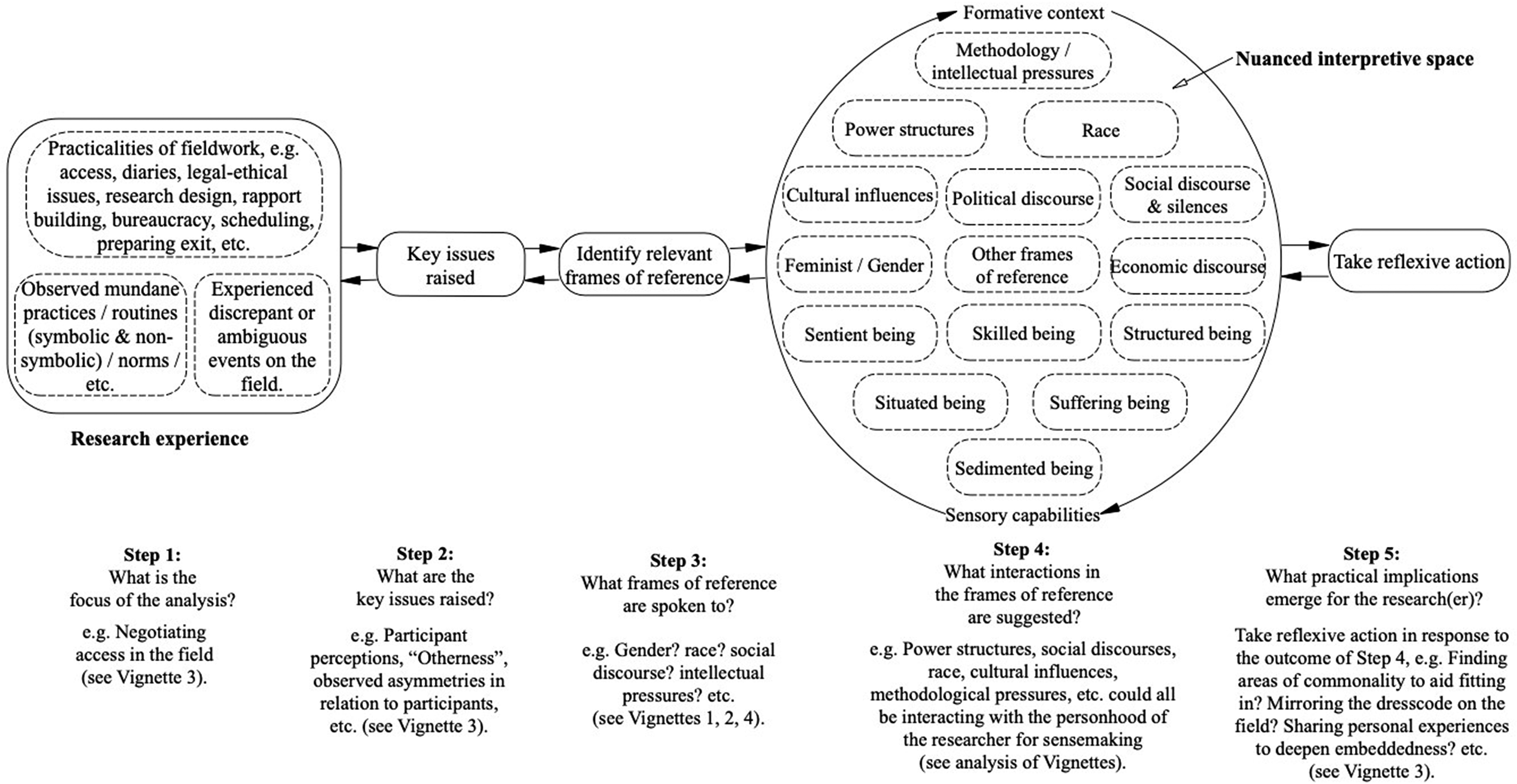
To achieve our objectives, we present key elements of the first author's identity and field experience. We show how she engaged her entwined positionality to navigate access with the gatekeeper and participants in the field. Building on our conceptual grounding in Figure 1, our goal is to provide researchers with a roadmap (Figure 2) for how to enrich reflexivity and engage more directly with entwined positionality. To analyze the vignettes, we engaged in analytic conversations with the literature (Wall, 2008) by linking the ethnographic experiences with the wider context, i.e. linking the personal with the cultural (Ellis & Bochner, 2000) through an iterative process of reflexivity (Kempster & Stewart, 2010). Using a diagrammatic representation of our methodological roadmap (Figure 2), we highlight a five-step iterative process to operationalize entwined positionality. This involves identifying the focal experience captured in each vignette, the key issues raised for interpretation, the frames of reference invoked to interpret the phenomena, the nuances generated from interacting frames of reference, and the implications raised for the researcher's reflexive actions. The returning arrows in the roadmap highlight the iterative nature of the process. Through critical sensemaking, we hope to speak to the experiences of other ethnographers (Ellis & Bochner, 2000) who may be navigating a “foreign” field, by providing a roadmap which guides the researcher in engaging their nuanced positionality. We add our voices to the growing body of work that challenges the notion of pure objectivity and detached researcher positionality in social science research (Boyd et al., 2019; Cunliffe & Coupland, 2012; Gioia, 2019).
A roadmap for reflexive analysis informed by entwined positionality.
In the first step, we begin with several readings of the data in each vignette to understand the context of the researcher's self-narrative, focusing on the person of the researcher but also on the wider context. In doing so, we probe for emotional responses that emerge in the experience and capture these as valuable data. We pay attention to the biographical details in the account in order to identify elements in the formative context that are directly related to the researcher as well as other aspects of her personhood such as gender, race, ethnicity, social class, etc. (Berger, 2013).
The second step involves identifying issues that have analytic value, for example those which prompt emotional responses or those which carry surprise elements and/or ambiguity for the researcher. Emotional responses, surprises and/or ambiguous elements may be indicative of discrepancies (Hansen & Trank, 2016). These issues signal the need for closer examination of the data. This step of the process is enriched by repeated examination of the data to uncover other potential issues raised.
In the third step, we identify what the issues speak to through iterative conversations between the data and the literature in order to elicit relevant frames of reference that are involved in the focal experience (Jackson & Mazzei, 2013). Figure 2 provides examples of some frames of reference that could be deployed for analysis. We iteratively (re)examine the data in relation to the interpretations provided by the frames of reference, noting that the outcomes could be different.
In the fourth step, we explore further the nuances that emerge when considering the frames as interacting in the interpretive process. For example, we re-examined the experiences of the first author for any possible gender and racial undertones. A researcher's account / experience is able to bring together different aspects of the person, for instance, the emotions, embedded values, intellectual pressures, etc. within a wider social context. This fourth step therefore recognizes the need for a researcher's methodological tools to take into account the richness of the person as a complex being in a dynamic social environment when (re)interpreting the focal experience (Berger, 2013). In the final step, we iteratively consider what implications the nuanced understanding has for the researcher in terms of reflexive actions (to be) taken (Manning, 2018).
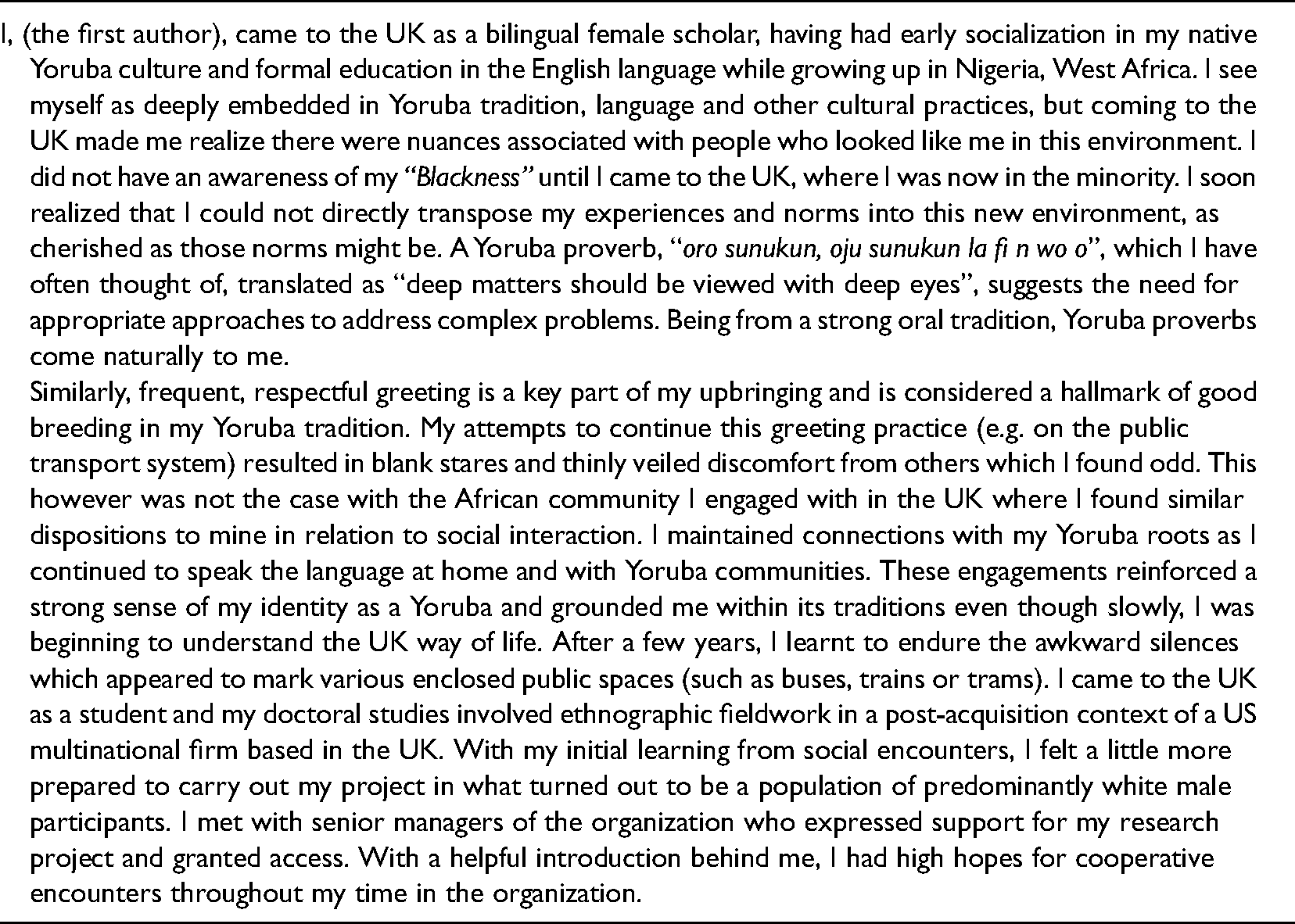
Researchers with significant experience of a different culture are predisposed to be sensitive to nuances in another culture which may otherwise be ignored by a “home” researcher (Sanday, 1979). This is partly because they possess a range of frames of reference through which they process their field experiences. There is therefore an opportunity to investigate the interpretive process using different frames of reference. Narratives, captured in autoethnographic accounts, provide a classic method for understanding the researcher's sensemaking process particularly in times of complexity, ambiguity, and significant change in order to make meaning (Browning & Latoza, 2005; Ellis & Bochner, 2000; Parry, 2008). They provide a way to access the researcher's interpretive process and allow for uncovering the frames of reference used in sensemaking “in relation to that cultural context” (Vickers, 2007, p. 224) being studied. The following vignettes present the first author's narrative.
Autoethnographic Sensemaking Narrative
Vignette 1: The researcher and her early encounters
In this first vignette, we see the entrance of the ethnographer, a black female scholar, into a foreign environment and subsequently, into the field. What is apparent about her positionality is her gender and race. However, there are other factors that contribute to her positionality beyond what is visible. The biography of the researcher illuminates this and indicates early socialization in a culturally different context with historical colonial ties to the UK. The ethnographer therefore comes in already possessing embedded cultural values and traditions that have become a part of her sedimented being (Wacquant, 2015). This ascribed positionality (Franks, 2002) is explained by both cultural factors and overt markers of identity. In this case, a black female in a predominantly white environment. However, positionality can simultaneously reflect how a person's standpoint and situatedness is perceived or in some cases thrust upon one (Franks, 2002). In this light, what should not be ignored is how historical imperial interests in Africa have framed the relationship between different racial groups, underpinning racial perceptions, power relations and discourse in the formative context (Franks, 2002; Unger, 1987).
Additionally, we see how through self-introspection and emotional recall (Ellis & Bochner, 2000), the ethnographer contrasts her various awkward social encounters in the UK with her life experiences as a Yoruba. What is occurring is an interaction of interpretive frames of reference, an entwinement within her positionality in which her background is confronted with a new reality. In making sense of these interacting frames of reference, she reflects, “I soon realized that I could not directly transpose my experiences and norms into this new environment, as cherished as those norms might be”. She then turns to proverbs as a sensemaking tool (Outila et al., 2020). The Yoruba culture, being rooted in strong philosophical and oral traditions, employs proverbs as a vehicle for codifying and reinforcing shared values (Abimbola, 1975; Fayemi, 2009).
The oral tradition lends itself to continuity as it is embedded in day-to-day usage for transmitting cultural values. The researcher, who hails from such a tradition is thus able to draw on them as needed. According to Innis (2008), oral cultures are tradition-focused, emphasizing “custom, continuity, community, the sacred and moral, which impeded individualism”
The mode of access into the organization also informs the researcher's positionality in relation to the research context and speaks to the power dimensions of the relationships formed. In contrast to the disadvantaged or vulnerable position as a result of historical race relations (Brown, 2011), the researcher could be seen as gaining social capital having been introduced by more senior managers in the organization. The introduction reveals an interaction of two frames of reference - power structures with her racial positioning. With this entwinement in her positionality, the interacting frames of reference implicitly signal the importance of the researcher. This appears to rebalance the power asymmetry, serving as a “corrective measure” aimed at ensuring non-authoritative and egalitarian relationships in the field (see Nencel, 2014, p. 77). We see how power structures begin to influence the positionality of the researcher and subsequently the conditions surrounding her engagement with participants. Her entwined positionality in this instance enables an unsettling of hierarchies in the field, allowing her to negotiate access with participants (Nencel, 2014). In the following vignette, she captures how these negotiations play out in her encounter with the gatekeeper.
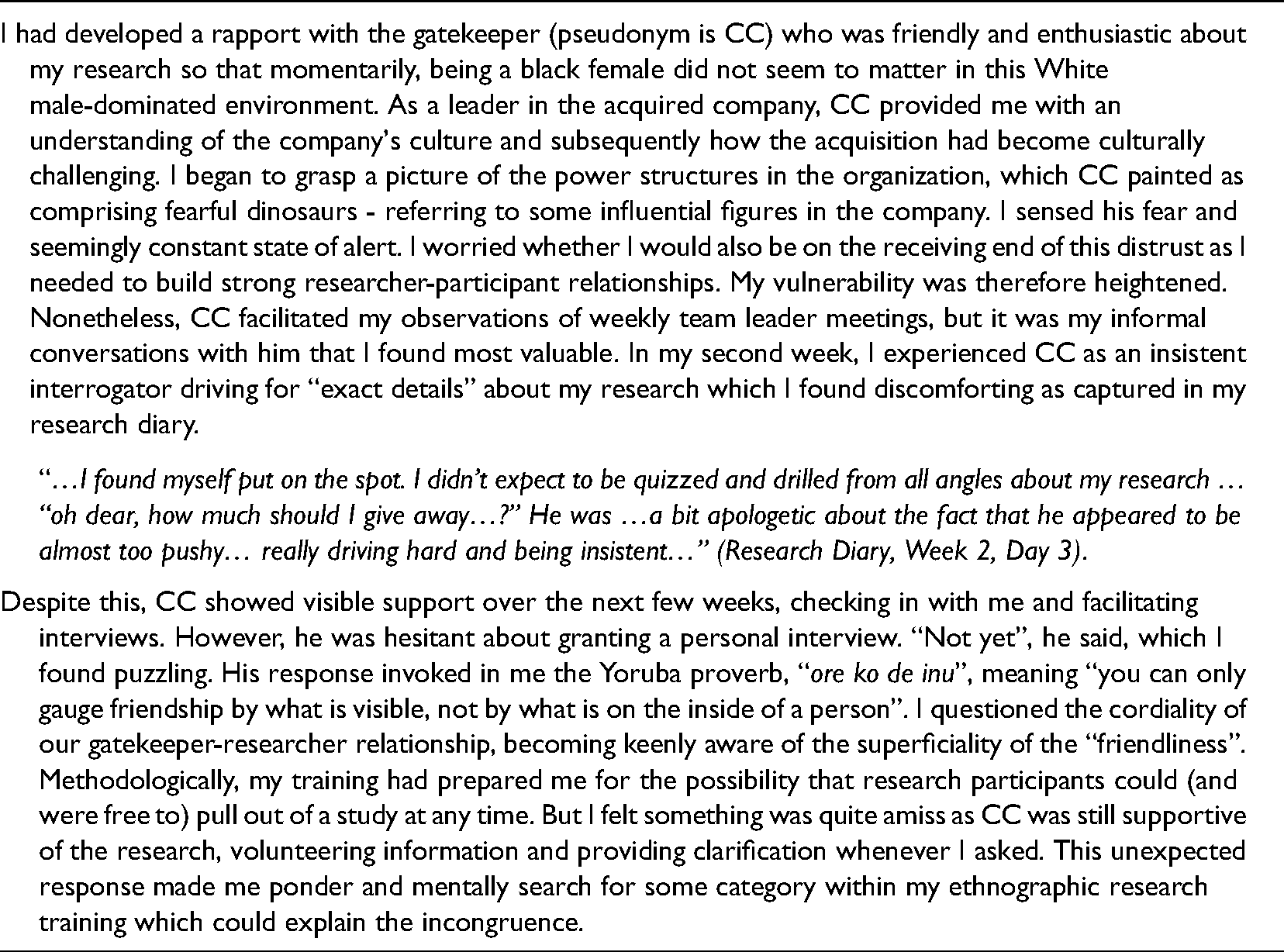
The researcher's encounter with CC demonstrates how power dynamics contribute to researcher positionality and how a seemingly advantaged positioning can become unstable and therefore require continuous negotiation. Franks (2002) posits that the literature tends to position researcher interviewers as experts; however this is not an inflexible position as researchers can move into more “helpless” positions or be caught in between (Franks, 2001; Luff, 1999). We see the internal turmoil which show the sensory capabilities of the researcher interacting with her intellectual pressures as she contemplates pushing back against CC's forceful interrogations. In this case, her suffering and sentient beings (Wacquant, 2015) continue to interact with her methodological demands. The dilemma around the limits of disclosure indicates the tension between protecting the research from undue influence and maintaining favorable conditions for engaging with research participants. The power dynamics suggest a struggle for control, where CC seeks to (re)establish his authority and gain information power (Pettigrew, 1972). This behavior is not inconsistent with what can be expected within post-acquisition contexts which are often associated with issues of uncertainty, trust, and change (Van Marrewijk, 2016). On the other hand, the researcher's response uncovers the struggle to impose boundaries around what to divulge, seeing that she is dependent on the gatekeeper for further access to participants. Divulging too much risks compromising the research through eliciting only socially desirable data, while communicating too little risks alienating key informants, with implications for access to rich, compelling data, thus creating a disclosure - confidentiality dilemma (Dickson-Swift et al., 2007). We see an entwinement of methodological pressures, power dynamics, and her internal sensory capabilities as she tries to make sense of her experience with CC.
Additionally, we observe how the researcher struggles with feelings of unmet expectations and disappointment, as a result of CC's hesitation to be interviewed thus revealing her as a suffering being (Wacquant, 2015). The researcher's skilled being finds the methodological toolkit insufficient in explaining CC's behavior. This loss of meaning prompts an inward look in which she draws on her internal sensory capabilities for interpretive frames. We see an entwinement of methodological pressures with the researcher's suffering being within the context of the power relations in her dealings with CC. By turning to her native Yoruba proverb, she latches onto a deep-seated cultural frame of reference. The proverbs emerged from her sedimented being (Wacquant 2015), accumulated over the years of experiencing the world as a Yoruba and through the socialization process within her Yoruba cultural group. These proverbs therefore represent a “deep, basic, abiding, or foundational” (Brubaker & Cooper, 2000, p. 7, Authors’ emphasis) aspect of her identity, allowing her to “zone out” of the present and to “zone in’’ to re-view her experiences through a cultural frame of reference. Again, we see an entwinement of elements in the formative context with the researcher's sensory capabilities in her positionality. This entwinement involves methodological pressures, power dynamics, her sedimented, skilled and suffering being as she makes sense of her experience with CC. In the next vignette, the researcher gives an account of her continuing negotiation with other participants as she tries to embed herself further in the context. This account reveals other aspects of her positionality becoming prominent.
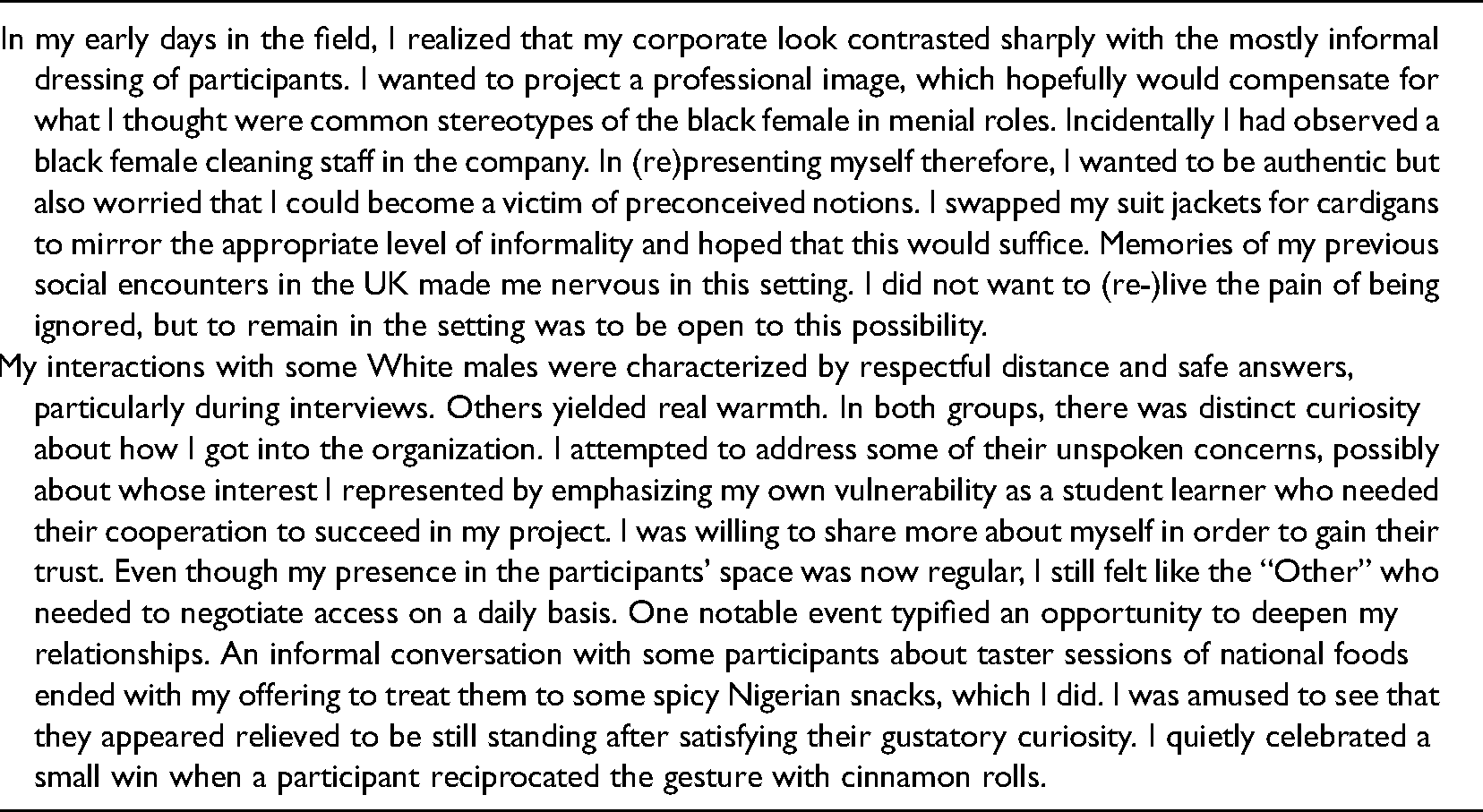
In this vignette, we see the researcher actively involved in negotiations in response to observed asymmetries in her relations with the other participants. While her introduction by senior managers offers a way to rebalance power asymmetries, there are other asymmetries that she becomes aware of in the field that her enforced positionality - i.e. how others perceive the researcher's situatedness (Franks 2002) - thrusts upon her. Nencel (2014) also argues how perceptions of participants contribute to the researcher's positionality. In particular, embedded views about racial relations in the formative context feed into preconceived notions about the “Other” and shape a researcher's experience in the field (Brown, 2011; Crenshaw, 1991). The racial and gender dimension of her positionality as a black woman inadvertently launches her into a face-off with stereotypes around what a black female does, especially when the “evidence” in the context appears to confirm this stereotype. When this is added to (un)intended media presentations of Black people as poor, uneducated and suppressed, it is easy to see how stereotypes can become perpetuated, as the media give voice and power to the message (Punyanunt-Carter, 2008). For the researcher, the field characterizes wider society and such “constructions represent in microcosm larger societal discourses shaped by their participants’ positions in terms of gender, race, and class” (Maher & Tetreault, 1993, p. 126).
In this vignette, she attempts to rebalance potentially negative preconceptions by presenting herself in a formal suit to communicate a professional look. However, her observations of the population of study present other methodological implications for embeddedness, and she makes reflexive adjustments by mirroring the less-formal dressing. What appears to be a simple wardrobe decision is in essence the effect of thoughtful sensemaking using interpretive frames which include methodological considerations and an understanding of social assumptions and discourse around racial positioning (Maher & Tetreault, 1993). By this interaction between her understanding of racial underpinnings of her field relations and her felt vulnerability to reliving “the pain of being ignored” - her suffering being (Wacquant, 2015), we see her reflexive decision to mirror the participants’ less formal look as a way to reduce her “Otherness” (Manning, 2018). The interacting frames of reference in the researcher's entwined positionality in this instance equips her to reflexively make sense of experiences and to take appropriate decisions offering methodological value.
Similarly, the reflexive action of the researcher in sharing more about herself can be seen as a methodological step to offer self-disclosure in her bid to fit in (Bourke, 2014). Beyond fitting in, it is also about attempts to actively correct imbalances that may accompany her positionality as a result of stereotypes. The formative context within which she is located is one where dominant voices could potentially erase the less dominant, e.g. as Maher and Tetreault (1993, p. 125) argue, whiteness as a dominant voice can “erase colour and ethnicity as any kind of meaningful differences at all”. Being reflexive about her entwined positionality thus informs her decisions in engagement with participants. It also informs her interpretation of the emergent data from those interactions using her Black eyes and ears (like Bourke (2014, p. 5) did with his “White eyes and ears”). Through informal exchanges such as sharing of food and conversations about her identity, we see the creation of a space where participants could get to know her as a person and address preconceived notions.
The researcher's reflexive actions in relation to power dynamics can be seen in the way she addresses participants’ questions which call out her positionality. By emphasizing her vulnerability as a student learner who needs their support, she appears to de-emphasize, as a corrective measure, any perceptions of “conferred” power as a result of her high-level introduction (Nencel, 2014). The need for reflexive negotiation of acceptance in the field highlights the researcher's Otherness (Manning, 2018), but this reflexivity also allows her to explore potential areas of commonalities between her research participants and herself, while acknowledging her own insecurities in the environment. These actions stem from an understanding of her positionality and the entwined nature of its dimensions. Seemingly ordinary encounters with participants take on deeper meaning in reflexivity when viewed from the perspective of entwined positionality through the nuanced interpretive frames of reference it affords. The next vignette focuses more on the researcher's personhood as she makes sense of her experience and Otherness in the field, where we see the value of her oral tradition in providing resources for making sense of her experience in addition to other frames of reference.
Vignette 4: An interesting turn
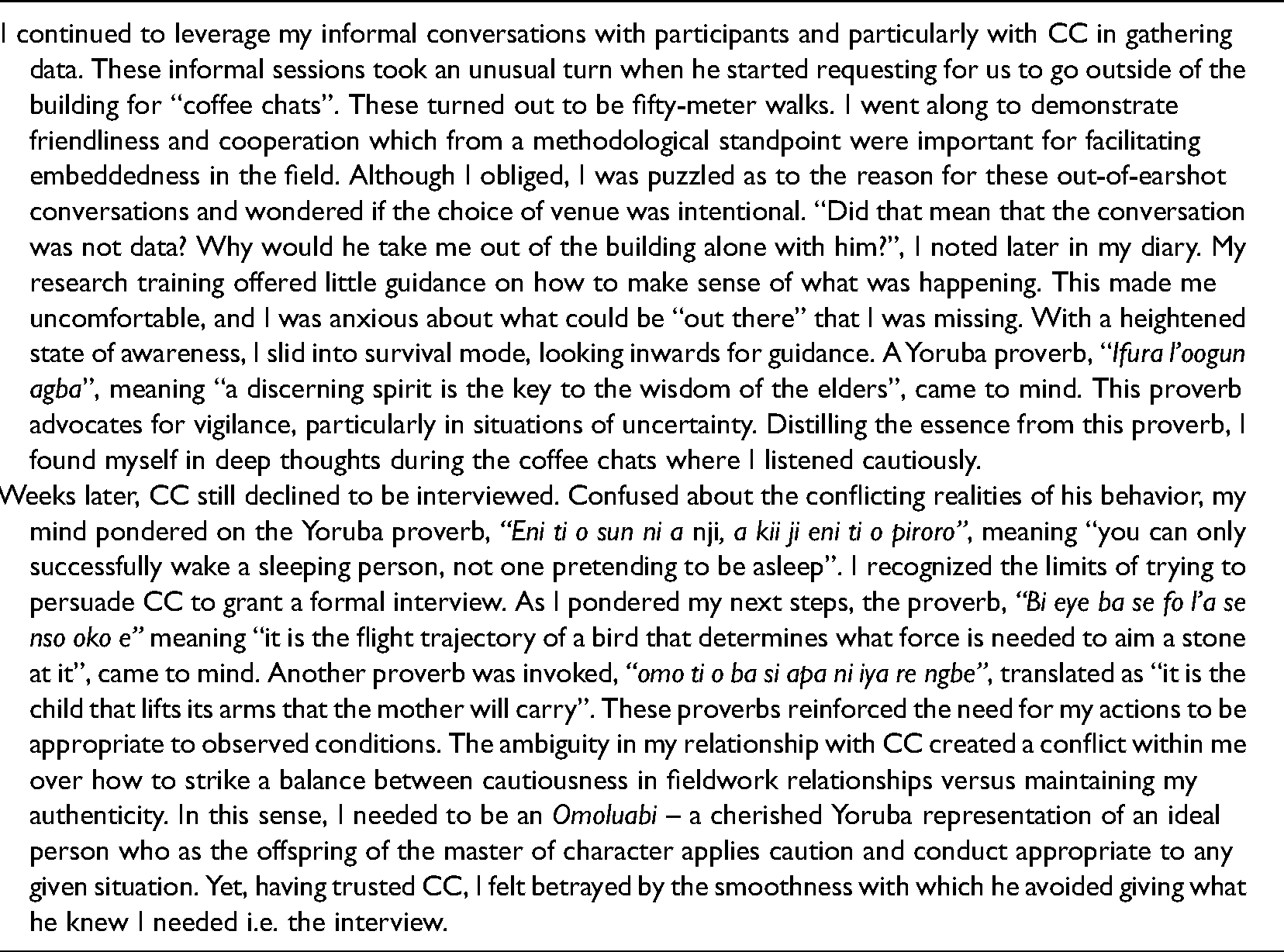
In this vignette, we see an interaction of frames of reference in the way the researcher makes sense of a tricky situation, that is, CC's invitation. There are intellectual pressures, the involvement of her sentient being, the emergence of her sedimented being manifesting as Yoruba proverbs and concerns about gender relations as a black female. The key focus of this vignette concerns the researcher's experiences around the decision about how to follow the data. Studies indicate that practicalities of accessing data are critical to achieving an understanding of a researched population (Dickson-Swift et al., 2007; Israel & Hay, 2006). The researcher's going along to the coffee chats represents an attempt to follow the data and lower any barriers to embedding herself in the field, particularly given CC's role as a key informant. As a result, despite not being able to make sense of CC's behaviors, she rationalizes her decision to follow the data as a methodological one. However, her sentient being prompts the need for other potential interpretations. In fact, research shows that in highly unsettling contexts, emotions can become an “enabler of insights and a vector of the researcher's identity” (Yousfi & Abdallah, 2020, p. 434).
Her sensemaking of this conundrum draws on her positionality, as a black female, a Yoruba, and a researcher. In other words, we see a researcher of non-Western origin, the “Other”, deploying a cultural frame of reference. The use of Yoruba proverbs allows the researcher to interpret her experience through a non-Western gaze, an approach which Manning (2018) advocates as a response to the hegemony of Western knowledge production. Manning’s (2018) critique of this hegemony argues for “the importance of ‘the Other's’ capacity for intellectual autonomy and their own seeing, doing and thinking, thereby constructing a different knowledge ‘from the perspective of Otherness’” (Manning, 2018, p. 3). This decolonial feminist perspective offers a way to rebalance knowledge production by recognizing the totality of the person. It opens up the opportunity for engaging non-Western frames of reference so that we do not privilege one group over another. Manning (2018) indeed argues for appreciation of and engagement with “indigenous knowledge in the Global South” which has largely been “categorised and determined through the gaze of the West” (p. 3).
As a black woman, the researcher is aware of social discourse around race which sometimes manifests itself in prejudice, violence, and other negative racial dynamics, which can influence the perception of “the Other” (Brown, 2011). Intersectionality research indeed shows how gender and race can qualitatively affect and shape the experience of blacks and other minorities in various social settings (Cho et al., 2013). We observe this in vignette 3 where the researcher reflexively takes steps to bridge insider-outsider gaps in relation to her participants (Keikelame, 2018; Sherif, 2001). Her encounter with CC in which she expresses a sense of vulnerability as a female, illustrates the argument that “researchers are in fact vulnerable when gatekeepers are able to exert power on the researcher and on the research process” (Mügge, 2013, p. 542). Studies suggest that female researchers have developed strategies to deal with challenges in ethnographic research, such as perceptions that influence their experience in the research process (Egharevba, 2001; Hunt, 1984), including being seen as a spy or objects of sexual harassment (Horn, 1997). In response to some of these challenges, female researchers in male dominated contexts sometimes deal with these perceptions through avoidance, “defensive humor” or becoming “one of the boys” (Horn, 1997) in order to obtain the needed data. In the case of our researcher, her response to the challenge posed by CC's invitations is to cognitively engage with proverbs which offer guidance for appropriate response as an Omoluabi. Earlier vignettes also indicate her use of proverbs as a sensemaking tool before and during fieldwork.
Indeed, recent research suggests that proverbs serve as sensemaking tools (Outila et al., 2019, 2020). For our researcher in her moment of felt vulnerability, the proverb, “Ifura l’oogun agba” meaning “a discerning spirit is the key to the wisdom of the elders” points her attention to the need for discernment. This suggests that caution and sensitivity are needed in correctly deciphering cues in her interactions with CC and in the actions taken thereafter. The flurry of proverbs that intuitively emerge signals a sedimented aspect of her identity at play. Identity here is “understood as a core aspect of (individual or collective) “selfhood” or as a fundamental condition of social being, “identity” is invoked to point to something allegedly deep, basic, abiding, or foundational” (Brubaker & Cooper, 2000, p. 7, Author's italics). The sedimented aspects of identity therefore answer the question, “Who am I?” and come from her Yoruba cultural meaning system. Specifically, we see how she draws on the values embedded in the proverbs.
Adéẹ`kọ´ (2007) argues that proverbs represent intergenerational wisdom and provide opportunity for reflection for the Yoruba. In addition to this intrinsic value, we see proverbs as providing an available reference point for sensemaking and acceptable behavior, serving as a complementary input into the interacting frames of reference and grounding the researcher in an abiding sense of self (Outila et al., 2019). Our researcher thus draws on the Yoruba cultural frame of reference to address her internal struggles. Through this, her focus is directed to virtues of reflective thought, carefulness and caution regarding uncertain situations. Given that the researcher invokes this frame of reference during sensemaking, we argue that her sedimented stock of assumptions and anticipations which feed into her positionality becomes sensitized as she interacts within the context of study. The interplay between interpretive frames of reference typifies an entwined positionality, where elements in the formative context interact with her internal sensory capabilities. In the researcher's reflexive engagement in different vignettes, we see nuances in her sensemaking and the adjustments she makes in response to experiences in the field (Albu & Costas, 2018; Gosovic, 2018).
Drawing on the values inherent in the proverbs to inform her actions shows the salience of the researcher as the “who” of sensemaking and a value-laden instrument. As an Omoluabi (a term which holds cultural meaning and espoused values as mentioned earlier), the researcher reflexively navigates the field with recourse to her sense of self. Reflexivity therefore involves accounting for the totality of the researcher's positionality, by drawing on analytic resources from the formative context and her internal sensory capabilities, in contrast to value-free objectivist conceptualizations of research where the research instrument must report data “objectively”. Wacquant's carnal sociology offers us analytic resources in this regard although it appears to present static categories. In our case, we see a dynamic interaction in Wacquant’s (2015) framework where the researcher's sentient being communicates a need for sensemaking by drawing on the sedimented cultural aspects of her being. Although cultural influences could be classified as part of the formative context, it is also intricately woven into enduring aspects of her identity as a Yoruba (Brubaker & Cooper, 2000). This interplay between her sentient being and sedimented aspects of her identity as well as methodological pressures reveals the dynamism involved in entwined positionality.
Unpacking the Dynamism in the Researcher's Nuanced Interpretive Space
Our analysis of autoethnographic data captured in vignettes illustrates how a researcher's interpretive frames of reference emerge from different sources to interact in the interpretive process. It shows how reflexivity is enriched from the perspective of entwined positionality due to the dynamic interaction of frames of reference. A researcher's experiences in the field take place within social, political, racial, gendered and cultural contexts, as well as intellectual traditions, which all form part of the formative context (Unger, 1987). For instance, studies show how racial discourse influences the research process including key methodological decisions, the researcher's sensemaking of experiences (including emotional ones) and ability to negotiate relationships and perceptions in the field (Alcadipani et al., 2015; Fernando et al., 2019; Sobre-Denton, 2012). Yousfi and Abdallah (2020) particularly demonstrate how interactions in the field can generate a nuanced emotional landscape that is inextricably linked to the sensemaking process. Embracing emotional reactions and experiences such as suspicion, friendship, frustration, discomfort, anxiety, fear, pain, anger or resentment allows a researcher to leverage these as resources and enables the integration of reflexivity with the “materiality of senses in methodological accounts” (Yousfi & Abdallah 2020, p. 8). Consequently, welcoming the emotional dimension of the researcher's experiences opens the door to “analytical triggers” which can generate critical insights as a result of having an “embodied connection to fieldwork” (p. 11). In this sense, emotions represent an important resource in ethnographic research which enriches sensemaking and the interpretive process. These perspectives on emotions as methodological resources lend support to our argument for the nuanced nature of the interpretive space and interacting frames of reference in relation to the researcher's positionality. We see emotions as engaged in the interpretive process through the bridges they build between the past, present and future, and as triggers for reflexivity. There is therefore an interaction of emotions, personal memories and sedimented aspects of the researcher, all of which represent an entwinement in the researcher's positionality in the field.
Similarly, studies suggest how gender shapes researchers’ experiences, particularly in relation to access or relations with research participants and how this affects access to data (Egharevba, 2001; Horn, 1997; Mügge, 2013). Feminist perspectives also indicate how positionality shapes what is salient or suppressed and the evolving relations of power in the field (Franks, 2002; Maher & Tetreault, 1993). Our analysis uncovers how methodological pressures and power dynamics interact in the formative context. With respect to interacting frames of reference, the role of race, gender, methodological pressures and power can be made explicit through reflexive accounts of researchers, showing the significance of reflexivity in illuminating the dimensions of the researcher's entwined positionality.
As a person, a researcher possesses sensory capabilities which allow for integrating the body as a frame of reference in the process of sensemaking (De Rond et al., 2019; Yousfi & Abdallah, 2020). This is because “inquirers are distinctly sentient embodied beings’’ (Locke et al., 2008, p. 909) with emotions, feelings, desires, and other carnal sensory capabilities that are involved in sensemaking and which can deepen reflexivity when engaged (Cunliffe & Coupland, 2012; Hansen & Trank, 2016). We demonstrate how these sensory capabilities are not static categories but interact in a dynamic sense with other elements in the formative context to produce nuanced interpretive frames of reference. Having an openness to entwined positionality allows the researcher to engage with the sensemaking process in a way that acknowledges these interactions but also enables a reflexive response. It embraces the personhood of the researcher, without an uncritical imposition of meanings.
Entwined positionality speaks to influences in the world within which the researcher operates, whether the researcher is aware of it or not. These influences from the perspective of Unger (1987) broadly define socio-political conditions surrounding persons but do not preclude them from exercising agency. Consequently, the researcher is able to engage in research in a way that is as true to themselves as it is to research participants (Harley & Cornelissen, 2020; Pratt et al., 2020). In this light, Manning’s (2018) critique of the hegemony of Western knowledge production opens the door to enriching knowledge through the unique voices, experiences and reflexive engagements of non-Western researchers in the field.
Entwined positionality thus offers value in making us see the personhood of the researcher. This is because it requires that the interplay between the researcher's own sensory capabilities as a unique individual and the formative context are accounted for in the sensemaking process. These arguments contribute to the literature on reflexivity in qualitative research (Berger, 2013) by bringing together the researcher's individuality and emotional responses in the account of observations which expands the scope of reflexivity. As Hansen and Trank (2016) argue, “emotions are an inevitable part of research, helping researchers understand particular experiences, but also shaping our response to those experiences” (p. 13). In this paper, we show how having first-hand experience of early life, socialization and adulthood in an African context shaped the researcher's understanding of what it means to be an immigrant in the UK, and enriched her interpretive process in the field. Experiences on the field which triggered emotional reactions enabled her to build bridges connecting her memories of narratives regarding her racial identity and social discourse which often contribute to the perceptions of the “Other”, that is, ascribed positionality (Franks 2002). For the researcher, emotions opened up critical reflexivity about her identity and positionality, as she engaged with the entwined strands she embodied as a researcher, a Black woman, an immigrant, as well as wider perceptions of this positionality within the context. We argue that the various dimensions of entwined positionality deepen sensemaking while also offering methodological value for the researcher's next steps through reflexivity. This argument is instructive for the ethnographic researcher who comes to a research context situated within a wider socio-economic context, equipped with technical research know-how but also has a stock of life experiences to draw on in interpreting observations. (Auto)ethnography provides opportunity for deeper engagement with reflexivity using interacting frames of reference for sensemaking as a result of entwined positionality.
Our conceptual framework (see Figure 1) offers wider scope to reflexivity as an important component of critical sensemaking thereby facilitating new learning (Cunliffe, 2009). This avoids “one-sidedness” (Albu & Costas, 2018) as it enables the researcher to re-examine interpretations in the light of the nuances provided by interacting frames of reference. This then informs the reflexive actions that the researcher takes in response to experiences in the field by taking into account the totality of the being as a value-laden instrument. In this sense, reflexivity also relates to interrogating assumptions about the positionality of participants as it can reveal the researcher's “assumptions, histories and identity and how they influenced the construction of intersubjective research relations and the research process” (Nencel, 2014, p. 76). Taking the perspective that fieldwork provides a place for positionalities to meet (Bourke, 2014), reflexivity plays a role in how the researcher plans conversation topics and questions, such that social exchanges create spaces for new learning and for re-examining preconceived notions. These may involve acts that reposition the researcher in a way that helps the research process. For instance, there may be actions which compensate for perceived positional disadvantages or actions to de-emphasize positions of perceived privilege, aimed at rebalancing hierarchies in the field (Berger, 2013; Nencel, 2014). This demonstrates the fluidity in a researcher's positioning from a standpoint of power, as a result of reflexivity. In other words, through reflexivity, the richness of what the ethnographer as the research instrument represents is illuminated rather than suppressed. Uncovering the “entwinement” in positionality reveals the “quality” of the ethnographic researcher. Quality in this sense is used to refer to dimensions of power, gender, culturality, preparedness (training), emotions, race etc. which feed into the reflexive practice of the researcher (Cunliffe, 2009; Patton, 2002; Sanday, 1979).
This paper argues for an entwined interpretive paradigm for the researcher – a nuanced way of interpreting observations and experiences to enrich understanding. With the growth in the adoption of ethnographic research methods for business research over the years, the profile of ethnographic researchers and contexts have also become increasingly diverse (D’Souza & Pal, 2018). For the practice of ethnography, “one of the most important criteria in the past has been prior experience in another culture…its rationale is based on the assumption that one comes to understand something by seeing it as an outsider” (Sanday, 1979, p. 528). This underscores the fundamental role of positionality in the interpretive process.
Ethnographic accounts reflect the experiences of the researcher who is assumed to be closest to the participants in the context being studied and therefore is “the critical source of information” (Agar, 2010, p. 288). Ethnographers typically are expected to transition from strangers to being embedded in the field and in so doing, are able to access rich and meaningful data necessary for putting together a more holistic picture of the context being studied (Hammersley & Atkinson, 2007). However, research suggests that relationships with participants are dynamic, and researchers can occupy hyphen-spaces, moving across positionalities and the different experiences and interpretations these bring (Cunliffe & Karunanayake, 2013; Sanghera & Thapar-Björkert, 2008; Suarez Delucchi, 2018). Such dynamic contexts of experiences present complexities in the interpretive process and require a diversity of explanatory frames of reference to holistically account for relevant factors involved. In this paper, we argue that a researcher's entwined positionality offers a nuanced interpretive space for making sense of such complexities in order to take reflexive action.
The paper makes a methodological contribution by offering a roadmap to researchers for navigating complex research contexts and the subsequent reflexive actions to progress methodologically. This structured approach allows for identifying elements in the formative context that potentially influence positionality, taking cognizance of emotional responses in the account of experiences in the field, being intentional about rebalancing perceived inequalities in relation to the researcher which may influence the research process, and being open to engaging and interrogating other frames of reference outside of the traditional methodological training. We also theoretically expand the understanding of reflexivity to show the dynamic interactions in frames of reference, thus offering value for research practice including decisions about what to study, how to engage with study participants, interpretation and reporting of data generated. Future research could examine how engaging entwined positionality may further inform decisions about research questions and contexts. This approach opens up opportunities to expand knowledge about the diversity of social structures and systems which inform sensemaking and reflexive actions. Our contribution illuminates the reasoning process that supports methodological rigor rather than simply offering a set of protocols (Harley & Cornelissen, 2020). We also contribute to decolonial feminist approaches (Franks, 2002; Nencel, 2014) which argue for the merits of knowledge production from non-Western traditions while answering the call to explore “the interactive effects of researcher position and sociocultural context on reflexivity” (Berger, 2013, p. 13).
Conclusion
This paper critically explores researcher positionality by examining reflexive autoethnographic accounts which illuminate the influence of interacting frames of reference in the interpretive process. We draw on critical sensemaking literature and perspectives from carnal sociology to uncover the dynamism in the interpretive process as a result of interacting frames of reference in what we argue as entwined positionality. We illuminate the researcher as a value-laden instrument whose internal sensory capabilities are involved in the interpretive process. Through a critical analysis of autoethnographic vignettes, we unpack the role of the researcher's entwined positionality and its implications for reflexivity. Methodologically, we show how a researcher's positionality offers interpretive frames of reference as resources that inform reflexivity in dynamic researcher-researched relationships. Using the methodological roadmap this paper offers, we contribute to ethnographic research practice in a way that deepens reflexivity in qualitative research. We also present theoretical implications for sensemaking more broadly, calling for a reflexive consideration of the nuanced positionality of the researcher in the interpretive process.
Footnotes
Declaration of Conflicting Interests
The author(s) declared no potential conflicts of interest with respect to the research, authorship, and/or publication of this article.
Funding
The author(s) received no financial support for the research, authorship, and/or publication of this article.
