




Abstract
This research note introduces the experience of using ‘timelines’ as a visual research method during online interviewing. It does so through a series of questions and answers that guide the reader through an exploration, understanding of and reflection on the method. This qualitative approach was used while conducting research on the influence that participation in a Reality TV show had on its finalists, and on the opportunities and life choices that were afforded to participants after the end of the show. The reader is encouraged to draw links between their own work as a qualitative researcher and the possibilities that this method can offer either in filling gaps or in expanding their current endeavour. Ultimately, the ‘quality’ of the answers we find in our qualitative work is illustrative of the way we choose to ask our questions.
Keywords
What do we know about timelines?
Timelines are a helpful tool to assist people in constructing a story or even in reconstructing their own history, either as individuals or as part of a group or community. They are particularly useful in identifying key moments in someone's life, as they are a display of people's own accounts of a series of events. They may include a chronology of important happenings or pinpoint specific changes that have occurred over time; dates can be indicated, even with an approximation.
In research, timeline drawing is regarded both as a visual and as an art-based data collection method. In the words of Kolar et al. (2015) ‘timelines are created from a participant's life events, placed in some sort of chronological arrangement, with visual indication of the significance or meaning attached to highlighted events’ (p.15). Bagnoli (2009) notes that the use of these drawing methods during an interview can expand the interpretation participants give to specific questions and therefore allow for creativity in the interview process, reacting to participants’ associations and meanings that are provided to certain ideas. This type of drawing can facilitate storytelling from participants (Sheridan et al., 2011), and it is useful both as a finished product and as a stimulus for further reflection (Guenette and Marshall, 2009).
Visually, a timeline can consist of a simple horizontal line or it can take different ‘twists’ and directions that may indicate significant events, sad times, decisions to change a course of action and so forth; it can also incorporate written text indicating the description of an event, its meaning, and even feelings associated with it (Marshall, 2019). Graphic elicitation and arts-based methods carry a strong analytical potential thanks to the insights that they present in the contextual analysis, which is often different from more traditional text-based data (Bagnoli, 2009). They also empower participants to produce the data by making them researchers of their own lives (Chamberlain and McGuigan, 2019).
Whilst initially adopted in quantitative inquiries (see, e.g. Carey, 1997; Van der Vaart and Glasner, 2007), qualitative researchers have increasingly been using this method in their work, including in the study of life stories (see the work of Adriansen, 2012, Berends, 2011 and Söderström, 2020, amongst others). Scholars have also adopted distinct approaches within this particular area of practice. Monico et al. (2020) included descriptive details for timeline entries, making them ‘an integral tool for summarizing and illustrating the complexity of youths’ experiences’ (p.1) in their study. Bremner (2020) used timelines as a ‘take-home’ exercise for his research participants, providing more time for individual reflection and selection. Bagnoli (2009) invited her young participants to add future goals and dreams to their timelines. Patterson et al. (2012) built research participants’ timelines following in depth-narrative interviews; in their work, ‘timelines were not constructed in partnership with participants but were used as an analytic strategy after the narrative interviews had been completed’ (p.137). More recent work from Flaherty and Garratt (2022) has taken on the form of ‘life mapping,’ with drawings replacing text in the configuration of sequential events.
In Monico et al.'s study (2020), interestingly, the researchers spoke separately with both the youth and their guardians to build timelines that recorded key events related to the research focus in a participatory way. Timelines were then reviewed to assess the differences or similarities either in the recollection of events or in what each participant considered a significant moment. The inclusion of descriptive details in the timelines enabled the circumvention of some of the limitations involved with the concise nature of the data collected through this method. The self-reported experience provided by participants in this study was critical for the enhancement of researchers’ understanding in the specific area of research the authors were focusing on; thus, it can be stated that ‘timeline served as an important communication device’ (Monico et al., 2020: 2). Therefore, rather than a planned data collection instrument, timelines became a practical tool to elicit and organize participants’ responses.
As Neale (2021) emphasises the importance of conceptualising the lifecourse from a qualitative longitudinal research stance, timelines have been used also in this field of research as instruments for representing time. Hanna and Lau-Clayton (2012) have discussed the application of ‘participant diagramming’ and ‘future narratives’ in complementing interview-generated data with the youth. These authors also suggest that timelines are particularly useful in recounting significant events from condensed life stories, which are relevant to the research focus. They are also helpful in facilitating participants to build a record of difficult moments without the need of providing lengthy accounts of those. From a similar longitudinal research perspective, Shirani et al. (2016) have attempted to capture the evolving dynamics of people's lives – including emotions, thoughts, beliefs and actions – through photo narratives.
This shows the multiple roles that timelining plays as a structured interaction between researchers and participants, with the embedded flexibility of a creative visual method. Sheridan et al. (2011) articulate this effectively when conceding that, in their work, ‘doing timelining became a complex amalgam of: interrogating weight data, life events and activities; finding and discussing the meaning of material objects; a focus for talk; a means to capture the importance of time; as well as producing an object for discussion in its own right’ (p. 559), where participants were instructed to not confine themselves into any form of temporal linearity.
In which context have digital timelines been used?
To gather data more effectively while addressing ‘the multilevel dynamic nature and complexity of psychological and social issues’, Lyublinskaya and Du (2023: 1) have developed digital interactive timelines. This annotated timelining that the authors built during a knowledge development project with teachers was used as a digital analytic tool that allowed the researchers to use different types of data originating from multiple online sources, and to present these simultaneously. Lyublinskaya and Du (2023) were also able to hyperlink data sources to their annotations in order to promote an iterative way of analysing data qualitatively.
Monico et al. (2020) transposed the timelines produced during their face-to-face interviews into electronic versions using Microsoft Excel. These served as a means to easily compare participants’ accounts and recognize important trajectories. Chen (2018) employed the use of data-driven timelines based on participants’ reminiscence of key moments in their lives arising from the social media content that participants had authored. These timelines, which Chen (2018) refers to as Online Scrapbook, were used in conjunction with participant-drawn timelines in order to assist with the recollection of key moments.
Digital timelining has also been adopted as a visual research method that works specifically alongside online interviewing. With new and innovative research approaches that assist the investigator in collecting data remotely through online channels, timelines in qualitative research also need to find new ways of visual representation. This novelty wants to make effective use of the digital environment while preserving the important aspect of participatory research that timelines consist of.
The author of this note conducted a study on The President TV show, a Reality Television programme produced by non-governmental organisation Search for Common Ground in partnership with Ma’an News Agency in the Palestinian Territories. The programme was created to address the very limited involvement of young Palestinians in political life and wanted to increase knowledge of and support for political processes among the youth; this was proposed to be achieved through the development of a culture of peaceful civic activism and inclusive democratic practices using media.
During the two series of the show (2013 and 2015) candidates aged 25–35 from the West Bank, Gaza and East Jerusalem auditioned to compete in an elimination-style series of trials designed to test their political skills. Throughout broadcasting, candidates were evaluated by a panel of celebrity judges. Audience members voted via SMS at the end of each episode, eliminating the least popular candidate. The last ten finalists of each series had to undergo multiple tasks that greatly increased their knowledge and skills in the realm of politics and in civic life more broadly.
Conducted in 2021, this study wanted to uncover the extent to which The President TV show had had a long-lasting effect on its participants. In particular, it wanted to ascertain how the acquired knowledge on civic engagement had shaped participants’ lives and/or careers, and to find out whether this had led participants to become more involved in civic initiatives that benefited their communities.
Finalists from the show were interviewed online on Zoom. Through the digital timeline activity that was carried out immediately at the end of each interview, participants were able to draw a visual sequence that illustrated their journey from The President to their current situation. The drawings were aimed at making visible the connection and disconnection between the TV show and civic engagement, and presented the experience of each participant while visualising steps and placing emphasis on what was important to their eyes. The activity wanted to provide further evidence on the connection, or lack thereof, between their TV show participation and current life trajectories, while reflecting together on some of the events. Participants provided informed consent for the publication of the information provided during the research activities.
How can visual research help in viewing life journeys as ‘timelines’?
To kickstart the activity with participants a template was created on Creately.com, a visual online workspace that assists people in organising information and data. This consisted of a graphic sequence of unnamed events organized in a series of consecutive boxes of different colours; each box was meant to indicate a significant moment or achievement that had taken place in a participant's life from their involvement in the Reality TV show (either in 2013 or 2015) to their current situation. With this template as a reference, each participant was able to virtually build a timeline that illustrated their journey from The President to their present circumstances. Figure 1 offers an example of this.
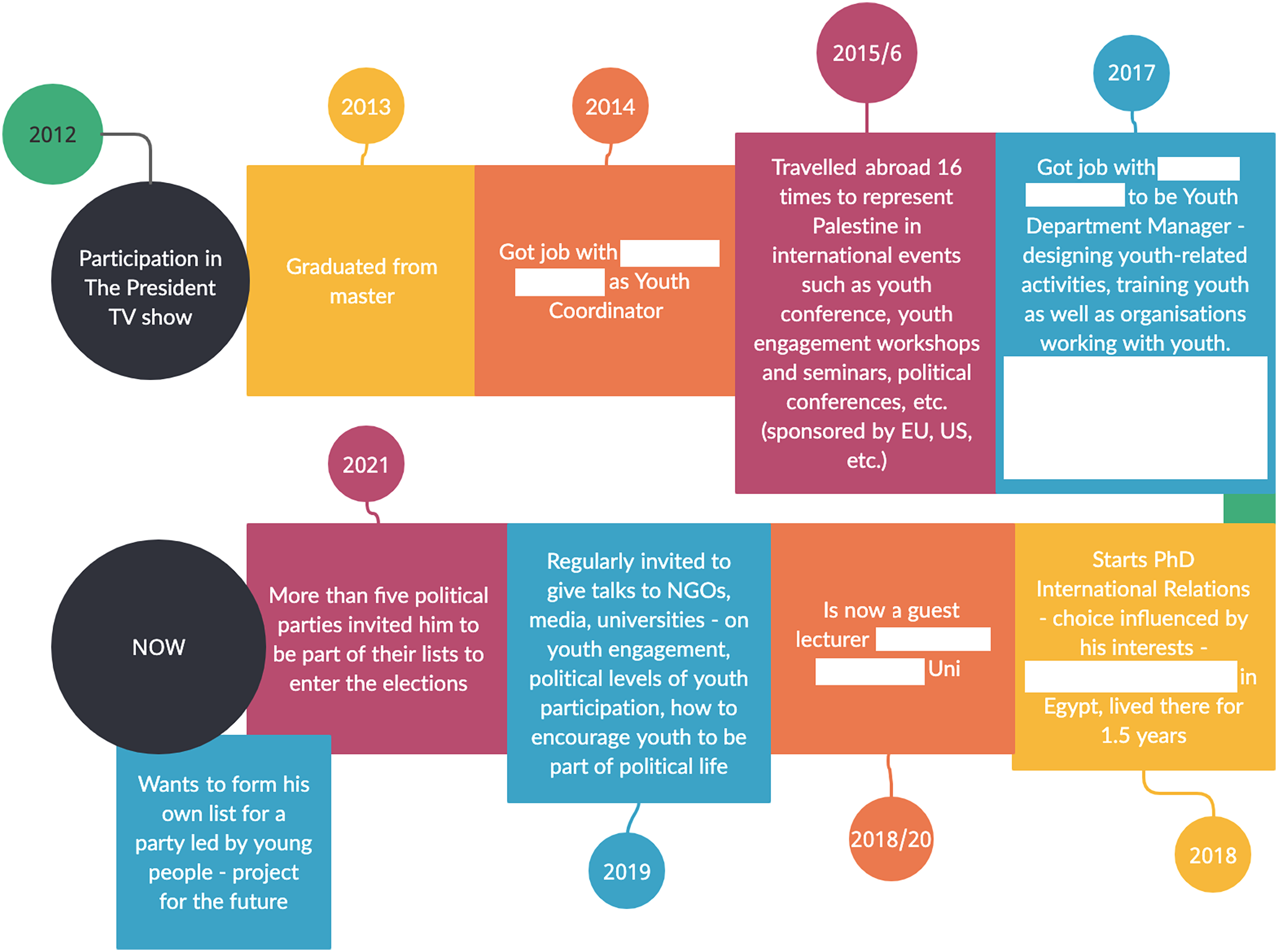
Timeline example from participant 1.
In order to build this collaboratively, Zoom was used as a virtual platform to meet each participant individually; the timeline template that had been prepared was screen-shared by the researcher with participants following their semi-structured interview. An explanation was provided on what the drawing was meant to represent, emphasizing the participant's choice on what was to be indicated in each box. The role of the researcher, in that interaction, was to facilitate reflection, recollection, and to type the information that was being presented into the corresponding boxes. As Figure 2 shows, key events and significant achievements related to the participant's civic commitments or even interests were distilled from a broader discussion.
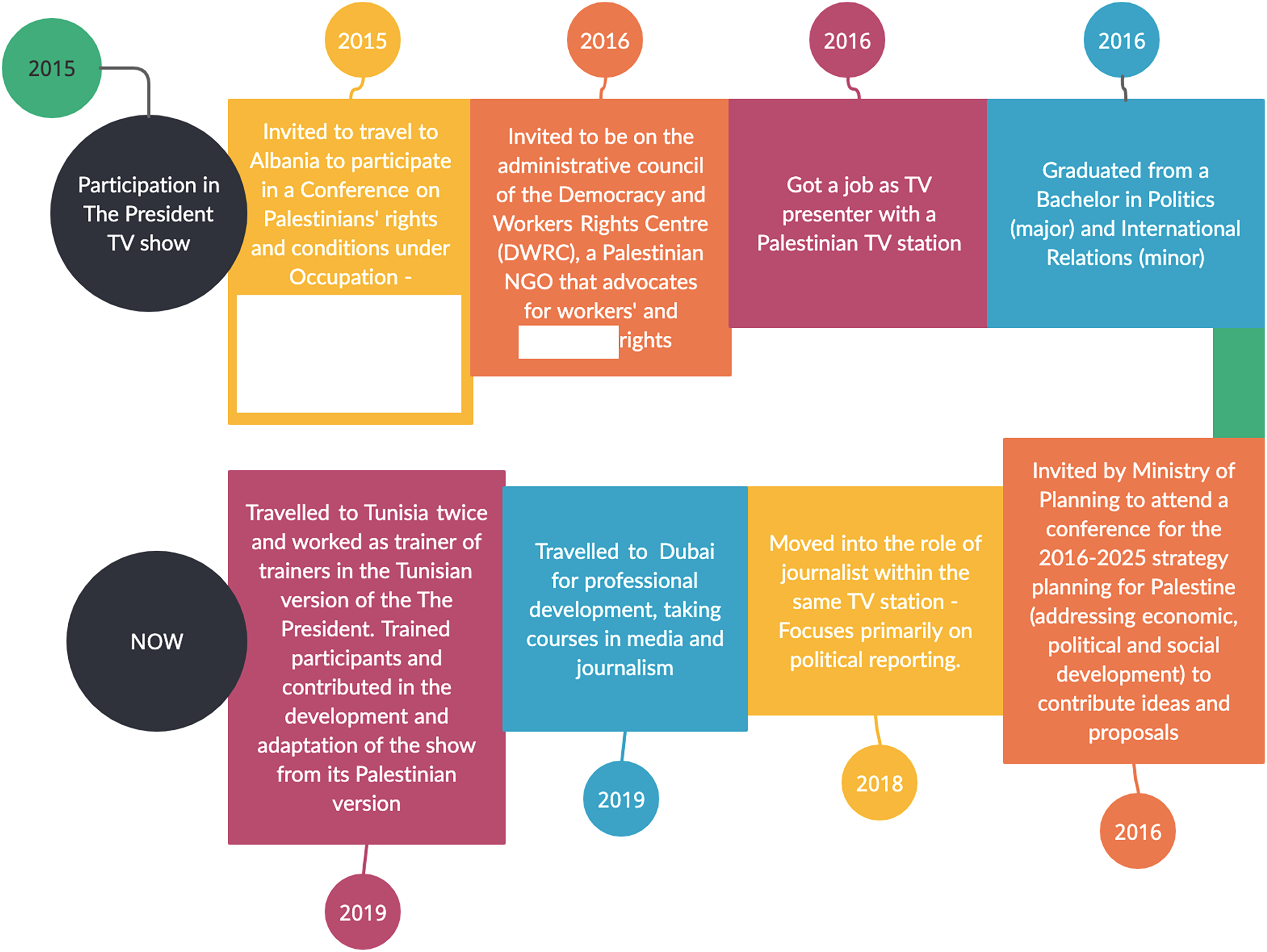
Timeline example from participant 7.
This exercise was useful not only in capturing significant events that clearly stemmed for the skills and knowledge (and at times popularity) gained by participants thanks to the TV show, but also for participants themselves, who had not often directly reflected on the connections between their past media experience and their subsequent life projects. As expected, recollection of events was not always linear: it was easy for participants to miss or omit relevant events, and to go back to some of these non-chronologically. Thus, boxes had to be shifted around promptly based on the information that was being added. At the same time, some of the participants feared that certain events in their lives were either irrelevant or not deserving enough meaning to be placed in the timeline. For others, the problem was related to the opposite: this means that while some were attempting to have an excessively comprehensive list of occurrences, the researcher had to simultaneously manage their typing with a sensitive negotiation of what really mattered in the context of what was being explored through the activity. This also had to been done in consideration of what was important for the participant (for additional methodological reflections, see also Baú, 2022). The example in Figure 3 demonstrates the density in the display of rich timelines, which researcher and participant co-produced on screen through an evocative discussion.
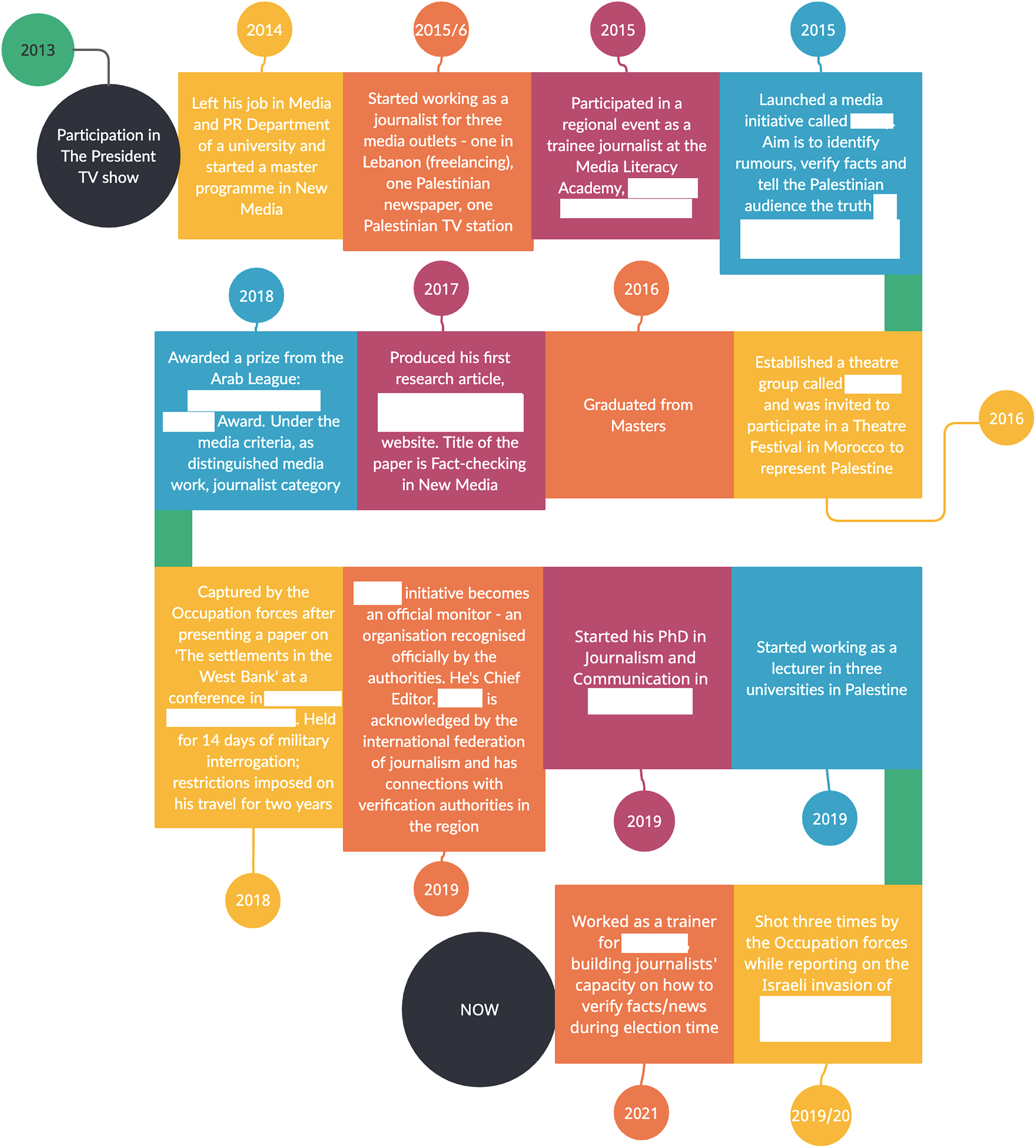
Timeline example from participant 3.
Ultimately, the drawings are useful in clarifying connections between the TV show and any civic engagement occurred in a participant's life as a result of the knowledge and skills developed from participating in the show, visualising the steps up to their present experience and placing emphasis on what was important in their eyes. Similarly to the experience of Monico et al. (2020: 5), ‘visual display of information increased accessibility to the data in real-time as youth could see time points and details’. Figure 4 shows a final example of one of the timelines that have been produced from this activity, which highlights once again critical links to the knowhow gained by participants through the TV programme.
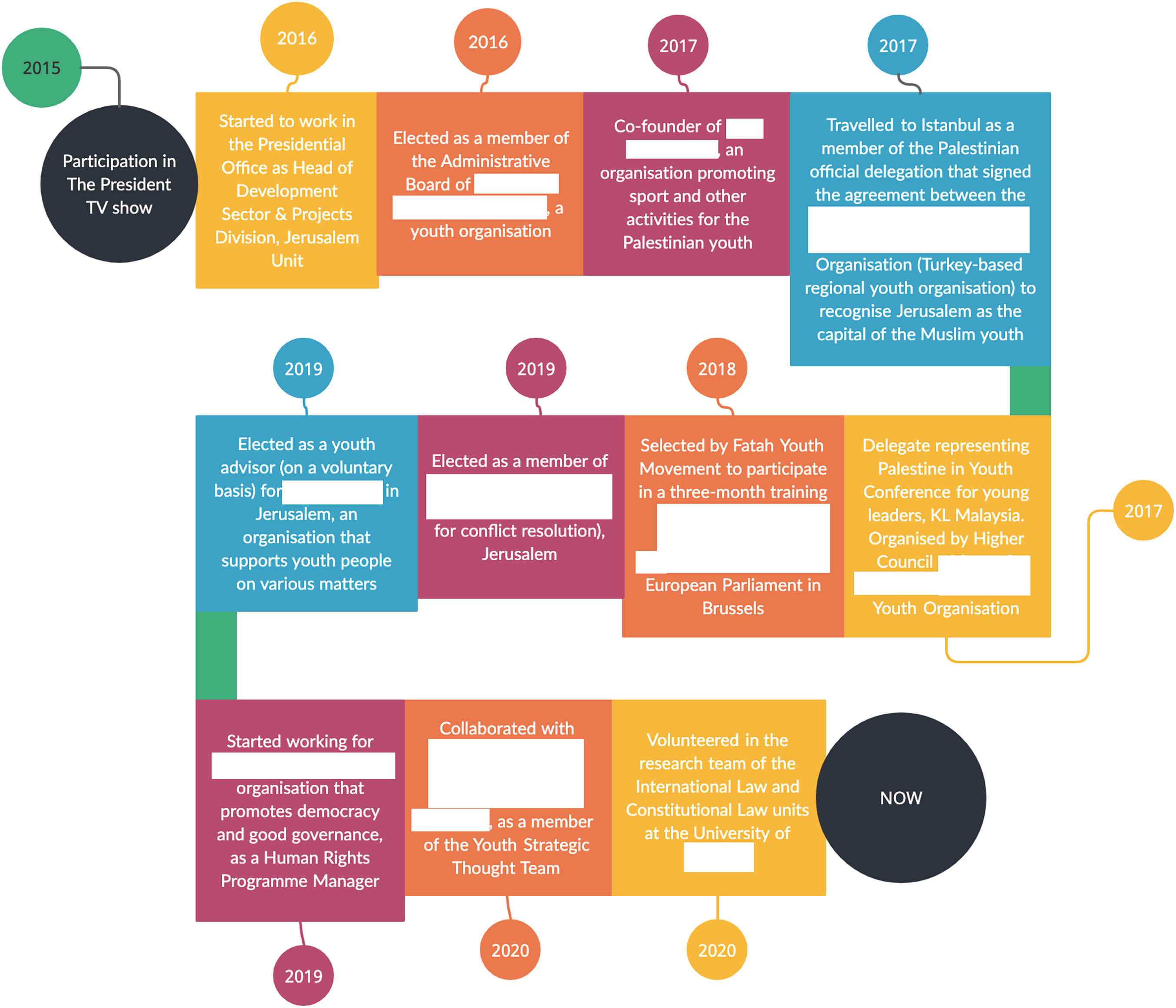
Timeline example from participant 8.
What does this bring to qualitative research and beyond?
Life journeys are intricate and elaborate. Qualitative methods such as narrative research, in depth interviewing and even oral history can be effective in capturing important stories and documenting life events. However, when the research focus lies on specific aspects of someone's journey, it is useful to adopt an approach that can provide support in narrowing down the effort. Timelines provide a helpful structure to view the most relevant and meaningful events of a participant's life chronologically, and assist in emphasizing milestones that are pertinent to the research questions.
With research being conducted more frequently online, visual research methods need to adapt to a virtual environment. The experience presented in this note shows that, while traditionally conducted as a face-to-face activity – predominantly within the context of an interview, timeline drawing can be transposed to a digital space where the researcher and the participant can even so cooperate effectively. This requires an adaptation from a more traditional way of constructing timelines to one that is technology driven and offers the opportunity for remote co-creation; the process takes place whilst preserving the participatory nature of the method, with technology operating at the level of collaborative interface.
Timelines can also be used to empower disadvantaged groups or communities that are being oppressed and to provide them with an opportunity to express their voice and their identity in a creative way, bringing to light experiences that are often questioned or disregarded in society as a result of particular social or political circumstances (Jackson, 2012). This is the case, for example, of young Palestinians. In addition, participating in the process of creating one's own timeline can have a restorative and asserting outcome for those who have undergone significant life challenges (Jackson, 2012). These may include people who live in conflict affected areas and have significantly limited freedoms. The adoption of creative methods to both carry out and present research can facilitate positive change-making by engaging individuals, communities, donors and policy-makers in meaningful conversations (Horsfall and Titchen, 2009). The timelines presented here can be used as instruments to advocate for the role that young people play in Palestine when provided with relevant opportunities to develop knowledge on how to contribute to society meaningfully and through non-violent means.
Footnotes
Declaration of conflicting interests
The author declared no potential conflicts of interest with respect to the research, authorship, and/or publication of this article.
Funding
The author disclosed receipt of the following financial support for the research, authorship, and/or publication of this article: This work was supported by the International Peace Research Association Foundation.

Author biography
Valentina Baú works as a Senior Research Fellow at Western Sydney University, Institute for Culture and Society. Both as a practitioner and as a researcher, her work has focused on the use of the media & communication in international development. Valentina has worked in different African countries, Asia and the Middle East. She has collaborated with international NGOs, UN agencies and the Italian Development Cooperation, both in a research and communication capacity. Her experience involves the implementation of both qualitative research and media projects with victims and perpetrators of conflict, displaced people, refugees and people living in extreme poverty.