



Abstract
Rapport is generally considered an essential component of successful interviewing, where participants are willing to share and divulge information. The present paper contributes to the research on rapport in qualitative interviewing by exploring ethical tensions that researchers may experience when conducting qualitative interviews with vulnerable participants. The analysis is based on semi-structured interviews with nine researchers from various fields within social sciences who had extensive experience in doing research with diverse vulnerable groups. We identified six ethical tensions related to building rapport with people in vulnerable life situations that cover issues concerning both too little and too much rapport. Findings illustrate that rapport as the ‘ideal’ for the researcher-participant relationship may need nuancing. The study concludes that researchers undertaking qualitative interviews on sensitive topics need to have a conscious awareness of ethical tensions that may arise when building rapport with their participants
Keywords
Introduction
In many fields of social sciences, qualitative research interviews are one of the most common sources to gain in-depth knowledge about peoples’ lives. Through the confidentiality and intimacy in one-to-one interview situations, research participants may share personal and intimate experiences, feelings and worries that are not accessible through other research methods. Due to its relational nature, interviewing has been described not just as a research methodology, but as a social relationship which is crafted and shaped by researcher and participant, their personalities, the ways they interact and their feelings towards each other (Seidman, 2019). Literature on qualitative interviewing therefore usually emphasises the importance of researchers’ interactions with participants for the research process and the quality of the data obtained, and researchers are advised to build rapport with participants (e.g. Brinkmann and Kvale, 2015; Glesne, 2016; Seidman, 2019).
According to Spradley (1979), rapport refers to a harmonious relationship between researcher and informant that allows for the free flow of information. Although Spradley emphasised that ‘rapport does not necessarily mean deep friendship or profound intimacy’ (p. 78), he argued that ‘a basic sense of trust has developed’ (p. 78) and that both the researcher and the informant have positive feelings about the interview. Similar definitions are provided in more recent literature, for example by Seidman (2019: 102), who described rapport as ‘getting along with each other, a harmony with, a conformity to, an affinity for one another’. Similarly, Prior (2018: 489) specified rapport briefly as ‘affiliation and empathy’. Based on such an understanding, researchers in the social sciences generally acknowledge rapport as a necessary though not sufficient condition for obtaining rich interview data (e.g. Brinkmann and Kvale, 2015; Glesne, 2016; Seidman, 2019).
Although qualitative researchers in all fields face issues of establishing rapport with participants, researchers highlight that these issues are particularly crucial in research with vulnerable participants (Liamputtong, 2007; Madziva, 2015; Melville and Hincks, 2016; Schulman-Green et al., 2010). While there is widespread agreement that certain research participants are vulnerable per se, such as children, people suffering from life-threatening disease or people who have gone through traumatic experiences, vulnerability is also a fluid concept that is context-dependent (von Benzon and van Blerk, 2017). Thus, some research participants will always be perceived as vulnerable due to certain personal traits or exceptional life circumstances, but for others, their vulnerability may result to a larger extent from the sensitivity of the research topic (Horowitz et al., 2002). In any case, vulnerable participants and participants in vulnerable life situations may have an increased need to feel trust, empathy and comfort to be both able and willing to share their private life stories (Madziva, 2015; Schulman-Green et al., 2010). Some groups of vulnerable people may also be suspicious of researchers, e.g. persons who engage in deviant activities, drug addicts or other people living on the margins of society who fear that their participation in research may have harmful consequences for them (Berk and Adams, 1970; Liamputtong, 2007). Furthermore, the increased potential for emotionally taxing situations and discomfort to both interviewer and participant may require measures to enhance their emotional well-being throughout the whole research process and lessen the impact of emotional distress (Kumar and Cavallaro, 2018; Sharkey et al., 2011). Building and maintaining rapport in qualitative studies with vulnerable and hard-to-reach populations may therefore be seen as a measure to ‘gain access’ to participants’ private lived experiences (e.g. Melville and Hincks, 2016: 9), but also as a measure to address the vulnerability of the participants and to enhance integrity and safety of both researcher and participant during the study (Schulman-Green et al., 2010). Hence, a lack of rapport (‘under-rapport’) may increase the risk of harm to vulnerable people who participate in qualitative research studies.
Although the concept of rapport is widely acknowledged as a central component of qualitative interviewing, it also raises ethical dilemmas for researchers. When researchers are encouraged to adopt a special kind of behaviour or self-presentation in order to build rapport and trust with participants, this may lead to a commercialisation of rapport and has also been called ‘faking friendship’ or ‘over-rapport’ (Duncombe and Jessop, 2012: 109, 117). Several research studies provide personal accounts of interactions with research participants that led to a blurring of boundaries between research and friendship and that left the researcher with feelings of discomfort and sometimes also of having betrayed the participants (e.g. Choe, 2020; Madziva, 2015; Wong, 1998). While this kind of ‘friendship rapport’ (Wong, 1998: 178) is generally considered unethical in qualitative research (Brinkmann and Kvale, 2005; Duncombe and Jessop, 2012; Wong, 1998), it may become particularly problematic in research with vulnerable participants, as they may have limited power or resources to protect their own interests and are at a higher risk of harm or being taken advantage of in research (Bracken-Roche et al., 2017; Council for International Organizations of Medical Sciences, 2016). Thus, building and maintaining rapport with vulnerable participants may sometimes seem like a balancing act between conflicting interests. Yet, as Brinkmann (2018) warns, we rarely pause and consider the particular interviewer-interviewee relationship, and we should beware of naturalising the fact that a vulnerable research participant is willing to share at length very personal information with a perfect stranger, i.e. the researcher.
In this article, we build on previous literature on rapport in qualitative interviewing in general and in research interviews with vulnerable participants especially. Our particular focus is on ethical tensions that researchers may experience when building rapport with vulnerable participants. With this focus, we aim to problematise an unquestioning approach to rapport and contribute to a more nuanced view of rapport as a communication tool in qualitative interviews. The research question guiding our study is the following: Which ethical tensions related to rapport do researchers experience in qualitative interviews with vulnerable participants?
Our motivation and understanding of the research topic
All three authors have many years of experience with interviewing vulnerable participants, either in the field of education or special education. A brief presentation of some of our personal experiences follows underneath.
Thus, throughout our careers, we have gathered ample experience with building rapport with vulnerable participants. At times, we have been surprised and even disturbed by how our building of rapport has led research participants to share their private thoughts and emotions, i.e. what Brinkmann (2018: 578) describes as ‘the “magic” of interviewing’. Since most of our research participants were vulnerable or in vulnerable life situations, we have sometimes questioned the ethics around our ability to push the ‘on’ button of our interview participants. Were they emotionally ready to disclose such intimate information? Did we encourage them too effectively to tell their stories? And how did they feel about their revelations afterwards? Hence, the idea for this article stems from our own professional experiences, which we wished to explore further amongst qualitative researchers within the social sciences, so that we could corroborate our experiences and contribute with more nuanced perspectives on the use of rapport.
Ethical tensions in rapport
While most literature on qualitative interviewing discusses the questions of why and how researchers establish rapport with participants, the building of rapport also poses the questions of ‘How much is enough?’ and ‘Is it ethically sound?’. According to Seidman (2019: 102), there is ‘the common assumption that the more rapport the interviewer can establish with the participant, the better’. However, such an unquestioning approach to rapport neglects the ethical aspects of qualitative interviewing. To gain rich interview data, researchers often depend on participants revealing personal information about themselves. Hence, qualitative researchers need to strike a balance between establishing sufficient trust to make participants feel comfortable to share personal information and maintaining a professional distance (Guillemin and Heggen, 2009). A professional distance is necessary to avoid a blurring of the lines between research, friendship, counselling and therapy, and such boundary management is seen as an important part of a researcher's work (e.g. Dickson-Swift et al., 2006). However, as emphasised by Guillemin and Heggen (2009), maintaining distance in the relationship to participants is also required out of respect for participants’ privacy. Although people who participate in a research interview may appreciate the opportunity to tell their story and to be listened to by someone who really wants to listen (e.g. Booth and Booth, 1994; Dickson-Swift et al., 2007), there may be limits to how much they may be willing to disclose to an unfamiliar researcher (see also Brinkmann, 2018). Furthermore, encouraging or even pushing participants too effectively to share their stories also has the potential to cause discomfort or even harm to them. In interviews on sensitive topics in particular, participants who share painful experiences may run the risk of re-traumatisation or re-victimisation (e.g. Jewkes et al., 2005; Melville and Hincks, 2016). Hence, building rapport with interview participants needs to be done in a sensitive manner and requires a conscious awareness of ethical boundaries.
Against this backdrop, the strategy of developing rapport to elicit good interview data has raised ethical concerns amongst researchers. While qualitative interviewing is largely dependent on building good interpersonal relations between researcher and participant, the question arises as to how researchers can balance establishing rapport and at the same time respect ethical boundaries. When rapport is used as a means to develop trust and facilitate access to participants’ personal stories, promoting rapport may become an ‘inauthentic’ or purely ‘instrumental’ practice (Duncombe and Jessop, 2012: 108). Especially when researchers use methods such as self-disclosure or reciprocity to create some sort of ‘level playing field’, these efforts may result in a blurring of boundaries between research and friendship (Choe, 2020; Dickson-Swift et al., 2006; Dickson-Swift et al., 2007; Duncombe and Jessop, 2012). This blurring of boundaries may be problematic for the research process and those involved. Researchers may be left with feelings of discomfort, guilt or of having betrayed the participants and, consequently, find themselves ethically challenged (e.g. Choe, 2020; Madziva, 2015; Wong, 1998). Participants may feel seduced into disclosing private information which they might later regret revealing. Several researchers have therefore raised the question as to how far participants actually can be said to have given their informed consent when the researcher's role is not clearly defined (Brinkmann and Kvale, 2018; Choe, 2020; Duncombe and Jessop, 2012).
Ethical issues related to rapport-building are well covered in feminist research literature in particular, where researchers have questioned how the concept of rapport is impacted by power relations and pointed to ethical tensions associated with the misuse of the power of persuasion (e.g. Campbell, 2003; Duncombe and Jessop, 2012; Oakley, 1981; Stacey, 1988). Yet, in research studies that deal with participants in vulnerable life situations, ethical questions related to rapport-building are usually barely discussed (notable exceptions are Choe, 2020; Madziva, 2015). Therefore, this article seeks to explore the ethical tensions related to building rapport with vulnerable research participants further by investigating the experiences of qualitative researchers who frequently interact with vulnerable participants.
Method
Data for this article are drawn from in-depth, semi-structured interviews with nine experienced researchers (5 women, 4 men) from different fields in social sciences (e.g. anthropology, education, health sciences, sociology, psychology). All informants had comprehensive experience with qualitative research studies on persons in vulnerable life situations. All informants had a doctoral degree and were well established in their field of expertise. Participants were recruited via searches on randomly chosen websites of Norwegian universities and research institutes, where we scrolled through staff lists looking for researchers who had recent publications (i.e. no older than five years) on qualitative research studies with vulnerable participants. To gain diverse perspectives, we chose researchers from various professional backgrounds who conducted sensitive research on vulnerable children, youth and adults (e.g. people with intellectual disability; homeless people; refugees; people who had experienced sexual violence). We collaborated to select participants whom we deemed able to contribute to our study and whom we thought would provide us with valuable expertise and experience regarding our research question.
As a framework for the interviews, a semi-structured interview guide was developed that covered the following topics: the emotional encounter with the research participants; building and maintaining rapport; role definition and professional support. A pilot interview was conducted to test the interview questions.
Each author conducted three individual interviews with three participants, giving us a total of nine interviews. Interviews took place between August and November 2021. The mean duration of the interviews was 65 min (range 45–90 min). Eight of the interviews were conducted face-to-face and one interview was conducted via an online platform. All the interviews were audiotaped and transcribed ‘intelligent verbatim’ by a specialised company.
The study was approved by the Norwegian Agency for Shared Services in Education and Research (Sikt), a government-owned company responsible for managing data for the research community of Norway. Participants received written information about the purpose of the project, and they gave their voluntary and informed consent to participate. They were informed that their participation was anonymous and that they could withdraw from the study at any time. Furthermore, we reminded them to ensure the anonymity of their vulnerable research participants when sharing their experiences with us.
Interview data were analysed using Braun et al.'s (2019) six-phase approach to reflexive thematic analysis. During the first phase of familiarising with the data, we read and reread the interview transcripts individually, looking for interesting features and taking casual notes. During the second phase, we engaged more systematically with the data and generated codes for text fragments that could be of relevance for our research question. At this point, we used an inductive approach, meaning that we used the data as a starting point for our analysis. Then, the third phase involved constructing themes by comparing individual codes and by evaluating these in light of the study's research question. To increase the reliability of the analytical process (cf. Creswell and Poth, 2018), we worked independently of each other at this point, and all three authors worked out a list of themes based on the previously identified codes. During the fourth phase, we discussed and revised the independently constructed themes together and sorted them into overarching themes. The fifth phase involved defining each theme more specifically by phrasing them as ethical tensions, thereby concisely capturing the essence of the identified themes. At this point, the following ethical tensions were defined: (1) When researchers feel that participants’ vulnerability requires extra efforts to build rapport prior to the interview, (2) When researchers and participants are out of tune with each other, (3) When rapport leads vulnerable participants to disclose information beyond the scope of the study, (4) When researchers are uncertain about whether to push forward or hold back while addressing a sensitive topic, (5) When rapport leads vulnerable participants to reveal private information and then regret it and (6) When rapport causes researchers to feel more responsible for their participants’ well-being than the researcher role suggests.
Finally, during the sixth phase, the robustness of our analysis was tested by writing this article and by checking whether our themes remained close enough to the interview data and at the same time answered our research question. An illustration of the data analysis is provided in Table 1.
Example of data analysis procedure.
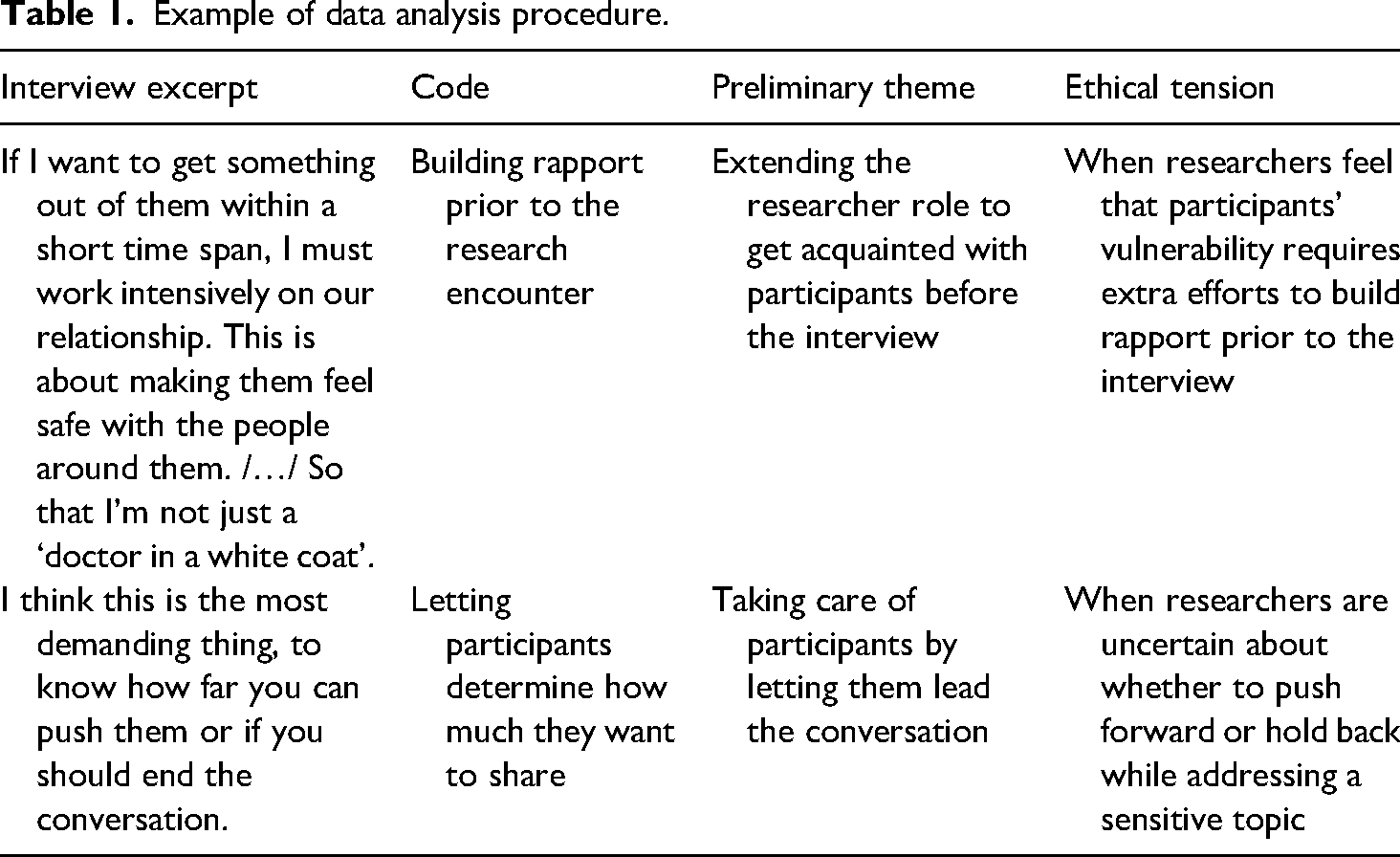
In the following sections, we present the six ethical tensions identified through our analysis, and we illustrate these with translated quotations from the interview data. To safeguard the anonymity of our research participants, background characteristics (such as field of expertise) have been anonymised, and all identifying information has either been changed or withheld. Participants cannot be identified by the excerpts presented in this study.
Ethical tension 1: When researchers feel that participants’ vulnerability requires extra efforts to build rapport prior to the interview
All of our participants explained that building rapport with participants in vulnerable life situations starts with adequate preparation. The researchers in our study described how they invested significant time and effort to establish rapport with vulnerable participants and to create an atmosphere where participants can feel safe and confide. These efforts included extending the researcher role in order to get to know the interviewees before the interview. From our interviews, it became clear that researchers often go to great lengths to get acquainted and establish rapport with vulnerable participants. Several of our participants described how they acted purposefully and extended the traditional researcher role to effectively build a temporary relationship with their participants, often by inviting themselves into the everyday lives of the participants. Especially when the research participants were children, people with intellectual disability or people who had gone through traumatic experiences, this kind of relationship and trust-building could extend over several days. Participant 4 explained about her modus operandi when interviewing children who lived in particularly vulnerable circumstances: Conducting an interview with a child is often not that easy. It's not like when interviewing adults, ‘Let's sit down and talk’, and even though we barely know each other, we are familiar with the [research] situation. /…/ But children, they are only familiar with talking with their mother, their teacher, the ones that are closest. So, what is important for me to do then, is to spend two days with the family, with the mother. /…/ Then the children see that I can talk with their mother, that we agree on things, that we can laugh together. Go for a walk and have lunch together. /…/ My experience is that it takes time to establish a relationship with the children before they can open up. If I want to get something out of them within a short time span, I must work intensively on our relationship. This is about making them feel safe with the people around them. /…/ So that I’m not just a ‘doctor in a white coat’.
Other participants explained how they would visit participants at school, on the street or in the workplace prior to the interview, both to get a sense of their everyday life and to show themselves as a fellow human being rather than as a distant researcher. Spending time with vulnerable participants in a context that is safe and familiar to them was considered an effective way of presenting a less intimidating image of oneself as a researcher and establishing a trusting relationship. At the same time, participants in our study also expressed ethical discomfort with using intimacy as a means to build rapport with research participants, and they were aware of the risk that participants could become too informal with them and that boundaries could get blurred. Participant 4 continued as follows about the amount of time that she spent to build rapport with vulnerable children: For better or for worse, maybe it's good for them that I don’t… (hesitates) Two days is enough so that they don’t… (hesitates) I have plenty of time for them in those two days. /…/ That's why I feel that two days is sufficient, and maybe three days would be more than enough. Just so that they won’t get too attached to me, because I have all the time in the world for them.
Thus, this participant experienced a need to spend quite some time with the children that she wanted to interview, so that they would feel comfortable to open up to her. Yet, at the same time, she did feel concerned that her efforts to build rapport could have the undesirable side effect that the children became attached to her, thereby making it harder for her to remain confined to the researcher role. As she stated: ‘They forget that I am a researcher’.
Because of such ethical tensions concerning role delimitations and rapport, several of our participants emphasised a clear distinction between the researcher-participant relationship and friendship. Participant 6, who had extensive experience with interviewing people who lived on the fringes of society, put it like this: ‘It's not like becoming friends with them. But I very much want to befriend them in the situation (emphasised by the participant). Very often, the best interviews are those where you genuinely have a nice and enjoyable time together’.
Hence, as illustrated by the above-mentioned excerpts, a certain expansion of the professional role of the researcher to include a more personal tone was generally considered helpful in creating an atmosphere of trust and safety and building rapport. However, the statements from our participants illustrate that taking extra measures to build rapport with vulnerable participants prior to the actual interview may also lead to ethical concern for the researcher.
Ethical tension 2: When researchers and participants are out of tune with each other
Even though researchers may often go to great lengths to establish rapport with vulnerable participants, several researchers in our study also witnessed of ‘poor interviews’ where they had experienced a lack of rapport or under-rapport. Despite their efforts to create a confidential atmosphere during the interview, sometimes the chemistry simply did not feel right. Some of the participants in our study attributed this under-rapport primarily to their own doings, such as being inadequately prepared for the target group or asking the ‘wrong’ questions, so that participants did not open up. Participant 9, who conducted research on mental health in employees in emergency services, referred to such an interview where he did not manage to get in tune with an interviewee as a ‘dead experience’, and he explained how this experience taught him to prepare better for interviews on emotionally difficult topics, so that building and maintaining rapport could be more readily facilitated.
In other cases, the researchers in our study attributed the under-rapport to the fact that the participant was unfamiliar with the interview situation. Sometimes participants were simply unable to share personal information with the researcher, because of the interview context that was unusual to them. Participant 2, who had a lot of experience with interviewing adolescents in vulnerable life situations, e.g. young people with mental health issues or students who were bullied, illustrated it like this: Some students, they rule in the hallway, and that's where they are like the ‘queen bee’, you know. But when they come to the interview, they don’t know, they can’t get a word out, because it's not their territory.
This researcher described silent and uncommunicative participants as the most common challenge, and in such cases, it appeared very difficult for the researcher to establish rapport and to gain access to the interviewees’ stories. She explained how this sometimes could result in ‘very tedious interviews’, where she clearly felt that the interview situation was not going well and was lacking flow. This researcher was honest enough to share that she could think ‘Oh God, this is so boring!’ during such interviews.
While all qualitative researchers may sometimes experience challenges to develop rapport with certain participants, in interviews with vulnerable participants, lack of rapport could also cause additional concern for the researcher about the interviewee's well-being. As related by some of the researchers in our study, the silence and very short answers of participants can turn the entire interview situation into a rather uncomfortable experience for both the researcher and participant. Participant 3, who conducted interviews with refugees, related the following: I’ve only experienced this once, but I had recruited a participant whom I really had to ‘warm up’ and who shared very little information. And I find that more challenging than when I get too much information because it makes me very insecure about the reason for this. Is the participant just shy? Or is it difficult issues to talk about? Right, because you don’t know what it is about.
Thus, vulnerable participants who share very little information may leave the researcher to wonder whether this is a matter of under-rapport in the researcher-participant relation, whether the participant experiences discomfort because of the sensitive interview topic or whether it is the unfamiliar interview situation that hinders a free flow of information. Moreover, researchers in our study expressed concern that an uncomfortable interview situation could aggravate participants’ vulnerability.
Ethical tension 3: When rapport leads vulnerable participants to disclose information beyond the scope of the study
In many cases, the research interview may be the first occasion for a vulnerable participant to talk freely about a sensitive topic, without fear of stigma or of frightening away the listener. Interview participants may appreciate the opportunity to open up and share personal information about sensitive topics that they cannot readily share with other people. Participant 1, who, among others, conducted research on people with serious physical health conditions, explained: I’ve experienced this many times, because I am a person who listens actively and who lets the other one talk. Then many people think this is very good therapy, right? And then maybe they experience that it is good to talk about it, and they really get started. And they may kind of forget themselves and maybe they will tell things, and then … ‘Maybe I’m telling you a bit much right now’, right?
As illustrated by this interview excerpt, the rapport between the researcher and the participant may sometimes cause vulnerable research participants to reveal considerable amounts of sensitive information, sometimes including information that may be irrelevant to the research project. Yet, interrupting the participant could possibly threaten the rapport that has been built up. As participant 1 continued: I’m thinking of all these interviews where I got much more information than what I wanted. There's a lot of vulnerability there. /…/ The participant must be allowed to talk. But it doesn’t necessarily relate to my research, you see. It may be topics that are beyond the scope of the study, but they may be very important for the participant to talk about.
Thus, the researcher may be inclined to let the participants talk off-topic because of the participant's vulnerability and the researcher's fear of compromising rapport. If the researcher tries to interrupt a vulnerable participant who has deviated too much from the research topic, this may leave the participant with a feeling of not mastering the interview situation. If the researcher chooses not to interrupt the participant, the researcher may be left with an amount of sensitive information that is not of essence for the research study. In some cases, ethical approval for this type of data collection may not even have been granted. Hence, vulnerable participants who disclose too much information may challenge research ethics in multiple ways, and researchers may be forced to choose between ‘the lesser of two evils’.
Ethical tension 4: When researchers are uncertain about whether to push forward or hold back while addressing a sensitive topic
A major concern of the researcher during an interview with a vulnerable participant is to maintain rapport and keep the conversation going even when the topic may be emotionally difficult and even distressing. As findings from our study reveal, researchers at this stage are guided not only by the aim of maximising participant disclosure, but also by genuine concern for their participants’ well-being. Hence, the question of how much participants should be encouraged or pushed to reveal information, particularly when participants are reticent to speak and the conversation is not flowing freely, may cause an ethical tension for researchers. The researchers in our study had experienced participants who ‘held the cards close to their chest’ (participant 7) and participants who ‘just opened their hearts and let everything fall on the table’ (participant 2). Both situations require researchers not only to be flexible but also to have a sure instinct. More concretely, to guide their participants safely through the conversation, the researchers in our study expressed the need for researchers to be ‘responsive and sensitive’ (participant 3), ‘empathetic in every possible way’ (participant 8), ‘alert in case something happens’ (participant 2), ‘vigilant’ (participant 7) and ‘cautious’ (participant 1).
All of our participants expressed discomfort with pushing participants to share their stories. Rather, they suggested closing an interview when participants show signs of discomfort, distress or exhaustion. One of the researchers in our study used the term ‘re-traumatisation’ (participant 4) to describe situations where participants’ recounting of their traumatic experiences may make them relive the stress reaction of the initial traumatic experience. In some cases, it may be possible to continue the conversation another day, in other cases an interview needs to be closed for good. This also means that sometimes researchers are required to put their professional interests aside, as related by participant 3: I try not to cause stress just because I want as much information as possible. But I respect the fact that some topics need to be left alone. /…/ I think this is the most demanding thing, to know how far you can push them or if you should end the conversation. Although I made it quite clear at the beginning that we can end the conversation whenever they want.
Similarly, participant 9 explained: ‘They must not feel like I have exploited them or tricked them into revealing their stories’. Thus, for social sciences researchers, there lies an ethical tension in the desire to shed light onto problematic issues in society, while at the same time safeguarding their vulnerable participants. As the researchers in our study described, they need to balance their goal of bringing into the open sensitive information on the one hand, and the moral obligation to protect the emotional well-being of their participants on the other hand. Rapport may give them access to their participants’ inner world, and the researchers’ professional curiosity may trigger them to seek as much information as possible from their participants. Yet, sometimes researchers need to take a rather reserved role during the interview and hold back on follow-up questions in order to avoid discomfort for their participants. This may mean that researchers cannot always get hold of all the information that a participant possesses.
Ethical tension 5: When rapport leads vulnerable participants to reveal private information and then regret it
When vulnerable participants are invited to participate in a research interview, quite often they may not yet have any prior experience of what it feels like to confide this very personal information to someone else. Hence, some vulnerable research participants may be at risk of revealing more information than they had planned for, and they may get second thoughts after the interview whether it was a good idea to share this information or not. In a study on domestic violence, participant 5 experienced that an interviewee was so surprised by her own recounting of a traumatic incident she had experienced, that she withdrew her consent to participate in the study a few days after the interview. I think she [the participant] was not prepared for and had not thought through that she would tell me about this particular incident. And when she later realised that she had revealed it, she felt very uncomfortable that this incident was part of the research material.
This researcher's experience illustrates that sometimes neither the researcher nor the participant has control over the direction an interview takes, what is discussed and how much the participant reveals, especially when it comes to sensitive topics. As this researcher recounted, she had been meticulous about going through the consent form with the participant prior to the interview, and she had specified the participant's right to withdraw from the study at any given point without stating a cause. In hindsight, she felt satisfied that she had not rushed through this part of the research process, and she was relieved that the participant had used the right to withdraw. However, as she shared with us, this experience had taught her to be even more conscious about not pushing participants outside of their comfort zone and to make sure that participants are fully informed and aware of their right to withdraw from the study: So, with the awareness that I have now, I will sometimes say to a participant: ‘When you’re sitting and talking, it may happen that you share things that you didn’t intend to share or tell things that you have never told to anyone else before. That can happen. I will try and be careful not to push you. So, you need to take the lead. But if it should happen that you tell me something and afterwards you regret it, then we can delete that part, or you can ask me not to write about something in particular’.
Rapport between researchers and vulnerable participants may lead participants to reveal more than they afterwards feel comfortable with. Therefore, being very explicit about participants’ rights and how they can exert these rights may help to create a safe climate for sharing personal information. In case of unforeseen revelations, informed participants may feel more confident that no interview content will be used without their consent. This way, participants may feel less anxious about losing control over their own story, and some of the ethical challenges concerning participants who reveal too much information may be overcome.
Ethical tension 6: When rapport causes researchers to feel more responsible for their participants’ well-being than the researcher role suggests
Although the research encounter usually ends with the closing of the interview, researcher's emotional attachment and involvement with their participants do not necessarily end there. All the researchers in our study experienced research encounters with vulnerable participants that were extremely touching and sometimes disturbing. Some researchers were affected by deep sympathy and concern for individual participants, and although they were aware of the limitations of their role as researchers, they felt responsible for ensuring that their participants would find help if needed. In most cases, the follow-up of participants was limited to giving them information about where they could find help, as illustrated by the following quotation from the interview with participant 1: When listening to participants’ life situations, it sometimes happens that I get worried and wonder what happens when I go out the door now? /…/ So, if a participant tells me something that requires follow-up, then I need to refer them to someone, right? /…/ This has to do with responsibility.
While participant follow-up is sometimes related to their difficult life situation in general, as illustrated with the excerpt above, researchers may feel even more responsible to provide follow-up measures when participants’ distress was caused by the interview. Concerns about causing distress in participants were mentioned by several of the researchers in our study, for example by participant 4: ‘What happens if they feel distressed after the interview? /…/ Many participants feel relieved when they are heard and seen. But if they feel disturbed, we must have a plan B’. For this participant, plan B consisted mainly of being prepared to refer participants to the right places for further care and support. Most participants in our study stated that they always had a list of addresses of support services with them when conducting interviews with vulnerable participants. In some cases, however, some researchers gave their phone number to participants who were in a particularly difficult life situation or who seemed distraught after the interview, and some researchers could even call participants after the interview, as related by participant 3: ‘I called two participants twice afterwards to find out if they needed help to be referred to another place or something like that’.
While such practices may cause a blurring of the lines between research, counselling and therapy, these findings illustrate how rapport is more than a pragmatic research tool. Even though the relationship between researcher and participant is usually short-lived, the proximity, trust and warm interest that is established may create a pronounced sense of responsibility in the researcher. This may be particularly so in encounters with vulnerable participants, where researchers may feel the need to follow up participants beyond the interview situation.
The continuum of rapport: a discussion
Rapport between researcher and participant is generally considered a necessity for the free flow of information in interview situations and thus a prerequisite for obtaining rich interview data. Consequently, building and maintaining rapport is seen as an essential part of the craft of qualitative research, and it is also described as such in most textbooks on qualitative interviewing (e.g. Brinkmann and Kvale, 2015; Glesne, 2016; Seidman, 2019). Moreover, rapport is acknowledged as ‘the ideal in the interviewer-interviewee relationship’ (Campbell, 2003: 290), and there is the ‘common assumption that the more rapport the interviewer can establish with the participant, the better’ (Seidman, 2019: 102). Yet, as our findings show, such an unquestioning approach to rapport needs nuancing. Based on our analysis of interview data, we identified six ethical tensions related to building rapport with vulnerable participants that cover issues concerning both too little and too much rapport.
On the one hand, a lack of rapport (‘under-rapport’) may leave vulnerable participants without the comfort and safety necessary to share their personal thoughts and experiences with an unfamiliar researcher. They may experience the interviewer as not tuned in or insensitive to their emotional state or even intimidating. In such case, they may not be willing to share their private thoughts and experiences. Furthermore, under-rapport may cause a sense of discomfort to both the researcher and the participant, and participants may feel unacknowledged by the researcher.
On the other hand, the intimacy of the interview situation may create over-rapport, which may tempt participants to disclose more information than they in hindsight feel comfortable with. Also, over-rapport may lead them to share personal information that is outside the scope of the study, and the researcher may struggle with regulating this stream of information. In the case of sensitive topics, such over-rapport may cause the risk of re-traumatisation or re-victimisation for the research participant (e.g. Jewkes et al., 2005; Melville and Hincks, 2016). Hence, over-rapport may be equally harmful to the vulnerable research participant as under-rapport, and it may also affect the emotional well-being of the researcher.
Based on these findings, we propose that rapport can be visualised as a window where the relationship between the researcher and the participant is ‘just right’. When outside this window, i.e. under- or over-rapport, ethical tensions may arise, with possible negative consequences for the researcher, the research participant and the research project. In our study, researchers tried to avoid these ethical tensions by being empathetic and attentive to participants’ needs and well-being, while at the same time being clear about the limitations of their role as researcher. Nevertheless, all researchers in our study did have personal experience with such tensions.
In sum, we find evidence in our data to present a ‘continuum of rapport’, where under-rapport on the left and over-rapport on the right indicate suboptimal rapport and the centre indicates optimal rapport. Figure 1 presents the characteristics and qualities of rapport, under-rapport and over-rapport as related by our participants.
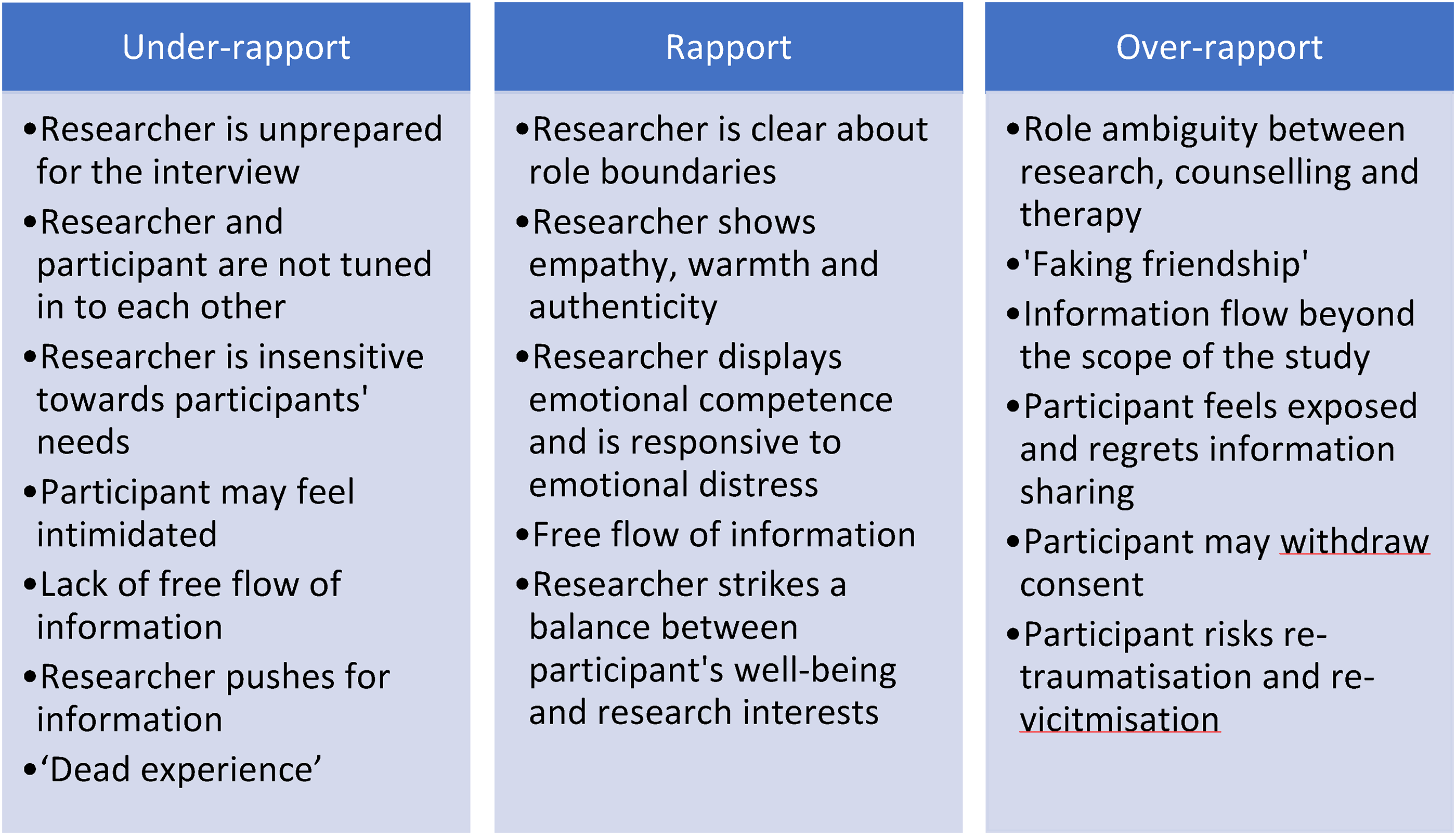
The continuum of rapport.
When researchers manage to build rapport with vulnerable participants, the warmth, empathy and confidentiality of the relationship may lead to a free flow of information, despite the sensitivity of the interview topic. At the same time, rapport is characterised by role clarity, authenticity and emotional competence, all of which help safeguard the well-being of both participant and researcher. However, under certain circumstances, rapport may be under- or overdeveloped, and both positions may damage the desired researcher-participant relationship, hamper the quality of the data collection and cause harm to the well-being of those involved.
Based on our findings, we therefore argue for a nuanced use and discussion of the concept of rapport, and we urge researchers to adopt a more conscious and reflective approach to building rapport. While there is no doubt about the need for vulnerable participants to feel safe and comfortable to be both able and willing to share their private experiences and feelings with a researcher, we see a clear need for researchers to be aware of the ethical tensions that may arise when building rapport with people in vulnerable life situations. We therefore suggest that textbooks on qualitative interviewing should include not only information related to the questions of why and how researchers establish rapport with participants, but also discuss ethical tensions that researchers may experience during research encounters, particularly when conducting interviews with people in vulnerable life situations. Furthermore, we support to include ethical tensions related to rapport as part of the required doctoral curriculum for qualitative researchers. Sensitisation of ethical tensions related to rapport-building may remind researchers to reflect upon their use of techniques and behaviours related to building and maintaining rapport when interviewing vulnerable participants. Researchers are required to create an ambiance of empathy and confidence and, at the same time, foster a more conscious awareness of building rapport with vulnerable participants.
Footnotes
Declaration of conflicting interests
The authors declared no potential conflicts of interest with respect to the research, authorship, and/or publication of this article.
Funding
The authors received no financial support for the research, authorship, and/or publication of this article.

Author biographies
Evi Schmid, PhD, is Professor in educational sciences at the Department of Vocational Teacher Education at OsloMet – Oslo Metropolitan University, Norway. Her research interests include school-to-work transitions and dropout from vocational education and training.
Veerle Garrels, PhD, is full Professor in special needs education at the Department of Vocational Teacher Education at OsloMet – Oslo Metropolitan University, Norway. Her research interests include special education, disability studies, neurodevelopmental disorders, self-determination and school-work transition.
Børge Skåland, PhD, is Associate Professor in special needs education at the Department of Vocational Teacher Education at OsloMet – Oslo Metropolitan University, Norway. His research interests include special education, school violence, violence against teachers and teacher identity.