



Abstract
There are increasing instances in which researchers study their migrant co-nationals in one language but report their research findings in another language. This raises significant issues regarding the mediating role played by bilingual researcher-translators when translating research data: the decisions they make when bringing the Other’s world to their readers, and the strategies they adopt when making such decisions. These issues of data translation, as well as the unique experiences of the researcher-translators and the valuable knowledge that they generate from this process, have not yet been given adequate attention in the academic literature. In response, this article explores a translation analysis which allows the researcher-translator to reflect in detail on the methodological challenges that researcher-translators are likely to encounter. Introducing Poblete’s five operations of translation, we highlight the processes that the researcher-translator adopts in recognising, reflecting and negotiating with the (un)translatability of culturally embedded linguistic expression. Focusing on International Student Mobility (ISM) as a particular instance of research translation/analysis as cultural mediation, we demonstrate how our intention to attune to students’ own ISM journey in their own language reverberates in the mediation and interventions the researcher-translator conducted through the translation analysis. The article thus emphasises how translating interview scripts as part of the research is more than seeking linguistic correspondence, it is also about understanding non-western lives and life-words through a second-language.
Keywords
Introduction
The phenomenon of the invisible translation act, and of the disappearing translator is of particularly interest in qualitative research (Temple and Young, 2004). Poblete (2009) argued that in much research literature, extracts from interviews that are translated by the researcher are most often presented in the same way as extracts from interviews conducted in the shared language of participants, researchers and readers. This form of presentation occludes the researcher’s intervention in the Other’s discourse through the translation process and renders invisible their position as a legitimate importer of cultural knowledge between different language registers. Both Simaon (1996) and Poblete (2009) point out that what the translator is doing is more than conducting linguistic exchanges and searching for correspondences between two language systems. Rather, they are involved in making legible, through translation, ‘lives rather than simply words’ (Temple and Koterba, 2009: 2). The challenge that translators face is, thus, how to render an Other’s discourse, culture and experiences comprehensible (Liu, 2010; Cook-Sather, 2012) through the interventions they conduct as one (perhaps the only one) capable of understanding that Other – in both the strictly linguistic sense, as well as in the broader cultural sense. The positionality faced by such cross-cultural researchers who are also involved in translation as part of the research process is much more complex than their mono-lingual counterparts as they negotiate the complexities of being, at once, linguistic and cultural ‘insiders’ with their co-national participants, and simultaneously, perhaps are ‘outsiders’ from their reading public. However, this insider/outsider binary is contested by several such researchers as it tends to simplify the dynamic and flexible nature of migrant researchers’ positionalities which are highly specific and complex (Carling et al., 2014; Matejskova, 2014; Nowicka and Cieślik, 2014). Most recently, Turhan and Bernard (2022) demonstrated how migrant researchers can increase the transparency of the reflexivity strategies adopted by such researcher-translators: by including original language excerpt transcripts, and by providing additional supporting explanations about translation decisions within brackets.
Rather than offering a comprehensive review of the literature on translation, we aim to highlight some of the many challenges faced by qualitative researcher-translators as they mediate language and culture as part of the research process. With reference to particular authors, as well as through explicating our research data, we aim, in this article, to explore how translation in qualitative research poses particular dilemmas for the qualitative researcher who, in the process of translation/analysis applies more to the meaning-making process that must be particularly attentive to language and context-specific experience, and the interpretation and transformation of (an)Other’s lived-realities (Cook-Sather, 2012). We thus make a case here for researcher-translators to reflect on their encounters and engagements with the research Other through translation, from both linguistic and broader cultural lenses. As such, we argue for an approach that foregrounds not only language mediation but one that is also imbricated in the translation of experiences, cultures and representations – the very stuff of interpretive qualitative research.
Aligned with the theoretical and methodological contexts outlined above, the article aims to discuss some of the translation issues involved in a transcultural, translingual research project on international student mobility (ISM) conducted by a Chinese researcher-translator, as a case-study in highlighting and exploring the dilemmas and affordances of bilingual researcher-translators when undertaking studies in their first language with their native populations abroad, and that are subsequently presented in English. Bearing in mind Poblete’s arguments about the ‘invisible researcher-translator’, we attempt to make more visible the main researcher-translator’s work in the current project by explicating the mediation she conducted in establishing conceptual equivalence between the source and target languages. In particular, we outline how she recognised and negotiated with the limits and liminalities involved in translation for research. We also highlight how the main researcher-translator, as a legitimate importer of Chinese students’ ISM life realities, engaged with the culturally embedded lives of her research participants as they expressed their life-worlds in the research interviews.
The article proceeds in the following way: after a brief discussion of two types of equivalence that translators aim to produce through translation, we argue that conventional Sociological writing protocols fail to describe the translation process in sufficient detail to fully acknowledge the mediating role played by researcher-translators. At this stage, we turn our attention to Poblete’s (2009) five discursive strategies that translators adopt and put particular emphasis on exploring the practical implications of these strategies in the context of the research-translation process involved in a particular ISM-related research project. We then briefly outline the current research project – a transcultural, translingual, ISM-focused project conducted by a Chinese bilingual researcher-translator. Based on this project, we highlight the translation-analysis of three particular Chinese phrases that emanate from our Chinese-speaking participants. In doing so, we explore the creative/interpretive process involved in not only rendering intelligibility between languages but also in embracing the potentiality for cultural exchange as part of the research translation/analysis process. We conclude by reflecting on how the engagements of bilingual researcher-translators with the translation process helps to add new meanings to ISM research and opens up further dialogue for re-presenting and transforming the Other’s voices in qualitative investigations.
Translating lives
Translation involves a process of ‘decoding/recoding which goes beyond the strictly linguistic’ (Poblete, 2009: 643). By translating extracts from research interviews, the (researcher) translator aims to bring the interviewee (linguistic other) closer to the reader-consumer through producing ‘equivalence’ from the source language of the interview to the target language for dissemination (Squires, 2009). Sutrisno et al. (2014) defined two types of equivalence between source and target languages: lexical and conceptual equivalence. As the basis for translation, lexical equivalence is achieved by identifying the corresponding words in the target language which represent those in the source language. However, it is not always possible (or preferable) to make such mimetic linguistic substitutions across languages. In such instances, seeking conceptual equivalence becomes key and involves the process of rendering the Other’s discursive references in a way that is considered comparable but also consonant with the linguistic register familiar to readers. Achieving conceptual equivalence requires careful consideration of how the opinions, feelings and life experiences constructed in one particular language – in this case the first language of interviewees – can be maintained as coherent whilst, simultaneously, rendering the perspectives of the interviewees so as to be intelligible to readers in a different language. Such considerations involve deep reflection on the direct manipulation of expressions conducted by researcher-translators.
Kim (2012) suggested that the translations conducted by translators can be more productive if extra attention is given to how conceptual equivalence is maintained across the whole translation process: in effect, Kim’s argument emblematises the point that translation is neither a simple nor a one-off operation but should be integral as part of the wider academic research project. Moreover, the translator often finds themselves struggling in achieving so-called conceptual equivalence when receiving a discourse immersed in a specific cultural and social context and, subsequently, disseminating it to readers in another, completely different cultural and social context. The struggle faced by translators, which represents the limits and liminality of all translation, is conceived by Simon (1996) thus: The solutions to many of the translator’s dilemmas are not to be found in dictionaries, but rather in an understanding of the way language is tied to local realities, to literary forms and to changing identities. Translators must constantly make decisions about the cultural meanings which language carries, and evaluate the degree to which the two different worlds they inhabit are ‘the same.’ These are not technical difficulties; they are not the domain of specialists in obscure or quaint vocabularies. (p. 137–138)
When the researcher becomes the translator themselves, they are, necessarily, adopting multiple roles. Not only are they the one who has ‘been there’ to conduct the fieldwork, to interpret the Other’s words and worlds, but they are also an importer who allows the ‘linguistic Other’ to speak in their own voice whilst introducing the discourse of the Other to their readers. Faced with this chasm of untranslatability, the researcher-translator’s intention of rendering an account of the Other’s discourse leads them to seek what is beyond lexical equivalence: to engage with the culturally embedded lived realities that are expressed by participants as part of the research process.
The invisible researcher-translator in dual – or multiple – language studies
‘Interlinguistic translation produces a major alteration of the Other’s discourse’ (Poblete, 2009: 635). Extant literature has discussed the common practice of involving translators in the translation of native-language interviews into the language of dissemination as part of the re-presentation stages of research (Temple, 2008; Temple and Young, 2004; Regmi et al., 2010). However, thus far, less attention has been drawn to the mediation and intervention conducted by bilingual researcher-translators when translating (and analysing) research data (Temple, 2006). Such practices are especially common when disseminating research that is conducted in non-anglophone settings back into English. Given that English is currently the lingua franca of global academia (Ferguson et al., 2011), it is understandable that data collected in other languages be translated into English, as this helps the published studies be promoted to a wider international academic audience. Poblete (2009) argued that, although sociological prose is a particular kind of conventionalised writing practice, very few sociologists seem willing to make the academic protocol which regulates their writing totally visible. Within standard sociological writing protocols, the presentation of translated extracts from interviews is another form of the process of citation in academic texts. This form of citational (re)presentation – a mode and marker of establishing researcher authority – reflects a desire on the part of the author to communicate the words of the Other to readers in a different linguistic context. This rhetorical convention also makes the Other’s words appear to the reader as if no language barrier existed, as if the Other could talk directly to readers. In the case of a sociological translations outlined here, the researcher-translator is both the receiver and emitter of the Other’s discourse. Through the mediation of the researcher-translator, the Other’s discourse which is addressed solely to them within a specific socio-cultural context, is interpreted and (re)presented in the way which the researcher-translator thinks can best be understood by their ‘foreign’ (language) readers. However, as ‘quotation is privileged as a narrative strategy in sociological writing’ (Poblete, 2009: 642), this narrative convention often fails to fully acknowledge the process of negotiating meaning from the Other’s language to the readers’ and, in doing so, renders invisible the researcher-translator’s position as mediator – both linguistic and cultural. Willgerodt et al. (2005) also pointed out that most published cross-cultural literature failed to describe translation procedures in detail. This dominant analytic approach to translation leads to a lack of theoretical and methodological understandings of how best to maintain overall rigor and coherence in dual language studies whilst retaining cultural sensitiveness toward the non-English speaking research group. Moreover, and especially in the social sciences, even less theoretical attention has been drawn to the practicalities and challenges those transcultural researchers frequently face when studying their native populations abroad in their own languages and then re-presenting that ‘Other language’ data in English (Gawlewicz, 2016). The conventional form of presenting translated interviews thus renders the legitimacy and mediation of the researcher-translator invisible – ‘as if the transfer from one language to another was an operation without consequence’ (Poblete, 2009: 632).
In order to highlight the significance of the translation practice, as well as to clarify what the researcher-translator is doing when they appear (or pretend) to be invisible, Poblete (2009) outlined five legitimate operations or discursive strategies that the (researcher-)translator adopts when rendering the voice of the Other intelligible for readers. These strategies, allow the researcher-translator to not only seek linguistic equivalences which (may) exist between the two semantic worlds but also to produce conceptual equivalences through different levels of manipulation of the Other’s discourse. The five operations outlined by Poblete are as follows: transposition, modulation, explicitation, equivalence and amplification. The first – ‘transposition’ – refers to the direct replacement of a word or phrase of the source language with a lexical equivalent more suited to the reader’s language. With the second operation – ‘modulation’ – the translator restates or paraphrases the speaker’s utterance because a literal or a purely lexical translation is impossible or fails to convey the same significance across the two linguistic spheres. The third operation is ‘explicitation’: here the translator renders more explicit any meaning in the speaker’s utterance which might be implicit when translated into the language of dissemination. The fourth operation – ‘equivalence’ – refers to the process of replacing the speaker’s utterance, as a whole, with an utterance that is equivalent in referential – rather than in solely linguistic – terms in the reader’s language. The last operation – ‘amplification’ – sees the translator developing information beyond that which is lexically present in the original text. Poblete indicated that the researcher-translator is free to choose any one or several of these five operations when attempting to construct equivalence across languages and, thus, enabling readers to understand the Other’s discourse better. Poblete makes the case that translation between languages (and cultures) is always an act of engaging in zones of ‘intermittent untranslatability’ (2009).
It is important to note that the researcher-translator in the current study does not have a background in linguistics or translation studies. As such, Poblete’s work is harnessed here as a heuristic in helping to more fully articulate the different strategies the researcher-translator applied as part of the researcher process. In this paper, we do not aim to ‘test’, from a technical perspective, which particular operation that Poblete outlines is best applied under which particular circumstance. Rather, we lean on and reinforce Poblete’s work as an attempt to increase the terminology available to those in the social sciences when working as researcher-translators. We are interested particularly in the notion of Poblete’s fifth operation ‘amplification’ in the context of our study on ISM and make explicit some of the many linguistic interventions made in seeking to achieve conceptual equivalence when translating between our Chinese-speaking participants and English, the language of research report. We explore extensively the application of the operation ‘amplification’ when resolving cases of ‘intermittent untranslatability’, so as to facilitate readers in understanding the Other’s words beyond a strictly linguistic so that the broader cultural senses inherent in particular phrases might be highlighted. In doing so, we wish to raise awareness of, and help furnish a vocabulary for, the interventionist and intermediatory leap that all (researcher-) translators make as they inevitably go beyond simply seeking linguistic correspondence when translating language (and lives).
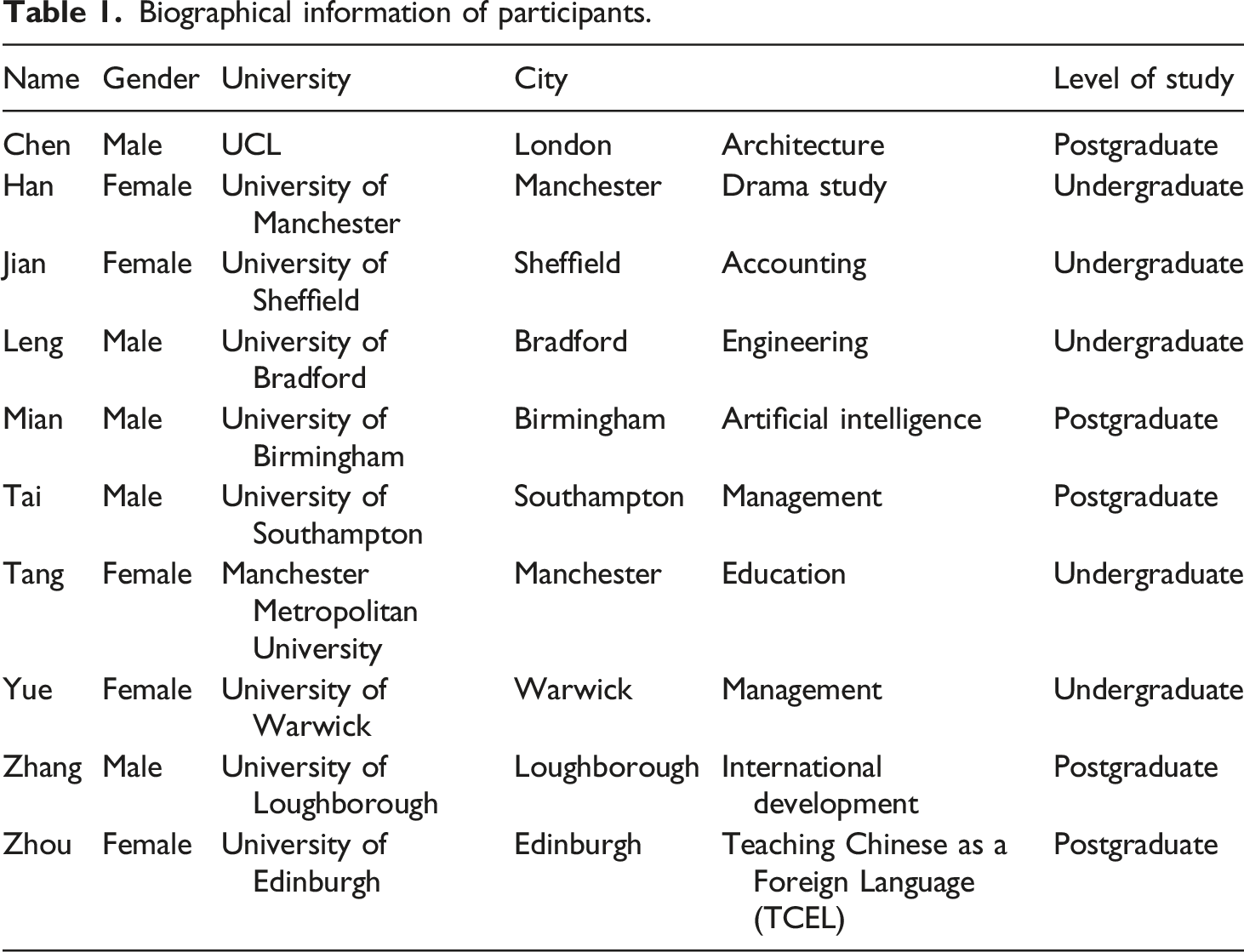
Translation context
Biographical information of participants.
Translation analysis
As well as themes being generated through the analytic strategy, the researcher-translator began identifying particular key phrases from the Chinese participants’ interview data. These phrases were used by some participants to describe their experiences of ISM. The translator realised that some of these Chinese phrases also resonated across the interviewees and echoed some of the shared experiences that the Chinese students articulated more widely in the interviews. Moreover, when translating several of these particular Chinese phrases, the researcher-translator sensed immediately the intermittent untranslatability of the phrases. In attempting to negotiate with the intermittent untranslatability of these phrases, she was acutely aware that she had to add ‘new’ elements in order to ‘make sense’ of participants’ expressions of their ISM experiences as evoked in the oral discourse of the interview excerpts being translated. These elements (of amplification in Poblete’s terms) are the ‘extra effect’ present in the original discourse; they are also the researcher-translator’s reflections on her position as linguistic/cultural de-/re-coder as well as her role as a legitimate importer of the Other’s discourse for dissemination. We thus decided to demonstrate some of the mediating work of the researcher-translator as she negotiated meaning from/with the interview participants in a way that we believe renders these phrases accessible to our English readers. In particular, we highlight the use of ‘amplification’ as outlined by Poblete, to demonstrate how the translator added new elements in the translated text.
In this article, we present the translation analysis of three particular Chinese phrases. We call these phrases significant phrases as, first of all, the uniqueness embedded in the structure of Chinese language is reflected in these phrases. Through the translation analysis of these phrases, we hope to demonstrate how each single Chinese character carries different meanings; how by putting single characters together, the Chinese phrases composed by these single characters represents more complex and subtle meanings. Through her engagement with the language structure involved in the translation and research process, the researcher-translator thus became wholly aware of the limitations inherent in the view that espouses translation as a simple process of finding word-by-word lexical correspondences. Secondly, these phrases are all idiomatic expressions through which we get a flavour of how the Chinese participants both experience and express their ISM world-view in their own language. As well as aiming for lexical equivalence, the researcher-translator also attempted here to enable the reader to understand the linguistic Other through recreating the referential situation equivalent to that experienced by research participants. The uniqueness embedded in the lived realities of these research participants – positioned as ‘the Other’ in both ISM and research terms – is reflected particularly by these significant Chinese phrases. We now provide further detail about the translations of each of these phrases.
Profound respect and humility (诚惶诚恐)
The phrase 诚惶诚恐 (profound respect and humility) (line 123) was utilised by one Chinese participant Tang when she was describing her feeling of talking to native English speaker. I’m not very confident when talking to British people. I’m fine with people from other countries whereas it’s like a fear of people from Europe and America, like a feeling of
This Chinese phrase 诚惶诚恐 includes four characters: the first character 诚 means sincere; the second character 惶 carries the means of being fearful; the third character is the same as the first one; and the last character 恐 means being or having a sense of panic. Putting all these four characters together, this phrase is a Chinese idiomatic expression that signifies a mixed feeling of profound respect, humility and cautiousness. As it is impossible to express such a concept in an English translation using only linguistic equivalence, the researcher-translator aimed to achieve conceptual equivalence by taking the phrase as a whole and restating it according to the coherent meanings represented by it as ‘profound respect and humility’. This process of translation/analysis was arrived at, at least in part, by applying Poblete’s operation ‘amplification’, which allowed the researcher-translator to go beyond what was stated explicitly in order to express what she felt was the key message underlying this phrase. However, her translational intervention here arose from her familiarity with the content of each individual participant’s story as part of their interview discussions. She also sensed the intermittent untranslatability embedded in this phrase and, as a linguistic and cultural insider, recognised the way that these Chinese research participants positioned themselves vis-à-vis native speakers and the dominant linguistic and cultural terrain in which they find themselves as ISM practitioners.
Extant literature about ISM has addressed and investigated Chinese students frequently and, in the main, these studies tend to construct Chinese students as being in deficit; lacking the necessary linguistic and critical thinking skills required by Western – and, by implication, dominant and universal – approaches to learning (Wang and Byram, 2011; Wang, 2012; Wang et al., 2012). Thus, when the researcher-translator engaged with this Chinese phrase as part of her translation/analysis, she recognised the ISM-associated context from which this idea of ‘respect’ and ‘humility’ emerged.
Tang, the participant above, further illustrated this constant feeling of profound respect and humility by reflecting on how, previously, she was largely unafraid of anything before going abroad, whereas now she was much more careful: she spoke about being afraid of offending people, of offending, unintentionally, all different people from different countries and cultures. Moreover, this sense of 诚惶诚恐 (profound respect and humility) was not only assignable to Tang. Another participant, Tai, also mentioned that Chinese students tended to be quite unconfident and adopted a respectful orientation when applying to (western) universities because of the high ranking accorded these institutions. Leng also stated several times during their interview that he felt he knew nothing when he first arrived in the UK. He felt that he needed to keep a modest attitude and try to learn as much as he could, and that this sense, consequently, resulted in his putting a great deal of additional pressure on himself.
On reflection, the researcher-translator herself no longer feels 诚惶诚恐 (with profound respect and humility) anymore and, found it difficult to remember whether she had the same, or similar, feelings when she first arrived in the UK 5 years previously. However, she senses that this failure to remember is not absolute. She can still remember one of her friends, who, having done her Master’s in Manchester (UK), returned to China after 3 years and imparted her central learning as an ISM practitioner in the UK: that if you do not know something, you’ve just got to ask people. This friend’s advice was replete with points of insight, and resonated with the researcher-translator as it reverberated with this feeling of 诚惶诚恐 (with profound respect and humility): ‘… don’t be afraid if they might laugh at you because this might be something everyone is supposed to know. Don’t worry about their accent and your terrible English. If you can’t understand what they say, ask them to repeat it politely. This is their country; it is natural that it seems there are lots of things you don’t know which they’ve already known since they were born.’
Engaging with the translation of this Chinese phrase 诚惶诚恐 (with profound respect and humility) triggered the researcher-translator’s memory; it reminded her of how she might have changed, but also of the emotional and embodied orientation that she adopted when first in the UK, and how she had not seen that reflected in any of the ISM literature that she’d been reading.
By applying amplification as part of the research analysis here, the researcher-translator hoped to illustrate the actions and feelings that can be attributed to this Chinese phrase 诚惶诚恐 (profound respect and humility). Approaching the translation with a keen sense of the intermittent translatability of the phrase helps to highlight the active agency of these international students who, in coming to the UK are not merely moving from one country to another. In this move, these participants are also traversing a series nexus points: of ‘foreigner’/native, of fluent/halting, or even of developing/developed. The translation here is meant to reflect the feelings of respectful deference involved in their goal of learning some advanced knowledge, in universities that occupy quite high positions on the HE global ranking system, often in the midst of most other classmates who can speak much better English. The researcher, in an act of translation, amplifies the participants’ deference, even whilst holding the sense that it is quite possible that if these very same Chinese students stayed in their host destination long enough, they might realise that their initial orientational assumptions are not necessarily fitting.
Quite scattered social circles (圈子比较散)
This phrase 圈子比较散 (quite scattered social circles) was utilised by one Chinese participant Tai to describe his social network in the UK as: I’ve got some quite scattered social circles
In Chinese, the first two Chinese characters comprise the word 圈子 which means circles – in a generic sense. The third and fourth characters together comprise the adjective 比较, which carries the meaning of ‘quite’ or ‘a bit’. The last character 散 means ‘scattered’, ‘dispersed’ and ‘not centralised’. Within the context of the research interview, the participant used this phrase to describe his social network(s) as an ISM practitioner. The phrase from the interview extract is thus presented for the reader as ‘quite scattered social circles’.
As a Chinese ISM practitioner herself and as an insider of the Chinese participant group, the researcher-translator engaged with this Chinese phrase with a sense of familiarity. The researcher-translator’s own experience of having scattered social circles, which she took as resulting from her status as a mobile subject, was echoed by her participants and their sense of making friendships on a strategic basis; of building and maintaining their social circles according to the needs of the setting and the interests that they shared with others when trying to establish themselves in an unfamiliar milieu. Rendering the phrase thus referenced the experience of integrating into the host country, of building a life space in that host country as an ISM practitioner, in the form of social circles built piecemeal, bit by bit.
Constant reflection on this unsettling and unsettled process of analysis-translation makes the researcher-translator realise that it is not invoking amplification in her translation of the phrase that bothers her most. What is most unsettling is not the nature of the friendship circles that she and her Chinese contemporaries actually build in the UK being described as 比较散 (scattered) but rather, that both she and her participants felt the need to describe their social networks thus. Leaning further into this metaphor of scattered social circles provokes further speculations: if these ISM practitioners’ friends are distributed like little scattered circles of stars in the sky, then what is the nature of, and from where does that black space come? This ISM experience reflects the nature of building a life space for these Chinese participants. Back in China, in their familiar milieu, they do not have to think about the ‘start’ of life, or the status of their friendship networks, because their lives in China are and have always been there. However, in making the move to, and finding themselves in, the UK, they were forced to identify clearly which part of their lives had been built properly, in which spaces they are located, how they are positioned and, concomitantly, in which spaces they are still wanderers.
Before landing in the UK, these students knew little about life in their future host country; the UK was like an empty space for them. Then life started from some different points for different people. Tai’s description of his social networks resonated with other participants’ responses. For example, Mian talked about how he made friends with several Chinese students who flew together with him from China to the UK. These friends, as he explained, went through the most challenging period of time in their transnational experience together: the time when they gradually left their respective homes but still hadn’t settled anywhere. They shared a mixed feeling of excitement and fear; they were all curious and, at the same time, felt the need to rely on each other. These participants also extended their academic life space, so they also had a group of studying mates who they would meet most often in the library. They also needed a social life, so they could lose themselves and have fun. As another participant, Chen, explained: he’s also got drinking mates and eating mates with whom he would do fairly superficial things together like just smoking and drinking. Furthermore, apart from what they have built, all the rest of the world is unknown for them, all the untouched spaces are part of the black sky for them.
Previous ISM research highlights the fact that socialisation with host-country students is especially difficult for Asian students in western educational contexts, and Asians tend to have homophilous social networks (Rienties and Nolan, 2014; Quinton, 2020). It also points out that these homogeneous social networks can impede Asian students’ adaptation to the host community in a long term (Kim, 2001). However, through our analysis/translation engagements with this Chinese phrase 圈子比较散 (quite scattered social circles), we hope to demonstrate more fully the bases on which these Chinese students actively take part in establishing their social networks based on their own needs and interests, aligning with their desires to construct their ISM life space whilst in the UK. The translation analysis thus helps to provide a more nuanced view into the nature and needs of Chinese students as they establish social and study friendship groups. We also argue that the analysis/translation offered here tends to avoid the oversimplifications that are inherent when discussions of successful ISM practice are positioned in binaristic ways: are international students socializing with host students or not? in order to integrate into the host community or not? Through our engagement with this Chinese phrase, the researcher-translator was also intrigued by the life reality of Chinese students (including herself) which made them state that their social circles are scattered.
Not fitting into the communal kind of life (不合群)
This Chinese phrase不合群 (not fit into the communal kind of life) was utilised by one Chinese participant Jian when she was describing some aspects in Chinese culture she did not like: Chinese people are too easily affected by the big family, which is such a pain of living in China. All of your businesses are others’ business. You always need to face the judgement such as not being good at getting along with people,
Three Chinese characters comprise this phrase 不合群 (not fit into the communal kind of life). The first character不 means negative, the second character 合carries the meaning of fit or in harmony with, and the third character 群 signifies group, flock or crowd. When putting these three characters together, it becomes a Chinese colloquial phrase to describe people who are not sociable, who do not get on well with others. In this case, the phrase cannot be translated literally as ‘not fitting into groups’ as such a literal translation would run the risk that the reader fails to receive that it is a way of living in China, a sense of being exposed to and being affected by people, that the participant was complaining about. The researcher-translator thus modulated the original discourse and retained Jian’s thinking about the self-disclosure and privacy issues in Chinese culture which she complained about.
Harrison and Peacock’s (2009, 2010) findings on how international students in general tend to be seen as ‘culturally distant or self-excluding’ from home students’ perspective is one that is common in the ISM literature. However, the current researcher-translator’s engagement with this Chinese phrase demonstrates a more nuanced view of these international students’ lived experience with forming social and study networks. Jian’s talking has resonance with other Chinese participants’ thinking of the undeterminable notion of communality in the UK, which involves a deep understanding of the boundaries of self-disclosure and privacy. For example, one Chinese participant Zhang talked about how he struggled to try to fit into the communal kind of life in the UK without being knowledgeable about the social and cultural mores of everyday communication: One thing I feel very curious about British people is, they barely ask you about anything proactively, anything about your country for example. Chinese people would always find out something to chat with you, so for foreigners, I suppose they never need to worry about nothing to talk about with Chinese people. However, sometimes I feel, without any reasons, that I’ve got nothing to talk about with British people. I reckon that for some British people, asking questions might be an invasion of their privacies whereas I don’t think it’s really a bad thing. It’s Ok you choose not to answer (line 121–126).
Another Chinese participant Zhou summarised the deviation he sensed with regard to the concept of communality in the British cultural context: Sometimes you think it is not really a big deal whereas they just keep silent all of sudden; sometimes you think it is their personal issue whereas they do not mind telling you about it (line 296–298).
By translating 不合群 (not fit into the communal kind of life), we hope to share with our readers the confusions Chinese students encounter when agentically conducting social practices in the UK. We also demonstrate how these students make efforts to gain a better understanding of the communality in the UK, which involves the concept of self-disclosure and privacy, and how these nebulous concepts and mores are performed in daily social communications. Considering the limitation of the research scope, what is expected to be shared in the Chinese communal kind of life, what are the similarities and differences between the discourse around ‘communality’ in Chinese and English cultural references, are beyond the translation issues discussed in this paper. What we are trying to argue here, is the limits in simply achieving lexical equivalence through the translation process, as even though the Chinese phrase is presented as ‘not fitting into communal kind of life’, what is considered as ‘communal’ in the Other’s discourse, is still, to a certain extent, incompatible with what might be considered so in, let’s say, the British context. We thus (re)argue here that there are limits in simply achieving lexical equivalence, that in translation one must go beyond the strictly lexical to further express the connotations embedded in the phrase under analysis. It is in the process of such translation/analysis that the researcher-translator becomes an importer of more than the purely linguistic, that in attending to the connotations and ineffable meanings attaching to linguistic expression that the lives of Others are more sensitively interpreted (and constructed) for readers who most likely do not share cultural referents.
We want to make clear here that the phrases chosen to present in this article were three of many others that were used by the research participants. We present these particular three phrases as exemplars of how a different and nuanced world-view can become apparent in seemingly mundane turns of phrase as part of a wider linguistic register. For example (see below): the phrase 诚惶诚恐 (profound respect and humility) denotes explicitly the deficit that the research participants perceived of themselves when they left their home country and stepped into an unfamiliar environment and culture. However, this phrase connotes very differently to the implied deficit that is predominantly conjured in respect of international students in mainstream ISM literature (Wang and Byram, 2011; Wang, 2012; Wang et al., 2012). By translating this phrase, we seek to not only represent a humble Chinese student figure but also, and more importantly, to illustrate where the humility and respect these students have might come from, as well as how their attitudes might shift and change across the duration of their ISM experiences. The phrase 圈子比较散 (quite scattered social circles) describes the process by which Chinese students gradually and actively build their social networks and life space in their host countries bit by bit, piece by piece. In translating this phrase, we aim to argue against the simplification inherent in dominant ISM discussions about the homogeneous friendship networks of Chinese students in the West and illustrate, instead, the complexities in their needs for establishing a meaningful, if expedient study/social life in the UK. The phrase 不合群 (not fitting into the communal kind of life) reflects the efforts Chinese students exert in making sense of the communications, encounters and interactions they conduct with/in ‘the West’. In translating this phrase, we gain insights into the contradictory nature of such students’ willingness to engage in intercultural communications whilst fearing causing offence to host-country students. Moreover, attending to the translation/analysis of this phrase attunes us to the inherent precarity of achieving a balance, even when such strenuous efforts are most likely constructed in mainstream ISM literature as superficial or unassertive attempts to integrate/assimilate.
Several researchers have paid attention to the ethical relationality of researchers position vis-à-vis their participants in translation studies (Gawlewica, 2016; Turhan and Bernard, 2022). In particular, we found Kouritzin and Nakagawa’s (2018) thinking about non-extractive research ethics particularly helpful when reflecting on the relational complexities faced by researcher-translators. These authors argue that western academic ethics frameworks are inevitably underpinned by pre-existing discourse codes which give researchers ability to act in a manner that sustains their own advantage and power (Kouritzin and Nakagawa, 2018). Instead, a non-extractive research ethics approach emphasises the relation between the researcher-translator and the participants and conceives of data (analysis) as an ongoing process of reflective negotiation about the power dynamics inherent in research representation. Kouritzin and Nakagawa propose five principles to guide non-extractive research: intent, integrity focus on process, social hostage and post-humanist outlook. We focus here on their intent and integrity principles as a basis for increasing the accountability of this research in terms of relational ethics. The intent principle is reflected in the current research through making explicit our aim of listening to the students’ own voices about their own stories. The choice of the particular Chinese phrases as exemplars of the focus of the translation/analysis highlights how participants’ own stories challenge some of the dominant and clichéd ISM discourses that claim to account from international students’ experiences. These phrases also imbricate the researcher-translator in actively ‘combating the dominant culture’s ways and norms’ (Kouritzin and Nakagawa, 2018: 683). Additionally, as a transparency check, extracts from interviews were presented in the original research report (Zhao, 2019) in Chinese and were then followed by the English language translation. The integrity principle is reflected most obviously in the constant reflection on the dilemmas and sense of unsettlement that the researcher-translator experienced as part of the translation process. It is also apparent through the transparency of her disclosure as she explored the dynamic and precarious nature of her on-going researcher positionality vis-à-vis her participants and her role as (publishing) ISM researcher.
Kouritzin and Nakagawa (2018) argue that western researchers often appear to consider insider/outsider positionality in reference to two axes: a horizontal axis that considers ascribed and seemingly fixed identity positions (e.g. race, sexuality and gender); a vertical axis that represents the values and perspectives of the studied community which are ‘“learn-able,” given enough time’ (Espinosa-Dulantos, 2004; Kouritzin, 2016). However, for Kouritzin and Nakagawa, this vertical axis imbues the dynamic complexity and mutability inherent in researcher positionality as on-going practice, rather than it being a simple one-off decision that can be made at the outset of the research (2018). The researcher-translator’s better understanding of Chinese students’ mobility experiences, as well as her relative familiarity of Chinese culture and language compared to English, seems to determine her as an ‘insider’. However, and at the same time, through the process of identifying and articulating the unsettlement in translation, she also became more aware of the shift of her researcher position. Her shifting (dis)position here is not that kind of position (ality) that is more usually defined and associated with being an insider/outsider of a particular group, and thus mastering a lens that claims to see things from this particular and given perspective instead of that one. Rather, it is more of a process of sensing if there is indeed a perspective, and engaging with the possibilities and potentialities of that perspective for the research. Following our reading of Kouritzin and Nakagawa, we posit that it is, thus, a process of making researcher positionality productive in the hope that this has benefit for those studied. Our reflections on, and suggested modes of praxis for, dealing with the relational ethics of the our research process seem to us to perfectly align with – and are indeed intrinsic to – the ethical care and attention required of researcher-translators when undertaking translingual, transcultural qualitative research. Indeed, such reflections and modes of praxis are wholly consonant with a more affirmative and asset-based exploration of ISM.
Concluding remarks
Translation has the potential to highlight not only what is accessible and understandable but also how that understanding is intermingled with different lived-realities, contexts and cultures. Conducting research in the linguistic Other’s first language creates the possibility of attuning to the Other’s own voice about their own life realities in their own voice, of reflecting the Other’s discourse based on their own linguistic and cultural references. However, when the interview script is translated, it is addressed to readers who possibly come from various and different linguistic, social and cultural backgrounds. The researcher-translator thus often finds themselves struggling in the practice of responding to two aims that are difficult to reconcile. On the one hand, they aim to maintain the coherence of the life experiences constructed and expressed in one particular language. On the other hand, they also seek to interpret the Other’s discourse in a way that they believe can be accessible and intelligible by their ‘foreign’ readers who might not be familiar with the historical, social and cultural contexts from which the interview discourse emerges. Research-translators must therefore never underestimate the challenges they are likely to encounter. In the article, we choose to present the translation process of three particular and significant phrases from our research interviews. We also discuss the translation analysis which shaped the (unsettled) achievement of conceptual equivalences between languages as well as extending our understandings of the language-based cultural contexts from which the phrases emerge. By applying Poblete’s framework, we explored a creative process of not only rendering intelligibility between languages but also embracing the potentiality for cultural exchange in the translation process of these significant phrases. We particularly highlight that analysing/translating interview scripts as part of the research is more than conducting simple memetic exchange between linguistic systems. It is also about understanding lives and life-worlds through analysis/translation/interpretation. We put emphasis on how the intermittent untranslatability involved in this complex process can be tackled by articulating in detail the ambiguities and unsettlement experienced by the researcher-translator on behalf of their interlocutors. Researcher-translators might also explore other frameworks based on which the interventions they exert, the challenges they face, the ambiguities and unsettlements they sense, and the insights they gain from their engagements with the translation process, can be reflected.
The aim of this article is not to raise objections to the translation of interviews as a convention within sociological writing, or to give final solutions to the issues regarding the invisibility of the interventions, manipulations and mediation necessitated by the researcher-translators in such increasingly frequent circumstances. Rather, we wish here to explore the possibilities of generating communication between the linguistic Other and the readers of research in more nuanced and productive ways. The article should be thus understood as an exploration and explication of a creative process – the process of translating spoken interview discourse into research ‘product’. This process of analysis/translation not only involves rendering intelligibility between languages; it also embraces the potentiality for cultural exchange through research that mediates the complexities of cultural diversity through a paradigm of exchange. English-language dominance in academic research and publishing tends to create hierarchies of knowledge and perspectives, with some being consecrated as legitimate while others as less powerful and legitimate (Xu, 2022). Our engagement with these three significant phrases helps to challenge some of the deficit discourse around Chinese students which is discussed above, and demonstrates how new meanings could be added to ISM research through the translation analysis that we conducted. The article thus opens the dialogue about how the involvement and engagements of bilingual researcher-translators with the translation process can make a significant contribution to cross-linguistic research and result in more nuanced understanding that are less Western-oriented when conducting translation/analysis as part of research with non-native first-language speakers.
From the methodological perspective, the specificity of the current research project brought about by the researcher-translator, who is a transnational and bilingual researcher, also a Chinese student studying in the UK, emerges from the translation/analysis process. The role played by researcher-translators differs from either the researcher or the translator. On the one hand, her understanding of Chinese students’ mobility experiences, as well as her mastery of both English and Chinese languages, made identifying correspondence and achieving lexical equivalence possible. On the other hand, her better understanding of Chinese students’ mobility experiences, as well as her relative familiarity of Chinese culture and language, compared to English, determines that the translation process presented in this article, is not the traditional translation focusing on identifying correspondence between words or concepts. In this respect, our work might only be fully appreciated by a small group of researchers. Nonetheless, in a broader sense, translating is ‘actively engaging in perceiving differently, interacting differently, and representing what we see and how we interact differently’ (Cook-Sather, 2012: 354). It is our hope that this discussion will be useful not only to researchers involved in ISM-associated research areas or by bilingual researchers who engage with translation as a process of research but also to anyone interested in a different way of representing and transforming the Other’s voices in qualitative investigations.
Footnotes
Acknowledgements
The first author as data collector would like to thank the 10 research participants for their punctuality and openness. The sharing of their experiences is not only the basis of the research but also helps the first author to see herself as both a transcultural, bilingual researcher and an international student herself.
Declaration of conflicting interests
The author(s) declared no potential conflicts of interest with respect to the research, authorship, and/or publication of this article.
Funding
The author(s) received no financial support for the research, authorship, and/or publication of this article.
