



Abstract
This study examines interviewers’ practices in managing conflicting institutional expectations of neutrality and rapport in interview interaction which are complicated by the normative expectation of antiracism. By applying conversation analysis and membership categorization analysis to sequences of interaction after interviewees’ possibly racist talk, we demonstrate that the interviewer deploys various interactional resources to orient to antiracism, while maintaining a neutralistic stance and sustaining rapport with interviewees. The interviewer’s orientation towards antiracism becomes more explicit as the interactions unfold. We argue that these practices are both constrained and enabled by the unique institutional features of qualitative interviews. Implications for research on race using interview data are also discussed.
Keywords
Introduction
Qualitative interviewing is a common data collection method in the social sciences. It is understood as well-suited for accessing people’s experiences and thoughts that are difficult to observe (Gerson and Damaske, 2020). To obtain rich data for analysis, interviewers work to meet two practical expectations when conducting interviews. First, they need to convey and sustain their neutrality in order to elicit unbiased accounts from interviewees (Gerson and Damaske, 2020; Weiss, 1995). Second, they are expected to build and maintain rapport with interviewees: interviewees need to trust and feel comfortable with researchers so as to openly share experiences and thoughts (see Gubrium et al. eds., 2012). Consequently, for interviews designed to access interviewees’ opinions and experiences, interviewers face a practical issue: “I want to establish rapport with the person I am interviewing, but that rapport must be established in a way that does not undermine my neutrality concerning what the person tells me” (Patton, 2015: 670).
General advice on interview practices are helpful resources. However, advice on maintaining interviewer neutrality and advice on building rapport can contradict. For example, while some researchers suggest that in order to obtain unbiased data, interviewers should not disclose themselves to their interviewees (Weiss, 1995), others argue that self-disclosure is a good strategy for engaging with and gaining trust from interviewees (Rapley, 2012). Amidst these recommended practices, interviewers must decide on which ones to adopt during interviews.
This practical issue can become more difficult when an interviewee’s talk is disturbing or problematic from the interviewer’s perspective. Some researchers retrospectively state that they often have to endure interviewees’ offensive talk and choose to act as unaffected (Dickson-Swift et al., 2009). Other researchers suggest that verbally ensuring neutrality while also admitting ideological differences between themselves and their interviewees can help build rapport and, therefore, ease this practical difficulty (Blee, 2002). However, limited studies have shown how exactly these competing demands are managed in the moment-to-moment unfolding of an interview interaction.
To address this lacuna, we examine the interviewer’s work of managing neutrality and rapport upon hearing possibly racist utterances from interviewees. We treat research interviews as a form of institutional interaction with unique characteristics. As persuasively argued by Hester and Francis (1994: 681), interview data gathered for the purpose of producing “sociological knowledge” are collaboratively constructed by both the interviewer and the interviewee(s) in the local setting of each interview interaction. Interactional practices, such as the ordering of sequences of talk and the introduction of topics, are constitutive of the data being generated (Hester and Francis, 1994). Therefore, examining interviewers’ practices, including those oriented to institutional and normative expectations of qualitative interviews, can also help researchers better understand their data when analyzing the data and making substantive contributions to their topics of interest.
In this study, we apply conversation analysis and membership categorization analysis to examine sequential unfolding of interview interactions when possibly racist utterances are made by interviewees. By analyzing interviews conducted with Chinese international students in Japan and the United States, we demonstrate that, constrained and enabled by the institutional features of qualitative interviews, the interviewer deploys various interactional resources to accomplish neutrality and rapport, while also orienting to antiracism in these moments with heightened tension among the competing institutional and normative expectations. Rather than generating advice for research practices, our goal is to explicate the interviewer’s interactional work in balancing these competing tasks of maintaining neutrality, sustaining rapport, and orienting to antiracism. Since the interviews examined in this paper are collected by one researcher, we anticipate that the practices adopted by other qualitative interviewers may be different. However, such a close examination highlights the fact that interview talk on racial matters is at least partially constructed by the interviewer’s practices in managing practical issues, such as neutrality, rapport, and antiracism. We suggest that researchers openly examine their own practices when generating findings from interview data in order to contribute to better knowledge and avoid doing injustice to interviewees.
Qualitative interviews: Institutional interaction, doing neutrality, and doing rapport
Qualitative interviews are institutional talks. Heritage (2005: 106) highlights three features of institutional talk: (1) participants orient to specific goals associated with their institution-relevant identities, (2) participants are subject to interactional constraints specific to the goal of the interaction, and (3) “inferential frameworks and procedures that are particular to specific institutional contexts” are used by participants. In research interviews, participants assume the identities of either “interviewer” or “interviewee.” The goal of the interaction is to successfully obtain data for research purposes. Institutional constraints include that the role of interviewer is to elicit information from the interviewee, and that the job of interviewee is to respond to the interviewer’s questions. Furthermore, interviewers should refrain from explicitly judging or identifying with interviewees’ positions while also maintaining rapport with interviewees.
One unique feature of interviews is their turn-talking system. Interviews commonly consist of question-and-answer sequences: an interviewer’s turns are mainly restricted to producing questions, and the interviewee’s turns are limited to providing answers (Heritage and Greatbatch, 1991; ten Have, 2004). Questions are not neutral, and advice on qualitative interviewing emphasizes careful wording and ordering of interview questions to obtain high-quality data (Gerson and Damaske, 2020; Weiss, 1995). Various actions, such as repair-initiation, challenge, and assessment, can be accomplished through questions. Thus, depending on the specific actions performed and their formats, questions make relevant interactional preference organization, such as preference for agreement to assessment (Pomerantz, 1984) and preference for type-conforming answer to polar question (Raymond, 2003). In the context of research interviews, many questions are designed to be responsive to interviewees’ answers by repeating their words (ten Have, 2004).
As questions are not neutral, neutrality or the “neutralistic stance” of research interviews must be accomplished locally (Heritage and Greatbatch, 1991). By examining news interviews, Clayman (1988) demonstrates that interviewers regularly change their “footing” when making assessments to distance themselves from being seen as holding those opinions. Another strategy commonly used by institutional speakers to display neutrality is to include evaluative or opinionated statements as components of questions (Clayman, 1988; Heritage and Greatbatch, 1991). Additionally, in journalistic interviews, interviewers produce statements that can be heard as questions to display their adherence to institutional formality (Clayman, 1988; Heritage and Greatbatch, 1991). These findings allude to the possibility that, while the neutrality of research interviews must be locally accomplished, the organizational features of research interviews provide built-in resources for interviewers to display neutrality in interview interactions: the neutralistic stance can be maintained by adhering to the question-answer sequential format that does not prevent interviewers from taking up a position regarding interviewees’ talk (see also Rapley, 2004).
Rapport also needs to be managed locally. Building rapport is not a once-and-for-all issue, as rapport can be weakened or lost during interactions (Gubrium et al., 2012). However, while rapport is one crucial methodological concept, it is ill-defined. Goudy and Potter (1975: 529–530) point out that building rapport is conceptualized as comprising various activities, including “generating free and frank answers,” building “harmonious relations or friendliness,” and achieving respondents’ acceptance of research goals and cooperation. Consequently, measures of rapport vary greatly, ranging from “frequency of smiles and nods” to “willingness of the participant to be reinterviewed” (Grinyer and Carol, 2012: 223). This paper treats rapport as locally achieved in interview interactions and focuses on practices of “doing rapport” that are empirically observable in interactions. In other words, instead of attempting to define “rapport,” we aim to investigate rapport as “emergent and observable conduct that unfolds in real time” (Prior, 2018: 490). We rely on the concepts of affiliation and alignment in conversation analysis (CA) to identify moments where rapport is being interactionally accomplished.
Affiliation and alignment constitute two levels of interactional cooperation: the ”affective” level and the “structural” level (Stivers et al., 2011; Stivers, 2008). Aligning responses to the prior speaker’s talk achieves cooperation “by facilitating the proposed activity or sequence; accepting the presuppositions and terms of proposed activity; and matching the formal design preference of the turn” (Stivers et al., 2011: 21). For instance, a story-recipient’s vocal continuers, such as “uh huh” align with the story-teller’s activity by allowing the teller to have “the floor until story completion” (Stivers, 2008: 34). In contrast, affiliative responses “cooperate at the level of action and affective stance” and are essentially “pro-social” for they “match the prior speaker’s evaluative stance, display empathy, and/or cooperate with the preference of the prior action” (Stivers et al., 2011: 21). For example, laughing at a joke is affiliative: it displays an agreement on the funny-ness of the joke (see Lindström and Sorjonen, 2012).
We suggest that by examining how interviewers align and/or affiliate with interviewees’ talk, we can start to empirically explore how rapport is managed locally. Affiliation and alignment are important components of the practices glossed as “rapport” by qualitative researchers (see Prior, 2018). Much advice on interview conduct can be understood with the concepts of alignment and affiliation. For instance, Rapley (2004: 26) suggests “that when listening, interviewers should be ‘going’ ‘mm’, ‘yeah’, ‘yeah, yeah’ alongside nodding, laughing, joking, smiling, frowning” to facilitate interviews. These practices are often done to align and/or affiliate with co-participants and are understood as doing so. Taking the CA approach, Koole (2003) shows that qualitative interviewers can establish rapport through affiliative practices, such as jointly constructing answers and confirming with interviewees’ responses; meanwhile, acknowledgment tokens can be used to show detachment from interviewees’ stances, thereby aligning without affiliating.
In summary, we suggest that by treating qualitative interview as institutional interaction, we can begin to study how researchers manage the tasks of maintaining neutrality and sustaining rapport in actual interview contexts. While being completely neutral is impossible, various practices can be done to display a “neutralistic stance” (Heritage and Greatbatch, 1991). Similarly, while rapport is ambiguously defined and difficult to measure, we can examine empirically observable practices wherein participants align and/or affiliate with each other. Adopting this approach, we focus on situations where the difficulty of managing neutrality and affiliation is especially acute: when an interviewee’s talk can be heard as racist.
Responding to racism in everyday and institutional talk
Discursive studies on race talk have highlighted the norm of antiracism (Augoustinos and Every, 2010; Whitehead, 2015). Existing research has examined how members of majority groups manage to avoid sounding racist while legitimizing negative views of oppressed groups and justifying group inequality (van Dijk, 1992; Wetherell and Potter, 1992). Societal members defend themselves and others against potential accusations of racism (Condor et al., 2006). Meanwhile, failing to sanction racist talk can be seen as being complicit with racism. As Condor et al. (2006: 459) suggest, the responsibility for racist talk “is shared jointly between the person of the speaker, and those other co-present individuals who occasion, reinforce or simply fail to suppress it.” However, recent studies have also suggested a norm against accusing others of being racist (Goodman and Burke, 2010), and people who make such accusations can be held accountable for being prejudiced (Whitehead, 2009).
Therefore, there are two contradictory normative expectations regarding antiracism in interaction: one should sanction potentially racist talk but also not overtly accuse others of being racist. The limited body of research on responding to racist talk in interactions has explored practices adopted by members to orient to such norms of antiracism (Robles, 2015; Stokoe, 2015; Whitehead, 2015). Even in institutional interactions where impartiality or neutrality is important, institutional speakers nevertheless orient to these norms (Stokoe, 2015; Stokoe and Edwards, 2007; Whitehead, 2015, 2018). For example, in radio call-ins, while maintaining neutrality, hosts are also expected to represent the general overhearing audience. Hosts often explicitly affiliate with callers’ anti-racist talk and openly admonish racism if callers admit to being racist and/or refuse to withdraw their racist talk after such opportunities are given (Whitehead 2015, 2018). In mediations, mediators sometimes explicitly challenge racist talk, despite the possible undesired outcome of losing those clients (Stokoe, 2015).
These findings suggest that institutional recipients can depart from their neutralistic stance upon hearing possibly racist talk. Meanwhile, the norm of antiracism makes it difficult for institutional speakers to affiliate with the producers of racist talk. Qualitative interviews have been widely used for studying people’s opinions on race and racism (Bonilla-Silva, 2014; Wetherell and Potter, 1992). However, little attention has been paid to how opinions reported by interview studies are co-constructed by interviewees and interviewers (see Watson and Weinberg, 1982). This study aims to examine whether the general observation of institutional speakers’ orientation to antiracism applies to research interviews by analyzing sequences of interactions following interviewees’ hearably racist talk. It focuses on describing the interviewer’s work of managing conflicting institutional and normative expectations during interview interactions. Following existing interactional studies on “everyday antiracism” (Robles, 2015; Stokoe, 2015; Whitehead, 2015), which focus on how “ordinary people resist or challenge racism” in mundane social interactions (Whitehead, 2015: 375), we treat participants’ interactional work which avoids affiliating with hearably racist utterances, recognizes the problematic nature of such utterances, and/or provides opportunities for such utterances to be withdrawn or mitigated as evidence of them orienting towards the norms of antiracism.
Data and methods
We apply CA in our analysis assisted with transcripts of interview interactions produced according to CA transcription conventions (Jefferson, 2004). The data corpus is based on 119 audio-recorded interviews with Chinese international students studying in Japan and the United States. The interviews, which lasted 2–4 hours each, were conducted in Mandarin Chinese from 2016 to 2018. All interviews were conducted by the first author. About half of the interviews were conducted in order to understand interviewees’ opinions on ethnic and racial matters. We focus on sequences where possibly racist utterances (henceforth PRUs) were volunteered by interviewees when describing an activity, making sense of a phenomenon, or explaining an opinion. A collection of 87 sequences of interaction is built accordingly. Transcripts in Mandarin Chinese are analyzed. We present two-line transcripts with English translations. All excerpts presented are from different interviews.
To identify PRUs and guide our analysis, we draw upon membership categorization analysis (MCA), a branch of ethnomethodological and CA studies developed from Sacks’ pioneering work (Fitzgerald and Housley, 2015; Hester and Eglin, 1997; Housley and Fitzgerald, 2002; Sacks, 1972; Schegloff, 2007). Sacks (1972) observes that members treat some social categories as going together, thus belonging to the same membership categorization device (MCD), that is, a collection of categories (see also Stokoe, 2012). For instance, the categories “whites” and “blacks” belong to the “race” MCD, the collection of racial categories. In addition, there are activities and characteristics commonly associated with social categories, which are category-bound activities and category-tied predicates (Hester and Eglin, 1997; Sacks, 1972). Using Sacks’ example, we can say that the activity of “crying” is bound to the “baby” category, and the predicate of being “caring” is associated with the “mommy” category (Sacks, 1972). As shown in MCA research, category-based commonsense knowledge, such as category-bound activities and predicates, are used by members to perform all sorts of actions (see Hester and Eglin, 1997; Fitzgerald and Housley, 2015). Meanwhile, the use of such knowledge in interactions can come off as conveying stereotypes and prejudices (Robles, 2015; Stokoe, 2015). Drawing upon these concepts, we define PRUs as utterances in which negatively evaluated activities or characteristics are proposed to be associated with members of a racial/ethnic category in general. We call such utterances as “possibly racist” to highlight that they could be heard as racist, while avoiding treating them as being definitely racially motivated.
We analyze interview data by treating them as interactions between interviewer and interviewee who orient to and manage local relevancies that emerge through talk and are set by the interview setting (Baker, 2002; Heritage, 2005; Roulston, 2006). A central principle guiding the CA approach is that both analysts and laypersons have to know both the compositional features of the talk and their sequential position in that interaction to understand the action being done (Heritage, 1984). By applying the CA approach, we show that the norm of antiracism becomes more explicitly oriented to as sequences of interaction unfold: the interviewer’s turns are designed in increasingly complex ways that indirectly problematize the PRUs.
Analysis
In excerpt 1, the interviewer ignores the interviewee’s PRU and only shows her orientation to neutrality, while no orientation to antiracism is observed.
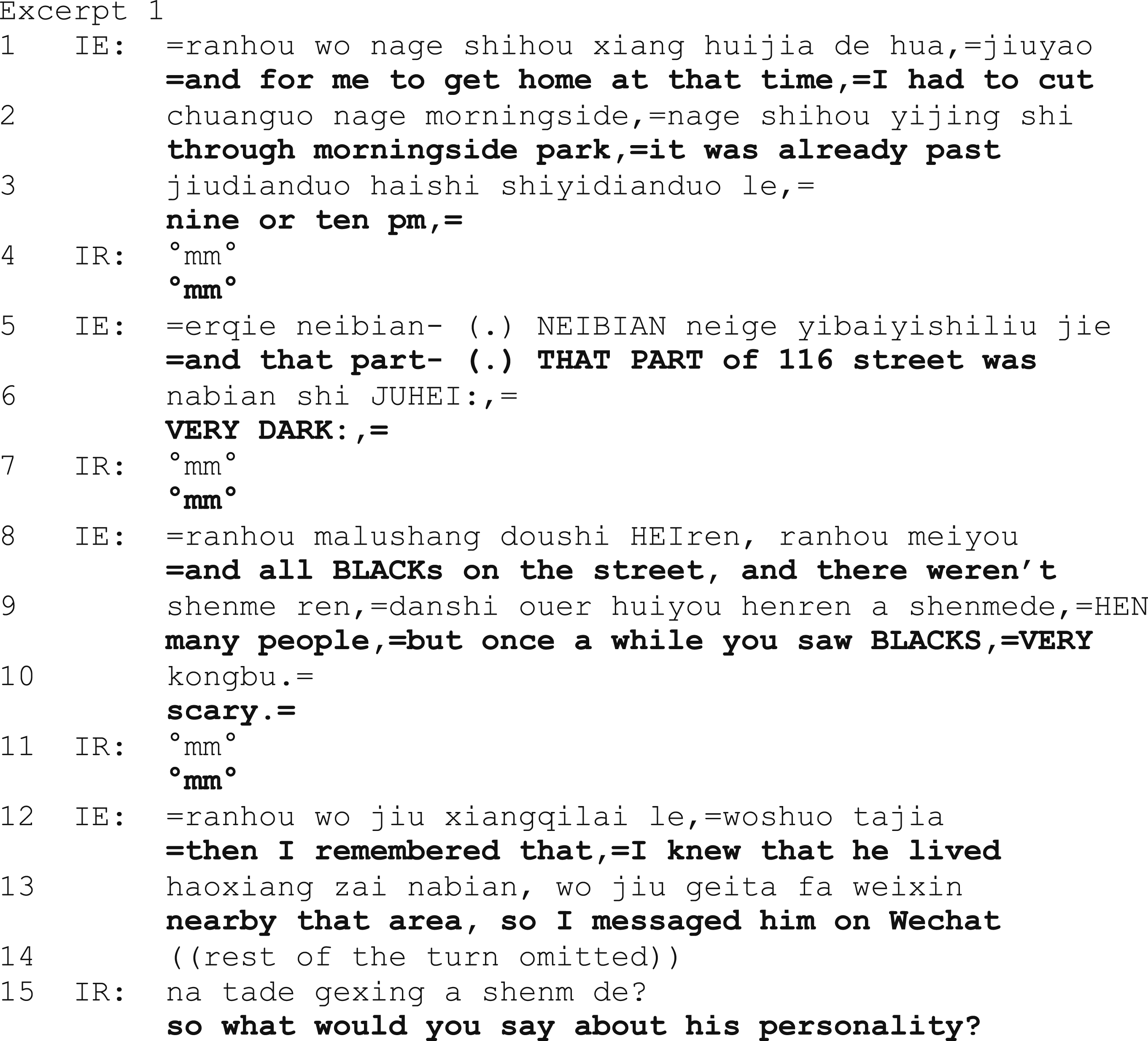
In lines 1–6, the interviewee (IE) explains why she felt unsafe walking home: she invokes place names, a late time, and descriptions of the physical environment. These can be heard as sufficient explanations. However, IE provides further justification for her fear by invoking the racial category of “blacks” (lines 8–10). While IE does not explicitly associate “blacks” with negative predicates, her utterance, which suggests that the street with many “blacks” are scary, constitutes a PRU. It implicitly associates the category “blacks” and negative predicates, such as being criminal, violent, and/or threatening. Without such categorical inference, the reason why she felt the street was scary would not be intelligible. The interviewer (IR) does not mention the PRU produced by the interviewee and only aligns by producing acknowledgment tokens. She proceeds to ask another question about IE’s friend, who is the topic of the discussion (line 15).
In a research interview, interviewers generally try to control the course of interviews by asking questions relevant to their research agenda (Mazeland and ten Have, 1996; Rapley, 2001). IR can reasonably ignore the PRU in this context, as her research agenda does not concern IE’s opinions on race. No orientation to antiracism appears in this excerpt. Instead, IR orients to neutrality by neither assessing nor mentioning the PRU produced by the interviewee. In this case, if IR pursued a follow-up question about the PRU, she could be seen as going out of her way to problematize the PRU, thus losing her neutralistic stance.
However, when interviews are conducted with the aim of understanding interviewees’ opinions on race, the interviewer cannot just ignore PRUs without probing them. Below, we present cases in which IR orients to neutrality, rapport, and antiracism in such interviews. In excerpt 2, IR displays these orientations with minimal interactional work.
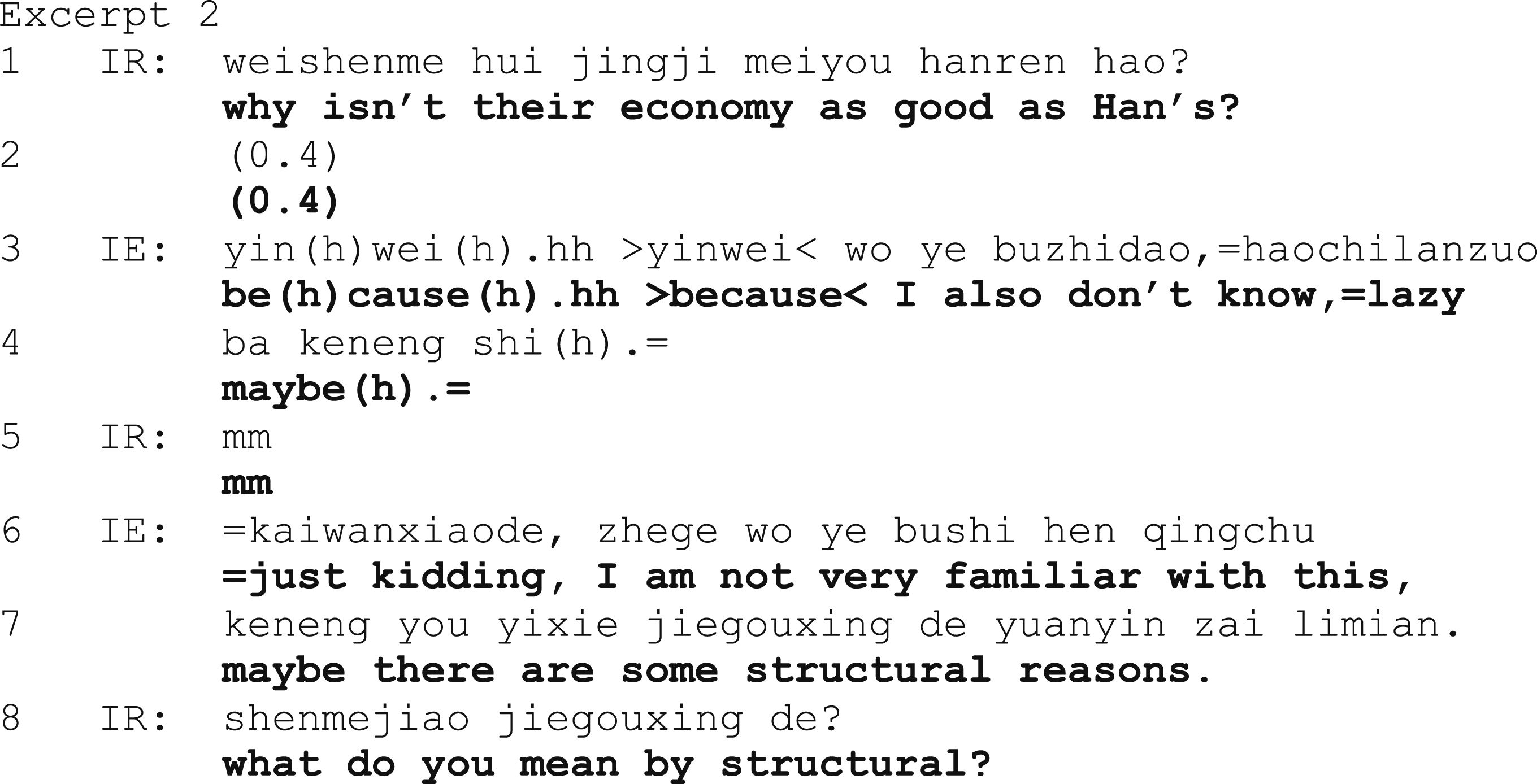
In previous turns (untranscribed), IE mentioned that Uyghurs generally have worse economic conditions than Hans in China. IR asks the reason for this difference (line 1). In response, IE starts with breathy sounds that could be heard as suppressed laughter (line 3). This beginning of the turn foreshadows the possible inappropriateness of what is coming forth. IE then produces a PRU: he associates the category Uyghurs with the negative predicate of being “lazy” (lines 3–4). Notably, in line 5, although IR could show her affiliative attitude by laughing together with IE (Jefferson et al., 1987), she just says “mm,” which only aligns with his talk (Stivers, 2008). Responding to the IR’s non-affiliative stance toward his PRU, IE quickly says “just kidding,” denying any malicious stance in his PRU and reduces its seriousness (line 6) (Stokoe, 2015). Then, without laughing, he provides an unproblematic alternative explanation by mentioning “structural reasons” instead of any negative traits associated with the category “Uyghurs” (line 7). IR requests clarification about “structural reasons” instead of asking a question about the PRU (line 8). By claiming that the PRU is just a joke, IE preempts interviewer’s uptake of the PRU. IR would be held accountable if she decided to pursue an unserious statement rather than focusing on IE’s hearably more serious response: IR could be seen as biased and motivated to explore IE’s problematic talk.
In excerpt 2, while IR’s orientation to neutrality in research interviews is shown in her not mentioning the PRU, her orientation to antiracism is also observed in that she does not produce an affiliative response but just an alignment to IE after he produces the PRU. In the following excerpts, IR shows her orientation to antiracism more explicitly by asking questions about PRUs, while also managing affiliation and neutrality.
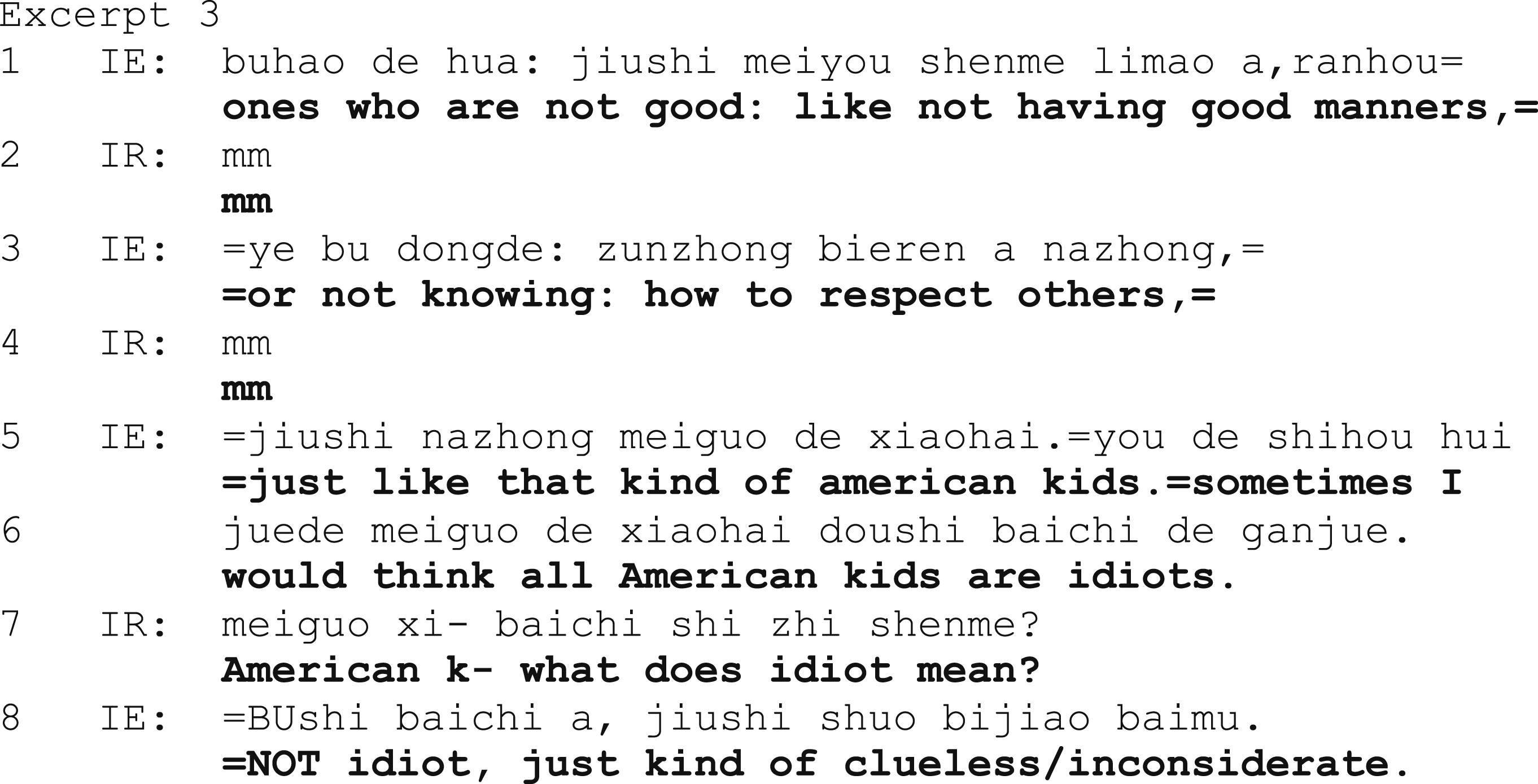
Prior to excerpt 3, IR asked IE about what she thinks of American peers in general. IE responded by saying there are good and not-so-good ones. IE explains that the ones who are not good are the ones who do not have “good manners” or do not “respect others” (lines 1, 3). IE further categorizes those “not good” ones as the “kind of American kids,” instead of any other kind of kids (line 5). While her description of American kids so far is not regarded as problematic by IR, IE’s utterance in line 6 is intelligibly a PRU. It associates the category “American kids” and the negative predicate of being “idiots” by using an extreme case formulation (Pomerantz, 1986), which generalizes such association. With some initial troubles formulating a response, IR asks a “what does X mean” question about the PRU (line 7). Notably, IE does not understand it as a request for information but as a potential challenge to the PRU she produced (Raymond and Sidnell, 2019; Schegloff, 1997). IE’s understanding is shown in her response where rather than elaborating on American kids being “idiots,” she replaces “idiot” with “clueless/inconsiderate” (line 8). Arguably, IE’s statement is still problematic since it associates negative traits with a whole category of people. However, replacing the term “idiot (baichi)” with “inconsiderate/clueless (baimu)” can be regarded as a qualitative mitigation of the PRU: the term “baichi” in Chinese originally referred to people who have severe intellectual disability, despites its more casual use for describing stupid people and things. In addition, adding the expression “just kind of” reduces the extent to which “American kids” is associated with negative predicates, thus mitigating the previous PRU. By replacing the category-bound predicate previously introduced by IE herself, she shows her understanding that IR’s interrogative utterance in line 7 does not pose a mere question but challenges the association between the category “American kid” and the predicate of being “idiots.”
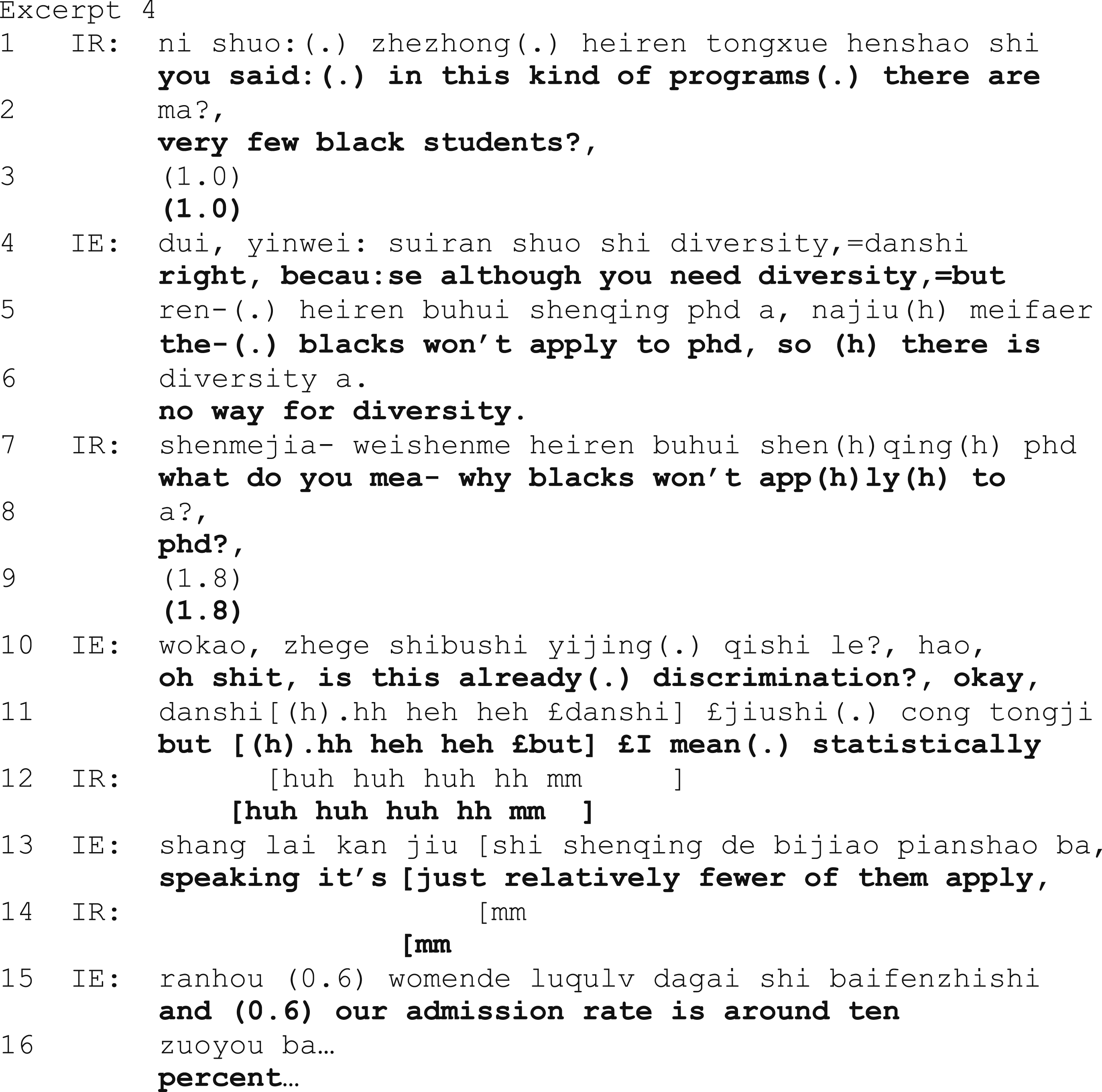
Excerpt 4 is similar to excerpt 3 in terms of the sequential structure of interactions. IR asks a “why” question (lines 7–8) about IE’s PRU produced in line 5 (“blacks won’t apply to PhD”), and IE mitigates the PRU by qualifying his statement (lines 10–11 and 13). IE’s utterance in line 5 constitutes a PRU: it associates the category “blacks” and the predicate “won’t apply to PhD” in general. Similar to excerpt 3, by mitigating his PRU, IE shows his understanding that IR’s question may be a challenge to the proposed association (Raymond and Sidnell, 2019; Schegloff, 1997). In addition, IR’s question includes laughter (line 7), which can be heard as displaying an ambiguous and less serious stance towards IE’s PRU while providing IE an opportunity to withdraw or mitigate it. After IR’s question, IE remains quiet for almost 2 seconds and then explicitly asks whether his talk constitutes discrimination. IE has evidently recognized IR’s orientation to antiracism and treated her question as a challenge to the proposed association between the category “blacks” and the predicate “won’t apply to PhD.” IE shows that he notices the inappropriateness of his previous talk by laughing in line 11, in which the association is no longer implied to be normative but is only presented as a “statistical” association. Importantly, IR laughs after IE has negatively assessed his own statement. In conversations, disagreement is normatively expected after the previous speaker’s self-deprecating assessment (Pomerantz, 1984). While the laughter here could be understood as showing IR’s orientation to neutrality of interviews by avoiding explicitly judging IE’s talk, the lack of explicit disagreement could also be interpreted as IR implicitly agreeing with IE’s assessment of his own talk. In this case, while IR affiliates with IE by laughing with him (Jefferson et al., 1987), she does so only after IE assesses his own PRU as problematic, thereby also orientating to antiracism.
The above two excerpts illustrate a typical phenomenon found in our data collection. After IEs produce PRUs, IR asks “why” or “what does X mean” questions about the PRUs. These questions are understood as signaling challenges or disagreements to IEs’ PRUs, which is followed with IEs mitigating their PRUs. In research interviews, interviewers are expected to ask questions, which allows them to challenge interviewees’ talk in question format (Stivers and Rossano, 2010). In these excerpts, IR orients to both antiracism and neutrality by producing question-sounding challenges, without explicitly stating her opinions nor assessing IEs’ PRUs.
In the following, we analyze more complicated cases wherein various question designs are adopted by IR to orient to antiracism while managing neutrality and affiliation.
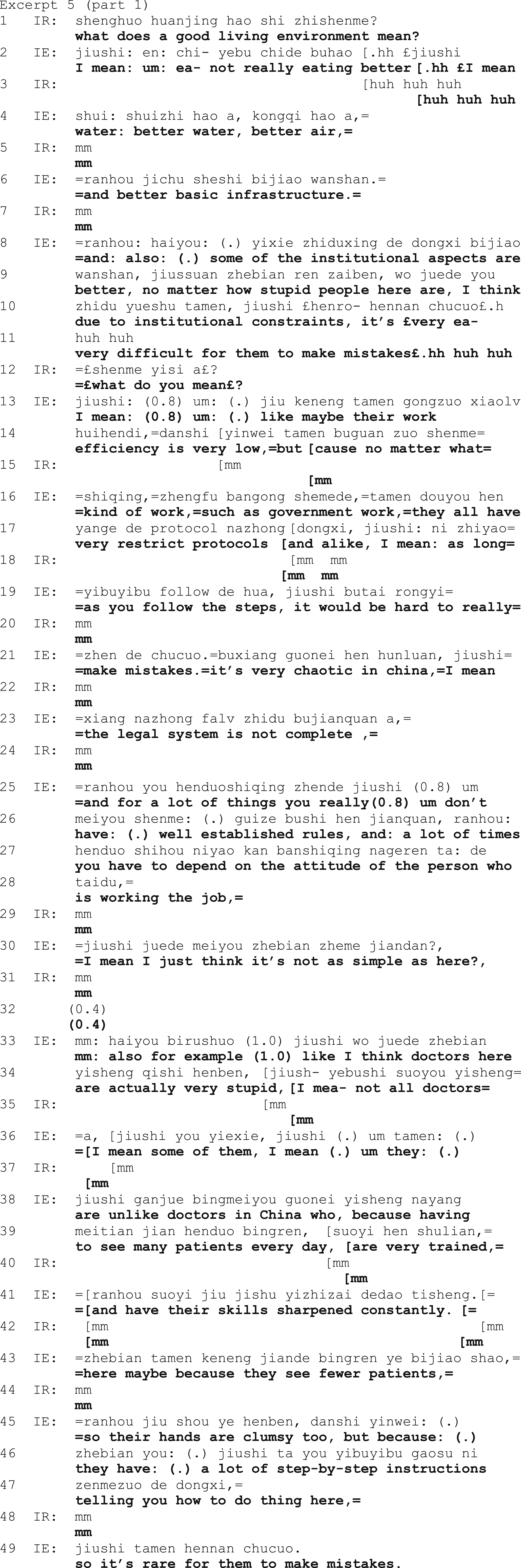
Prior to excerpt 5 (part1), IE said that the living environment in the United States was good. IR requests further information about this statement (line 1). In her explanation, IE produces a PRU by implying an association between the category “US people” and the negative predicate “stupid” (line 9). IR asks “what do you mean?” with a smiley voice (line 12), showing her orientation to treat the PRU less seriously while also affiliating with IE’s laughter. While “what do you mean?” could be understood as a challenge to the target utterance rather than a request for clarification (Raymond and Sidnell, 2019; Schegloff, 1997), in this excerpt, IE elaborates without mitigating or withdrawing her PRU. IE then produces another possibly problematic utterance (“doctors here are actually very stupid”), though she mitigates it (lines 33–34). The interaction unfolds as follows after IE elaborates more on US “doctors” being “stupid” (lines 35–49).
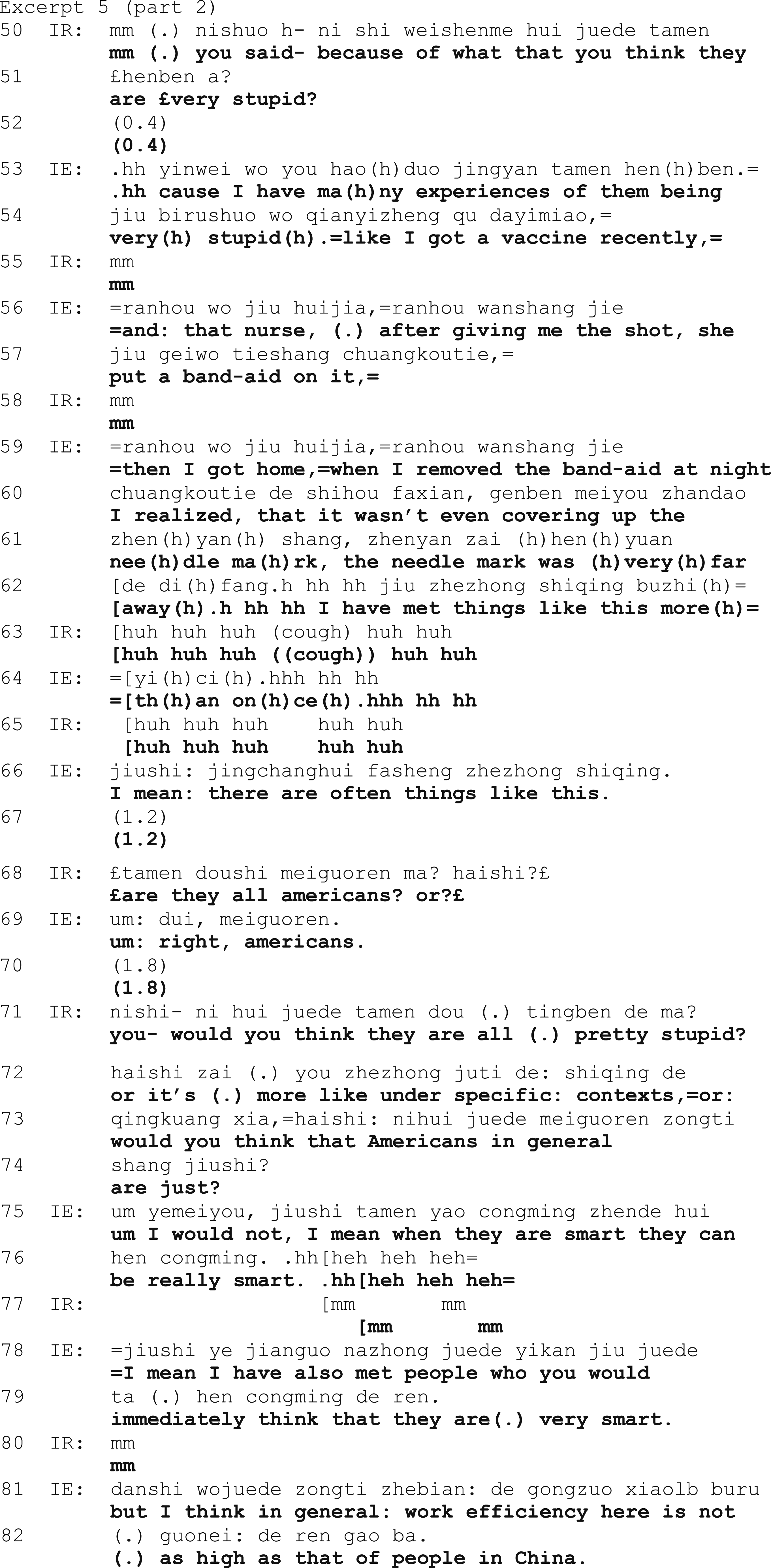
IR then asks IE about the reasons why she thinks so (lines 50–51). IR’s smiley voice in saying “very stupid” again shows her stance of treating IE’s PRUs as more humorous than serious. In response, IE does not deny the US doctors’ “stupid[ity]” but her laughter shows her stance of also treating her story as funny rather than a serious attack against Americans (lines 62, 64). IR affiliates with IE by laughing together (lines 63, 65) (Jefferson et al., 1987). In a more suppressed smiley voice, IR asks a question to confirm whether the story is evidence of the proposed association by invoking the category “American” (line 68). IE confirms by repeating the category (line 69). Importantly, it is unclear whether IR is affiliating with IE’s humorous stance or the gist of the story (i.e., “Americans are stupid”) when she is laughing along with IE. IR then asks IE a question in order to negotiate the association between “American” and “stupidity” (lines 71–74) (Raymond, 2019). This utterance contains “extreme case formulation” by asking whether “all” Americans are stupid, which cannot be literally true (Pomerantz, 1986; Robles, 2015). Moreover, the question presents candidate answers, including one that proposes an extremely strong association between the category and the negative predicate and is hearably more prejudiced, thereby inducing IE to choose the less problematic candidate answer. IE uses the opportunities to modify her PRU by offering counter examples of “really smart” Americans. Doing so negates the extent to which the predicate “stupid” is bound to the category “American,” while maintaining her judgment about differences of work efficiency between the Americans and the Chinese (lines 75–82).
Unlike in excerpts 3 and 4, IR’s “what do you mean” question in excerpt 5 is not understood by IE as a challenge to her PRU, and she does not mitigate or withdraw it immediately after the question. IE only mitigates her PRU when responding to the question with candidate answers. By using various question designs that offer IE opportunities to mitigate her PRU, IR orients to the expectations of antiracism and neutrality, while also doing rapport by laughing after and along with IE.
Excerpt 6 (divided into three parts) contains longer sequences with more explicit challenges to IE’s PRU.
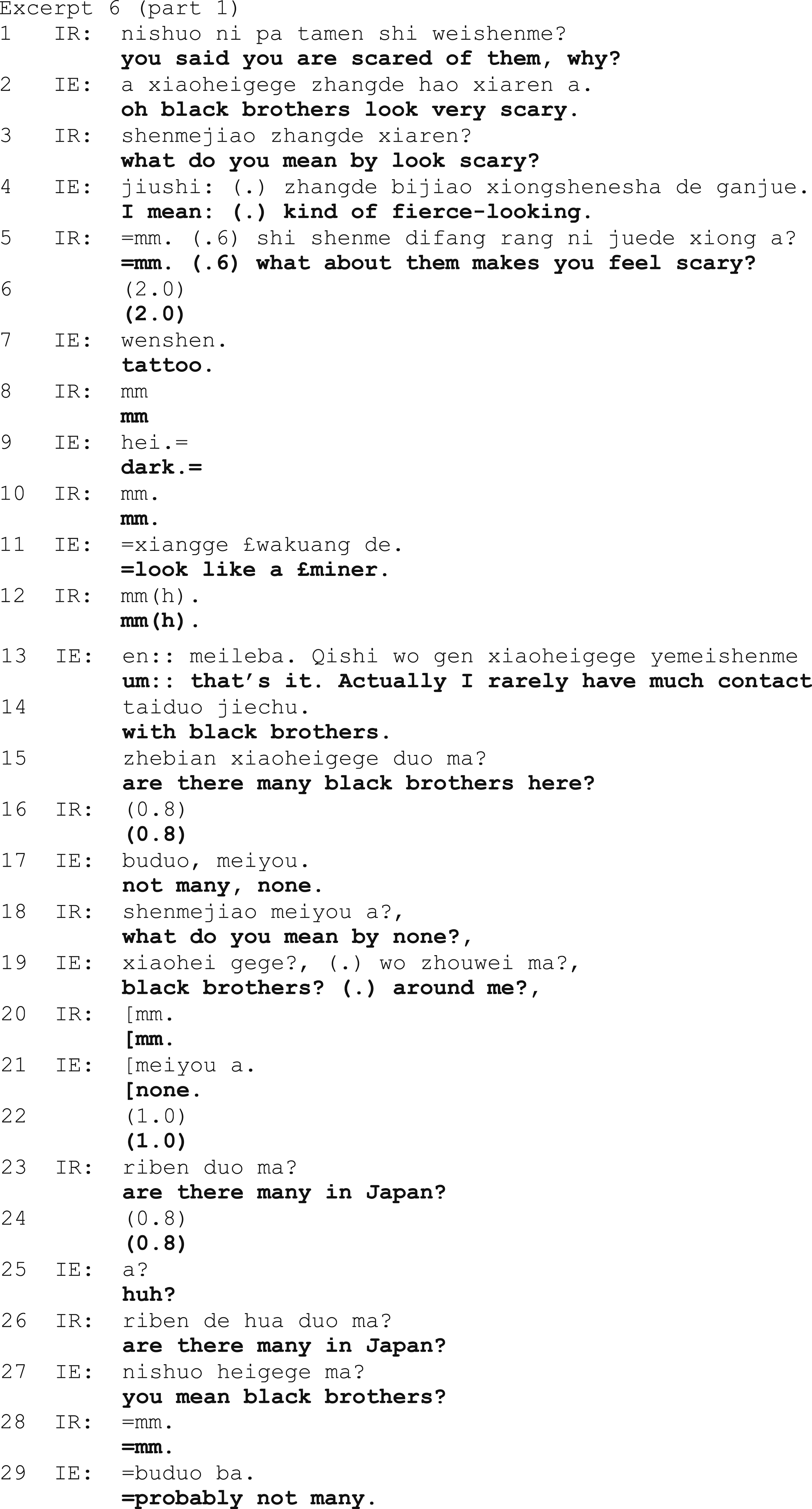
In line 2, IE produces a PRU by explicitly associating the category “black” and the negative predicate “scary.” IR then asks a “what do you mean + repeat” question (line 3). IE does not treat the question as a challenge to her PRU but only explains what she means by associating predicates such as “having tattoos,” “being dark,” and “looking like miners” with blacks (lines 7–11). IE also implicitly admits that her impressions of blacks have no valid empirical bases (lines 13–29).
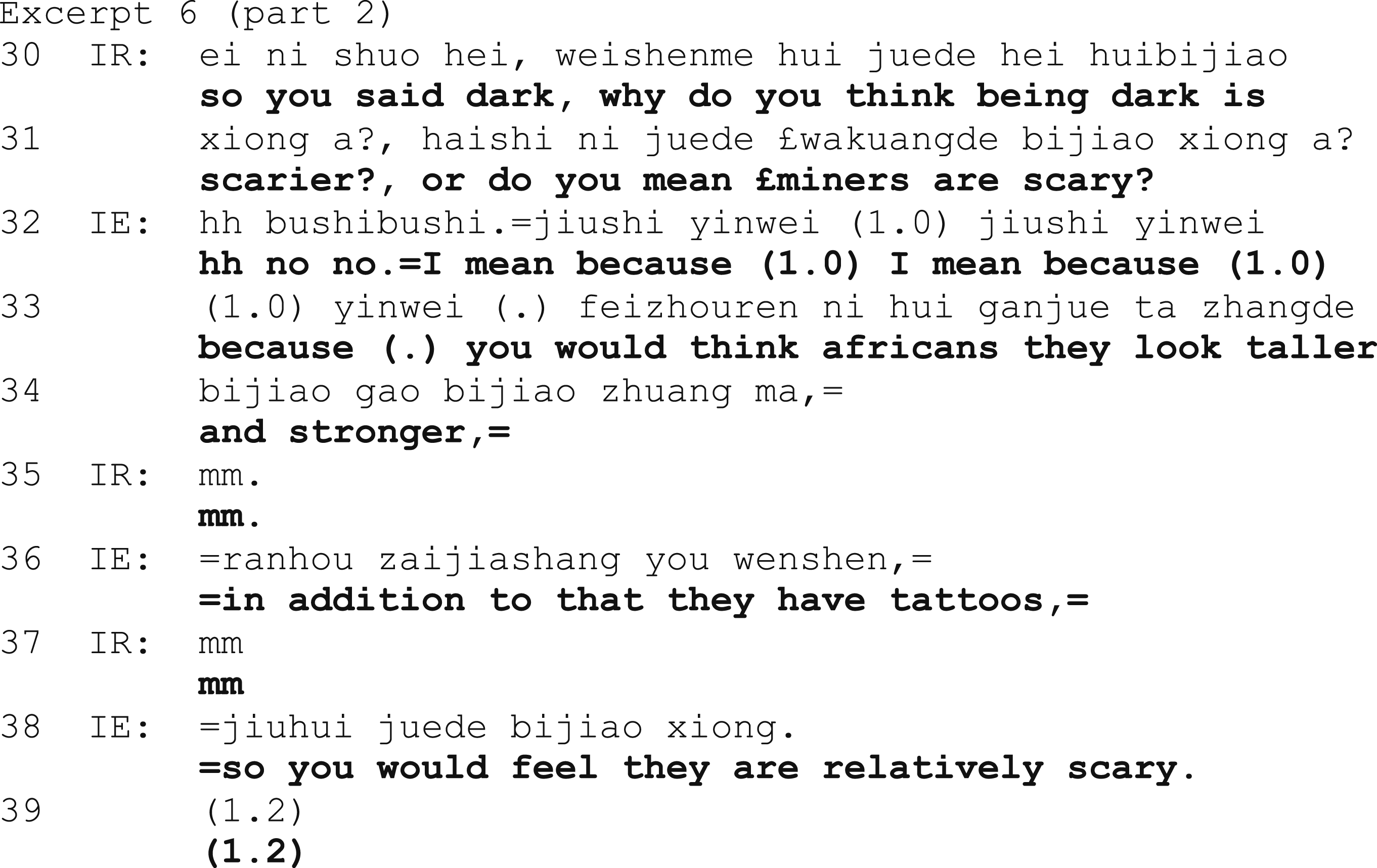
Notably, repeating IE’s words, IR asks IE a question offering two candidate answers: IE is scared of blacks because they are “dark” versus because they “look like miners” (lines 30–31). However, for anyone familiar with Chinese culture, it is understood that “looking like a miner” is just a different way of saying someone is “dark,” given the stereotypical image of miners with faces covered with coal dust. Therefore, IR’s question may sound ridiculous, as it treats the two expressions as meaning different things when they both refer to the same trait of “being dark.” Both IR’s smiley voice and IE’s suppressed laughter at the beginning of her turn seem to orient to the funniness of this question. Nevertheless, the two candidate answers—if understood literally—are asymmetrical in terms of racism, as the statement “’black brothers look very scary’ because they are ‘dark’” sounds more racist than the statement “’black brothers look very scary’ because they look like ‘miners’”, though the latter might sound classist. Therefore, on the surface, the question offers IE an opportunity to choose the less racist answer. However, IE cannot really choose the latter without agreeing to things she does not mean. If she chooses the former, she will come off as racist. In response, IE chooses neither, thereby denying finding “blacks” scary because they are “dark.” Furthermore, IE invokes the category “African” instead of “blacks” (line 33). This categorization practice, which employs the regional (or continental) MCD instead of the race MCD, may imply that she does not use race as evidence of them being “scary” at this point. She also associates the category “African” with the predicate “taller and stronger,” which would not be negative in other contexts. While her categorization practice shows some orientation to antiracism, her answer still contains a stereotypical description of “blacks” or “Africans.” Although she withdraws part of the PRU, her orientation towards antiracism remains unclear, and the question-answer sequence regarding her PRU in line 2 continues. This makes excerpt 6 different from excerpt 5.
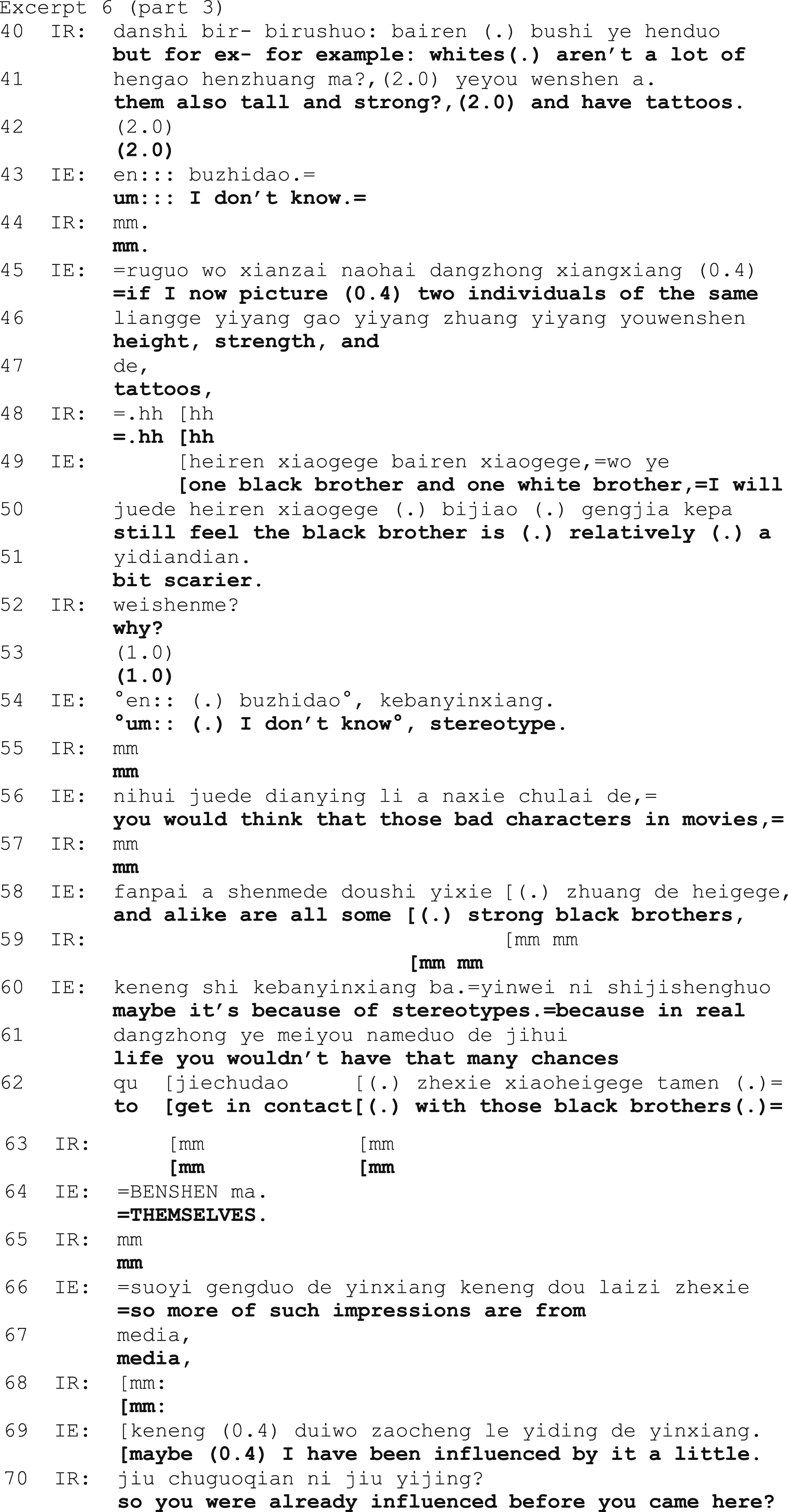
In lines 40–41, IR challenges IE by saying that those traits are not only true of blacks but also of “whites.” By explicitly mentioning another category from the race MCD, IR resists the association between the category “blacks” and the predicates. IR’s challenge is formulated as based on general knowledge about physical appearances of “whites,” instead of her own knowledge of “whites.” In doing so, IR sustains her neutralistic stance and refrains from personally judging IE’s statement interviewers (see also Clayman, 1992; Roth, 1998). Deployed as a question, IR’s response also allows IE to clarify or modify her statement about “blacks.” IE maintains that blacks are scarier than whites even when everything else is equal (lines 49–51) and admits that this idea is based on her stereotypes. This admission reduces the validity of the association between the category “black” and the negative predicate “scary” that she herself initially introduced (line 54). This also reveals IE’s understanding that the sequence of interaction has been about the potentially racist nature of her talk. By attributing her negative thoughts about “Africans” or “blacks” to stereotypes, IE displays to IR her own orientation towards antiracism. For IR, this admission seems to be a satisfying resolution: she moves on to ask a question not related to the PRU.
In this excerpt, IR again orients to neutrality by not explicitly evaluating IE’s PRU. IR deploys various interactional resources, including questions offering candidate answers and questions highlighting the potentially racist nature of the PRU, to give IE multiple opportunities to mitigate the PRU or admit stereotypes behind it, thereby balancing the orientations to neutrality and antiracism. In other words, IR designs her questions in different ways to mobilize IE’s response in which IE can clarify, mitigate, withdraw, or admit stereotypes behind the proposed association between “blacks” and those negative traits. IR’s orientation towards the norm of antiracism becomes more explicitly observable in her question design as the sequence unfolds and no sufficient mitigation is produced.
Discussion
Existing studies have reported that immediately accusing a speaker of racism after a PRU is dispreferred in interactions. Instead, participants often give the speaker opportunities to account for or withdraw the PRU (Robles, 2015; Stokoe, 2015; Whitehead, 2015). We show that an interviewer in research interviews deals with PRUs produced by interviewees in similar ways. The interviewer can ignore the PRU (excerpt 1) (Stokoe, 2015) or provide a minimal response that shows her detachment from an interviewee’s PRU (excerpt 2) (Koole, 2003). The interviewer can also implicitly challenge PRUs by asking “what do you mean” and “why” questions (excerpts 3–4): while they can be heard as requests for more information, they can also be heard as incipient disaffiliation and initiation for repair (Raymond and Sidnell, 2019; Schegloff, 1997). In the context of following a PRU, such a question can be heard as the interviewer challenging the proposed association between the negative trait(s) and the racial/ethnic category, without having to explicitly voice her disagreement. Finally, the interviewer can formulate follow-up questions that make the problematic nature of a PRU more explicit (excerpts 5–6) (Robles, 2015). Such interactional work gives interviewees opportunities to display orientations towards antiracism and to distance themselves from the views they recognize as being problematic: interviewees can mitigate and/or withdraw their proposed association between a racial/ethnic category and some negative trait(s), and they can also admit the prejudiced nature of such associations. Importantly, interviewees are not compelled by interviewers’ questions to change their opinions. Rather, interviewees choose whether to modify or insist on their statements. Either way, by responding to the interviewer’s follow-up questions, interviewees elaborate more on their PRUs.
When dealing with PRUs, the interviewer is constrained and enabled by features of research interviews, which are commonly understood as consisting of question-answer sequences. Her challenges to the PRUs are always accomplished by asking questions, which shows her adherence to the turn-taking organization of research interviews. Questions could always potentially be heard and justified as neutral questions requesting more information. Accordingly, interviewees could respond by elaborating on the PRUs with or without orienting to their potentially problematic natures. Similarly, the interviewer can always be justified to ask follow-up questions on the topic of interest. These questions can be designed to display antiracism attitudes to various degrees of explicitness. Therefore, even when the interviewer makes explicit challenges in questions, she is still hearably “doing interviewing” and maintaining a neutralistic stance.
Institutional norms suggest that interviewers should maintain rapport with interviewees. In all the excerpts, the interviewer displays at least minimum alignment after the PRUs are produced. In multiple cases, she actively affiliates with the interviewees by laughing with interviewees, without explicitly indicating what she is affiliating with (see also Hak, 2003). We demonstrate that the institutional expectation of maintaining rapport is a strong constraint of what interviewers can do when responding to PRUs. Unlike interactions in other institutional settings (Stokoe, 2015; Whitehead, 2015), the interviewer never explicitly admonishes interviewees nor abandons the interactions, despite deploying various interactional resources oriented to antiracism.
We show that the seemingly contradicting requirements of neutrality and rapport are accomplished locally, even when this difficulty is intensified by the norm of antiracism. This is done by exploiting the features of research interviews as a form of institutional talk. The goal in the above interviews (excluding excerpt 1) is to collect data about interviewees’ opinions on race. This explains the interviewer’s series of questions about PRUs, thereby justifying the work that orients, at least partially, to manage neutrality, rapport, and antiracism in that interaction. We anticipate that practices adopted by other interviewers will differ from practices examined here. Nevertheless, those practices are likely to be similarly enabled and constrained by the institutional features of research interviews. Likewise, close examinations are needed to demonstrate the consequences of those practices.
Finally, while interviews are commonly used by researchers interested in exploring people’s opinions on race, our analysis suggests that opinions on such complex issues are also shaped and modified during the interview interactions. It is not always the case that speech at a certain point reveals pre-existing fixed thoughts of the interviewee. Instead, it is through the actions in the interactional contexts of interviews, such as the acts of mitigating, withdrawing, or referring to stereotypes, that participants’ thoughts on race are presented. Consequently, researchers should analyze and present interviewees’ talk as a part of the interview interactions. Removing interviewers’ practices from analysis risks doing injustice to interviewees. While we do not advocate that the practices examined in this paper are either good or bad, we demonstrate how interviewers’ practices should and can be examined.
Acknowledgements
We thank Barbara Entwisle, Tania Jenkins, Lisa Pearce, and two anonymous reviewers for their constructive feedback on earlier versions of the paper.
Footnotes
Declaration of conflicting interests
The author(s) declared no potential conflicts of interest with respect to the research, authorship, and/or publication of this article.
Funding
The author(s) received no financial support for the research, authorship, and/or publication of this article.
