



Abstract
Due to the COVID-19 pandemic, a sudden shift was warranted from face-to-face to digital interviewing. This shift is in line with the existing trend of digitalization. However, limited literature is available on how to conduct focus group interviews online successfully. This research note provides practical guidelines, tips, and considerations for setting up and conducting online synchronous focus groups for eight relevant factors: preparation, the number of participants, the duration, a break, the usability of the online platform, the interaction between participants and researchers, support and roles of the research team, and privacy considerations. These guidelines were formulated based on the available literature and our own positive hands-on experiences. We consider online focus groups to be an excellent option when taking into account the considerations related to the eight factors.
Interviewing, such as focus group interviewing and in-depth one-on-one interviewing, is a commonly used method in qualitative research. Even though information and communication technologies such as telephone or teleconference platforms have been used to conduct interviews, social researchers have—over the years—mainly conducted interviews face-to-face. Due to the COVID-19 pandemic, a sudden shift was warranted from face-to-face to digital interviewing. This shift was in line with the existing trend of digitalization (Thunberg and Arnell, 2021). Using the internet for social and health science research enables continuity in times when in-person social interactions should be limited due to COVID-19 preventive measures. Furthermore, it is also a valuable technique to reduce constraints related to time and money, and to tackle problems related to physical mobility and the geographical location of participants (Forrestal et al., 2015) and is useful in different patient populations (Lally et al., 2018) and for health professionals (Matthews et al., 2018). Online interviewing thus has merit beyond the COVID-19 pandemic.
This research note focuses on digital synchronous (i.e., real-time) group interviews. Limited literature is available on how to conduct focus group interviews online successfully. The available literature suggests that participants in digital focus groups are comfortable sharing their experiences and ideas in an online environment (Matthews et al., 2018; Mayer et al., 2006). Moreover, the quality of the data from online focus groups seems to be comparable to the data from face-to-face focus groups (Abrams et al., 2015; Flynn et al., 2018; Shapka et al., 2016; Underhill and Olmsted, 2003). Yet, there can be challenges in terms of communication. For example, interviewees may be less likely to elaborate on their opinion (Schneider et al., 2002), and the flow of discussion or communication may be hindered (Matthews et al., 2018); for example, there can be response delays due to an unstable internet connection. To adequately deal with these challenges, some practical considerations need to be taken into account, such as how to optimally prepare for a focus group, how many participants to invite and include, how to choose the optimal duration of the interview, how to maximize engagement of participants, what platform to choose, and how to deal with privacy considerations.
The purpose of this research note is to provide practical guidelines, tips, and considerations for setting up and conducting online synchronous focus groups on eight relevant topics: (1) Preparation, (2) The number of participants, (3) The duration, (4) A break, (5) Usability of the online platform, (6) Interaction between participants and researchers, (7) Support and roles of the research team, and (8) Privacy considerations. These practical guidelines and tips are based on the available literature and our hands-on experience with conducting eight online focus groups as part of the project “FitKnip.” FitKnip was an experiment that was set up as an innovative way to improve population health. Below, we first present more details on this experiment.
Background of the FitKnip experiment
In the FitKnip project, interested Dutch citizens were offered a digital health budget of 100 euros to purchase reliable preselected eHealth applications as offered on an online platform, aiming to stimulate the uptake of eHealth and empower individuals to work on their health and vitality, supporting a healthier and more vital society. The study aimed to scientifically evaluate FitKnip, which was an innovative way to improve population health. The study was a prospective mixed-methods study including five measurement moments (See Figure 1). Outcomes included feasibility, acceptability, health empowerment, and preliminary health outcomes. Outcomes measures were assessed quantitatively (i.e., surveys and online user data) and qualitatively (i.e. focus group interviews). The inclusion criteria were (1) being aged 18 years or older, (2) being able to understand, read, and speak the Dutch language, and (3) having Internet access. Overview of the study design of the FitKnip study. *FG = Focus group.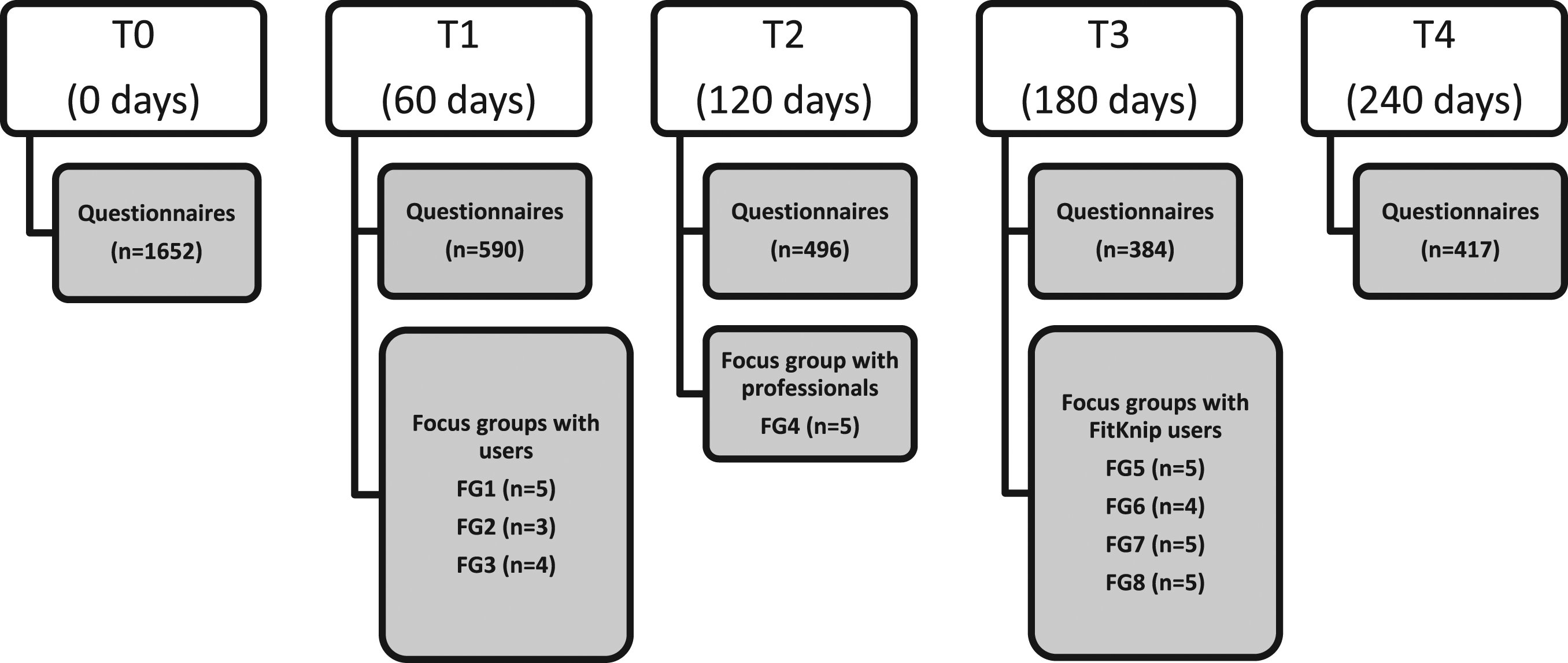
Between July 2020 and December 2020, seven focus groups with FitKnip users were conducted with three to five participants per group. One focus group was conducted with relevant stakeholders and experts in the field of population health, as well as healthcare professionals (n = 5). The topics in the focus groups with FitKnip users were practical and focused primarily on investigating the acceptability, feasibility, and usability of FitKnip. For example, participants’ opinions on the colors and the design of the FitKnip platform and their satisfaction with the amount and type of offered applications. The focus group with experts aimed to identify perceived barriers and facilitators regarding the future implementation of FitKnip. It was an open and conceptual discussion on the concept of FitKnip, for example, professionals’ opinions on possible target populations and stakeholders (e.g., health care insurers and municipalities). Focus groups were semi-structured and used an interview topic guide. At the end of each focus group, participants were directly asked to share their experiences regarding their participation in the online focus group.
Individuals were recruited through various institutions, including insurance companies, (local) government, and municipality teams. A total of 1650 FitKnip users filled out the baseline questionnaire, of whom approximately 800 (48%) indicated they were interested in joining a focus group. Participants signed a digital informed consent at baseline. At T3 56 participants indicated they were interested in participating in the focus groups. Participants at T0 were not aware the focus groups were to be held online, participants at T3 were. For their participation in the focus groups, FitKnip users received a reimbursement of 25 euros and professionals 75 euros in gift vouchers via postal service. In composing the focus groups we strived for homogeneity regarding age, work status, and educational level, for example, by inviting only highly educated participants and participants of young age to the same group, to make participants feel more comfortable and create a safe environment. For the focus groups with professionals, a more heterogeneous group of (potentially) relevant stakeholders was recruited. The differences in the aims of the focus groups and population d influence some of the topics discussed in this research note. Advice on how to handle these differences will be given throughout this research note. We will elaborate on our experiences of the online focus groups and—based on this—give general advice for practical considerations that is usable for researchers in the field of (e)health and health promotion.
Preparation
Preparation is an important part of conducting both on- and offline focus groups. Participants were informed about the upcoming online focus group using two e-mails (See Supplementary Appendix 1). The first e-mail provided information on the number of participants and researchers present and mentioned that the interview would be audio-taped. Participants were furthermore informed about which platform would be used, and instructions on how to use this platform were provided. More specifically, participants were informed that they would receive a link to the online platform and password on the interview day. “House rules” were also provided to maximize the chances of a smoothly running focus group; (a) use headphones if possible, (b) use the mute function when you are not talking to reduce background noise, (c) enable the video function so that researchers are able to see gestures and facial expressions, and (d) use the “raise hand” option when you want to say something. In this first e-mail, participants were also informed about the opportunity for a practice session with the moderator in the online platform before the focus group would take place. Participants had to send an e-mail to set up a practice session. Finally, participants were informed about the opportunity to use a fake name for privacy considerations. The second e-mail was sent out on the day of the focus group and included the link and password to the online platform, and the abovementioned house rules were repeated. Moreover, participants were informed that the online room was opened 15 min before the start, encouraging them to log in on time to create the opportunity to solve potential technical problems before the start of the focus group.
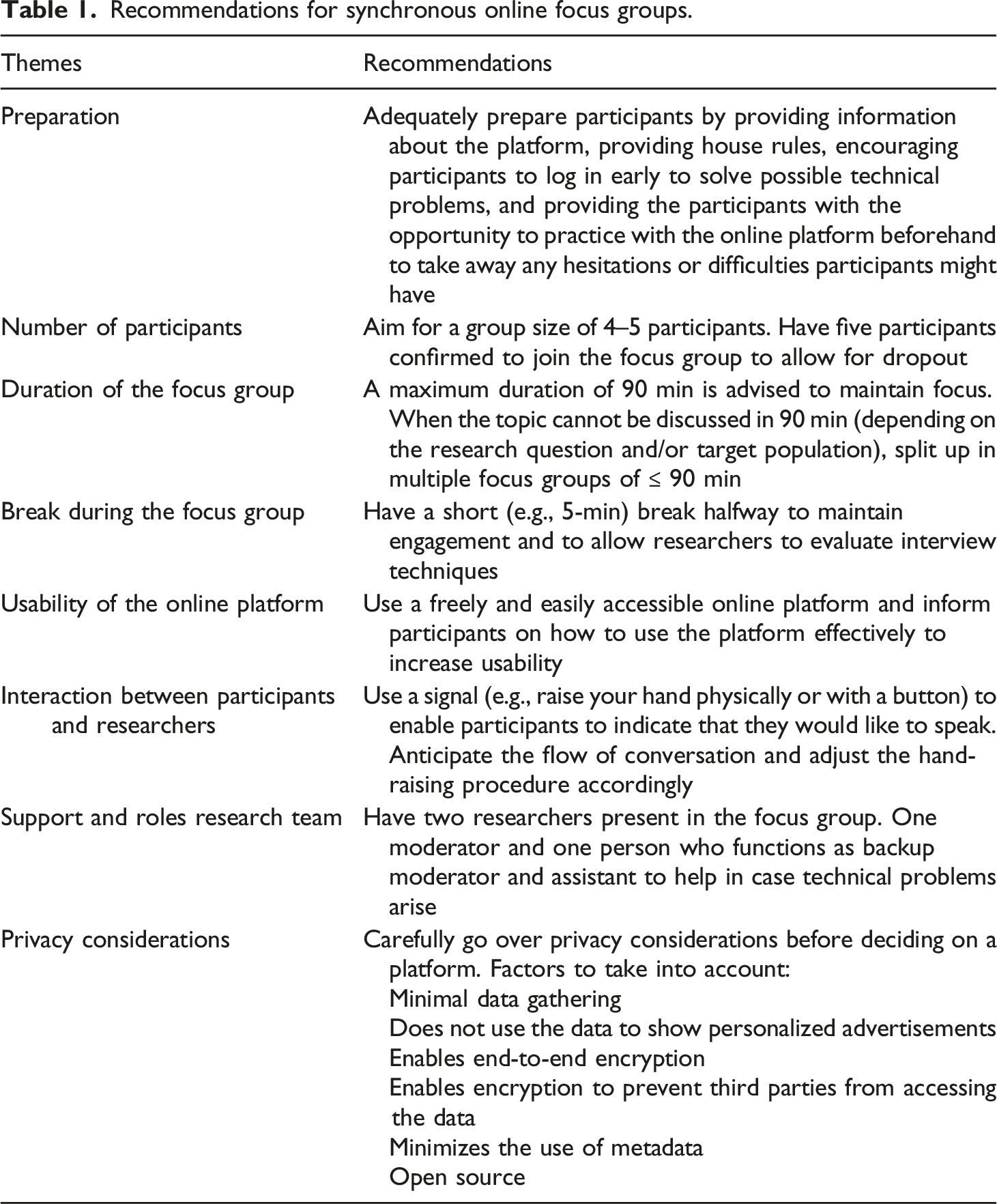
Based on our experiences, these preparations helped to run a successful focus group with good audio quality. No log-in problems occurred and the majority of participants followed the abovementioned instructions. One participant made use of the opportunity to practice with the online environment beforehand; this participant did not experience any troubles logging in to the environment during both the practice session and the actual focus group. Although participants were encouraged to log in early, not all participants did. Nonetheless, having this extra time is certainly helpful as some participants experienced troubles with their sound or video. To summarize, we advise researchers to prepare participants carefully for the online focus groups by providing information on the platform, providing the house rules, encouraging early log-ins to solve possible technical problems, and allowing participants to practice to take away any hesitations or difficulties they may have.
Number of participants
Usually, face-to-face focus groups are conducted with six to eight participants (Ritchie et al., 2013). We advise a reduced number of participants for a digital focus group due to potential technological issues (e.g., potential delays in responses due to unstable internet connections, difficulties logging into the online platform) and potential interruptions due to, for example, other members of the household or background noise. Previous literature has, therefore, suggested a group size in the range of four to six participants (Daniels et al., 2019; Flynn et al., 2018). Based on our own experience, a group size of four to five participants allowed for optimal discussion providing every participant with sufficient opportunity to express their opinion. In our study, four participants had to cancel the focus group on short notice and one participant did not show up for the focus group. To account for no-shows, cancellations, and dropouts due to technical issues, we recommend having five confirmed participants for the focus group.
Duration of the focus group
Typically, a face-to-face focus group lasts about 2 hours (Ritchie et al., 2013). It is advisable to shorten the duration of an online focus group as digital conversations are commonly experienced as more tiring, and—in our experience—participants find it harder to keep their attention and stay engaged. Yet online communication might be slower since participants have to unmute themselves first, and it is often harder for participants to see when it is their turn to talk due to the lack of, or limited visibility of, non-verbal communication (Kite and Phongsavan, 2017). To allow for sufficient discussion time, whilst not overstraining participants, we decided on a 90-min duration for the focus groups in line with previous research showing its feasibility (Daniels et al., 2019).
In the FitKnip focus groups, we noticed that participants were active and seemed able to concentrate for the full 90 min. The duration was good to elicit sufficient discussion to answer the research questions. These research questions were concrete and focused on the users’ experiences with the platform. The focus groups with relevant stakeholders, however, were focused on more conceptual research topics. Interest and opinions varied widely across this group, and 90 min was relatively short to discuss all the predefined topics adequately. Altogether, we recommend a maximum duration of 90 min for online focus groups, and we suggest splitting the focus group into multiple focus groups of 90 min or less when the topic cannot be adequately discussed within that timeframe.
Break during the focus group
Usually, a break is incorporated in face-to-face focus groups (Ivanoff and Hultberg, 2006). In an online focus group, it is also beneficial to have a short break. In our focus groups, we incorporated a 5-min break halfway. Not only to ensure participants’ continuous engagement, but also for the moderator to take some time to evaluate the progress, content, group dynamic, and quickly prepare for the next part. The break was used by the moderator to write down notes and to evaluate and adjust interviewing techniques if necessary. Therefore, we recommend a short break halfway through the focus group.
Usability of the online platform
The usability of the online platform is an essential precondition for a successful online focus group. Ideally, the platform needs to be easily accessible and usable for participants with fewer digital competencies (Daniels et al., 2019). To increase accessibility, we chose the platform Jitsi where participants did not need to register or download a program beforehand in contrast to more well-known programs such as Zoom or Microsoft teams. Some platforms offer auto transcription, which can significantly reduce time preparing transcripts if this service is accurate.
During the first focus groups, we noticed other technical aspects that need to be taken into account. Jitsi, for example, asks permission to use your camera and microphone. Some participants denied this permission and logged in without sound or video. Another point of attention is the browser in which the chosen platform runs best. It is advisable to inform participants beforehand (i.e., preparation) about all the steps they need to take to be able to access and use the online platform successfully. To conclude, we recommend using an easily and freely available platform and informing participants in detail of the steps that need to be taken to access and use the chosen platform.
Interaction between participants and researchers
To stimulate interaction and engagement, and to be able to rely on non-verbal communication such as facial expressions and raising hands, we chose a platform with a video connection and encouraged participants to keep their cameras on. All participants collaborated and kept their cameras on. For both the moderator and participants it can be challenging to identify whether someone else wants to talk. To overcome this problem and stimulate interaction, we used the “raise your hand” button in Jitsi, which was also suggested in Daniels et al. (2019). At the start of the focus group, the moderator explained that the “raise your hand button” could be used if someone was talking and you would like to say something. The “raise your hand” button could make conversations more static, disrupting the natural flow of conversations. We recommend the moderator carefully monitor group dynamics and adjust the “raise your hand” procedure as needed based on the flow of conversation and whether every participant has the opportunity to speak. We have experienced that, during a focus group, it was sometimes no longer necessary for the moderator to give someone a turn based on the raise your hand function. That is, in case the conversation went smoothly and participants were naturally giving each other enough space and time to speak up. Nevertheless, in general, we recommend the use of a “raise your hand” button or another signal in combination with a clear explanation of when and how to use this button.
Support and roles research team
It is advised to have an assistant present in case technical problems arise (Daniels et al., 2019). In that case, the moderator can continue to run the focus group, while the assistant can fix the technological problems in, for example, the chat function of the platform. The chat function was only used in case of technological problems. Besides an assistant, a backup person for the moderator is advisable. This backup may also be assigned other relevant tasks, such as keeping track of time and audio recording. In our experience, fixing technological problems and overall support can be easily provided by the same person. Therefore, our recommendation is to have at least two researchers present in the focus group: one moderator and one serving as a backup moderator and assistant.
Privacy
The privacy of participants needs to be ensured before starting digital focus groups. In the Netherlands, the Data Protection Authority (in Dutch Autoriteit persoonsgegevens) provides an overview of privacy considerations of different video platforms (AutoriteitPersoonsgegevens, 2020). In choosing the platform, it is necessary to choose a platform that gathers minimal data, does not use the data to show personalized advertisements, enables end-to-end encryption (meaning that even the provider cannot access the data), enables encryption to prevent third parties from accessing the data, minimizes the of use of metadata, automatically turns on (end-to-end) encryption, and is open source. The platform Jitsi met all these requirements and was therefore used in our study. The recommendation concerning privacy is to carefully review the privacy policies of the platforms and check whether these are in accordance with national and/or international laws, as well as requirements of the respective institution of the executive party, before deciding on a platform.
Participants’ and moderator’ experiences
In the first round of the focus groups as part of the FitKnip experiment, participants were asked how they experienced and evaluated the digital focus group. A majority of participants stated that the duration of the focus group was acceptable. Participants were positive about the group size and the “raise your hand” button; they considered it easy to contribute to the conversation and to wait for their turn to talk. Moreover, no traveling time and efficiency were seen as benefits of a digital focus group. Next to this, one participant explained that being in her own house made her more comfortable expressing her opinion. A participant stated it was very clear how to participate. Another participant mentioned people are getting used to digital conversations, and this participant did not mind digital conversations. However, a minority of the participants preferred face-to-face meetings.
The moderator experienced the start of the focus groups as stressful, because of possible no-shows or technical difficulties. Building up rapport with participants is challenging as firstly sound and camera needs to be checked. And in contrast to face-to-face focus groups, you cannot greet participants one by one. On the other side, the moderator experienced conducting focus groups from home as comfortable and relaxed because you have more control over your environment. Moreover, it was easier to plan focus groups next to other work tasks or during the evening.
Conclusions
In our experience, online focus groups are an excellent option when adequately taking the eight practical considerations into account. However, online focus groups might not be suitable for every study population or research question. For example, if your study population is older, digital illiterate, or does not have access to the internet or if your research focuses on sensitive topics such as mental or sexual health, online focus groups might not be the best choice. In our case, the research focus was on evaluating FitKnip, an eHealth platform. Participants were likely to be familiar with digital services, making it easier to participate in online focus groups. The online focus groups were also suitable for our practically focused research questions. Nonetheless, online (a)synchronous focus groups have been used for sensitive subjects and vulnerable populations, such as psychosocial needs in rural breast cancer survivors, dating and intimacy in young cancer survivors, and sexual health information in female-to-male trans masculine transgender individuals (Lally et al., 2018; Reisner et al., 2018; Wettergren et al., 2016). These studies suggested that online focus groups are suitable for these populations and research questions.
Another important aspect to consider is accessibility for the respective target population, regarding, for example, internet access and visual impairment. Several studies show that it is possible to recruit rural or geographically dispersed populations (Lally et al., 2018; Reisner et al., 2018). A participant with visual impairment participated in one of our focus groups, suggesting that online focus groups can also be accessible for visual impaired individuals.
Recommendations for synchronous online focus groups.
Supplemental Material
Supplemental Material - Online synchronous focus group interviews: Practical considerations
Supplemental Material for Online synchronous focus group interviews: Practical considerations by RF Willemsen, JJ Aardoom, NH Chavannes and A Versluis in Qualitative Research
Footnotes
Acknowledgements
The authors would like to thank Rimke Vos and Lisa van Tol for sharing their knowledge and experience concerning online focus groups.
Declaration of conflicting interests
The author(s) declared no potential conflicts of interest with respect to the research, authorship, and/or publication of this article.
Funding
The author(s) received no financial support for the research, authorship, and/or publication of this article.

Supplemental material
Supplemental material for this article is available online.
Author biographies
References
Supplementary Material
Please find the following supplemental material available below.
For Open Access articles published under a Creative Commons License, all supplemental material carries the same license as the article it is associated with.
For non-Open Access articles published, all supplemental material carries a non-exclusive license, and permission requests for re-use of supplemental material or any part of supplemental material shall be sent directly to the copyright owner as specified in the copyright notice associated with the article.
