




Abstract
This paper argues that trust cannot be taken for granted in long-term participatory research and promotes greater consideration to conceptualizing the trusting process as fluid and fragile. This awareness by researchers can reveal to them how the passing of time shapes and reshapes the nature of trusting relationships and their constant negotiation and re-negotiation. The paper draws together literature from different disciplines on the themes of trust, temporality and participatory research and outcomes from interviews and workshops undertaken for The Trust Map project to focus on two key moments that reveal the fragility of trust. These are the subtlety of disruption and trust on trial and trust at a distance. We discuss how trust was built over time through processes of interaction that were continually tested, incremental and participatory.
Introduction
There is widespread agreement in literature that building and maintaining trust is vital in participatory research (PR) and that it takes time to develop (Christopher et al., 2008; Israel et al., 1998; Jagosh et al., 2015; Plowfield et al., 2005). Despite acknowledgement of its importance when developing collaborative research relationships, trust is often ‘mentioned’ as desirable in relation to the funded period of research rather than being explored in detail (see, for example Davenport et al., 2007; Garcia, 2017; Perez, 2019). Less is said about the waxing and waning of trust over time when there are periods of loose attachment, absence, distance and uncertainty regarding further funding. PR in particular, often involves long periods of collaboration, some of which may last for years and may or may not have funding. As Pratt (2007) notes in relation to a PR project with migrant communities in Vancouver, Canada that involved four projects over 11 years, negotiating trust is an ongoing process and collaboration has to be nurtured. Trust is a core feature of PR (and all research involving relationships and/or partnerships) therefore, it is surprising that scant attention has been paid to the dynamics of trust (within the context of PR) over longer periods of time. As Simpson (2007: 587) observed: Trust lies at the foundation of nearly all major theories of interpersonal relationships. Despite its great theoretical importance, a limited amount of research has examined how and why trust develops, is maintained, and occasionally unravels in relationships.
This paper addresses this gap and draws on research conducted in the North East of England as part of The Trust Map 1 , a funded participatory project that ran from 2014 to 2018, which investigated the dynamics of power and trust in minority communities with a focus on digital technologies. The Trust Map research enabled the main author of this paper to continue collaborating with a community organization they had recently worked with and to re-engage with another.
Specifically, this paper examines two key questions: firstly, how is trust re-negotiated when an opportunity to work together comes about once more, and secondly, how is trust maintained when a funded project has ended, when attachments are loose and distant?
The term ‘participatory research’ is used here to cover a range of collaborative research approaches whereby academics and communities work together and combine knowledge and expertise, for example community-based participatory research (CBPR); participatory action research (Askins and Pain, 2011; Kindon et al., 2007); action research (Reason and Bradbury, 2008) and co-inquiry (Banks et al., 2014). More recently, the term ‘co-production’ has come into vogue, founded in scientific scholarship (particularly science and technology studies or STS) (Jasanoff, 2004). Co-production (like other collaborative research traditions) involves a process in which boundaries between academics and non-academics become blurred and research ‘is a collaborative, iterative process of shared learning rather than distanced and linear; hence research is undertaken with people rather than on people’ (Campbell and Vanderhoven, 2016: 12, original emphasis). Despite the different terms and traditions, they have common aspects that include democratizing the creation and sharing of knowledge, a commitment to social change for social justice and offering higher education an innovative means to combine teaching, service and scholarship (Strand et al., 2003).
The nature of long-term PR is complex and power-laden. Although the dynamics of power and positionality in the production of knowledge is widely known (see Foucault, 1972; Rose, 1997), there is scope to further explore the dynamic of trust as trust here is a central function. We argue that conceptualizing the trusting process as more fluid, fragile and intermittent over time shapes and reshapes the nature of trusting relationships through constant negotiation and re-negotiation.
This paper begins with an overview of trust research and key concepts. The following section ties together literature on PR, trust and temporality; initially, providing an overview of findings before focussing on the conceptual work. This reveals that temporality has been an under-researched dimension of trust. The next section provides an overview of The Trust Map including the methods used, before describing the process of [re]negotiating trust over time, focussing on two key moments. The final section considers the significance of the findings and suggests future research.
Trust research
The literature on trust is vast. Reviews of trust (see, for example Bellaby, 2010; Withers, 2017) demonstrate the growing interest and importance of trust in research. Debates about trust have run in parallel in multiple disciplines including management and organization studies, sociology, psychology, anthropology, economics and political science (Lyon et al., 2012; Braithwaite and Levi, 1998; Cook, 2001; Hardin, 2002; Kramer, 1999). There have been efforts to define, measure and categorize trust particularly in management, organization and economic studies (Kramer and Tyler, 1996; McKnight and Chervany, 1996) yet such work has often viewed trust as static, a desirable outcome and an end state. Many researchers take the concept of trust for granted and trust research largely revolves around its functional properties (Mollering, 2001).
Since the 1980’s, key scholars in sociology have stimulated debates about trust, acknowledging the influence of Georg Simmel (1950) and his insights into faithfulness (see Luhmann, 1979; Lewis and Weigart, 1985; Mollering 2001). They argue that trust is a blend of the rational and relational, as opposed to just a rationalistic concept and that the rational/cognitive dimension of trust has an emotional and behavioural dimension (Lewis and Weigart, 2012). These scholars and Barber (1983) moved away from thinking of trust as individual and calculative. A taxonomy of trust developed by Lewis and Weigart (1985) recognized that the cognitive, emotional and behavioural dimensions of trust are intrinsically social and collective, and distinguish between personal trust and system trust. Others have labelled these respectively interpersonal trust (Weber and Carter, 1998) and institutional trust (Garcia, 2017; Yeager et al., 2017). Simply, personal/interpersonal trust focuses on the trust dynamic within and between personal relationships whereas, system/institutional trust focuses within and between people and institutions (government, financial services, etc.). Investigating public perceptions of government and various institutions, Cooke and Gronke (2005) introduced the concepts of active trust and active distrust. Active trust is characterized by high general trust (a history of reliability and good faith) and high levels of scepticism whereas active distrust is characterised by low levels of general trust and high scepticism, which would lead to rejection (Cooke and Gronke, 2005; Garcia, 2017). Similarly, the risk management literature includes a typology of trust and distrust that ‘exists along a continuum, ranging from uncritical emotional acceptance to (downright) rejection’ (Poortinga and Pidgeon, 2003: 971).
Participatory research, trust and temporality: practicalities
One frequently mentioned challenge of PR is a lack of trust between researchers and community members. This, in part, stems from research from which there was no direct benefit and sometimes actual harm to the community (Jagosh et al., 2015). More generally, a lack of feedback of results to the community contributes to mistrust and sometimes develops into anger and suspicion (Martin, 1996). When there is a legacy of mistrust, community members may hesitate to get involved in new projects. Once established, trust cannot be taken for granted and researchers must continually prove their trustworthiness (Israel et al., 1998: 183).
Critical to the establishment of trust is the amount of time it takes to build trusting relationships (Durham Community Research Team, 2011) and the importance of ongoing dialogue and relieving group tensions (Johnson et al., 2009). Furthermore, the mismatch between academic calendars, funding timelines, community needs and expectations create challenges (Durham Community Research Team, 2011: 7). Facer and Enright (2016: 5) identify the discrepancy between allocation of time and funding, noting that all types of co-production require significantly more time than is usually budgeted for.
During research, decisions have to be made about resources (e.g. funds and time) and trust is crucial to this and outcomes perceived as unfair or undesirable lead to mistrust (Jagosh et al., 2015). While mistrust and scepticism at the start of a research collaboration can be viewed as healthy, ‘blind trust’ in the absence of defensiveness, is deemed naive (Jagosh et al., 2015).
PR and co-production in particular has gained attention as a way of demonstrating the social and economic impact of research (Pain et al., 2011; Campbell and Vanderhoven, 2016). Yet as Pain et al., (2016) argue, these processes are built on relationships of trust that take time, which is often the scarcest resource.
Whilst the practicalities of PR are important to consider, this paper contends that further critical engagement with trust and temporality reveals a greater understanding of the trust dynamics of PR, thereby, moving beyond viewing both as practical issues.
Conceptualizing trust and temporality
Trust is a process, not just a variable, deeply embedded in social relations (Granovetter, 1985; Khodyakov, 2007; Lyon et al., 2012; Mollering, 2013). There is a distinctly spatial dimension to trust. Withers (2017: 16) argues, ‘trust is inscribed in space – that is, it moves over space and over time’. Even though trust is understood as a dynamic process ‘the temporal element is rarely captured in trust research’ (Lyon et al., 2012: 11). This is surprising because: The idea of temporality makes the study of trust building processes possible because it illustrates factors that influence the creation, development and maintenance of trust worthy relationships (Khodyakov, 2007: 128).
When constructing trust between people, the movement from stranger to non-stranger is influenced by each person’s history of initial and subsequent encounters, including successful and/or failed trusting relationships (Weber and Carter, 1998). This temporal dimension is key to understanding the waxing and waning of trust. Synchronicity is essential when developing an interpersonal relationship; meaning the sharing of time, or what Schutz and Luckmann (1973) refer to as a reciprocal ‘we-orientation’. A ‘we-relationship’ emerges from, for example being absorbed in common experiences, from which further common experiences are shared.
Crucial to the trust dynamic of ‘we-relationships’ are disclosing the self, reciprocity and perspective taking (Weber and Carter, 1998). During trust building, and moving from stranger to non-stranger, the self is disclosed. At first, disclosures may be trivial but as the relationship grows disclosures can become more personal, for example sharing fears, and this is often the point when trust is recognized as developing. Yet, self-disclosure is risky because the self becomes vulnerable to rejection and betrayal so just as important as self-disclosure is how the other responds (Weber and Carter, 1998). However, Weber and Carter (1998) found that reciprocity of disclosure was not always necessary or appropriate, rather a supportive response to self-disclosure was more important. Over time, individuals are able to share in the conscious lives of others and become able to take on their perspective. Discovering the other’s view demonstrated through behaviour is most important in constructing trust, for example how one is valued, not harming the other emotionally or physically leads to the development of trust (Weber and Carter, 1998). Furthermore, knowing that you are in the mind of the other, especially when they are making decisions that could affect you is important in establishing trust, for example knowing they have your best interests in mind. In other words, ‘even outside of each other’s physical presence, the one must be objectified in the mind of the other’ (Weber and Carter, 1998: 19).
Drawing from the review of literature outlined briefly above, the Trust Map team came to an understanding of trust as contextual, precarious and changing over time (Barbalet, 2009). Specifically, the project was particularly interested in the dynamic in and between interpersonal trust when building and maintaining trust in research relationships with external (non-academic) partners and institutional trust in relation to power and authority. In our project, that meant critically exploring the trust dynamic from the perspective of minority communities and their everyday experiences of authority and power both face-to-face and online. Rather than offering insights on trust from the broader research, this paper focuses on a particular period of fieldwork in the North East of England and what we learnt about the trust dynamics when re-negotiating research partnerships with two community organizations. We felt that this was important given the growth in participatory, collaborative and co-production ways of working with non-academic partners as building and maintaining trust is vital. Central to our conceptualisation was an understanding of trust as a dynamic process that shifts over time and that has to be re-negotiated. This is in contrast to static notions of trust and gives greater emphasis to the temporal dimensions of trust which we argue is a neglected aspect in scholarly works.
With this conceptualisation of trust in mind we embarked on the fieldwork and in the following sections we outline our methods before articulating some of the dynamics of trust and temporality through the story of [re]engagement with two community-based organizations.
The Trust Map: Methods
In order to examine the dynamic of trust in minority communities from the perspective of everyday face-to-face and digital interactions, we worked with community organizations in the North East of England – the chosen site for this particular fieldwork. The research team approached the organizations as potential collaborators because the main author had worked with the first organization sporadically for seven years and the second for the previous 2 years on another project. Consequently, there was a level of trust established over time from the perspective of the academic.
One community organization was located on Teesside and one in North Tyneside. Community Organization A works with people experiencing poverty by offering practical help and advice and campaigning on community issues and Community Organization B is a detached youth project working in an area experiencing high levels of poverty. While the two organizations had very different remits they both shared working with highly marginalized groups, who are often misrepresented by others and are living in extreme poverty by UK standards.
Initial discussions with the two organizations involved an explanation of The Trust Map project, emphasizing that as the research team we were interested in the dynamics of trust from their perspective as a community organization and from their users’ perspective. Central to these early discussions was the underlying social justice principle of participatory research and particularly important was that the research would provide an opportunity to explore mutual areas of interest to the organizations, the groups they serve and the research team. We found that ‘trust’ was of interest to them and on reflection, even though ‘trust’ is quite complex to fully understand when you start reading literature it is also a term widely known and used, and which people tend to have experience and opinions about, which is very helpful when initiating discussions about possible collaboration. The method of engagement was a series of co-design workshops. We outline the sequence of engagements and activities below.
Chronological timeline of the fieldwork: October 2016–June 2017
Between October and December 2016, we engaged in a 3 month period of discussion with the organizations to identify and mutually agree the focus of the workshops. Central to this period of discussion was the collaborative preparation of one-page Community Partner Working Agreements which outlined the aims and activities, outputs, detailed budget (i.e. venue hire, refreshments, travel for participants and administration costs), invoicing information and a timeframe for the workshops. This informal document was intended to be transparent and realistic about the research focus and expected outcomes/outputs. The aim was to hold three workshops with each organization on topics agreed through dialogue and consensus and to discuss the strengths and weaknesses of the first workshop together before deciding next steps. Following this, we met again and communicated over email to detail and finalise plans for the first workshops, including approaches to advertising and recruiting participants through, for example flyers, social media, personal contacts and by sending out invitations. In January 2017, we ran the first workshop with each organisation and had completed a series of three with each organization by June 2017 (see Figures 1 and 2 and Clarke et al., 2021). Photo of envisioning activity with community organization A. Photo of persona building activity with community organization B.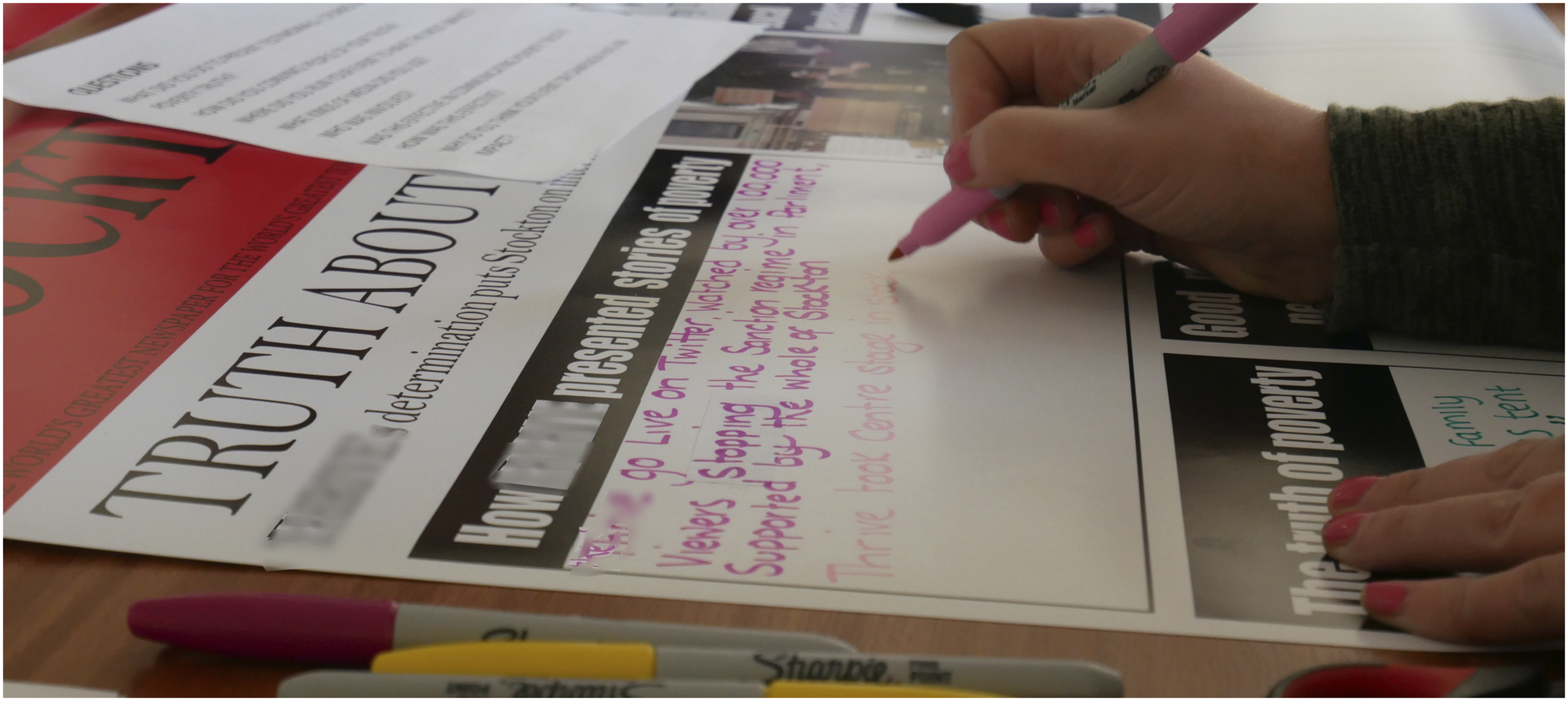
During this time the main author conducted 11 semi-structured, in-depth interviews with key staff members and volunteers at each organization to solicit perceptions on the dynamics of power and trust in different situations such as the individual, organizational, community, digital technology and social media. Before participating, each person was given an information sheet about the research and a consent form to sign if they were happy to take part in the research. All workshops and interviews were audio recorded and transcribed and anonymized through codes and pseudonyms. The ethical agreement negotiated between the academic team and funders before the project started stated that all participants should be aged 18 and over and data must be anonymized. The process of analyzing the data was collaborative and involved researchers initially producing summaries of key themes around issues of trust, power and digital technologies. These were then discussed at The Trust Map team meetings which helped refine the analysis. Key quotes and themes were also part of the workshop co-design methodology with the first organization (discussed below) and participants’ feedback on the themes fed into the analysis (see Clarke et al., 2021).
The first workshop with Community Organization A focused on locating trust within the community using the Community Conversations design tool (see Johnson et al., 2017) to encourage place-based discussion. The research team set up two tables: the first, had a map of the local area, a tablet computer (with the questions on it), a counter, a sound recorder and the tripod with camera and sound to record activity on the map. The second, had infographics/logos of local organizations, businesses, institutions, for example NHS, Durham University, internet and mobile network companies, library, high street, Job Centre, Local Council, police, Lidl, Aldi and Tesco, some blank pieces of paper, a marker, the tablet with questions and pens. In turn, participants answered questions from the tablet computer, for example move the marker to a place that makes you un/happy and say why; and discussed and later ranked actors collectively by perceived trustworthiness.
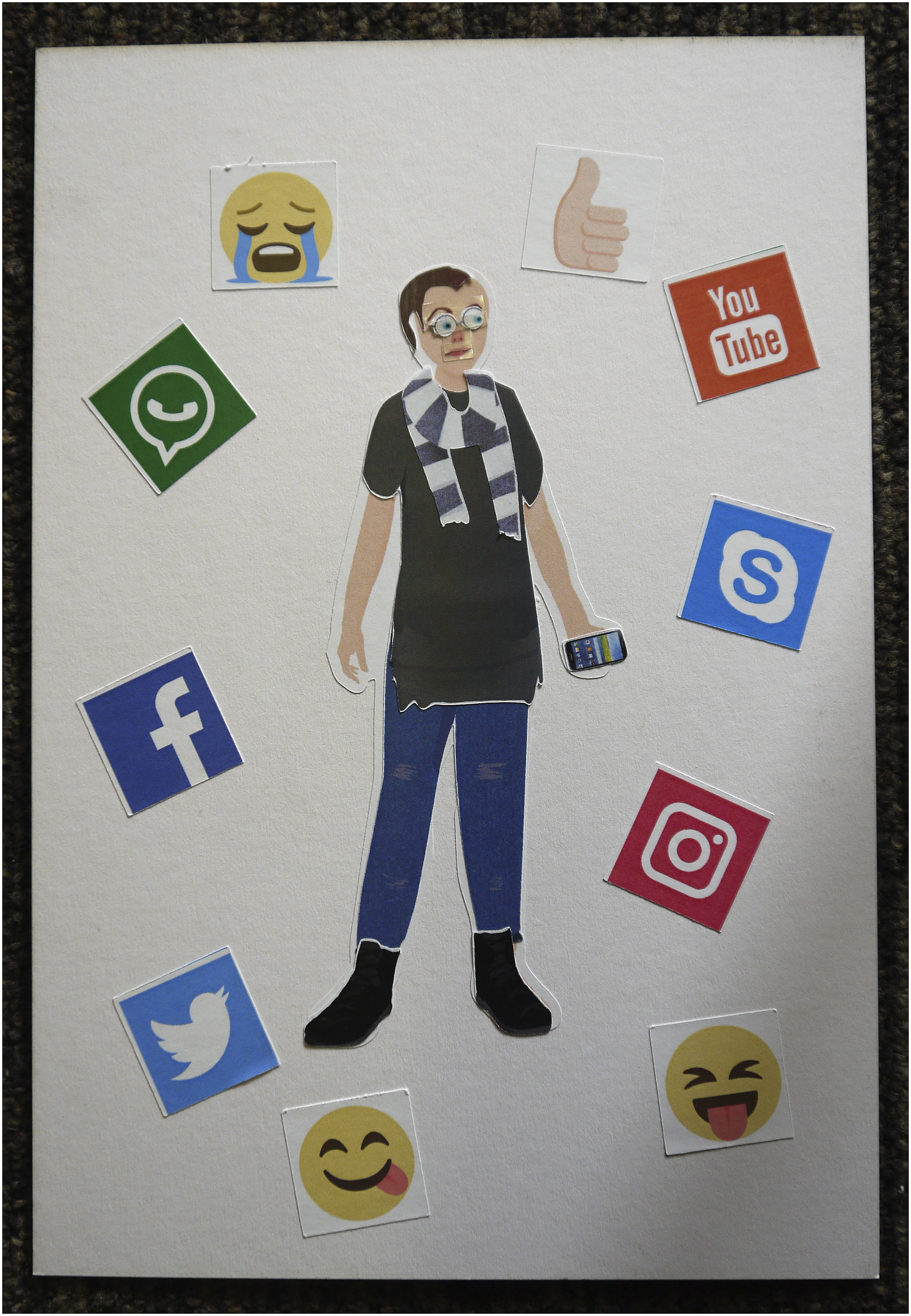
At Community Organization B the first workshop comprised a ‘sticky persona’ building activity for enabling reflective conversations with young people (all participants aged 18 years to mid-20’s). We created ‘sticky personas’ (Figure 2), involving participants in the physical task of creating their ‘self-portrait’ from sticky labels of clothing and hair styles etc., and indicating their broad experiences of services and devices they had used by adding platform/service logos and emojis. The activity aimed to promote conversations around personal mobile phone use based on questions about the role of social media played in their lives; platforms/usage; posting habits; best/worst experience and social spectrum of friends/ties. As we only engaged with those over 18 years, discussions centred on their reflections on past behaviours. All discussions were audio recorded and the persona collages photographed. We left additional workshop resources and an audio recorder with the organisation, employing the main youth support worker to conduct further sessions with other service users over 18-years. He later requested additional sticky labels as he had used these to engage younger children in dialogue on a range of health and wellbeing service areas outside of the project.
Following these first workshops we held meetings between February and March to establish further activities with each organization.
Thematic analysis of outcomes from the first workshop with Community Organization A identified community dis/connections, (un) employment and digital technologies as key matters of concern. We summarized and shared these in a short report at a formal meeting and discussed and co-designed the aims of the second workshop, and also reached general agreement on the focus of interviews with service users led by the first author. We prepared the necessary workshop materials on the theme of envisioning collective action and, at the second workshop in March 2017, again invited participants from workshop 1, this time to reflect on the three key themes from the analysis using printed anonymized quotes. These quotes expressed a range of perspectives on trust and mistrust in relation to experiences of poverty. We then engaged participants in an envisioning exercise to imagine winning an international award for work on poverty action and working in small groups, to compose a speculative 2020 newspaper using a pre-printed template (Figure 1). We additionally provided printout examples of art activism as inspiration. Each group then presented their ideas to the rest of the room and everyone voted for the best idea on voting slips.
In April, we scoped the third workshop with Community Organization A on the theme of building new partnerships, and ran this the following month. This encouraged organization members to reflect on different aspects of trust in relation to institutions and individuals, and identify key individuals with whom they could build a relationship to help their work towards creating a poverty trust commission. The workshop comprised four activities: visually diagramming ‘aspects of trust’ as a poster to share knowledge and discussion about how trust is operationalized; a washing line continuum of trust involving mapping and ranking local institutions and organizations; a persona/role playing exercise to identify key actors for fruitful new partnerships that involved dressing up (in clothes/props) and engaging in role play to explore how key people could be engaged; and finally a trust cake layering exercise where participants assembled up to five key ingredients (edible cake making and decorating ingredients) as though to share with their key actor identified in the previous activity. The cake ingredients aimed to represent trust attributes to help articulate expectations and core values for building trusting relationships.
In June, we held a further workshop with staff and organization volunteers to discuss their experiences and perceptions of participating in the research project, posed through the following questions; What do you remember most about taking part in the workshop? Was there anything new that you learnt? Has the research influenced you or your organization and if so, how? How much do you feel you trusted the people, organizations and/or resources involved and if so, in what way(s)?
Meanwhile our concurrent discussions with Community Organization B centred on its safeguarding responsibilities for young people who were engaging in risky online behaviours that could have a negative impact on social relationships and employment prospects. Organization staff found this aspect of their pastoral responsibility especially difficult when they did not to know how to advise or practically support the young people. Furthermore, they recognised from experience that trust is both hard won and constantly changing, making managing these issues especially challenging. Earlier meetings in March involved discussions to detail particular workshop themes and issues informed by the ongoing interviews with staff and service users. We then co-created workshop ideas with the lead youth worker and held workshops 2 and 3 with the organisation in May and June, involving sessional youth workers. The first of these unpacked facets of trust with respect to both young people and youth worker uses of social media. We designed an icebreaker and three activities to encourage participants to think critically about trust and its various dimensions. Icebreaker games (Trust Throw Catch and Trust Towers – Jenga, Trust Tombola and Trust Top Trumps ) involved choosing words associated respectively with trust face-to-face, trust for social media, and trust(ed) networks. Trust networks involved discussion on how geographical community building is mediated through facets of trust and mistrust; working in small groups participants built out from their existing community using metaphorical/imaginary places such as honesty hill, trust tower, vulnerability viaduct, risky road, mistrust mansion, suspicious street, action avenue. The third activity, social networks and trust stories, was premised on the assumption that everyone has a story about good and bad things that have happened to them, or someone known to them, on social media. We asked youth worker participants to complete the ‘Write your story here …’ template in any genre from romance, horror, drama, etc. and to identify where aspects of trust or mistrust appeared in their story, also discussing issues of privacy and anonymity, agreeing that they could continue writing at home if they preferred. We then discussed turning some of these outcomes into a resource young people could use.
In June 2017, a third workshop tested out provisional ideas for tools and resources for longer-term use within the youth service Community Organization B. This involved five activities over 2-hours, and concerned youth worker roles and identification of different layers of responsibility. Again, the session began with an ice breaker, this time to visualize scenarios and surface general concerns. The main workshop activities then comprised comic strip stories (detailing stories from workshop 2) used to identify pertinent professional and personal values and responsibilities; the envisioning of a new social media world exploring both dystopian and utopian futures, and sharing experiences of social media related ‘flash points’, all using foam pin boards, toys, pipe cleaners and cardboard motifs to create a material picture; and finally, a mapping responsibilities amid shifting regulations activity. This final activity involved collectively composing letters to Facebook, Twitter and/or Ofcom (UK communications regulator) telling them what the proposed new social media worlds needed from them to be successful. The session concluding with an evaluative feedback discussion.
At the end of June 2017, we summarized in writing key final findings for each organization and shared these with them along with any of the relevant workshop materials
The process of [re]negotiating trust over time
We now return to the beginning of The Trust Map collaboration to explore the process of [re] negotiating with people and community organizations their willingness to participate to examine what this tells us about the dynamics of trust and temporality. The aim is not to detail each engagement or collaboration as a case study, nor to focus on the period of intense closeness whilst working together on a research project where resources are rich. This period of time is already commented upon by authors in relation to trust (see, for example Christopher et al., 2008; Jagosh et al., 2015; Weber and Carter, 1998). Instead we concentrate on key moments during the fieldwork process that demonstrate the fragility and precarity of trust (Barbalet, 2009).
The subtlety of disruption
Our research found that the fragility of trust can be demonstrated by a subtle disruption, for example when something happens during the encounter to re-negotiate trust that halts and/or disrupts the process. As Valentine (2008: 333) argues, ‘encounters never take place in a space free from history, material conditions and power’. This section provides a digest of what happened during early encounters to discuss the possibility of the organizations’ participation in a further, new project, and an account of the main author’s entry into that space and perceptions of the trust dynamics. The disruption during these encounters are not catastrophic, unique or particular to these moments. Rather, other researchers working in similar situations will recognise this.
Trust on trial
The organizations were contacted in October 2016 to discuss whether they would like to be involved in The Trust Map. They were contacted through prior relationships with one of the researchers and because The Trust Map team thought the collaboration would be mutually beneficial. Although both community organizations agreed to participate in the workshops, the process of discussion and planning involved very different trust dynamics. The youth-detached community organization most recently worked with for a period of 3 years explained their decision: [Name of university] has always shown itself to be extremely good with us and with [name of previous research project] you were extremely flexible in what we could do, and it was organic and we still have stuff coming back on that now, and that extra funding helped it tick over and take it to the next level. I’ve been involved in youth work for 8-9 years and the [previous research project] was the best so far and I’ve had experience with colleges or schools where it was not so good. But [name of university] - there’s trust in that and we’ve had some amazing students from [university] in the past, because Roger’s known you forever and… for us it was a no brainer (Interview NT1001, 2017).
The organization assessed trust based on previous encounters with academics and university reputation. Elaborating further the participant said: Because you got local organizations to work with the community they already knew, they didn’t have to trust the university, they just had to trust us, and we already had their trust and we trust you. (Interview NT1001, 2017)
Although it appeared that trust comprised ‘uncritical emotional acceptance’ on the continuum of trust (Poortinga and Pidgeon, 2003), further questioning revealed that their rationale involved thinking about trust critically. Trust was assessed in relation to a range of good experiences and tangible outcomes and compared with less favourable experiences with some schools and colleges.
In contrast, the second community organization, who the researcher had worked with sporadically for a period of 6 years, signalled ‘critical trust’ (Poortinga and Pidgeon, 2003) or even mistrust while arranging the Community Partner Working Agreement and throughout the planning process. Despite previously working together it was necessary to re-negotiate trust for the new project. On reflection, this was not surprising as (1) there was a new project manager who the researcher had met once and only worked with at a distance (via email); (2) there was only one person remaining at the organization who the researcher had maintained contact with since 2011 and (3) there were new staff and volunteers. Even though, the researcher trusted the organization based on previous encounters and perceived a shared trust history, the we-orientation (Schutz and Luckmann, 1973) had waned, due to the lack of common experiences with the new staff and volunteers, over time.
During the preliminary meetings staff and volunteers at the organization signalled mistrust as uncertainty and scepticism. In an evaluation interview held after the workshops, the project manager explained that there ‘was a wariness about what was going to happen to the information’ (Interview NT1004, 2017). However, as Jagosh et al., (2015) argue, mistrust and scepticism at the start of a project is healthy as it can ensure that the community partner is not taken advantage of by academics.
Throughout this process of [re]negotiation, trust was continually on trial and was contingent on how researchers and community partners responded to all circumstances and resources (Jagosh et al., 2015). ‘Trusting as testing’ is identified by Mollering (2013) as testing both a willingness to be vulnerable and also to reciprocate. In interviews, the trust dynamic was revealed in more detail. It transpired that feelings of mistrust stemmed from a legacy left by previous research encounters with another university: It could be any university but sometimes as a voluntary organisation we feel a little bit like they come in and come out when it suits their needs to get research and it doesn’t impact on our communities….It’s the people living in our communities that have provided the data and yes, they can’t put it together like a researcher can… but it should be classed as equal. I feel like we’re the poor relation … we’re not an equal partner (Interview NT1004, 2016).
Contextual factors such as a history of research collaborations which have led to feelings of mistrust pose ethical challenges for future partnerships. To ensure research collaborations are ethical, there are institutional review bodies (IRB) and/or committees, a plethora of academic literature on ethics in PR (Banks et al., 2013; Banks and Brydon–Miller, 2019) as well as guides (see, for example Banks and Armsrong, 2012; Centre for Social Justice and Community Action, 2012). Some refer to the challenge of feelings of mistrust towards universities and research projects and that it takes time to develop trusting relationships so that concerns and disagreements openly acknowledged (Banks et al., 2014). Mostly this literature is concerned with the period of intense research engagement. We witnessed a temporal dimension to the trust dynamic. Even though there may be a perception of a trusting relationship, this cannot be taken for granted and that ‘trust on trial’ is something that all possible collaborators (university and community) have to navigate.
Feelings of uncertainty and/or mistrust on behalf of one or both collaborators can cause a significant disruption to the trust dynamic. In the end, three workshops took place in an iterative, participatory process designed and planned together. At the end of the workshops, a group evaluation exercise with the participants captured their insights on how testing turned into trust. Participants expressed their views about the trust dynamic in terms of interpersonal and institutional trust. With interpersonal trust, participants recollected from their research partnership experiences and identified several ways in which trust was lost (i.e. a lack of openness, transparency, inclusion; a vagueness about the research and their involvement in it and breaching or not being clear about confidentiality/anonymity) and how it was gained (i.e. being open, honest, transparent, making everything clear and ensuring participants are involved from the beginning in the research design and the process).
Overall, we found that trust was built over time through an incremental, participatory and continually tested interactive process. Some encounters were only brief but a willingness for members of the research team to travel for an hour or over to the communities for meetings that sometimes lasted only 5–10 min contributed to building trust. Also, from a research perspective, and focussing on interpersonal trust, ‘passing the trust test’ meant being open and clear throughout the process rather than being vague. Ensuring anonymity was important here too. We also see found that the university and its good reputation, can help foster institutional trust.
Furthermore, our research provided insights into ‘maintaining trust at a distance’ and we turn to this next.
Maintaining trust at a distance
In an earlier section, we highlighted how reciprocity of disclosure was a crucial aspect of the trust dynamic and in developing the ‘we-relationship’. Disclosing the self and perspective taking helps build trust and our research found that being objectified in the mind of another, even when at a distance is important in maintaining trust. In the context of our research, ‘trust at a distance’ means the period of time when a research project has ended and the relationship moves from being close, intense and geographically proximate with frequent face-to-face communication to one that is characterized by a looser attachment, absence and a distance from each other 2 . Considering how ‘trust at a distance’ plays out is important because as Nohria and Eccles (1992) argue, physical proximity and face-to-face interactions are crucial to developing and maintaining trust. Once the period of close proximity ends and people are geographically distant and reliant on communication technologies (e.g. email, phones and social media), information flows less freely, may be understood less, and it may be more difficult to reconcile issues and team members may assume the worst of distant workers (see Zolin et al., 2004). To maintain trust at a distance, the research found that (a) continuing to share knowledge via communication technologies, and (b) periodic face-to-face interaction were particularly important. We turn to each of these next.
Continuing to share knowledge via communication technologies
In an interview, a community partner recounted a positive example of a trusting relationship with an academic: Any time something’s comes up with the [a shared area of interest] he’ll send me stuff or he’ll tweet. So although you’re not in each other’s pockets it just seems like there’s a two-way relationship going on (Interview NT1004, 2016).
Trust here is signalled by continuing to share knowledge that is of interest and perhaps of use, for example reports, policy updates, funding calls through email or social media. This demonstrates that an understanding of each other has built up over time and of what is of interest and valued. Loyalty is a crucial social emotion in this dynamic (see Barbalet, 2009; Connor, 2007 for more on loyalty as an emotion and the difficulty of agreeing a definition as loyalty differs from person to person and conceptualizations have shifted over time). The quote also illustrates how the relationship changes over time, from one of close proximity to one of distance. When this happens, maintaining a two-way relationship to communicate and think of each other comprises an example of what Schutz and Luckmann (1973) called the reciprocal we-orientation.
The choice of communication technologies available here has expanded radically, from e.g. email and texting to social media (e.g. Twitter and Facebook). As mentioned, a connection is maintained via Twitter which is the favoured social media platform of this particular participant. However, asked to elaborate further the participant revealed: I’m quite happy writing a letter. But I rely on email. And people ask are you on LinkedIn, are you doing this, Snapchat and blah blah blah and there’s too many things. I don’t even like texting…I’m half way through a text and I think ‘oh just forget it’ and I’ll ring them (Interview NT1004, 2016).
It is often assumed that various communication technologies and social media have replaced traditional communication methods, especially when maintaining friendships or romantic relationships (Guerrero et al., 2018) or in geographically distributed work (Zolin et al., 2004). Less is said about relationships built on working partnerships (between different people in different organisations) and maintaining communication. Our research revealed that a variety of traditional and digital communication methods are utilized, with phone calls often seen as quicker (i.e. than texting) and as Canary and Dainton (2014) argue, important for maintaining communication in a distant relationship.
Periodic face-to-face interaction
Our research found that periodic face-to-face interaction was also important. In interview, one participant described an example of this: When we had [an event], I contacted him and asked if he’d like to come and he said ‘fine. I’d love to be there’ and I think it’s a different relationship. And that’s what I’d like with the University … if I contacted [person] and said we’ve got our event and it’s about social justice and it’s a key piece of work … could you be there? (Interview NT1004, 2016).
The level of trust built up here means being able to ask for favours, help and advice. Actually attending/participating/supporting in person, that is unfunded reciprocal work, is vital to maintaining trust over time. This supports other work that found in a study of long distance relationships how periodic face-to-face contact is vital in maintaining trust, satisfaction and commitment between partners (Canary and Dainton, 2014).
Conclusion
We began this paper by stating that building and maintaining trust in research partnerships was vital and that it takes time and we set out to reflect and examine how and what this involves from the context of two prior research partnerships with the main author. Drawing on the literature, we conceptualized trust as fragile and fluid, shifting, for example along a continuum (though not in a linear pattern but back, forth and around according to the situation/context) with: • Trust as uncritical emotional acceptance when there is a history of good faith, honesty and familiarity to; • Critical trust when there is scepticism and the trust relationship requires re-work, re-negotiation, repair and may involve testing and; • Mistrust which many involve rejection at worst and at best, doubt based on suspicion due to prior experiences of unreliability, lack of transparency or harm.
Trust is fragile and even with a shared trust history its dynamics can be easily disrupted. However, the nature of this disruption does not have to be catastrophic and can be a ‘subtle’ disruption. We found that one of the community organizations apparently signalled trust as uncritical emotional acceptance whereas the other signalled critical trust, even mistrust. Unpicking the reasons for this revealed that the open expression of uncritical emotional acceptance was based on thinking critically. The decision to participate was based on their evaluation of previous successful encounters with the University. The good reputation of the University was a factor in this. In contrast, the second organization revealed mistrust and scepticism at the start of negotiations, where the trust dynamic was most fragile. Here the researcher assumed a shared trust history. In fact, the we-orientation had waned over time with only one person remaining in the organization from past encounters. From the perspective of community organizations critical trust signalled as scepticism is healthy (Jagosh et al., 2015) at the start of new projects because it can shift the power dynamic by making the academics/university demonstrate their trustworthiness. In fact, we found that trust was continually on trial throughout the process, in part because of a legacy of mistrust left by previous research encounters with other researchers that left feelings of inequality. We found that trust was built over time through a process of interaction that was continually tested, incremental and participatory. The research team demonstrated their trustworthiness in delivering the workshops based on carefully planned materials that were co-designed with members of each organization. Furthermore, workshop participants said they enjoyed the sessions and could see their value.
However, the dynamic between interpersonal and institutional trust is often blurred and related. On the one hand, the reputation (good or bad) of an institution can influence decisions about trust yet. On the other, personalities, behaviour and shared values between individuals are vital when navigating through the trusting process.
Within the context of PR, once a period of funded research ends we found that maintaining trust at a distance was signalled in two related ways: continuing to share knowledge electronically; interspersed with periodic face-to-face interaction. This is a significant finding for both academics and community partners in demonstrating how the reciprocal we-orientation (Schutz and Luckmann, 1973) plays out over time, for example through continuing to communicate and think of each other combined with periodic face-to-face interactions.
Moreover, the coronavirus outbreak in early 2020 and resulting pandemic has been hailed as an unprecedented global shock (Armstrong, 2021) and resulted in huge societal changes with lockdowns, home working and schooling and social distancing becoming the norm. It has also brought to the fore the issue of maintaining trust at a distance as we are increasingly distanced physically but at the same time connected digitally through a variety of technologies. Governments, public health and science experts conveyed their messages to publics via media (e.g. TV, social media) and building and maintaining trust at a distance with the population was crucial to ensure compliance with the range of social rules and regulations such as staying at home, social distancing, testing etc., As we found, continuing to share knowledge and information was vital as was periodic interaction, although not face-to-face but on TV or online, that is regular messages from the countries leaders and experts to the whole population. It is beyond the scope of this paper to speculate further but the pandemic has further highlighted the importance of understanding the dynamics of trust and how it is [re]negotiated and maintained as well as how it can be disrupted and lost.
In summary, these findings are significant for academic disciplines working within a PR approach and more broadly of interest to anyone working in cross-sectoral teams and partnerships including government and policymakers. The growing imperative to ensure research has societal and economic impact acutely brings to the fore issues of trust, especially when knowledge is co-produced with communities. Creating impact takes time and questions arise about who is responsible for, (a) gathering evidence and (b) dissemination via academic, policy and online/offline media channels. In most circumstances, the university and PI of research projects initiate impact and are the ‘face’ of the project. Continuing to be trustworthy and understanding the fragility of trust here is crucial.
Further research should explore how experiences vary when there are different contexts and histories; there could be investigations to unpack the dynamics of power and trust over time, and more attention could be paid to the nature of relationships taking into account personalities and friendships within the trust dynamic. We also propose, that critical understanding of the dynamics of trust will contribute to recent debates concerned with a life course approach to the field and fieldwork (see Wimark et al., 2017). For too long, it has been stated simply that it takes time to build trusting relationships in a research context. This paper is an attempt to stimulate more critical interventions that draw together conceptual work on trust and temporality with examples from the real world. In doing so, this will reveal valuable insights into how trust dynamics play out over time and how trust is signalled, created, destroyed and repaired. Trust is fragile and always in flux and has to be re-negotiated, it cannot be taken for granted. Also, the lack of trust, an initial wariness or even mistrust can be a good thing as seen in politics and democratic processes as this enables the active testing of trust.
Footnotes
Acknowledgements
Thank you to the participants from the two community organizations for their time and energy.
Declaration of conflicting interests
The author(s) declared no potential conflicts of interest with respect to the research, authorship and/or publication of this article.
Funding
The author(s) disclosed receipt of the following financial support for the research, authorship and/or publication of this article: The research was supported by the Empathy and Trust in Online Communicating (EMoTICON) funding call administered by the Economic and Social Research Council in conjunction with the RCUK Connected Communities, Digital Economy and Partnership for Conflict, Crime and Security themes, and supported by the Defence Science and Technology Laboratory (Dstl) and the Centre for the Protection of National Infrastructure (CPNI). Grant number [ES/M003566/2]
