




Abstract
Researchers using deliberative techniques tend to favour in-person processes. However, the COVID-19 pandemic has added urgency to the question of whether meaningful deliberative research is possible in an online setting. This paper considers the reasons for taking deliberation online, including bringing people together more easily; convening international events; and reducing the environmental impact of research. It reports on four case studies: a set of stakeholder workshops considering greenhouse gas removal technologies, convened online in 2019, and online research workshops investigating local climate strategies; as well as two in-person processes which moved online due to COVID-19: Climate Assembly UK, a Citizens’ Assembly on climate change, and the Lancaster Citizens’ Jury on Climate Change. It sets out learnings from these processes, concluding that deliberation online is substantively different from in-person meetings, but can meet the requirements of deliberative research, and can be a rewarding and useful process for participants and researchers alike.
Keywords
Introduction
It was evening in the United Kingdom, but mid-morning in California, back in 2019. We were half way through an online deliberative workshop, bringing together representatives from government, businesses and the academic community, across three continents, using a Zoom video call. We had stopped for a coffee break, but our Californian participant stayed in front of his laptop to chat, lifting a foot up to the screen to show us his beautiful hand-knitted rainbow socks. We were separated by 5000 miles, but linked by common interests, a curiosity about each other, and technology that was, in those pre-pandemic days, unfamiliar to many. That was the moment that we realised the potential of the online setting to bring people together to have genuine, exploratory, human, deliberative conversations.
Our initial interest in taking deliberation online was not the crisis of COVID-19, but the longer-term crisis of climate change. As researchers investigating climate issues, we have an obligation to reduce the environmental impact of our research. Starting in 2018, we began to experiment with online workshops. When the COVID-19 pandemic hit, other research that we were involved in also moved online.
The aim of this paper is to draw on our experiences, reflect on the possibilities and limitations of online deliberative research, and provide practical and methodological assistance to researchers who may be considering similar approaches. Four of the authors are academic researchers using deliberative methods; one (Peter Bryant) is a practitioner with expertise in deliberative processes.
In this paper, we focus on events (such as workshops and citizens’ assemblies and juries) taking place in real time, that is, a synchronous, not asynchronous, process in which a group of people come together to learn, discuss and deliberate. Before COVID-19, these events would predominantly have involved meeting in person, and we discuss the process of adapting to online discussion, using video call software such as Zoom. We use the term ‘synchronous deliberative process’ to describe such an event. However, as we discuss below, online deliberation can take many forms, both synchronous and asynchronous communication and both written and spoken. We bring in wider examples for comparison, but the case studies we evaluate here are all synchronous deliberative processes.
Below, we first summarise the principles of deliberative research, before reviewing existing research into experiences of deliberative research in an online setting. We note that there has been very little analysis of synchronous deliberative processes online, in the academic literature. We then describe four case studies. Our experience demonstrates that, if carefully designed and facilitated, online processes can work well. They allow learning from expert commentators and other information sources to take place; it is possible to facilitate meaningful, structured discussion; and participants can work together toward a goal. Given current COVID-19 restrictions, and the need to reduce the climate impacts of travel associated with research, there are, therefore, good reasons for conducting deliberative research online. We highlight some considerations, such as ensuring commitment from participants, working with small numbers, overcoming technical difficulties, encouraging informality and ensuring inclusion. We conclude that more formal evaluations of such processes are required, but our findings indicate that online deliberative processes have fast become a useful research tool.
The principles of deliberative research
Deliberative research can be understood as an approach to empirical research which is informed by the principles of deliberative democracy. Deliberative democracy, as developed by Jürgen Habermas, John Dryzek, James Fishkin, Jane Mansbridge and others (Dryzek & Niemeyer, 2008; Fishkin, 2018; Habermas, 2015; Mansbridge, 2003), is a broad field, summarised by James Bohman as ‘any one of a family of views according to which the public deliberation of free and equal citizens is the core of legitimate political decision-making and self-government’ (Bohman, 1998: 401). In other words, deliberative democrats place emphasis on the conditions under which people participate in democratic debates. They stress the importance of considered judgement, based on good evidence and free and fair collective discussion (Steiner et al., 2004).
Deliberative research applies these principles to the research process. Such research may be purely academic, but it is often linked to, or carried out in partnership with, parliaments, or local or national government. Typically, it brings people together to undertake a structured discussion, with a focus on ensuring meaningful participation. Burchardt (2014) identifies three features of deliberative research. Firstly, it aims to ‘reach people’s informed and considered judgements in relation to the subject in hand, through a process of public reasoning’ (2014:357). Secondly, it involves learning – participants are offered information, from written briefings or expert witnesses, for example, to consider in their discussions. Thirdly, ‘there is an expectation that the beliefs and values of participants may be transformed by involvement in the research’ (2014: 357). In a similar vein, the UK participation charity Involve, who ran Climate Assembly UK, one of our case studies, below, distinguish three crucial features of deliberative processes – discussion between participants; working with a range of people and information sources, and a clear task or purpose (Involve, 2008).
In summary, deliberative research generally involves three factors: input from expert witnesses and other information sources; structured, facilitated and inclusive discussion and deliberation between participants; and participants coming to considered judgements, linked to a goal or purpose, such as formulating recommendations or a statement. Thus, it can be distinguished from other qualitative research methods such as focus groups, participant observation or interviews, which aim to capture participants’ views, but do not necessarily meet these criteria (Evans Kotchetkova, 2009). There are many different forms such meetings can take, depending on the aims and resources available; examples include Citizens’ Assemblies, Citizens’ Juries, deliberative workshops and deliberative polls (Involve, 2008).
Deliberative research is often used to investigate expert or dominant narratives. For example, Phil MacNaghten reviews deliberative workshops on nanotechnology, geo-engineering and genetic modification, which, in his words, ‘open up spaces for collective imagination of the possible’ (2021: 16).
Previous analysis of online deliberative research
As described in the introduction, we focus here on synchronous deliberative processes taking place online. It is important to acknowledge asynchronous deliberative research too, which usually involves participation through the written word rather than speech (see Medaglia, 2012 for an early review of this field; and Williams, 2010 for a specific example; see also the vTaiwan initiative, Hsiao et al., 2018). Such research may be structured and facilitated in such a way as to meet the criteria of deliberative research, as defined above. Both these structured approaches – synchronous and asynchronous – are in turn different from the broader phenomenon of discussion and interaction online, such as group discussion boards, debate on social media and so on. Such online discussion is very unlikely to meet the criteria for quality deliberation. In fact, there is evidence that much online discussion creates greater polarisation and works against deliberative ideals (Strandberg & Grönlund, 2018). However, the success or otherwise of the general online space in promoting deliberative discussions has little bearing on the likely success of structured processes.
Until COVID-19, there were few instances of online synchronous deliberative research. An early experiment, in 2009, took a deliberative mini-public event that had been convened in Finland, seeking views on nuclear power, and recreated it online, with webcams and group discussion. Researchers found a high quality of dialogue and learning in both settings, despite technical difficulties. As they concluded, ‘our experience shows that it is possible to achieve discursive quality and mutual respect in an online environment when the process is carefully pre-designed to meet these needs’ (Grönlund et al., 2009: 197). The following decade saw the development of software like Zoom (established 2011) which made online meetings more straightforward to establish and run, yet there were few further examples of synchronous deliberative research online, until the COVID-19 pandemic necessitated a shift.
Neither has there been much analysis or evaluation of synchronous online deliberative research in the academic literature. There have, however, been a number of reviews of wider online deliberation. A 2014 review by Jonsson and Åström (2014) identified four distinct ‘arenas’ of research – institutional (platforms where politicians, civil servants, and citizens discuss political issues), non-institutional (platforms or activities unconnected to governmental institutions); experimental (in which researchers conduct controlled experiments), and general (research conducted using random sample surveys). They found only one analysis which compared a synchronous deliberative process by videoconference to face-to-face deliberation – the Grönlund et al. (2009) study mentioned above. In a later review, Strandberg and Grönlund (2018) note that most research on online deliberation has focused on ‘non-institutional’ arenas. Both reviews observe a general lack of studies looking empirically at discussion quality in organised online deliberations. However, this literature does contain insights that provide useful learning for synchronous online deliberation, including the issue of anonymity (Friedman et al., 2000; Kim, 2006), moderation practices (Wright & Street, 2016); the different experiences of online versus face-to-face deliberations (Wojcieszak et al., 2009); and the effects of online deliberative processes, such as changes in individuals or the construction of specific forms of ‘citizenliness’ (Coleman & Moss, 2012).
In addition to the academic literature, there are many sources of advice on online research from practitioners in the field. The participation charity Involve has an online resource hub (Involve, 2018), and the podcast series ‘Facilitating Public Deliberations’, convened by the Australian NGO, New Democracy Foundation, has a number of episodes discussing online deliberation (New Democracy Foundation, 2020). In addition to the examples offered here, specific examples of online deliberative research are the online deliberation about COVID-19; and Stanford University’s Online Deliberation Platform, which has been used for a range of different topics (Stanford University, 2021).
Given the lack of discussion or evaluation of synchronous online deliberative processes, we wanted to offer our own experience. As practitioners and researchers, we are primarily concerned with finding ways to ensure that online spaces provided genuine opportunities for deliberation. We want to develop online processes that are inclusive, and allow learning, discussion and deliberation to take place. The account of our experience is not a systematic analysis or empirical experiment. It is a summary of our experience of four structured deliberative processes online, followed by some reflections. There would be a benefit to a more systematic evaluation of such processes, now that many have taken place due to COVID-19 restrictions.
Online deliberation: Four case studies
The four case studies.
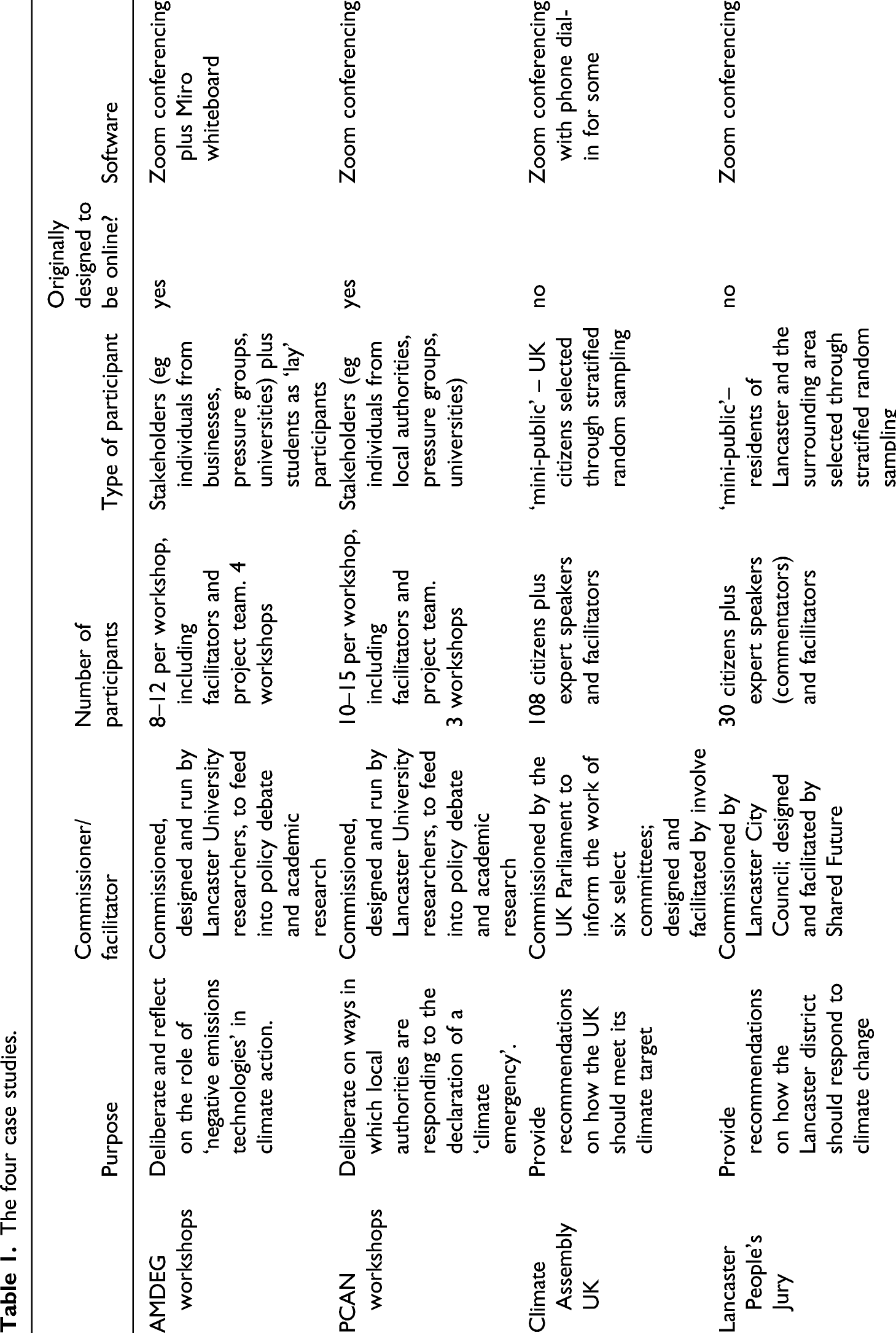
AMDEG deliberative workshops on greenhouse gas removal technologies (2018–19)
These workshops formed part of the Assessing the Mitigation Deterrence Effects of Greenhouse Gas Removal Technologies (AMDEG) project (AMDEG project, 2017). The work investigated the concept of ‘mitigation deterrence’: whether greenhouse gas removal (GGR) technologies, which remove greenhouses gases directly from the atmosphere, may delay or deter other climate action. Deliberative workshops were held to investigate the views of stakeholders from business, government and the research community, as well as lay views, represented by students from local universities. Participants were presented with a set of scenarios, developed by the project team, setting out different possible socioeconomic futures, and were asked to discuss these scenarios and work together to develop recommendations for the governance of GGR technologies.
Nine workshops were held, four of which were online, with international participants. The online workshops were designed to mirror, as closely as possible, the face-to-face format. Participants used an online whiteboard to post virtual ‘sticky notes’. A physical line-up, in which participants stand up and form a line showing their support or opposition to a statement, was recreated online, with participants posting their position on a line on the whiteboard.
A survey of participants’ experiences was completed by 50% of online participants. Around 10% of workshop participants were contacted around a year afterwards for follow-up interviews which discussed both the content and methodology of the workshops. Participants were generally positive about the value of the online workshops. One interviewee spoke at length about the online process: ‘It was both unusual and useful to do an online workshop like that. I’d never participated in such a thing before and I thought it was a really good format to run for that sort of research topic. That’s because getting everyone together is otherwise a big barrier to a collaborative exercise like that.’
One reason to be particularly encouraged by the feedback is that the AMDEG workshops were complex, discussing multiple scenarios, diverse technologies complex interactions over long timelines; with deliberate intent to stimulate reflexive deliberation. Follow-up interviews and feedback suggest that this was achieved more easily in the face-to-face groups, but was still possible in the virtual settings.
PCAN workshops for local authorities
This project, part of the Place-Based Climate Action Network (PCAN, 2020), had a dual purpose (Yuille et al., 2021): firstly, to help local authorities address social, cultural and institutional barriers to taking rapid climate action and secondly, to act as a test case for the possibilities of low-carbon research. The project was designed to replace conventional modes of deliberating with participants – in-person interviews and workshops – with online equivalents. This decision was taken explicitly to reduce the carbon impact of the research process and to investigate the challenges and benefits posed by the shift online from the perspective of researchers as much as from that of participants: to turn the social scientific gaze onto themselves and their practices (cf Coleman & Moss, 2012).
A set of online interviews with key stakeholders in three cities fed into a paper containing recommendations and supporting reasoning, to be discussed at three separate online workshops - one for each city. At the workshops, which took place in the autumn of 2020, participants were asked to reflect on the results of the project so far, and refine and develop the recommendations. We learnt from the AMDEG project, discussed above, and consequently planned short, focussed online sessions, with small numbers, to encourage high-quality deliberation.
Care was taken at the outset to develop an informal atmosphere and to build rapport between participants and researchers alike, in an endeavour to enable deliberation to move beyond statements of formal strategies and policy positions, to more personal expressions of participants’ experiences. Other techniques were also drawn on to facilitate this. For example, the majority of the discussion took place in small group breakout rooms, each facilitated by one of the research team; at the start of each breakout sessions, participants were encouraged to turn off their mics and cameras to spend a few minutes reflecting on the issues to be discussed; creative/visual methods were used (participants were asked to draw ‘what future climate strategy looks like’ to them, and then to hold their drawings up to the camera and talk the group through them); and initial questions in breakout sessions asked explicitly for personal, emotional reflections (such as the highs and lows of working on the issue).
Climate Assembly UK
Climate Assembly UK was a Citizens’ Assembly, convened by the UK Parliament in 2020. 108 citizens were selected through stratified random sampling, to represent the sociodemographic profile of the UK as a whole. The group considered the question of how the UK can reduce greenhouse gas emissions to net zero by 2050. One of the authors of this paper, Rebecca Willis, was involved in designing and running the Assembly, as one of four Expert Leads.
The original plan was for the Assembly to meet in person, over four weekends. However, the final weekend did not take place, due to COVID-19, and was replaced by six shorter online sessions over three weekends in April and May 2020. Participants were consulted, helped with technology access, and did a rehearsal of an online meeting in preparation. They were mailed copies of written material. Nearly all participants used a laptop or tablet to join, but some used a mobile, and a small number dialled in using a phone line, and could not see fellow participants.
The sessions were held in a way that mirrored, as closely as possible, the format that participants had become familiar with through the in-person weekends. They met as a whole Assembly (108 people plus facilitators and speakers) to hear from expert speakers. They then broke into smaller groups of 8–10 participants, the online equivalent of ‘table discussions’, each with their own facilitator. In smaller groups, they held question sessions and discussions with the speakers; deliberated as a group; and formulated recommendations. The process also involved anonymous voting on recommendations, which was carried out through an online survey site.
70 of the participants responded to a survey about their experience of moving the Assembly online (Allan, 2020). There was strong support for the move online, given the circumstances, and participants reported that they had been able to question speakers and take part in discussions and voting: ‘The online weekends have been organised really well at such short notice and I’m glad that the assembly can carry on under the circumstances’. However, there were two aspects of the in-person experience that they felt were lacking in online. Firstly, participants had enjoyed the sense of occasion, and atmosphere, of the in-person weekends, as well as the chance to chat and socialise informally; they missed this informal interaction online. As one said, ‘I’d be lying if I said the first two months wasn’t good. It was great meeting new people and was a lovely atmosphere. Although, this method of finishing it [online] has worked great’. Secondly, there was a sense that more meaningful discussion could take place in-person: ‘I felt there was a greater ability to have in depth discussions both while at the tables and during the breaks. I felt this allowed a lot more consolidation of the information you have heard as through the extra discussions I was able to formulate more opinions and share knowledge with other members that could then be fed back into the table discussions’.
When asked, in the same survey (Allan, 2020), for their views on how to run future Assemblies, very few (3%) supported entirely online events, but the most popular option – chosen by 51% – wanted a mixture of in-person and online. Just under half (46%) wanted entirely in-person events. Understandably, those who joined by laptop or tablet had a better experience and were more supportive of running some of the Assembly online.
An independent evaluation of Climate Assembly UK, commissioned by the UK Parliament, has been published and includes some discussion of the difference between in-person and online meetings. Using participant survey data and researcher observation of discussions, the evaluators concluded that ‘the quality of deliberation in the online sessions of CAUK was superior to the in-person sessions. We attribute this to the digital deliberation coming at the end of the process by which time the Assembly Members had already formed bonds with each other and developed their deliberation skills’. (Elstub et al., 2021)
The Lancaster District People’s Jury
This was a Citizens’ Jury on climate change, held in Lancaster in early 2020. It was commissioned by Lancaster City Council and carried out by Shared Future, including Peter Bryant, an author of this paper. Thirty participants were chosen to reflect the sociodemographic profile of the area. The question the Jury addressed was ‘What do we need to do in our homes, neighbourhoods and district to respond to the emergency of Climate Change?’ After an introductory session, participants heard from commentators and deliberated ahead of developing a set of recommendations. The original plan was to run nine evening sessions and a full day, in person. However, the final three sessions could not take place in-person due to COVID-19, and so an additional five sessions took place online.
All thirty participants were contacted by phone to talk through the online sessions, and to assess their digital capability and access to appropriate technology (laptops, data and internet). Subsequently, seven participants were loaned laptops, three of whom received intensive coaching by phone. All received, through the post, a specially designed guide to using Zoom and ten members of the jury took up the offer of Zoom practice calls. Undoubtedly, the fact that participants had all worked together previously helped establish a relaxed, supportive tone to the online sessions.
Subsequently, Shared Future went on to initiate the UK’s first entirely online climate change deliberation, starting in July 2020. Twenty local residents of Kendal, ranging in age from 16 to 89, met fortnightly, in the Kendal Climate Change Citizens’ Jury. Similar to Lancaster, some participants took up the offer of laptop loans and coaching ahead of the first session.
Feasibility of online deliberative processes
The central finding from our case studies is that it is possible to conduct effective deliberative research online. The features of deliberative research – input from expert commentators and other information sources; structured and inclusive discussion; deliberation; and the development of conclusions and recommendations, can all be achieved in an online setting. Using meeting software such as Zoom enables researchers and practitioners to take participants through a similar process to a face-to face meeting.
There is, therefore, a clear case for designing online research projects of this sort. Online processes allow geographically diverse populations to engage, as with the AMDEG international workshops, significantly reducing costs and carbon emissions compared to in-person meetings. As one interviewee noted, it ‘removes one of the big barriers to participation – getting everyone in the same room’. Another said, ‘it was exciting to meet these people from all over the world who care about the same issues I do’. A participant commented that one of the two things they liked about the workshop was ‘not travelling’.
A growing body of university researchers is questioning the carbon emissions associated with academic work (eg Pandian, 2018; Westlake, 2019). So far, the attention has focussed on the air miles generated by academic staff, particularly for conference travel. However, our experience shows that there is much that can be done to reduce emissions from the research process itself, as well. This is particularly important for projects involving international collaboration. It also allows researchers to lead by example – there is good evidence that individuals and organisations who pledge to reduce their own emissions have an effect on others and on the political agenda (Westlake, 2017).
There may also be cost savings from conducting research online – again, particularly when considering international meetings. The international workshops for the AMDEG project would not have been affordable in-person, given the limited budget for the project, and the costs of airfares, accommodation and subsistence for participants. Similarly, there can be time savings from online processes, given that there is no travelling time, which may encourage greater take-up.
It is important to acknowledge, though, that taking processes online does not necessarily result in cost or time savings. For example, The Lancaster People’s Jury was relatively low-cost to run as an in-person event. Most people travelled from the local area; the venue was free; and only two facilitators were used. Costs for these processes may actually increase online, arising from the need to work in smaller groups and thus requiring more facilitator input; safeguarding needs for vulnerable participants; and provision of equipment to participants who do not have their own.
For these reasons, online processes may work particularly well with groups of professionals, such as the AMDEG project. Participants appreciated the opportunity to connect with people working in the same field, but in a different country. The PCAN project allowed politicians, council officers and city stakeholders to reflect on their experiences and the potential for future action in a forum that would not otherwise have existed. With a group of professionals, access to ICT equipment and knowledge is likely to be higher, so it is possible to consider more elaborate options such as online whiteboards (see point 7 below).
For deliberation between representative groups of citizens, an online process requires groundwork to allow people to participate fully. The experience of Climate Assembly UK and the Lancaster People’s Jury has shown that it is possible, but should not be seen as a simple or straightforward alternative to in-person meetings.
Considerations for the design of online deliberative processes
Below, we pull together our experience with the above projects to highlight some central considerations for the design and execution of online deliberative research.
Format and participant numbers
Our experience leads us to conclude that, in comparison with in-person events, smaller numbers and shorter sessions work better. Participants report that online sessions are more tiring and that it is difficult to commit to long sessions. Because online events can be reconvened relatively easily, they can be run as a series of shorter meetings, though careful thought is needed to motivate participants to attend multiple sessions.
For Climate Assembly UK, an in-person whole-weekend session was replaced by six short sessions over three weekends, with discussion sessions in groups of eight participants. For the AMDEG project, the workshops were 3 hours long (as opposed to 4 hours for the face-to-face equivalents), with a break, and numbers were limited to 8–12 people. Smaller numbers allow facilitators to keep track of each participant and their interventions, allow participants to see each other, and to be more informal about turn-taking in discussion. In planning the PCAN workshops, these constraints were borne in mind, with participants limited to 15, (including three researchers/facilitators) for a two-hour workshop, with the majority of deliberation taking place in small facilitated breakout ‘rooms’.
The experience of Climate Assembly UK suggests that there are particular issues associated with convening a large event, involving 108 citizens as well as staff, facilitators, observers and other contributors, online. Participants noted the sense of atmosphere and ‘buzz’ in the face-to-face weekends that was not replicated online. This may have an effect on participants’ motivation. Larger sessions may work best as a hybrid process combining in-person and online events.
Commitment
It is relatively easy to join an online process, as it does not require travelling. In our experience, a consequence of this is that people may not commit properly to the process. When in a room together, people focus on the task they have been brought together for; online, it is easier for people to leave for a period, or multi-task by checking emails or websites. A virtual event is less of a collective experience. The AMDEG follow-up interviews revealed that online participants had less detailed recollections of the sessions than face-to-face participants. One interview said specifically that ‘virtual is less memorable’.
To ensure commitment, we found that it was important to signal in advance that we required participants to focus solely on the event, during the time set aside. This can be done by explicitly asking participants for their full attention; and asking them to join from a quiet space, keep their camera on, turn off email notifications and close down other programmes. Frequent breaks help, as does working in very small groups of 4–5 participants, with facilitation to engage each participant and encourage informality (see point 7 below). For mini-publics, participants are given a payment or vouchers in return for their participation, which helps to ensure commitment. For the AMDEG project, a charity donation was made as an acknowledgement of people’s time. However, particularly for mini-publics, arguably the onus lies not on the citizen to focus solely on the event, but on the facilitator to create a stimulating, interactive and personal experience to increase the chances of participants remaining committed to a process.
Tech issues
Tech issues are inevitable and should be expected and planned for. This can be done in two ways: advance preparation; and help during sessions. In terms of advance preparation, for participants less familiar with online settings, particular support will be needed to allow them to familiarise themselves with working online. This can be done through ‘rehearsal’ sessions, as happened with Climate Assembly UK and the Lancaster People’s Jury, and advance contact with each participant. In the AMDEG project, we asked participants to log in 20 minutes before the session began, to troubleshoot any issues and talk them through the programmes being used (eg the interactive whiteboard). During the session itself, the aim should be to move any tech or access issues out of the main discussion space, to be managed separately. This can be done through having a dedicated contact for tech support, separate from facilitation. Tech support can be offered via phone or messaging, separate from the main session.
Participants’ access to, and confidence in using, technology may overlap with other inclusion issues, discussed in point 6 below. For example, participants on lower incomes may not have access to equipment or broadband. In our experience, older participants struggle more with the online space. Personal or institutional preferences may complicate matters – for example, individuals may be familiar with one platform but not others. Thus careful groundwork is needed to make sure that tech issues do not compound other disadvantages that some participants might have.
As the above discussion shows, there is a need to be guided by the needs, skills and levels of digital confidence of the group. This is likely to include providing loans of laptops or tablets if necessary; arranging internet access; and deciding which tools to use after an initial assessment of people’s capabilities and comfort levels.
Encouraging informality and building rapport
Online meetings can make participants, including facilitators, feel more uncomfortable or awkward than in-person encounters. There is greater pressure to maintain eye contact, increased emotional and cognitive load, and an absence of non-verbal cues, as highlighted by other research into online meetings (Ferran & Watts, 2008; Miller et al., 2017). This may lead to a more formal and less social atmosphere, and a risk of an over centralisation of the process with attention overly focussed on the facilitator rather than on peer-to-peer.
This can be mitigated to some degree through deliberate and planned efforts to build rapport, encourage informality and, where appropriate, introduce some playfulness. Strategies are those that many facilitators use as a matter of course in face to face processes. They may include setting a relaxed tone as soon as participants join the call, building on the tone already set during a previous call with a facilitator, stressing the fact that facilitators and participants are all learning together and so embracing unscripted moments (i.e. we are all human and we love it when we are temporarily interrupted by children or pets) and most importantly of all, having fun.
In the feedback from Climate Assembly UK, it was noticeable that participants missed the informal social interaction that they had experienced when they met in person. This is hard to replicate online, and may result in participants enjoying the process and being motivated to continue. However, it may be possible to allow some informal social time online, for example by encouraging people to leave cameras on during breaks, and having coffee with others; or by including time for informal chat once the meeting has ended. Breakout rooms can be used for this. The use of creative visual methods to stimulate discussion in the PCAN workshops helped to break down barriers and facilitate a more informal atmosphere, at least in part by encouraging participants out of their professional roles and into their ‘human’ selves by sharing the experience of engaging in a task quite removed from their professional practice, and which often provoked laughter and self-deprecation.
Emotional connections
In the AMDEG workshops, we stressed throughout that we wanted to talk about people’s personal experiences and emotional reactions as part of the deliberation. Subsequent evaluation interviews confirmed that these sessions did work at an ‘emotional’ register – for example, one participant described the mix of ‘head and heart’. However, this was more difficult to achieve in the online sessions than in-person.
One of the AMDEG researchers reflected that in online meetings, our senses matter differently.… the way we interact using touch – shared handling of post-its, tables, coffee cups etc is very different… that sensorial bandwidth probably matters. There is some sense I guess that with the (by and large) narrower bandwidth, we are more reliant on words online. Spoken and written. So the event happens more “in our heads” and is somewhat “less embodied”.
There is a risk that if participants feel less connected with each other in an online setting, this may discourage the sharing of emotions and personal stories, excluding some voices and valuable inputs from (but also some risks to) the deliberative processes (for a discussion, see Polletta & Gardner, 2018). This could also potentially limit the individual-level emotional and cognitive effects of deliberation, and the capacity of the group to continue in a role beyond the deliberative process. This inevitably means that the facilitator has to work harder to make sure the group moves from communication to connection.
Inclusion
In our experience, inclusion issues are different for online deliberative research. Convening online may make events more accessible for some because travel is not required. In one of the online Climate Change Juries described, some participants spoke of how face-to-face engagement maybe be doubtful in the foreseeable future due to their vulnerability to COVID-19. One hearing impaired participant spoke of how using headphones online meant they found participation easier than in a face to face setting, whilst another also commented on how the opportunity to use a chat function might make them feel more comfortable offering their opinion than in a face to face situation.
But there are other forms of exclusion, particularly access to equipment, wi-Fi, and quiet, personal space to use them. In the AMDEG workshops, we found that participants from the global South struggled with connectivity. In our experience, online participation was more difficult for older people, whereas younger people were more relaxed. For Climate Assembly UK, a small number of participants joined by phone rather than online, as they did not have internet connections. Others used mobile phones, which tend to be less effective for group interaction than laptops or tablets, due to screen size. Such technical issues impact on participants’ ability to contribute. Even among those joining by video, the quality of the picture has an influence (Jackson et al., 2000).
For the Lancaster Peoples Jury, there were seven (out of thirty) people we were particularly concerned about in terms of digital skills, confidence levels and access to technology. Four of these were from people living in IMD 1 and 2 (‘IMD’ or ‘indexes of multiple deprivation’, with levels 1 and 2 indicating significant levels of deprivation). This suggests that extra efforts may be necessary to ensure that participants living in areas of deprivation can meaningfully participate.
In procedural terms, facilitators of online processes report that ensuring participation from all requires careful work, including agreeing groundrules and turn-taking. Facilitation in the online space might need to be more deliberate, such as calling participants in by name, given the difficulties of reading social cues on screen.
In the AMDEG discussions, we found that dominant personalities could dominate in an online space as well. As one respondent noted, ‘there was one participant who sort of talked too much and mansplained a bit too much’. Another commented on the importance of ‘lifting up less-heard voices’, and felt that the event had created a safe space for open discussion. As discussed above, facilitation is likely to be more structured online, given lack of good visual ‘turn-taking’ cues. Structured facilitation can help to prevent discussions being dominated by a few participants. In our experience, we did not find different or more unhealthy power dynamics compared to in-person processes, but some participants might find the online setting more intimidating. In either setting, structured facilitation can help to prevent discussions being dominated by a few participants.
Creative facilitation techniques
Recent months have seen a wave of experimentation, as facilitation has moved online in response to COVID-19. For the AMDEG project, we experimented with replicating in-person techniques online. We used an online whiteboard, called Miro, which allowed participants to post sticky notes, and reactions to questions posed. We also replicated an in-person ‘line-up’, where participants arrange themselves in a line to signify levels of agreement or disagreement with a statement. Online, participants wrote their names on a line posted on the whiteboard. This provided a starting point for discussion about different people’s reactions. Participants found the online whiteboard activities helpful, with one survey respondent saying its use was one of the things they liked most about the session.
Software like Zoom and teams allows breakout groups, so that smaller discussions or pairwork can take place. As with teaching, this can be a good way of allowing participants to consider their opinions, and rehearse positions, before a full-group discussion. Offering participants a short time to reflect alone, with mics and cameras turned off, can also enhance the quality of subsequent discussion.
For Climate Assembly UK, a decision was made not to use online tools in addition to the basic Zoom platform, because some participants were joining by phone or via a smartphone (rather than laptop or tablet) and so could not have participated. A simpler possibility is screensharing or Google Docs, but again, this is harder for people joining by phone.
An online meeting can also include physical rather than digital techniques – for example, asking participants to have pen and paper to hand, and draw or write reactions or answers to questions, then hold them up to the camera. This technique was successfully applied in the PCAN workshops.
As is the case with face to face facilitation techniques, there is sometimes a temptation for facilitators to experiment with the use of dynamic, exciting and colourful facilitation techniques. It is important to reflect whether such techniques actually improve the process or whether there is sometimes the risk of creating an unnecessary level of complexity and confusion for the participant who has little experience of such spaces.
Ethical considerations
Online meetings bring additional ethical considerations, mainly around data and confidentiality. These issues required careful consideration, particularly for those processes, like Climate Assembly UK and the Lancaster Jury, which began in person and then had to move online. On confidentiality, many software programs display people’s full names by default. For Climate Assembly UK, participants were shown how to change the name displayed, to use first names only. For those joining by phone, phone numbers may become visible. The use of cameras provides a window into people’s home environments; this needs to be considered, encouraging participants to be in a separate space within their home where possible; blurring backgrounds; and/or adapting consent procedures accordingly. There are further considerations if any participants are not adults – Climate Assembly UK included participants aged 16 and 17, meaning that further safeguarding measures were needed (for example ensuring that all small groups included a facilitator at all times and that participants were unable to message individuals). On data, as in any research, consent must be secured for recording audio and video. However, with online processes, it is straightforward to record proceedings – for example, any participant could use a ‘screen capture’ function to record images. In addition to the ethical issues this poses, participants could be less forthcoming if they are worried about how their comments could be used or shared online.
Conclusion
In the introduction, we drew upon deliberative democratic theory to establish some essential features of deliberative research: bringing people together to learn from expert witnesses and other information sources; creating structured, facilitated and inclusive discussion and deliberation between participants; and enabling the group to come to considered judgements. Our experience of four very different processes demonstrates that online synchronous deliberation is feasible, and can meet these standards. Even if no longer necessitated by COVID-19 restrictions, there are advantages to online processes, in terms of reducing travel and therefore carbon emissions, sometimes reducing costs, and widening participation. This is particularly true for research involving international collaboration. Overall, we suggest that face-to-face meetings should not be considered the default. Given the urgent need to reduce carbon emissions, researchers should consider online research, particularly for meetings that would otherwise involve international travel. Experience to date suggests that researchers can be confident that online deliberative research is feasible and effective.
Although carrying out such research online is feasible, it is important to recognise the different nature of online interaction, and in particular, the emotional and social connections between people which develop naturally through in-person meetings. These deeper connections help to create a sense of common purpose and contribute to people’s enjoyment, and therefore motivation. They are also vital to deliberative research, allowing people to connect on an emotional level, and discuss their own and each others’ views and values. We found that this is possible, but more difficult, online, and requires careful, skilled facilitation.
Good facilitation, careful handling of technology issues, and a focus on inclusion can help to create a good environment for deliberation online. As familiarity with video conferencing grows, some of the barriers to effective online communication may well recede.
Lastly, consideration could be given to hybrid processes, as recommended by the participants in Climate Assembly UK, in feedback surveys. An initial event in-person would allow participants to meet each other, get a sense of the process, and build motivation and a ‘sense of occasion’. Then, some of the detailed work, such as hearing from speakers, question sessions and deliberation could take place online, with a possible final face-to-face stage to draw conclusions.
Footnotes
Declaration of conflicting interests
The author(s) declared no potential conflicts of interest with respect to the research, authorship, and/or publication of this article.
Funding
The author(s) disclosed receipt of the following financial support for the research, authorship, and/or publication of this article: This study was supported by Economic and Social Research Council, ES/S008381/1; 10.13039/501100000270; Natural Environment Research Council; NE/P019838/1.
