



Abstract
The purpose of this paper is to explain and describe the use of presuppositional interviews as means of the researcher being able to expose their own, often unknown, assumptions about the phenomena of interest. Within this, we provide a philosophical and practical account for the development and use of a presuppositional interview from an insider perspective to expose insights which influence researcher reflexivity and directly impact on the research process. Author A’s hermeneutic phenomenological study seeks to gain insights into the lived experience of children learning mathematics in outdoor environments, such as forests and woodland. The paper describes how the reflexive method of presuppositional interviewing helped him to understand more about his research position and find a clearing in his ‘Being in the Wood.’ A template for a presupposition interview schedule is presented.
Keywords
Introduction
To view, interpret and gain insights into the experience of another person, the researcher must recognise and carefully consider their own position (Dibley et al., 2020). Strategies are needed to attend to what the phenomena is like for the other person, whilst reflexively reviewing how the experience is for themselves (Berger, 2015). This paper presents and exemplifies how to use presuppositional interviewing in hermeneutic phenomenological studies for a researcher to gain reflexive insight into how their profession and the research subject influence the way in which the study is conducted. For the purpose of this paper, we define presuppositions as the known and unknown assumptions that we bring to the thing we are attempting to understand. From this perspective a presuppositional interview attempts to gather insights about matters of significance in the interviewee’s lifeworld.
The origin of this paper stems from the lead author’s (Author A) thinking and actions whilst undertaking professionally based doctoral research in his practice context and is a mix of personal and philosophical thinking through to practical implementations. This paper therefore centres on the voice of the lead author (Author A), presented in the first person, and references decisions made within the supervisory team, Author B and Author C. Author A’s hermeneutic phenomenological study seeks to gain insights into the lived experience of children learning mathematics in outdoor environments, such as forests and woodland. As Author A’s pedagogic practice is embedded in outdoor education, this paper describes how the reflexive method of a presuppositional interview helped him to understand more about his research position, or metaphorically to find a ‘clearing in the wood’. We discuss how this reflexive tool offered an opportunity to unpack the ‘conceptual baggage’ (Kirby & McKenna, 1989: 32) Author A carried with him through his research and how it enabled him to lift his reflexivity by taking superficial thoughts about biases and raising them to authentic insights into his individual way of seeing and being in the world. The presuppositional interview acts as a starting point for uncovering biases and as a springboard to further deeper reflexivity.
Due to the dynamic context within which this paper originates, the tone of voice changes within and through the paper as a means of presenting differing aspects of the way in which the presuppositional interview was developed by the doctoral team. At times, the voice used is situated as active reflecting and journaling, and this is deliberate because it is through unmediated thinking and writing that thoughts become clear. We see this paper as opening a conversation and welcome others to join this conversation in relation hermeneutic empirical research and other interpretive methodologies also.
Hermeneutic phenomenology
Phenomenology is a research methodology used to evoke and decipher what it means to ‘be’. In other words, ‘Being’ is encapsulated in the lived experience. Hence, to enquire about Being is to enquire about the nature or meaning of phenomena, or as van Manen suggests ‘the world as we immediately experience it prereflectively rather than as we conceptualize, categorize, or reflect on it’ (2016a: 9). Beginning with the thoughts and writings of philosopher Edmund Husserl in the late 19th century (Käufer & Chemero, 2015), phenomenology has since undergone numerous alterations via a successive line of philosophers and researchers (Carpenter, 2011). As a result, various forms of the approach as a research methodology now exist. Zahavi (2019a) comments that several approaches claiming to be phenomenological are not aligned with the thinkers associated with the philosophical tradition. Zahavi (2019b) goes on to suggest that the extent to which an approach is truly phenomenological is of less concern than the quality of the research if the researcher maintains sight of rich phenomenological concepts.
Hermeneutic phenomenology seeks to not only describe the essences of a lived experience, as originally conceived by Husserl, but draws on the work of Martin Heidegger to also uncover meanings of a phenomenon (Dibley et al., 2020). Key to this approach is Heidegger’s (1927/1962) proposition that as self-interpreting entities, we are intimately entangled in a world that we have been thrown into. The task of empirical phenomenology is to describe the structure and unravel the meaning of experience in terms of our consciousness, imagination, relationships and situatedness in society and history. For van Manen, ‘phenomenology is, in a broad sense, a philosophy or theory of the unique; it is interested in what is essentially not replaceable’ (2016a: 7). To detect the uniqueness of the experience, the research process aims to find out what the phenomena is like for the individual. Phenomenological researchers can only illuminate what is already understood (Caputo, 1987) and our interpretations inform how we experience our being-in-the-world. For Heidegger (1927/1962), this means that we are not defined by what we are but how we exist. This he describes as Dasein (being there). Yet, this proposition does not infer that Being and understanding are mutually fixed, but rather ‘as understanding, Dasein projects its Being upon possibilities’ (Heidegger, 1927/1962: 188). Interpretation is viewed as ‘the working-out of possibilities projected in understanding’ (Heidegger, 1927/1962: 189), and hermeneutic dialogue is an interpretive interaction. In a practical sense, this means that the ‘I’ as the researcher is tasked with working out and translating inner world knowing to an outer world understanding and the focus of this paper is to think about, and apply, how researchers might start to expose their prereflective assumptions.
Researchers working in the hermeneutic tradition root the activity of self-reflection throughout the research process. This contrasts to Husserlian descriptive phenomenology, where researcher biases and assumptions are bracketed, set aside, or bridled (Dahlberg, 2009: 16). van Manen rejects Husserl’s principle of bracketing and questions: ‘If we simply try to forget or ignore what we already “know”, we might find that the preunderstandings persistently creep back into our reflections’ (van Manen, 2016a: 47). As a result, the notion of turning reflexive attention to the researcher connects to both descriptive and hermeneutic traditions. As suggested by Heidegger, living-in-the-world positions us to finding meaning via interpretations that incorporate previous (temporal) understandings which permit an attentiveness and anticipation to the potential of experience. In turn, interpretation by the researcher and the participants remains always ready in the continual process of meaning making (Dibley et al., 2020). Hence, bracketing is not consistent with the hermeneutic phenomenological tradition. Instead, what has gone before, what is now and what is to come create an interpretative hermeneutic circle to enlighten understanding. Originally conceived by Schleiermacher (1998), the hermeneutic circle involves going forwards and backwards in the questioning of our presumptions and preconceived notions. Leaping into the hermeneutic circle involves simultaneously recognising the parts and whole of a lived experience (Palmer, 1969). The hermeneutic circle is a dynamic, interactive and interpretive process to extend and manoeuvre towards deeper awareness by unravelling of the already known. In this sense, the known is the recognition that our perceptions and attitudes come from somewhere (Nagel, 1974) and are related to something and somehow influence thoughts, feelings and behaviours.
Study context
I (Author A) am a deputy headteacher of a primary school with 10 years of experience teaching and as a mathematics subject specialist. I am also a staunch advocate of outdoor, forest based (the Wood) learning which has become fully embedded within the ethos of my school. These two worlds have taken me on a journey towards a desire to understand what it is like for children to experience maths learning in the outdoors. My inquiry began with a sense of wonder and led me to enrol in a Doctor of Education to further understand how it is for the children I teach: it is, after all, my positionality as an insider researcher that offers me unique opportunities to gain meaningful insights and knowledge otherwise out of reach for an outsider. However, there is another layer in this story, that of me learning to become a practice-based hermeneutic phenomenological researcher.
As a maths specialist, my focus has been on facts, numbers and quantifiable truths. At the start of my research journey, I would have confidently labelled myself as a positivist, seeking causal relationships between intervention and outcome, whilst attempting to develop generalisations from statistical data as proof of my findings. However, very early on in my development as a researcher, I came to understand that the question I was asking required a different approach. Whilst as a maths specialist I trust numbers and facts, as a teacher I understand that learning experiences are not simply quantifiable. As I was interested in discovering how learning felt for children, rather than focusing on numbers-based outcomes, I needed to reconsider my research paradigm. Transferring from a positivist approach to one deep-rooted in interpretivist philosophy, inevitably resulted in a change in the way I perceived myself as the researcher. No longer an impartial investigator following a scientific approach to research, I was now a researcher who required the skills to interpret another person’s experiences. As an individual, inherently linked to this educational content, I had my own opinions. My position had moved from someone observing from the outside to someone embedded within the research frame, with greater influence over the interpretations and insights.
I became increasingly aware that I have my own subjective experiences and preunderstandings which I bring to my research. These knowledges play a vital role in my interpretation of the participants’ lived experiences. As a teacher, I have strong relationships with the pupils I teach. Although I cannot claim to have first-hand knowledge of their experiences, I can use my relationships with the pupil participants to access nuances within their descriptions. I am, in effect, in my Wood, where I am familiar with my thoughts. The more I read, the more I realised that this familiarity could be a barrier to accessing others’ lifeworld. On the one hand, my own experiences are part of my professional context which give me invaluable insights into the education system in which the children experience learning. However, these deeply established preconceptions about my profession and my practice also need to be illuminated and transparent to identify the lens through which I interpret my data. For example, I spend much of my time teaching in the outdoors, believing that I am providing a better education for my pupils. This comes from my observations of them – seeing them happy in the outdoor environment, free from the constraints of the classroom. I attend and have regularly presented at the Council for Learning Outside the Classroom National Conference discussing the benefits of outdoor learning amongst those who have the same deep-rooted beliefs about the advantages that this pedagogy provides. My own experiences of teaching in the outdoors and observing children learning in the natural environment lead me to suppose that the experiences of the children are positive. Approaching my research, I knew what I anticipated the children to reveal about their exciting and engaging outdoor learning experiences – what Heidegger would call my fore-conception (Heidegger, 1927/1962). The real danger is that my fore-conception would go unrecognised, and I would put my own positive spin onto the analysis of my participant’s experiences.
Empirical phenomenologists hold a distinctive position in the research frame which requires review and closer inspection. As such, I needed to become aware of my assumptions and their influences on my research. However, to expose and grasp assumptions is tricky and slippery because our fore-structures are inherently linked to our Being and are often unquestioned. The concept of fore-structures is key in Heidegger’s work (1927/1962). Our fore-structures are how we come to interpret and understand everything. They include our previous familiarity with the world, our current perspective and our anticipated sense of the future. The aim of unpacking and illuminating my fore-structures was to acknowledge their existence and become more transparent with myself about what they were and how they may impact on my study.
I realised early in my research planning that I needed a reflexive diary in which I tried to articulate the interconnected and often messy nature of my being a teacher-researcher. The process and content revealed my reflections, thoughts and ideas about what I was doing and was a useful starting point for my own reflexivity. But as time progressed, I became aware that my solitary reflections were skirting around the edges of my assumptions. I had unintentionally set parameters of where I allowed my thinking to wander. The way in which I used my reflexive diary constricted my thinking and reflection to simple thoughts and never allowed me to expose these further. For example, an early comment in my reflexive diary illustrates my concern over my presuppositions. I had written at length in my research journal about the need for me to ‘own’ my own experiences and become aware of how mythoughts and opinions would impact on my analysis. I began to write lists of my opinions of outdoor learning and the benefits of this pedagogy. I wrote what I thought each of the participants would say to try to illuminate my fore-conceptions. However, my ability as a new researcher to dig deeper into my presuppositions ended here. I needed to re-examine what reflexivity was in relation to me as a teacher and a researcher in my context. I had to move beyond my familiar way of Being to identify other perspectives as well as re-examine my well-trodden and comfortable paths of knowing. I felt something ‘more’ was needed to stimulate me into being openly questioning about my knowledge and assumptions, as opposed to it being only a verbal and written exercise. In effect, I needed to do something ‘active’ to deepen my reflexivity. This call to challenge my reflexivity was discussed within my supervisory team (Author C and Author B). We decided to engage in a presuppositional interview as a means of encouraging hermeneutic insight to shed light on my own fore-thought and presuppositions.
Presuppositional interviewing
The qualitative research literature explores reflexive interviews as potential gateways to presuppositional thinking. The idea of a researcher-focused interview is described using a number of terms, for example bracketing interview (Graber & Mitcham, 2004; Rolls & Relf, 2006; Tufford & Newman, 2010), critical friends (Northway, 2000), bracketing facilitator (Drew, 2004) and interviewing the interviewer (Chenail, 2011). In an article written to guide the supervision of hermeneutic phenomenology, Spence (2017) briefly discusses her own experiences of conducting ‘presuppositions interviews’ and the potential these can have for arriving at an understanding of our preconceptions. However, little else is written about what this process looks like in practice. This in itself is interesting; hermeneutic phenomenology is both an intellectual and a practical activity, and we felt that the need to describe and explain the practical aspects of this activity warrants focus. van Manen identifies phenomenology as essentially practical and establishes the need ‘to nurture a measure of thoughtfulness and tact in the practice of our professions and in everyday life’ (van Manen, 2016b: 31).
Gaining access to presuppositional thinking requires careful consideration (van Manen, 2016a). Treading into the uncharted territory of tacit assumptions can expose a range of realisations which can have unique cognitive and affective consequences. As interviews with participants are regularly used in phenomenological research to find out more about the lifeworld of the other person, we felt this was a natural starting point, but with the focus of myself being interviewed about my lifeworld and my research. By leafing through the language, ambiguities, contradictions, certainties and interconnections with the phenomena in questions, I hoped to unfurl the layers of my own story. We therefore started from the stance of a semi-structured interview framework where the interviewer (Author B) adopts the stance of an independent interlocutor with the intention to encourage self-driven reflexivity. As such, the interviewer is an interested discussant performing the functionary task, rather than having a particular role in the research. In this sense, the interaction connects with how Heidegger (1975) re-conceptualised language as different from exchanges, notably involving questions and answers. Following this thought, we carefully deliberated about how to frame the interview schedule, the language to use and how to effectively cast light on my previously unrecognised thoughts and assumptions.
The aim of the presuppositional interview is to probe into my relationship with the research and its purpose; therefore, we structured the presuppositional interview to follow the stages of the research process. The interview schedule therefore takes a funnelled approach, beginning with broader inquiry into the researcher position and how this links with the area of research interest. The questions then move to a more focused consideration of the identified experience to be studied and consideration of how the research may be undertaken. Each part of the interview comprises of guiding questions to orientate the interviewee to the different facets of the experience, without being prescriptive. This is not a structured interview, but a means of discovery using the central questions of ‘what’, ‘why’ and ‘how’ (Høffding & Martiny, 2015). The construction of this presuppositional interview is based on phenomenological idea that open dialogue encourages the phenomenon to reveal itself and be transmitted through language. In this way, van Manen (2016a) suggests that interviews are opportunities to firstly explore and create deeper conceptualisations of the phenomenon and then to generate conversation about the meaning of the experience working through the known to highlight the unknown, beliefs, biases, preconceptions and value judgements to become more overt and evident; hence, the phenomenological interview can be considered a method and a technique. In this type of interview, there is an acceptance that the interviewee will find sense in their world. How they see, think, hear, feel and act provide insights about the phenomenon, rather than any attempt to describe the phenomenon itself. Consequently, this presuppositional interview is directed towards a conversational approach, whereby new understandings emerge from a shared position of enquiry.
Open questions are used by the interviewer to guide the conversation so that the interviewee is enabled to ponder and reveal their own moments of discovery. Rather than bracketing away pre-existing knowing, the presuppositional interview beckons forward preunderstanding thoughts, feelings and actions to inform the research. In this instance, the example refers to the early stages of developing the research design, moving forward the presuppositional interview can be repeated, with a different focus. Therefore, the presuppositional interview is inherently linked to the research process. By reflexively allowing suppositions and biases to emerge, space is created to embrace openness and acceptance of the multitude of possibilities held in the experience that the research seeks to investigate. As such, presuppositional interviews are hermeneutic because the researcher to manoeuvres between previous, current and new understandings. The process informs and guides via activating reflexive awareness to overtly assimilate thinking, decision-making and research activities.
A presuppositional interview aims to move the researcher away from their taken-for-granted perspective and explore their assumptions from different angles. The challenge is to uncover meaning (Dahlberg & Dahlberg, 2019), not because this is a complex task, but because taken-for-granted thinking can be easily overlooked. The exploration and identification of our preconceptions is therefore not a single activity, but an ongoing process. However, it is sometimes difficult to know where to start and the suggestion of a presuppositional interview responding to the initial planning phase of the research allows the review of decision-making prior to the field work. Hence, the order and structure of the questions in this interview deliberately follow the research process (Denzin & Lincoln 2018) to clarify the thoughts, assumptions and knowledge underpinning the research, which can then be used in ongoing reflexive self-appraisal as the research progresses. Finding a starting point is important because our fore-thoughts impact on how we understand what we encounter and has the potential to limit what we are willing to consider.
Figure 1 presents the structure of the presuppositional interview we developed and used in the research. The schedule structure was adapted into an interview schedule in my (Author A) thesis. Presuppositional interview prompts © Goldspink, 2022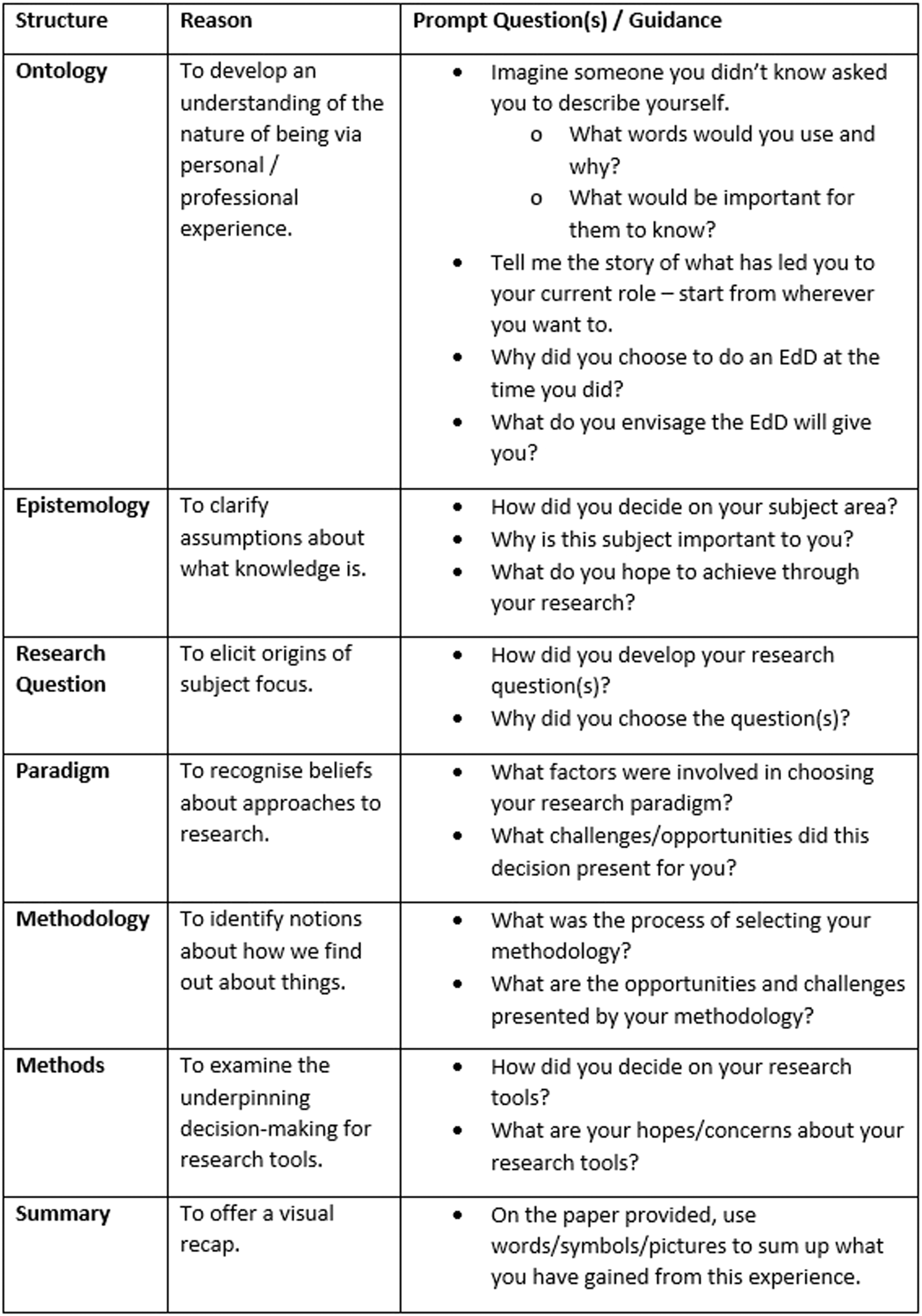
The aim of a presuppositional interview is not the same as a therapeutic intervention (Rolls & Relf, 2006), however, the conversation is likely to have some level of personal impact, whether salutary or troublesome. By their very nature, insights are unpredictable. Like will-o’-the-wisps, new perspectives can be fleeting or alternatively, catch us off guard with sudden awareness. A presuppositional interview therefore may create some level of disquiet in the accepted wisdom of our experience. The doing of the presuppositional interview therefore needs to provide a safe environment to stimulate ideas, as opposed to finding answers or re-presenting a known and well-rehearsed narrative. To mitigate against adverse harms, we established pre-interview guidelines to set out clarity of purpose for the dialogue. This includes: • The information that we generate today is yours and you will decide how to use it. • Take your time. • Try to offer detail and examples in your responses. • We can stop at any point. • Once we have finished, I will be available if you need to discuss anything further. • When you review our conversation, consider both what is said and what has remained silent. • You do not need to share this interview. It belongs to you only, and you can decide how you might use it, or not.
Confessional narrative
To give insights for both researchers and supervisors, the following presents a narrative of the experience of engaging in a presuppositional interview from both my own (Author A) and the interviewers’ (Author B) experience.
Being the interviewer (Author B)
At the core of the presuppositional interview is recognition that researchers bring something to their phenomenological research. The role of the interviewer is to open a conversation for the self and with the self. Any sense of expectation needs to be countered with a sense of wonder. The words that we utter are new to the strand of enquiry, and as they fill the present space, a co-created understanding of what is already known begins to form. The skill of the interviewer is to use active listening to encourage the dialogic transfer of thoughts to language. A gentle, unrushed process of beckoning expression revives the unchecked, inner world. Acceptance is needed that the conversation will travel in the direction that it needs to, at that moment in time. The interviewer offers suggestions for consideration rather demanding fixed or definite responses. In this way, all dialogue is viewed as helpful dialogue because it provides information that is previously separated from the outer world. As an interviewer, questions must be crafted in a way that will make sense to the interviewee, while acknowledging that answers brim from an immersed world. By taking a stance of purposeful naiveté (Kvale & Brinkmann, 2009), the seemingly obvious can be unveiled and examined. No judgement is made by the interviewer, other than when to invite further detail and when to conclude the interview. Therefore, the interview and its contents belong to the interviewee, in this instance, the interviewer is a conversational companion, tasked in the spirit of helpfulness. Decisions about how to use the self-generated data remain with the interviewee, there is no expectation that verbatim accounts or insights will be shared.
We deliberately chose to conduct the presuppositional interview in the research location in order to contextualise the phenomena and evoke the imaginative domain of experience. Hence, being in the woods framed both the methodological lens and purpose of our interaction. Opening the gate and walking into the school forest, I realised that we were entering Author A’s world. He wanted to share this place, his being in the woods revealing ownership and delight. This was a place of learning, nature intertwined intimately with the self. Evidence of the children’s artwork fluttering in the branches, a reconstructed Viking ship made from logs gradually decaying into a science experiment, and a wicker structure for outside assembly all signalling the dynamic complexion of this living and growing setting. The gentle hum of school life drifting through the trees suddenly switched gear with the explosion of sound as play time began. Although this environment was new for me, it was clearly familiar to Author A, and that is the point: the design of the presuppositional interview aimed to take Author A further into his world by noticing the routine and observing the taken-for-granted. Our conversation in the woods situated Author A’s reflections, at his pace and in his own time. Neither of us could have (or should have) predicated the outcome. However, we were both aware that we were sensitively wandering through thoughts, memories and assumptions in order to see the phenomena more clearly. The temporality of experience meant that some insights appeared at the time, while other realisations grew more slowly. With this in mind, we left the interview knowing that we had started something that would inevitably evolve during the process of the research.
Being the interviewee (Author A)
I (Author A) will take any opportunity to take someone new into the woodland learning space. Being in the wood is a special part of my working day, a unique selling point of my school and an experience that we (teachers at my school) take great pride in. Seeing the faces of people new to our woodland for the first time and hearing the gasps of amazement when they see the children learning in the outdoors is priceless. Usually, I introduce the woods to prospective parents or visiting teachers, but this time was different. This time, the aim was more than just to take in the wonder of the surroundings. This time, the subject of the visit was also me, my thoughts, ideas, and experiences. Before the interview, I took my supervisor (Author B) on the guided tour that I had practiced many times before and then it was time to sit down and begin the interview. I chose a space which I knew well – in which I had taught many lessons and had good memories. A space which I thought offered the best overview of the amazing natural environment… and then we began.
Although I had worked on the interview schedule with my supervisors, I was keen not to think consciously about my replies until in the moment. I wanted to surprise myself with my answers rather than echo a well-rehearsed script. I realised that this too was going to be important for my participants. A substantial part of teaching is feedback which takes many forms. Feedback from teachers to children in their learning, feedback from leadership to teachers about their performance, feedback from teacher to teacher when conducting peer-reviews and from children to teachers about their enjoyment and perceptions of school. Everyone in a school setting is well-versed in giving feedback and when children are asked about their learning will often reply on stocked answers. This reflection on my own responses to questions prompted me to consider which methods I would use to collect my research data and how I would try to elicit meaningful insights rather than simple responses.
For me, the process of ‘being interviewed’ for the first time enabled me to have my own experience of this process. I experienced searching to find the ‘right’ answers, trying to fill the awkward silences and an uneasiness around not knowing what the next question would be. I was also conscious of my potential anxiety around silence which I had experienced. I felt a sense of obligation to provide answers which would fully address the question in sufficient detail and be what my interviewer wanted to hear. I realised that I wanted to please. This is something that I have seen so many times in lessons – children who want to get the right answer in a maths lesson to please the teacher but cannot quite grasp the concept being taught. Connected with this was also a lack of control and anticipation. This was my school, my woods, my interview and yet I felt that I was not in the lead. I had been put into a place beyond the limits of my usual comfort. Of course, as an adult, I knew this is exactly where I needed to be to allow my true preconceptions to be laid bare. If I were too comfortable, I would be tempted to revert to a simplistic rhetoric. However, I knew that a delicate balance was required – too far out of my comfort zone could also result in the closing down and concealing of raw experiences where natural defences kicked into action. This experience has consequences for my research design. If I were to be able to gather meaningful insights from my participants, I needed to encourage them beyond their simplistic narrative but give them ownership of the interview to maintain their engagement with the process.
Informing my research practice (Author A)
After the interview, I was keen to write reflexively about the process of ‘Being in the Interview’ to try and uncover what it was like for me. I know that my experience will be different to that of my participants, but as a researcher, it gave me empathy for the children I was going to interview. When writing my questions, I revisited them with my new-found sense of care and affinity to the interview experience. I was keen to make the process as pleasant and reassuring as possible. I realised that when we say, ‘There are no right or wrong answers’, at the beginning of an interview, this has real meaning.
I was also conscious of my potential anxiety around silence which I had experienced. I therefore decided to use art methods within the interviews. This not only allowed the children the ability to convey their experiences more succinctly, it also ‘permitted’ silence whilst they were drawing. It made it okay for there not to be anybody talking and instilled a sense of quite togetherness in our mutual exploration.
As a reflection of my own need for control and anticipation of what questions were coming next, I also built into my interview schedule opportunities for the participants to take control. My research focuses on the environment of a phenomenon as a key driver of the lived experience. Therefore, I allowed the children to choose where to have the interview. During the interview, I also asked them to take me to a place which would help me to understand their experiences of learning outdoors. I knew that I wanted to gather the prereflective experiences of my participants, and to do this, I would need to remove the interference of the experience of being interviewed as much as possible. When I conducted the interviews, I allowed the children to lead me through their narrative, only probing and moving the conversation forward when required. I also ensured that I had time with the children prior to the interview (usually when walking to the place that they had chosen to be interviewed) to talk to them about how their day was going and relax them into the process. Had I not experienced being interviewed first-hand, I would have been more likely to have designed a more rigid interview schedule and not have been aware of the impact of the children’s experience of being interviewed on their ability to convey their experiences of learning mathematics in the outdoors.
Being in the interview also gave me the opportunity to learn from my interviewer. I was lucky to have been interviewed by one of my supervisors who is an experienced interviewer. She skilfully extended her questioning, so she was able to probe deeper into my assumptions. Being on the receiving end of this probing enabled me to understand the skills required to be an effective interviewer. When creating my semi-structured interview schedule, I listed a series of probing questions which I would be able to use to deepen the responses from participants. I was also able to lead on from what the children had said and gather further insights through using the techniques which had been demonstrated to me by my supervisor during the presuppositional interview. Without seeing these in practice (and more powerfully used on me) I doubt that I would have been as confident when conducting my own interviews.
Being in the interview gave me an understanding of the position of an interviewee and allowed me to observe the skills of an experienced interviewer. However, listening back to the interview, transcribing and analysing the results, is what elevated my reflexivity to a deeper level. Writing in my reflexive diary post-interview provided me with a chance to describe what I thought the interview would say about me. Although I was being reflexive (if only on a superficial level), I can now see that I was reproducing a rehearsed narrative which described how I perceived my beliefs. The purpose of phenomenological methods is to disrupt this practised account and grant access to the prereflective (Boden et al., 2018). To do this to myself, I found that I needed to ‘become other’.
The first time I listened to the interview, I spent the duration of the recording trapped in thoughts of, ‘Is that really what I sound like?’ However, after listening to the interview several times, I developed a separation from my own voice. I lost ownership of my words and instead listened to them as if they were the words of a stranger. By being immersed in the words, the detachment that I felt meant that I found I could listen anew. I began to hear the words, sentences, sounds and silences as other and experienced an opening up to what I heard. In some ways, I was being reflexive of my own reflexivity. What I thought that I believed (what I expected to hear myself say) was not what I was now able to hear. I realised early in the analysis of my transcript that I would have to put aside the ‘me’ I knew and listen to the ‘me’ as it presented itself. Treating the words with detachment enabled me to put aside the assumptions I had of my own presuppositional and really listen to what was there. My own ontology and epistemology were laid bare as if it were not a part of my own Dasein. I became critical of my own assumptions from a third-person perspective rather than being self-critical. However, these detached parts were of little use to me in their broken-apart state.
As described by the paradox of detachment, as we walk away, we are able to see more. In other words, we need to detach in order to draw near. For me, this did not mean that I saw more as a result of moving away but moving away gave me the ability to see more by drawing nearer. The parts which I had isolated had to be synthesised together and made whole. The thoughts required ownership otherwise they would remain just thoughts. At this point, I had not yet completed, what I now recognise as, the hermeneutic circle. Only when the realisation that this account of the world was my own became fulfilled was the interconnectedness I possessed with my phenomena revealed.
The preconceptions I had around outdoor learning revealed through the interview were not revelatory. I had written extensively in my own research journal about my biases towards outdoor learning as an effective pedagogy. At a surface level, I had already acknowledged my disposition towards the advantages of outdoor learning and that I would be tempted to look for a positive interpretation of my participants’ experiences. Although it is essential to acknowledge these biases in hermeneutic phenomenological research, what was uncovered was far deeper. The presuppositional interview enabled me to reveal my ontological position. Uncovering this led me to go back to my research design and explore different approaches to gathering my data.
Importantly, the way in which I analysed the presupposition transcript is different to the way in which a phenomenological interview would be analysed. This was not a trial run for analysing my participants’ interviews because the aim of the interviews is different. A hermeneutic phenomenological interview seeks to gain insights into the prereflective experiences of participants. This interview sought to offer a platform for self-reflection and a catalyst for deeper reflexivity.
I started this process from the challenge that my early reflexivity was superficial, that writing a reflexive diary can be as simply asking yourself the questions and answering them, but it can lack the opportunities to dig deeper. I learnt that transcribing my presuppositional interview added a layer of reflexivity which allowed me to get closer to my own truths. The process developed my understanding of what it is to be truly reflexive. It is not enough simply to consider your own opinions of the phenomena. You need to recognise your own beliefs about what knowledge is and your understanding of the nature of Being. Without ownership of these, you cannot hope to engage in philosophically grounded phenomenological research.
Conclusion
To inform and inspire the thoughts we have and the actions that we take, van Manen’s phenomenological approach proposes three types of knowledge and understanding: (1) ‘knowledge as text (product), (2) knowledge as participation (understanding), and (3) personal knowledge (being)’ (van Manen, 2011). The presuppositional interview aims to enable hermeneutic researchers to take a closer look at what they know and how they know. As a conversation with a particular purpose, the questions in the presuppositional interview align with view that ‘the phenomenological method consist of the ability, or rather the art of being sensitive – sensitive to the subtle undertones of language, in the way language speaks when it allows the thing themselves to speak' (van Manen, 2016a: 111). Using our experience, knowledge can be recognised as deriving from our experience and assumptions. In other words, phenomenology presents us with opportunities to discover different types of knowledge and gives us an alternative perspective on how we view information. Rather than providing answers, we can gain formative insights which can lead us to continue to enquire. According to van Manen (2011), phenomenology ‘enhances our perceptiveness, it contributes to our sense of tact in human relations, and it provides us with pathic forms of understanding that are embodied, situational, relational and enactive’. As a result, the presuppositional interview is not intended to give answers but to heighten our sensitivity and guide our thinking. Therefore, as phenomenological researchers, we need to maintain methodological congruence and as Osborne (1994) advises, the phenomenology chosen for the research endeavour must remain philosophically grounded throughout the research process (Laverty, 2003).
Being in the research recognises taken-for granted assumptions via the sense of presence. Therefore, positioning the researcher-self is more than identifying the insider status; it is about understanding that research is a lived and lively experience. As such, the experience moves through cycles, from surfacing the unknown, developing and growing new conceptualisations through to the fruition of novel insights. In turn, our insights will continue to evolve as we continue to be.
The presuppositional interview has provided me with a platform for standing back to get closer – turning artificial reflection into a more genuine version of understanding what it is that I think, believe, and know to be true. It has helped me to uncover my interconnectedness with the phenomena and this is evident in the quality of my reflective journal prior to and following the interview. My sensitivity to my own presumptions is heightened and returning to it frequently helps to guide my thinking through the research process.
The aim of this paper has been to offer ideas for a flexible interview framework to inform hermeneutic phenomenological researchers. How we experience being in the world raises awareness of being with others so that we can learn more about the meaning of everyday existence. Whilst the presuppositional interview is directed to the inner world of the interviewee (the ‘being’ in the wood), the interaction with ‘the other’ (the interviewer) assists with accessing the hard-to-reach aspects of our motivation and the facets of our being that remain accepted and unquestioned. Therefore, understanding the presence of the researcher is multi-dimensional and essential to the integrity of qualitative research. To be there in the research means to accept the embeddedness of the researcher-self as inseparable from the world in which the research takes place. Yet recognising, exploring and interpreting how the researcher influences and is influenced by the research takes time and effort. Sitting with the uncertainty of Being is not an easy or singular task, and in this paper, we present the presuppositional interview as a means of exposing researcher positionality. We also started this paper as an opportunity to open the conversation about using presuppositional interviews and welcome further dialogue.
Footnotes
Declaration of conflicting interests
The author(s) declared no potential conflicts of interest with respect to the research, authorship, and/or publication of this article.
Funding
The author(s) received no financial support for the research, authorship, and/or publication of this article.
