



Abstract
The purpose of this paper is to demonstrate how presuppositional interviews can develop reflexive transparency in grounded theory methodologies. Grounded Theory aims to generate understanding of a given socio-psychological process using a systematic methodology for gathering, analysing and interpreting data. As the researcher is intrinsic to this process, reflexivity is an essential tool to explore and challenge the researcher unknown presuppositions that influence the research process and findings. Reflexivity in practice is challenging as it aims at identifying unknown influences which are by nature, hidden. In this paper, we demonstrate how presuppositional interviews can be applied to Classic and Constructivist grounded theory, and to qualitative research in general. We illustrate this process with two practical case studies, demonstrating how the presuppositional interview can be utilised to enhance transparent reflexive practice. We suggest the presuppositional interview enables higher levels of reflexivity and subsequent positive impact on praxis and the research process.
Keywords
Introduction
Grounded theory methodology (GTM) is a systematic methodology for collecting, analysing and interpreting data with increasing levels of abstraction with the purpose of generating a theory to provide understanding of a given socio-psychological process (Charmaz, 2014; Watling and Lingard, 2012). Throughout GTM research, the researcher’s ontological, epistemological and axiological position are highly influential, meaning what the researcher believes about knowledge and how that knowledge can come to be known, combined with their values and opinions that underpin both the purpose and process of the research. How the researcher views the world engenders a unique relationship between the researcher, participants and the research itself which intrinsically informs the positionality of the researcher. Awareness of these values and beliefs about knowledge, purpose and process and the influence they may covertly have, is essential for all GTM researchers. To be aware of one’s positionality, values and beliefs and the impact they inevitably have upon the grounded theory produced, is essential in enhancing rigour and transparency of intent, as well as enabling more accurate representation of the voices of participants, that we might generate high-quality GTM research that is ethical, valuable and trustworthy.
However, at the origins of grounded theory, the researcher’s personal values and beliefs were not always seen as having influence in the ‘doing’ of the research. In the 1960s, Glaser created grounded theory as a scientific methodology using a systematic model of analysis and interpretation to aid understanding of a social process (Glaser and Strauss, 1967). Glaser and and Strauss (1967) ontological objectivist position was that reality existed externally and was there to be discovered. The researcher took the role of objective observer of the social process with little value being given to the researcher’s axiological stance, meaning the researcher’s personal values and perceptions. The problematic implication of not addressing axiology is that it is unclear as to how the positionality and the presence of the researcher impacts both the GTM being undertaken and the eventual grounded theory being produced. As the development of GTM progressed, Strauss and Corbin (1998) gave more recognition to the subjectivity of the researcher and their influence on the both the data gathering and the analytic process. Later, Corbin and Strauss (2015) acknowledged that each researcher brings their own philosophies and experiences to the research process and that whilst bias and assumptions cannot be fully eliminated, with self-awareness, such introspection can bring valid insights to the interpretive process. Researchers who hold to a Glaserian objectivist or realist ontology later came to similarly acknowledge the influence of their own subjective views and bias within the research process, thereby adopting a more post-positivistic approach, taking the view that reality externally exists and that the researcher subjectively discovers it (Birks and Mills, 2015).
Constructivist grounded theorists differ from earlier generations in GTM in both their ontological position, meaning their perceptions of reality, which then influences how that reality is come to be understood - their epistemology (Charmaz, 2014; Mills et al., 2006). The most common ontological stance in constructivist grounded theory is that of relativism, meaning the belief that there is no objective reality, but what is known or seen to exist is subjective to each individual and relative to social and cultural context. Epistemologically, knowledge or understanding is then actively co-constructed through building those multiple perceptions of reality together, thereby generating a multi-faceted social construct, without need for consensus (Scotland, 2012). Researcher and participant positionality is therefore intrinsically different to earlier generations of GTM, as the researcher co-constructs knowledge with the participants, together building understanding through the different perspectives of the social process being explored. Such co-construction requires a flexible and open approach throughout, including an awareness of the potential power differentials and in order to ensure that agency remains with the participants (Birks and Mills, 2015), including, for example, in choices such as where and when to meet, using a more open method of questioning as opposed to a rigid interview schedule and allowing the researcher to share their views and interpretations of the subject/data as part of the co-construction of meaning process (Birks and Mills, 2015; Bryman, 2012). The reciprocity this generates allows understanding to be generated through the discussion itself, as ‘participants and researchers discursively construct reality together’ (Ladegaard and Phipps, 2020, p.74), with ideas and concepts not necessarily being pre-thought by either side. It can be seen, however, that the underlying influence of the researcher on the research process is potentially much more significant, and the need for reflexivity and mitigations is clear.
Whichever form of grounded theory is undertaken, consensus is that achieving a true objective stance is impossible as researcher values and beliefs cannot help but be influential (McCall and Edwards, 2021). This is not only true for the analytical, interpretive and conceptualising phases of research, but in all choices made throughout the research process, including determining the purpose of the research, the social process being explored, which participants are chosen, which questions asked, what data is gathered, how meanings are clarified, codes assigned, memos created (as in the recorded thought processes that assign meaning to the data) and how the analysis is made, conceptualisation configured and how the theory is generated (Berger, 2015; Holmes, 2020). Research using grounded theory therefore can never be fully neutral, no matter which GTM approach is used, and to gain insight regarding potential researcher influence would seem a more realistic goal than aiming at the objectivist, neutral, passive observation that early grounded theorists sought to promote. Through questioning and challenging decision making, insights into how conclusions are arrived can occur (Holmes, 2020) and the influences of the researcher, as rooted in their values and beliefs about the whole research process, meaning their underlying axiological position - can be identified. The main tool used to identify, explore and challenge a researcher’s axiological position is reflexivity.
The importance of reflexivity in grounded theory
Reflexivity has been described as the ‘analytical self-awareness of the researcher’s experiences, reasoning and overall impact throughout the research process’ (Råheim et al., 2016, p.1). Reflexivity identifies and acknowledges the beliefs, perceptions, biases and constructs within a researcher that both consciously and unconsciously impact on the research process (Engward and Davis, 2015; Guba and Lincoln, 1994) and the positionality between the researcher and their participants, meaning how they relate to or interconnect with each other. This can be particularly pertinent when issues of intersectionality form the focus of the research, such as exploring structural inequalities of race or gender or other social or political identities through which power and disadvantage are outworked (Crenshaw, 2017). In such an area of exploration, a researcher’s ideologies would have a highly significant impact on the participant/researcher relationship (Kassam et al., 2020), so it would be vital that the tacit perceptions and situatedness of the researcher across different social and power locations be reflexively explored and addressed (Collins, 2022; Hankivsky, 2022). We would argue, however, that reflexivity is important in all qualitative research, agreeing with Bolton (2014) that it is the main way of establishing congruence between the researcher's conscious values and their subsequent research practice, no matter the subject being explored. In all qualitative research, attention is needed to examine why researchers make the choices they do and how their actions and interpretations connect with their social and cultural context (Holmes, 2020). In stating the importance of introspective elements of reflexivity, Finlay (2002) highlights the value of a researcher becoming self-aware of their own passions and drivers, where they come from and how they potentially impact the research process. It should not stop there however, as Hibbert et al. (2019) particularly emphasises, for reflexivity to have meaning, it needs to impact on practice, as in what we do that is different in light of insights gained. If insights arise but no change in practice occurs, it must be questioned if there is any purpose in the exercise (Holmes, 2010). However, with increased insights gained through proactive reflexivity and subsequent change in practice, the researcher can become more able to differentiate between their own perceptions and those of participants, so generating more accurate understanding of participant voices and subsequently a more reliable representation within the research findings and analysis.
The concept and practice of reflexivity can be challenging because it involves turning critical thinking and appraisal towards the self. In essence, it is about making things that are unknown, known, which can prove difficult and personally troublesome, especially when we shake our unquestioned assumptions. The commonly used method of keeping a reflective diary, though useful, can only go so far, as identified by Barrett-Rodger: ‘I became aware my solitary reflections were skirting around the edges of my assumptions’ (Barrett-Rodger et al., 2023, p.7). For reflexivity to be useful, there is a need to dig deeper and demands a level of preparedness to explore our closely held values and beliefs. One method to gain insight into these concealed influences is the presuppositional interview.
The presuppositional interview
A presuppositional interview is a structured conversation to discover and understand one’s unseen presumptions about oneself in relation to the research. How to overtly go about having such a conversation is rarely described in the literature. Some possibly similarities to this practice in social research are limited to papers by McSwite (2000), Crawley (2012) and by Barrett-Rodger et al. (2023). McSwite uses a self-interview to structure their thoughts and arguments in an essay on the discourse movement, however, they do not provide a detailed reflexive analysis of their responses to the questions. Crawley (2012) makes further reference to self-interview in a book chapter, where they frame auto-ethnography as a form of feminist self-interview. However, they discuss self-interview more as a conceptual presentation of in-depth auto-ethnographic self-reflection, rather than using an interview technique for transparency and reflexivity purposes. Outside of this context, the term ‘self-interview’ as a research method is more commonly used as a method for researchers to collect data from participants interviewing themselves (Keightley et al., 2012), but not as a reflexive tool to collect information about oneself. The presuppositional interview differs from a self-interview in that it aims to make explicit through conversation and dialog any biases and presumptions held by the researcher, which are then actively integrated in the research process. A key distinction we forward is understanding oneself as revealed through dialogue with another. From this, new insight and actions can be formed. This is intended as a practical tool to enhance the research process – it is not a therapeutic exercise.
The concept of the presuppositional interview is relevant across all social science methodologies that utilise inductive research approaches. However, the purpose of this paper is to give examples of the application of a presuppositional interview in a grounded theory context.
In this paper, we conceptualise the presuppositional interview concept similarly to Mallory (2001), who discusses the benefits of examining the differences between researcher and participant. Mallory argues that not only is it essential to understand the researcher’s background relative to the participants, but that researchers should be explicit about how the researcher interprets data (Mallory, 2001, p.87). Unfortunately, Mallory does not indicate how these differences are best examined, so making it difficult to apply in practice. The only example of a presuppositional interview we are aware of is found by Barrett-Rodger et al. (2023) who utilises the presuppositional interview to practically explore his positionality and its influence on his own research in a hermeneutic phenomenological context. Whilst useful, this does not specifically address spheres of wider application in relation to other qualitative methodologies, nor does it clarify that undertaking a presuppositional interview in itself does not mean the research is done reflexively, as it is the analysis and application of the insights gained following the interview that affords the most significant impact.
Despite the lack of documented examples, the premise of a presuppositional interview has the potential to be a valuable method to structure a transparent reflexive analysis in the grounded theory research context. When the researcher engages with in-depth questions about their personal values and beliefs, their responses will help explore and analyse their position in the research. The presuppositional interview as facilitated by a third party, provides structure and thereby helps achieve greater challenge and so clarity, thereby potentially allowing a greater depth of analysis. It is important that the presuppositional interview is conducted with an independent party not connected to the researcher or the research to maintain an objective position in relation to the questions asked and to enable new thoughts to be realised. Once completed, the insights gained from the interview remain with the interviewee. This information is now owned by the interviewee, and it is their choice how to utilise these new insights. As such, careful consideration about skills of the interviewer is needed for the presuppositional interview to enable in-depth reflexive analysis in a safe collegiate space more so than reflection and reflexivity in isolation could allow.
The role of the pre-suppositional interviewer is to safely navigate the interviewee through a reflexive process which Finlay (2002, p.12) describes as ‘perilous, full of muddy ambiguity and multiple trails’. Holmes (2010) and Burkitt (2012) see emotions as central to the reflexive process, which they highlight can prove challenging to navigate, with both recommending reflexive dialogue (Burkitt, 2012) or a socially embedded model of reflection (Holmes, 2010) as a useful approach. To ensure that the presuppositional interview is a safe and effective learning experience, emotions as well as thoughts therefore need to be recognised, and carefully managed (Barrett-Rodger et al., 2023).
The parameters of the interview must be established in advance and tailored to the individual research purpose. A one size fits all interaction is unlikely to generate the nuanced self-based information that is required for the exercise to be useful both in the short and long term. The construct of the interview is determined by what the interviewee feels they need to explore, for example this may include the interviewee’s professional practice in relation to the research, or a particular ideological stance. The intention of the interview is twofold, firstly to unlock insights and different ways of thinking about the area under investigation and secondly for the researchers to thinking about their ongoing role in uncovering new knowledge. Therefore, the agenda of the interviewer is based on the spirit of helpfulness, and questions are sensitively framed, with empathic impartiality to promote curiosity and internal dialogue. The interviewees are informed that the information generated is owned by them and it is their decision how to use it, no record is kept by the interviewer. Emphasis is placed on taking the time to offer detailed responses, along with examples that leap into mind. Once the conversation concludes, the opportunity remains open to return to the conversation with the interviewer if anything requires further discussion. Finally, interviewees are encouraged to explore their transcripts and find the knowledge held in their words and to also be inquisitive about what is not said as in the silences, gems surface from the unspoken. In other words, the interviewer acts as a reflexive advocate to stimulate and support the interviewee in gaining insights into their reflexive researcher self.
To demonstrate how the presuppositional interview can be used in practice in grounded theory research, two case examples will be presented next. The first case example outlines the application of the presuppositional interview in classic grounded theory. In this example, the researcher (NvV) was presuppositional interviewed by the third author (SG), who is experienced in semi-structured interviews as a qualitative research method. Similarly, in the second case example, JA was presuppositional interviewed by SG in relation to constructivist grounded theory. Both NvV have known SG since the start of their doctoral journeys, and whilst both were presuppositional interviewed by SG, the interview schedules themselves differed in line with the requirement of the individual researchers. The process of being presuppositional interviewed is detailed below, each case demonstrating how the experience enhanced and developed their reflexivity and transparency in relation to their individual GTM doctoral studies. From here on, NvV and JA write as first persons about their experiences.
Presuppositional interview – NvV case example
The purpose of the presuppositional interview in this case: My study is about researching experiences of course leaders in one small higher education organisation, within which I am also a course leader. As such, I am an insider in relation to both my research topic and professional employment. To understand this complex relationship, I requested SG to facilitate a presuppositional interview. To start this process, I shared my research interview schedule with SG, and in a pre-meeting, we agreed the purpose, context and parameters of the interview. SG subsequently made adaptations to the interview schedule to fit her personal interview style, without altering the meaning of the questions. A benefit of this approach is that although I was familiar with the interview schedule, I could not pre-empt the questions and therefore unduly influence the interview. Moreover, because SG was able to use her own style of interviewing, the interview felt natural, and I was comfortable discussing my course leader practice. My pre-suppositional interview was in an online meeting environment and lasted for 90 minutes. I recorded the interview after which it was transcribed by an external transcription agency. Upon receiving the transcript, I then read the transcript and wrote reflexive memos linked to my responses in the interview.
Practice of using the presuppositional interview
The interview started with the SG outlining the purpose of the interview and confirming that I was still happy to go ahead. The opening question was as follows:
To begin the interview, and thinking about this idea of course leaders and course leadership, can you explain to me a bit about your role in your current institution?
I have multiple roles. First and foremost, according to my employment contract, I’m a senior lecturer in Bioveterinary Science. Secondary to that, I’m the course leader for the Bioveterinary Science course scheme, which comprises an integrated master’s degree, an honours degree, and a certificate of higher education. I’ve been doing that since 2016 and before that I was course leader and senior lecturer in Animal Science.
I learnt the importance of the opening phases of an interview, where the interviewer tries to learn more about the participant’s background whilst simultaneously putting the participant at ease. However, I also learnt an important aspect of reflexivity about myself as detailed in a reflexive memo I wrote for the analysis of this part of the interview: It is interesting that I chose to refer back to my contract of employment when answering this question. Although I generally see my professional identity as a variable collection of roles, the only formal role I have within my institution is that of senior lecturer. I have no contract that reflects my role as a course leader for the bioveterinary science scheme, and my transition from animal science to bioveterinary science was very organic. This reflects what I found in my literature review last year, where lack of a contract or job description for the course management role was discussed as a shortcoming, which is why I started this project in the first place. I need to ensure that I do not project these values onto my participants during the interviews.
Through the interview, it became apparent that my professional identity as a senior lecturer and course leader has influenced my research project from the very beginning (Holmes, 2020). As an insider-researcher researching my own role in my own institution, I am intimately connected to my research and its outcomes (Brannick and Coghlan, 2007). As argued by Poggenpoel and Myburgh (2003), for my research to be trustworthy, as in establishing confidence in the research design, analysis and therefore findings, I will need to ensure a high degree of reflexivity and transparency throughout all phases of my research. Developing codes and categories will need explanatory memos which link back to my presuppositional interview to ensure this transparency and to enable thorough continuous reflexive analysis for enhancing quality (Holmes, 2020). Furthermore, because the interviewer used my research interview schedule and their experience to expand/further address my answers as appropriate, I found that I was forced to explain my thoughts and experiences in detail. The following part of the interview demonstrates this nicely:
[. . .] In my head it’s not very important because I know how many annual leave days I have, how many I’ve taken and I’ll make sure I don’t take too many. It’s those kinds of things that I don’t really see the value of, but I guess there’s quite a lot of micro-management at <name of employer> from support departments and academics don’t do very well at being micromanaged.
Why do you think that is?
I don't know, we’re stubborn, we’re academics, clever, no tolerance for stupid things, I don't know what it is. My former line manager used to say that managing us as a team is like herding cats because everyone has their own opinion and everyone does their own thing, I guess that comes with the territory, being an academic.
It’s interesting when you start thinking about what autonomy means in that situation.
In some respects, we have a lot of it and in others, particularly in the current day and age, higher education and the marketisation of higher education, we don’t so . . .
How do you think that feeds into your role as a course lead?
Reading back through the interviews I realised that there are a lot of unspoken and inherent values and beliefs hidden in my words, which reflect how I see myself, my role and my position in the institution. However, I would not have considered this influential without also reading my replies to the follow-up questions asked by the interviewer. My memo for this section read: I am surprised by the way I use my words here, and by how my words are loaded with value and beliefs in relation to my role, and to what it means to be an academic. I don’t normally have time to think about this because of the busy nature of an academic, but my sense of belonging and being valued is inherent to my approach to my role as a course leader. I will always put the student first, because there is a higher chance of being appreciated by them than by my organisation.
The values and beliefs recorded in the memo will without a doubt have influenced my research, and therefore it is important to address this influence transparently. I was able to develop a deep understanding of how my personal and professional experiences have steered the way I interview my participants and gave me better insights on how my codes ‘come to be’. I realised that because I can get frustrated by my views on certain topics related to the role that I was more sensitive to the nuances in interviews and coded these with more insight than other elements of the interview.
For example, I sometimes feel that support departments are not helpful in my attempts to support students with their pastoral needs. Initially, this led to a code of ‘being without support’ in my first interview when participants described a similar experience. However, following the presuppositional interview, and upon reflection on my experiences, I recoded this to ‘experiencing conflicting priorities’ as I realised support colleagues are not necessarily unhelpful, but likely have different priorities in the institution.
This part of the reflexive analysis demonstrated that because of my insider role, my participants identified with my course leader position and likely gave more honest answers, which is in line with arguments by Holmes (2020). However, I also learnt that my insiderness led to pre-assumptions about how participants experience course leadership, something previously described by Mehra (2002) as a source of potential bias. Through my presuppositional interview, I made these influences explicit and could learn from them. This in turn means I am now better able to work to address these potential biases, and therefore collect better quality data and improve analysis because of my increased awareness of the influence of my presuppositions. This is essential, because even though Glaser poses that the GT method will ensure high quality research and addresses any bias by virtue of its design (Glaser, 2002), there is an inherent impact of the researcher on the process which needs acknowledging, particularly in the context of current research practice.
Presuppositional Interview – JA case example
The purpose: I (JA) work as a medical educator in psychiatry education in the UK and internationally. My research topic is about the process of engagement in undergraduate psychiatry education in India, using constructivist grounded theory. I hold a relativist ontology and social constructivist epistemology which underpins my methodology, aligning with my personal beliefs about being and how things are known, my preferred educational practice of experiential and social constructivist learning and the context of where I am researching. As a white English woman, I am frequently questioned as to why I am undertaking research in India, particularly challenging the potential for post-colonial bias and presuppositions. To understand my position in more depth, I was interviewed by SG as a means to explore my motives and purpose in investigating in a country other than my own, and to gain insight into what could be challenged as an unconscious post-colonial bias.
Upon consideration of the methodology best suited to answer the research purpose, I am using constructivist grounded theory with the recognition that in working in a different cultural context there would be many areas of cultural nuance that I would not necessarily understand. In choosing a methodology which co-constructs understanding with participants, I aim to gain a greater depth of knowledge through exploring the students’ experiences and opinions, clarifying meaning and together building a place of understanding, that a theory around engagement and non-engagement might be co-constructed. However, I remain aware that it was I asking the questions, even although I used a semi-structured format, I set the agenda or topic focus, and that it was I who undertook the analysis, identified codes and conceptualised what the data might mean in terms of theory. I used memos throughout but am aware I could be unknowingly blind to any bias I might bring, including cultural or colonial, and therefore, without insight had no chance of mitigating. To be aware of unknown presuppositions, particularly regarding the ‘imaginative, theoretical interpretations’ (Charmaz and Belgrave, 2019, p.74) that led to theory production, would seems essential.
The practice of using a presuppositional interview
During the interviews, I was lead through a series of questions by SG initially exploring how I would describe myself – ‘quite driven, quite self-sufficient, quite compassionate. . .’ with – ‘many, many ideas’. Key words were then picked up and explored by SG: ‘What does compassion mean for you, what does it look like?’, which lead to an exploration of my beliefs about our responsibilities as humans for other humans, and how this came from my upbringing and informed the underpinnings of my motivation. SG asked how I became a practitioner researcher; I talked of my work overseas teaching psychiatry and how Indian psychiatrists in person and in the literature provided insights into the gap in knowledge that I aim to address. Of special significance was a senior psychiatrist in India who said to myself and colleagues to: ‘teach my students to think’. SG picked this up and explored more, helping me to consider what ‘thinking’ meant in this context and how it linked into the process of engagement in learning. I was helped to work through why I believe learning to think and engage was so important for young doctors and subsequently to the people with mental illness in India. This led to consideration of my research question and the why I chose the interpretivist paradigm, how this related into undertaking research in another country and if I as a white woman from England, was able to interpret what I was hearing as an accurate representation of the Indian undergraduates, who appear so different to me. We discussed colonialism and the impact of researching in a country not my own, and how I felt about that – my perceptions and how they impact the whole research process.
Immediately after the interview, I recall having enjoyed it more than anticipated, realising the privilege of having an external ear to listen while I talked for almost 2 hours and an external mind to help me unpick my motives and why the subject mattered to me so much. I heard an enthusiasm and passion for the subject and the meaning behind what I was doing and the research process. However, at times I also heard a potential arrogance from a position of privilege, that I wanted to ‘help’, had every right to do so and blindly believed I could. Such white privilege is written about by DiAngelo (2018) who talks of white people not knowing they have opportunities that others do not, and that from a place of ignorance being blind to their own good fortune. Mills (2014) speaks of this desire to ‘help’ being a symptom of that privilege, intrinsically seeing others as lesser and needing assistance. Being privileged and superior was not a conscious thought for me, but I did use the word ‘help’ 22 times in the presuppositional interview therefore I had to reflect on why. I had not ‘heard’ my words, or thought of their potential meaning as I spoke them in the interview, but I did hear them as I listened to the recording of the interview and as I read the transcript, which enabled me to see more than the words themselves, but addition possible motivations, assumptions and bias behind those words.
I chose to code the transcripts using NVivo, and to code my memos alongside, creating 55 codes that I then held against a colonial, post-colonial and post-postcolonial frame of reference. Post-postcolonialism is a positionality that I seek to hold which promotes a hybridisation of different perceptions including cultural, for mutual learning (Bhabha, 2012; Gosselin et al., 2016). It means deliberately giving agency to ‘other’ or people of a country formerly colonised, whilst remaining reflexive to one’s own ethnocentrism, meaning the tendency to consider the world only through our own cultural eyes (Falen, 2020). It means continuously embracing a mutual curiosity of difference (Etim, 2019; Falen, 2020; Shapiro, 2000). Thus, my desire to ‘help’ could now be perceived as a colonial manifestation of ingrained white superiority - a self-perception of being a ‘white saviour’ (Straubhaar, 2015); or a post-colonial continuation of an oppressive stance where I had power (Falen, 2020); or alternatively a post-postcolonial desire for one group of people to share good practice with another for mutual benefit (Datta, 2018; Gosselin et al., 2016). I did this process for all 55 codes, analysing them all against the colonial, post-colonial and post-postcolonial frames, holding my previously unknown assumptions and new insights to account. I then grouped the codes into five main categories and made my priorities explicit by counting the number of times different words were used (see Figure 1). I charted these key categories as to the number of times the codes occurred, creating a visual representation of the main presuppositions, drivers, motivators and concerns that impact my research choices, thinking and interpretations in my research context. This became my ‘map of consciousness’ (Mullings, 1999, p.337), which I recognise is constantly changing and requires frequent revisiting, in order that it might be useful in maintaining transparency and holding my research decisions to account (Holmes, 2020).
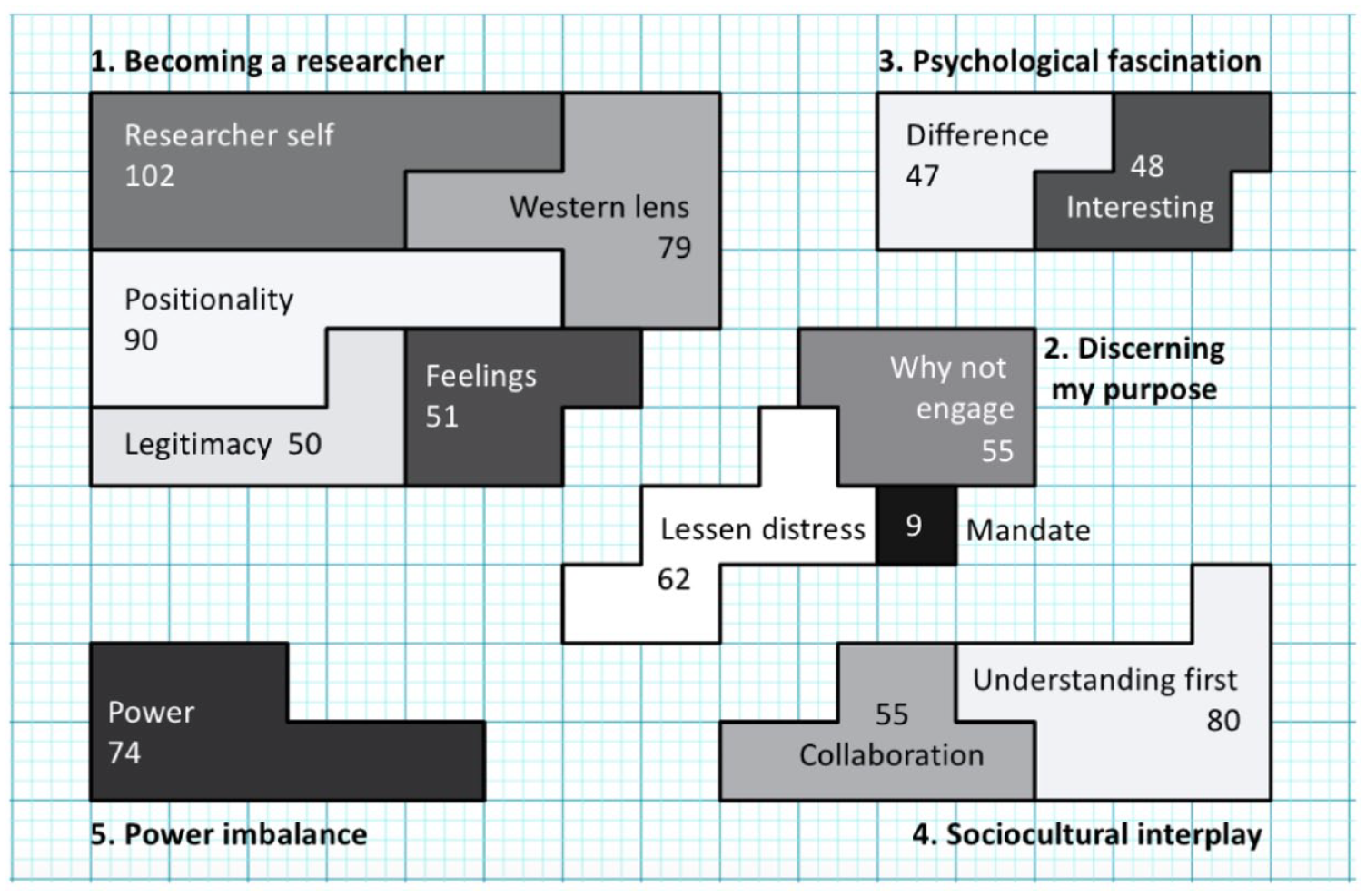
Map of consciousness showing categories and themes arising from the reflexive process, with numbers denoting the recurrence of the words in the interview to demonstrate weightage or possible significance.
Without the presuppositional interview, my reflexivity in isolation would not have been sufficient to uncover these influences or allow me to challenge them robustly, particularly from a colonial, post-colonial or post-postcolonial perspective. I now feel significantly more consciously aware of what I am doing and why, which means I can reflexively adapt my research practice in mitigation and hold the research process to account, thereby becoming more transparent throughout. Whilst the presuppositional interview within a reflexivity framework cannot totally remove my presuppositions or biases, it can make them less unknowingly influential that a more accurate understanding of the process of engagement or non-engagement in undergraduate psychiatry education in India might be constructed.
Discussion
As demonstrated within the two case examples, undertaking a presuppositional interview provides a means of a researcher increasing insight into their individual axiological positions which in turn can overtly increase transparency within reflexive practice, and therefore enhance the quality of a GTM study. Such enhanced transparency leads to more robust research as it allows researchers to address inevitable presuppositions both through mitigation within research practice and by openness and illumination in praxis when mitigation is not possible. By providing a tool for questioning the axiological underpinnings of research practice, the presuppositional interview promotes the development of the reflexive researcher and propels them forward with a heightened awareness of their position in and influence upon the research process, with such heightened awareness enabling a more accurate representation of the voices of the participants,
The presuppositional interview turns the attention to the researcher, rather than the type of GTM used. Using examples from our experiences of undertaking presuppositional interviews, we have demonstrated that they can be applied to GTM, irrespective of the generation of GTM being used. In other words, the presuppositional interview has no strict ontological or epistemological allegiance rather it is directed towards promoting the integrity of the research process by establishing the position of the researcher within it. Additionally, we suggest presuppositional interviews can offer transferable insights for the wider community of social scientists and is not limited to grounded theory only. As a method of achieving transparent reflexive practice, we have shown that the approach is flexible, and should be viewed more as a framework than a reductionist, prescriptive method. This is demonstrated by the fact that even though the two case examples used contrasting forms of grounded theory and utilised the presuppositional interview in different ways, the end result was similar in that both researchers were enabled to consider their position in the research process in a structured and transparent manner which in turn impacted positively on their ongoing practice, both for insights gained into the world of their participants and the theories generated. It is the flexibility of the presuppositional interview framework that is its greatest strength: it allows the researcher to meld the presuppositional interview around their personal experiences and their research project requirements, while still leading to transparent reflexive practice.
We have used this paper to open the discussion on the application of the presuppositional interview. Further work is needed to explore at what stage of a grounded theory research project the presuppositional interview is best used, whether it could be carried out at multiple stages, for example from problem identification and literature reviewing at the beginning of the research process, within data gathering and coding, then as part of constant comparative analysis and latterly theoretical integration. Further work also needs to be conducted on the application of the presuppositional interview to other qualitative approaches beyond grounded theory and hermeneutic phenomenology.
Conclusion
To conclude, we strongly recommend all grounded theory researchers undertake a presuppositional interview, to increase insight into their own axiological position, in order to enhance the transparency of their research, and to hold themselves and their research practice to account. We recognise that presuppositions cannot necessarily be removed, but instead be understood, used and where appropriate mitigated for, and that they should be acknowledged where mitigation is not appropriate. We suggest the presuppositional interview can be incorporated in all variants of GTM research for this purpose. We demonstrate this for Glaserian and constructivist GTM and encourage the GTM community to apply the presuppositional interview more broadly. Whether to reflexively explore and understand the impact of being an insider researcher, or to appraise one’s position in a different cultural context, or any other context where the researcher wants to explore their influence on the research, the presuppositional interview will highlight important influences the researcher has on their project and through insights gained, enable the voices of participants to be more accurately understood.
This paper positions the presuppositional interview as a useful tool for enhancing current reflexive practice. In accordance with the existing body of literature, we agree that reflexivity is an ongoing process rather than a one-off activity, and that the presuppositional interview can be a useful addition to inform this process. Through applying such robust reflexive practice, we maintain that ethical practice will be enhanced and the overall quality of the research can only improve.
Footnotes
Acknowledgements
The authors would like to extend their thanks to the two anonymous peer-reviewers for this manuscript. Their constructive and helpful comments have made this paper better, for which we are grateful.
Declaration of conflicting interests
The author(s) declared no potential conflicts of interest with respect to the research, authorship, and/or publication of this article.
Funding
The author(s) disclosed receipt of the following financial support for the research, authorship, and/or publication of this article: Nieky van Veggel was part-funded by Writtle University College under a Learning and Development Fund grant (2016/17-NV). Anglia Ruskin University provided funding to cover the Article Processing Charge for this paper through the ARU Open Access Publishing Fund.
