




Abstract
This paper presents one aspect of a sociocultural micro-ethnographic study examining how 11- and 12-year-old children formulate meanings when working with an artist in a contemporary art gallery. My primary focus is an examination of methodological contributions emerging from an imaginative coding and analysis of children’s art. Ninety-nine artworks were created in collaboration with the artist and were organised and interpreted using a constructionist interviewing coding scheme. This unorthodox approach to visual analysis unearthed information that oral accounts cannot provide alone revealing meanings which would otherwise remain dormant. By intuitively applying the coding framework I expose how participants’ meanings are negotiated by appropriating and re-organising cultural concepts into personalised narratives. As such, artworks reveal participants’ desires, interpretations and intentions, operating as agentic cultural producers as well as unconsciously reproducing visual epistemologies ubiquitous in Western cultures.
Aims
Motivated by increasing inequality in the English education system and ensuing marginalisation of art and design in the curriculum (for example, see Payne, 2018; Payne & Hall, 2018), I facilitated a collaborative art education project and scrutinised it using a sociocultural micro-ethnographic lens. The study explored how 99 Year seven pupils (aged 11–12 years) learn in a contemporary gallery by participating in artist workshops, where art production was positioned as a dominant data collection method. The aim of this paper is to present the inductive coding scheme used to organise and interpret the artworks and to examine their relationship to artist-pupil unsolicited conversations. By applying an approach to coding usually reserved for interview transcripts, an approach which I claim as unique having found no similar examples in research literature, the resulting imaginative interpretation of visual data represents an original methodological contribution. Conclusively, I champion the value of children’s art as a visual method and clarify methodological decisions to facilitate replication or adaptation in other settings. All participants’ names have been changed to maintain confidentiality.
The project
The project took place in a large contemporary gallery in a South of England city where pupils participated in one of six artist workshops organised over a 2-week period. The research was made possible by extending existing professional relationships between a gallery educator (Sara), an artist (Mary) and a secondary school head of art and design (Jamila). As a former Postgraduate Certificate in Education [PGCE] university lecturer, I had worked with Jamila and the gallery staff over an 8-year period, a factor which played a fundamental role in shaping the study.
Jamila and the pupils attended a sponsored academy – an under-performing ‘public-funded, independent school’ (New Schools Network, 2015: 3) – located in an area of deprivation in the city. Prior to data collection the English national schools’ inspectorate Ofsted [The Office for Standards in Education, Children’s Services and Skills] identified low literacy levels and children’s limitations in self-expression. This was compounded by 2011 Census data indicating the children lived in a part of the city ranked amongst the five per cent most deprived in England for education, skills and training. I was aware that English pupils from low socio-economic backgrounds, especially where their families have limited qualifications, are far less likely to engage in diverse British culture either in childhood or adulthood (Arts Council England (ACE), 2014). This is intensified by an education system where increasing numbers of learners have their cultural rights curtailed through political marginalisation (Neelands et al., 2015).
At this point it is important to contextualise the term culture in this study. Culture is positioned as social practice where meaning, value and subjectivities are constructed through the creation and symbolic exchange of meanings (Bruner, 1996; Williams, 1981). Knowledge production shapes individuals and societies and so culture is active, ever forming and reforming. Cultural practices vary allowing for difference, resistance and subversion as well as dominance and marginalisation (Freedman, 2000). With this definition comes the acknowledgement that culture is ‘located in everyday spaces […] and does not need solely to reside in theatres, art galleries and other spaces’ (Byrne et al., 2016: 728) deemed legitimate. In this study, I wanted to champion children’s sociocultural experiences through engagement with contemporary art, which can facilitate inclusion by exposing hidden or suppressed narratives (Sandell 2002). I chose arts-based research to capture this as it fosters access and participation for those who might not normally engage in arts-based enrichment opportunities (Salmon and Rickaby, 2014). It opens up new ways to understand participants’ lived experiences by ensuring voices are valued whilst simultaneously engendering new cultural experiences.
Three-quarters of participants in my study had no prior experience of visiting a gallery or working with an artist, although a quarter had worked with Mary (artist) previously in their primary school. Acknowledging most participants’ limited experience of contemporary galleries I explored how the pedagogy Mary used to structure and deliver the workshops influenced participants’ cultural participation. To achieve this, pupils were asked to create collages responding to the question: ‘What are you doing at 11.30 a.m. on a Sunday Morning?’ using A3 sugar paper, blank postcards, coloured gels and pens. When using art in research it is important for the artwork to have a culturally meaningful focus for participants (Kearney and Hyle, 2004), which is why Mary encouraged participants to utilise their social worlds including experiences, memories and desires. Stimuli also emerged from themes communicated through gallery exhibits, and in dialogue between Mary and the pupils while they made art (see Payne, 2018).
The organisation of learning activities through artist pedagogy was of primary concern because research practices must pay close attention to how knowledge is constructed in the research setting (Alvesson and Sköldberg, 2018). To examine pedagogy, I focused on micro-interactions between Mary and the children by documenting artworks and cross-referencing them to artist-pupil conversations recorded during the making process. This removed any formal influence from Jamila or me and separated pedagogical activity from formal assessment which may impact pupils’ decisions when creating art (Taylor and Payne, 2013). Instead, Mary attempted to reduce participants’ anxiety by building trust through collaborating on a child-centred open-ended brief (Pink, 2013; Pringle, 2008, 2009). Artworks were constructed through engagement with real and imagined environments, privileging children’s agency and views of the world.
Making art is complicated. How meanings are constructed and communicated through making visual culture needs to be scrutinised in order to understand its many values. With this in mind, I used reflexive analytical notes and memo-taking when negotiating the data to maintain awareness of any potential bias. This facilitated my immersion in the data and proved instrumental in the interpretation, analysis and dissemination of findings. Consequently I learnt to trust the data which forced me to explore information from alternative perspectives. Data scrutiny challenged my professional position and revealed genuinely surprising findings, indicating the value of the visual as a means of making and communicating new knowledge. This substantiates an argument for art production as a legitimate epistemology in educational contexts and justifies its presence in the curriculum. To effectively communicate my design, representations of the visual coding scheme coupled with extracts of data are embedded throughout this paper, demonstrating the coding process to enhance trustworthiness and transferability. I present methodological decisions which foster findings that highlight the worth of art and design education.
Visual methods
Rose (2014) indicates three strengths of embedding visual data into research. First, data produced cannot be generated using other methods; the visual can stimulate types of speech (for example, social-talk) that are not necessarily replicated in interviews, revealing information that may otherwise remain hidden. In this sense, the visual acts in a complementary way to spoken or written data (Pink, 2013) by signifying different but equivalent ways of knowing (Eisner, 2002). For example, oral accounts that relate to the visual may promote the experiential, affective or sensory as well as the interpretive and cognitive.
This supports Rose’s (2014) second proposition: the visual can represent that which is overlooked or taken for granted. Constructing images and discussing their content removes the maker from the making process by allowing them distance from what they are creating. Drawing can help researchers reassess the familiar (Mannay, 2010) because it forces us to ‘slow down our perception, to linger and to notice’ (Kaomea, 2003: 15). Time and space enabled through this process helps the maker to build partially formed understandings which can uncover new knowledge about the everyday. This is particularly useful when working with children as research participants. Eglington (2008) argues that when children make art, the outcomes represent their experiences, instead of capturing their interpretation of our (the adults’) positions and perspectives, and when embedded into research, art allows children to articulate their worlds ‘through approaches that were congruent with their way of seeing and relating to the world’ (Johnson et al., 2012: 164; Mitchell, 2006). However, this is only useful if researchers have some understanding of the culture represented by children, to enable them to consider the nature and purpose behind children’s image construction (Banks, 2001). Art as a research method disrupts our perception which forces us to respond deliberately, either through making or interpreting the visual (Kaomea, 2003). Therefore, relationships between the creator, the image and the researcher are crucial (Pink, 2013).
Rose’s (2014) third strength reinforces this mediation. Creating visuals is a negotiation between ‘the making and meaning of images’ (Rose, 2014: 29), and between the internal and external (Kearney and Hyle, 2004; Vygotsky, 1999). An image captures many worlds simultaneously stimulated by imagination and negotiation between the maker and environment, drawing from culture as well as personal biographies (Hickman, 2007). In this non-linear and versatile format, images communicate time and space ‘in a comparatively more unbound and unregulated fashion’ (Literat, 2013: 87). Eisner (1988) argues that artistic representation of experience demonstrates partial understanding of the world, where the visual as data enables an investigation of these spaces through capturing expressions of the ineffable, elusive or metaphorical. Additionally it has been asserted (see Hickman, 2007) that art provides particular ways of knowing which extend beyond art disciplines. Drawing, for example, may not simply indicate art production as it is used as a tool to generate ideas, solve problems, organise information and communicate emotions. This is particularly important when considering children’s art where drawing is a form of symbolic expression, something they control, where the potential for connecting abstract and concrete concepts is limitless (Haney et al., 2004).
As Lyon (2020: 297) contends, ‘images have agency’. Drawings are not just indicative of cognitive activity; they move beyond representation to facilitate discovery and force participants to think about how to represent experiences pictorially (Kearney and Hyle, 2004). Art as research provides child participants with a voice that may otherwise be influenced by the researcher; their lives are respected (Johnson et al., 2012). Where drawing is used as a dialogic method, it is positioned as a primary research activity generated collaboratively as a form of communication, becoming the focus for intersubjective meaning-making between the participant and researcher (Lyon, 2020). Whilst the researcher instigates the making activity, responses are participant-led enabling interpersonal reactions which help to negate researcher bias (Kearney and Hyle, 2004). Drawings under these conditions support exposure of unconscious desires, hopes and fantasies (Lyon, 2020; Mannay, 2010) and help participants make sense of and process feelings and experiences, indicating the affective impetus for making art (Kearney and Hyle, 2004).
Banks (2001), Haney et al. (2004) and Webber (2008) posit that if we want to better understand how children experience and shape their worlds then researchers must take their artwork seriously. Artworks are a negotiation of meanings constrained by the tools utilised to create the artwork (Taylor and Payne, 2013) and its production allows children to actively engage with and influence cultural fluidity wherein making becomes a ‘socio-political act’ (Freedman, 2000: 315). In this sense, children’s art production is indicative of symbiosis between cultural experience and the cognitive process of meaning-making to create acts of self-discovery (Atkinson, 2013; Freedman, 2000). Malin (2013) argues that most researchers tend to focus on adult interpretations of children’s intentions in art production, with few studies representing the act of meaning-making from the child’s perspective. To counter this, I aimed to capture the meaning-making processes where data reveal children’s cultural dialogues. In the following Methodology section I outline methodological decisions which enable this.
Methodology
Critical micro-ethnography
Ethnographers attempt to make sense of humans’ meanings in relation to social actions (Usher, 1996). To explain how meanings are arrived at requires the researcher to articulate the kind of knowledge that will be generated from the research project. Drawing on constructionist epistemology, knowledge may pre-exist as potential meaning within objects but it cannot exist until it meets human consciousness. Therefore, research participants are perceived as subjects with agency and cultures are viewed as established by human participants, not as external pre-given realities. What occurs at the point of meeting is shaped by society and history. How the world is formulated changes according to negotiations by different players within the cultural system where knowledge is neither objective nor subjective, but a mediation of the two brought together through lived experience (Bryman, 2012; Crotty, 1998).
From a sociocultural position meaning-making is the development of cognitive processes to support new or extended understandings (Hein, 1998). Fundamentally this refers to human consciousness and development where lived experience is based to a large extent on our acts, which have meaning. It presupposes interaction with others, where meanings are generated through social relations and situated in social events or environments (Hasan, 2012). Derry (2013) argues that to negotiate meanings effectively social interaction needs intentionality, where the individual performs agency which is shaped by personal biography and positions in society. This means that ‘in the course of their own development human beings also actively shape the very forces that are active in shaping them’ (Daniels, 2004: 121).
Ethnographers consider resulting accounts as social creations and by studying them can ascertain some understanding of the contextual processes that facilitate them (Hammersley and Atkinson, 2007). This relates to the participants’ and researcher’s positions. For example, through implementing the study I became part of and so impacted on the research environment, influencing others’ constructions of reality and so the research itself. In ethnography, this is traditionally negotiated through a full immersion in the research context. However, capturing children’s activities during six discrete events inhibited my access to the field over a longer period of time. Pragmatically I found that working with a micro-ethnographic design enabled detailed scrutiny of participants’ micro-actions within the gallery (Hammersley, 2006) and resulted in an in-depth examination of participants’ behaviours and experiences.
Data collection
Whilst the micro-ethnographic design curbed my collection of broader contextual information it enabled an examination of participants’ activities by collecting substantial data in a short time-frame. This was achieved through implementing three empirical methods in the field, chosen to capture the genesis of participants’ meaning formations: two audio recorded datasets and one visual dataset. Pupils make sense of their workshop experiences through art making and conversations with Mary, which engender negotiations between subject and object (Crotty 1998; Vygotsky, 1999). To capture, this Mary recorded 6 hours of unsolicited conversations as she supported the children to create art by placing a Dictaphone on the table. I conducted focus group interviews with small groups of self-selecting participants (n = 30 in total). These were organised in two groups per workshop – those who had worked with Mary before and those who had not – with the aim to elicit response differences from the two groups. After each workshop I digitally scanned the resulting artworks (n = 99).
Cross comparison of unsolicited conversation and visual datasets enabled me to ascertain how participants made sense of the event (see Payne, 2018 for cross-examination of the two audio datasets). From a sociocultural perspective speech is perceived as a fundamental human behaviour where its development and symbolic activity transform tool use (Vygotsky, 1999). The basis for the manipulation of tools is indicated through the person organising their behaviour differently as soon as they learn new solutions. This always employs speech, enabling a gradual re/organisation of social reality. Vygotsky (1999: 15) observed that during practical tool use ‘the child does not simply act to achieve his (sic) goal, but speaks at the same time’, often in a spontaneous way. Speech continues throughout the activity, increasing when it becomes more difficult and changing if the activity changes. This indicates meaning-making in action where speech plays a central role in negotiations between internal and external worlds. Building on Hickman’s (2007) ascertain that drawing supports thinking in the same way that talking facilitates understanding, what interested me most was whether artworks performed similar mediating roles to speech.
There were a number of ethical considerations when collecting data, with full ethical approval gained from my University before project planning began. Participants were recruited through self-selection; children could attend a workshop and not participate in the research if they chose and participant information sheets and consent forms were distributed in advance outlining data collection methods. Consent forms were co-signed by families and children, and where consent was refused, names were correlated with class lists to ensure accurate identification at the data organisation stage. Undoubtedly I would influence any data collected during the workshops and so my removal from recording unsolicited conversations fostered a privileged insider – outside researcher position. Whilst my existing familiarity with the environment was advantageous in supporting a quick assimilation into the research context, my researcher position was also an ethical hindrance which could potentially result in abuse of power in the field and bias at the coding stage (Hammersley and Atkinson, 2007). Visual data are often used to examine what is visible in the image and fail to address symbolic communications within images or participants’ understandings of representations (Rose, 2014). To elicit symbolic communications, power relationships must be accounted for. However, drawings can mitigate the ethical issues of the insider research. For example, I ensured that I was removed from the making process with art production designed to build relationships between Mary and the children. Where participants create self-directed drawings researcher influence over data is reduced; advantageously this enables the familiar to become strange as drawings open up spaces beyond the researcher’s experience (Mannay, 2010).
Visual coding
Drawing methods provide a way for researchers to create a trace of something intangible (Lyon, 2020). Therefore, the organisation and analysis of visual data needs consideration. Elicitation approaches are the most commonly implemented strategies to organise drawings in educational research (Lyon, 2020). They enable large quantities of data to be coded using processes such as content analysis where content is summarised numerically (Parry, 2020). This is adult-centred because it focuses analysis on the drawing rather than the context in which it was made (Lyon, 2020); so it tells us what can be seen, but fails to support an analysis of visual meanings (Mannay, 2010). In this study, I am more concerned with compositional interpretation, a visual coding approach designed to analyse fine art (Rose, 2007). The researcher scrutinises an image in relation to sociocultural practices whilst acknowledging the power an image can evoke. This is achieved by implementing ‘visual connoisseurship’ (Rose, 2007: 35) to describe art using art historical language, implying the researcher has contextual knowledge. A third approach associated with communication is visual discourse analysis which focuses on ‘how people use language to construct their accounts of the social world’ (Tonkiss, 1998 cited in Rose, 2007: 146). This is as representative of visual texts as it is for speech and is concerned with societal meanings, power and authority. Whilst I examined speech and action, my focus is on individual not societal meaning generation. A more aligned position is auteur theory, what Rose (2007: 19) considers an under-represented process that distinguishes between meaning generated by the maker and interpretation of the audience where researchers ask the image creator to articulate meanings behind their drawings (for example, Kaomea, 2003; Kearney and Hyle, 2004; Mannay, 2010). By cross referencing oral and visual datasets at the coding stage I too attempt to expose participants’ intentions and representations, thereby reducing the potential to misinterpret meanings (Haney et al., 2004). However, a crucial difference is that I used unsolicited rather than solicited conversation data to achieve this and implemented a constructionist interviewing coding scheme to interpret and cross-compare data. My aim was to understand how meaning-making occurred through the event rather than primarily focussing on the meanings participants ascribed to their artwork.
Constructionist interviewing coding scheme
To ensure a considered relationship between data coding and the research design I interpreted spoken data using a constructionist interviewing coding process (Holstein and Gubrium, 2010). This enabled me to address relationships between two elements: content (what is said) and form (how it is said). The coding scheme is usually applied to interview narratives (Silverman, 2011) but I adapted it as a thinking tool when organising unsolicited conversations for several reasons. Constructionist coding facilitates my interpretation of how responses are assembled through negotiated dialogue, what meanings are produced, what circumstances enable the meaning-making process and how dialogue relates to participants’ lives. An advantage here is that participants are viewed as generating cultural narratives which emerge from contemporary understandings of the conversation topic. This enables an examination of processes of reciprocal interaction between participants. In this sense, I avoid inferring the meaning another ascribes by attempting to elucidate how meaning is constructed and the sequence in which this occurs (Silverman, 2011). This approach has several advantages as participants reveal tensions and opportunities dictated within the context of dialogue, and their understandings can be established rather than surmised by me.
Imaginative coding is encouraged in ethnographic research (Hammersley and Atkinson 2007), and considering the importance that art production has in this study, I adapted Holstein and Gurbrium’s (2010) approach to reconsider visual as well as speech-generated data. Whilst this was unconventional (having found a scarcity of similar examples in research literature) it enabled me to describe what (content) can be seen in the artwork and how (form) it has been constructed in the hope that it provoked unexpected negotiations of participants’ meaning-making when cross referencing datasets. To make explicit how I arrived at key findings and enable adaptation of the coding process, I first present categories that emerged from coding unsolicited conversations. Acknowledging the need to view datasets as interconnecting not discrete subsets, resultant categories were used to organise artworks. This represents the first salient ethnographic decision I made when coding visual data.
Unsolicited conversations: definitive categories
I wanted to know how interactions between Mary and the participants supported the learning process, and five definitive categories surfaced from conversation data which interact and influence each other according to individual context (Figure 1). The artist pedagogy employed by Mary proved particularly powerful in supporting surprising making and thinking practices that enabled risk taking and genuinely valued pupils’ contributions. This was stimulated through and reinforced by different types of spoken language, for example, personal-social talk between Mary and the pupils served to enable new and different types of meaning to emerge. Participants transformed these into spoken and visual narratives as a means to construct and communicate a range of experiences and identities. Certain combinations of artist pedagogy, spoken language and narrative construction facilitated evidence of participant agency. Motivation and orientation towards art production goals ensued and, in some cases, revealed imagined future selves (see Payne, 2018: 565). The final category affective domain was the most tentative signifying that emotional links were formulated through personal-social speech and artist pedagogy, which impacted cognitive understandings. Unsolicited conversation data categories.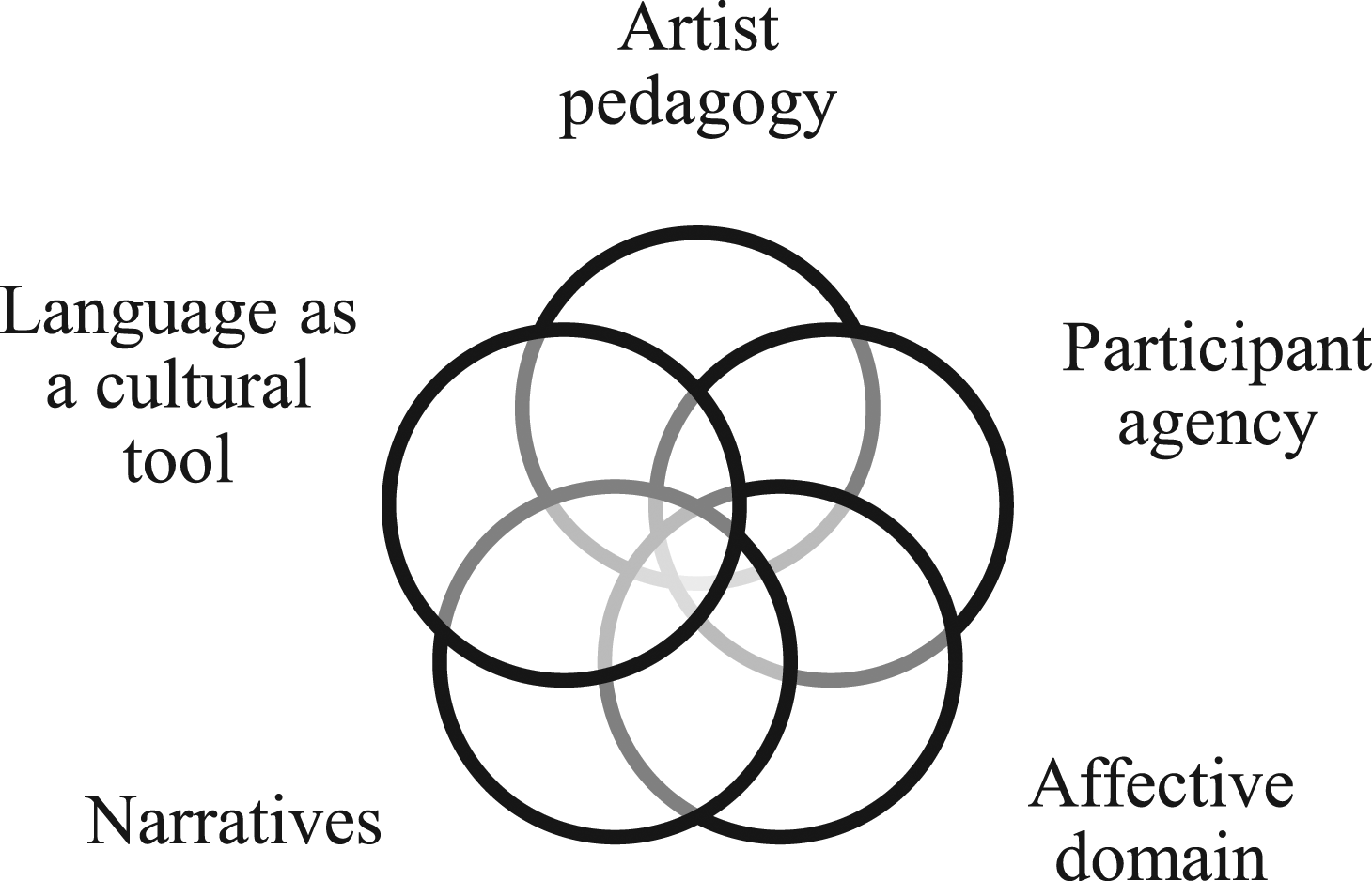
Artwork: stage 1 coding
Towards the end of coding unsolicited conversation data I recognised the need to organise artworks concurrently. This application of coding processes from spoken to visual data was instinctive, and at this early stage, my aim was to move uncertainty about how to code visual data to establishing initial sensitising concepts (Hammersley and Atkinson, 2007). When initiating the coding process Silverman (2011) recommends focussing on a small part of the research data and examining it intensively. Patterns which emerge can then be applied to a broader dataset once initial sensitising concepts have been established. With this in mind, I worked intuitively with a small sample of nine artworks which corresponded to nine sequences of talk. To maintain focus into how meanings were mediated through speech and action I examined the phenomena in a continual back and forth analysis between the two datasets. While it was a difficult and frustrating process, I gradually learnt to trust the data, and through persistent and systematic documentation of and reflection on the process, initiated a breakthrough.
Operating instinctively, I drew on compositional interpretation (Rose, 2007) to record what I could see in the artwork and interpret how the artwork had been constructed (Figure 2). During this scrutiny, I worked diligently to allow new themes to emerge. For example, in the following analytic notes entry I direct myself accordingly: ‘Choices made in the making process are specific and intentional (Banks, 2001) so find examples across datasets that indicate intention and direction’. In response to this reflexive dialogue, I assigned memo comments to each transcript margin, acting as a bridge between initial sense making of data and reflections in analytic notes. Such interrogation is evident when I question whether Pupil 9 had implemented the rule of thirds compositional device consciously or intuitively, asking in memo notes: ‘Has this been taught as a formal device? Look out for this elsewhere’. This additional layer of ‘finding meaning’ (Madden, 2017: 140) enabled more consistency when identifying codes by supporting cross-referencing during different stages of coding, interpreting and analysing. Pupil 9’s artwork.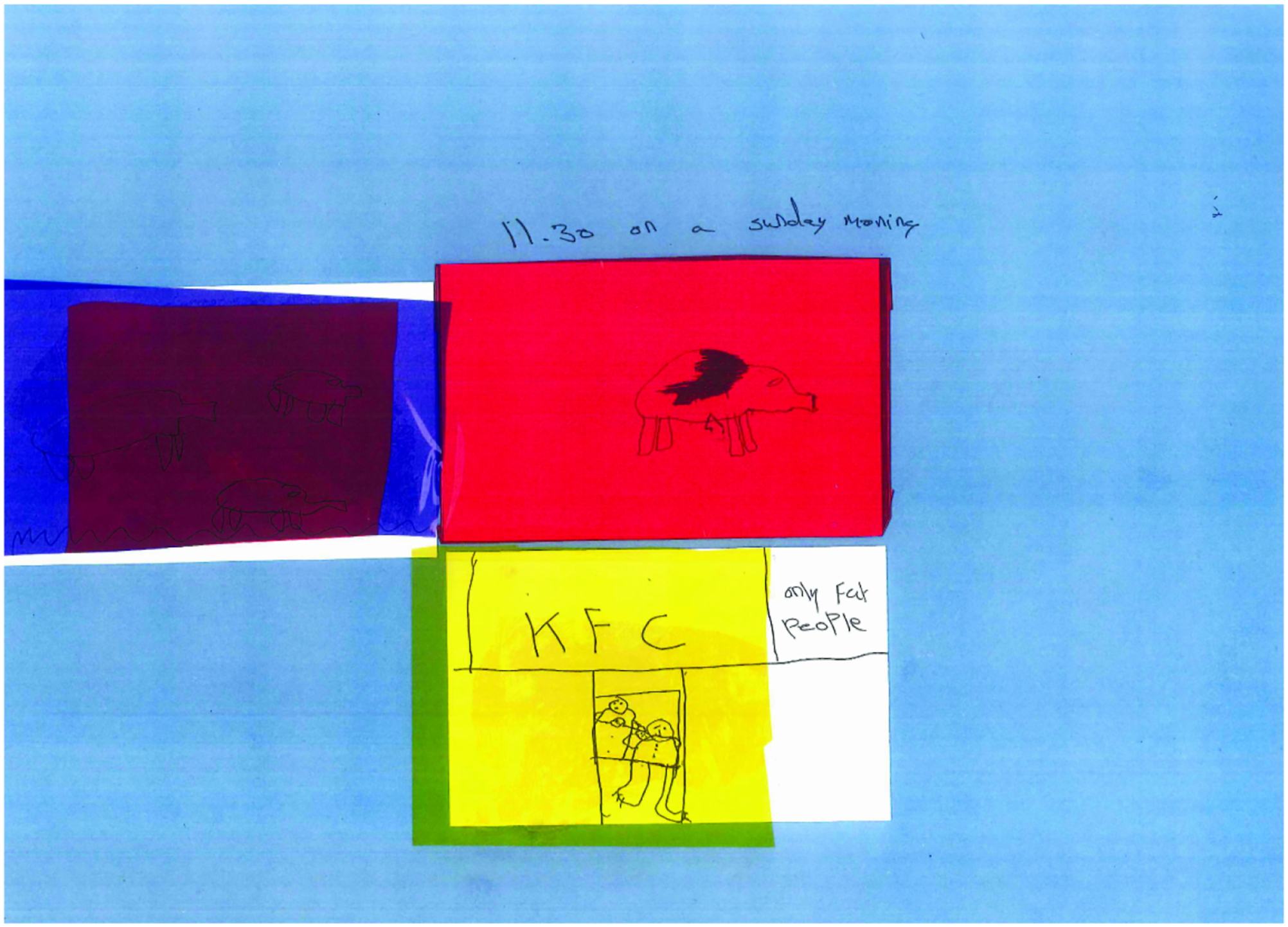
Reflexive analytical notes became central in the early coding process, operating as a space where the disjointed qualities of ethnographic data could coalesce (Walsh and Seale, 2018) and assisting safe articulation of thoughts that surfaced from reading artworks. Analytic notes also facilitated deeper interrogation of dataset relationships, exemplified by the following comparison of talk sequences and artworks by Pupil 9 and Pupil 11: There are significant differences between Pupil 9 and Pupil 11 in the way they construct and communicate different meanings in their artwork. This shouldn’t be surprising, especially considering what Banks (2001: 7) indicates as an ‘unnatural’ creation of images. Decisions made when representing through making the visual are ‘products of specific intentionality’. They are both remarkable and singular but we see them as ‘unexceptional presences in the world of material goods and human social relations’ […] Outcomes differ and the impulses or motivations that engender them may also differ, but there are also similarities. In both images, relationships between emotional connections to key concepts and cognitive decisions are clear. Pupil 9 focuses on recreating a pig on one postcard, the one aspect of his work that Mary did not encourage; he accepts her practical advice but not her suggestions about narrative content, possibly because he was very excited about the prospect of drawing a pig even though – or possibly because – it was an imaginative and spontaneous response. He returns to this narrative in his drawings regardless of expert opinion. Pupil 11 connects his Sunday morning to his brother and to activities that indicate social desirability and objects or activities that hold cultural agency for him. In both cases, emotional responses underpin selection of narrative. The artwork reveals hidden meanings as well as reinforcing identified negotiations; they also challenge alternative readings of images too.
This reveals that unsolicited conversation categories (Figure 1) are present but embodied differently in the visual data. For example, the focus on maker intentionality (Banks, 2001) indicates that participant agency is strongly communicated through artworks. This may be represented by decisions in the making process and/or narrative content and can sometimes be read directly from the visual. Alternatively, meaning is clarified as a result of the talk sequence. Intentionality is shaped by individual contexts, including the fluid combination of internal/micro – external/macro relationships (narratives) and affective responses (affective domain). Purposeful art production is influenced by children’s real and imagined lives and their emotional responses to these experiences. They are underpinned by Mary’s position, and so artist pedagogy is paramount in engendering negotiations. Where categories are communicated through speech sequences in the first dataset, here they are communicated through a visual language. Coding the artworks reveal that all five categories outlined in Figure 1 are in operation, but representations differ as a result of the visual language implemented and the child’s interpretation of environment. From this analysis, it is also clear that the most tentative category previously identified, affective domain, emerges more persistently when considered in tandem with artworks.
Artwork: stage 2 coding
To consolidate early findings I identified 20 further artworks for analysis. Loose categories were applied to the artefacts as a means of classifying the remaining dataset (Hammersley and Atkinson, 2007). To clarify patterns that emerged, I employed an index system, by classifying notes and memos under headings and reconceptualising stage one coding into categories and themes (Figure 3). In theory, this approach provides a recurring reading of data, ultimately leading towards an interpretation process (Coffey and Atkinson, 1996). However, having constructed the two indices, relationships between content and form categories became increasingly segregated and I felt removed from the research focus. Content categories such as colour, drawing and composition (Figure 3) could not be read in isolation and as separate indices they failed to expose how symbolic communication was being constructed or what circumstances enabled the meaning-making process. I recognised the need to return to the principles of constructionist coding if I were to generate a more refined understanding of categories. So I asked of the data: how are participants’ responses constructed visually and what circumstances enable meaning-making? Summary of stage 2 indices.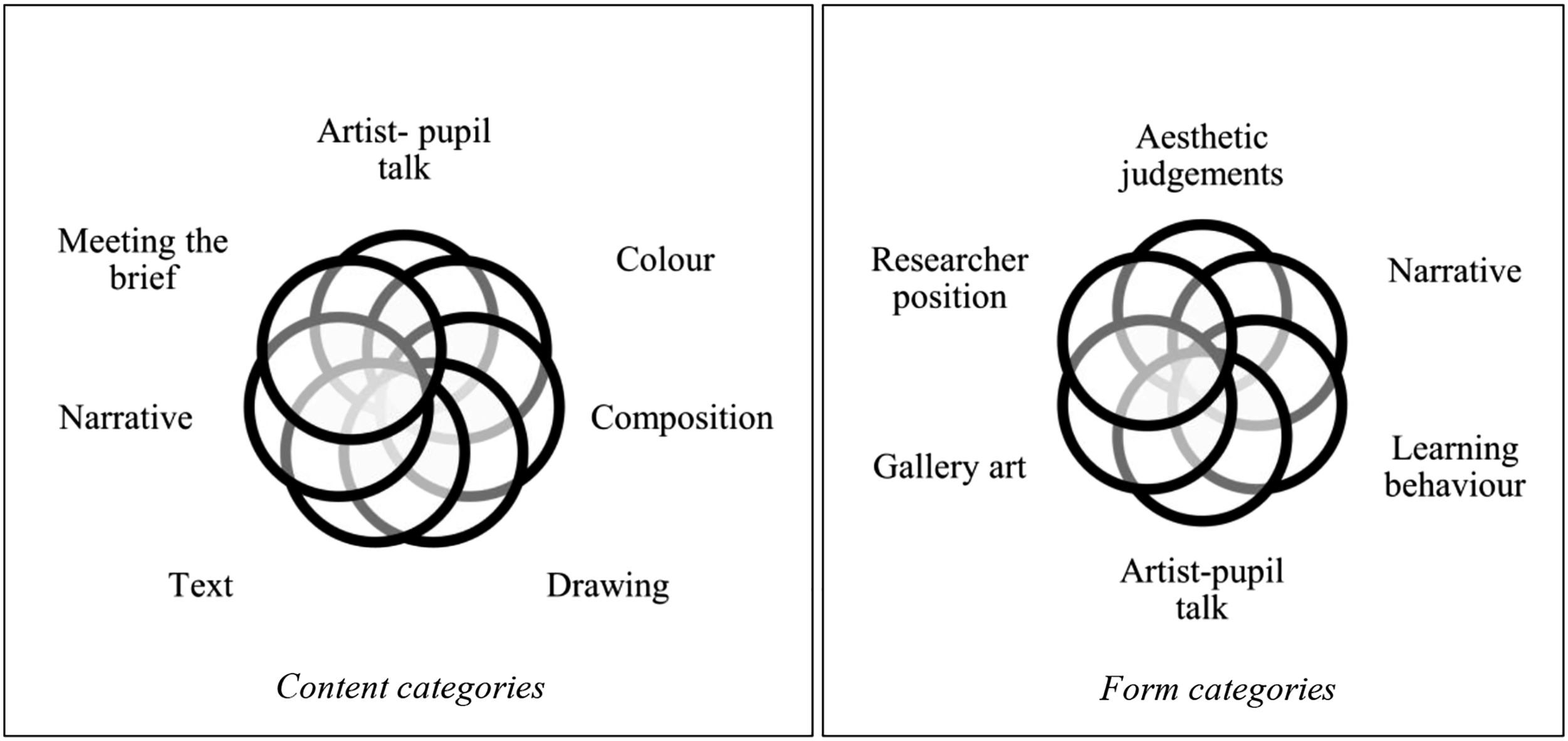
To illustrate how I answered this question, I present a cross-referencing of categories identified in Pupil 58’s artwork (Figure 4(a) and (b): 1. Analogous colour scheme and balanced composition using the rule of thirds; this may demonstrate partial or unconscious understanding of Western visual devices. 2. The drawings are limited and no clear or linear narrative is discernible but the artwork is strong. 3. The buttons from the Grandfather’s cardigan are clearly represented [identified from audio data]. (a) Golden Mean. (b) Rule of Thirds.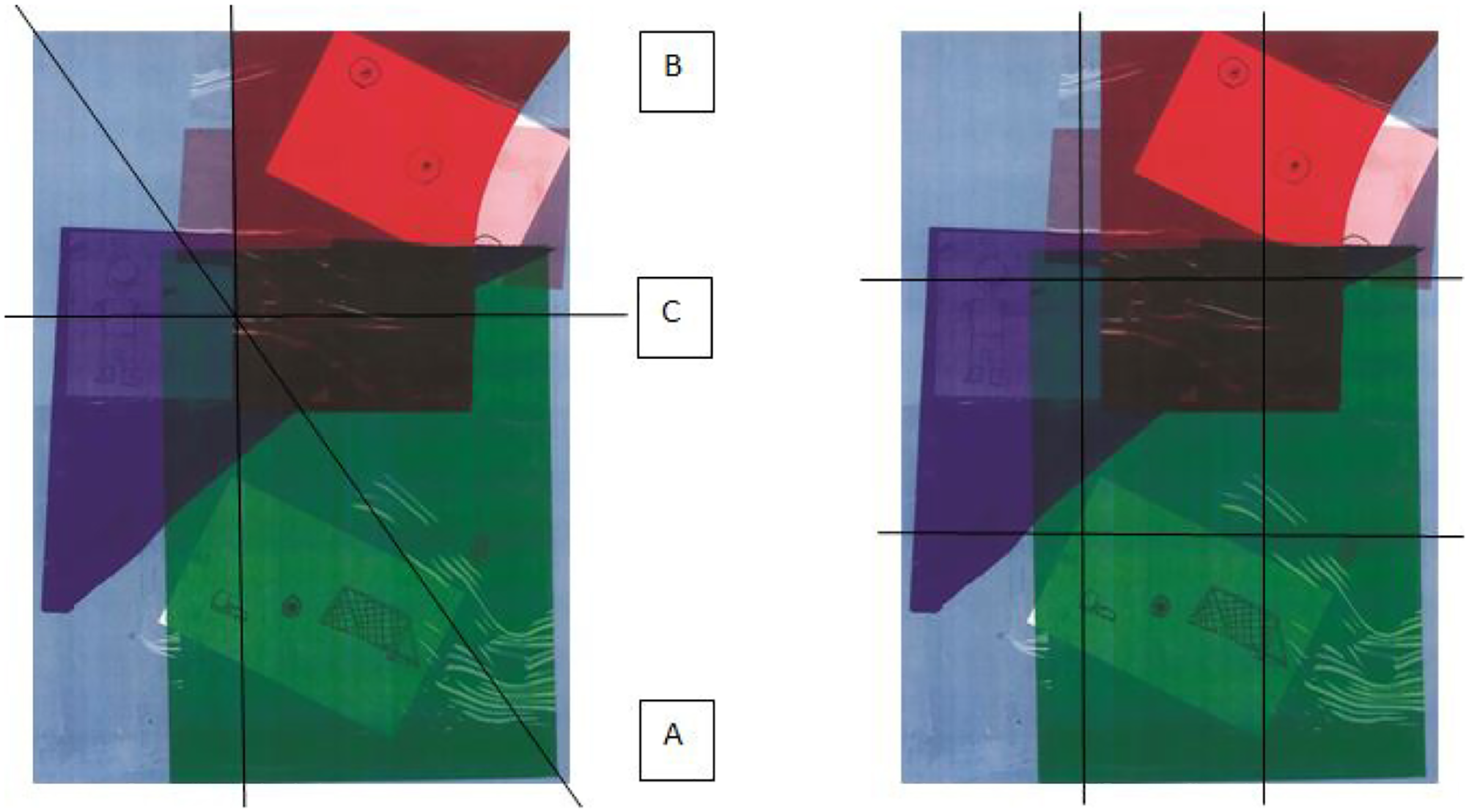
When considering evidence of meaning-making through this cross-comparison I identify: 1. The pupil has formulated meaning visually: 2. Visual intentionality 3. Visual metaphor to communicate meaning
I am impressed with how meaning is communicated through the visual despite the child’s under confidence in drawing.
During my examination of this art piece, I was preoccupied with the interplay between colour, composition and aesthetic judgements as two visual devices implemented in the layout struck me. I readily admit I was surprised by the level of sophistication on display in this artwork (Figure 4(a) and (b)). The balanced composition stands in contrast to the child’s limited drawing skill and suggests a partial or unconscious visual response. The use of an analogous colour scheme – reds/purples and blues/greens – serves to construct visual harmony throughout the image. Likewise the shape and positioning of coloured gels, some of which overlap and create new colours and shapes, breaks the composition up following a complex device applied in ancient Greek aesthetics called the Golden Mean or Section. This consists of dividing the composition using a geometric formula: The Golden Section, as it applied to works of art, stated that a small part relates to a larger part as the larger part relates to the whole. It may be seen in a geometric relationship when a line is divided into what is called the mean and extreme ratio […] When a line AB is sectioned at point C, AC is the same ratio to AB as CB is to AC (Ocvirk et al., 1998: 58).
Using this method of division, a rectangle is achieved that the Greeks perceived as beautiful in proportion: the Golden Rectangle. By applying this ratio to Pupil 58s artwork (Figure 4(a)), the Golden Rectangle is achieved. This begs the question why the child is unconsciously reproducing an ancient Western aesthetic device through his artwork, something that had not previously been taught formally in school or is easy to reproduce consciously.
A second compositional device frequently utilised in visual culture is the Rule of Thirds, which can also be applied to Pupil 58s artwork (Figure 4(b)). This is often employed in various cultural industries (for example, film, advertising and photography) and involves dividing the visual frame into thirds and placing key components along the divisions. When constructed with consideration this formula supports a balanced composition, not necessarily one which demonstrates symmetry, but where the composite parts take on relationships that contribute to a cohesive whole. As Arnheim (1974: 20) explains: In a balanced composition all such factors as shape, direction, and location are mutually determined in such a way that no change seems possible, and the whole assumes the character of ‘necessity’ in all its parts. An unbalanced composition looks accidental, transitory, and therefore invalid.
There are two unexpected threads that emerge from coding this art piece. First, the visual – like spoken language – acts as a mechanism for constructing and negotiating new meanings and understandings by the maker. Stage two coding revealed that participants used visual language in different ways when constructing their artworks to negotiate different meanings. In this example, visual relationships between individual parts of the image and its whole composition capture the personal and cultural simultaneously, representing the child’s interaction with and understanding of the world (Hickman, 2007; Rose, 2014). The second thread builds on the first, referring to the unconscious application of cultural structures to communicate emerging understandings. This is supported by Eglinton (2008: 53), who reminds us that ‘young people are living in and through a visual material culture’. Freedman (2000) argues that popular visual culture is seductive to young people, in part because it arises from the appropriation of fine art aesthetics that have been used for centuries. These visual epistemologies are embedded in our culture and represent how we have been taught to see, think and know. This is not universal but situated. It is unsurprising then that participants draw on cultural references surrounding them when constructing a visual narrative, re-presenting this interpretation through the prism of the child’s experience (Vygotsky, 2004). Art activity, and the pedagogy that shapes it, enables participants to act out meanings and motives, indicating complex layers of knowledge generation (Hickman, 2007). Children’s art should not be decoded as a single meaning but comprehended in relation to their experiences of reconstructed culture, identity and lived experience.
Artwork: stage 3 coding
Stage three visual categories were established by mapping stage two categories onto unsolicited conversation definitive categories. In so doing, I highlight which categories are original to the visual dataset (audience, visual language and conversations with artist) and which link to unsolicited conversation categories (pedagogy, participant agency, affective domain, narratives and language). For example, this is evident in the transition of aesthetic judgements (stage two coding) into visual language (stage three coding). Aesthetic judgements are symbiotic in participants’ use of a visual language to communicate through and with art. Considering this I add visual language as a sub-category to language indicating that visual language in its various forms, like speech, is used as a mediating tool between internal and external structures. Likewise, learning behaviour embodies both participant agency (for example, motivation, goal orientation and independent decision-making) and the affective domain (such as under/confidence in making processes, spontaneity, playfulness and joy in making altered understandings and visual representations). Coding of artworks created by Pupil 9 and 11 demonstrates these negotiators at work. Conclusively, I subsumed learning behaviour into existing categories to avoid repetition.
In total, six categories, twelve sub-categories and 70 themes were identified by integrating unsolicited conversations and visual codes, where one category, four sub-categories and 49 themes were attributed exclusively to visual data. The inclusion of the bespoke sixth category audience highlights my dual identities at work: researcher and art education professional. The examination of how meanings are constructed and mediated through art production places the researcher in the position of audience member interpreting others’ creations. This was greatly enhanced through compositional interpretation (Rose, 2007) and is an advantage of art as a dataset as this would not have been possible with audio data alone; the visual adds richness to the research experience (Pink, 2013; Rose, 2014). In this context, I view artworks in isolation from the artists, adding further layers of meaning in their absence. A limitation of interpretation without solicited maker input is that meanings I attach to artworks are predicated on my experience and existing knowledge as an art educator in secondary and higher education (Haney et al., 2004). This colours my interpretation, and while cross-referencing interpretations to unsolicited conversation data aided consistency, in hindsight, implementing a purer form of auteur theory by interviewing participants about their artworks would have captured their intentions (Mannay, 2010). Whilst I acknowledge this as a limitation of my research design, the use of unsolicited conversations indicates unique methodological adaptation. Conversations with Mary expose how participants’ meanings are negotiated by appropriating and re-organising cultural concepts into personalised narratives. They expose ‘shared practices, experiences and beliefs, as well as dissonance and surprise’ (Payne, 2018: 571). Art acts as visual representations of personal experiences of the social context where cognitive and affective domains work symbiotically, indicating an awareness of self as a social subject.
Final thoughts
In this paper, I have represented my interpretation of data through inductive, imaginative coding. Another’s engagement with the same information may result in different ways of dealing with data and so disseminate an alternative view of findings. To minimise this limitation, I have presented my position as honestly and ethically as possible. When considering recommendations for others, the ability of the researcher to maintain a reflexive position throughout is salient. This can be achieved by embedding into the design interpretation methods, which facilitate a constant questioning of data and researcher self. Multiple identities operate in this process, not just my researcher self, and so it is important to listen to oneself and respond honestly. Whilst I worked hard to minimise bias at the planning stage, it was the coding process that exposed my professional assumptions. I perceived meaning-making through the lens of my existing professional knowledge, which at times proved useful, but more frequently challenged me to view information from alternative positions. It was genuine engagement with data that facilitated ongoing modifications as I learnt to trust through methodical analytical note taking and memo comments. Engagement with participants’ artworks exposed my professional bias, revealing a previously unknown world of knowledge and repositioning my authority to privilege theirs.
The children’s art provides information that oral accounts could not have provided alone. By applying the constructionist interviewing coding scheme to each dataset I was able to foster consistency in the application and cross-comparison of data. However, it was essential to also embrace the unknown and take risks with the coding process. Ethnographic methodology welcomes imaginative coding, and by intuitively responding to the artworks in relation to unsolicited conversation data, I was able to generate a novel approach to data organisation. It was important to balance persistence in pursuing systematic processes with being bold, and it was these decisions that provoked the unexpected. That artworks reveal insights into how children draw on visual epistemologies pervasive in our culture, seemingly unconsciously, continues to excite me. Participants structure a visual response based on lived experience, where they reconstruct established knowledge according to new experience. This allows for altered meaning formation and is exemplified by the way the children drew on boarder cultural references when making art. Resulting artworks reconstitute visual signs of their culture.
Cultural activity communicates our humanity. In the digital age of connectivity and multimedia, this cycle of sociocultural development is played out in a global arena. Art and design education opens up democratic debate and supports children to examine the world and their place in it. It helps them to behave in autonomous, self-regulating and imaginative ways and the artwork produced indicates hidden worlds and alternative forms of knowledge generation. My research provides a glimpse into these worlds, demonstrating that there is much more to be learnt from children’s artworks if we care to look.
Footnotes
Declaration of conflicting interests
The author(s) declared no potential conflicts of interest with respect to the research, authorship, and/or publication of this article.
Funding
The author(s) received no financial support for the research, authorship, and/or publication of this article.
