




Abstract
This article brings methodological insight into in-situ drawings as representations of daily life with dementia. As part of ethnographic fieldwork in dementia care units in a nursing home, drawings were made on site by a researcher. We suggest that the ambiguity of in-situ drawings, and the ensuing possibilities to disambiguate them, is valuable. Inspired by Asdal and Moser’s (2012) concept of “contexting,” we experimented with arranging the drawings with fieldnotes, discussing them with staff members, as well as with configuring multiple drawings and fieldnotes in sequences. This led to reflexive engagements with the drawings, creating space for discussing concerns in research practices and care practices. Switching between different forms of contexting produced tensions, revealing that what was cared for through the practices of researchers, staff members, and residents, diverged. In this way, we argue that contexting in-situ drawings may intervene in ways of knowing, caring for, and living with dementia.
Fieldnote 12 December 2018: Anna, Vera, and I sit at the table in the living room. Anna is deeply concentrated, solving crossword puzzles. When she suddenly walks out of the room, she leaves most of her things. Her pens are carefully placed on a napkin on top of her magazine on the table. It seems like a precaution, as if she wants to make sure that her things stay there – in her spot.
Anna
1
and Vera were residents in a dementia care unit in Stockholm, Sweden, where first author (Helena) conducted ethnographic fieldwork, making drawings in-situ (see e.g. Figure 1). For people with dementia, routine activities such as using a kitchen to cook a meal, or dressing oneself usually become increasingly challenging. In Sweden, many individuals live in ordinary housing for some time but move to nursing homes when more comprehensive support and assistance is needed. While living with dementia is affected by loss of cognitive functions, daily life in a dementia care unit is also shaped by living together with other residents and the support provided by staff members. Moreover, life with dementia is affected by how dementia is understood and studied (Moser, 2011). In this way, social scientists—and their methods—play a role in making daily life in dementia care units as good as possible (Driessen, 2019; Moser, 2011). So, what is worth noting when studying daily life in a dementia care ward? Is Annas spot at the table something to care for? In this article, we will attend to such questions by analyzing in-situ drawing as a method. The text is structured as follows: we begin by suggesting that there are meaningful connections between dementia studies, STS studies and the development of visual research methods. This is followed by a description of Helena's use of in-situ drawing in dementia care. Examples of these drawings are presented and analyzed in depth. In the concluding remarks, we present three aspects related to working with in-situ drawing that we see as essential to the insights that this method can generate. In-situ drawing, 12 December 2018.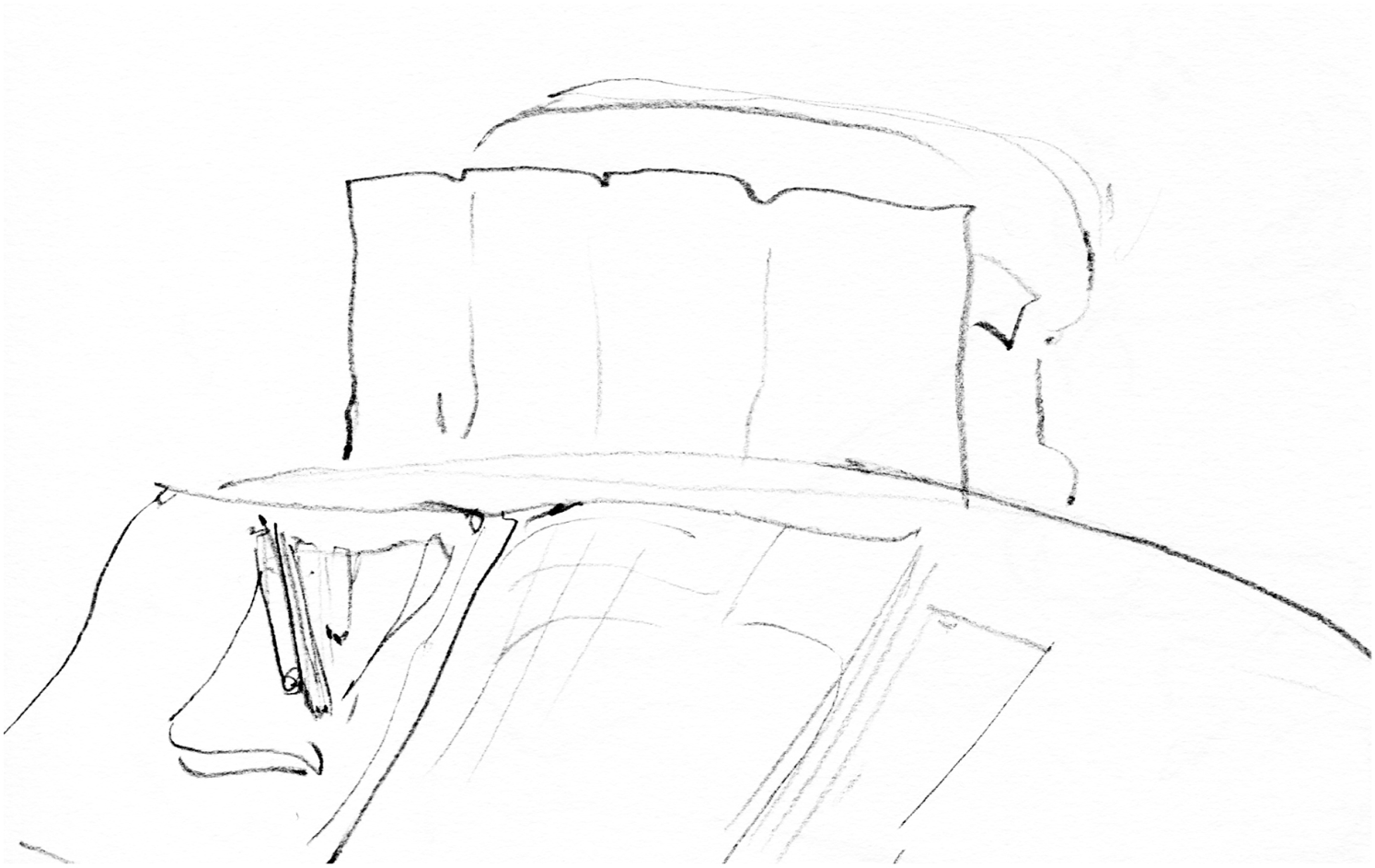
In studies on life with dementia, there is a history of excluding persons with advanced dementia. One of the reasons for this exclusion has been the perception that individuals with dementia gradually lose their identities and their ability to provide reliable verbal accounts (Murphy et al., 2015; Hydén and Antelius, 2017). A gradual shift has occurred in the last three decades with scholars increasingly arguing that it is crucial to include persons with dementia in studies in order to understand how life with dementia can be improved (Murphy et al., 2015). Since dementia often involve increasing challenges with verbal communication, we agree with Driessen (2019) that it is relevant to question the reliance on language as a primary form of research data in these contexts. This is also in line with Keady et al. (2018) who point out that new methods aimed at including people with dementia tend to underline what is shown and enacted, rather than only that which is told and reported. Gradually, this has begun to widen the scope of what might be considered as important in research studies.
From “matters of concern” to “matters of care”
Science and Technology Studies (STS) is a field with longstanding traditions of furthering ideas on what is scientifically relevant. Early constructionist science studies, for example, (Pickering, 1992; Latour and Woolgar, 1986) drew attention to science as a practice with workaday routines and collective concerns. Latour and Woolgar (1986) described how various materials and machines participate in such practice, which provided insight into the construction of scientific facts. Subsequently Latour (2004) has proposed that “matters of facts” should be thought of as “matters of concern,” to openly acknowledge the configurations that participate in realizing particular social realities. For Latour, the realization that something is constructed is not a reason for picking it apart, but rather a reason for enriching the attachments that holds it together. Puig de la Bellacasa (2017) reads “matters of concern” as an important intervention that attends to the affective dimensions of knowledge. While Puig de la Bellacasa sees the word “concern” as implying a worry for something, she argues that “care,” provides a stronger ethical charge as it contains a notion of material doing. According to Puig de la Bellacasa, material doings are indicative of what is affectively and ethically cared for, even if this is not literally described. Rather than understanding care as a moral layer that can be added unto practices, it is vital because “nothing holds together without relations of care” (Puig de la Bellacasa, 2017, p 67). Consequently, “matters of care” is a proposition emphasizing seemingly petty and unimportant material doings and practices that tend to be neglected.
Turning toward the visual
The focus on practice and materiality in social sciences coincide with a turn to the visual (Rose and Tolia-Kelly, 2012). In STS, visual representation marks an established field of inquiry related to how knowledge is produced in practice (Coopmans et al., 2014). An increasing number of social scientists are also exploring and developing visual research methods (Rose, 2016). This turn to the visual can also be noted in dementia studies that seek to include persons with dementia (Keady et al., 2018). Whereas STS scholars have primarily been interested in the observational practices of those working in natural sciences (Garforth, 2012), scholars working with visual research methods are often focused on exploring the everyday and seemingly ordinary things (Rose, 2014). Our work draws on visual research methods as well as on how STS scholars have engaged with representation. These “visual turns” stimulate questions about what visuals do. Are they “representations,” “visualizations,” “mediations” or perhaps “enactments”? As argued by Coompans et al. (2014), such terms are precarious. For instance, “representation” is contested due to how it has been understood to reify the idea that a visualization somehow mirrors something out there that is more “real” (Coopmans et al., 2014). Nonetheless, in this article we will use the term “representation,” following Woolgar’s (2014:331) suggestion to think of it as an unsettled concept, worth grappling with and reflecting on.
In particular, we are concerned with in-situ drawings as a form of visual representation. Compared to visual research methods based on photography or technological advancements, drawing has received relatively little scholarly attention (Pink, 2012). Even in fields such as anthropology where drawing was once considered essential (Geismar, 2014) it has largely been replaced by photography and film (Kuschnir, 2016). Historically, drawing has however held a place in science. In sixteenth century anatomical studies and in encyclopedias, drawings were often used for explanatory purposes, and early anthropologists used drawing as a way to document the life of a culture, surveying techniques and materials (Kuschnir, 2016; Geismar, 2014). In these practices, drawings were considered factual and descriptive (Causey, 2017). Today, drawing is primarily used in two ways in research. Either participants are asked to draw as a way to visualize things that are meaningful but not visible to the eye, for instance, experiences of living with illness (Guillemin, 2004), or as an expression of one’s inner life (Hogan and Pink, 2012; Literat, 2013; Kearney and Hyle, 2004; Mannay, 2010). Alternatively, researchers use in-situ drawing to study everyday life, framing it as a way to pay close attention to something (Brice, 2018; Taussig, 2009; Heath et al., 2018; Kuschnir, 2016; Causey, 2017; Harris et al., 2020). Building further on the use of in-situ drawings, we are interested in how this method may contribute to the movements in dementia studies and in STS which seeks to question an expand notions of what is considered worthy of scholarly attention. In our analysis, we take inspiration from Puig de la Bellacasa’s (2017) “matters of care” to stay attuned to the significance of material doings. That is, although our empirical work is situated in a dementia care context, we are not using the term “matters of care” to refer solely to professional care practices. Rather, “matters of care” denote material doings in a more general sense, encompassing practices of residents, researchers, and staff members. The aim of our article is to provide methodological insight into in-situ drawings as representations of everyday life in dementia care units. Specifically, our analysis is concerned with how in-situ drawings facilitate representation of diverse matters of care, and how this may intervene in practices relating to life with dementia.
Case study
Our arguments in this article are based on an empirical study, conducted as part of an ongoing interdisciplinary research project led by co-author Lena R. In this larger project, we explore nursing home environments, imagining how they could be different, together with staff members, family members, and residents. With the ambition to learn more about the everyday life of nursing home residents with dementia, first author Helena conducted participatory observations in three dementia care units in a nursing home. 2 That is, she spent time with residents who welcomed her to do so, having coffee with them, going for strolls in the corridor among other things. In this way, Helena also became acquainted with family members and staff. The nursing home comprised a total of twenty-three units with eight to nine residents living in each unit. Hammersley and Atkinson (2007) discussions on ethnographic practice guided our fieldwork. As a sensitizing concept, we drew on a number of studies concerning materialities (Brice, 2018; Cleeve et al., 2020; Latimer, 2018), which emphasize how everyday materialities in care settings may illuminate situations that tend to be overlooked due to their assumed triviality. Observations took place between September 2017 to November 2017 and from October 2018 to February 2019 3 While spending time with residents in the nursing home, Helena, who has a background as a designer, made drawings. Helena visited the nursing home once or twice a week with a typical visit lasting for about 3 hours. After every visit, fieldnotes were written based on each drawing. A total of 694 drawings were made, which were scanned and arranged together with fieldnotes. In addition, four workshops were organized with staff members working in the units concerned to discuss a selection of drawings. 4 In preparation of these workshops, Helena (in consultation with Lena R) purposefully selected drawings that depicted aspects or situations that she had questions about, or that she thought would make for relevant discussions with the staff members concerning daily life and care in the units. 5 Two workshops were held in the late fall of 2017 and two were held in early spring 2019. 6 A total of thirteen staff members, three men and ten women, participated in the four workshops. There were six to seven participants in each session, and while some only participated in one workshop, several individuals participated in two or three. 7 The drawings were shown one at a time, without fieldnotes. The workshops lasted for two hours, providing enough time to discuss around six drawings. Different drawings shown in each session and all workshops were audio-recorded.
In line with this article’s methodological focus, the in-situ drawings, and fieldnotes along with audio-recordings from the workshops were reviewed with the intention to describe the research process. Helena led the analysis in discussion with co-authors Lena R and Lena B. Particular attention was paid to what we found surprising in relation to what this method generated, and that which encouraged reflections on what mattered in this setting. As previously mentioned, we found Puig de la Bellacasa’s (2017) “matters of care” useful for conceiving material doings as intertwined with affects and ethics. Examples from the fieldwork and workshops were discussed and sorted so that examples pertaining to certain topics were grouped together. 8 In this article, we present a selection of examples, which we analyze with the use of literature on visual research methods, dementia care studies, and STS theories on representation and knowledge.
(Dis)ambiguating drawings
The above line drawing (Figure 2) is relatively simple, perhaps even slightly ambiguous. Other drawings were similarly minimalistic. This is because drawing situations in-situ demanded a quickness, resulting in a certain level of abstraction. Nevertheless, the drawing elicits and evokes and immediately following the visits to the nursing home Helena used the drawing as a mnemonic device for writing fieldnotes, reminding her about circumstances in which the drawing was made, and to reflect on its relation to the overall research question. When the above drawing is viewed together with its corresponding fieldnote, something happens. Fieldnote 20 September 2017: I’m sitting at the kitchen table. Gertrud walks up to Iris, asking if she can have a shower. Iris says that she doesn’t have time, she has to prepare dinner. “But we’re not having dinner yet – not for several hours!”, Gertrud objects. Iris puts her hand on Gertrud’s shoulder explaining that she simply cannot abandon all the other residents, whereupon Gertrud leaves the kitchen. In-situ drawing, 20 September 2017.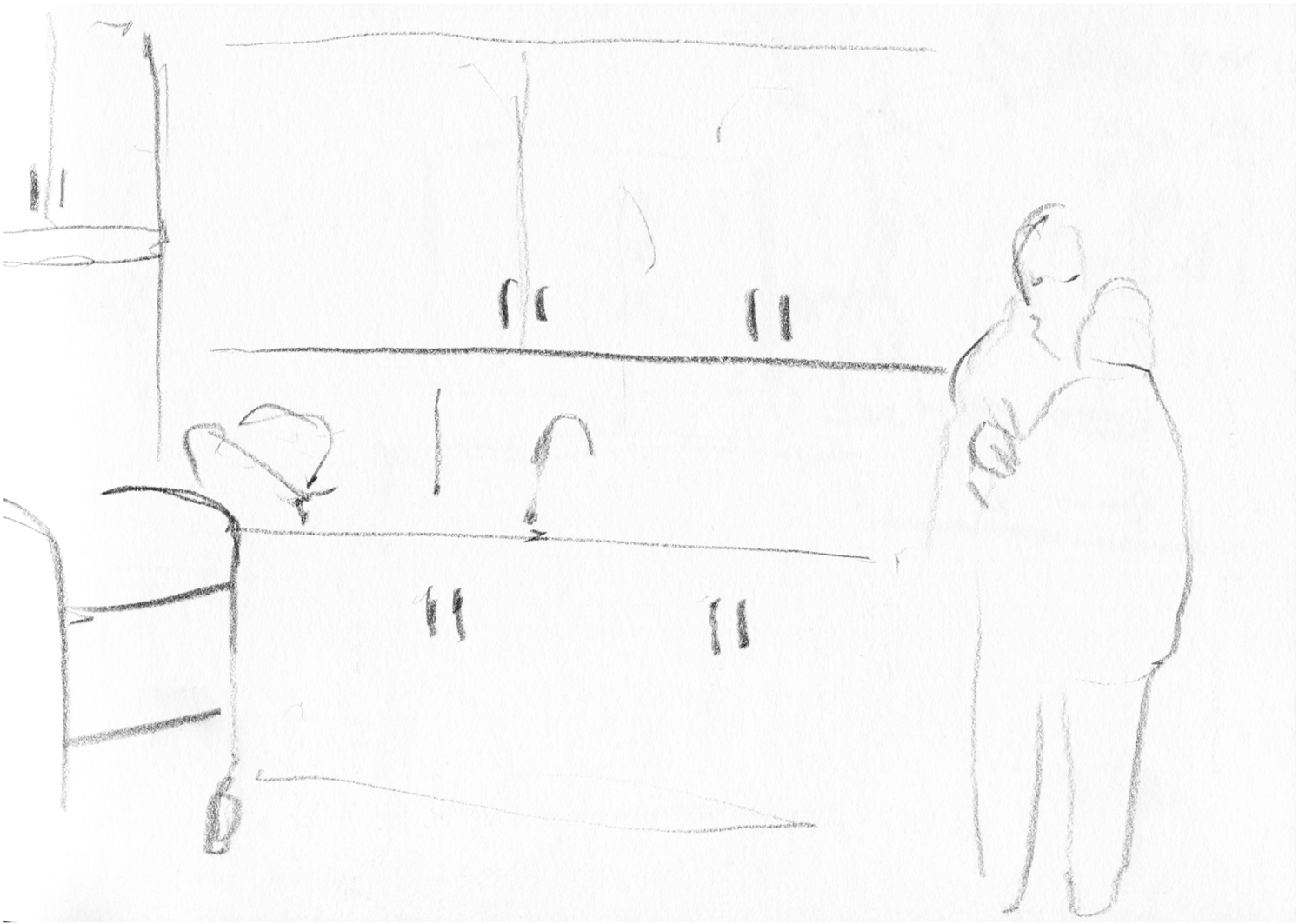
The fieldnote gives the drawing direction, providing details about what preceded and followed the depicted situation. Similarly, the drawing accentuates the fieldnote, making some aspects, such as the interaction between Iris and Gertrud, more salient. For those not familiar with the setting, the fieldnote “disambiguates” the drawing. We borrow the idea of representational disambiguation from Vertesi (Vertesi, 2014) who uses it in relation to scientific practices where images are manipulated to elucidate valuable information. However, whereas Vertesi’s work concerns the how the images are visually altered, we suggest that visuals may be disambiguated through context. Drawing on Asdal and Moser (2012), we refrain from thinking of context as a stable backdrop which can be referred to as an explanation of what is seen and heard. Instead we follow their suggestion to think of context as a verb, “contexting.” Contexting refers to a process of experimenting with how to draw things together. According to artist John Berger Berger (2011) an image flourishes the more it is joined with other things. Along these lines, and in relation to the research question about everyday life and materialities in dementia care, we were curious how the drawing could be interwoven with other things than fieldnotes. We showed the drawing (without fieldnotes) to a group of staff members.
Through the discussion
9
with the staff members (see Figure 3), a slightly different context was achieved. Despite the abstraction in the drawing, the staff members were able to discern where the drawing was made, and who was depicted. We had not expected that such information could be seen in a drawing so devoid of details. We think that this has to do with the staff member being familiar with the setting and Gertrud, but even more to do with them acquiring knowledge through specific practices and particular situations. When the staff members looked at the drawing the depiction of closeness seemed important. Their recognition of Gertrud appeared intertwined with their experience of how she, when asking about something important positioned herself very close to them. By looking at the drawing this could be “felt,” as Sini put it. Goodwin’s (1994) writings on “professional vision” explain how professional practices involve particular ways of seeing and understanding. Importantly, and perhaps not surprisingly, ways of seeing are focused on what is rendered relevant the social group in question. A group of archeologists will, for instance, look at soil and see things others would not. In line with this, the matter of care which was highlighted in Helena's fieldnote differed from what was highlighted through the staff members’ discussion. The latter drew attention, not to the singularity of this situation, but to how the situation was similar to other instances where Gertrud had asked for things that were important to her. What emerged as relevant in their discussion, and as a matter of care, was the way in which the staff members collectively dealt with Gertrud’s wanting. The hand on her shoulder seemed almost as a choreographed response intended to makes Gertrud feel seen and heard but which nonetheless enabled them to say “no” to her. Workshop, 30 October 2017.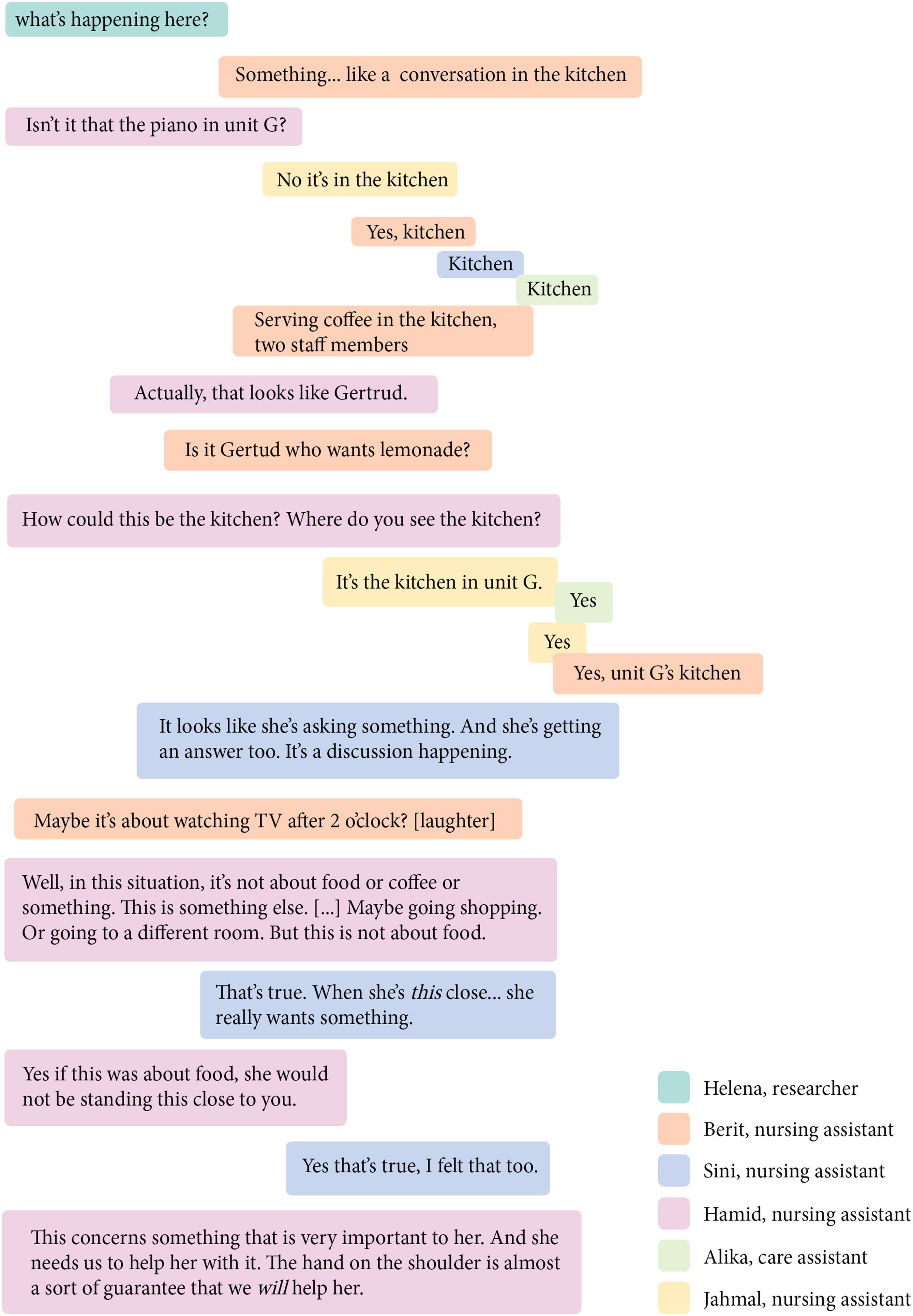
The ambiguity of the drawing as a representation appeared useful to inquire about the relevance of a particular situation. Simon’s (1969: 16) writing on abstraction offers insight into why this could be: “the more willing we are to abstract from the detail of set phenomena the easier it becomes to simulate the phenomena. We do not have to know, or guess, all of the internal structure of the system but only the part of it that is crucial to the abstraction.” If we were to compare the drawing of Gertrud to a snapshot photograph, the drawing is both more abstract and more concrete and hence able to include within one representation a wide range of comprehension. 10 The drawing is more concrete in its reference to a situation because its temporal constriction differs from that of photography. A photograph captures an instant while the drawing refers to a period of time (Berger, 2005). The drawing thereby included more time, and could refer more concretely to specific gestures that were crucial to the situation, even if these unfolded consecutively. Simultaneously, the drawing also more effectively referred to the situation in the kitchen because abstraction was possible, directing focus to the interaction as opposed to other particularities and details that a photo would include (see also Causey, 2017). In this way, the drawing enabled an inquiry about a particular situation, without requiring Helena to fully grasp the situation or the issues at stake. Showing the drawing without the fieldnote liberated her from verbally articulating, and naming the situation. This created space for the staff members to articulate their concerns, resonating with Asdal and Moser (2012: 303) argument that contexts are enacted and require an “openness to the richness of research objects, actors, worlds, and materials.”
Seeing and being seen
What the in-situ drawings depicted relied on what happened in the nursing home but even more on the situations that Helena, who drew, was able to participate in. In other words, what was seen, and consequently drawn, depended on relations. When visiting the nursing home, Helena would approach the residents, introducing herself and her work, asking if she could join them in what they were doing. This included walks in the corridor, drinking coffee, or just sitting at a table. Drawing became a practice to just “be” in the units, spending time with people without necessarily feeling the need to talk.
To draw in-situ also meant that the act of observing veered around itself: the person observing could be observed. Sometimes this led to conversations with residents, family members, or staff members, about the observations in the units, and about the research. The drawings seemed helpful here because others could literally see what was being observed. Occasionally, residents made explicit requests. Fieldnote 29 September 2017: Stig asks if I’m drawing him. I reply that I’m not, but that I could if he would like me to. He lights up and says that he would very much like to be drawn together with his girlfriend Ulla (a resident), who sits next to him. He asks me if he has to sit still, but I tell him that it’s fine if they want to move around. It makes me happy that they want me to draw them, and that they invite me to do so. So far, I have avoided to portray residents, but Stig’s question generate new reflections. Anna, looks at my paper with great interest while I draw. When I show the finished drawing to Stig and Ulla they both admire the result. Stig asks me for a copy of the drawing but unfortunately the reception, where the copy machine is located, has closed for the day. Fieldnote 3 October 2017: I give Stig a copy of the drawing. He does not remember asking me for a portrait. When I show him the drawing he does not recognize himself nor Ulla.
We were surprised by the residents’ wishes to have their portraits made. In the application for ethical approval for this study, we had underlined that we would be open to what residents wanted us to focus on. Yet, in hindsight we realize the limits to our presumed responsiveness as we had outlined that the intention was to capture situations, not making portrayals of people. This stance was influenced by prevalent ethical guidelines, recommending that research participants should be guaranteed anonymity (Clark, 2012). In studies where photographs of persons with dementia are included, facial portrayals are often avoided (Hibberd et al., 2009) or attempts are made to disguise facial features (Campbell and Ward, 2018). However, as Clark (2012) writes, full anonymity is difficult to achieve in visual research since those within a studied community are often able to recognize themselves and others even if attempts to anonymize the visuals have been made. Furthermore, we agree with Clark (2012) that anonymizing visual material may diminish the advantages of using visual methods. Stig reminded us of the importance of being seen. Anonymizing research data can protect individuals from being identified but it could also mean that people are literally overlooked. What is made visible in research, and how, is important because as Tsouvalis et al. (2012: 110) write, scientific visualizations such as pie-charts, photographs, films, echograms shape predicate how practices are sustained and/or advanced.
11
That is, representations participate in reifying or challenging particular worldviews. Accordingly, how residents are portrayed (or not) matters. Fieldnote 12 December 2018: I’ve spent the afternoon drawing in one of the units. When I’m about to leave Elsa asks me to sit with her. I’m a little thrown by this because while I’ve spent time with Elsa, she has rarely taken the initiative to talk with me. I sit down and tell her that I have time. I show her my drawing journal. On one page there is a quick sketch of her. She looks at it. I’m expecting her to say that she does not know what it is, as I’ve experienced that other residents with advanced dementia do. Elsa points at the eyes in the drawing: “That’s spot on.” “Yes. It’s you” “I thought so!” It is a wondrous moment. Elsa, often quiet and withdrawn, turns to me with a look full of life. The moment quickly passes as Elsa is wheeled out of the room by a staff member who comments that she’s not sitting very well in her chair.
The examples with Elsa (Figure 4) and Stig illustrate the unpredictability of drawing in this setting. Sometimes residents would suddenly recognize themselves, opening up for extraordinary moments, as in the example with Elsa. Sometimes the act of drawing entailed a special connection with two people looking at one another for several minutes. On a certain day, the finished drawing would bring a resident joy, while it the following day would seem almost meaningless, as in the example with Stig. Thus, drawing portraits was not one thing in this context, which is why we argue that it is difficult to adopt a rigid position in relation to them. It is unlikely that an outsider would be able to identify Elsa from the drawing, but she recognized herself, which is revealing of how drawings may capture a resemblance with relatively few details. The process of drawing in-situ, aligns with scholars underlining the affective and embodied aspects of scientific practices, which lends themselves to particular ways of caring for things (Puig De la Bellacasa, 2017; Latimer and Miele, 2013). Berger (2011: 14) also writes that “we who draw do so not only to make something observed visible but also to accompany something invisible to its incalculable destinations” hinting at how drawing is about moving, and being moved. As our examples show, drawing in-situ moved and unsettled our stance on portrayals, transforming it into a matter of care for us. In-situ drawing, 12 December 2018.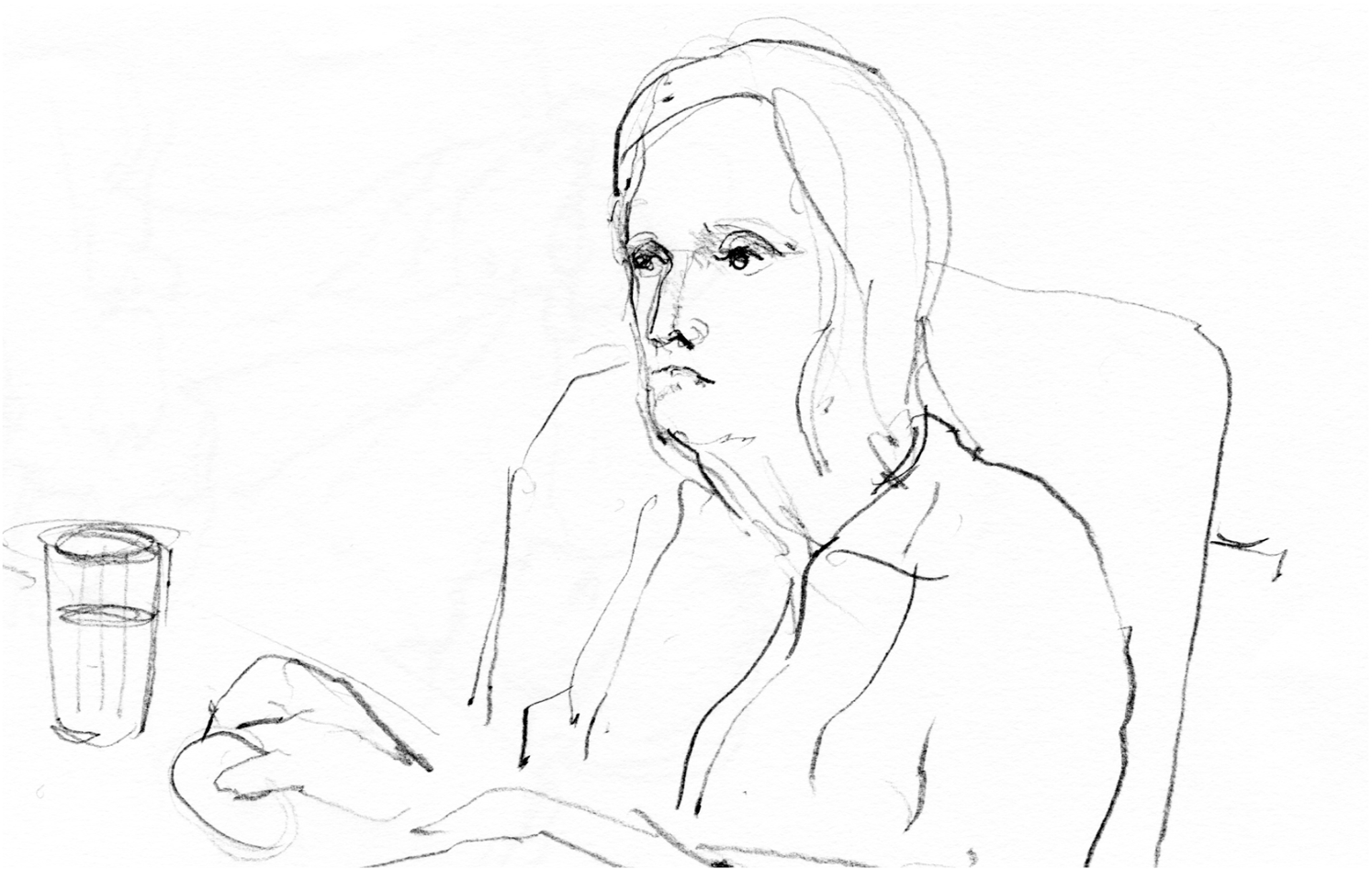
In-situ accountability
In a previous study, we demonstrated how illustrations (which were not made in-situ) were useful for asking staff members about their experiences working in dementia care (Cleeve et al., 2020). Accordingly, the in-situ aspect may not be necessary for eliciting meaningful conversations or reflections. As seen below, it is however a quality which appears to be influential.
Jasmine’s question (Figure 5) about which unit this had happened in, exemplified how staff members would occasionally turn to Helena, interested to know more about the particularities of a situation. Hence, it was not only the staff members who were asked to construct a context from the drawing, but to some extent, Helena was asked to do this too (Figures 5 and 6). Neyland and Coopmans (2014) describe accountability and visibility as intertwined, referring to accountability as practices of looking-and-telling. Helena had observed everyday life in the units, including aspects of the staff members’ work. Comparably, the staff members had seen the research work in the units. Helena was held accountable for the lines on the paper and how this corresponded to a situation, while the staff members were held accountable of how the drawing may relate to their practices and experiences in the units. Thus, the drawings connected research practices with professional care practices in the unit. This seemed to offer opportunities to articulate shared concerns, which were often of ethical importance. Workshop, 26 February 2019. Continued discussion (workshop, 26 February 2019).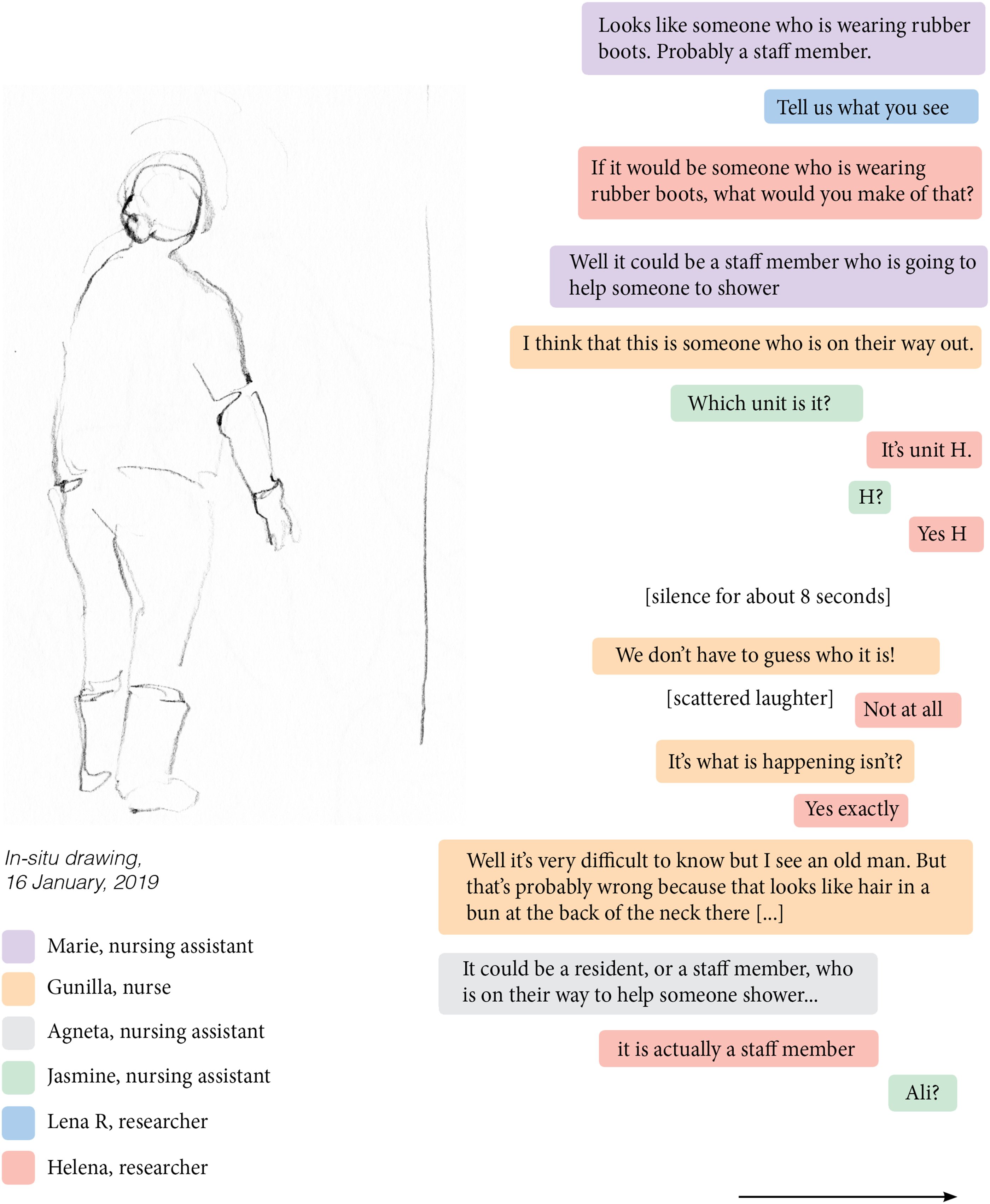
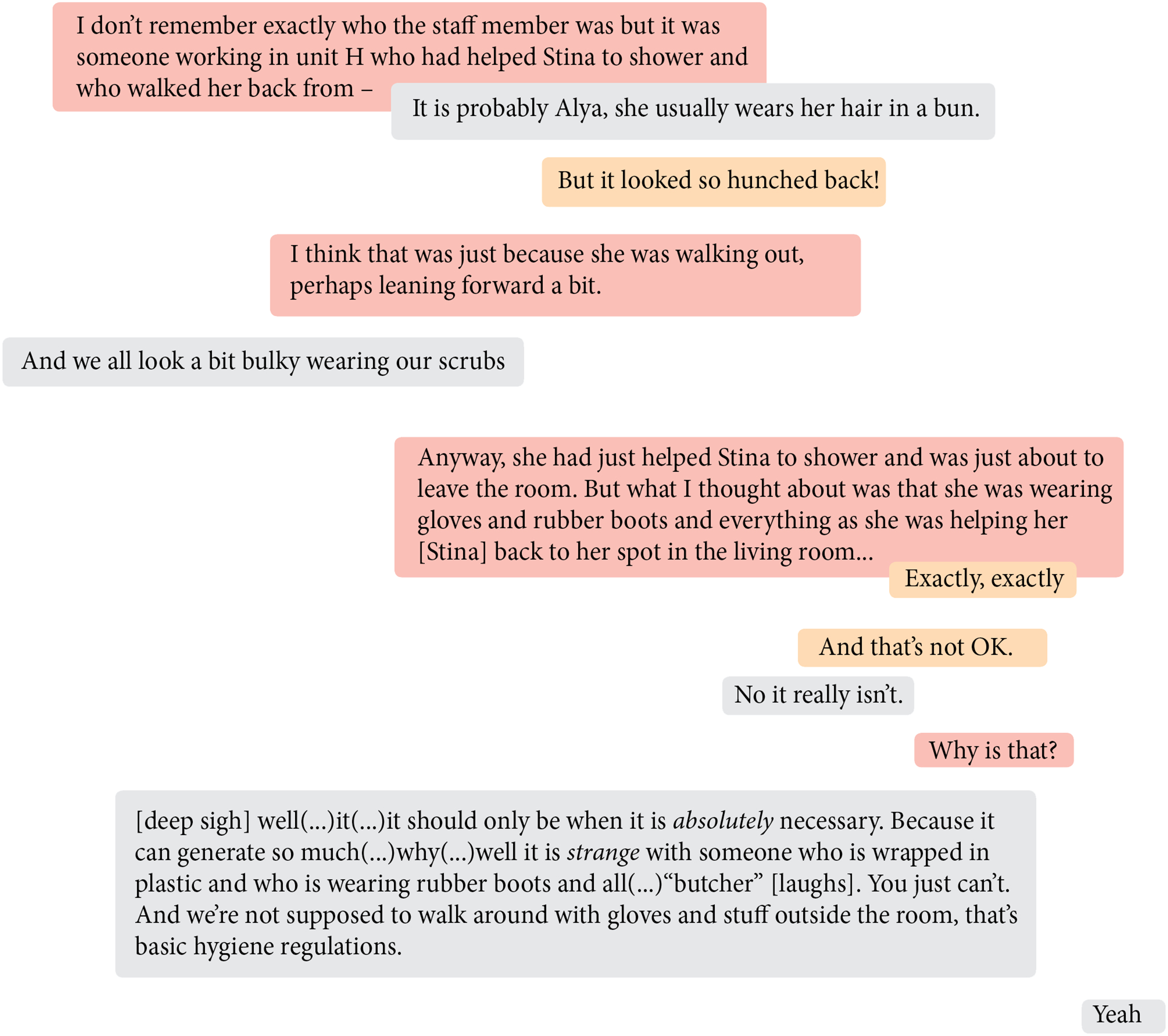
Gunilla and Agneta (Figures 6 and 7) initially commented that wearing rubber boots outside a resident’s room was unacceptable as it was a violation of hygiene regulations in the nursing home. Latimer and Puig de la Bellacasa (2013) distinguish between Ethics with a capital E and “the ethical.” Whereas the former is a fixed and normative framework within a certain practice, the latter signifies how good and bad is continuously rearticulated in the everyday. While care policies and regulations framed the issue as being about where and when the rubber boots were worn, Jasmine’s and Marie’s comments (Figure 7) shed light on the use of rubber boots in the shower as an overlooked ethical issue. They described the distress that the rubber boots caused in the shower, and their techniques for mitigating this. However, as Latimer and Puig de la Bellacasa’s (2013) claim that which falls outside Ethics is often seen as ethically irrelevant, and Gunilla concluded that the boots were engaged with on such a routine basis that they were rarely reflected upon. This points to the problem with predefining ethics because when the rubber boots were ethically neglected, the practical and affective work that staff members had to do in order to wear the rubber boots was overlooked too. In line with Pols (2015) and Vosman and Niemeijer (2017), we argue what is “good” has to be articulated from within care practices. In this sense, the drawing was an intervention. It gave pause and opened a space where the neglected distress and work associated with the practice of wearing rubber boots in the shower could be discussed as something worth caring about. Continued discussion (workshop, 26 February 2019).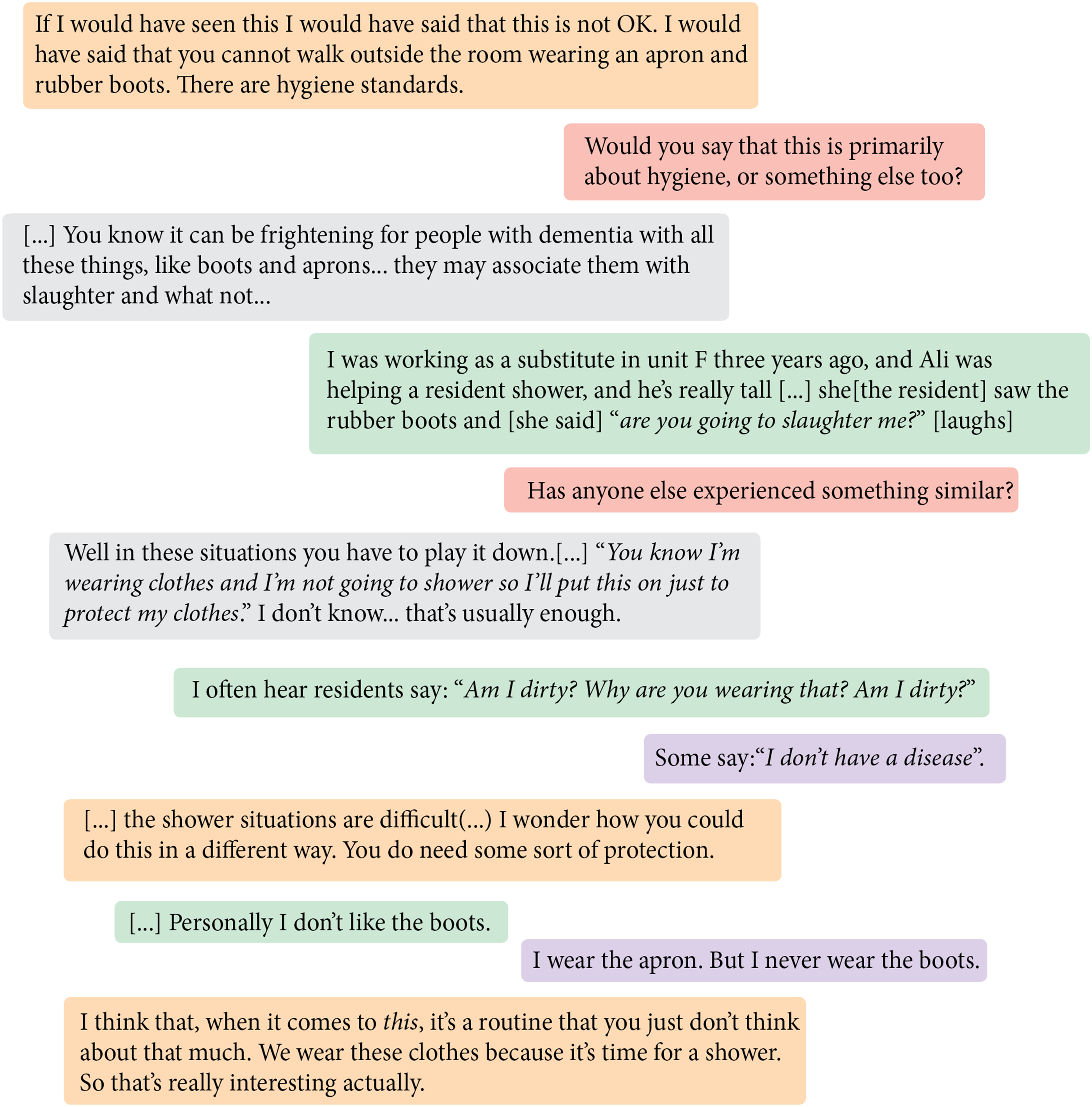
Tensions to care for
Until now, we have described contexting achieved through placing drawing with corresponding fieldnotes and through discussing drawings with staff members. However, contexting does not have to rely entirely on written or verbal accounts. In this last example, we return to the opening example of this article—Anna’s spot. In Figure 8 several drawings are put together in a sequence, woven together not only by fieldnotes, but also with each other.
12
Drawings and fieldnotes 2017-2018.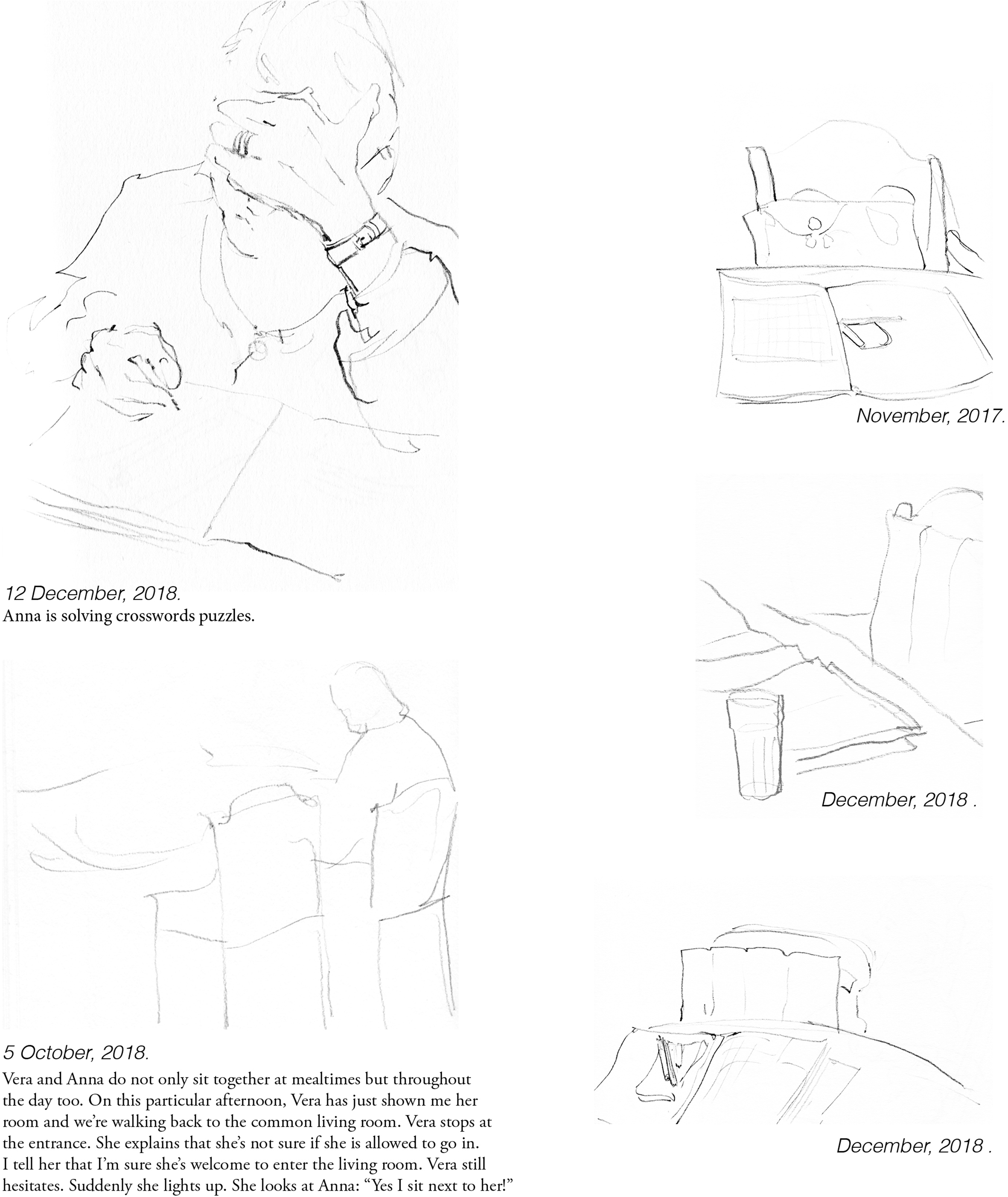
Around Christmas (2018) the kitchen walls in the three unit were repainted. At the same time, many tables were permanently rearranged so that all residents were seated in the kitchens during mealtimes. This decision was made by staff members and senior managers for the purpose of creating a clearer distinction between meals and other activities. It was postulated that this would make the environment more intelligible for the residents. A number of residents, including Anna and Vera, were consequently moved (see Figure 9). Workshop 26 February 2019: We showed the above drawing (Figure 10) to a group of staff members who recognized it as Anna’s spot. The nurse Gunilla explained that Anna’s son had told them that Anna never had any friends. She added that Anna was quite reserved, her main interest being crosswords puzzles. When they first rearranged the tables some had noted that Anna only sat at her new spot during mealtimes and the nursing assistant Jasmine remarked that Anna did not seem to leave her things at the table to the same extent as before. Jasmine also said that while they had worried that Anna would oppose the move, she had indeed accepted it. Drawings and fieldnotes, 1 February 2019. In-situ drawing, 12 December 2018.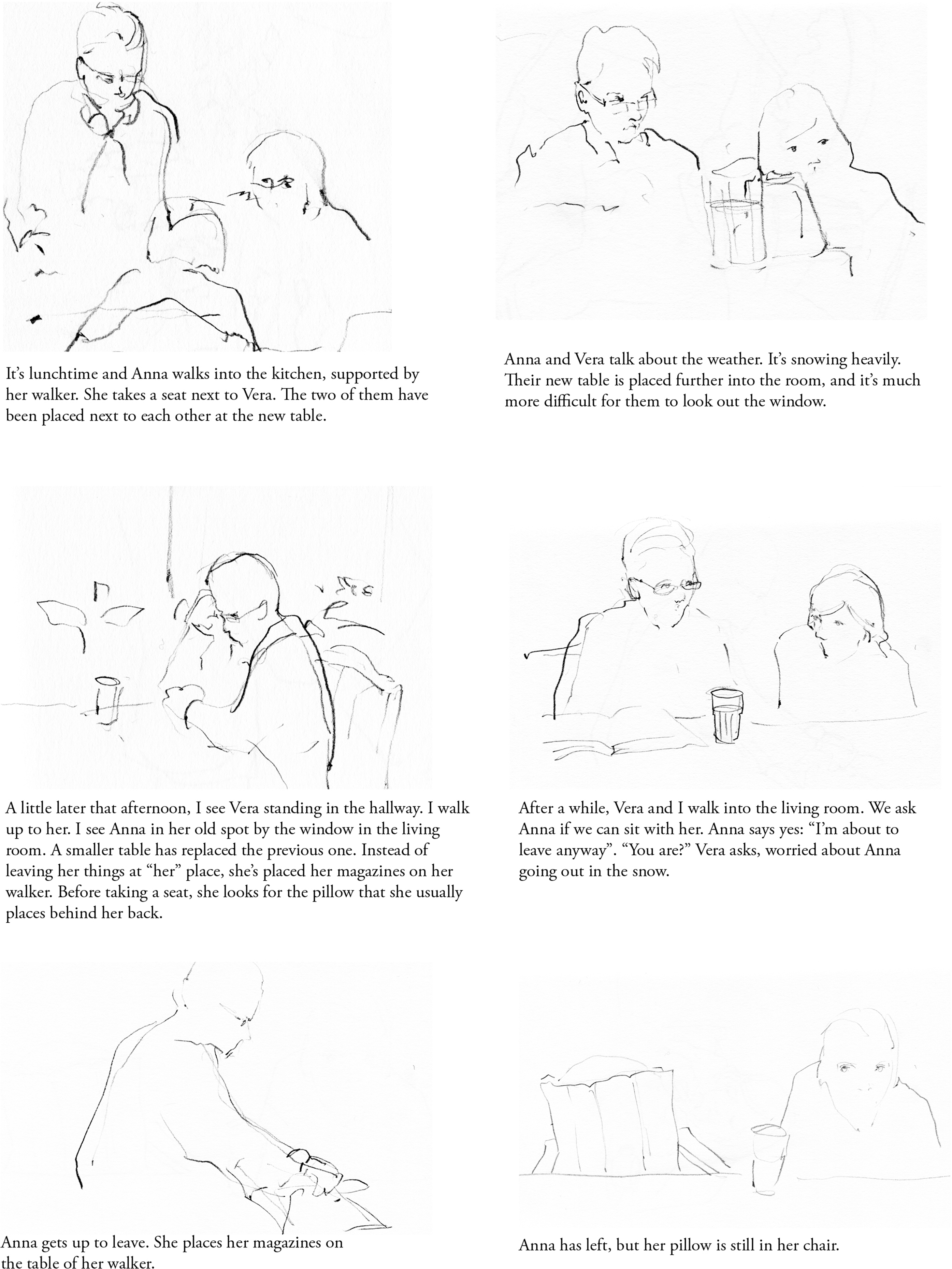
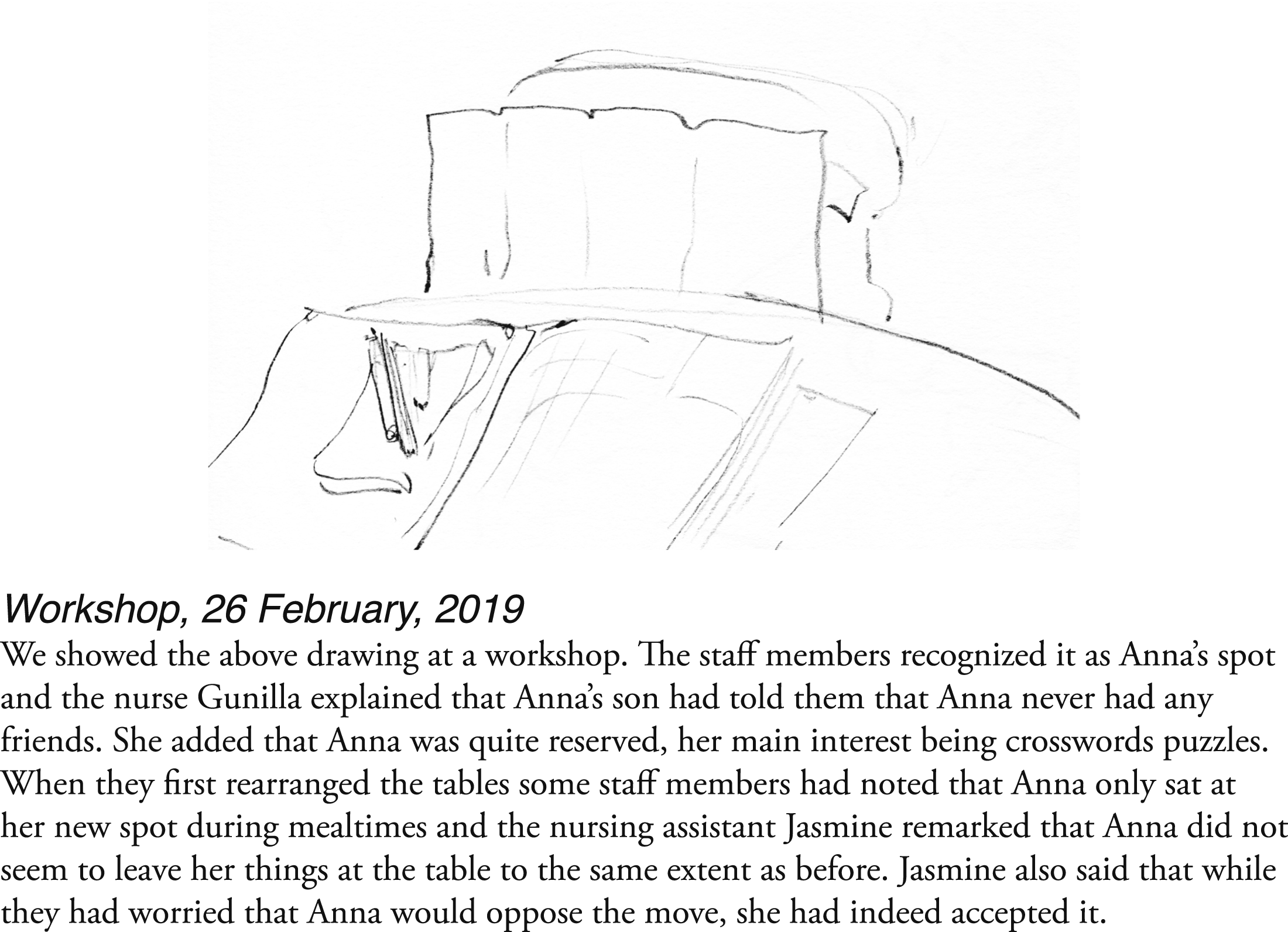
Through arranging the drawings and fieldnotes (Figures 8 and 9) in relation to Anna’s spot a pattern emerged, which was not discernable in the single drawing and fieldnote. When juxtaposed with the staff members discussion, there is tension because depending on contexting this drawing represents opposing matters. For instance, the staff members described Anna as socially isolated. Indeed, Anna came across as somewhat lonely in the sequence of drawings and fieldnotes too, but she also appeared as a person who cared for her relations with other residents, such as Vera. While it may be tempting to rely on the verdict that Anna in the end had accepted the move, we argue that the tension produced by these different forms of contexting may be worth caring for. Simply relying on proxies to verbally validate what residents feel and want, risks overriding other ways in which they express themselves. As Pols (2005) has alerted us, having a “perspective” in care research is often reduced to having a language to express that perspective through. Anna and Vera did not explicitly talk about the table, instead they underlined its importance much more subtly, through daily interactions. The description of how Vera did not dare to enter the living room until she saw Anna sitting in her usual spot is one example of this. Anna cared for her place, not only by sitting there, but also by leaving her things there. This resonates with Pols’s (2005) argument that a person’s appreciations become discernible through what s/he do in practical situations. As this example demonstrates, such indirect articulations of matters of care may be fragile against verbal oppositions. It is therefore imperative that research in these settings tend to what which residents, through everyday material doings, care for.
Concluding remarks
Based on fieldwork in a nursing home, this article is concerned with in-situ drawings as representations of everyday matters in dementia care units. Whereas previous methodological studies on in-situ drawing have primarily focused on the drawing process, we stress how the “completed” drawings are ambiguous and therefore malleable as representations. Our work aligns with STS scholars (Coopmans et al., 2014; Asdal, 2012) who oppose the idea of representation as sort of mirror to a reality “out there” and who suggest that it is possible to analyze representation as a form practice, and as part of how scientific activities are “bringing (aspects of) the world into existence in the first place” (Woolgar, 2014: 330). On the one hand, drawing as a method may appear dated 13 compared to the proliferation of digital media and technological advancements in visual research (Pink, 2012). On the other hand, Lury and Wakeford (2012) propose that the inventiveness of a method lies in how it addresses and develops a specific problem. We argue that in-situ drawings may be useful for challenging and furthering notions of what matters. Zuiderent-Jerak (2015) insists that sociological knowledge is obtained through interested interaction and in these concluding remarks we draw attention to three moves which were crucial for our interactions, and consequently for the insights that the method yielded about life with dementia.
Our first move concerned our position as researchers in relation to the visuals. Many scholars studying representation have done so as second-order-observers, analyzing how others work with visual methods (Hoeppe, 2015). In our case study, Helena made visuals in-situ as part of ethnographic fieldwork. This direct involvement affected what was drawn as it meant that the research partly became visible to residents and staff members in the units, making it possible for them to interject. For instance, residents’ requests to be portrayed challenged our ideas about anonymity in research and its associated ethics. In this way, drawing in-situ can be described as an activity that invited a collaborative experimentation with what to represent and how. Overall, making the drawings first-hand enabled a sort of “playful” approach to them as representations. This is valuable since, as Chadwick (2021) argues, social studies are inevitably partial and benefit from creative engagements that preserve contradictions, plurality, and ambiguity. While our study is focused in-situ drawing, we recognize that our work also resonates with scholars who work through other mediums. Lindén and Singleton (2020) have, for instance, shown how working collaboratively with written fieldnotes and interview data may allow for that, which is easily neglected to be noticed. To describe that which is often overlooked, they argue, provides possibilities to intervene in prevailing narratives. In social studies, direct involvement is an important form of experimentation which interlocks representing and intervening, becoming a device for heightening reflexivity and for producing sociological knowledge (Zuiderent-Jerak, 2015). Along these lines, we consider drawing as a method for simultaneously studying and intervening in practices.
This brings us to our second move, involving how the finished visuals were engaged with. Rather than arguing that drawings revealed what was cared for, we found them to be useful points of departure for further inquiry. We agree with Savransky (2016) that objectivity calls for a methodological inventiveness which allows that or those that are studied to formulate what matters to them in a certain situation. Inspired by Asdal and Moser’s (2012) “contexting” we experimented with arranging drawings with fieldnotes, discussing drawings with staff members, and with configuring several drawings and fieldnotes in sequence. This allowed for reflexive engagement with drawings as representations. The drawings’ abilities to balance between the abstract and concrete seemed important for this purpose as it meant that a specific situation could be referred with such an openness that it invited for further reflection. In the workshops, the in-situ drawings enabled a particular kind relation between staff members and researchers with both parties holding one another accountable in relation to the drawing. The intertwinement between visuals and accountability have previously been considered in relation to punishment, discipline, or diagnosis (Neyland and Coopmans, 2014; Bowker and Star, 1999; Foucault, 1977). Our study shows how visuals may also generate trusting accountability relations aimed at articulating how situations could be otherwise. This may be valuable for furthering care practices. In previous studies (Cleeve, 2020; Cleeve et al., 2020). we have discussed how seemingly trivial materialities have profound consequences for persons with dementia living in institutional settings, arguing that care practitioners need time and space to reflect on this. Hence, it is of significance that in-situ drawings enabled staff to talk about ethically overlooked moments within mundane routines.
Finally, our third move concerned switching between various modes of contexting. This elucidated overlaps and tensions in what was cared for through the practices of researchers, residents and staff members. Moving between different forms of contexting offered opportunities to question what was represented in one form of contexting, compared to another. To work with the drawings in this way clarifies how understandings are actively put together and becomes a sort of methodological response to Puig de la Bellacasa’s (2017) suggestion to think of research as “matters of care” (an active doing) as opposed to matters of “fact” or “concern.” Switching between different forms of contexting can also be a way to attend to what Law (2014: 338) calls “collateral realities,” denoting realities that are being done in practice but that tend to be overlooked because they are not verbalized. To care for such realities, Law argues that we have to develop abilities our see beyond the verbal. This may be of particular importance in dementia care units where many have difficulties to express themselves verbally and where several scholars highlight the need to develop and adapt research methods (Bartlett, 2012; Murphy et al., 2015; Pols, 2018; Phillipson and Hammond, 2018) and care practices (Mondaca et al., 2018) in order for persons with dementia to exert greater influence. Pols (2018) writes that the concept of participation needs to be opened up so that various expressions and doings by persons with dementia are acknowledged as valid and legitimate. In-situ drawings could be a step in this direction, bringing attention to nonverbal articulations of what matters. Still, as social sciences are increasingly interested in the visual, it is important to recognize the limits of that which can be seen (Garforth, 2012). Presumably, there were significant aspects of everyday life in dementia care wards that were not observed, or that were invisible.
To conclude, in-situ drawing is a method which through time and attention helps developing ways of seeing a phenomenon. While one could argue that the drawings are contestable research data as they depend on the artist’s selective seeing, we contend that this concern can be transformed into a possibility assuming that the drawings are treated as starting points rather than as conclusions. That is, the drawing process as well as the finished drawings can be used to engage participants in the field, facilitating careful inquiries into varied and contradictory experiences and ways of knowing. Our case study refers specifically to dementia care but representations are inextricably part of research practices in social sciences at large and consequently representations (no matter which form they take) participate in shaping notions of who or what is worthy of attention and care. As such, our article may serve as methodological inspiration for researchers, encouraging them to examine their representations again and again. This is particularly relevant in settings where some realities and positions are difficult to articulate, or where routines run the risk of silencing certain insights. We began this article asking if Anna’s place at the table was something to care for. Our ambition has been to show that in-situ drawing is a method that creates space for such questions. We have also demonstrated how in-situ drawings are not fixed representations, but dependent on contexting and the doings they bring to the fore. Different practices may render matters such as Anna’s spot as more or less significant, hinting at the reciprocity between representation and practice. That is, drawings along with their contexting can be potential interventions for how things are understood, and acted upon, elucidating that which is taken for granted, or made invisible in various practices. In this particular case study, in-situ drawings offered valuable reflections on how to know, how to care, and how to live with dementia.
Footnotes
Acknowledgments
We thank the nursing home that allowed Helena Cleeve to conduct fieldwork in the dementia care units. We are particularly grateful to the residents and staff members who participated in this study.
Declaration of conflicting interests
The author(s) declared no potential conflicts of interest with respect to the research, authorship, and/or publication of this article.
Funding
The author(s) disclosed receipt of the following financial support for the research, authorship, and/or publication of this article: This research was supported by Formas under grant 2016–01177; Forte under grant 2017–2022; the National Research School for Health Care Sciences and the Strategic Research Area Health Care Science (SFO-V) at Karolinska Institutet.
Ethical approval
The Regional Review Board in Stockholm (study code #2015/512–531/5, addendum 2017/1735–32) reviewed and gave permission for this study to be conducted with this design. Lena Rosenberg applied for ethical approval.
