




Abstract
This article explores how solicited paper diaries, and the accompanying materials, are carefully handled over the course of one research project. It foregrounds the value of attending to mundane moments with research materials, by tracing tangible material encounters together with intimate fieldnote reflections. Through drawing upon theories of materiality with feminist and relational ethics of care, this article centralises paper diaries as a key mediator of relationships and care within research. It considers the micro processes of choosing diaries, posting them, receiving and storing them and tracing the emotionally charged moments as a researcher in everyday research situations. Such reflections, from the perspective of the researcher, look to offer insights into research relationalities and care. It argues that these momentary fieldwork reflections extend understandings of material methodologies by emphasising relational intimacies as a researcher and connects material and sensory understandings with feminist ethics of care and researcher reciprocities.
Introduction
November 2018: Storing diaries, opening up feelings
‘I head to my locker in my office which, upon opening, bulges a significant amount of stuff. I sit there and inside are a stack of participant diaries. I pause. The accounts from the participant written diaries are transcribed now – they’ve taken on a new form. I have ‘the data’ to put it crudely. So why do I stop, take a moment and return to the greeting card sent with Katie’s diary, look at the signature engraved in Molly’s diary, the attached letter sent from Deborah? I carefully place them back in the locker. It appears that I simply cannot part with them’. (Author fieldnotes, Figure 1) Image description: A pile of stored participant diaries kept in a research locker.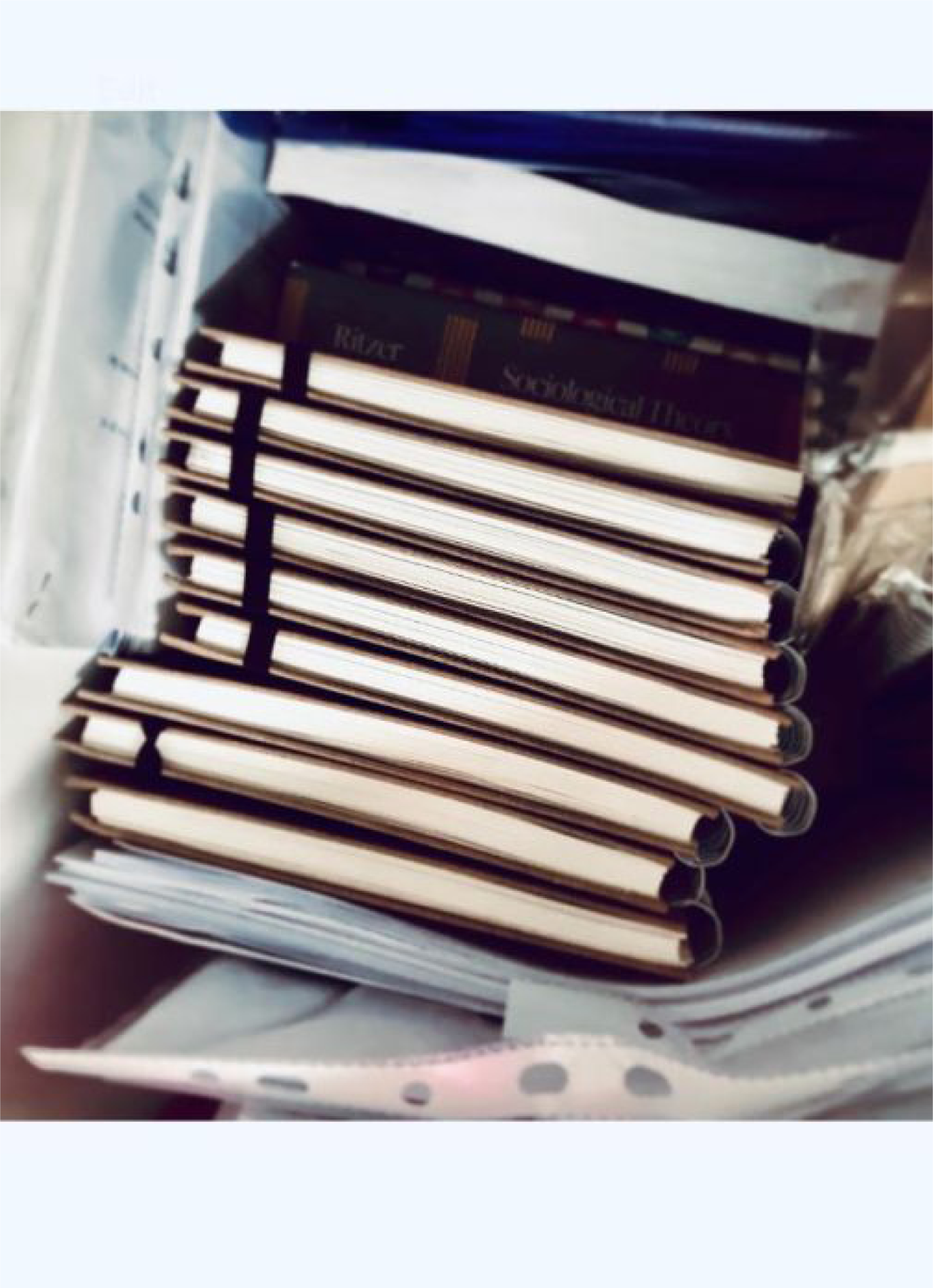
I begin this article with this personal moment of realisation that the diaries, a core part of the data collection in my project exploring living with irritable bowel syndrome (IBS)
1
and the accompanying correspondence from participants often in the form of letters, notes and greetings cards were more than the sum of their parts. The ‘heft’ of these diaries had both physical consequences in terms of storage and transportability, but there also lie an emotional weight in my affiliation to the stories and people within. Thus, this encounter reflected the tangibility of the material diaries but a ‘sensory intangibility’ of feeling attached and knowing the diaries as in relation to others (Mason and Davies, 2009). My momentary encounter with the stored diaries, and indeed my emotional response, felt small and yet significant. In a somewhat similar vein, Back (2016) has reflected upon his nostalgic attachment to his no longer functional Dictaphone. He says: ‘…contained in the nostalgic attachment to a broken machine and the comfortable feel of the weathered case is something telling about the taken for granted norms of sociological craft’. (2012: 246)
While Back’s (2016) example is a focus more on research tools as opposed to research materials or data (if indeed they can be separated), momentary encounters when presented with our research materials carry powerful affects. Traces of the material life of research are found within Thomson’s (2014: 41) note that ‘the data that we generated [...] still sits in boxes of an attic in north London’. Similarly, Hockey et al. (2014: 10) notes how the material efforts of research are made visible, where the ‘legacy of these projects [are] more than the number of filing cabinets’. It is certainly the case that the materiality of research methods amounts to more than the practical processes of where they are kept. Encountering and tuning into the taken-for-granted material presence of research makes it thus important to consider materiality, methods and relational research processes.
This article builds on the ‘liveliness’ (Back and Puwar, 2012) of research methodologies, through coming to know and listening in (Bennett et al., 2015), to the people and things that accompany our research journeys. Drawing upon fieldnotes from my doctoral research, this article will reflect upon the ‘social life’ (Appadurai, 1986) of these material forms. Literature into solicited diaries has explored their value in understanding historical worlds and personal lives (Bartlett and Milligan, 2015; Steedman, 2001). Yet a focus on the receipt of such material objects as a researcher has received less attention. This article examines the materiality of research matter, developing relational affinities of diaries and their companions (Edwards et al., 2017) as they move through the course of research. This article builds on understandings of materiality and material methods (Woodward, 2015a, 2020) and considers the materiality of diaries, and the personal and ethical processes of handling them, from a researcher perspective. As the research materials come to embody personal trails and connections, this article draws upon feminist methodologies (Oakley, 1981; Stanley and Wise, 1993) and relational ethics of care (Ellis, 2007). These bring to attention not only the physical handlings and processes of working with research materials, but the care and emotion intertwined from the position of the researcher. Working with paper diaries and having to think about their journeys, aesthetics and storage, evokes a particular imaginative reflexivity in research relationships and the gifts of social research (Oakley, 2016).
In replaying the social life (Appadurai, 1986) of the material items gathered, shared and gifted throughout the research, I bring to attention the affordances of diaries sent, letters received and broader practices of intimate and relational lives within qualitative research (Fraser and Puwar, 2008). I argue that my own emotional and relational responses to research materials, in both tangible and intangible senses (Mason and Davies, 2009), are telling of research practice and connections desired or made within research. This is achieved through imagining participants and putting particular care into choosing and preparing diaries, through the giving and receiving of items, and finally, through the careful handling of those completed and returned. This article offers a contribution to diary and material methodologies by applying feminist and relational approaches, demonstrating the relations imagined, desired, and made, with care for participants and their objects within the processes of social research.
Diary methods
Diaries are an established research method, occupying a long history in documenting social lives throughout time and space (Bartlett and Milligan, 2015). Diaries are often studied closely to formulate individual biographies or socio-historical contexts, whether that be extraordinary events or the mundane realities of everyday life (Stanley, 2015). Diaries have a unique character in their form as ‘documents of life’ (Plummer, [1983] 2001; Stanley, 2013). As a qualitative method, diaries have been theorised in terms of their methodological value in achieving multiple layers of data collection and generation (Alaszewski, 2006; Bartlett and Milligan, 2015; Elliott, 1997). Diary methods literature has acknowledged the role of diaries as complimentary to follow up interviews (Spowart and Nairn, 2014; Zimmerman and Weider, 1977), the behaviours of participants keeping diaries (Cao and Henderson, 2020), as offering biographical insights (Plummer, [1983] 2001; Stanley, 2013) and relatedly, diaries as a direct route into emotions (Alaszewski, 2006; Spowart and Nairn, 2014; Thomas, 2007). Although there is a wealth of literature on the value of diaries in relation to sensitive topics, everyday intimacies (Harvey, 2011; Okami, 2002) and their ability to capture everyday life and mundane practice (Bates, 2011; 2019; Pink, 2007), a focus on the materiality of diaries and the emotional associations has received less attention. However, Bates (2011) offers a note on this: ‘As physical objects, the journals added their own sensual materials to the project. The paper, ink and other made and found objects - postcards, drawings and tickets that were inserted between the pages, rooted the written words in the materiality of the journal.’ (Bates, 2011: 187)
What Bates describes aligns with the sensory experience of my participant diaries. The materiality of diaries as a method (as well as other materials) is significant. Building upon Bates (2011), it is with this reflection in mind that conceptualisations of materiality can further develop insights into the diary method.
Materiality and material methods
Engaging with the materiality of research methods has been introduced with Back’s (2012) Dictaphone, Hockey et al.'s (2014) filing cabinets and Bates’ (2019) diaries. Miller (2010) notes that in centralising material objects, we come to see the shaping of everyday practice. Material lenses demonstrate how objects mediate social relations (Miller, 2010) and work as connections in the flows of everyday life (Ingold, 2010). Such theorisations of objects are present in the practices documented in my own reflections as a researcher, and thus work at tuning into research materials as signifiers of connections and relations within qualitative research.
Materiality has further received attention within qualitative research methodologies. Woodward (2015a; 2020) asserts that qualitative research should include the live materials that people speak of or elicit. Woodward’s (2008) work on photography notes how cameras can act as a mediator between researchers and participants. Elsewhere, Peterson, 2020 has noted the ‘work done’ by maps, photos and pens within focus groups in mediating social interaction. Taking Woodward’s (2015b) work as telling of the evocative capabilities of objects, even items stored away can hold past and future imaginaries. Woodward (2020) also notes that there are ethics to consider when utilising material methodologies, stating that these should not be dissimilar to qualitative interviews whereby there is an attentiveness to unanticipated emotions. Yet, questions surrounding the researcher’s own emotional entanglements evoked by materials are less discussed. Mason and Davies’ (2009) discuss how creative methods capture the interplay between the tangible and the ‘sensory intangibility’. With this in mind, I focus on how my affective and sensory and handlings fold into, and become entangled with, tangible materialities. Thus, this article focuses not on the research objects as evoking a substantive topic, but rather telling the relational and careful processes from the researcher. What do we do with such materials before, during and after the research? What, and who, is in mind when preparing, handling and distributing research materials? How do these materials enable a reflexive imagination for the researcher? This article revisits personal fieldnotes with research materials, seeing them not only as tools for data generation but as mediators for relational and careful research. It is with this that I look to establish a connection between materialities and feminist relational ethics of care.
Ethical moments and material relationalities
As I introduced this article, my personal, emotional, and affective experiences of material research companions were brought to the fore. In bringing in the personal, it is necessary to align this with feminist methodological approaches. Feminist methodologies have a well-established history, with contributions from Oakley (1981) and Stanley and Wise (1993) centralising women’s identities and their value within research. Strands of positionality and reciprocity were key and encouraged researchers to reflect upon their social identities and personal handlings within research. As Stanley and Wise (1993: 160–1) note, all research involves a social and relational interaction between the researcher and those who participate in research. It is important to note that feminist tools of positionality and reciprocity lie not only in the identity work of an interview, but with and through materials created, gifted and shared throughout the process. Fraser and Puwar (2008: 2) note that the intimacies afforded by research materials are often glossed over within methodological discussions, but how they inform knowledge production, power relations and ethical negotiations. As such, this article builds upon these feminist points of connection and shared social location by offering a broader extension found within the capacities of research materials and their value in being powerful and timeless connectors.
On a similar note of positionality, positions of care and of personal situatedness within the research process can be found within literature on feminist relational ethics and ethics of care. Relational ethics involves researchers acting with their ‘hearts and minds’, acknowledging personal bonds, respect for others and maintaining relationships (Ellis, 2007). Importantly, relational ethics involves researcher reflexivity. This is particularly important when considering what Guillemin and Gillam (2004: 262) call ‘ethically important moments’ – the subtle but unpredictable situations arising within qualitative research such as an unexpected disclosure in a qualitative interview. However, this article extends such moments beyond the interview, finding them in the broader spheres of everyday life – from the post office to the stationery shop. These moments are not only to be found through personal conversations or interactions, but with research materials (such as diaries) themselves. As such, this article builds upon these moments with participants but also with, and through, research materials. Bringing together practicalities of the diary method with conceptual understandings of materiality and relational ethics, this article assimilates the handlings of research materials as telling of craft and care. Grounded within my own fieldnotes and recognising that the feminist researcher cannot be separated from any part of the research process (Oakley, 1981: 58), I tell the worries, woes and intimacies of handling research materials. Through, and with the diaries, I sought to mediate relations and always had participants in mind. This opened up broader questions regarding how we establish and maintain relations throughout the course of qualitative research. In doing this, this article contributes to understandings of careful and relational research by centralising the materiality of research objects as crucial connective devices.
The Study
This article comes from my doctoral research that explored everyday life for people living with the health condition, irritable bowel syndrome (IBS). Diary methods were chosen given the sensitive nature of the topic (Harvey, 2011; Okami, 2002). The subject matter of this study is fundamental here as it foregrounds the careful consideration found within the fieldnotes of this article. Ethics approval was granted from the University of Sheffield (No.: 016164). In-depth interviews followed diaries, drawing upon Zimmerman and Weider’s (1977) diary-interview method. The follow up sensitivities arising from the diaries were often further articulated within the interview, reflecting Spowart and Nairn’s (2014) discussion on the reperformance of emotions. The participants who identified as living with IBS were asked to document how their experiences met with the demands of everyday life. Partial demographic details were revealed by the 25 participants, driven by the open-ended and selective nature of diary prompts and narrative approach. Participants were recruited through supporting charities, personal networks and social networking sites. Participants were geographically spread across the UK, meaning that many of the diaries were sent and returned in the post (and some follow up interviews conducted by phone). Any names mentioned in this article are pseudonyms. All articulations of fieldwork encounters involving participants rely on my own interpretations and are not the direct wording from research participants.
The participants were asked to complete a diary over a 2-week period with brief guidance and questions, with a broader statement ‘Tell me about your day with IBS’. Fourteen paper handwritten diaries, nine electronic (word processed) and one audio recorded diary were produced. One participant chose to take part only in an interview. While I had not initially intended to focus on the materiality of the handwritten diaries, the ongoing handling and affective nature of working with them brought this to attention. Upon tuning into the emotional encounter at my locked research cupboard that I documented at the start of this article, I retraced my own fieldnote reflections that captured the moments of encountering research materials. In doing this for the purposes of this article, I do not wish to take value away from the electronically typed or audio recorded diaries (see Cottingham and Erikson, 2020 for a discussion on capturing emotion with audio diaries). The electronically typed and audio recorded diaries, while materially different, maintained their own emotional, affective and relational encounter to navigate. Each diary completion evoked a different sensory and relational experience (Mason and Davies, 2009) and is analytically rich in its own right. The same goes for the follow up interviews that carried further affective encounters, with and without diaries and other material items present. Such ‘research materials’ extend beyond the diaries to include the ‘by-products’ (Edwards et al., 2017) of research, including the envelopes that carried them, the sidenotes and signatures within, and the letters and cards sent alongside.
In centralising the research materials, the analysis ‘follows the thing’ (Cook, 2004) – locating them in the places in which they travelled, were held, and stored within the stages of research. My fieldnote reflections also reflect an ethics in practice, demonstrating the degrees of unpredictability that accompany qualitative research – the ‘warts and bruises’ of research (Ellis, 2007: 14). My fieldnote reflections seek to capture the performative capacities of objects and reflect broader sociological work into the sensory and relational nature of talking about experiences that cannot easily be represented – the ‘sensory intangibility’ (Mason and Davies, 2009). These reflections also seek to capture the ordinary doings of social research in place, not solely focused on the data collection processes, but the everyday and ‘in place’ nature of the whole process (Davies, 2010; Fraser and Puwar, 2008). The fieldnote reflections, derived from both written notes from my own diary as well as undocumented memories and recollections, are driven by my own emotions and positionality as a researcher (and importantly, a PhD student embarking on my first research project). I do not intend to make any claims about participants’ experiences of receiving diaries, or their thoughts or feelings of the research process.
I will now present the analysis where I retrace the relational moments where research materials became apparent, were felt or evoked ‘potent’ connections (Mason, 2018) (on my part) with research participants. These fragments represent ‘ethically important moments’ (Guillemin and Gillam, 2004) with research materials. Key moments centralised around the materialities of the research have been thematically organised (although not always chronologically) and explore three key areas – (1) imagining the lives of others, (2) relations and reciprocity and (3) handling with care. Together, these work at telling a story of why such mundane moments with research materials matter in revealing social connectedness and care within journeys of research.
Following research materials: The social life of diaries
Imagining the lives of others
October 2017: Choosing diaries
‘I’m in a high street store on the stationery aisle. I look at the selection of notebooks. Some lined, some colourful, and some have interesting graphics. I think through what is appropriate for the research, who will take part and who will complete them. I opt for a brown recycled paper notebook with off-white lined paper inside. Blank and ‘neutral’, I think. Participants can make it their own and customise as they wish.’
From the outset, participants were at the forefront of my mind. It is perhaps only since having the distance of reflexivity that such moments became revelatory of the deeper processes that such research materials reveal. Research materials were in many ways, a portal into the personal lives of the research participants. Taken from my own fieldnotes, the account above demonstrates the thought processes experienced as a researcher in the stationery shop and how choosing notebooks meant imagining (James, 2014) the kind of research, the data desired and ultimately, who would be writing in them. Of course, these questions of research design and development of materials are part of any research project. However, it is important to draw attention to the materiality of such and its relationship to imagining and thinking of future participants. Bates (2011: 87) details a similar process, as she states how her chosen diaries had a brightly coloured hard cover, A5 in size to allow for mobility, with squared graph pages, again chosen as a free format that moved away from linear journals and medicalised diary keeping. My reflection of choosing diaries revealed that first, the material constitution of them was important, and second, that the format of the diaries was selected with imaginations of what participants could ‘do’ with them – the capacities of notebooks as research and relational objects (Woodward, 2020). Peterson, 2020 talks of choosing materials that are ‘ordinary enough’ and not too specific for research purposes. An empty recycled brown paper notebook with inner lined sheets was a ‘blank slate’, but most importantly, it was a deliberate, material choice with the expression of participants in mind. I now turn to another imaginary – the completed and returned diary.
April 2018: Opening up
‘It’s another day and another diary has arrived. This time it’s from Joyce [a research participants]. I open it to start reading and immediately I am overcome with emotion. I work in a shared office and look around, trying to think of a way to articulate how the arrival of the diary and the opening up of a participant’s world made me feel. I wonder how our conversations will go, and how I will talk to her from the ‘elicitations’ that her diary offered.’
Breaking the seals of envelopes and opening up diaries brought imaginaries of participants to the fore. This emotive reading of participant narratives is well acknowledged (see Dickson-Swift et al. (2007: 336–337) on reading data and its emotional effect). Mason (2002) talks of the immersion of reading as a way to discover and learn about participants. Steedman (2001) recalls the process of rewriting written historical accounts, and how putting her own pen to paper and the process of retelling helps to come to know and be intimate with the original writer themselves. The same can be said for transcription, as the act of transcribing written diaries further became a way for me to listen, learn and reflect upon participant narratives. This further worked as an analytical process in becoming familiar with participants narratives and biographies in time for their follow up interviews (Zimmerman and Weider, 1977).
However, there is an important distinction in that the materiality of the diary offers an ‘evocative capacity’ (Hockey, 2014: 95) – the opening up (both in a physical and metaphorical sense) and the reading of the diary with emotions laid bare on the desk captured this. There is the ‘sensory intangibility’ in the elicitation process of reading and feeling the intimacy of intimate written personal lives, woven together with the handling a tangible diary with its ink marked page and written thoughts (Mason and Davies, 2009). Ellis (2007: 23) notes that she tells her students that situations in research will arise in the field ‘that will make their heads spin and their hearts ache’. For me, it was the arrival, opening up and reading of a diary. But this moment also opened up questions. It prompted me to think about what questions to ask when speaking with Joyce and how the intimate narrative found within, and experienced from, the diary would be felt and experienced within the interview. Spowart and Nairn (2014) talk about the reperformance of emotions from diaries within interviews, and the role in connecting emotional data. Yet, what happened was the tone of the interview was in complete contrast to the diary – while the diary was intimate and personal, the interview carried an air or light heartedness and ease. This perhaps suggests something about processes of data collection as different affective and material encounters. There is also something to be said here about tools versus data – a paper diary and a telephone call with different proximities may evoke alternative ways of storytelling and of researcher reciprocities (Stanley and Wise, 1993). Thus, multiple methods provoke a question of shifting intimacies and methods of communications as well as researcher relations.
Relationality and reciprocity
October 2017: Preparing diaries and gift formation
‘I’m creating packs for my potential participants. I have a selected paper diary, with the guidance and prompts glued inside. The guidance neatly folds over as not to be intrusive or obvious to others as to what the notebook is or indeed what the project is about. I purchase nice ballpoint pens to include in the pack, paper copies of all the relevant documents, a discreet card for the supporting charity, and a personalised ‘with compliments’ slip from me. I include a pre-paid envelope with a printed address slip for the participants to return their completed works to me.’
Building on the point made earlier around choosing paper notebooks, putting together the ‘packs’ of materials also felt like a careful act of preparing and coming to know (or wanting to make a good impression on), future participants. Thus, these material interactions were part of developing relationships and attempting to build networks of care (Stanley and Wise, 1993). Ellis (2007: 5) notes that whilst institutional ethics provide helpful guidelines, they rest on the assumption that participants are strangers with no future relationship. Yet, developing these packs were, for me, the process of establishing the ‘first impression’ of a hopefully much longer research relationship. These material packs were in many ways, part of the communicative network of establishing contact and introducing participants to the project, and to me as a researcher. As demonstrated through my fieldnotes, developing these envelopes of research materials was the start of the collection of materials becoming part of mediating social relations (Woodward, 2020: 20; Miller, 2010). The preparation of research packs was the first research or ‘gift’ exchange (Mauss, 2001 [1925]). As Oakley (1981: 49) notes, one cannot gain intimacy without reciprocity. This reciprocal relationship emerged in numerous ways which include my willingness to talk about my own health experiences as part of initial contact or later interviews (only if prompted by participants) but was further found in the production of materials. I approached the creation of research materials with the same intimacy that I was hoping from the participants. This reciprocal nature was further found in the ‘gifts’ that were returned.
April 2018: ‘Gifts’
‘Another diary has arrived in the post and it’s from Katie. Along with the diary, she enclosed a greetings card. It is pink and has a photograph of a lovely cupcake on the front. Inside, Katie has written a note to say that she hopes the diary reaches me ok. As a lover of cards and someone who loves to write (and give) them, I am touched. I feel increasingly connected, like two strangers who have become pen friends’ (Figure 2). Image description: (left) front of a greetings card sent by a participant. The card has a pink iced cupcake with love hearts on the front. (right) the inside of a card from a participant which reads ‘hope this gets to you ok, speak to you soon’.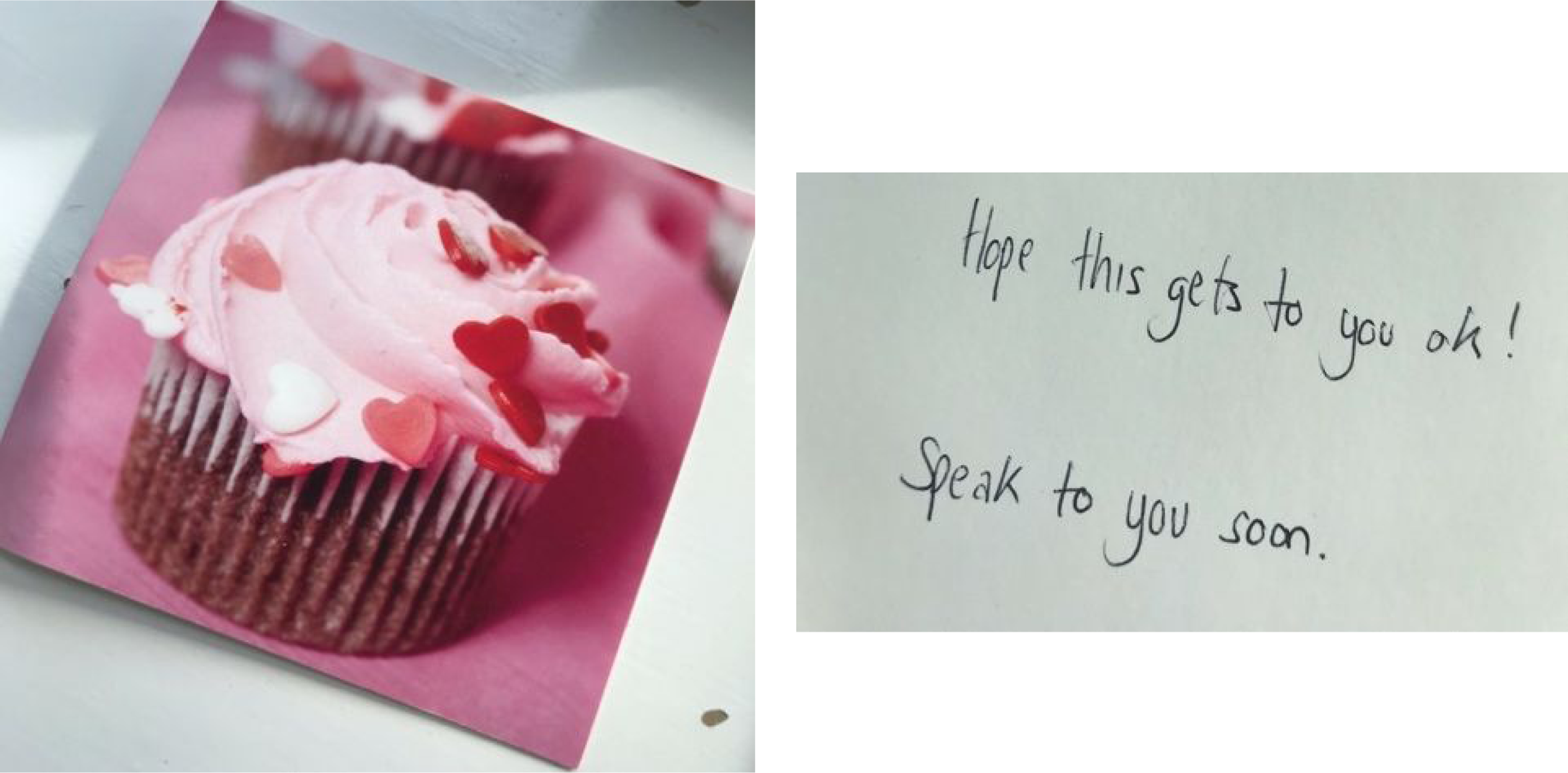
The completed diaries often travelled alongside, and were delivered with, intimate notes and letters. There is a special feeling to getting post, and receiving a completed diary certainly echoed this. As previously noted, the opening up of envelopes and completed diaries were a time for emotional engagement, analytical reflection and another piece of the jigsaw in coming to know participants. Yet, what further made these moments emotionally charged and connective was not only the diaries but the materials that came alongside – a greetings card, a follow-up letter and a booklet found at a museum that they thought may be of interest. Edwards et al. (2017) note that ‘paradata’ – the research ‘by-products’ of letters, correspondence, notes and so on – come to be valuable data. This ‘paradata’ often involves scribbles, signatures or notes written by the side of the page. But these cards and letters were ‘paradata’ in they felt like an intimate exchange, ‘gift’ like (Mauss, 2001 [1925]) and of sign of mediated relationality. Bates (2019: 2) similarly compares her written diaries, drawings, photographs and videos given by participants as ‘gifts’ that share ‘intimate moments’ of participants’ lives. Posting out and being a recipient of materials felt like an important part of the research relationship and the role of reciprocities. Captured above, Katie’s greeting card further demonstrates the negotiation of social relations through objects (Miller, 2010) and pushed me to reflect upon how she chose and decided to send the card that she did. Oakley (2016: 208) reflects upon the gift of social research, stating that such gifts come out when researchers ask participants about their lives, particularly when participants can choose how to respond and can ‘donate research material’ in the form of their own personal narratives. Oakley (2016) and Limerick et al. (1996) focus, however, on the gifts of narratives offered in interviews, but not physical artefacts. Thus, such gifts involve the intertwinement of materials together with intimate prose and ‘sensory intangibilities’ (Mason and Davies, 2009). As part of these material relationalities, I also became aware of my desire for continued communication, connectedness and care beyond data collection. This is reflected as I began to consider disseminating research findings and what to do as an ethics of ‘giving back’.
October 2020: Disseminating research
‘I’m sitting mulling over the plans for public engagement and the dissemination of research. How do I capture people’s lives and stories? My partner suggests, ‘Why don’t you make them [participants] a booklet? You know, something you can post out to them that they can keep?’ I’m once again reminded of my attachment to the materiality, returning to the post office and gift of social research.’
Both the greetings card and my thoughts on creating booklets for research dissemination work at illuminating the gifts of research and their desired relational nature. I posit that research materials are not only holders of data but mediate and respond to desired connections and relationalities. Too, our research materialities can be a tool in which we attempt to perform an ethics of care (Ellis, 2007).
Handling with care
December 2017: Encounters at the post office
‘Another trip to the post office and I am asked to place the parcel on the weighing scales. They ask, “What’s in the parcel, please?” I suddenly feel uneasy and reply, “Just some paper and a notebook”. I become aware that inside are details of a project and its delicate nature, placed alongside the written personal address on the front of the envelope.’
The encounters of packaging up parcels and organising appropriate stamps at the post office illuminated how research materials should be handled with care. Tuning into this process meant that I became aware of the vulnerability and durability of research materials, as well as my own emotional engagement in ensuring the ethical mobility of the materials in reaching participants, and them safely arriving back to me. I became familiar with the necessity of padded envelopes, strong parcel tape and the rules of postage – none of which came up for me in textbooks and training. Perhaps, this is because it is ‘common-sense’, but I was learning the field through the trials and tribulations of trips to the post office. Fraser and Puwar’s (2008: 2) have touched upon this as they illuminate the sensibilities of doing the research as it is carried into libraries and lecture halls. Similarly, Steedman (2008) points to the connections and intimacies within research beyond what we might see at the traditional research site, with physical and emotional weights of our research carried from the home to journeys on the train. The encounters of parcels being questioned before posting evoked a nervousness in ‘protecting’ the intimacy of the insides. In many ways, problems at the post office became a time when I felt an ethical ‘tug of responsibility’ (Bochner and Ellis, 2016: 111) of imagining participants and the intimacy of the research topic. The privacy of diaries has been addressed within literature, often in part due to the detailing of everyday intimacies within (Harvey, 2011), and for those who are keeping them (Bartlett and Milligan 2015: 84; Minnis and Padiman, 2001). Yet the intimacy and privacy of material diaries in transit, and as something navigated by the researcher, became increasingly apparent.
Capturing the careful mobility of diaries became even more noticeable in times of disruption. A smooth journey of the diaries being signed, sealed and delivered was one of the key fieldwork navigations in using paper diaries. Bartlett and Milligan (2015: 40) state that when planning to use diary methods, it is important not to forget about the practical matters of getting diaries back. The majority of the diaries were returned safely and came with companions. However, despite my efforts and conscientiousness, these paper trails were not always smooth sailing.
December 2017: Broken seals
‘A participant emails me to tell me that their envelope was slightly damaged in the post, so they’ve repackaged it all up with another envelope. The strength of envelopes and packaging are suddenly crucial ‘in the field’. Why did no academic textbook warn me about the weathered nature of the paper trail? Should I have thought this through? Perhaps the paper diary is all a bit old fashioned now. I am also reminded how Shaun (one of my participants) also explained how he loved writing his diary, and how putting pen to paper meant the words came flowing for him.’
Despite the focus thus far being on the collection of stored diaries at the end of the research project, it is vital to acknowledge that not all diaries followed the same journey. While most diaries were returned and some were started and then stopped, others were left unknown and lay dormant (Woodward, 2015b) in potential participants’ home, perhaps repurposed as a notebook for another purpose, thrown in a cupboard amongst a pile of papers or even in the bin. Thus, diaries abandoned, and emails with no reply, work as a further reminder of the ethics of declining or leaving research. Further to this, questions about the whereabouts of the diaries when out of my own hands also came up in another unfortunate and regretful encounter:
May 2018: Lost diaries
‘I’m almost at the end of my data collection and I’m waiting for the last couple of diaries. I arrive at my desk one morning and I have post. However, it’s not the usual brown envelope as plastic surrounds it. My heart sinks. It appears that the envelope was not sealed on its way back to me, and the diary has fallen out. The postal service repackaged the envelope in plastic with a notice apologising for its returned condition. I get in contact with the post office in pure panic and they advise that the insides most likely have been destroyed in the sorting office if they have fallen out’ (Figure 3). Image description: ‘Our sincere apologies’ – a repackaged parcel.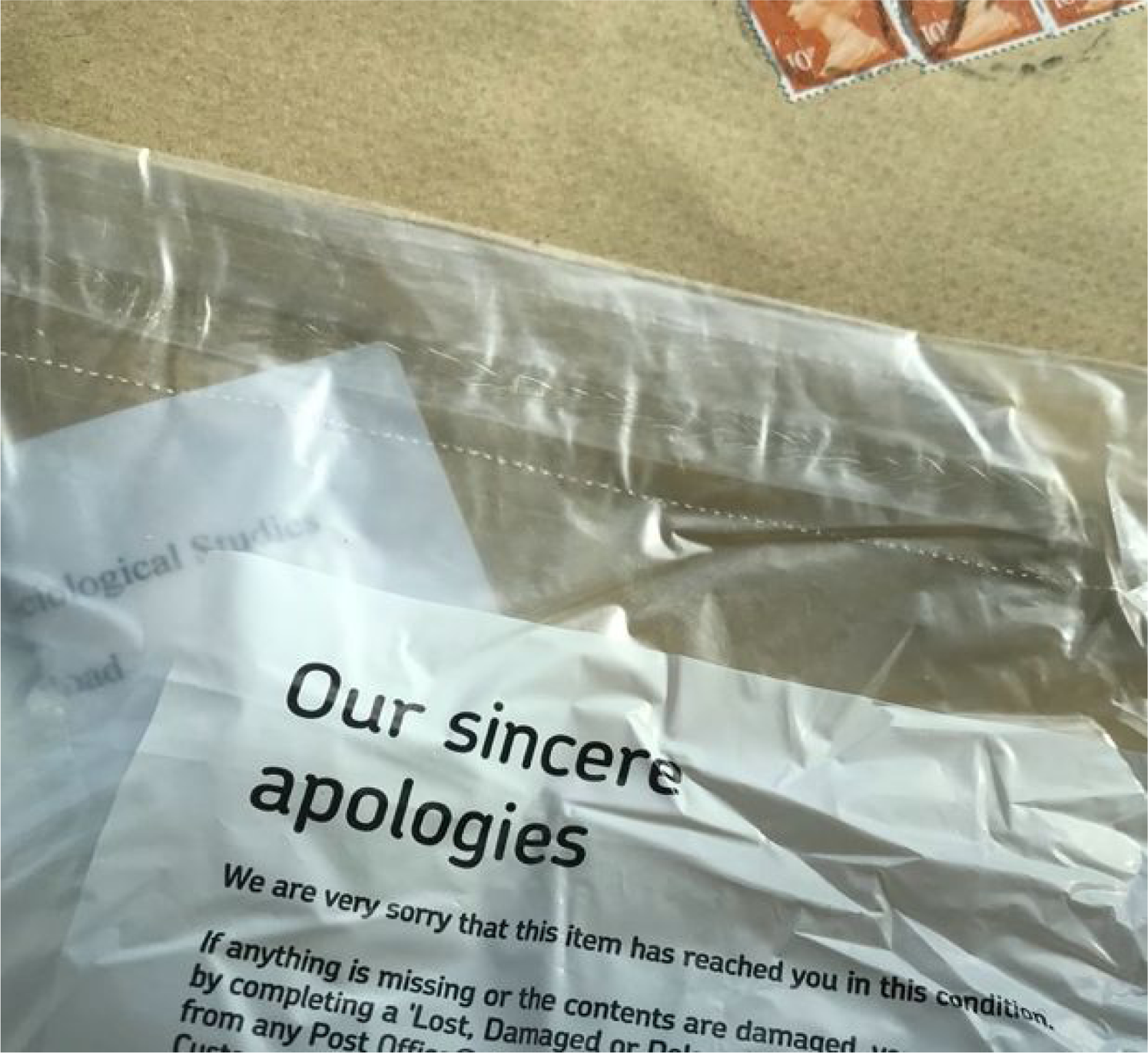
I had not anticipated that a diary could in fact get lost in the post. Despite these practices of careful packaging, instructions and pre-paid postage, one completed diary slipped out of an envelope whilst in transit from a participant. The ‘procedural’ ethics (Guillemin and Gillam, 2004) came into action as I contacted the postal service, sought out institutional advice and contacted the participant. What happened was that the participant appeared not to mind at all, stating that they had not had much time for the research anyway and our conversation ended there. I have since reflected upon this experience in a multitude of ways. First, in that I will never know how the participant felt and how it could have been a very different and emotional encounter had it been another diary and another participant. Second, is that the careful handling of research materials, even in the most ordinary of ways, is important. They are affective and part of a collective of research communication (Woodward, 2020). The materiality and care mattered, highlighting the fractured and messy nature of communication and care with participants with and through materials. Third and most importantly, the most fruitful reflection was the materiality and emotional attachment and ‘possession’ of the ‘data’ in this instance meant more to me as a researcher than it did to the participant. Doing my PhD was a time of establishing myself as a ‘competent’ researcher and completing a research project that mattered. However, it is a lesson to remember that the value and weight of research participation is not to be expected or imagined on both sides.
Linked to this imaginary of the efforts of participatory and relational research is that I set out with a commitment to the diaries being open and in line with participatory ethics (Bartlett and Milligan, 2015). I began the research imagining participants would have their diaries back at the end of the ‘data collection’ process. I reflected upon this after my very first follow up interview.
November 2017: Returning the diary
‘I’ve just done my first interview with a participant who completed a paper diary. The process of writing a diary was revealing to her. She expressed finding the process both cathartic and disrupting in realising the effects the condition had on her everyday life. We talk about this in the interview and at the end, I reminded her that she could take her paper diary back. I explain that I’ve written up the information, but that she can keep the physical copy if she’d like. She says yes. Offering diaries back was the ethos for interviews going forward.’ (authors fieldnotes)
I stood firm by the idea that these completed diaries while ‘co-produced’ were theirs, not mine. I wanted to do right by the participants as part of a commitment to principles of feminist ethics of care. This desire was met in some cases as two participants did in fact say that they would like their diaries back, having learnt from the process of reflection or that they wanted to keep writing. This was demonstrated by the participant described above who detailed the intimacy of learning from keeping the diary as we reflected upon it in the interview. However, the remaining twelve diarists were happy to let go and think no more of it. Yet, the diaries gifted felt far more complicated than the diaries given back. This remains an ongoing question of how to materially handle these with care, where to store them and how long for. There is a logistical point here about the temporary nature of my work locations as an early career researcher, ‘moving on’ to projects and universities anew, and thus where to move or carry the material diary data ‘to’ (Fraser and Puwar, 2008: 13). Too, ‘data’ are discussed in this manner, as we as researchers are required to outline the time lapse of destroying or archiving research data on an institutional and procedural level (Guillemin and Gillam, 2004). However, the material matter and ‘paradata’ (Edwards et al., 2017) from the project felt more than this. Keeping the diaries and the personal artefacts that are in their company evokes broader questions when seeing these through the lens of care and relational ethics (Ellis, 2007). My own attachment and feelings of responsibility, as well as the embodiment of personal lives through the materials, unsettles questions of destroying data. These cannot always be anticipated when designing research or undergoing ethical processes for institutional approval. Perhaps it is the case that research materials in all shapes and sizes lie dormant in academic offices long after anticipated procedural ethics because of their ‘sensory intangibilities’ (Mason and Davies, 2009). Though research projects may end and researchers move on, research materials carry both practical considerations of what we do with them, but also emotional weights in the connections, relations and lessons learned from doing social research.
Discussion and Conclusion
Through the seemingly mundane moments with research materials, I have sought to highlight the relational and careful processes of doing social research. I return to Back’s (2012) contemplation on the taken for granted processes and reliance on the voice recorder. Within his reflections, are the methods of learning the craft, tuning in, the company of materials in the course of being independent researchers in uncertain territories, and the practices of processing and responding to materials and participants alike. Back (2012) notes that whilst such tools allow for authentic voices and record, there is a role in the non-verbal and a cautiousness in over relying on our research companions to do the work for us. With diaries in mind, the written, spoken, and typed words of diary keepers are only one feature of the methodological story. While they may capture the intimacy of people’s lives, they are not the only way of tuning into relational research. As Fraser and Puwar (2008) note, sensory and affective relations from researchers, even if they are flawed or portray the complicated labours of qualitative research, are important to share. What was sent alongside the research diaries and gifted was another method of tuning into the intimacies of research – including my own.
This article has acknowledged how scholarly contributions into diaries as a method have recognised the value that diaries hold over time and their ability to capture everyday intimacies and sensitivities (Harvey, 2011). Yet, a focus on the materiality of research diaries as experienced emotionally by the researcher has received less attention. Building on the reflexive commentary offered by Bates (2011), I have shown how elements of materially driven research have received less attention when it comes to diaries. Turning to conceptualisations of materiality (Miller, 2010) and material methodologies (Woodward, 2015a, 2015b; 2020), this article sought to centralise diaries and research materials through illuminating the evocative ways in which objects shape social relations and everyday practice. This article returned to feminist methodologies (Oakley, 1981; Stanley and Wise, 1993) and relational ethics (Ellis, 2007) to show the reciprocal, careful and emotive facets of doing research. It has developed existing contributions into the diary method by highlighting the tangible materialities of material methodologies with a folding in of the ‘sensory intangibilities’ (Mason and Davies, 2009) and the relational and ethical thought processes of the researcher.
This article has centralised my own emotional negotiations in handling processes of research through material encounters. First, I documented the moments with materials as acts of care for imagined future and present participants. Through picking notebooks, designing ‘packs’ and reading written accounts, participants were imagined and thought carefully about (James, 2014). Written diaries and objects given to the researcher are perhaps distinct to the readings of a transcript in that they embody, materially inscribe and ‘hold’ the personal. That is not to say that reading of transcripts is not affective, but rather highlights an ethnographic attentiveness that includes research materials (Back, 2012; Bennett et al., 2015). These moments of reflection are important when having conversations about material methods and considering the ‘evocative capacity’ (Hockey, 2014: 95) from the perspective of the researcher.
Second, the practical and emotional handlings of research have sought to tell a tale of giving, receiving and relations within research. The acts of diary preparation and receiving diaries, letters and cards demonstrates the gifts of research participation (Limerick et al., 1996; Oakley, 2016) – and the materiality of such. The methods of research are not simply ‘holders’ of data, but are mediators of research relationships (Woodward, 2008). This offers possibilities for appreciating materialities as a method for research relations, as well as more traditional debates surrounding reciprocity and participatory efforts (Bartlett and Milligan, 2015). This reciprocal nature of receiving materials also opens up important questions for qualitative researchers in asking what we do with both data and ‘paradata’ (Edwards et al., 2017) that accounts for such trails of connection and affiliation. Ethical and emotional struggles sit alongside as diaries, cards and letters remain in the cupboards of offices and jar with the procedures of destroying data that holds relational importance.
Third, I have retraced the handling of research objects. Back (2012: 225) notes that what counts as data is the ‘rhythm of life itself’. In the same way, these ‘spaces of intimacy’ (Steedman, 2008) at the post office, the diaries left ‘dormant’ (Woodward, 2015b) and the diaries buried away capture the everyday practicalities of being a sociological researcher, as well as listening into the value of how such items hold relational and ethical lessons for care in qualitative research (Ellis, 2007). Mundane encounters that include the mobility of research, researchers and paper trails should not be discounted. Finally, this article works as a reminder that social connectedness between the researcher and the research can be found not only in conversations but through research materials (Steedman, 2008). Tuning into the personal encounters with material belongings shows the gift of personal stories, connectedness and research participation.
Footnotes
Acknowledgements
Thank you to the twenty-five people who participated in this research. Thank you to Sarah Neal, Katherine Davies, Rose Barbour, Mel Hall, Susan Oman and Delyth Edwards for conversations on an earlier version of this paper, and to the generous reviewers for their suggestions.
Declaration of conflicting interests
The author(s) declared no potential conflicts of interest with respect to the research, authorship, and/or publication of this article.
Funding
The author(s) disclosed receipt of the following financial support for the research, authorship, and/or publication of this article: This research was funded by the Economic and Social Research Council grant number ES/V009397/1.
