




Abstract
This article discusses narrative practice and textile-making as two techniques of researcher reflexivity in diverse teams conducting qualitative-interpretive research. Specifically, it suggests definitional ceremonies—a collective structured method of storytelling and group resonances—as a useful tool to interweave diverse researchers as a team, while maintaining the plurivocity that enables deeper reflexivity. Additionally, textile-making is introduced as a material and embodied way of expression, which complements narrative practice where words fail or need a non-linguistic form of elicitation. We illustrate the two techniques with examples from our international, collaborative qualitative-interpretive research project with demobilized guerrilla fighters in Colombia.
Keywords
Introduction
We have been saturated with death and pain; we have also survived. We have seen the war very closely; it has been present in the daily life of all of us. Today, we do something to reinvent the story. We meet and talk, which gives us hope; it lets us know that there is something that can be done, and that we can go ahead and do it. (Excerpt from editorialized team reflection, Andrea Ortega, Medellin, 2019)
This article proposes narrative practice and textile-making as innovative techniques through which heterogeneous teams of researchers can practice processual reflexivity in qualitative-interpretive social research, particularly in research on violent conflict and its transformation. Based on the fundamental assumption that the researcher-subject cannot be separated from the social world and that her research contributes to the social meaning-making processes she studies, reflexivity is a cornerstone of all qualitative-interpretive research. The specific research project underpinning this article sought to unearth subjugated knowledges and alternative self-narratives of former combatants of the Colombian guerrilla group FARC (Fuerzas Armadas Revolucionárias de Colombia) who are now in the process of reincorporation into society, as well as of their rural host communities, with the stated aim of fostering dialogue between antagonistic groups within Colombian society. In the context of this project, the generally assumed need for researcher reflexivity in qualitative-interpretive research became particularly pertinent, for the past armed conflict had affected the lives of the majority of our team’s members in manifold direct and indirect ways.
A broad, long-standing literature on reflexivity in qualitative-interpretive research addresses many topics relevant to our research process, for instance the role of positionality and privilege in research, challenges of reflexivity in research on emotionally taxing topics, methods of reflexivity that encompass the researcher and researched, and ethics in structurally unequal teams involving researchers from the Global North and South. However, only comparatively few texts engage with the practical challenges of actually ‘doing’ reflexivity as a team, over time, and in relation to difficult subjects such as armed violence (Soedirgo and Glas, 2020). To contribute to addressing this lacuna, in this article we develop and discuss two novel techniques of reflexivity—narrative practice and textile-making—which, while centrally focussed on textual aspects, also extend existing practices of (team) reflexivity to the material and the embodied. By developing these techniques, our article makes two major contributions. Firstly, it suggests a practical and collective approach to reflexivity through structured storytelling and resonances, supported by textile-making, in which different members of the research team collaborate in ways that allow them to weave themselves as a team and create relationships through reflexivity, while maintaining the plurivocity that enables deeper reflection. Secondly, the article proposes an approach to reflexivity that, rather than reflecting on relatively stable researcher identities in an anticipatory way, emphasizes researcher-subjectivities that emerge, develop and potentially transform throughout the research process.
By ‘narrative practice’, we refer to the specific narrative approach pioneered by Michael White and David Epston (1990). Originating in psychotherapy and subsequently developed for social and pedagogical work with communities (Denborough et al., 2006) and reflective teamwork in therapeutic settings (White, 1995), we have adapted the approach to enable processual, intersubjective reflexivity in our research team. By ‘textile-making’, in turn, we mean processes of needlework, including embroidery, sewing, appliqué, and other techniques (Andrä, 2020). Previously employed by one of the authors as a method in research with victims of violent conflict in Colombia (Arias López, 2017), here we use textile-making as a material and embodied complement to narrative practice. Importantly, these methods of researcher reflexivity are also the very methods our team used in its research with communities of former FARC fighters and their rural host communities (Arias López et al., 2020b). An additional contribution of this article is therefore the development of a method for processual, collective and practical reflexivity that, in an interpretive spirit, breaks down barriers between methods of understanding the self and those used with participant-subjects.
In the following, we first discuss the methodological literature on reflexivity, focussing on three questions particularly pertinent to the challenges encountered in our project, namely when, by whom, and how reflexivity is done. Next, we briefly introduce our research project and explain its reflexivity-related needs and challenges. We then turn to the two core techniques we used to practice reflexivity. Here, we firstly introduce narrative practice—specifically, the tool of definitional ceremonies—and describe how we used this tool for the purpose of group reflexivity. Secondly, we explicate textile-making as a technique of reflexivity and illustrate how we have employed it to accompany the reflexive process enabled by narrative practices. Taken together, we argue that narrative practice and textile-making enabled reflexivity as an ongoing process that accounted for how researchers’ subjectivities evolved throughout the research, and as a collective process that wove a heterogeneous group of researchers into as a team without smoothing over differences between their respective individual experiences and perspectives. We conclude by reflecting on the limits, but also the more general applicability of the suggested tools for ‘doing’ reflexivity.
‘Doing’ reflexivity in qualitative-interpretive social research
With the interpretive turn in the social sciences and its ‘overarching appreciation for the centrality of meaning in human life’ (Yanow and Schwartz-Shea, 2006: xii), the ideal of the objective, neutral researcher has given way to the notion that researchers are themselves inevitably implicated in the meaning-making activities they study (Denzin and Lincoln, 2005; Russel and Kelly, 2002). This, in turn, implies the central need for reflexivity. Described as an ‘awareness of the researcher’s own presence in the research process’ (Barry et al., 1999: 31), ‘explicit self-aware meta-analysis’ (Finlay, 2002: 209), or the ‘active acknowledgement by the researcher that her/his own actions and decisions will inevitably impact upon the meaning and context of the experience under investigation’ (Horsburgh, 2003: 309), reflexivity demands the clarification of researchers’ involvement in the socially constructed and meaning-laden world they study. Insofar as methodology and methods are one central avenue through which this involvement and clarification can unfold, qualitative-interpretive scholars have long conceived of reflexivity as a ‘crucial strategy’ for improving knowledge-making about the social world (Berger, 2015: 219).
Theoretical perspectives on reflexivity tend to vary by discipline, with cultural anthropology (Geertz, 1973, 1988), sociology (Bourdieu, 2004; Bourdieu and Wacquant, 1996), and geography (Rose 1997), among others, disagreeing about the methodological possibilities, purposes, and politics of reflexivity. Feminist scholarship, in particular, has done much to advance theoretical understanding of these matters. It has pointed out the limited reach of reflexivity as a tool for achieving transparency in social research (Haraway, 1988; Pillow, 2003; Rose, 1997), established reflexivity’s embodied, emotional/affective, and experiential nature (Malacrida, 2007), and laid out the power relations inherent also in reflexive approaches to knowledge production and research methods (Alcoff and Potter, 1993; Reinharz, 1992; cf. Alvesson and Sköldberg, 2017: 13ff., 279ff.). Overall, these and related theoretical debates have furthered our understanding of reflexivity in multiple and important ways.
Yet these debates notwithstanding, living up to theoretical ideals of reflexivity in endeavours to cultivate reflexive empirical knowledge remains a formidable task—as is attested to by a growing methodological literature devoting itself to ‘the difficulty of actually doing it’ (Rose, 1997: 306; cf. Soedirgo and Glas, 2020). Here, we discuss this more practically inclined literature with regard to three aspects of ‘doing’ reflexivity that are of particular relevance to our research, namely when, by whom, and how reflexivity is practiced.
Regarding the question of the ‘appropriate times, spaces and contexts to be reflexive’ (Mauthner and Doucet, 2003: 419), much qualitative-interpretive social research emphasizes an anticipatory kind of reflexivity, which in practice consists in explicating how researcher positionalities come to affect the research in different analytical moments. In this vein, Berger (2015: 221), in her systematization of researcher positionings vis-à-vis their research along an insider–outsider spectrum, argues that this kind of ‘[r]eflexivity is crucial throughout all phases, including the formulation of a research question, collection and analysis of data, and drawing conclusions.’ 1 Such an anticipatory reflexivity may be limited, however. Retrospectively discussing her experience of studying traumatic cultural memories, Drozdzewski (2015: 30f.) finds that her approach to reflexivity, which sought to clarify the positionalities she was ‘“bringing” to the research’, had been insufficiently adept at grasping the emotions arising from the research process and ‘perhaps even a little naïve’ in its assumption that having thought about and articulated ‘my own positionality had equipped me for this [research] venture.’ An even more sceptical stance towards the ‘popular strategy [. . .] of “situating” oneself by prior announcement’ is taken by Patai (1991: 149), who argues that in this practice of reflexivity, individual and group identities are often ‘deployed as badges’, in effect deflecting ‘attention from the systemic nature of inequality’ and the question of what can be done to challenge it. Overall, however, there are still only few attempts to go beyond anticipatory forms of reflexivity, or to expand the practice of reflexivity to also ‘encompass [. . .] subjectivities that emerge from the multiple interactions’, which together make up ‘the complex tapestry of the research process’ (Russel and Kelly, 2002; cf. Soedirgo and Glas, 2020).
A second question concerns the ‘cognised and cognisant agents (whether individually or collectively)’ of reflexivity (Guillaume, 2002). Against the overwhelming focus within the methodological literature on reflexivity as an activity of individual researcher-subjects (Barry et al., 1999: 31f.; Massey et al., 2006: 133f.), ‘participatory’ practices of reflexivity (Kumsa et al., 2015) and approaches to reflexivity in/by research teams (Barry et al., 1999; Horsburg, 2003; Massey et al., 2006; Russell and Kelly, 2002) suggest collectivist takes on reflexivity to be analytically worthwhile. In particular, insofar as the inclusion of team members with complementary experiences, skills, and personalities can improve the interpretive process and its outcome (Barry et al., 1999: 28ff.; Mead 1970; Pezalla et al., 2015), collective practices of reflexivity can contribute to safeguarding and further enhancing the analytical benefits of teamwork by underlining the ‘multiplicity of voices’ and subjectivities that constitute the team (Russell and Kelly, 2002). Awareness of and collaboration on this multiplicity can improve the research by serving as an additional check on one another’s reflexivity (Berger, 2015: 222), by offering a space in which to discuss the (often contentious) ‘issue of hierarchy versus collegiality’ (Barry et al., 1999: 29; cf. Rogers-Dillon, 2005), and by providing team members with ‘a stable sense of [not least emotional] support’ that enables them to expedite their analyses beyond what they would have been ‘able to do if left to [their] individual (and individualized) devices’ (Russell and Kelly, 2002). Collective practices of reflexivity could be of particular benefit for research on violent conflict and its socio-political aftermath, a field of study in which researchers not only grapple with emotionally challenging topics such as the process of accounting for war-time atrocities (Thomson et al., 2012; Wood, 2006), but which also continues to be characterized by teamwork constellations in which scholars from the Global North often exploit and erase the intellectual and practical contributions of their colleagues from the Global South (Bouka, 2018).
Finally, there is the question of ‘how reflexivity can be operationalized’ (Mauthner and Doucet, 2003: 416), by giving a reflexive twist to an existing repertoire of research practices (interviewing, fieldnotes, analytical writing, etc.) or experimenting with new ones. Proposals for ‘doing’ reflexivity include tools to be used throughout the research process—for example, autoethnography (Brigg and Bleiker, 2010; Caretta, 2015), ‘biographical reflexivity’ (Ruokonen-Engler and Siuti, 2016), or ‘feminist research ethic’ (Ackerly and True, 2008)—and approaches focused on embedding reflexivity within other methods for data generation (Fujii, 2017; Pitts and Miller-Day, 2007) and analysis (Mauthner and Doucet, 2003; Malacrida, 2007). In addition, there are a number of specific propositions for tools of team reflexivity. For example, Barry et al. (1999: 35ff.) wrote and shared ‘reflexive position statements’ to render explicit the assumptions they brought to their joint project and reflected on key theoretical questions by a similar method of individual writing followed by group discussion. Caretta (2015: 501) asked her research assistants in the field to write individually and collaboratively authored ‘self-reflective texts’ and thereby practically engaged her team in a feminist, deconstructive reflexivity. Lingard et al. (2007), to negotiate the identity politics within their interdisciplinary research team, first individually wrote about their experiences of conducting research through concepts like ‘knowledge brokers’ and ‘structuration’ and then discussed these reflective writings collectively. These examples highlight the need for developing practical tools through which reflexivity can be implemented in team-based projects.
Taking up the questions of when, by whom, and how reflexivity is practiced, in what follows we propose narrative practice and textile-making as two innovative complimentary techniques for processual, collective, and practical reflexivity. We describe how we used these techniques to practice reflexivity within a diverse team, focussing on team members’ relationships to each other and to our research topic and on how these relationships evolved and transformed throughout the research process. We suggest that these techniques and the broader approaches they stem from add a novel approach to the existing toolbox for conducting processual, collaborative, and practical reflexivity. On the one hand, narrative practices such as definitional ceremonies are particularly helpful for engaging a research team’s multiplicity of voices, as they can encompass both stories shared between various team members and stories that are specific to individuals. On the other hand, textile-making can completement existing, text-centric tools by accentuating the embodied and affective nature of practical reflexivity.
‘Doing’ reflexivity through collective narrative practice and individual textile-making
Our project
The funded 2.5-year international, collaborative research project underpinning this article explored processes of reconciliation that followed the 2016 peace agreement between the Colombian government and the FARC, Latin America’s oldest guerrilla. 2 While the agreement put an official end to the war, the implementation of the agreement has remained fragmentary, and Colombian society remains divided over the integration of the ex-combatant ‘other’ (Crane and Vellajo, 2018; Kroc Institute, 2020; McFee and Rettberg, 2019). In this context, our project used interpretive methods including ethnographic observation, narrative biographical interviews, and textile-making to explore continuities and transformations in subjectivities and relationships in the process of the FARC peace signatories’ reincorporation into civilian life in Llano Grande and San José de León, two rural locations in the department of Antioquia. Moreover, the textiles embroidered by our participants have been exhibited locally, regionally, nationally, and internationally to generate dialogue and make a modest contribution to the Colombian peace process (Arias López et al., 2020a). 3
The project was carried out by a diverse research team of ten women from different countries, life backgrounds, academic disciplines—nursing/community mental health, social anthropology, political science/international relations, plastic arts, psychology—and civil society organizations. The strong teamwork element of the project warranted a collective reflexive approach. Firstly, we had to address the question of how to do collaborative research when, geopolitically and socially, team members came from evidently asymmetric contexts and positions of privilege, including the Global North and South (Colombia and the UK/Germany) as well as academic institutions and grassroots organizations. To reflect on this heterogeneity, it was necessary to avoid the single-story approach attached, for instance, to professional labels, and to encourage multiple, alternative stories of self in relation to the project.
Secondly, it was important to reflect on how team members’ lives had been directly and indirectly affected by armed conflict. Family trajectories, personal experiences during formative secondary-school and university years, and professional encounters in conflict areas had a bearing on how the Colombian team members related to the research project and its participants, and with which expectations, preconceptions, and concerns they entered the field. Meanwhile, the biographies of the two European researchers, both UK-based but originating from Germany with its particular history of political violences, also had particular resonances with the project. This made it vital to find ways to capture team members’ (changing) subjectivities and how these influenced the analysis.
‘Doing’ reflexivity was a major concern from the outset of our project. The team used the occasion of an initial team workshop, set up to ensure that all researchers felt technically confident in using the project’s core research methods of narrative practice and textile-making, to explore whether and how these methods could also be used to ‘do’ reflexivity. Over the course of the project, these methods were furthered to create collective fieldwork diaries and to reflect on the effect of the project’s process and data on team members’ own subjectivities and their understandings of violent actors in Colombia.
Collective reflexivity through narrative practice
Rooted in social-constructionist and post-structuralist thinking, narrative practice (also known as narrative therapy) was formulated in the mid-1980s as a form of psychotherapy (White and Epston, 1990). It is based on the assumption that individuals’ subjectivities are storied: ‘In striving to make sense of life, persons face the task of arranging their experiences of events in sequences across time in such a way as to arrive at a coherent account of themselves and the world around them’ (White and Epston, 1990: 10). Self-narratives are not fixed or static, since they only ever present a selection of lived experiences (White and Epston, 1990: 12), yet they are also not random: people’s (self-)narratives are bound to wider socio-cultural discourses, which operate within regimes of truth that privilege some aspects of lived experiences as ‘normal’ (dominant stories), while silencing other aspects, either because they are considered secondary or insignificant (alternative stories) or because they are invisibilized or sanctioned (silent/silenced stories). Proponents of narrative practice aim to create space for people to explore alternative and silent/silenced stories from the stock of their experiences and subjugated knowledges, to enable them to re-author their lives by choosing different parts of their experience to represent themselves (White and Epston, 1990: 13, 16–17, cf. Payne, 2002: 58).
One method of narrative practice which we suggest is particularly useful for doing reflexivity collectively and taking it beyond ‘identity badges’ or ‘virtue-signalling’ are ‘definitional ceremonies’ (White, 2007: chapter 4; cf. White, 1995). Definitional ceremonies are group setups that ‘provide people with the option of telling or performing the stories of their lives before an audience of carefully chosen . . .witnesses’, who in turn ‘respond to the stories with retellings’ that resonate with the story heard without judging it (White, 2007: 165). Usually, an ‘interviewer’ conducts a first interview with the person seeking advice, which is observed by the ‘witnesses’. In a second interview, this time observed by the person who told their story, the witnesses are asked to resonate with the original story by retelling and relating their own experiences to it. Finally, the person interviewed at the outset reflects on these resonances (White, 2007: 185–201). In both therapeutic team and community work, definitional ceremonies have been shown to enable team reflexivity and allow for ‘‘thick’ conclusions’ through the resonances of outsider witnesses (cf. Denborough et al., 2006; Pia, 2013; White, 2007: 181). White (1995: 13) observes that in work-related contexts, members of teams who respond to an initial story in a definitional ceremony ‘often find themselves talking about what they would not have imagined they would be talking about ahead of their reflections’. Team members may recover ‘half-forgotten memories’, change the way they talk or think about their lives, or uncover alternative life stories ‘that bring new options for action’ (White, 1995: 13–14). These characteristics of definitional ceremonies also render them useful for continuous collective reflexivity in conflict research contexts.
To constitute ourselves reflexively as a research team and vis-à-vis our research, we first used a definitional ceremony in our initial methods workshop, for which we invited a colleague experienced in narrative practice as interviewer. First, the Colombian principal investigator was interviewed about how she had come to develop the core idea for our research and invite the other team members to the project. Her account touched upon the rural origins of her family and her feelings of indebtedness towards, but also romanticization of, rural communities in Colombia; her disillusionments with leftist revolutionary thought and action during her studies which, over time, gave way to the hope that despite a lack of institutional change there was nonetheless scope for grassroots work toward social justice; and her engagements with rural victims of violent conflict in her academic work, which had a blind spot when it came to those members of rural communities who had joined one of the armed groups.
Next, the team members were invited to individually answer two questions: ‘What caught your attention in what you just heard?’ (retelling) and ‘How does your own experience relate to this story?’ (relating). From these resonances it soon became clear that all team members’ lives had been touched by war in some way, and that the Colombian team members held divergent experiences and positions regarding the Colombian conflict and its armed groups (the military, different left-wing guerrillas, right-wing paramilitary groups, and criminal cartels). 4
For example, one team member recalled the constant flow of stories received by her mother, a coordinator of long-distance studies for teachers: ‘She told us how this or that teacher couldn’t come because she had been held up by a guerrilla or paramilitary roadblock, or how some other teacher was forced to get off the bus and threatened with death, but somebody saved her.’ These horrifying stories of everyday violences in the conflict contrasted with the odd normality of family life in the conflict: ‘I also had a relative who was married to a paramilitary commander, and that’s how it was, that was our everyday life.’ Resonating with this story and a remark by the Colombian PI about the choice of doing research with former FARC guerrilla, another person reflected on why our team found it more difficult to imagine a similar project with former paramilitaries, infamous for their responsibility for the majority of atrocities during the height of the conflict. She recalled a first encounter with former paramilitary fighters in her community work and how it clashed with her strongly antagonistic feelings toward the paramilitaries: ‘Going to their house, getting to know their mothers, how they live today, how they ended up in this. For me it was very hard to meet these human beings who for other reasons also ended up in those groups.’
Another team member talked about her time as a rural teacher and the personal debt she felt toward her former pupils, most of whom had ended up in one of the guerrilla groups and many of whom had been killed. Two other team members reflected on reasons why they did not end up in an armed insurgent group, despite certain opportunities and temptations in their youth. One related: ‘My home was like a place where the Franciscans would pass through and rest for a few days. This was a time of storytelling about what was happening in the north and the south of the country, in Central America, Nicaragua.’ She recalled how this had inspired an urge in her to change something about this violent world, but how it had also led her to realize that this change would not come about through armed violence. This resonated with another team member’s experiences, who in her youth had been a leftist activist and who credited it to her family that she did not take up armed activities despite having relatives and romantic partners who joined a guerrilla group—and who ultimately lost their lives.
Our definitional ceremony lasted several hours and was an emotional process of storytelling and resonances. In lieu of the usual third step (final resonance of the original storyteller), the interviewer used ‘editorialization’, a narrative practice common in community work, to summarize the team members’ individual resonances into a collective account, a part of which was quoted at the beginning of this article. Another part reads: We are survivors of the war. We resume life with radicalism, broadening perspectives, recovering senses of humanity, listening to those we hadn’t heard. We are starting to understand what has happened, getting to know the other, living together, remembering that our lives deserve to be lived. This is our country; this is our story. We have been on a suspension bridge. Today, we process our own experiences and those of others. We have our debts, debts of justice, debts of indifference. Today, we listen to others’ stories; we allow ourselves this understanding embrace, an embrace which recovers humanized ways of seeing that build truths without discounting the conflict.
After the collective account had been read back at us, many team members remarked that the definitional ceremony had encouraged them to share experiences which they had seldom shared before and which were not part of their dominant self-narratives in professional settings. The technique thus enabled our team to go beyond ‘identity badges’ or ‘virtue-signalling’ by redirecting attention to the resonances our project was causing within us. For many, the definitional ceremony was a first opportunity to reflect on and share how they had come to be interested in working on violent conflict and what it meant for their self-understanding that the project’s focus was not on the victims of conflict, but on its armed actors. While differences between the team members’ professional, generational, and national backgrounds emerged clearly, the method also enabled unexpected resonances between personal experiences. The editorialization, finally, wove these distinct experiences into a common fabric, a shared theme recognized by all team members as representing both them as individuals and the team as a collective.
In the course of our research, we continued the collective reflexive process started with this definitional ceremony in two ways. Firstly, during monthly week-long fieldwork trips by smaller groups of our research team (usually two to three people) to our two research communities, we used the practice of resonances to create collective audio-recorded field diaries. Similar to the experiences of Creese et al. (2008: 198), this way of creating fieldnotes helped us in further ‘constituting the team and producing findings that the team share’, while also understanding ‘how researchers’ different life trajectories, ideologies and viewpoints impact on how they represent research participants and themselves’. Our team members’ different experiences thereby helped to maintain curiosity and safeguard against nonreflective or hasty conclusions emanating from a supposed familiarity with the conflict.
Secondly, as we discuss in the next section, over the course of the research project we used definitional ceremonies to engage in deeper reflections on the empirical data and how the research impacted on our own subjectivities and understanding, and combined definitional ceremonies with textile-making to this end.
Reflexivity and textile-making
Due to its emphasis on language, narrative practice reaches its methodological limits when tacit knowledges cannot be put in words, or when individuals find it difficult to express their experiences and emotions (Da Silva Catela, 2004). Textile-making, with its long tradition as a form of political expression and memorialization of victims of political violence (Agosin, 2014; Andrä, 2020; Andrä et al., 2019; Parker 2010), has been shown to provide a useful methodological complement to more standard social-scientific methods (Arias López, 2017; Arias López et al. 2020b). We suggest three ways in which textile-making can also enhance reflexivity through narrative practice. Firstly, the ‘making’ aspect of needlework creates time for becoming aware, feeling, remembering, and reflecting; revolving around notions of mending, unravelling, and recomposing materially and emotionally, it also enables resignifications (Gauntlett, 2018; Ingold 2013). Secondly, when carried out in groups, textile-making creates spaces and relations of trust, affect, and mutual care, which allow individuals to express their experiences and collectives to establish and/or resignify relations (Bello Tocancipá & Aranguren Romero 2020: 189; Pérez-Bustos & Chocontá Piraquive 2018: 5–7). Finally, textiles also have an embodied effect on their makers and audiences (Andrä et al., 2019; Thamen and Knights, 2019); as textile artist Mercy Rojas explains: ‘The textile narrative is a language that can only be transmitted from and received with the body.’ 5 We observed these affective rather than intellectual resonances among the audiences of our project exhibitions, but also recognized them in how team members related to each other’s experiences, thoughts, and stories when relayed through textiles, which in turn contributed to the process of coming together as a team.
For example, we used textile-making as a form of reflexivity in group sessions to resonate with the question: ‘What ideas have you unstitched and/or restitched in the course of our fieldwork with former combatants?’ Figures 1 and 2 show two examples of individual textile resonances.
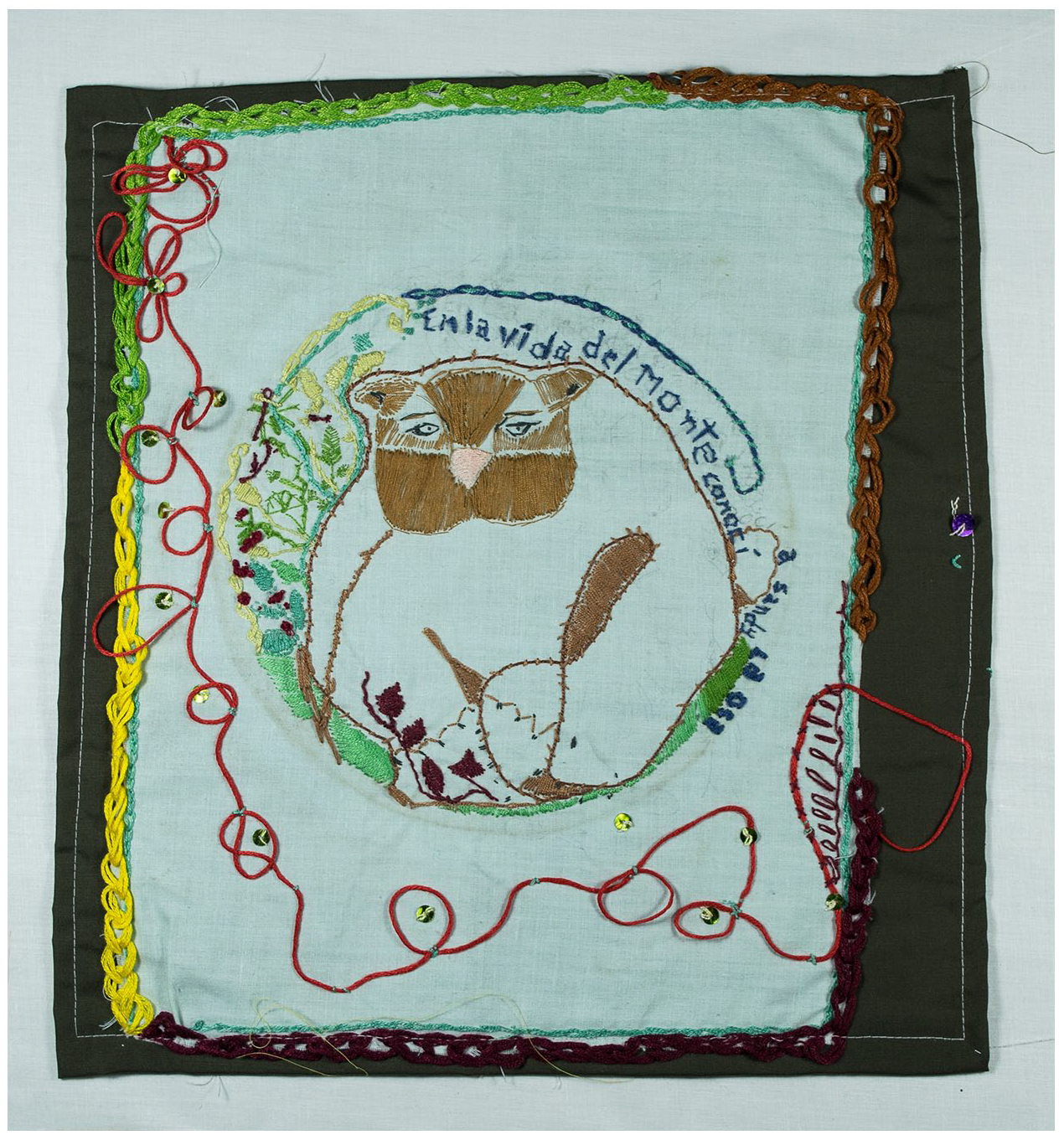
‘Sandy, the little bear’ by Laura Coral (Medellin, 2019).
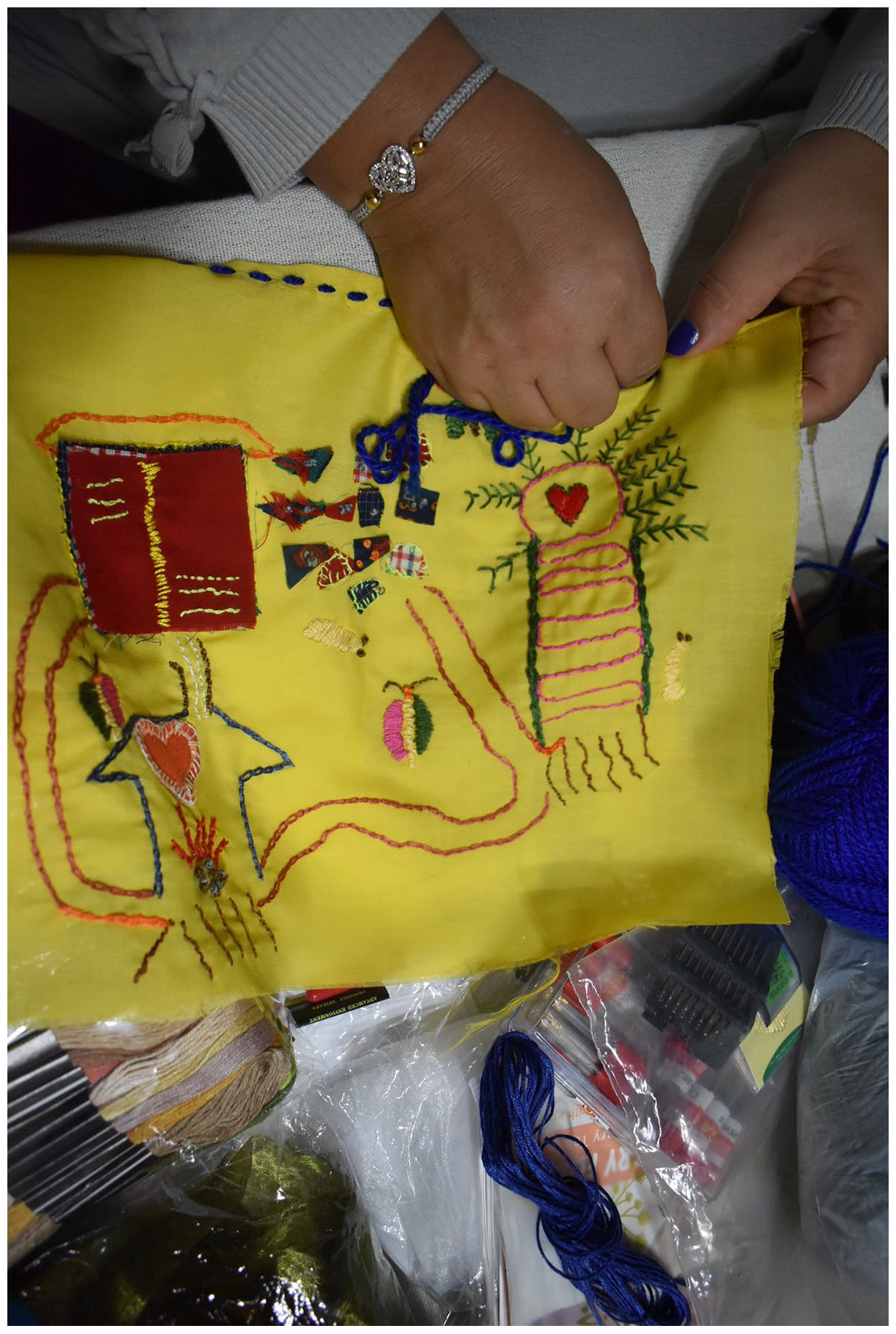
‘Always on the go’, by Berena Torres (Medellin, 2019).
In her embroidery ‘Sandy, the little bear’, plastic artist Laura Coral reflects on a story shared by a former FARC combatant about a bear cub her fighting unit once found in the jungle and ‘adopted’ until it became too unruly and had to be left behind. What resonated with her during the fieldwork, Laura reflected, were ‘all those stories and nostalgias of a world which supposedly was left behind [by FARC combatants] in search of something better’, and which made her realize that she had not been able to imagine that, outside of combat, the war could also be a ‘preferred place’. The fieldwork conversation about Sandy also led participants to speak about nature and the role of environmental protection during the war, which resonated with Laura due to her own environmental concerns. These reflections show how the fieldwork encounters had led to a nuancing of preconceived understandings of ‘war’ and its ‘perpetrators’ and proved valuable for our interpretation of ex-combatants’ experiences. 6
In ‘Always on the go’, social anthropologist Berena Torres uses the metaphor of different houses ‘that give fire and nourish the heart’ to reflect on how her life trajectory relates to Colombia’s conflict and on the strong role played by her liberal family and upbringing, which instilled in her an ethics of social justice and human rights and an urge to work for the rights of the most vulnerable. With regard to the project’s participants, she shared: ‘I really never felt much empathy for the FARC, despite their peasant origin; I’ve always felt a certain repulsion against the things they were doing near the villages where I lived.’ As she reflected, however: ‘I have only started to feel empathy now that they [the FARC] have decided to take the step to return to civilian life and that I see that nobody wants to help them.’ This, Berena felt, undermines not only the reincorporation process but the general vision of peace in Colombia—‘a vision we all have.’ The project’s narrative reflections, supported by textile-making, Berena told us later, led her to seeing the FARC peace signatories as, ‘strangely, a vulnerable population’ and encouraged her to stitch new links of association with this population, which changed both how she interpreted field encounters and which value she attributed to the transformative aims of the project. 7
By rendering material our own preferred and alternative stories and sharing them among our team, the products of our textile reflections came to constitute social memories in their own right. Moreover, as we shared them with research participants and—through their inclusion in our project exhibitions—wider audiences, the project team’s reflective textiles garnered further resonances and became interwoven with our research. By doing so, we aimed to recognize the impossibility of separating ourselves as researchers from the social and political world we share with our participants, and embraced this entanglement to actively work toward the construction of social narratives which incentivize peace.
Conclusions
In this article, we discussed narrative practice and textile-making as techniques for ‘doing’ reflexivity in the qualitative-interpretive research process of a diverse team working on political violence and its transformation in Colombia. Narrative practice’s understanding of subjectivity as ‘storied self’ emerged as a useful tool for such reflexivity, which we practiced in word and stitch. By acknowledging the wider power/knowledge structures implicating research participants and researchers, reflexivity through narrative practice works against the tendency of situating the researcher-self ‘by prior announcement’ and through ‘identity badges’ (Patai, 1991: 149) or as a mere form of ‘virtue-signalling’. Rather, with its focus on dominant and alternative narratives, it foregrounds structural inequalities underpinning researchers’ subjectivities, situatedness, and privileges. The acknowledgment of (self-)narratives’ indeterminacy, and of the multi-storiedness of lives which opens the possibility of re-authoring individual and group subjectivities, makes narrative practice a useful method to reflect, throughout the research process, how the research itself influences and changes researchers’ subjectivities and how this in turn affects the interpretation of research findings.
We have experienced the collective, intersubjective encounters of definitional ceremonies as a particularly adequate technique for practicing reflexivity in our team, and textile-making—using the same logic of stories and resonances—as a material and embodied form of expression to complement spoken words. Attention to the relational has been key to these processes and has helped account for team members’ individuality and for that which emerged between them. Our reflexive exercises resulted in stories around motivations, prejudices, experiences, emotions, fears, and expectations regarding our research and also turned into a recurring practice of constructing field diaries.
Sharing experiences through the creative processes of narrative practices and textile-making has helped us to address challenges including team members’ emotional and political commitments, their close familiarity with the research topic which, if unaddressed, can be a hindrance to understanding (Mannay, 2016: 27–44), as well as some members’ scepticism of academic research as an institutionalized form of knowledge production. Our reflexive practices have allowed us to better understand the power relations, tensions, and asymmetries that intersect both the research process and us as researchers. Recognizing and continuously putting into practice the plurivocity of our team through narrative practice and textile-making has also kept us alert to analytical speculations and anticipations.
This has not entirely prevented failures and setbacks. As Bliesemann de Guevara and Kurowska (2020) show, the power/knowledge structures of the research context are real and material, and as such circumscribe what research is possible beyond questions of researcher positionality. Furthermore, both narrative practice and textile-making find their limits as techniques of reflexivity where team members, for various reasons, refuse to engage. For narrative practice, language proficiency may be an important limitation, not only in multilingual teams. Regarding needlework, a reluctance to engage due to a lack of prior skills or to (resistance against) gender norms is not uncommon. Such limitations have to be factored into the use of these specific practices of reflexivity.
These limits notwithstanding, we suggest that narrative practice and textile-making can be of use to all types of reflexive social-scientific research conducted by (heterogenous) teams. In our project, these textual and textile practices of dialogue and listening have been powerful hermeneutic strategies, which have not only contributed to reflexive research conduct, but also allowed us to recognize the political implications of our research in a socially committed way.
Footnotes
Acknowledgements
The authors would like to thank the research team members Grey Ceballos, Laura Coral, Pilar Parra, Marta Rendón, Dr Berena Torres, Blanca Valencia and Jessica Valencia for sharing their experiences in the collective reflexivity processes described in this article; Andrea Ortega and Maria Mercedes Rojas for providing invaluable insights into textile narratives and narrative practices, respectively; and Dr Claire Phillips and two anonymous reviewers for their very helpful comments on an earlier draft of this article.
Declaration of conflicting interests
The author(s) declared no potential conflicts of interest with respect to the research, authorship, and/or publication of this article.
Funding
The author(s) disclosed receipt of the following financial support for the research, authorship, and/or publication of this article: This work was supported by Ministry of Science, Technology and Innovation in Colombia, Minciencias (project reference FP44842-282-2018) and Newton Fund, UK (project reference AH/R01373X/1).
