




Abstract
Qualitative analysis is, inherently, a complex, messy and nuanced process. In the context of contested notions of validity, for novice researchers there is therefore an attraction in adopting established, systematic and formulaic approaches. Yet, in prioritising methodical processes, over critical engagement and methodologically coherent quality criteria, these approaches can risk limiting research to a process of cataloguing and reporting face value readings. This research note reflects on an attempt to address and examine this risk in a doctoral research project by progressing from an initial thematic interpretative approach to data analysis to a secondary stage informed by ideas of interruptive analysis. The paper introduces a conceptualisation of interruption as prioritising interrogation of aspects of presentation, over a focus on the interpretation of content or a shift from analysing what is said, to how it is said. Empirical data from research exploring doctoral students’ methodological decision-making is utilised to illustrate the approach and to provoke consideration of the value of embracing disruption. Analysis of two narrative accounts from the study is presented, providing a snapshot of the different understandings and an insight into the learning it generated. The learning in this research note is intended to act as an illustration and provocation for thinking rather than any form of procedural guide.
Keywords
Introduction
This paper utilises the research note format to provide reflection on an approach to qualitative analysis in a doctoral research project. The approach aimed to re-visit initial interpretations of data, using an understanding of the concept of interruption. The paper is intended to act as a provocation for embracing the value of experimenting with alternative approaches to analysis, to challenge and disrupt initial interpretations of data, both in terms of the potential for researcher development and reflection and as a methodological enhancement.
Qualitative analysis is, inherently, a complex, messy and nuanced process (Braun and Clarke, 2021). As a qualitative doctoral researcher working in the context of contested notions of validity (Cohen et al., 2018) and navigating the terrain of ‘what counts as research’ (Quaye, 2007), there is therefore an attraction to adopting established, systematic and formulaic approaches to analysis. Yet, there are concerns that such approaches frequently lead to the prioritisation of methodical processes over critical engagement and the application of methodologically coherent quality criteria (Kincheloe, 2011; Silverman, 2013; Braun and Clarke, 2022). As a result, analysis can be limited to an organised process of reproducing and cataloguing accounts, with little focus on interrogating and analysing their complex construction. With the assumption of ‘transparent accounts’ often acting as an ‘unchallenged starting point’ (Hollway and Jefferson, 2008, 298) such interpretations risk reducing social research to reporting ‘taken for granted… window(s) on experiences’ (Silverman, 2013, 50) based on surface level ‘face-value’ readings (Eakin and Gladstone, 2020). The challenge as a novice researcher in moving beyond these ‘face-value’ understandings is that embracing, and engaging with, meaningful, authentic, analysis requires the development of tacit knowledge, reflexivity and creativity (Konecki, 2019; Eakin and Gladstone, 2020; Folkes, 2022). Whilst the teaching of postgraduate research methods typically prioritises the technical skills which may be required to underpin these aspects (Wagner et al., 2011), there is also a need for researchers to develop a sense of permission and confidence to experiment, and to access appropriate provocations for thinking. Therefore, there is potentially significant value in examples, particularly those from doctoral research, which illustrate and reflect on in-depth consideration of sequences and narratives (Silverman, 2005) and attempt to stop and examine how information has been shared or elicited.
In this research note, I examine and reflect on the use of an analysis approach which aimed to achieve this by engaging in a process to ‘interrupt’ a series of narrative accounts and the related understandings which had been generated in an initial stage of more systematic thematic interpretative analysis. Building on an understanding of interruption as challenging the assumed ‘neutrality’ of relationships between ‘appearance and reality’ (Silverman and Torode, 1980) focus was placed on analysing data through a secondary lens, concerned with moving questioning from what was said, to how it was said (Czarniawska, 2004). This approach enabled the identification of areas of potential uncertainty and inconsistency in initial interpretations and the generation of alternative understandings.
The note builds on recent discussions which have provided insight into enhancing qualitative analysis through engagement with aspects of positionality (Folkes, 2022) and co-research (Lyndon and Edwards, 2022). It is intended to offer an illustration of the potential for the concept of interruption to generate learning by enhancing attention to aspects of the presentation of qualitative accounts. The paper begins by offering a discussion of the conceptualisation of interruption as part of an approach to data analysis, including its epistemological foundations, before providing a brief note about the specific study. I then utilise my analysis of two accounts from the study to provide a snapshot of the approach and to offer insight into the learning it generated. The understanding offered here is not intended to act as any form of procedural guide to taking such an approach, but rather to provoke reflection on the nature of engagement with qualitative accounts.
(Re)Conceptualising interruption
Interrupt: ‘to break the uniformity or continuity of’ (Merriam-Webster, 2022)
The understanding of interruption which I employed in the study was influenced not only by previous work which had addressed the notion of interruptive analysis but also by a broader intention to engage with a research mindset which actively sought to learn from ‘breaking the uniformity and continuity’ of the initial analysis. The idea of taking an interruptive approach to analysis may be seen as instilling permission to question, challenge and disrupt surface-level readings. In this context, the term interruption has previously been utilised to define a relatively small volume of work, primarily focused on application in linguistic, semiotic and textual analysis (Torode, 1977; Silverman and Torode, 1980; Czarniawska-Joerges, 1994; 2004). This existing work provided a stimulus and starting point here, offering principles which subsequently informed my decision to organise the data analysis into two phases, in an attempt to apply two different lenses: moving from interpretative to interruptive. The interruptive phase was not intended to replicate the specific procedural or disciplinary features found in previous work, but instead utilised the overarching methodological principles and philosophy which had informed these. This meant that part of its application involved embracing the value of the researcher's ‘creative presence’ (Eakin and Gladstone, 2020) and aspects of ‘methodological fusion’ (Press and Rossi, 2022), carefully considering the methodology and research questions to effectively reframe the idea of interruption for this study. In this section, I briefly outline the background to the concept, the subsequent principles which were applied and the rationale for adopting the term.
The notion of interruption in relation to analysis, and its differentiation from interpretation, was originally proposed by Torode (1977) through a focus on ‘interrupting intersubjectivity’. Torode initially illustrated it as an analytical approach by interrogating teacher–student dialogue in the classroom environment, focusing on language to consider meaning as constructed within interaction. This work was subsequently extended and outlined in more detail in Silverman and Torode's (1980) book ‘The Material Word’, which sought to conceptualise, and illustrate its value, in terms of analysing the sociology of language. They summarised that:
The language of interruption approaches another text or conversation with the aim of interrogating the relation between appearance and reality that is proposed there.
(
Silverman and Torode, 1980
:vii)
Later Czarniawska (1994; 2004) revisited the idea and used it to develop an approach which was framed as an ‘interruptive interpretation’, particularly addressing its value as a method for textual narrative analysis in the social sciences. Czarniawska characterised interruption as supporting ‘close readings’, through a process of ‘hypothesising’ about the ‘how of the what’ and applied it to interrogate features of narration (2004:91). The combined term of ‘interruptive interpretation’ used here, highlighting that such an approach unavoidably involves interpretation, but that emphasis on its interruptive nature is significant in defining and differentiating the focus and intentionality. Czarniawska (2014) later suggested that the idea of interruption supported provocative analysis, with relevance and utility for, but seemingly limited adoption by, social scientists.
The most significant principle introduced by these previous works was the idea that interruption is fundamentally about challenging the face-value appearance of accounts, by questioning how they are narrated and constructed. Silverman and Torode (1980, 26) referred to this as acknowledging ‘preferred conscious’ readings and considering the need for interrogation of alternative ‘unconscious readings’. Importantly, the epistemological rationale for this is not based on positivist notions of verifying the validity, reliability or even authenticity of the accounts themselves. Instead, the focus shares foundations with post-structuralist and narrative approaches (Czarniawska, 2004), which seek to enhance transparency in how understandings have been reached and prioritise engagement with multiple understandings and possibilities (Roos, 2003). In doing so, this stance involves rejecting the notion that either the presentation or interpretation of data is neutral and reasoning that there is value in generating meaning(s) through their interruption. With this in mind, it was also evident that the idea of interruption potentially had consistencies with, and scope to incorporate aspects of, other prominent ideas which have focused on the value of analysing narrative as ‘performance’ (Riessman, 2003) and theorising the significance of the ‘presentation of self’ (Goffman, 1959).
Building on these understandings, within the study I opted to shift from Silverman and Torode's (1980) primary focus on linguistic interruption, to a broader objective to interrupt the presentation and narration of the accounts. This provided permission, and space, for consideration of aspects beyond language, including expression, sequence and features such as silence and hesitation, which may become lost in systematic processes of coding thematically, and potentially even in the process of turning oral accounts into written accounts (Eakin and Gladstone, 2020). In doing so, the idea of ‘close readings’ (Czarniawska, 2004) may perhaps be better defined as a broader notion of close engagement. Initially, this introduced some doubt in terms of the necessity or legitimacy of framing this as interruptive analysis, as opposed to variations of other approaches to narrative analysis, for example. However, there were two key points which led me to engage with this as a conceptual framework. Firstly, the concept of interruption supported the development of a defined approach, with clear principles and scope, which emphasised the differentiation in analytical ‘lens’ for the two stages. Secondly, given the original significance placed on linguistic choice, the framing of analysis as interruption encapsulated and communicated important notions of challenge, disruption and provocation in research, which was increasingly seen as significant in influencing mindset and analytical intention.
With this understanding, parallels may perhaps be drawn between the design of reflexive approaches, which seek to interrogate positionality (Folkes, 2022), and the aspiration to design an interruptive approach, which seeks to interrogate presentation. This understanding positioned interruption as a methodological concept, rather than a practical method or tool. This also reflected coherence with a methodology which was more consistent with the application of ‘post-modern quality criteria’ (Steinke, 2004), privileging attention to aspects of authenticity and transparency of analysis (Etherington, 2004), rather than positivist notions of validity and reliability. The following section introduces the specific study and outlines how this conceptual understanding reflected the research design.
The research project
This research note draws on experience from a doctoral study which was concerned with exploring the methodological journeys and decision-making processes of a group of doctoral students in the social sciences (Clark, 2021). The students were all studying at UK universities and the purpose of the project was to explore the relationships between their life histories and educational experiences, and their methodological understanding and assumptions. The research sought to challenge domain-specific understandings of methodological thinking (Muis et al., 2006) to provoke further consideration of the complex, socially constructed nature of methodological becoming and its implications for doctoral pedagogy. Whilst the notion of ‘insider’ researcher has many nuances (Cohen et al., 2018), my own positionality as a doctoral researcher is relevant to the interruptions here and was viewed as having the potential to act as a positive factor in terms of power balance and authenticity during interviews. A focus on the necessity for sensitive engagement with personal narratives was maintained throughout (Eakin, 2004) and prior to commencing the study ethical approval was granted via the host university.
Grounded in paradigmatic understandings of methodology and theories of socialisation, the project utilised an unstructured approach to narrative interviewing (Jovchelovitch and Bauer, 2000) to elicit life history accounts from nine doctoral researchers. The narrative accounts were framed as providing insight into the students’ ‘methodological journeys’, and emphasis was placed on exploring the doctoral researchers’ perceptions of the key influences on their methodological assumptions. Importantly, the project had two central research questions, the first question focused on what factors and influences were impacting on their journeys, and the second had a specific focus on how the journeys were conceptualised: RQ2: How do doctoral researchers speak of their perceptions of their personal methodological journeys?
In line with these questions, the methodology adopted for the study could be described as embracing aspects of both interpretivist and deconstructivist assumptions. Beginning with an understanding that reality and knowledge are socially constructed (Petty et al., 2012), the study sought to consider the ‘local’ and individual nature of the production, and ownership, of meaning within the accounts (Hughes, 2010). Through problematising perceived reductionist understandings of researchers’ methodological decision-making, the work embraced the ‘messiness’ of qualitative research and prioritised the generation and acknowledgement of multiple understandings (Roos, 2003).
The dual focus of the research questions, alongside these methodological foundations, magnified the necessity to develop an approach to data analysis which enabled consideration of the accounts through different lenses. Embracing the idea of the researcher as ‘bricoleur’ the rationale was essentially to engage and experiment with a secondary process which involved: abandoning the short-sightedness of prespecified, correct patterns of analysis in favor of more holistic… and eclectic models. (
Kincheloe, 2011
, 347)
Using the conceptualisation of interruption outlined in the previous section, the following practical approach to analysis was adopted for this study. I initially transcribed and analysed the narrative interviews in relation to the first research question, using a thematic interpretative approach. This resulted in the generation of themes which predominantly related to key contextual factors in the doctoral researchers’ accounts – for example, experiences of postgraduate education and professional backgrounds. In the second, interruptive, stage I revisited the recordings and transcripts, with a focus on how the stories had been presented and shared. This process involved iterative, and often ‘messy’, engagement with the data, including attempts to engage with sequence by re-writing the stories (Richardson and St Pierre, 2008) and to revisit recordings to identify potentially hidden aspects of dialogue, which sat outside of initial themes or may not have been transcribed, such as silence and hesitancy. With a broader focus on aspects of plot, positionality and doubt, I embarked on utilising this engagement to interrupt by extending and challenging the existing understandings (Silverman and Torode, 1980). This process was used not only to address RQ2 but also to then revisit and disrupt the initial thematic understandings from the earlier stage. In the next section, I consider two accounts from the study, offering an illustration of the shift from interpretative to interruptive engagement with these.
From interpretation to interruption
This section offers an illustration of the nature of the learning which was generated through engaging with the qualitative accounts of two of the doctoral researchers using the two different lenses. The researchers are referred to using the pseudonyms Sian and Jane. Brief context is provided for each account, before two understandings are offered, one relating to each stage of the analysis.
Sian's story
Sian was in the first year of her PhD in social work, she was adopting a positivist approach to her work, a study which involved analysing quantitative secondary data sources. Prior to her PhD Sian had undertaken no formal social science or research training and she framed the purpose of her current doctoral research methods training as helping to test how ‘robust’ her work was.
Describing her methodological perspective and approach, she explained that:
I’m very comfortable in a quantitative positivist thing, but I don’t really believe that the ontology and epistemology of it is.…I don’t think that is reality.
Interpretation
Following interpretative analysis, my understanding of Sian's account was that she perceived her methodological decisions as reflecting aspects of her personality. This was a perspective which she was able to illustrate through sharing a series of related life experiences. Through thematic analysis, I highlighted multiple examples where she drew on, and directly connected, events throughout different periods in her life history with her current research approach. The most significant factors appearing to be her interest and achievements in maths and science at school and her professional experiences in banking and social work. These experiences were understood as reinforcing her positivist understanding, which she justified in terms of its utility and alignment with her personal skills.
At one point all I wanted to be was a secretary, organising things. Yeah, being able to do that kind of categorising and sorting things out. But then actually, that kind of thinking is almost what I have ended up doing.
Transferring that analytical thinking, to a variety of sectors I guess, but it's (the PhD) a way of making that piece of work better and more robust and relevant.
Interruption
I noted that the narration of Sian's account as a whole was relatively fragmented. Rather than one clear, linked narrative, Sian presented a series of shorter recollections, with no apparent chronology. Whilst she made direct connections between personal experience, including perceived interests and strengths, and her methodological decisions, the telling of her story in the context of the research topic also appeared to be marked by hesitancy and uncertainty. From this perspective, the research focus and process of sharing her account was framed as generating, rather than eliciting, these connections. Sian presented as being interested in different methodological perspectives, but words which appeared to display confidence in her own approach were contrasted by instances where she questioned her own methodological understanding. In the following short excerpt, Sian cited her approach as ‘coming from’ her business background, but then proceeded with multiple pauses and moments of hesitancy, questioning her understanding of the ‘research arena’. Soon after she paused to seek reassurance that this account was consistent with the interview expectations:
I’d designed the methodology myself and that kind of thing (pause). But I didn’t know how robust it was. And I’d kind of. I didn’t know where it sat within the whole research arena. And the methods to me seemed sensible, because they came from my business background. And my, um. The way in which…
Sian then changes topic, before stopping to query: ‘Is this OK?’
My interruptive understanding of Sian's narrative positioned it as one which was very much ‘under construction’. Sian utilised the opportunity to make sense of her perspectives, but this was framed by uncertainty about the process and her emergent methodological understanding.
Jane's story
Jane was undertaking an EdD, which included a taught component with a specific focus on narrative methodologies. Her previous experience included both undergraduate and postgraduate study in the social sciences. She described her methodological perspectives as aligning with deconstructionism and post modernism and framed the purpose of her doctoral journey as being about developing personal understanding, rather than having wider impact or influence.
Explaining her understanding of research methodology, she outlined:
I was just opening up possibilities of explanations, rather than certainties… I had been bitten by deconstruction, mostly deconstruction, and post modernism.
Interpretation
My interpretation of Jane's narrative account was that it indicated that her methodological perspectives had been influenced by a series of emotive, personal and academic experiences, each having a powerful impact on her worldview. Her methodological journey highlighting a ‘shift’ from earlier positivist understandings to an increasingly deconstructivist understanding. My thematic analysis illustrated the prevalence of references to childhood experiences and family, including conflict and challenge. Later academic experience was then understood as supporting her to make sense of the social world and her own experiences.
Over my childhood… there was an awful lot of confusion and conflicting messages and I think that kind of uncertainty and fear tends to drive, or drove for me, a sense making mission.
I went on that (Masters) degree and I have never in my life experienced such fantastic teaching, subject matters, ways of looking at things, exploration. The whole thing was just life changing, I think.
Interruption
In interrupting Jane's narrative account, I was able to identify one clear, coherent narrative with methodological understanding central to the plot throughout. Jane appeared to present a connected thread of experiences, at times emotive in nature, in a largely schematic, reflexive, and apparently pre-considered, narrative. She spoke with apparent certainty regarding connections between her experiences and her personal philosophy and utilised retrospective identification of positions and shifts, for example recalling ‘I was a raging positivist’. Whilst other respondents framed their methodological perspectives by utilising personal experience to justify personal decisions, Jane's narration presented her views as a series of reactions to wider life events, often framing them as outside of her personal control. For example, using metaphor to emphatically and emotively recollect earlier alignment with positivist understandings, Jane presents these as a reaction to uncertainty and trauma:
And I wouldn’t have to be fearful or lost. There were these indisputable facts and there were answers and there was a certainty. An armour, a little armour.
In Jane's account the narration presents her methodological decisions not as rational and evidence based, but as instinctive and reactive, here using a metaphor which identified positivism as protection.
My interruptive understanding of Jane's narrative framed it as one with significant methodological consciousness (Gadamer, 1975) and consistency with a narrative ontology. However, it also exposed elements of a sense of limited agency, contradicting this with an almost deterministic worldview.
Discussion
In both Jane and Sian's accounts, connections are made in terms of the what question of influences and these connections do not then become ‘invalid’ through the interruptive reading. However, re-framing these with consideration of the how allows the understanding to be further contextualised and the nature of the influence to be challenged and disrupted. The development of additional possibilities and questions facilitates for earlier understandings to be re-visited. This act of ‘hypothesising’ (Czarniawska, 2004) about the process of narration informs new lines of consideration and, in common with reflexive engagement, offers the potential to contribute to developing rigorous and credible engagement qualitative data (Patterson et al., 2022). Whilst individually these specific areas of focus are not new or original in qualitative analysis, they reflect some of the value in this study of revisiting the same data with this deliberate shift in analytical lens.
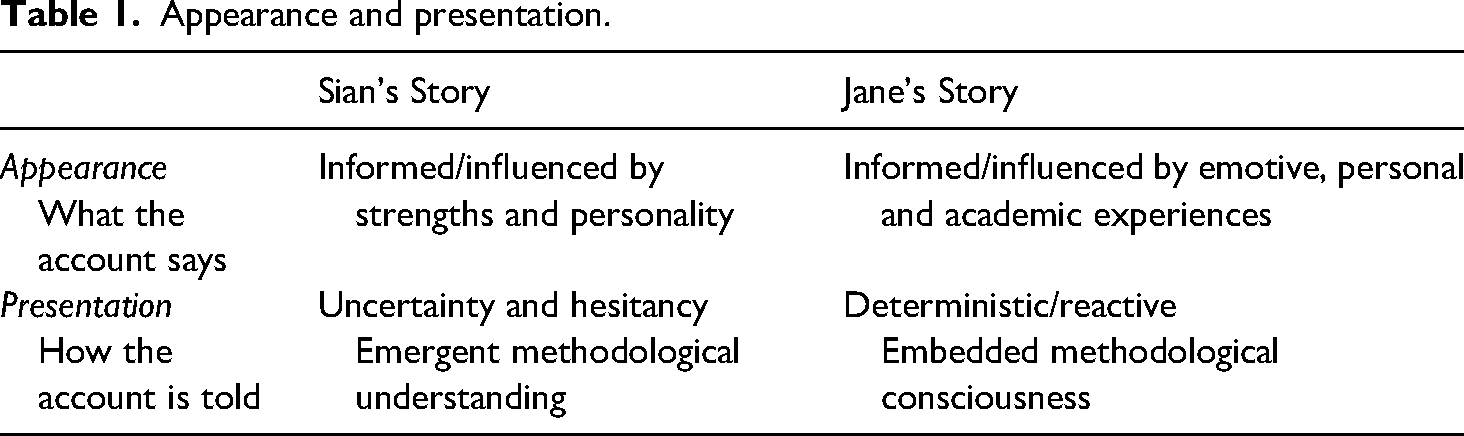
Table 1 adopts an approach to illustrating interruption derived from Czarniawska-Joerges (1994), this summarises my subsequent understanding of the two accounts through the two different analytical lenses. The tendency to interpret one neat straightforward idea of influence is exposed and the challenging process of making sense of the personal stories in the context of complex ideas is highlighted. In particular, a specific learning point arises from the opportunity to reflect on the potential for an assumption, based on categorised written words, that individual statements may be presented with equivalent certainty, clarity and confidence. In keeping with the notion of ‘face value’ readings (Eakin and Gladstone, 2020), systematic analysis of written words is highlighted as subject to both the limitations of process and of written language itself (Silverman and Torode, 1980).
Appearance and presentation.
In this specific study, the interruptions supported development and contextualisation of the earlier findings and created coherence with the research questions and the nature of the quality criteria adopted as part of the methodology. In particular, they led to in-depth consideration of the relevance of the concept of ‘methodological consciousness’ (Gadamer, 1975) to all of the accounts and consideration of the potential implications of this for doctoral pedagogy.
For researchers, particularly doctoral and early career researchers, who are engaging with more idiographic methodologies, identifying and justifying appropriate approaches to analysis can be challenging. With dominant ideas of the ‘correctness’ of systematic pattern focused approaches (Kincheloe, 2011), the decisions of less experienced researchers may be led by ‘academic apprehension’, rather than methodological coherence (Dobson, 2022). Although my experience in this study was consistent with understandings of the challenging and uncertain nature of employing an interruptive approach (Czarniawska, 2004), it also reflects its value and potential for methodological enhancement. With increasing attention and legitimacy being placed on the relevance of reflexive intent in qualitative research, this offers insight into the potential for an equivalent, or parallel, focus on interruptive intent as a way of embracing and acknowledging the significance of interrogating presentation as well as positionality in analysis.
Conclusions
Engaging with understandings of the construction and presentation of qualitative accounts is a complex, subjective and messy process, which may be particularly challenging for less experienced researchers who may be drawn to established procedural approaches to analysis. Beginning with an argument that attention to these aspects may provide opportunities to mitigate the risk of reducing qualitative research to the reproduction of face value accounts and to develop research confidence and creativity, this research note has sought to provide a provocation for adopting and combining different lenses during qualitative analysis. The idea of interruption has been presented as having potential to introduce an intentionality to prioritise interrogation of aspects of presentation, over a focus solely on the interpretation and categorisation of content. Whilst the illustrations unavoidably offer interpretations, in engaging with ideas of uncertainty, agency, sense making and positionality, they reflect on attempts to move beyond initial readings and to challenge and disrupt these. This discussion, and these illustrations, is intended to have value, not as a template or procedure for analysis, but to provoke reflection on engagement with qualitative data. The paper aims to contribute to discussion by proposing that an interruptive mindset may support the development of methodologically appropriate approaches to analysis in some forms of qualitative research.
Footnotes
Funding
The author(s) received no financial support for the research, authorship, and/or publication of this article.

Author biography
Timothy Clark is Director of Research and Enterprise for the School of Education and Childhood at the University of the West of England, Bristol, UK. His research focuses on aspects of doctoral pedagogy, doctoral student experience and researcher development, particularly in relation to academic writing and methodological decision making.