




Abstract
While belonging is rarely an explicit concern of participatory arts-based research (PABR), fostering inclusive relations is both an important condition for and outcome of PABR projects. Based on a participatory arts-based study with refugee-background young people in the United Kingdom and Australia, this article proposes five dimensions of PABR that mediate belonging within the project and shape possibilities for belonging beyond it: resources, relations, reflection, representation and recognition. Acknowledging the possibilities for transformative belonging emerging from PABR’s unique combination of participation, arts and research, this article draws on Bourdieu’s framing of the research interview as an ‘exceptional situation for communication’ to conceptualise the PABR project as an exceptional sphere of belonging. Attending to (non)belonging in participatory arts-based research projects facilitates new insights into the practical, affective, embodied, socio-cultural and ethical relations that they produce and makes an important contribution to our understanding of PABR’s much lauded – but less well evidenced – transformative potential.
Introduction
In the best place, and in the most beautiful place
I was with the best people in my life
We learned a lot, and we made music a lot
We all sang with the most beautiful voices
1
We were four weeks into music workshops for our participatory arts-based research (PABR) project when Amira, 2 a 15-year-old Syrian young woman, approached one of the project artists with the above song. The song, she said, was about the project. She had written it following the previous week’s workshop in which youth artist-researchers engaged in a free writing exercise responding to the provocation: ‘What makes you feel like you belong?’ Amira performed the song, accompanying herself by drumming on a table. The rhythm of the drumming evokes a mesaharati calling Muslims to sahur (the pre-dawn meal) during Ramadan, while the melody, sung in Arabic, is reminiscent of a childhood rhyme. The lyrics express some of the possibilities for belonging emerging out of PABR projects, and some of the spirit of this particular study. Put together, the song captures the affective, embodied experience of coming together across languages, cultures, and histories, to create and collaborate, learn and share. But the song is, as artworks always are, only part of the story. Along with the song, Amira brought to this workshop some deep worries about her role in the project. While in previous sessions she had sung confidently in front of the group, she had become concerned about how this might be perceived by the emerging local refugee-background Syrian community. She was no longer willing to sing in the presence of the male youth artist-researchers. And so, while the song was later recorded and performed as one of the project’s outcomes, it was sung by male members of the group.
Amira’s song, and the tensions around her performing it, highlights the importance of both sense of and politics of (non)belonging in participatory arts-based research projects. As a relational approach, the success of participatory arts-based research is reliant on creating an inclusive sphere of belonging. This is practical: providing an environment and relations that encourage the ongoing commitment and contribution of community co-researchers; ethical: facilitating the democratisation of the process through ensuring that research is co-produced and benefits co-researchers and their communities; and epistemological: supporting the generation of high quality data by creating the conditions for open and honest communication. It is critical therefore that we understand how belonging is produced in and through PABR projects. This is particularly the case for projects that engage traditionally marginalised groups such as refugee-background young people, whose belongings are so often constrained and contingent (Nunn, 2018; O’Neill, 2010), and for whom PABR approaches are so often posited as a positive intervention (Nunn, 2010; Lenette, 2019). Moreover, applying (non)belonging as a conceptual lens for understanding community co-researchers’ relations in and through PABR enables us to attend to the variously and simultaneously affective, embodied, socio-cultural, practical, formal and ethical nature of these engagements in relation to people, places, institutions and activities.
Emerging out of the Dispersed Belongings project in which Amira participated, this article demonstrates that PABR projects not only constitute their own spheres of belonging, but are also exceptional spheres of belonging, giving rise to new, transformative possibilities for belonging within and beyond the project. Building on Dispersed Belongings’ broader exploration of experiences of (non)belonging among refugee-background young people in regional resettlement locations in Australia and the United Kingdom (Nunn, 2018), this article proposes five dimensions of PABR that mediate belonging within the project sphere and shape possibilities for belonging beyond it: resources, relations, reflection, representation and recognition. While this article focuses on a project involving refugee-background young people, it has significance for PABR more generally, surfacing and interrogating a critical but often tacit dimension of this work. Understanding the ways in which PABR projects function as exceptional spheres of belonging makes an important contribution to our understanding of PABR’s much lauded – but less well evidenced – transformative potential.
Participatory arts-based research projects as exceptional spheres of belonging
(Non)Belonging
(Non)belonging is a critical concept for understanding relations between individuals and groups and the communities, places, activities and institutions with which they engage, as well as the needs, desires and politics that shape these relations and their (a/e)ffects (Baumeister and Leary, 1995; May, 2013; Yuval-Davis, 2011). We all negotiate (non)belonging across multiple, intersecting spheres and at multiple scales of experience, from the neighbourhood to the nation state, local clubs to transnational communities (Antonsich, 2010). Relations within these spheres may be variously – and simultaneously – embodied, affective, practical, formal, socio-cultural, historical and ethical (Nunn, 2014). They may be sought or imposed, enabling or constraining. Moreover, each sphere is governed by its own politics of (non)belonging, mediating who belongs and how (Yuval-Davis, 2011). Borders may be more or less flexible, porous and dynamic, and belonging within them more or less hierarchical (Back et al., 2012; Yuval-Davis, 2011). Cumulatively, our (non)belongings have great practical and affective significance, informing how we understand ourselves and the world around us and how we are perceived and treated by others. (Non)belongings thus play a critical role in shaping our life chances.
(Non)belonging takes on particular significance for refugee-background young people granted permanent protection in refugee resettlement countries such as the United Kingdom and Australia (Correa-Velez et al., 2010). These young people must negotiate multiple, at times conflicting relations and attachments as they adapt to their new home, deal with the ongoing effects of refugee experiences, and work towards their desired futures. This compounds the already dynamic processes of (non)belonging experienced by all young people as they transition to adulthood (Cuervo and Wyn, 2017). Refugee-background young people are simultaneously negotiating (non)belonging across the broad spheres of family, ethnic community and culture, religion, friendship and recreation, local community and place, education and employment, homeland and countries of asylum, and the resettlement country (Nunn, 2018). Moreover, these negotiations are mediated by the (gendered, raced) politics of refugee (non)belonging that mediate the possibilities for these young people’s inclusion locally, nationally and transnationally (Nunn, 2010, 2017a; Back et al., 2012).
Participatory arts-based research
Participatory arts-based research can be broadly defined as any research approach in which people collaborate with researchers in ‘art making as a way of knowing’ (Leavy, 2018: 4). It combines the tenets of participatory action research, with its focus on democratising the research process and orienting it towards social change, and arts-based research, in which art forms are employed as methodological tools in all or part of the research process (Chevalier and Buckles, 2013; Finley, 2005; Leavy, 2018). PABR’s unique constellation of participation, art and research has a number of strengths, including privileging and amplifying marginalised voices and experiences, accessibility to non-academic audiences, and communication in alternative registers such as sensuous, embodied and affective ways of knowing (Nunn, 2017b; Conquergood, 2002; Harris, 2012; Lenette, 2019; O’Neill, 2010). Herein lies PABR’s transformative potential: the capacity to challenge dominant representations and ways of knowing, to facilitate dialogue across ideological and epistemological boundaries, and to change hearts and minds through building intellectual and affective understanding (Conquergood, 2002; Erel et al., 2017; Finley, 2005; O’Neill, 2010). Frequently utilised in research with traditionally marginalised groups, an additional aspect of PABR’s transformative potential is the benefits it provides to community co-researchers, including developing artistic and research skills, building personal capacities such as confidence, leadership and teamwork, fostering social connections, and facilitating recognition of ideas and experiences (Nunn, 2010; Finley, 2005; Harris, 2012; Vaughan, 2014).
While fostering belonging is not an explicit tenet of participatory arts-based research, creating a supportive, inclusive environment for community co-researchers is widely recognised as both an important condition for and outcome of these projects (Cahill, 2007; Erel et al., 2017; Tarr et al., 2018). Indeed, regardless of whether we intentionally constitute them as such, PABR projects emerge as spheres of belonging through regular and sustained practices of gathering and collaborating in temporally, spatially and relationally bounded contexts. As such, PABR projects offer possibilities for formal, affective, embodied, socio-cultural, practical and ethical belonging to places, people, activities and institutions. And also as such, they hold the potential to – at times problematically – reproduce relations of (non)belonging that exist beyond the project. It is important, therefore, that we attend to the politics that govern (non)belonging in PABR projects, the sense of (non)belonging felt by those engaging in them, and the practical, ethical and epistemological implications of (non)belonging for both the project and community co-researchers.
The politics of (non)belonging in PABR projects are both intentionally produced through project design and implementation, and organically emergent through the process of being and doing together. While the democratising ethos of PABR necessarily informs the politics of (non)belonging in projects, the research context imposes its own parameters. The research question, academic notions of rigour, institutional ethics protocols and budgetary constraints, for example, variously inform the inclusion criteria for community co-researchers, the location(s) of the sessions, the project duration and resourcing and more. At the same time, even in the least participatory of PABR projects, community co-researchers assert power through their ability to constitute or dissolve the sphere through (non)attendance and (non)participation. The politics of (non)belonging in adjacent or intersecting spheres, such as friendship, education and neighbourhood can additionally seep into the project, mediating evaluations of what constitutes ‘appropriate’ behaviour, ‘valuable’ attributes, ‘desirable’ company and myriad other relations and practices. Moreover, the politics of (non)belonging inevitably shift over time as relationships develop and as community co-researcher understandings of research, arts and participation increase alongside researchers’ increasing understandings of the communities and contexts in which they are working.
Cumulatively, these politics have a powerful influence on people’s sense of belonging in the project. Are community co-researchers willing and able to attend the project? Do they feel welcome in the project space? Do they trust researchers, artists and fellow co-researchers? Do they feel safe to express their ideas and experiences? Confident to try new things? Entitled to ask for what they need? Empowered to take the lead? Importantly, do they see themselves as participants or as co-researchers? While the answers to these questions inevitably shift across time and differ among co-researchers, they underpin the success (and limitations) of PABR projects in supporting active, sustained engagement; facilitating genuine, equitable collaboration; generating meaningful, innovative art works and research data; and benefitting community co-researchers (Lenette et al., 2019; Kara, 2017; Mayam and Daum, 2016).
PABR as an exceptional sphere of belonging
Given their transformative effects on relations within and beyond the project, participatory arts-based research projects can be conceptualised as exceptional spheres of belonging. In doing so, I borrow from Bourdieu’s (1999: 614) formulation of the research interview as an ‘exceptional situation for communication’: By offering the respondent an absolutely exceptional situation for communication, freed from the usual constraints . . . that weigh on most everyday interchanges, and opening up alternatives which prompt or authorize the articulation of worries, needs or wishes discovered through this very articulation, the researcher helps create the conditions for an extra-ordinary discourse, which might never have been spoken, but which was already there, merely awaiting the conditions for its actualization.
Like the research interview, the PABR project is a sphere of engagement ‘freed from the usual constraints’. Removed from everyday life – though informing and informed by it – these projects are interstitial spaces where conventional rules and relations are placed on hold, or are at least tempered by alternative politics of engagement. As spaces of co-inquiry that are grounded in critical reflection and creative knowledge production, PABR projects can ‘prompt or authorize’ new ‘articulations’ that support the transformation of relations of (non)belonging. In providing exceptional opportunities for co-researchers to develop networks, competencies, ideas and experiences, PABR projects give rise to relations that, though new, ‘[were] already there, merely awaiting the conditions for [their] actualization’ (Bourdieu, 1999: 614). In all of these ways, the PABR project goes beyond merely constituting a bounded sphere to which co-researchers establish a sense of belonging, to provide an exceptional sphere of transformative belonging. As will emerge below, through such projects, community co-researchers have the opportunity to access and develop resources, relations, reflections, representations and recognition that support this transformation.
Dispersed Belongings: a participatory arts-based study of resettled refugee-background young people in regional cities in Australia and the United Kingdom
Dispersed Belongings was a participatory arts-based study exploring experiences of (non)belonging among refugee-background young people in regional resettlement locations in Australia and the United Kingdom. In addition to studying (non)belonging more generally, a key aim of the project was to evaluate the effectiveness of participatory arts-based approaches for exploring, communicating and supporting belonging. The project was conducted in 2016–2017 in Bendigo, southeast Australia, and Gateshead, north east England, in collaboration with local governments and arts, ethnic and resettlement organisations. Across the two sites, 24 refugee-background young people participated as youth artist-researchers, supported by seven community artists and musicians.
In Australia, research was conducted in the regional city of Bendigo in the state of Victoria. Since 2007, Bendigo has been home to a growing Karen community: an ethnic group long-persecuted in their native Burma 3 who have been resettled from camps on the Thai–Burma border through Australia’s offshore humanitarian programme. Karen youth artist-researchers were identified and initially approached by representatives from partner organisations. Eight young people aged between 15 and 24 commenced the project, with five contributing to the final arts outcome. They had lived in Australia for between one and nine years, arriving aged between seven and 20 years. In the UK, research was conducted in the city of Gateshead in north east England. Commencing in 2015, Gateshead has participated in the United Kingdom’s Syrian Vulnerable Persons Resettlement Scheme, pledging to settle a total of 550 Syrians by the end of 2020. Identified by the resettlement team, 16 Syrian and Kurdish Syrian young people participated in the study, with 14 contributing to the arts outcome. They had lived in Gateshead for between 3 and 15 months, arriving aged between 14 and 24 years.
The research approach centred on a participatory arts project in each site, in which youth-artist researchers were mentored by artists to create works exploring any aspect of their (non)belonging. Art forms were selected in consultation with youth artist-researchers to reflect their skills and interests, with mentorship groups ranging in size from 1:1 to 1:7 depending on young people’s interests, artist approaches and project capacity. Artists were all experienced in community-based practice with diverse young people and were trained by the researcher in PABR research ethics and practice. In Bendigo, where youth artist-researchers worked individually or in pairs with artists, sessions were ad hoc, based on individual availabilities and creative processes. In Gateshead, where oversubscription to the project necessitated larger group work, sessions were held at regular times and venues each week. Due to recent resettlement of Syrian and Kurdish Syrian young people, Gateshead sessions were conducted with support from Arabic-speaking interpreters. While processes differed across locations, art forms and artists, all youth artist-researchers participated in approximately 12 arts sessions over a three-month period, comprising discussions and activities facilitating critical reflection on (non)belonging, visits to galleries and performances, skills building, art making and hanging out. In both research sites, the project culminated in an arts event and exhibition attended by members of local, ethnic, academic and arts communities, local government and community organisation representatives and interested others.
The participatory arts process was recorded in researcher field notes, semi-structured ‘artist diaries’ in which artists recorded their observations and experiences, and participatory evaluation activities with youth artist-researchers. This was augmented by in-depth semi-structured interviews with youth artist-researchers conducted prior to and following the arts component of the study, and post-project interviews with project artists and representatives from partner organisations. In Bendigo, a participatory video evaluation was also conducted (McPhillips et al., 2016). All data was entered into NVivo software and coded using a combination of deductive and inductive thematic analysis. The five dimensions of PABR addressed below – resources, relations, reflection, representation, recognition – were identified through analysis of data relating to the research project as a sphere of (non)belonging. The quotes from youth artist-researchers are drawn from post-project interviews in which we critically reflected on the PABR process. While they are not representative of the experiences of all youth artist-researchers, they are illustrative of the transformative possibilities of participatory arts-based research.
Dispersed Belongings as an exceptional sphere of belonging
In both research sites – though in different ways and to different degrees – the Dispersed Belongings project came to constitute its own sphere of belonging for youth artist-researchers. While the project intersected with a number of other spheres of refugee-background youth (non)belonging – notably ethnic community, local place and friendship – it was also clear that the project was experienced as an exceptional sphere, distinct from everyday life and providing unique opportunities for belonging within and beyond it. The intensities and (a/e)ffects of engagement in this sphere varied considerably among individuals and between groups, mediated by factors including individuals’ desire – or not – to belong, their existing engagement with other spheres of (non)belonging and the politics of (non)belonging in the project. In particular, the difference in duration of residence between the UK and Australian cohorts, and associated differences in local socio-cultural resources for belonging such as language, familiarity with places, and integration into local recreational activities, led to different intensities of and outcomes for belonging. Despite these differences, resources, relations, reflection, representation and recognition emerged in both sites as potentially transformative for the young people involved.
Resources
When the project commenced in Gateshead, the Syrian Vulnerable Persons Resettlement Scheme was in its infancy, and there was little in place to cater to these young people’s needs and interests. Outside of attending ESOL
4
classes, many young people spent all of their time at home and feeling isolated. As Yusuf explained (through an interpreter):
. . .at the beginning [of the project] most of us [felt] bored because we don’t know much people or we don’t know the activities in the city or things like that. This has totally changed when we start the project, because [we] visit different places and start to know about more activities in the area. . .[we] have more friends than Syrians. . . So this has actually changed our life to better, and we now feel like we are more confident about going around in Gateshead because we know more.
Inclusion or not in a given sphere is determined in large part by an individual or group’s resources – or what Yuval-Davis (2011: 21) terms ‘requisites’ – for belonging. These can be understood as values, knowledge and skills, material assets, personal attributes and other resources that facilitate recognition and inclusion, providing a sense of comfort and agency and signalling to others that one belongs. When refugee-background young people are first resettled, they often find that their resources for belonging pre-migration (language, for example) do not translate to the new local context. Developing new resources is therefore an important part of the integration process (Ndofor-Tar et al., 2019). Participatory arts-based research projects are exceptional in this context in their provision of a supportive environment in which resources are developed that can be mobilised beyond the project to support belonging in other spheres. This dimension of the project emerged as particularly valuable for more recently arrived young people, who were yet to accumulate many of the resources that mediate practical and sociocultural belonging in resettlement, but also for those who were seeking opportunities to develop as leaders, artists and researchers.
Resources identified by youth artist-researchers as emerging from the project were practical, such as materials and expertise to engage in artistic and research practices; local, such as increasing familiarity with people, places and institutions; and personal, such as confidence, teamwork and leadership. They were also aspirational and hopeful: When I used to listen to a song or see any art, I used to think, how did they do it? What did they do to do it? When I tried it, I felt like today I’ve done something. I learned something. I actually produced something. So today was a nice day. What am I going to do tomorrow, and the day after? (Zahid, Gateshead)
Critically, the project provided time and space to gather beyond the pressures and stresses of everyday life, providing an exceptional sphere in which the expression and pursuit of interests, needs and desires was encouraged.
At the same time, however, inclusion in the project was predicated on young people having a particular set of resources that facilitated their participation. These included availability to attend sessions, access to transport, parental consent (for those aged less than 16 years) and an existing relationship with the recruiting organisation. Among those indirectly excluded from the project for such reasons were young women whose parents or husbands discouraged participation or who had caring responsibilities, and in Bendigo (where there were no interpreters provided), those who did not speak English. In this regard, the project risked further privileging those who already had greater resources for local belonging.
Relations
The music sessions in Gateshead began the same way each week. We sat in a circle with drums and other percussion instruments and played rhythms as call and response. In early sessions, these drumming circles were led by project artists. The results were discordant. We were unfamiliar with the instruments, the venue, each other. We came from different music traditions, different learning environments. But over time, we were increasingly in sync with each other. Grounded in the embodied routine of weekly practice, the rhythms passed more or less smoothly from person to person as we communicated through our hands, eyes and voices, through the sounds of our instruments and their reverberation through the floor of the rundown studio. Sessions ended similarly with gathering in a closing circle, in which we all offered a reflection on the project. These circles were often less harmonious than those that commenced sessions as people shared their frustrations and disappointments, as well as their successes and hopes, and as other conversations among group members disrupted the process. Yet this discord was also a claim of belonging: of the right to be heard and respected and the right to assert authority over how we progressed.
These opening and closing circles provide insights into the practical, affective, embodied and ethical dimensions of relational belonging (May, 2013) emerging through PABR projects, and how they evolve through the ongoing process of gathering and creating together. The combination of creative co-production, with its emphasis on affective and embodied communication, and participatory research, with its democratising ethos, creates an exceptional sphere in which to develop new relations – and new modes of relationality – among co-researchers. Through these circle rituals and other forms of collaborative, creative and critical engagement, conversations and connections emerged that might not otherwise have been generated, but which have their foundations in shared ideas, experiences and ethics, and which lay foundations for future potential collective action (Vaughan, 2014).
Co-ethnic social relations were a key motivator for participation in the project, especially among those who faced barriers to meeting up regularly in other formal or informal settings. This was of particular comfort to recently resettled young people. As Sara explained, ‘For a Syrian to be here, you feel lonely, but when you gather with people from Syria you feel like you’re not lonely anymore.’ However, as Amira’s experiences testify, this safe and welcoming social space cannot be guaranteed, and the politics of PABR belonging cannot always ameliorate embedded intra-group relational hierarchies.
PABR projects additionally produce relations between community co-researchers and researchers, artists, organisations and audiences. For many young people, it provided a rare opportunity to engage with members of the local community outside of institutional and service provision contexts, in a sphere that is relational rather than transactional, facilitating affective engagement: You’re not from the same country, you don’t speak the same language, and maybe a different religion. Still, from the beginning I felt that you’re so kind – all of the team – and you can understand me. Even with the language barrier, you still can feel what I’m feeling. . . (Fatima, Gateshead)
However, while these relationships are valuable, we must also acknowledge that they are bounded by the PABR project, and consequently require careful framing to avoid ‘feelings of loss, abandonment, and guilt’ when the project concludes (Mayam and Daum, 2016: 73).
Nonetheless, relations in PABR projects can have a significant impact on community co-researchers, broadening perceptions of how and with whom they belong, and increasing their sense of well-being (May, 2013). This is particularly true for refugee-background young people, for whom bonding and bridging relations are widely recognised as a means and a marker of integration (Ndofor-Tar et al., 2019). Yet the democratising ethos of the PABR project goes beyond merely creating a sphere of ‘homely’ belonging, to foster a sense of ‘governmental belonging’ (Hage, 1998: 45), with youth artist-researchers encouraged to assert ownership over the project. For traditionally marginalised groups, this can present an exceptional opportunity to rehearse alternative forms of relationality with the potential to challenge conventional hierarchies of belonging (Back et al., 2012; Erel et al., 2017), though the barriers to unsettling these hierarchies both within and beyond the project cannot be overestimated (Flicker, 2008; Vaughan, 2014).
Reflection
‘This is representing the different pathways . . . many opportunities [available in Bendigo]’, Eh Paw explained as she constructed her sculpture, using a hot glue gun to attach bamboo skewers to each other in an intricate tower. The message she sought to communicate about belonging through the work reflects the dominant uncritical celebratory narrative of refugee resettlement in Bendigo (Wilding and Nunn, 2018), as well as Eh Paw’s lived experience of moving from a refugee camp where her options were severely constrained to Australia, where she was successfully completing secondary school. She discussed the work with her artist mentor as it emerged: its form, construction and meaning. Initially focused solely on the pathways expressed through the intersecting skewers, their attention, over time, turned to the glue that held the skewers together, reflecting the many points of connection that are required for these opportunities to be realised: the policies, institutions, relationships and individual capacities. Through this dialogic creative process, Eh Paw’s understanding of the work – and of her belonging in Bendigo – deepened. Later, at the launch of the exhibition, it deepened further. ‘I was explaining how it represents the different pathways’, she told me, ‘and one of the ladies said the pointy bits can represent how opportunities are not always smooth. I was like, that makes sense.’
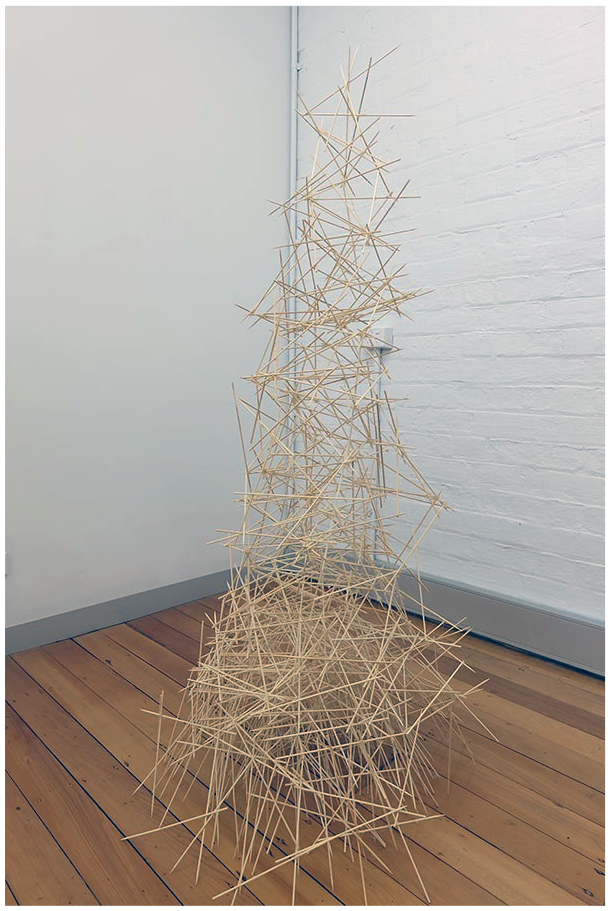
Many Pathways.
Eh Paw’s journey in making and displaying ‘Many Pathways’ demonstrates PABR’s potential to foster a reflective process that deepens artist-researchers’ understandings and enriches the art and the data that is generated (Erel et al., 2017). This reflective dimension of PABR is foundational to its transformative potential. Freire’s (2017) conceptualisation of the necessary interrelation between critical reflection and action – or ‘conscientization’ – which strongly informs the theory and practice of participatory action research more generally, is further nuanced in arts-based approaches through collaborative creative processes that surface alternative affective, embodied ways of knowing (Nunn, 2017b; O’Neill, 2010). As Wah Poe, another youth artist-researcher, observed: ‘art has lots of different languages . . . it’s a good way [to communicate rather] than just talking about it . . . I feel like art is an easier way to showcase how you feel.’
Working together creatively and critically over time allows space for dialogue and reflection, rendering visible politics of (non)belonging in ways that provide insights into – and at times unsettle – an individual or group’s sense of belonging, but that also empower them to reposition themselves within – or work to transform – spheres of (non)belonging (Vaughan, 2014). This opportunity to critically reflect on (non)belongings through a supportive and generative process is exceptional given that, as Yuval-Davis writes (2011: 10), ‘[b]elonging tends to be naturalized and to be part of everyday practice’, generally rendered explicit ‘only when it is threatened in some way’. A key challenge, however, is the extent to which individuals and groups can use their critical reflection as the basis to transform politics of (non)belonging beyond the PABR project (Vaughan, 2014). And indeed, whether traditionally marginalised groups should be expected to take on the labour of doing so.
Alongside this process of critically reflecting on (non)belonging beyond the project, participatory evaluation activities such as reflective circles supported critical reflection about the project itself, surfacing the politics that mediated and structured (non)belonging within it. In addition to Amira’s grappling with gendered (non)belonging, discussed in the introduction to this article, such processes revealed hierarchies of (non)belonging in the project related to age and English literacy. They also facilitated the uncomfortable but important work of addressing tensions between the democratic discourse of the project and the unequal distribution of power, which still ultimately resided with the paid research and arts team members: a key challenge in PABR practice (Gilchrist et al., 2015).
Representation
At the launch of the Bendigo exhibition, Lah Htoo stood in front of the audience and delivered, in heavily accented English, the final line of her poem: ‘I belong in this country.’ Earlier in the poem she spoke of the freedom to go anywhere, but also of experiencing disapproval and misunderstandings, of ‘not hav[ing] the right words’. Yet in the end, her words are clear and confident. I belong. This claim of belonging is an affront to the White Australian imaginary (Hage, 1998), and a challenge to those who believe that refugee belonging is something to be earned and bestowed, rather than so boldly asserted. It is a redrawing of the borders of national belonging (Yuval-Davis, 2011). Elsewhere in the exhibition youth artist-researchers stretched the boundaries of belonging across time and space, embedding attachments to Thailand and Burma within the exhibition. That an exhibition entitled ‘Belonging in Bendigo’ expressed belongings to other places was a strong statement from these young people that they belong in Bendigo not despite these attachments but with them. In these ways, the artworks produced through Dispersed Belongings are not only representations of belonging, but also interventions into local and national politics of (non)belonging.
(Non)belonging, like identity, is to a large extent (re)produced through representation (Fortier, 2000; Hall, 1990; Sigona, 2014). Yet traditionally marginalised groups are often represented by others – and as other – in public and political spheres (Morley, 2001). Even advocates at times employ disempowering discourses and representations, positioning these groups as objects of pity, obscuring their agency in an attempt to elicit sympathy (Marlowe, 2010; Sigona, 2014). In this context, the PABR project is exceptional in providing space and support for people to make their own claims of belonging (or non-belonging), and to amplify them through artistic presentation.
PABR projects can therefore contribute to the redrawing of borders and unsettling of hierarchies of (non)belonging, with community co-researchers not only challenging how they are represented, but also who does the representing (Erel et al., 2017; O’Neill, 2008, 2010). In Dispersed Belongings, youth artist-researchers authored their own identities and experiences – and those of their communities more generally – and in doing so, challenged and nuanced dominant representations produced by mainstream media and by co-ethnic adults. Majid, for example, wrote a song to give voice to the suffering of Syrian refugees:
I wanted to send the message for everybody about the tragedy that people lived, all the babies who were in the sea and drowned, and nobody heard about them. I think most of the world didn’t really care.
At the same time, other youth artist-researchers sought to shift the focus of representations of Syrians away from war and forced migration and toward other aspects of identity. For Ishaq, this was football:
All them are talking about Syria and these things. They still talk about Syria from today ‘til tomorrow. There is nothing going to change. . . .[I]f I still think about it, I’m going to be tired from inside myself . . . but if you think of a different thing, it’s just better for you, for your future.
These different perspectives are critical in representing groups that are often homogenised by a defining marginality – such as refugee-ness (Kumsa, 2006). PABR projects can challenge this by presenting a complex, polyvocal representational landscape that disrupts assumptions of singular belongings. Artistic representations have a powerful role to play here, with their capacity to access non-academic audiences and to encourage affective engagement (Nunn, 2017b; O’Neill, 2010), though there are challenges relating to both the barriers to and risks of sharing these representations. Attendees at PABR events are typically already pre-disposed to support the issue and group being represented (Bagley and Castro-Salazar, 2019), while attempting to reach less receptive audiences has the potential to present untenable risks to the young people involved.
Recognition
I was so proud [of the arts outcome] because we went to different countries after moving from Syria, and in all these countries, nobody gave us this chance, and we never thought we had the skills. So we were so proud of it. And we thought if we didn’t have this chance, nobody will know that he can write songs, or he can do pictures, or anything. It was a shock for us. . .that we have the skills. It was amazing. (Yusuf, Gateshead)
During forced migration and displacement, young people face a range of practical, social, economic and legal barriers to pursuing their interests and aspirations. Some of these barriers continue into resettlement, with factors such as disrupted schooling, family conflict, financial stresses and discrimination impeding young people’s opportunities to realise their hopes (Nunn et al., 2014; Correa-Velez et al., 2010; McMichael et al., 2011). More profoundly, forced migration and its intersection with life stage, can impede recognition of refugee-background young people as active agents, or, in Fraser’s (2003: 24) terms, ‘as full partners in social interaction’ (Marlowe, 2010). Dispersed Belongings provided an exceptional sphere in which these young people were recognised – and recognised themselves – as creative, critical subjects, belonging in, and meaningfully contributing to, artistic, academic, ethnic and wider communities.
This status as ‘full partners in social interaction’ was epitomised in the arts events, which provided an ‘in-between space’ (Vaughan, 2014: 189) between the project and the community where exceptional encounters and engagements could take place between the youth artist-researchers and members of their ethnic and wider communities. As Vaughan (2014: 189) explains, in such projects the artworks function as ‘a resource providing credibility to the young people, and material evidence of their expertise in their own lives’. These events can facilitate affective connection through the expressive media of art and music, as well as embodied connection through audience members’ co-presence with youth artist-researchers. As one White British attendee at the Gateshead exhibition wrote on a feedback form:
I felt more connected to the lives, experiences, and feelings of the young Syrians involved because there was a sense of hearing directly from them rather than hearing about them via the media.
Moreover, in Dispersed Belongings, these events involved an inversion of conventional relations of hospitality, so that youth artist-researchers assumed the role of hosts – both for their ethnic community elders and members of the wider local community – demanding recognition of their belonging as emerging leaders in their communities. Wah Poe observed of the Bendigo event, ‘I feel like we’re taking the next step in our community and representing our culture as well.’
In Gateshead, the arts event served a broader function of providing recognition of newly arrived Syrians and Kurdish Syrians as belonging in the local community. Through the celebration of the creative, critical work of the young people at an event attended by local community leaders and residents in a high-profile art gallery, Syrian and Kurdish Syrian attendees experienced a sense of pride and optimism, expressed in Arabic feedback forms as hope for the future: ‘that nothing will stop us in this life’, and that Syrians can ‘pursue our destiny in any country’. For youth artist-researchers, it provided recognition of their capacity to belong not as beneficiaries of national and local humanitarian support, but as active agents with something to contribute. As Sara told me, ‘we can do something, we can build ourselves, we feel confident in ourselves. . . [W]e have experience . . . we can introduce this knowledge to [the Gateshead] community.’
Beyond the exceptional sphere of the project
Let us return now to Amira and her song. Though Amira elected not to sing her song at the exhibition event, she agreed to play drums for it, along with her friend Leila so she was not the only girl. On the night, however, Leila was sick. A female project artist stepped in to support Amira, who was still willing to perform if there were no photographs or videos taken. Unfortunately, not all audience members adhered to this request. Further, several Syrian community members approached Amira’s parents to express concern about her performing. Amira said of that night: ‘I regret the decision to play drums after what happened. . . I lost trust in you that day. . .because you promised me that there would be no photos and no videos.’ This incident focuses our attention on the continued impediments to belonging beyond the exceptional sphere of the project, and the risks associated with challenging wider politics of (non)belonging. In this case, Amira’s own transformation as a young woman, musician and emerging leader was incongruent with a community still grappling with ethno-religious and gendered politics of (non)belonging in a new, post-migration socio-cultural context. Amira’s decision to perform was made in the exceptional context of the project – where she felt safe and confident to try new things with the support of co-researchers and artists. We all underestimated the risks for Amira and her family of asserting her transformative belonging in the ‘in-between’ space of the performance event.
Much is made of the transformative potential of participatory arts-based research, and of participatory research more generally (e.g. Beckett et al., 2018; Budig et al., 2018; Cahill, 2007; Erel et al., 2017; O’Neill, 2008). Indeed, throughout this article I have argued that the PABR project, as an exceptional sphere of belonging, provides transformative possibilities for belonging within and beyond the project. Belonging, however, is a two-way process of seeking and granting. Transformation among individuals and groups – and even in collaborating organisations – isn’t necessarily enough to effect change in entrenched politics of (non)belonging beyond the project sphere (Vaughan, 2014). This presents attendant risks for community co-researchers, who can become disheartened by their inability to effect change (Flicker, 2008) or face hostility for asserting their belonging. It also raises important questions for researchers: What is at stake in the creation – and inevitable conclusion – of these exceptional spheres of belonging? What are our roles and responsibilities beyond the project sphere? And how might we capture the longer-term outcomes of PABR research? Such questions require urgent critical attention (Beckett et al., 2018; Vaughan, 2014).
Conclusion
The Dispersed Belongings participatory arts-based research project provided an exceptional sphere of belonging for refugee-background young people resettled in the UK and Australia. While the intensities and (e/a)ffects of belonging differed among youth artist-researchers, between cohorts and across art forms and approaches, the five dimensions of relations, resources, reflection, representation and recognition emerged clearly as offering transformative possibilities for belonging in and beyond the project. Of particular benefit to those who were recently resettled was the provision of local resources for belonging, while for youth artist-researchers more generally, in the context of their intersectional marginality as young people and refugees, the recognition of their belonging in both their ethnic communities and wider communities as critical, creative subjects was of great affective significance. While the challenges for other traditionally marginalised groups collaborating on participatory arts-based research projects are likely to differ in many regards, research on PABR approaches and their transformational potential with other cohorts, including by O’Neill (2010), Vaughan (2014) and Worthen et al. (2019) suggests that the five dimensions identified here may productively be applied to PABR projects more broadly as conceptual resources for understanding the role of (non)belonging.
(Non)belonging is rarely the central concern of participatory arts-based research. It is, however, always a central aspect of PABR projects. The unique combination of participation, arts and research creates exceptional conditions for supporting transformative belonging within and beyond the project. Attending to both politics and sense of (non)belonging in these projects opens up possibilities for new understandings of the practical, affective, embodied, sociocultural and ethical relations that they produce. Moreover, conceptualising PABR projects as an exceptional sphere of belonging supports the necessary work of understanding PABR’s transformative potential – and its limits.
Footnotes
Acknowledgements
This project was conducted in partnership with Bendigo Community Health Services, City of Greater Bendigo Arts and Culture, Gateshead Council, GemArts, Karen Organisation of Bendigo and Victoria University’s Centre for Cultural Diversity and Wellbeing. Thank you to these organisations, to project artists, and especially to the youth-artist researchers who collaborated on this project. Thanks also to Hannah Smithson and Izzy Finch for their feedback on this article.
Funding
The author(s) disclosed receipt of the following financial support for the research, authorship, and/or publication of this article: This research was funded through a Marie Skłodowska-Curie actions/Durham University COFUND International Junior Research Fellowship.
