




Abstract
Interdisciplinarity, multidisciplinarity and counter-disciplinarity are the hallmark of cultural studies and qualitative research, as scholars over the past three decades have discussed through extensive self-reflexive inquiry into their own unstable and ever-shifting methods (Denzin and Lincoln, 2018; Dicks et al., 2006: 78; Grossberg, 2010). Building on the interdisciplinary thought of Jacques Rancière and Caroline Levine on the one hand and traditions of participatory action research and activist anthropology on the other, we bring the methods conversation forward by shifting the focus from disciplines to forms and by making a case for aesthetic practice as qualitative research process. In this paper, the question of methods is approached through the action-based Cartonera Publishing Project with editoriales cartoneras in Latin America – community publishers who make low-cost books out of materials recovered from the street in the attempt to democratise and decolonise literary/artistic production – and specifically through our process-oriented, collaborative work with four cartonera publishers in Brazil and Mexico. Guided by the multiple forms of cartonera knowledge production, which are rooted not in academic research but rather in aesthetic practice and community relations, we offer an innovative ‘trans-formal’ methodological framework, which opens up new pathways for practitioners and researchers to work, think and act across social, cultural and aesthetic forms.
Keywords
Reframing qualitative methods for cultural research
It’s 15 April 2019, and seven women are preparing for the launch of their book Espejo y viento (Wind and Mirrors) in Puente Grande prison, Jalisco (Mexico). This is no ordinary book, however. The copies on display are bound with recovered cardboard and have been hand-painted by the imprisoned women themselves. Awash with colour, they stand in contrast to the beige and grey tones of the prison walls and the women’s clothing. A mood of nervous excitement prevails as seven of the nine participants prepare to take part in the launch, sitting on a row of plastic chairs in a crowd of fellow imprisoned women, alongside visiting family members and workshop facilitators Israel Soberanes and Irene Ruelas Ortiz. At the front, a table adorned with books is set up with labels for each speaker – high-ranking cultural and prison authorities as well as Lucy Bell (researcher on the Cartonera Publishing Project) and Sergio Fong (founder and coordinator of the community publisher La Rueda Cartonera). These five speakers are given the public-facing seats by the organisers and take turns with the seven participants to stand in front of the lectern and deliver their readings. Over the next hour, the audience listens, cheers and claps as the participants read out extracts of their writings in front of the cameras of C7 Jalisco TV station – some with great ease and confidence, others struggling but determined to get their words across (Figure 1).
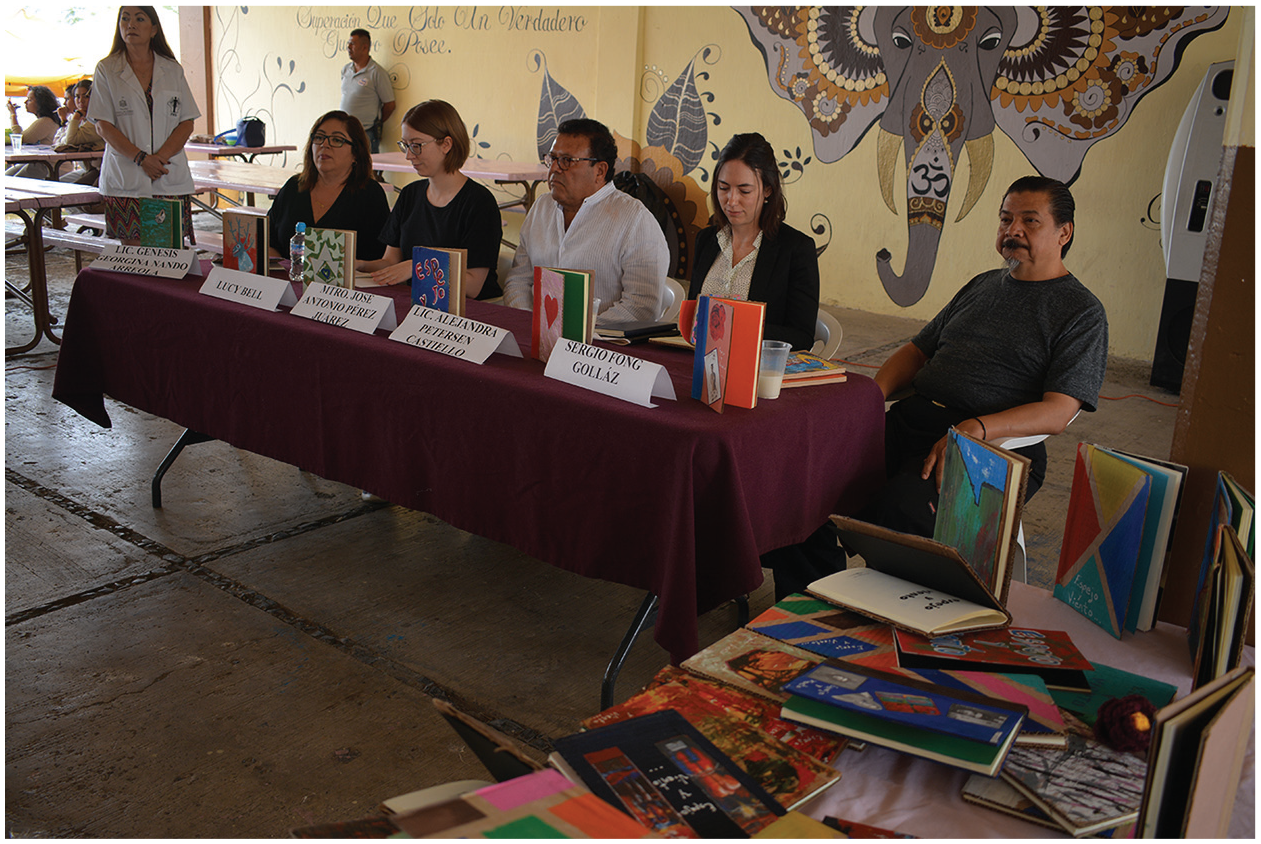
Book launch at Puente Grande prison, 15 April 2019. Photograph by Puente Grande press team.
In the three months leading up to this event, nine women took part in a series of bookmaking workshops facilitated by cartonera publishers La Rueda Cartonera and Viento Cartonero, two of the seven collectives from Guadalajara that form part of a loose, ever-growing network of around 250 cartonera publishers that has extended across and beyond Latin America over the past two decades. The Puente Grande programme is just one of many community projects initiated by La Rueda, which over the past decade has developed its own countercultural, contestatory character, inspired but not limited by the model pioneered by Buenos Aires–based Eloísa Cartonera in the early 2000s: a collaboration between waste-pickers, writers, and artists established in the wake of the economic crisis that had left millions unemployed and thousands seeking to make a living as waste-pickers. Cartonera publishers take their name from the cardboard (cartón in Spanish) that most of them use to bind their handmade books, as well as from the waste-pickers (cartoneros) with whom Eloísa set up their publisher in 2003.
The above scene raises a fundamental question of research method: how should we approach cartonera publishers, whose practices lie between artistic practice and social intervention, publishing movement and political project? Developing an appropriate method involved working out what unites the different elements of scenes such as that described earlier – the interactions between authorities and prisoner participants, the relations between ‘outside’ publishers and ‘inside’ writers, the connection between Espejo y viento (La Rueda Cartonera, 2019) as art object and as literary collection. Furthermore, it entailed seeking what is common to the diverse practices of cartonera publishers across the ever-expanding rhizomatic network within which they operate (Bell and O’Hare, 2019).
Aside from the colourful books, there was at least one element of continuity between the Buenos Aires–based collective and the Puente Grande project: an attempt to rearrange forms of power that, as Jacques Rancière and Caroline Levine have argued, characterise social and political life – whether in the guise of hierarchies, rhythms or networks – through processes of ordering, patterning and shaping (Levine, 2015: 3). Eloísa Cartonera set out to horizontalise relations between waste-pickers, writers, artists and publics through participatory workshops and to call attention to conditions of alienated labour through a process rooted in fun, creativity and freedom (Bell and O’Hare, 2019; Epplin, 2009). In Puente Grande, the cartonera programme disrupted the established hierarchies and networks that underpin prison life. Thanks to the sustainability of the cartonera model, these disruptions have outlived the project: participants have gone on to set up their own prisoner-led Bote Cartonero (Cartonera in the Clink) in collaboration with other incarcerated women and the Puente Grande authorities.
Drawing on action-based research within the framework of the Cartonera Publishing Project (2017–2019), this paper addresses three questions: what methods might be used to study cartonera publishers, encompassing both their artistic works (literary texts and art objects) and their social actions? How do these build on existing methods and theories from the social sciences and humanities? And finally, how are these theoretically-developed methods put into practice? As assemblages of social actions, political projects, literary texts and art practices, cartoneras relate to a broader shift in contemporary art practice that finds expression in spaces beyond the white cube, from socially-engaged art (Kester, 2004) to activist chicano ‘artivism’ (Sandoval and Latorre, 2008) and post-autonomous art practices (García Canclini, 2014). This liminality constitutes a challenge to researchers, calling for the mobilisation of a set of methods capable of engaging with multifaceted sociocultural practices. Yet as highly self-reflexive sociocultural actors engaging in their own forms of knowledge production, they also furnish us with innovative methodological pathways.
In what follows, we begin by engaging with Rancière’s ‘politics of aesthetics’ (2004), exploring the convergence of democratic politics and participatory aesthetics in cartonera practices, before exploring how Levine’s (2015) expanded formalist methodology sheds new light on cartonera books and activities as ‘theorization[s] of the social’. Drawing on existing methodologies from participatory action research (PAR) to presence-oriented art criticism, we argue that cartonera publishers’ multidimensional forms of knowledge production simultaneously call for and offer up forms of understanding and meaning-making that are rooted in aesthetic practice and community relations. Guided by the multiple forms through which our cartonera project partners operate, from workshops to co-publications, we develop an innovative ‘trans-formal’ methodological framework which opens up new possibilities for working across the arts, humanities and social sciences, across research and practice and across creative production and social action. We finish by offering an example of how these ‘trans-formal’ methods have been implemented in the Cartonera Publishing Project.
From disciplines to forms
Interdisciplinarity, multidisciplinarity and counter-disciplinarity are the hallmark of cultural studies, as scholars over the past three decades have discussed through extensive self-reflexive inquiry into their own unstable and ever-shifting methods (Denzin and Lincoln, 2018; Grossberg, 2010; Rodman, 2015). Denzin has recently called our attention to the ambition of such interdisciplinarity: by working across different traditions, presenting our findings in new forms and committing to issues of social justice, cultural researchers are ‘active agents for social change’ (2018: 8). Yet this focus on disciplines, we argue, obscures another more fundamental tool for cultural researchers: form. In the following section, we explore how theoretical contributions by two interdisciplinary thinkers, Rancière and Levine, might help reframe qualitative research methods in ways that shift the attention from working across different disciplines to working across different forms. Our point of entrance is not a set of theoretical assemblages, however, but rather the practical challenges posed by our collaborative research project on cartoneras – community publishers who make low-cost books out of materials recovered from the street in the attempt to democratise, decentre and decolonise the production of literature, art and knowledge in Latin America.
Cartoneras are difficult to pin down: they cannot be classified as ‘waste-picking publishers’, as most have moved away from Eloísa’s and Dulcinéia’s model of working directly with waste-pickers; nor are they, exactly, cardboard publishers, because some make books with materials other than cardboard, like textiles, recycled clothes and recovered plastics like milk cartons. One element they have in common, though, is the embeddedness of their literary texts and art objects in local community spaces as well as transnational social networks. Because of the workshop model through which most cartonera books are made (Epplin, 2009), they are marked by diverse subjectivities and socio-material processes, from cutting and stitching to distinctive paint work and collage. The means of circulation further embed the books in community contexts, through cartonera ‘meetups’, alternative book fairs, exhibitions, radio shows and public performances. These hands-on practices, in turn, imply a commitment to democracy, a stance against social inequality and a desire to produce social transformation through prefigurative actions (Flynn, 2016; Juris, 2012; Leach, 2013; Maeckelbergh, 2009). This is evident in the introduction to Eloísa Cartonera’s 10th-anniversary anthology:
Eloísa Cartonera has a record: it’s the publisher with most friends.
Eloísa’s publishing project therefore goes far beyond any art ‘field’ (Bourdieu, 1985), connected as it is to social networks, democratic principles and the solidarity economy. Today, Eloísa continues to sell cartonera books for around ARS$60 ($1), to collaborate with waste-pickers and to challenge a literary canon reinforced by multinational publishing corporations worldwide (Bell, 2017b).
Through longitudinal, ethnographic work with Dulcinéia Catadora (São Paulo, Brazil), Catapoesia (Minas Gerais, Brazil), La Rueda Cartonera (Guadalajara, Mexico) and La Cartonera (Cuernavaca, Mexico), the Cartonera Publishing Project has explored how the Eloísa socio-artistic model has been adopted and adapted beyond Argentina’s borders. Dulcinéia was founded in 2007 by artist Lúcia Rosa and waste-picker Peterson Emboava following the 27th São Paulo Biennale, where they collaborated with Eloísa on the exhibition ‘Como viver junto’ (‘How to Live Together’), curated by Lisette Lagnado. Based in the Glicério recycling cooperative, the Dulcinéia publishing project has been developed by Rosa in collaboration with female waste-pickers from the cooperative, including Andréia Emboava, Maria Dias da Costa and Eminéia dos Santos. Dulcinéia’s poetry, prose and art books emerge from workshops run in the cooperative, as well as collaborations with diverse community groups and social movements, from a homeless community in Rio’s informal settlement Morro da Providência for the exhibition ‘O Abrigo e o Terreno’ (‘Shelter and Land’) in the Rio Art Museum (2012) to more recent collaborations with the Frente de Luta por Moradia (FLM, the largest housing movement active in central São Paulo) and other housing activists (2017–present). Dulcinéia’s texts are therefore inseparable from the material conditions of the communities in and by which they are produced – be it the recycling cooperative, the Providência favela or an FLM occupation – and the corresponding socioeconomic situation of precarity, informal labour and social exclusion (Bell, 2017a; Flynn, 2018).
La Rueda, which ran the Puente Grande project described earlier, is deeply rooted in Guadalajara’s countercultural scene, as a continuation of underground publishing initiatives in which its founder, Sergio Fong, has been participating since the 1980s. Today, La Rueda encompasses various intersecting activities and spaces. It is a publishing collective that has produced dozens of handmade books by local and international authors since 2009 and holds writing and self-publishing workshops where new authors can get involved in the bookmaking process. La Rueda is also the community literary café where the books are made by Sergio, family members, local writers and artists and friends (including, over the past three years, members of our research team). More recently, it has also formed a local internet-based radio station (radiocarton.com). Through these multiple activities, La Rueda has generated an active network of over a dozen cartoneras across and beyond Guadalajara, which help build capacity to fulfil Sergio’s aim to ‘oppose government cultural policy and resist the homogenising ideology and (dis)information propagated by public institutions and the mass media: mechanisms by which the state seeks to maintain its control’ (Fong, 2018). Both the texts and activities of La Rueda are thus fuelled by a spirit of resistance to Mexico’s ‘flawed democracy’: its inadequate governance, its high impunity and corruption rates and the deeply entrenched marginalisation of large segments of the population (Felbab-Brown, 2019).
This convergence of aesthetics and politics might be better understood through Rancière’s notion of a ‘distribution of the sensible’ – a ‘system of self-evident facts of sense perception’ that separate ‘something common’ from ‘exclusive parts’, the shared from the private (2004: 12). Artistic practices, in his account, are not privileged means of understanding ‘reality’ but ‘“ways of doing and making” that intervene in the general distribution of ways of doing and making as well as in the relationships they maintain to modes of being and forms of visibility’ (13). All art, in that sense, is political – and, conversely, ‘there is [. . .] an “aesthetics” at the core of politics’ – because both are built on sensory perception, on ‘what is seen and what can be said about it, around who has the ability to see and the talent to speak’ (13). Both aesthetics and politics can produce equality and inequality, inclusion and exclusion. Artistic practices, by offering alternative ways of seeing, have the capacity to ‘intervene’ in different arrangements and distributions.
In the case of cartoneras like Eloísa, Dulcinéia and La Rueda, artistic practices are explicitly used to forge productive relations and exchanges between artists, writers and disenfranchised communities, thus producing a redistribution of roles and responsibilities in a way that models a certain form of egalitarianism (Epplin, 2009). As with Rancière, who believed that human equality proceeds from the common faculty of sensory perception – aesthesis – cartoneras foreground the role of art as a means of horizontalising social relations. For Dulcinéia Catadora, ‘the encounters and exchanges between participants [from different strata of Brazil’s highly unequal society] is more important than the final product’ insofar as they ‘dismantle prejudices’ and ‘question aesthetic concepts connected to a world that’s still being built on inequalities and privileges’ (Rosa, 2018).
Building on Rancière’s ‘distribution of the sensible’, Levine develops concrete reading practices premised on the ‘radical potential that lies in acts of rearrangement’ (2015: 3, 17). She makes a case for expanding the definition of form beyond the aesthetic, as ‘an arrangement of elements – an ordering, patterning or shaping’ and for mobilising formalism, beyond literary analysis, as a tool for understanding sociopolitical formations and institutions (2015: 3). This allows us to approach literature and art relationally – that is, in relation to the social networks and political formations with which it intersects, by ‘seek[ing] out pattern over meaning, the intricacy of relations over interpretative depth’ (23).
Eloísa Cartonera’s narrative of foundation points to the value of a repurposed formalist methodology: It all began with the crisis of 2001 [. . .] Some say “we are a product of the crisis,” or that we “aestheticized misery”. Actually, it was nothing like that. We were a group of people who came together to work in a different way, to learn new things through work, to build up a cooperative, to learn how to subsist and manage ourselves, to work towards a common good. Like many of the movements and collectives born from these insane times, we organized into a cooperative or a small assembly group. There were also neighborhood and community groups, all sorts of social movements. There were people, workers and neighbors. [. . .] It was summer, and Javier Barilaro and Washington Cucurto were busy producing some colourful poetry books. Eloísa was the name of a charming Bolivian Javier was in love with, and the name of the publisher became an ode to her. The story tells that they never did get together, but despite all that Javier and his friends went on producing beautiful and love-inspired books. Then one day came Fernanda . . . a yellow late afternoon, a pink bike, and a green skirt, like spring itself. She proposed to open a workshop at Guardia Vieja. That was how Eloísa Cartonera was born, in the spring of 2003. (Eloísa Cartonera, n.d.)
Two principal narratives are used to frame Eloísa’s practices: the multiple social movements and community collectives that emerged in the wake of economic crisis, and the romantic and practical inspiration afforded by two women, Eloísa and Fernanda. Within these two narrative frames, there are many overlapping forms (Levine, 2015), which belong at once to the realms of the social and the aesthetic, the functional and the beautiful: colourful poetry collections and cartonera books; a pink bike and a green skirt; and the bookmaking, vegetable-selling workshop on Guardia Vieja. All of these material forms have diverse ‘affordances’, a term originally used by psychologist Gibson (1979) that refers to the potential uses and actions latent in material things, repurposed by Levine (2015: 6–8) to support her argument about the political potential of literary form. The pink bike and colourful clothes, for example, inspired a ‘colorinche’ aesthetic that has come to define Eloísa, which is proud of being loud, flashy and vibrant in colour, expression and character. Eloísa’s colourful books are not just works of literature, but also provocative, political acts that break through the invisible class barriers that separate manual labour from intellectual activity, informal workers from renowned writers, the streets along which the cardboard is collected from the hyper-sanitised environs of upper-middle-class Latin America.
These multiple forms resist a new formalist interpretation of Eloísa’s aesthetics, like that of politically-minded literary critics Herbert F. Tucker and Susan Wolfson, which would situate the publisher in the context of Argentina’s economic crisis. Though the Eloísa model undoubtedly has much to do with the post-crisis context in which it came into being (Bell and O’Hare, 2019), the collective denies being ‘the product of the crisis’. Rather than an embrace of ‘arte povera’ or an ‘aesthetics of poverty’ (Schmidt, 2017), Eloísa’s use of recovered cardboard is a socio-aesthetic choice, inspired by the affordances of what cartoneras often refer to as the ‘noble’ material and the symbolic value of creating literature from the discards of high consumerism. In this sense, their foundational narrative resists an epiphenomenal reading of cartonera forms as an outgrowth of the social situation(s) that it mimics or resists (Levine, 2015: 12), encouraging us to find meaning instead in the multiple socio-aesthetic forms within which the collective works, plays and intervenes.
Across the ever-growing cartonera network inspired by Eloísa, cardboard-bound, hand-painted, collectively-produced texts invite us to break with literary studies approaches that, as Levine puts it, ‘focus [their] attention on the ways that a couple of formations intersect at any given moment: imperialism and the novel, for example, or the law and print culture’ (2015: 132). The dense overlapping of forms within and across cartoneras is reflected in the publishers’ use of hybrid literary/social forms. Fong’s prose fiction, for example, is inspired by American Beat poetry, but also borrows from the Mexican oral tradition, the short story genre and local Guadalajara street gossip. Dulcinéia’s collective autobiography Catador (Waste-Picker, 2012) is similarly rich in form, a collage of texts including a rap song, interviews with waste-pickers and an academic essay, incorporating different social strata, sociolects and lived experiences (Bell, 2017a). In turn, these forms are themselves explorations of the multiple ways in which the publishers’ cities are experienced by communities that are largely absent from the catalogues of transnational commercial publishers (Bell, 2017b) and the narratives of repressive government regimes (Bell and O’Hare, 2019; Fong, 2018; Rosa, 2019).
Turning to cartonera texts as ‘theorization[s] of the social’ (Levine, 2017: 134) enables us to work not on but in collaboration with cartonera publishers as creative, reflexive, social actors and to renew cultural theory and methods through social practice, aesthetic form and collective imaginaries. To develop such horizontal methods, however, it is necessary to avoid the pitfalls in Levine’s work: her privileging of the literary canon and the literary critic. First, Levine’s analyses focus on canonical works from Charlotte Brontë’s Jane Eyre to David Simon’s The Wire, a fact that arguably undermines her central argument that ‘forms are everywhere structuring and patterning experience’ (2015: 16). By bringing Levine’s innovative formalist methodologies in dialogue with cartonera texts and practices, we overcome this issue, demonstrating that forms are not only in the hands of the literary or political elite but also those of relatively unknown individuals and collectives, from emerging writers to community publishers. Second, by taking the lead from cartonera texts and practices as ‘theorisations of the social’, we move beyond the tendency to view the literary critic as a reader with a special access to the understanding of forms – the ways they work, the possibilities they afford, their transformative potential. Indeed, Levine anchors her formalist methods in academic – and specifically literary critical – approaches to form: One has to agree to read for shapes and patterns, of course, and this is itself a conventional approach. But as Frances Ferguson argues, once we recognize the organizing principles of different literary forms – such as syntax, free indirect speech, and the sonnet – they are themselves no longer matters of interpretative activity or debate. (2015, 13)
Levine thus anchors her formalism in ‘conventional’ literary critical approaches, which are normalising insofar as that they are anchored in specific critical traditions, particularly structuralism. The problem with this is that structuralism is itself is based on a universalising notion that human societies and communities worldwide are organised by shared structures – an assumption that, as Levine acknowledges, has undergone fierce criticism for ‘assuming that these patterns were natural and therefore inexorable’ (5). Working within a deeply immersive ethnography with interlocutors from all walks of life in Argentina, Brazil and Mexico, the Cartonera Publishing Project precluded the possibility of ‘having to agree’ on a single approach or reading these rebellious texts through a ‘conventional’ literary critical lens.
Confronted with this problem, we engaged seriously with the post-critical turn that in recent years has begun to demand that we, as cultural researchers, question a mode of reading and dominant paradigm in the field of literary and cultural studies – critique – that has tended to ‘render the thoughts and actions of ordinary social actors as insufficiently self-aware or critical’ (Anker and Felski, 2017: 14). As Anker and Felski point out, the possibility of separating ‘ordinary’ social actors from ‘privileged’ critics – an assumption challenged, with limited success, by British cultural studies – has been fuelled by prevailing antagonistic and combative trends in the humanities, particularly since poststructuralism, which in spite of its radically democratic underpinnings has in fact fostered a ‘spirit of marginality’ and thus ‘kept serious thought sequestered in the ivory tower’ (2017: 19). This has paradoxically lessened its impact on the public sphere and its connection to the non-academic world, and therefore the very structures with which it seeks to engage and intervene.
In the following section, we describe the post-critical methodological framework we have developed throughout the Cartonera Publishing Project, which we refer to as ‘trans-formal’ because of the possibilities it affords to move between social, cultural and aesthetic forms. While it is based upon Levine’s Forms, it also seeks to resolve the above-mentioned impasses in her work by drawing from a range of practice-oriented and action-based approaches to research from the arts, humanities and social sciences.
Towards a ‘trans-formal’ methodological framework
From a social sciences perspective, the ‘trans-formal’ approach we propose in the following text builds on PAR paradigms and activist anthropology. Though our premise differs considerably from the original PAR methodology set out by Fals Borda (1978), whose work with Colombian peasants in the 1980s was deeply inspired by Marxism and the political atmosphere of Latin America of the time, we retain a commitment to the co-creation of knowledge with the aim of challenging North/South and academic/non-academic epistemological hierarchies and decolonising qualitative research practices. The political commitment of early PAR researchers connects to that of the ‘activist anthropologist’. Like Fals Borda, anthropologist Nancy Scheper-Hughes, in a classic article (1995), advocates a straightforward, if not simple, methodological and ethical principle: siding with the oppressed. Yet as Roy D’Andrade argued in a response at the time, identifying the oppressed and the oppressors is not always easy or unproblematic, nor a particularly helpful framing of social life: sources of oppression are often ‘more diffuse and less amenable to solution than the social scientist thinks’ (1995: 408). In our case, working with cartonera publishers in diverse Latin American contexts meant that attributing forms of structural homogeneity – as can be ascribed to oppressed peasants, for instance – was hardly an option. Instead, we made a commitment to dialogue and co-create with a multiplicity of actors engaging with the shared socio-aesthetic practice of cartonera publishing but adapting it to their own lived realities and struggles, whether those of indigenous communities, homeless people, punks or women prisoners. More specifically, our research builds on Elena Ponzoni’s notion of PAR components as ‘windows of understanding’ (2015) and her notion of the different kinds of expertise and participant knowledge involved in co-generated research as diverse ‘forms of knowledge’ (2015: 572). Following up on this passing but significant reference to form, we argue that a broadened formalist focus allows us to develop research methods through practices rooted epistemologically not in academic disciplines but rather in aesthetic processes, community spaces and everyday experiences.
From a cultural studies perspective, methodological contributions by Nikos Papastergiadis and Scott Lash have been particularly influential in guiding our approach to cartoneras. First, Lash (2007: 74) argues that, within the second wave of cultural studies, researchers need to engage seriously with ‘project-networks of practitioners and theorists’ which will result in ‘not just scholarly articles and books but also exhibitions, software, designed space, media experiments and prototypes’ (Lash, 2007: 75). Second, Papastergiadis offers new ways of putting Rancière’s thought into practice. Drawing on the contributions of Thomas Hirschhorn on the project of The Bijlmer Spinoza-Festival 2009 and Isabell Lorey on the Occupy movement, Papastergiadis (2014: 19) highlights the importance of practical issues of time, location and engagement: In order to gain a sense of what actually happens in these artistic projects, and the various occupations that occurred throughout the world in 2011, a critic would need to be there for a considerable length of time and be open to the cosmopolitan imaginary through which the work is constituted. These collaborative, immersive, boundless, dialogic works are often confined to a process in which there is no single object to look at and evaluate.
As suggested by Hirschhorn’s art works that ‘require [his] presence and [his] production during the entire duration of an exhibition’ (2014: 102), any engaged approach to processual and open-ended artistic practice relies on ongoing presence and participation. This means staying true to the ‘radical contextuality’ that has driven cultural studies since the 1970s (Grossberg, 2010: 20). Yet it also implies longitudinal, ethnographic methodologies that have always characterised anthropology and sociology but have tended to be lacking in the field of cultural studies, which has been criticised for its ‘quick and dirty’ ethnographies (Alvarez et al., 1998: 3). ‘Learning to “be” with others and making the time to be “there” has radical methodological implications’ (Papastergiadis, 2014: 23) not only for art criticism, as Papastergiadis argues so forcefully, but also for cultural studies. Whereas in Levine’s methodology, it is a distance between critic and object of critique that enables literary and cultural scholars to map out – from above and from outside – the forms at play in cultural texts, Papastergiadis foregrounds a means of engaging with cultural production from below and within.
As a study of cultural acts, actions, and activists, the Cartonera Publishing Project has involved engaging with the ‘facticity of practice’ or rather the multiple practices that have allowed this community publishing model to spread across and beyond Latin America. On a local scale, cartoneras have gained momentum principally through participatory workshops (often held on streets and in public squares) and publications by little-known or emerging authors. On a transnational level, it has spread thanks to encounters from chance meetings to international ‘encuentros’ (gatherings), like that held annually in Santiago (Chile) since 2012 (Bell and O’Hare, 2019). These connections are further consolidated at local and international levels through exhibitions of cartonera books, like that curated by Sergio Fong and Israel Soberanes in 2018, which travelled to seven public libraries in Jalisco, or the international exhibition ‘O Universo dos livros Cartoneros’ (‘The Universe of Cartonera Books’) curated by Gaudêncio Gaudério (Vento Norte Cartonero, Brazil) from 2017 to the present, which is now in its sixth edition and has so far travelled to Portugal and Spain before returning to Brazil. They are also reinforced through international co-publications, from Mario Santiago Papasquiaro’s Respiración del laberinto (2008) published by 7 then young cartonera publishers to the recent Letras de Cartón (Cardboard Writings), a co-edition by 22 cartoneras from 8 countries (2019).
Cartonera publishers thus work across different socio-aesthetic forms – from workshops to exhibitions – which in turn overlap and collide with broader social formations, from class hierarchies to horizontal networks. As illustrated in the Puente Grande project, these include at least three of the key structural forms covered by Levine: rhythm, hierarchy and networks. First, the publishing programme disrupted the repetitive rhythms of prison life, described by Erika in Wind and Mirrors as a ‘daily routine that has taken over my senses. Here the concept of time is completely different, the atmosphere is tinged with a strange character called eternity’ (Cartonera Publishing, 2019: 29). For her, the cartonera programme was a chance ‘to escape imaginatively from this oppressive system’, allowing her to break out of this sense of endlessness and find her own pace of writing over extended periods of time (interview with Bell and O’Hare, 2019). Second, the project challenged – at least temporarily – the deeply entrenched colonial hierarchies that permeate the prison system in Latin America (Whitfield, 2018: 6–16). Through participatory workshops, the publishers were able to develop more horizontal exchanges with the women, simultaneously teaching them artisanal, self-publishing methods and learning from their experiences and struggles, sharing their stories of cartonera publishing and listening to the participants’ life stories. Third, it opened new channels of communication through solidarity networks between writers and publishers on the ‘inside’ and readers, publishers, bookshops and libraries on the ‘outside’. For these women prisoners, and especially those who receive few or no visitors – a painful, isolating experience described by the likes of Erika Ivonne and Bogarín in Wind and Mirrors – it was highly significant that the books would not only be available in La Rueda bookshop and the Central Library of Guadalajara but also, through our collaboration, later be translated into English (Cartonera Publishing, 2019) and collected by key UK libraries, thus connecting the women to readers across the world. 1
Our ‘trans-formal’ methods are inspired by the political power of such aesthetic practices or more specifically, by the publishers’ mobilisation of the affordances of cartonera forms not only to generate new literary imaginaries within the ‘art world’ but also to enact social transformation and micro-political interventions through the redistribution of social roles and the disruption of prevailing institutional forms, from school syllabuses to prison regimes. From the start of the project, we conducted participant observation, accompanying and co-facilitating their workshops, exhibitions and collective publications. As we developed closer relations with our cartonera partners, we actively shaped our research process around some of the key forms that structure and shape their practices: workshops, exhibitions, encuentros and collaborative publications. After accompanying and supporting La Cartonera’s 10th-anniversary exhibition (2017), we co-curated our own in São Paulo, working closely with project partners on the decision-making processes in relation to construction, expography, themes and content. Both exhibitions were also accompanied by encuentros (encounters/gatherings) and over the course of our project we organised three such gatherings, with participants from across Latin America, to discuss their work and our research through open-ended, horizontal forms like round-table discussions, debate fora, and workshops. We also co-produced cartonera publications with our project partners, including Tim Ingold’s O Mundo e outros escritos (The World, and Other Texts) and Cartoneras in Translation, a compilation of texts from the four publishing collectives (Bell et al., 2018).
Working side by side with cartoneras through their own forms allowed us to approach their work through their own ‘windows of understanding’ (Ponzoni, 2016). In turn, these windows opened onto ‘trans-formal’ possibilities for qualitative research, a methodological framework that might be mobilised, beyond cartoneras, by researchers and practitioners working across different aesthetic, literary, discursive, social, political and material forms. While we facilitated possibilities for the discussion and exhibition of cartonera during the lifetime of our research project, it is important to emphasise that such events pre-existed and will continue long after our research project has finished. Indeed, early on we decided that it was crucial to work with already existing structures that are intrinsic to cartonera itself and therefore sustainable. Developed through the structures and insights of cartonera publishers, our trans-formal methods are innovative and challenging in that they bring together, into a shared research process, different modes of knowledge production, artistic creation and social participation – modes as distinct as literary formalism and participatory action, close reading and literary experimentation, anthropological enquiry and artistic creation. Since space does not permit us to describe each of these methodological pathways in full, we elaborate here on the co-production process of Cartoneras in Translation.
Putting trans-formal methods into practice
Cartoneras in Translation was conceived with a simple objective: to make a sample of cartonera texts available to English-speaking audiences. Yet as we immersed ourselves in the complex processes of cartonera production, it soon turned into a methodological pathway in itself – one that would shed light on the new relations and meanings generated when different subjectivities, literary forms, material constraints and social practices are brought together. In early discussions with our four project partners in Mexico and Brazil, we agreed that each collective would choose a selection of texts to showcase the collective’s creative labour. Though we discussed possible common themes on which to focus the volume, we finally agreed that it would be best to leave the selection process open-ended, so that the collection emerged organically out of each collective rather than as an external imposition. Further, recognising the individuality of each project partner’s aesthetic approach, we decided that, though the research team’s graphic designer would collate all four selections into one collection, each cartonera would bind the text using the cartonera’s usual method and style.
Following the encuentro we co-organized with La Cartonera in the first months of the project (Cuernavaca, 1–2 April 2018), which unveiled the rich diversity of the cartonera scene, our hypothesis was that this publishing community could best be understood through a common socio-aesthetic practice – the basic model of producing books and art objects out of recycled cardboard in workshops – which tied their otherwise disparate social aims and literary catalogues together. The co-publication process, however, uncovered a much more complex picture. The ‘basic’ artistic model of cartonera book binding was, from the first stage of selecting the texts, found to be a generalisation of quite different, and at times incompatible, socio-material practices. For example, whilst La Cartonera was able to work with any length of manuscript, Dulcinéia was constrained by a very specific page limit. Seeking to resolve this technicality proved difficult, as attested by the following Whatsapp exchange, translated here (Figure 2):
What I’m asking is, do you think you can work with this form, a book of 100 pages, composed of 5 booklets?
Something like this:
No.
It would have to be coptic stitch (encadernação francesa).
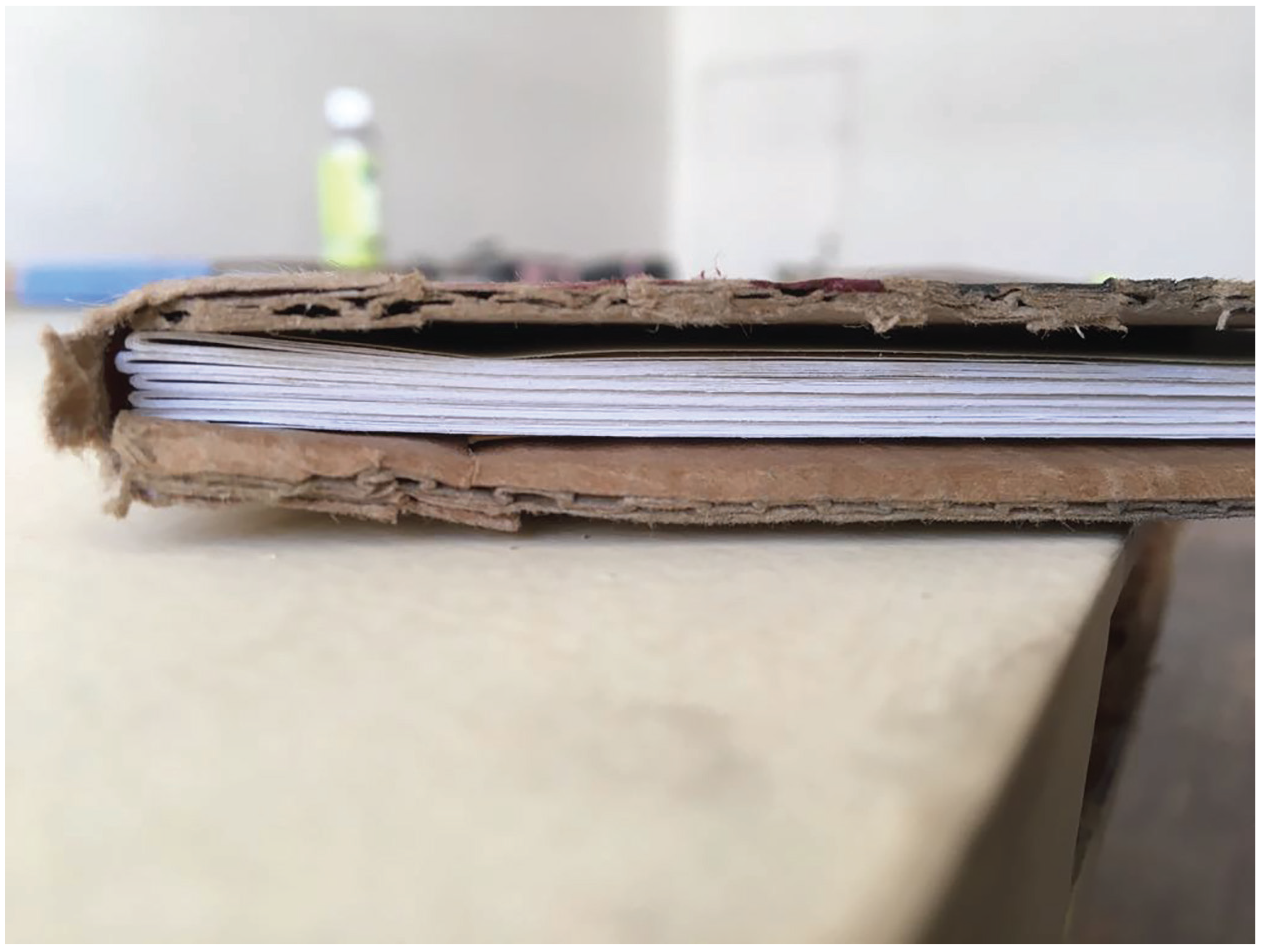
Whatsapp image. Photograph by Alex Flynn.
This difficulty seemed a purely technical question: how to perforate 100 sheets of paper and a cardboard cover? But as time passed with no change in Dulcinéia’s position, we realised that the aesthetic form that this co-publication would eventually take was entirely a product of the social situation and dimensions of relationality in which it was being imagined. Whereas La Cartonera had developed their flexible binding technique from an ‘inherited’ model (passed on by the father of one of collective’s key members, Nayeli Sánchez), Dulcinéia had developed a rather more limiting technique that employs a handheld bradawl to perforate the cardboard covers and booklets – the tool used by the waste-pickers to collect materials from the street, for purposes of hygiene. The idea of 5 booklets did not work for Dulcinéia because they could not physically perforate 100 pages with a bradawl. Lúcia’s counter-proposal was to create a book with 3 cadernos of 33 pages, the whole held together with a different kind of binding. Laura, the designer, created both models and we took them to Dulcinéia. At this meeting, it became clear that the collective had altered their stance. Dulcinéia’s fierce autonomy, as expressed through socio-aesthetic choices, was at stake in this collaboration and the efforts we had made to engage with the processuality of creating the book had tipped the balance. A couple of days later, the collective replied that yes, they could make the five booklets work through the Coptic stitch method. What had made a difference was our genuine commitment to making things work through careful dialogue and horizontal collaborative practices – the same horizontality that structures the day-to-day relations between artists, writers and publishers that are developed through Dulcinéia’s work within and beyond the Glicério recycling cooperative.
The desire to act against the pronounced hierarchies that characterise Brazil’s highly unequal society – a social stratification rooted in its history of colonisation and slavery – is also evident in the literary contributions to the co-publication by three of Dulcinéia’s members, Andréia Emboava, Maria Dias da Costa and Eminéia dos Santos. Through brief autobiographical narratives, all three reveal a desire to assert their pride, dignity and self-worth against the social stigma that surround them as waste-pickers. Andréia, for example, concludes her story thus: ‘I still face some difficulties in life, because I’m “Black”, “Poor”, and a “Waste-picker” and for these and other reasons I suffer a lot of prejudice. But I live with dignity, love, peace and wisdom!’ (2018, 27) She thus uses Cartoneras in Translation as a medium to denounce the stigma she has suffered due to her race, socioeconomic status and profession, and to reassert herself through positive qualities. Moreover, she seizes on the opportunity to affirm herself as a human being, not in spite of but through her profession and gender: ‘This is the story of my life, as a waste-picker, a mother, a woman, a daughter, a wife, a grandmother and, above all, a warrior.’ (2018: 27).
Similarly, Maria writes not only about the experiences of unemployment and homelessness that led her to waste-picking as a means of survival but also about her position as President of the Glicério Waste-Pickers’ Cooperative and as a member of the Dulcinéia publishing collective, which she has represented in a range of outreach activities from public workshops to talks and round-table discussions at literary festivals. In so doing, she disrupts the sharp divisions and exclusions that characterise global capitalism – the distinction between ‘useful’ producers/consumers and ‘disposable’ unemployed people, migrants, refugees or indeed waste-pickers (Bauman, 2004; Bell, 2017a). Against this flawed duality, she theorises her social situation thus: ‘to be a Dulcinéia waste-picker is to say that a waste-picker also makes culture’ (Bell et al., 2018: 33). The waste-picking cooperative is therefore presented not as the bottom of the capitalist chain of value (which descends from production to consumption to disposal) but rather as an active participant in São Paulo’s cultural life. As Lúcia puts it in her contribution, In choosing a recycling cooperative to put our project in practice, and having as protagonists female waste-pickers, mostly black women, and then circulating the books through different parts of the city, Dulcinéia visibilises these women and promotes exchanges between people from different segments of society. (2018: 36)
The desire to open up the literary establishment and the publishing sector (Bell, 2017b), and to highlight and forge connections between cultural production and other day-to-day activities (whether recycling, working or simply existing), can be seen across the different publishers’ contributions to the collection. Indeed, from a literary perspective, the process of gathering and reading these texts together in a single collection alerted us less to divergence than to a convergence through significant overlapping of forms across the diverse locations – again challenging our initial hypothesis. Though it was only Dulcinéia that chose to focus exclusively on the autobiographical form, all participants selected texts that construct the self through lived experiences: the quirky tragicomic short story Azul by Sergio, based on an anecdote about a fatal car accident, involving the author himself, two friends, a land dispute between rancheros and the eponymous pig; the light-hearted story La Vaca Bipolar (The Bipolar Cow, 2014) selected by La Cartonera, a local oral tale ‘told at a lovely cattle ranch in Cuernavaca’; and an extract from Catapoesía’s Tia Tança (Aunt Tança, 2009), the story of the former slave as retold by her niece and nephew, Sílvia and Sílvio de Siqueira, as part of the Colectivo Jovem programme of Matição, a former ‘quilombo’ or community created by people who escaped slavery in rural Minas Gerais. These different forms of life writing, which recover otherwise forgotten memories and invisibilised subjectivities, connect the authors and publishers with the streets that they walk and the communities to which they belong. In so doing, the literary texts overlap with the socio-material form of the art books themselves: made from cardboard recovered from the streets, in collaboration with their local communities, they bear the material traces of the actors who have collected, bound and painted them.
To finish, then, let’s turn to the art objects that emerged from this collective process, whose distinctive forms take us back to where we started: to their cultural, social and economic autonomy. Whereas Dulcinéia’s books were all produced by members of the collective, thus retaining uniformity of painting style across each unique copy, La Cartonera’s were a mishmash of painting styles by the different friends and collaborators who had attended their Saturday workshops. La Rueda’s was made in the café over several days by different community members and thus include different techniques from spray paint to collage. And Catapoesia’s were made in collaboration with the children with whom the group had been working for almost a decade (see Figures 3 and 4). The diverse material objects that emerged from a seemingly common process thus resulted from an aesthetics which embraces networked production while insisting on autonomy and resisting any external contributions until ‘outside’ collaborators work on a horizontal basis with ‘inside’ practitioners – an aesthetics which is fundamentally embedded in social relations that break down hierarchies between publishers and publics, adults and children, teachers and students, researchers and practitioners.
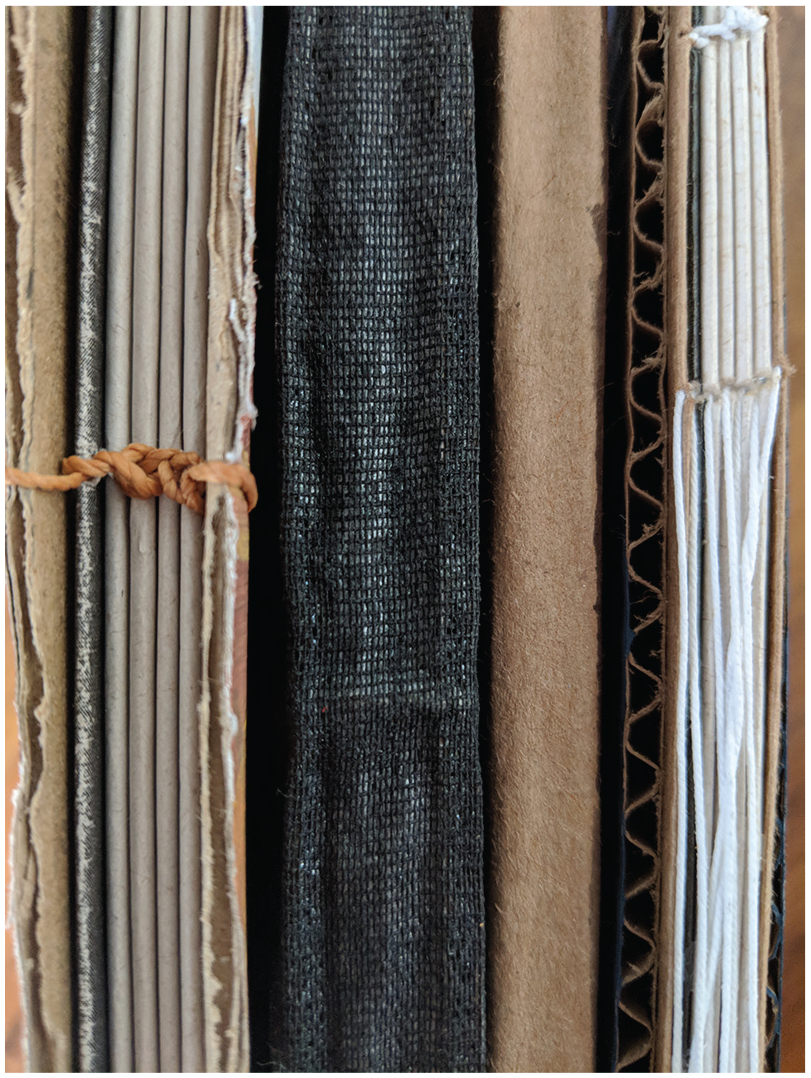
Four cartoneras, four binding techniques. From left to right: Catapoesía, La Cartonera, La Rueda, and Dulcinéia.
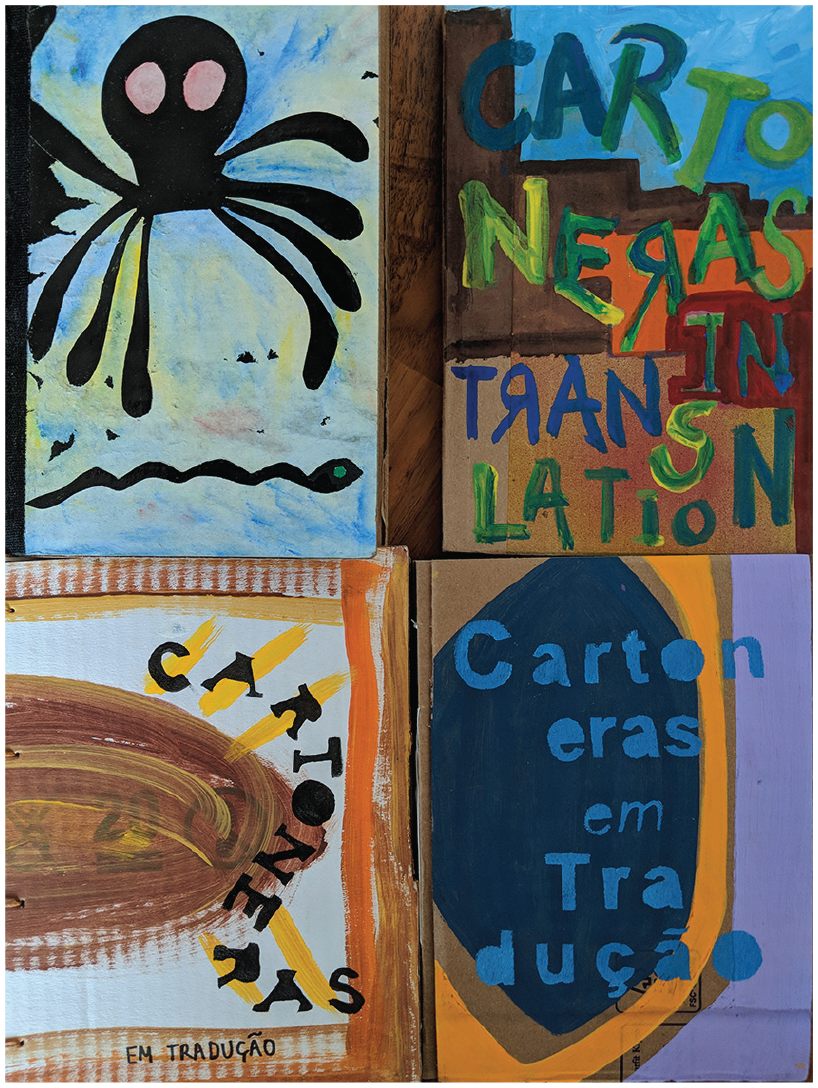
Four co-editions of Cartoneras in Translation. Top left: La Cartonera; top right: La Rueda; bottom left: Catapoesía; bottom right: Dulcinéia.
Conclusion
Working with cartonera publishers has alerted us to the multiplicity of ‘forms of/for understanding’, from life writing and handmade books to participatory workshops and exhibitions, and to the necessity of approaching these forms through research practices that are at once theoretically infused and socially engaged, rigorous and collaborative, text based and practice driven. Building on the pioneering work of the publishers themselves, in dialogue with theorists like Rancière and Levine, our trans-formal methods have enabled us to move with more ease across cultural texts and social processes, literary works and material practices, cultural studies and collaborative anthropology. The methodological framework presented in the preceding text is based on three principal premises: the embeddedness of cultural texts in the social networks of production and circulation (a key principle for cultural studies); the multiplicity of forms and shapes (social, aesthetic, political, economic and material) that structure day-to-day experience; and the role of artistic, literary and cultural actors in the generation of knowledge, thought and thus ‘theory’. All three have entailed working more self-reflexively and collaboratively to examine our own positionalities and strive to horizontalise and decolonise our research methods. Such horizontality is modelled by cartonera practitioners themselves, who, since Eloísa, have enacted different forms of inclusiveness and equality, traversing professions and activities from waste-picking to writing, artistic labour to social action.
Guided by, and developed through, the work of our cartonera partners, ‘trans-formal’ methods allow for the movement of artists, activists and academics across theory and practice, academic discourse and social activism, cultural products and social processes, higher education institutions and anti-institutional initiatives. Crucially, these methods both result from, and allow for, research grounded not in academic disciplines, which still pervade even the most interdisciplinary of research, but rather in artistic practices, everyday life and collective work. As García Canclini insists, in order to acknowledge the role of artists as thinkers and artworks as ‘platforms for thinking’ (Gabriel Orozco in Obrist, 2003), we must proceed through undisciplined approaches (García Canclini, 2014: 28). And there is no better place to start than with the radically open-ended methods of creative practice itself.
Footnotes
Authors’ note
Patrick O’Hare’s current affiliation is University of St Andrews, UK.
Funding
The author(s) disclosed receipt of the following financial support for the research, authorship, and/or publication of this article: This work was supported by the Arts and Humanities Research Council (Grant No. AH/P005675/1).
Notes
Author biographies
