



Abstract
This article outlines a novel application of meta-ethnographic synthesis in the analysis of multiple ethnographic case studies of youth activism emanating from a large transnational European research project. Although meta-ethnography is used increasingly as an alternative to systematic review for the synthesis of published qualitative studies, it is not widely applied to the synthesis of primary data. This article suggests such a use is not precluded epistemologically and potentially addresses a growing need as ethnography itself becomes increasingly ‘multi-sited’. The article outlines the practical process of adapting meta-ethnography to primary data analysis drawing on the synthesis of 44 ethnographic cases of youth activism and provides a worked example of the translation of cases and resulting ‘line of argument’. It discusses the challenges and limitations of the approach in particular the danger that, in extracting the general from the specific, the key quality of qualitative data – individual differentiation – is diminished.
Keywords
This article discusses the dilemmas encountered by qualitative researchers analysing data from large transnational research projects and suggests a potential solution in a novel application of meta-ethnographic synthesis. It charts the design and implementation of a qualitative data analysis strategy for an EU funded research project – Memory, Youth, Political Legacy and Civic Engagement (MYPLACE 1 ). The project employed a mixed method (survey, interviews, ethnographies) and case study approach to map the relationship between political heritage, current levels and forms of civic and political engagement of young people (16–25 years) in Europe, and their potential receptivity to radical and populist political agendas. It generated (alongside survey data, n=16,935) a number of large qualitative data sets 2 from 30 locations in 14 languages. In summarising research findings across locations, 3 while the survey team was able to employ a standard variable-based comparative analysis strategy, the qualitative researchers struggled to identify a model for analysis that would meet the need to speak beyond the individual ‘case’ whilst not rooting the aspiration to generalisability in false claims to representativeness.
This article suggests a potential solution to this dilemma in the adaptation of the meta-ethnographic approach for the synthesis of primary data. Qualitative synthesis approaches – of which ‘meta-ethnography’ is the most frequently employed (Hannes and Macaitis, 2012: 430) 4 – have, to date, been applied primarily to the synthesis of published studies. This article suggests there is potential for the meta-ethnographic approach to be employed in the synthesis of primary qualitative data from multiple cases in large multi-location or transnational research projects. This method may be of particular interest to qualitative researchers working in large EU funded projects where the imperative to reap the ‘value added’ of a Europe-wide research project is often in tension with the epistemological principle of retaining local language and context (central to understanding the phenomenon studied) and the organisational reality that the research is often conducted simultaneously across the European space but relatively discretely by nationally based teams. It is an approach, however, that could be applied to a broader range of multi-sited qualitative studies.
The article first sets out the core epistemological and methodological arguments underpinning the adaptation of meta-ethnography for the synthesis of primary qualitative data. Although meta-ethnography is currently employed primarily as an alternative to systematic review for published qualitative studies, its use in the synthesis of primary data is not precluded in its original formulation (see Noblit and Hare, 1988). Moreover, its potential use for analysing multiple, transnational ethnographic studies is timely as ethnographers seek to accommodate the increasingly transnational nature of ethnography through the development of multi-sited ethnography (Marcus, 1995, 2011) and identify ways to ‘extract the general from the unique’ through the development of the ‘extended case ethnography’ (Burawoy, 1998: 5).
It is not the intention to set out here an alternative method for the analysis of all large qualitative data sets; there are numerous robust methods for coding, analysing and interpreting primary qualitative data. Rather, this article draws on existing approaches including classic (Glaser and Strauss, 1967) and revised (Strauss and Corbin, 1998) versions of grounded theory and ‘multi-grounded theory’ (Goldkuhl and Cronholm, 2010). These methods underpin the now standard qualitative data analysis techniques of open, axial and selective coding and present different models for generating and engaging theoretical concepts in the interpretative process. The approach developed here also draws on the epistemological rationale for generalizing from the unique set out by Burawoy (1998) in his ‘extended case method’ and the empirical imperative to ‘follow’ the object of observation since, in our globalised and networked world, it is increasingly present simultaneously in (or travels across) different locations (Marcus, 1995). What is new in the approach outlined in this article is its specific concern with the interpretation of the findings of multiple research studies, 5 each conducted in their own linguistic and cultural contexts and coded and analysed independently by discrete, nationally based, research teams. It seeks to address in this way a growing need for qualitative research methods capable of synthesising the findings of a multiple, linked (but not strictly comparatively designed) case studies generated by large, transnational qualitative research projects.
The article outlines the practical process of adapting meta-ethnography to primary data analysis for the synthesis of 44 ethnographic cases of youth activism, relating the process to key stages described in other published studies. This is followed by a worked example of the translation 6 of cases and the resulting ‘line of argument’ that emerged from the synthesis of research findings on the question of how young people interpret the organisations in which they are active. Finally the challenges and limitations of the approach are outlined, focusing on the concern that, in extracting the general from the specific, the key quality of qualitative data – individual differentiation – is diminished. Measures are suggested to ensure the ‘ethnography’ in meta-ethnography is not lost.
From systematic review to conceptual innovation: the principles of meta-ethnography
Qualitative synthesis approaches are employed most frequently in the field of healthcare studies to review the research evidence base in relation to particular approaches, interventions or patient responses. Thus, although applied specifically to qualitative research studies, this form of synthesis has been developed in the spirit of the ‘systematic review’ used for the evaluation of statistical data to facilitate policy decisions about ‘what works’ (Dixon-Woods, 2006). Published studies demonstrate the value of the qualitative synthesis approach for ensuring the best clinical treatments are promoted (Campbell et al., 2011: 1) and preventing the reinvention of the wheel through conducting isolated qualitative studies without adequate reference to existing literature (Sandelowski et al., 1997: 366).
This explains why much of the reflection on qualitative synthesis to date has focused on: search techniques and selection procedures that ensure the inclusion of all relevant studies (Hannes and Macaitis, 2012; Thomas and Harden, 2008; Campbell et al., 2003); tools for evaluating the quality of studies (Barnett-Page and Thomas, 2009; Kuper et al., 2008; Higgins and Green, 2011; Spencer et al., 2003); and adaptations allowing a larger number of studies to be synthesised (Toye et al., 2014). It has led also to criticism that meta-synthesis can slide into statistically rooted approaches of meta-analysis (Booth, 2001).
Synthesis is not, by definition, concerned with the ‘what works’ approach of evidence-based policy and practice, however; its origins lie in the building of cumulative bodies of knowledge in the interests of conceptual and theoretical advancement (Weed, 2008: 26). It is rooted in an interpretative approach, which recognises that general relevance can emerge from theoretical inference as well as empirical generalisation (Gomm et al., 2000: 103). From this perspective, generalisability is not exclusively the property of statistically secured representativeness but achievable through ‘idiographic generalizations’ 7 (Sandelowski et al., 1997: 367; Toye et al., 2014: 2) in which knowledge extracted from rich descriptions of individual cases is viewed as transferable to other studies (Lincoln and Guba, 1985 cited in Brannen and Nilsen, 2011: 615). Synthesis can thus be understood as the integration of a set of parts that leads to ‘some degree of conceptual innovation, or employment of concepts not found in the characterisation of the parts’ (Strike and Posner, 1983: 346 cited in Weed, 2008: 26).
In order to make the case that the principles of meta-ethnography are not incompatible with its application to primary data it is first necessary to establish what distinguishes qualitative synthesis approaches from secondary data analysis. Underlying this distinction is a differentiation between aggregation or ‘pooling’ of the findings of separate qualitative studies (Sandelowski et al., 1997) and interpretation of existing interpretations (arising out of qualitative data) in the interests of developing or refining concepts and theory. Thus Campbell et al. (2011: ix) characterise qualitative synthesis as either ‘integrative’ (where data from primary studies are comparable and can be aggregated often through quantitative analysis) or ‘interpretative’ (in which concepts emerge through a process of induction). Thus, like secondary analysis, qualitative synthesis involves re-interpretation but, unlike secondary analysis, it is applied to published findings rather than primary data (Britten et al., 2002: 209; Campbell et al., 2011: 2). Meta-ethnography is placed within the ‘interpretative synthesis’ category and considered capable of generating conceptual innovation in the form of a new interpretation or theory that goes beyond the findings of any individual study (Campbell et al., 2011: 8). The process is described by Campbell et al. (2011) as one in which ‘the synthesis builds interpretation from original studies by firstly identifying interpretations offered by the original researchers (second-order constructs) and, secondly, enabling the development of new interpretations (third-order constructs) that go beyond those offered in individual primary studies’ (Campbell et al., 2011: 8).
While these distinctions ostensibly draw a clear line between meta-ethnography and secondary data analysis, the latter may be regarded as a form of interpretive synthesis if it involves multiple qualitative data sets and is conducted with the aim of providing a new perspective or conceptual focus (Campbell et al., 2011: 8). Toye et al. (2014: 4), moreover, suggest that there is no absolute distinction between the two enterprises since ‘as description itself demands interpretation, it might be more useful to see aggregative and interpretive approaches as two poles on a continuum rather than two distinct approaches’.
The adaptation of the meta-ethnographic approach for the MYPLACE project is a case in which secondary data analysis might be regarded as a form of interpretive synthesis. That very few examples of such analysis have been published to date (and those that have mainly involve the re-analysis of researchers’ own data) may be for practical methodological rather than fundamental epistemological reasons including: the ethical issues involved in reusing data for a purpose other than originally specified; the lack of familiarity with data collected by other researchers; and variations in research design across different studies (Campbell et al., 2011: 8). These problems are avoided or minimised in the MYPLACE meta-ethnographic synthesis because the data were collected within the framework of a single project governed by common ethical protocols, research instruments and analysis strategy. This has some precedent in the field since Noblit and Hare’s (1988: 39) worked examples of synthesis included Noblit’s own studies.
The exclusion of primary data from qualitative synthesis is rooted in the statement that ‘the data of synthesis are interpretations and explanations rather than the data collected through interviews and observations’ (Noblit and Hare, 1988: 32). This logic, it is suggested here, makes more rigid a distinction between ‘data’ and their ‘interpretation’ than qualitative research warrants. In practice, published articles based on qualitative data frequently employ concepts that are ‘grounded’ in understandings articulated directly by respondents while ‘primary’ qualitative data consist of respondents’ understandings and interpretations of the world. Meta-ethnography is understood here, therefore, as ‘the synthesis of interpretative research’ (Noblit and Hare, 1988: 10) that might be applied in a variety of ways from conducting ‘interpretivist literature reviews’ through ‘the systematic comparison of case studies to draw cross-case conclusions’ to constructing ‘a synthesis of ethnographic studies’ (Noblit and Hare, 1988: 11–13). In the following section, it is demonstrated how such a synthesis of ethnographic case studies can be conducted on the basis of primary data sets.
A key challenge for meta-ethnographic synthesis is that, in contrast to positivist approaches, which seek to minimize and/or control for context effects, a reflexive social science starts from the premise that ‘context is not noise disguising reality but reality itself’ (Burawoy, 1998: 13). While this is not the place to review developments in the field of ethnography more generally, it is important to recognise that its direction of travel is convergent with that of meta-ethnography in two important ways. Firstly, there is an increasing recognition of the need to move beyond the single case study and to reflect the transnational and mobile nature of the ‘thing’ studied through ‘multi-sited ethnography’ that goes beyond ‘conventional controlled comparison’ in anthropology (Marcus, 1995: 102). This is important for the purposes of meta-ethnography in that it recognises the potential ‘unevenness’ (‘thick’ but also ‘thin’) of cases (Marcus, 2011: 21) and a move towards collective research practices (Marcus, 2011: 22). Secondly, developments in the ethnographic method have called for researchers to ‘extend out’ from the field in a way that allows a form of generalisation to which meta-ethnography also aspires. This is a particular concern of Burawoy (1998: 5) who proposes an ‘extended case method’ that allows the extraction ‘of the general from the unique’. While for Burawoy this is achieved primarily through the forefronting of pre-existing theory, the recognition within his ‘reflexive social science’ of the possibility, and desirability, of generalisation from single ethnographic cases is consistent with the principles of meta-ethnography. Notwithstanding the danger of the ‘dilution’ of the particular, it is argued below that the application of meta-ethnography to primary data rather than published studies allows for the retention of context and ‘thick description’.
Applying meta-ethnography to primary data: practical steps
In the MYPLACE project, meta-ethnography was adapted to primary data analysis in the synthesis of 44 ethnographic cases of youth activism in 14 countries. 8 The MYPLACE project as a whole did not employ a strict comparative design but a case study approach that prioritised the retention of context (Pilkington and Pollock, 2015a: 21–28). In this context, ethnographic case studies (three per country) were selected from those inductively identified by national research teams as reflecting locally and nationally relevant forms of youth activism. The ethnographies were designed to explore the meanings attached to activism among young people engaged in organisations and movements ranging from student self-organisation and youth sections of political parties through anarchist and Occupy groups to radical right wing movements. Cases were grouped in six thematic clusters of between six and nine cases: radical right and patriotic movements; anti-capitalist/anti-racist/anti-fascist movements; anti-austerity/Occupy movements; gender and minority rights movements; youth sections of political, labour and state-sponsored organisations; and religion-based organisations. Case studies located at the intersection of clusters were included in both relevant clusters (indicated in Table 1 by the use of italics in the ‘secondary’ cluster).
Overview of cases and data from the MYPLACE project
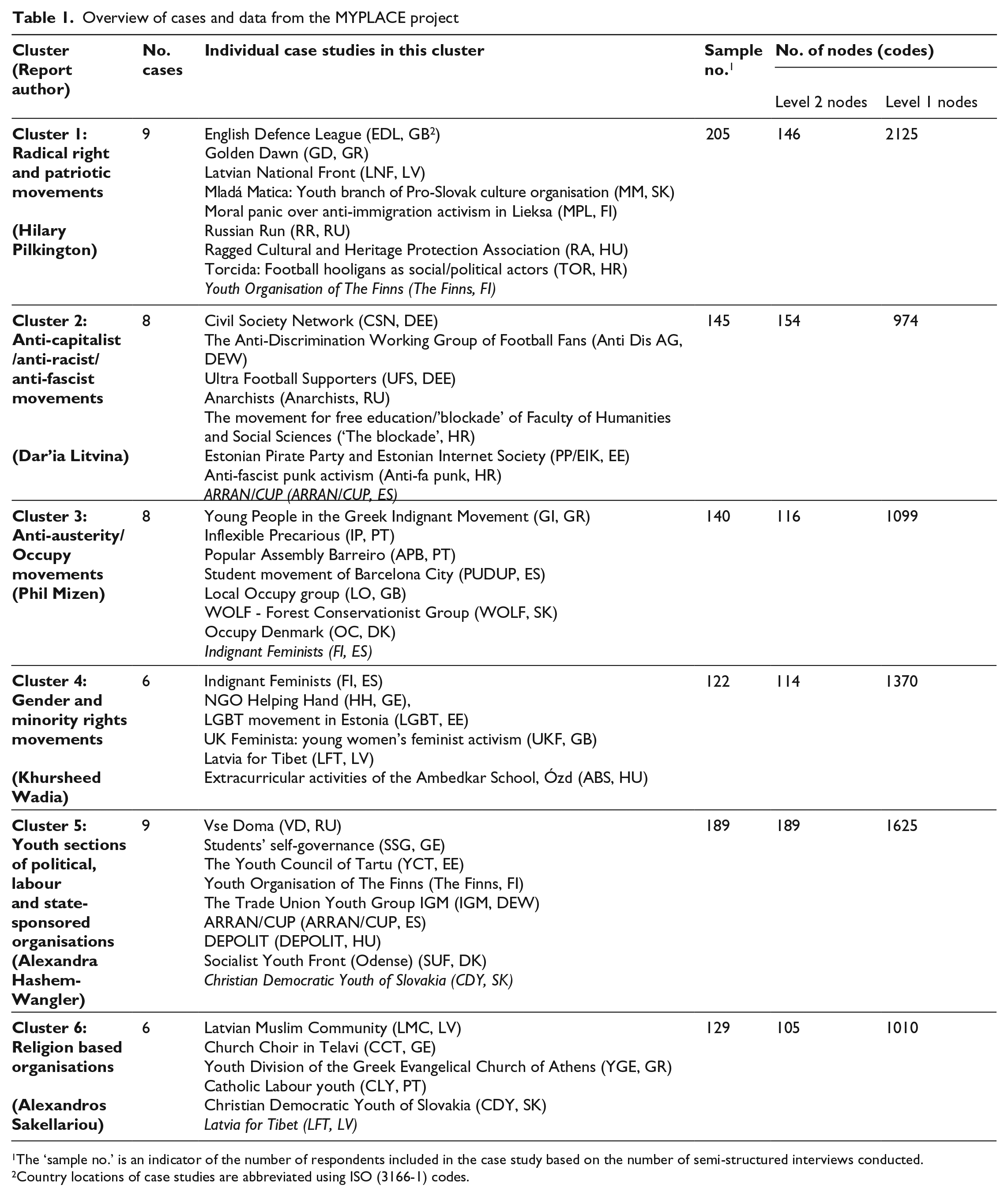
The ‘sample no.’ is an indicator of the number of respondents included in the case study based on the number of semi-structured interviews conducted.
Country locations of case studies are abbreviated using ISO (3166-1) codes.
The synthesis of cases was rooted in the seven-stage process outlined by Noblit and Hare (1988: 26–29) guided by practical reflections on its implementation in Britten et al. (2002). The application of the method to primary data rather than published studies required significant adaptation of the early stages of the meta-ethnographic process since studies did not need to be selected and were already familiar. The outcome was a five-stage process (see Text Box 1) discussed below in two parts: the construction of the data set (Stages 1–3); and the synthesis process (Stages 4–5).
Stages of the meta-ethnography of ethnographies of youth activism.

Constructing the data set
In contrast to the complex selection protocols discussed in other meta-ethnographies, the boundaries of the data set for this synthesis were determined by the MYPLACE study (see Table 1).
Full methodological details of the studies are beyond the scope of this article (see Pilkington, 2014; Pilkington and Mizen, 2015) but it should be noted that researchers worked to an agreed framework and guidelines for what constituted an ethnographic case study rather than micro-methodological instructions. This meant that studies varied in type – particularly in their use of classic ‘participant observation’ or more ‘virtual’ (internet or social media based) modes of ethnography – and each employed a unique combination of fieldwork techniques (including semi or unstructured interviews, field diaries, informal conversations, documentary materials and visual images). This meant that an important early stage of the process was a scoping of the data during which synthesisers familiarised themselves with the relative ‘thickness’ or ‘thinness’ of accounts in each case.
These case studies were analysed discretely and published as individual case reports, 9 which constituted potential units for meta-ethnographic synthesis. In the interests of retaining as much ‘ethnography’ in meta-ethnography as possible, however, data sets including elements of the primary data were constructed for each study. This was implemented through the production of two sets of ‘memos – ‘node memos’ and ‘respondent memos’ – which, together with the case study reports, constituted the data sets for the synthesis of cases at cluster level. Node memos and respondent memos were written following the coding of the primary data for each case study and provided researcher generated summaries of the thematic codes (‘node 10 memos’) and individual respondents (‘respondent memos’). Coding was conducted employing standard methods of open, axial and selective coding facilitated by the use of Nvivo 9.2 software. 11 Researchers were asked to code, in the first instance, to a maximum of two hierarchical levels. Codes were assigned in the language of the interviews; this retained the subtle meanings and cultural cues which would have been lost if initial coding had been conducted on interviews translated into English (Team members, 2006: 59). The lowest hierarchical level of coding was named ‘Level 1 nodes’; these were open codes expressing respondents’ own views, accounts, descriptions and interpretations of their experiences. The guidelines provided to researchers stated that Level 1 nodes should include attitudes, reflections, opinions, emotions or meanings attached to phenomena by respondents but should not include coders’ own evaluation of such attitudes. 12 Researchers were also encouraged to keep as close as possible to the expressions of respondents when creating Level 1 nodes and illustrative quotes in English were included in the node memo to allow the synthesiser to feel the texture of the primary data. At the second hierarchical level, ‘Level 2 nodes’ grouped Level 1 nodes through a process of axial coding. This often generated rather descriptive categories (such as ‘forms of activism’ or ‘political views’) in contrast to the more ‘authentic’ Level 1 nodes.
Once coding at these two initial levels was complete, researchers created ‘node memos’ in English for each case study. Node memos are thematic memos generated in the form of simple Word documents for each Level 2 node and consist of the descriptions of the content of Level 2 nodes and their constituent Level 1 nodes as well as illustrative quotes for each Level 1 node. Node memos also included a summary of the context of the generation of the Level 2 node (including particular theoretical paradigms drawn on or important contextual factors such as historical or political events). These node memos constituted the primary objects of synthesis and in some cases ran to more than 30 pages. In addition, ‘respondent memos’ were generated in English for each individual respondent, 13 providing a reference point for the main socio-demographic characteristics of the respondent and other contextual information of relevance to the interpretation of the data. Illustrative examples of node and respondent memos can be found in Pilkington and Mizen (2015: 10–24). The data sets constructed for synthesis are thus far from ‘raw’ data. They consisted of respondents’ accounts and interpretations of their views and actions, articulated as close to their original expression as possible, alongside researchers’ interpretations (in the process of coding and node memo production) of these interpretations.
Finally, five questions were agreed to guide the synthesis. While in meta-ethnographies of published studies, the definition of the area of interest is usually the first stage of synthesis, in this study, the broad area of interest had been pre-defined in the Work Package description as ‘interpreting activism’ by ‘understanding the meanings young people attach to their activism’. For the purposes of synthesis, this needed to be narrowed and, following a preliminary reading of the materials in their cluster level data sets, five questions 14 were agreed by the researchers involved in the synthesis with the anticipation that between five and ten concepts (constructs, metaphors) would emerge in each cluster in relation to each question.
The synthesis process
The building blocks of the meta-ethnographic approach are the second-order concepts and metaphors and ‘third-order’ interpretations that are generated (Britten et al., 2002: 213; Lee et al., 2015: 347). Definitions of first, second and third-order constructs differ in the published literature (Malpass et al., 2009: 158) although there is consensus on the underlying process:
Meta-ethnography involves identifying key concepts from studies and translating them into one another. The term ‘translating’ in this context refers to the process of taking concepts from one study and recognising the same concepts in another study, though they may not be expressed using identical words. Explanations or theories associated with these concepts are also extracted and a ‘line of argument’ is developed which pulls these concepts together and, crucially, goes beyond the content of the original studies. (Thomas and Harden, 2008: 5)
The synthesis of ethnographic case studies of youth activism outlined here was undertaken in two stages: the translation of the meanings of one case into another (producing second-order ‘concepts’); and the generation of ‘third-order’ interpretations.
The translation process in this study was not of concepts extracted from published literature but respondents’ own interpretations as coded, categorised, contextualised and interpreted in node memos, respondent memos and case study reports. These materials were read repeatedly in the process of the translation of the meanings of one case into another, where necessary clarifying context and interpretation with the field researchers. This process was facilitated by creating a table (adapted from Britten et al., 2002) to record and describe the emergent second-order concepts. Table 2 provides an illustration of such a table constructed from the translation of cases in Cluster 1 (Radical right and patriotic movements) in relation to the first of the five guiding questions (‘How do young people inhabit, interpret and own their organisations?’). This table illustrates one of five concepts – ‘an organisation of the people’ – that emerged in the process of translating respondents’ interpretations of the organisations in which they were active in the nine cases included in this cluster. As Malpass et al., (2009: 158) note, the use of the term ‘translation’ indicates that, at this stage, the synthesiser is comparing concepts, each infused with its own interpretation, and thus engaged in an interpretive ‘reading’ of meaning, but not further conceptual development. Indeed, in this case ‘an organisation of the people’ is a respondent’s interpretation, into which the meanings of other cases could be reciprocally translated.
Translation of cases: ‘An organisation of the people’
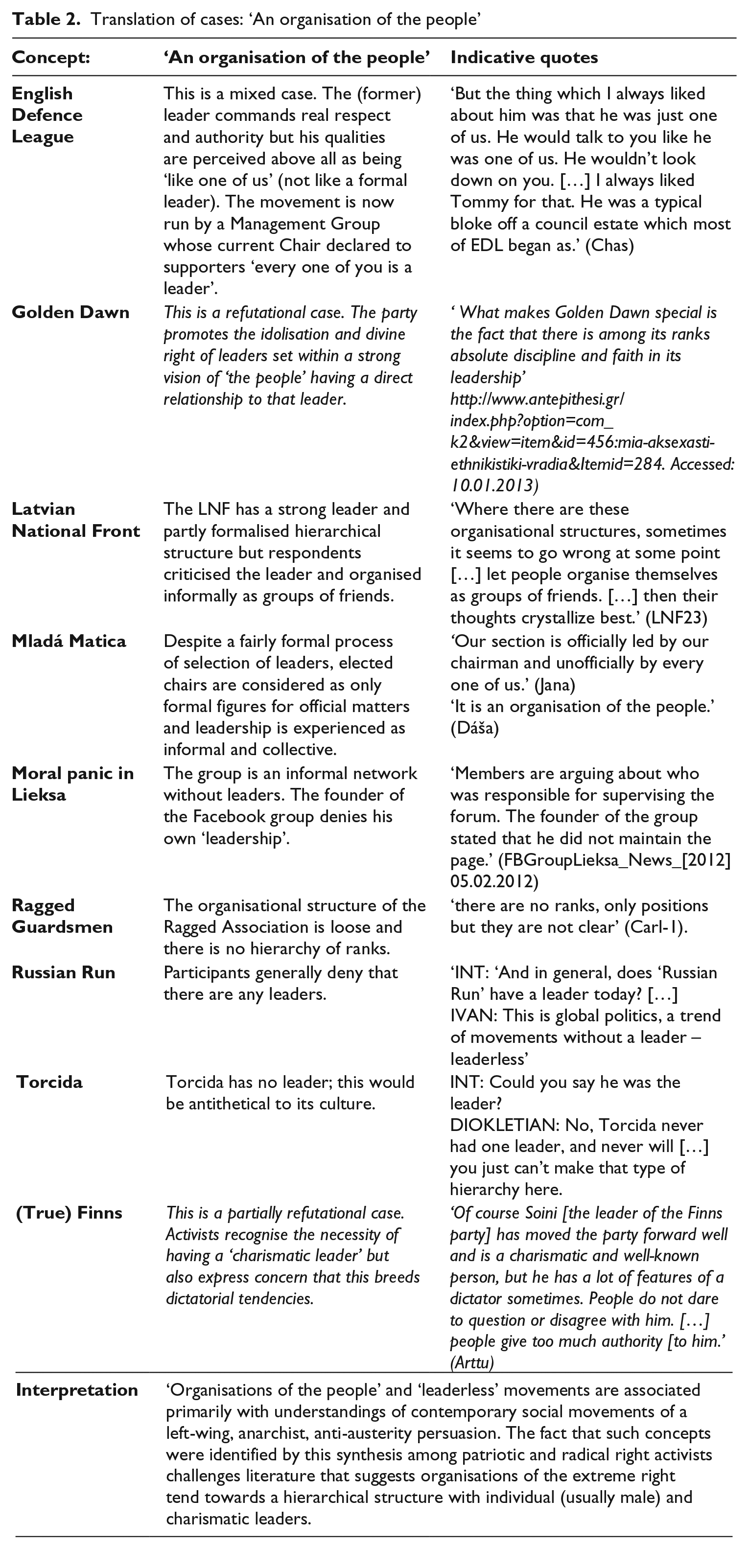
Noblit and Hare (1988: 36) propose three forms of translation: cases are directly comparable as ‘reciprocal’ translations; cases stand in opposition to each other and are thus ‘refutational’; cases are diverse but, taken together, represent a ‘line of argument’ rather than a reciprocal or refutational translation. All three kinds of translation were anticipated in the analyses conducted for MYPLACE and this is indicated in the concept tables. The concept ‘an organisation of the people’ emerged as a mainly reciprocal translation although refutational or partially refutational cases are also recorded and indicated by italic font (see Table 2). In practice, a single meta-ethnography may include all three types of translation (Campbell et al., 2011: 24; Dixon-Woods et al., 2006: 103), and in the case of the meta-ethnographic syntheses outlined here, the diversity of the data meant that the end product was usually ‘a line of argument’ developed on the basis of the reciprocal translation of cases but taking account of refutational or partially refutational cases. An illustrative example of such a line of argument is presented below.
The final stage of analysis is the generation of ‘third-order’ interpretations. This stage remains the most opaque in existing literature since it involves determining what additional insight is brought to the research questions through the synthesis of cases and it is the stage least open to procedural systematisation. Recognising the danger of overstating the capacity of third-level interpretations to give rise to ‘a new order of understanding’ (Lee et al., 2015: 347), the aim here was to generate a qualitative synthesis that extends knowledge over and above the sum of the individual case studies included in the study whilst recognising that it may also be that no new insight emerges (Campbell et al., 2011: 119). This reflects also the relationship between theory and method underpinning the MYPLACE approach, which diverges from Noblit and Hare’s (1988: 37) aim to induce ‘grounded’ theory, in favour of Burawoy’s (2003: 647) insistence on the ‘necessity of bringing theory to the field’. Theory is essential to interpretation and knowledge production and is envisaged as being revised, refined or ‘reconstructed’ rather than generated anew. Drawing on Goldkuhl and Cronholm’s (2010) explication of a ‘multi-grounded theory’ approach, inductive coding at the first two levels of analysis was followed by a process of ‘theoretical matching’ and validation against both data and existing theoretical frameworks at the third or interpretative level. 15 The third-level interpretations were recorded at the bottom of each concept emerging from the translation (see Table 2) and it is the synthesis of these third level interpretations that produces the line of argument.
In this study, translation was carried out primarily as a synthesis of the individual case studies in each of the six clusters (as stipulated in the original research design). Subsequently, however, a synthesis across clusters was conducted of concepts of particular interest to produce a ‘line of argument’ translation based on all 44 cases.
Dispersed leadership: a worked example of meta-ethnographic synthesis using primary data
The transnational analysis of MYPLACE ethnographic data was designed for implementation at cluster level. However, a more limited ‘synthesis of the syntheses’ was conducted across clusters consisting in the identification of the second-order concepts emerging in each cluster and their translation into one another. Table 3 provides an overview 16 of the concepts extracted from cluster syntheses for the question ‘How do young people inhabit, interpret and own their organisations?’ The concept ‘an organisation of the people’ derived from the Cluster 1synthesis described above, for example, can be seen in the top left hand box of Table 3. This process revealed a possible reciprocal synthesis of concepts related to leadership and hierarchy (see Table 3, row 1) and was expressed through a new concept of ‘dispersed leadership’. However, there were also refutational cases (Table 3, italic font) as well as diversity within some cases (especially Cluster 6). After further testing against data (returning to the case study materials) and against theories suggesting ‘horizontality’ and ‘non-hierarchy’ are associated traditionally with left-wing, anarchist and radical democratic movements (Purkis, 2001), a line of argument was developed and expressed in the concept of ‘dispersed leadership’.
‘Dispersed leadership’: synthesising the syntheses.
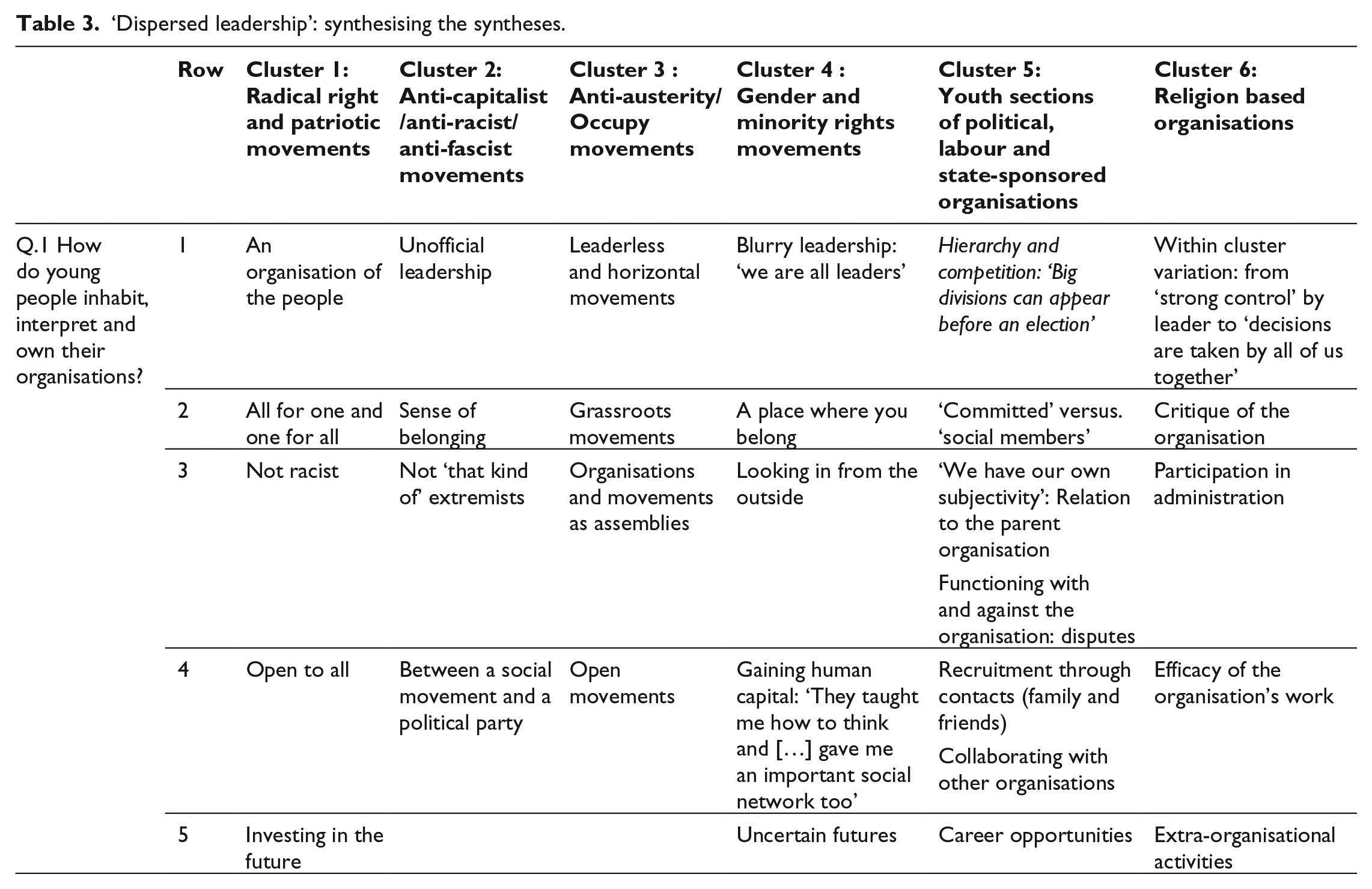
‘Dispersed leadership’ emerged from a reciprocal translation of the concepts of ‘an organisation of the people’, ‘unofficial leadership’, ‘leaderless and horizontal movements’ and ‘blurry leadership’ derived from the synthesis of cases in Clusters 1–4 respectively. It is epitomised by cases in Cluster 3 where young activists in local Occupy movements in Denmark and the UK demonstrated a self-conscious rejection of organisational hierarchies and the representative principle of decision-making in favour of leaderless, horizontal and directly representative democratic organisations. The commitment to leaderless and horizontal movements was described as the ‘golden thread’ (LO, GB) 17 uniting the Occupy movement but was found across a broad range of anti-austerity movements included in the cluster (Mizen, 2015: 18–19). However, the synthesis of cases across clusters revealed that the concept of ‘leaderless’ movements connotes not the absence of leadership but its dispersal (Wadia, 2015: 12). This is expressed in respondents’ interpretations of the movements in which they were active as organised such that ‘we are all leaders’ (Wadia, 2015: 12–16) or ‘decisions are taken by all of us together’ (Sakellariou, 2015: 11). This generates a collective responsibility, accountability and efficacy articulated in interpretations of movements as governed not by hierarchy but equal opportunities to make suggestions, act and express opinions (Litvina, 2015: 13). In this way, leadership is not negated but ‘blurred’. This emerges especially in the case of gender and minority rights organisations where blurred lines of leadership serve both to resist conventional authority and hierarchy and to evade attempts by hostile authorities to neutralise or ‘decapitate’ movements (Wadia, 2015: 13). Such ‘blurring’ is identified also among anti-capitalist, anti-racist and anti-fascist movements where activists identify a kind of ‘unofficial leadership’ based on an informal hierarchy rooted in longevity and intensity of activist experience (Litvina, 2015: 12–14).
The line of argument developed here emerged to accommodate, on the one hand, refutational cases and, on the other, the unanticipated reciprocal translation of cases. At cluster level, the refutational case is that of Youth sections of formal political, labour and state-sponsored organisations (Cluster 5) since in these organisations, positions within the organisation are determined often by democratic elections, leading to competition between members for clearly defined leadership positions (Hashem-Wangler, 2015: 12–13). In contrast, among the Radical right and patriotic movements studied, four of the nine organisations were interpreted by their members as ‘leaderless’ despite suggestions in existing literature, that, following the dominant understanding of populist radical right organisations as a ‘normal pathology’ (Mudde, 2007: 297), organisations in this cluster were likely to be characterised by hierarchical structures and charismatic leadership (Wodak, 2013: 28; Stutje, 2012: 2). In fact, the only case to follow this rule was Golden Dawn (GR), which prides itself on ‘absolute discipline and faith in its leadership’ (Pilkington, 2015: 17); invoking the Führerprinzip embedded in the ideology of the NSDAP (Fielding, 1981: 17) and reflecting the party’s neo-Nazi positioning. In three organisations in this cluster, formal structures and leaders were identified but activists experienced their movements as governed by an informal ethos of collective ownership expressed as ‘an organisation of the people’ (MM, SK) and ‘leadership’ was understood as the initiation of collective endeavour (EDL, GB). These cases could be reciprocally translated, therefore, alongside a number of movements in the Gender and minority rights cluster, which also had clear organisational structures and identified ‘leaders’ although activists experienced that leadership as diffuse, communicative and consultative (Wadia, 2015: 13).
The line of argument derived from this synthesis of 44 ethnographic case studies of youth activism conducted for the MYPLACE project thus contributes to a re-emergent interest in leadership and decision making aspects of social movements (Barker, Johnson and Lavalette, 2001: 3). It confirms the shift identified among many protest movements towards organisational forms characterised by horizontality (Della Porta, 2015: 159) and without clearly identifiable leaders (Castells, 2012) whilst generating new insight through its demonstration of greater consistency across the left-right political spectrum than suggested in that literature. 18 Organisations of the radical right, normally associated with charismatic leaders and strict hierarchies, were found to adopt a ‘leaderless’ structure or reserve a critical attitude to their own hierarchies. There is not scope in this article to reflect on the possible explanations for this convergence. However, other emergent concepts from the cross-cluster synthesis demonstrate that certain shared values and experiences – non-conformism, self-ascribed outsider status, confrontation with authorities – direct activists of the right as well as the left away from movements with a strong internal hierarchy and leadership. Examples of concepts derived from the wider synthesis that feed into the emergent line of argument illustrated in Figure 1 are denoted in the circles. Envisaging their own movements as ‘open to all’ emerged as a means by which young activists distance themselves from more orthodox far left or far right groups characterised by closed, secretive or democratic centralist structures. The concept ‘politics is not us’ reflects the wider disavowal of ‘traditional’ politics, political parties and modes of leadership across the activist spectrum captured in the synthesis of concepts related to the question ‘What are young activists’ perceptions of politics/the political?’
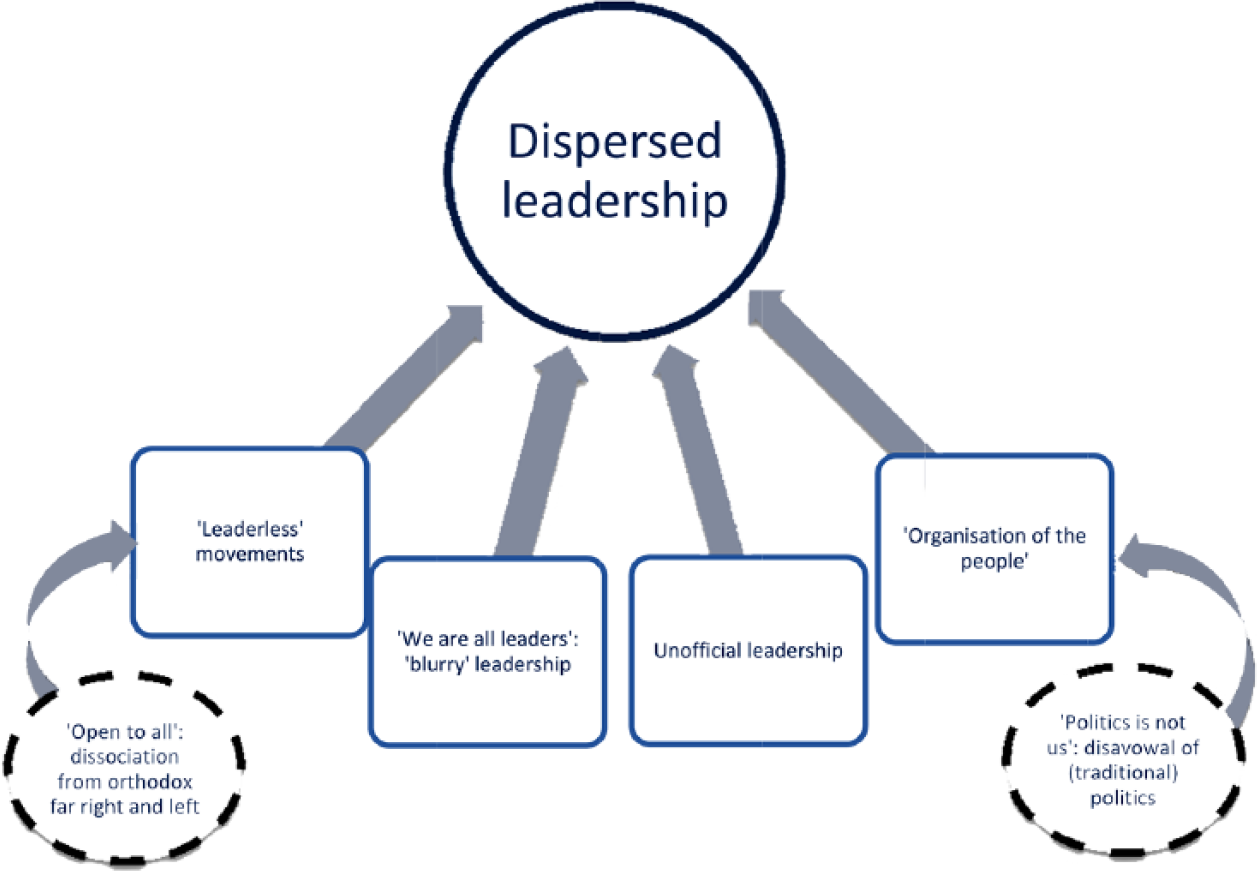
Line of argument: ‘dispersed leadership’
Preserving the ethnography in meta-ethnography: reflection and evaluation
The meta-ethnographic synthesis approach was developed by researchers themselves engaged in ethnography in order to facilitate the generation of strong interpretive explanations by deriving understanding from multiple cases while retaining the sense of the original accounts (Campbell et al., 2011: 10). However, there is an inherent danger that, as the meta-interpretations of the synthesiser are added to those of the researcher and the research participant, the nuances of data will be in lost in a process of ‘triple averaging’ (Weed, 2008: 22). While recognising the risk that synthesis thins out the thickness embedded in the original studies (Sandelowski et al., 1997: 366), it is argued here that the application of meta-ethnography to primary data helps retain as much detail as possible from individual cases and protect against a slide into the proceduralism that may characterise the systematic review of quantitative research.
The approach outlined in this article does this in a number of ways. First, the use of primary data (in the form of ‘node memos’) as the unit of synthesis allows concepts to be derived directly from the articulation by respondents of their experience and significant detail and differentiation from the original studies to be retained well into the analysis process. Secondly, by retaining a commitment to including ‘refutational’ data in the synthesis, cases that are ‘exceptions’ or ‘outliers’ can be used to enhance understanding – through the development of a ‘line of argument’ – rather than excluded because they lack ‘fit’. Indeed, the refutational translation acts as a powerful reminder not to seek similarity alone and to question why some concepts ‘work’ (in terms of reciprocal translation) better than others. Thirdly, meta-ethnography did not substitute ethnography but added to it by extracting the general from the unique over and above the contributions made by individual case studies. The MYPLACE research design was premised on an inductive selection of cases that prioritised the importance of contextual validity. While analysis protocols provided a systematic process of coding to two levels, this was completed in the local language and thereafter each team generated their own third-level interpretations and published their findings as discrete projects. Thus this method (unlike a strict comparative design) allowed the synthesis of findings alongside the production of unique case studies interpreted in context. Fourthly, this inductive approach meant that the concepts that emerged from the synthesis were not pre-defined by parameters for comparison rooted in the research design (and thus on secondary literature rather than primary data). This ensured that the synthesis was capable of eliciting concepts that were genuinely unforeseen (although this does not happen in every case). Finally, criticisms that the thickness of description and depth of scrutiny during synthesis is compromised when meta-ethnography is applied to more than a very few cases was addressed by adopting a two-tier process of synthesis. This two-tier synthesis of clusters of cases (n=6–9), followed by a synthesis of derived concepts across all cases (n=44), is not dissimilar to that conducted by Campbell et al. (2011: x) in their synthesis of published studies (n=38) of medicine-taking for chronic illness for which they first conducted a synthesis of studies by medicine groups and subsequently incorporated all groups in a thematic synthesis.
The application of meta-ethnographic synthesis to primary data nonetheless presents some major challenges. First, although all cases synthesised in this study were drawn from a common research project (supported by cross-project guidelines and protocols) differences between data remained. This was partially a result of the inductive process of selection of cases which meant that some clusters contained ‘outliers’ defying reciprocal translation. Rather than excluding cases that appeared not to add value to the synthesis (Weed, 2008: 18; Campbell et al., 2003: 671; Toye et al., 2014: 7), in this study, such cases were retained and recorded as ‘missing’ in relation to those aspects of the synthesis where they demonstrated ‘lack of fit’. A second challenge lies in the unevenness of cases inherent in any multi-sited ethnography (Marcus, 2011: 21). While some studies were deeply ethnographic, including extensive field diaries, visual data and semi-structured interviews, others were based on substantial interview material but afforded less opportunity for ethnographic observation while a number were primarily document-based studies using web materials and official documents supplemented by a smaller number of interviews or observations. These differences often explain why some cases are ‘missing’ from translations; cases based primarily on web-based analysis, for example, could not contribute significantly to the synthesis of findings on respondents’ experiences of activism. A third, and practically most difficult, challenge in conducting the synthesis was the different modes of coding employed in different cases. Despite working to a common data analysis strategy with specific guidance on coding, the number of both first and second level nodes varied greatly, as did the degree of detail provided in the ‘node memos’. This was due in part to the highly labour intensive nature of the construction of the data sets for synthesis and is reflected in unevenness in the contribution of cases to the synthesis. Finally, the evident benefit of team members conducting different meta-ethnographies simultaneously and sharing reflections on the process (Lee et al., 2015: 340) was not fully realised due to the transnational nature of the team and the strict reporting deadlines of the project.
Conclusion
Meta-ethnographic synthesis enables a body of qualitative research to be drawn together in a systematic way through a process of reciprocally translating the findings from each study into those from all the other studies in the synthesis (Campbell et al., 2011: xi). Thus, meta-ethnography allows researchers concerned with the richness and texture of the social world, and interpretations of it, to speak beyond the individual case. Whether meta-ethnography produces conceptual innovation – through the generation of concepts above and beyond those found in the analyses of individual studies – remains an open question. There is evidence that in some cases synthesis has produced major new insights, through the development of ‘third order’ concepts. However, even in cases where such insight is not generated (Campbell et al., 2011: 119), the meta-ethnographic synthesis, like the systematic review, is a valuable tool for rigorously reviewing the existing knowledge base before the implementation of new qualitative research.
This article has set out a case for the application of meta-ethnography to the synthesis of primary data. While this contravenes usual distinctions between ‘secondary data analysis’ and the synthesis of published studies, as primary qualitative data sets become increasingly available to other researchers through archiving, there is likely to be heightened interest in strategies and protocols for synthesising the findings of qualitative research (Campbell et al., 2011: 9). The current article draws on the experience of adapting the meta-ethnographic synthesis approach to the interpretation of multiple ethnographic case studies emanating from a single transnational research project to start a dialogue about how such protocols and procedures might look.
Notwithstanding the challenges encountered, the application of the meta-ethnographic method to the analysis of MYPLACE ethnographic case studies provided a resolution to the dilemma faced by qualitative researchers noted at the start of this article. It did so by employing a mode of analysis in which the contextual ‘noise’ constitutive of qualitative research was retained while generating significant ‘value added’ over and above what could be derived from the post-hoc comparison of discrete case studies. It is hoped that the experience of its implementation outlined here might be taken up and developed by other teams engaged in similar transnational or multi-sited projects in a way that will enable qualitative researchers to speak beyond the individual case.
Footnotes
Acknowledgements
The author would like to thank other members of the MYPLACE team, especially Florian Sipos, Phil Mizen, Khursheed Wadia, Alexandra Hashem-Wangler, Alexandros Sakellariou and Dari’a Litvina, for their contribution to developing and implementing the project’s qualitative data analysis strategy.
Funding
This research was funded under the European Union Seventh Framework Programme (Grant Agreement: FP7-266831).