




Abstract
This article describes a series of studies of young children’s experience of place in which parents acted as co-researchers, collecting and analysing data. This approach to research resulted in an emphasis on sensory engagement and embodied experience, for both adults and children. As my own young daughter accompanied me during this research, the boundaries between parent and researcher were further blurred. As research progressed, parents became increasingly critical of pathologising discourses about parenting, and stated more strongly the expertise they possessed in their own children. Collaborative research with parents opened up new possibilities for understanding the perspectives of very young children, by drawing on the expertise parents have.
The screen of the small hand held camera closely frames my 23 month-old daughter’s face, as her huge eyes peer curiously at it and at me. ‘Izzy, Izzy, what shall we do today?’ I ask in a high pitched sing song voice. ‘Shall we go to the museum?’ Wordlessly, my little girl changes her gaze, alters her expression, nods so vigorously that her whole body bounces up and down on the bed. ‘What shall we do there?’ I ask. Looking intently into the screen, effort etched onto her face as she prepares to verbalise her ideas, Izzy replies ‘mushroom, strawberry, grape.’
The above vignette describes an extract of video from my first experimentations with my new FLIP video camera, a short piece of footage shot at home, a couple of months into my doctoral research. My research would look at the experiences of toddlers as they visited a museum with their parents. Being an ethnographic study, the research would involve building ever closer relationships with a small group of families whose children were the same age as my own daughter. Largely as a solution to balancing my studies with motherhood, my daughter Izzy would accompany me on my visits to the museum with families during this research.
This article draws on five years of research with parents and their young children in communities in northern England. During my doctoral research and beyond it, I continue to research collaboratively with some of the same parents. Their participation in the research has increased over time, from traditional ethnographic participants to co-researchers, working with me to shape research questions, collect and analyse data and most recently, to act as a research advisory board for a project. Here I describe the processes of doing collaborative research with parents. In addition, I describe some of the findings this research has surfaced. The decentring of academic knowledge in the methodology led to a foregrounding of materiality, emplaced knowing and children’s and adults’ sensory engagement with places. The presence of my own daughter during field work and collaboration addressed power imbalances in the research encounter to some extent, by blurring the boundaries between researchers and participants (Tillman-Healy, 2003). Over time, the parent-researchers also began increasingly to voice their own expertise in their children, coupled with a growing critique of pathologising discourses about parenting.
What do parents know?
Interested in the multimodal nature of young children’s communication (Flewitt, 2005; Kress, 1997), my attention in the video described in the above vignette was initially drawn to Izzy’s scant use of words and the importance of her gaze and facial expressions, as we exchanged ideas for several minutes about our planned museum visit. However, this video interview also marked the beginning of my thinking about the expertise parents have in their own children, and ways in which more collaborative approaches to research could be employed to connect with this knowledge.
There are multiple of ways in which parents have expertise in their young children that differ from academic expertise. In the interview with Izzy described at the beginning of this article, I became aware of three aspects of parental expertise; firstly, I was better able to identify her words than a stranger (no one else could tell the words she was saying were ‘mushroom, strawberry, grape’). Secondly, certain aspects of non-verbal communication had established meanings for Izzy and I, which added context to our exchange. An example of this is Izzy’s ‘big smile’, a grimace like expression, which she tended to make every time she was asked to pose for a photo. Izzy made her ‘big smile’ during our conversation to indicate how she would approach other children in the museum. Thirdly, parents often know the wider context of their children’s lives best; ‘mushroom, strawberry, grape’ referred to dressing up outfits that used to be at a certain local museum and were no longer there.
Mayall (2000) argues for the need to ‘extricate children, conceptually, from parents, the family and professionals’ (2000: 243) in order to fully understand childhood. Whilst I would concur, research seeking to understand the lives of very young children requires different methods, and as a result, the social studies of childhood literature on the lives and experiences of children aged under five years is sparse (MacNamee and Seymour, 2013; Warming, 2011). In working with parents as co-researchers, I do not attempt to privilege the voices of parents over the children themselves. Rather, I propose co-research with parents as a way of better understanding the realities of young children, by drawing on their parents’ accounts and interpretations in addition to other forms of knowing, particularly participatory ethnographic research with the children themselves. Mayall (2000) states ‘psychological knowledge is relevant but not sufficient’ (2000: 244) for understanding childhood. In my collaborative research with parents, tacit, experiential forms of knowledge were foregrounded, adding an additional perspective on how we as adults might know about the lives of young children.
Five years of collaborative research with parents has expanded the initial observations I outlined above about what parents might know, to encompass a broader view of the expertise parents can bring to research about their children. Parents know about their children through being with them, spending extended periods of time with them, and the daily embodied experience of parenting them. In collaborative research with parents, children’s lived, embodied experiences (Pink, 2009), the materiality of place (Hultman and Lenz Taguchi, 2010), and experiential and procedural forms of knowing (Niedderer, 2007) became very significant in our findings.
The relationship between parents and childhood research
Some of the earliest scientific studies of child development involved researchers making detailed records of their own children’s behaviour, Darwin and Piaget being two of the most famous examples (Poveda, 2009). More recently, a growing need to re-balance the over-representation of white middle-class children in research on children’s development, learning and language (Ochs and Schiefflin, 1984) has led to ethnographic studies in which researchers have explicitly focused on under-represented groups and their linguistic, parenting and socialising practices. Within these more etic approaches to ethnographic research, several researchers have discussed the implications of researchers being parents themselves while doing research with children and families (Cassell, 1987; Levey, 2009). For example, Theophano and Curtis (1996) describe how, during ethnographic research in an Italian American community, they were positioned and treated differently by the community because Theophano was a married mother whilst Curtis was single.
Researchers who are perceived by participants as parents have found that this has led to opportunities to build rapport with other adults (McGrath, 1998; Wylie, 1987) and offered a way of connecting with other children (Adler and Adler, 1996; Poveda, 2009). McGrath (1998) touches on this potential for a deeper connection with others in her description of parenting her own child alongside Tongalese mothers during fieldwork.
There is something deeper available, closer to empathy that emerges as a result of sharing similar roles. (McGrath, 1998: 65)
Few studies have positioned parents as co-researchers. Adler and Adler (1996) describe their longitudinal research on pre-adolescent school children, through observing their own children and the children of others in their children’s school and community. Loizou (2013) describes a parenting programme in which parents were invited to act as action researchers, employing the tools of an action research methodology, in order to identify and explore solutions to various parenting issues they faced. Liebenberg’s (2009) study involved asking teenage mothers to photograph their everyday mothering experiences, creating a set of images which formed the basis of interviews. My research builds on this small body of research in which parents played a more active role in collecting and analysing data about their own children, by placing a particular emphasis on foregrounding the expertise parents themselves have.
The intensification of parenting within policy discourses (Gillies, 2007) has led to a tendency to hold parents accountable for their children’s ‘proper’ development (Nichols et al., 2009). Parents may therefore be pathologised by research (Burman, 2007) and policy (Clarke, 2006) for failing to parent in culturally specific ways. In this way, parents may become positioned as a threat to their children’s ‘proper’ development, whilst childhood research may be seen as the ‘solution’ to these perceived risks to children’s normative development (Burman, 2007; Gillies, 2007). Rather than create an oppositional dichotomy between parents as unknowledgeable and a threat to children’s development and research as a source of expertise and solutions, parents as co-researchers is a methodology seeking to emphasise the commonalities between parenting and childhood research. Both endeavours are emotional, engaged identity work, in which certain kinds of understandings about children’s experiences may become apparent, whilst other aspects remain mysterious and unknowable (Elwick et al., 2014). Parents constantly observe their children and make interpretations about their behaviour (Nichols, 2002). Researchers interested in the everyday lives of young children must also observe, share experiences and try to make interpretations in order to begin to feel a connection with their young participants’ perspectives (for example, Warming, 2011). Researchers are sometimes also parents. Reflecting on the experience of her own children accompanying her during fieldwork, Joan Cassell describes the relationship between being a parent and a researcher thus,
Fieldwork is a profound and emotional experience…. In parenting, we also risk ourselves. Children are fragile links between our past and future, fears and hopes… We are doubly at risk, then, when our children are in the field. In attempting to learn and grow, we risk failure and sorrow, our own and theirs. In exposing ourselves, we expose them. (Cassell, 1987: 257–258)
Parents as co-researchers: describing the methodology
The insights in this article are drawn from a series of ethnographic studies I carried out with a small group of parents in northern England. Following an ethnographic doctoral study of 2 to 4 year-old children’s meaning making in a museum (Hackett, 2014) and inspired by the literature on collaborative approaches to ethnography (Lassiter et al, 2004; Pahl and Pool, 2011), I initially invited some of the parents from my original study to return with me to the museum. These three parents had younger children, siblings of the original participants, aged between 13 and 18 months. As with the original study, I was accompanied in the field by my own daughter (by now 36 months). Therefore in this scenario, each adult was both a parent and a co-researcher in the field. During this follow up visit, all four parents (including myself) used a FLIP video camera to collect visual data, and wrote fieldnotes following the visit. We subsequently met as a group at my house to share our different versions of the fieldnotes and analyse them together.
The second study, ‘Parents as Researchers’, involved three parents who had participated in my doctoral study. We jointly agreed a research question ‘How do our children learn when they go to different places?’, informed by parents’ concerns that there were few options for keeping their children busy and engaged during the summer holiday break. In this community, parents were generally on a low income, and no one in the study drove. Therefore, once the local Children’s Centre scaled back its provision for the summer break, options were limited to the local park or occasional soft play visit. To address this concern, over a summer, we visited a park, a farm and the seaside with our children, aged between 24 and 48 months. All four of us collected visual data in the form of photographs which we compiled and annotated in scrapbooks, in order to record our children’s learning and engagement in these different places. We met as a group three times during and following these visits to share, discuss and analyse the scrapbooks.
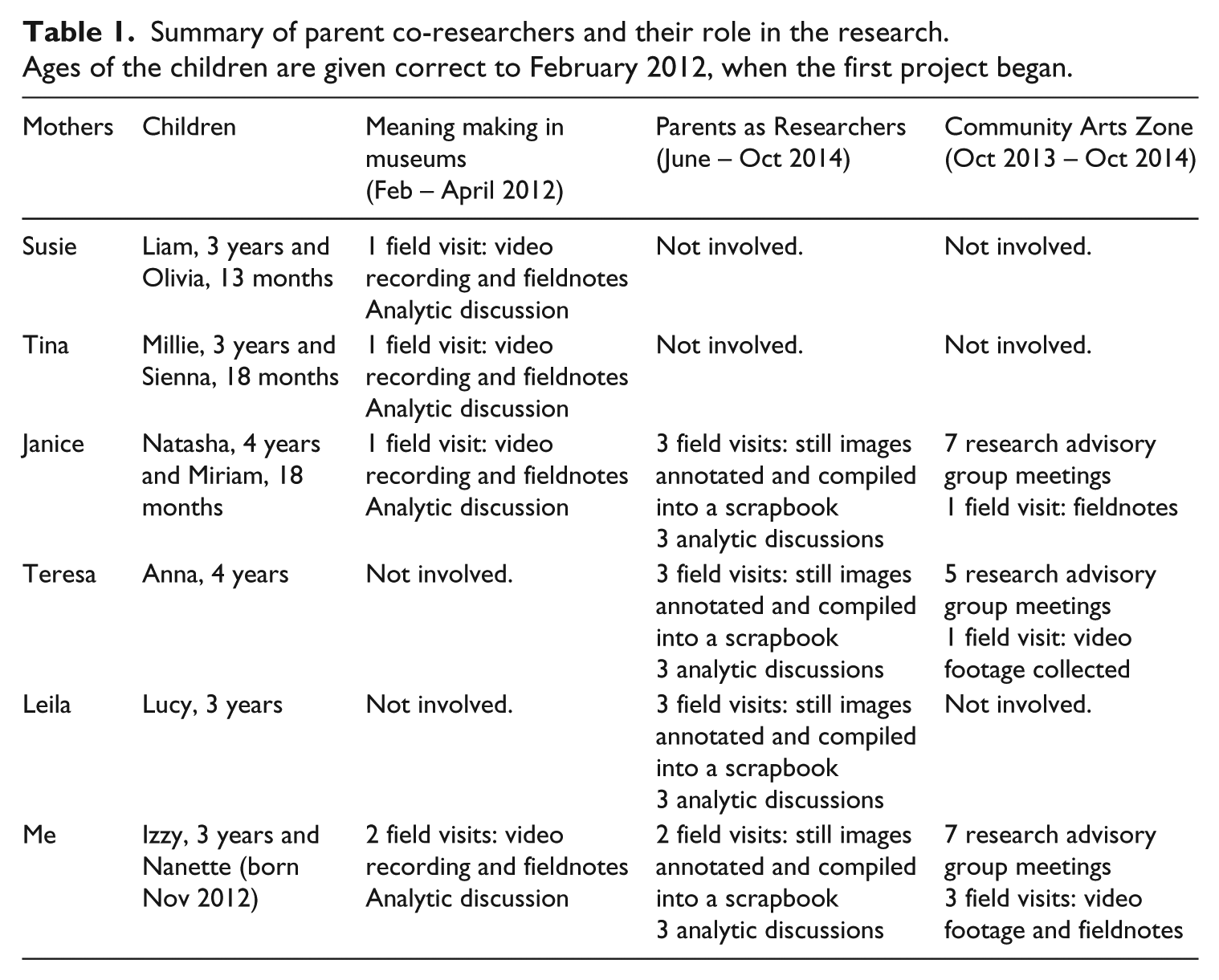
The third study this article draws on was part of a wider Canada SSHRC funded project, Community Arts Zone. My research within this project sought to understand children’s emplaced meaning making through den building. In this study, two of the parents involved in the previous studies acted as a research advisory group, advising on the direction of the project. In addition, these parents also collected data (fieldnotes and video footage) during some of the den building events and analysed the data through a series of group meetings. Once again we were accompanied by some of our children, aged between 10 months and 6 years, at some of the den building events. Table 1 summarises the parent-researchers and children in each of the three studies, and the role each parent-researcher played in each study.
Summary of parent co-researchers and their role in the research. Ages of the children are given correct to February 2012, when the first project began.
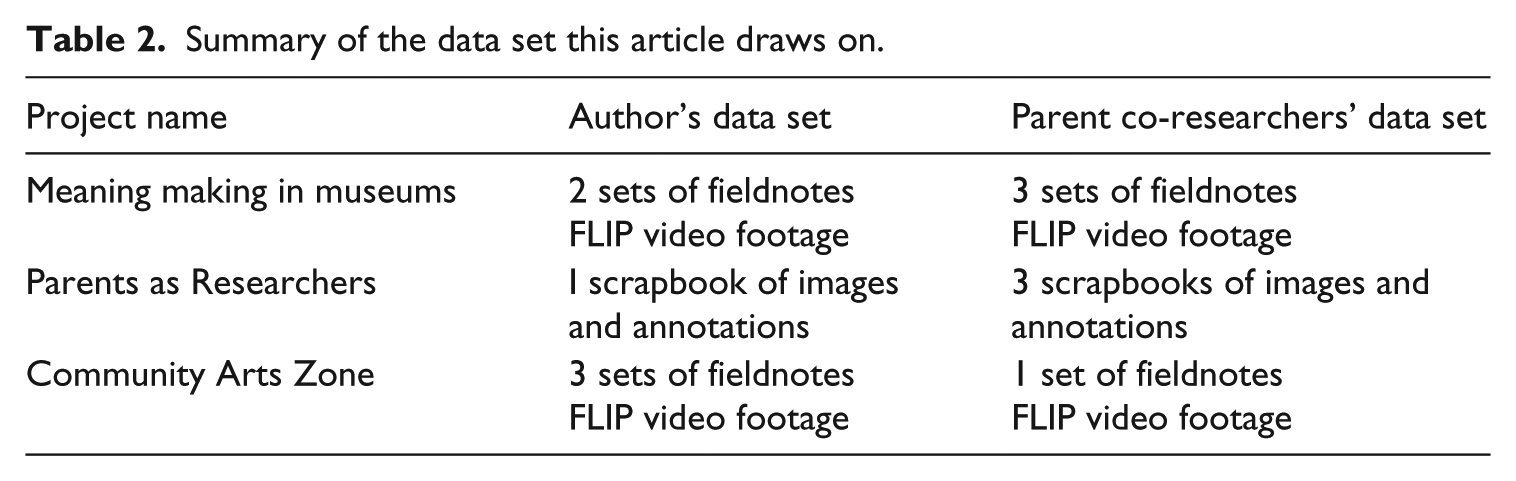
The dataset this article draws on has been collected and analysed by both myself and the other parent-researchers, over a period of three years. It includes video footage, field notes, annotated scrapbooks of photograph and notes from a series of group meetings in which we analysed the data. This dataset is summarised in Table 2.
Summary of the data set this article draws on.
Throughout this research, parents collaborated with me in different ways, at different times. For example, in the first study, parents primarily contributed to data collection. The second project expanded on the collaboration, with parents helping to frame the research questions, and collect and analyse data. In the third project, parents advised on the research questions and direction of the project, as well as collecting and analysing some of the data. There are some aspects of the research process which the parents have not been involved in, in some cases because they don’t have time or inclination, such as reviewing the literature. Other aspects of the research process, such as writing together, we hope to do together in the future. Overall, the process of collaborating with parents as co-researchers has been slow, emergent and exploratory, rather than pre-planned. For me it has been an experiment in different approaches to collaboration. For the parents, involvement has built up incrementally, as individuals have felt their way into doing research, whilst deciding how and whether they want to participate. Tillman-Healy (2003) describes a methodology of friendship, during which the researcher works at ‘the natural pace of friendship’ (2003: 724), that is, committing enough time, over a long enough time period, for ‘profound relationships’ to develop. In my research, approaches to collaboration have developed at the ‘pace of friendship’; there are ways of working together now we could not have envisaged five years ago. This way of doing research involves risk, as the direction of the research is not always predictable and researchers’ own emotions and personal life become slowly more intertwined with the research site (Finlay, 2002; Kleinman, 2002).
Ethical considerations
Parker (2005) makes the point that research is always a moral and political activity, and therefore, ‘fidelity to commitments made during a research event is the space for ethics’ (Parker, 2005: 14, emphasis in original). The implications of this are epistemological; embracing particularity of experiences, alternative interpretations and ‘points of impossibility’ (2005: 15) and the role of the researcher within the research are starting points for an ethical practice. The long term, collaborative nature of my research means that the experiences, involvement and representation of the families in the study are of paramount ethical importance. The families all invested a lot in this study and therefore, ‘fidelity to commitments made during a research event’ (2005: 14) become, I argue, even more important. In developing an ethical parents as co-researchers methodology, key concerns included parents’ time and ongoing involvement, consent of both parents and children, and developing an ethics of care (Banks et al., 2013), as ethical decisions were made as the arose, over long term relationships and in unfolding contexts.
Consent
Christensen (2004) argues for the importance of developing an approach to research with children that takes account of children’s ‘cultures of communication’ (2004: 166). Within this research, ‘cultures of communication’ for both adults and children were understood within an ethnographic process of sharing experiences and learning to empathise with the viewpoints of others (Pink, 2009). Throughout our collaborations, I adopted an approach of ongoing consent, in which individuals made choices about the exact nature of their involvement as the project unfolded. For the young children themselves, assent, by which I mean gaining children’s agreement to participate, was a more appropriate concept than consent (Cocks, 2006; Dockett et al., 2009). For Cocks (2006), assent is a process of reflexivity for the researcher, and requires ongoing work and attention to ensure the children are happy to be participating in a particular way at a particular moment in time. In practice, the children were well able to express their assent to be involved in the research. For example, children’s hunger or tiredness was often a cue for an activity to end. This relational and reflexive process was one that involved myself and the parent co-researchers throughout the study. We jointly aimed to tune in to the children’s body language, actions, and words (Dockett et al., 2009), in order to make ongoing judgements about whether activities should continue, be cancelled or cut short.
Time, commitment and ownership
Being involved in this research involved considerable time and commitment from parent-researchers over a sustained period. Doing fieldwork with one’s young children in the field and writing fieldnotes is hard work. The small number of parents who have continued to research with me in this way over a number of years have described the enjoyment, interest, satisfaction and also increase in confidence being involved has brought them. Equally, there are many other families who have been involved in my research for shorter periods of time, or not opted to participate as co-researchers. The parent co-researchers are, therefore, a self-selecting group.
Banks et al. (2013) describe the nature of ethical considerations in community based research as going beyond the implementation of abstract rules to encompass ‘dynamic, complex and value-based’ negotiations, with ‘responsibilities attaching to personal relationships’ (2013: 263). Banks et al. (2013) therefore propose a concept of everyday ethics, involving daily processes of negotiating ethical challenges. The concept of everyday ethics resonates in the context of research with parents as co-researchers, in which daily decisions, grounded in personal relationships and commitments were and are made.
I have described the particularity of the process of my collaborative research with parents, with an emphasis on how parents contributed to different aspects of the research process, and the ethical considerations involved. Next, I present some examples of the findings emerging from this research, by offering three lenses for understanding the process of knowledge production in this collaborative methodology. Firstly, I describe the importance of emplaced, embodied knowing (Pink, 2009) in the research findings, and the way in which this offered a counter to propositional notions of academic knowledge about children. Secondly, I describe the blurring of roles of parent and researcher in the study, drawing on Fine’s (1994) notion of working the hyphens. This led to an engagement with the subjectivities of what adults can know about young children. Thirdly, I outline the growing sense of entitlement parent-researchers felt in articulating their dissatisfaction with pathologising discourses about parenting and the inherent assumptions these discourses make about who holds expertise about young children.
Emplaced knowing, collaborative research and the de-centring of academic knowledge
Pahl and Pool (2011) describe an approach to collaborative research with young people in a school in which the children’s different interpretations of the research led them to reframe their findings. In this case, approaches to collaborative research draw on post-modernist critiques of dominant assumptions of knowledge as fixed, discoverable and quantifiable (Law, 2004; Niedderer, 2007; Somerville, 2007; Vasudevan, 2011). In the debate about what counts as academic knowledge, Vasudevan (2011) appeals for the importance of ‘unknowing’ in academic research, stressing the processes through which multiple points of view can come to be known, and ‘unexpected trajectories’ open up. Niedderer (2007) makes a distinction between propositional, procedural and experiential knowledge, pointing out that the privileging of propositional knowledge is common in academia. In contrast, procedural and experiential knowledge are tacit forms of knowing, which can only ever be partially communicated in written or spoken language. As Johnson (2004) points out, collaborative ethnography is multi-voiced; in The Other side of Middletown (2004) this multi-vocality was realised through the writing process. In the research described in this article, I did not write with the parents, but multi-vocality is represented in the importance of parents’ tacit, lived ways of knowing about young children, which came to dominate the findings of the research.
Much data collected during the research about children’s experiences of places (museums, parks, farms, the seaside and cardboard dens) stressed the importance of the materiality of the place, which the children encountered through their bodies. Susie’s account of her field notes, given at a group meeting, illustrates the significance of the materiality of the museum for her 13 month old daughter Olivia.
So she was just walking I think holding hands and doing a lot of crawling, fast crawling. She’s very inquisitive and I think like her brother loves people and just kind of watching and listening, in terms of what’s going on. At the museum, she seemed to be quite excited about grates on the floor, didn’t she?… I think she was captivated by that, as well as the grate being on the floor, the metal grate! I think she was making noises, or something with her fingers. And I think that’s about all I can remember. (Susie, group discussion, April 2012)
The embodied experience of different kinds of places was central to the concerns parents voiced about the limited range of places to go with children during the summer holidays. In talking about the planned trip to the seaside, Leila talked about the chance for her little girl Lucy (3 years) to experience the sand as being a valuable, special opportunity. Lucy’s usual experience of sand was in a sand tray at nursery, and the group were clear that, as Leila put it ‘the sand they play with at nursery is different to the sand at the beach’. The wider context of the beach rather than the nursery changed the meaning or experience of the sand itself.
The importance of the materiality of place was picked up strongly in the data parent-researchers collected during the beach trip. For example, Janice recorded examples of her 2 year old daughter Miriam’s embodied experience of the beach. Miriam insisted on crawling for most of the day on the beach with bare legs (despite normally choosing to walk rather than crawl). One image which was particularly significant was a photograph Janice took of Miriam sitting on the sand staring out to sea. She appears lost in thought, but for Janice, the significance of this photograph was that Miriam had her hands buried deep in the sand, lifting her hands and running in through her fingers, repeating this action over and over again.
Building on notions of embodiment as central to human experience, Pink argues for the significance of emplacement in how people experience the world. Pink (2009: 25) argues for the need for research that
attends to the question of experience by accounting for the relationship between bodies, minds and the materiality and sensoriality of the environment.
Hultman and Lenz Taguchi (2010) critique the emphasis post structuralism has placed on language and discourse aspects of experience, leading to the creation of human/non-human binaries. Humans and the material environments are seen instead as ‘performative mutually intra-active agents’ (Barad, in Hultman and Lenz Taguchi, 2010: 527, emphasis in original), with agency emerging from the interaction between them. In their fieldnotes, parent-researchers were pre-occupied with the sand on the beach, and grates in the floor, and the ways these were experienced through fingers and knees. This privileging of the material and the embodied by parent-researchers in the study is related to the kinds of knowledge being drawn on through this methodology, and particularly the tacit and relational ways in which parents know their children.
An interest in how children’s bodies experience place was mirrored in the parent-researchers’ own experiences of being in places with their young children, whilst carrying out fieldwork. Doing research with young children was frequently a physically demanding experience, involving carrying, lifting, pushing buggies up hills and running after small children in busy public places. These physical, embodied aspects of doing research with our young children were something which all parent-researchers in these studies shared. For example, in the following extract from my own fieldnotes, I reflected on these parallel experiences, as I describe holding Tina’s daughter Sienna, aged 18 months, during a field visit.
I held Sienna for a long time, at a height that was awkward, so she could see the models and reach the buttons. It reminded me of when Izzy was that age. Tina and I stood next to each other, both talking to Sienna in the same sort of way, saying the same sort of things in the same slightly high pitched voice – it made me think about the way in which I am researching with people whose lives I am share so much in common with. The voice, the phrases of speech and the way in which I was holding this heavy little bundle so she could see the thing that was fascinating her, were all so familiar because I did all this with Izzy. (Fieldnotes, 15 February 2012)
As I touch on in these fieldnotes, ways of knowing about the field began for parent-researchers in their own bodies, in the weight of a child in their arms, a certain tone of voice, and in the experience of being in places as parents. As Susie comments
I think you’re just used to running around after them and going through the museum and getting to lunchtime’s kind of an achievement isn’t it, cos it’s tiring at times! (Susie, group analytic discussion, April 2012)
The examples provided above of data collected in the field and chosen for analysis and discussion by parent-researchers, illustrate the relevance of emplacement for the parent-researchers’ ways of understanding young children’s engagement with places.
Working the hyphens: both parents and researchers
Coffey (2000) describes the relationship between identity and the field as not fixed, but shifting and re-created during the study. Fieldwork during which I researched children the same age as my own, alongside parents who also had children the same age as mine, brought specific aspects of my identity and experience to the fore. During fieldwork, I was perceived as and enacted an identify that was equally parent and researcher, and as the research progressed and I collaborated more and more with the other parents, the lines between parent and researcher became increasingly blurred.
This blurring of roles aligns this research with the work of feminist and queer scholarship which has sought to resist hierarchical separation between respondent and participant (Tillman-Healy, 2003). Fine (1994) has used the term ‘working the hyphens’ in her critique of social science researchers’ tendency to write about ‘others’ while ‘occluding ourselves and our own investments, burying the contradictions that percolate at the Self-Other hyphen.’ (1994: 70). For Fine, acknowledging the multiplicity of identities, including the researcher’s and the relationship between these self-other identities is an ethical practice.
Eroding the fixedness of categories, we and they enter and play with the blurred boundaries that proliferate… these ‘relationships between’ get us ‘better’ data, limit what we feel free to say, expand our minds and constrict our mouths, engage us in intimacy, and seduce us into complicity, make us quick to interpret and hesitant to write. (Fine, 1994: 72)
During analytic discussions, my positionality as a fellow parent was frequently referenced by the others, through comments such as ‘as you’ll know yourself’ and ‘it’s probably the same with Izzy’. As I have discussed above, this shared sense of experience and positionality was embodied in the experience of being in places with children (carrying, holding, speaking in a certain way, keeping ever alert as to what the children were doing) as much as conceptualised as an identity category. A focus on the embodied experiences of children that we were seeking to understand aligns closely with Pink’s (2009) approach to sensory ethnography, in which ‘sensoriality is fundamental to how we learn about, understand and represent other people’s lives’ (2009: 7). Within this understanding of ethnography, ethnographers are constantly seeking to access experiences of others which can never be fully accessed. This partiality and subjectivity is described by Pink in her description of research methodology.
This is not so much the gathering of data that the researcher will take away to analyse, but rather it is a process of bringing together which involves the accumulation of emplaced ways of knowing generated not simply through verbal exchanges but through, for example, cups of tea and coffee, comfortable cushions, odours, textures, sounds and images. By sitting with another person in their living room, in their chair, drinking their coffee from one of their mugs, one begins in some small way to occupy the world in a way that is similar to them. (Pink, 2009: 86, emphasis in original)
During co-research with parents, two parallel processes of sharing experiences took place. Firstly, as a group of parent-researchers, we shared embodied experiences of parenting during fieldwork, and through this understood or ‘occupied’ each other’s worlds in a deeper way. Secondly, through research seeking to understand the experiences of our young children, we as a group of parent-researchers began to imaginatively empathise (Pink, 2009) with the emplaced experiences of the children themselves. Much of this imagining produced subjective statements about our children’s everyday lives. One such example was Janice’s discussion of Natasha and Miriam’s experiences in the park. She described how ‘Natasha really likes holding ladybirds in her hand, but it’s not just seeing them in her hand, it’s the feel of their legs, I realise that now’. In this statement, Janice makes a claim to know about the feel of a ladybird’s legs on her child’s hand, and states her belief of the centrality of this embodied sensation to the importance of the trip to the park for Natasha.
In her discussion of methodological paradigms for researching multisensorily, Dicks (2014) makes the distinction between the interest in ‘looking, listening and touching’ of multimodality and ethnomethodology, and the ‘seeing, hearing and feeling’ (2014: 667) with which sensory ethnography is concerned. In attempting to understand inner experiences which may not be observable through external actions, Pink engages with the subjectivities of others’ experiences. As Dicks (2014) points out, such ways of knowing are not accessible through ‘discursive representations (such as maps, texts, models, inscriptions) that suspend emplaced, moving, being-in-time and therefore abstract from the flow of experience.’ (2014: 667).
The distinction between discursive and non-discursive ways of knowing and representing takes on a new significance in research with very young children. While phenomenologically, it is perhaps not possible for anyone to truly understand the experiences of any other one (Dicks, 2014), at least in sensory ethnographic research with adults, participants can produce discursive representations to supplement researcher’s sensory participation. In addition, a researcher’s interpretations of the experiences of adults or older children can be checked and discussed with participants themselves. Children aged under three years are unlikely to answer direct interview questions, may not be writing or drawing representationally, are perhaps too young to use a camera (Hackett, 2014). Therefore, the non-discursive and subjective may take on a new significance in terms of how researchers can understand young children’s worlds.
Following her description of ladybird feet, Janice went on to comment
I do keep thinking more now about the idea that your child is taking something from every experience. Like I was in the park the other day with Natasha and we were looking at the clouds and looking for shapes in them, and usually I wouldn’t think anything of that, it’s just something that we are doing, but I was thinking this time, yes she is learning from this. (Janice, group analytic discussion, August 2012)
During this research, parents’ interpretations of the meaning of experiences they and their children were having in their everyday lives were shifting. At the same time, as co-researchers, parents were attempting to engage with and articulate these shifting, emergent interpretations. Being co-researchers positioned parents in ways that enabled them to articulate these ways of knowing, and validated them.
De-pathologising parenthood and childhood: engaging critically with parenting discourses
Being parent-researchers involved careful looking and paying attention to children for a different reason (doing research) and making permanent records (video, fieldnotes, scrapbooks) of moments and incidences which are usually fleeting and given little attention. Some examples of these fleeting and often overlooked moments have been presented above; grains of sand running through fingers, the grimace meant to indicate a ‘big smile’, the feel of ladybird’s legs. As discussed above, making records of these things required effort and commitment; it is challenging to parent, observe and record all at the same time. However, the lens of research and creation of field records offered parents new ways of knowing and talking about their children’s experiences. Transformations in how parents viewed or interpreted their children’s behaviour were strongly articulated by the parents during analytic discussions. All parents were surprised when looking back over their data by how much was there, and how much their children seemed to have done and learned during the field visits.
But it’s, it seems now she got out probably more than what I thought she’d got out of it. And it’s interesting because it makes you more aware by making the notes versus doing a trip independently, and yeah they’ve been to the museum and they’ve had a nice time, you know, played with a couple of things. Makes you, I suppose, analyse and realise that they do actually get quite a lot out of these things that they do and things that they look at, makes you a bit more aware I suppose. (Susie, group analytic discussion, April 2012)
One particularly striking example of this is Janice’s interpretations of her daughter Miriam’s quiet, reserved behaviour. The way in which Janice interpreted and gave meaning to Miriam’s non-verbal communicative modes changed during the course of her involvement as a co-researcher. At the beginning of the research in 2012, Janice felt that Miriam would be too young to get anything out of a museum visit for some time, and her fieldnotes from our museum visit reflected this.
We started off with the room that had the pheasant. At this point she didn’t show any particular interest in the contents of that room. We then went into the room that housed Nelson the lion. She had a brief ride on the rocking zebra. She didn’t show any overt reaction to Nelson, but her gaze at him was intent. (Janice’s fieldnotes, February 2012)
Miriam was reserved during the museum visit, and verbally quiet. Initially for Janice, Miriam’s silence and reserve in the museum was a sign that she was not learning or particularly engaged during the visit. However, during group analytic discussions a few months later, Janice commented
I picked up from your [author’s] notes, just like the non-verbal communication, you know like the leaning towards something, you know even if she’s in arms, she sort of, you know, leaning towards something to get something. And it’s funny cos when we’re at home and when it comes to feeding, changing, anything it’s all non-verbal, you know as a mum you pick up what your kid’s saying. So I don’t know why I didn’t link when we go out, to learning, that’s why I never thought she would benefit from the museum initially, I just thought what’s an 18 month-old going to do? (Janice, April 2012)
For Janice, reflecting on and analysing her observations of her daughter, and reading my fieldnotes of the same visit, led her to reinterpret the meaning of her daughter’s behaviour, from disengaged, to rich non-verbal communication which parallels the way Miriam makes her needs known at home. The parents in my research wanted to keep copies of the fieldnotes and the scrapboooks because, they said, ‘they are important’. Loizou (2013) and Liebenberg (2009) both describe how for the parents in their studies, reflecting on the challenges of parenting from the perspective of research helped them to think about issues in a new way. For me, understanding Janice’s evolving interpretations of her daughter’s behaviour, alongside my own fieldnotes, gave a richer and more nuanced understanding of Miriam’s multimodal meaning making and emplaced engagement at the museum in a wider context of home and family.
In Tillman-Healy’s (2003) research, the space for participants to tell their stories and think about identities through the production of written texts helped towards self-understanding and acceptance. The space and permanency of the field records offered parents in my study the opportunity to make sense of their own and their children’s experiences in new ways. Over time this led to a growing sense of critical engagement with pathologising discourses about parents, particularly mothers, and particularly mothers from poor communities (Clarke, 2006; Gillies, 2007). During Community Arts Zone, in which parents acted as a research advisory board, analytic discussions turned increasingly from understanding our own children’s experiences to commentary on early-years pedagogy and political discourse. In this way, the fracture lines between the epistemological understandings of knowledge embraced by this research (for example, Vasudevan, 2011), and the assumptions and narratives of mainstream UK early years policy discourses (Clarke, 2006), became increasingly apparent.
Children’s Centres have a remit to educate the parents, so you always feel, as opposed to you knowing your child better than anyone else, that you have to listen to the professionals who know children better than you know children. And when we did the research with Abi, she kept emphasising, no one knows your child better than you, that’s why I’m getting feedback from parents. And it does give you confidence, no it does. Because when you first asked me I was like, uh that’s a bit weird, I’m not really qualified to do it, you know. But you are qualified, you’re their mum, you’re raising your children. (Janice, group discussion, September 2014)
In the context of teaching critical literacies to young children in the classroom, Jones (2013) makes the point that issues of power and identity are central to whether readers feel ‘any sense of entitlement’ (2013: 220) to analyse and critique dominant discourses. Applying Jones’ argument about the need for participants to have a sense of entitlement, and the role of power and identity in this sense of entitlement, is useful for thinking about the extent to which working with parents as co-researchers provided a sense of empowerment. Within discourses of parenting, parents in general, and mothers in particular, can often be marginalised (Clarke, 2005; Gilles, 2007). For Janice, the benefit of being a co-researcher was that ‘it reinforces your knowledge of your child’. Therefore, rather than seeing empowerment as a product which could result from my research, I have found it helpful, following Jones (2013) to see the shift in power and agency which partially came about when parents were positioned as co-researchers, and particularly when they formed the research advisory board, as a process leading towards a growing sense of entitlement felt by parents to speak about their own children’s learning and their role as experts in their own children.
Concluding thoughts
In this article, I have described a way of doing ethnographic research collaboratively with parents in order to understand the lives of young children better. This research is grounded in an appreciation of multiple ways of knowing, and the significance of non-propositional knowledge (Niedderer, 2007) for understanding, or beginning to make interpretations about, the lives and perspectives of young children. For others seeking to carry out similar research, exploring the self-other hyphens (Fine, 1994) between researchers and parents, and adopting a certain kind of epistemological position seems crucial. Mayall (2000) has described how underlying assumptions about the nature of childhood have resulted in both a denial of children’s right to be heard, and an increasing tendency for professionals to ‘tell mothers what to do’ (2000: 244). During collaborative research, parent-researchers spoke about both the lack of fit between assumptions about childhood and their own children’s lived experiences, and their awareness of professionals seeking to assert claims of authority over parents. Researching collaboratively with parents, an approach which attempted to deliberately disrupt the hierarchy between researcher and participant (Tillman-Healy, 2003), foregrounded different kinds of knowledge (embodied, tacit, subjective), which added depth and texture to understandings about how young children experience places. A recognition of the multiple ways of knowing that different adults might bring to understanding the perspectives of young children, is summarised by Janice, as follows.
The only thing I would say, like you did, and this was crucial to me taking part, was to emphasise that the parent is in an equal position, if not greater, to be able to speak on observations about their child. (Janice, group discussion, September 2014)
Footnotes
Acknowledgements
Grateful thanks to the families who gave up their time to take part in this research. Also to Professor Jennifer Rowsell and the anonymous reviewers for their comments on earlier drafts of this article. I would like to acknowledge Canada SSHRC for funding some of the later co-research described in this article.
Funding
This research received funding from the Canada Social Science and Humanities Research Council.