



Abstract
Across many countries, the design of social protection for informal workers – particularly in response to shocks – is often shaped by assumptions about their limited agency. This article examines how the COVID-19 pandemic and the introduction of South Africa’s Social Relief of Distress (SRD) grant influenced the agency of informal traders. The SRD was the country’s first cash transfer made available to able-bodied, working-age adults. Drawing on structuration theory, the article explores how informal traders responded to crisis within a constrained structural environment. The findings challenge prevailing narratives that depict informal workers as passive recipients or deviant economic actors. Instead, traders demonstrated a strong agentic identity and a desire to be recognised as legitimate workers. The article argues that shock-responsive social protection can support informal workers’ own efforts to sustain livelihoods, if it offers stable, appropriately designed benefits linked to broader labour protections. These insights have broader relevance for inclusive global social protection policy.
Keywords
Introduction
Globally, polarised views on the agency of informal workers have often characterised social protection policies. On the one hand, their agency is viewed as a deviant expression of self-interest to be curbed by limiting access to social protection (Alfers et al., 2022). On the other hand, a view of informal workers as vulnerable victims of distorted social structures and labour markets may lead to social assistance provisions that are delinked from their status as workers (Alfers et al., 2018).
This study draws on structure–agency theory to examine the agency of informal traders in South Africa in the context of the major structural economic and social reordering that resulted from COVID-19 and of a governmental response to the pandemic in the form of the shock-responsive Social Relief of Distress (SRD) cash transfer. The case study contributes to a growing body of evidence that addresses the widespread lack of understanding of informal workers’ livelihoods and contributions, which tend to be misunderstood, undervalued and often stigmatised, and responds to the need to rethink redistribution through the lens of informal workers and their economic units (Chen and Carré, 2020).
There are three important reasons why an understanding of informal workers’ agency matters for social protection policy. First, the evidence counters widespread perceptions of informal workers as deviant agents, and the related assumptions that social assistance inappropriately legitimises informal work, creates perverse incentives, increases dependency and tax evasion, thus creating unfair competition to formal enterprises (Orozco and Vélez-Grajales, 2024). Second, the data highlights the importance of informal workers, of their status as workers, and the need for social protection policy to take this into account. Third, despite the misconception that all economies are on a pathway to greater wage employment, in reality, traditional forms of informal employment are a systemic feature of modern capitalist development and represent 61% of workers (Chen and Carré, 2020).
In addition, the design of shock-responsive social protection policies is especially relevant for informal workers, given their disproportionate vulnerability to covariate uninsured shocks. This is due to the constraints that make informal workers (generally, and in South Africa) more vulnerable than formally employed workers, notably, exclusion from employment-related social protection (such as the Unemployment Insurance Fund), low incomes and financial exclusion (no savings) and the inability of informal workers to unionise or mobilise for collective action to protect their interests (unlike formally employed workers) (ILO, 2024).
All social protection systems are designed to respond to shocks, typically at the individual or household level, such as loss of jobs or illness. A shock-responsive social protection system is also prepared to respond to systemic shocks that affect a large proportion of a population simultaneously, for example natural disasters, food shortages or disease outbreaks such as COVID-19 (Kind, 2020). The large gaps for informal workers in social protection provision for both lifecycle and systemic shocks draw attention to the need to document lessons learned from recent innovations, such as the SRD.
The structure–agency debate remains highly influential in the broader contestation about approaches to social welfare policy internationally and how beneficiary behaviour is constructed. Giddens’s structuration theory (Giddens, 1984) and its iterations by later scholars (Archer, 1995; Stones, 2005) provide a theoretical lens for understanding the interaction between structural opportunities and barriers to informal workers’ livelihoods and how individuals themselves navigate their way through these challenges. Giddens’ framing of the contours of the agency–structure interface in constant flux permits a granular analysis of the fast-changing institutional environment created by COVID-19 and the governmental responses, further underscoring the need to understand how the design and delivery of a shock-responsive social protection intervention can intersect with informal traders’ agency and the structures and practices that shape, constrain and enable their livelihoods.
The SRD case study offers valuable evidence to inform shock-responsive social protection policy and delivery, and more generally for social protection policy with regard to informal workers. Traders were selected as a subset of informal workers due to the frontline impact they experienced as a result of both COVID-19 and the SRD. Drawing on the perspective of informal traders in urban and peri-urban contexts in South Africa, the evidence presented provides a situated understanding of agency that tempers the structure–agency dichotomy and contributes to more evidence-based and less ideologically driven social policy for informal workers.
The following sections provide an overview of the informal sector in South Africa, the analytical framework adopted in this article, the study methods and a presentation of the findings on informal trader perspectives on the agency–structure interface in relation to COVID-19 and the SRD in South Africa. The findings and their implications for the design of future shock-responsive social protection for informal workers, a growing area of policy interest, are discussed in the closing section.
Informal work, COVID-19 and the SRD in South Africa
Informal employment in South Africa represents almost a third of non-agricultural employment and comprises a diversity of economic activities such as food vending, waste picking, market trading and domestic work (Plagerson et al., 2023). In South Africa, as in many other countries, workers in the informal economy were disproportionately affected by the onset of the COVID-19 pandemic, as well as measures to prevent its spread. Informal traders generally operate in the most vulnerable parts of the labour market, relying on daily earnings to survive, in many cases heading households that are near or below the poverty line (Skinner et al., 2021).
In the initial response to COVID-19, informal food traders were not recognised as essential service providers or permitted to trade. Following pressure from civil society, regulations were amended, allowing informal traders in possession of trading permits to resume operating (Rwafa-Ponela et al., 2022).
Significantly, the emergency context created by the pandemic weakened the historic political resistance to social assistance for the able-bodied working-age population. The SRD was introduced in April 2020 as a component of the government’s economic stimulus plan in response to the economic and health impacts of the COVID-19 pandemic. The SRD provided monthly payments of ZAR350 (~USD20) and was made available to adults not in formal employment or (initially) in receipt of any other form of social assistance. The SRD represents a significant addition to the long-established social assistance benefits available for children, persons with disabilities and older persons. It addressed a large gap in the social security system which had previously, for the most part, excluded workers in the informal sector.
The programme was initially introduced for 6 months, between May and October 2020. Subsequent extensions and an interruption of the cash transfer between May and July 2021, as well as changes in the eligibility criteria and income thresholds, affected accessibility for informal workers. Access for women increased considerably when the SRD was re-introduced in August 2021 and made available to caregivers in receipt of the Child Support Grant, who had previously been excluded (due to their receipt of another grant). As a result, levels of coverage oscillated, at their peak reaching 10 million beneficiaries in 2021 (Plagerson et al., 2023).
This article contributes to the emerging literature that reflects on the innovations for informal workers in social protection that occurred in response to COVID-19. These include Brazil’s Auxílio Emergencial, Madagascar’s Tosika Fameno and Sri Lanka’s Emergency Cash Transfers. While these schemes were temporary, they offer evidence on the feasibility and legitimacy of direct income support to people in need, including informal workers, showing that administrative and political challenges can be overcome (Alfers and Juergens-Grant, 2023). In addition, as discussed by this study’s research participants, evidence from other contexts in the global South highlights the complementary social protection needs of informal workers in addition to cash transfers.
Structuration theory in relation to social protection and informal work
Despite growing recognition that informal workers’ contributions are often misunderstood or undervalued, dominant policy discourses still focus on critical perspectives regarding their intentions and labour market position (Alfers et al., 2022). Informal workers are often portrayed negatively as illegal or undesirable (Chen et al., 2022).
Structuration theory, introduced by Giddens (1984), offers a useful framework to examine the agency of informal traders during COVID-19 and the SRD. It emphasises human choice and agency as central to both societal reproduction and transformation. Agency, according to Giddens (1984), is the ability of individuals to “make a difference” to existing conditions. Key dimensions of agency include the following:
Motivations – the goals individuals pursue.
Decision-making – the selective process through which agents navigate problems.
Reflexivity – the use of knowledge by agents to modify social structures.
The study explores the motivations of informal traders receiving the SRD and their complex decision-making patterns to achieve desired outcomes. Agency is also framed in terms of self-awareness, dignity and recognition.
Giddens (1984) also defines social structure as the sum of “rules and resources” within systems, which include the following:
Signification – meaning tied to knowledge.
Legitimation – societal norms.
Domination – the application of power, especially in resource control.
Accordingly, the study describes how the combined effects of COVID-19 and the SRD shape informal traders’ engagement with their environment, influencing their understanding of norms, practices and the meaning of work. It explores how state responses to COVID-19 impact informal workers’ identities in the workplace, home and community.
Furthermore, structuration theory sees structure and agency as mutually constitutive, rather than oppositional, bridging positivist views, which see social structures as beyond human control, and interpretivist perspectives, which view action as creating social structures. This framework allows for the analysis of how individuals’ actions and social structures interact dynamically over time, as seen in studies of labour market changes (Kessler et al., 2003) or community norms during COVID-19 (Matli, 2020).
Critiques of structuration theory have sought to strengthen its empirical applicability and to avoid conflating agency and structure. Stones (2005) distinguishes between
The following questions apply the lens of structuration theory and its variants to develop an empirical understanding of agency in relation to informal work and cash transfer policies with the aim of bringing clarity to conflicting political and social narratives:
Do informal traders characterise themselves as agents, and if so, how?
How do informal traders characterise and engage with structural dimensions of society?
How did COVID-19 reformat the relationship between agency and structure for informal traders?
How did the SRD cash transfer influence informal traders’ agency?
Methods
The study used a qualitative exploratory design. The research began with a scoping phase (Feb–April 2022), which included consultations with informal worker organisations. Through Women in Informal Employment Organising and Globalising (WIEGO) and the Centre for Social Development in Africa (CSDA) networks, five research sites were selected across three provinces: Johannesburg and Orange Farm in Gauteng, Mthatha and Mqanduli in the Eastern Cape and Durban in KwaZulu-Natal. These locations represent a spread in terms of population density, income levels and urban/peri-urban characteristics. They were selected as areas with high levels of economic activity, in which the social and economic effects of the SRD would be most visible. Although the findings are contextually embedded, given the explorative nature of the study, the findings provide “proof of concept” evidence, highlighting processes, especially around the interaction of structure and agency, that can be considered in the design of social protection policy tailored to the needs of informal workers. To bring these dynamics to light in each location, participants were selected to provide a range by gender, age and trade sector (food/non-food). Research participants were purposively identified through the mobilisation of personal networks and through snowball sampling by local representatives of informal traders.
Interviews were conducted with 60 participants by trained researchers who were fluent in the local languages. As Table 1 indicates, the sample included a higher representation of older women in line with the higher levels of female participation across the trade sectors. Interviews took place at respondents’ work locations in most cases, or at a nearby location which provided a quieter space for in-depth conversation. The semi-structured interview guide included sections on participants’ experiences of COVID-19, of cash transfer receipt (with a focus on the SRD) and business strategies. In the quotes cited in the analysis, respondents are denoted by their location, gender, age and trade sector (food/non-food).
Interview respondents by location, gender, age and business type.
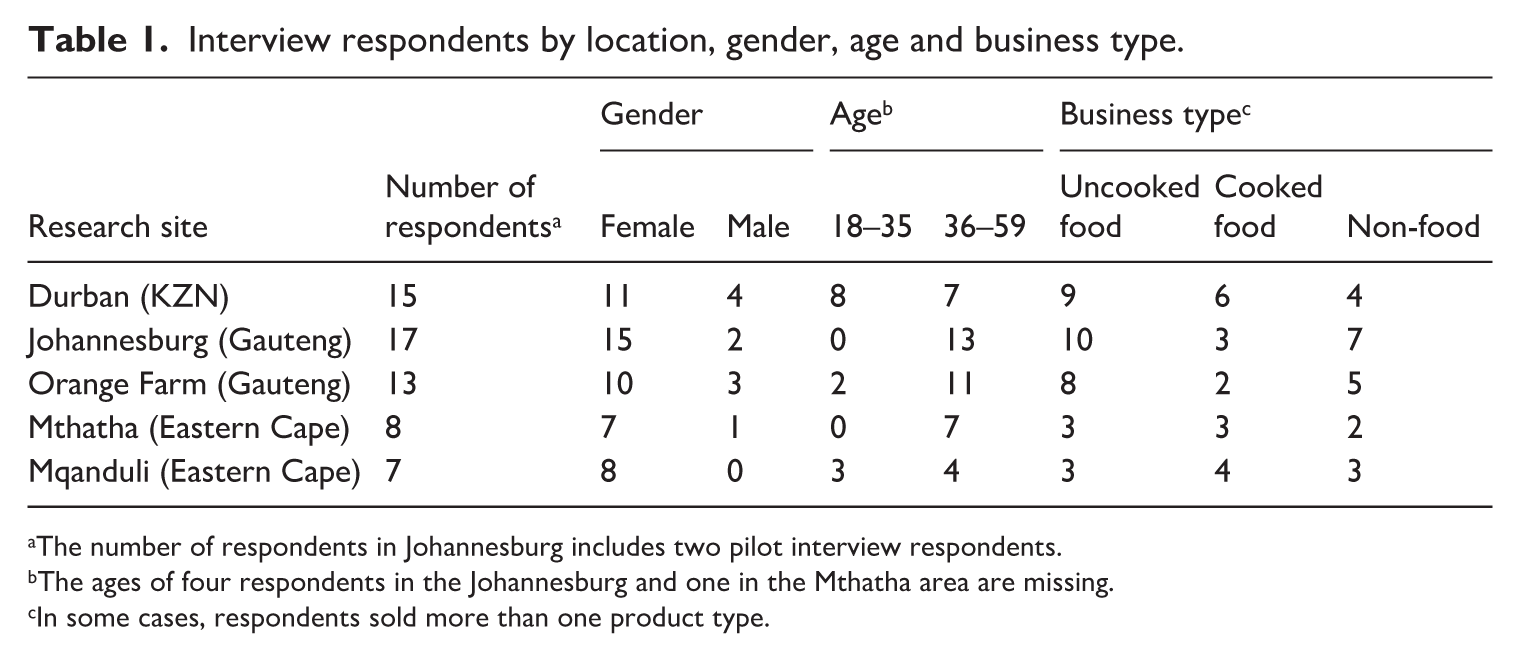
The number of respondents in Johannesburg includes two pilot interview respondents.
The ages of four respondents in the Johannesburg and one in the Mthatha area are missing.
In some cases, respondents sold more than one product type.
A deductive approach guided the thematic analysis. The focus of the study was on the local economic effects of the SRD, which have been previously published (Plagerson et al., 2023). However, in the course of the analysis, researchers noted that agency in the face of structural change emerged as a clear theme of importance to participants. Subsequently, data were re-analysed to explore this theme in greater depth in relation to social protection and are presented in this article. Atlas.ti was used to manage the analysis. Analysis by the research team served to improve the rigour of the process by ensuring that multiple views on the same data reduced individual researcher bias. Internal synthesis workshops and feedback sessions with informal trader representatives supported the analysis process.
Findings
Did informal traders characterise themselves as having agency, and if so, how?
Respondents’ sense of agency was closely tied to their identity as workers
A strong thread of agentic identity consistently characterised the narratives of informal traders, who saw themselves as capable of making a difference in the lives of their households and communities, and as contributors to their local economies. Recognising themselves as workers, and specifically as hard workers, was a common self-portrait: “We work hard here” (J16, female, 36–60 years, food/non-food). One respondent described traders as “Us independent business people” (M4, female, 36–60 years, food). Informal traders’ contrasted their efforts with “sitting” – the common term used to denote a lack of activity and/or agency: “You wouldn’t just sit and do nothing. You have to be strong, even when things are hard, you need to wake up and go to work” (J17, female, 36–60 years, non-food).
Motivations for informal trading livelihoods ranged from necessity to vocation
The need to “make a living” drove respondents’ strong sense of commitment in the face of the daily struggle to survive. As one trader explained: “I started my business in 1999. Why I started was because I was struggling” (J16, female, 36–60 years, food/non-food).
Likewise, responsibilities for one’s household, and extended household, were a strong motivator for initiating and sustaining businesses, particularly for women: “I had to start a lot of businesses because I started looking after my sister’s kids” (OF2, female, 36–60 years, food).
In a smaller set of responses, a sense of vocation was prominent in narratives around work, foregrounding individuals’ agency over time: “We do love working” (J16, female, 36–60 years, food/non-food), “Business is in my blood” (OF3, female, 36–60 years, non-food). In rare cases, informal trade was described as a source of opportunity and as a long-term career prospect: “‘Yes, at the stand you create, you create money . . . yes. Maybe with that R1000 I will make 2000 and give back the R1000 and leave 1000. Then you are left with R1000” (M7, male, 36–60 years, food). Two women selling chickens discussed their work trajectory over the years: P1: Yey, the chicken business, I come with it from the end of high school. I think I have 25 to 27 years selling chickens. Because when I think of that time, I looked for a school but there was no school, I went in and started selling some things. I went into chickens and found something there. P2: That is where my life is, I will die there. (M2+3, females, age 36–60 years, food)
The sense of achievement, linking reward to effort, was evident in the testimony of a trader who reflected that: As I am in the street, I have my own house, I got it by what I am doing in the street. I have children, I have a child that is a social worker, I have a child who is a police officer, they come from what I do. I never give up on business, I respect it because it has done things for me. (M1, female, 36–60 years non-food)
Traders exercised strategic decision-making in relation to the long-term trajectories and to the daily operational dynamics of their businesses
Over the long term, informal traders described complex decisions regarding their type of business, as well as where, when, how often and how much to stock, how to navigate seasonal variations and whether to invest in productive assets. Combining strategies offered a way to minimise risk: We sell different things. You see the hat table by the side, we follow the season. So each season stipulates, if it’s winter we sell winter hats and take caps for summer. That is what sells. When it comes to sweets, there is no season. It sells. (J16, female, 36–60 years, food/non-food)
Managing an informal trade business also involved detailed and sensitive decision-making to manage limited resources on a daily basis. Typically, given the survivalist nature of many informal enterprises, a daily profit was to ensure sales exceeded the cost of transport and stock (particularly for fresh food): “If I don’t sell anything, it means I have no food” (J2, female, 36–60 years, food/non-food). A female trader in Mthatha stated that: “you live a life where you have to balance things everyday, you live that life from Monday to Saturday trying to balance” (M4, female, age ns, cooked food).
Overall, the narratives highlight traders’ strong identity as agents capable of making a difference to ensure households’ survival. Working as informal traders was considered an active channel of agency. Yet, as the next section shows, the space within which traders operate was severely restricted by imbalances in labour markets, by lack of educational opportunities and, to some extent, by social norms around gender and age.
How did informal traders characterise and engage with structural dimensions of society?
Traders felt they could influence local informal markets and communities
Respondents felt that they could navigate and manipulate informal markets with a high degree of internalised knowledge and versatility. Social norms in which traders felt well versed were built on trust and consistency over time, creating patterns of overlapping social and economic relations.
Several women described how they viewed their work as making a contribution to society, for example by acting as mentors and offering an alternative pathway to youth who might otherwise engage in petty criminal activities: As you can see, when we take the thieves and bring them closer to us and when they sit with you, they aren’t doing anything wrong. But when they are seated with people that do wrong things, they don’t see the vision of taking a trolley and having money, and not taking by snatching from a person. Yes, so a lot of people have changed there at those stands. (M6, female, 36–60 years, food)
Formal labour markets were perceived as preferable to informal work, but as exclusionary
The comparison of informal and formal forms of employment suggested that traders considered the employment and economic structures related to formal markets as exclusionary and rigid boundaries that constrained their agency. Informal trade was seen by some as second best to a job in formal employment, in the face of constraints such as lack of education: “We are not even educated, the filling in of forms is not a norm for us. That is why we are holding on to this place because it assists us in getting what we want” (J16, female, 36–60 years, food/non-food). A preference for the elusive “perks” of formal employment was expressed by one worker: “We also wish to be in offices, holding pens and computers. And we know that we might spin on chairs and make phone calls for free” (OF9, female, 36–60 years, food). Informal trade was described as vulnerable, outdoor work: “We sit outside, we sit in the wind, you see, so we wish that our government looks out for the people outside” (M3, female, 36–60 years, food). During COVID-19, the depiction of informal trade as a fallback rather than as a preferred option was evident: “However, because there are a lot of us who aren’t working anymore, a lot of us are now street vendors. When you first lose your job, the first thing you think about is being a street vendor, you see” (OF5, female, 36–60 years, non-food).
Notably, one mechanism through which traders could envision their agency as being able to surmount the formal/informal labour market divide was by supporting the next generation in obtaining an education in order to transition from informal to formal labour markets. In the face of their own lack of education, a female respondent commented on how the work of informal traders could contribute to the education of the next generation: “They have a lot of things, all these children that are educated. Maybe some of them were educated by women that sell in the streets” (M2, female, 36–60 years, food).
Social norms around age-constrained agency in relation to livelihoods
Age was consistently mentioned as a significant factor in relation to agency. Several older traders remarked on the contrast between their motivation and expertise in work, and the lack of recognition and opportunity offered to them, perceiving that employment and social protection policies favoured youth: There’s no work. What I have noticed with governments, they hire children who are 18-35 and then what about 36 to 40 to 50? What do we do because we are not injured? And that is when we are most strong. The time when we could do other things . . . we were raising kids. Now the children have grown and we are able to work. It feels like they have abandoned us, like we are incapable of doing things. (J1, female, 36–60 years, food/non-food)
In sum, the testimonies offer insights into how traders relate to societal structures: when they feel they can associate with the structures through high degrees of knowledge, they are also able to straddle the agency/structure interface to some extent, and even to influence these structures. However, more often, respondents described themselves as navigating around impenetrable obstacles, with only rare incursions, for example where traders could contribute to children receiving an education that had been denied to them. Age overlays onto these structural landscapes by further differentiating, enabling or constraining their options. The cumulative picture painted in the interviews was that traders’ expressions of agency are unable to significantly alter the structural interface, except through very minor adjustments.
How did COVID-19 redefine informal traders’ experiences and perceptions of the structure/agency interface?
COVID-19 radically reshaped and destabilised the structure/agency contours
Overall, traders’ experiences depicted an image of uncertainty and volatility in the institutional skyline with which they interacted, affecting every area of Giddens’ structuration framework, including the sense of meaning and identity which infused traders’ work. Particularly in the early stages of COVID-19, severe restrictions on work and travel suppressed many of the freedoms of informal traders around which their livelihoods were constructed. This was accompanied by the sudden ban on group gatherings, including for events such as funerals, entailing a reordering of traders’ entire social norms and practices.
In the later phases of the pandemic, when traders were allowed to return to work, widespread loss of income, increased levels of unemployment, reduced customer flows and high rates of inflation continued to disrupt the preceding fragile networks and economic systems on which informal trader livelihoods relied. Unpredictability in the economic trajectory of informal traders’ businesses increased as a result of COVID-19: [With the businesses] it was up and down, it goes well, then again you see that it’s bad now, you see that no, now . . . you relax then again it goes down. It’s up and down, I cannot lie and say it stays constant, it doesn’t remain constant, win and lose, up and down. (Mq14, female, 36–60 years, food)
In the context of lives thrown upside down by a new and largely unknown pandemic, relationships also lost some of their stability, for example between traders and customers. A trader who sold chickens described the challenges of navigating the speculation and lack of knowledge around the spread of disease, and people’s belief that the chickens might also be infected: “It wasn’t easy sis, if someone thought a chicken looks funny, they would say ‘this chicken is sick, it has COVID’. People were scared. People just said ‘we won’t buy your chickens because they also have a disease, they must have gotten infected’. Our businesses went down because of such things, it was really bad” (M2 + 3, females, age 36–60 years, food).
Informal traders’ expressions of agency varied widely, from hopelessness to problem-solving and adaptive decision-making practices
For some, COVID-19 led to discouragement and demotivation. Dislocated certainties upset fragile ecosystems that had previously protected a sense of purpose and confidence in the returns to labour available to informal traders. A trader described the constant internal tussle of exercising agency when the outcomes were so uncertain: It was really hard because when you want to go up, you come back to the floor. Sometimes you come back with nothing, ask for transport money if people didn’t buy. Come back tomorrow to repay the one that lent me money. Just like that, business is on and off. Sometimes you get some and sometimes you don’t get anything. (J17, female, 36–60 years, food)
Conversely, many informal traders responded with renewed motivation for action, demonstrating creative solutions and a determination to not just “sit.” Agency was expressed, for example through efforts “to keep busy”: I kept myself busy, I wasn’t just sitting. In COVID, I was breeding some chickens that lay eggs, to save money . . . we take the eggs and eat them. We would go get some vegetables in the garden. I told myself I won’t just sit down because of COVID. (M1, female, 36–60 years, non-food)
Others practised agency by staying alert, ready to “jump” or respond quickly to unexpected opportunities (such as increased sales of cleaning products) or changes in government policies: When COVID started, things were really bad because we could not work. Then when the Minister, Nkosazana Zuma, said fruit and veg business can return, we jumped. So, the following morning, I went and registered. I got the permit, I rushed to the market and came back to start selling. It was not as busy, but it was better because our kids could eat something. They did not go to sleep hungry. (J5, female, 36–60 years, food)
Adaptive and self-reflective patterns of decision-making were prominent in respondents’ narratives, to try to provide for their households in the midst of challenges caused by rising prices and reduced customer flows. Many described reducing prices to avoid discarding fresh produce, and reducing the frequency and amount of stock they bought from suppliers. A food seller described how she adapted: I started approaching business in a different way, like finding other ways of selling, like door-to-door, instead of opening up and selling and waiting for people to come. I ended up approaching people, telling them this is what I do. You had to get creative to sell. (OF2, female, 36–60 years, food/non-food)
In some cases, to ensure the survival of their businesses, informal traders resorted to irreversible decisions to drain their savings. The obstacles were too great for some to overcome, causing permanent damage to some businesses and the informal cycles of debt and credit: Some traders died, some don’t have enough stock or enough to order. If you left having owed a person, you can’t come back now and stare them in the face. You can’t come back and create more debt. They will chase you away, say they are unable to help you. (W6, female, 18–35 years, food)
The state was characterised as authoritative and non-responsive
The enforcement of containment measures sharpened a perception of the state as a hostile force, rather than as a representative and responsive entity, by showing itself as insensitive to the needs and livelihoods of informal workers. COVID-19 measures created an image of an overbearing and punitive state, bent on quashing informal traders’ efforts to survive: During COVID, you know how business was low. My sister would cook and sell from her car. She had customers. All the people from these shops knew that they buy from her. So, the Metro [police] came and took her pots. Till today she does not have her pots. When we follow up, those pots cannot be found. So, those are some of the challenges faced by informal traders. (J2, female, 36–60 years, food&non-food)
Another respondent also noted the unpredictable nature of police activities: “Ohh COVID broke us. Because when you selling the police will pop up then you have to run and it becomes a mess ohh no we didn’t do well, COVID, shame” (Mq12 + 13, females, 18–35, non-food/food).
Alongside the perception of the state as overly present, dominant and critical, there was also a sense of the state’s absence in terms of supporting the labour-related and social protection needs of small traders. Traders in the study described discrepancies between the structures available to informal and formal workers, such as financial assistance funded through the Unemployment Insurance Fund that small and medium businesses could access, but from which they were excluded, due to their lack of formal status. In their accounts, they compared their businesses with their registered formal counterparts: “The government wants people with certificates and certain things, and who have registered business the correct way. If your business is not registered, it’s the same as sitting and doing nothing” (Mq12, female, age 18–35 years, non-food).
Perceptions of misrecognition by the state confirmed traders’ strong agentic identity as workers. They explained how state interventions in response to COVID-19, which prevented them from working, ignored their role as workers and agents of change. This was noticeable in Johannesburg, where respondents who had to some extent organised themselves for collective action in relation to the local municipality described how: They just stopped us from selling. Everyone around Joburg was inhibited from selling. They claimed to be cleaning the town. Are you cleaning the town or are you cleaning us? Us who bring food to the table? Us who are raising children? (J1, female, 36–60 years, food)
In sum, COVID-19 abruptly reformulated the structure/agency configuration, introducing uncertainty and volatility, highlighting the state as a dominating structure, and the lack of supportive structures such as labour and social protections for informal traders, and having a devastating effect on the livelihoods and agency of informal traders. Yet informal traders demonstrated varied responses, including a commitment to keep reshaping the dynamics and social norms underlying informal markets.
How did the SRD cash transfer influence informal traders’ agency?
The SRD provided material and symbolic pathways for agency
Despite its small amount, the SRD was seen as symbolising a sympathetic state, thus contrasting with the negative image created by official responses to COVID-19. It provided a significant allocative contribution as both a symbolic and material support to informal traders’ agency, reviving their goals of providing for their households and contributing to their communities. A respondent in Durban described how she used the SRD to set her business “in motion” again. A trader in the Johannesburg CBD clearly explained the important role played by the SRD: It [the SRD] helped because other businesses that could have shut down, did not. Those that survived, you can find the R350. There is no hope that you’ll get money from anyone else. So, when you have this R350, you know that it will help. Your business will not fail with this R350. You can buy some things. Bananas are cheap right now at the market. A box is R100. You can buy 3 boxes of bananas and a box of apples for R50. The R350 can generate more money. So, if you didn’t register for it, how can your business not fail? (J4, male, 36–59 years, non-food)
However, reversals to these effects occurred when the cash transfer was interrupted (due to changes in the conditions of access to the policy).
The hope associated with receiving the SRD, and loss of hope when it was interrupted, confirmed its symbolic role in activating agency: “It becomes painful when it’s stopped because you always have that hope, even when you think that it’s hard, but there is this date when you will get that 350” (M8, female, 18–35 years, non-food). The widespread uptake of the grant within disadvantaged communities also increased customer flows for informal traders, creating hope by supporting their livelihoods in multiple ways: “Now when you see them [customers receiving the SRD] come to town, we get filled with hope, we feel good internally, now when they come to take this 350, I have hope that they will leave R5 with me” (M5, female, 36–59 years, food).
The SRD opened up spaces for traders to make decisions again, by injecting cash into households and livelihoods
The ability of the SRD to act as a guarantee within local economy transactions mitigated the unpredictability caused by COVID-19 and strengthened the social trust relationships that underlie economic exchanges within the informal economy. The SRD supported informal traders’ efforts to implement fine-tuned strategies in order to balance the needs of households and businesses: “It really helped me; I don’t want to lie. Because I know if I didn’t sell well at the table, the R350 would come in and I would be able to support at home with buying food” (W6, female, 18–35 years, food). Study participants described the various ways in which the SRD widened real choices regarding transport options, where they could shop and what they could buy. Buying stock was seen as a way of stretching the SRD and using it as seed money: So when I get the R350, I’d look at where I need to add on. If I’m missing stock, I’d buy the material and make beads so I can return and sell them. I’d get profit and use it for transport. After I’ve came back with profit. I’d see that I continue until month end, and get another one again. (J17, female, 36–59 years, non-food)
Several study participants described how they would join together with other recipients and save multiple grant payments to buy more substantial quantities of stock, then save the profits to re-invest into their business. But not all felt they could adapt easily to changing circumstances, a reminder of how a lack of support to adapt can weaken one’s agency.
The ability of the SRD to alleviate the uncertainty caused by COVID-19 was greatly reduced by interruptions due to policy and administrative challenges, which rapidly reversed the gains accrued. Interruptions counteracted the predictability that is an essential feature of cash transfers and reduced traders’ capacity to make plans: When I do not receive [the SRD], I am forced to take from the stock money to buy the mealie-meal when I had planned that I would buy those things from [the grant money]. It really costs me . . . When the grant is not there, that gap widens. (J16, female, 36–59 years, food/non-food)
The SRD acted as a trigger for agency by drawing new traders and new customers into the economy
A respondent recounted a story they had heard on the news: “There was a child in KZN that opened an ice-cream spaza shop, with these 350s, you see and did something that’s a business, so we can plan how to survive” (M1, female, 36–59 years, non-food). An example of this was shared by a participant in Orange Farm, whose sister, also an informal trader, had advised that she use her grant money to set up a stand next to her, selling sweets and cigarettes. Traders witnessed the arrival of new unfamiliar customers and connected their own agency with that of their customers, suggesting that the SRD enabled young people to stop “sitting” by giving them the means to travel and make purchases. Those who previously had no income, referred to as “omahlalela” 1 , could now go to town and be active participants in their local communities and economies.
Receipt of the SRD interacted with beneficiaries’ identities as citizens and as workers
For example, one respondent felt that the SRD recognised their efforts to remain engaged and active in providing for their households: It didn’t come when your hands where folded [doing nothing], we are in the street, we are working, although we are working under difficult conditions right? With that 2 cent that you have, you combine things up and say thank you Lord, you see. (M1, female, 36–60 years, non-food)
Conversely, other respondents associated the SRD with their unemployed status: “Yes, the government was helping people who were unemployed, it was really bad, so they helped then because a lot of people in South Africa are not working. So, the 350s help them then because some will say I don’t even get the children’s grant. I’m just sitting, I am unemployed, so the government came up with the idea to give the 350” (Mq15, female, 36–60 years, food). But a worker involved in efforts to create a platform for collective representation of informal workers felt that while the SRD represented an acknowledgement of their need, it ignored their status as workers: You have no idea how happy I was because there was something. I am one of the block leaders here. We have block leaders for every street. We met as block leaders and tried to apply for the government to help us somehow. Unfortunately, since we are not registered, we are informal traders, we couldn’t receive any aid. So, we had to individually apply for these R350s. (J2, female, 36–60 years, food)
Complementary labour and social protection interventions were identified
In their reflections on the limitations of the SRD, respondents were able to speculate how increased support from the state might further strengthen their agency, allowing them to significantly influence the structures and institutions that direct and curtail their livelihoods. By considering what they had been able to achieve with the small cash transfer represented by the SRD, some respondents felt that a larger amount would greatly increase their ability to “grow” the money. But they recognised the limitations of the cash transfer in altering the rigid boundaries of economic, political and administrative limitations to their agency. They argued that more structural and far-reaching interventions, particularly in relation to their work, would require the provision of formal jobs, access to land, access to capital, greater access to services and business support. For example, contrasting the potential impact of a cash transfer and job opportunities, one respondent requested that: “Could he [the President] also bring job opportunities, if that’s not the case, increase the R350” (J11 + 12, females, 36–60 years, food/non-food). They felt that business support and labour protections would ease the burden of having to make trade-offs between household and business needs. They also felt that greater support would enable them to negotiate with supermarkets, their formal competitors: “What we want is farming. We want the land so that we can farm, have chickens and be the suppliers to Boxer, Shoprite and Checkers” 2 (J1, female, 36–60 years, food).
Discussion
The data presented in this article offers insights into several important themes: first, on how informal traders across various sites in South Africa characterise agency; second, on the implications for policy narratives and for the design of shock-responsive social protection programmes. A third methodological area of reflection regards the relevance of structuration theory to the context in which the analysis was conducted.
Informal traders’ characterisation of agency
Overwhelmingly, informal traders in the study saw themselves as agents who could make a difference within their households and communities. Their identity as agents was deeply connected to their identity as workers and as contributors to the local economy. Informal businesses provided a means to achieve their goals to ensure the well-being of their households, supported by intricate systems of adaptive decision-making. The desire for recognition as workers emerged repeatedly, and even when the pandemic deprived traders of their ability to work, there was an expressed desire for social protection to be accessed both on the basis of need and of worker status. These findings align with emerging evidence globally, especially from the global South, that informs a new narrative around informal workers as hard workers, and as contributors to local and national economies, and to the social fabric of their communities (Alfers et al., 2022).
The SRD was perceived as supporting many expressions of agency of traders, who represent some of the most precarious economic actors, as well as of consumers, including among youth and the long-term unemployed, offering dignity and the ability to contribute within households. Both the symbolic and the material value of the SRD were significant for facilitating agency. The symbolic value of the grant was activated by the sense of hope and recognition by the state that the injection of cash prompted, and the ability to maintain one’s identity as a worker, also confirmed in research among informal workers in comparable contexts (Monteith and Giesbert, 2017). Where COVID-19 had introduced deep insecurity and disordered the agency/structure linkages, the SRD restored some degree of stability and predictability when it was issued without interruption.
Typically, informal traders focused on their individual agency, though there was strong recognition that agency breeds agency, for example, when actions on the part of traders facilitated others in the community to start businesses and gain an education. Collective agency among the study respondents, which could have strengthened interactions between agency and structure, was limited. While this is a common research finding, there is also evidence to show that as recognition of the social and economic contribution of informal workers has gradually been increasing, so too has support for collective representation of informal workers, despite the challenges posed by their widespread exclusion from formal labour trade union platforms (Bonner et al., 2018).
Despite their strong identity as workers, informal traders were well aware of the structural limitations to their agency and the precarity of their livelihoods. COVID-19 provided a major litmus test of the nature of structures and institutions that shape informal traders’ lives, showing the state as a powerful and at times hostile power, or absent as a provider (due to lack of labour and social protections), a reality in part countered by the introduction of the SRD. Although barriers were described across all types of work, stark distinctions were drawn between informal and formal spheres of labour. In the informal sector, participants described how their insider knowledge and acumen within informal markets created some fluidity at the agency–structure interface, for example by providing employment and education to younger members of the community. Conversely, respondents felt excluded by, and unable to effectively interact with, formal labour markets, limiting the scope of their agency and preventing them from enacting change and transformation. Overall, these findings are in line with a body of evidence showing that informal workers are subject to a host of social, economic, environmental and political structural constraints, which vary by sector and location, and include punitive policies, particularly at the municipal level (Alfers et al., 2022).
Implications for the design of shock-responsive social protection policies and programmes
The findings offer several points of reflection regarding social protection policy for informal traders and informal workers more broadly. First, a shock such as the pandemic, despite its detrimental impacts, provided an opportunity to reframe policy narratives around informal workers and to redirect previously entrenched social policy trajectories. Indeed, the SRD, introduced as a response to the COVID-19 pandemic, represented the first cash transfer made available to informal workers in South Africa. Respondents’ narratives highlighted the need for greater recognition of informal workers as active contributors in order to counter narratives around deviance, which can lead to punitive processes of formalisation that do not cater for the needs and requirements of informal workers. In terms of policy narratives, the findings also pointed to the need not to overstate the scope of informal workers’ agency, but rather to situate efforts to support the agency of informal workers through cash transfers and other complementary measures, within a broader recognition of the state’s role in providing rights-based redistributive responses to structurally embedded poverty and inequalities. This balance was clear in the narratives discussed in this article: the positive gains and increases in customers as a result of the SRD were small compared to the loss of customers due to the effects of the pandemic.
Second, the advantages of situating shock-responsive social protection measures within established national social protection systems and delivery mechanisms were made clear in the analysis. The benefits of the SRD were strongly associated with its reliability and regularity, thus strengthening the relational and economic ties that permit traders to build their livelihoods. Interruptions and administrative discontinuities reduced the positive impacts of the SRD. The symbolic recognition of informal workers as workers and as contributors to the economy was also valuable to traders, again pointing to their desire to be recognised as mainstream recipients of social protection alongside other citizens and workers. The need for integration between short- and long-term social protection interventions aligns with a growing body of literature emerging from the humanitarian sector (Ulrichs and Sabates-Wheeler, 2018).
Third, the data confirmed the need for a shock-responsive transfer to be linked to complementary and multidimensional social protection and labour interventions, designed to (1) overcome structural barriers inherent to the informal sector and (2) to support informal-formal sector linkages. Traders articulated a range of interventions that would support them to dynamically engage with economic and civil structures: access to jobs, land, credit and collective representation, reducing their levels of insecurity and bringing greater equilibrium in the relationship between agency and structure. The importance of incentivising the informal sector, rather than simply corralling it into narrow formalised structures, is underlined by Asmal et al. (2024), who note the potential of the informal sector for creating employment in contexts where unemployment rates are inordinately high. Their research supports investment in overcoming the varied constraints (accentuated by shocks) that informal workers face, including transport, security, regulatory and infrastructure costs. In line with these findings, significant research conducted in partnership with informal workers and their representative organisations has shown that appropriate policies can strengthen existing efforts by the working poor to secure their livelihoods by increasing their voice and by supporting their need to overcome significant social, economic and environmental barriers (Chen et al., 2022; Patel et al., 2022).
With regard to overcoming formal-informal linkages and the exclusion that participants expressed, the data pointed to the seemingly insurmountable gap between self-employment in the informal sector and wage employment in the formal sector. Beyond employment and education interventions, social protection can contribute to overcoming this divide through a nuanced approach that seeks to design both contributory and non-contributory forms of social protection, including social insurance, and does not simply de-link social protection from worker status through limited access to social assistance (Torm and Oehme, 2024). These findings resonate with the policy recommendations proposed in Chen and Carré (2020) to consider work status and citizenship in relation to each other in order to comprehensively address the risks informal workers face as workers through exclusion from – or adverse inclusion in – other spheres of policy.
Relevance of structuration theory to the study
In relation to structuration theory, the study prompts various reflections regarding the agency–structure interface through the eyes of informal traders. The study resonated with the key tenet of structuration theory that meaning and motivation are deeply intertwined with agency, drawing out, for example both the material and symbolic support to agency represented by the SRD. The classification of resources as authoritative and allocative also aligned with respondents’ descriptions. Many of the structural barriers and enablers encountered by the informal traders were understood as authoritative, where interactions with local and national government authorities were often hostile and obstructive. The SRD functioned as an allocative resource, providing resources to counter the disabling effects of COVID-19, with the unpredictable changes in access criteria adding an authoritative power dimension. The narratives of participants illustrated how the combined effects of COVID-19 and the SRD shaped informal workers’ engagement with their external context, reshaping their inference of norms, practices and the meaning of work.
The greater latitude provided by the various expansions and critiques of structuration theory helped to unpack the complexity of the study participants’ juxtaposition of agency and structure in contexts of rapid change and precarity, which arguably could not be accommodated by Giddens’ more normative form of structuration theory. Indeed, respondents expressed a range of understandings of structures as internalised as well as completely “other” social norms and practices. This in turn is linked to the sequencing of agency and structure, whereby enabling structures that resonated with agents could be shaped and reformed by them, whereas exclusionary structures restricted their scope for agency.
In conclusion, interviews with informal traders in South Africa provided evidence of their self-perceptions as agents, particularly in relation to their identities as workers. Both COVID-19 and the SRD engaged at a deep level with identity as workers and agents disrupting practices, relationships, economics and health. Despite its devastating impact, COVID-19 provided an opportunity for the SRD to reshape the contours of who was considered deserving of social protection. The study highlights several mechanisms in which a shock-responsive intervention can strengthen existing efforts by the working poor to secure their livelihoods and the potential to design holistic policies by considering the dynamic agency/structure interface to enable informal workers to overcome and influence significant social and economic barriers.
Footnotes
Acknowledgements
The authors are grateful for the feedback provided by Prof Lauren Graham on an earlier version of this manuscript.

Ethical considerations
Ethical clearance was obtained from the University of Johannesburg’s Faculty of Humanities Research Ethics Committee (REC-01-033-2022) on 7 March 2022. Principles of informed and voluntary consent were abided by. No incentives were offered for participation, but the costs of participating were covered, including any travel costs and costs of not working to participate.
Consent to participate
All participants provided written informed consent and their signatures prior to enrolment in the study.
Consent for publication
When the consent form was explained to participants, they were made aware that the information collected would be used for research purposes. Participants were assured that any personal information shared with us (like their name or the name of their business) would not be passed to any third party. Any information that could be used to identify the respondents has been removed.
Funding
The authors disclosed receipt of the following financial support for the research, authorship and/or publication of this article: This study was commissioned by the South African Presidency and funded by the Agence française de développement (AFD).
Declaration of conflicting interests
The authors declared no potential conflicts of interest with respect to the research, authorship and/or publication of this article.
Data availability statement
The focus of the study was on the local economic effects of the SRD, which has been previously published as a research report (Plagerson et al., 2023) and is available publicly on the University of Johannesburg (UJ), Centre for Social Development in Africa (CSDA) website. The research team will make the anonymized data available on the university’s library data repository, whose purpose is to increase the visibility of the research produced by UJ and promote research data management practices.