



Abstract
International organizations play an important role in framing the debate about how new technologies transform global labour markets. Merging insights from the recent scholarship on technology and society with academic debates on global social policy, we look at policy reports from international organizations to see how they discuss the debate for middle-income countries. We focus on these countries because they are very much affected by technological change, but often less discussed. Contrasting the reports against discussions of academics and policy experts, we find that the overall tone of these reports tends to be more positive than underlying sources, even if there are discernible multiple differences between organizations. We also find that frames about cash transfers are much more present than discussions about labour standards or the regulation of technology, and important aspects such as workplace surveillance are almost absent. Our findings imply that most international organizations exhibit a conditional solutionist mindset – ‘technological change is good, if . . . ’– thereby excluding important dimensions of the debate. This casts a shadow on how policy responses towards technological disruption in these countries will look like.
Keywords
Introduction
International organizations (IOs) play a crucial role in framing policy debates on issues of labour rights and social protection (e.g. Müller, 2004; Sugiyama, 2011) as well as the very notion of development (e.g. Lewis, 2019; Williams and Young, 1994)). Given their influence in shaping policy reforms, scholars have looked at how these IOs frame the policy debates and what kind of narratives and discourses they use (e.g. Bebbington et al., 2004). In doing so, these contributions follow insights from the general literature on the power of ideas in shaping policymaking (e.g. Blyth, 2013; Campbell, 2002; Hall, 1997).
In this article, we show that discussions about the Future of Work (FoW) are an important field to analyse how IOs frame policy debates for middle-income countries (MICs). With FoW we refer to the enormous structural transformations new technologies engender in the workplace. Technological innovations such as platform work, virtual and physical automation processes and the recent ‘revolution’ in artificial intelligence (AI) already affect jobs and labour markets in general and they do so at an increasing speed (for an overview see Balliester and Elsheikhi, 2018). We will refer to all of these as processes of digitalization (e.g. Busemeyer et al., 2022).
We use insights from the recent scholarship about how technology is framed (Morozov, 2013; Nachtwey and Seidl, 2024) and merge it with the literature discussing the FoW from a global social policy perspective (e.g. Grimshaw, 2020; Silva, 2022, 2024). Analysing 25 policy reports on the topic, we identify different types of frames (Snow et al., 2018): diagnostic frames dealing with projections about the socio-economic impact of FoW, prognostic frames dealing with policy implications of those changes as well as their deeper, political underpinnings which, in our view follow a conditional solutionism – ‘new technologies work well, if . . .’ that is consistent with the notion of a Schumpeterian investment or some notion of flexicurity (e.g. Silva, 2024). In this way, technological and socio-economic mindsets come together to cement a very specific notion of global social policy.
We focus on MICs because most discussions about the political and policy consequences of the FoW tend to focus on OECD countries with a few exceptions. Moreover, the socio-economic projections about potential gains in productivity, employment gains or losses as well as impact on inequality are relatively similar for OECD and MICs (e.g. International Labour Organization (ILO), 2021a; McKinsey Global Institute (MGI), 2017). Thus, there is both a need and a relative lack of scholarly reflections for those countries. 1
Empirically, we look at policy reports from various IOs such as the International Labour Office (ILO), the World Bank and some globally visible think tanks such as McKinsey Global Institute (MGI). We mainly look at those (parts of) reports that discuss MICs and follow insights from systematic and critical reviews (e.g. Chandrasekhar, 2017; Grimshaw, 2020; Meagher, 2020; Silva, 2022). Specifically, we employ a mixed-methods strategy, using quantitative human and some automated codings to look at the salience of specific frames and qualitative codings to see how those IOs structure the debate and what they do not talk about.
Three findings are worth highlighting. First, the overall tone, not surprisingly, tends to be either neutral (highlighting both risks and opportunities) or outright positive, sometimes even more positive than the underlying academic sources. However, there are clear differences between IOs with the ILO, clearly weighing risks more than other IOs (see also Grimshaw, 2020; Silva, 2024). Second, when we look at important policy areas mentioned, measures such as cash transfers or training and reskilling clearly dominate others, such as health or labour rights, suggesting a much narrower policy frame than similar discussions among policy experts and academia which highlight tools such as regulation more. Third, references to politics and political consequences of the FoW are more frequent than some of the critical voices would anticipate (Cammack, 2004; Thompson, 2004), but they tend to be unspecific and rather superficial. Such motivational frames are limited given the mandate of IOs, but this bias reinforces a logic of solutionism – as a kind of flipside – to the evolution of a Schumpeterian flexicurity and investment paradigm visible in many of these organizations.
The ideational power of IOs in global social policy
IOs not only have financial leverage over low-income countries (LICs) and MICs, but also ideational influence (e.g. Béland and Orenstein, 2013; Noël, 2006). They frame important domains, by excluding topics, prioritizing others and labelling and constructing specific notions. These notions can then spill over into policy initiatives or funding decisions about domestic social policy, especially in LICs and MICs (e.g. Deacon, et al. 1997).
Given that the discourses and frames IOs use matter, the question is what causes these frames to arise in the first place. Scholars have looked at this from several perspectives. From an interest group perspective, Silva (2022) uses a fascinating case study to show how right-wing political and business groups have lobbied to change ILOs’ position on the FoW. Other scholars have looked at dynamics in the international political economy and how this shapes what IOs communicate. For instance, some strands of this literature look at the diffusion of different policies, models and ideologies in these organizations (e.g. Orenstein, 2008). There are also interesting differences between leading IOs and the way they frame and transform social policy. For instance, while the ILO has championed the idea of a minimum social protection floor for some years now (Deacon, 1997; Deacon et al., 1997), the World Bank, until recently, has rather used the metaphor of a pillar system, a difference that had real policy consequences not only in the design but also the sustainability of those systems (Kemmerling and Makszin, 2023; World Bank, 2005). Hence, while there is some degree of convergence in more recent years among the leading institutions (e.g. Berten, 2022; Silva, 2024), differences between them have also ignited interest in organizational perspectives.
In this article, we mainly focus on a specific aspect of this ideational dimension of IOs in the FoW debate: what types of frames dominate in the discussion and what types create resonance? To do so we take inspiration from scholarships on big policy leitmotifs in the academic debate that often pre-date the latest rounds of technological innovations: flexicurity (e.g. Obinger et al., 2013), social investment (Garritzmann et al., 2022; Jenson, 2010) as well as ideas about lifelong learning (Jakobi, 2012).
To these frames we add scholarly literature that discusses how ideas about technology spread and affect policymaking. While there are many specific types of ideas, one of the most general one is the concept of solutionism, that is, the idea that technology is a means to solve big social problems, rather than a cause for these problems (Morozov, 2013; Nachtwey and Seidl, 2024; Sætra and Selinger, 2024). This idea or mindset is particularly prevalent among tech entrepreneurs selling technological innovations, but it is interesting to trace these ideas also in other areas of policymaking not directly involved in technology policy.
Finally, we look at how biased those frames are towards the Global North or the OECD world. As is well known, many ideas have been developed and tested in the OECD world, only to be naively exported to other regions of this world, while ideas originating in the Global South usually face an uphill battle doing the same (Kemmerling, 2023; Mahon and McBride, 2009). The category of MICs is, in this regard a particularly interesting and heterogeneous group of countries that is often not rich enough to be politically powerful, and ‘not poor’ enough to attract concerns from the OECD world (Naseemullah, 2022; Sumner, 2013). 2 This puts these countries into a grey zone in which socio-economic shocks could be sizable, but attention is often limited in the global landscape.
Frames about the FoW in IOs
Before we start talking about specific frames, we have to define what kind of frames we have in mind. There are different notions of frames such as set of cognitive maps (Bleich, 2002) or normative concepts elites use to legitimize policy (Campbell, 1998). We follow the standard definitions of frames originating in political psychology, in which different frames as well as their underlying ideas compete for attention (e.g. Chong and Druckman, 2007; Nelson et al., 1997). 3 For (Chong and Druckman, 2007: 104) frames entail ‘the process by which people develop a particular conceptualization of an issue or reorient their thinking about an issue’. Nuancing this argument further, we notice how often frames are treated as rhetorical weapons, but there is also a second face in which frames frame the framers (Baumgartner and Mahoney, 2008; Entman, 1993; Kemmerling, 2017)). In this case, the frames shape not only those who read the message, but also who send them because they themselves are shaped.
Recent scholarship on framing in advocacy movements has distinguished between three types of frames, namely diagnostic, prognostic and motivational (Snow et al., 2018). Our analysis specifically resonates with the first two types. The third typology, as we will see is harder to identify for IOs, since we mainly use outputs of essentially diplomatic organizations which are hesitant to speak about outright political matters of agency and power. Hence, we foreground deeper, more implicit frames related to overall mindset revealed by the framing. We use these types to look at a chain of different arguments among experts and policymakers and how they frame the debate about FoW. Figure 1 gives a simple graphic depiction of these major types of frames.
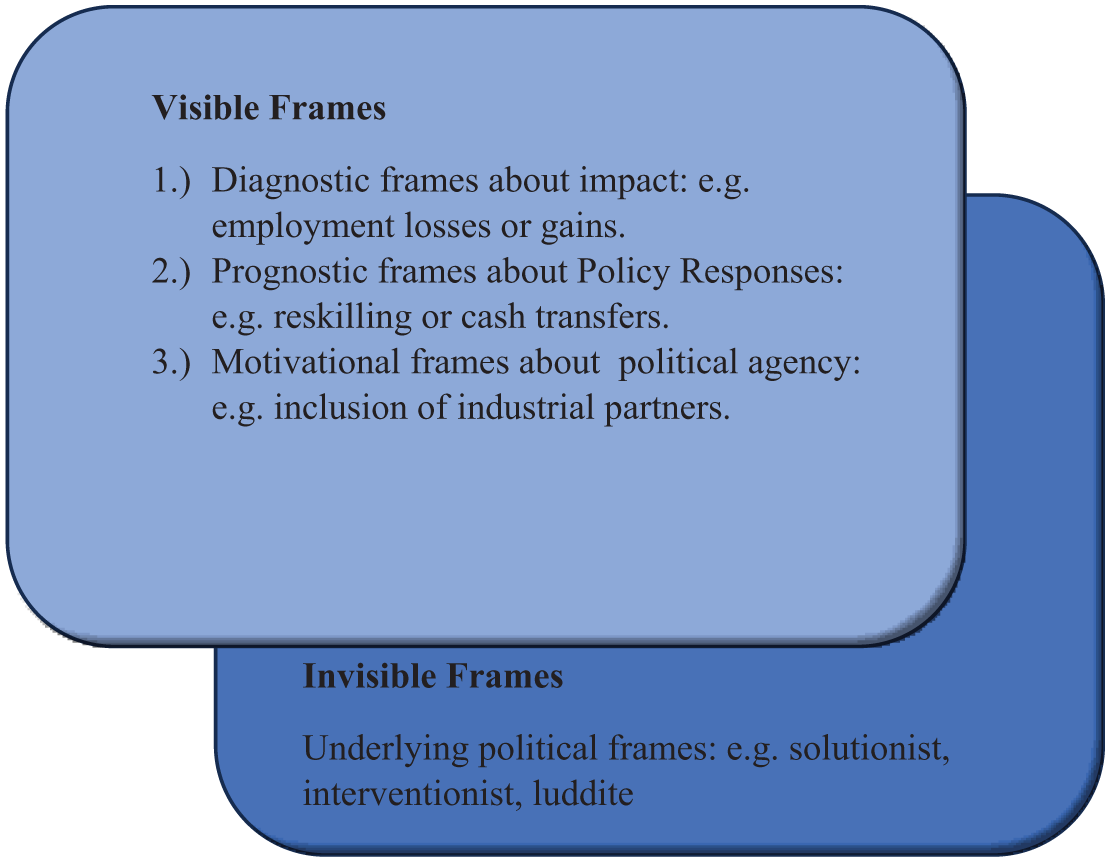
(In)visible frames of FoW.
Beginning with diagnostic frames we see that even discussions about MICs often use cues from academic research for the OECD world. One key example is, whether new technologies will create more jobs than it destroys. In the academic literature, we often see cyclical movements starting with more alarmistic studies followed by less alarmistic scenarios. For instance, Frey and Osborne (2017) forecasted that up to 50% of all jobs in the United States could be susceptible to automation in the next couple of decades. Only 3 years later, Arntz et al. (2016, 2022) found much lower probabilities around 10% for a similar time frame and for a selection of OECD countries. Remarkably, the first study is cited much more than the second, suggesting a premium for alarmistic studies among academic scholars (see Online Appendix). A third famous study (Autor and Dorn, 2013) found less of an aggregate impact, but a job polarization where middle-income jobs will be especially endangered with huge consequences for income inequality. These studies have often been replicated for MICs, sometimes with little reflections about the differing contexts. Other diagnostic frames visible also for MICs are positive, highlighting how technology boosts productivity and creates new jobs (see Kemmerling et al., 2023).
Frames about inequality created by technological disruption also appear in many scientific studies. Inequalities can be between employees, tech companies and the rest of the economy or even between those countries (Brynjolfsson and McAfee, 2014; Guellec and Paunov, 2017). In this regard, the digital divide within countries is a dominant frame for LICs and MICs (e.g. Ragnedda, 2019), while other frames visible in the literature, such as surveillance at the workplace (e.g. Zuboff, 2023) and modalities of work such as the possibility of working from home or anywhere (e.g. Aksoy et al., 2022), tend to get less attention.
These possible frames about the nature and size of the digital shock then lead over to relevant prognostic frames about policy implications. A lot of inspiration comes from the ideas of lifelong learning and social investment (e.g. Garritzmann et al., 2022). Applied to the FoW, this leads to calls for investment in reskilling and specific training measures, allowing the working population to keep up with the innovations. Such calls create resonance in welfare regimes that put emphasis on human capital and commodification instead of social insurance (e.g. Rudra, 2007). The dominant frame for compensating losers is some type of cash transfers and especially in the form of universal basic income (e.g. Chrisp and Martinelli, 2021; Gentilini et al., 2019). In the labour and social policy domain, other important frames abound regarding regulating digital platforms and employment (e.g. Ranft et al., 2018).
In turn, these policy frames may reveal deeper political or motivational frames about the FoW. In this respect, the question is how much the debates are framed as technological or technocratic problems (e.g. Thompson, 2004) and how much they are framed as problems of asymmetries of political power, of political participation and of finding political rather than market-driven solutions. On one extreme end of the spectrum are perspectives on some forms of luddism, defined as a movement to destroy new technologies because of their actual or alleged impact on societies (e.g. Johnson and Acemoglu, 2023; Jones, 2013). Here, big tech companies and new technologies are perceived to be incalculable risks to modern societies, either because they become data feudalists (Saura García, 2024) or because they create unpredictable regulatory risks (e.g. Manheim and Kaplan, 2019).
At the other extreme there is technocratic solutionism (Morozov, 2013), the ‘belief that the use of digital technologies . . . is the royal road to fixing social problems’ (Nachtwey and Seidl, 2024:92). Somewhere in between are different ideologies of economics from less interventionism and more liberalism towards more intervention to compensate for the downsides of technology and to regulate against its dangers. A priori, it is not very likely that IOs engage with these polar views, especially not with Luddite ideas. But as a basic orientation, Figure 2 might be helpful to see where IOs place themselves in their approach to regulation and compensation.
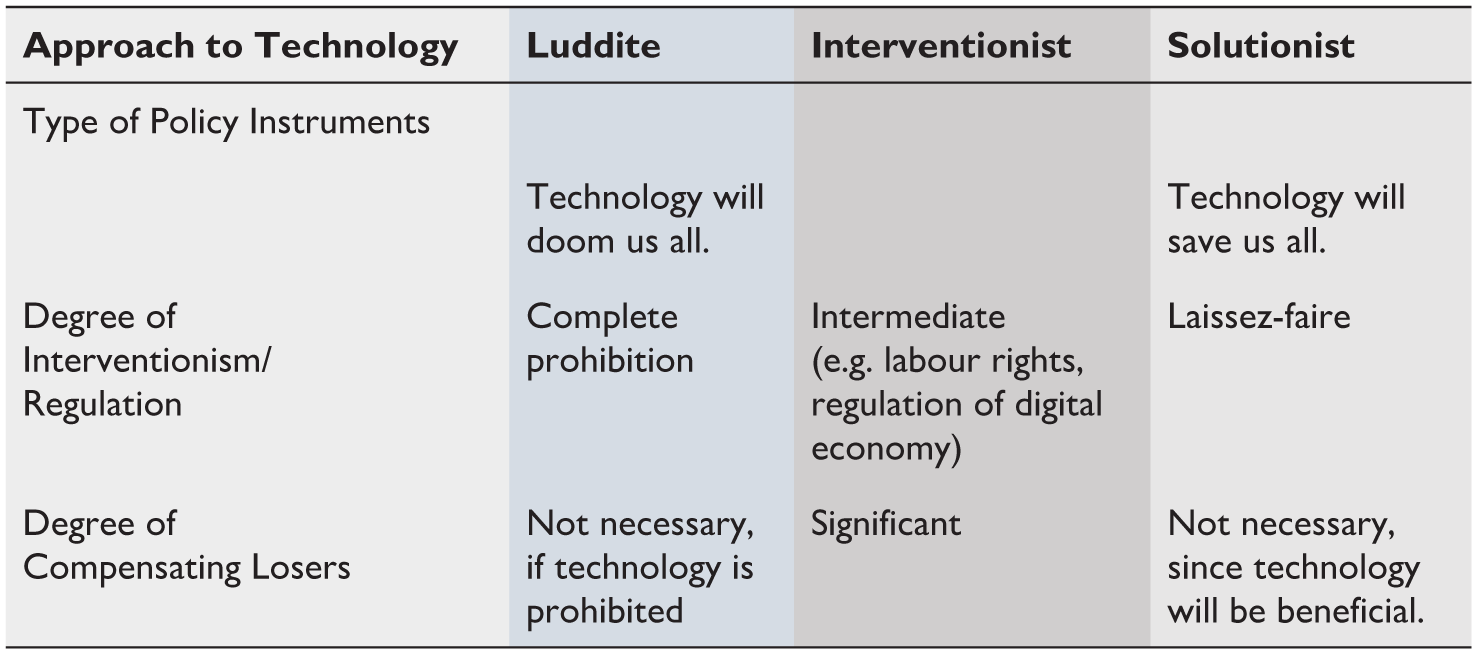
The spectrum of policy beliefs about technology.
All in all, several aspects call for a better understanding of the political underpinnings of the global policy debate. First, the digital disruption is always (hu-)manmade, and hence contingent on political and policy decisions (e.g. Busemeyer et al., 2022). Second, as seen above, the interdisciplinary scientific consensus on FoW can be weak, so it matters who picks which cues from these debates. Third, even on an individual level, public opinion is very much divided on fears and hopes about digitalization, especially if we also look at differences between OECD countries and MICs (e.g. Awuni and Kemmerling, 2024). We would hence expect that IOs do have some ideational leverage, for instance, by endorsing certain policies and not others. It matters which frames they pick.
Methodology: identifying key frames in IO policy reports
In practical terms, our study follows the idea of a systematic literature review (Munn et al., 2018; Paul et al., 2021; Petticrew and Roberts, 2008; Singh and Singh, 2023). We look at a total of 25 policy documents issued by key organizations in the epistemic community of the world of work and welfare. With key policy documents we mean publications that are freely available and accessible to the general public. IOs such as the World Bank are acutely aware of the distribution and circulation of their own reports arguably because this is how they measure impact (e.g. Doemeland and Trevino, 2014).
Policy documents as a concept is not very well specified because it depends on the organization itself. We mentioned above the World Development Reports, but we also include more specific studies on similar topics for regions or countries as examples. We aimed at sampling some of the widely circulated with less widely spread circulations for balance. We also selected publications that give some weight to discussions of MICs (ILO, 2018b; MGI, 2017) as opposed to only or predominantly OECD-oriented contributions.
We look at policy reports from the major IOs: ILO, International Monetary Fund (IMF), the World Bank, as well as the United Nations organizations of Industrial Development (UNIDO) and Trade and Development (UNCTAD). We studied only those IOs with global reach and did not select region-specific IOs such as the Asian Development Bank. As a means of contrast, we add some organizations that are not supranational in nature, but are rather think tanks of global outreach: the MGI and the World Economic Forum (WEF). The selection of these organizations was based on the relative visibility of their publications in the FoW debate, but they might also adopt a visible ‘pro-business’ stance on many framing dimensions.
An initial keyword search 4 yielded 154 publications, some of which were very generic or very similar to pre-existing reports. We narrowed the sample down to 50 articles eligible for review, and then to 25, reducing redundancies within the sources, for example, similar publications. To meet the final selection criteria, a source had to be checked whether they had a policy element and whether they did discuss the topic on MICs.
Once we identified the sources, we did apply mixed methods to extract information from these publications. To define the dimensions for our codebook, we mainly used the academic literature discussed above. From this premise, we proceeded with a coding procedure based on human interpretation. The codebook contains some 40 categories with major frames to be expected in the policy document (see the Online Appendix): diagnostic frames on the socio-economic impact, the prognostic frames on policies as well as political and motivational frames.
With this codebook we mainly coded those segments of the texts where we either found references explicitly to MICs, or where we could infer from the previous discussions that MICs were included or the focus of attention. To assure a comparability in the length of the documents, we only coded some segments of the longer texts such as the World Development Reports.
We also coded the overall sentiment or emotive tone of the policy documents. These codings allow us some degree of quantification of the results, but we also look at the material qualitatively, identifying recurrent patterns, connections between arguments as well as areas of bias or omission. Given that human coding is always subject to simple errors and to substantive disagreements among coders, we cross-checked the validity of some of the categories, by coding a subset of the policy documents twice. We computed measures of inter-coder-reliability (see Krippendorff, 2004) which showed moderate to high levels of agreement (see the Online Appendix). 5
Salient frames in IO policy reports
Descriptives and overall sentiments
As argued before, we select policy reports to cover a wide field of technologies, sectors and countries. Around half of the reports cover various types of technologies, three cover platforms and platform work particularly, five talk about bots and robots and five talk about AI. In terms of sources, the selected 11 are from ILO, so more than 40% of all, because ILO is the most prolific IO with a mandate to speak about topics related to FoW. 6 Furthermore, we included six sources from the World Bank, three from IMF and two from UNIDO and UNCTAD, respectively, two from MGI and one from WEF.
As a first impression, we coded the sentiment or tone of those reports. We opted for a simple, but robust triple coding: 1 ‘negative’, 2 ‘neutral or ambivalent’ and 3 ‘positive’. While there was some disagreement among coders it was relatively low (in less than 20% of all cases).
Table 1 breaks down the sentiment analysis for sources and technologies. We see that, all in all, sentiments are neutral towards positive, which is to be expected given the types of outlets we are looking at. Most positive are the think tanks, for instance, MGI (2017) outlines that ‘even while technologies replace some jobs, they are creating new work in industries that most of us cannot even imagine, and new ways to generate income’ (p. 3). Compared with think tanks, IOs like the World Bank are not markedly more negative in tone. The only exception is ILO, which has a lower score (around 1.8 compared with the mean of 2.2). 7 While this does not come as a surprise because the ILO is known for its commitment towards the decent work agenda, the difference is still noticeable.
Sentiment by organization and type of technology.
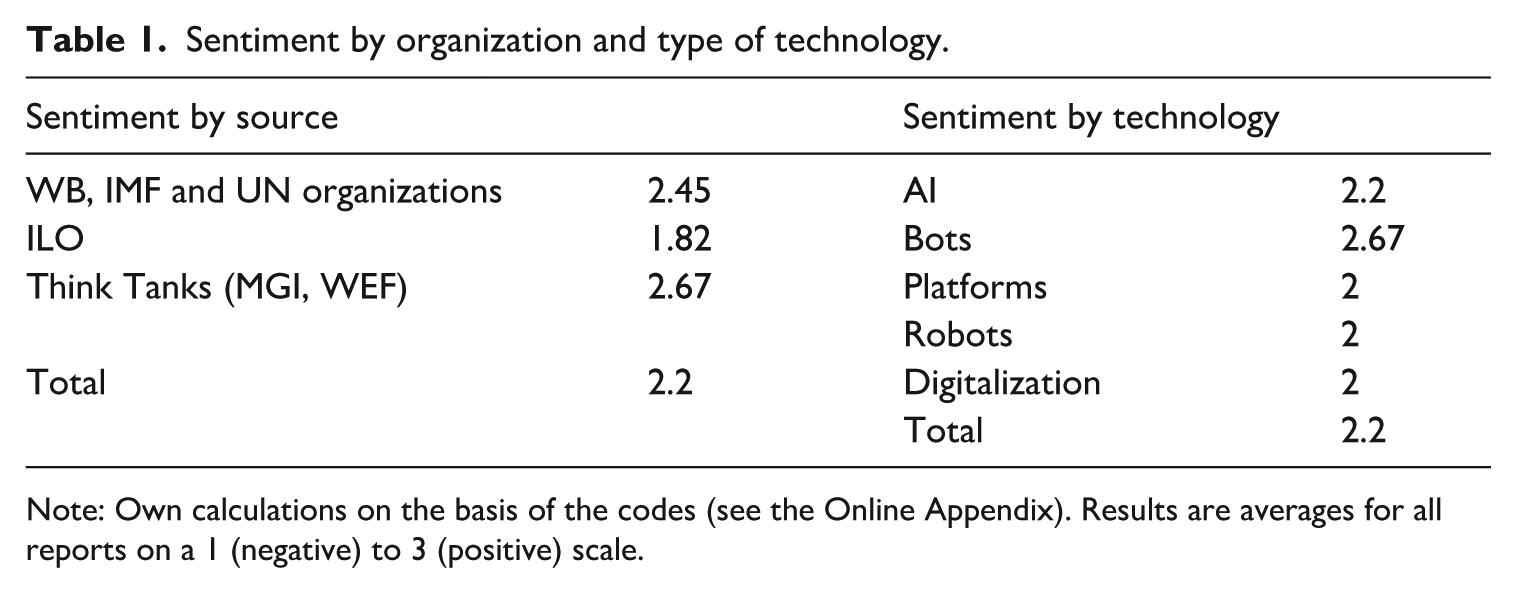
Note: Own calculations on the basis of the codes (see the Online Appendix). Results are averages for all reports on a 1 (negative) to 3 (positive) scale.
Somewhat surprisingly, the differences between technologies are less pronounced. Most concerns are raised about platforms and robots. Discussions about AI and robots are relatively more optimistic, especially in earlier sources (ILO, 2018b). Compared with the literature on economics and other social sciences, the overall tone is clearly more optimistic (see section ‘The ideational power of IOs in global social policy’). This is remarkable, because the reports tend to report negative sources more often than positive ones (see the Online Appendix). Nonetheless, the overall tone does not follow this bias towards more alarmistic sources.
Diagnostic frames about socio-economic impact
To understand better why the overall sentiments swing that way, we look at those parts of the reports that discuss the dimensions of socio-economic impact and how they portray these. First, and perhaps most importantly, a relative majority of sources see technology as producing more jobs than it destroys, closely by those who see a balanced impact (9). Only a minority insinuates a net employment loss (5). Again, this is different from some of the early alarmistic scenarios described in section ‘The ideational power of IOs in global social policy’, but perhaps more in line with the more recent discussions among experts (see also Grimshaw, 2020).
When we look at the sources for this cautious optimism, we see that most studies (more than 90%) invoke frames of productivity and growth that should also benefit the labour market. However, most studies do also concede that some sectors, some occupations and some tasks will be disproportionately affected by the technological disruption emulating assessments of influential academic experts (e.g. Acemoglu and Restrepo, 2019; Autor, 2015).
Figure 3 shows the salience of different types of inequalities and divides that might arise from further digitalization. Socio-(economic) inequality is almost universally invoked in all sources. There is a common worry that sectors and societies in general will drift apart (ILO, 2022a, 2024; UNCTAD, 2021; World Bank, 2016). Most of the discussion boils down to some form of inequality in wages and incomes as a consequence of people ‘racing with or against the machines’. For instance, ILO (2020) states that ‘technological change is associated with increasing wage and income inequality due to falling demand for low- and middle skilled workers’ (p. 106). In this context, gender and the famous digital divide are also frequently mentioned.
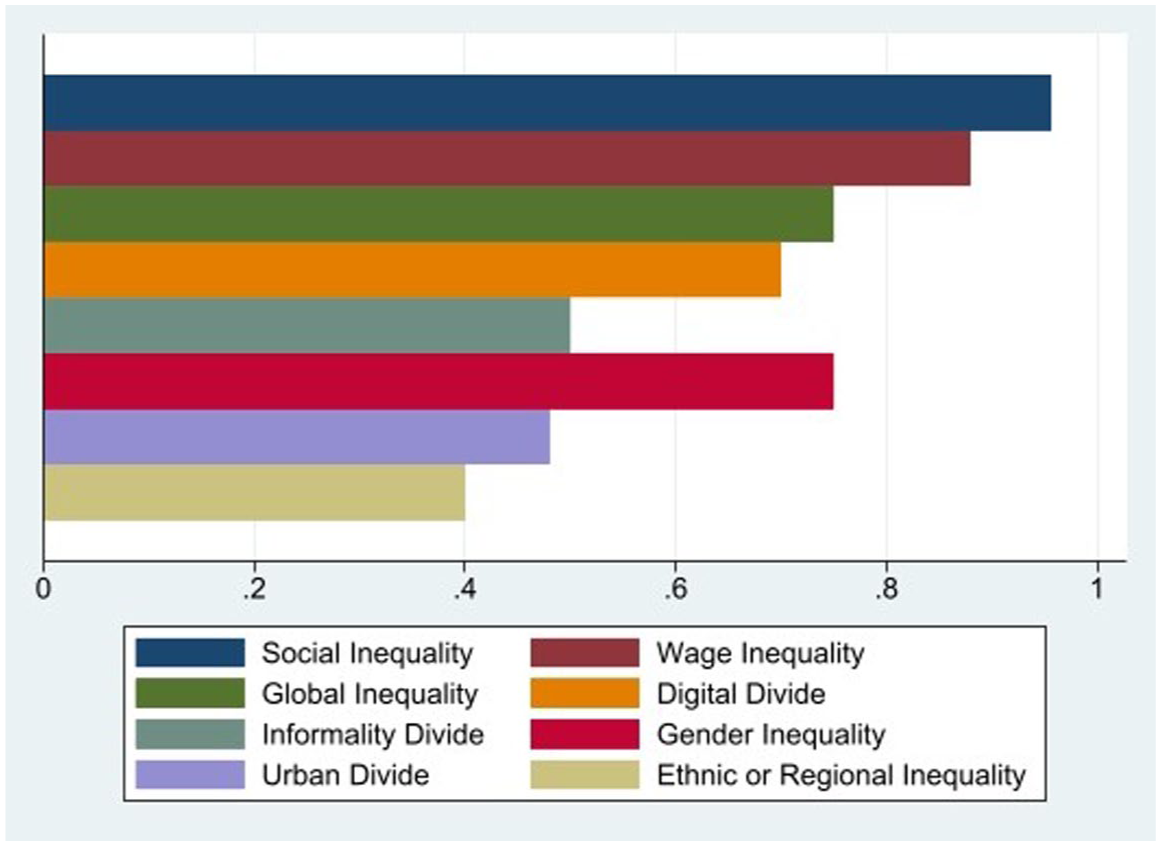
Salient inequalities and divides.
Rather astonishingly, the informal–formal divide is less salient. ILO does mention the topic frequently, but other sources tend to be rather superficial about the topic (see discussions in UNCTAD, 2021; UNIDO, 2019; World Bank, 2017, 2024). The urban–rural divide (see UNCTAD, 2021; World Bank, 2016, 2019; WEF, 2020) and the inequality between different regions (ILO, 2018a, 2023a, 2023b; UNIDO, 2019; World Bank, 2017) are also sparsely mentioned. This is in contrast with the academic literature that shows considerable levels of political and social divides in this regard (e.g. Awuni and Kemmerling, 2024), especially for MICs.
Prognostic frames about policies and motivational frames about politics
So far, most reports are not too alarmistic, but share some concerns about inequality. The question then becomes which policy responses are most salient in these reports, compensating for some of the negative side effects of the FoW. Similar to Figure 3, we look at two clusters of interventions: (1) regulations of different kinds and (2) different financial tools such as transfers or investments.
Figure 4 shows the results for regulations. We see that mainly ILO reports (e.g. ILO, 2018a, 2021b, 2023a) talk about (decent) working standards, while concrete suggestions about employment protection legislation and hiring and firing laws are less salient (only in about 40% of the reports). Working time and its regulation is a more frequent topic and so are discussions about new working modalities (e.g. working from home) (ILO, 2018b, 2020, 2022b, 2024; UNIDO, 2019). However, only some 25% of all reports give specific suggestions such as endorsing home office rules (see ILO, 2021b, 2023a; World Bank, 2016; WEF, 2020). Even where discussed, some reports are vague, endorsing ‘flexibility of working from home or working flexible hours’ (World Bank, 2016: 108). Issues about data protection at the workplace and the regulation of the digital economy in this sense are somewhere in between, visible in some 50% of all reports, but again few of the reports really entail discussions of specific measures, especially about surveillance at the workplace (but see ILO, 2018b, 2020; UNIDO, 2019).
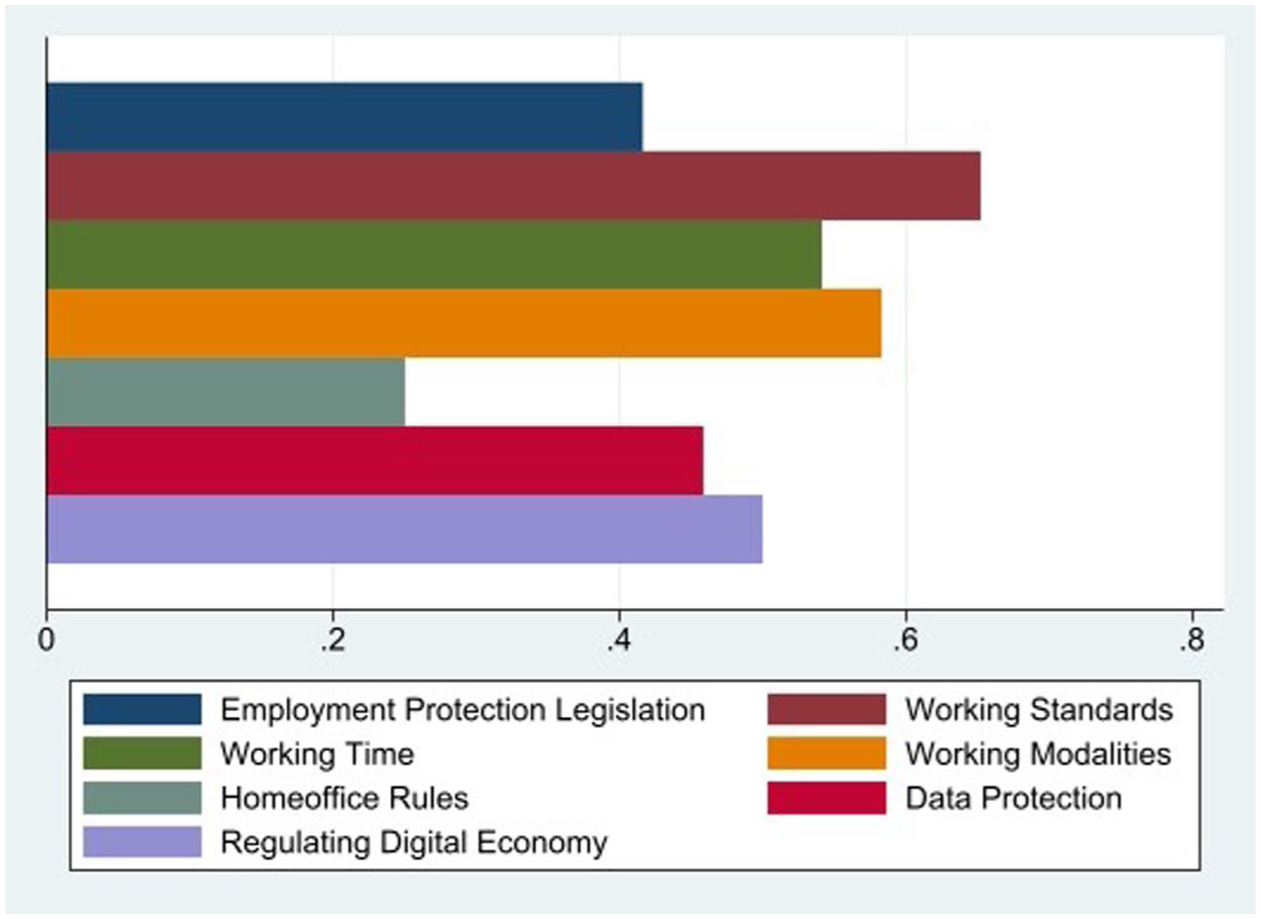
Salience of regulatory measures mentioned.
Figure 5 shows the salience of different financial tools of social protection and investment. We see that social protection in general is a frequent topic, only surpassed by discussions about training and reskilling. If there is a panacea for most of these reports, it is in human capital and social investment. However, we find relatively little reflection on how such reskilling should look like for specific segments, for example, for elderly workers trying to cope with technological change.
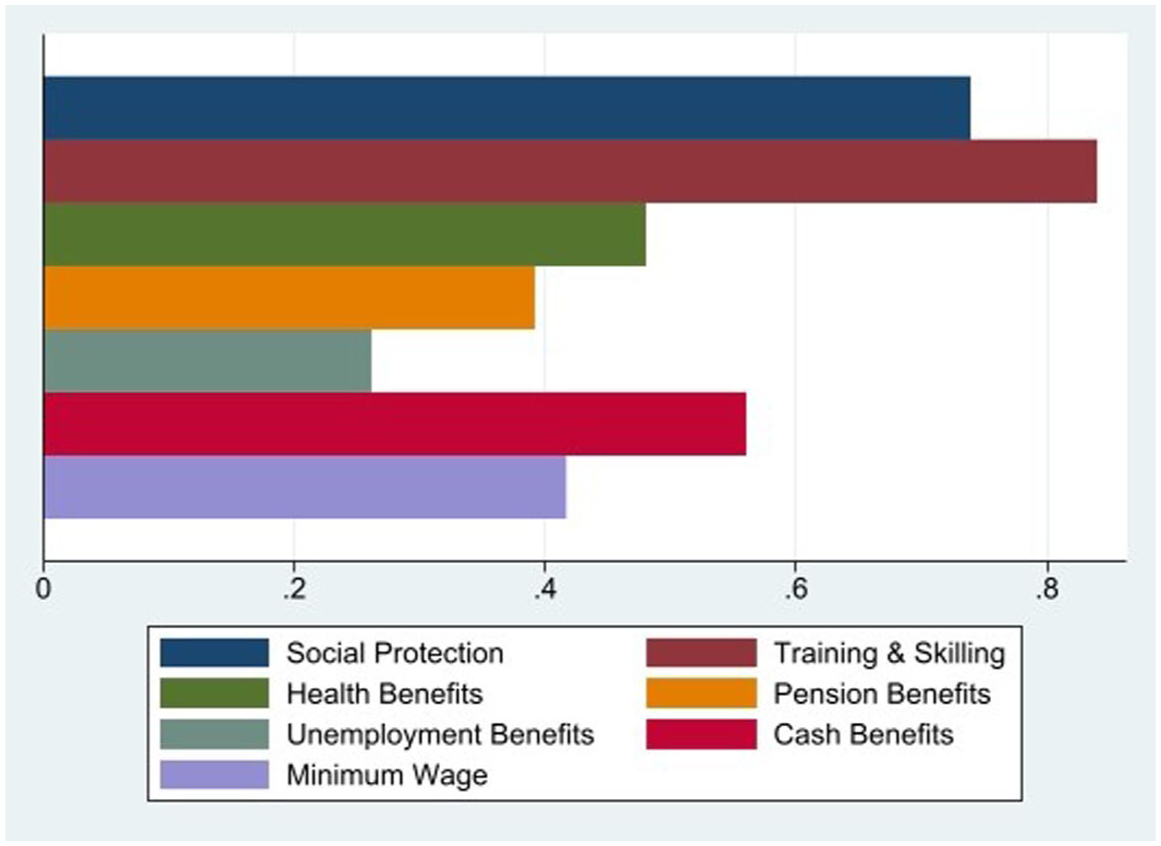
Financial policies and social protection.
Among transfer, cash benefits (conditional or unconditional) are the ones most visible. In this regard, the reports follow the current trend of IOs endorsing cash transfers (ILO, 2018a) or social minimum pensions (e.g. ILO, 2018b), to fighting a global pandemic (e.g. Gentilini et al., 2022; WEF, 2020). Mainly, these discussions refer to some form of conditionality, for example, means-testedness or participating in training measures (MGI, 2020; World Bank, 2019). But several studies have picked up discussions about Universal Basic Income, mentioning some not always well-chosen examples such as Iran and also somewhat sceptical about experiments with unconditional programmes (UNCTAD, 2021: 61). The MGI (2017), for instance mentions somewhat generically: ‘If automation (full or partial) does result in a significant reduction in employment and/ or greater pressure on wages, some ideas such as universal basic income, conditional transfers and adapted social safety nets could be considered and tested’ (p. 5).
By contrast, other transfers are less salient. For instance, health benefits have already lower salience than cash transfers (World Bank, 2023), although they are a big topic for risky digital professions such as working for food delivery or ride-hailing apps. The least important seem unemployment benefits. While a big and politically salient topic in Europe (e.g. Busemeyer and Tober, 2023), they tend not to be featured much (see World Bank, 2023). We also added minimum wage in this graph, because of their close relationship to social minimum protection, but few policy reports mention them.
The final frame type we examine, pertains to the visible political notions articulated in the reports. This dimension is the most difficult to measure, because indeed there are few explicit examples when those IOs dare to tackle sensitive issues. Rather, IOs use ‘code’ when they talk about the issues. An example is the World Development Report 2016, which mentions ‘accountability’ as an important prerequisite for improving digitalization’s effectiveness (World Bank, 2016). But very rarely does it go into details on what the World Bank means directly by this term, namely political feedback loops, lack of corruption and eventually democratic institutions (Williams and Young, 1994).
If you also include such relatively indirect statements about the political dimension, we find some mixed results for the 25 reports. Clear and direct references to the electoral politics of FoW are relatively rare (in less than 20% of all cases). Fears about political polarization are even more absent, in contrast to an increasing interest in the scholarly literature (e.g. Frey, 2019; Im et al., 2019). Similarly, the vested interests of big tech companies are rarely problematized. By contrast, the reports are much more explicit about the role of industrial partners and non-governmental organizations (ILO, 2020, 2022b, 2023b; UNCTAD, 2021; World Bank, 2015, 2016, 2023), whose active participation they see as a solution to overcome some of the problems of the FoW.
Biases, omissions and mindsets in framing
For pragmatic reasons we only picked some of the major policy publications of the past 10 years, while the topics of digitalization and FoW go much further back in time. What we still see, even nowadays, is a relative dearth of information for countries outside the OECD world. Even in the policy reports we studied, countries and regions covered are highly unbalanced with the OECD world and then China and India getting most attention. MICs (and LICs) play less of a prominent role.
Beyond the OECD world, even the reports studied here give few indications of how exactly the digital disruption plays out and there is a lot of uncertainty around the issue (Berten, 2022). What is remarkable though, is that this uncertainty conveys a precautionary approach to the future which is still fairly optimistic. In other realms of assessing technological risks, a precautionary approach would also provoke more risk-averse reactions, but not so in FoW debates. The emphasis of prevailing discourses is on estimating the total amount of jobs gained or lost as well as the types of sectors, occupations and tasks most affected by the uncertainties (see ILO, 2023c; IMF, 2018b; MGI, 2017). Yet, issues around the profits accrued from AI and digitalization and how these are shared – albeit unequally among societies (regions) – often only gets cursory mentioning. The deeper policy issues of inequality in a market dominated by zero marginal costs and oligopolistic structures are thus rarely covered. Notably, suggestions on how to improve tax systems and to minimize harmful tax competition also play a little role in these policy reports, although the linkages between FoW and its implications for fiscal policies are clear (e.g. Busemeyer et al., 2022).
Hence, all in all, epistemic communities embodied in these organizations tend to prioritize those policy areas identified by academic scholars as leitmotifs for global social policy: a Schumpeterian logic-allowing for creative destruction (Silva, 2024) - with an emphasis on investment in human capital and a minimal model of flexicurity with a focus on cash transfers. Most of these policy ideas have been developed in and for the OECD world, although there are emerging discussions about their applicability in other regions (e.g. Garritzmann et al., 2022).
Similarly, issues around putting guardrails to safeguard and regulate technology are not (yet) priority policy for LIC and MICs. The void is striking given that technology adoption is moving fast in MICs and LICs and considering that a lot of big technology companies use low-wage labour in those countries to collect and code data, for example, for large-language models (e.g. Saura García, 2024). There is also little discussion about the dominance in the manufacturing, ownership and patenting in what has been termed as the provision of ‘all-in-one platforms’ (Grimshaw, 2020: 497).
In addition, some policy issues as well as the scientific basis they use are rendered (in)visible. For instance, estimation methods developed for OECD countries do not necessarily fit the context of many MICs. While occasionally this is acknowledged, the numbers are still reported and will develop their own viral dynamics. 8 Or take the example of political considerations such as electoral support of necessary policy reforms which are acknowledged, but rarely to a greater length. Hence, while most IOs seem to converge on bringing the social and economic aspects of policies closer together (Silva, 2024), the same cannot be said for bringing the political and socio-economic aspects. This decoupling of political and economic aspects of policy reforms might ultimately lead to reform failure as has been demonstrated by scholars working on technocratic reforms such as pension privatization (Blyth, 2013; Kemmerling and Makszin, 2023; Orenstein, 2013).
There are some instabilities in these frames, to be expected in a multi-actor field (Caiani, 2023: 198). In some of the publications we find frictions in policy positions even within publications of the same organizations (e.g. World Bank, 2019, 2024). This is evident in the swing from at times optimistic to cautionary sentiments on the impact of digitalization and the FoW within publications. Presumably, this might also extend to inconsistencies on how some policy positions evolve over the years within the same institution(s). For this, we will have to study a longer time frame than we used. Such inconsistencies might reflect the flexibility rather than the rigidity of ideas and knowledge (knowledge inertia). In this sense, ‘frames are also not static’ (Caiani, 2023: 198).
If we move up the ladder of abstraction, new technologies, so far, are never discussed as something that needs prohibition or severe forms of regulation. Luddite frames are near-to-absent. While this is not surprising, it is still remarkable, given that even leading tech experts advocate moratoria in the development of new algorithms (Metz and Schmidt, 2023). Where luddism is explicitly referenced, it seems to be a distant past, such as in IMF’s (2018a) ‘anxiety about the adverse impact of new technologies on jobs and incomes is not new. It dates back at least to the Luddites movement at the outset of the Industrial Revolution’ (p. 4).
Most IOs tend to believe that technology indeed brings some form of progress even if it requires some lesser degree of regulation and compensation. ILO is – to some degree –different from the rest in as much as it insists on more regulation and more compensation, but even ILO is far from a luddite perspective. All IOs highlight the need for reskilling and upskilling, even though predicting future skills is increasingly difficult in a world in which new fundamental technological revolutions seem to happen every other half a decade nowadays. Hence, overwhelmingly relying on lifelong learning evident in most of the reports (e.g. ILO, 2023c) is understandable, but also seems exaggerated, especially, if waves of technological innovations come faster and faster. Taken together, the mindset shining through most of the reviewed reports can be characterized by some form of conditional solutionism: technology can be very productive and create new employment, if its potential is realized through a set of well-known, but very narrow policy measures of education and some form of minor compensation.
Conclusion
We should highlight the general limitations of our own study. The selection of policy documents can be challenged. We aimed at a good balance in regional terms, different types of organizations and degrees of policy impact. Moreover, our mix of qualitative and simple quantitative methods can be challenged. There is a certain degree of subjectivity that is unavoidable in human coding, but we do believe that this is not a nuisance, but reveals some of the strengths of human research against AI-driven alternatives. Moreover, automated content analysis is neither completely devoid of human interpretation nor of mistakes. Our study is hardly the only one that could be criticized as exhibiting human bias, albeit our ‘technology’ is much more primitive.
As we have seen, real interventionist frames, let alone frames that call for prohibiting the spread or development of certain types of technologies, are rare. With some exceptions, technology is seen as something with huge potential, which only needs the right calibration: human beings with the adequate skills, moderate forms of regulation and compensation for those falling behind. Despite serious discussions of the downside of technology, most IOs follow a conditional solutionist spirit of digital capitalism that asks society to adapt to the needs of technology, rather than technology adapting to the needs of society. They do so, more often than not, even if the underlying empirical evidence presented in academic sources are much more cautious or negative.
This creates fascinating follow-up questions. For instance, how do IOs deal with underlying sources, statistics and evidence? There is a lot of research on evidence-based policymaking in IOs but even when they explicitly use these sources, they seem to create their own findings which do not need to align with the underlying sources. A second question is how they engage with uncertainty. Berten (2022), for instance, highlighted that the technological revolution triggers a precautionary approach, but it does not induce typical risk-averse behaviour, so how do those IOs come to such a seemingly incongruent approach?
In this article, we highlighted some approaches from the literature on the social reception technology. We believe the solutionist mindset visible in those debates, not only has consequences for how IOs frame the FoW, but also have consequences for national debates on related topics. For instance, for countries like Indonesia we do find national ministries very much emulating the tone and messages of World Bank reports (Kemmerling and Ranawijaya, 2024). In other contexts, the signals might be less strong or come primarily from other IOs such as ILO. Further research should go much further in showing linkages between the type of policy recommendations visible in IO and think tank reports and domestic policy discussions.
We do not go deeper into the origins of this (conditional) solutionist mindset. Of course, political economy plays an important role here, since big tech companies and the governments benefitting from them shape the global policy agenda (e.g. Busemeyer et al., 2022; Rikap, 2021). This might also explain why we see this solutionist mindset not only in one major IO or think tanks, but in most of them, with those closer to big business also showing more of it. For students of global social policy, it is remarkable how well a mindset poised towards creative destruction, a focus on human capital and an idea of flexicurity with some degree of compensation neatly fits the technological narrative of solutionism. These sets of ideas as well as their advocates do work in lockstep with each other and create a global social policy agenda that is limited in scope. For one, it (practically) excludes more prohibitive and stronger policy options (tougher fiscal stances on platforms, forcing them to recognize platform workers as dependent employees, etc.). Moreover, solutionism is also a universalist creed often not much adjusted to the local context of MICs and hardly able to address the deeper, structural issues exposed by the technical disruption.
Supplemental Material
sj-docx-1-gsp-10.1177_14680181251389617 – Supplemental material for Conditional solutionism: How international organizations frame the future of work in middle-income countries
Supplemental material, sj-docx-1-gsp-10.1177_14680181251389617 for Conditional solutionism: How international organizations frame the future of work in middle-income countries by Achim Kemmerling and Gift Mwonzora in Global Social Policy
Footnotes
Acknowledgements
The authors thank Viddy Ranawijaya, the members of EIPCC, University of Erfurt, PERG, Central European University Vienna, the participants of the ReCentGlobe Annual Conference 2024 on ‘Technology, Resources, and New Global Dynamics’ – 17–19 April 2024, held in Leipzig – Germany in particular Marian Burchardt and Florian Stolle for their comments. All remaining errors are their own.

Funding
The authors disclosed receipt of the following financial support for the research, authorship and/or publication of this article: The research project was funded by the Deutsche Forschungsgemeinschaft (DFG, German Research Foundation) under the Grant Project Number: 504172432 on the Politics and the Future of Work in Middle-Income Countries (PolDigWork) covering Mexico, Indonesia and South Africa.
Declaration of conflicting interests
The authors declared no potential conflicts of interest with respect to the research, authorship and/or publication of this article.
Supplemental material
Supplemental material for this article is available online.
Notes
Author biographies
References
Supplementary Material
Please find the following supplemental material available below.
For Open Access articles published under a Creative Commons License, all supplemental material carries the same license as the article it is associated with.
For non-Open Access articles published, all supplemental material carries a non-exclusive license, and permission requests for re-use of supplemental material or any part of supplemental material shall be sent directly to the copyright owner as specified in the copyright notice associated with the article.
