




Abstract
Free school meals can be a transformative social policy instrument, especially in the Global South. Domestically sourced school feeding programs can improve children’s food security, augment household incomes, incentivize school attendance, and support local agricultural production. Scholars have so far paid only limited attention to the political causes and processes behind school feeding programs. To contribute to a better understanding of school food politics in Africa, we study the development of two national school feeding programs in Nigeria. We reconstruct and compare the development of the Obasanjo administration’s Home-Grown School Feeding and Health Programme, implemented from 2005 to 2008, and the Buhari administration’s National Home-Grown School Feeding Programme, implemented from 2016 to 2023. We argue that the relatively more successful implementation of the Buhari-era program was the result of a presidential ideology that was more supportive of social policy expansion, a policy design that was more conducive to state-level program implementation, and supportive technical assistance from the London-based Partnership for Child Development.
Keywords
Introduction
Recent decades have witnessed the global expansion of publicly financed school feeding programs (SFPs). Free school meals are not only ‘politically popular’ (Alderman and Bundy, 2012: 204), they also have the potential to be transformative, especially in the Global South. According to Thandika Mkandawire (2007) and Jimi Adesina (2009, 2011, 2015), social policies can be ‘transformative’ to the degree that they go beyond being residual safety nets and instead fulfill multiple functions as part of a broader development strategy. 1 Broad-based, domestically sourced (‘home-grown’) SFPs, like those of Brazil or Ghana, are an ideal-typical example of social policies that fulfill multiple functions. They directly improve children’s food security and augment the incomes of poor households (Alderman and Bundy, 2012). They also facilitate human capital formation by incentivizing regular school attendance and enabling children to focus on learning (Aurino et al., 2023). Moreover, they support local agricultural production by creating ‘structured demand’ through public procurement (Sumberg and Sabates-Wheeler, 2011).
Today, an estimated 418 million children benefit from SFPs globally, making school feeding one of the world’s most extensive social programs (Bundy et al., 2024: 4, 10). While much of this progress has been driven by the expansion of SFPs in large emerging economies, like those of Brazil, China, and India, the coverage and generosity of SFPs remain lowest where it is most needed, namely, in low- and lower middle-income countries, especially in Africa (WFP, 2022: 56–57). Yet, scholars of the politics of social policy in Africa and the broader Global South rarely examine school feeding in detail (but see Robert and Gaddis, 2025; Rutledge, 2012, 2013; Seekings, 2016, 2020b). We therefore still know relatively little about school food politics, that is, the political causes and processes behind the formulation, introduction, implementation, and maintenance (or termination) of SFPs.
To contribute to a better empirical and theoretical understanding of school food politics in Africa, we first provide a comprehensive overview of the domestic and international political dynamics of SFP development across the African continent, drawing on existing literature as well as our own research. We then conduct a detailed case study of school feeding in Nigeria, a lower middle-income country and federal democracy with a population of more than 200 million. School feeding holds immense potential in Nigeria, where undernutrition among school-aged children remains a major social problem. In 2015, 37% of all school-aged children had low height-for-age (i.e. were stunted), while 29% were underweight (Iheme et al., 2025: 5). Despite its substantive relevance, Nigeria remains underresearched by scholars of social policy development (but see Adesina, 2012; Kpessa, 2011) and school food politics (but see Rutledge, 2013).
The development of national school feeding in Nigeria provides an interesting case to study the political dynamics of SFP development in Africa. Since 1999, Nigeria twice attempted to introduce national, that is, federally funded, school feeding. In 2005, the administration of Olusegun Obasanjo introduced the Home-Grown School Feeding and Health Programme (HGSFHP), motivated by a joint initiative of the World Food Programme (WFP) and the New Partnership for Africa’s Development (NEPAD). The program aimed to reach 2.5 million children, but it was suspended by the Yar’Adua administration in 2008 due to a supposed combination of non-utilization and misappropriation of federal funds. In 2016, the administration of Muhammadu Buhari introduced the National Home-Grown School Feeding Programme (NHGSFP), informed by Osun State’s acclaimed state-level SFP and with technical assistance from the Partnership for Child Development (PCD). At its peak, the NHGSFP reportedly reached 9.9 million children in 2022. This program stopped being implemented by the outgoing Buhari administration in 2023 and it was formally suspended by the Tinubu administration in 2024 on account of the misappropriation of funds by the responsible minister. While both of these national SFPs were eventually suspended, the Buhari-era NHGSFP can be considered a relative success, as it covered more children and was implemented longer than the Obasanjo-era HGSFHP.
In this article, we reconstruct and compare the development of these two national SFPs. We argue that the relative success of the Buhari administration’s NHGSFP was the result of a presidential ideology that was more supportive of social policy expansion, and of a policy design that was more conducive to state-level program implementation. Our analysis is based on a qualitative content analysis of 93 primary documents and seven in-depth interviews with key informants. To make our analysis more transparent, we present complete references to all our primary sources and more detailed information on the conducted interviews in the online supplementary material.
School food politics in Africa: an overview
The history of publicly financed school feeding in Africa goes back to at least 1935, when a school dairy program was introduced in South Africa. Since then, SFPs were introduced in most African countries, although programs have varied greatly in coverage and generosity. During the 20th century, many SFPs were operated by international actors, in particular the WFP and Catholic Relief Services (CRS). Since the 2000s, national governments have played an increasingly important role in the operation and funding of SFPs, although (old and new) international actors continue to be influential through financial and technical assistance. In this section, we provide an overview of African school food politics up until the early 2020s. 2 Empirically, we focus on three countries whose SFPs have already been studied in some detail, namely, South Africa, Botswana, and Ghana, and on three international actors that have been particularly active in the promotion of school feeding across Africa, namely, the WFP, NEPAD, and Brazil – around which we also structure this overview.
As noted above, South Africa has a particularly long history of school feeding. Public school feeding first emerged in South Africa in 1935, when the government of the Union of South Africa introduced a Milk and Cheese Scheme for primary-school and ‘necessitous’ secondary-school children (Source 1, abbreviated S1). 3 This program was motivated, at least in part, by surplus dairy production (Kallaway, 1996: 3). It was also ‘racially hierarchized’, initially targeting only children of ‘European, Indian and Coloured origin’ (Chipenda et al., 2021: 6). African children were included in 1943, through the Native School Feeding Scheme, but this program remained ‘underfunded’ and only reached ‘a minority of African students’ (Chipenda et al., 2021: 8). After the 1948 election victory of the white-supremacist National Party and the beginning of apartheid, all SFPs were soon dismantled (Kallaway, 1996). A major reason for this was the National Party’s desire to end the Native School Feeding Scheme benefiting African children (Chipenda et al., 2021: 12–17).
School feeding quickly re-emerged on South Africa’s political agenda after the end of apartheid and the 1994 election victory of Nelson Mandela’s African National Congress (ANC) (Devereux et al., 2018: 10–12; Seekings, 2020b: 5). One of the ANC’s flagship programs, the Primary School Nutrition Programme was launched in September 1994, with technical assistance from the United States Department of Agriculture (S2). The program was renamed the National School Nutrition Programme in 2006 and expanded to include secondary school students (Devereux et al., 2018: 12). In 2018/2019, the program reached 9.6 million school children (of a population of 58 million) on a budget of approximately US$0.5 billion, making it one of Africa’s largest SFPs (Seekings, 2020b: 5). This reintroduction and expansion of South Africa’s SFP after 1994 was clearly driven by South Africa’s democratization and the change in ruling party from the apartheid-era National Party to the ANC.
World Food Programme
Since the 1960s, the development of school feeding across Africa has been substantially influenced by the World Food Programme (WFP), the United Nations’ specialized agency for food assistance. The WFP was established in 1961 on the initiative of the United States (Shaw, 2011), which has remained the agency’s largest and most influential donor until at least 2024 (S3). The WFP’s support for school feeding has historically had a strong focus on Africa (Rutledge, 2013: 19). One of the first WFP-supported SFPs was introduced in Togo in 1963, just 2 years after the agency’s creation (S4). The WFP subsequently began operating SFPs in many other African countries, including in Lesotho in 1965 (Devereux et al., 2018: 20) and Benin in 1967 (Gaesing et al., 2023: 10). Most of the WFP’s food assistance during this era was sourced in-kind from surplus agricultural production in the Global North (Shaw, 2011: 341). The WFP’s support for school feeding declined during the 1980s and 1990s, when the agency adopted a more exclusive focus on emergency relief (Shaw, 2011: 359).
The WFP’s long-term impact on SFP development is well documented for the case of Botswana (Seekings, 2016, 2020c). Botswana introduced a large-scale SFP in 1966 in response to a massive drought and with extensive funding from the WFP (Seekings, 2016). In the late 1960s and early 1970s, ‘Botswana received more WFP food aid per capita than any other country’ (Seekings, 2016: 35). The WFP withdrew its support in the 1980s in light of the country’s economic development and the end of several droughts (Seekings, 2020c: 126). Botswana’s government maintained the SFP, not least because it had become a central source of electoral support (Seekings, 2020c: 125). This illustrates the long-term policy effects that WFP support can have on SFPs (Seekings, 2020c: 126). Today, Botswana’s SFP reportedly covers all of the country’s approximately 0.6 million primary school students (WFP, 2022: 250).
Donor support for school feeding in the Global South increased again in the early 2000s. In 2000, against the background of a renewed institutional focus on development projects and at the initiative of the United States (Shaw, 2011: 238–239; 359), the WFP established a dedicated School Feeding Service and launched its Global School Feeding Campaign ‘to encourage governments throughout the world to put in place national school feeding programmes’ (S5; see S6; S7; Interview 4). The WFP has always had a strong focus on Africa, where it ‘assists more people and spends more money [. . .] than in any other continent’ (S8). Bilateral donor support for school feeding also increased in the 2000s. In 2002, the United States launched the McGovern-Dole International Food for Education and Child Nutrition Program, which has funded SFPs in ‘priority countries’ around the world (S9). In 2024, 25 out of 44 active McGovern-Dole programs were implemented in Africa (S10). Some of these programs have been implemented by the WFP, for example, in Rwanda, others by international non-governmental organizations, such as Catholic Relief Services, for example, in Togo (S10).
New partnership for Africa’s development
In Africa, increased international donor support for school feeding coincided with the creation, in 2001, of the New Partnership for Africa’s Development (NEPAD) by the Organisation of African Unity, the precursor of the African Union (Adesina, 2006: 35). NEPAD sought to promote socioeconomic development in Africa through policy recommendations inspired by the ‘post-Washington Consensus’ and in close cooperation with donor countries and international financial institutions (Adesina, 2006: 37–42). NEPAD identified ‘social safety net mechanisms’, including school feeding, as ‘essential for Africa’s hungry poor’ (S11). On the suggestion of the WFP and the United Nations Millennium Project’s Hunger as well as Education and Gender Task Forces, NEPAD adopted ‘home-grown’ school feeding as a central policy recommendation (Gelli et al., 2010: 4; Interview 6). Home-grown school feeding seeks to ‘link school feeding to agricultural development through the purchase and use of locally and domestically produced food’ (Gelli et al., 2010: 1; see Morgan and Sonnino, 2008: 150; Sumberg and Sabates-Wheeler, 2011).
In 2003, the WFP and NEPAD agreed to launch a pilot program to support the adoption of home-grown school feeding and prepared a ‘joint concept paper [. . .] to help governments plan for implementation of this programme at the national level’ (S12). Ten member states of the African Union, including Nigeria, were eventually selected to implement national pilot programs in 2005, although in the context of ongoing disagreements over how much of the program funding national governments would have to contribute (S13; S14; Morgan and Sonnino, 2008: 157–158).
In Ghana, the NEPAD initiative facilitated the introduction of a large-scale national SFP. Humanitarian aid organizations, such as the Catholic Relief Services and the WFP, had operated smaller SFPs in Ghana since the 1950s (Morgan and Sonnino, 2008; Sulemana, 2016: 58). The NEPAD pilot program motivated the 2005 introduction of the country’s first national SFP, the Ghana School Feeding Programme (GSFP). The introduction was co-funded by the Netherlands Development Organization (SNV) (Morgan and Sonnino, 2008: 157–158). Ghana’s SFP was introduced by the center-right government of John Kufuor (2001–2009), during a period characterized by high electoral competition and a ‘cross-party consensus on the need for a comprehensive social protection system’ (Grebe, 2015: 3). Since the mid-2010s, Ghana’s SFP has been under significant fiscal pressure, as the country has gone through a protracted economic crisis and multiple loan agreements with the International Monetary Fund (Mohammed, 2021). Today, Ghana’s SFP covers an estimated 3.4 million children, about 55% of all primary school students (WFP, 2022: 252).
Ghana’s SFP has been demonstrated to have clear positive effects on educational attainment (Aurino et al., 2023). Yet, the program has also suffered from politicized implementation. While the GSFP was introduced with the intent to target the ‘most deprived districts/communities’, expenditure allocations came to starkly advantage regions that were comparatively wealthy but political strongholds of the ruling party (Abdulai and Hickey, 2016: 67–68). Schools have been more likely to be included ‘if the headteacher and [local District] Assembly member have strong linkages with the party in power’ (Botchwey, 2021: 72). Catering contracts are often awarded to members of the region’s governing party, especially its women’s wing, thus ‘rewarding political party activists and supporters’ but leading to lower ‘quantity and quality of meals that are served’ (Mohammed, 2022: 908–909). It was evidence of such ‘excessively politicized’ implementation that led the Netherlands Development Organization to withhold its funding for the program at least once (Abdulai and Hickey, 2016: 70).
Brazil’s South–South development cooperation
Since the late 2000s, Brazil has been a new important supporter of global SFP development, especially during the left-wing presidencies of Lula da Silva (2003–2010, 2023–today) and Dilma Rousseff (2011–2016). Brazil significantly expanded its own National School Feeding Program and introduced extensive local purchasing requirements in the 2000s (Sidaner et al., 2013). Brazil’s SFP has since become a global model, which Brazilian state actors have actively promoted through South–South development cooperation (Leite et al., 2015; Nehring and Hoffmann, 2017). These efforts were institutionalized through the 2011 establishment of the WFP Center of Excellence against Hunger in Brasilia (Dri and Molinari Da Silva, 2021). Primarily financed by Brazil and focused on technical assistance, the center organizes frequent visits by delegations from low- and middle-income countries, often with a focus on Brazil’s SFP (Dri and Molinari Da Silva, 2021: 676).
Brazil’s efforts to promote school feeding had a strong focus on Africa. From 2012 to 2016, Brazil cooperated with the WFP, the Food and Agriculture Organization (FAO), and the United Kingdom’s Department for International Development (DFID), in implementing the ‘Purchase from Africans for Africa’ program, which promoted Brazil-inspired local school food procurement in Ethiopia, Malawi, Mozambique, Niger, and Senegal (Nehring and Hoffmann, 2017: 41–42). Brazilian advocacy also contributed to the African Union’s adoption of home-grown school feeding as a high-level policy goal and the launch of the African Day of School Feeding in 2016 (S15). However, the policy impact of Brazil’s efforts to promote school feeding in Africa remains unclear. In Mozambique, for instance, Brazilian technical and financial support facilitated the 2013 introduction of a national SFP closely modeled on the Brazilian model, but program funding and implementation have remained weak (Milhorance et al., 2019: 449–454).
In conclusion, there have been various international influences on the development of SFPs in Africa. Since the post-colonial era, international donors have been closely involved in the financing of SFPs, often with operational support from the WFP or nongovernmental organizations. Since the 2000s, the African Union and Brazil have emerged as new advocates of school feeding in Africa, focused on South–South technical assistance. Regarding the domestic political dynamics of SFPs, one can note that in South Africa the 1994 reintroduction and subsequent expansion of school feeding was led by the broadly center–left African National Congress in the wake of the country’s democratization. In Ghana, in contrast, the 2005 introduction of a national SFP was led by the center–right government of John Kufour and his New Patriotic Party in a context of high electoral competition. This suggests that school feeding can be promoted by political leaders and parties of different ideological orientations, while generally benefiting from democratic political competition.
Political, economic, and social development in Nigeria’s Fourth Republic
To contribute to a better understanding of the political dynamics of school feeding in Africa, we conduct a case study of the development of school feeding in Nigeria. In 2018, Nigeria was home to 206 million people, including around 37 million children in primary-school age (6–11 years), of which, however, only about 64% regularly attended school (S16). In 2015, 37% of all school-aged children had low height-for-age (i.e. were stunted), while 29% were underweight (Iheme et al., 2025: 5). Broad-based school feeding could go a long way toward reducing undernutrition, while incentivizing school attendance and supporting local agricultural production (Adeyanju et al., 2024). Before turning to a detailed analysis of the development of school feeding, we provide some relevant background on Nigeria’s recent political, economic, and social development.
Nigeria gained political independence from the British Empire in 1960. Its Fourth Republic, that is, the country’s fourth post-colonial period of democratic government, was established in 1999. It is a federal republic, in which 36 state governments are led by governors and the federal government is led by a president. Since 1999, Nigeria has had five different presidents, all coming from Nigeria’s two major parties, the People’s Democratic Party (PDP), founded in 1998, and the All Progressives Congress (APC), founded in 2013. According to the Varieties of Democracy database, Nigeria was an ‘electoral autocracy’ from 2000 to 2010, an ‘electoral democracy’ from 2011 to 2020, and has been an ‘electoral autocracy’ again since 2021. Throughout its Fourth Republic, Nigeria has suffered from high levels of political corruption (Igiebor, 2019).
Nigeria’s economic development since 1999 has been volatile. Nominal gross domestic product (GDP) per capita rose steadily from US$481 in 1999 to US$3089 in 2014 but has since fallen again sharply, reaching US$807 in 2024 (S17). Nigeria made the transition from a low-income to a lower middle-income country in 2008, limiting its eligibility for international development aid (Dolan et al., 2020). Agriculture continues to make up the largest part of the Nigerian economy and small-scale, subsistence agriculture remains common. Government revenues, however, depend overwhelmingly on oil exports, which has made them extremely dependent on world oil prices. Nigeria’s poverty rate has risen since the 1970s and has since remained persistently high. In 2018/2019, 31% of Nigeria’s population lived below the extreme poverty line of US$2.15 per person per day (S18). This combination of extensive oil revenues and increasing poverty has made Nigeria a frequently cited example of the ‘resource curse’ (Idemudia, 2012).
Social policy development during Nigeria’s Fourth Republic has occurred in the aftermath of a period of authoritarian neoliberalism in the 1980s and 1990s, characterized by austerity measures, structural adjustment policies, and retrenchment of social programs (Ihonvbere, 1993: 142). Since Nigeria’s redemocratization in 1999, there has been a renewed political focus on social reform. For instance, in 2001, the Obasanjo administration introduced the National Poverty Eradication Programme (NAPEP), including the well-known ‘Keke NAPEP’ scheme, which subsidized the acquisition of tricycles to support employment generation (Paul and Ojo, 2017). In 2004, the Obasanjo administration also introduced a comprehensive pension reform, which replaced the country’s fragmented and reportedly largely ‘bankrupt’ pension system with ‘fully-funded individual retirement saving accounts’ (Kpessa, 2011: 96–97), modeled after Chile’s privatized pension system (Casey and Dostal, 2008: 241). In 2007, the Yar’Adua administration introduced a small conditional cash transfer program, In Care of the People (COPE), initially financed through an international debt relief program (Umukoro, 2013). In 2014, the Jonathan administration adopted the National Health Act to make healthcare funding more sustainable (Chukwuma, 2023; Chukwuma and Obi, 2025). In 2016, the Buhari administration introduced four new social programs under the umbrella of the National Social Investment Programme (NSIP), including an expanded conditional cash transfer program (Ajah, 2023). Despite all these new programs, Nigeria’s social policy system remains limited in coverage and chronically underfunded (Hagen-Zanker and Holmes, 2012).
The development of national school feeding in Nigeria
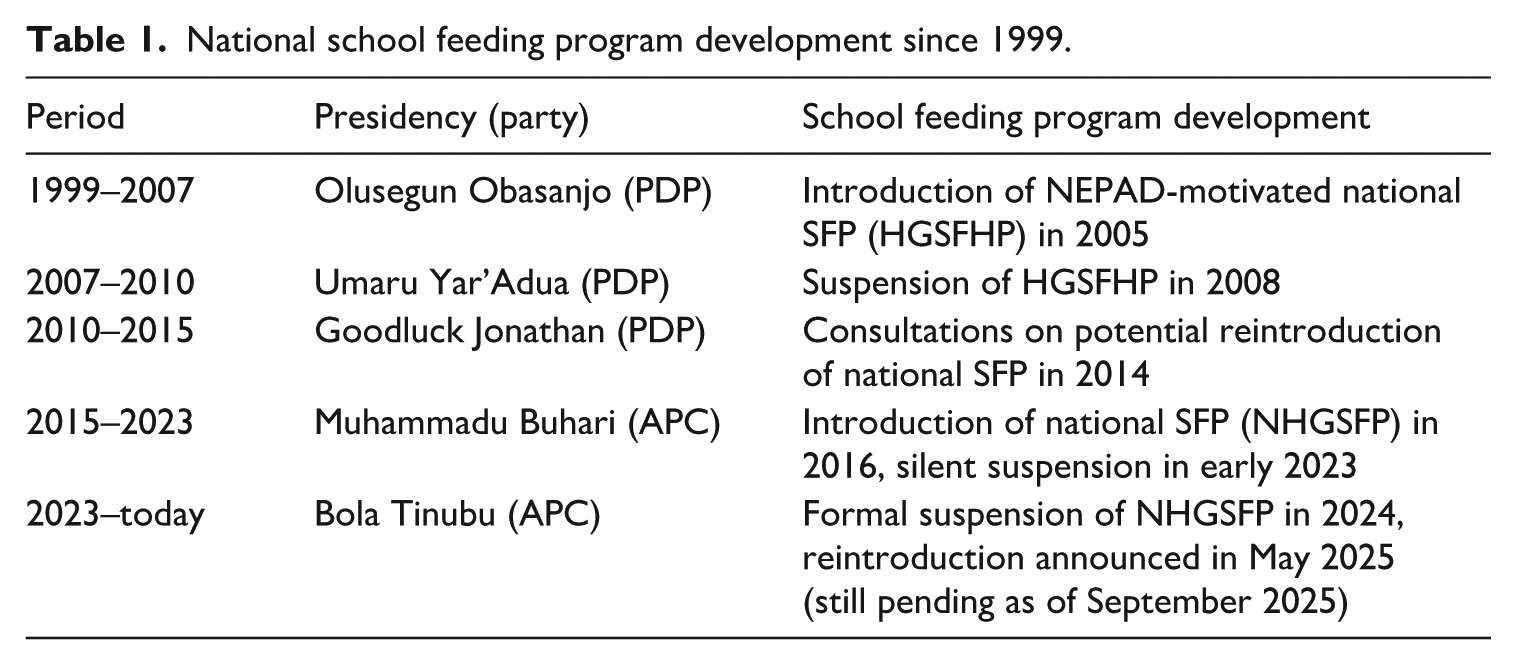
Since redemocratization in 1999, Nigeria twice operated national, that is, federally funded, SFPs, first from 2005 to 2008 and again from 2016 to 2023. In the following, we reconstruct the development of national school feeding in Nigeria. Table 1 provides an initial, schematic overview of national school feeding development during the five most recent presidential administrations.
National school feeding program development since 1999.
Obasanjo administration: introduction of the HGSFHP
The development of publicly financed school feeding in Nigeria can be traced back to 1999, when Olusegun Obasanjo (PDP) became Nigeria’s first president after the restoration of democracy. 4 In that year, Kano State introduced a state-level SFP, which was implemented during the first administration of governor Rabiu Kwankwaso (PDP), from 1999 until 2003 (S20). At the national level, the Obasanjo administration incorporated school feeding into its flagship education reform (S21). Nigeria’s 2004 Universal Basic Education Act required ‘every [state] government in Nigeria’ to provide ‘free, compulsory and universal basic education for every child of primary and junior secondary school age’ as well as related services, notably including ‘free lunch’ (S22; see S23).
The idea of introducing a national SFP in Nigeria was strongly influenced by global and regional policy debates, in particular those surrounding the creation of NEPAD in 2001. As discussed above, NEPAD had adopted ‘home-grown’ school feeding as a policy recommendation for all AU member states and, together with the WFP, had launched a pilot program to support the introduction of national programs. Nigeria was among the 10 member states that participated in this NEPAD pilot program. The Obasanjo administration’s willingness to participate in this initiative was unsurprising given that Obasanjo was one of NEPAD’s ‘founding fathers’ and the first chairperson of NEPAD’s Heads of State and Government Implementation Committee from 2001 to 2003 (Alo, 2013).
Preparations for a national school feeding pilot program under the NEPAD banner intensified in late 2004, when the WFP organized two technical missions to Nigeria for consultations with the federal government (S14). According to the WFP’s mission report, the Nigerian government planned to introduce the pilot program in the 2005/2006 academic year (S14). In an apparent attempt to increase high-level political commitment to the program, the WFP invited Obasanjo to address its executive board meeting in June 2005 and to be the ‘WFP’s ambassador in advocating to end child hunger’ (S24). Yet, there apparently were different expectations regarding the funding of the program. According to the WFP, the ‘project budget’ was ‘expected to be shared among the federal, state and local governments’ and a non-trivial 0.2% of Nigeria’s federal budget was expected to be ‘earmarked’ for the pilot program (S14). By contrast, Nigeria’s education minister, in December 2004, expected to receive a ‘50 per cent matching fund grant from NEPAD’ (S25; see S13) for the pilot program. It appears that this matching fund never materialized, similar to what occurred during the introduction of Ghana’s NEPAD-motivated SFP (Morgan and Sonnino, 2008: 157–158) and likely due to NEPAD’s own funding problems (Alo, 2013: 301).
Parallel to these efforts of NEPAD and the WFP to motivate the Nigerian government to implement its model of ‘home-grown’ school feeding, President Obasanjo also supported Nasarawa State to partner with Tetra Pak in developing an alternative school feeding model. Tetra Pak is a global food packaging corporation, originally from Sweden, specialized in carton packaging for liquids. Since the 1960s, Tetra Pak has promoted the development of school milk programs in the Global South, including in Kenya (Interview 4). In 2002, Tetra Pak established a dedicated Food for Development unit, which has worked to support child nutrition and agricultural development in the Global South, while ‘creating and developing new markets for Tetra Pak’ (S26). In South Africa, Food for Development developed the Nutri-Sip, a fortified maize- and soy-based liquid feed in Tetra Pak packaging. The Nutri-Sip was developed to be ‘used in South African school-feeding programs’ (S26), but it was never adopted by any of South Africa’s provincial governments (Interview 4).
In 2004, Tetra Pak became involved in Nigerian school feeding policy. In February 2004, Sweden’s ambassador to Nigeria helped set up a meeting between Tetra Pak and President Obasanjo (S26; see S27; S28). The meeting focused on Tetra Pak’s experience with Nutri Sip and on the ‘question of dairy development in Nigeria’ (S26). Obasanjo appointed Abdullahi Adamu (PDP), then governor of Nasarawa State and owner of a commercial dairy farm (S29), to chair a new presidential committee on dairy development, which was to ‘prepare a report on the status of Nigerian milk production and its capacity to support a school milk program’ (S26). Obasanjo, Adamu, and Tetra Pak reconvened in June 2004. After concluding that Nigerian milk production was too ‘fragmented’ to support a school milk program, they decided that Nasarawa State would introduce a state-level school feeding pilot program using Tetra Pak’s Nutri Sip, which would be imported from South Africa until a local Nigerian alternative became available (S26). Funded by the Nasarawa State government, the program was implemented from June 2005 until the end of Adamu’s gubernatorial term in April 2007 (S19; S30; Interview 4). 5
In mid-2005, it seemed like Nasarawa State’s Nutri Sip model could become the blueprint for Nigeria’s emerging national SFP. Governor Adamu ‘believed’ that the model would be ‘extended into additional States’ (S31). But the scheme soon faced criticisms, including that a liquid feed would not be filling enough and that the idea of importing it contradicted the vision of home-grown school feeding (S30; Interview 7). This led to the swift development of a parallel pilot program in Abuja, Nigeria’s federal capital, which was supported by UNICEF and provided cooked ‘complete’ meals (S32). Following these state-level experiments in Nasarawa and Abuja, the federal government launched its Home-Grown School Feeding and Health Programme (HGSFHP) in September 2005 (S33). The program’s funding was shared between the federal, state, and local governments through a counterpart funding system (S33). In 2006, the program expanded to 11 additional states (S34; S35), all of which opted for cooked meals rather than the Nutri-Sip model.
Yar’Adua administration: termination of federal funding
In April 2007, Umaru Yar’Adua (PDP) was elected president of Nigeria. In February 2008, his administration halted the payment of SFP funds to state governments due to an apparent combination of non-utilization and misappropriation of federal funds. The Universal Basic Education Commission’s executive secretary noted that ‘about N3.3 billion is currently lying unused in the vaults of the Central Bank because State governments cannot come forward to ask for more funds as they could not account for the money collected earlier’ (S36; S37). The Ministry of Education highlighted state governments’ limited political commitment, noting that ‘you can’t compel them if they don’t put down their counterparts funding’ (S38). After this loss of federal funding, all but one state government terminated their SFPs (S39; see Drake et al., 2016: 388), marking the end of Nigeria’s NEPAD-motivated home-grown SFP.
The only state-level SFP that survived this federal funding termination was Osun State’s. Launched in 2006, under Governor Olagunsoye Oyinlola (PDP), Osun State’s SFP was also the only state-level program that covered all public primary schools (S34; S40) and it quickly became the poster child of Nigerian school feeding (S41). The subsequent administration of Governor Rauf Aregbesola (APC) decided to maintain the program but reformed and renamed it (Drake et al., 2016: 388; S42; S43; Interview 7). In November 2012, Osun State and the London-based Partnership for Child Development (which would later play a key role in national policy development) signed the Osun Elementary School Feeding Transition Strategy Plan to strengthen program implementation and sustainability (S43).
Jonathan administration: renewed interest
Following the death of President Yar’Adua, Vice President Goodluck Jonathan (PDP) was appointed interim president in May 2010 and was eventually elected president in April 2011. In 2014, the Jonathan administration signaled interest in potentially reintroducing school feeding after advocacy from global actors (S44; S45). In May 2014, consultations were held in Abuja and Osun State with the Partnership for Child Development, the World Bank, and the Bill and Melinda Gates Foundation, recommending increased funding, improved inter-ministerial collaboration, and policy institutionalization (S46). However, no tangible policy progress was made during the Jonathan administration.
Buhari administration: introduction and silent suspension of the NHGSFP
Ahead of the 2015 elections, the All Progressives Congress (APC), an opposition party established in 2013, began to champion the issue of school feeding. At the time, the APC sought to position itself as a ‘progressive’ and welfare-oriented alternative to the PDP, which had ruled Nigeria since 1999 (see Husaini, 2023). The APC’s 2014 manifesto explicitly promised to ‘introduce free daily school meals for all primary school children’ (S47). The APC eventually won the 2015 presidential elections with 54% of the vote, the smallest margin of victory since 1999, and President Muhammadu Buhari took office in May 2015. Buhari was joined by his Vice President Yemi Osinbajo, who had played a central role in drafting the social policy component of the APC’s 2014 manifesto (S48) and would play a crucial role in the development of the Buhari administration’s school feeding policy.
After its close election victory and its ousting of the PDP, the Buhari administration seemed motivated to deliver on campaign promises. In September 2015, Vice President Osinbajo reaffirmed that a ‘free feeding scheme’ was a ‘core project of the Federal Government’ (S49). In December 2015, the federal government earmarked 500 billion naira in its 2016 budget proposal for a national SFP and three other new social programs under the umbrella of the newly created National Social Investment Programme (NSIP) (S50), which would be directly coordinated by the office of the Vice President (S51; S52).
In January 2016, the Buhari administration presented the London-based Partnership for Child Development (PCD) as its main technical advisor for the development and implementation of its new SFP (S53). PCD’s work is focused on school-based health and nutrition interventions in low- and middle-income countries. Since its establishment in 1992, PCD has received support from, among others, the World Bank, the World Health Organization, the United Kingdom’s former Department for International Development, the Wellcome Trust, and the Gates Foundation (S54; S55; S56). Based at Imperial College London since the early 2000s, PCD conducts policy-focused research and provides technical assistance on policy development and implementation (Interview 1). PCD began promoting SFPs in the 2000s (S55), including in Ghana and Kenya. In 2009, PCD received a 5-year, US$12 million grant from the Gates Foundation to expand its work on home-grown school feeding, including in Nigeria (S56; S57).
The federal government’s decision to work with PCD was facilitated by Osun State governor Aregbesola (APC), who had been closely working with PCD since 2012 (S53). As part of PCD’s technical assistance, its Nigerian country director, Abimbola Adesanmi, who previously had worked with Osun State’s SFP, was seconded to the office of the Vice President as program manager of the new national SFP. Building on the 2014 consultations described above and with financial support from the Gates Foundation, the World Bank and the Vitol Foundation (funded by Dutch oil trading company Vitol), PCD collaborated with federal ministries, NEPAD, and state representatives to develop the Nigeria Home Grown School Feeding Strategic Plan 2016–2020 (S46).
In June 2016, Vice President Osinbajo officially launched Nigeria’s new National Home Grown School Feeding Programme (NHGSFP) with the presentation of the above-mentioned strategic plan and the inauguration of a national coordinating team, led by PCD’s Adesanmi (S58; S59). In July 2016, a delegation from the Office of the Vice President and seven other states carried out a 3-day study trip to Osun State (S60). This program launch occurred a month after the long-delayed passage of Nigeria’s 2016 budget (S61). This first budget of the Buhari administration represented an attempt at fiscal expansion and deficit spending in a context of falling global oil prices (S62). It specifically earmarked 93 billion naira for the NHGSFP (S63).
In December 2016, implementation of the NHGSFP began in Anambra State, complementing pre-existing state-level programs in Osun and Kaduna (S64; S65). The program then gradually expanded. In November 2017, the NHGSFP was being implemented 19 states and reportedly reached 5.2 million beneficiaries. In 2018/2019, the official coverage of the NHGSFP reached 9.2 million children (S66). The NHGSFP used a shared funding system, in which the federal government financed school meals for students in primary classes 1 to 3, while state governments financed meals for primary classes 4 to 6. As this was not a counterpart funding mechanism, the federal government would fund school feeding for the first 3 primary school years, even if state governments did not provide funding to continue school feeding during subsequent primary school years (S67).
After its 2019 re-election victory, with 56% of the vote, the Buhari administration transferred the responsibility over the NHGSFP (and all other NSIP programs) from the Office of the Vice President to the newly created Ministry for Humanitarian Affairs, Disaster Management, and Social Development to ‘institutionalize’ these social programs (S68). The subsequent development of the NHGSFP was complicated by a series of interrelated crises. In 2020, the COVID-19 pandemic led to comprehensive school closures and the concomitant suspension of school feeding, which significantly worsened poorer households’ food insecurity (Abay et al., 2021). The pandemic together with falling global oil prices also plunged Nigeria into an economic recession, with GDP per capita contracting by 4.4% in 2020 (S69).
After the pandemic-related disruptions of 2020, school feeding resumed in most parts of the country (S70). In 2022, official coverage of the NHGSFP rebounded to 9.9 million (Adesanmi et al., 2024: 9). In the same year, the federal government also raised the daily rate it pays per child from N70 to N100 (S71). While this was a significant nominal increase of 43%, consumer prices had actually increased by more than twice that rate (93%) between 2016 and 2021 (S72; see Adeyanju et al., 2024: 16). Also in 2022, the federal government, together with the WFP, began to develop a National Home-Grown School Feeding Policy, that is, a higher-level framework document, which the Buhari administration approved in May 2023, its final month in office (S73), suggesting that it had an interest in the institutionalization and continuation of the NHGSFP.
It appears, however, that the NHGSFP stopped being implemented in various parts of the country in early 2023, that is, during the final months of the Buhari administration. Investigative reporting in five states suggests that the federal government systematically stopped paying school meal caterers in late 2022, who, in turn, stopped providing school meals as of the early 2023 (S74). It is not entirely clear why the federal government stopped paying school meal caterers in late 2022, especially with presidential elections scheduled for 25 February 2023. There were some accusations that Buhari’s faction within the APC was trying to sabotage the presidential bid of Bola Tinubu, who had been selected as the APC’s presidential nominee but was from a rivaling faction within the party (S75).
This silent suspension of the program also coincided with a peculiar economic crisis. In October 2022, the government had announced a comprehensive currency reform to replace existing banknotes. Nigerians were asked to deposit their old banknotes by the end of January 2023 and later withdraw new banknotes. The problem, however, was that, in early 2023, ‘few [new banknotes] were available’, leading to serious ‘cash shortages’ and leaving many Nigerians unable to ‘buy food or medicine, despite having money in the bank’ (S76). Hence, even if some caterers continued to be paid into their accounts, they might have been unable to withdraw enough cash to buy food on the market in early 2023. While the exact reasons remain unclear, subsequent reports confirmed that the Buhari administration had suspended the program during its final months in office (S77; S78).
Tinubu administration: formal suspension and planned relaunch
Bola Tinubu (APC) won Nigeria’s presidential elections in February 2023 and took office in May 2023. His administration initially announced that it would ‘reintroduce’ the NHGSFP (S77). However, in January 2024, the Tinubu administration formally suspended the NHGSFP and all other NSIP programs, initially for a period of 6 weeks, with reference to the ‘ongoing investigation of alleged malfeasance in the management’ of these programs (S79; S80). Shortly after, Tinubu also suspended his Minister of Humanitarian Affairs, Betta Edu, and initiated an investigation against her and her predecessor, Sadiya Umar Farouk, for alleged misappropriation of funds. In October 2024, Edu was officially replaced (S81). This broader corruption scandal and investigation resulted in the suspension of the NHGSFP.
While this corruption scandal was the trigger for the Tinubu administration’s formal suspension of the NHGSFP, the government likely welcomed the reduced expenditure. Since Nigeria’s 2020 recession, economic growth remained minimal, while inflation and government debt continued to grow (S69). The Tinubu administration responded to this economic crisis with a series of fiscal reforms that have been described as ‘shock therapy’ (S82), including the unpopular removal of the country’s fuel subsidy (S83), a failed attempt to increase the value added tax (S84), and an early loan repayment to the International Monetary Fund as a ‘strong signal of fiscal responsibility’ (S85). The continued suspension of the NSIP social programs, justified by the ongoing corruption investigation, arguably aided the government in its single-minded pursuit of fiscal consolidation.
In May 2025, the Tinubu administration announced that it would reintroduce school feeding, under the rebranded Renewed Hope National Home-Grown School Feeding Programme (RH-NHGSFP) (S86; S87). In September 2025, an NSIP official ambitiously suggested that the program could reach up to 50 million children (S88). PCD, which was influential in the initial development of the NHGSFP during the Buhari administration, continues to work with the Nigerian government, including through the preparation of a so-called ‘Value for Money’ study (S89). The federal government also re-engaged with Tetra Pak about a potential ‘partnership’ (S90). However, as of September 2025, it remains to be seen if, when and how the Tinubu administration will reintroduce national school feeding in Nigeria.
Comparative and theoretical discussion
In the previous section, we reconstructed the development of two Nigerian SFPs, both of which were eventually suspended. Despite the clearly flawed implementation of both programs (S78; S91; S92), we posit that the Buhari-era NHGSFP should be considered a case of relative success, as it covered significantly more children and was implemented significantly longer than the Obasanjo-era HGSFHP. The following section therefore conducts a (within-case) comparison of these two SFPs to explain the relatively more successful implementation of the NHGSFP. Theoretically, this analysis engages with and contributes to the literature on social policy development in Africa (see Lavers and Hickey, 2016; Seekings, 2019).
To begin with, the more effective implementation of the Buhari-era NHGSFP was rooted in the Buhari administration’s higher political commitment to national school feeding. This difference in political commitment was driven by the different welfare ideologies of Buhari and Obasanjo and their respective parties (and party factions). While scholars of Nigerian party politics have argued that the broader economic ideologies of the PDP and APC have been largely similar (Egwim, 2022; Husaini, 2024), we find that the APC, at least under Buhari, has been more open than the PDP to expanding (tax-financed) social assistance programs. Indeed, while the most significant social reform of the Obasanjo administration was arguably the privatization of the pension system (Kpessa, 2011), the most important social reform of the Buhari administration was the introduction of four new social assistance programs under the umbrella of the NSIP, including the NHGSFP. As regards school feeding, the PDP under Obasanjo took up the issue in an ad hoc manner, on the suggestion of NEPAD and the WFP, while the APC incorporated school feeding in its original party manifesto. It appears though that this ideological difference is less the result of differences in (stable) party ideologies but rather presidential ideologies, characterizing the specific beliefs of presidents and their factions. Hence, the openness to the expansion of school feeding and other social programs was a specific ideological feature of ‘Buharism’ (Husaini, 2023), especially given the ongoing suspension of school feeding under the Tinubu administration. This highlights that differences in presidential ideologies of welfare are consequential for the development of social policy in Africa (see Seekings, 2020a).
A second major factor that contributed to the relative success of Buhari’s NHGSFP was the specific design of the program’s funding mechanism, which proved to be more conducive to state-level program implementation in the context of Nigerian federalism. Obasanjo’s HGSFHP used a counterpart funding mechanism, in which state governments needed to ‘put down their counterpart funding’ (S38) before receiving federal funding for their state-level SFPs. While the purpose of the mechanism was clearly to motivate further state spending on school feeding, in practice it resulted in federal funds ‘lying unused in the vaults of the Central Bank’ (S36), as only very few states were able or willing to sustainably match federal funding (Interview 2). In contrast, Buhari’s NHGSFP used a split funding mechanism, in which the federal government funded school feeding for primary classes one to three, leaving it to state governments to fund additional feeding for primary classes four to six. Again, only few state governments were able or willing to complement federal funding, but as many as 19 of Nigeria’s 36 states implemented school feeding for the first three primary classes, enabling the NHGSFP to reportedly reach almost 10 million children. This confirms that policy design is crucial for effective policy implementation.
Regarding the involvement of international actors, it is interesting to note that larger international advocates of school feeding only had limited impact in Nigeria. Obasanjo’s HGSFHP was explicitly motivated by an initiative of the WFP and NEPAD but was suspended after only 3 years. The WFP and NEPAD’s influence was likely limited, as Nigeria received no multilateral or bilateral donor support for its HGSFHP – in contrast to Ghana, which received funding from the Netherlands Development Organization for the concurrent launch of its Ghana School Feeding Programme. Regarding the South–South development cooperation promoted by Brazil, there was an early statement by a Buhari administration official that Nigeria’s SFP was ‘to be fashioned after the Brazilian model’ (S93), but in practice there was only limited exchange and technical cooperation between the two countries (Interview 2). In contrast, we have demonstrated that technical assistance from PCD, which has so far not been considered in the literature on school food politics, played a significant role in influencing the policy design of the politically more sustainable Buhari-era NHGSFP.
Conclusion
In this article, we have examined the development of national school feeding in Nigeria since 1999. More specifically, we have reconstructed and compared the development of two national SFPs: the Obasanjo administration’s HGSFHP, which was implemented from 2005 until 2008, and the Buhari administration’s NHGSFP, which was implemented from 2016 until 2023. While both programs were eventually suspended, we have argued that Buhari’s NHGSFP should be considered a relative success, as it reached up to 10 million children over a period of 7 years. We have argued that this relative success of the NHGSFP was the result of a presidential ideology that was more supportive of social policy expansion, and of a policy design that was more conducive to state-level program implementation. Domestic policymaking was supported by technical assistance from the London-based Partnership for Child Development.
Given the transformative potential of SFPs, scholars should continue to study school food politics in Africa and the broader Global South. Future research should focus on still largely unexplored national SFPs, for example, those of Burkina Faso and Kenya, pioneering subnational programs, for example, those of Addis Ababa (Ethiopia) and Osun State (Nigeria), as well as other international actors that have promoted school feeding, for example, Catholic Relief Services and the School Meals Coalition. Such research has important implications for school feeding policy and, more generally, the potential to contribute to a better understanding of social policy development in Africa.
Supplemental Material
sj-docx-1-gsp-10.1177_14680181251387293 – Supplemental material for School food politics in Africa: Two Nigerian school feeding programs in comparative perspective
Supplemental material, sj-docx-1-gsp-10.1177_14680181251387293 for School food politics in Africa: Two Nigerian school feeding programs in comparative perspective by Tim Dorlach, Ugbedeojo Sule and Nathaniel Umukoro in Global Social Policy
Footnotes
Acknowledgements
For comments and suggestions that helped improve this article, we thank Arlene Mitchell, Kevin Morgan, Ivica Petrikova, Maryanne Wamahiu, the reviewers and editors of this journal, as well as participants at the 2023 World Congress of Sociology of the International Sociological Association (ISA) and the 2024 General Conference of the European Consortium for Political Research (ECPR). We also thank Bernice Apemiye, Victoria Feitosa and Raphael Katz-Zeitlin for excellent research assistance.

Funding
The authors disclosed receipt of the following financial support for the research, authorship, and/or publication of this article: Nathaniel Umukoro received financial support for the research from the University of Bayreuth Centre of International Excellence ‘Alexander von Humboldt’.
Declaration of conflicting interests
The authors declared no potential conflicts of interest with respect to the research, authorship, and/or publication of this article.
Supplemental material
Supplemental material for this article is available online.
Notes
Author biographies
References
Supplementary Material
Please find the following supplemental material available below.
For Open Access articles published under a Creative Commons License, all supplemental material carries the same license as the article it is associated with.
For non-Open Access articles published, all supplemental material carries a non-exclusive license, and permission requests for re-use of supplemental material or any part of supplemental material shall be sent directly to the copyright owner as specified in the copyright notice associated with the article.
