




Abstract
Countries in the global South have expanded social security significantly since the late 1990s. What kind of social security are they heading for? Are they following models from the global North, or are genuinely Southern models building up? Focussing on middle income countries (MIC) and on the last safety net, social assistance, the article investigates the social assistance regime that has emerged in Turkey and situates the Turkish case in the broader context of the global South and North. We draw on Turkish policy documents and on partially self-constructed quantitative data on the global South and North. While most MIC have adopted social assistance programmes, which are a Northern model, we find that the institutional design, the objectives, the institutionalisation, and the scale of social assistance differ fundamentally from European models. The case of Turkey confirms this finding, and also exemplifies the formative influence of international organisations on MIC. While some distinctive features may indicate deficiencies of ‘Southern’ social assistance, others may be seen as appropriate adaptations of a Northern model to development contexts.
Emerging social assistance regimes in middle income countries: heading North or South?
It has largely gone unnoticed in the general public that many countries in the global South, especially in middle income countries (MICs) as classified by the World Bank, have expanded social security programmes significantly since the late 1990s. What kind of social security are they heading for? Are they following models from the global North, or are the ‘the developmental paths of European welfare states . . . not likely to be repeated’? (Gough and Therborn, 2010: 711)? This article pursues this question with special emphasis on MIC and on the bottom tier of social security, social assistance. The policy area of social assistance, that is, individualised means-tested monetary transfers to the poor, has been central for the recent social security expansion in the global South (Barrientos, 2013; Leisering, 2019; World Bank, 2025). While most studies investigate single programmes, including flagship programmes like Brazil’s famous Bolsa Família (Zucco, 2013), we draw on data that covers the entire global South and we study not only programmes but also the ensemble of all social assistance programmes in a country – what we call national ‘social assistance regimes’.
The question of convergence or divergence between North and South is highly relevant in many policy areas and speaks to theories of policy diffusion (Dobbin et al., 2007) and world society (Meyer et al., 1997). Some international organisations, such as the International Labour Organisation (ILO), have formulated social policy models that are largely based on Northern social policy systems and that have spread around the world since colonial times (Schmitt, 2020) and on a broader scale since the 1990s (Deacon et al., 1997). One could thus assume that Southern countries seek to emulate Northern models in the field of public welfare. Yet, even within the North, national idiosyncrasies with deep historical and ideational roots persist in social policy (Kaufmann, 2013). Furthermore, the bid for national independence and autonomy could make domestic solutions more likely in the South. Therefore, indigenous socio-political traditions and home-grown policy innovations could lead to genuinely Southern models. Or countries may blend a range of external and domestic policy models.
To examine these dynamics, this study focuses on Turkey – an MIC uniquely positioned at the interface of the global North and South, both geographically and historically. The country has been an EEC/EU accession candidate for decades, and its modernization is famous for its strive to emulate Europe and ‘the West’. This might suggest that Turkey follows European models. However, we know surprisingly little about Turkey’s welfare state in comparative terms. Turkey has been neglected in comparative welfare state research, not least due to the scarcity of appropriate data (Kim, 2015, but see Powell and Yörük, 2017). 1
In terms of research method and material, we conduct a qualitative analysis of a broad range of Turkish policy documents. In addition, we rely on partially self-constructed quantitative data on social assistance regimes in the global South and North to situate the Turkish case in comparative perspective. Since comparisons between South and North in the field of social assistance rarely figure in the literature and truly global data is not available, the article partially has an explorative character.
Our analysis shows that social assistance has also expanded in Turkey, as part of a broader expansion of public welfare, with changes gaining pace since around 2000, as in other countries of the global South. Historically, poor relief was mostly delegated to local administrations, which mainly provided discretionary in-kind benefits. Nowadays, there is a complex arrangement of numerous monetary transfers and in-kind transfers, managed by the central government. According to official figures, out of 26 million households nearly 5 million receive social assistance (Aile ve Sosyal Hizmetler Bakanlığı, 2024).
While the rise of social assistance in Turkey has been traced in the specialist literature (Aytaç, 2014; Buğra, 2016; Kutlu, 2014; Yoruk, 2022), it remains unclear how Turkey compares to other countries (but see Ark-Yıldırım and Smyrl, 2021). Has the country built up social assistance close to European patterns, or does it rather resemble the global South?
There is no unitary ‘European’ model, nor is there a single ‘Southern’ social assistance model. Yet, as we demonstrate, drawing on two authoritative studies (Bahle et al., 2011), there are certain characteristics that prevail in Europe and in the global South respectively. We find that Turkey has created an idiosyncratic regime that can no longer be aptly described as ‘rudimentary’, as it had been done earlier (Gough et al., 1997). Still, the regime differs from European systems in key dimensions. Our comparison with the global South and specifically with MICs reveals that Turkey’s social assistance regime shares many characteristics of an emerging ‘Southern model’. Recent changes, however, indicate a potential shift towards a European-style minimum income protection system.
The article is structured as follows. After describing the concepts, data, and methods we use, we depict basic patterns of social assistance in the global North and South, highlighting how Southern regimes differ from the North. In the next section we trace the development of the policy area in Turkey and identify key traits of contemporary Turkey’s social assistance regime. In the following section, we situate the case in a comparative perspective. In the conclusion we seek to make sense of our findings. Regarding terminology: besides ‘social assistance’, the term ‘social cash transfers’ (SCT) is common in the literature and in politics; the term also includes basic non-means-tested (‘universal’) benefits.
Concepts, data and methods
We conceive of social security as an institution based on norms and ideas that reflect distinct notions of social justice. Social security falls into a variety of normative models that differ by the underlying concept of social justice and the related institutional design. The most basic issue is who is seen as deserving public benefits. This raises the classical question ‘who gets what’ and on what grounds (Schneider and Ingram, 1993). Accordingly, we analyse coverage (relating to the ‘who’ question and to the grounds of entitlement), benefits (relating to the ‘what’ question, including benefit levels and benefit standards), and institutionalisation (to ascertain if persons actually receive the benefits they are legally entitled to). We mainly refer to legal coverage (legal entitlements) as laid down in legal regulations, in order to identify the political commitments to the welfare of the citizens. In addition, ‘institutionalisation’ addresses the conditions of effective coverage and is also determined by the way programmes are implemented and benefits are taken up by the addressees (Nelson and Nieuwenhuis, 2021; Öktem, 2020). Institutionalisation matters in all countries, but especially the South due to low institutional capacities. The three dimensions coverage, benefits, and institutionalisation are also crucial in view of human rights standards.
First, we need to investigate the coverage (or scope) of programmes. There are different programme types. ‘Categorical’ programmes address a social group or category defined by socio-economic variables like age or economic status and seen as deserving, for example, children or the unemployed. ‘Universal’ programmes cover all citizens or, as in the case of universal pensions and universal child benefits, which are the most widespread universal programmes, all members of a designated category seen as deserving, providing flat rate benefits without a means test. In this sense, universal programmes are also categorical, even though this is rarely mentioned. Only an unconditional basic income for all citizens would be non-categorical. Non-universal categorical programmes only address a subset of the members of the designated social category. Finally, ‘general social assistance’, a programme type that is neglected in the literature (but see Niño-Zarazúa et al., 2012, who speak of ‘poverty-based’ programmes), addresses persons identified as poor on grounds of need (defined by specific or broader criteria) without or with little reference to the standard socio-economic and demographic variables such as age, unemployment, or low pay.
In view of the universal right to social security laid down in UN human rights document, it is crucial that legal coverage extends to all citizens. We argue that a means test does not necessarily contradict this criterion. Social assistance programmes may provide entitlements to all citizens in case of need, constituting ‘the right to protection against poverty’ (Barrientos and Hulme, 2008: 324; see also Leisering, 2019: 80f.).
Second, we need to analyse the benefits provided under a programme. This includes benefit levels sometimes referred to as ‘generosity’ 2 and benefit standards. Benefit levels refer to the amount of benefits provided to recipients. Benefit standards refer to the question whether benefit levels are tied to socially defined standards such as poverty lines or minimum wages, or, for example, if benefits fluctuate according to public budgets. Benefit standards may be vague or absent. Third, institutionalisation matters, that is administrative structures, financing, and the rights character of a programme. Conditions of access are also crucial and may be seen as part of institutionalisation or of coverage.
Scholars measure social security in various ways: by tracing programme introduction (statutes), by analysing social spending, or through composite measures of social rights (Clasen and Siegel, 2007; Esping-Andersen, 1990). These measures, however, often neglect social assistance. In this article, we examine several qualitative aspects of social assistance that matter for assessing its rights character.
Ideal-typically, social assistance is a normative model of social security that provides individualised benefits to individuals or households based on need, ascertained by a means test. The principle of need contrasts with achievement, which underlies social insurance, and deserts, which characterises, for example, provisions for war veterans. Social assistance is financed by government rather than by contributions of the addressees. The administration mostly lies with local governments, sometimes in conjunction with voluntary welfare associations. The core of social assistance is untied cash, that is, money that can be freely used for general subsistence. However, it may also include tied cash such as allowances for housing cost, social services, and benefits in kind (see Barrientos, 2013: 109).
Social assistance programmes tend to be less standardised and more variegated than other welfare programmes. Moreover, social assistance has fuzzy boundaries. Cash equivalents like fee waivers or vouchers are sometimes counted as social assistance (Howell, 2001). The World Bank’s (2018) term ‘safety nets’ covers a broad range of such programmes.
Due to its variegated and fuzzy character, comparative data on social assistance is difficult to construct. Comparative studies, therefore, came late (Bahle et al., 2011; Eardley et al., 1996; Gough et al., 1997; Marx and Nelson, 2013). Specific databases on the global South only came up in the 2010s, while World Bank (2018) data are fairly broad and relate more generally to social safety nets. Moreover, there is no large n database that would jointly cover the global North and South, although there are ongoing efforts to ameliorate this (see Böger and Öktem 2019; Yörük et al., 2022).
By the same token, typologies of social assistance programmes are difficult to construct. Eardley et al. (1996; building on that: Gough et al., 1997) constructed eight types, but without clear patterns. Bahle et al. (2011) have produced clearer, yet complex typologies. Furthermore, interpreting findings can be tricky. For example, if a country has only few recipients of social assistance, this may indicate a patchy social assistance arrangement with low inclusiveness, as in East Europe, or strong prior programmes that prevent people from falling into the last safety net, as in the Nordic countries.
It is common in politics and in research to look at social assistance programmes. However, it is the ensemble of all social assistance programmes in a given country – the national ‘social assistance regime’ – that ultimately determines the social quality and the rights character of social assistance in the country. For example, in our view, the global call for ‘universal social protection’ or inclusiveness does not require that every programme covers all citizens but should be read to mean that each citizen is covered by at least one social protection programme. Some NGOs advocate universal (non-means tested and flat rate) pensions and child benefit, but regimes can also cover all citizens without universal programmes. Comparing regimes is more demanding than comparing programmes, and we need better data and concepts to fully implement a consistent regime focus. In this article, we make a start by comparing programmes in view of their contribution to the overall social assistance regime, and we try to characterise regimes.
To assess coverage, benefits and institutionalisation of Turkey’s social assistance regime, we analyse a broad range of official documents (primary legislation, official reports, government websites and parliamentary proceedings; see the Appendix 1). We selected this material through a research involving numerous websites affiliated to the Republic of Turkey, secondary literature and by conducting keywords searches of the Official Gazette, the Legislation Information System and the Parliament Library. We complement the qualitative analysis by a systematic analysis of self-produced quantitative data on coverage and generosity of Turkey’s social assistance regime.
To put Turkey’s regime in comparative perspective, we draw on data on Southern countries from FLOORCASH produced by FLOOR, and focussing here specifically on MICs. FLOORCASH is a major database that covers all identifiable national SCT programmes in the global South, drawing on 27 extant data collections, 214 studies, 218 governmental documents, and 15 expert interviews. Furthermore, we compare the data on Turkey with data on social assistance in European countries produced by Bahle et al. (2011). 3 In the absence of a large n global database on social assistance that would cover both the global North and South, we have to draw on these databases even though they are not coordinated. Still, both FLOOR and Bahle et al. constitute large-scale data gathering efforts that feature detailed comparable information on target categories, conditions of access, benefit levels (partially) and institutionalisation of social assistance, and also provide information on social assistance regimes. Our research on Turkey builds on these data-gathering efforts, both of which do not cover Turkey, to collect data on similar dimensions of social assistance, allowing us, for instance, to replicate Bahle’s cluster analysis with Turkey added (see FN 3).
Social assistance in the global North – trends and policy designs
The origins of social assistance lie in the early modern poor laws. After World War II, in line with the rise of the welfare state, many programmes were modernised, became more rights-based, or were newly created (see Bahle et al., 2011: 196), with most Mediterranean countries as laggards. Since the 1990s, most countries have undertaken reforms in view of ‘activating’ the clients (Natili, 2020). Social assistance expansion has been fuelled by three key factors: changing labour markets, changing family structures, and immigration. Categorical programmes, that is, programmes that address designated socio-economic categories, prevail, but many European countries also have some kind of non-categorical assistance – what we term ‘general social assistance’–that serves as a last safety net.
In welfare state research, social assistance has long been neglected. In the early days, comparative research on welfare states focussed on welfare effort, that is, public social expenditures. Given that spending on social assistance in most welfare states is marginal compared to social insurance, researchers naturally focussed on social insurance. When the field turned to the analysis of social rights, social assistance was again overlooked, as it was assumed that entitlements to social assistance do not constitute genuine social rights (Esping-Andersen, 1990).
Yet, in recent years the policy area has been discovered by researchers. The pioneering large-n comparative study of social assistance in OECD countries by Eardley et al. (1996) grouped Turkey as a South European ‘rudimentary’ social assistance regime. Fifteen years later, Bahle et al. (2011) no longer classified the South European countries as ‘rudimentary’. Alas, Turkey was not included in the study.
Focusing on four dimensions (generosity, scope, expenditure, and differentiation, the latter denoting the number of social assistance schemes in a country), Bahle et al. (2011) show that the design and quality of social assistance vary considerably across Europe. The countries in the North and West Europe have the most comprehensive and substantial systems.
Employing cluster analysis, Bahle et al. arrive at five national ‘minimum income protection’ (MIP) systems: highly differentiated MIP with residual last safety nets in Western Europe, patchy safety nets in rudimentary MIP in Eastern Europe, residual citizenship-based MIP in Northern Europe, extensively differentiated MIP with insurance substitute function in Southern Europe and the United Kingdom, and highly institutionalised extensive MIP with categorical differentiation in Ireland. Three of the five types roughly correspond to Esping-Andersen’s area-related distinction of welfare regimes – social-democratic regimes in the Nordic countries, conservative regimes in Western continental Europe, and liberal regimes in Anglophone countries–but with deviations. The Mediterranean countries introduced national social assistance, at a late stage, between the late 1990s and 2020, but have expanded their systems since Bahle’s study (Marchal and Marx, 2024: 18–19, 26–27).
Social assistance in the global South – trends and policy designs
In the global South, social assistance has also expanded since the late 1990s, but in a more fundamental way and for different reasons. Newly introduced programmes by far outnumber earlier ‘public assistance’ programmes that originated in colonial times, especially under British rule (Schmitt, 2020). Table 1 shows the incidence of SCT in the global South by the income status of the countries. The regional spread of SCT, both in MIC and LIC, is uneven. In Latin America and Asia almost all MIC have at least one SCT programme, while the incidence is somewhat lower in Africa. Moreover, MIC are more likely to have a programme than LIC, and to have larger programmes than LIC, such as Di Bao in China or the former Progresa (Oportunidades) in Mexico. That is, SCT programmes are better in countries with less poverty – a ‘social assistance paradox’ (Barrientos, 2018).
Social cash transfer programmes in the global South by world region and income group.
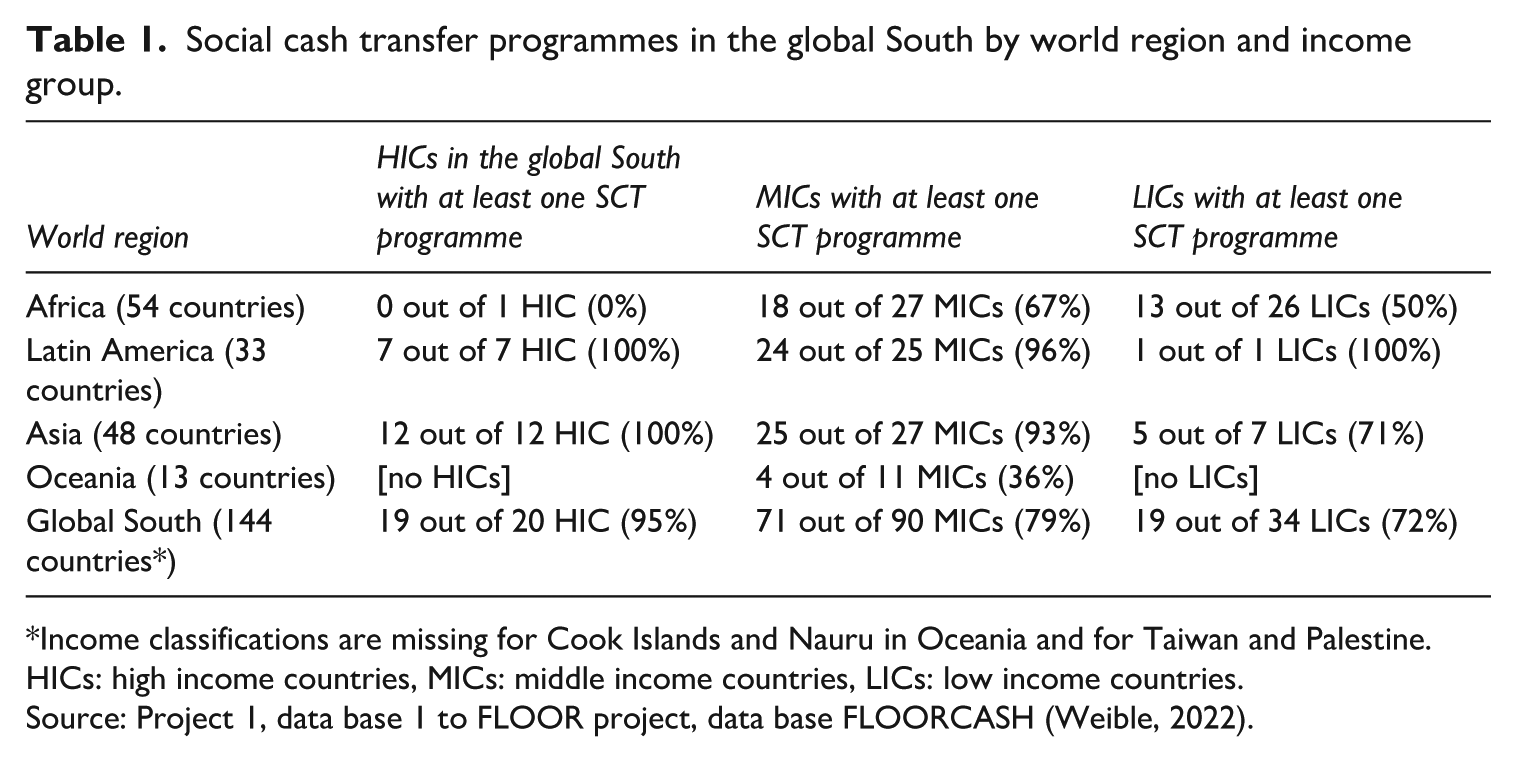
Income classifications are missing for Cook Islands and Nauru in Oceania and for Taiwan and Palestine.
HICs: high income countries, MICs: middle income countries, LICs: low income countries.
Source: Project 1, data base 1 to FLOOR project, data base FLOORCASH (Weible, 2022).
During the 2000, international organisations constructed four models of social assistance (von Gliszczynski and Leisering, 2016): social pensions, with large programmes for example in Brazil and South Africa; family allowances/child benefit, for example, in South Africa; conditional cash transfers (CCT) for families, widespread in Latin America; and general social assistance, for example, in China. These models prevail in the literature and in political debates, although the world of SCT is much more diverse (for a differentiated typology see Leisering, 2019: 175–179). In most countries the inclusion of the poor remains patchy. Only 11% of the regimes cover all citizens, that is, each citizen is protected against poverty (as explained above) by at least one of the programmes that make up the regime, including all big life cycle categories and disabled adults. With one exception, these fully inclusive countries mix categorical programmes with non-categorical programmes (general social assistance), that is, only mixed regimes achieve full inclusiveness in this sense. Mixed regimes generally make up only 36% of all Southern countries with at least one SCT programme (56% of countries: only categorical programmes, 8% of countries: only general social assistance). The richer a country, the more likely it is that it has a mixed regime.
Moreover, the rights character of Southern programmes is often precarious. Unfortunately, the FLOOR study excluded Turkey ranking it as European. Thus, it remains unclear how Turkey compares to the global South.
Other databases, such as SALMIC (Barrientos, 2018) and NSTP (Dodlova et al., 2016) feature Turkey but underrepresent the range of programmes. The World Bank’s ASPIRE database provides a longer list of programmes with data on expenditure, but the programmes are partly misclassified and also include social insurance programmes. ASPIRE’s survey component is difficult to interpret as survey questions do not reflect the complexity of Turkey’s social assistance regime. For those survey questions that can be linked to precise programmes (e.g. social pensions), results do not align with administrative data.
Comparing the global South to the global North
To our knowledge, there is no systematic comparison of social assistance in the global South and North (but see Barrientos, 2013: ch. 5 and Leisering, 2009: 261–262 for elements of a comparison). We make a first start. Key structural characteristics put most of the global South apart from most of the global North. This applies also to more ambitious social assistance regimes in the South, especially in MIC; they, too, differ substantially from the most developed regimes in the North, namely, the North and West European countries.
The following characteristics distinguish the global South from most of the global North: extensive scale (high numbers of recipients and high spending); low benefit levels; patchy legal coverage; the exclusion of non-disabled persons of working age from direct entitlements; the reliance on behavioural conditions for claiming SCT in some Southern countries; the limited use of non-categorical, general social assistance programmes; weak institutionalisation; and the formative influence of international organisations.
Scale (coverage and spending)
In MICs with developed social protection arrangements, larger sections of the population than in European countries receive social assistance, and social assistance incurs relatively higher spending when measured as percentage of total social spending. In Europe, social insurance was the main pathway to universalising social security. However, in the global South, social insurance is largely confined to formal, mostly urban workers, and social assistance in a way takes over the role of social insurance to cover larger sections of the population. SCT might constitute a new pathway to universalism in Southern countries (for social pensions see Böger and Leisering, 2020), and an SCT-dominated social security architecture might be a new ‘Southern’ social model. In this setting, social assistance need not be as stigmatising as in the North. However, such a SCT-biased arrangement is liable to residualism, providing meagre SCT for the poor while the better-off go private – as in liberal welfare regimes (Esping-Andersen, 1990: 25).
Benefits
In many MICs benefit levels are quite low (but see Leisering, 2019 for exceptions especially in social pensions) and benefit standards are often absent (but see Leisering, 2019: 173, for various standards used in some Southern countries). Benefits are thus designed as an add-on that symbolise social recognition and serve developmental goals (Barrientos, 2013: ch. 5). This contrasts with the ‘social’ aim of securing a living minimum, the ideal-typical feature of European social assistance. Typically, this is achieved through high benefit levels tied to socially defined benefit standards (Marchal and Marx, 2024). Low benefits can be related to limited economic resources, but politics determine how resources are transformed into fiscal space for social security. Within a given fiscal space, low benefits allow broader coverage which may win votes for the parties in government (Zucco, 2013) while keeping spending at bay. All in all, in Southern SCT individual benefits are often not need-oriented, as they are decoupled from the means test. Moreover, entitlements are often individualised (Weible, 2022), with the implication that benefits, which are shared in the household, entail a further reduction of individual benefits.
Persons of working age
The exclusion of non-disabled persons of working age from direct categorical entitlements to SCT is a crucial feature of most Southern social assistance regimes. Only 15% of all Southern countries have a categorical programme that caters for this group (making up only 9.8% of all programmes in the South). Even when additionally considering general social assistance programmes, the group is covered in fewer countries than the other main groups, namely, children, older persons, and adults with disabilities (Leisering, 2019: 164). The neglect of the working poor makes sense considering the conditions of labour, namely, widespread informal labour, underemployment, unemployment, and low pay. Covering all these contingencies would require enormous means likely to transcend the fiscal capacity of many countries.
The entitlement gap regarding persons of working age is a fundamental difference to European social assistance. According to the programme regulations, Southern social assistance mainly attends to persons outside formal work, emphasising quasi-biologically defined target categories (children, older persons, persons with disabilities, all of which are seen as dependent; Leisering, 2019: 161), while in Europe, social assistance is work-centred and unemployed formal workers are the core group. Southern social assistance is thus only partially concerned with the (formal) labour market, which is a key component of a ‘modern’ economy. To be sure, persons of working age may receive public benefits through their households in many Southern countries, especially allowances for families and children, but they lack own entitlements which would reflect a recognition of their contingencies.
Behavioural conditions
29% of all SCTs in the global South connect benefits to behavioural conditions such as mothers sending their children to health check-ups and to school. Conditions restrict the right to social security. By contrast, behavioural conditions in the global North do exist, but they are programme-related, mainly proving need and the willingness to take up work (workfare). Moreover, in most Northern countries the provision of and access to education and medical services is taken for granted and secured by other government departments, unrelated to social assistance. Only for a small group of families with special social problems, social workers would make sure that their children attend school and health check-ups.
General social assistance
General social assistance programmes are more common in the North. Only 44% of the Southern countries with at least one SCT programme have a general social assistance programme in place. These include better-off countries mainly in East Asia, which can afford such programmes (of a more universalistic nature), and very poor countries in sub-Saharan Africa with more restricted programmes (Leisering, 2019: 190–192; for Africa see Niño-Zarazúa et al., 2012). This shows that having a general social assistance programme is not only a matter of socio-economic conditions but also of politics. Vested interests and political support for specific social groups tend to prevail over the abstract concern for need. As mentioned above, social assistance regimes can only achieve full legal coverage of all citizens if a general social assistance programme is in place besides categorical programmes. The scarcity of general social assistance in the South, therefore, is one reason of the low legal coverage compared to the North.
Institutionalisation
According to the quantitative large n data from FLOOR, funding and government control of SCT is fairly secure but legal foundations are often weak and the rights-character of social assistance remains precarious. Yet, the very idea of rights is foreign in some socio-political traditions. Programme implementation of SCT is frequently flawed, giving rise to ‘exclusion errors’ and ‘inclusion errors’, that is, excluding eligible persons and including non-eligible persons. Weak legal foundations, poor implementation and precarious rights-character reflect limited administrative capacity, but also the persistent clientelism, patronage, and influence of powerful groups in many Southern societies.
In 80% of all Southern SCT programmes, means tests are applied. While means tests in developed European countries are highly juridified and bureaucratised, in the South we find a variety of means tests that often do not rely on a formal and bureaucratic assessment of income and assets but on proxy means tests or informal assessments by community committees, local teachers and the like, which may be appropriate in development contexts.
International organisations
The influence of international organisations and of other countries and donors on domestic policies is another characteristic of Southern politics. International organisations, such as the World Bank, the ILO, or UNICEF, have played a crucial role in spreading SCT in the global South, with each organisation having their own preferred policy models (von Gliszczynski and Leisering, 2016). By contrast, the EU’s role in the field of social assistance in European countries has been rather limited (Marchal and Marx, 2024: 20–21).
By introducing social assistance programmes, global South countries have moved closer to Northern social protection which has social assistance as a key element. In the process, the South has moved from an exclusionary model of social protection that largely excluded informal workers and their households (Leisering, 2009) to the long-standing Northern dualistic model of social insurance for workers as the upper tier of social protection and social assistance for the poor as the bottom tier. The dualistic model reflects divisions in labour markets. Since the 1990s the nature of the dualism in OECD countries has changed (for the ‘age of dualization’ see (Emmenegger et al., 2012), with growing social assistance in response to the precarization of labour and other social problems, and tightened regulations of social assistance. Breman and van der Linden (2014) have argued that the North is moving closer to the South since informal or precarious labour is also spreading in the North, and this might suggest that the North is equally moving closer to the South regarding the fabric of social protection. However, the recent shape of the social protection dualism in the North differs markedly from the new Southern dualism: social assistance in the North continues to address a relatively small section of the population and largely retains the rights-based standards of inclusiveness that had been built up in Northern and Western Europe during the post-World War II decades (Marchal and Marx, 2024: 26), while Southern social protection has an exclusionary dualism, with patchy legal coverage of social assistance, even excluding persons of working age, and benefits far below a living minimum.
Turkey’s social assistance regime
Having explored the key characteristics of Northern and Southern social assistance, we now turn to the analysis of Turkey. Similar to other MIC, Turkey has expanded social assistance. Yet, we still lack an understanding of the regime and its characteristics. Our analysis aims to fill this gap in order to ascertain whether the regime resembles Northern or Southern patterns of social assistance.
History: from marginal to central policy area
In the Republic of Turkey, which was founded 1923, social assistance long remained marginal. The central state largely put municipalities and the voluntary sector in charge of poor relief, even if it continued the small Indigent Benefit programme that it had inherited from the Ottoman Empire (Buğra, 2016: 128–155; Özbek, 2006). The introduction of social (i.e. non-contributory) pensions for the elderly and the disabled in 1976 signalled a radical change in the state’s approach in several ways. First, it aimed to include all older persons and persons with disabilities. By 1980, nearly one-third of all over 65 year olds received benefits. Second, the policy put the central state in charge of poor relief. Third, entitlement was codified, specifying under what circumstances someone had the social right to a cash benefit. Yet, the programme fell into disregard in the 1980s as rampant inflation eroded real benefits. Still, around one-fifth of older persons continued to receive – rather low – benefits by 1990 (Öktem, 2018).
In 1986, the government created the Fund for the Encouragement of Social Cooperation and Solidarity (SYDTF). The Fund was launched to provide discretionary in-kind and cash benefits through a vast network of para-state Social Assistance and Solidarity Foundations (SYDV). Although nominally private, these Foundations were headed mainly by state bureaucrats. The Fund marked a complete reversal from the earlier approach encapsulated in social pensions. First, it shifted responsibility from the central state towards local Foundations. This is remarkable since the emergence of welfare states is usually a story of increasing state involvement. Second, entitlement was not specified and the poor had no right to benefits. Third, benefit levels were not specified. Essentially, social assistance became discretionary, partly to avoid the bureaucratization of poor relief. While the Fund and the Foundations provided aid to millions, they were also mired in accusations of clientelism and, successive governments diverted funds for non-social assistance related purposes (Öktem and Erdoğan, 2020).
Yet, the Fund and the Foundations remained crucial institutions for poor relief. In 2001, the institutions were chosen by the World Bank as conduits for its Social Risk Mitigation Project. The project aimed to alleviate the impact of a severe economic crisis on poor people through a CCT programme and through capacity building of the responsible institutions. The CCT, one of the World Bank’s favourite policy models (von Gliszczynski and Leisering, 2016), tied benefits to participation in health and education systems (Beleli, 2022). It meant a departure from the policy design of the Fund and the Foundations. While these institutions had been designed to provide discretionary transfers, the CCT was regular and rule-based even if not fully rights-based. Moreover, the CCT entailed a complex means test to assess entitlement. Hence, the Foundations were now led to embrace the bureaucratized form of poor relief, which they had been supposed to overcome. This was a remarkably explicit case of a policy transfer by an international organisation.
The CCT was deemed a success by the World Bank and the government. By 2010, it provided regular, monthly benefits to around two million beneficiaries, exceeding the scope of social pensions. The government kept the programme after the World Bank project ended and added new SCTs. Some new transfers, such as the SCT to widows, were financed by the Fund and administered by the Foundations. Curiously, these SCT lack dedicated legislations. Collectively, these various SCT meant a complete change in the approach of the Fund and the Foundations: from discretionary in-kind and cash benefits to regular, monthly cash transfers. In addition to the new SCTs administered by the Foundations, the government created other programmes, such as the SCT for home care of disabled persons, that were financed and administered by other state institutions.
Today, there are 18 separate SCT. On top, the state continues to deliver in-kind transfers – primarily coal and food – and local governments also increasingly provide poor relief. Thus, an elaborate social assistance regime that provides benefits to millions of households has been built.
Moreover, special programmes for refugees, which are mainly EU-financed and administered through a collaboration of the government and NGOs, have been established in recent years – a further, yet special case of the influence of an international organisation. Of the around 4 million (mainly Syrian) refugees, some 1.7 million refugees benefit from the Emergency Social Safety Net, a monthly cash benefit to refugees of all ages. Around 600.000 refugee children are supported through the Conditional Cash Transfer for Education, which resembles Turkey’s CCT (Ark-Yıldırım and Smyrl, 2021; Yilmaz, 2019).
Turkey’s social assistance regime: structural characteristics
Turkey’s social assistance regime is unwieldy. There are numerous cash and in-kind transfers with sometimes overlapping target groups, administered by different institutions which apply different rules. Moreover, discretionary benefits are provided to target groups that are not well defined. Therefore, generosity, scope, and institutionalisation of programmes are highly diverse, eluding simple and clear-cut characterization. Yet, four overarching features of Turkey’s regime stand out: the scale (number of recipients and spending), fragmentation, stratification, and a mixed rights-charity character.
First, scale: Turkey’s regime is fairly big. Spending on social assistance amounts to 1.1 percent of GDP, exceeding 10% of all social expenditures. Collectively, the transfers reach nearly five million households, or 17% of all households (Cumhurbaşkanlığı Strateji ve Bütçe Başkanlığı, 2024: 325). This high coverage rate partly stems from the sheer number of programmes, which range from tiny programmes to huge transfer systems benefitting millions, as Figure 1 shows.
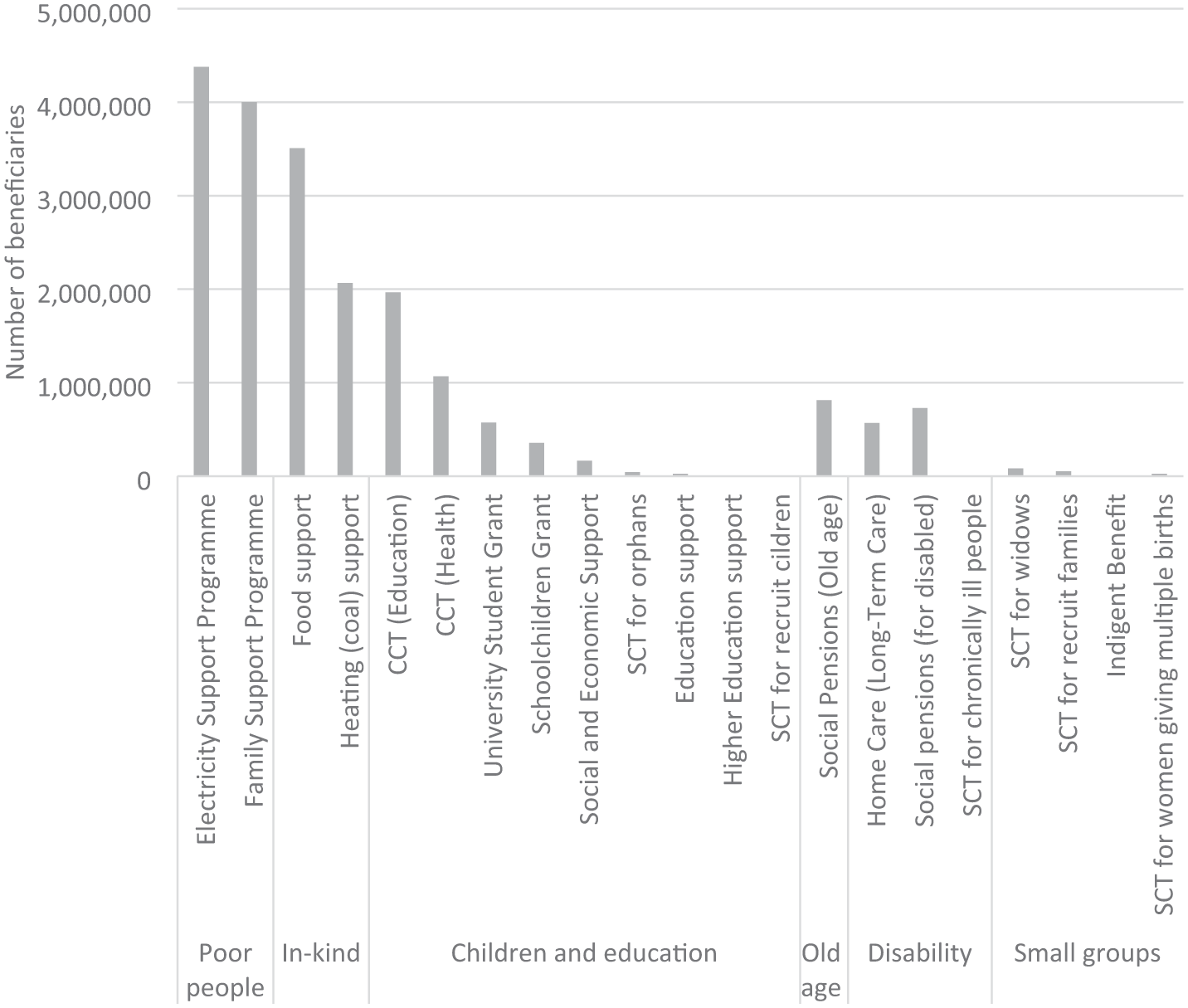
Number of beneficiaries of social assistance programmes in Turkey (2023).
It is rare for social assistance regimes to be fully unified as a single programme (Leisering, 2019: 82–83). Yet, the complexity of Turkey’s regime sets it apart from most other countries. Figure 2 shows the fragmentation of the regime. Different programmes target different categories among the poor, but sometimes target categories overlap. For instance, there is a CCT and two separate grants for schoolchildren. The regime prioritises quasi-biologically defined categories–the two life course groups children (as part of families) and older persons, and persons with disabilities. Poor families may often be eligible for several different programmes at a time. In this sense, we can speak of a family-centred regime – reflecting the official discourse that explicitly moves families to centre stage (Akkan, 2018).
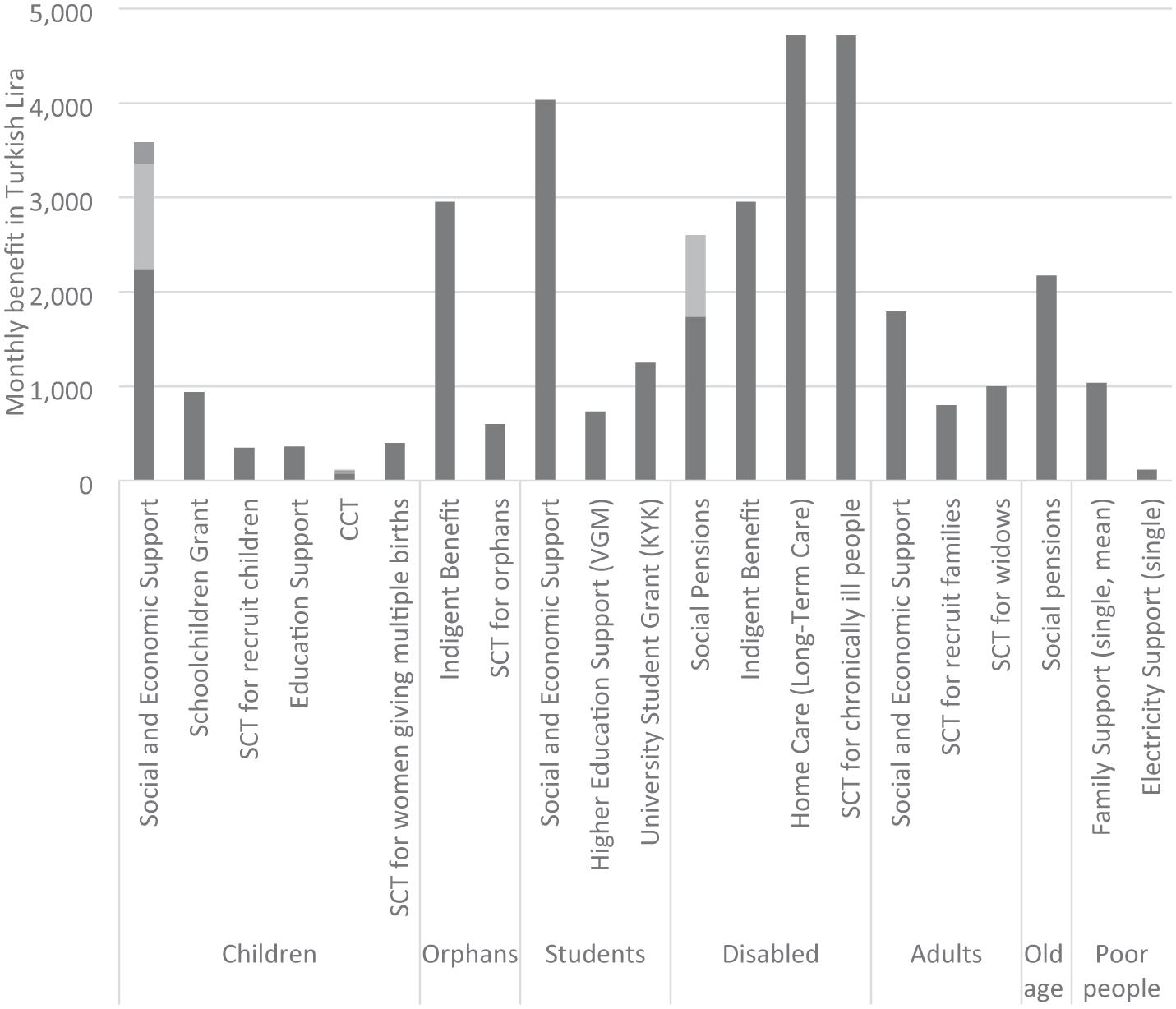
Nominal monthly benefit levels of social assistance programmes, by programme and target group (2023).
Alongside numerous categorical programmes two non-categorical ones exist. First, the Electricity Support Programme, introduced in 2019, provides cash support to poor people for their electricity bills. However, it only addresses beneficiaries of other SCTs, thereby excluding, again, non-disabled single adults of working age, who do not fit into the family-centred regime. Second, the Family Support Programme provides benefits to all poor households irrespective of their categorical status. Hence, it is the first programme that also benefits non-disabled single adults of working age. Started as a pilot programme in mid-2022, there is considerable confusion at the time of writing about whether the programme will be continued (İletişim Başkanlığı, 2025).
In addition to fragmentation across programmes, we observe administrative fragmentation. Separate institutions administer separate programmes based on separate legislation. While most major programmes are administered directly or indirectly by the Ministry of Family and Social Services with benefits mostly channelled through the Foundations, other state institutions, such as the Ministry of Education, the Institution for Higher Education Credit and Dormitories and the General Directorate of Foundations all administer their own SCT.
Stratification is another defining feature of Turkey’s social assistance regime. This is particularly visible in two dimensions: benefit levels and rights-base. Regarding benefit levels, Figure 2 shows that there are around twenty different benefit levels across the regime. To a degree, this is unsurprising given the diverse aims of the programmes. The different benefit levels can also be read as orders of deservingness, with some target groups seen as deserving more than others. However, even among similar programmes with similar target groups we find stark differences. For instances, orphans receiving the SCT for orphans provided by the Foundations (SYDV) received 600 Lira per month in 2023, whereas orphans receiving the Indigent Benefit provided by the General Directorate of Foundations received close to 3000 Lira per month.
Regarding rights, we find that the institutionalisation of social assistance as a social right remains partial. The widespread view among specialists that benefits are not rights-based (Bahçe and Köse, 2017; Bozkurt, 2013) needs qualification. The issue is more complex. For one, evidence suggests that social assistance recipients view it as their right, regardless of how the state conceptualises and provides social assistance (Kutlu, 2014: 240). For another, the degree to which social assistance is provided as a social right is highly unequal across programmes. In some programmes, such as social pensions and home care, entitlements are based on clear legal foundations, on need and every person fulfilling the criteria is entitled to receive benefits. In other programmes, such as the education support, however, entitlements are not based on clear legal foundations, or are grounded in merit and need, and the number of beneficiaries is constrained by a limited budget. Therefore, some programmes arguably guarantee a social right to social assistance, whereas others resemble state-provided charity. Interestingly, most programmes combine elements of rights-based programmes with charity.
Turkey’s regime in comparative perspective
How does Turkey’s elaborate social assistance regime compare to Europe and to MIC (Table 2)? Compared to European minimum income protection systems, three distinctive features stand out. First, Turkey’s regime is far more fragmented, containing more programmes than any other country (18 programmes as compared to 4.8 as the mean number of programmes in European countries; Bahle et al., 2011: 218). These numerous programmes aired up a higher share of social assistance recipients than in Europe. The large number of recipients in conjunction with relatively high spending indicate the large scale of social assistance in Turkey. Second, benefit generosity is highly variable across programmes. Third, unless the pilot Family Support Programme is counted, there is no programme catering to non-disabled single working-age adults. In contrast to EU countries, persons of working age thus lack (own) entitlements to social assistance. All these features make Turkey an outlier in European perspective. 4
Coverage, benefits and institutionalisation in different social assistance regimes.
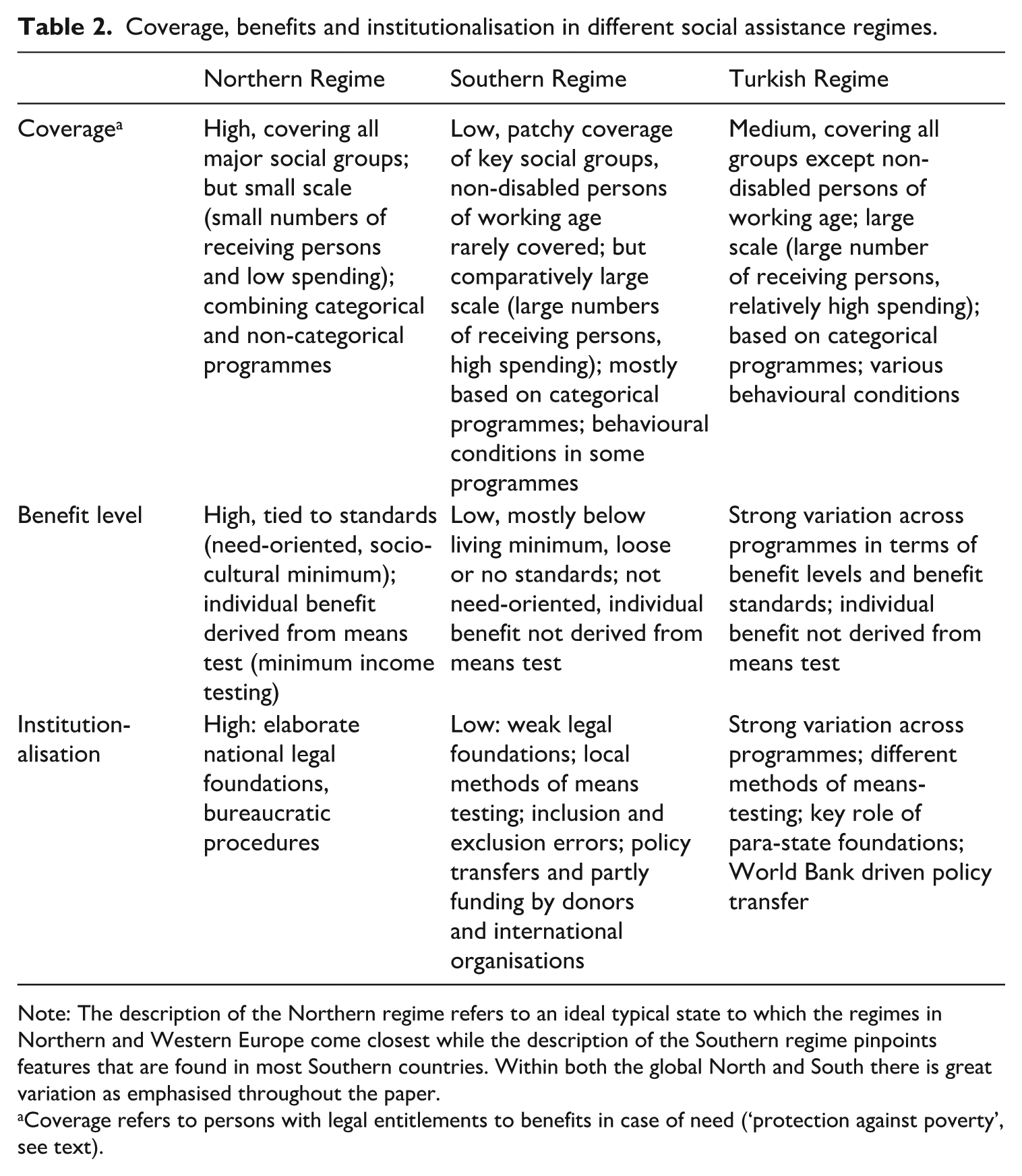
Note: The description of the Northern regime refers to an ideal typical state to which the regimes in Northern and Western Europe come closest while the description of the Southern regime pinpoints features that are found in most Southern countries. Within both the global North and South there is great variation as emphasised throughout the paper.
Coverage refers to persons with legal entitlements to benefits in case of need (‘protection against poverty’, see text).
By contrast, comparing Turkey’s regime to Southern SCT, we find remarkable similarities as seen in Table 2. First, regarding the scale of social assistance, the massive increase in coverage aligns with developments in the global South. As in other Southern countries, social assistance has come to play a more central role in Turkey’s overall social security architecture (Yoruk, 2022) although social insurance in Turkey has a broader (if limited) coverage than in other Southern countries. Second, benefit levels vary strongly across programmes, and explicit benefit standards are rather rare.
Third, even though the regime reaches many households, non-disabled persons of working age are excluded from categorically defined direct entitlements. Thus, like most other Southern social assistance regimes, Turkey’s regime is not universal. Rather, the emphasis is on quasi-biologically defined target categories, namely, ‘dependent’ persons outside the workforce, above all children, older persons, persons with disabilities, students. However, if the pilot Family Support Programme were institutionalised in the future, persons of working age would figure. Moreover, like other Southern social assistance regimes, the Turkish regime also caters for a number of small groups (Leisering, 2019: 160–162).
Fourth, institutionalisation strongly varies across programmes. As in many MICs, relatively secure funding and government control prevail, while legal foundations are precarious for some programmes, which are akin to charity rather than rights-based provisions. Furthermore, clientelism pervades the regime (Kutlu, 2014; Özdemir, 2020). Even for Home Care and social pensions – probably the most institutionalised SCT in Turkey – the comptroller’s office found that around one in five beneficiaries did not fulfil the programmes’ disability-related criteria (Sayıştay Başkanlığı, 2019).
Besides these close similarities between Turkey and the global South, Turkey’s social assistance also shares features that are found not in all but in a sizable number of Southern countries. First, regarding conditions of entitlements, behavioural requirements are well established in Turkey as in other MIC. This includes Turkey’s CCT, but also, for instance, the schoolchildren and student grants. Furthermore, workfare has entered the legislations, but it remains unclear to what extent it is implemented. In addition, Turkey’s regime features a variety of means tests, with some being – partly as a result of World Bank support–fairly complex and formally institutionalised as in the global North.
Second, until recently non-categorical, general social assistance programmes, which are more common in the global North than in the South, were not on the agenda. Instead, Turkey’s regime is defined by categorical fragmentation and a selective particularism, focusing on running categorical programmes for special groups seen as particularly deserving, and doing without a general social assistance programme.
Third, as in many other MIC, international organisations were influential in shaping Turkey’s social assistance regime. It is remarkable that the country–an EEC/EU accession candidate and close neighbour, which has seen significant Europeanisation across policy areas (Bölükbaşı et al., 2018) – did not look towards Europe when reforming social assistance. Instead, it called on the World Bank, and imported a model of SCT, namely, CCT, that originated in Latin America and was (and still is) advocated by the World Bank. It is CCT in particular that have fuelled the view that SCT are a Southern innovation – ‘. . . a development revolution from the global South’ (Hanlon et al., 2010). The influence of the World Bank on establishing CCT in Turkey qualifies the assumption with which we started that IOs spread Northern models of social protection. Social insurance is a Northern model spread by the ILO, but CCT are a genuinely Southern model. Still, in recent years the EU has started to play a key role in Turkey, by financing social assistance for Syrian refugees that have fled to Turkey. This serves the political purpose (for the EU) of keeping the refugees away from European territory and (for Turkey) of securing social peace. This demonstrates the multiple uses social assistance can be put to.
Taken together, these findings suggest that Turkey’s regime shares many features with Southern social assistance that are absent or rare in the global North. In a systematic quantitative analysis, it is likely that the country would be grouped among the more elaborate and generous Southern social assistance systems, such as South Africa. These countries provide a host of benefits for different groups among the poor, but mostly shy away from giving persons of working age an (own) categorical entitlement to a minimum. Accordingly, as many countries in the global South, Turkey has moved closer to Northern social protection by expanding social assistance. However, the resulting social protection dualism still differs from the global North, where social assistance benefits target smaller population groups but remain more rights-based.
Conclusion: making sense of ‘Southern’ social assistance: development contexts and national idiosyncrasies
In this article, we have analysed social assistance in the global North and South and situated Turkey’s social assistance regime in a comparative perspective. We have shown that over the past decades Turkey has developed an elaborate ensemble of social assistance programmes that can no longer be aptly described as ‘rudimentary’ (Gough et al., 1997). We may conclude that the very introduction of social assistance indicates a convergence of Turkey with the global North, since elaborate national social assistance systems are part of the Northern welfare state model but were absent in Turkey before.
However, there is no convergence when it comes to the legal design, the institutionalisation, and the scale of social assistance. In these respects, Turkey differs fundamentally from European models. This includes the large scale of social assistance, low benefit levels in key programmes, pronounced fragmentation regime, lack of categorical programmes for non-disabled persons of working age, and institutionalisation through non-state foundations. Most of these features are characteristic of social assistance in the global South, that is, Turkey shares the key characteristics of Southern social assistance. Moreover, Turkey shares characteristics that are found in many but not all Southern countries but hardly in Northern countries: behavioural conditions of benefit receipt, the absence of a general social assistance programme, and the formative influence of international organisations. All in all, Turkey fits the emerging ‘Southern model’ of social assistance much more than European models.
How can we make sense of the peculiarities of social assistance in Turkey and in the South more generally? We suggest that some peculiarities may be seen as deficiencies of Southern policies and institution building, while others may be seen as ‘appropriate’ adaptation of a Northern model to developmental conditions, that is, a kind of hybridisation or syncretisation (see Midgley, 2008). When Western researchers turned to social policy in the global South, they spoke of ‘social policy in development contexts’ (Gough and Wood, 2004). This contextualisation also matters for social assistance. Developmental thinking has a future perspective, emphasising the prevention of future poverty (e.g. through child-related behavioural conditions of benefit receipt for families) rather than a present-day guarantee of a living minimum (hence a low level of benefits) (Barrientos, 2013: 104–106). This developmental objective of social assistance, together with other Southern peculiarities – the exclusion of persons of working age, the reliance on local knowledge for the identification of the poor, and the large scale of assistance – can be seen as appropriate in countries that are riddled with extensive poverty and a weak social insurance and give priority to ‘development’. From the 1990s onwards, social security has come to be seen as part and parcel of development, but the traditional future-oriented developmental thinking shapes the kind of social security (von Gliszczynski, 2015: 131–135).
To a degree, this developmental thinking also applies to Turkey. While social insurance in Turkey is comparatively strong, coverage was never universal due to widespread informality in the labour market. Social assistance expansion was not just perceived as a means to fill coverage gaps, but framed as an instrument to increase the human capital of the poor. Nonetheless, policymakers also increasingly debate social assistance in the context of providing a living minimum.
However, ultimately, thinking in terms of ‘models’ or ‘types’ – ‘Northern’ or ‘Southern’, ‘developmental’, old or new Southern models, social assistance types within the global North or South – is of limited use. Rather, national cultural and institutional traditions of state and social welfare lead to diverse, idiosyncratic arrangements of social security in each country, as Kaufmann (2013) maintains in view of Northern countries. National traditions also matter for social assistance, which is inextricably linked to fundamental moral issues of labour and family, of rights and social obligations. Obviously, Turkey has a highly idiosyncratic social assistance regime, manifest for example in the conspicuous role of para-state charitable foundations. Their ideational foundations lie in an imagined Turkish-Islamic history, even though their work is mostly detached from Islamic practices (Öktem and Erdoğan, 2020). Across the South, it is an open question what kinds of secular welfare consciousness might evolve out of Islamic and other religious origins (Tajmazinani, 2021).
The use of models is also limited because things may change. The pilot Family Support Programme, for example, which is a general social assistance programme introduced in Turkey in 2022, bestows entitlements to benefits also on non-disabled persons of working age. A similar development was seen in other parts of the global South during the pandemic. In South Africa, for instance, the social relief of distress grant included unemployed working-age adults for the first time in the social assistance regime (Fouksman and Dawson, 2024: 244). If institutionalised, such a programme could make the various SCT redundant, thereby reducing fragmentation. Turkey would then move closer to the ‘Northern’ model, especially to Ireland, which in Bahle’s typology figures as an outlier due to high scores for scale and categorical fragmentation. Socio-economic and political modernisation and the rise of social welfare as an election issue (Özel and Yıldırım, 2019) might further transform the Turkish social assistance regime. All in all, our analysis suggests that Southern countries do not necessarily follow Northern or European models in social protection, not even MIC that are coming closer to the North in economic terms or are even spatially and politically close to Europe, as in the case of Turkey. Social protection remains, to some extent, idiosyncratic.
Footnotes
Appendix 1
Acknowledgements
The authors thank Katrin Weible, Tobias Böger, Tolga Bölükbaşı and Cansu Erdoğan for valuable comments and suggestions.
Declaration of conflicting interests
The authors declared no potential conflicts of interest with respect to the research, authorship and/or publication of this article.
Funding
The authors disclosed receipt of the following financial support for the research, authorship and/or publication of this article: The article is a joint outcome of two research projects at Bielefeld University, Germany (principal investigator Leisering): the FLOOR project (http://floorcash.org) on social cash transfers in the global South, funded by the German Research Council (DFG), and the project ‘How “social” is Turkey?’ (postdoc Öktem;  ), funded by Stiftung Mercator.