



Abstract
Although comparative welfare research has long criticized that the social insurance system in low- and middle-income countries (LMICs) fails to cover the under-privileged population, very little is known about the discrepancy between social insurance legislation and its practice. In LMICs, social insurance legislation has remained only on the books for a long time, which prevents citizens from accessing their ‘entitled’ benefits. By analyzing the gap between the de jure and de facto coverage of maternity leave in 73 LMICs, this article provides the first systematic overview of the discrepancy between social insurance law and practice in different world regions. The empirical findings show that nearly a third of LMICs provide de jure universal coverage but only very few adhere to the promise. Low state capacity, prevalent corruption, and poor policy design impede the effective implementation of social insurance legislation.
Introduction
Low- and middle-income countries (LMICs) adopted the social insurance system at the early stage of their economic development due to international pressure (Collier and Messick, 1975) and the colonial past (Barrientos and Hulme, 2009; Leisering, 2018). The first social insurance legislation in LMICs included advanced standards: their generosity was higher than that of pioneer welfare states (Arza and Johnson, 2006) and the legislation often covered ‘all the employed’, encompassing employees in the industrial, commercial, and agricultural sectors (Son and Böger, 2021). Since the 1990s, LMICs have extended the coverage of the social insurance system or/and adopted non-contributory cash transfer systems to reach various groups of under-privileged workers (Deacon, 2007).
Yet, in practice, only 46.9% of the world population receives some kinds of social security benefits (ILO, 2021). While it is well known that large proportions of the workforce in LMICs, particularly those without employment contracts, are not covered by social insurance legislation, less attention has been paid to hindrances in accessing ‘entitled’ social insurance benefits. Social insurance legislation in LMICs has remained on the books over a long time period, but has been routinely ignored outside the public sector and large-scale enterprises (e.g. Pellissery and Walker, 2007). Ronconi (2010) goes further, saying that the poor working conditions in LMICs do not result from the lack of coverage by social security systems but from the large discrepancy between laws and practice, since de jure universal coverage by social security systems is prevalent. And yet, due to the limited availability of data, no empirical research has measured or systematically examined the discrepancy between social insurance legislation and its practice in LMICs.
This article aims to fill this gap by providing a cross-sectional analysis of the discrepancy between the laws on paid maternity leave and their practice in 73 LMICs. My contribution captures the discrepancy by calculating the difference between expected coverage, estimated from legal coverage of maternity leave, and coverage in practice. Paid maternity leave, one of the oldest and most universally adopted social insurance programs, provides a compelling lens through which to explore the enduring issue of discrepancies in the Global South. 1 To calculate expected coverage, I utilize a new Historical Database of Maternity Leave (HDML) (Son et al., 2020) that codes whether maternity benefits are granted to employees in three employment sectors (i.e. the industrial, commercial, and agricultural sectors) and workers in atypical employment (see Supplemental Appendix 1 for details of the HDML). For the coverage of maternity leave in practice, I use a proxy, namely, the proportion of female employees who are registered with maternity insurance or who are likely to receive maternity benefits from their employers, drawn from the International Labour Organization (ILO). I examine the supply-side factors that may explain the degree of the discrepancy between de jure and de facto coverage, namely, state capacity, corruption, as well as the policy design of maternity leave. I use two-stage least-squares (2SLS) regression analysis to first examine de jure coverage and then the discrepancy. The results show that a long history of social insurance legislation does not automatically lead to the maturation of social insurance systems in LMICs, which would narrow the gap between coverage in laws and practice. The implementation failure of the social insurance system depends on various types of state capabilities and the degree of corruption. Moreover, a long contribution period discourages workers from registering with the social insurance system. Counterintuitively, relatively affluent LMICs exhibit high discrepancy because they strive to extend social insurance benefits to self-employment, where implementation failure is concentrated.
The article is structured as follows: in the following section, I explain the concept of the discrepancy between laws and practice and briefly illustrate why a large discrepancy of social insurance system is expected in LMICs. In section ‘Defining the discrepancy between social insurance laws and practice’, I argue that the discrepancy is not simply a synonym for the informal sector, since the informal sector does not differentiate between the lack of coverage by social insurance legislation and implementation failure. In section ‘Theoretical explanations of the discrepancy between social insurance laws and practice’, I introduce state capacity, corruption, and institutional factors that may explain the varying degrees of the discrepancy in LMICs. Finally, I measure the discrepancy between maternity leave coverage in law and practice and test various determinants using cross-sectional regression analyses.
Literature review: discrepancy between laws and practice
Existing research has detected a discrepancy between laws and practice at the nation–state level in the context of policy diffusion. More specifically, scholars find a large discrepancy when examining the question of whether states actually change their behavior after adopting international laws or importing Western-style institutions in various fields (e.g. Levitsky and Murillo, 2009). The adoption of ‘external’ rules often remains symbolic without causing fundamental changes in practice. To legitimize themselves in the international community, states may adopt advanced policies without having the capacities to implement them. Alternatively, states may have no intention to implement them in practice. Since enforcement mechanisms for international laws are limited or practically non-existent, domestic political actors have large room to maneuver the implementation of the rules to sustain the status quo.
The origin of social insurance legislation in LMICs comes from importing social insurance systems from elsewhere (Obinger et al., 2013). Historically, LMICs have endorsed international labor standards in order to be acknowledged as a ‘modern state’ in the international community (Baccini and Koenig-Archibugi, 2014). Nation–states’ ILO membership explains their adoption timing of social insurance legislation (Schmitt et al., 2015). States incorporate international labor standards into domestic laws shortly after the adoption of ILO Conventions, regardless of whether they ratify the conventions or not (Son, 2023). The ILO also pressured European colonizers to extend their labor codes and social insurance systems to colonies, which resulted in the early adoption of social insurance systems in a large number of LMICs (Schmitt, 2015).
However, the global diffusion of social insurance legislation is accompanied by a large discrepancy between the laws and practice in social insurance systems in LMICs. In contrast to advanced welfare states, the adoption of ILO standards in LMICs does not result in a significant improvement of labor and social rights in practice (Son, 2023). Since international labor standards have, for a long time, mainly focused on workers with employment contracts, the majority of the working populations in LMICs have been left outside the purview of international labor standards (Boris, 2019). Furthermore, even ‘entitled’ workers fail to secure their rights due to cursory enforcement: labor and social insurance legislation are only selectively enforced in the public sector and large-scale enterprises (Basu et al., 2010; Bosch et al., 2013; Soundararajan, 2019).
Existing studies provide case study evidence on the large gap between social insurance legislations and their practice in LMICs. For example, Asian countries adopted labor and social insurance legislation for workers in the garment industry as well as beedi and cigar production since the 1960s to comply with the ILO. However, violations of the legislation were tolerated by regulatory institutions and compliance was not ‘expected’ for decades (Dicaprio, 2013). Another example is the work-injury protection systems in African countries, which still remain in their infancy near half a century after their introduction. Although many African countries ratified relevant ILO Conventions and extended the legal coverage of the program (e.g. including industrial workers without employment contracts), the regulation and enforcement of work-injury protection systems is practically non-existent (Umeokafor et al., 2014).
Comparative researches also provide hints on the large discrepancy. Studying maternity benefits in 90 countries of all income levels, Son (2024) finds that the generosity and inclusiveness of maternity leave legislation are not significantly correlated with its expenditure or coverage in practice in LMICs, unlike in advanced welfare states. In a similar vein, scholars point out that the legal conditions of social security legislations are not sufficient to understand social security systems in LMICs in contrast to advanced welfare states (Bolukbasi et al., 2021; Kuitto, 2018). Typical outcome measures of social security policies, such as the Gini coefficient or female labor participation rate, do not correlate with the generosity of social security legislation in LMICs (Fallon et al., 2017; Holland, 2018). However, no study has addressed crucial questions: How large is the discrepancy between social insurance laws and its practice in LMICs? What determines the varying degrees of the discrepancy? This article aims to fill the research gap by systematically examining the discrepancy in LMICs using new measurements.
Defining the discrepancy between social insurance laws and practice
It is well known that social insurance legislation is not enforced in the majority of workplaces, the so-called informal sector. The initial definition of the informal sector was the sum of specific occupations or employment statuses in which government regulations are often not enforced, such as the self-employed and family workers (Hart, 1970), while scholars mostly use this term to indicate an ‘establishment which is unregistered and unlicensed’ in law or in practice (ILO, 2018).
The discrepancy between social insurance laws and practice is not simply a synonym for the informal sector. First, the concept of the informal sector does not take account of whether the unregistered and unlicensed establishments are supposed to be under the purview of social insurance legislation, while the term discrepancy indicates an establishment which is registered in law but not in practice. This difference is particularly relevant for the recent efforts by LMICs to incorporate atypical forms of employment that have long been considered ‘the informal sector’ into their insurance systems. For instance, in both advanced welfare states and LMICs, the self-employed are often one of the last groups that are granted social insurance entitlements (Flora and Heidenheimer, 1981; Mesa-Lago, 1978). If the social insurance system extended its coverage to the self-employed, the limited access of the self-employed to social insurance benefits would then become a discrepancy matter rather than ‘the informal sector problem’. It is necessary to distinguish the discrepancy issue from the informal sector, since the logic underlying implementation failure differs from that underlying unequal entitlement to social insurance benefits.
Second, the discrepancy problem is not limited to the informal sector, although it is concentrated there: workers with employment contracts are often partially or not at all registered in social insurance systems (Bosch et al., 2013; Holland and Hummel, 2022). Employees may avoid paying social insurance contributions due to low benefit levels or low expectations of receiving benefits (Bailey and Turner, 2001). Alternatively, employers do not register their employees with the social insurance system in order to reduce costs and increase flexibility despite their legal obligation to do so.
Existing research has focused primarily on the informal sector without disentangling the lack of coverage by social insurance legislation from implementation failure (Dewey, 2018; Kus, 2010; Schneider and Enste, 2000). Recent publications propose a more disaggregated approach to understanding the informal sector problem, for example, differentiating between workers without employment contracts who are registered for non-contributory cash transfer programs and workers in formal employment arrangements who do not receive ‘entitled’ social insurance benefits (Holland and Hummel, 2022). This article aims to address this challenge by shifting the focus back to the disparity between social insurance legislation and its practical implementation, moving beyond the predominant concentration on the informal sector.
Theoretical explanations of the discrepancy between social insurance laws and practice
The discrepancy between laws and practice may be a time lag problem, which could be naturally solved through the maturation of a social insurance system. The historical account of welfare formation in advanced welfare states shows that the gap between social insurance laws and practice existed in the early stage of their development (Flora, 1986; Flora and Heidenheimer, 1981). Flora (1986) demonstrates that while advanced welfare states accomplished de jure universal coverage between the 1960s and the 1970s by incorporating students, dependent family members, the self-employed, and farmers, it was not until the 1980s when more than 90% of the economically active population was registered in the social insurance systems. For example, the enforcement of social insurance legislation in home-based or family production was only gradual due to the ambiguous definition of ‘real work’, which left considerable room for manipulation both by bureaucrats and beneficiaries (Quataert, 1993). These groups of beneficiaries were skeptical of the notion of social insurance, financed through deductions from their current earnings, and thus sought a gray area to avoid paying social contributions. The scattered location of these workers also posed an additional obstacle to enforcement, as the notion of the home as a private realm insulated it from inspection in most places. However, advanced welfare states eventually ‘filled in’ the coverage of their social insurance programs during the post-war period, as welfare administrations sought to meet uncovered social protection needs (Flora, 1986).
This article argues that the persistent gap between laws and practice is a distinctive feature of welfare development in LMICs, which has been only implicitly assumed by comparative welfare research. The discrepancy has been used as the criterion for case selection to justify the strong focus of comparative welfare research on 18–23 advanced welfare states, because the effective provision of public goods (e.g. welfare) requires a high level of compliance with tax payments and enforcement of the rule of law (Beramendi et al., 2015: 44). LMICs have a long history of social insurance development: for instance, Latin American countries adopted the first maternity leave legislation in the 1940s on average, and African and Asian countries in the 1960s (Son and Böger, 2021). Particularly, shortly after the adoption of the second ILO Maternity Protection Convention in 1952, a large number of LMICs, as new nation–states or colonial states, introduced encompassing maternity insurance or extended legal coverage to comply with the ILO standards (Son, 2022, 2023). It implies that LMICs may have overpromised to legitimatize themselves. However, the majority of workers in LMICs are still left unprotected in practice, signaling that the maturation of social insurance systems does not automatically lead to improvements in enforcing social insurance laws, in contrast to advanced welfare states. Existing research proposes three explanations for the persistent discrepancy: state capacity, corruption, and policy design of social insurance programs. I briefly outline each explanation before I measure and analyze the discrepancy in the following section.
A major cause of weak enforcement in LMICs is a lack of state capacity (Levitsky and Murillo, 2009). First, effective bureaucracies have long been considered as a crucial factor for the implementation of a welfare system, given its significant role in reaching citizens’ spread across the national territory and translating national initiatives aimed at extending coverage of the welfare system into local implementation (Wilensky, 1974). Bureaucrats inform citizens about how to apply for social security programs and assist them with complex application processes, helping individuals claim their legal rights. However, an inefficient bureaucratic system could delay or impede the application process for social insurance benefits, often requiring multiple visits to various bureaucratic agencies (Holland, 2018: 565). Furthermore, a lack of fiscal capacity to effectively collect and credibly manage contributions or general taxes would pose a critical challenge to the sustainability of a social insurance system.
Second, the lack of state infrastructure increases the cost of accessing social insurance benefits. For instance, pre- and postnatal care in public healthcare facilities as well as medical certificates confirming pregnancy are often required to be eligible for maternity benefit. If these facilities are only sparsely located or overcrowded, women workers would have to invest the cost of a 1-day absence from work plus travel costs, which low-income mothers with precarious working conditions often cannot afford (Matthias, 1994).
Finally, strong enforcement capability would increase compliance with social insurance legislation by monitoring and punishing violations. In the absence of administrative mechanisms to identify noncompliance, and if labor inspectors responsible for enforcement are weak or absent, the incentive for employers or employees to comply with social insurance legislation would be weak (Bailey and Turner, 2001; Levitsky and Murillo, 2009). For example, Ronconi (2010) finds that the number of inspectors in Argentina is a strong predictor of the rate of registering with the social insurance system. Umeokafor et al. (2014) assert that the low enforcement capacity in Nigeria has severely impeded the development of the work-injury protection system for decades, namely, there are only 60 factory inspectors for regulating workplaces in a country with a population of more than 200 million. Auerbach et al. (2007) go even further, arguing that the combination of low state capacity in LMICs and the high cost of monitoring and sanctioning small-sized production units partially explain the exclusion of these types of workers from the social insurance system in practice.
Even if welfare bureaucracies are sufficiently staffed, prevalent corruption would impede the implementation of social insurance legislation (Bailey and Turner, 2001; Pellissery and Walker, 2007; Umeokafor et al., 2014). Police and regulatory institutions may overlook the violation of social insurance legislation for their own material interest, which would motivate employers to prefer paying bribes over registering their workers in the social insurance system and so undermine citizens’ trust in social insurance institutions. Recent publications emphasize a broader implication of corruption (or clientelism): political actors tolerate the violation of regulations to obtain political and financial resources (Holland, 2016). For example, Dewey (2018) demonstrates that labor standards in the Argentinean garment industry have not been implemented persistently, from which political actors gain electoral support and extract resources that they use to finance their political campaigns.
The policy design of social insurance systems are also blamed for limited access to social insurance benefits. Practitioners and scholars criticize the strict conditionality of social insurance benefits (Addati et al., 2014; Bolukbasi et al., 2021; Kuitto, 2018). A long contribution period would be a critical obstacle for working populations in LMICs in particular, since the majority of them are engaged in precarious jobs in which long-term employment can hardly be expected (Bailey and Turner, 2001; Bosch et al., 2013). The transition from employer liability to a social insurance system would also enhance compliance, by placing workers’ social protection under public scrutiny instead of solely relying on employers’ actions. Scholars report that the extension of employer-liable maternity leave without proper enforcement can lead to suboptimal outcomes, restricting women’s employment opportunities (Uribe et al., 2019). In addition, the extension of coverage, particularly to the self-employed or home-based industries, would accompany implementation challenges. States tend to monitor and regulate only large enterprises, where enforcing legislation is less challenging than in the heterogeneous mosaic of small and transient enterprises (Auerbach et al., 2007; Bosch et al., 2013).
Measuring discrepancy across LMICs
To measure the discrepancy between social insurance laws and practice, I calculate the gap between de jure and de facto coverage of maternity leave in 73 LMICs. While existing empirical research estimates the correlation between the generosity of social insurance legislation and its outcomes (e.g. social expenditure) to capture the discrepancy (Palme et al., 2009), I choose de jure and de facto coverage to minimize the intervening factors, for example, varying administrative costs of social insurance systems and the division of financial responsibilities between government, employer, and employee (Kuitto, 2018).
I first estimate the expected coverage, namely, the proportion of women workers who are legally entitled to maternity leave among all women workers, which requires two pieces of information: legal coverage of maternity leave and the proportion of women workers who qualify for the legal coverage. A new database on maternity leave includes information on whether maternity leave laws in each country cover employees in the industrial, commercial, agricultural sectors as well as workers in atypical employment (see Supplemental Appendix 1 for data and sources). The ILO provides data about the ratio of women workers engaged in the industrial, commercial, agricultural sectors to all female employment. The aggregated ratio of women workers in the industrial, commercial, and agricultural sectors is 100%.
However, a distinctive problem arises when calculating the legislation’s expected coverage of atypical employment: while most legislation covers all employees in the industrial, commercial, or agricultural sectors without disaggregating them into a detailed list of occupations, no maternity leave in the world covers all types of atypical employment. The expansionary reforms regarding atypically employed workers are gradual, extending from one group (e.g. the self-employed) to another group (e.g. family workers). Since no data exist regarding the proportion of female employees in disaggregated types of atypical employment, I used the self-employed as a proxy for atypically employed workers. The self-employed are an ideal litmus test to detect the discrepancy, because a large proportion of these workers do not have access to social insurance benefits: half of informal sector workers globally (including high-income countries) and 75% in Latin America are self-employed (ILO, 2018). At the same time, if a state intends to extend its insurance coverage to workers in atypical employment, the self-employed are one of the first groups that are included in a social insurance system (Flora, 1986; Mesa-Lago, 1978). 2 Thus, a large number of LMICs granted the self-employed the right to social insurance benefits, including maternity leave. The ratio of women workers in each employment sector and the self-employed is aggregated with legal coverage of maternity insurance to calculate the expected coverage. If a maternity leave policy covers female employees in the industrial, commercial, and agricultural sectors but excludes the self-employed, the expected coverage would be calculated as ‘ratio of female employment in the industrial, commercial, agricultural sectors * 1-ratio of women workers who are self-employed’. Here, the ratio of the self-employed is not simply deducted because ‘self-employed’ is a terminology based on types of employment rather than sectoral classification.
I use the proportion of working women who are potentially granted maternity leave either through maternity insurance or their employer to measure de facto coverage, which is taken from the ILO’s Maternity and Paternity at Work report (Addati et al., 2014: 144–149). The number of potential beneficiaries of maternity insurance is measured by the number of working women who are contributing to maternity insurance. Although this so-called effective coverage is practically the only indicator that measures de facto maternity protection coverage in different world regions, this indicator entails several shortcomings. First, the effective coverage of maternity leave underestimates the discrepancy between maternity leave laws and practice, since employers may refuse to pay maternity benefits to women workers who are legally eligible to them or employees fail to fulfill eligibility criteria despite their contribution history. Nonetheless, case studies on implementation failures argue that a large proportion of workforces in LMICs are not even registered in social insurance systems, because employers seek to reduce labor costs or employees stop paying their insurance contributions (Bosch et al., 2013; Pellissery and Walker, 2007).
Second, social assistance systems are taken into account, which may result in the underestimation of discrepancies, given that they are not considered in the calculation of expected coverage. However, I argue that the number of women workers who are registered in social assistance systems is included in the calculation of effective coverage only to a limited extent, if at all. For example, when the ILO introduced the legal and effective coverage of maternity leave benefits, it presented Mongolia as one of the LMICs that adopted social assistance cash benefits for women (Addati et al., 2014: 44). However, the legal coverage of maternity protection for working mothers in Mongolia was coded as 33–65% instead of universal coverage, implying that the new program was not considered when calculating coverage. The legal and effective coverage of maternity protection in Mongolia has been updated as universal coverage only in the ILO World Social Protection Report 2017–2019 (ILO, 2017).
Third, effective coverage is composed of categorical values (0–9, 10–32, 33–65, 66–89, 90–100), which leads to the underestimation of the discrepancy. I use the maximum value of each category when subtracting the effective coverage from the legal coverage to take a conservative approach to estimating the discrepancy. For example, Burkina Faso provides maternity leave to women workers in the industrial, commercial, and agricultural sectors but excludes the self-employed. Since the proportion of self-employed among all women workers reaches 94%, the expected coverage would be 6%. In Burkina Faso, the effective coverage is recorded as ranging from 0% to 9%. I estimated the discrepancy as 0 because the country may provide maternity benefits to all women workers who are legally entitled to them – specifically, the 6% of women workers who are not self-employed.
Table 1 provides an overview of the maternity leave discrepancy in 2010. Here, the numeric value of expected coverage is converted to categorical values to facilitate the comparison between expected and effective coverage of maternity leave. There is large variation between LMICs, ranging from 0 to 91. While 34% of LMICs achieve de jure universal coverage and 66% of the LMICs extended their coverage of maternity leave to the self-employed, only two Eastern European countries, namely, Latvia and Serbia, potentially provide maternity benefits to more than 90% of women workers. In extreme cases, less than 9% of women workers in Cambodia and Ecuador may have access to maternity benefits, although women workers in the industrial, commercial, and agricultural sectors as well as the self-employed are legally entitled to maternity leave in these countries. Cambodia extended the coverage of maternity leave to associations of self-employed 3 and handicraft establishments in which a large number of women workers are engaged in 1997 and Ecuador extended its coverage to the self-employed and domestic workers in 1990, which is still not reflected in the effective coverage after two decades. Scholars confirm this observation: for instance, Ronconi (2012) found that the enforcement mechanism of social insurance and labor regulations in Ecuador is one of the weakest among Latin American countries.
Comparison between the expected and effective coverage of maternity leave in 2010.

Exp and Eff indicate the expected and effective coverage, respectively.
The expected coverage of Egypt is 30%.
Explain variation in the varying degrees of discrepancy in LMICs
The dependent variable is the difference between expected and effective coverage of maternity leave, ‘(the expected coverage of maternity leave – the effective coverage of maternity leave)’ in 2010. A higher value of the dependent variable indicates a greater discrepancy. Since, data on effective coverage are highly limited and no time series information is available, I conducted a cross-sectional analysis. To explain the discrepancy between maternity leave laws and practice, I account for state capacity, corruption, as well as policy design of maternity leave. Following established practice (Schmitt, 2020), I expect that independent variables would have long-term effects rather than an immediate effect within 1 year. Therefore, the country-specific averages for independent variables are calculated for the 10 years preceding 2010, specifically from 2001 to 2010, if the variables are time-variant or measured in metric values.
Although this article primarily focuses on the discrepancy, examining the legal coverage of maternity leave would enhance our understanding of this discrepancy. Thus, I employ a 2SLS analysis: first, I conduct ordinary least squares (OLS) regressions to assess expected coverage of maternity leave (Supplemental Appendix 2), which reveals that logged gross domestic product (GDP) per capita explains cross-national differences in legal coverage of maternity leave, outweighing other control variables. The logged GDP per capita is, however, not correlated with the degree of discrepancy, meeting the requirements of an instrumental variable. Then, I examine the discrepancy between maternity leave legislation and practices using OLS regressions that include the fitted value of expected coverage as control variable.
As independent variables, first, I include the average number of years since a country adopted five social insurance programs: social protection policies against old-age, unemployment, sickness, work injury, and income loss from family formation (ranging from 3.2 in Ethiopia to 85.8 in Serbia), which I took from Social Policies Around the World (Knutsen and Rasmussen, 2018). I expect that the long history of a welfare system in an LMIC would not guarantee a narrowing of the gap between laws and practice in contrast to the experience in advanced welfare states.
Second, I test the impact of various types of state capacity on the discrepancy, because fiscal capability, bureaucratic capacity, state infrastructure, and enforcement capabilities play a crucial role in achieving compliance with social insurance legislation. As the first proxy for state capacity, I use tax revenue as a percentage of GDP, combining the OECD Global Revenue Statistics Database and the World Development Indicators. Tax revenue reflects states’ enforcement capabilities in collecting taxes, while it also matters as the main financial resource for a social insurance system. The second and third proxies are the government effectiveness and regulatory quality indicators, for which I rely on the Worldwide Governance Indicators from the World Bank. The Worldwide Governance Indicators are based on hundreds of individual variables measuring perceptions of governance drawn from domestic firms with firsthand knowledge of the governance situation, country analysts, and nongovernmental organizations. The government effectiveness indicator captures perceptions of the quality of bureaucracy and state infrastructure, while the regulatory quality indicator reflects a state’s ability to promote private sector development, including the regulatory burden that comes from weak regulatory compliance, bureaucratic inefficiency, and tax inconsistency. Both indicators are standardized and range from −2.5 to 2.5.
Third, to measure the degree of corruption, I include the control of corruption indicator, one of the Worldwide Governance Indicators. This indicator captures bribery in tax collection, judicial decisions, and public utilities as well as collusion between state elites and private business (e.g. foreign companies and local businesses). Like the other two indicators from the same source, this indicator also ranges from −2.5 to 2.5, with lower scores corresponding to a higher degree of corruption. I use an alternative measure, the political corruption index from the V-Dem project, to cross-validate the results. This indicator measures the degree of corruption in the executive, legislature, and judiciary that aims to influence law making and implementation. Higher scores on this indicator indicate the higher prevalence of corruption in a society. Following the literature, I argue that prevalent corruption would impede the enforcement of social insurance legislation.
Fourth, I include various institutional variables affecting maternity leave that may determine workers’ access to maternity benefit, drawn from the HDML. I argue that a long contribution period would discourage workers from registering with social insurance systems in LMICs. I operationalized the length of contribution period as a categorical variable, ranging from 0 to 4, with higher scores corresponding to longer periods of contributions or employment. The absence of a contribution period would be coded as 0. The score increases with every 4 months of contribution period. If a maternity leave program requires a contribution period longer than 12 months, the contribution period would be coded as 4. An employer-liability program would show less compliance with the social insurance system in comparison to a social insurance program, as its enforcement is left outside public scrutiny. The existence of a maternity insurance program is coded 1 and 0 otherwise.
In addition, I control for alternative explanatory factors that are often discussed in comparative welfare research when explaining the general development of welfare systems. I use polity 2 score to take account of the political regime type, ranging from −10 (fully autocratic) to +10 (fully democratic). I also include the number of years during which the leftist head government held office in the past 10 years to control for government ideology. The data are taken from Database of Political Institutions (Scartascini et al., 2021). From the perspective of power resources theory, I posit that left-leaning governments are likely to prioritize expanding workers’ access to social insurance benefits. However, this assumption must be tempered by the complexities of the Global South, where political parties often lack well-defined programmatic profiles, making their classification more challenging. Furthermore, I test the impact of international actors on the implementation of social insurance legislation. I control for the ratification of the three ILO Maternity Protection Conventions that have promoted maternity protection rights since 1919. The ratification of the ILO Conventions may decrease the gap between laws and practice, since the ILO supports and monitors ratifiers in their implementation of international labor standards.
Empirical findings
The results show that the long history of welfare development in LMICs does not guarantee the enforcement of social insurance legislation. The gap between expected and effective coverage is not statistically significantly lower in countries with long welfare experience as Table 2 shows, implying that the welfare development process in LMICs differs from the experience of advanced welfare states. The degree of government efficiency and regulation quality are statistically significantly and negatively associated with the discrepancy between laws and practice, which confirms case studies. For instance, the weak enforcement of labor inspection is responsible for the under-coverage of the social insurance system for the self-employed and flexible workers in urban China, given that employers and employees would have substantial discretion regarding the enrolment in the social insurance system (Jiang et al., 2018). In contrast, tax revenue as a percentage of GDP fails to reach conventional levels of statistical significance. This may be because tax revenue is influenced not only by fiscal capacity but also by the degree of state intervention, namely, the level of tax payment.
The discrepancy between the expected and effective coverage of maternity leave.

In the first stage, expected coverage is regressed on potential instrumental variables, using OLS, which identifies logged GDP per capita as an instrumental variable. In the second stage, the original regression is estimated, using OLS, with expected coverage replaced by its fitted value from the first stage. Instrument variable is logged GDP per capita. Robust standard errors in parentheses.
p < 0.1; **p < 0.05; ***p < 0.01.
The estimated coefficients of the corruption variables also consistently show the theoretically expected signs. The high level of corruption in the executive, legislature, and judiciary impedes the implementation of social insurance policies, as shown in Pellissery and Walker’s (2007) observation: the extension of the social insurance system in South Asian countries has been constrained by the prevalence of corruption to evade social insurance contribution. For instance, the Public Provident Fund, aimed at extending the coverage of old-age insurance for informal workers, covers less than 1% of the working populations even four decades after its adoption (pp. 402–403). The state capacity variables and the corruption variables are highly correlated with each other, as the non-enforcement of social insurance legislation or labor laws frequently leads to politicization of the distribution of social insurance benefits (Dewey, 2018: 572). Therefore, I present the models with these two types of variables separately.
The results highlight the significance of the maternity leave policy design. Stricter conditionality leads to a larger gap between expected and effective coverage. The contribution period is statistically positively correlated with the discrepancy. Countries that establish maternity insurance programs administrated by the state are more effective in granting women workers their legally entitled maternity benefit in comparison to countries relying solely on employers to provide maternity leave benefits. However, the estimated coefficient for this variable fails to reach statistical significance. Expected coverage of maternity leave is statistically significantly and positively correlated with its discrepancy. Reflecting the findings from the first stage regression analysis, this suggests that more affluent LMICs tend to expand their maternity leave coverage, leading to greater challenges in adhering to these policies compared with poor countries with narrower legal coverage.
Particularly, the inclusion of self-employment in maternity leave schemes determines both legal coverage and the extent of discrepancy. As Figure 1 illustrates, higher-income countries (e.g. Armenia, Brazil) are more likely to extend maternity protection to the self-employed than their lower-income counterparts. Among the 73 countries examined, 25 legally provide maternity leave benefits to the self-employed. Cambodia is the sole low-income country, offering benefits exclusively to individuals affiliated with associations of the self-employed. The remaining 24 countries granting such coverage are notably more affluent than those that exclude the self-employed from maternity leave provisions. Since relatively high-income countries tend to (over)extend legal entitlements to maternity leave – including self-employment, where implementation challenges are most pronounced – counterintuitively their degree of discrepancy is generally higher than that of low-income countries.
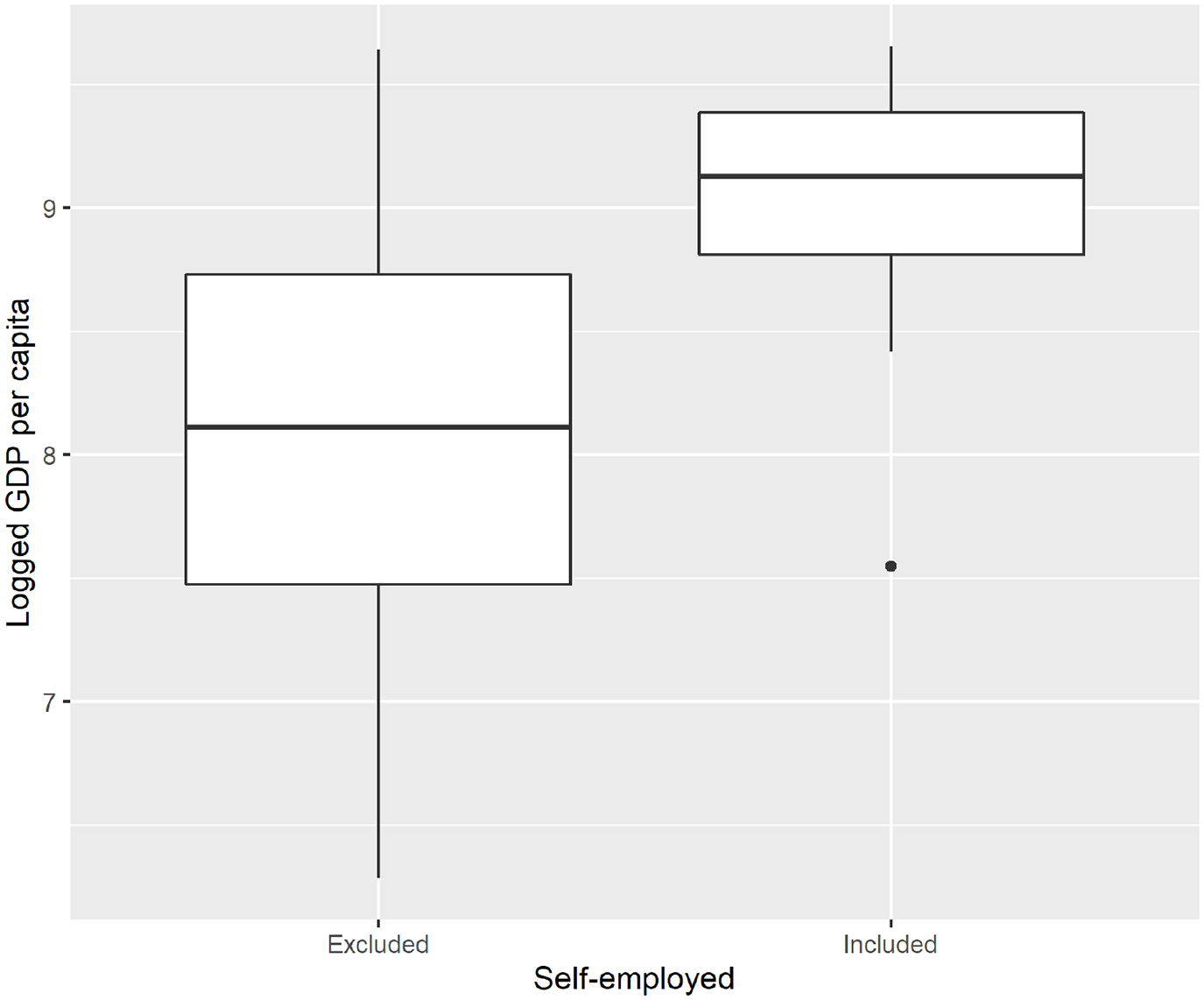
Boxplot displaying the logged GDP per capita for countries where the self-employed are excluded or included in maternity leave legislations.
Conclusion
Despite the long history of welfare development in LMICs, the majority of the working population still lacks access to social insurance benefits. Comparative welfare research criticizes the inadequate coverage for workers without employment contracts, yet less attention has been given to barriers to ‘entitled’ benefits. This article aims to address this gap by systematically measuring the discrepancy between de jure and de facto maternity leave coverage and examining its determinants using an original database.
My empirical findings reveal a substantial discrepancy in LMICs: while a large number of countries promise de jure universal coverage, very few achieve it in practice. The discrepancy is also persistent in LMICs, which could be not be automatically solved by having a long history of social insurance systems. Strong state capacity, such as bureaucratic capabilities and state infrastructure, seems key in mitigating the discrepancy. Conversely, the prevalence of corruption or states’ inability to control it significantly hampers the effective enforcement of social insurance legislation. Poor policy design can pose additional hindrances to the effective implementation, such as an excessively lengthy contribution.
This article presents new evidence on the significant disparity between social insurance legislations and practices, indicating that the expansion of social insurance legislation is merely a preliminary step toward universal welfare access. I hope that these findings will stimulate further research to investigate barriers preventing access to ‘entitled’ social security benefits in LMICs. Future research could explore at least three areas. First, the challenge of accessing benefits for which potential recipients have already contributed needs to be investigated, a hurdle underscored by existing literature. For example, even Eastern European countries with low discrepancy between expected and effective coverage exhibit notably lower sickness absence rates in comparison to advanced welfare states. This implies that a considerable number of workers do not or cannot benefit despite their entitlement and contribution (Bolukbasi et al., 2021). Second, there is a pressing need to scrutinize the discrepancy in other types of social policies (e.g. pension, healthcare, and non-contributory cash transfer). For instance, recent studies provide case-based evidence of implementation failure in emerging non-contributory cash transfer programs (e.g. Lavers, 2022). The mechanisms underlying the implementation failures of other social policies may differ from those of maternity leave due to distinct targeting methods and the added complexities associated with longer contribution periods (e.g. pensions).
Supplemental Material
sj-docx-1-gsp-10.1177_14680181251324061 – Supplemental material for Discrepancy of social insurance between laws and practices: Implementation challenges of maternity leave in 73 low- and middle-income countries
Supplemental material, sj-docx-1-gsp-10.1177_14680181251324061 for Discrepancy of social insurance between laws and practices: Implementation challenges of maternity leave in 73 low- and middle-income countries by Keonhi Son in Global Social Policy
Footnotes
Author’s note
The author confirms that this manuscript has not been published elsewhere and not under consideration by another journal.
Declaration of conflicting interests
The author(s) declared no potential conflicts of interest with respect to the research, authorship, and/or publication of this article.
Funding
The author(s) disclosed receipt of the following financial support for the research, authorship, and/or publication of this article: This article is a product of the research conducted in the Collaborative Research Center 1342 ‘Global Dynamics of Social Policy’ at the University of Bremen. The center is funded by the Deutsche Forschungsgemeinschaft (DFG, German Research Foundation) – Project No. 374666841 – SFB 1342.

Supplemental material
Supplemental material for this article is available online.
Notes
Author biography
References
Supplementary Material
Please find the following supplemental material available below.
For Open Access articles published under a Creative Commons License, all supplemental material carries the same license as the article it is associated with.
For non-Open Access articles published, all supplemental material carries a non-exclusive license, and permission requests for re-use of supplemental material or any part of supplemental material shall be sent directly to the copyright owner as specified in the copyright notice associated with the article.
