




Abstract
Access to education and health care are core development goals of the United Nations since its inception. Today, almost all countries have education and health systems in place. In former colonies, the historical roots of these systems can often be traced back to colonial times. In this article, we argue that spending on social services for the local population was seen as a necessary condition to expand the trade-based colonial economy especially in the initial stage of social services dating back to the interwar period. Using novel data on health and education expenditure in 35 former British and French African colonies during the height of their empires (1919–39), we show that trade volumes account for a large share in the variance of expenditure on education but not health services, and that present-day expenditures partly reflect these patterns. Our results suggest that similar mechanisms are at play within the two empires and differences between them are in degree rather than in kind.
Introduction
Since the founding of the United Nations, access to education and health care have been among its core development goals. Today, almost every country in the world has an education and health system in place. In many former colonies, these systems originated during colonial times (Midgley and Piachaud, 2011; Schmitt, 2015). In British and French Africa, colonial investments in medical and educational services for the local indigenous population mainly started in the interwar period (1919–1939). On average about 13% of the colonial budget was spent on health and education services. However, the expenditure share allocated to health and education services in the interwar period differed widely across colonies – even within the same empire. 1 This raises the question regarding what factors account for the large differences in expenditure levels across colonies.
Understanding the determinants of historical patterns of social expenditure is important, as several studies attest to a high degree of path dependency between colonial and contemporary social policy and outcomes. Mkandawire (2020) argues that different modes of incorporation into the colonial economy were associated with specific social welfare regimes that continue to persist into the present day. Huillery (2009) has shown that colonial-era investments in education and health continue to be associated with higher enrolment and lower mortality rates today. Ricart-Huguet (2021) finds a similar though weaker persistence in British Africa, arguably due to the eroding effects of high economic growth. Glaeser et al. (2004) even argue that investments in human capital are more decisive for long-term development than other fundamental factors, in particular geography and institutions. Given this persistence of social policies and long-term impacts on outcomes necessitates a better understanding of what drove early social expenditure.
In this article, we argue that colonial trade and related economic rationales are an important driving force for initial government expenditure on social services during the interwar period. 2 After the First World War, efforts to rebuild war-torn metropolitan economies increased governments and firms’ interest in expanding markets to colonial territories. This was facilitated by technological progress in railway infrastructures, the institutionalization of wage labour and the introduction of portable currencies in the colonies. Colonial trade was increasingly considered to be important for colonial budgets as trade taxes account for the lion share of government revenues in the colonies. In Africa, labour scarcity posed a delicate challenge to firms engaged in trade and other commercial activities. Unlike in earlier years, firms could not rely extensively on forced and indentured labour due to pressure from the international community. Instead, providing very basic education and health services also to the local population became one instrument to increase the number of able-bodied and skilled workers, which were in short supply (Mkandawire, 2020: 5). In consequence, higher trade activities put pressure on colonial administrations to spend more on basic education and health services.
For our empirical analysis, we make the first use of a novel data set that provides data on colonial Africa during the interwar period (1919–1939). 3 For this article, we analyse 35 former British and French African colonies, applying cross-section analyses, to determine whether differences in the intensity to which colonies were engaged in trade can account for the varying spending levels on health and educational services. The underlying data consist of primary data extracted from British Blue Books and French Annuaires Statistiques, alongside other documents such as mandate and expenditure reports. Documents have been collected from historical archives in Cambridge, Geneva, Hamburg, London, and Paris, as well as through online repositories. 4 This novel dataset offers a unique possibility to analyse the roots and development of social policies in contexts or times where comparative knowledge is particularly lacking in the current literature.
This article contributes to the existing literature, both to comparative social policy research and political economy scholarship. Existing research on the emergence and early development of social policies have emphasized the role of domestic factors such as industrialisation, democratization and organized labour (Flora and Heidenheimer, 1981; Wilensky, 1974) or transnational actors such as missions and colonial administrations (Beck, 1966; Becker, 2022; Lankina and Getachew, 2012). We show that colonial trade and economic activities have to be added to the narrative of the emergence of social policies in former colonies.
Concretely, we provide evidence that in colonies strongly involved in the trade-based economy, especially spending on education is particularly high, independently of the colonies’ budget size or revenues. This finding demonstrates that the expansion of capitalism propelled spending on education and complements work by Ricart-Huguet (2022), who argues that public investments within colonies was affected by opportunities and demands that trade created. Moreover, it contributes to the political economy literature which focused on the impact of colonial institutions on economic growth drawing less attention to the influence of colonialism on social policies (Acemoglu et al., 2001; Agbor, 2015; Bolt and Bezemer, 2009; Lange et al., 2006). In this strand of literature, it is subject to debate whether the colonizer’s identity or the colonial institutions, which were often adapted to characteristics of the colonies (e.g. climate and geographical conditions), are responsible for the observed differences in economic performance. We show that despite different social expenditure levels across empires, the relationship between trade intensity and social expenditure is observable in both empires independently of the colonizer’s identity. We also provide preliminary evidence on the persistence of social expenditure shares but leave the in-depth exploration of this topic to future studies.
The article proceeds as follows. The next section elucidates the state of the art. We proceed to describe and theorize how the trade-based colonial economy affects spending in health and education services. Subsequent sections first present our method and data, and then our main results. A final section concludes.
State of the art
When explaining the emergence of social policies, the comparative social policy literature has emphasized domestic factors such as industrialisation, economic development, urbanization and its impact on the social structure and demographics to play a key role (Flora and Heidenheimer, 1981; Wilensky, 1974). The increase in productivity induced by industrialisation provided governments with fiscal resources which allowed them to respond to growing social needs. This development was fostered by strong labour unions and democratization processes (Esping-Andersen, 1990). More recent studies have argued that globalization (Rudra, 2008; Schmitt and Starke, 2011), policy diffusion (Brooks, 2007; Schmitt, 2013) and international organizations such as the International Labour Organization (ILO) and The World Bank (Deacon, 2007; Orenstein, 2008) have had a significant impact on social policy-making. Studies that explicitly focus on social policy in developing countries emphasize additional factors such as the development strategy (Barrientos and Santibáñez, 2009; Wibbels and Ahlquist, 2011) and regime type (Mares and Carnes, 2009; Rudra and Haggard, 2005). However, while these studies could explain the development of social policies in later periods, they do not take into account the historical roots and the colonial legacies of social policy.
Research that considers the earlier stages of social policies in former colonies or the influence of colonialism on contemporary social protection is rare. Some studies focus on the role of specific actors such as missions for education services (Becker, 2022; Lankina and Getachew, 2012; Whitehead, 2007). Others argue that different colonizers implemented different imperial strategies that shape the pathways of social protection in former colonies (Cooper, 1996; Midgley and Piachaud, 2011; Schmitt, 2020). These studies include provide rich country case studies on health and welfare policies many of them on the Tanzanian case (Eckert, 2004; Mbise et al., 2021; Turshen, 1977). Finally, some scholars emphasize that the variance in social policies and social welfare regimes can mainly be traced back to different colonies’ economic systems. Most prominently, Mkandawire (2010) distinguishes between cash crop, labour reserve and concession economies and argues that all three economy types have different implications for social protection. Social policies in cash crop economies, for example, were often community-based including many informal instruments of social welfare provision due to the high presence and dominance of peasantry. In labour reserve economies, in contrast, the most important issue was to increase the productivity of labour and the reproduction of workers. Social policies in these economies were based on formal wage employment leading to a higher level of labour militancy and racially segmented social policy regimes (Mkandawire, 2020: 4–5).
Studies stemming from political science and economics, which deal with the effects of colonialism, mainly address the question of how colonialism has affected economic and social outcomes rather than how it has influenced social policy (Acemoglu et al., 2001; Huillery, 2009; Lange, 2004; Lange et al., 2006; Mahoney, 2010; Ricart-Huguet, 2021). This literature typically argues that colonies differ with regard to the institutions that have been implemented. For example, in colonies where mortality rates among Europeans were high or which were densely populated in pre-colonial times, extractive institutions have been established (Acemoglu et al., 2001). Extractive institutions are expected to have negative effects on economic growth in the long run. Moreover, Glaeser et al. (2004) address the issue of endogeneity and reverse causality. They ask whether growth in income and human capital causes institutional improvements or whether pro-investment policies are a consequence of political constraints on government (p. 272). They point to the methodological and conceptual difficulty of disentangling causes and effects and find a slight tendency for the ‘primacy of human capital for both growth and democratization’ (p. 297). Engerman and Sokoloff (2002) also identify initial factor endowments (i.e. natural resources and population densities) as crucial but argue that it is their effect on colonial-era inequality that shapes long-term outcomes. Despite not analysing social policies, this often-cited literature holds conceptual value, since it systematically links different imperial strategies or pre-colonial characteristics to colonial and post-colonial economic pathways. However, the understanding of the causal mechanisms between colonialism and economic growth remains at an abstract level.
In addition, some studies from historical economists show that tax policies in British and French African colonies depended on specific geographic and pre-colonial conditions, such as access to the coast rather than the specific colonizer (Frankema and Van Waijenburg, 2014: 385). For example, Frankema (2011) argues that differences in geographical conditions influenced the colonial fiscal systems which then affected spending patterns. In colonies, where colonial administrations could generate revenues predominantly form taxes on trade, investments in public goods such as education and health care were higher compared to colonies which had to rely mainly on poll taxes. Custom duties were comparably easy to collect relieving colonial governments from imposing taxes on individuals which were accompanied by considerable enforcement costs, especially in sparsely populated areas in landlocked colonies. These enforcement costs for police and security forces reduce funds available for social services, such as education and health (see also Gardner, 2012).
In sum, existing research by historians, political economists and comparative social policy researchers has provided valuable knowledge on determinants of social policies and possible effects of colonialism in selected fields of social policy. However, the influence of colonial trade, and relatedly economic rationales and the labour question, on basic social policies in colonial contexts during times when government investments started has been mainly neglected by now.
The colonial economy and social expenditure: theory and hypotheses
In this article, we argue that colonial trade was one important driver of governmental investments in basic social services especially in the interwar period. This section develops this argument in detail. From its inception, the colonial enterprise was an economic undertaking. One central objective of the colonial powers exercising political control was to economically benefit from the colonies (Abernethy, 2000). The colonial economic system established especially in the African colonies can be characterized as a trade-based economy. European companies exported agricultural produce and raw materials such as timber, palm oil, groundnuts, coffee, and rubber, and imported manufactured products to the colonies. Engaging in international or imperial trade was key for the economic development of colonies and the revenues from trade taxes were ‘the single most important determinant of the cross-colony variation in budget size’ (Frankema and Booth, 2019: 15).
The trade-based economy was characterized by a strong concentration of power within the hands of a few commercial houses and (semi-)commercial banks (Crowder, 1968: 287f; Tadei, 2020). These houses controlled the majority of Africa’s commerce and dominated the import-export trade of African colonies. The trading companies often owned or had interests in shipping lines and controlled or worked closely together with manufacturing companies. For example, in French tropical Africa, three commercial giants stood out in terms of power and size: the Compagnie Francaise de L’Afrique Occidentale which was involved inter alia in oil works, soap works, tanneries, and many others; the Société Commerciale de L’Ouest Africain also engaged in banking activities; and finally Unilever which appeared in the form of various representative companies (Suret-Canale, 1971).
Besides these powerful trading companies, several banks dominated investments and economic activities. In the French colonial Empire, one of the most powerful banks, the Banque D’Afrique Occidentale, was even granted the privilege of being an issuing house for all sub-Saharan territories under French domination, and it was the principal deposit bank.
This colonial trade-based economy was highly labour intensive. Able-bodied men were needed for the plantations to produce raw goods (i.e. groundnuts, cacao, and timber), for the transport of raw material and products to the coastal regions, for the construction of ports and railways, and other commercial operations. The demand for labour became more pertinent after World War 1 when metropolitan governments and firms increasingly looked for economic opportunities outside of Europe. Expanding the trade relations between the metropole and the colonies was seen as one instrument to overcome the economic recession and to contribute to metropolitan development (Constantine, 1984; Mkandawire, 2020). Especially in Great Britain, politicians discussed the importance of colonial trade to deal with the high unemployment rates at home (Havinden and Meredith, 1996). This process was accelerated by the development of the railway system. A functioning railway system enabled the economic integration in the colonial trading system as it lowered costs for the transportation of goods, raw materials and labour. Other technologies, such as the introduction of portable currencies and wage labour, further aided the expansion of the colonial economy.
However, companies in nearly all areas and fields of operation were faced with massive labour scarcity. In the beginning of the 20th century, companies became more vocal about labour scarcity and the related negative effect for the colonial economic project. For example, the director of one of the three largest commercial houses in French tropical Africa, the Compagnie Francaise de l’Ouest Africain, Julien le Cesne explained: The export of major crops has not risen enough. The reason for this is the lack of manpower. . . .Growth in production (. . .) is only possible through the growth of population. And each of us, by the extension of commercial transactions, by the resultant growth in raw materials, will reap big profits
5
(Suret-Canale, 1971: 408).
Labour scarcity had several reasons. Many potential workers did not voluntarily participate in the colonial economy or were not interested to work for European trading companies. Especially in less densely populated areas, recruiting workers needed for the development of infrastructural networks, and the expansion of mining and cash crop was very difficult (Frankema and Van Waijenburg, 2014: 390). Communication problems arising from the absence of a common language further exacerbated this problem. Another reason for labour scarcity was the physical condition of potential workers. Diseases like yellow fever, sleeping sickness, malaria and nutritional deficiencies were severe problems and the ‘grave state of physical disability’ made economic activity difficult (Hailey, 1938: 1121). This problem came to the forefront during the recruitment efforts for the military during the Great War – it elucidated the ‘extent to which the peoples of West Africa were impoverished’ (Conklin, 2000: 218). In consequence, ‘[t]he presence of a sufficient number of healthy African workers . . . could not be taken for granted’ (Conklin, 2000: 218). Doctors were rejecting 60% of labour recruits examined as physically unfit (Cooper, 1996: 40), and in the case of soldiers, even more than 80% were refused (Echenberg, 1990; Schmitt, 2020).
Against the background of the tremendous extent of physical disorder, as well language problems, investing in basic health and educational services for Africans was deemed ‘essential to economic improvement’ (Crowder, 1968: 275) and productivity increases (Conklin, 2000: 218). 6 Until World War 1, health and education services provided directly by colonial administrations were typically reserved for the White minority. Expanding health and education services to the local population was not regarded as possible or even desirable: ‘The first [objective of health care] was to protect the health of the European administrative personnel, the armed forces and where possible, the lower rank African workers of the colonial staff’ (Suret-Canale, 1971: 414). This changed after World War 1, since the conviction that producing a sufficient amount of the labour force required an increase in basic education and health services for the local population became more prevalent. 7
Albert Sarraut (1923) stated in his famous plan, La Mise en Valeur, which aimed at increasing the productivity of the French empire: In fact, the first effect of education is to greatly improve the value of colonial production by multiplying the quality of intelligence among the mass of indigenous workers, as well as the number of skills; it (. . .) will compensate for the numerical insufficiency of Europeans and will satisfy the growing demands of the agricultural, industrial or commercial enterprises of colonisation. (p. 95; translated by the authors) The growth of colonial production is (. . .) above all, a question of manpower, of preserving the population and birth rate, conditioned by a major program of hygiene, medical assistance, and education (p. 61; translated by the authors).
In British political circles, World War 1 reinvigorated debates about the importance and potential of colonial development for welfare in the United Kingdom. In consequence, the Colonial Development Committee was founded in 1919 and presented the ‘Report on Economic Development of Crown Colonies’ in its introductory session. This report outlined that in the light of the pre-war experience successful colonial development depends on five factors, including the maintenance of social order, a working infrastructure, adequate health services, agricultural education and research, as well as sufficient financial investments: ‘(1) internal peace (2) adequate transport (3) health schemes (4) agricultural education and research, and (5) a steady flow of capital for agricultural and mineral development and to provide a sufficiency of credit and marketing facilities’ (as cited by Constantine, 1984: 41). As such, social services – particularly health and education – were firmly established as important features of any development agenda.
In sum, we argue that colonial trade became increasingly important when colonial administrations increasingly looked for economic opportunities outside of Europe after the First World War in the light of economic recession in the metropoles. Investments in basic education and health services for local populations was one instrument to expand labour supply and counter the miserable physical conditions of existing labour and language problems (Crowder, 1968: 274). Trading companies made use of their increasing political importance and lobbied colonial administrations to expand labour supply through investments in social services. They were more successful in doing so where the colony was highly involved in and important for trade. Cross-pressured by metropolitan governments and trading firms, colonial administrators frequently complied with such claims (Crowder, 1968: 274). We therefore hypothesize that in colonies highly involved in trade activities, social expenditures in the field of health and education were more prioritized than in colonies which were integrated in colonial trade to a lesser extent (H1). Moreover, taking up the controversy within the political economy literature, we do expect that the suggested relationship between trade intensity and social expenditure exists independently of different colonial governance structures and should therefore be similarly present in different empires (H2).
Method and data
Quantitative historical research is severely constrained by data availability. While this is certainly true for machine-readable data, a vast range of archival records remain untapped. Fortunately, advances in the digitization of archives and renewed interest among social scientists in historical research have helped turning more and more dusty files into digital datasets.
For the purposes of this article, we use new data on colonial-era social expenditure in British and French Africa, 8 mainly collected from the British Blue Books and French Annuaires Statistiques, alongside other documents such as mandate and expenditure reports. Documents have been collected from historical archives in Cambridge, Geneva, Hamburg, London and Paris, as well as through online repositories.
The bilateral trade data are also partially novel: we rely on the Ricardo dataset which features historical data on bilateral trade and complement it with additional primary data to provide more refined, colony-level measures where Ricardo data are only available for aggregates, such as French West Africa or the Union of South Africa. The data cover the interwar-period (1919–39) and thus represents the situation during the height of European colonial empires in Africa. In the following, we describe all variables used in the analysis.
Dependent variables
Our main dependent variables are the government expenditure figures for education and health. They are indicated by the average proportion of the total government expenditure allocated to each of the two social policy areas between 1919 and 1939. 9 Shares have the advantage of representing government priorities vis-à-vis other expenditure categories and are not dependent on the size of the colony’s budget. Using shares is a conservative test of our argument as it reflects the government priorities more directly than absolute figures, such as per capita spending which fluctuate with general economic conditions. However, the results of our models do not change when replacing the share values by per capita spending on health and education services.
We focus on education and health as they were the two social policy areas most colonial administrations first invested in. As colonial administrations constitute the institutional predecessor of the national governments that followed after independence, their expenditures are of particular interest. 10 The expenditure figures are derived from primary sources, such as the British Blue Books and the French Annuaires Statistiques. Details are provided in Supplemental Material Appendix 1.
Independent variables
Our main independent variable is each colony’s per-capita trade (i.e. the sum of exports and imports), whereby we again compute averages for the period of interest following the same approach as for the expenditure data. The variable we use is based on the Ricardo dataset (Dedinger and Girard, 2017) from which we extract data as reported by the colonial administration. For further analyses, we also reconstruct figures for trade with the metropole, that is, trade between British colonies and Britain as well as between French colonies and France.
The data provided by Ricardo is often only available for federations of colonies, such as French West Africa or the Union of South Africa. Therefore, we disaggregate the data to the colonial level by using information from other primary sources to determine each colony’s trade share within the respective federation. Details on the procedure and sources can be found in Supplemental Material Appendix 2. Following the approach described by Cogneau et al. (2018), these figures are transformed into 1925GBP. To better assess the economic relevance of trade, we use population data from Frankema and Jerven (2014) to further transform both figures into per capita measures. Figure 1 shows the geographic distribution of the trade variable together with our two social expenditure measures.
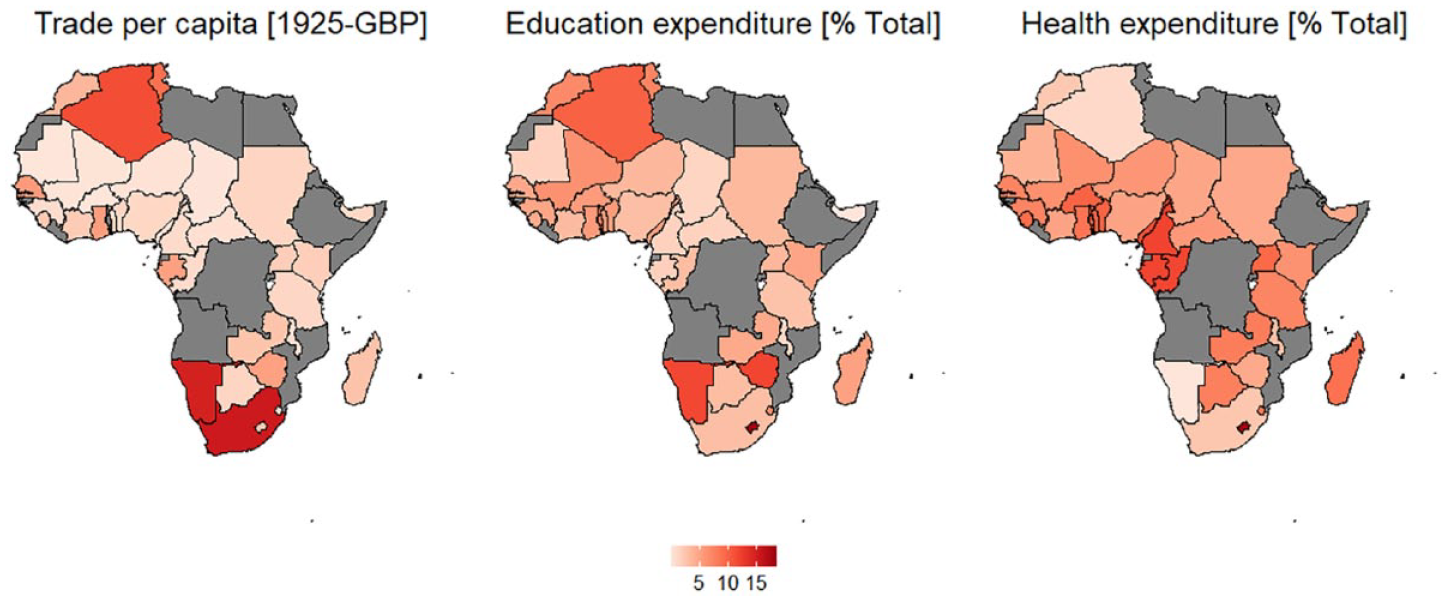
Trade and social expenditure averages in interwar Africa (1919–1939).
Control variables
In our analyses, we account for a variety of factors that might explain why trade and social expenditure are related. First, we control for pre-colonial variables that are of relevance for both trade and social expenditure. Geography shaped how easily Europeans could access colonial territories, and thus also the costs of trading and governing. This is accounted for by a variable on coastal access, that is, the proportion of the territory within 100 kilometres of the coast, and another variable on the surface area of the territory (in thousands, km²). In addition to coastal access, geography also shaped the kind of dominant economic activities that Europeans engaged in. These activities affected trade volumes as well as what kinds of skills were required from African labourers. We therefore control for the proportion of arable land, which favoured the emergence of cash crop economies, and the availability of mineral resources, which spurred highly extractive and exploitative activities (Acemoglu et al., 2001). These initial endowments have also been shown to directly affect inequality and public goods provision (Engerman and Sokoloff, 2002).
Beyond geography, levels of pre-colonial development varied widely across the African continent. Europeans often found it easier to establish trade networks and political control in areas that were more developed. Following earlier studies, we capture different levels of development through pre-colonial population densities as they are strongly associated with economic and political complexity. The indicator is based on population count data by Frankema and Jerven (2014). Some of their data are indicated for sub-colonial units that we aggregated to correspond to our units of analysis. We divide these aggregates by each colony’s total area to derive our population density measure (persons per square-kilometre).
On top of pre-colonial differences, we also need to account for colonial activities that might confound the relationship between trade and social expenditure. The most basic difference between colonies is the identity of the colonizer. As our analyses are limited to British and French colonies, we only need a dummy variable (British colony) to control for empire-wide differences. 11
As already pointed out above, geography shaped the types of colonial economies that emerged. However, this was certainly not a deterministic relationship. Therefore, we account for the type of economy that actually emerged in different colonies. Based on Mkandawire (2020), we distinguish cash crop economies from labour reserves and concession economies. 12
To control for the argument provided by Frankema (2011), we include the level of customs revenue. As outlined in section ‘State of the art’, Frankema (2011) has argued for a mechanic relationship between trade and social expenditure. In his argumentation, trade is easy to tax in comparison to poll taxes as a major alternative. In contrast to trade taxes, extracting poll taxes required costly investments in police and security which, in consequence, are not available for social services. Therefore, we control for per-capita customs revenue to test whether our proposed relationship between trade and social expenditure emphasizing the interests of colonial trade firms and efforts by colonial governments holds when the mechanic linkage is accounted for.
We collect customs data directly from primary sources. For the British colonies, we draw on the Statistical Abstract for the British Empire and the Statistical Abstract of the British Commonwealth. For the French colonies, we again rely primarily on information from different Annuaires Statistiques, which we complement with budget reports (compte définitifs) where necessary. We transform the collected data into per-capita values and compute averages for the interwar period.
Christian missions were an important provider of social services in colonial Africa. This is especially true for educational activities and British Africa, which had a more liberal approach towards missionary activities (Becker and Schmitt, 2023). At the same time, Christian missions were also closely entangled with trading companies. Already in the pre-colonial era, missionaries often relied on free transportation with commercial ships and mission stations therefore often grew where Europeans traded. This continued during the colonial area. As a major social service provider, their presence not only affected the costs and benefits of government investing in social services, but they also were an important political player that lobbied for the expansion of social expenditure, and in particular subsidies for mission schools. To account for the potentially confounding role of missions, we introduce a variable capturing the mission presence in each colony, that is, the proportion of the territory within 25 kilometres of colonial mission stations.
Finally, we account for the fact that higher trade volumes went hand-in-hand with a larger number of Europeans in the colonies. As social expenditure was also direct at Europeans, their presence might confound the relationship with trade. We therefore control for the interwar share of the European population in each colony. Detailed summary statistics for all variables are presented in Table A1 in Supplemental Material Appendix 3.
Results
We will first provide descriptive evidence on the dynamics of government expenditure prior to reporting on the results of our statistical analyses.
Descriptive patterns
First insights can be derived from a simple comparison of the trade volumes and the expenditure on education and health. Figure 2 shows bivariate correlation plots that summarize the relationships. It can be seen that most colonies have rather low trade volumes, below 2.5GBP (in 1925 values). Only a small number of colonies has a trade volume of above 10GBP (in 1925 values). A similar clustering around low values also exists for the education expenditure share, although it is less pronounced. For health expenditure, there is a more even spread, in particular the clustering around low values is absent.
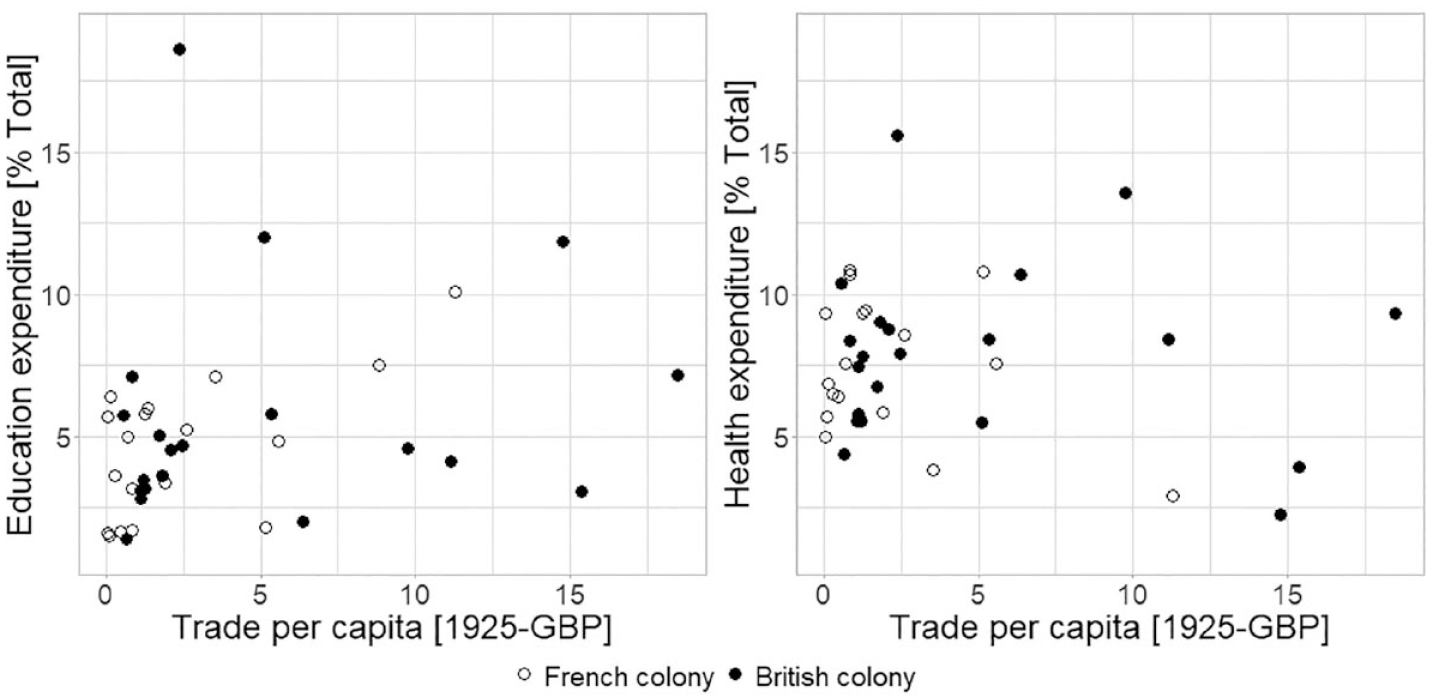
Bivariate relationships between trade and social expenditure (1919–1939).
Looking at the bivariate plots, a positive relationship between trade and education expenditure is rather obvious. This relationship also exists if one focuses on the bottom-left of the graph, in which most of observations are situated. With regards to health expenditure, no clear relationship emerges, neither overall nor for one of the empires. As such, this offers some first suggestive evidence that trade and education expenditure are indeed positively related but that this relationship might be less pronounced for trade and health.
In addition, the patterns between trade and social expenditure are comparable across the French and the British empire. Within both the French and the British empire, higher levels of trade are associated with higher levels of education expenditure. No such relationship between trade and health can be discerned in either of the empires. This suggests that differences in colonial models do little to explain the link between trade and social expenditure. Instead, it seems likely that similar forces are at work in both empires.
To further probe these patterns, the next section continues with a statistical analysis that accounts for the influence of other variables.
Regression analyses
A first set of regression models estimates the effect of trade and education expenditure (see Table 1). In the first model, our main model, we include only pre-colonial controls, that is, the four geographic variables and an indicator for pre-colonial development. The model attests to a positive and statistically significant effect of trade on education expenditures and thus provides support for our first hypothesis. In the remaining models, we include a variety of colonial variables that might confound the relationship between trade and social expenditures. Model 2 enters a variable for the colonizer identity and interacts it with the trade variable. It points towards higher education expenditures in the British empire, but is not statistically significant. Importantly, the interaction effect is small in substantive terms and statistically insignificant. This supports our second hypothesis that trade did not affect social expenditure differently in different empires. Accounting additionally for the type of economy in model 3 reduces the trade effect somewhat, though it remains large and statistically significant. Controlling for customs revenue in model 4 slightly increases the trade effect. The same applies when we control for the presence of Christian missions (model 5). Mission presence is the only control that itself has a statistically significant effect on education expenditures. As expected, mission presence is associated with higher levels of education expenditure. 13 Finally, model 6 attests to the expected positive relation between the share of Europeans in each colony and education expenditure, but the effect remains statistically insignificant. The effect of trade is somewhat smaller, but remains large and statistically significant.
Trade effects on education expenditure.
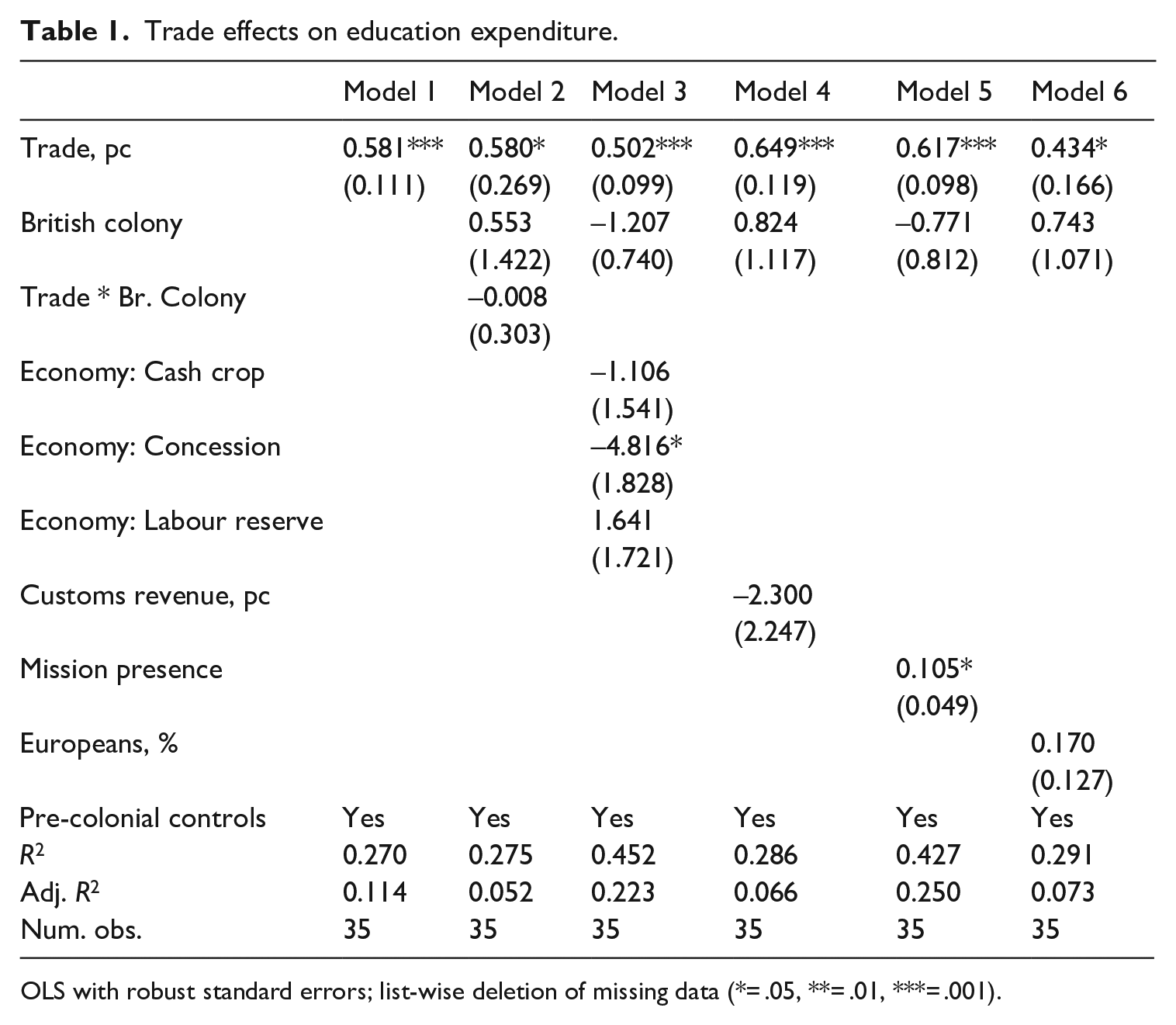
OLS with robust standard errors; list-wise deletion of missing data (*= .05, **= .01, ***= .001).
A second set of models tests the relationship between trade and health expenditure (see Table 2). We estimate the same models as before and only change the dependent variable from education to health. The results support the impression from the bivariate plots in the previous section. In none of the models, trade has any effect on health expenditures. In fact, the estimated coefficient consistently points in a negative direction, though it is far from reaching statistical significance and therefore strongly suggests a null effect. Again, there is also not statistically significant difference in how trade affect expenditure (see model 2).
Trade effects on health expenditure.
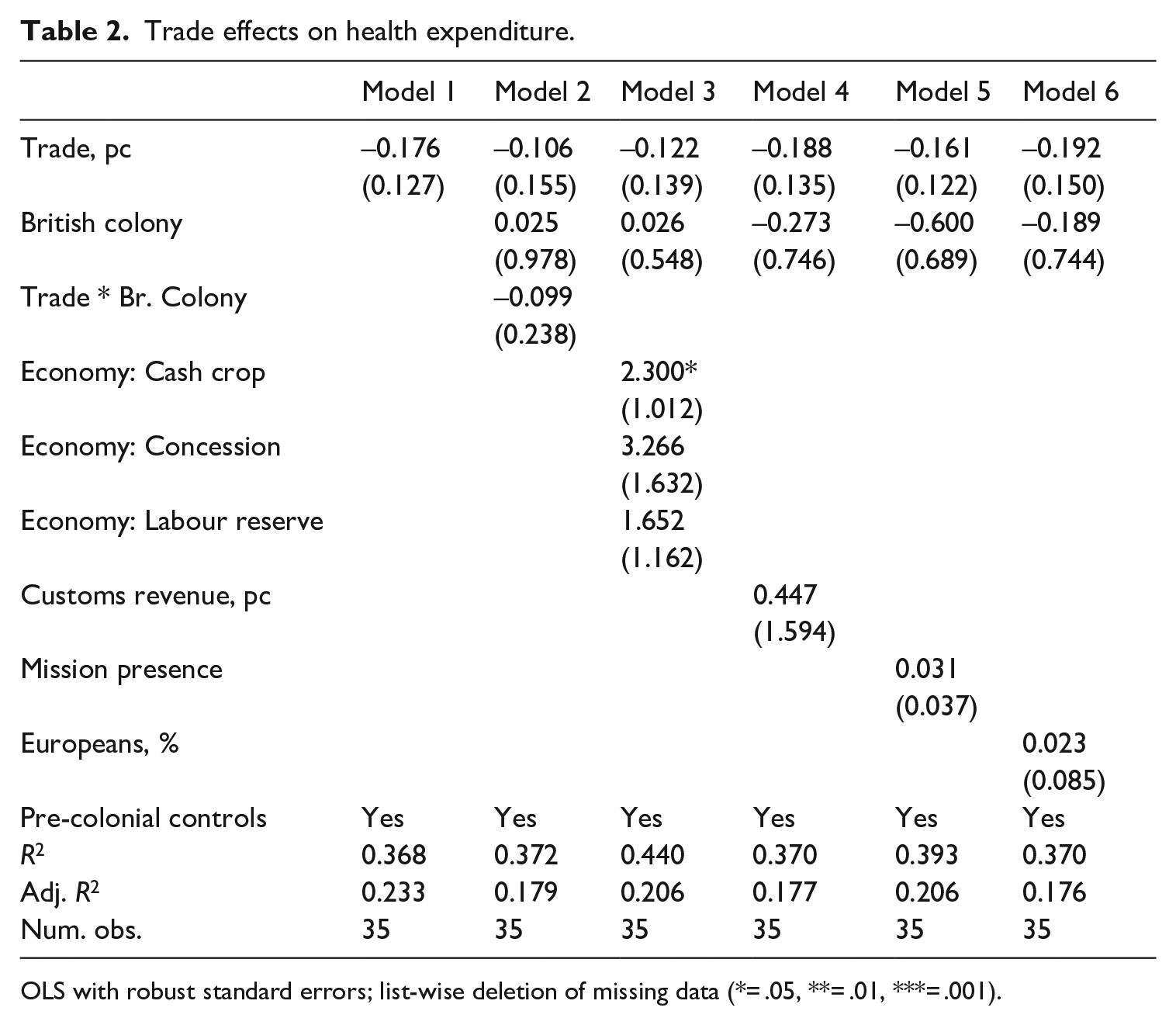
OLS with robust standard errors; list-wise deletion of missing data (*= .05, **= .01, ***= .001).
This is an interesting finding which underlines the necessity of sector-specific analyses. The share of colonial budgets allocated to health does not increase with the trade volume per capita. This means that investments in health in contrast to investments in education were not prioritized in colonies highly integrated in colonial trade activities. One reason might be that investments in health were also driven by military concerns. The military needed to recruit colonial soldiers who were needed in both empires during the world wars but often considered as physically unfit (Echenberg, 1990). However, no comparative data are available on the number of returning soldiers or the recruitment quota to test this influence. Moreover, substantive compensation for war veterans was not introduced until World War II (see Schmitt, 2020; Schmitt and Shriwise, 2023).
To further probe our main argument, we again estimate all models but distinguish trade with the metropole from trade with other countries. Underpinning this test is the assumption that trade firms from the metropole have better political access than other trade firms. Therefore, their lobbying efforts should be more successful. At the same time, colonial governments should be most interested in promoting trade activities by metropolitan firms. The results suggest that this is indeed the case (see Table 3). The first model attests to a large and statistically significant effect of metropolitan trade on education expenditures. The effect is about twice as large as the effect for overall trade. As overall trade and metropolitan trade are highly correlated, model 2 introduces a control for trade with other countries. This control corresponds to the difference between overall and metropolitan trade. Trade with other countries has no apparent effect on education expenditures and only minimally reduces the effect of metropolitan trade. This supports our claim that the trade effect results from concrete interactions between governments and firms that go beyond the mere tax benefits of trade activities. Performing the same test for health expenditure reveals the same null results that we documented in the main models (see Supplemental Material Appendix 3).
Metropolitan trade effects on education and health expenditure.
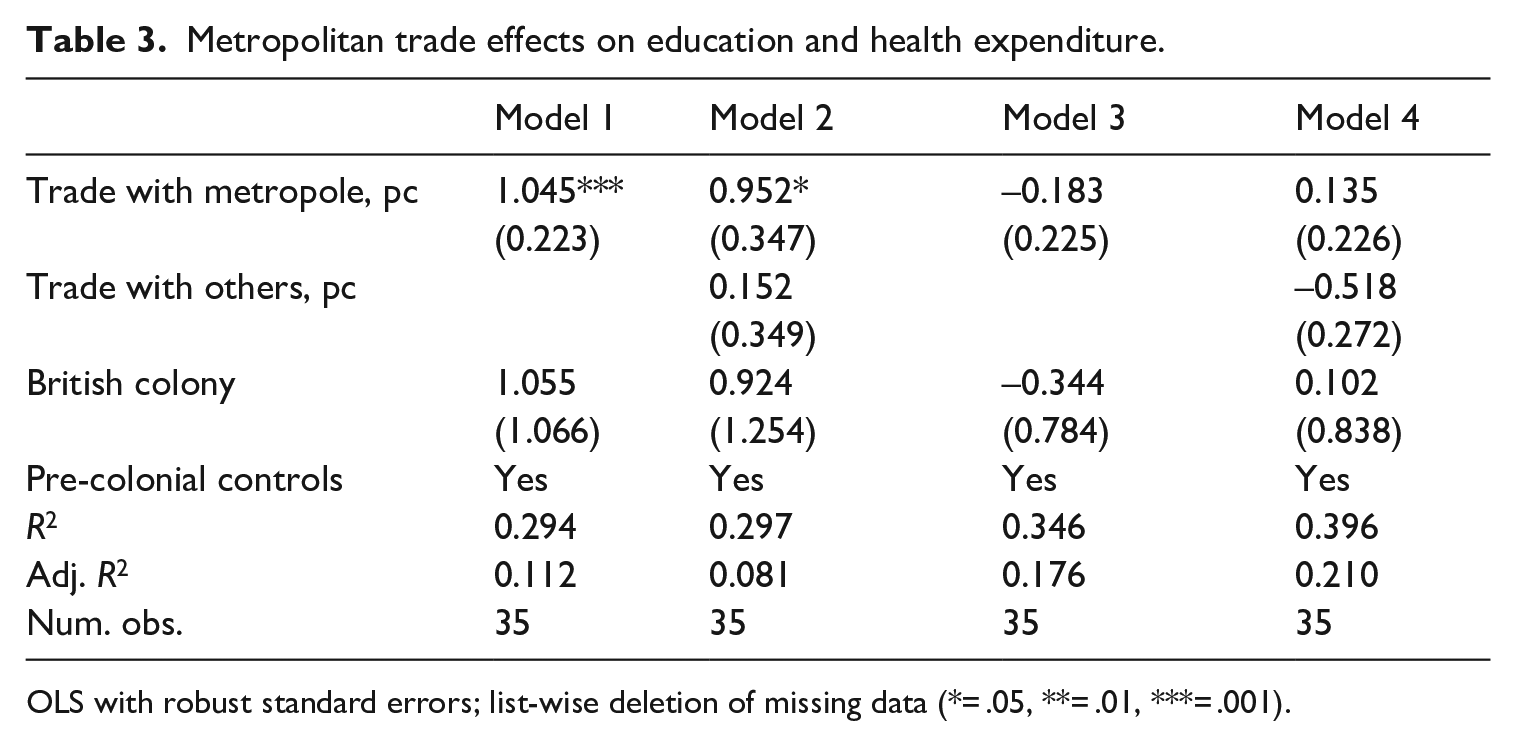
OLS with robust standard errors; list-wise deletion of missing data (*= .05, **= .01, ***= .001).
The results presented here are robust to various adjustments that are shown in Supplemental Material Appendix 3. As such, the results are robust to the exclusion of island colonies. 14 This is important because island colonies can more easily tax trade and therefore might be particularly dependent on such revenues. Our findings also hold when the dependent variables for education and health are indicated by per-capita figures.
Regression diagnostics of the main models, that is, models with pre-colonial controls only, in Tables 1–3, reveal no concerns with any of the underlying assumptions. We also confirm that our results hold when all statistically influential cases are removed from the analysis. For this purpose, we calculate Cook’s distance and employ a commonly used threshold. 15 As a further robustness check, we re-estimate the main models dropping all observations on a one-by-one basis. The estimated effects remain positive and statistically significant in all estimations (see Supplemental Material Appendix 3).
Legacies of social expenditure
Although this article is concerned with the determinants of colonial-era social expenditure, we close our empirical section with a look at the relationship between colonial and present-day expenditure. Figure 3 therefore plots colonial expenditure shares against present-day expenditure shares, which we derive from the World Development Indicators (The World Bank, 2022). It attests to a strong increase in the average expenditure share, from 4.9% in 1919-39% to 16.3% in 2000–20, for the set of countries corresponding to the colonies included in our study. The upwards sloping regression line shows that countries with a high education expenditure share in the colonial era still expend more on education compared to other government activities. With regards to health, the expenditure share stayed virtually the same, at 7.5% of total government expenditure. Maybe even more surprisingly, present-day expenditure shares do not correlate with colonial expenditure shares.
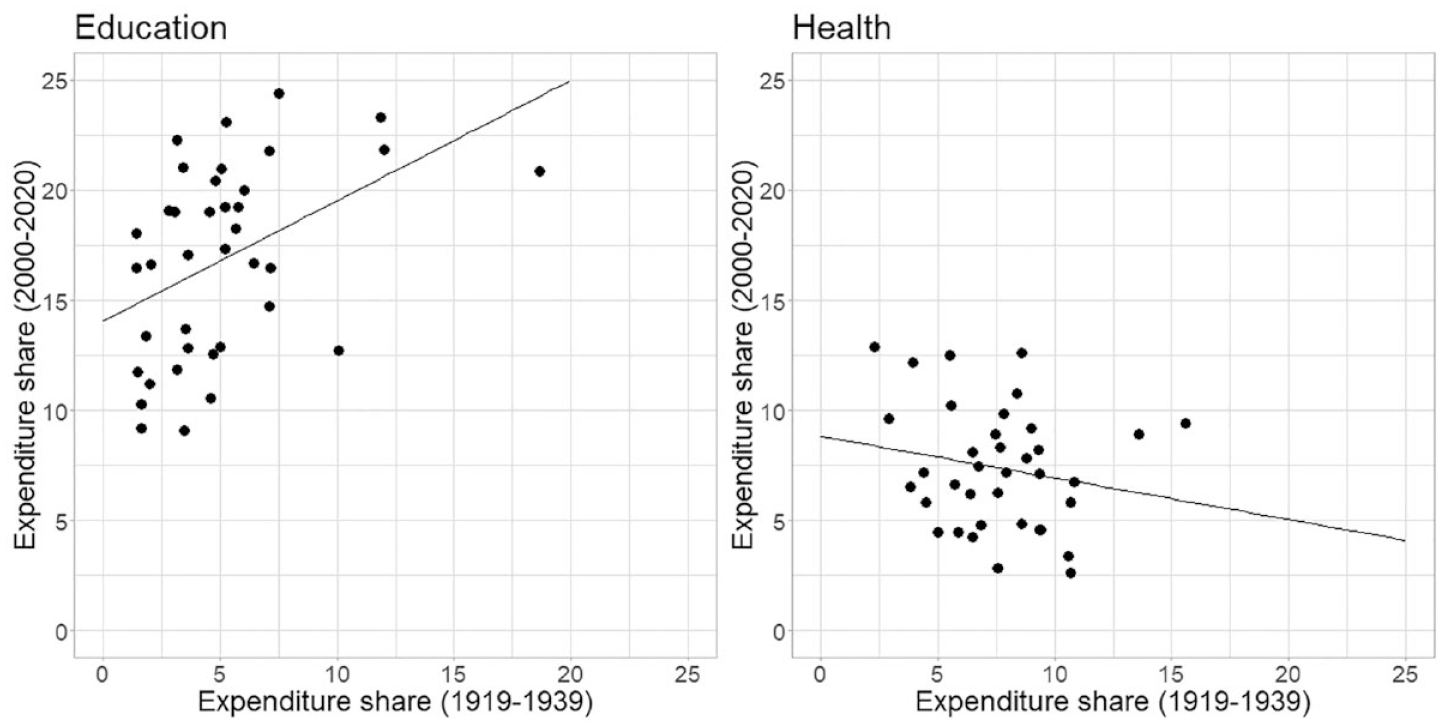
Bivariate relationships between colonial and present-day social expenditure.
This brief comparison with present-day expenditure suggests that the past can throw a long shadow. Current education expenditure shares continue to reflect the priorities of colonial governments, though there appears to be no persistence when it comes to health. This suggests different mechanisms explain why certain sending priorities persist while others do not. We leave it to future research to explore these mechanisms.
Conclusion
In many countries of the Global South, the roots of social policies can be traced back to colonial times when the labour question was put on the political agenda of colonial administrations for the first time. The expansion of capitalism throughout the empires put the labour question on the political agenda of colonial administrations and pushed the debate around social policies not only in the metropoles themselves but also in the colonies. In colonial Africa, the labour question became more virulent with the expansion of the trade-based economy throughout the empires in the 20th century, especially from the interwar period onwards.
In this article, we argued that in the initial stages of colonial social policies, one important driving factor for investments in basic social services was an economic rationale and the commercial concerns of the big trading companies in order to secure the provision of labour and to keep the colonial economic enterprise alive. In consequence, we expected spending on education and health services to be driven by trading activities. We analysed this relationship using a sample of 35 British and French African colonies during the interwar period, that is, in the period when investments in social services started. We presented a novel dataset which incorporates expenditure figures from several colonial archives and which is complemented by an extended version of the bilateral trade data from the Ricardo project.
The following two major findings stand out. First, colonial trade was one important driving force for investing in basic social services in times when organized labour, encompassing industrialisation or labour and social standards were by and large absent. However, a high involvement in trade activities only pushed investments in basic education and not in health services.
Second, the relationship between trade and social spending does not differ between the French and the British Empire. Although absolute spending figures are higher in British than in French colonies, the influence of a colony’s trade intensity on the respective social spending category is similar and comparable in size across empires. This is an interesting result in the light of the literature where differences between colonial empires are frequently discussed. Our findings corroborate the view expressed by Suret-Canale (1971) who thoroughly described the colonial economy in African colonies. He states that, in colonial Africa, the differences [across Empires, the authors] were far less deep than was sometimes imagined. The economic system was the same: the economy was controlled by the same trading monopolies (. . .). The political principles were also the same. (. . .) The principles were simply applied in a different style. (Suret-Canale, 1971: 348)
It has to be noted that the identified relationship between spending on social services and trade does not tell us something about the beneficiaries of social investments. It is possible that different groups of the society benefit differently from social spending on health and educational services due to institutional differences across Empires and colonies which in turn could affect post-colonial social outcomes in the long term.
This study paves the way for several subsequent research questions. The causal mechanisms driving the identified relationships have to be analysed more in depth. One way to move forward in this direction would be the application of an actor-centric approach where the interactions between the colonial administration and trading companies, that is, political and economic actors are systematically analysed. This more qualitative approach would also enable to incorporate other important actors such as missions and local elites that shape political decisions in the early days of social policies. Together with the presented quantitative analyses, this would be one important step towards a better comprehension of the historical roots and dynamics of social policies in former colonial contexts which is a prerequisite for enhancing our understanding of social problems in a more global perspective.
Finally, further research should explore the long-term persistence of social policy investments. On line with our preliminary evidence on expenditure persistence, some studies attest to long-term impacts on outcomes (Huillery, 2009; Ricart-Huguet, 2021). However, it is necessary to understand exactly when and how contemporary government expenditures and institutions are affected. Research that ascribes human capital a fundamental role in development processes (Glaeser et al., 2004) also encourages a look at a broader set of political and economic legacies of early social policy investments.
Supplemental Material
sj-docx-1-gsp-10.1177_14680181241268301 – Supplemental material for The colonial labour question: Trade and social expenditure in interwar Africa
Supplemental material, sj-docx-1-gsp-10.1177_14680181241268301 for The colonial labour question: Trade and social expenditure in interwar Africa by Bastian Becker and Carina Schmitt in Global Social Policy
Footnotes
Acknowledgements
The authors thank Judith Ebeling, Matthew Lange, Herbert Obinger, Laura Seelkopf, Amanda Shriwise, Marlous van Waijenburg, André Walter, and Reimut Zohlnhöfer for helpful comments and suggestions. They also acknowledge the constructive feedback received at the International Conference of Europeanists (2020, online substitute) and during seminars at the University of Bremen and Heidelberg University. Excellent research assistance was provided by Josefine Dehn, Christine Hedde-von Westernhagen, Jakob Kaiser, Maximillian Pfeil, Savannah Pine, and Amanda Shriwise. All remaining errors are our own.
Declaration of conflicting interests
The author(s) declared no potential conflicts of interest with respect to the research, authorship, and/or publication of this article.
Funding
The author(s) disclosed receipt of the following financial support for the research, authorship, and/or publication of this article: This study is part of a project funded by the European Research Council (ERC) under the European Union’s Horizon 2020 Programme (grant no. 755129).

Supplemental material
Supplemental material for this article is available online.
Notes
Author biographies
References
Supplementary Material
Please find the following supplemental material available below.
For Open Access articles published under a Creative Commons License, all supplemental material carries the same license as the article it is associated with.
For non-Open Access articles published, all supplemental material carries a non-exclusive license, and permission requests for re-use of supplemental material or any part of supplemental material shall be sent directly to the copyright owner as specified in the copyright notice associated with the article.
