




Abstract
With the publication of the European Green Deal (EGD) in December 2019, the European Union (EU) has recognised a link between environmental and social challenges and the need to tackle them together. A body of literature publishing under the umbrella concept of sustainable welfare and the term eco-social policies has acknowledged the environmental and social nexus and has been characterised by six prominent eco-social aspects namely, the integration between environmental and social policy goals, their link with economic growth, just transition, redistribution and compensation, citizens’ participation, and the state’s role. However, an in-depth analysis of the eco-social aspects contained in recent European policy documents that can be traced back to the eco-social literature is missing. To address this gap, this article focuses on two policy documents considered at the heart of the European ambition of achieving carbon neutrality by 2050, namely the EGD Communication and the Farm to Fork (F2F) Strategy. The article applies a document content analysis of these two documents and uses the six eco-social aspects as a heuristic to analyse and provide descriptive examples of the EGD and the F2F. The content analyses of these documents reveal several elements that advance the understanding of recent EU policies from an eco-social perspective. The study provides knowledge of envisaged compensatory and redistributive measures to the groups and entities affected by the socio-ecological transition and initiatives to enhance a global just transition. Both documents also recognise the primary role of citizens in driving the transition, complementing ongoing eco-social research on participatory processes. The EGD and the F2F reveal also some distinctions in the way the eco-social literature discusses states’ role in eco-social policy-making, the relationship between environmental and social policies and economic growth and intergenerational justice.
Introduction
Studies on European welfare and environmental policies have often been limited to each policy area with a general lack of contributions theorising an intersection between the two policies (Hirvilammi and Koch, 2020; Koch et al., 2016). An attempt to overcome this silo-mentality has been made by the eco-social research field which has reflected upon the interactions between these two policies. On one hand, theoretical contributions have delved into the environmental challenges to welfare systems and the social implications of environmental and climate policies (e.g. Büchs et al., 2011; Koch, 2018; Markkanen and Anger-Kraavi, 2019). On the other hand, empirical studies analysed policy discourses and objectives in policy documents (e.g. Mandelli, 2022a; Sabato and Fronteddu, 2020), welfare and environmental performances of selected countries (Zimmermann and Graziano, 2020) and concrete eco-social policy instruments (e.g. Büchs, 2021; Dukelow and Murphy, 2022).
While scholarly exchanges and cross-fertilisation research on environmental and social concerns are still in the making, recent European policies have encouraged an integrated perspective to address the current welfare and climate challenges. In December 2019, the European Green Deal (EGD) was published as Europe’s new framework of actions to ‘cut emissions while also creating jobs and improving our quality of life’ (Von der Leyen, 2019). The interrelation between environmental and social aspects of the EGD is made also evident by its double ambition of transforming the EU into a ‘fair and prosperous society’ and at the same time becoming the first carbon-neutral continent by 2050 (European Commission, 2019: 2). Hence, the EGD not only addresses both environmental and social aspects but also considers them as interconnected and mutually reinforcing objectives (Mandelli, 2022b).
Recent research has recognised an eco-social (or socio-ecological) 1 dimension of the EGD. Studies have analysed this policy document by focusing either on the social or on the environmental discourses and compared them to previous European strategies such as the Europe 2020 and the Lisbon Strategy (Laurent, 2020; Sabato et al., 2021; Sabato and Fronteddu, 2020) and to established environmental theories (Eckert and Kovalevska, 2021). Ossewaarde and Ossewaarde-Lowtoo (2020) have delved into the relationship between economic growth and environmental and social aspects of the EGD while several studies have recognised the interlinked environmental and social dimensions of the EGD when analysing key concepts (Laurent, 2020), specific objectives such as the ‘just transition’ (Mandelli, 2022a) and policy instruments such as the ‘Just Transition Fund’ (Kyriazi and Mirò, 2023). Eco-social research has also investigated the social implications of industrial decarbonisation and provided policy indications for adopting eco-social policy mixes to address the environmental and social challenges of the EGD (Mandelli, 2022a; Skjærseth, 2021). Moreover, studies have analysed the social dimension of the EGD (e.g. McCauley and Pettigrew, 2022; Zimmermann and Gengnagel, 2023). However, an in-depth identification and analysis of the eco-social aspects included in the EGD and other recent European policy documents that can be traced back to the eco-social scholarly debate is still missing. To address this gap, the article engages with the following research question: What eco-social aspects are contained in the EGD and the Farm to Fork policy documents?
To answer this question, the article identifies the eco-social aspects contained in recent EU policies and discusses them in relation to the eco-social literature. It applies a document content analysis of two recent European policy documents, namely the EGD Communication adopted in 2019 and the Farm to Fork Strategy (F2F) adopted in 2020. These documents are considered flagships at the core of the EU’s policy reform ambition of becoming the first carbon-neutral continent and are both part of the EU’s implementation effort of the United Nations 2030 Agenda and the Sustainable Development Goals (Schebesta and Candel, 2020). The EGD is a programmatic document which sets environmental and social objectives and details the actions to be followed while the F2F is a strategy that promotes the transition towards a sustainable food system and has been indicated by the European Commission as one of the policy instruments 2 to achieve the EGD’s goals (Bazzan et al., 2023; Wesseler, 2022). These documents have also been chosen for this analysis because they contain explicit reference to interrelated environmental and social aspects such as the promotion of a green and socially just transition in the EGD and of environmentally friendly, fair and healthy food systems in the F2F.
The primary aim of this article is to contribute to the eco-social policy research field by providing an eco-social perspective of recent European policy documents, and by expanding the existing research on the EGD. Yet, this study has also societal and policy-making relevance. By providing an in-depth content analysis of EU eco-social policy documents, it broadens the knowledge of key addressees, measures and modes of policy-making which shed light on the potential conflicts and trade-offs that may arise from the adoption of eco-social policies, especially in terms of their acceptance, as well as of their implementation. The remainder of the article is structured as follows: Section ‘Mapping the eco-social aspects in European policy documents’ discusses existing definitions within the eco-social literature and presents six ‘eco-social’ aspects previously identified by the author through a systematic review of the eco-social literature. Section ‘The eco-social aspects contained in the EGD and the F2F policy documents’ introduces the EGD and the F2F and presents the results of their content analyses along the six eco-social aspects. Section ‘Discussing the EGD and the F2F analyses with the eco-social literature’ discusses these eco-social aspects with the eco-social literature while Section ‘Conclusion’ provides some concluding reflections.
Mapping the eco-social aspects in European policy documents
In recognising the existence of a link between environmental and social policies, the eco-social research field has paid attention to the impacts of environmental problems on welfare systems and policies to tackle them, including the regressive distributional effects of climate change on welfare and social policies (Bailey, 2015; Büchs et al., 2021) and the role of welfare and environmental states in this nexus (Gough, 2016; Koch, 2020a). Within this literature, concepts have been developed to consider the respect of planetary boundaries (Raworth, 2017) and the satisfaction of human needs (Gough, 2015) such as the umbrella concept of ‘sustainable welfare’ defined as the ‘satisfaction of basic human needs within ecological limits in an intergenerational and global perspective’ (Koch and Mont, 2016: 107). This concept has been recently defined as a new paradigm in welfare and social policy research that studies policy solutions to deal with interconnected environmental and social problems (Fritz and Lee, 2023). Moreover, the term ‘eco-social policies’ was developed to indicate a connection between environmental and social dimensions of public policies and to ultimately forge ‘a unified eco-social policy’ (Gough, 2013: 14) where social policies are formulated in synergy with environmental goals (Koch, 2022a).
These definitions give emphasis to the environmental and social nexus but rather than describing what this nexus entails, they prescribe its occurrence (Cotta, 2024; Mandelli, 2022b) to ‘achieve ecologically beneficial and socially just impacts’ (Gough, 2013: 14). Recently, Mandelli has offered a more descriptive definition of eco-social policies as ‘public policies explicitly pursuing both environmental and social policy goals in an integrated way’ (Mandelli, 2022b: 9, italics in original). This definition introduces further details on the environmental and social combination prescribed in the two previous definitions by defining what is combined, namely environmental, and social policy goals, and how it is combined, namely in an integrated manner. At the same time, it gives only limited information on the content of eco-social policies (Cotta, 2024).
Previous research by the author has entailed a systematic review of the eco-social literature 3 to provide a bottom-up identification of eco-social aspects (Cotta, 2024). This review has revealed six prominent ‘eco-social’ aspects, well recognised and commonly used by the eco-social scholarly community, as shown in Table 1. The first aspect concerns the integration between environmental and social policy goals which is recommended as an objective to be achieved and indicated using similar terms such as interconnection, interaction and intersection between them (e.g. Hirvilammi and Koch, 2020; Zimmermann and Graziano, 2020). Another aspect concerns the environmental and social policies and their link with economic growth. Studies have identified several perspectives on this relationship that include, on one extreme, a growth-first market-oriented approach that prioritises the economy over the other two policies and, on the other extreme, de-growth and post-growth approaches which entail a temporary (de-growth) or a long-lasting (post-growth) decoupling from resource use and a steady-state economy where social and environmental goals are prioritised (Mandelli et al., 2021). A balanced approach is placed between these extremes in which the environmental, social and economic spheres are interdependent and mutually reinforcing (Sabato and Mandelli, 2018). An example of this balanced approach is green growth characterised by improvements in environmental protection within economic-growth strategies (Schulze Waltrup et al., 2023). The eco-social literature has also paid attention to just transition, often associated with the concept of (in)justice between countries and individuals regarding climate change policies (Emilsson, 2022; Gough, 2015), which should be achieved through equal sharing of responsibilities and wealth between and within countries and generations (e.g. Büchs and Koch, 2017; Gough, 2013). The eco-social literature emphasises also the issue of redistribution and compensation linked to aspects of social equity in the redistribution of costs and benefits across income groups and through compensatory measures (e.g. Büchs et al., 2011; Murphy and McGann, 2022). Furthermore, the eco-social literature recommends the intervention of states ‘to grapple with climate emergency’ (Koch, 2022b: 447) and identifies them as actors with a role as potential initiators (Bonvin and Laruffa, 2022; Koch, 2020b) or facilitators (Coote, 2022) of eco-social policies. Participation is connotated as a bottom-up endeavour from civil society and citizens (e.g. Coote, 2022; McGann and Murphy, 2021) and is recommended as a mode of eco-social policy-making (e.g. Bonvin and Laruffa, 2022; Lindellee et al., 2021).
The six eco-social aspects derived from the eco-social systematic literature review.
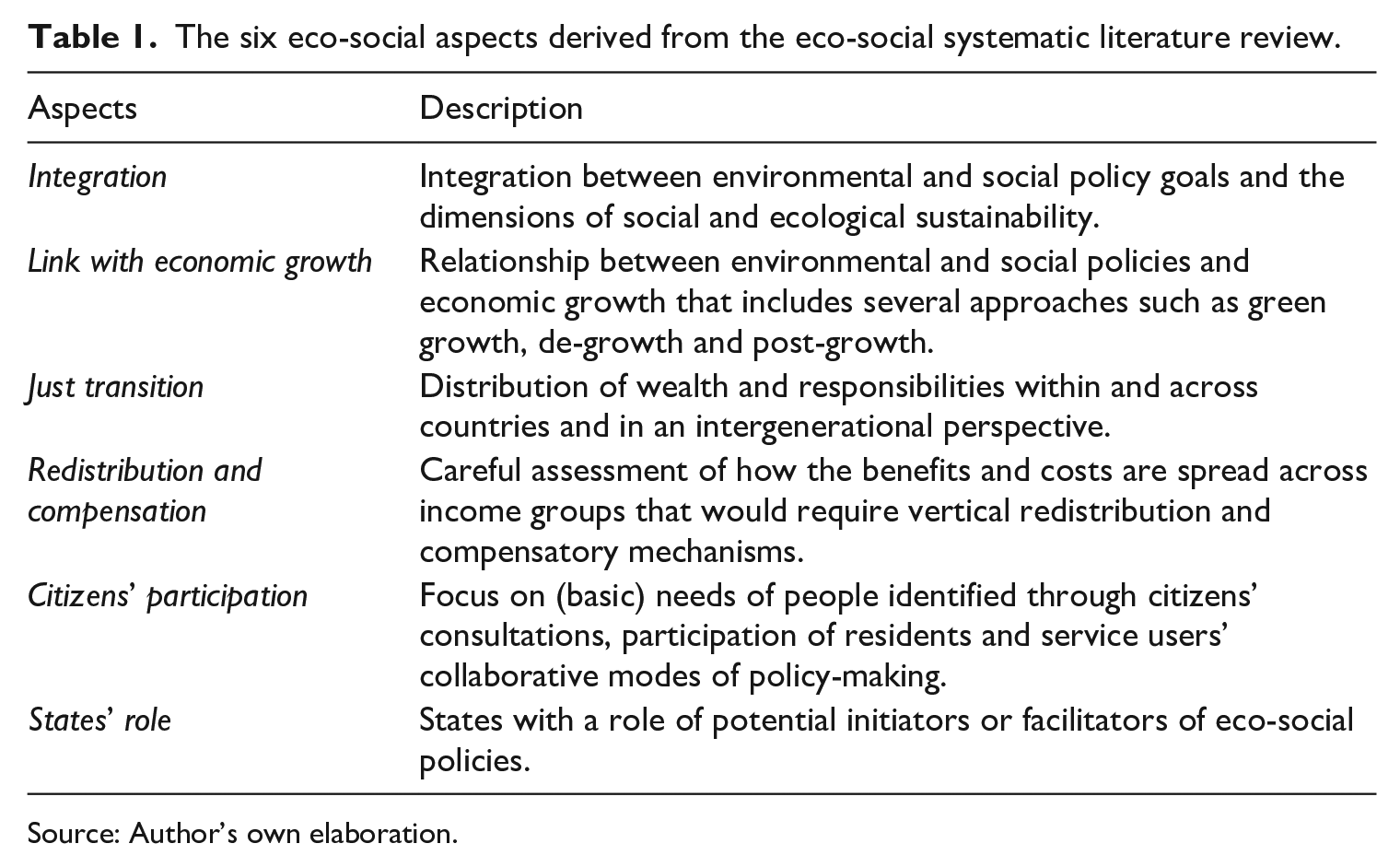
Source: Author’s own elaboration.
To identify the eco-social aspects contained in European policy documents, a document content analysis of the EGD and the F2F has been applied. Content analysis involves the use of analytical categories (coding) applied to textual data by focusing on textual content and the occurrence of words (Hardy et al., 2004). The coding of these two European policy documents was done deductively based on the six eco-social aspects previously identified by the systematic review of the eco-social literature (see Cotta, 2024). The document content analysis has been conducted using the MAXQDA 2022 software.
The eco-social aspects contained in the EGD and the F2F policy documents
On 11 December 2019, the President of the European Commission, Ursula von der Leyen, presented the newly adopted ‘EGD’ Communication as ‘a roadmap for making the EU’s economy sustainable by turning climate and environmental challenges into opportunities across all policy areas and making the transition just and inclusive for all’ (Press Release IP/19/6691). This Communication acknowledges an interconnection between environmental and social policies and sets policy objectives and instruments to achieve economic growth (Sabato et al., 2021). Moreover, it sets the framework path for future European policies (Press Release IP/19/6691) by specifying actions and policies to be carried out in the following eight interconnected macro-areas that concern: (1) climate change, (2) energy, (3) circular economy, (4) buildings and renovation, (5) mobility and transport, (6) ecosystems and biodiversity, (7) toxic-free environment, and (8) sustainable food systems. A final section indicates the role of the EU in promoting and implementing ambitious environmental policies at the global level and envisages support actions to achieve the ecological transition for the EU’s neighbour and partner countries.
The EGD recognised the achievement of a sustainable food system as an integral part of carrying out the European socio-ecological transition. It thus envisaged the adoption of a Strategy that ‘From Farm to Fork’ would help European farmers and fishermen tackle the environmental consequences of food production such as water, air and soil pollution, and improve their position in the value chains (European Commission, 2019). Published in May 2020, the F2F is a strategy in the food sector that details objectives and ambitions concerning the care for nature and the planetary boundaries as well as people’s health and quality of life by addressing sustainable food production, processing and distribution, sustainable food consumption, food loss and the prevention of food waste (Schebesta et al., 2020). The F2F is considered to be ‘at the heart’ of the EGD (Wesseler, 2022) and an important initiative to address the environmental and climate change challenges mentioned in the EGD (Schebesta et al., 2020). However, studies on the F2F recognise that the actions envisaged in this Strategy are not entirely novel in their approach as they build upon ongoing initiatives that aim at modifying and improving environmental sustainability concerns in existing legislative frameworks (Schebesta et al., 2020), including the EU’s Common Agricultural Policy reform (Bazzan et al., 2023; Marek and Tosun, 2023).
The EGD and the F2F contain explicit reference to interrelated environmental and social aspects which makes them suitable to be analysed from an eco-social perspective. The six eco-social aspects introduced above have been used to code these two European documents and as a heuristic to structure their analysis, namely the integration between environmental and social policy goals, their link with economic growth, just transition, redistribution and compensation, citizens’ participation, and the states’ role (cf. Table 1). Statements from the two documents referring to these aspects are presented as descriptive examples.
Integration
The documents of the EGD and the F2F mention both environmental and social policy goals. The EGD is presented as the European ‘new growth strategy that aims to
Besides recognising a nexus between environmental and social goals, the two documents refer to specific yet semantically similar words to integration. The EGD refers to environmental protection, social fairness and economic growth as mutually reinforcing goals (Sabato and Fronteddu, 2020). At the same time, it does not give priority to environmental and social objectives, although it recognises that ‘careful attention will have to be paid when there are potential trade-offs between economic, environmental and social objectives’ (European Commission, 2019: 4). The EGD provides also some descriptive details on the comprehensiveness needed in the European policy response which ‘will require intense coordination to exploit the available synergies across all policy areas’ (European Commission, 2019: 3) as well as a more systematic looking at all policies and regulations (European Commission, 2019: 14). The F2F refers to ‘interrelations between [people’s] health, ecosystems, supply chains, consumption patterns and planetary boundaries’ (European Commission, 2020: 2), which link together environmental and social aspects with food production and consumption. Furthermore, the F2F mentions the integration between food production, consumption and environmental and social goals when acknowledging the EGD as ‘an opportunity to reconcile our food system with the needs of the planet and to respond positively to Europeans’ aspirations for healthy, equitable and environmentally-friendly food’ (European Commission, 2020: 19).
Link with economic growth
Both documents provide descriptive details on the relationship between environmental and social policies and economic growth. The EGD provides a straightforward information on the kind of relationship envisaged being it explicitly presented as the new European economic growth strategy which is decoupled from resource use, and it is put on a ‘sustainable and inclusive’ path (European Commission, 2019: 2). Moreover, the EGD recognises the EU to have ‘the collective ability to transform its economy and society’ towards a more sustainable direction (European Commission, 2019: 2) and having in mind the objective of climate neutrality (European Commission, 2019: 4). The F2F poses the emphasis on the issue of fostering the economic competitiveness of the EU supply sector and on ‘ensuring the integrity of the single market’ (European Commission, 2020: 5). In this document, it is claimed that ‘a sustainable food system will be essential to achieve the climate and environmental objectives of the Green Deal, while improving the incomes of primary producers and reinforcing EU’s competitiveness’ (European Commission, 2020: 5). The F2F recommends changes in the production and delivery of sustainable food to achieve sustainable food systems that would entail ‘higher [economic] returns by creating added value and by reducing costs’, and provide ‘farmers with a new source of income and help[ing] other sectors to decarbonise the food chain’ (European Commission, 2020: 6).
Just transition
‘Just transition’ is explicitly mentioned in the EGD and the F2F and refers to the idea of leaving no one behind. However, the two documents provide different specifications on who should not be left behind, and how this just transition should be carried out. As regards the who, the text of the EGD refers to ‘the people’ who must be put ‘first’ to achieve a just and inclusive transition (European Commission, 2019: 2), but without providing further details. The F2F specifies that the beneficiaries of a just transition are ‘[a]ll citizens and operators across value chains’ (European Commission, 2020: 3) both inside and outside the EU. Concerning the way to achieve a just transition, the EGD indicates that ‘a socially just transition must also be reflected in policies at EU and national level’ where ‘coherence of climate and environment policies and a holistic approach are often a precondition for ensuring they are perceived as fair’ (European Commission, 2019: 16). The F2F foresees future, yet unspecified, initiatives that will consider ‘workers’ social protection, working and housing conditions as well as protection of health and safety’ and play ‘a major role in building fair, strong and sustainable food systems’ (European Commission, 2020: 11).
Both documents emphasise the establishment of global initiatives for the achievement of a just transition. The EGD specifies the need for ‘tailor-made geographic strategies that reflect different contexts and local needs for example for current and future big emitters, for the least developed countries, and small island developing states’ (European Commission, 2019: 20). Among the global initiatives, relevance is given to the leadership role that the EU has played and will continue to play in terms of defining policies. For example, the EGD recognises global climate and environmental challenges and their implications on geopolitics in terms of ‘global economic, trade and security interests’ (European Commission, 2019: 21). This document recognises also implications on societies and states and specifies that the EU will engage and work with third countries and partners to ‘increase climate and environmental resilience to prevent these challenges from becoming sources of conflict, food insecurity, population displacement and forced migration, and support a just transition globally’ (European Commission, 2019: 21). Similarly, the F2F recommends that ‘efforts to tighten sustainability requirements in the EU food system should be accompanied by policies that help raise standards globally, in order to avoid the externalisation and export of unsustainable practices’ (European Commission, 2020: 5). In addition, the EGD recognises the EU and its member states as ‘world’s leading donors of development assistance and provide over 40% of the world’s public climate finance’ while also specifying that they will ‘coordinate their support to engage with partners’ to mobilise ‘private finance’ and ‘bridge the funding gap’ (European Commission, 2019: 22). The EGD mentions some examples of these commitments such as the Commission’s proposal on a ‘Neighbourhood, Development and International Cooperation Instrument’ (NDICI – Global Europe) 4 and the more general Commission’s pledge of supporting ‘the commitment made by national public financial resources to improve the investment [on] climate and achieve contributions from the private sector’ (European Commission, 2019: 22).
Redistribution and compensation
The EGD and the F2F mention redistributive measures and indicate who are the targets and in which areas such measures may be needed. For the F2F, to achieve a successful transition to sustainable agrifood systems it is essential to target ‘primary producers who still lag in terms of income’ (European Commission, 2020: 2). These producers are specified in the F2F as being ‘farmers, fishers and aquaculture producers’ (European Commission, 2020: 3). The EGD recognises that regions, industries, workers (European Commission, 2019: 2) and households (European Commission, 2019: 6) will be the ones facing the greatest challenges of energy and climate transition. This document indicates a relationship between granting affordable energy services and reducing the ‘risk of energy poverty’ (European Commission, 2019: 6) and recognises that redistributive measures will be needed to ensure affordable prices and access to services, especially in the energy sector such as ‘financing schemes for households to renovate their houses’ (European Commission, 2019: 6). The F2F provides less information on specific areas in which redistributive measures are foreseen, but it mentions that ‘the Commission will determine the best way of setting minimum mandatory criteria for sustainable food procurement’ (European Commission, 2020: 13) to enhance the availability and price of sustainable food and promote healthy and sustainable diets.
The EGD and the F2F identify also targets and measures to compensate those most vulnerable to transition. The F2F clarifies that this Strategy ‘aims to reward those farmers, fishers and other operators in the food chain who have already undergone the transition to sustainable practices, enable the transition for the others, and create additional opportunities for their businesses’ (European Commission, 2020: 4). However, this document does not provide information on which measures will be chosen to reward and compensate farmers, fishers and the other actors. In the EGD, ‘[t]he most vulnerable are the most exposed to the harmful effects of climate change and environmental degradation’ (European Commission, 2019: 16). This document further identifies citizens and workers affected by the transition as targets of compensatory measures. It also mentions several examples of compensation mechanisms such as ‘access to re-skilling programmes, jobs in new economic sectors, or energy-efficient housing’ within the Just Transition Mechanism (European Commission, 2019: 16). Moreover, the EGD mentions several energy and climate compensatory measures, for example, in the form of new investments to provide ‘affordable solutions to those affected by carbon pricing policies’ (European Commission, 2019: 16). The EGD includes also transport and sustainable mobility as areas where ‘affordable, accessible, healthier and cleaner alternatives to current mobility habits’ (European Commission, 2019: 10) will need to be granted. In these areas, the EGD recognises persisting gaps and envisages the deployment of new ‘public recharging and refuelling points’ especially ‘for long-distance travel and in less densely populated areas’ (European Commission, 2019: 11). Moreover, it clarifies that the Commission ‘will launch as quickly as possible a new funding call to support this’ (European Commission, 2019: 11).
Citizens’ participation
The EGD and the F2F recognise the importance of public participation in policy-making. In this respect, the F2F recognises that ‘the transition to sustainable food systems requires a collective approach involving public authorities at all levels of governance (including cities, rural and coastal communities), private-sector actors across the food value chain, non-governmental organisations, social partners, academics and citizens’ (European Commission, 2020: 19–20). The EGD mentions the definition of a new pact to address the environmental and social challenges and that would involve and bring together ‘citizens in all their diversity, with national, regional, local authorities, civil society and industry working closely with the EU’s institutions and consultative bodies’ (European Commission, 2019: 2). The importance attributed to citizens’ participation is explicitly associated with the success of specific policies in both documents. The F2F indicates that affect assessments will ‘contribute to making efficient policy choices at minimum costs, in line with the objectives of the Green Deal’ and together with broad public consultations will guide the Commission’s work to ‘a common definition and general principles and requirements for sustainable food systems and foods’ (European Commission, 2020: 6). The EGD acknowledges that ‘[t]he involvement and commitment of the public and all stakeholders is crucial to the success of the European Green Deal’ (European Commission, 2019: 22). In this document, citizens are recognised to be the driving forces of transition and to become game-changers when they are fully involved in designing policies because they are ‘concerned about jobs, heating their homes and making ends meet’ (European Commission, 2019: 22). The EGD also states that EU institutions should engage with citizens for ‘the Green Deal [. . .] to succeed and deliver lasting change’ (European Commission, 2019: 22).
States’ role
The EGD and F2F policy documents do not refer prominently to states and, in general, to public authorities. Both mention the cooperation between the Commission and the member states to ensure the definition of specific policies, but they both do not provide a clear picture of what role states may play in the socio-ecological transition. The only exception is a sentence in the EGD that states that public authorities including those at the EU level ‘should lead by example and ensure that their procurement is green’ (European Commission, 2019: 8). However, this document does not provide details on what does ‘lead by example’ concretely mean for public authorities, nor does it indicate potential or existing green procurement actions by states.
Discussing the EGD and the F2F analyses with the eco-social literature
The study of the EGD and the F2F from an eco-social perspective has provided insights into the content of these two EU policies. By discussing the eco-social aspects contained in these two documents and the eco-social literature, we draw some considerations on the ways the EU policy documents complement or deviate from broader eco-social debates.
Integration as a mutually reinforcing and synergetic relation between goals without concrete policy indications
The eco-social literature has recognised an interconnection between environmental and social policy objectives (Mandelli, 2022b; Sabato et al., 2021) and several studies have explicitly encouraged the establishment of synergetic relations between social and environmental goals in European policies (e.g. Hirvilammi and Koch, 2020; Jakobsson et al., 2018; Koch et al., 2016). Contributions have also focused on policy solutions to solve potential trade-offs (Büchs and Koch, 2019; Hirvilammi et al., 2023). From the perspective of policy integration, recent research by Domorenok and Trein (2024) has explored the political challenges of eco-social policy integration in European policies in terms of ensuring consistency between goals, coherence between instruments and congruence and coordination between policy-specific actors (Domorenok and Trein, 2024).
The EGD and F2F policy documents contain insights into the integration between environmental and social policy goals. On one hand, the EGD recognises the mutually reinforcing nature between environmental, social and economic goals. On the other hand, the F2F document explicitly refers to the synergetic relation between ‘ecosystems’, ‘planetary boundaries’ and humans’ ‘health’ (European Commission, 2020: 3) and between food systems and the needs of the planet (European Commission, 2020: 19). However, these two documents do not manage to articulate the synergies that may occur between the two policy goals nor suggest concrete policy proposals and instruments. The only indication that the EGD provides, on integrated policy responses to the socio-ecological transition, is the general recommendation of improving the coordination between European policies and fostering a systematic look at the EU legislation (European Commission, 2019: 3, 14).
More addressees and examples of redistribution and compensation measures
The eco-social literature acknowledges that the socio-ecological transition will affect some groups and entities more prominently than others. Eco-social studies identify as affected groups those workers likely to lose their jobs as a result of the low-carbon transition (e.g. Bailey, 2015; Mandelli, 2022a) and automation (e.g. Robins and Rydge, 2019), workers in carbon-intensive communities and regions (e.g. Gambhir et al., 2018; Harrahill and Douglas, 2019) and low-income households (e.g. Bohnenberger, 2020). Moreover, the eco-social research envisages a fair distribution of costs and benefits of the eco-social (and climate) policies as well as the setting up of compensatory and redistributive instruments for those most affected (e.g. Gough, 2016; Sabato et al., 2021). Studies particularly recommend the use of taxation in the forms of wealth or income-related taxes (Koch, 2020a), carbon taxes and cap-and-trade measures (Gough, 2013) to compensate the ‘losers’ of the socio-ecological transition. Moreover, contributions have argued in favour of designing complementary policies such as transfer payments or tax cuts to compensate for the regressive effects of the low-carbon transition (Jakobsson et al., 2018).
The EGD and the F2F mention specific categories of people and entities affected by the socio-ecological transition which broadens those identified in the eco-social literature. For example, the EGD mentions regions, industries and citizens in addition to workers and households while the F2F mentions the primary producers, farmers, fishers and other operators in the value chain. Moreover, the two documents contain examples of compensatory and redistributive instruments which target specific categories of ‘losers’ from the transition. Interestingly, the EGD does not recognise taxation as a compensatory measure. Instead, it provides examples of specific programmes for affected workers such as the access to re-skilling programmes and transfers to new economic sectors. Moreover, the EGD requires new investments to compensate those affected by carbon-pricing policies as well as new infrastructure to encourage affordable and accessible sustainable mobility. The F2F acknowledges the need for compensatory policies for farmers, fishers and other operators in the food system, but it does not provide examples of such measures. The EGD is also concerned with redistributive measures in the energy sector and warns particularly about the risk of energy poverty for households. For this reason, it recommends the definition of specific measures that would grant affordable prices and access to energy services to households. Furthermore, recognising a link between buildings’ renovation and energy performance, the EGD encourages financing schemes for the renovation of social houses and for helping those households ‘who struggle to pay their energy bills’ (European Commission, 2019: 10). The F2F does not detail redistributive measures but foresees the Commission’s commitment of ensuring the availability and price of sustainable food.
Citizens’ participation as crucial for successful EU eco-social policies
Participation of citizens and stakeholders is a relevant aspect in the eco-social literature and has also substantially emerged in the analyses of the EGD and F2F. Eco-social research indicated ‘inclusive political processes, equitable forms of partnership, multilevel governance reforms’ (Krause, 2021: 333) as modes of eco-social policy-making in which ‘state “top-down” policies’ should be complemented with ‘“bottom-up” mobilisations’ to initiate ‘the required ecological and social transformation’ (Lindellee et al., 2021: 330). Recent studies have focused on participatory processes and the involvement of citizens and civil society (e.g. Bonvin and Laruffa, 2022) with contributions recommending citizens’ participation in the formulation and co-production of eco-social policies (e.g. Dukelow and Murphy, 2022; Gough, 2022; Laruffa et al., 2022).
In line with the eco-social literature, the EGD and the F2F emphasise citizens’ participation in policy-making by recognising participation as essential to the successful formulation and evaluation of European policies. Both documents recognise the primary role of citizens as driving forces and game-changers of the socio-ecological transition when fully involved in designing, co-creating and co-producing policies. Moreover, citizens’ involvement and commitment are recognised as crucial for the success of the EGD, and both documents mention the Commission’s pledge to actively engage with citizens to make the transition possible and the European food system sustainable.
Relationship with economic growth as synergetic integration between spheres
To understand the relationship between environmental, social and economic spheres, scholars have developed the ‘eco-social-growth trilemma’, an analytical construct to study the interactions and reconcile the tensions between the three spheres (e.g. Mandelli et al., 2021; Sabato and Mandelli, 2018). Sabato et al. (2022) argue that there are three main perspectives to address the trilemma: first, a growth-first approach that puts economic growth at the centre stage; second, a balanced perspective where economic, environmental and social goals can be pursued simultaneously; and third, a de-growth perspective where economic growth is incompatible with environmental resource use. Building upon this trilemma, Schulze Waltrup et al. (2023) suggest that in the green growth approach integration means a combination that is perceived as neutral (no relationship) or as synergetic. Opposite, for post- and de-growth approaches the integration will necessarily entail trade-offs between the three spheres (Schulze Waltrup et al., 2023). Furthermore, in the debate between green growth and post- or de-growth approaches, several eco-social studies recommend a shift from the goal of economic growth and green growth to one of de-growth and post-growth that encompass a transition without economic growth that better reconciles environmental and social aspects (Hirvilammi, 2020; Koch, 2022b).
The EGD is presented as an economic-growth strategy which aims to be decoupled from resource use and where environmental, social and economic goals are interrelated. The F2F emphasises the link between sustainable practices and preserving a market-based economy where transition must also ensure the integrity of the market and allow benefits and higher returns to the actors operating in the food system. Hence, the integration envisaged in these documents, and particularly in the EGD, is more synergetic than in previous European strategies such as the Lisbon Agenda that ‘side-lined environmental and social ambitions’ in favour of growth and employment ones (Sabato and Mandelli, 2020: 118). At the same time, the integration envisioned in the EGD is not unproblematic but related to ‘complex and interlinked’ challenges (European Commission, 2019: 3). It is recognised that potential trade-offs may occur and should be addressed (European Commission, 2019: 4). However, this document does not provide concrete examples nor does it offer details on how to tackle these trade-offs.
States with only an implicit role
Environmental and welfare research has analysed the role of states in the promotion of environmental and social policies by focusing on the establishment of welfare states and environmental states and comparing their tasks and responsibilities (e.g. Gough, 2016; Meadowcroft, 2005). Within the eco-social literature, ‘eco-welfare’ and ‘eco-social’ states have been analysed for their environmental performance and their belonging to words of welfare state capitalism (Koch and Fritz, 2014) or in terms of interactions between policies, politics and outcomes in social and environmental protection (Zimmermann and Graziano, 2020). Eco-social studies reject the idea that an eco-social state is a ‘retreating state, where public action is strictly constrained by ecological boundaries and “growth to the limits”’ (Bovin and Laruffa, 2022: 486) although several contributions have recommended a greater state’s intervention (Koch, 2022b). Furthermore, studies recognise to states the responsibility for action (Lindellee et al., 2021), functions, and competencies (Gough, 2013; Krause, 2021) to initiate (Bonvin and Laruffa, 2022; Koch, 2020b) or facilitate (Coote, 2022) eco-social policies.
The EGD and the F2F policy documents do not prominently mention states nor offer insights into states’ responsibilities. They mention collaborations between member states and the Commission on specific tasks to address the socio-ecological transition but the role that states may play in this transition is only implicitly recognised. For example, the EGD enumerates several examples of redistributive measures for households in the energy sector or compensatory mechanisms for affected workers which suggest but do not specify an intervention by national governments through, for example, the adoption of legislation and policy instruments.
Just transition across the globe rather than between generations
In the eco-social debate, just transition relates to the concepts of double/triple injustice and concerns distributive justice issues between income groups and countries. Similarly, the EGD and the F2F recognise that a fair and just transition should address European citizens, workers and producers with the idea that no one is left behind. However, the eco-social literature refers to just transition also as a matter of justice between generations. Scholars recognised that the challenges linked to climate change increasingly posed threats to the well-being of people across the globe as well as of future generations for its long-lasting effects (Gough, 2015; Koch et al., 2016). Future generations should thus have enjoyed similar resources and opportunities to the ones of present generations (Catney and Doyle, 2011). While the aspect of intergenerational justice is debated in the eco-social literature, the EGD and the F2F do not mention it at all.
The eco-social literature has only marginally investigated the global dimension of just transition. For example, Koehler (2016) addresses global climate and economic inequalities by assessing the United Nation’s Sustainable Development Goals from an eco-social perspective while Lakeman (2021) analyses the role of international organisations in shaping global social policies to address climate change. Moreover, Kaasch and Schulze Waltrup (2021) posit that climate change and global social problems will require the definition of global eco-social policies. On the contrary, the EGD and the F2F explicitly mention the global dimension. Both documents recognise the EU to be a global polluter, in the EGD, by exporting waste outside its borders (European Commission, 2019: 8) and, in the F2F, by being a global food importer and exporter (European Commission, 2020: 12). At the same time, these two documents recognise that to address these issues, proper actions must be taken into account at EU level by revisiting, for example, ‘the rules on waste shipments and illegal exports’ (European Commission, 2019: 8) or by tightening the ‘sustainability requirements in the EU food system’ (European Commission, 2020: 5). According to the EGD, the EU will set ‘a credible example’ (European Commission, 2019: 20) and will use ‘its influence, expertise and financial resources to mobilise its neighbours and partners to join it on a sustainable path’ (European Commission, 2019: 2).
Conclusion
The study has explicitly analysed the content of the EGD and the F2F policy documents from an eco-social perspective. The study has used six eco-social aspects previously identified by the author through a systematic review of the eco-social literature as a heuristic to structure the analysis and present descriptive examples from the two documents. This exercise has provided a first content analysis of the F2F from an eco-social perspective. At the same time, it has expanded the existing research on the EGD.
This research has also offered the opportunity to discuss the content of the EGD and F2F with aspects debated within the eco-social literature. In line with several eco-social studies, the EGD and the F2F acknowledge the integrative attempt between environmental and social policy objectives, without however articulating expected synergies and potential trade-offs between them. Moreover, moving forward with emerging research recommending citizens’ participation in eco-social policy-making, the EGD and the F2F recognise citizens as driving forces and game-changers of the eco-social transitions and their involvement in policy formulation and evaluation as crucial for the success of eco-social policies. At the same time, the analysis of the EGD and the F2F has highlighted some distinctions from the eco-social literature. On the link between environmental and social policies and economic growth, the two documents propose a synergetic integration, unlike the de-growth and post-growth approaches which postulate a transition to a steady-state economy and which are recommended by several eco-social contributions. Furthermore, the EGD and the F2F do not mention states as central actors in the eco-social policy-making but foresee a collective approach that includes national, local, and regional authorities, civil society, consumers, producers and industry representatives. Moreover, both documents recognise to citizens a pivotal role in driving the socio-ecological transition while the state’s role is only implicitly recognised in the adoption of compensatory and redistributive measures. Finally, the EGD and the F2F do not mention an intergenerational perspective to achieve a just transition, but emphasise initiatives and actions at the global level.
The content analysis of the EGD and the F2F has offered insights on several aspects discussed from an eco-social perspective which have also societal and policy-making implications. For example, by recognising regions, industries, workers and households, as well as the primary producers as the main targets of the EGD and the F2F, our research helps to identify these entities as the most vulnerable to the socio-ecological transition. On one hand, this will imply a more detailed definition of compensatory instruments to address the adverse effects of the transition on these entities. On the other hand, our results suggest that the potential trade-offs that eco-social policies might entail will have an impact on the acceptance and consensus over the adoption and implementation of eco-social policies. Recently, we have observed demonstrations in several parts of the EU and Brussels carried out by farmers protesting against low food prices and strict environmental regulations. The antagonistic reactions from the farmers which claimed to lose from the eco-social transition have resulted in corrections and changes to the objectives envisaged in the EGD and the Common Agricultural Policy reform (Rajvanshi, 2024). The social impacts of environmental and climate policies must therefore be an essential theme to consider in future interactions between European and national policy-makers and social stakeholders.
Indeed, how envisaged actions and objectives contained in the EGD and the F2F policy documents will translate into actual eco-social policies will largely depend on the acceptance of these policies as well as on their implementation at European and national levels. Further empirical research is required to better understand the content of the eco-social policies. By expanding the analysis to other European, global, national or urban strategies addressing interlinked environmental and social aspects it would provide a broader knowledge of the eco-social aspects of policy documents and offer greater empirical grounds to evaluate their relevance about ongoing debates within the eco-social literature, and to address potential societal conflicts that may arise.
Footnotes
Acknowledgements
Earlier versions of this article were presented at various workshops, at the ESPAnet Italy Conference (2022) and at the ESPAnet Europe Conference in Vienna (2022). The author thanks the participants of these conferences and workshops for their insightful and valuable comments. She also thanks the two anonymous reviewers for their helpful suggestions.
Funding
The author(s) received no financial support for the research, authorship, and/or publication of this article.
