



Abstract
The use of social protection measures has garnered increasing attention in recent years from academics and policymakers aspiring to unite the humanitarian origins and development ambitions of displacement governance regimes. Much of this attention has been focused on establishing and strengthening national systems of social protection provision. Analysis of policy approaches to social protection has become increasingly detailed, but typically does not extend beyond formal rights-based provision. This article seeks to address the paucity of literature on how refugees strategise around access to social assistance beyond Northern-mandated approaches. We review existing research on Syrian displacement in Lebanon to interrogate assumptions that refugees automatically seek institutionalised assistance. Drawing on postcolonial literature, we explore why modalities of social and humanitarian assistance offered through a rights-based approach represent only a partial mapping of the social protection that refugees avail themselves of. In doing so, we signal a move beyond the narrow and restrictive binary of formal/informal and attempt to consider the range of social protection opportunities from the perspective of refugees. Though unequal, we argue that both national systems of social protection provision and alternative approaches identified by displaced people are currently necessary, although a language of rights is only applicable to the former. Ultimately, greater coordination between the two is required. In conclusion, this article describes directions for future research aimed at a holistic understanding of how social protection is accessed in displacement and a more explicit interrogation of the impact of social protection measures in displacement settings.
Introduction
We start this article with the puzzle that social protection for refugees is formally framed as a right, but a right that is almost universally ignored. For refugees hoping to access social protection, a right that is ignored is essentially the same as no right at all. 1 In such situations, does a language of rights serve any purpose? As refugees strategise to obtain social protection, how does a rights approach affect them? In Hannah Arendt’s famous formulation, refugees lack the ‘right to have rights’ (Arendt, 1958: 296), that is, they lack not only rights themselves, but also any mechanism by which to introduce the very concept of rights. Arendt was writing at the origins of the international refugee system. Now, major organisations, principally UNHCR, are well established to respond to the gap in international protection that she highlighted, underlining the fact that everyone is entitled to protection by right and where the state fails in its duty to guarantee that protection, the system of international protection must be available.
While UNHCR is explicitly framed as a human rights organisation, the protection offered has its limits (Verdirame and Harrell-Bond, 2005). The reticence of so-called ‘host’ states in incorporating refugees into social protection programmes can be attributed to a fear of ‘local integration’ as a durable solution being foisted upon them. Combined with little appetite for third-country resettlement on the part of more affluent states in the global North and little possibility of return to the country of origin, displacement takes on a decidedly protracted character in countries of first refuge. In such contexts, state infrastructure for the provision of social assistance is often rudimentary. This has meant that social protection provided through both formal and informal humanitarian actors and agencies has increasingly taken on greater significance for refugees in urban or non-camp settings.
Rights-based frameworks are particularly associated with Northern-mandated forms of social protection. While poverty alleviation programmes, such as the Productive Safety Net Programme (PSNP) in Ethiopia and Ehsaas in Pakistan, are clearly nationally owned and retain a degree of autonomy in deciding how resources are allocated, Northern donors retain significant influence through funding. In the case of Ethiopia, donor financing accounted for 60% of the total expenditure on social protection in 2015/2016 (Endale et al., 2019). For the rural component of the PSNP, donors’ contributions have reached ETB 8.7 billion – 82% of financing in 2017/2018 (UNICEF, 2019). By comparison, the Ethiopian state’s contribution to both the urban and rural components of the PSNP rose from ETB 220 million in 2015/2016 to ETB 1.9 billion in 2017/2018 (Endale et al., 2019). A Northern-mandated perspective on social and humanitarian assistance privileges the assumed indispensable character of humanitarian actors and agencies of and from the global North in any response to mass displacement or what Estella Carpi (2018) has described as ‘humanitarian Southism’. We use the term ‘Northern-mandated social and humanitarian assistance’ to acknowledge that social protection and humanitarian support from non-state actors and donors in the Global South is often substantial and often goes unrecognised. The reliance of UNHCR on a limited number of wealthy states has implications for the geography and focus of UNHCR activities. The $3.814 billion contributed by Northern states in 2019 accounts for 80% of all UNHCR funding. Of this 85% had been earmarked for countries specified by donors (UNHCR, 2020), suggesting that Northern-mandated is a more accurate description than ‘international’.
Where Northern-mandated forms of social protection fail, or where the conditions for the enjoyment of that protection are too onerous, refugees may identify alternatives such as the sending and receiving of financial remittances, protection afforded through faith-based and kinship networks, and other efforts at creating solidarity with and for displaced people. Rights are typically not part of these other forms of provision: they are not universal, often exclusionary and maybe time-limited, yet in some cases they appear to be preferred and, in most cases, provide an important supplement. This prompts two interrelated questions: (a) How do refugees strategise to maximise their access to social protection? and (b) Where does non-state led provision of social protection fit into the wider social and economic context that underpins the decision-making of displaced people?
To answer these questions, we review recent literature on Syrian displacement in Lebanon to consider developments in Northern-mandated modalities of social protection. Next, drawing on postcolonial literature, we explore why modalities of social and humanitarian assistance offered through a rights-based approach represent only a partial mapping of the social protection that refugees avail themselves of. In doing so, we signal a move beyond the narrow and restrictive binary of formal/informal and attempt to consider the range of social assistance opportunities from the perspective of displaced people. The final section of this article examines alternatives to which displaced people may turn if the Northern-mandated system fails or they choose to reject it. These include alternative sources of social protection as well as more unauthorised uses of the Northern-mandated system.
Lebanon: a hybrid model of social assistance provision
The question of who has an obligation to meet refugees’ rights and to provide them with access to social protection prompts a consideration of whether, if at all, assistance for refugees should relate to national social protection systems in fragile and crisis-affected settings. While it is possible to provide state-delivered or state-funded social protection to refugees, from the standpoints of donors, governments and humanitarian agencies, there are many challenges which often reduce the space for negotiation and programming design/implementation. This can result in completely parallel systems, with one covering citizens and the other covering refugees (ODI, 2020).
In cases where governments are unwilling and/or unable to afford assistance for non-citizens, different types of collaborations are supported by Northern donors and aid agencies keen to integrate their efforts with the nascent national social protection programme of fragile and crisis-affected states. These partnerships often include both state actors (such as ministries) and non-state actors (multilateral agencies and INGOs). This is the case of some large-scale national safety nets that are expanded, tweaked or redesigned, and where efforts among multiple actors are combined or aligned, such as the Government of Lebanon’s National Poverty Targeting Programme (NPTP) in partnership with the WFP (2017).
The WFP Lebanon Country Strategic Plan (2018–2021) is aligned with the government-endorsed Lebanon Crisis Response Plan (2017–2020), the United Nations Strategic Framework (2017–2021) and Lebanon’s National Agriculture Strategy (2020–2025). It positions WFP as a major partner of the Government of Lebanon and other UN agencies in crisis response.
In 2012, the Government of Lebanon requested WFP to address the food and nutrition needs of the growing population of Syrian refugees. In 2013, WFP scaled up and expanded its assistance programme, shifting its transfer modality from vouchers to electronic cards (e-cards). The system has enabled UNHCR-registered beneficiaries to purchase food commodities at over 480 WFP-contracted shops. This approach depended on functioning markets, technical capacity, adequate banking services and infrastructure throughout the country. WFP provides e-cards to refugees in Lebanon based on their refugee status and eligibility for assistance, as determined by the Vulnerability Assessment of Syrian Refugees in Lebanon (Gentilini et al., 2018). 2
In response to rising poverty in communities hosting Syrian refugees, and to mitigate tensions between refugees and ‘host’ communities, the government partnering with WFP and the World Bank introduced an identical programme for poor Lebanese families in 2014. The e-cards were made available to the poorest 10,000 households (53,000 people) in the NPTP database. The value of the unconditional transfer received monthly by each group of beneficiaries through the e-card was harmonised; capped at a monthly rate of $27 per household member for a maximum of six household members (SPaN, 2019).
Both the World Bank and WFP saw the importance of this step not only in terms of reducing poverty and tension among the two communities but also as an opportunity to strengthen the NPTP. This involved WFP providing financing, operational support, training and capacity development assistance for the Ministry of Social Affairs so that it could eventually assume overall responsibility for the implementation of the food voucher programme (Gentilini et al., 2018).
The fact that the two programmes connect to both refugees and citizens based on need/vulnerability and not on the basis of ‘rights’ has implications for who holds social protection obligations. While the Lebanese example seemingly endorses a technocratic fix that allows a convergence between state and supra-state actors in Northern-mandated provision of social and humanitarian assistance, closer examination reveals social and humanitarian assistance coverage remains far from adequate. Delivering effective social protection in situations of mass displacement requires a deep understanding of the structures that underlie refugee inclusion and exclusion. Exclusion of refugees may result from a one-off displacement event which deprives them of the material basis for subsistence. In such cases, regular material support is required before refugees can re-establish the means of supporting themselves. But displacement typically results in much more than the loss of material goods. Refugees also find that their skills have less value, their support networks are vanished or similarly disenfranchised, and the social, political and natural environment is alien, if not actively hostile. Exclusion is thus determined by unequal access to resources and endowments that coincide to regularly and repeatedly exclude displaced people from both productive opportunities and social provision. Context is key.
The cautiousness in moving towards integration of national and humanitarian systems of social protection provision is indicative of irreconcilable tensions between UNHCR and the Lebanese state. The former recognises all Syrians in Lebanon as de facto refugees in order to appease the security and political concerns of the Lebanese government who refuses to countenance displaced Syrians as legally defined refugees (Janmyr and Mourad, 2018). In 2015, the Lebanese state suspended UNHCR registration of displaced Syrians and in the process stripped more than 70% of Syrians residing in Lebanon of their legal residence papers (Frangieh, 2016). The decision also served to simultaneously restrict Syrians from entering Lebanon, denying admission to poorer Syrians, but keeping the borders open to those with greater financial resources (Frangieh, 2015). Furthermore, the Bilateral Agreement (1994) between Syria and Lebanon provides temporary residence permits for 12 months to Syrian refugees entering through regular border crossing. While re-entry renews permits for free, a fee of $200 applies for everyone over 15 years of age to annually renew without re-entry (and the associated security risks a re-entry entails). This has great economic implications for already severely impoverished Syrians and may result in undermining their legal status. The Lebanese state’s informalised, fragmented and restrictive refugee practices have shaped refugees’ attitudes towards return (Fakhoury, 2021). Such moves on the part of the Lebanese state can be understood as a means to transform Syrian refugees 3 into Syrian economic migrants. Although access to labour markets is essential, this also presents other dangers. While refugees can potentially lay claim to legal rights and entitlements, economic migrants are arguably a readily available pool of disposable labour that can be returned to their country of origin when no longer required. The success of the WFP programme should also be tempered by the fact that Syrian refugees must be registered with UNHCR. As noted above, UNHCR registration has been suspended since 2015 making an estimated 500,000 displaced Syrians invisible.
The example of Lebanon shows that we must be wary of assumptions that displaced people automatically seek institutionalised assistance. Even in cases where assistance from institutional actors is sought, challenges around registration and discriminatory practices of the state may result in exclusion. The lessons learned from the links between these programmes can direct future research towards a deeper understanding of non-market Northern-mandated social and humanitarian assistance provision through hybrid systems for displaced populations. This prompts the question: in what ways do state-led or formal humanitarian systems of social protection engage with locally embedded social assistance initiatives? Forcibly displaced people can be actively excluded from accessing Northern-mandated social and humanitarian assistance by virtue of their legal status and/or by discriminatory policies.
Critique of the rights-based framework – recognising collective responses
For refugees, the seeking of social protection is not necessarily mediated through agents embedded within state and supra-state systems. Southern-led responses to displacement have largely gone unremarked upon by academics, policymakers and practitioners operating from the global North (Fiddian-Qasmiyeh, 2018). Where responses outside of Northern-mandated social and humanitarian assistance have been acknowledged, Northern analysts have dismissed these as being motivated by ideological and faith-based priorities that are at odds with the core ‘international’ humanitarian principles (Ferris, 2011; Fiddian-Qasmiyeh, 2018). For postcolonial scholars, this is perhaps an unsurprising revelation. From this perspective, the culture of human rights is found already moored in a way of seeing, knowing, being and doing in the world itself born out of the ruins of Western imperial formations. This in turn prompts ‘a real epistemic discontinuity between the Southern human rights advocates and those whom they protect’ (Spivak, 2011: 83). In other words, the language of human rights, particularly its intransigent insistence on the individual, does not speak directly to the needs and lived experiences of displaced people in the global South.
This epistemic break reveals itself in an understanding that the statist articulation of a rights-based framework in response to displacement is also mirrored by responsibilities that are grounded in an ethics of care in concrete circumstances, rather than rights (Lawson, 2007; Popke, 2006; Spivak, 2011; Tronto, 1993). The lack of recourse to the language of human rights by displaced people arguably shows that they are cognisant of rights (that enabled them before being displaced and dislocated) being no longer available post-displacement. As Wendy Brown (1995:98) points out, ‘rights converge with powers of social stratification and lines of social demarcation in ways that extend as often as attenuate these powers and lines’.
For advocates of a rights-based approach, the language of human rights is one of ‘individual empowerment’ (Ignatieff, 2001: 57) or an enabler of agency and ‘when individuals have agency, they can protect themselves against injustice. Equally, when individuals have agency, they can define themselves what they wish to live and die for’ (Ignatieff, 2001). This view on agency and rights equates to a liberal individualism that serves to ‘simply expand autonomy and choice’ (Brown, 2011:145).
An alternative point of departure opens avenues in thinking through how responsibilities or duties to care necessitate encounters with others – recognising individuals not as autonomous and sovereign but as inherently vulnerable, fragile and dependent on others in situations of constraint. For many displaced people, access to social protection can normally be found in reciprocal arrangements rather than formal structures, with a reliance on kin, clan, religious and ethnic networks (Fiddian-Qasmiyeh, 2016; Trapp, 2018; Zaman, 2016). Together, the formal and informal spaces of provision comprise what we might call ‘landscapes of care’ wherein ‘complex embodied and organisational spatialities emerge from and through the relationships of care’ (Milligan and Wiles, 2010:740). The economies that emerge from these landscapes of care are less about producing goods and services, but rather they are concerned with ‘accessing and making claims on the resources of others’ (Ferguson, 2015: 94). They are part and parcel of what James Ferguson (Ferguson, 2015), in his discussion on what it means to survive under the precarious conditions of global capitalism, calls a system of ‘distributed livelihoods’. Put simply, this is how ‘people who do not have access to wage labor endeavor [sic] to capture a piece of the wages earned by those who do’ (Ferguson, 2015: 99). This is a moral economy wherein claimants depend on a framing of being entitled to a rightful share. Here, rights are understood in the vernacular – the demand for rights and entitlements ‘is not only always sovereign, individualist, discrete, or indeed privately articulated one. It is predominantly expressed collectively and in religious, gendered, and caste terms’ (Madhok, 2017: 487).
Drawing on the discussion above, we next consider how refugees navigate access to social protection through everyday encounters with actors embedded in their displacement context and how they engage with Northern-mandated provision of social assistance on their own terms.
Beyond (in)formal approaches to social protection
Understanding how refugees make claims to and negotiate social protection requires knowledge of the structures that underlie their inclusion and exclusion. Sometimes the exclusion is determined by unequal access to resources and endowments as well as imperfections in markets for goods, services and labour that come together to regularly and repeatedly exclude refugees from both productive opportunities and social provisions. Even in cases where legal entitlements to social protection should on paper be available, actual application or enforcement may be found wanting. In other cases, refugees might be excluded because they have no information about their rights, they might lack the language and education required to access their rights, they might be physically and locationally isolated and are therefore unable to travel to access resources, or they might live in a location where the supply and quality of services is so poor or damaged that ‘rights’ to a resource have no way of being fulfilled.
This demands a less static understanding of rights to social assistance provisioning, one that is not fixated on non-market-led systems mandated by and through Northern actors and agencies that dominate the humanitarian field. In averting our eyes away from Northern-mandated provision of social protection, our gaze alights on spaces for thinking how, and through which actors and domains, entitlements can be exchanged. In addition, social protection can also be mediated through the market. However, entry to national labour markets remains contingent on refugees’ legal relation to the state – re-affirming an Arendtian view on rights.
Refugees may only be partially visible to the functional interventions of public distribution systems while having to operate within the constraints of an imperfect market that severely restricts access to labour markets, banking, credit and insurance. It is at this juncture, informal systems of social assistance can be critical in helping displaced people protect, maintain and perhaps even grow their initial endowment. Through practices of care, mutual aid and the collective pooling of resources, displaced people can lower household exposure to risk from livelihood crises and the precarity induced by their legal relation to the state (Janmyr and Mourad, 2018). It is at the level of the household that refugees develop understandings, practices and strategies of self-reliance while drawing on a portfolio of risk management mechanisms – that include not only state, market and locally embedded networks (Carpi, 2020), but also migration as a strategy for diversifying risk to household income and to insure against future shocks and stresses (De Haan, 2000: 30).
Long before the war in Syria, seasonal migration had been a persistent feature of livelihood strategies pursued by Syria’s rural population (Abdelali-Martini and Hamza, 2014). The allure of higher wages in Lebanon combined with the access of public services for family members in Syria created a condition of ‘prolonged unsettlement’ wherein Syrian migrant workers found themselves on a carousel of ‘exilic rotation’, moving between life-worlds in Syria and Lebanon (Chalcraft, 2009). Displacement and its attendant state-led responses of humanitarianism and border closure have led to a spatial reconfiguration of Syrian kinship-based networks that now extend beyond Lebanon – across West Asia, the Eastern Mediterranean and into Europe. Several studies point to Syrians mobilising pre-existing connections with foreign employers and relatives abroad to secure sponsorship for residency and work opportunities (Charles, 2021; Zuntz, 2021). Zuntz (2021) advances a more complex picture. Not only do refugees pool and circulate resources to distribute income through transnational kinship networks, but access to resources is often gendered. For Syrian men, opportunities for work in Jordan post-displacement are similar to what preceded displacement – predominantly in the agricultural sector where they have been reinserted at the bottom rung of a segmented labour market. Syrian women increasingly have access to new income generation opportunities through actors in the formal humanitarian system that favour addressing gender inequalities. Each situation of protracted mass displacement, therefore, is located in its own specific geography. Spaces produced and inhabited by displacement-affected people can best be understood in relation to a range of other actors, materials and aspirations. These relational flows or trajectories converge and intersect to produce a particular blend of social protection provision.
Elsewhere, Van Uden and Jongerden (2021) draw attention to the multi-layered character of the social networks accessible to Syrian refugees in Urfa in Southeast Turkey. Networks centred on kinship, regional belonging and religion coincide at the level of neighbourhood to generate new configurations and avenues for the access and distribution of resources. This provides an understanding of socialities tethered to understandings of ‘everyday civility and coexistence [. . .] based on shared experiences and common economic and political institutions’ (Rabo, 2012: 90–91). Here, the distribution of resources is interposed not only through the triptych of state, market and formalised civil society but is also mediated through the spatial formations of the city and the informal network of relations based on associations of kinship, village and religious communities that arise therein. Kawtharani (1992) suggests the use of the term ‘al-mujtama’ al-ahli’ (from ahl meaning kinship) in place of al-mujtama’ al-madani (civil society) as a means of comprehending this fourth sphere. From Kawtharani’s perspective, the nomenclature of ahli better captures the historical space for the generation of social life, culture, commodities and relations of exchange, while the state represents the ruling force, organisation and policing of those interactions in the context of traditional Arab and Islamicate societies. Zaman (2016) locates his work on displaced populations in West Asia and the Eastern Mediterranean in ahli formations and finds that the loss and recovery of understandings and practices of neighbourliness are central to experiences of displacement in the region.
Recovering neighbourliness and the spatial reproduction of neighbourhoods under conditions of displacement and dislocation necessitates an enactment of family. For those displaced from rural towns and villages in Syria, enacting family can be done through calling on ties of kinship that extend beyond the territorial boundaries and claimed histories of the nation-state (Chatty, 2017). Where actual kin cannot be found, family is enacted through the naming of fictive ties of kinship. In an ahli society, the vocalisation of fictive ties of kinship serves to reduce social distance in encounters between people who would otherwise be strangers. Implicit in such vocalisations is an understanding of trust, reciprocity and mutual obligation.
The im(material) flows of resources generated through the loose and often ad hoc networks that comprise al-mujtama’ al-ahli intersect with the circulation of more formal humanitarian flows. Fawaz et al. (2022) demonstrate that the production of shelter in the northern Lebanese city of Halba is contingent on disjointed arrangements which involve transforming refugee labour and humanitarian aid into real-estate capital. The authors identify a convergence of diverse (im)material flows disbursed by institutions responding to the population in Halba based on different classification systems. In this case, funds dedicated to providing subsidised housing for military personnel are invested in the production of refugee accommodation wherein refugee labour is deployed alongside humanitarian flows to make refugee shelter a possibility. Access to this housing is mediated through informal market transactions facilitated by networks of kinship, regional belonging and religion (Fawaz et al., 2022: 499–500).
In cases where the provision of social protection (either through the state, the humanitarian system or through market mechanisms) is unavailable or inaccessible, collective modalities of support outside of a rights-based framework take on greater significance. Often these forms of provision are described as being informal as opposed to the formality of provision offered through state actors, supra-state agencies and the international humanitarian system. This neat binary of formal/informal occludes not only the power relations that serve to privilege European ways of knowing, seeing, being and doing in the world, but also the embedded character of the so-called informal in the everyday lives of those receiving social assistance. Where the ‘formal’ insists on ‘seeing like a state’ (Scott, 1998) with its emphasis on an administrative ordering of society to determine how and for whom available resources are redistributed, the ‘informal’ provision of social assistance can often be found anchored in a duty and ethics of care.
Figure 1 maps the range of actors involved in the provision of social protection for refugees. The vertical axis shows a continuum indicating what underpins the presence of actors in the humanitarian field with ethics of care on the one hand and the monitoring and governance of displaced populations on the other hand. In acknowledging the different motivations behind the presence of actors and agencies in the humanitarian field, we question the assumption that refugees will automatically seek institutionalised (state or non-state) assistance. While it is possible to map the actors and providers along this continuum, the lived realities of refugees show that the distinction between the state and humanitarian governance is a blurred one. For instance, Boeyink’s (2020) case study of migrant and refugee agricultural labourers and renters in western Tanzania illustrates a complexity in how refugees manage the ‘boundaries’ between state and humanitarian governance and provision. He shows that refugees strive towards being ‘sufficiently visible’ towards humanitarian and state authorities to receive assistance, while remaining ‘invisible enough’ to avoid the gaze of these institutional actors upon their quasi-legal agricultural practices outside the confines of the humanitarian encampment.
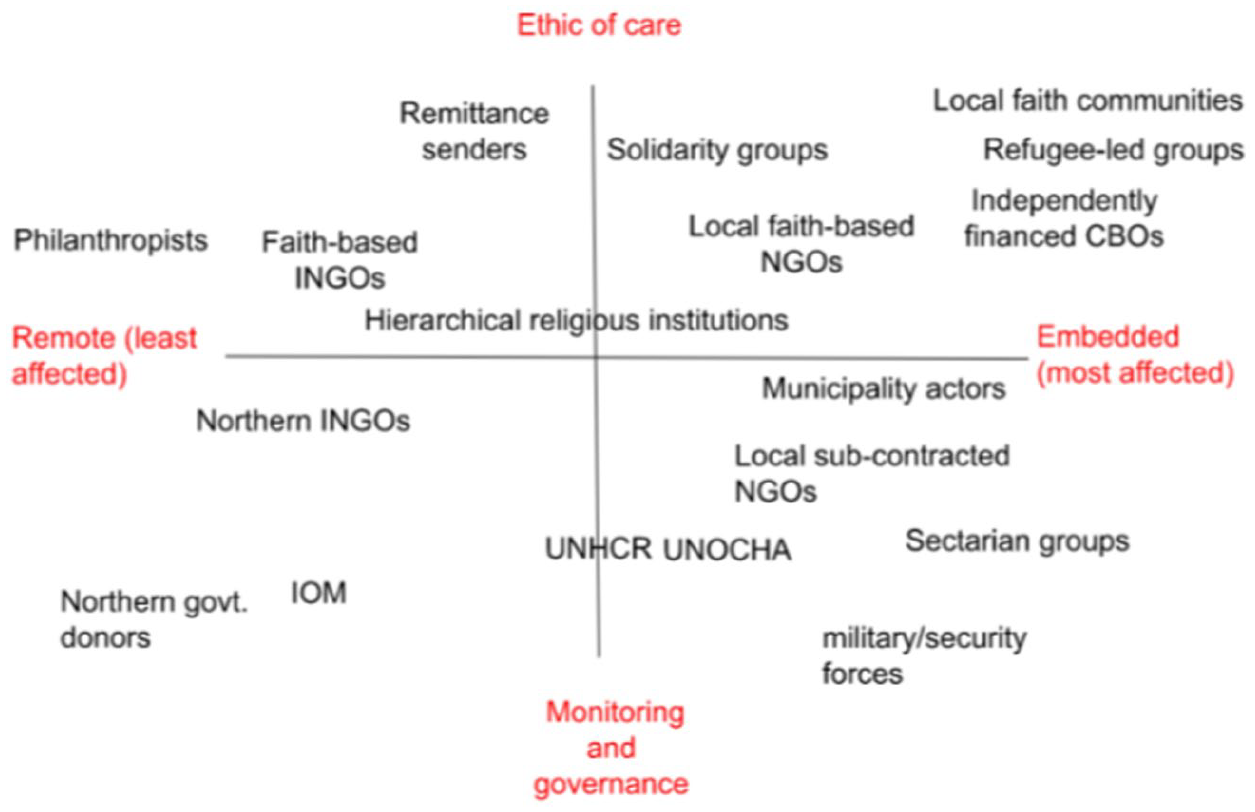
Mapping of social protection in situations of mass displacement.
A second continuum is shown along the horizontal axis, recognising that some actors in the humanitarian field are in closer proximity to displaced populations than others. In situations of mass displacement, resources for the provisioning of social assistance largely flow from a distance towards those who are embedded. This has important consequences particularly given that over 70% of displaced people are in protracted situations. What happens when donor interest begins to wane? Beth Whitaker’s (2008) work on Burundian refugees in Tanzania evidences how crisis-affected states can move from progressive policies of inclusion to rapidly declining standards of protection once funding from Northern donors dries up. This raises questions as to how well equipped locally embedded actors are to provide social assistance in the absence of support from Northern-mandated provision of social assistance.
Returning to our earlier example of Lebanon, both displaced Syrians and resident Lebanese citizens increasingly operate in local economies that have little in the way of a regulatory framework. The Beirut Port explosion in 2020 compounded by the outbreak of Covid-19 and the pressures of a consociational form of governance effectively led to a prolonged period of ‘no government’ in Lebanon. This coincided with a massive financial crisis. The World Bank (2022) has described the precipitous collapse of the Lebanese economy as one of the worst ever recorded since the mid-19th century.
The convergence of these multiple crises has resulted in a rapid exacerbation of poverty and the sudden disappearance of livelihood opportunities. Considering factors other than income, such as access to health, education and public utilities, 82% of the population in Lebanon lives in multidimensional poverty (UNESCWA, 2021). A UNICEF report in March 2021 found that 77% of 1244 households surveyed indicated that they did not have enough food or enough money to purchase food. For Syrian households, this figure for food poverty rose to 99% (UNESCWA, 2021). Worsening opportunities for informal employment has escalated debt accumulation for Syrian refugees, with 93% borrowing for food, 48% for rent and 34% for medicine (Karasapan and Shah, 2021). The depletion of currency reserves has resulted in the Lebanese Central Bank cutting its subsidy programme on which much of the population has been reliant.
Precarity, informality and an incessant drive towards improvisation and adaptation fill the gaps where a regulatory framework ought to be. Survival in these circumstances necessitates the deployment of what AbdouMaliq Simone (2011) describes as an ‘economy of repair’. Here, there is an ad hoc and incremental approach to patching-up of the built environment – from improvised supplies of electricity to leaking pipes and unfinished buildings – to sustain the circulation of small sums of capital that keep alive the urban poor (Fawaz et al., 2022). Consequently, the heavily entangled web of relationships and modalities generated in economies born of displacement makes difficult any meaningful discussion of (in)formality.
Remitting social protection
One area that has begun to receive greater attention in scholarship is the salience of financial remittances in displacement contexts. Van Hear (2009) highlights the importance of complex migration trajectories undertaken by displaced people resulting in a greater spread of family members across several locations. This, he argues, influences patterns and practices of remittance sending and receiving. There is some limited evidence emerging that indicates remittances are particularly significant in displacement contexts as compared to migration situations dictated by economic necessity. Carling et al. (2012) show that for Pakistani migrants and Somali refugees in Norway, there are differences in both the number that remit money to relatives and the frequency with which they do so. Less than half of Pakistanis sent remittances compared with three-quarters of the Somali refugees surveyed. Moreover, around two in every five Somali refugees surveyed sent remittances on a monthly basis compared to around one in every 20 Pakistani migrants surveyed. The authors provide three explanations for this pattern. First, conflict creates an immediate and vital need for access to social assistance. Second, the country of origin or first refuge often is unable or unwilling to provide the requisite level of resources needed to cope with displacement, leaving those living abroad to support family members. Finally, conflict disrupts livelihoods and seriously impacts the capacity of individuals to generate regular means of income.
These findings are consistent with Lindley’s work on Somali refugees in the United Kingdom (2009) who also reported that 61% of the Somali refugees remitted on a monthly basis. Similarly, Johnson and Stoll (2008), looking at Southern Sudanese men living in Canada, found that around two in every five respondents sent money home at least once a month. The sending of remittances is corroborated with studies investigating the receipt of remittances. Betts et al. (2014) report that in both urban and camp locations, Somali refugees are regular recipients. Studies indicate that households often channel remittances towards specific uses resulting in increased expenditures on health, education and housing, supporting the hypotheses that remittance inflows result in a stronger human capital accumulation and expenditures are future oriented (Göbel, 2013). In countries or areas where credit markets are not well developed, remittances are used to establish micro enterprises and small businesses (Amuedo-Dorantes and Pozo, 2006). Framing diaspora actors as agents of developmental change, however, obscures the fact that remittances also increase pressure on family members who have secured employment in wealthier countries since they are disproportionately represented in low paid, service sector work (Jacobsen, 2005; Lindley, 2009).
Conflict also transforms practices and patterns of remittance giving and receiving. Zuntz’s (2021) study of displaced Syrians in Jordan captures this change. Before the onset of war, remittances served as insurance for old-age provision, protected rural households from economic shocks and contributed to rural development. Since 2012, remittances have been primarily used to fulfil social and economic obligations towards kin adversely affected by displacement wherever they may be, helping meet food and medical expenses (Zuntz, 2021: 1413). This creates a complex map of remittance giving and receiving depending on where need and capability to meet that need is greatest. Chehade et al. (2017) find that one in every eight Syrian refugees in Jordan send or receive international remittances. Around one in every two displaced Syrians receiving remittances do so from kinship networks in the Gulf. Family members in Lebanon, Turkey and Syria also send remittances to those displaced in Jordan. Remittances sent to Syria in 2019 through formal channels alone amounted to 1.6 billion USD (KNOMAD, 2020) and yet arguably fails to capture money that travels physically across neighbouring borders (Christou, 2020).
Omata’s (2011) work on Liberian refugees in Ghana introduces a class-based analysis to the study of remittances in displacement contexts. He finds that 95% of the income of the better-off households came from remittances, whereas poorer households received no income from remittances. If mobility is taken as a factor of class stratification, then distance to money transfer operators may impede the receipt of remittances (Dean, 2015). In situations of conflict, collecting remittances may involve movement in and out of areas outside of government control.
Competing authorities – contesting social protection
The Lebanese state’s refusal to develop a coherent framework towards displaced Syrians has helped produce a complex humanitarian arena wherein INGOs, local civil society organisations and faith-based institutions and organisations jockey for position. This ambivalent policy of ‘institutional ambiguity’ (Nassar and Stel, 2019) fragments humanitarian responses and allows greater leeway for local actors to have a greater presence in the humanitarian field. Little is understood regarding those local actors whose sources of funding lie outside of the Northern-mandated system of social and humanitarian assistance. In contexts where state authority may be contested by a range of governance actors, a clearer approach is needed on whether and how to engage these various actors in order to reach the most vulnerable host and refugee populations. Persistent state weakness and the predominance of denominational politics have centred faith-based social assistance in Lebanon. The presence of Hezbollah in the Lebanese humanitarian field throws up an interesting example of the dilemma faced by Northern-mandated actors operating in the same humanitarian field. Since its inception, Hezbollah’s social and humanitarian assistance programmes have consistently proven to be far more effective than that offered through the Lebanese state (Flanigan and Abdel-Samad, 2009). Today, Hezbollah holds elected offices at both local and national levels, placing it in a position to determine which prospective aid programmes take place. Hezbollah commands several roles highlighted in Figure 1. It is a hierarchical religious institution. It holds municipal offices and is a military actor. It also has a number of affiliated NGOs registered with the Lebanese government (Flanigan and Abdel-Samad, 2009: 124). In short, it is a hugely influential actor operating in the field of social and humanitarian assistance in Lebanon today. However, it continues to be proscribed as a terrorist organisation by governments funding the Northern-mandated system. As te Lintelo et al. (2020) observe, this proscription acts as a constraint on humanitarian programming and challenges humanitarian principles, making it extremely difficult ‘to develop municipal capacities without also unjustifiably punishing people living in these areas, who may or may not be supportive of [Hezbollah]’ (te Lintelo et al., 2020: 54).
Carpi (2020) makes the case for more nuanced readings of neutrality in a context where support for faith-based humanitarian actors, particularly from the Gulf region, intersects with Lebanese confessional and clientelist politics. Faith-based humanitarianism is a broad church and includes a range of actors with different understandings of what a humanitarianism based on faith should look like. Relief work undertaken by the Union of Relief and Development Associations (URDA) and I’tilaf al-Majmuat al-Khairiya (The Alliance of Charitable Associations) in Lebanon are examples of humanitarian and social assistance that lies outside of Northern-mandated systems. Largely funded by Gulf donors, these umbrella organisations coordinate aid delivery through local faith-based actors. In the case of I’tilaf, these faith-based actors are largely Salafist, while URDA was founded by the Muslim Brotherhood (Hasselbarth, 2014). Despite their association with Sunni Islamic political movements, both organisations claim distance from any overt political orientation and in the case of URDA are even careful about designating their work as faith-based (Schmelter, 2019). Indeed, URDA’s website shows a tendency towards organisational homogeneity to better reproduce normative and regulative frames aligned with Western modes of humanitarianism. In doing so, secular institutional scripts are adopted in place of religious scripts.
Not all faith-based actors providing social protection are viewed through a securitised lens. Actors in the Northern-mandated system have nonetheless largely operated under the logic of ‘functional secularism’ in humanitarian contexts that has served to privilege European ways of providing assistance, reducing religion to the functional capacities of institutional actors (Ager and Ager, 2011). Humanitarians operating under this functional secularism begin with an assumption that faith-based acts of assistance are inherently ill-suited to accord with humanitarian principles of neutrality and impartiality (Ferris, 2011).
Add to this the understanding that faith-based humanitarians operate under different modalities from hegemonic secular humanitarian actors, it is perhaps unsurprising that the significance of faith-based responses to displacement situations is underplayed. Gutkowski and Larkin (2021) advance the notion that faith-based responses to displacement comprise three distinct modes: hospitality, humanitarian and spiritual development. It is the second mode that has been of most interest to policymakers and researchers – producing a burgeoning literature on faith-based humanitarianism. Localised humanitarian responses by faith-based actors are multi-layered, operating out of diverse religious traditions with varying degrees of religiosity among staff and donors alike (Lyck-Bowen and Owen, 2019). In Lebanon, Syrian displacement has witnessed the emergence of new local humanitarian actors prioritising the professionalisation of aid delivery by faith communities. This is achieved through translating secular humanitarian language into a religious idiom and reinterpreting a religious vernacular and grammar for a secular formal humanitarian system (Kraft, 2015). This synthesis of humanitarianisms (Thaut, 2009) moves towards an isomorphic tendency that makes Faith-Based networks visible (read acceptable) to the formal humanitarian system – linking Northern donors to local implementing partners. Less understood is how hospitality and spiritual development can result in widening access to social assistance provision.
Exclusion and invisibility: strategies and tactics for access
To choose to be invisible is also a survival resource for many Internally Displaced Persons (IDPs) and refugees, especially if they face a context of oppression, threat of physical violence or expulsion from the community or country. For instance, in a study of Burundian refugees, Turner (2016) shows that refugees may choose to leave the protection and predictability of refugee camps in order to seek their fortune in precarious situations of illegality, going below the radar in growing cities. In this sense, displaced people chose invisibility as a ‘survival resource’, yet, neither visibility nor invisibility is a route to empowerment (Polzer and Hammond, 2008). Polzer and Hammond frame (in)visibility as fundamentally relational in the sense that the processes that lead a group to be (in)visible are indicative of the power relationships and structures within the contexts that they live and move. It is a relationship between those who have the power to see or to choose not to see, and, on the other hand, those who lack the power to demand to be seen or to protect themselves from the negative effects of imposed visibility. (Polzer and Hammond, 2008: 421)
In other words, invisibility does not necessarily indicate politically motivated exclusion on the part of a powerful elite and cannot, therefore, be associated directly with disempowerment. That is, (in)visibility does not always imply passivity on the part of the invisible. In fact, invisibility can be an active choice on the part of the displaced persons – to remain hidden and as a strategy to access resources that otherwise would not be available to them.
Long and Rosengaertner’s (2016: 5) research on protection through mobility concludes that [c]urrent approaches often leave refugees forced to choose between seeking asylum and the protection of the international community (including legal guarantees against refoulement as well as humanitarian assistance) and pursuing autonomy and socioeconomic opportunity through either legal or unauthorized channels.
Janmyr and Mourad’s (2018) work on Syrians in Lebanon evidences this dynamic. Here, households weigh up access to employment and residency through local registration and brokerage offered through shaweesh (camp leaders) against benefits perceived to accrue from having official refugee status. In her study on Sudanese refugees in Northern Uganda’s Moyo District, Hovil (2002) observed individuals using poll tax tickets to regularise their status rather than apply for asylum. Crucially, these documents allowed them to live and work outside of the refugee camps, which were seen as offering connotations and conditions associated with ‘refugeehood’. Elsewhere, as many as 30% of IDPs in Colombia are estimated by the government to have chosen not to register themselves as being displaced for fear that their official status may make them more vulnerable to exploitation by parties to the conflict (Refugees International, 2006; Riaño-Alcalá, 2008).
The embedded character of social and humanitarian assistance provisioning
The examples listed above illustrate that (in)visibility turns on the specific requirements of displaced people. It involves the calculation of how being visible to actors operating in the Northern-mandated provision of social and humanitarian assistance may work to their advantage to better secure the basic needs of themselves and their dependents. A displaced person’s perspective of social and humanitarian assistance also serves as a reminder that we should not be mesmerised by the neat formulations of Northern-mandated social assistance provisioning with its insistence on a mimetic and isomorphic articulation of humanitarianism that centres European ways of knowing, being, doing and seeing. Rather, what is required is ‘a greater acknowledgement of the everyday projects through which displaced individuals and host communities constitute political and social protection space themselves’ (Cole, 2020: 7). This follows from work that reveals the subtle de-centred and everyday processes through which protection space for displaced people is not simply seen as the preserve of those embedded in a Northern-mandated infrastructure of humanitarianism but reconfigured as networks of protection that together contest who is a legitimate player in the humanitarian field (Zaman, 2016). Turning our attention to the everyday embedded sites of interaction and exchange (see the upper right-hand quadrant of Figure 1 mapping social and humanitarian assistance provisioning) highlights how refugees and local communities are co-creators of securing meaningful and sustainable spaces of refuge alongside, or at times instead of, the professional refugee protection institutions and states (Lyytinen, 2017). Central to these spaces are faith communities (Fiddian-Qasmiyeh and Pacitto, 2019) and solidarity groups.
UNAIDS identifies three levels of faith-based communities: ‘formal religious communities with an organised hierarchy and leadership’, ‘independent faith influenced non-governmental organisations . . . and . . . networks’ and ‘informal social groups or local faith communities’ (Samuels et al., 2010). Much of the literature emphasises the first two, overlooking the fact that in fragile and crisis-affected states high levels of religiosity and the prominence of faith-related structures in civil society render such distinctions as not very meaningful (El Nakib and Ager, 2014). The often-decentralised character of local faith community groups makes it particularly challenging to both estimate the total annual value of social and humanitarian assistance they provide (Stirk, 2015) and to map their relationships with actors and agencies operating under the aegis of Northern-mandated provision (Walker et al., 2012). There remains then a question regarding the scalability of locally embedded social and humanitarian assistance provisioning. Further research can be oriented towards how assistance through social structures relate and compare to the scale at which Northern-mandated interventions operate.
Solidarity responses to displacement have garnered much attention since the so-called refugee crisis of 2015 when the spontaneous movement of people from West Asia along the Balkan route rose to prominence as a security concern for European states. Largely based in critical border studies, the literature here focuses on the peripheral regions of Southern Europe: Italy (López-Sala and Barbelo, 2019; Rakopoulos, 2016; Zamponi, 2018). As with faith-based responses to displacement, there remains a distinct lack of empirical data on the value of social assistance provided through such efforts. More generally, there is an absence of granular knowledge on the embedded landscapes of care wherein solidarity and faith-based responses to situations of mass displacement are located. Further research can be undertaken on the relationships between solidarity and faith-based actors and more widely on the dynamic between those actors anchored in landscapes of care and those whose provision of social and humanitarian assistance is bound up with monitoring and containment concerns. By centring research from the perspective of displaced people, we can develop a more nuanced understanding of how they gain access to social and humanitarian assistance and the fluidity by which they are able to negotiate different systems and offers of assistance.
Conclusion: rights-based provision, alternatives and future research
A human rights approach provides the only comprehensive way of systematically incorporating refugees into social protection systems and yet there is significant reason to doubt that this is achievable. Where it is properly implemented and effectively institutionalised over the long term, rights provide a welcome alternative to humanitarian aid as an organising principle for the distribution of vital support to those people who fall outside state-based systems. Few would argue with the goals of ensuring equality of treatment while maintaining the dignity of recipients. This should remain the objective of social protection provision. In the analysis that the paper opened with, Arendt argued that rights could not be fulfilled in the absence of the nation-state. For Arendt, rights are not bad, simply partial. Refugees had to depend on the relationship that had failed them, the connection to their nation-state. It was not only that she saw no sign of any alternative to the nation-state system when she was writing in 1949, at the point of origin of the international refugee regime, but that she saw reason to doubt that it could ever be the case.
In this article, we have largely supported Arendt’s view. As the international refugee regime commemorated the seventieth anniversary of its founding legislation, there is plenty of reflection. There have been major changes over that period, most obviously the broadening of what was initially a European focused set of concerns to apply to much of the world and from refugees as defined in that convention to a much larger group of people displaced within and beyond the borders of their own countries. The fact that the international regime supporting refugees is still in place is an achievement, but the fact that it is still needed reinforces Arendt’s doubts about the possibility of ensuring the absolute universality of those rights.
The attention that social protection has received within the field of displacement over the last 5 years charts an exciting new direction. It currently offers the best hope of uniting the humanitarian origins and development ambitions of the displacement regime. The focus on rights as a basis for social protection must be secured wherever possible. The gradual move towards mainstreaming protection for displaced people into state-based provision has the drawback that it will require continued financial support from the Northern-mandated regime. The challenge of ensuring this support is sustainable is well known, though this is nonetheless a positive step.
Yet, our analysis in this article has demonstrated that this is not currently sufficient. The individual nature of human rights means that they miss relationships that are important to the provision of social protection. Beyond the Northern-mandated regime, social protection is fundamentally relational, it relies on collectives, household, family, community, co-religionists who may be co-located or may be widely dispersed. These systems of provision are not based on rights, and they rely on the reciprocity of the gift, although the networks of obligation in which they are embedded allow reciprocity to be delayed, even across generations. These systems do not present any kind of alternative, they are frequently exclusionary and time limited, they reinforce rather than replace social and economic hierarchies within communities and they may be semi-formalised into patronage networks that in extreme cases may undermine rather than supplement state provision. Nevertheless, they almost always provide part of the range of social provision that displaced people draw upon and they therefore need to be taken seriously. The current developments of Northern-mandated social provision overlook these systems almost entirely, and perhaps it is inevitable that they remain separate, given the very different logics which govern them.
There is interaction between these two systems. The Northern-mandated system has become good at preventing death, at least on a large scale. This humanitarian imperative is now effectively implemented and in recent decades we have seen no repeat of large-scale starvation that occurred as recently as the 1980s. Yet, as the growing numbers of people in protracted displacement highlights, the humanitarian imperative is not sufficient. Few people are happy to rely exclusively on the support provided, at least where they have a choice. Forcibly displaced people therefore use their agency, gather information and use the more limited institutional social protection offered where they can. In this way, they develop a portfolio of social protection, a range of possibilities which provide the closest displaced people can get to a form of insurance, as we have discussed. For these reasons, humanitarian provision continues to serve a purpose.
We need to pay more attention to the situations in which the Northern-mandated system does not perform as expected from the perspective of those who receive support. Where individuals reject the official system, even to the extent of trying to remain invisible, it highlights situations where trust in that system has failed, possibly for good reasons. Individuals may also try to deceive the Northern-mandated system, to try to obtain social protection to which they are not considered eligible. A greater understanding of the blind spots in the Northern-mandated system and an appreciation of how social protection looks from the perspective of those who need it would provide a clearer basis for analysis of these interactions.
Footnotes
Funding
The author(s) disclosed receipt of the following financial support for the research, authorship, and/or publication of this article: The research was undertaken as part of the Better Assistance in Crises (BASIC) Research programme, funded by the UK Foreign, Commonwealth and Development Office (FCDO/ UKAid).
