




Abstract
Introduction
This article advances labour conflict research in authoritarian regimes in two important areas, one methodological and one substantial, with the help of a unique dataset of labour mobilisation in Russia. First, in authoritarian regimes where large trade unions are often incorporated into the regime’s structures, workers protest regularly, but the scale of mobilisation remains hidden from view when one relies on official strike statistics. We therefore argue that methods from the field of contentious politics, like protest event analysis (PEA), provide a way to more accurately assess the true scale and consequences of labour contention in modern authoritarian regimes. Second, with the help of a unique dataset compiled by one of the authors, we use descriptive data to suggest that unofficial worker mobilisation can indeed be quite successful, but that this success depends on the specific form of contentious action. In substantiating these points, we first discuss the dilemma faced by trade unions in authoritarian countries, followed by a short introduction to the Monitoring of Labour Protest (MLP) dataset. We then illustrate basic trends captured in this dataset, compare them to official strike data, and briefly address the question of success measured as the share of labour protests that extracted a concession. We close with a reflection on how similar datasets can be compiled and how they can be fruitfully employed for better understanding labour mobilisation in authoritarian contexts.
Trade unions and strikes in authoritarian regimes
Trade unions exist in many authoritarian countries. They are often officially tasked with representing workers’ interests vis-à-vis their employers, but at the same time need to retain positive relations with state authorities in order to keep their privileged positions and their material assets. Regimes often exploit this dilemma, seeking to preserve unions’ formal status as workers’ representatives, but at the same time co-opt their leadership in order to control their mobilisation potential. In many such instances, unions decide not to risk organisational extinction and instead choose the ‘line of least resistance’ (Clarke, 2005: 14), which robs workers of a critical organisational infrastructure (Barrie and Ketchley, 2018). This exacerbates the collective action problem in contexts in which mobilizational resources are already sparse.
However, even under conditions of lacking representation and organisational coordination, workers in authoritarian regimes do stage unofficial or even illegal strikes to press their demands in conflicts with their employers or the state. Sometimes, informal worker collectives also take part in political contention, pressuring authorities by disrupting the economy – and thus potentially endangering the flow of rents needed to bind elites to the regime.
It is therefore important to have a solid understanding of workers’ mobilisation under authoritarian conditions. But where unions do not mobilise, unions do not keep track of worker mobilisations, which makes existing union statistics unreliable. Moreover, modern authoritarian regimes often provide formal rights comparable to liberal democracies – including the right to strike – but effectively make it very difficult to exercise them. In Russia, for example, since 2006, government agencies have only collected information about so-called ‘legal’ strikes (Gerasimova and Bizyukov, 2018). The procedure for such strikes is very complicated and, according to trade unions, their realisation is nearly impossible. Both factors – co-optation and high legal barriers – lead striking workers to circumvent official channels, which in turn presents researchers with an acute data problem.
The dataset
We propose to address this by turning to PEA (Hutter, 2014). PEA is traditionally employed to study citizens’ protests against government actors, but can also be used in labour conflict research. The basis of PEA datasets is usually a collection of newspaper reports, from which relevant information on the events is extracted. The present dataset, assembled by one of the authors, follows the same logic and applies it to labour protests, broadly defined as an open form of labour conflict in which employees of an enterprise renounce their usual activities and take actions aimed at defending their social and labour position by influencing the employer in order to change it in the desired direction (see Bizyukov, 2019).
At the time of writing, the dataset covers such labour protest actions carried out in the Russian Federation between January 2008 and February 2020 (146 months, 3572 cases). The collection is ongoing. If available in the news source, information is extracted on (1) the location of the protest, (2) the start and end date, (3) the industry, (4) the reasons for protesting, (5) the form(s) of protest, (6) the number of participants and (7) any repressive measures against participants or organisers. Moreover, it contains various results of the conflict like concessions, negotiations or the founding of a new trade union. This outcome dimension makes the dataset especially valuable for labour conflict researchers and beyond, because it allows for the use of advanced statistical methods to assess the conditions under which labour protest successfully extracts concessions, which contributes to knowledge about social movement outcomes, an area particularly underdeveloped in authoritarian regimes.
Degree of mobilisation and rate of success: illustrations of the dataset
The following graphs use the MLP dataset to show what can be gained when switching from officially reported strike data in an authoritarian regime to protest event data collected from (mostly local) newspaper reporting. Figure 1 compares the official data on the numbers of legal strikes to strikes that were conducted illegally and thus not recorded by authorities, and adds an aggregate measure of other protest forms like demonstrations, firm occupations or road blockades. As is immediately apparent, relying on official data alone captures neither the scale nor the temporal development of labour conflict, nor indeed the relation between strikes and other forms of contention.
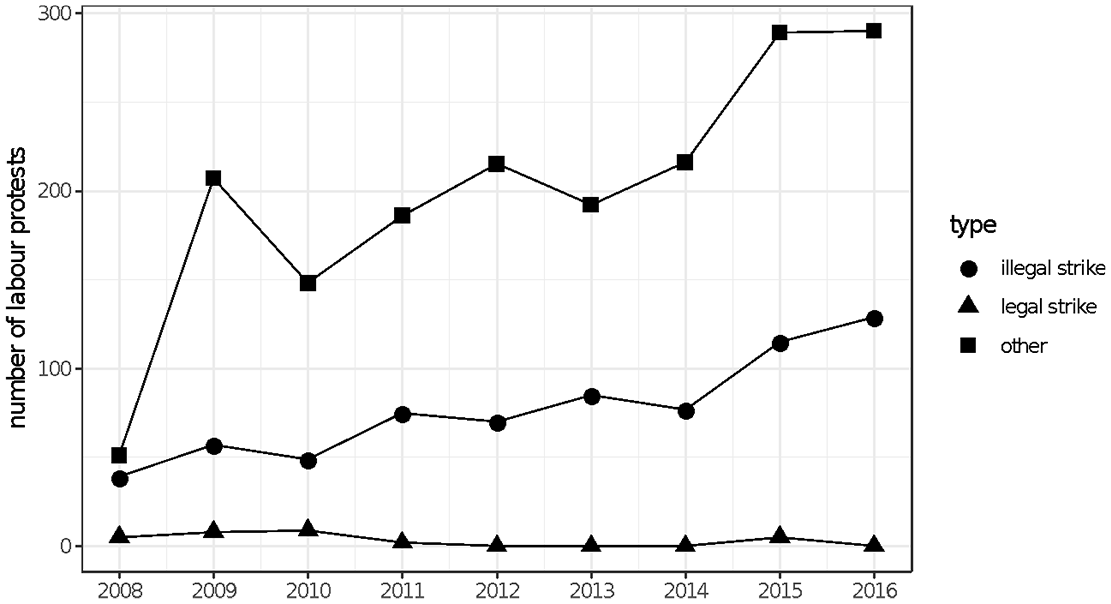
Number of labour protests in Russia by type, 2008–2016.
Figure 2 goes on to display different forms of labour protest and their rate of extracting at least partial concessions from the employer. The graph shows that more disruptive forms of protest, such as illegal strikes (i.e. strikes that violate the officially prescribed procedures), road blockades and firm occupations, are associated with a higher rate of concessions than symbolic actions such as protest demonstrations and declaratory actions such as raising claims and appealing to authorities. To be sure, these descriptive numbers do not warrant causal attribution, since the graph does not control for potentially confounding factors like industry type, number of affected workers and supporting organisations. However, these findings clearly underscore that even under authoritarian conditions of thwarted organisational resources, labour protest can be effective.
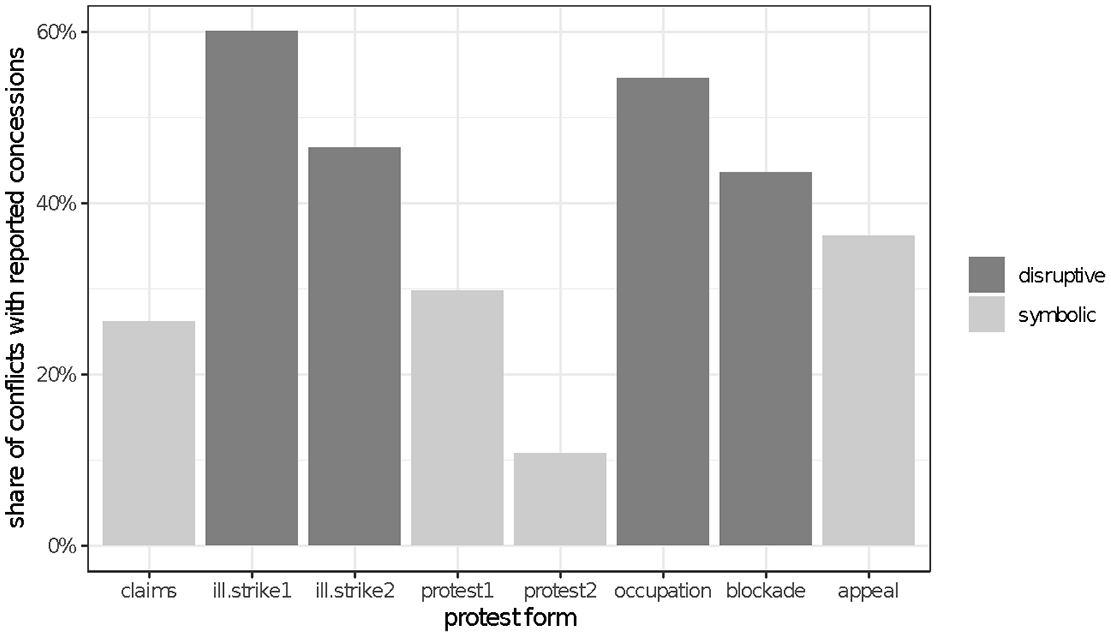
Contentious actions and success rate in Russia, 2008–2016.
Conclusion
A brief and necessarily restricted look at the MLP dataset revealed that, when compared to official strike statistics, a dataset based on PEA appears to be superior for tracing dynamics and consequences of labour mobilisation in an authoritarian setting. In order to escape the data problem emanating from co-opted trade unions and highly complex legal procedures common to modern authoritarian regimes, we therefore encourage the broader application of PEA to include labour contention (see also Barrie and Ketchley, 2018).
A full documentation of the dataset, as well as the data themselves (restricted to the years 2008–2017), is available on the Discuss Data platform. 1 The documentation includes a detailed description of the data gathering process, including a discussion of potential inaccuracies and biases, providing a template for creating similar datasets in other national contexts. Such efforts are, of course, conditional on the accessibility of reliable newspaper reporting, which may be a problem in authoritarian contexts in its own right. Research has shown, however, that even under conditions of limited press freedom, some forms of bias can be mitigated by diversifying the number of sources (Beissinger, 2002) and explicitly sampling regional or local news outlets (Gladun, 2020).
If such potential difficulties are taken seriously during data gathering and research design, we argue that approaching labour conflict with the methodological toolkit of PEA provides great opportunities to researchers of workers’ mobilisation, especially in situations in which other types of data are hard to come by.
Footnotes
Funding
The author(s) disclosed receipt of the following financial support for the research, authorship and/or publication of this article: This publication has been produced as part of the research project ‘Comparing Protest Actions – Part 2’, which is being organised by the Research Centre for East European Studies at the University of Bremen with financial support from the Volkswagen Foundation.