




Abstract
The five ‘developmentalist’ welfare states of East Asia (South Korea, Singapore, Taiwan, Hong Kong and Japan) have been presented as successful projects of economic progress, positively aligning citizen-interests with business objective. Utilising Jessop’s Strategic-Relational Approach (SRA), we analyse the Central Provident Fund (CPF), Singapore’s ‘forced savings’ social policy which organises housing, healthcare, education and retirement. Through a myriad of eligibilities/ineligibilities, Singapore’s CPF administers desired social behaviours while sustaining a series of inequalities supporting certain classed and gendered interests over others. Our analysis breaks down the CPF into three social relational orientations: (1) heteronormative familial responsiblisation, (2) labour market activation and (3) class reproduction. The article highlights the function of CPF in institutionalising conservative and pro-market political interests. CPF reproduces material inequalities and fashions behaviours conducive with the dominant accumulation strategy while discouraging those which are not, privileging some interests over others.
Keywords
Introduction
Sections of the social policy literature describe ‘East-Asian developmentalist welfare states’ (South Korea, Singapore, Taiwan, Hong Kong and Japan) as having the ‘primary long-term objective as improving national economic development through active and concerted government intervention’ (Hudson et al., 2014: 304). East-Asian states are thought to be formative of a fourth, so-called ‘developmentalist’ or ‘productivist’ ideal type within Esping-Andersen’s (1990) codification (Holliday, 2000; Holliday and Wilding, 2003). Aspalter’s (2006) description of East-Asian developmentalism, for example, suggests that what ‘unites the East-Asian experience, from Japan to Singapore, is the high priority that is put on the harmonious relationship between economic and social development, as reflected in the leading ideologies of governing elites – that is, social policy was sought to be supporting and not hindering economic growth’ (p. 298). Writing in a similar tone, Vasoo and Lee (2001) describe the central components of Singapore’s social policy as a ‘fully-integrated national development strategy’ that promotes a ‘process of sustainable, people-oriented development’ with ‘improvements in standards of living for all’ (p. 281).
In this article, we interrogate these visions of East-Asian developmentalist welfare through an inquiry of Singapore’s Central Provident Fund (CPF). Drawing upon Jessop’s (1990, 1999, 2004, 2008) Strategic Relational Approach (SRA), the analysis develops a state theory lens which draws out the vested political and economic interests embedded within CPF, questionning the uncritical and depoliticised account of social policy routinely provided in the comparative literature.
Chu’s (2016) comprehensive review of the East-Asian developmentalist literature across different fields suggests that explanations emphasise competent bureaucratic coordination between state and business. This developmental story is one of robust bureaucratic organising, centralised technocratic planning, state direction of business and the responsive control of all aspects of socio-economic environment through which the ‘virtue of the variable capacity of states to generate and direct economic growth’ is emphasised (Hameiri and Jones, 2020: 7). Developmentalist perspectives regarding Singapore’s public policy similarly highlight the ‘autonomous’ benevolence of state bureaucratic variables (Phang, 2010; Vasoo and Lee, 2001), avoiding discussion of inequality, oppression or harms organised through state policies. The important dynamic of inter-factional conflict on national and global planes are commonly left out of the developmentalist analyses of East Asian welfare systems.
This article challenges developmentalist analyses of East-Asian social policy by questioning whether welfare policies have resolved the contradictions of market societies to the extent proclaimed. This article challenges the modernist assertion made by many scholars that East-Asian developmentalism is an almost complete amelioration of the social needs of the mass population with political economy (Aspalter, 2006; Holliday, 2000; Holliday and Wilding, 2003; Low, 2004; Vasoo and Lee, 2001). While our case study focuses on Singapore, our approach also indicates the potential for repoliticising analyses of East-Asian welfare states in comparative social policy debates: first, by focusing on the various socio-political interests and conflicts from which social policy solidification emerges and, second, by developing a critical scholarly project identifying the oppressions connected to policies. This approach is not necessarily a departure from Esping-Andersen’s original typology which left considerable intellectual space for highlighting the politics of welfare. In his analysis of the ‘causes’ of welfare state construction, he emphasises the complexity of social policy materialisation from the allegiances and conflict of capitals and differently dis/empowered sections of labour (Esping-Andersen, 1990: 29–32). He also noted that welfare policies protect some people’s class status over others, for example, reproducing rather than deconstructing inequalities. Much of the debate around East-Asian developmentalism has subordinated this dimension of the original specification of comparative welfare studies, seeing social policies as principally reflections of efficient technocratic decision-making. These Weberianist examinations foreground the powers of effective planning without exploring the socio-historical conditions within which social policy formation became possible. Our study of Singapore’s CPF opens the door for more critical comparative interrogations of East-Asian social policy. For instance, there are continuing and known problems with poverty and inequality in Taiwan, Hong Kong, South Korea and Japan, but this fact does not sit centrally in conceptualisations of East-Asian developmentalism. All five countries’ reproductive regimes rely on maintaining, to some extent, traditional caring roles for women.
There have been significant advances in terms of wages, living standards, capital accumulation and institutional capacity in Singapore since independence and welfare policies have been a central driving force in these dynamics. However, the articulation of East-Asian developmentalist social policy reproduces a modernist conception that a benevolent mode of production where everyone ‘wins’ is not only possible but achievable if the right matrix of socio-economic regulation and political leadership is established. This constrains interrogating welfare as strategically calibrated to support forms of accumulation. While our analysis is somewhat inhibited by its singular focus on Singapore, we still hold that our case study suitably uncovers the deeply political nature of social policy, countering the depoliticised conception given by other scholars. SRA is employed here to expose the rationalities of the CPF and associated structurally fashioned ‘losers’. CPF is an important institutional pillar in supporting and constructing Singapore’s unequal political economy. Embedding the analysis in the SRA foregrounds the systemically embedded ‘intentions’ of CPF and the groups who lose out because of the interests it promotes.
Jessop’s SRA
Jessop’s SRA (1999, 2004, 2008) advances the ontological and epistemological suppositions of critical realism for advancing a theory of the state. Critical realism asserts that social structures exist independently from social action, but socially contextualised and intentional agency continually reproduce or transform social structures. Social structures are taken to be established relations or positionalities between sets of actors, including law, economic institutions, policies, meanings, values, norms and so on. Such structures are tendentially inclined to reproducing existing relational forms but always open to transformation through struggle, resistance and changes in other social/non-social structures. In developing critical realist analysis of state power, the SRA sees state forms and practices as the outcome of strategically situated actions by groups and individuals (Jessop, 1999, 2004, 2008), albeit not all agential forces have equal power to shape state ventures towards their interests. State forms are at once the current field of potential influence but also embossed articulations of past and ongoing concessions and conflicts.
The SRA transcends positions viewing the state as a singular expression of ruling-class power or a resolution to the endemic crisis tendencies of capitalism, while retaining a Marxian claim that the state is a condensation of interest-oriented conflict. Jessop (2008) argues that the state comprises practices and institutions defining and arranging popular consent for prevailing socio-economic conditions. It is an ensemble of material and discursive forms which have ‘core’ locations (i.e. in law, central bureaucracies, government), yet also dependent on ‘micro-political practices dispersed through society’ (Jessop, 2008: 10). The multitude of ‘core’ and ‘peripheral’ state forms are coagulations of previous and ongoing ‘struggles’. State forms, such as narratives, policies, practices and regulative processes are condensations of strategic interests and conflict-resolutions with inevitable ‘winners’ and ‘losers’, thus states are not expressions of the ‘general will’ (Jessop, 2008). The formulation and actualisation of selectivities, or whose project becomes ascendant in semiosis and procedure, depends on a complicated set of potential determinants. These include the strength of the dominant coalition of interests; extra-national forces who extend influence (i.e. global, international and regional dynamics), the development of counter-modalities; reformulation of spatio-temporal conditions or, emergent crisis tendencies within existing structural propensities.
Within any sphere of state-activity competing projects will vie for ascendancy. Thinking through the SRA in relation to accumulation projects is particularly useful for thinking about developmentalism as an economic project. In State Theory, Jessop (1990) argued that ‘accumulation strategies’ are an effective conceptual apparatus for interpreting the economic dimensions of state power (p. 155). Accumulation strategies are specific institutionalisations of economic growth uniting circuits of capital as value assumes material and immaterial forms (e.g. commodities, logistics, labour, trade, currency and consumption). State power is central to instigating and morphing accumulation strategies thus advancing compositions of class-orientated interests to the detriment of others. Within any locale there will be an unimaginable diversity of economic activity occurring, but state power tends towards elevating certain circuits of production and exchange. The question of which accumulation strategy will come to be more heavily supported by the state can be framed in terms of ‘economic domination’ and ‘economic hegemony’ (Jessop, 1990: 199). Domination is the capacity of a capital to have its interests ‘served’, for example, pressuring state capacities to cooperate in forming the necessary physical and social infrastructure for its operation. Hegemony is achieved when a particular accumulation strategy comes to be ascendent finding representation throughout society. The stability and intensity of hegemony depends on whether a structural coherency is achieved between prevailing ideological justifications, administrative and institutional power, and the ascendent accumulation projects. The state’s special status is partially dependent on its role in demarcating and imposing its power according to claims about general, popular will. In this regard, states engage in strategic considerations regarding popular legitimacy, and deploy ideological, material and coercive power to achieve hegemony, but with hegemony always open to contestation.
The SRA repoliticises social policy study by visualising welfare as arising from the historical process of political conflict and domination: policies are embodiments of strategically orientated demands and concessions, including various class positionings. State-structures assume structural tendencies to ‘privilege some actors, some identities, some strategies, some spatial and temporal horizons, some actions over others’ (Jessop, 2004: 2). Social policies are not wholly concessionary demands made by the masses, although they may, at times, be exactly this. They are also interventions by the state to achieve hegemony on behalf of dominant forms of capital, such as helping to sustain a degree of moral commitment to the economy or ensure the relative health and capacity of labour (Offe, 1984). In this sense, they are also unifying processes, building coherence between political hegemony and accumulation projects.
SRA offers a powerful mode of analysis for understanding developmentalist state forms that emerged in East-Asian countries since independence from colonialism. The following analysis dissects CPF’s selectivities by uncovering the rationalities and outcomes of current policy mechanisms. Rather than picturing Singapore’s development as simply good planning or the reign of technical and bureaucratic governance in the interests of the ‘general will’, CPF is entwined with bringing about and reproducing accumulation and associated unequal distribution. We begin with a recent history of the shifting political and economic dynamics shaping development in Singapore. We then move to a more detailed account of the selectivities of CPF policy: the behaviours, actions, identities and ‘choices’ it reproduces vis-à-vis the prevailing political economy of Singapore.
Welfare development and political economy in the era of ‘globalisation’
Social policy development in Singapore emerges from the shifting regional and national class dynamics of the Southeast-Asian post-colonial Cold War era (Carroll, 2020). Through the 1950s the People’s Action Party (PAP) was a coalition of pro-independence forces including communists, socialists and more conservative, pro-bourgeois interests. A faction of English-speaking Chinese, led by Lee Kwan Yew (who would become Prime Minister of Singapore from 1959 to 1990), co-opted the popularity of the party to a more marginal, conservative agenda. Singapore gained independence in 1965 after 2 years as part of Malaysia. From these chaotic years arises an increasingly strong PAP, who go on to form, what Tremewan (1994) calls, the ‘PAP-state’ (p. 40): an intimate fusing of robust institutional state power, including security and ideological apparatuses, with a capacity for the micro-management of all aspects of economy and society. After independence, PAP policies sought to direct accumulation towards foreign capital investment. From around 1965 until the late 1970s Singapore underwent a period of intense industrialisation, first, geared towards import substitution and then latterly for export. From 1961, the government coordinated investment from the United Kingdom and World Bank. After the brief period as part of Malaysia, Singapore officially joined the International Bank for Reconstruction and Development (IBRD), the lending arm of the World Bank. Between 1963 and 1975 Singapore received 14 loans used to develop the necessary infrastructure for a shift to export-orientated development (Centre for Liveable Cities Singapore, 2014). These loans paid for the development of housing and education systems and the infrastructure necessary for industrialisation.
Critically, this period also saw the destruction or co-optation of all organised solidarities that posed a threat to PAP ‘planning’, including the detention of members of political opposition, forced resettlement in public housing, gerrymandering and electoral manipulation, a whole raft of measures ending the possibility of action by organised labour, and, lastly, the accusation of communism and subsequent termination of many civil society organisations (Chua, 2017; Tremewan, 1994). This was an intense period of ‘proletarianisation’ immobilising various forms of bottom-up class struggle and handing almost complete control over the intensity and form of exploitation to the government (Coe and Kelly, 2002).
In the decades after, the Singapore state continued to exert formidable effort towards orchestrating industrialisation. Perhaps three major themes unify the PAP-state’s approach to the economy through all the decades: first, ensuring foreign capital investment, second, ensuring demobilised compliant labour and finally, developing local state-owned and linked enterprises. Today, the economy depends on lowly paid labour in conjunction with low corporation tax and minimal barriers to trade. In this sense, although Singapore might be considered as advanced and ‘developed’ in many respects, many activities remain low value-adding (Carroll, 2020). In 2016, Foreign Direct Investment in Singapore was US$74,253 million, the highest in East Asia after China, but how much this contributed to either the state’s coffers or employment is unclear as this figure is largely made up of monies transferred as part of tax avoidance schemes (Carroll, 2020: 58). Manufacturing remains a crucial sector in Singapore accounting for 20% of gross domestic product (GDP) in 2019 but is led by Japanese, American and Taiwanese capital. Manufacturing also depends on the importation of Global South labour, rendered highly exploitable through the Work Permit visa system (Greener and Naegler, 2021). Singapore is a global shipping hub, accounting for around 7% of GDP, but, yet again, the industry depends on minimal taxation and disempowered migrant labour. The development of business services, high-quality infrastructure, the strong emphasis on social stability and security, and again, low-tax schemes has encouraged multinational corporations to locate key offices in the city-state. The instigation and maintenance of Government Linked Companies (GLCs) help to secure profits for ‘indigenous’ capitalist classes and employment for middle classes, thus aligning elite-interests with lower down stratums (Chua, 2016; Rodan and Hughes, 2014). In essence, Singapore companies, be it state-owned or private, have debatably failed to enter higher value-adding processes with many circuits of accumulation dependent on diverse types of foreign investment (Rahim and Barr, 2019).
Since independence, social policy systems have reinforced dominant accumulation strategies. As Tremewan (1994) argues, the mass rehousing of the population in the Housing Development Board (HDBs) estates provided better access to quality living conditions, it also created a mass proletarian class, disconnected from subsistence in small holdings and fishing villages made dependent on wage labour. The interrelated progression of CPF and HDB through the 1970s increasingly enforced living in isolated family units, no longer connected to denser localised networks in kampongs (Malay for villages). Education and healthcare was also central to transforming the mass population into a relatively skilled, housed and self-reproducing working class. While there is evidence of significant dissent and serious distress during this period of proletarianisation, these were also important hegemony-making strategies as people were seeing genuine material gains. As Singapore transitioned into the neoliberal-era, welfare increasingly assisted middle-class families. For example, the government implemented educational reforms from 1979, emphasising meritocracy through intensified streaming early in children’s education. Meritocracy became a key principle for creating inequalities between sections of the citizenry while legitimising them as reflections of individual ability or effort (Lim, 2016). Despite the huge investment in welfare, formally PAP politicians crafted an ‘anti-welfare’ narrative arguing that Western welfare states are an economically unviable, corrupting moral force (Barr and Skrbiš, 2008; Chua, 2017; Lian, 2008).
There are several key points to pull out regarding post-independence developmentalism in Singapore. First, the PAP elite that emerged saw the importance of ensuring Singapore’s role within globalisation. The success in condensing a variety of economic strategies is fundamentally interlinked with Singapore’s geopolitical role as a low-tax wealth transference hub, facilitated by its close trade and military relationship with America and other Western powers (Rodan, 2018). Maintaining ‘security’ became central to fortifying the country as a regional financialised centre for global capital. Individual investors and large multinationals can have faith that a change of leadership, currency crashes or political revolt are highly unlikely. This explains why despite the destruction of working-class solidarity early in the reign of the PAP, mass forms of legitimacy-seeking organised through welfare remain central to ensuring permanency through a process of ‘hegemonic authoritarianism’ (Sim, 2006: 143). The article provides a contemporaneous analysis of CPF in the following section, revealing its role in ensuring mass support while simultaneously structuring Singaporean lives to be conducive with dominant economic objectives.
Strategic-relational approach to the CPF
CPF is a forced savings scheme with origins in British rule which has matured into a highly complex system managing housing, medical services and retirement (Vasoo and Lee, 2001). Officially, CPF is described as ‘a comprehensive social security system’ enabling citizens ‘to set aside funds for retirement’ and ‘addresses healthcare, home ownership, family protection and asset enhancement’ (CPFB, 2021a). Benefits are arranged through a set of savings accounts with strict conditions regarding the spending of money. CPF accounts are automatically created, and savings accrue chiefly through employee contributions, employer contributions and interest (CPFB, 2021b). There are three savings accounts accruing different amounts of interest (3.5–5%): Ordinary Account (OA), Special Account (SA) and Medisave Account (MA). The OA receives most contributions, and withdrawals from this account can be made for housing, education and investments. The SA is reserved for pensions. The MA is used for approved medical expenses and CPF-approved medical insurance. Funds from OA and SA combine to create a retirement sum that forms a guaranteed monthly income through CPF LIFE (Lifelong Income for the Elderly) (CPFB, 2021c). Since independence, CPF has become interlinked with GIC Private limited, one of the two sovereign wealth funds of Singapore. Monies from CPF are invested by the CPF Board under Special Singapore Government Securities (SSGS) (Chua, 2016).
Through a critical interrogation of CPF’s current rules and regulations alongside a review of the existing literature, we construct three distinct selectivities within the policy. Selectivities are materialisations of certain group interests within the policy frameworks. Each strategic-relational CPF orientation notes relevant features which reproduce certain social relations (see Table 1), tending to encourage certain subjectivities and actions over others. The SRA provides our analytical framework by which to scrutinise the CPF, allowing the gendered and social class-based selectivities of policies to come to the fore as well as revealing the supportive role welfare has in Singapore’s political economy.
Strategic-relational Central Provident Fund orientation.
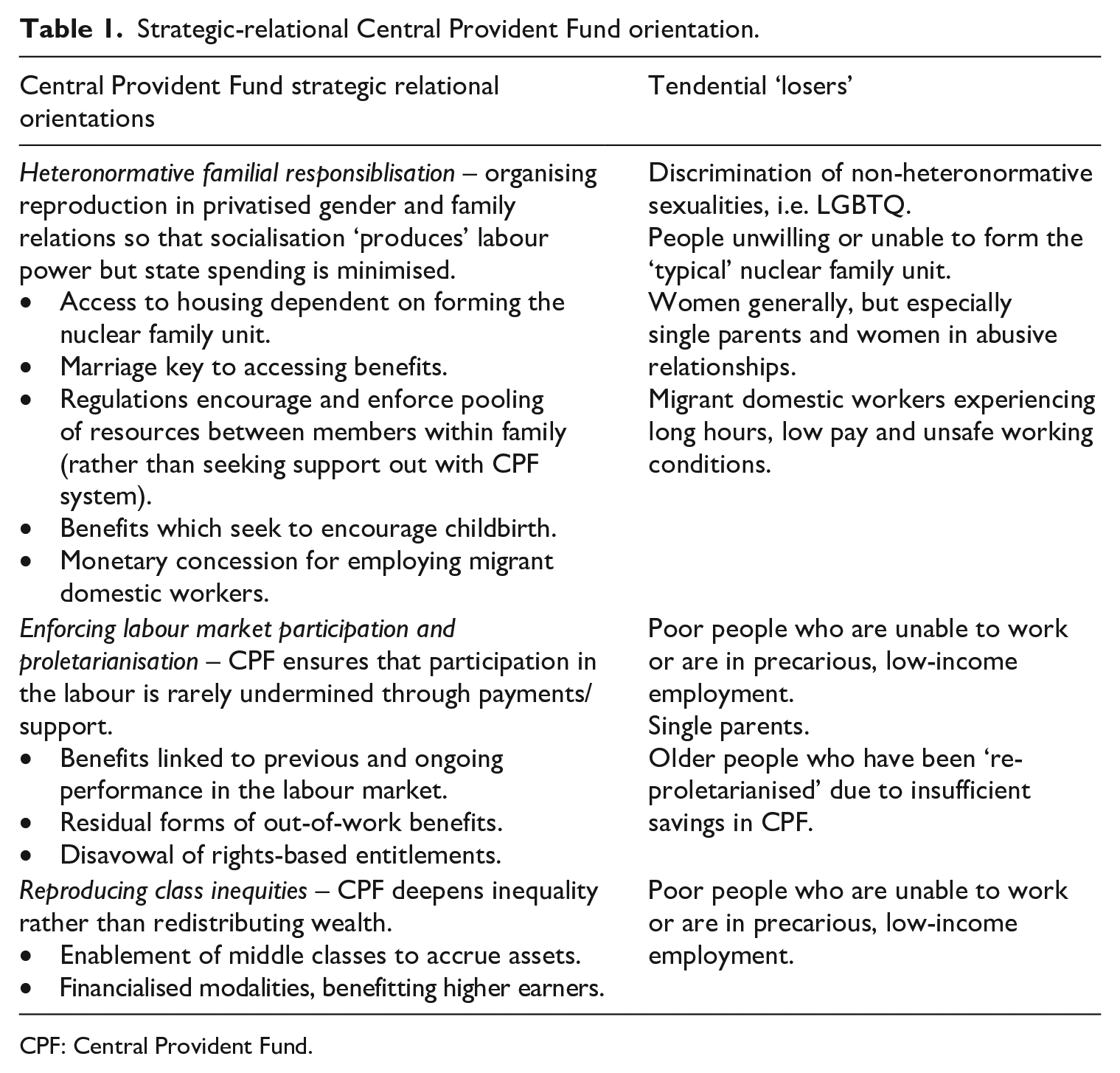
CPF: Central Provident Fund.
Strategic-relational CPF orientation 1: heteronormative familial responsiblisation
This first orientation explores CPF’s maintenance of ‘traditional’ nuclear family relations, a central example of the state’s ‘gender selectivities’ (Jessop, 2004: 210). CPF seeks to structure the family as the primary source of socio-economic protection, minimising the responsibility of the state in welfare. CPF has also transformed over time in attempts to guarantee robust systems of social reproduction in the face of increasing ‘modernising’ forces around sexuality and traditional family relations. All capitalist societies, according to Fraser (2016), are perpetually plagued by re-emergent crises in reproduction. Reproductive labour, such as caring and child-rearing, is constructed to be women’s unpaid remit but as feminist struggles strengthened and the position of women as consumers and paid workers is increasingly systemically significant, the societal organisation of care meets new difficulties. We argue here that CPF responds to contradictions in social reproduction by reinforcing heterosexual familial gender roles. The policy seeks to establish privatised nuclear familial obligations as the primary unit for care and welfare while permitting women’s participation in the labour force.
Many CPF benefits are accessible only after legal marriage, with spouses enabled to combine CPF savings to purchase housing or share their MA for medical services. The Approved Housing Scheme allows the use of OA funds to purchase apartment flats after the formation of the ‘family nucleus’ (HDB, 2021a). The criteria managing HDB ownership is central to regulating familial social relations. The commonest and larger types of HDB are only accessible if those applying have established a family nucleus, and bigger five-room apartments are also easier to access if families go through the ‘3Gen’ pathway, requiring the cohabitation of three generations (HDB, 2021b). The Single Singapore Citizen Scheme and Joint Singles Scheme allow over-thirty-fives who are not in state-certified relationships to access housing, but they are restricted to smaller, more expensive flats. Singles under-thirty-five or those in ‘non-standard’ sexual relations have less opportunities to depart parental accommodation (Oswin, 2010; Sayoni, 2018).
CPF incentivises childbirth through other bonuses for married couples. New parents are permitted to use MA for medical expenses for pre-delivery procedures and for delivery (Ministry of Health (MOH), 2021). Children are given a Child Development Account (CDA), part of the Baby Bonus scheme designed to support parents with the cost of raising children. Aside from a cash gift between SG$8000 (US$5882) for their first and second child to SG$10,000 (US$7382) for their third child and above. There is also an initial grant of SG$3000 (US$2205) in the CDA and the government will also match parents’ savings of up to SG$3000 (US$2205) for their first child and up to SG$15,000 (US$11029) for their fifth child (Ministry of Social and Family Development (MSF), 2021a). While money in the CDA can only be used for educational and healthcare expenses, unused funds will eventually be transferred to the child’s Post-Secondary Education Account (PSEA) and then to their OA when they turn 31 years of age (Gov.sg, 2017a). On top of the Baby Bonus, a newborn will automatically be granted an MA, be provided with Medishield Life insurance and a Medisave grant of SGD4000 from the government (MOH, 2021). Parents are able to support their children’s tertiary education using funds in their OA through the CPF Education Scheme (CPFB, 2021d). These benefits assist with the costs of reproduction and encourage familial and individual financialised asset building from birth.
CPF encourages inter-generational shared economic responsibility and even enforces legal dictates for financial and care support during times of sickness and disability. If an elderly parent has insufficient MA funds to cover hospitalisation, their child(ren) can transfer funds from their MA to defray bills (CPFB, 2021e). Adult children can support their parents’ mortgage using their OA if parent(s) are retired or unable to afford payments (CPFB, 2017). There are also Top Up schemes that appeal to working children through tax relief to add funds to retired parents’ CPF account (CFPB, 2019). The Proximity Housing Grant encourages married children to stay near their parents, promoting caring responsibilities (HDB, 2021a). Familial obligations are also enforced within the Maintenance of Parents Act (Singapore Statutes, 1995), which allows older Singaporeans to demand that sons or daughters pay financial support. These measures establish privatised intergenerational cooperation and obligation.
Whether CPF has helped women to overcome the double burden of care and paid labour is questionable. Kong and Chan (2000) suggest that the advancement of women in Singapore was economic ‘pragmatism’ rather than female empowerment. Despite greater participation in employment, family policies still treat women as homemakers. Teo (2007; 2015) argues that policy processes formalise expectations around employment and marriage, leaving traditional divisions of labour unchallenged. Women are still earning less than men for the same job (Phua, 2020), yet paying more than men for national insurance through their MA (Careshield Life, 2020). In other words, while CPF has provided some women with greater individual financial freedom, especially employed middle-class mothers, it has been a strong force maintaining the conventional family even as societal values have liberalised in light of women’s organized resistance to patriachy. CPF’s pro-nuclear family principles strongly discourage divorce and there is evidence that women divorcees face intense financial insecurity (Sun et al., 2014).
Although CPF policies seem to offer some benefits that may help mothers and young families, contradictions arising from home and work life are more commonly resolved through ‘outsourcing’ care to devalued, racialised labour by employing foreign domestic workers (FDWs). Average wages for FDWs are around SGD$600 (USD$436) per month (HelperChoice, 2016). Meagre forms of protection are legalised through the Employment of Foreign Manpower Act (EFMA) and promoted through the Ministry of Manpower’s employer’s guide which encourages permitting 1 day off a week, access to food, monthly payment and encourages employers to manage expectations (Minister for Manpower (MOM), 2021). Nonetheless, the institutionalisation of employment fashions a disempowered workforce with no routes to citizenship, curfews, no rights to collective action and limited policing of regulations. FDWs maintain low-cost privatised reproduction, revealing the inability of CPF or other welfare systems to provide robust systems of care. The FDW system ensures the health and well-being of Singapore’s rapidly ageing population (AWARE-HOME, 2020).
By linking housing and a range of benefits to forming a nuclear family, CPF guides decisions about marriage and childbirth. The framework of eligibilities rewards heteronormativity and animates the establishment of nuclear families. Ultimately, familial responsibilisation maintains minimal state commitments to welfare by removing direct state obligations to provide ‘rights’ to specific benefits. CPF is structuring of gender relations through grounding ‘traditional’ conceptions of masculinity and femininity ‘in different institutions and material practices’ (Jessop, 2004: 211). The system constructs the appropriate role for women as busy, responsible worker-wives, balancing employment with caring responsibilities. The empowerment of (some) women to engage in paid labour has not primarily rested on welfare state measures or more far-reaching rearticulation of gender relations, but the mass importation of precarious care workers from the Global South.
Strategic-relational CPF orientation 2: enforcing labour market participation and ‘proletarianisation’
Offe (1984) argues that welfare states maintain conditions of ‘dispossession’ by underpinning labour market participation. Without welfare state structures the ‘transformation of dispossessed labour into active wage-labour was not and is not possible without state policies’ (Offe, 1984: 93). The relative economic gains that some groups obtain legitimise capitalist production, but accruing assets and wealth erodes the economic compulsion to engage in paid labour. This moving contradiction is central for understanding the structure of CPF support. Delivering material concessions improves legitimacy for prevailing accumulation strategies and supports consumption, but if out-of-work benefits are generous it may limit entry into paid labour. Studies of state power in Singapore frequently highlight the legitimacy-serving capacities of welfare (Chua, 2016; Sim, 2006), but this section reveals CPF to also be important for labour market activation.
CPF growth is inextricably tied to employment as both employee and employer contributions are compulsory. Where an individual earns SG$50–500 (US$36–360) a month, they are not required to contribute but the employer is (Gov.sg, 2017b). Fundamentally, the benefits of CPF closely follow the ability of the account holder to make contributions through employment or the ability to top up their own accounts with available cash (CPFB, 2021f). In the event of unemployment, there is no stipulation for accessing savings. Singapore also has no minimum wage, with wage standards agreed through the National Wage Council (Lim, 2014). Those in poverty due to long-term illness or disability are eligible to apply for subsistence through strict means testing but assistance is provided separately from CPF and always on a ‘case-by-case’ basis. To be eligible for long-term assistance, they must be unable to work, have no available financial support from family members, not be receiving significant funds from CPF if they have retired and, also, if they are older, their children also must be low-income (MSF, 2021b). CPF neither supports unemployed people nor those of working age who are unable to engage in employment due illness or disability.
The labour market activation orientation is best articulated through an examination of older workers in Singapore. In June 2018, 26.8% of all people above the age of 65 years in Singapore were in employment (MOM, 2018). Singapore is one of the most rapidly ageing societies in the world, but this prevalence of working in later life is significant evidence that CPF is not achieving economic security for this group (Asher and Nandy, 2008; Choon, 2012; Ng, 2015). In past deaces, many older people relied on their children either for cash payments and/or frequently co-habitation, but these sources of security have eroded (Ng, 2011). Without direct payments from the state, Singapore’s poorest older people are forced into the labour market. Ng et al. (2019) show that CPF payments are relatively insignificant in terms of meeting household needs of elderly people. In 2018, the CPF paid an average of SG$450 [US$329] per month to persons aged 65 to 69 years old, $290 [US$212] to those aged 70 to 79 years old, and just SG$220 [US$161] to those aged 80 to 87 years old. (MOM, 2019: cited in Ng et al., 2019: 57)
Despite the argument that CPF is primarily a retirement fund, its capacity to realise socio-economic protection for its older citizens appears limited. Concerns with this issue led the Singapore government to announce an annuity scheme called CPF Lifelong Income for the Elderly (CPF LIFE) in 2009 to replace the prior Retirement Sum Scheme (CPFB, 2021g), although its efficacy remains to be seen.
The failure to deliver economic security in later life drives re-proletarianisation as many older Singaporeans are forced to continue working (Cucino et al., 2017) even into their eighties. Employment rates for those aged 65 years and older jumped from 13.8% in 2006 to 26.8% in 2018 (Liew, 2019). The state even encourages employment into later life, with the 2015 Action Plan for Aging asking older Singaporeans to remain ‘productive’ for longer (The Ministerial Committee on Ageing, 2016).
From the perspective of SRA, CPF articulates a major dimension of capital’s domination over labour: it configures high degrees of commodification by constraining access to subsistence outside the labour market. The potential advantages that CPF offers individuals are entirely dependent on past performance in the labour market. Denying individuals’ access to their savings, even during times of severe need, ensures labour market participation. Individuals who are experiencing poverty due to caring responsibilities, chronic illness/disability or low-income work are often forced to seek more conditional welfare support existing outside the CPF system, on a ‘case-by-case’ basis. Certain sections of the population are at risk of poverty, but our argument is that this is not an unforeseen blind-spot of CPF. The CPF system retains a strong coercive capacity for systemic passive proletarianisation (Offe, 1984), where labour market failure results in a lack of savings and an inability to find better paying jobs results in deprivation. This is most true for older people with insufficient CPF savings. CPF’s refusal to provide out-of-work benefits, in our view, is both an historical legacy of the destruction of organised class struggle (Coe and Kelly, 2002) and critical for sustaining a highly disciplined and ‘un-decommodified’ labour force, keeping Singapore highly attractive for foreign investment.
Strategic-relational CPF orientation 3: reproducing class inequities
PAP ministers’ claim that European style welfare states revolve around ‘hand-outs’ to poorer or non-working classes (Lian, 2008) is a misleading representation. Welfare in the United Kingdom, for example, is not a vast expensive charity system for the feckless masses. Hills’ analysis on UK social policy spending shows most of the ‘welfare’ spending is overwhelming on pensions, healthcare and education, not to out-of-work benefits (i.e. long-term disability or shorter-term unemployment) (Hills, 2017). Social policies in many countries are advantageous for wealthier households. Previous literature frequently demonstrated the importance of ‘consent’ orientated governmental processes in Singapore (Sim, 2006: 147), which operate through housing, healthcare and other concessions (Chua, 1995, 1997, 2017). This section argues that CPF reproduces class inequalities by privileging middle-class, higher earning households, assisting them to develop a portfolio of insurance schemes, assets and savings. CPF is not a system of wealth redistribution as each account holder benefits according to the amount of contributions made and the interest accrued. CPF institutionalises income inequality and as Chua (2015) argues, incentivises wealth accumulation through employment rather than tackling poverty.
Retirement planning is mandatory in CPF, but ‘choices’ to maximise savings are primarily available to wealthier individuals. Contributing extras to the Retirement Sum, or partaking in investment schemes, are only available to those with enough earnings. While individuals are allowed to start withdrawing funds from their CPF accounts at 55 years, combined funds in OA and SA must meet the Full Retirement Sum, which in 2021, was SG$186,000 (US$137,432), or they would only be able to withdraw up to SG$5000 (US$3672) per annum (CPFB, 2021g). An individual can pledge their property and only meet the Basic Retirement Sum (in 2021, SG$93,000, US$68,717) to withdraw more cash, but this also means that their eventual monthly cash handouts will be much lower. Those who have bought a private annuity using cash or CPF Investment Scheme may be exempted from setting aside a Retirement Sum (CPFB, 2021h).
Although retirement age is 62 years old, monthly cash pay-outs are only made automatically when the individual turns 70 years old (CPFB, 2021c). The gap between the retirement age and cash pay-outs highlights the expectation of savings or working after retirement age. The introduction of CPF Investment Scheme (CPFIS) allows individuals to invest funds in their OA and/or SA. To invest through CPFIS there must more than SG$20,000 in the OA and/or more than SG$40,000 in an individual’s SA (CPFB, 2021h). These measures ensure that only individuals with certain endowments can optimise their retirement through the scheme. Individuals who have been able to reap returns from their investments are enabled to put aside a higher Retirement Sum. Various regulations restrict the use of CPF monies (CPFB, 2021a) to prevent individuals from spending too much, too early in life.
The ability to ‘use’ CPF to enhance wealth is far greater for richer households (Teo, 2013). Obviously, because CPF works through an individual’s capacity to save, the returns and privileges will be higher for those with higher income. While there is a sense that CPF is implicated in sustaining ‘consent’ it also needs to be noted that this is focused towards middle-class households, reproducing rather than deconstructing inequality.
Discussion: CPF as domination and hegemony
Certain social policy studies have sought to describe East-Asian developmentalism as a kind of best-case example of proficient welfare management where policies are ameliorated to capitalist economic imperatives (Aspalter, 2006; Vasoo and Lee, 2001). Such analyses have often focused on effective bureaucratic management as achieving a kind of social policy perfection (Holliday, 2000; Holliday and Wilding, 2003) through modernising technocratic governance. This article complicates the developmentalist story by recognising the strategic interests embedded in the development of the Singapore welfare state and their articulation in current priorities and oppressions of CPF. Rather than seeing CPF as simply containing some ongoing difficulties requiring reform (see Low, 2004; Ng, 2015), a strategically orientated conception reveals CPF to be privileging some groups’ interests over others. Here, we summarise the argument and reconnect CPF to earlier discussions by indicating its connection to economic hegemony and domination (Jessop, 1990), noting CPF’s role in undergirding economic projects.
Social policy expansion in Singapore has undoubtedly increased material well-being, expanding access to education, healthcare, housing and consumerist lifestyles. Nonetheless, CPF needs to be understood as entrenching certain power-differentials. First, we analysed the arrangement of reproduction, interconnecting benefits with the setting up of a ‘family nucleus’ and intergenerational responsibility. Second, CPF activates labour market participation, especially for lower income groups, by severely limiting access to unemployment assistance. Retirement incomes are not guaranteed to a minimum standard leading to a re-proletarianisation of older aged people. Finally, we suggested that CPF reproduces inequality by bestowing greater benefits on wealthier individuals and families. The policy orientations are deeply material as they harness people’s motivation for economic prosperity and distribute essential commodities such as healthcare and housing. We have tentatively suggested a range of structurally inscribed ‘losers’ relating to each of the orientations in Table 1.
In the earlier section, we showed that the expansion of CPF is inextricably linked to the rise of the PAP and its achievement in creating a coherence between administrative capacity and political hegemony in undergirding capital accumulation projects that have risen and fallen over the decades. An ongoing and critical political dimension of this project has been the continued fragmentation and disorganisation of any social relational formations that could challenge the centrally administrated economic objectives. Originally, this took the form of mass resettlement, deliberate breakdown or appropriation of forms ethnic solidarity, co-option or destruction of institutions empowering labour and the use of security forces to ‘weed’ out dissenting voices, creating a climate of zero-tolerance for opposing political activities. As noted, in the decade after independence, government agencies systematically destroyed trade unions and other forms of labour-based organising as well as imprisoning political dissenters (Chua, 2017). Disciplining critical voices continues to be an essential government strategy for maintaining hegemonic control manifested recently in the guise of the 2020 Protection from Online Falsehoods and Manipulation Act and the 2021 Foreign Interference (Countermeasures) Bill. Today, the government also retains direction over the conditions of exploitation, tending to preempt potential bottom-up resistance. For instance, whilst improvements in wages for citizen workers are mandated at times, particularly in low-income sectors of employment, legally sanctioned protections such as curbs on working hours, rights to time off and minumum pay are poor, espeically when compared to other wealthy countries.
In many respects, CPF supports and reproduces the dominant forms of capital accumulation: a particular political economy which condenses regional multinational corporate activities into a low-tax, high-security haven. The ‘get what you’ve saved for’ principle alongside the privatising of responsibilities to the family means that rights to services or assistance is avoided, curtailing government spending. This is consistent with maintaining minimal corporation tax and thus a business-friendly environment for investors, merchants and transport industries. Singapore’s economy depends on inflows of business activities from multinational corporations and foreign investors seeking a financially secure, politically stable location to store and manage wealth. The primary structures of labour market discipline within this welfare system are upholding ‘passive’ modes of proletarianisation (Offe, 1984: 93), where subsistence outside of the labour market is constrained. There has recently been prominent discussion seeking to render visible the poor and precarious low-income citizens (Teo, 2018). The persistence of poverty admidst the country’s huge wealth is explainable when we consider that much welfare assumes this labour market activation orientation. The government’s reluctance to respond to deprivation more directly can be explained by the systemic importance of the structures of passive proletarianisation. The principle of ‘no income without work’ has been central to maintaining the highly business-friendly labour regime with minimal wage guarantees and almost complete destruction of labour’s capacity to dissent (Hameiri and Jones, 2020).
Consent-orientated dynamics within the policy framework, especially around the state-organised housing system, have facilitated significant social mobility. Through middle-class job creation, supported through state-capitalist enterprises, well-financed government bureaucracies and foreign multinationals, the system has created significant social mobility over the past decades. CPF and HDB has supported many to accrue assets given they are willing to participate in the economic and familial practices preordained by the government. The buoyancy of the housing market and home ownership secured through HDB has helped to generate consent and suppress potential resistance. Arguably, the organisation of the housing system facilitates the maintenance of low wages as heavily regulated mortgage payments and fixed rents for HDB properties keep housing costs low for citizens. On top of this, CPF’s conservative leanings for ‘individual effort’ and ‘responsibility for the family’ (CPFB, 2021i) reproduce a moralistic ‘consensus’ of the urban middle-classes of Singapore.
Our final but important point is that the critical realist foundation of SRA also reveals that stability and transformation within the state are contingent (but not determined) on existing conditions, including geopolitical forces. Critical realism asserts that while agency is an active part of social transformation, it is always contextualised by the current socio-historical conjecture. The SRA recognises that welfare state formation is ingrained in structural horizons: states and politics are constrained and empowered by the conjuncture of material and social conditions, including the shifting forces of geopolitical power and inequality. Singapore’s and the CPF’s development are closely connected to the complex and uneven transformation of Southeast Asia. Development in Singapore was led through the design and consolidation of an accumulation strategy emergent from the post-colonisation Cold War geopolitics and continuing today as Singapore assumed the status of tax haven and Global City (Hansson et al., 2020). In this sense, developing is not an autonomous political ‘choice’ made by domestic technocrats, politicians and civil servants, but is contingent on a host of socio-economic structural factors and historical legacies which restrict or empower the building of state-capacity. Developing robust legitimacy was partly possible due to the privileged position that Singapore received from World Bank policies and its important role in maintaining the US’ hegemonic position in Southeast Asia (Hameiri and Jones, 2020; Rodan, 1989). This facilitated, first, a strong economic growth based on industrialisation, and latterly a transition to regional and international financial hub. While countries like Singapore were privileged in the emerging global economic order, growing to become important hubs for global capital and American militarism, other countries had their developmentalist aspirations quashed early on. The American- and British-backed coup in neighbouring Indonesia led to the genocide of around a million people reinforcing a peripheral and extractive role for Indonesia in the world economy. Indeed, much of what is materially possible in today’s Singapore may only be due to the country’s special status in wealth transference and its position in value chains relative to other countries in the region.
Conclusion
In applying Jessop’s SRA to Singapore’s CPF, we have critiqued the ‘good news’ developmentalist story. Our approach is suggestive of the potential gains from greater attention to critical analysis within comparative approaches to East-Asian social policy studies – for example, drawing the connections between domination and political economy as well as the role of interest-orientated conflict in social policy solidification. Such an agenda transcends the obsession within comparative studies for categorising different types of welfare state towards a re-politicising examination of the structurally imposed oppressions emerging from social policy systems and their role in reproducing hierarchies, even amid the benefits of such policies.
Footnotes
Funding
The author(s) received no financial support for the research, authorship and/or publication of this article.
