



Abstract
The negative impacts of the COVID-19 pandemic have motivated an unprecedented level of global advocacy for gender-responsive and gender-transformative social protection systems that buffer individuals from shocks and vulnerabilities. This turn to a systems approach reflects growing recognition that the presence of one or two social protection programmes targeting women does not guarantee that they are protected throughout the course of their lives and over a wide range of contingencies. Relative to the high levels of interest, however, very little empirical evidence exists about what a gender-responsive or transformative social protection system entails in practice. This article departs from existing literature that focuses on the design and impact of discreet social protection instruments, to present a ‘state of the evidence’ on gender and social protection systems. Drawing on the results of a phased scoping review of academic and policy literature spanning various fields, the article charts the defining features of the existing evidence base, summarizes what is known and identifies pathways for future research. In addition to scholarly analysis, the article offers a comprehensive view of the evidence for policymakers, practitioners, movement leaders and funders working on policy problems from a gender perspective.
Keywords
Introduction
The negative impacts of the COVID-19 pandemic on women’s employment, care responsibilities, access to services and mental health (e.g. Kabeer et al., 2021; Seck et al., 2021) have motivated an unprecedented level of advocacy for immediate action at the ‘critical juncture’ opened up by the past 2 years around gender equality (Cook and Staab, 2022). Among the loudest demands is for investment in strengthening national social protection systems from a gender perspective (Gavrilovic et al., 2022; Heintz et al., 2021; UN Women, 2020). These calls emanate in spite of the remarkable pandemic-response investments in social assistance mechanisms (mostly cash transfers) made by governments around the world (Hale et al., 2021), including those that account for gender inequalities (UNDP and UN Women, 2021). The calls also build on a handful of pre-pandemic commitments to developing social protection systems that buffer individuals from routine life-cycle shocks and vulnerabilities and address gender inequalities: Sustainable Development Goal 1.3 calls for governments to ‘Implement nationally appropriate social protection systems and measures for all’; in 2019, United Nations Members States agreed at the 63rd Commission on the Status of Women to ‘work towards establishing or strengthening inclusive and gender-responsive social protection systems, including floors, to ensure full access to social protection for all without discrimination of any kind’ (UN Women, 2019); and in 2020, as part of the Santiago Commitment, Member States of the Economic Commission for Latin America and the Caribbean agreed to ‘Design comprehensive care systems from a gender, intersectional, intercultural and human rights perspective that foster co-responsibility between men and women, the State, the market, families and the community. . .as part of social protection systems’ (United Nations, 2020).
Advocacy for a systems approach reflects growing recognition that no single social protection programme can guarantee that women are protected through various shocks that may occur throughout their lives, never mind in the face of a global health crisis. Thus the calls represent a pivot from prior emphasis on singular social protection instruments targeting women – often cash transfers – towards a much broader ‘whole of systems’ focus. A national social protection system refers to the total set of social protection instruments in a particular country, as well as the various administrative mechanisms required to coordinate, implement and evaluate them (Loewe and Schüring, 2021). In recent years, weak social protection systems have been associated with persistent coverage gaps in social protection programmes, as well as inefficiencies and ineffectiveness in programme delivery (Holmes and Jones, 2013; Loewe and Schüring, 2021). In response, governments and international development agencies have recognized that ‘the broader goals of social protection can only be achieved when the different components of the social protection system talk to each other and are synchronized across policies, programmes, and the delivery chain’ (Loewe and Schüring, 2021: 23). Such gaps and inefficiencies have strong gendered dimensions: for example, only 44.9% of women with a newborn receive a cash maternity benefit, and in old age, only 8.1% of women in low- and middle-income countries are covered by a pension scheme, compared to 20.8% of men (International Labour Organization (ILO), 2021). For Holmes and Jones (2013), social protection systems are one of the key ‘institutional filters’ that shape opportunities and constraints for addressing gender inequality through social protection programmes: ‘one of the key challenges facing efforts to promote more inclusive and gender-sensitive policies and programmes is the weakness of social protection institutional arrangements in many low-income countries’ (Holmes and Jones, 2013: 191). The calls for and commitments to gender-responsive social protection systems – and increasingly, for gender-transformative ones – emerge from this context.
However, relative to the growing prominence of gender-responsive and transformative social protection systems in high-level rhetoric and commitments, the evidence base around these is sparse and scattered across a range of disciplines. This is distinct from the vast gender literature that exists on social protection instruments (programmes), from cash transfers (Cookson, 2018; Molyneux, 2006; Patel et al., 2015; Tabbush, 2010), to universal basic income (Schulz, 2017), pensions (Arza, 2018), public works programmes (Chopra, 2014) and maternity leave (Amin and Islam, 2019). Programme-focused scholarship has deepened our understanding of how social protection can improve or entrench gendered inequalities, and how it might be designed in service of achieving more gender equitable outcomes (Holmes and Jones, 2013; Perera et al., 2021). This literature notwithstanding, what is missing is a systems perspective on how these discrete programmes hang together to provide coverage across the life-course for a variety of gendered risks, vulnerabilities and inequalities – that is, What are the gendered effects of integration in a social protection system and how are these effects produced? (Peterman et al., 2020; see also Gavrilovic et al., 2022).
Resolving what constitutes a gender-responsive or transformative social protection system is in part a matter of having the requisite evidence or ‘gender data’. Yet the lack of definitional clarity is also indicative of a political dilemma that hinges on beliefs about what is right and gender just. With the discursive emphasis on responding and/or transforming, advocacy would appear to move beyond the utilitarian ‘gender aware’ approach placing mothers ‘at the service of the state’ (Molyneux, 2006; see also Bradshaw, 2008), as well as ‘gender-sensitive’ approaches that acknowledge but propose limited action on gendered inequalities. ‘Gender-responsive’, in contrast, indicates that gendered interests, needs, vulnerabilities and inequalities are acknowledged and that measures are taken to address these through the design, implementation and monitoring of social protection. A ‘gender-transformative’ approach goes further, to tackle and ultimately change the social relations and economic and political structures and systems (e.g. social norms, patterning of care and productive economies, legal and regulatory frameworks) that produce and sustain gendered inequalities in the first place (Holmes and Jones, 2013). 1
Yet even accepting gender-responsiveness – or more radically still, the transformation of gender relations – as the goal, many questions remain with regard to how such concepts are mobilized in practice, what facets of gender (in)equality are prioritized, and what theories of change are deployed. In the spirit of evidence-based policymaking, we suggest that better systems design should begin with an overview of the research landscape in order to clarify which ‘system focused’ questions, topics and (political) approaches have received relatively more robust treatment and which areas merit further elaboration. While there has been much-needed recent work to synthesize knowledge on social protection systems generally (Loewe and Schüring, 2021), to our knowledge, no such endeavour has been undertaken from a gender perspective.
This article addresses this gap in the literature around gender and social protection systems through a phased scoping review of academic and grey (policy) publications. The review aimed to answer the following questions: (1) What evidence exists on gender and social protection systems? and (2) What does the existing evidence base tell us about gender and social protection systems? In addition to a scholarly contribution, this article seeks to provide policymakers, practitioners, donors and advocates with a practical map of what is already known and what has yet to be discovered and developed. The article begins by outlining our study design. Section ‘Study design’ describes the composition of the evidence base, including characteristics such as share of research that is academic or policy-oriented, type of research outputs and geographical focus. In section ‘Results’ we discuss the content of the evidence base in terms of conceptual frameworks utilized and components of social protection systems under inquiry (e.g. administration, financing, etc.). We conclude with a discussion of the results and implications for future research and practice.
Study design
We undertook a phased scoping review following the steps laid out by Arksey and O’Malley, (2005). This methodology is used to map nascent research areas as well as those spanning academic fields that might not be in conversation. This approach to literature review is useful for identifying trends in the knowledge base, including gaps, and as such can inform further lines of inquiry when the evidence base is nascent. Scoping reviews are distinct from systematic reviews because they do not evaluate the effectiveness of the interventions under inquiry.
The project began with the broad remit to review the global evidence base on gender and social protection systems. While we did not discriminate by country income level, we are aware that ‘social protection system’ is a term used predominantly (though not exclusively) in development contexts (low- and middle-income countries), while ‘welfare system’ and ‘social security system’ are terms more commonly used to describe systems in higher income contexts where these tend to be more established (Loewe and Schüring, 2021). Whereas a more robust literature exists that analyzes and categorizes welfare states from a gendered, policy regime perspective (Franzoni, 2008; Orloff, 1996), we knew through practitioner experience that the literature on gender and social protection systems was significantly sparser. On this basis, we therefore limited our search to ‘social protection systems’.
We began by defining a strategy for systematically searching for articles published in English and locatable on Google Scholar. We also searched for articles on Web of Science and PAIS. Searches included combinations of ‘social protection system’ with ‘gender’, ‘gender sensitive’, ‘gender responsive’, ‘gender transformative’, ‘gender equality’ and ‘feminist’. We also hand-searched relevant journals and examined reference lists. Broad searches such as scoping reviews require temporal parameters; we included articles published between 1 January 2015 and 31 December 2021. We chose our start date because practitioner and academic interest in social protection as a development theme gained traction with the launch of the 2015 United Nations Sustainable Development Goals. To be eligible for inclusion, articles had to (1) focus wholly on social protection systems; (2) use a gender perspective; and (3) present evidence or a technical or theoretical framework. Articles that did not encompass all three were excluded. We included technical documents that presented guidance, best-practices or a conceptual framework for designing, implementing or evaluating social protection systems when these were evidence-based. Figure 1 shows a Preferred Reporting Items for Systematic Reviews and Meta-Analyses (PRISMA) diagram representing our search process.
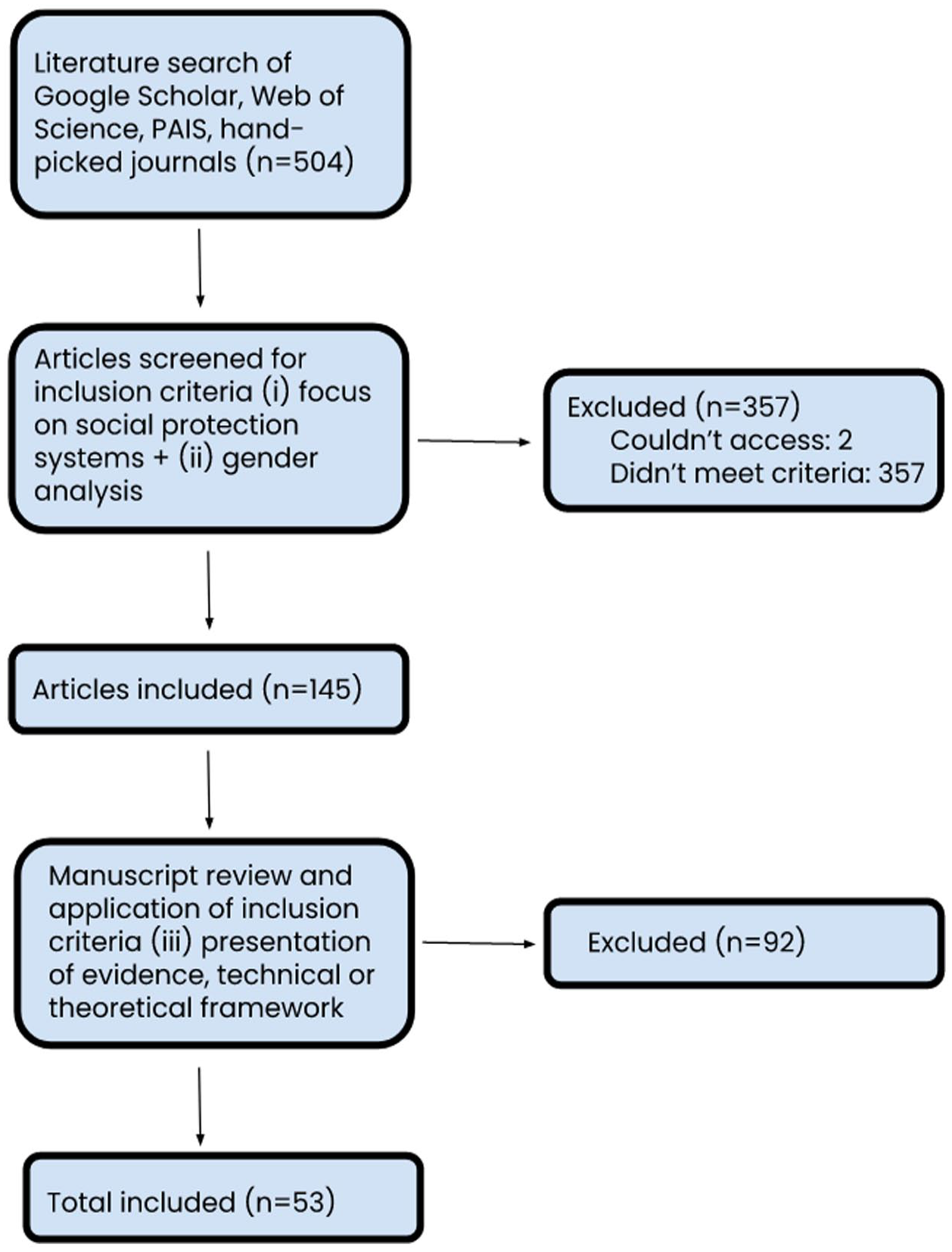
PRISMA flowchart illustrating the search process.
Upon completion of the search, we charted and analysed the data. The remaining articles were downloaded for full review. We charted these articles according to the key themes that we identified throughout, keeping with Levac et al.’s (2010) recommendation to chart iteratively by continuously updating the categories on our spreadsheet to reflect the emerging findings. See Annex 1 for details on our search methodology.
Results
Our search overall yielded 504 articles (n = 504). The Google Scholar search yielded 400 results, of which 52 met the full inclusion criteria (n = 52). The electronic database (Web of Science, PAIS) searches yielded 21 results, of which one article met the inclusion criteria (n = 1). Hand-searching of key journals yielded 83 results, of which one met the full inclusion criteria (n = 1). In total, 53 publications were included.
Where does the evidence come from? Policy institutions at the forefront
The existing evidence base is largely generated by development and policy institutions. In all, 32 of the total 53 articles we captured were policy reports and evidence briefs, compared with 20 peer-reviewed academic publications. With regard to type of publication, our search yielded 29 empirical studies presenting primary or secondary data analysis, including document analysis of strategies, policies, laws and programmatic documents; quantitative analysis of census, labour and social security data; surveys; and qualitative interviews and focus groups. Of these 29 empirical studies, 15 were published as policy reports, working papers or policy briefs, and 14 were academic publications. Just over a third (9) of the publications were evidence reviews. Six of the included articles were technical grey literature, presenting recommendations or best practices for implementing gender-responsive social protection systems. Relatedly, we captured five conceptual frameworks to guide gender-responsive social protection programming from a systems perspective, all published by major development agencies. Finally, five academic articles engaged various streams of feminist theory to analyse gender and other inequalities in access to and delivery of social protection. While these did not typically offer concrete programming recommendations in the style of the conceptual frameworks published by the development agencies, they provided analytical frameworks for thinking about the problems that development and social policy agencies grapple with.
Most of the literature focused on low- and middle-income country contexts, with a few exceptions focused on Organization for Economic Co-operation and Development (OECD) countries, European countries, and one on Japan. Latin America and sub-Saharan Africa were the regions most commonly covered, followed by Europe and South Asia. The review did not capture any articles focused explicitly on countries in Southeast Asia, the Caribbean, the Middle East and North Africa, although they may have been included in publications with a broad or global focus.
What does the literature say about gender and social protection systems?
Our analysis of these articles revealed several thematic trends in the evidence base on gender and social protection systems, which we grouped in four conceptual categories: (1) perspective and conceptual framing (approach); (2) cross-cutting institutional features that enable system functioning; (3) benefits offered by the system; and (4) system-wide performance goals related to equity and inclusion (see Figure 2).
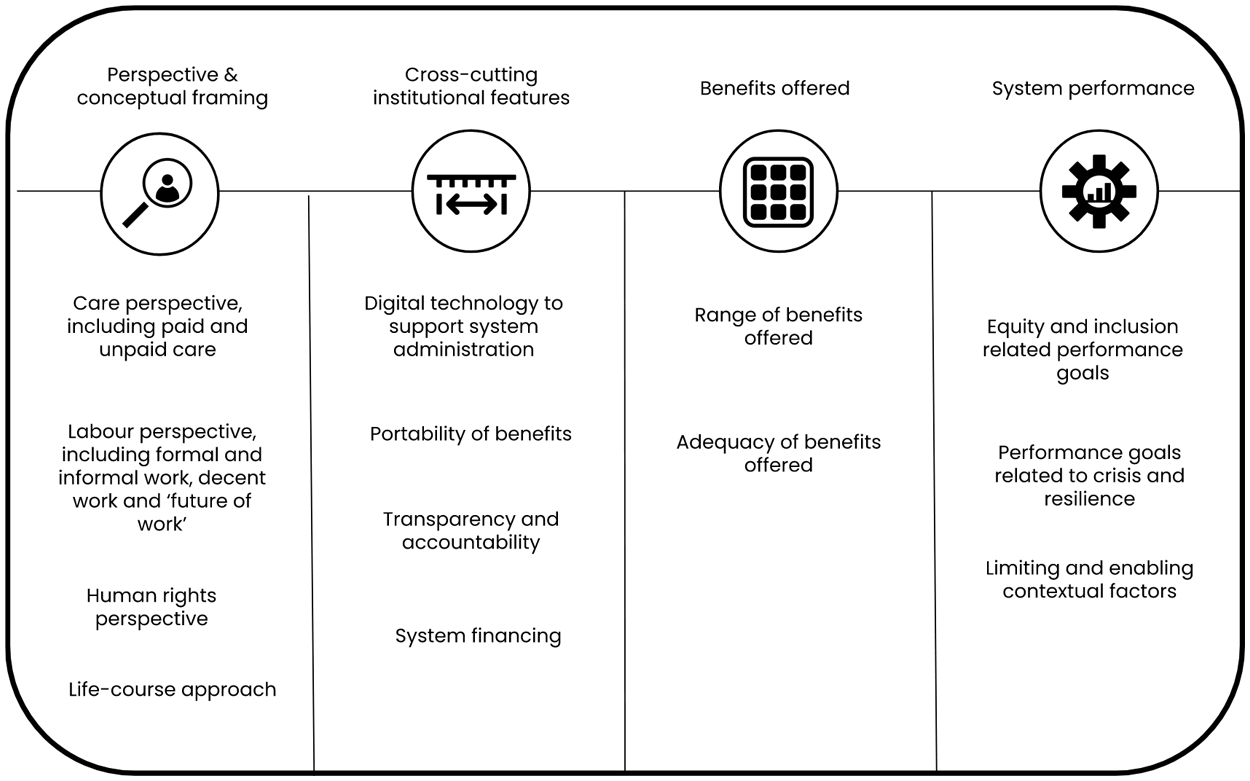
Thematic trends in gender and social protection systems research.
Perspective and conceptual framing
There exist many different ways to apply a gender perspective to social protection systems. The vast majority of publications that specified an approach referred to ‘gender-responsive’ or ‘gender-sensitive’ systems (and sometimes both, interchangeably). Only 4 of the 53 publications we reviewed used the term ‘gender-transformative’, and within these 4, it was used interchangeably with ‘gender-responsive’ in one publication, and with ‘gender-aware’ and ‘gender-responsive’ in another. A quantitative rendering of terminology use has some limitations. A fair summary of the existing social protection system literature would also acknowledge that (1) these gender-categorical terms are not always deployed coherently; (2) they are technical and seem to have greater purchase in policy publications over academic publications; and relatedly (3) some academic work may align with a particular (responsive, transformative, etc.) agenda but not use any of the categorical terms.
We also identified four significant perspectives or conceptual approaches in the literature for assessing and achieving social protection systems through a gender lens: care, labour, human rights, and life-course. These perspectives are suggestive of how social protection systems are envisioned to address gender inequalities by those that study and build them – in other words, what contributes to defining them as gender-responsive or gender-transformative.
One salient perspective, as indicated by the largest set of policy and scholarly literature we reviewed, deploys a care lens to attend to gender and social protection systems. A salient critique in this literature is that social protection systems rely on women’s willingness and ability to provide unpaid care within households, a dynamic that disadvantages women and begets a reorientation of social protection systems to support care (Bastagli and Hunt, 2020; Darooka, 2016; OECD, 2019; Tarabulsi and Abou Habib, 2020). A smaller share of articles addressed care through a focus on paid care workers’ access to social protection systems, given factors such as labour informality and migration (Bastagli and Hunt, 2020; ILO, 2018; Wibowo, 2017). The deployment of a ‘right to care’ approach is one such way to reorient social protection systems using the legal system – this approach is gaining traction in Latin America (Abramo and Robles, 2021; Esquivel, 2017).
The second most common approach centres the relationship between social protection systems and female labour force participation. In the context of demographic transition in Brazil, Paraguay, Uruguay, South Africa, the Philippines and Vietnam, one study found that sharp fertility declines do not automatically translate into higher female labour force participation, suggesting an important role for social protection systems in easing women’s transition into formal employment (Gammage et al., 2020). Another comparative study explored gendered labour market outcomes of three different social protection system models following the 2008 financial crisis, finding that both Nordic and Liberal models had the best employment outcomes for women, but with key distinctions between them: Nordic countries had a mix of strong social protection policies and social norm-driven emphasis on gender parity, while the Liberal systems relied more strongly on labour flexibility, which may have put women under pressure to return to work (Kushi and McManus, 2018).
While the relationship between women’s unpaid care work and female labour force participation is implicit in much of the above cited literature, the perspective that a social protection system oriented towards gender equality must account for both of these is sometimes more explicit. In Ecuador, the ‘women-as-carers’ model underpinning social assistance provision in the country may undercut women’s access to the labour market and more robust social security benefits associated with formal employment (Palacio Ludeño, 2019). Meanwhile, Rubery (2015) suggests that not enough has been done to connect the demand for social protection system reform from a gender perspective to an actual policy plan. In response, Rubery proposes a ‘multi-dimensional assessment framework’ to assess social protection and employment system reform by dually accounting for unpaid care and reproductive work and waged work, both of which she argues are ‘central to a gender equality agenda’ (Rubery, 2015: 520), lest employers be entirely relieved of the responsibility to account for reproduction.
Within the perspective that approaches gender and social protection systems through a labour lens, there is also a focus on the gendered dynamics of informality, decent work, and the ‘future of work’. One study that we reviewed examines the role of labour unions in mobilizing around women domestic workers’ access to decent work in Bangladesh, including full access to the national social protection system, inclusive of contributory social security (Ghosh, 2021). The study found that the unions’ focus on national legislation and policy bore some fruit by enabling domestic workers to form collectives, and guaranteeing maternity leave for domestic workers, although implementation of these rights still lags. Others consider rising automation and gig work, finding that while many of the gendered challenges facing social protection systems aren’t novel or unique to ‘future of work’ trends, there is a real risk that these trends exacerbate pre-existing gender inequalities, and as such, policymakers would do well to adapt social protection system design to reflect these (Bastagli and Hunt, 2020).
The third main approach we identified suggests that social protection systems should align with human rights principles. Sepúlveda Carmona (2017) argues that the principles of equality and non-discrimination can be better utilized to overcome wide and persistent coverage gaps for women, including through application to various system components and mechanisms such as personal identification systems and targeting mechanisms. In South Africa, Matthews (2020) applies a human rights perspective to the conceptualization and implementation of the national social protection system as it interacts with labour policy. Focusing in particular on the concept of non-discrimination, the article finds that gendered and racial discrimination in the labour market perpetuates the exclusion of Black South African women from accessing social protection.
Finally, a ‘life-course’ perspective adopted in the policy research we reviewed, suggests that social protection systems need to account for gender inequality from birth to death. The ILO’s (2017) flagship research report uses sex-disaggregated social security and survey data from around the world to show that women and men have unequal access to social protection throughout their lives. In-depth gender analyses of specific national social protection systems from a life-course perspective were fewer. An evaluation of Georgia’s system found that while women had greater access to social protection than men in childhood and old age, their access during working age was more limited (ILO, 2020). The report authors called for further research investigating the drivers of such gaps. An analysis of national social protection strategies across sub-Saharan Africa finds that while most of these planning documents say that they deploy a life-course approach, fewer actually address gendered life-course risks through the proposal of specific policies and programmes addressing for example adolescent pregnancy, maternity, and widowhood (Cookson et al., 2021), mirroring results from a similar global study (Camilletti et al., 2021).
A notable gap was a gender-based violence (GBV) perspective, particularly given the growing interest in using cash transfers to address the relationship between economic vulnerability and GBV (e.g. Baranov et al., 2021; Blofield et al., 2022; Buller et al., 2018). More comprehensive empirical studies bringing theories of GBV prevention and response to bear on social protection systems would contribute to an area of policy research with significant practical purchase.
Institutional features
Aspects of system governance such as administration, accountability, financing and coordination were addressed in the research we reviewed. We refer to this research as focusing on the ‘institutional features’ of social protection systems.
The administration features of national social protection systems can shape the extent to which a system’s benefits are equitably enjoyed, through, for example, targeting, eligibility and enrolment requirements and processes, as well as information mechanisms to ensure awareness about entitlements. One study we captured found promise in a digital portable benefits app enabling clients of US-based domestic workers to contribute to a fund through which domestic workers can purchase social protection benefits that would otherwise be available exclusively to workers in formal jobs (Bastagli and Hunt, 2020). Yet not all uses of technology in social protection systems have straightforwardly positive benefits. In South Africa, Matthews (2020) found that the adoption of a digital identification system during the COVID-19 pandemic exposed Black South African women to predatory creditors. Challenges also exist in ensuring equitable access when benefits are dispersed through digital means, for example with cash transfers delivered via mobile phones in contexts where women’s technology ownership is low, or with fingerprint technologies that for example do not pick up prints on hands that are worn through age or manual labour (Sepúlveda Carmona, 2017). Barca et al. (2021) suggest that while digital information systems can be leveraged to decrease the risk of gender- and disability-related exclusion throughout the social protection delivery chain, the technology on its own will not generate inclusion–it needs to be designed in service of inclusive goals.
Our review captured only a few studies that examined system-wide benefit portability from a gender perspective. One of these analysed bilateral and multilateral agreements between 120 countries, finding that only 30% of these include social protection-related provisions (World Health Organization (WHO), 2017). The study, which focuses on women migrant workers whose labour drives health and care systems around the world, finds that those same women are largely excluded from the systems they support. The authors call for further evidence around gaps and barriers, as well as increased participation of migrant women in policy processes, and coordination of transnational social protection policies on the basis that care is a public good. More studies on portability in national social protection systems were called for to identify evidence-based pathways to address coverage gaps, including for the ‘sending’ and ‘receiving’ countries of global care chains (e.g. Wibowo, 2017), as well as in cases of forced displacement (Sabates-Wheeler, 2019).
Accountability is another governance-related theme captured in our review. In Uganda, Muhanguzi et al. (2016) found that while non-state actors (NSAs) play a significant role in social protection provision, few had adequate transparency protocols in place to share information about entitlements and procedures for access and redress. Furthermore, only in cases where a specific gender equality mandate was present were NSAs accountable to progress on gender-related goals and the needs of women specifically. Another study reviewing the gender-responsiveness of 55 different national social protection strategies identified significant scope for greater accountability: around half mentioned some form of participatory monitoring and evaluation system, only a quarter mentioned grievance and redress systems that would allow beneficiaries to file a complaint, and less than a quarter involved the participation of national women’s organizations in the formulation of the strategy (Cookson et al., 2019).
A paramount but under-studied institutional issue is the financing of social protection systems from a gender perspective. In a reflection on lessons learned in the Caribbean, Iyahen (2017) notes that economic stagnation and high debt burdens undercut opportunities for much-needed investments in gender-responsive social protection systems, and that under such constraints, knowledge sharing spaces that bring together gender equality advocates with high-level policy decision-makers are critical. Another study looking at 28 OECD countries found that women did not benefit at the same rate as men from stimulus packages following the 2008–2009 financial crisis due to sectoral segregation; moreover, cuts to social protection deepened women’s unpaid care burden, making them less able to take advantage of employment opportunities where these existed (Kushi and McManus, 2019). A call was issued for studies exploring how to finance gender-responsive social protection systems in the context of increasing labour informality, tax avoidance and capital flight (Bastagli and Hunt, 2020).
Few studies explicitly addressed the issue of coordination of national social protection systems with other policy areas. One of these was the Rubery (2015) article on social protection and labour policy discussed above. Another identified a need for coordination between social protection systems and infrastructure – principally access to water – in order to address the gendered impacts of climate change (Mushunje and Sewpaul, 2018). Women interviewed reported that as men migrated out of rural communities, women were faced with managing crops; while they had diversified their income streams where possible, they identified a need for social assistance and consistent irrigation to prevent food insecurity during periods of drought.
Benefits offered
The existing evidence base on gender and social protection systems also addresses the range and adequacy of the total benefit package on offer – that is, not a singular programme, but rather the set of instruments in a given system – finding these often fall short of what is needed. Two studies examined the range of benefits proposed in national social protection strategies in global and sub-Saharan Africa–specific samples, finding that strategies often fell short of addressing the very gendered risks and vulnerabilities they acknowledged (Cookson et al., 2019, 2021). Few articles discuss the adequacy of benefits offered. Matthews (2020) found that lack of adequate adjustments for inflation contribute to the exclusion of Black South African women by eroding the adequacy of the largely social assistance benefits to which they have access. An OECD report (2019) finds that the range and adequacy of benefits provided to unpaid carers in low- and middle-income countries are often inadequate to meet their needs, and points to the promise of integrating care credits, maternity leave and public healthcare into national social protection systems.
In the context of automation and ‘gig work’, Bastagli and Hunt (2020) advocate for reforms to standard benefit mixes to ensure that gendered protection gaps do not increase; this includes expanding the range and size of social assistance mechanisms such as family cash transfers, old age pensions, employment guarantee programmes and universal basic income. In a review of various approaches to extending coverage to gig workers and others in non-standard employment, with women especially prone to lacking protection, Behrendt et al., 2019 find that there is no singular policy solution. They argue against universal basic income as a ‘fix all’ solution, suggesting that a mix of contributory and non-contributory schemes is needed to provide gig workers with a comprehensive range of benefits, as well as ensure the financial sustainability of the social protection system.
Performance goals
Finally, the existing evidence base on gender and social protection systems addresses system-wide performance goals related to equity, inclusion and resilience.
A handful of these examined system performance from the perspective of specific groups. An analysis of the Dutch national social protection system from the perspective of lesbian, gay, bisexual, and transgender (LGBT) elder persons found that while its universal orientation laid the groundwork for inclusive coverage, an additional intersectional lens sensitive to sexual orientation and other identities could help ensure universal coverage in practice (Ye, 2018). In a grounded case study of social protection systems in three countries in the Pacific region, Jolly et al. (2015) explore the effectiveness of national social protection systems for Indigenous women, who will continue to ‘fall through the net’ unless system design takes into consideration traditional ways of relating as well as gender norms.
The performance of social protection systems in terms of resiliency and coverage of women during the recent COVID-19 crisis was another major theme (Alam, 2020; Beazley et al., 2021; Holmes and Hunt, 2021; ILO, 2020; McCrum, 2021; Rubery and Tavora, 2021; Tirivayi et al., 2020; UN Women, 2020). Attention to other crises was less common. The few studies addressing financial crises found that austerity exacerbated gendered inequality, during and in the aftermath of crisis, and called for social spending and public sector investment to mitigate the gendered impacts (Ibáñez et al., 2021; Kushi and McManus, 2018, 2019); The two papers in our database considering climate and environmental crises called for the conceptualization of social protection systems as proactive tools to strengthen women’s resilience (Anderson 2021; Mushunje and Sewpaul, 2018). Only one paper discussed the gendered impacts of humanitarian crisis on social protection systems, detailing specific legal provisions and system mechanisms to address the vulnerabilities of displaced persons (Sabates-Wheeler, 2019). Across all of these studies, the lens of crisis emerges as useful for testing the limits of social protection systems and addressing a recurring theme in the crisis literature: that all too often, women bear the brunt of crises, whether economic, political, health or environmental in nature.
The limiting or enabling effects of political context on system performance was less often explored. A notable exception is Staab’s (2016) process-analysis of the adoption of centre–left agendas around social protection and care services in Chile. Through a focus on the processes and actors involved in reform efforts, Staab shows how policy legacies, political institutions and the ingrained beliefs of those promoting reform can constrain the adoption and implementation of gender-responsive social programming, despite a ‘women-friendly’ regime.
Discussion
In the aftermath of the 2008–2009 financial crisis, Rubery (2015) contended that ‘the time [was] right to develop a feminist agenda for building a new social and employment order’ (p. 514). Following Nancy Fraser, however, she cautioned that ‘without control over how policymakers would use this agenda, and without a fully developed plan for a more socially just and gender inclusive system’, feminists were at risk of leaving a vacuum to be filled with un-feminist policy – at worst, furthering a neoliberal order (Rubery, 2015). Today, reeling from a different crisis, and amid mounting advocacy for social protection systems that address gender inequalities, we suggest that her warning still stands: ‘We cannot expect to arrive at a gender equal world without either knowing what that world might look like or identifying policy agendas for welfare and employment reform that might move us in that direction’ (Rubery, 2015: 535). As we suggested earlier, resolving the question of what is a ‘gender-responsive social protection system’ – or for that matter, a ‘gender-transformative’ one – is both an issue of evidence and a political dilemma.
Our scoping review confirms that while advocacy for such systems is growing, relevant evidence to guide their design and implementation is still nascent. Our initial search revealed 504 papers that used the terms ‘social protection system’ and ‘gender’. Yet the vast majority (451) made only passing references to gender or erroneously used ‘system’ as a synonym for ‘programme’ – often a cash transfer. Systems thinking requires consideration of gender in much more than the design and implementation of one or two programmes targeting women or girls. The existing literature shows that at a minimum, gender should be considered comprehensively and throughout a social protection system’s many components, from administration and coordination mechanisms, to monitoring and evaluation and system financing, as well as the total benefit offering from birth to old age.
To date, research focusing on total benefit offering is more common than studies addressing other institutional features. Country-level case studies such as the one in Georgia that dive deeply into the full range of benefits and services available through a specific system and within the national demographic context and political economy can be deeply useful to advocates pushing for system-wide gender mainstreaming. This type of research is accessible for national governments and development agencies because it can be conducted largely via low-cost desk research on a relatively tight timeline. Opportunities exist for comparative research in this regard; researchers might look to the more developed literature on gender and welfare states for inspiration (e.g. Franzoni, 2008; Orloff, 1996). There is a need for more gender research addressing institutional features around administration and financing. Such studies can reveal unintended consequences, such as Matthew’s (2020) study finding predatory behaviour on the part of financial institutions after the digitization of benefits, or opportunities to improve system efficacy, like Mushunje and Sewpaul’s (2018) call for coordination with infrastructure actors in light of climate change. Studies that cost-out policy alternatives and plan for the financial viability of gender-responsive social protection systems are also needed (e.g. Bierbaum and Cichon, 2019; Remme et al., 2017), especially in contexts where advocates contend with the challenging politics of austerity and diminished trust in public institutions (Razavi et al., 2020).
If the empirical evidence is yet nascent on gender-responsive social protection systems (especially their institutional features), it is even more so with regard to what is practically required for gender-transformative ones. If we accept that achieving gender equality requires ‘a fundamental transformation of economic and social institutions, including the beliefs, norms and attitudes that shape them, at every level of society, from households to labor markets and from communities to local, national and global governance institutions’ (UN Women, 2015: 13), then in practice, the work of building transformative social protection systems is no small task. Rather, it necessarily involves effort across multiple scales, in diverse policy arenas, with a wide range of actors, and of a technical and deeply political nature. The ambition and complexity of a transformative agenda poses practical challenges with regard to operationalization, not least because gender cannot be added as an after-thought, as it has been done in programmes and policies thus far. Take norms, for example: although the need to address social norms is widely recognized in gender and development practice more broadly, little consensus currently exists with regard to how, particularly given the short-term funding cycles and measurable outcomes favoured by development donors see (Wazir, 2022). Overall, the existing evidence base requires significant development if it is to inform an actionable feminist roadmap to gender-transformative social protection systems. Conceptual and empirical work in this direction includes Camiletti et al.’s (2022) conceptual framework for ‘gender-responsive social protection for gender-transformative change’; and Chopra and Krishnan’s (2022) ‘care-integral approach to ensure gender-transformative outcomes’ consisting of a 7–4–7 framework of principles, policy areas and implementation levers that includes social protection programmes.
Beyond merely a question of evidence and data gaps, defining what makes a social protection system gender-transformative is also a political dilemma that requires consideration of context, power and politics. These matter for policy change within social protection systems (e.g. adoption of gender-responsive programming) but also for tackling other policy areas such as taxation and budgeting (fiscal policy), labour and employment, infrastructure and care systems, all of which feminists have recognized as critical to achieving social protection systems that promote gender equality (UN Women, 2018). What is needed in one country context, moreover, will differ from another, both because of how that country is organized politically and economically and laid out geographically, as well as the ways in which gender relations are shaped by other dynamics that structure power relations such as class, location (rural/urban), ethnicity, caste, race, sexuality and religion.
Thus there is also a need for embedded ‘process research’ that asks ‘why’ and ‘how’ questions about the gendered construction and operation of systems – in other words, how policy is made in different contexts (Mosse, 2005). Staab’s (2016) analysis of systematic change in Chile shows how such research can produce critical insights into the way that politics enables and constrains gender equality agendas as these are rolled out. We thus re-emphasize prior calls for a political economy perspective that focuses on ‘institutional dynamics and competing interests or power relations between different economic, political and social actors’ (Holmes and Jones, 2013: 183; see also Peterman et al., 2020). While feminist political economy analyses of social protection programmes has grown significantly since this call a decade ago, attention to social protection systems as one such key institution is yet under-developed. Such situated and exploratory ‘slow research’ is often better suited to academic projects. Dorothy Smith’s (2005) Institutional Ethnography approach would be well suited to fill this gap because it seeks to generate knowledge of institutions that is useful to those inside them.
The political nature of defining gender-transformative (or even responsive) systems also has to do with who is at the table. The generous share of publications produced by large development institutions was notable. This suggests a set of problems and questions grounded in real-world development practice that have not yet been comprehensively tackled by academic researchers. It may also suggest a constrained range of ideological perspectives regarding what such systems entail. The mandates and ideologies that inform the work of development agencies will shape the way they define and operationalize the terms ‘gender-responsive’, ‘gender-transformative’ and even ‘social protection’. In line with the warnings of Rubery and Fraser, not all of these will be favourable to feminist agendas: there is no shortage of past examples demonstrating how gender equality goals embedded in social protection programmes can be watered down through contact with un-feminist development agencies (e.g. Nagels, 2021). Beyond differences in approach that might exist between say a development bank and a UN agency, or among UN agencies, research anchored in the everyday experiences of a given system’s social protection beneficiaries – or even generated by them – may reveal a different picture entirely.
Conclusion
As Smith (2022) recently noted, there is ‘unprecedented attention to the gendered effects of pandemics, in terms of not only health effects, but also the disproportionate social and economic impacts on women, yet little progress in rectifying these inequities’ (p. 202). Addressing this ‘gender paradox’ requires strategic manoeuvres on the part of feminist advocates, researchers, practitioners and policymakers (Smith, 2022). Advocacy for social protection that addresses gender inequality from a systems perspective is a welcomed advance, not least because it demonstrates a move beyond the erroneous assumption pervading development practice for over two decades – that cash (transfers) can solve all problems. Language can be performative (Ahmed, 2012), however, and simply calling a social protection system gender-responsive or gender-transformative does not make it so. Meanwhile, existing social protection systems may already have institutional features and benefit packages that advance gender equality, albeit implicitly. There is a need for action-oriented research that identifies what is already working in specific contexts and what might be adapted elsewhere, in addition to that which identifies gaps and problems. One of the high-level observations of this landscape analysis is the leadership of development institutions in the existing research. At the same time, we identified a need for studies driven by a qualitative interest in understanding process, politics and outcomes, particularly through the perspective of existing and potential social protection beneficiaries. Such research could go a long way towards creating feminist, nationally appropriate roadmaps for social protection systems.
Footnotes
Annex 1
Acknowledgements

Funding
The author(s) received no financial support for the research, authorship and/or publication of this article.