




Abstract
This article examines global social policy formation in the area of skilled migration, with a focus on the Gulf Arab region. Across the globe, migration governance presents challenges to multiple levels of authority; its complexity crosses many scales and involves a multitude of actors with diverse interests. Despite this jurisdictional complexity, migration remains one of the most staunchly defended realms of sovereign policy control. Building on global social policy literature, this article examines how ‘domestic’ labour migration policies reflect the entanglement of multiple states’ and agencies’ interests. Such entanglements result in what we characterize as a ‘multiplex system’, where skilled-migration policies are formed within, and shaped by, globalized policy spaces. To illustrate, we examine policies that shape the nursing labour market in Oman during a period when the state aims to transition from dependence on an expatriate to an increasingly nationalized labour force. Engaging a case-study methodology including a survey of migrant healthcare workers, semi-structured interviews and data analysis, we find that nursing labour markets in Oman represent an example of global policy formation due to the interaction of domestic and expatriate labour policies and provisioning systems. The transnational structuring of policy making that emerges reflects a contingent process marked by conflicting outcomes. We contend that Oman’s nursing labour market is an example of new spaces where global social policies emerge from the tension of competing national state and market interests.
Introduction
The globalized nursing labour market of Oman provides an example of the deterritorialization of national social policy while illuminating how global policies emerge in new, but fuzzy and contested, regulatory spaces. Global migration is one of the most prominent global social policy issues of the time, with over 250 million people living outside of their country of birth. Over 38% of this stock is characterized as south–south migrants, which now exceeds south–north migrant numbers (World Bank, 2016: 1). From South East Asia to Europe to the United States, migration governance presents challenges to multiple levels of authority. Its complexity crosses multiple scales and involves a multitude of actors with diverse and often conflicting interests and realms of authority. Migration has been a key feature of the global economy for centuries, yet international migration remains one of the most staunchly defended realms of sovereign policy control. We argue that in the area of skilled migration, we need to understand how globalization has informed global social policy with an eye to the heterogeneity of state and market entanglements and their outcomes in contexts marked by transnational engagements outside of core OECD (The Organisation for Economic Co-operation and Development) nations (Yeates, 2001).
The case of Oman demonstrates how skilled migrant labour market interactions are shaped by multilevel, interstate and regional state engagement processes, along with a multiplicity of nonstate stakeholders all simultaneously engaged in some aspect of labour policy while subject to differing levels of autonomy, regulation and control. In this article, we engage the word multiplex to denote the multiple agents (state and market based) that are variably interconnected, generating intense complexity in this policy space (cf. Wedel, 1998). The migration of nurses has previously been shown to be a realm of complex globalized multi-state and agency interactions (Kingma, 2006; Yeates, 2009). In the case of Oman, the main actors include the governments of Oman and migrant sending nations (the Philippines in the context of this article), their relevant government ministries and Embassies, employers (public, private and hybrids of these), intermediaries that facilitate migration, civil society and the expatriate and Omani workers themselves.
Global social policy formation in the transnational political economy of care
Policies that frame how international migrants are incorporated into overseas labour markets illustrate the ‘three R’s of global social policy, redistribution, regulation, and rights’ (Deacon and Stubbs, 2013: 6). In cases of feminized migration, such as nursing, we also enter debates over the political economy of global care services (Yeates, 2009), which includes the dynamic movement of care labour, the nature of care commitments, the movement of care capital, the type of care discourses that frame policies and how non-governmental organizations (NGO) and social movements are influential in related social policy discussions taking place at different scales (Williams, 2011: 25). Our argument supports the idea that public policies are formed within – and their outcomes shaped by – globalized policy processes, ‘complex multilateralism’ and transnational networks that represent a ‘mechanism of global public policy’ (Stone, 2008: 34, 35). This argument also emerges in global social policy approaches that explore ‘the complexities of the actions of transnational, international and global actors within national and regional spaces’ (Deacon and Stubbs, 2013:11). Our article adds context and empirical flesh to this conceptual framework.
Specifically, we examine how nursing labour markets in the Sultanate of Oman represent an example of global social policy formation due to the interaction of domestic and expatriate labour provisioning systems, resulting in the transnational integration of multiple national policy processes. We contend that Oman’s nursing labour market provides an example of ‘new public spaces where global policies occur’ (Stone, 2008: 19) and how ‘key policy players are transcending “levels” at any one moment’ (Deacon and Stubbs, 2013: 10). Furthermore, our article illustrates Yeates’ (2002) claim that a ‘multiplicity of actors – economic agents such as transnational corporations (TNCs), national states and various national and local interests – interact in various ways, at various levels, and with various outcomes, none of which are predetermined’ (p. 87).
A multitude of policies frame nursing labour market formation globally (Kingma, 2006), but in Oman a gendered political economy structures nursing markets in interesting ways. Similar to its Gulf neighbours, Oman’s economy has been heavily reliant on hydrocarbons and foreign labour, but as demographic and economic conditions change, Oman faces the need to transition from a rentier state serviced by expatriate workers, to a country engaged in educating and promoting the employment of its population (Zerovec and Bontenbal, 2011). During this transition, the ‘Gulf paradox’ has emerged of labour markets with increasing numbers of non-nationals, while nationals (particularly young people and women) experience increasing rates of unemployment. In Oman’s nursing sector, this labour market complexity includes the interaction of nationalization and skilled-migration labour policies. We examine this complexity in the following three sections. First, we provide an overview of our methodological approach and research methods. Second, we make the case for Oman’s nursing labour market as a space for global social policy formation, and we organize this in four subsections. The first subsection examines health care and health labour governance in Oman. The second highlights labour recruitment and workplace processes arranged between Oman and the Philippines – a key supplier of nursing labour to Oman – while paying attention to some of the key players and the means by which they engage. The third provides more detail of the multiplex nature of the nursing labour market by examining its gendered political economy. The fourth examines the actors involved in policy interaction in Oman and how this contributes to the generation of global social policy. In the final section, we review how understanding the multiplex space of Oman’s nursing labour market, with the contingent and contested interactions involved, illustrates a mode of global social policy formation.
Research methods
We employ a methodological transnationalism approach by foregrounding the nature of cross border links, structure and agency in order to overcome territoriality and the conflation of state, society and territory (Amelina et al., 2014: 11). Transnational analysis reveals how care migration policies are co-determined by actors operating beyond or across their national borders, thereby illustrating the value of methodological transnationalism during a period of increased global care migration (Yeates, 2014b). Methodological transnationalism thus escapes the tendency of analysis to begin and end with the nation, thereby revealing how global social policy is increasingly being formed at scales beyond the nation, for example, through regional collaborations such as ASEAN (Yeates, 2014a). Thus, we engage a methodological transnational approach to reveal overlapping nascent informal inter-regional networks that shape and inform migration and labour market regulation in Oman.
To address the complexity evident in Oman’s nursing labour market, and to develop our interpretation of its construction as evidence of a form of global social policy, we utilized a range of research methods and forms of data collection. Using an online survey developed in consultation with colleagues at the Centre for Development Studies in India, we gathered data from expatriate nurses in Oman. The survey results demonstrate the interaction of labour and migration policy through the lived experience of healthcare workers in Oman. The research also entailed three field visits to Oman by Ennis in 2014 and 2015. Eventually, after promoting the online survey though our connections with networks in Oman, we gathered 25 responses from nurses working in Oman, 23 from the Philippines and 2 from India. For the purposes of this article, we consider only the Philippine respondents. We also conducted seven key informant interviews in Oman, including subsequent telephone calls and multiple informal (off-the-record) meetings with government officials from both Oman and the Philippines and with Omani nurses. The analysis was further supplemented with secondary data evaluation and review.
Oman’s nursing labour market as a space for global social policy formation
Situated on the Arabian Peninsula and bordering the Arabian Sea and Indian Ocean, Oman’s embeddedness within migration flows in the region has deep historical roots. It has been integrated into the Indian Ocean economy for generations (Chaudhuri, 1985). In the current period, there are multiple layers and sites of authority which intersect in complicated ways to govern the flow of migrants into the nursing labour market and their labour within it.
The contemporary governance of migration in Oman, like other parts of the Arab Gulf, is connected to the neoliberalizing tendencies of global capital, with labour flows serving the demands of global capitalism and global production networks. Long-standing labour demand patterns in hydrocarbon-dependent Gulf economies have produced a strong dependence on foreign labour. Demand for service labour is a regular feature of rentier economies where the growing consumption needs of the national middle class manifests itself in highly segmented labour markets that selectively draw from international supplies of low-, semi- and high-skilled labour.
Over 60% of Oman’s workforce is non-national whose residence in the country is tied to their work contract (Census, 2010). Globalized migration in Oman is distinguished by a lack of integration and citizenship and is structured by the kafala (sponsorship) system which binds the migrant to their employer (Sater, 2014). Irrespective of skill level, economic migrants in Oman remain legally temporary despite their frequent longevity or even generational presence in the country. The temporariness of the expatriate experience, even when a lifetime of work is conducted in the country, impacts the relationship of the individual with their host country, their home country and their work more broadly. This tension is exacerbated in lived experiences of long term, yet temporary migrants even when those migrants are highly skilled. A sense of impermanence and limit to rights on belonging contribute to the circular production of insecurity, which in turn influences how sending countries manage outward migration and their diplomatic relations with Oman.
One of the key policies aimed at trying to reduce Oman’s dependence on foreign workers is Omanization, a labour localization programme aimed at promoting the employment of citizens through quota systems, training initiatives and other incentive schemes (Ennis and Al-Jamali, 2014: 6). It is an economy-wide policy which was born of necessity, geared towards employment burden sharing when oil revenues were low, but meeting limited success in the private sector. Despite government plans since the late 1980s to reduce the number of foreigners in the workforce, expatriate numbers have increased and even surged in the last decade (National Centre for Statistics and Information [NCSI], 2010–2013). Only the recent oil price crash seems to be dampening this trend. Although the Omani government has been successful in its efforts to reduce the reliance on expatriates in the government, public education and the banking sectors, most others, especially in the private sector, remain dominated by expatriates.
Since Omanization is a state-led initiative, it is not surprising that the public sector has led the way in increasing the share of Omani employees. The private sector, on the contrary, has proven more resistant to Omanization. Business actors maintain a preference for less expensive, more flexible workers in the low-skilled sector and in high-skilled foreign labour. Data from 2015 show that 81% of expatriates working in the Sultanate work in the private sector, whereas only 4% work in the public sector and 15% are located in the household sector (NCSI, 2015: 18). The same data show that 88.4% of the private sector is non-national, which is up from 81.7 in 2006 (NCSI, 2015: 20). This trend continues despite policy efforts to encourage a stronger national presence in the private sector workforce. Policy levers competing for government attention include the pressures of global competitiveness, on one hand, and the need to protect the domestic workforce, on the other. Gulf States have therefore been caught between ‘the aspirations of the modernist welfare state and the goals of capital accumulation’ (Al-Shehabi, 2015: 25). The desire for a modernist welfare state is well illustrated by Oman’s efforts to provide improved health care.
Health care and health labour governance in Oman
There have been drastic improvements in health care across the Sultanate since the 1970s. A change in head of state in 1970 coincided with a sudden influx of export earnings following the 1973 oil embargo. These incidents marked the beginning of a new impetus for improving development indicators across the country, including those in health, and meeting the aspirations of capital accumulation alongside enhanced welfare provision. In 1975, the total number of nurses across Oman was 450. This increased to 4147 by 1990, 7829 by 2000 and 15,627 by 2012 (Ministry of Health [MOH], 2014: 123). Alongside this, investment in education became a major component of improving healthcare provision nation-wide. Medical education only began in Oman in 1986 when the College of Medicine and Health Sciences was established at Sultan Qaboos University (MOH, 2014: 127–128). Before this, Omani students had to travel abroad to receive medical training. As in other sectors, the rapid demand for healthcare provision meant healthcare workers had to be hired from abroad while simultaneously increasing the number of locals educated in the health field.
A similar pattern transpired in many sectors of the economy, where labour was imported to fill a numerical and skill shortage. As the population grew and income levels rose, demand for labour also increased, especially in services. During the oil price decline and economic stagnation of the late 1980s and 1990s, it became clear to policy makers that mechanisms were required to encourage Omani citizens to work in a wider array of fields and especially in the private sector, thereby reducing the reliance on expatriates.
Since the 1990s, concerted efforts by the government to educate and train Omanis in health care have resulted in significant changes. When the term Omanization came into common use in the early 1990s, Omanis were not well represented in the healthcare sector. Despite significant improvements, the ambitious Omanization goals laid out in 1995 in the long-term development strategy Oman Vision 2020, and in subsequent 5-year development plans, have not been reached. According to the Omanization of Health Manpower Plan 2006, the MOH expected the nursing category to be 100% Omanized by 2015. MOH suggested this could happen if the Ministry had the ability to distribute nursing graduates across various governorates according to need.
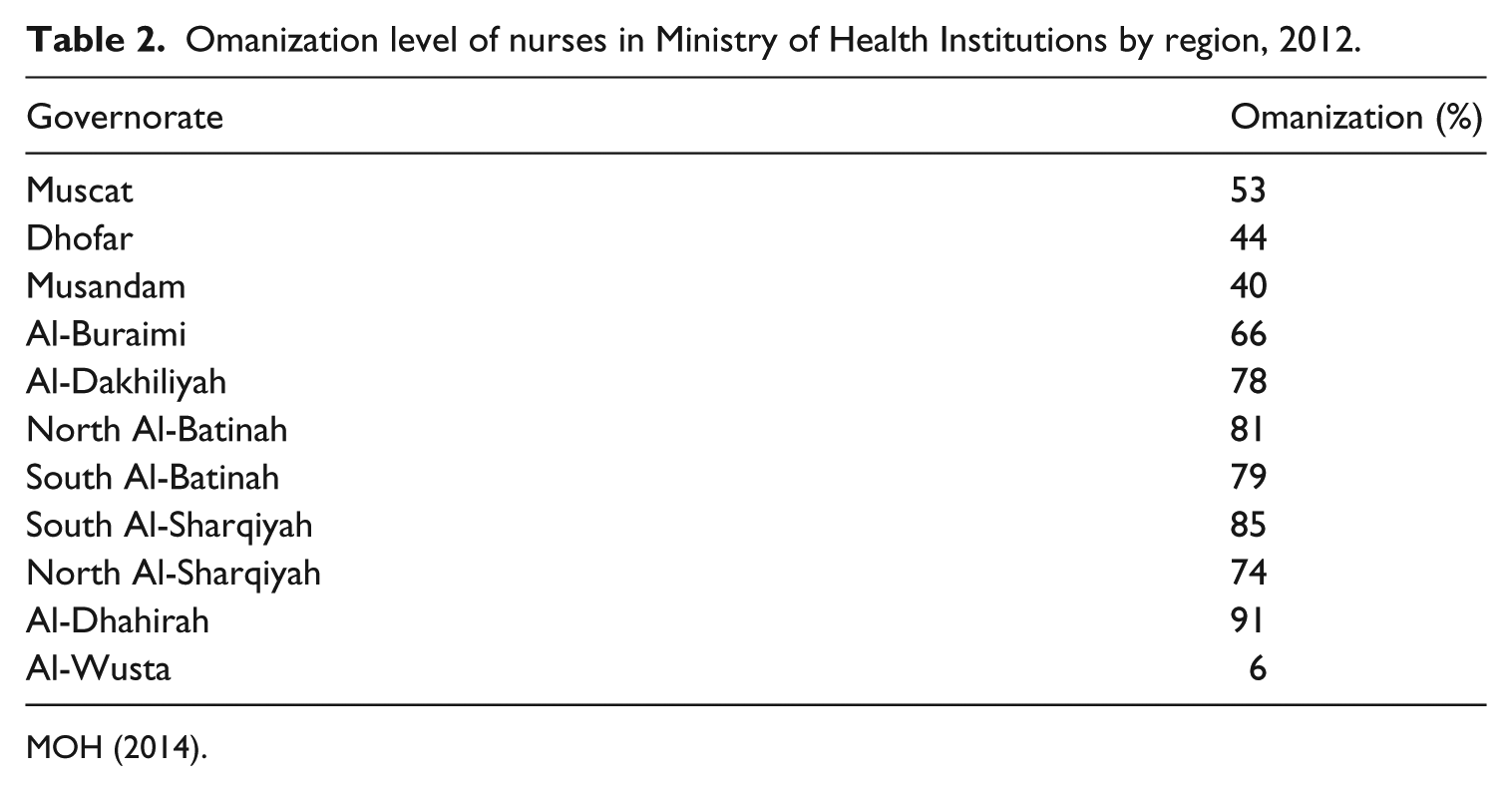
Although institutions managed by the MOH have had the most success in localizing the nursing workforce (see Tables 1 and 2), none of the governorates have reached 100% Omani employment. Such policy goals were too ambitious from the outset, given population numbers and distribution across the regions, as well as local social norms associated with female employment. As in other areas of the economy, public sector health institutions have been more successful than private sector ones, which are largely foreign-managed. In fact, Omanis only comprise 5% of the nursing staff in private healthcare facilities. In contrast, Omani employees comprise 66% of all MOH institutions, ranging from 6% in the remote region of Al-Wusta to 91% in Al-Dhahirah. Outside of the capital area, the higher number of Omani nurses appears to reflect the presence of regional nursing educational institutes, with Al-Sharqiyah, Al-Batinah and Al-Dhahirah home to several nursing institutes (MOH, 2013).
Omanization level of nurses across type of healthcare facility, 2003 and 2012.
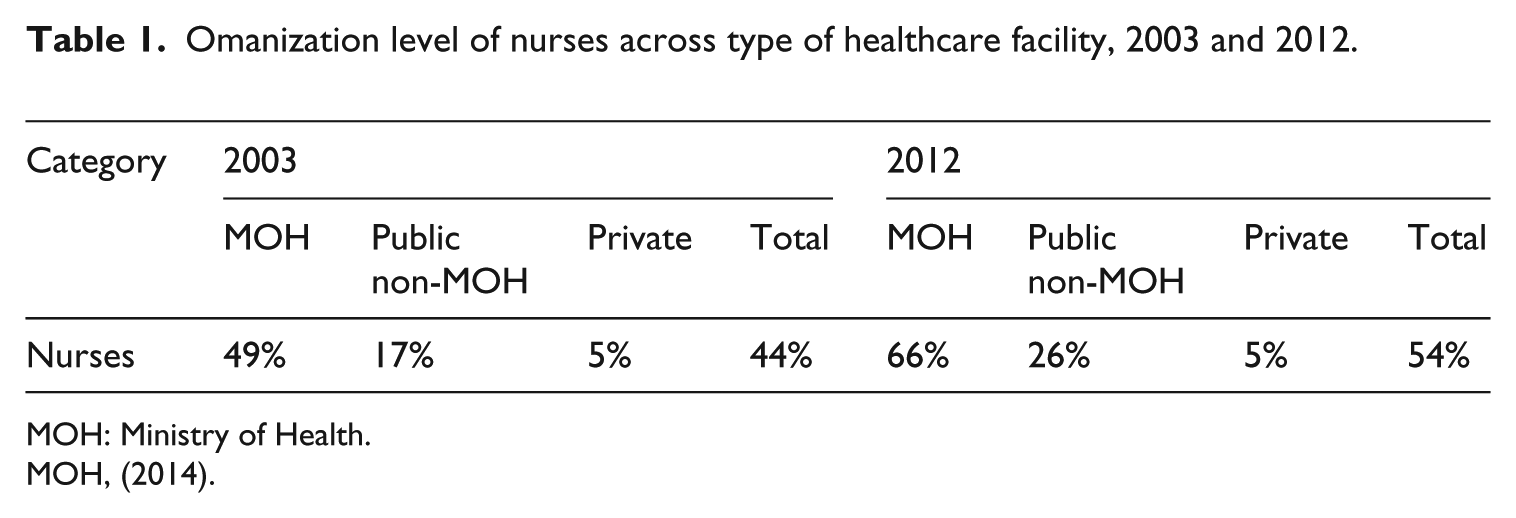
MOH: Ministry of Health.
MOH, (2014).
Omanization level of nurses in Ministry of Health Institutions by region, 2012.
To compensate for the lack of local nursing graduates, Oman’s expansion of health services depended upon the use of expatriate nurses, the majority coming from India and the Philippines. Between 2007 and 2011, the number of new Filipino hires deployed to Oman doubled, and by 2015, Oman was among the top 10 destinations for Philippine overseas workers (POEA, 2011, 2015). Notwithstanding these increases, the ambitiousness of Omanization plans in the healthcare sector alarms some foreign nurses in the country and adds to their sense of precarity and worry. The policy of Omanization effectively intensifies the vulnerability embedded in Oman’s migration labour policy, since it enhances migrant insecurity even while migrant workers are still needed in the sector. Survey results indicate that 60% of respondents were worried about Omanization forcing them out of their job:
Yes, especially when you are already over age to transfer to other counties for work (Survey response 2014). Even if you have specialized here with so many years of experience, they can easily take you out even with exemplary work performance. Then you will be left unemployed (Survey response 2014).
Our respondents assess their vulnerability within a transnational field of options, because they understand losing a job in Oman means they would have to find employment in another country, as opposed to merely returning home:
Because if Omanization will push through, I have to look for another country that will offer me a job (Survey response 2014).
The failure of the Philippines to offer some kind of return options to nurses interacts with the Omanization policy to enhance the sense of precarity. Even if migrants are allowed to continue to work in Oman, the Omanization processes were interpreted through concerns over possible changes in workplace controls and hierarchy:
They [Omanis] will be the head of every group. And it will depend on the attitude of that Omani if he or she will not discriminate his or her colleagues, especially expatriates (Survey response 2014).
Notwithstanding these concerns, 40% of survey respondents were not overly worried about Omanization. Some seemed confident that their work ethic and willingness to work longer hours than Omani nursing staff would help secure their employment:
Some work schedules cannot be catered by Omanis, so they need expatriates to do the work (Survey response 2014).
These comments suggest that Omanization can work as a social policy of control over labour even when it has effectively ‘failed’ to fully nationalize the labour force in question. The reality of this failure was evident in the responses of several participants, who reported a visible increase in the number of foreign healthcare professionals in Oman since 2011. This corresponds with the recorded annual increases in the number of non-nationals added to the labour market and general decline in the level of Omanization (NCSI, 2010–2013). In one interview with a Philippine nurse who had been in Oman for nearly a decade, he claimed,
It used to be about 50/50 expats/locals in the hospitals. The government is doing a good job investing in local people to work in this field. Sure, there are some work or quality issues, but it is developing. We used to be worried about Omanization taking over, but not now. A strange thing happened in the last three years. In all the hospitals, the number of expatriates shot up. Recruitment has been very high, and now we are more than the locals. (19 June 2014)
Philippine Embassy staff noted a similar perception, expecting numbers of Philippine nurses to continue increasing. MOH (2015: 12) data confirm a decline in Omanization levels from 2010 to 2015. Embassy staff seemed to believe that there was an increasing demand for Filipinos in Oman because they were deemed more qualified and better trained. As much as Oman may want to nationalize the labour force in health care, these trends suggest there remains a need for well-trained expatriate labour within the Omani healthcare sector. This intersection of healthcare service demands, training and staffing need, and the effectiveness of regional migrant labour provisioning systems suggests labour nationalization policies will not be fully achieved for some time. Despite this, the mere presence of an Omanization policy can be considered to do the work of regulating migrant labour by maintaining a sense of insecurity even as the number of expatriates recruited increases.
Gendered political economy of the nursing labour market in Oman
In the case of Oman, as with many Gulf Cooperation Council (GCC) members, the issue of gender norms and patriarchal governance is profoundly relevant to the operation of the labour market and how social policy is imagined and achieved in practice. Contrary to stereotypes, women in the Gulf graduate from universities and other higher educational institutes at higher rates than men (Al-Nasr, 2011: 43, 46). However, high youth unemployment rates characteristic of the region disproportionately impact women (OECD 2014: 43–44). Despite significant investment in education and health, and despite development indicators (such as female education, fertility and life expectancy) that favourably compare to other regions, women’s labour force participation remains low. This is what the World Bank (2004) has labelled the ‘gender paradox’ in the Middle East. Notwithstanding this so-called paradox, societal norms in the Gulf states around women’s role in society ‘drastically transformed’ over the last generation (Al-Nasr, 2011: 44). Female participation in the Omani labour force has expanded significantly in the past three decades; increasing from 7.6% in 1980 to 29% in 2013 (see Table 3).
Female labour force participation (percentage of female population aged 15+ years).
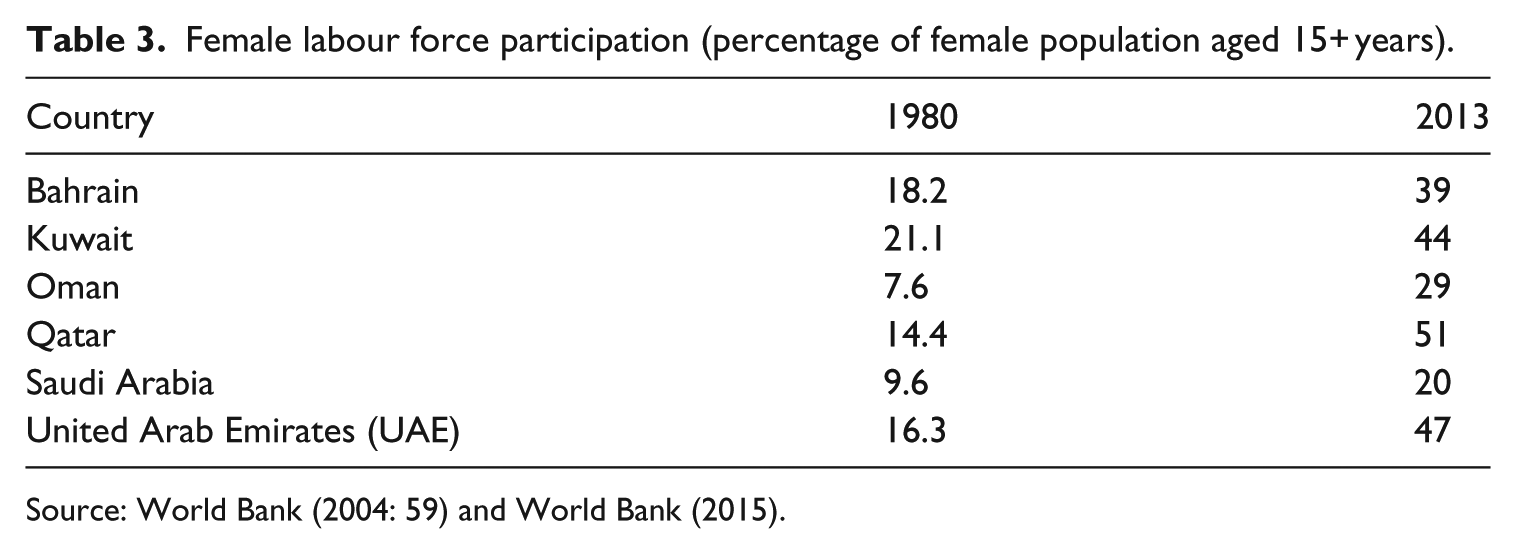
Source: World Bank (2004: 59) and World Bank (2015).
GCC governments that seek to promote the education and employment of their national labour force must reconcile the abnormal national/non-national segmented characteristic of Gulf labour markets, and the concomitant gender imbalances that result, with the necessity to facilitate the integration of national women into the labour market. With a majority of workers in the private sector being non-national and male, female employment in this sector remains difficult. Nursing, however, is globally a feminized profession.
The internationalization of the healthcare labour force interacts with nursing’s gendered and insecure occupational status (Nelson and Gordon, 2004). This professional marginalization is evident in many parts of the Middle East, where ‘nurses are considered maids for patients and assistants for physicians’ (Al Jarallah et al., 2009: 70). To further add to this complexity, the actual autonomy of female nurses – working with unrelated men, sometimes at night and engaged in ‘body work’ that demands touch and personal care – challenges the gender norms of socially conservative societies (El-Hadad, 2006). The ambiguous status of the nursing profession means that in Oman ‘the majority of students entered into nursing as their last choice of preferences’ (Al-Riyami et al., 2015: 464). Increased university level training has, however, boosted the desirability of the profession for young Omanis (Al-Riyami et al., 2015). In fact, Omani nurses spoken with during this research suggested that nursing was their top choice. This may be partly connected to the expectation of a de facto guaranteed job after graduation; Omanization rates are higher in areas with higher local unemployment (Table 2). Here, many local women work as nurses, since labour demand outpaces supply and employment opportunities mean Omani nurses can find jobs rather quickly after graduation.
Nursing, especially in the public sector, is slowly emerging as an appropriate field for Omani women. In 2013, women represented 81.6% of the current students enrolled in MOH nursing institutes (MOH, 2013: 12–13). A female Omani ward supervisor at a government hospital, and nurse for over 12 years, believed the biggest problems facing her hospital were staff shortages and high levels of Omani staff turnover (interview, 11 January 2015). She felt that low pay, long hours and limited opportunity for promotion discouraged Omani nurses from staying in one hospital for a long time. Interviewees also suggested that many male Omani nurses do not remain in patient care for long, preferring instead to shift to administrative roles, a pattern that is evident for male nurses generally (Dill et al., 2016).
National nurses in Oman support the Omanization process, but have expressed concern about replacing experienced expatriate nurses too rapidly with inexperienced and poorly trained national nurses (Al-Riyami et al., 2015). The supervisor mentioned above expressed this sentiment as well. She was worried about the level of experience of new graduates coming in and wished administrators would not replace the more experienced, and more expensive, expatriates with fresh graduates. The multiple interests and complexities at work in this realm of social policy making are clearly articulated in this case. While Oman has a stated interest in boosting the employment of female nationals, gendered expectations and poor conditions of nursing employment undermine the profession’s acceptability and limit its capacity to attract and retain locals. The demands made of the healthcare sector and the recognition of skills and expertise, meanwhile, protect migrant workers as key actors in this sector. The perceived threat of Omanization, however, can still operate to control migrant workers and contain demands for improved conditions.
Labour recruitment and workplace experience between Oman and the Philippines
Health labour force policy in Oman is informed by policy frameworks originating in both Oman and health professional migrant source regions. This is a clear example of global social policy making since multiple states and agents become enmeshed in the process of migrant worker provisioning to service Oman’s needs. Oman’s MOH has guidelines for international staffing requests, whereby hospitals should bring staff shortage issues to the attention of their board, and if no internal staff can be found, submit a staffing request to the appropriate MOH divisions, in this case the Directorate General of Nursing Affairs and the Undersecretary for Health Affairs. National nurses should be sought first, and if this fails to satisfy the demand, then the DG of Nursing Affairs submits advertisements in consultation with the concerned MOH authorities. Recruitment agencies in nursing source countries like India and the Philippines respond to such advertisements and liaise with employers (MOH, 2003, MOH Website). Although Oman and the Philippines do not have a bilateral labour agreement, Oman uses licenced private recruiters in the Philippines, a leading source supplying trained nurses to overseas markets, to fulfil staffing requirements (Pittman, 2016). Using licenced recruiters is supposed to be a safeguard against recruiter exploitation, but in practice is no guarantee. These recruiters are licenced through the Philippines Overseas Employment Administration (POEA), which regulates recruitment, implements and develops programmes and policies linked to migrant worker recruitment, accredits foreign employers, documents overseas foreign workers, adjudicates recruitment conflicts, as well as negotiates bilateral agreements. The Philippines …
has a vast, transnational migration bureaucracy through which it facilitates out-migration [through] four key functions: (i) authorization (by processing i.e. visas and passports of migrants), (ii) predeparture skills training, (iii) marketing (advertising migrants to prospective employers), and (iv) conducting ‘marketing missions’ (bilateral negotiations with labour-receiving countries). (Rodriguez and Schwenken, 2013: 382)
When the Philippines does development bilateral labour agreements, it is based on extensive public–private agreements structured to provide support for migrant workers while meeting the development needs of the source and destination country (Rivera et al., 2013). Indeed, migration from the Philippines is emblematic of a labour export model that is driven and orchestrated by what Rodriguez (2010) calls the ‘labour brokerage state’. Various actors play their role in this migration process to create ‘ideal migrant subjects’ who embody the goals and objectives of migration as a development tool (primarily through the remittance process). Workers from the Philippines are ‘desired’ employees in Oman because they are perceived as well educated, well spoken (good English skills) and ‘clean’ (Philippine Embassy official, 18 June 2015, author interview). The state and private intermediaries play a role in generating these migrant subjectivities during the migrant cycle, which includes ‘extraterritorial interventions in contractual disputes’ (Rodriguez and Schwenken, 2013, 381). Extending such rights normalizes emigration with the promise of ‘some degree of protection’ overseas (Rodriguez and Schwenken, 2013: 381).
The Philippines government currently requires a minimum wage of 160 OMR (US$415) for general employment. This is feasible because the minimum wage set in Oman only applies to citizens. This stipulation also makes Philippine nationals more expensive relative to other labour-rich countries, which seems to contribute to perceptions of value and therefore increase demand for Philippine workers. Healthcare workers earn more, and nurses earn in the range of 500 and 600 OMR (US$1298–US$1558) in public establishments. In private establishments, nurses often only earn 250 OMR (US$649), but the embassy is pushing for this to be increased to 350–400 OMR (US$909–US$1039), including free accommodation. Salary is thus an example of deterritorialized labour market regulation in Oman that differentiates between Asian migrants.
The politics of nationality also plays a role in perceptions of job security, promotion and employee relations. Language can at times perform a crucial role here. Language is a tool that can be used by individuals to make conversations, and by extension knowledge and learning opportunities, exclusive to a particular group. This can impact nationals and non-nationals in various ways. For instance, Omani nurses report feeling the need to fight for patient care to be discussed in English so all parties could participate, not just doctors and nurses from particular language groups. Conducting work-related matters in a foreign language (such as that of the expatriate workers) excludes non-speakers from the opportunity to contribute or to learn. This simultaneously marginalizes nationals and securitizes knowledge and jobs for certain expatriate groups. The transnational nature of the labour market also creates vulnerabilities for migrants in terms of contract translation issues. A few expatriate research participants report signing contracts or other documents in Arabic, without understanding the contents. Media, government edicts and other reports on labour market regulation released in Arabic also cause concern. These are often poorly translated or misinterpreted in English press coverage, resulting in miscommunication, information asymmetries and escalated concern over job security or employment conditions and benefits. The language politics of these combined practices, experiences and perceptions thus contribute (unintentionally or otherwise) to feelings of exclusion and paranoia on both sides. Where Omani nurses worry about opportunities for learning and improvement, expatriate nurses worry about job security. We therefore understand labour market regulation as resulting from the interactional effect of labour export and labour market segmentation effects at various scales.
Our survey results indicate that for expatriate workers there is a general sense of unease and raw acknowledgement of the precariousness of their employment in Oman, even as the process of migration is framed as one of national need for Oman and national development for the Philippines. This precariousness is generated by the reality of limited rights (related to job insecurity and impermanence in country) and the perceived sense of employer greed (searching for loopholes to pay less or limit benefits). This is especially evident in responses to questions about labour nationalization and wage rates, where 74% of those surveyed believe that Omanis receive higher wages for the same job. Interestingly, Omani nurses interviewed believed all nurses were paid according to seniority. This apparent lack of awareness about the conditions of employment between coworkers contributes to a lack of workplace solidarity while enhancing status and tenure insecurity for expatriates.
No respondent reported ‘poor’ treatment by their employer. A majority of respondents selected ‘good’ or ‘very good’, with a few selecting neutral as their response to questions about this. While interviewees suggested nurses were ‘actually treated good’, they did comment that Western expats ‘had it better’. This speaks to the formal and informal ways in which expatriates from OECD nations, especially ‘White’ workers, receive better treatment. This often starts with the visa regime and continues with salary levels framed by nationality. Although visa rules apply equally in principle, certain regulatory mechanisms and employment practices reinforce racialized perceptions and practices. Western expats rarely submit to surveillance and control to the same degree that Asian migrants are expected to—often refusing to surrender their passports to employers. Moreover, at times there are quotas for certain nationalities or certain genders which may be introduced nation-wide or on a sectoral basis. These are often rationalized as part of nationalization drives, but such policies are symptomatic of gendered, raced and classed configurations, regulating both gender and family structure. Similar patterns have also been identified in Bahrain (Nagy, 2013).
Recent reports suggest that visas for expatriate women to Oman are being restricted in certain professions. The Ministry of Manpower explains that female visa applications are ‘treated on a case-by-case basis’ with a view ‘to protect women and prevent abuse of the system’ (Anderson, 2016). Whether a workplace is appropriate or safe for women is essentially left to the discretion of visa officers. Another restriction is linked to the requirement of a minimum salary level (600 OMR/US$1558 as of early 2016) in order for the family of the employee to be allowed to join (Times News Service, 2016). While this especially targets unskilled labourers, it also impacts many skilled professions like health workers who may not earn enough to receive a family visa for their spouse and children.
Intermediaries also play a role in creating uncertainty with regard to salary, and this has a clear gendered dimension, since 27% of the women surveyed indicated they were paid lower salaries than promised compared to none of the male respondents. Nearly twice as many women as men were made to sign a new contract after they arrived (20% compared to 11%). Women also paid more in total costs to migrate than men, with 20% of female respondents spending more than 500 Rials (nearly US$1300) compared to none of the male respondents. While a much larger survey would be necessary to examine whether this gendered dimension persists across other migrant professions, global evidence on the feminization of labour suggests that women are disproportionately impacted by the casualization of the global labour force, receive worse contracts and are routinely paid less than their male counterparts (Das, 2012).
Most survey respondents were attracted to work in Oman because of the better salaries offered in comparison to the Philippines, their home country. The obligation to support families was part and parcel of the economic motivation for migrants. One respondent noted,
Salary is way better here than in the Philippines, same work load and yet there is a very big difference. At least here even if we are far away from our families our efforts are not wasted because monetary wise we are being compensated (Survey response 2014).
Some were motivated to work in Oman because of the experience of working in a different country or with different equipment. Approximately 17% of our survey respondents indicated they were using Oman as part of a two-step migration process towards Canada or other Western countries (also see Paul, 2011; Percot, 2006).
The tenuous conditions of employment for female expatriate workers will not necessarily dampen the supply, and the Philippines labour export model and Oman’s segmented labour market arguably maintains supply through transnational interaction. For example, while the confiscation of passports is no longer legal in Gulf countries, in practice it continues to happen with the implicit consent of many Asian embassies. The Philippine labour attaché claimed that passports should be in custody of the owner or the Philippine government and stated that the Embassy tries to encourage employers to leave passports with their employees. However, he also said that ‘he understands their concerns’; employers do not want the risk of the employee leaving without warning. Our respondents noted that employers often retain employee passports and do not relinquish them for holiday or other travel without adequate justification. Passport confiscation is deemed necessary in Oman because exit visas (and implicitly sponsor permission) are not required to travel outside the country. Because of the dual requirement of passport and resident card to exit the country, the Philippine embassy suggests employers leave at least one document with the employee while holding on to the other. While playing the advocate in encouraging the relinquishment of passports, such unwritten policies on the part of sending nations essentially sanction the restrictions on the movement of their nationals and signal subservience in the bilateral state relationship that enhances the vulnerability of expatriate workers of that nationality.
The immobility of labour within Oman is what seemed most concerning to our interlocutors. This immobility is formally regulated since there is a requirement to finish a contract before moving to another employer, or face a 2-year visa ban. Movement to a new employer under any circumstance requires a non-objection certificate from the existing employer, suggesting further reinforcement of control over migrant labour though the production of insecurity.
The vulnerabilities of the nursing labour market in highly internationalized healthcare markets like Oman are heightened by the gendered nature of the occupation globally. This reality intersects with the segmentation of the labour market between nationals and non-nationals in the workplace and through the regulation and surveillance policies and practices evident in the labour market. These multiple vulnerabilities exact a disciplinary force on expatriate workers, which is supported through transnational factors of poor employment conditions at home, the complicity of sending governments and the multiplex nature of employment in Oman’s health sector. This underlines our findings that the nursing labour market in Oman operates in a globalized policy space, with overlapping levels of authority and deterritorialized regulation at play often in very mundane spaces of state practice – an argument discussed further below.
National policy interaction and the generation of global social policy: actors on the ground
Meetings with Philippine Embassy officials contributed to our conceptualization of multilayered governance in the health labour market and the construction of global social policies. There are multiple components of this, including legal representation, setting wage rates, assessing and providing contract language, reviewing and approving employers, promoting and facilitating further bilateral relations that might enhance migrant worker opportunities, the provision of worker insurance and regional consultations with other ASEAN sending nation representatives in Oman. Despite the fact that Oman has only ratified four out of nine international labour conventions (Roper and Barria, 2014: 46), the Philippine Embassy uses such approaches to advance a policy of migrant worker protection and compensation within the national Omani labour market system.
In terms of legal representation, the Philippine’s Embassy in Oman is active in the governance of its own nationals according to local laws. In addition to advocating for Philippine nationals within Oman, including promoting the need to ease restrictions and improve working and living conditions, they also represent Philippine nationals in labour disputes. Sending states mediate in the legal system of the receiving nation and in so doing become part of the labour complaints process. According to Embassy officials, when confronted with complaints they play an active role. First, they try to mediate between employee and employer. If the parties will not meet, the Embassy calls the placement agency. The Embassy allocates much of the responsibility for contracts and placements, and by extension contract discrepancies and violations, on the shoulders of the recruitment and placement agencies, which have been vetted and licenced by POEA. If the parties refuse mediation by the Embassy, they are referred to the Omani Ministry of Manpower’s small court system. The labour attaché suggested there are clear rules governing labour and the labour court is well equipped and ready to move quickly. In these occurrences, the Embassy provides Arabic-speaking counsel for their nationals. Indeed, this example reveals Stone’s (2008: 19) argument that global public policy formation includes ‘multiple and contested modes of authority’. Responsibility shifts between employee and employer, sending and receiving governments, and intermediaries like recruitment agencies.
The Philippines Embassy is involved in the extraterritorial governance of the nursing labour market in Oman, enacted through setting minimum wage requirements; reviewing accommodation, facilities and contracts; and monitoring Philippine companies operating in Oman. The Philippine Overseas Labor Office (POLO) (POLO Muscat) and the Overseas Workers Welfare Administration (OWWA), both under the auspices of the Embassy, are active in such matters in Oman. Employment contracts are also assessed by the embassy. In fact, the Embassy provides a standard contract that is used for employer and employee, which contains the same text and the same protections as the contract provided by the Omani Ministry of Manpower. According to the labour attaché, the contracts do not usually vary between the one the employee is given in the Philippines and the one they ultimately sign. The problem emerges when private establishments or recruitment intermediaries give new hires an offer letter with different provisions to sign. Complaints are at times brought to the Embassy. In these cases, the Embassy informs them that such contracts are not valid. Complaints are made in a variety of ways, including in person, through text messaging and increasingly through social media. According to the Embassy, the majority of complaints come from those employed in private establishments and tend to be related to delayed salary, poor accommodation and long hours. The segmentation of nursing labour markets differentiates regulation into distinct public and private sector policy domains, leaving expatriates in the private sector disadvantaged.
The provision of insurance is another dimension of worker protection policy that reflects a transnational institutional interaction. Within Oman no company or sponsor can hire a Filipino without an adequate insurance package. On the other end, employees are insured and examined (full medical and psychological examination) in the Philippines prior to being permitted to leave the country for work purposes. All recruitment agencies require accreditation with the OWWA. In order to work or return to a job overseas, Filipinos require an Overseas Employment Certificate. This can be obtained in Muscat prior to going home on leave or at home.
Global social policy can also emerge from the interaction of a collection of sending states, and this is occurring in terms of the negotiation and coordination of policies across ASEAN member states. This is not only within the ASEAN region but also in Oman. There is a committee comprising ASEAN members in Oman that meets on a monthly basis to discuss items of mutual interest. Called the ASEAN Committee in Muscat (ACM), the ambassadors meet on a monthly basis with a semi-annual rotation of the committee chair (Philippine Embassy to Muscat Press Releases, 2015a, 2015b). Among the issues that preoccupy them most, according to senior officials at the Embassy, are labour. The labour attaché regularly consults with ASEAN members and views Indonesia as the Philippine’s most relevant ASEAN partner in Oman. In addition to regular meetings, ASEAN members try to coordinate their positions and advocacy with regard to expatriate labour issues in Oman. According to interviews, a group of labour attachés approached the Ministry of Manpower together to discuss hiring, recruitment and other procedures. Officials cited various ministries and institutions they approach, including the Ministry of Manpower, Ministry of Health, Ministry of Higher Education, Royal Oman Police, Supreme Council of Planning and some of the main employers including the Sultan Qaboos University hospital.
The activism of sending states and the informal diplomatic interactions of ASEAN states to secure favourable policy developments reveals a multiplex landscape of more than national regulation and policy formation in the area of the healthcare labour market. When combined with the particular nature of the healthcare system, the challenges of advancing a national policy of Omanization in health care and the gendered complexities associated with the status of nursing, we see how the development and operation of health workforce policy in Oman can be characterized as a form of global social policy emerging from a contingent multiplex process marked by asymmetrical contestation.
Conclusion
In this article, we have examined the convergence of policies that shape nursing labour markets in the Sultanate of Oman during a period of policy transition from dependence on an expatriate to an increasingly nationalized labour force. Our case study has advanced theoretical arguments about the nature of complexity at work in global social policy and the variable and interactional effects of multiple states and institutions operating in this realm. We have explored global social policy in the making in a Gulf nation where labour nationalization policies alongside the increased use of expatriate labour appear to be contradictory, but are in fact complementary in reinforcing the wider context of insecurity that is a central feature of migration to Gulf countries. In this case, we observe contradictions and tensions that ‘emerge from an inherent incongruence between the logic of policy and the structural logic of the economy’ (Ennis, 2015: 138). We thus argue that the incorporation and status of migrant workers in overseas labour markets is produced through a transnational interaction of the policies and discourses of sending and receiving states. Examining a case of economic migration outside of the dominant Western south-to-north migration context broadens scholarship on migration and global social policy formation to include important migratory spaces which receive limited academic treatment.
Conversations about work, labour and migration still centre on bounded spaces and identities, and territorial boundaries where the state is the central actor. Although states ultimately enforce geographic boundaries and regulate modes of individual participation in the labour market, the policies which guide and inform these are increasingly deterritorialized. Expat labour dependence, export labour policies and nationalization polices in the GCC have come to interact in a manner that effectively creates a form of global social policy. The governance of healthcare labour markets does not occur at a domestic level alone, but includes multilayered forces above and across national contexts. The more we analyse this process and such multiplex spaces the better positioned we are to advocate for and advance fairer labour migration policies.
Structural features in the global economy and the supremacy of neoliberalism frame and configure policy formation, where ‘goals are defined and pursued in which the state (or government) is not necessarily the only or most important actor’ (Betsill and Bulkeley, 2006: 244). This is clear in Oman where private sector employers continue to demand expatriate workers, and in the case of the Philippines where the deployment of Overseas Foreign Workers occurs through a capillary system of regulated private recruiters. The interaction of states and markets in the global transmission of migrant workers contributes to a hybrid system where national policies can be constrained, undermined and bypassed. New formations and processes emerge, which are the product of the transnational effects of national policy making in both nations, in other fora such as ASEAN and in wider regional groupings. Such pressures suggest the extraterritoriality of labour market policies and hint towards governance and social policy formation beyond the state. We elaborated on these arguments focusing on Oman’s healthcare sector and the nursing labour market, intersecting our analysis of conditions in Oman with an overview of policies in one of Oman’s labour sending nations, the Philippines. The case of the nursing sector in Oman demonstrates how labour market complexity is reflective of Stone’s (2008: 24) observation that policy practice is increasingly reflective of ‘a double devolution first, beyond the nation-state to global and regional domains and second, a delegation of authority to private networks and nonstate actors’. Global social policy around labour governance can thus form in a contingent fashion out of processes of deterritorialization and transnational market and regulatory forces.
Through examining the complexity of the Omani nursing labour market, we show that labour market policy can be comprehended as a form of global social policy formation. While sovereign decision making can theoretically dictate what happens within the borders of a single state, the reality of gendered labour market complexity and ongoing worker export, as evident in nursing, effectively result in the production of forms of global social policy. Understanding this reality offers a new perspective of the spheres of influence and realms of authority involved in managing skilled labour markets and migration under conditions of globalization and a more fulsome recognition of how social policy and economic transformation occur and evolve.
Footnotes
Acknowledgements
We would like to extend a wealth of gratitude to Dr Irudaya S. Rajan at the Centre for Development Studies, Kerala, for his guidance and contribution to the survey instrument. We are also grateful to the two anonymous reviewers whose detailed and insightful comments on earlier versions of this article improved the clarity of our argument. Finally, we are especially thankful to our many interlocutors who participated in interviews and our survey and particularly those who helped us advertise and disseminate the survey.
Funding
The author(s) disclosed receipt of the following financial support for the research, authorship, and/or publication of this article: Funding for this research came from the Social Sciences and Humanities Research Council file # 410-2010-1013.