



Abstract
Summary
Home care workers often work alone and are geographically distant from colleagues, managers, and security services, placing them at a high risk for client-initiated violence. Studies have shown that home care workers are subjected to significant degrees of such violence, yet there is an indication of underreporting. Based on 25 individual and group interviews with 79 staff from various types of home care services in Sweden this study aims to enhance our understanding of why home care workers choose to report or not report violence.
Findings
Using a theoretical lens of emotional labor, the findings reveal that, in the face of violence, workers manage their emotions in accordance with organizational and professional norms. This contributes to and perpetuates a view of client-initiated violence as something that workers should endure, manage, and prevent, rather than acknowledge and report. In the long run, this idea shifts the focus away from the organization and its responsibilities, redirecting it toward the individual worker.
Applications
As the findings suggest that violence is often minimized and normalized, finding a common definition of client-initiated violence in the organization could relieve workers from having to define and, at worst, reinterpret violent incidents. Furthermore, norms contributing to an understanding of violence as a professional failure should be addressed. Organizations and cultures that facilitate swift reporting, provide organizational support and work against the stigmatization of those who report are likely to create safer and better work situations for their home care workers.
Introduction
Client-initiated violence is a worldwide issue that occurs across different social work and healthcare settings (Byon, Lee, et al., 2020; Enosh & Tzafrir, 2015; Freysteinsdóttir & Sveinbjörnsson Brink, 2022; Sicora et al., 2022). It has significant consequences, including decreased job satisfaction, burnout, resignation, stress, depression, and sleep problems among workers. Additionally, it risks negatively impacting the quality of care provided to clients, as workers may experience fear, alter the time spent with clients, change the treatment they provide, and ultimately develop a disillusioned view of clients (Hanson et al., 2015; Tzafrir et al., 2015; Zhong & Shorey, 2023).
In this article, the spotlight will be put on client-initiated violence in Swedish home care services (i.e., services provided in clients’ homes) and, more specifically, on the reporting of such violence. Home care services are an integral part of the social and healthcare system in Sweden and elsewhere, with the potential to reduce costs for the care of people who otherwise may have required care in institutional settings (Hollander & Chappell, 2007). However, workers in home care services face challenges that may put them at high risk for client-initiated violence. Unlike social and healthcare services carried out in institutions or office settings, home care workers often work alone in the clients’ homes and have very little control over the work environment, both in the clients’ houses and the surrounding neighborhood (Byon, Lee, et al., 2020; Phoo & Reid, 2022). Furthermore, as lone workers, they often lack geographic proximity to colleagues, managers, and security services, making them more vulnerable to threats and violence (Campbell, 2017).
Research on the prevalence of violence in home care services indicates that it is a common, but somewhat elusive, problem. In a recent meta-analysis, the prevalence of violence was estimated to be 22% over the last 12 months and 30% over a career (Byon, Lee, et al., 2020). Another review estimated the prevalence to be between 33% and 87% over the course of a career (Campbell et al., 2014). Different methodologies, sample sizes, and definitions of workplace violence make comparisons difficult, but it is clear that a large share of the workers is affected.
Despite the compelling evidence that home care workers are subjected to a significant degree of client-initiated violence, far from all cases of violence in home care services are reported. Apart from the more personal consequences of not reporting violence, such as not receiving adequate help and risking continued exposure, underreporting leads to an underestimation of the problem and limits the possibilities of addressing and reducing risks on an organizational level (Byon, Liu, et al., 2020). More knowledge about the reasons behind underreporting is needed to better understand potential barriers and nuances surrounding the reporting of violence in home care services.
This study aims to, by means of qualitative interviews, analyze home care workers’ considerations regarding the decision to report, or not report, acts of violence committed by clients. The inclusion of staff from various home care services such as personal assistants, housing support, child welfare, and eldercare, allows for an exploration of differences as well as similarities in experiences and discussions regarding these issues. Analytically, the concept of emotional labor (Hochschild, 2012) will be used to help understand the staff's considerations about potential challenges and opportunities for incident reporting.
Previous research and theoretical framework
The concept of home care services is somewhat unclear but generally refers to care services provided in a client's residence by professional healthcare personnel (nurses, physicians, social workers, etc.) and paraprofessional healthcare personnel (nurse assistants, home health aides, etc.). This article's empirical data encompasses experiences from social work staff and paraprofessionals. It does, however, not include experiences from nurses or physicians.
Much research on client-initiated violence in social and healthcare has concerned institutional settings, such as residential care homes for adolescents or older people (Andersson, 2021; Banerjee et al., 2012; Winstanley & Hales, 2015), statutory social work (Munobwa et al., 2023; Shier et al., 2021) or healthcare institutions (Mento et al., 2020). Research on workplace violence in noninstitutional services, including home care services, is both scarcer and more fragmented. The fragmented nature of this research may be a consequence of the fact that such services involve different disciplines, such as nursing and social work.
The studies on client-initiated workplace violence in home care services that exist have primarily focused on the prevalence, determinants, and consequences of such violence. Most previous studies concern services delivering assistance for daily living (generally executed by paraprofessionals), but also health care such as nursing, physiotherapy, etc. Few studies have focused on social work in home care services (Phoo & Reid, 2022). Client-initiated violence has been described as a common but often underestimated problem that is linked to conditions such as dementia, mental illness, psychiatric disorder, and substance use in clients, and factors such as fear of violence and level of familiarity with clients among workers. Organizational factors have been less studied, but there are indications that care plans failing to meet clients’ expectations, or inadequate time allocated for care, are associated with violence (Phoo & Reid, 2022). The consequences are grave, including negative effects on the physical and mental health of the workers (Zhong & Shorey, 2023).
As noted above, client-initiated violence in home care services is sorely underreported. Yet, our knowledge about the considerations surrounding the reporting of incidents and the potential reasons for underreporting in home care is scarce. In the nursing literature, it has been suggested that the reasons for underreporting include aspects of uncertainty regarding what can be reported, normalization of violence (Byon, Liu, et al., 2020), complicated systems, and lack of time (Byon, Liu, et al., 2020; Campbell, 2017). It has also been indicated that underreporting may have serious implications, including difficulties understanding the risks, underestimating the problem, and hampering the possibility of developing interventions that could help ensure the safety of home care staff (Byon, Liu, et al., 2020; Campbell, 2017).
Within the field of social work more generally, that is, not specifically in home care services, Leadbetter (1993) postulated a few decades ago that the underreporting of violence was a result of the client-centered ideology within the social work profession. He suggested that the relationship-based nature of social work may generate an expectation that aggression from clients can be “effectively case-worked by a skilled professional” (p. 616). This view, he worried, overlooks the organizational and structural dimensions of the problem and risks inhibiting the tendency to report. In addition, within a client-centered ideology, violent behavior may not be reported as professionals believe that the service of clients takes precedence over their own safety (ibid.; Macdonald & Sirotich, 2001).
This line of thought bears resemblance to the understanding of client aggressions through the concept of emotional labor. The concept was initially introduced by Hochschild in 1983, describing it as “the management of feeling to create a publicly observable facial and bodily display” (Hochschild, 2012, p. 29). All people manage their emotions in their everyday lives, but when this management is performed for pay, serving the interest of an organization, it becomes what Hochschild terms “emotional labor.” Emotional labor encompasses two processes: “surface acting” which involves displaying to others emotions that are not felt, and “deep acting” which entails modifying actual emotions. According to Hochschild, emotional labor can have negative consequences for the worker, such as burnout, stress, etc. (ibid.).
In the context of caring professions or caring work, Hochschild's ideas have been further developed to capture all aspects of the emotional work carried out by the employees. Compared to Hochschild's respondents, who worked as flight attendants, professionals in the caring field have been suggested to possess a greater degree of autonomy and manage their emotions in accordance with professional norms and values, rather than solely in line with the prescriptions of their organization as a means to create profit. In addition, professionals have been proposed to see this management of emotions as an important part of their professionalism, or as a professional norm, that they take pride in (Funk et al., 2021; Virkki, 2008; Wharton, 2009).
Social and care workers may use their emotional skills to prevent client-perpetrated violence. In the face of violence, emotional skills are used to interpret the clients’ emotional states and respond in a way that is considered appropriate while simultaneously managing their own feelings of fear (Funk et al., 2021; Virkki, 2008). Hence, suppressing one's own emotions by surface or deep acting is viewed as a professional way of handling violence. In this article, Hochschild's concept of emotional labor, along with its developments, will be used to understand the workers’ considerations related to deciding whether to report threats and violence or not.
Method
This article is based on data from 25 individual and group interviews with staff from various types of home care services, including personal assistance (support provided to people who, due to serious and long-lasting functional impairments, need help to accommodate their basic needs), housing support (practical support for people with, e.g., mental health or substance use issues), eldercare (home help), child welfare services (therapeutic or pedagogical interventions), etc. In Sweden, these services are tax-funded municipal responsibilities which can be provided in-house by the municipalities, or outsourced to private organizations. The 79 interviewees work with different target groups and hold different occupations: namely paraprofessional occupations such as carers, assistant nurses, and professional occupations such as social workers. Among the interviewees, 22 were men and the rest were women (see Table 1). Most interviewees were born in Sweden, but a significant number of interviews were from other countries (around 30%). All but one of the included services were provided in-house by a municipality.
Participant characteristics.
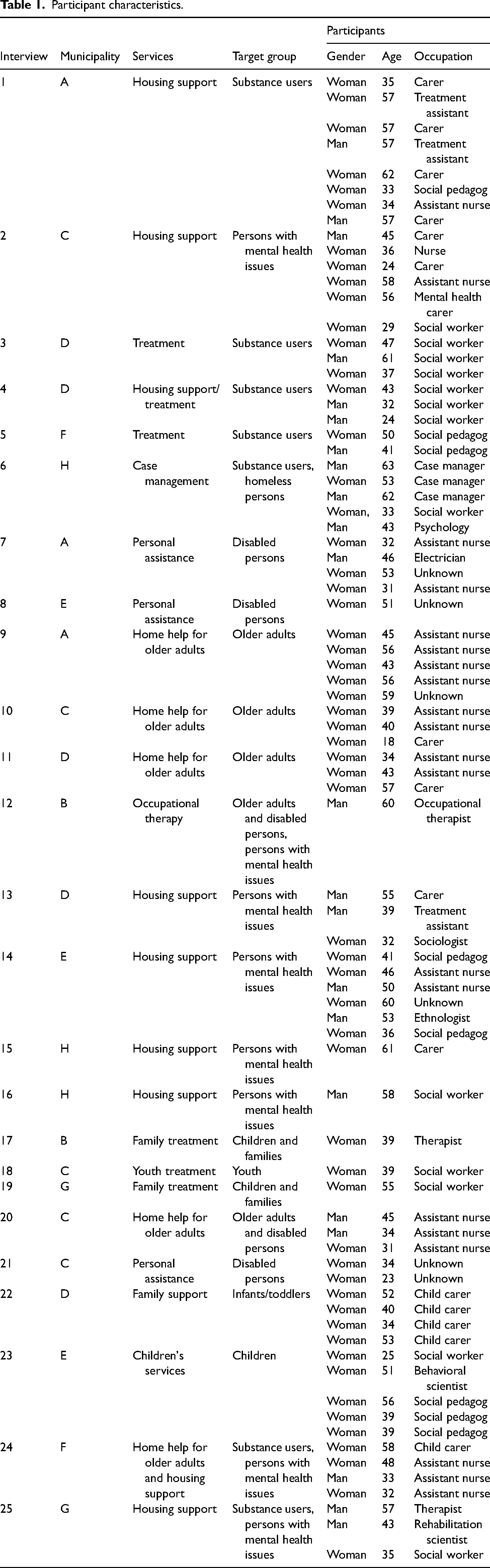
The study is part of a larger project that investigates different aspects of client-initiated violence. In the initial phase of the larger project, employers’ formal reporting of client-initiated violence (i.e., to the Swedish Social Insurance Agency) was explored (Brodin & Shanks, 2024). The results of this quantitative study were used to achieve a varied selection of municipalities with different rates of reporting for the purpose of this article. In addition, the number of inhabitants, geographic location and use (or nonuse) of a system of choice model was considered. In total, 11 municipalities were selected, of which eight granted us permission to undertake interviews with the frontline staff (A–H in Table 1).
The semistructured interviews were mainly performed as group interviews (18), although some interviews were individual (7) due to the absence of a team or as a result of difficulties in accessing personnel. The interviews were conducted in 2022, generally lasted around one hour and were held by one or two of three research assistants. The interviewees were invited to participate on the basis of informed consent and that quotes should be anonymized. Ethical approval was obtained from the Swedish Ethical Review Agency (Registration No. 2019-06274).
The interview guide was informed by the previous study in the project (Brodin & Shanks, 2024) as well as previous studies in the area of threats and violence in social and care work. It contained questions about the work setting, experiences of threats and violence, preventive work, ideas about threats and violence, and routines for handling threats and violence including considerations regarding reporting violence. Through the interviews, lengthy and rich descriptions were obtained, highlighting similarities as well as differences in the interviewee's experiences.
After conducting the interviews, the recordings were transcribed verbatim. A thematic content analysis was performed, as this type of analysis is appropriate for examining the perspectives of individuals and shedding light on potential similarities and differences between their experiences (Nowell et al., 2017). As a first step, the interview transcripts were coded and broadly categorized in line with the focus areas of this article—e.g., experiences of threats and violence and considerations and dilemmas regarding reporting violence. Secondly, subthemes with a focus on the interviewees’ descriptions of challenges regarding the reporting of violence were identified; namely “unclear definition of violence,” “professional handling of violence,” and “organizational aspects” were identified. Concepts from the sociology of emotional labor were thereafter used to further the understanding of the challenges described by the interviewees. Throughout the article, the results are related to previous literature. In addition, as rich data as possible is provided so that readers can decide to what extent the findings are transferable to their contexts (Nowell et al., 2017).
Results
In the majority of interviews, experiences of threats or violence are mentioned. However, interviewees seem to share an understanding that not all incidents are reported or documented and that there is a significant risk that incidents, and underlying structures that increase the risk of violence, remain unrecognized. Hence, when speaking of considerations relating to the decision to report, or not report, acts of violence, interviewees tend to emphasize the barriers to reporting. Nonetheless, the importance of reporting is mentioned in several interviews, for example, to protect staff who will work with the specific client in the future, to make the incidents known to higher levels in the organization, and to maintain incident statistics. When the interviewees are prompted to speak about why incidents go unreported, a few recurring themes emerge. While most of these are present in interviews across occupational groups, some experiences appear to be more occupation-specific. In the following sections, the identified themes and the occupational differences and similarities will be explored further.
Unclear definition of violence
Similar to findings in previous literature, it is notable that the respondents find it difficult to determine what is to be considered threats and violence and what is to be considered a part of the job (Byon, Liu, et al., 2020). In some cases, the initial reaction of the interviewees in this study is to state that they have no experiences of threats and violence, only to later describe pushes, verbal abuse, etc. These difficulties in defining threats and violence in social and care work continue throughout the discussions regarding the reporting of incidents.
One of the most often occurring aspects in the discussions about the considerations regarding reporting is that of uncertainty of the reportability of the incident. In many cases, the respondents state that the choice to report is dependent on the incident being physical. In one interview with four personal assistants, one of the respondents described how s/he previously had tried to cope with recurrent threats and verbal abuse, and how it eventually ended with him/her going on sick leave. In reply, his/her colleague stated that: There is such a difference between physical and psychological violence. If you get a bruise, it is visible. […] If I get a punch in the face, it hurts. But the psychological [violence] goes further in, and takes longer before, before it appears, before it is visible, and before it is handled, so to speak. And I think that, now, you may have other information, but I think that physical violence is easier to report than psychological violence or threats of violence. (Interview 7, Personal assistance)
Physical violence is perceived as comparatively clear-cut and therefore easier to report. Although psychological violence may be just as difficult to cope with, it is not considered immediately serious enough to report.
In other cases, incidents—both physical and verbal violence—are viewed as too insignificant, too commonplace or too difficult to distinguish from more acceptable emotional outbursts to report. Some respondents describe that in their line of work, clients often display strong emotions—sometimes due to a pressured situation and sometimes due to health issues—which may make it difficult to determine which expressions of emotions should be viewed as violence: Sometimes it can be difficult to know what should be registered as threats and violence. We deal with behavioural disorders […] It is different words being uttered, different kinds of threats, so, where is the threshold for threats and violence? (Interview 12, Occupational therapy)
The interviewee quoted above continues to describe how recurring violence (both physical and psychological) may result in the workers adapting to this type of incidents, and how they eventually become a part of everyday work. Similar types of considerations regarding the normalization of violence are echoed both in other interviews and in previous literature (Byon, Liu, et al., 2020).
It is implied in the statements above that the lack of a definition of violence complicates reporting and leaves the definition of violence to the individual worker. Workers are left on their own to determine if their experience is serious enough to be viewed as violence. As a result, the definition varies between staff, as described in the quote below: IP1. It is so different, what people perceive as a threat. What someone else may perceive as a threat, I may not perceive as a threat. IP2. It depends on how sensitive you are (Interview 24, Home care for older adults and Housing support).
This excerpt was preceded by a discussion on whether or not threats and violence are taken seriously in the workplace. The interviewees went on to speak about how the interpretation of incidents depends on how sensitive the staff is. In other interviews, similar ideas are expressed. The interpretation of aggression in clients is described to vary between individuals—what is violence for one may not be so for the other. Ideas like these indicate the existence of norms expecting workers to be “tough” enough not to interpret aggressions as violence.
Doubtlessly, finding a common definition of threats and violence is difficult, and there are many gray areas in care and social work. For example, it may be challenging to determine if acts that lack intent (committed by clients with conditions like dementia or significant disabilities) should be defined as threats and violence. Additionally, as clearly described by the interviewees, establishing a boundary between acceptable emotional reactions from upset clients and threats and violence can be a challenge. Nevertheless, the lack of a definition of threats and violence creates uncertainty among staff regarding what should be reported, as well as ample room for staff to interpret the aggressive acts. Based on the interviews, this appears to lead to a minimization of the incidents in line with prevailing norms of being tough, and consequently, an underreporting of violence (cf. Byon, Liu, et al., 2020).
Professional norms
The respondents in this study appear to view the ability to handle and prevent violence as professional know-how that they take pride in. This is probably the reason why aggressive acts, when they occur, are sometimes viewed as professional failures that evoke feelings of guilt in the staff: I imagine that many of us staff feel, in some way, responsible for what has happened. That we may have done a bad job. […] You blame yourself in some way, your work, and feel ashamed in some way, like ‘I am a bit responsible for this’. (Interview 1, Housing support)
The quote above is a statement in a discussion regarding why incidents are not reported. It is the most explicit regarding why feelings of responsibility and guilt hinder the reporting of incidents, but across the different occupations interviewed for this study, the respondents describe similar tendencies.
Statements regarding ideas about how to prevent violence provide further insights into the professional norms of handling violent situations. These statements are useful in understanding the feelings of professional failure when aggression occurs. Throughout the interviews, there are statements emphasizing the importance of how clients are approached and treated and how this is crucial for avoiding violence. The quote below is extracted from an interview with an occupational therapist who acts as a support and advisor to staff in their interactions with clients. In this quote, the respondent is emphasizing his/her expectations for staff to be able to prevent violence through their approach: It is all about what happens before the person hits, or what happens before the person acts out or is self-destructive. […] It is not the actual incident that … or yes, the actual incident is important, but … How can you respond? What happened? […] Can you handle the person differently? […] What can you do to prevent it from happening again? That is what I think is important when I talk to staff. (Interview 12, Occupational therapy)
While the expectations for handling violent clients often originate from the workers themselves, the quote above suggests that these expectations also emanate from other professionals within the organization, sometimes occupying higher positions. Hence, the norms of professional handling of violence may be both imposed on the staff by others and something with which the workers align themselves.
The type of reasoning regarding professional norms in handling violence is evident across all the occupational types interviewed for this study, be it paraprofessional occupations or professional. However, there are some variations between different occupations. For example, in home care for older adults, in which paraprofessionals are employed, the interviewees use quite general terms when they describe how they work in a professional manner, such as having an appropriate approach or being “very professional.” The interviews with housing support staff and services for children and youth, which normally are staffed with social workers, are instead marked by discussions about specific methods. The “low-arousal approach” is the most frequently mentioned method, which can be attributed to its recent significant impact on various types of social and educational services in Sweden (Swedish Agency for Health Technology Assessment and Assessment of Social Services, 2020). The idea behind this approach is to prevent confrontation by avoiding behaviors and triggers that might agitate the client, such as demands, certain body language, etc. (McDonnell et al., 2018). In several interviews, this approach is emphasized as crucial in preventing aggressive situations. Whether employing specific methods or a more general professional approach, the perceived importance of one's own actions and the emphasis placed on the ability to “professionally” handle violent situations are likely to contribute to an avoidance of reporting incidents.
Another aspect of professional norms that may impact incident reporting is that of empathizing with the client. Here, the staff empathize with the client by looking for and finding, mitigating circumstances that explain the violence. This is exemplified by the quote below, where housing support staff describe that they overlook incidents of violence and would rather receive an apology than report violent acts committed by clients who are described as mentally ill: And that may be part of our role as well, that we, that you may feel that you cannot report people who are severely mentally ill, that you have a bit of leniency. You may wait a bit and see if they apologize or something instead because in that case, it can strengthen the relationship. (Interview 4, Housing support)
Unlike reporting, an apology is thought to strengthen the relationship, which in turn is viewed as crucial for good professional work. Furthermore, the aggressive acts are seen as symptoms of the “disease” that the staff are there to treat: “we are there to work with the anger and work with all these things” (Interview 19, Family services). These ideas are present throughout the different occupational groups. In home care for older adults, for example, the clients are described as not fully accountable for their actions due to factors like age, dementia or other types of diseases, and the staff, therefore, feel “ridiculous to report an old man” (Interview 20, Home care for older adults).
Organizational aspects
Lastly, several organizational factors that could impact the tendency to report were also highlighted by the respondents. Lack of support from the manager was described as a reason for not reporting incidents. For example, some workers describe how managers have belittled their experiences or simply ignored them. In this case, managers are described to convey the idea that threats and violence come with the job, that the staff should be able to handle such incidents and/or that they should possess a higher tolerance. However, it is also common that interviewees describe that the managers “encourage us to report” and that it is not “the attitude of the managers or the job that we should be tough” (Interview 4, Housing support).
Some interviewees speak about reasons for not reporting incidents that are more related to the systems for reporting incidents. The reporting of incidents in the workplace's system is half-jokingly described by one interviewee as “more of a trauma than actually experiencing something at the job” (Interview 14, Housing support). In other cases, interviewees describe that they feel that they lack time to report incidents, like the employee in home care for older adults quoted below: It may be that you think that you will do it later. Then a lot of things come up and you forget about it. When some time has passed, you ignore it. […] It takes time. If you have maybe 25 visits, how are you going to get it done? (Interview 20, Home care for older adults)
Lastly, in interviews with personal assistants, an aspect that is not present in the other interviews emerges. Here, staff describe that they avoid reporting due to fear that if they do “the user or the manager may not want to keep me” (Interview 7, Personal assistance). In many cases, the employment conditions for personal assistants differ from those of other staff. Personal assistants may be employed directly by the user, or at least work only with one user. As a result, they feel that they are dependent on this user for the job. Hence, they avoid reporting incidents out of fear of being perceived as difficult and thereby risk getting laid off.
Discussion—The emotional labor of dealing with violence
This article sets out to discuss the considerations of home care workers’ regarding the decision to report, or not report, acts of violence committed by clients. It is clear from the results that barriers to reporting incidents of violence, rather than facilitators, were at the forefront of the respondents’ minds. The overarching understanding was that too few incidents were reported. The challenges that complicated or hindered the reporting of violence were mainly related to three aspects; lack of definition of violence, prevailing professional norms and organizational aspects.
Firstly, it is evident that respondents find it difficult to distinguish between what constitutes threats and violence and what elements are inherent to their line of work and should be considered acceptable. This lack of an agreed-upon definition contributed to uncertainty about which incidents should be reported, fostering the notion that recognizing and reporting violence is a sign of oversensitivity. Secondly, professional norms indicating that violence could be professionally prevented or handled appeared to hinder the recognition and reporting of violence. In some cases, when violence occurred, it was interpreted as a professional failure. Thirdly, various organizational factors, such as a lack of managerial support and cumbersome reporting systems, appeared to impact the tendency to report. Some organizational factors seemed to be occupation-specific. For instance, personal assistants, who often work closely with a specific client and whose work depends on their approval, fear reporting due to concerns about job security. Furthermore, the ability to allocate time for reporting appeared to vary among different occupational groups. Staff in home care for older adults appeared to be particularly short of time.
Several of the challenges identified in this article align with those emphasized in studies focusing on home care services undertaken by nurses. In those studies, underreporting of violence has been attributed to uncertainty regarding what can be reported, the normalization of violence (Byon, Liu, et al., 2020), complicated systems, and a lack of time (Byon, Liu, et al., 2020; Campbell, 2017). The results in this article suggest that these factors also significantly influence social and care work. However, on top of these factors, this study shows that professional norms also play a significant role in this line of work—be it carried out by paraprofessionals or professionals. This is an aspect that has not been extensively covered in the literature regarding home care.
The results in this article lend themselves well to the interpretive framework of emotional labor. In social and care work, emotional management has been deemed central for many aspects of the work (Funk et al., 2021). However, also in the context of violence, the staff are continuously engaged in the emotional labor of responding appropriately—in accordance with organizational and professional norms—to the various emotional states of the clients. Using the lens of emotional labor can enhance our understanding of workers’ considerations regarding what should, and should not, be reported as violence.
One strategy for managing one's own emotions in the face of violence appears to be minimizing and normalizing aggressive acts; an approach to violence that can be recognized from previous research (Funk et al., 2021). Reinterpreting violent situations, particularly the subtler nonphysical violence, into something less serious may take place as a way of deep acting to suppress emotions of fear or frustration. However, when a violent situation is reinterpreted into something else, it is unlikely to be reported as violence. The reinterpretation or deep acting also occurs to avoid being perceived as oversensitive by colleagues and managers. In this respect, the respondent's statements suggest that a prevailing norm in social and care work organizations is the importance of being “tough,” which appears to be understood as not recognizing aggressive acts as violence. Hence, workers may use deep—or surface—acting to appear more resistant to violence. The absence of an agreed-upon definition gives room for individual interpretations of violent situations, as well as for speculations that some individuals are more capable of tolerating acts of violence than others. Again, when actions are not recognized as violence, they cannot be reported as such.
The respondents in this study also appear to view the ability to manage clients’ aggression (and their own ensuing emotions) as a professional skill they should possess. This attitude is evident in interviews with all different occupations, professionals (social workers) as well as paraprofessionals (e.g., nurse assistants), and implies that not preventing violence is viewed as a professional failure. There is little difference between paraprofessionals and professionals in this respect; both groups emphasize the importance of professional skills. This finding highlights that professional norms play an important role not only for more traditional professionals but also for other occupations in the care sector. The difference lies mainly in the wording used to describe these skills. While paraprofessional workers use everyday terms, professional workers often refer to named methods, such as the low arousal approach. In many ways, this latter approach appears to perfectly exemplify the emotional labor required in professional work. In this approach, the workers are expected to adopt a gentle tone, maintain a calm appearance, be mindful of body language, and be forgiving of the individual, etc. (McDonnell et al., 2018). Consequently, the emotions that the staff are expected to project may be completely different from what they actually feel. Adhering to the ideals of a low arousal approach risks resulting in both surface acting (gentle tone, appearing calm, being aware of body language) and deep acting (forgiving the client) (ibid.). Such ideals appear however not to be the ideal only in this method, but also in the more general professional approach that other occupations adhere to. Those who nevertheless are subjected to violence may perceive it as evidence that their low arousal approach (or other types of professional handling) was not practised well enough, potentially leading to self-blame and avoidance of reporting. Furthermore, it appears to be considered as inherent in the professional role to empathize with the client, even when aggression is involved. Here, staff contain their own emotions by finding mitigating circumstances, such as the client's physical and mental health, that explain the violence. In consideration of these mitigating circumstances, the threshold for reporting may be experienced as higher.
This study reveals that expectations for the workers to professionally handle or downplay violence can be either internalized by the worker or explicitly voiced by others (such as managers or colleagues) in the organization. Regardless of the source of these expectations, or the underlying norms, the emotional labor involved in normalizing, minimizing, empathizing, and self-blaming contributes to and perpetuates the notion that workers should endure, manage, and prevent client-initiated violence. This dynamic contributes to underreporting and, in the long run, shifts the focus away from the organization and its responsibilities, redirecting it toward the individual worker. This focus on individual responsibility rather than the organization's is sometimes combined, in an unfavorable way, with organizational factors that further inhibit reporting violence, such as insecure working conditions and lack of time. In addition, the intimate setting of a client's home may enhance workers’ tendency to emphasize with the clients, which can further complicate the decision to report violence in home care services.
Furthermore, it has been noted in previous research that emotional labor in itself may have negative consequences for workers, including burnout, guilt, depersonalization, and exhaustion (Hochschild, 2012; Wharton, 2009). There are reasons to believe that having to manage client's and one's own emotions to protect oneself from violence will cause even more distress. In home care services, where such emotional labor is carried out in the less controlled environment of a client's house and relative isolation from colleagues and management, the strain on the workers may be even greater.
Limitations of the study
This qualitative study was conducted within the context of home care services in Sweden. Despite efforts to achieve a varied selection of participants and occupations, it remains uncertain to what extent the results are valid in other home care contexts, such as those in different countries or other fields of work. Additionally, it was not possible to enrol more than one private provider of home care services, despite the significant proportion of such organizations. However, throughout this article, the results are compared with previous literature from a range of countries. Furthermore, substantial information regarding the research setting as well as rich data is provided to allow readers to assess the extent to which the findings are transferable to their settings.
Implications for practice
The results underscore the complex interplay of factors contributing to the underreporting of threats and violence within the context of home care services. Addressing this issue is necessary but challenging. For example, differentiating between violence and acceptable emotional outbursts from clients is more complex in work with vulnerable groups than within other contexts, and may be even more difficult when it occurs in the setting of a client's home. It is possible that the “normality” of using emotional management to deal with distressed clients increases the tolerance among workers. Furthermore, and as noted above, there are many incidents of violence where there is a lack of intent due to the client's severe disabilities. Issues such as these make it difficult to find a clear definition. However, without one, the individual workers are left very much to their own devices which, judging from the results above and previous research, contributes to the trend of underreporting. This is an aspect that needs to be understood and amended in practice. Also, the norms that contribute to an understanding of violence as a professional failure need to be addressed, as do the norms of minimizing violence, and the more concrete factors that contribute to underreporting (such as cumbersome systems and lack of time). Overall, the focus on the individual workers and their behavior shifts the focus away from the organization and its responsibilities. Ultimately, organizations and cultures in which reporting could be done swiftly, with organizational support and without a risk of being stigmatized, are essential to create safer and more supportive environments for staff in social and care work settings.
Footnotes
Ethics
Ethical approval for this project was given by the Swedish Ethical Review Agency.
Acknowledgements
I would like to extend my gratitude to the research team including Helene Brodin and Sara Erlandsson, Stockholm University, for the collaboration in collecting and analyzing the data. Their expertise has greatly benefited the study.
Funding
The author disclosed receipt of the following financial support for the research, authorship, and/or publication of this article: Swedish Research Council for Health, Working Life and Welfare (FORTE, reference number 2019-01297).
Declarations of Conflict of Interests
The Author declare that there is no conflict of interest.
