



Abstract
Summary
Social workers in China have been involved significantly in the response to the COVID-19 pandemic. This article introduces the innovative interdisciplinary remote networking framework which both provides a guide for medical and community social workers’ involvement during the COVID-19 outbreaks, and also to support interdisciplinary collaboration with the aim of helping individuals and families in need during the pandemic.
Findings
The implementation of interdisciplinary remote networking, developed by Chinese social workers, has effectively addressed the different domains of need experienced by the affected population and has established a new approach for social work in the field of health. The framework also provides an effective model for setting up a targeted and sustained service system that links social workers with psychological and medical resources, which capitalize on social resources to buffer the negative impacts of the disease. Social workers play an essential role during such a public health emergency, providing critical services for patients and families, medical workers, self-quarantined residents, and the general population.
Applications
The service mode of interdisciplinary remote networking, based on the frontline experiences of social work interventions in China, may serve as a framework for combating COVID-19 in other countries. The framework is among the initiatives that provide transferrable skills to social work practitioners working in network-based social work services during public health emergencies. Thus, the framework presents implications for future practice development in both disaster social work and also public health social work.
Keywords
Introduction
The COVID-19 pandemic is a catastrophic threat to humanity, has sparked outbreaks worldwide. The number of infections continues to rise, with over 60,000,000 confirmed cases as of December 2020 in over 200 countries (The Center for Systems Science and Engineering [CSSE] at Johns Hopkins University, 2020). Public health and social efforts to reduce the spread of COVID-19 must be implemented with the full cooperation of all members of society (World Health Organization [WHO], 2020). Such a catastrophe, which is not merely, or even primarily, a medical issue, calls for activating networks of different agents of society to better meet the needs of people amid the pandemic (Desai, 2007). Sustainable, interdisciplinary, and integrated collaborative actions among helping professionals should be advanced to contain the spread of the novel coronavirus and help communities in need.
When dealing with public health emergencies like the pandemic, countries across the globe should take measures at national level to balance the possible benefits and mitigate the negative consequences, by deploying strategies to encourage community engagement in reducing the infections and saving lives (WHO, 2020). For example, the measures taken by China have shown that quarantine, social distancing, and isolation of infected populations can contain the pandemic (Anderson et al., 2020). To be effective, public health measures at individual and community levels are encouraged to be implemented with the full engagement of all members of society, such as frequent handwashing, keep social distancing, flexible work arrangements, and coordinated reorganization of social services networks (WHO, 2020). Meanwhile, social workers can build on their existing strong ties to individuals, families, and communities to rapidly respond in ways that are effective (Anderson et al., 2020).
In addition to the effective intervention and prevention measures undertaken in the fields of public health, clinical management, and research development in China, social workers have also been actively involved in the COVID-19 response. These social workers worked closely with community workers as well as medical workers. However, little is known about how social workers in China have responded to the pandemic and how Chinese social workers’ experiences can inform the social work practice elsewhere. This article aims to introduce the innovative interdisciplinary remote networking framework for guiding medical and community social workers’ involvement during the COVID-19 outbreak, and for supporting interdisciplinary collaboration to help the individuals and families in need amid such a catastrophe.
The roles of social workers in disasters and public health emergencies
Social workers, who have been trained in the systematic and integrated practices of helping people access tangible services, should be appropriately equipped and empowered to mitigate the damaging effects of the COVID-19 pandemic. Over the past few decades, social workers have devoted their efforts as rescue teams during periods of emergency. For example, following Hurricanes Katrina and Rita in 2005, school social workers had delivered immediate post-disaster therapeutic recreational services for children to reduce their post-traumatic stress (Plummer et al., 2008). During the 2013–2016 Ebola virus outbreak in West Africa, community workers were involved in the surveillance for signs of danger, the promotion of healthy household practices, and the mobilization of community health training programs (Perry et al., 2016). Each of these crises brought unprecedented challenges to social work education and practice that were overcome with creative adaptation.
Previous studies have documented that social workers played a significant role in linking the victims with resources based on their needs in the rescue and recovery stages of disasters (Chou, 2003; Mhlanga et al., 2019; Sewell, 2016). In particular, the main roles and functions of social workers in these large-scale disasters and public health emergencies include supporting individuals and families, facilitating access to resources, preventing severe health problems, preventing organizations and communities from breaking down, and intervening to change micro and macro systems to improve individuals’ well-being (Chou, 2003; Mhlanga et al., 2019; Sewell, 2016).
Social work participation in China
Since the 1980s, social work education in China has been committed to introducing the professional service system of social work established in Western countries. The severe acute respiratory syndrome (SARS) outbreak of 2002–2003 in China ushered in a new era of international public health and raised four ethical issues for future social service workers: the role and responsibility of medical workers, the impact of the infection on the global economy, equitable care, and the challenge of balancing public welfare and individual rights (Mack et al., 2007). Immediately after the Indian Ocean tsunami in 2004, social work students in Hong Kong offered direct assistance to victims, such as networking and emotional relief provisions and indirect assistance through fundraising and educational campaigns (Tang & Cheung, 2007). After the Sichuan earthquake in 2008, a group of social workers, led by the China Youth Development Foundation, implemented a school social work model for disaster relief schools. This action marked a new stage in the development of disaster social work in China (Liang & Zhang, 2016).
In spite of China advancing its disaster social work infrastructure, the conceptual model of social work involvement during public health emergencies in China requires detailed examination (Liang & Zhang, 2016). Specifically, how the modes of professional social work services could meet the needs of the local Chinese welfare service, and how community social workers could acquire resources and build partnerships in enhancing cross-disciplinary collaboration require further discussion. Furthermore, the rapidly changing and highly contagious nature of infectious diseases like COVID-19 poses a threat to lives and devastates service delivery due to uncertain risks of cross-infection. To support the medical system by giving priority to the most urgent issues, social workers should evaluate how to navigate their communities and take care of an increased case load of affected individuals.
Interdisciplinary remote networking as framework
There is a growing body of evidence on information and technology-based interventions in social work practice. Recent studies have shown that a social network-based intervention approach can be effective (Amirkhanian et al., 2005; Rice et al., 2012). The experience of the above-mentioned social work involvement in disaster situations has shown that attracting public attention and embedding a coordinated communication system are essential aspects of intervening to promote the formation of service networks among nongovernmental organizations (Liang & Zhang, 2016; Mack et al., 2007). Social network theory posits that similarity among people breeds connection, which informs intervention service designs by highlighting the behavioral characteristics to the networks (Rice et al., 2012).
Social networks have been an increasingly popular phenomenon in social interrelationships and as a social provision of support schema (Auslander & Litwin, 1987; Latour, 1996; Murdoch, 2001). This network approach has been actively used in social work practice and policy (Folgheraiter & Raineri, 2017). The organized social network gathers people with similar concerns and provides a forum for information and support, where participants can freely exchange resources (Hether et al., 2016). Social intervention refers both to intervention in society as a whole and also to specific intervention through the networking of people involved in a situation (Folgheraiter & Raineri, 2017). Hence, the network approach implies that social action requires the awareness of all individuals within the social system.
Social work services during emergencies, like the SARS and COVID-19 outbreaks, require substantial resources for widespread dissemination of the services. The contagious nature of disease makes it difficult to conduct face-to-face intervention. To reduce the risk of infection while ensuring the continuity of services, new approaches like social network-based intervention should be promoted and further explored (Folgheraiter & Raineri, 2017; Mack et al., 2007). The advancement of communication technologies has expanded what interpersonal interactions can occur, and facilitated theory development focused on the inclusion of broad contextual systems and policies (Hether et al., 2016; Valente & Pitts, 2017). Determining the components for the successful deployment of online and offline social networking services during an emergency clearly presents a significant opportunity for future social work development.
As outlined above, a social network analysis could reveal essential intervention dynamics in community services and behavioral changes. In this study, we present an analysis of a case study in Wuhan communities. This analysis is based on a social networking framework for providing online social work services during the COVID-19 outbreak in 2020. The discussion of the pilot test will contribute to the understanding of the acceptability of this new intervention model, and will provide implications for future social work involvement in disaster social work and public health social work practice.
Social work involvement in the COVID-19 response in Wuhan communities
The number of social workers in China has increased over the past decade, along with the country’s rapid economic and social development. At the COVID-19 outbreak epicenter, Wuhan, a large number of professional social workers acted quickly to support the medical system and provide services for people in need. Due to the super contagious nature of the disease, one local social work team called the “Good Companions Response Team,” assembles five members in a group to coordinate and provide services using social media platforms (Xinhua News, 2020).
The Good Companions Response Team was a nongovernmental and unregistered team initiated by the first author of this article. The first author mobilized a team of professional social workers comprising her colleagues, students, and other social workers across the city via internet when Wuhan was officially locked down. She also turned to the China Association for Social Work Education to recruit professionals nationwide. As a result, more volunteers, experts, and social work supervisors from different cities in China voluntarily joined to support the team. The Good Companions Response Team has grown to include a pool of over 500 professional team members nationwide. It comprises social workers, medical workers, psychologists, and other professional consultants who provide ongoing support and services to over 4695 clients via 27 online services groups.
Under the guidance of the three-tier prevention mechanism, this team has developed an efficient service mode called “Interdisciplinary Remote Networking.” The aim is to denote efficient linkages between online and offline resources, between formal and informal support, and between professionals and the general public. Various service groups were established to respond to the specific needs of individuals and families in Wuhan city via the WeChat social media platform. Each service group consists of four online volunteers, normally one social worker, one psychological consultant, one medical worker, and one assistant who helps with administrative work, and one community worker. The online team works together with the community worker offline to offer logistical support and medical, psychological, and referral assistance for isolated patients in designated communities. This “4 + 1” service model integrated partnerships between professionals and volunteers and employed a three-tier prevention mechanism to develop comprehensive online and offline services for local residents.
The workflow of the three-tier prevention mechanism is shown in Figure 1. Tier One targeted the general public, applying a grid management structure 1 to answer basic questions and assist medical workers in screening suspected cases. Social workers were in contact with community workers in each gridded block of the community to allocate resources and volunteers to provide services for specific groups of residents. Medical volunteers were mainly responsible for answering questions related to the disease. The psychological volunteers taught emotional regulation skills, and the social work assistants managed all of the service records and coordinated the logistics of the service process.
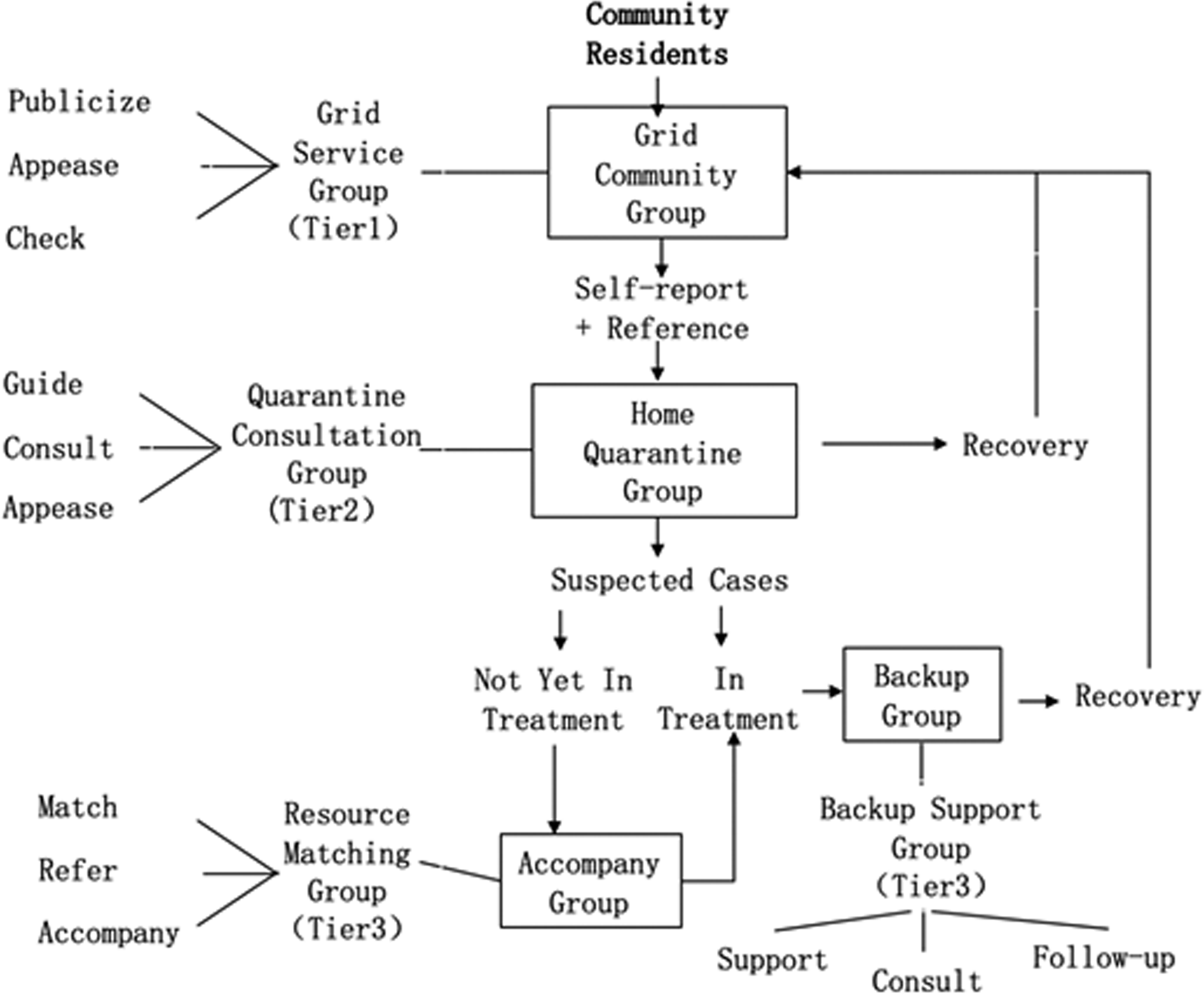
A three-tier prevention approach for social work involvement.
In Tier Two, residents who had suspected symptoms of COVID-19 such as fever were referred by community medical workers to an online “Home Quarantine Group.” In these groups, medical workers provided consulting services for the group members who were required to stay at home and self-quarantine, while the psychological volunteers and social workers provided tips on emotional relief for quarantined residents and their family members. In addition to medical referral services for patients in hospitals, Tier Three specifies the provision of material and emotional support services to accompanying groups, which includes family members of confirmed patients with COVID-19. For the accompanying groups, social workers served as leaders to help assess the members’ psychological status and needs, form mutual aid groups, and link members with available community resources.
Discussion
Under the framework of interdisciplinary remote networking, the three-tier service mode developed by social workers in China highlights the status and needs of the members of the community, and allows for their concerns to be better understood and assistance provided by specific volunteers. The framework is also an efficient operation model for setting up a targeted and sustained service system that links social workers with psychological and medical resources, capitalizing on social resources to buffer the negative impacts of the disease.
Several distinct features of this newly developed service mode based on local Chinese social work practices should be highlighted. First, due to the super contagious nature of COVID-19, online social services played an overwhelmingly effective role in responding to the different needs of clients amid the pandemic. Social distancing regulations have been effective in preventing disease as their aim is to contain person-to-person transmission. To comply with social distancing measures, social workers in China remained actively involved in fighting against this social disaster through remote networking. This is a salient change since traditional social work practices have mainly been conducted face-to-face, and the role of online services is commonly regarded as supplementary. Our three-tier social networking framework is among the initiatives to provide transferrable skills to social work practitioners in providing network-based social work services in public health emergencies and in a broader scope. The online social work groups share similar intervention techniques to face-to-face services, but eliminate the barriers of time and distance by using existing technology-based networks. These advantages are especially important not only to social work service in emergencies but also to people with special needs like disabilities who have difficulties approaching service centers, while research and evaluation into the online groups have lagged behind their use. Future research should examine the characteristics of online social work services under both normal conditions as well as during public health emergencies. This may be achieved by comparing the similarities and differences between online and traditional face-to-face services in operational details and outcome evaluation.
Second, the remote networking service model establishes a new approach for social work in the field of health. Social workers’ active responses to COVID-19 in China highlight the value of the social work profession in community outreach. In this unprecedented pandemic, the community at large has become susceptible to considerable stress regarding the situation, particularly at times when information and knowledge about the crisis are insufficient (Leung & Wong, 2005). In this case, medical social workers and community social workers took decisive action to provide tangible services for people in need by creating a network of existing material and human resources across disciplines. This successful social work involvement serves as the clearest example of the impact of Chinese social work on public health. The COVID-19 outbreak brought the current gaps in global public health security to the forefront of discussion; future research and practice may introduce and promote the implementation of successful Chinese social work programs for international recognition.
Finally, but most importantly, this model sheds lights on the transition from multidisciplinary teamwork to transdisciplinary networking. In the new model, volunteers and professionals from various fields can collaborate and support each other beyond the boundaries of their different disciplines. Multidisciplinary helping professionals can work together to bridge the needs of local communities in frontline zones utilizing online platforms. Social workers play an essential role during a public health emergency, providing critical services for patients and families, medical workers, self-quarantined residents, and the general population. Social workers in China forged partnerships with other service providers and accessed different resources in response to the needs of individuals, families, and communities. This interdisciplinary remote networking implemented in Wuhan may serve as a valuable framework for combating the spread of COVID-19 worldwide. China, as a centralized state emphasizing the authority and responsibilities of the central government, may find it easier than those decentralized states to implement policies in a top-down fashion (León & Orriols, 2019; Yan et al., 2020). Chinese citizens are more likely to adhere to government interventions and normative commitment (Gelfand et al., 2011). This power of monitoring provided the mobilization context of our social networking intervention across nongovernmental organizations. In comparison, those relatively decentralized nations prefer to provide lax restrictions on individuals and share responsibilities to multiple tiers (Goel et al., 2017; Yan et al., 2020). Therefore, future social work involvement in public health emergency should evaluate the distinctive institutional and cultural orientation, before localizing this framework in specific sociocultural contexts.
Limitations of the study
Future implementations of the framework on a broader scale should take several limitations into consideration. First, this pilot study only targeted communities in urban areas of Wuhan City, which have established connections with social service centers and research institutions. Such mobilization may not be feasible for remote village communities or hard-to-reach populations. However, these populations could benefit most from the normalization of online social services provision. To address the needs of those groups, extra resources for the underdeveloped communities should be allocated to assist them access to online social services. Second, each service team in our program consists of four professional online workers and one community worker. This connected network structure of community partnerships requires further evaluation to assess the effectiveness of the programmatic dynamics for conducting system-wide assessment across communities. Third, for the future implementation of such programs, the views and feedback of clients regarding the service, which are crucial to the effectiveness and sustainable development of social work services, should be ascertained.
Conclusions
This study introduces the innovative interdisciplinary remote networking framework that was used for guiding medical and community social workers’ involvement in the COVID-19 response in Wuhan, China. The implementation of interdisciplinary remote networking, which employs a multifaceted, three-tier intervention, effectively addressed the different domains of need experienced by the affected population. It can serve as a valuable framework for combating the spread of COVID-19 in other countries as well as for future interventions in the face of a public health emergency.
Footnotes
Ethics
All procedures in this study were approved by the institutional review board of Wuhan University.
Authors’ contributions
All authors contributed to developing the social networking analysis. ZY conducted the program design, implementation, developed the conceptual framework with YZ and GZ. YZ and QC wrote the manuscript with review and approval by YZ and ZG. The overall study was led by the correspondence author—YZ and funded by YZ’s research project.
Funding
The authors disclosed receipt of the following financial support for the research, authorship and/or publication of this article: This study was supported by the Fundamental Research Funds for the Central Universities and the Research Funds of Renmin University of China (No.: 19XNA007).
