



Abstract
Summary
Forensic social work is the application of social work knowledge, skills, values and ethics within a legal and criminal justice context. Globally, social workers play an integral role in the criminal justice system but in many countries, including Australia, there is limited conception of the competencies needed for this specialist practice. Australia serves as an example of forensic social work regulated through a generalist social work competency framework, where specialist skills and knowledge are not distinctly outlined or assessed. The purpose of this study was to identify the knowledge and skills used by forensic social work practitioners in Australia. This study used a 3-round Delphi method with an expert panel of social workers working in forensic practice across Australia. It consisted of a 1-hour semi-structured individual interview followed by 2 rounds of online surveys.
Findings
Consensus was obtained for 30 skill and knowledge items for Australian forensic social work. The panel identified these competencies as specialist, meaning requiring further training beyond generalist proficiency. Of these, eight of the skill and knowledge items were seen as essential for graduates entering forensic social work.
Applications
The findings from this study contribute to an evidence-based model of forensic social work competency. In Australia, they can be used to consider potential gaps between current generalist mechanisms and specialist practice expectations. With further research, these findings can be used to inform professional standards for forensic social work in Australia and potentially internationally.
Forensic social work is the intersection between social work and the legal and criminal justice systems. It is a sociolegal practice that combines social work ethics, knowledge of the law, evidence-based practice, transdisciplinary knowledge and multidisciplinary collaboration (Harvey, 2020; Lattas et al., 2023; Loue, 2018; Maschi et al., 2017; Reamer, 2023; Sheehan, 2014). As a practice modality, it is focused on the experience of inequity in the criminal justice system, and the advancement of human rights and social justice (Vaughan-Eden, 2022). Forensic social workers employ a dual lens of the individual person-in-context perspective and the macro-level, critical systemic view of social injustice (Harvey, 2020; Maschi & Killian, 2011). They have an important role in upholding social justice in a system that traditionally uses a retributive justice framework (Maschi et al., 2019).
Forensic social workers are employed in a myriad of justice-related settings and roles, including youth and adult probation, parole, mitigation and correctional services, child welfare, immigration, victim services, forensic disability and mental health services (Lattas & Davis, 2023). Forensic social workers engage at all levels of the system, from micro-level-interpersonal direct practice to messo-level-organisational and program development, and macro-level-policy and legislation reform. Their role can be pre-during-or-post engagement with the justice system and can involve working with the individual, the family, or the community. At all levels, forensic social workers advocate for the betterment of justice inequities and disparities (Maschi et al., 2019; Sheehan, 2012; Turner, 2022). Their professional responsibilities vary but can include psychosocial and risk assessments, casework and related duties, behaviour change, therapeutic intervention, community and family work, community re-integration, providing expert testimony, preparing recommendations for court or sentencing or forensic interviewing (Duvnjak et al., 2022; Loue, 2018; Rome, 2013; Turner, 2022). Whilst discrepancies between roles and professional duties exist, this practice speciality is defined through its engagement and collaboration with the justice system, for example, working closely with legal professionals in an adversarial setting or holding contentious forensic statutory obligations.
Forensic social work is a challenging practice speciality. Forensic practitioners regularly face ethical dilemmas, often related to their organisational context and their support of a population that has a wide range of vulnerabilities and needs (Schaffer, 2021; Sheehan, 2016; Reamer, 2023). The professional domain of forensic social work is increasingly dictated by a societal demand for the prediction and mitigation of risk, specifically in relation to recidivism or the maltreatment of children (Sheehan, 2014). Often, such risk management duties sit in conflict to social work values (O'Donahoo & Simmonds, 2016). Several researchers have suggested that social workers need appropriate training on how to uphold professional values within a forensic context (Harvey, 2020; Maschi et al., 2017, 2019; Markham, 2023). In a review of forensic social work education programs in the United States (US), Maschi et al. (2019) argued that critically reflective and reflexive practice skills were fundamental to creating forensic practitioners who were attentive to human rights and social justice disparities. A sentiment echoed by Sheehan (2016), forensic social workers require specialist training so that they can understand and uphold their professional values, beliefs, and knowledge within an adversarial, and often hostile, context.
Much of the scholarly discussion on forensic social work is underpinned by the debate of whether it is a specialist practice or one practice domain within the umbrella of generalist social work (Naessens & Raeymaeckers, 2020; Sheehan 2012; 2016). Without clarity on whether it is a specialist practice, challenges exist in determining educational expectations, competency models and professional development structures (Lattas & Davis, 2023; Maschi et al., 2019). This research project seeks to identify the skills and knowledge needed for forensic social work practice in Australia and consider which if these are a generalist and specialist proficiency. It is the first Delphi method conducted for forensic social work and contributes to the development of an evidence-based understanding of forensic social work competencies.
Forensic social work skills and knowledge
Social workers bring a unique and valuable perspective to the criminal justice system (Naessens & Raeymaeckers, 2020; Robbins et al., 2014; Stout, 2017). The generalist skill set of social work offers a flexible and adaptable model of practice that understands and can respond to the diverse range of needs and vulnerabilities of a forensic cohort (Naessens & Raeymaeckers, 2020; O'Donahoo & Simmonds, 2016; Stout, 2017). Generalist social work is defined through its broad range of tools and practice models positioned as universally applicable to various practice contexts (Lattas & Davis, 2023). The alternative model for forensic social work is specialist practice, which stipulates professional competencies, associated behaviours, and training pathways (Lattas & Davis, 2023; Lattas et al., 2023). Countries that use a specialist model for forensic social work recognise a need for additional skills and competencies related to legal and criminal justice processes and practices (Lattas et al., 2023), including advanced knowledge of the law, court systems and the interrelationship between mental health and offending (Hughes & O’Neal, 1983; Kheibari et al., 2021; Maschi et al., 2019; Maschi & Killian, 2011; Robbins et al., 2014; Sheehan, 2016;).
In several countries, concerns have been raised about the preparedness of social work graduates for forensic practice (Copeland et al., 2022; Kheibari et al., 2021; Maschi et al., 2019; Robbins et al., 2014; Sheehan, 2016; Sinha, 2019). Specifically, student's lack of exposure to specialist knowledge and opportunities for specialist skill development (Casey & Powell, 2022; Kheibari et al., 2021; Sheehan, 2016;); inadequate education responses to the changing landscape of criminal justice-related social issues (Kheibari et al., 2021; Robbins et al., 2014; Maschi et al., 2019); lack of research into effective forensic social work pedagogy, curricula and learning outcomes (Lattas & Davis, 2023; Lattas et al., 2023; Robbins et al., 2014). Maschi et al. (2019) called for the creation and standardisation of forensic educational and professional training competencies in the US. They argued that forensic social work education needs a clear competency structure that establishes and upholds professional standards.
Forensic professional competence is defined as the knowledge, skills, and attitudes that align with specialist practice standards designated by the regulating body (Munson, 2014). Such competency structures are designed to safeguard clients and enhance professionalism. There have been efforts in several countries to establish this, but limited research into the efficacy of these. In the US, forensic social work competence is not defined by the National Association of Social Workers (NASW) or Council on Social Work Education (CSWE); instead, the independent, National Organization of Forensic Social Work (NOFSW) has taken on this duty (Maschi et al., 2019). The NOFSW developed forensic social work guidelines for ethical principles and standards; these guidelines can be used to inform professional standards but are not otherwise enforceable (NOFSW, 2020). By contrast, the United Kingdom (UK) has the Forensic Mental Health Social Work Capabilities Framework, endorsed by the British Association of Social Work (BASW) (Bogg & Barcham, 2016). This framework is a post-qualifying guide; it identifies the skills and knowledge needed at a new graduate, social worker, experienced social worker and advanced or strategic social worker level. There is limited research into how this framework develops and upholds practice standards and supports professional development. Canada uses a largely generalist social work model of forensic social work; the Canadian Association of Social Workers (CASW) notes criminal justice as a scope of practice: ‘clinical social work services that require additional training and competence’ (CASW, 2020, p. 3), but it is not recognised as a distinct specialisation. Canada has an independent professional association for forensic social work: the National Institute of Forensic Social Work (NIFSW). NIFSW does not provide practice standards but did partner with Dalhousie University to offer a continuing education pathway for forensic social work. In Australia, there are no forensic-specific social work competency framework practice standards (Ogloff & Sheehan, 2014). Forensic practitioners are reliant on generalist social work practice standards (AASW, 2023) or non-profession-specific forensic practice standards (AIHW, 2006; Hanley & Ross, 2013).
Australian forensic social work is regulated as a practice domain within generalist social work. This means it is governed by the national professional organisation, the Australian Association of Social Work (AASW). The AASW does not outwardly offer support for forensic social work as a specialisation; it does not offer a forensic credentialing pathway or scope of practice. There are no clear forensic social work education pathways available in Australia, and largely, forensic studies in the undergraduate social work studies rely upon interdisciplinary knowledge from criminology and sociology (Lattas & Davis, 2023). In the mid-2010’s, Monash University introduced Australia's only forensic social work course, the Master of Social Work (Forensic Studies), but this course was decommissioned after a few years. At present, Australian forensic social workers must rely on their generalist qualifying education and on-the-job training and learning. Australia does not have a professional association equivalent to the NOFSW; as such, there is limited and fragmented understandings of forensic social work as a distinct community of specialists. Australian social workers are not given guidance regarding the level post-generalist study or professional development required for forensic practice. As such, Australian forensic social workers must develop their own framework and understanding of competence.
This research project aims to clarify the skills and knowledge needed for Australian forensic social work by consulting a panel of experienced forensic social workers through a Delphi method. This research is guided by the research questions: (a) What skills and knowledge are needed for forensic social work in Australia, (b) Does forensic social work require specialist skills and knowledge from generalist trained social workers and (c) What forensic skills and knowledge are industry professionals looking for in social work graduates?
Method
This research project conducted a mixed-method Delphi study with three rounds. The Delphi study is a structured communication methodology that engages a group of experts to clarify and reclarify their opinions to obtain a consensus on a specific topic (Barrett & Heale, 2020; Jefferies et al., 2023). Whilst initially a market research tool, the Delphi research method is now widely used in health and allied health research to connect empirical research and clinical/practice wisdom (Beddoe et al., 2016). It is a practice-led research method characterised by its participant expertise, anonymity during participation, multiple rounds of questions and a feedback process with participants (Monforte et al., 2022). Its strengths are in its participatory design, which uses the voices of experienced practitioners (Beddoe et al., 2016). This Delphi study was designed as a three-round project: the first round was a 1-hour interview followed by two online surveys. Ethics approval for this study was provided by the University of Sunshine Coast (Ethics #A221822).
Recruitment
Participants were qualified social workers with a minimum of two years of experience in a forensic setting. A forensic setting was defined as one that intersects heavily with the law and/or criminal justice system. This included custodial environments, forensic mental health, family court, forensic-specific private practitioners, and child protection. Participants were recruited from professional networks and strategically recruited based on their organisational context. One of the challenges with the Delphi method is defining an appropriate sample size (Beddoe et al., 2016). According to Chalmers and Armour (2019), the ideal number of participants in a Delphi is between 25 and 30. Sampling concerns with a Delphi study include the recruitment of experts who support the researcher's interest, the definition of expertise and what constitutes an appropriate sample size (Beddoe et al., 2016). The researchers made efforts to recruit a diverse pool of participants, including various locations, roles and services.
Invitations to participate were sent via email and social media platforms. Purposive sampling was used to recruit participants from forensic organisations, mental health, corrections, youth justice, court services, child protection, victim services and private practitioners working with forensic clients. The research team searched Google and job advertisement websites to identify forensic institutions who hire social workers. In addition, individual participants were sought and contacted via LinkedIn by searching ‘forensic social worker’. Snowball sampling was used by asking participants to share the invitation to participate with relevant contacts. The same participants completed all three rounds.
Participants
Participants included 26 social workers with various roles, including 38.5% (n = 10) in management, 23.1% (n = 6) at social worker or equivalent, 15.5% (n = 4) at a senior level social worker and 15.5% (n = 4) in private practice. Forensic practice experience ranged between 2 and 32 years (μ: 14.58; SD: 8.31); over half of the participants (61.5%, n = 16) had over 10 years of forensic experience. Participants were recruited from across various forensic fields, with 42.3% (n = 11) in forensic mental health, 38.5% (n = 10) in corrections, 30.8% (n = 8) with children and families, 15.5% (n = 4) in youth justice and 7.7% (n = 2) with victims of crime.
Demographic data revealed that the majority of participants identified as female (69.2%) and only 11.5% (n = 3) identified as First Nations. Participants ranged in age from 30 to 62 (μ: 45.9, SD: 10.53). Participants were represented from most states and territories across Australia from Queensland 46.2% (n = 12), New South Wales 11.5% (n = 3), Tasmania 11.5% (n = 3), Victoria 11.5% (n = 3), Northern Territory 7.7% (n = 2), South Australia 7.7% (n = 2) and Western Australia 3.9% (n = 1). The participants also represented a mixture of urban 57.7% (n = 15) and regional 26.9% (n = 7) contexts. In this study, a regional context was defined as a smaller non-metropolitan region characterised by geographically distance to its urban counterparts, lower population density and reduced economic activity.
Round one
Process
The first round was a 1-hour semi-structured interview. Round one used a semi-structured interview method to fulfil the Delphi goal of generating large amounts of data in the first round (McPherson et al., 2018). Participants completed their interviews online via Zoom and Microsoft Teams. Each interview started with a series of qualifying questions about their education and employment history, and the interviews were structured around ten open-ended questions. The interviewer asked the practitioners to reflect on their employment history, the experience of working in forensic settings and with forensic clients, and how they learnt the skills and knowledge needed for their roles (see Appendix 1 for details). The interviewer allowed participants to follow their own interests and discuss relevant issues in addition to the questions posed, but prompts were used to refollow the question sequence when needed. The interviews were recorded via Zoom or Microsoft Teams, and Otter.ai was used to assist with the transcriptions (Corrente & Bourgeault, 2022). Interview transcripts were crosschecked with audio recordings by the lead researcher. Transcripts were uploaded and coded in the NVivo software program for data analysis.
Results
The first cycle of coding was completed in NVivo using a description-focused methodology whereby relevant statements were extracted and labelled. Codes used representative statements from the data, exact language was used where possible, and the research team formulated a similar code where verbatim was not possible. In the first cycle of coding, 290 primary codes were utilised which represented a skill, knowledge or value mentioned as important by a participant to their role as a forensic social worker.
The second coding cycle organised the codes into categories. Codes were reviewed for overlap, relevance to the research questions, and frequency of mentions by different participants in Round 1. To proceed to Round 2, a code needed to be referenced by 4 or more participants in the Round 1 interviews. Of the 290 codes, 101 codes proceeded to Round 2 and were grouped within six categories: Core Values, Direct Practice Skills, Ethical Considerations, Documentation, Knowledge, and Theories. Coding was checked and validated independently by a second researcher on the research team.
Round two
Process
Round two was an online survey designed in Qualtrics. The second Delphi round aimed to confirm and reclarify the statements’ accuracy from round one (McPherson et al., 2018). The survey used a five point Likert questionnaire to rank the codes on a spectrum of generalist-speciality knowledge and skills: (1) Not Applicable to a forensic setting; (2) Learnt outside of social work education; (3) Generalist social work knowledge is sufficient; (4) Some further training is needed for a forensic setting/cohort; (5) Advanced specialised forensic social work education/training needed. Participants could only select one rank for each skill and knowledge item.
Results
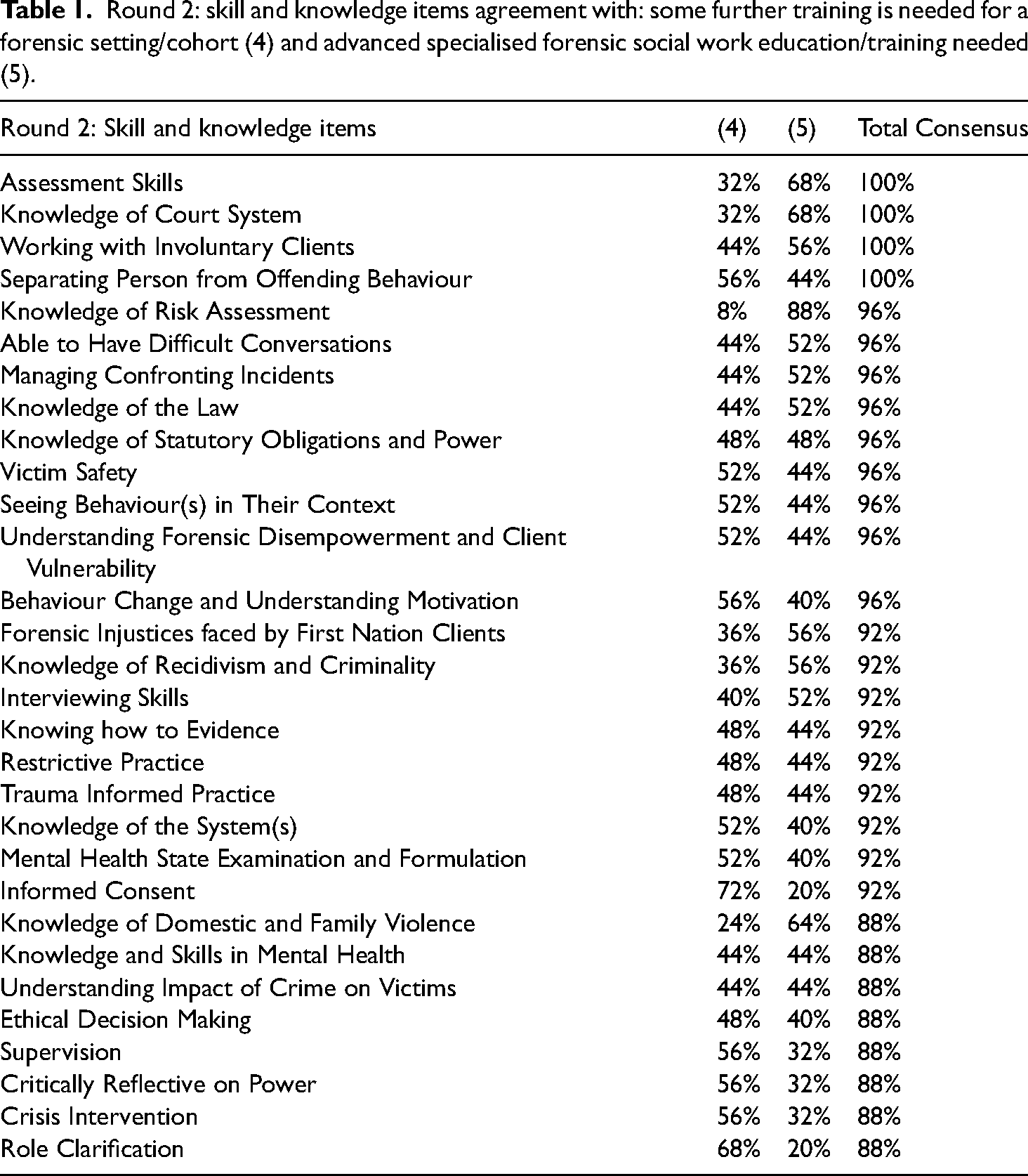
Twenty-five participants completed the round two anonymous survey, and one participant partially completed. The partially completed survey was excluded from the final statistics to preserve data integrity. The survey data was exported from Qualtrics and analysed in IBM SPSS Statistics, Version 29. The research team used descriptive statistics to measure consensus and understand the speciality rating of each skill or knowledge item. Consensus was measured at over 85% of the participant's ranking of the skill or knowledge item in the top two tiers of the Likert scale: Some further training is needed for a forensic setting/cohort (4) and Advanced specialised forensic social work education/training needed (5). The consensus rule followed principles from Monforte and colleagues (2022) and Stewart and colleagues (2017). A skill or knowledge item that did not achieve an 85% consensus indicated that the panel felt this was obtained through generalist social work education. Of the 101 skills, knowledge and values surveyed in round two, 30 had a consensus ranking of over 85% (See Table 1). None of the Round 2 skill and knowledge items were ranked as ‘not applicable to a forensic setting’ by any participant.
Round 2: skill and knowledge items agreement with: some further training is needed for a forensic setting/cohort (4) and advanced specialised forensic social work education/training needed (5).
Round three
Process
Round three, the final round of this Delphi study, sought to reconfirm and obtain a final consensus on the skills and knowledge identified in the previous rounds (McPherson et al., 2018). This round was an anonymous online email survey via Qualtrics. In this round, participants were asked to re-rank the 30 skills and knowledge from Round 2 in a ‘drag and drop’ format. Participants were asked, ‘If you were hiring a social worker in your forensic setting which of the following skills, knowledge and values would you see as “essential” to be hired and which would be “desirable” (e.g., can develop later)?’, and had to drag each item into either ‘Essential: Applicants must have this’ or ‘Desirable: Not required and can be developed later’.
Results
All 26 participants completed round 3. Consensus was set at above 80%; reflecting that more than 80% of the participants felt that this was an essential skill or knowledge item for forensic social work practice. Out of the 30 skills and knowledge, eight items met the consensus ranking, these included:
Able to Manage Confronting Incidents: This skill had the highest consensus ranking within the study, with 88.5% (n = 23) of participants seeing it as essential. Given the complex and often high-risk nature of forensic work, practitioners have a greater likelihood of being exposed to situations which are emotionally unsettling, physically unsafe or even potentially traumatising, including witnessing self-harm, violence, seclusion or restraint (Munobwa et al., 2023; O'Donahoo & Simmonds, 2016; Reamer, 2023). Managing an incident requires an awareness to the safety of all relevant parties, including the client and the practitioner, and using appropriate skills and methods to de-escalate and reduce further risks (Broadley & Paterson, 2020). It involves communication skills, professionalism, self-awareness, knowledge of risk, and understanding the reasons behind why incidents occur. In Australia, this skill is not named in the Australian Social Work Education and Accreditation Standards (ASWEAS) (AASW, 2020b), as such social work education institutions are not obligated to teach students how to handle confronting incidents (Broadley & Paterson, 2020). Research has suggested that due to inadequate professional attention to this issue, social workers often adopt the coping strategies from their organisational context and culture rather than a profession-specific framework (Munobwa et al., 2023). As such, incidents are commonly minimised as a ‘part of the job’ and any psychological distress experienced by the practitioners is framed as the individual's lack of resilience (Broadley & Paterson, 2020). In forensic social work literature, little attention has been paid to the tools and skills for handling confronting incidents, or a profession-specific framework for managing confronting incidents. Able to Separate the Person from the Offending Behaviour: Consensus ranking: 84.6% (n = 22). This skill is built upon the fundamental social work values of dignity, human rights and strengths-based practice (Duvnjak et al., 2022). It recognises the capabilities and potentials of the individual, rather than a traditional deficit model that focuses on negative attributes and labels. It is well recognised that criminal justice labels, such as offender and inmate, impact identity and reinforce notions of deviancy (Nguyen & Van Ngo, 2021). The deviant or anti-social behaviour becomes enmeshed with the whole being of the individual; social theorists have argued that this can encourage a further immersion into deviant subcultures and increase risk of reoffending (Nguyen & Van Ngo, 2021). Labelling reinforces self-stigmas and exacerbates social exclusion and inequity. Forensic social workers need to engage with anti-labelling practices to hold a perception of the individual as separate from offending behaviour. This acknowledges the complexities of the individual, and sees them as more than their history, diagnosis or actions. It encourages an awareness to the contextual and structural reasoning behind offending behaviour, for example poverty, historical experience of abuse and trauma, and maladaptive coping strategies (Levenson, 2016). Ethical Decision-Making Skills: Consensus ranking: 84.6% (n = 22). Ethical decision-making is a foundational social work skill in any practice domain (AASW, 2020b). It is practice method and process to ensure that the practitioner's actions and judgments are morally correct and professionally grounded (Bonner & Vandecreek, 2006). Ethical decision-making can be a structured tool or framework for engaging with critical reflection, scholarly literature, professional Code of Ethics, organisational policies and procedures, or consultation with supervisors to consider possible actions and outcomes. The presence of legal obligations and dimensions in forensic social work adds a layer of complexity to these ethical dilemmas (Allardyce & McAfee, 2016; Reamer, 2023). Whilst ethical decision making is a core competency of Australian generalist social work (AASW, 2020b), in Round two, 88% of participants felt that further development was needed to develop proficiency for forensic practice. This was echoed in Reamer's (2023) research, which contended that further development is needed to create a forensic social work specific ethical decision-making model. Knowledge of Trauma Informed Practice: Consensus ranking: 84.6% (n = 22). Trauma informed practice is a frequently used method in social work practice (Levenson, 2017). It is an approach to practice which recognises the long-lasting and adverse impacts of trauma. Early exposure to trauma and adverse experiences can affect development, neurochemistry and functioning and compromise self-regulation mechanisms (Levenson & Willis, 2018). Forensic populations have a higher-than-average exposure to trauma and adverse childhood experiences (Levenson & Grady, 2016). There is increasing acknowledgement of the relationship between trauma and adverse childhood experiences and offending, mental health and substance misuse (Lattas & Davis, 2023; Levenson & Grady, 2016; Sheehan, 2012). Forensic social workers can use trauma informed knowledge to develop appropriate treatment plans, provide legal decision makers with potential mitigation factors, and develop holistic and client-centred intervention strategies. Assessment Skills: Consensus ranking: 80.8% (n = 21). A social work assessment is the process of gathering information to assist the practitioner in understanding their client's wellbeing, situation, strengths and needs (Pomeroy & Garcia, 2017). Practitioners are required to analyse and interpret this information to make informed decisions about the next steps. They occur in an interview format and are often structured by organisation of specific tools and instruments. In forensic social work, assessors can inform courts or tribunals on the mental wellbeing or potential risks, such as soundness of mind, formulation, the prediction of risk of recidivism, violence and suicide/self-harm (Sheehan, 2016). These assessments can be used in court proceedings and impact decisions regarding release or intervention plan. Forensic assessments involve skills in observation and documentation, and knowledge of risk and of static and dynamic factors contributing to individual risk, cultural competency and professional values (Munson, 2011; Pomeroy & Garcia, 2017). Informed Consent: Consensus ranking: 80.8% (n = 21). Informed consent is both a legal and ethical obligation for social workers. It involves using adapted and appropriate communication strategies to ensure that the client understands the potential risks, benefits and alternatives to the proposed interaction (Burkemper, 2004; Drisko, 2021). One of the complexities in forensic social work is the involuntary nature of the client-practitioner interactions (Butters & Vaughan-Eden, 2011). It is the practitioner's responsibility to explain the nature of the interaction, limits of confidentiality and extent to which client can refuse service (Drisko, 2021). In addition, there is increasing awareness to the prevalence of cognitive impairments in the criminal justice population (Catalano et al., 2020). It is important that forensic social work practitioners understand the complexities of engaging a vulnerable involuntary client group, and how to engage in a consent process that ensures understanding of potential implications of client participation. Interviewing Skills: Consensus ranking: 80.8% (n = 21). Interviewing skills are a core component of social work practice. Interviews are conversational but require the practitioner to translate and vocalise their knowledge to aid and illicit information from the client (Trevithick, 2012). There are several skills built within interviewing, including active listening, empathy, rapport building, non-verbal communication, self-disclosure and use of self, and communication techniques. In forensic social work, interviewing skills are important to assist the practitioner in gathering accurate information, building rapport with clients, and conducting thorough assessments (Guin et al., 2003). For Round 2, 92% of participants felt that further training and education was needed to understand interviewing skills with a forensic client. Knowledge of Domestic and Family Violence: Consensus ranking: 80.8% (n = 21). Domestic and family violence are behaviours and actions perpetrated in an intimate or family setting that can include coercive control, sexual, physical, financial and emotional harm (Tarzia et al., 2017). The widespread and detrimental impacts of domestic and family violence are well documented (Pfitzner et al., 2022). Forensic social workers can support either perpetrators or victims of domestic and family violence (Lattas & Davis, 2023; Sheehan, 2012). They are involved with risk assessments, safety planning, sentencing reports and interventions (Rome, 2013). Domestic and family violence is recognised as a critical competency for social workers in Australia. It was introduced as a core competency in the ASWEAS, but in addition, the AASW released the Family Violence Capability Framework and the Family Violence Credential after the Victorian Royal Commission into Family Violence (Crisp, 2019). As such, Lattas and Davis (2023) found that much of the forensic studies in Australian undergraduate social work is centred on domestic and family violence. At present, little research has explored the influence and implications of the capability framework and credential in Australian social work, and as a proficiency for forensic practice.
Only one item met the consensus rating for ‘desirable, can develop later’, which was knowledge of the law. Consensus ranking: 84.6% (n = 22). This refers to the practitioner's comprehension and awareness to their legal obligations and duties, procedural rules and regulations, and the ability to engage with legal professionals. Knowledge of the law as a forensic social work skills has been well documented in previous scholarly literature (Green et al., 2005; Barker & Branson, 2014; Sheehan, 2012; 2016; Maschi et al., 2019). Whilst 96% of the participants in Round 2 identified this as specialist knowledge, in Round 3, the majority did not consider it essential for graduates entering a forensic social work role.
Discussion
This study provided an opportunity for a panel of experts to engage in a consensus-gaining process to identify the skills and knowledge needed for Australian forensic social work. It was limited to practitioners within Australia, which has a federal system of government, meaning that each states have its own legal and regulatory systems; as such, the conception and duties of forensic social work in each state are different. Despite these limitations, the study has several strengths, including panellist participation: all-rounds had a 97% to 100% completion rating, and panellist experience: 61.5% of panellists had over 10 years of experience in forensic social work. This project was the first use of a Delphi method to identify the skills and knowledge needed for forensic social work. It identified a set of knowledge and skills as specialist, meaning beyond what was taught in generalist education, and several as essential to the role. It contributes to the evidence-based understand of forensic competency and can be a useful tool for developing forensic social work training.
The skills and knowledge found in this study are largely consistent with existing literature, including, the need for ethical decision-making and forensic interviewing skills (Casey & Powell, 2022; Reamer, 2023; Sheehan, 2016). However, there were notable shifts in the consensus rating between Round 2 and 3. For example, knowledge of mental health went from an 88% consensus with further specialist training needed in Round 2 to 35% felt that it was an essential skill for social work graduates being hired in Round 3. Similarly, the skill of working with involuntary clients went from 100% consensus in Round 2 to 76.9% felt that it was an essential skill for social work graduates being hired. In addition, understanding forensic injustices faced by First Nation clients, there was a 92% consensus that further specialist training was needed, but only 53.8% felt that it was an essential skill for social work graduates being hired. There are several considerations for the changed consensus ranking, including the participant's practice context and focus, or their differing views constitutes ‘essential’ or ‘desirable: can be learnt later’. However, given the over-representation of Aboriginal and Torres Strait Islander people in prison and the AASW commitment to partnering with First Nations People (AASW, 2023; Jarldorn, 2020), there is a need to develop a more comprehensive understanding of Australian forensic social work as a practice speciality that works alongside and in partnership with Aboriginal and Torres Strait Islander peoples and actively seeks to reduce systemic disadvantage.
The findings from this study indicate that further research is needed to consider if Australian generalist social work education develops the skills and knowledge needed for forensic practice. Several of the identified forensic social work skills and knowledge items are present in the current ASWEAS (2020b) and AASW Code of Ethics (2020a). The results from Round 2 underscore a consensus that these competencies are beyond what is covered in generalist education. Such findings align with previous research that generalist social work knowledge and skills need adaptation to meet the complexities found in forensic practice (Green et al., 2005; Sheehan, 2012, 2016), and indicate that a gap exists between generalist education and forensic practice expectations. Using the knowledge and skills found in this study, further research should consider student preparedness for forensic practice.
Although the project is undertaken in an Australian context, the approach to mapping forensic skills and knowledge has wider application in the development of forensic professional competency internationally. The development of educational standards and professional competencies for forensic social work involves a multitude of stakeholders, including, practitioners, academics, community and clients (Maschi et al., 2019; Munson, 2011; Turner, 2022). The Delphi method is one step in developing forensic competency structures using practitioner voices. Thirty forensic social work skill and knowledge items were found to be specialist and a further eight as essential proficiencies for graduates. These findings can serve as an evidence-based understanding of forensic social work competencies and be a useful tool for developing forensic social work training in Australia. Further research is needed to consider how current social work education programs foster proficiency in the identified knowledge and skills for forensic social work. Whilst outside of the scope of this research project, further consultation and research is also needed to consider these skill and knowledge items with other relevant stakeholders.
Footnotes
Ethics
Ethics approval for this study was provided by the University of Sunshine Coast (Ethics reference number #A221822).
Funding
The authors disclosed receipt of the following financial support for the research, authorship, and/or publication of this article: This research was funded by Higher Research Degree Commonwealth Support to support the completion of a doctoral degree.
Declarations of conflict of interests
The authors declare that there is no conflict of interest.
Authors’ contributions
DL, GJ, CD and CC were responsible for the research design and methodology. DL was solely responsible for data collection and led the analysis. CD, CC, GJ, and ST provided guidance and feedback on data collection, analysis, and results. DLs wrote the submitted manuscript. CD, CC, GJ, and ST reviewed and provided feedback on the final manuscript.

Appendix 1