



Abstract
Summary
Results of our previous research indicated that older adults believe that there's a lack of sufficient social support from informal sources available to them in difficult situations they face. In follow-up research, we found that older adults defined limitation in their self-sufficiency in daily activities to be the most significant difficult situation for them. This paper disseminates the results of the research seeking to answer the research question: According to older adults, can family be a source of social support in a difficult situation of limitation of self-sufficiency in daily activities? Social support theory is the used theoretical basis. Using the method of qualitative content analysis we analysed 23 semi-structured interviews with older adults.
Findings
We found that if two conditions, that is, geographic proximity to individual family members and the quality of relationships with family members, are ensured, family can function as one of the informal sources of social support according to older adults. In case that older adults prefer a formal source of social support, they consider their family as a source of social support only in an extreme situation of limited self-sufficiency.
Applications
This study provides social workers with a better understanding of the difficult situations of older adults and what kind of social support older adults prefer. This study also provides an argumentation about the importance of gerontological social work.
Introduction
In our previous research studies ‘Analysis and Description of Availability and Sources of The Social Support in Selected Difficult Situations for Seniors by Type of Their Household in the Czech Republic’ (Kowaliková & Chytil, 2019), we investigated the sources of social support and the anticipated availability of social support for older adults. We found that in difficult situations, older adults expect a lack of availability of social support from informal sources. However, the interpretation of this finding remained problematic, given that it was not clear to us which difficult situations older adults might have in mind, nor was it clear to whom older adults would turn in a difficult situation.
In follow-up research (Kowaliková & Chytil, 2022), we investigated how older adults define difficult situations, and what the sources and availability of social support (anticipated and received) in those defined difficult situations are. We found that older adults defined limitation in their self-sufficiency in activities of daily living as the most significant difficult situation (current and possible future difficult situation).
Based on our previous findings (Kowaliková & Chytil, 2019, 2022), we asked the research questions: ‘According to older adults, can family be a source of social support in a difficult situation?’, and ‘What are the limitations of self-sufficiency in daily activities?’.
Theory
When defining the concept difficult situation for older adults, the authors tend to also make use of other terms such as stressful situation (Špatenková et al., 2017; Sýkorová, 2011) and everyday situation (Dykstra, 2015; Russell, 2007; Tanner, 2007).
The theoretical basis for conceptualising the concept of difficult situations of older adults is the life situation. We understand a life situation as ‘a complex of diverse circumstances. These circumstances include both the characteristics of individuals or groups and the characteristics of the environment in which these individuals and groups live’ (Musil, 2004, p. 15). The concept of life situation is broader and includes a complex of diverse circumstances. Difficult situations, on the other hand, represent only part of a life situation that is characterised by the occurrence of one or more problems.
According to Mareš (2001), social support is a multidimensional construct and therefore it is not easy to give one definition that would express all its dimensions. The construct of social support is embedded in sociology, psychology, medicine, and is melding into other disciplines too. It is a construct that varies over time and changes depending on different situations, life events, age, and social inclusion of the individual. At the same time, social support has an interactional form and therefore can be perceived differently by the provider, the recipient and the independent observer. It can have both positive and negative effects.
We understand social support as a phenomenon that contains selected available dimensions, as shown in Table 1.
Dimensions of social support.
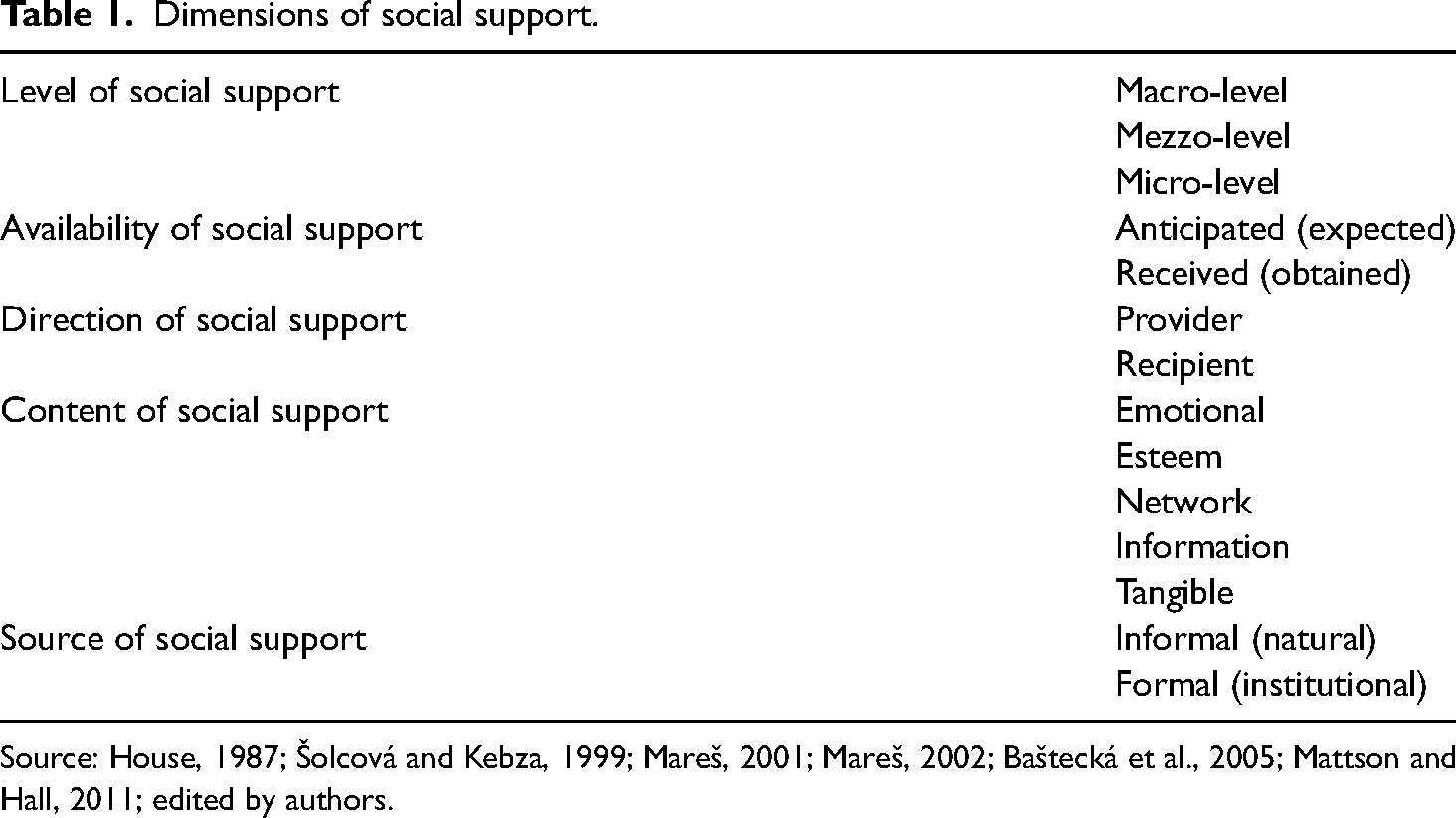
Source: House, 1987; Šolcová and Kebza, 1999; Mareš, 2001; Mareš, 2002; Baštecká et al., 2005; Mattson and Hall, 2011; edited by authors.
According to Šolcová & Kebza (1999), social support is provided at different levels – the macro, mezzo, and micro level. Macro is the level of participation of an individual in the activities of the closest community. The mezzo level is determined by the range and quality of the structure of the individual's social network. The micro level is defined by the quality of intimate relationships of an individual. Furthermore, Šolcová & Kebza (1999) show the distinction of social support according to what older adults might anticipate and what they actually receive. Anticipated social support is perceived within the conviction that if it is necessary, help from close relatives will be provided if needed. On the other hand, the received social support represents the actual social support that individuals receive. Anticipated social support reflects the general expectations of an individual, while the received social support is based on a person's experience in a specific situation. The social support direction determines whether social support is provided or received. Mattson and Hall (2011) distinguished five types of social support regarding its content.
Emotional support includes the emotional and affective needs of individuals related to their difficult situation (e.g., cheering up an older adult when feeling down). Support in ensuring self-esteem and confidence encourages individuals to take action to solve their problem or difficult situation (e.g., strengthening older adult self-awareness and strengths). Network support affirms that individuals are part of a network of social relationships (e.g., older adult awareness of the existence of friendly relations in the neighbourhood). Information support provides individuals with the necessary information in the decision-making process when trying to solve some difficult situation (e.g., provision of advice or information regarding the social services offer). Tangible support takes the form of specific assistance provided to an individual by another person (e.g., assistance in the household).
Baštecká et al. (2005) distinguishes informal (natural) sources of social support (family, relatives, friends) and formal sources of social support, such as helping professions, religious organisations, support groups organised by professionals and self-help groups.
Methodology
The qualitative content analysis by Schreier (2012) is a method for systematically describing the meanings of qualitative material. This method leads to a description of the main categories and subcategories of the coding framework. In this article, we present the partial results of the research Social support for older adults in difficult situations – implications for social work. The aim of the research was to find out what dimensions of social support and to what extent these are available to older adults in selected difficult situations, depending on their household type. In this article, we do not deal with the entire coding framework related to the research. The authors present previous research findings and a description of the coding framework in those texts (anonymised). This article only answers a sub-research question: According to older adults, can the family be a source of social support in a difficult situation of limited self-sufficiency in daily activities?
Using the qualitative content analysis, we described latent meanings of qualitative material analysed. We worked with qualitative material that included verbatim transcripts of semi-structured interviews with communication partners. The research began by developing a coding framework following a deductive reasoning principle (‘concept driven way’). The categories of the ‘concept driven way’ coding framework were identified and defined based on theories and selected research on social support for older adults in difficult situations. The qualitative content analysis process was used to further define categories and subcategories following an inductive reasoning principle (‘data driven way’).
Following the recommendations by Schreier (2012), we began by carefully reading the qualitative material and identifying relevant sections in relation to the research question. For the relevant parts of the qualitative material, we step-by-step created a summary of the material (‘summarisation’). In the process of creating the categories and subcategories of the coding framework, we also used the contrasting technique. This technique allowed us to identify differences in relation to difficult situations defined by older adults and sources of social support, with respect to the research sample.
Our research set only one criterion for the research sample that an older adult (for whom we consider an individual who has a legal entitlement to a retirement pension, according to the Pension Insurance Act No. 155/1995 Coll.) resides in his or her natural social environment. We chose this definition because social old age defined by retirement is associated with a change in lifestyle, a change in needs, and a change in social roles (Haškovcová, 2010; Přibyl, 2015), and these changes may affect the level of social support to older adults. In our analysis, we also note differences in the answers of older adults according to the type of their households. The household is comprised of persons living together in one flat (Czech Statistical Office, 2015). We distinguish between a one-person household of an older adults and a two- and multi-person household of an older adults. We further distinguish a specific type of the one-person household – ‘Living Apart Together (LAT)’. According to Levin and Trost (1999), the term LAT is a couple (either unmarried or married) that does not share the same household. Each of the partners lives in their own household but perceive themselves and by their surroundings as an unmarried or married couple. The presumption that people enter into a new relationship after the age of 69 is declining, while the possibility that older adults will choose to live separately is increasing (De Jong Gierveld, 2002). According to research by Karlsson and Borell (2002), this life stage is marked by the loss of a partner due to death or divorce. The fear of older adults of being and feeling lonely or the effort to maintain independence lead to the formation of the LAT relationship between these older adults. Many older adults who have been living in a one-person household for a long time have become accustomed to this situation and may find it difficult to adapt to someone else's lifestyle.
According to Yeh and Lo (2004), older adults who live in one-person households experience a lower rate of social support and greater feelings of loneliness. Similarly in our research (Kowaliková & Chytil, 2019), we came to conclusion that older adults living in one-person households reported a lower rate of anticipated availability of social support in a difficult situation than older adults living in two- and multi-person households.
We applied a deliberate sampling of communication partners through institutions; communication partners were approached by social workers of home care services and the head of the older adults’ club, so it was a deliberate sampling through institutions. The research sample consisted of a total of 23 communication partners. All communication partners lived in municipalities with population exceeding 10,000. Deliberate sampling through institutions (older adult club and home care service) was chosen to obtain a sample that would represent older adults who are aging in their natural social environment while ensuring some degree of heterogeneity in the senior population. Interviews with communication partners (members of the older adult club) were most often conducted in the premises of the club whereas interviews with communication partners (home care service clients) were most often carried out in the older adult homes. The University of Ostrava provided ethical approval for this project. We declare that the research has been approved by the scientific committee that supervises dissertation research by students at the University of Ostrava as part of their doctoral studies. In the Czech Republic, this type of research is not subject to any other ethical approval requirements.
We carried out 10 interviews with older adults who are the clients of home care services. In the following section, we present the statements of the communication partners and the abbreviation of the older adult category along with its order number and an indication of the typology of the older adult household, for example, 1HCS, one-person household. Seven communication partners were included in the category of one-person household of older adults. None of the communication partners fell into the category of a one-person ‘Living Apart Together’ (LAT) household. And finally, we ranked the three remaining communication partners in the category of two- and multi-person households. We conducted research with six women and three men. One married couple participated in one of the interviews. The average age of all communication partners was 82 years. Interviews with this group of older adults lasted an average of 77 min, with the longest interview lasting 143 min and the shortest 43 min.
A total of 13 interviews were conducted with older adults from the seniors’ club member category. In the following section, we present the statements of the communication partners and the abbreviation of the older adult category along with its order number and an indication of the typology of the older adult household, for example, 2SC, two- or multiple-person household. We ranked five communication partners in the category of a one-person household of an older adult, two in the category of a one-person LAT household, and six in the category of two- and multi-person households. We conducted research with nine women and four men. The average age of all communication partners was 75 years. Interviews with this group of older adults lasted an average of half an hour, with the longest interview lasting 91 min and the shortest 16 min.
Research results and discussion
We used qualitative content analysis by Schreier (2012) to investigate whether older adults believe that the family can be a source of social support in a difficult situation such as limited self-sufficiency in daily life activities. We were interested in the perspectives of two categories of older adults – home care service clients and seniors’ club members. We also looked at whether the type of household that older adults live in is linked to their family's capabilities as a source of social support.
The older adults were convinced that the most important difficult situation is the limitation of their self-sufficiency in daily activities. In this context, older adults described what their days look like and identified difficult situations in them. As a rule, they talked about activities related to self-care, household care, and leisure activities.
Older adults (home care service clients)
Received formal and informal source of social support
Older adults (home care service client category) in need of assistance due to the limitation of their self-sufficiency receive help from social and health care services, or a combination of social and health care services and help from their family members. An example is the communication partner (1HCS, one-person household) who stated that the source of social support for her in meeting her daily needs is a combination of home care services, health care service, and family members, which allows her to ‘age in a natural social environment’: ‘I’m surrounded by carers. They (son with daughter-in-law and grandson) live next door, and whenever something is going on they come right away. My grandson who lives next door, comes to see me every day. Whatever I need help with, he helps me – he goes grocery shopping or does cleaning chores for me’. (1HCS, one-person household).
According to the statements of communication partners, there are two main conditions that allow the family (if older adults have one) to be a source of social support in a difficult situation characterised by limited self-sufficiency. The first is geographic proximity to individual family members, and the second is the quality of relationships with individual family members. This is evidenced by the statement of the communication partner (3HCS, one-person household), who responded that when she needs something, she turns to her niece, with whom she has the closest relationship: ‘My niece helps who lives nearby helps me. When she comes by, we chat, she trims my trees, gives me advice what and how to do it, and organises everything’. The importance of geographic proximity of family members for the availability of social support for older adults has been noted, for example, in a study by Lorca and Ponce (2015) and research by the group of authors Evans et al. (2017). It is already a study by Shanas (1979) that refers to the older adult close family (children, siblings, and other relatives) as the main source of social support. The author found that when in need of any assistance, older adults first turn to their families for help, then to neighbours, and finally to formal sources of social support such as social workers. Li, Ji, Chen (2014) also states that intimate relationships are often formed in the family, and therefore family members are the first choice of older adults when asking for help in difficult situations. In addition, research by Gallardo-Peralta et al. (2018) demonstrates that informal sources of social support are associated with a higher quality of life of older adults.
We found that this category of older adults (home care service clients) has the opportunity to combine formal and informal sources of social support in a difficult situation, which is the limitation of self-sufficiency in daily activities. The possibility of combining sources of social support is due to the fact that older adults are clients of home care services and at the same time have family members nearby with whom they have good and close relationships.
Information and communication technologies as an instrument of received informal source of social support
Another communication partner who lives in a household with her husband (8HCS, two- and multi-person household) answered that she has a daughter and a son who live far away, but she at least maintains a telephone contact with them: ‘We talk on the phone and use a video application. If we can’t see each other in person, we manage this way. First there was a computer and Skype, and now I have this smart phone and I have a Viber application installed’. In this case, even if both conditions (geographic proximity to individual family members and quality of relationships with individual family members) have not been met for the family to be considered a source of social support, family members still partially contribute to providing social support in the older adult's difficult situation. The communication partner (8HCS, two- and multi-person household) stated that her children help her financially and emotionally ‘from a distance’. This communication partner's statement can be used to illustrate that if the condition regarding the quality of relationships with family members is ensured, the family can, according to the older adults, in part provide social support. With information and communication technology, older adults can stay connected with family members and the family can provide emotional, social, and informational support. Tangible social support can be remotely arranged for by the family. As noted by Czaja et al. (2016), information and communication technologies and some applications can help to strengthen social networks, reduce older adults’ feelings of loneliness and social isolation, and on the contrary, increase older adults’ opportunities for social support.
Concern about the unavailability of sources of social support
Not all older adults can expect social support from their families. If older adults do not have family or are not in contact with its members, they may be at risk of not having an informal source of social support. An example of this is the communication partner (4HCS, one-person household) who stated that she has no one around: ‘Well I don’t have much of a family, I only have cousins, but they live far away. My son lives far away too. I don’t have any siblings unfortunately’. According to Truhlářová (2015), social services can be an instrument replacing the missing informal source of social support. However, the communication partner (7HCS, one-person household) stated that when he needed help in the household, especially with major cleaning, help in the form of tangible social support was unavailable to him, both from the formal and informal source of social support: ‘I would sometimes need help with cleaning, because I can’t manage to do the bathroom or the windows anymore… they used to have the service for cleaning the windows, but they don’t have people for this work, so they cancelled it’.
The unavailability of tangible social support from a formal source may be due to insufficient capacity of social services. Using data from the Ministry of Labour and Social Affairs (MoLSA, 2017), we carried out an analysis of social services for older adults in the Czech Republic and found that social care services aimed at ensuring the self-sufficiency of the older adults in their natural social environment have insufficient capacity. As Nešporová et al. (2008) write, there is no sufficient provision of a formal source of social support for older adults throughout the Czech Republic. Simultaneously, these authors notice a prevailing traditional model of providing assistance to older adults (traditional care model) in the Czech Republic, based on which it is assumed that the family is responsible for providing social support to older adults. According to the traditional model, a formal source of social support is used only in situations where the family is absent or is failing in managing the care (Nešporová et al., 2008). This statement is only partially in line with the research results. We found that one category of older adults (clients of home care services) has the possibility to combine formal and informal sources of social support in a difficult situation, which is the limitation of self-sufficiency in daily activities. The possibility of combining sources of social support is due to the fact that older adults are clients of home care services and also have family members nearby with whom they have good relationships. In this case, it is a shared model of care (Čámský et al., 2011), between an informal source of social support (family or other persons) and a formal source of social support (registered social service providers).
Older adults (the category of home care service clients) are concerned that in the event of limited self-sufficiency in their daily activities, formal source of social support may not be fully available to them. One of the formal source options of social support for the older adults in their natural social environment is home care services – the most widespread source in the Czech Republic. However, the results of Kubalčíková and Havlíková's research (2015) clearly show that home care service cannot be perceived as an adequate alternative to institutional care, especially when it comes to providing care for older adults with reduced self-sufficiency. In other research, Kubalčíková & Havlíková (2016) conclude that the availability of a formal source of social support for older adults in their natural social environment is currently decreasing despite an increasing number of older adults in the Czech population and a political preference for deinstitutionalisation.
Concern about the unavailability of a formal source of social support
Older adults (the category of home care service clients) also expressed concerns about the financial unavailability of a formal source of social support, that is, the social services that would enable them to ‘age in a natural social environment’ (Kowaliková & Chytil, 2022). Also, according to Rodríguez et al. (2018), the level of income of older adults is a key factor that allows them to use a formal source of social support.
Some older adults claimed that they were ashamed of their lack of finances or ashamed to ask for financial help from informal sources of social support. This is supported by one older adult's statement: ‘Well, I don’t know yet because I have only been granted the lowest care allowance and I have a very low pension. I don’t plan on claiming care allowance again, as I feel embarrassed having to explain to someone that I really can’t take care of myself. The Care allowance will not cover my care costs. Because I also need to buy my medication and medication supplements. So, it's costing me a lot of money, but you have to buy them unless you want to sort of leave early from this world…’ Our findings are consistent with the research results of Sýkorová (2004), according to whom older adults are ashamed to ask their families for financial help. A barrier may be constituted of conflicting and sometimes completely broken relationships, or fears of burdening family members.
Concerns about the financial unaffordability of social services repeatedly emerged in respondents’ answers. Another communication partner stated that she was aware that ‘there might come times when I need more help. Right now, I’m happy to be using home care services and when I start needing more help I’ll pay for more of their services. Even if I was to be down to bread and water, I want to stay living in my home and be able to pay for those services. You know, the prices are going up, there's nothing you can do’. (4HCS, one-person household). Our observed tendency of older adults to cut back on spending to secure basic needs due to high housing costs is consistent with the findings of Mikeszová et al. (2018). Beran and Godarová (2017) state that the financial situation of older adults is linked to the amount of their retirement pension and household size. According to research by Chen et al. (2014), older adults living in a one-person household are less satisfied with their financial situation, which does not provide them with the conditions for a quality life in old age compared to older adults from two- or multi-person households. The problem of financial unaffordability of social services is also emphasised by Mošová et al. (2018). The results of their research show that services are financially unaffordable because they are too expensive. The results also show that the local and temporal availability of social services for the older adults is insufficient.
In the case that older adults (the category of home care service clients) consider a tangible social support from an informal source, they also worry about its unavailability. An example of this is the communication partner who stated that if she got into a difficult situation, she would have no one to turn to: ‘So I don’t have any big problems, but I don’t have anyone to turn to either’. (2HCS, one-person household). Older adults living in one-person households may be more likely to be at risk of not having an informal source of social support.
In seeking to answer the question of whether the family can be a source of social support for older adults in a difficult situation of limited self-sufficiency in activities of daily living, the results of our research point to differences between the selected categories of older adults – home care service clients and members of a seniors’ club.
Older adults (older adult club members)
Absence of difficult situations
Many older adults in the category of older adult club members do not perceive the limitation of self-sufficiency in their daily activities as a difficult situation. These older adults do not admit to themselves that they may need help in the future and want to remain self-sufficient at all costs. At the same time, these older adults reported that they do not know to whom they would turn if they needed help in a difficult situation. The results suggest that this category of older adults adopts a defensive strategy in old age, as described by Dvořáčková (2012). The older adults in our research, in line with the defensive strategy definition, refuse to accept the changes associated with a decline of functions in old age trying to prove to themselves and to the environment their self-sufficiency by being active (they are members of a seniors’ club) and refusing help from others (they do not want to be a ‘burden’ for others). They do not even admit to themselves that such a situation when they need help may arise. This strategy of older adults may also be an expression of internalised ageism defined by Steward (2022) as ‘a form of group discrimination in which older adults are marginalized and discriminated by other older people’ (Gendron et al., 2016, 998).
Anticipated informal source of social support only in extreme situations
Older adults from this category (the older adult club members) reported that they only thought of family as a source of social support in extreme situations. The communication partner (6SC, one-person household, LAT) stated that she did not know who to turn to if she needed help: ‘I can’t imagine it yet. Such situation has not happened yet. I don’t know what I would do, and it's hard for anyone to make a qualified judgement. We are both retired, something could happen to him or to me. So, I don’t know. There are all kinds of circumstances. I don’t know, it's hard to say’.
The main barrier that leads older adults (the seniors’ club members) to not perceive family as a source of social support is their fear of being a ‘burden’ to other family members. This barrier was noted in the statement of the communication partner who said that she did not know who to turn to if she needed help linked with limitations in her self-sufficiency: ‘In no way I would want to be somebody else's load to bear’. (1SC, one-person household). Another communication partner (2SC, one-person household) stated that she would not ask for help in a difficult situation because she would not want to be a burden to her family: ‘As long as I have my arms and legs, and even if I was climbing on all fours, I most likely wouldn’t ask for help’. Older adults reported that in case they needed help, they would turn to social or health care institutions themselves. ‘I go to the retirement home's kitchen for lunch…once, when I went there, I also visited a social worker's office and asked what my options were as a single living person. To learn what one needs for a caregiver to eventually start coming. I can pay for a caregiver and stay at my home’. (5SC, one-person household). Some older adults answered that no help other than institutional awaited them, as evidenced by the communication partner's statement, ‘I will end up in a retirement home’. (11SC two- or multi-person household).
Limitations of the study
Our research focused only on investigating older adults’ perspectives on whether the family can be a source of social support in difficult situations. We did not explore the perspective of other relevant stakeholders on the same question. In order to answer this sub-question targeted at the perspective of other relevant stakeholders, we would need to conduct research with family members of older adults, or perhaps with family policy makers and social service providers. An inspiration can be analysis by Carvalho (2014) dealing with the relationship between social work, aging and social policy. The author recommends analysing the existing results of research, which would make it possible to characterise the areas of social work intervention with older adults in the social security system and the area of gerontological social work.
Conclusion
The article aims to answer the research question: According to older adults, can family be a source of social support in a difficult situation, which is defined as the limitation of self-sufficiency in daily activities? The research was carried out in Czech municipalities with population exceeding 10,000. Our main findings from this research are summarised below.
When older adults (home care service clients) thought about difficult situations, they most often talked about the need for tangible social support in case of limited self-sufficiency in their daily activities. The difficult situation of limited self-sufficiency in activities of daily life is not perceived by the older adults from the seniors’ club members category. These older adults talked only about their fear of limited self-sufficiency in daily activities.
We found that older adults in the category home care service clients have the option to combine sources of social support in case of limited self-sufficiency in daily activities. This is due to the fact that they are clients of home care services and at the same time have family members nearby with whom they have good relationships, which is a prerequisite for the availability of social support from informal sources. In Kubalčíková's (2012) research, home care service workers also talked about the need for a complementary role of formal and informal sources of social support in providing assistance to older adults.
For this category of older adults (home care service clients), it appears that older adults from one-person households are often at risk of not having formal and informal sources of social support available compared to older adults from two- or multi-person households. It is worth considering whether older adults living in one-person households without an available source of social support should be considered a vulnerable group. Reher and Requena (2018) also bring attention to the problems of older adults living in one-person households without available social support. These findings suggest that gerontological social work should intend to develop interventions aimed at securing and maintaining an available informal and formal source of social support.
In Korea and Japan, with the development of social service systems for the older adults, efforts have been made to overcome the problems arising from insufficient availability of formal and informal sources of social support for older adults living in one-person households. The reasons for the development of new social services for this target group are linked to the population aging and the weakening of family ties (Kwon, 2013). Korean authors argue that social services primarily targeting older adults who live in one-person households are necessary, because these older adults often cannot expect social support from their families. Moreover, they argue that older adults who live in one-person households are at risk in other aspects of daily life too and suggest that social services for this group of older adults should focus on the following areas: ensuring their safety, contact with family, available information, and developing appropriate social support for informal caregivers (Chung et al., 2016).
Other authors also point to the difficulties of the group of older adults living in one-person households. For example, Victor et al. (2000) as well as later Banks et al. (2009) emphasise the problem of social isolation of older adult citizens. The research shows that prevention of selected difficult situations such as loneliness and/or social isolation is needed to help seniors to ‘age in their natural social environment’. For the social work practice with older adults, we recommend taking inspiration from the development of services and projects that work, for example, in England. One of them is the Campaign to End Loneliness, a network of organisations established in 2011 to promote the independence of older adults in order to help them to age in their natural social environment. The Campaign to End Loneliness aims to develop services to mitigate social isolation and loneliness among older adults and also to promote research activities on this topic (Campaign to End Loneliness).
Furthermore, we found that the category of older adult club members does not identify any difficult situations in their lives. These older adults referred to a difficult situation as a fear of limited self-sufficiency in daily activities. In this case, they prefer a formal source of social support because they fear ‘becoming a burden’ for other family members. Regarding formal sources of social support, we found that there is a lack of social care services in the country. This finding is based on analysis of the social service network for older adults in the Czech Republic (MoLSA, 2017).
As for informal sources of social support for older adults in the Czech Republic, we expect a ‘care deficit’. The expected ‘care deficit’ is also related to the individualisation of society, where the importance of traditional values and family functions is weakening (Dudová, 2015). Gerontological social work poses a new question as to how this expected deficit can be replaced. For example, Jeřábek et al. (2013) argue that the weakened functions of families lead to policies and models that rather prefer institutional solutions for older adult care. At the same time, there are efforts for deinstitutionalisation that prefers ‘ageing in natural social environment’. Given the demographic changes and changes in the structure of society, we believe that the deinstitutionalisation efforts should not be the only solution at a time when a ‘care deficit’ is expected, and the supply of social services does not match the needs of the target group of older adults. Gammonley (2009) proposes to use so-called lay helpers to provide an informal source of social support for older adults. The task of lay helpers is to provide social support and friendship as well as access to services. Mali (2013) notes that building a society based on intergenerational solidarity is important in gerontological social work. Social work should aim to identify ways by which members of different generations can live and work together, exchange different forms of help and be supportive of each other. Henzler and Späth (2013) refer to how forms of intergenerational solidarity work in other European countries. According to these authors, one of the ways of building a society based on intergenerational solidarity is to use a time bank. The basic principle of time banks is the coordinated exchange of various activities between members of a time bank in a certain locality. A basic unit is comprised of 1 hour of activity provided or assistance received. Unlike in the UK or Germany, time banks are not used in the Czech Republic.
Other authors propose models for combining formal and informal sources of social support for older adults. Brodie and Gadling-Cole (2008) describe Family Decision Meetings model in gerontological social work. This model is understood as a way of working with family members who provide older adults social support in the event of limitation in their self-sufficiency in daily activities. The purpose of Family Decision Meetings is to alleviate the stress of the family members and at the same time allows the family members to obtain the necessary assistance in providing social support to older adults. Another way of working with family members is mentioned by Wall and Spira (2012). The authors talk about Mediation and Family Therapy Interventions. This approach builds on family therapy and therapeutic mediation and provides intervention in complex situations in providing social support for older adults. According to Goodman (2008), the existence of support groups is an important source of help for family members, who provide social support for older adults.
As a result of changes associated with an aging population, social work with older people, sometimes indicated as gerontological social work (Łuszcyńska, 2018), has developed in recent years. Vaguely indicated social work with the target group of older adults also brings an unclear role of social work with older people (Lymbery et al., 2007). According to Mali (2013), gerontological social work requires not only knowledge in the field of social work, but also other scientific disciplines dealing with the target group of older adults. Multidisciplinarity is important in developing the skills and knowledge needed to identify the difficulties of older adults and also to offer opportunities to solving difficult situations of older adults. Rosen et al. (2008) and Mellor and Ivry (2012) draw attention to the need to develop education in gerontological social work. Rosen et al. (2008) recommend a gerontological infusion model in social work education with the aim to restructure the social work curriculum. In their studies, the authors present a model for infusing content on aging into the basic undergraduate and graduate curricula in order to ‘gerontologize’ the education of all students.
Furthermore, Mali (2010) lists a specific set of knowledge and skills that a gerontological social worker should have. Social workers who want to provide specific forms of assistance to older adults must have a working knowledge of the aging process, social policy, as well as approaches and methods of gerontological practice. In addition to this knowledge, they also need for example professional skills, such as an ability to communicate with older people, to work in a multidisciplinary team, and to establish ties between generations. As part of the process of assessing the living situation of older adults, the social worker needs specific knowledge and competences that are different from those needed in social work with other target groups. The issue of assessment in gerontological practice is addressed by Naleppa and Reid (2003), who provide recommendations for assessment using the social worker's interview with an older adult and possibly with the broader social environment, but also recommendations for assessment using standardised instruments. These areas should be the content of social work education in higher education. The social worker needs to be able to assess mental, physical, and social capabilities of older adults, assess their ability to age in their natural social environment, and identify possible barriers to aging in their natural social environment (Mali, 2010). What is also important for a gerontological social worker is the knowledge of local services and the broader community. The need for education in community-based care is also emphasised by Rowan et al. (2011). Their research implemented in the USA found that social work students rated their knowledge and skills in community-based care as low.
Footnotes
Ethical approval
The University of Ostrava has given ethical approval for this project. We declare that the research has been approved by the scientific committee that supervises dissertation research by students at the University of Ostrava as part of their doctoral studies. In the Czech Republic, this type of research is not subject to any other ethical approval requirements.
Funding
The author(s) disclosed receipt of the following financial support for the research, authorship, and/or publication of this article: Financial support for the research provided by SGS03/FSS/2018 Sociální opora seniorů podle typu jejich domácnosti.
Declarations of conflict of interests
The Authors declare that there is no conflict of interest.
