



Abstract
Summary
Public trust towards social workers is essential for legitimacy and accessibility of the social services, as well as for help-seeking behaviour. However, research on public trust towards the social services is lacking. The aim of this study was to describe the extent to which Swedish citizens trust social workers who work within the social services, and to explore patterns in level of trust based on demographic factors and history of service use. The analysis draws on survey data from 2010, 2014, and 2018 (total n = 4975). Logistic regressions were conducted to assess associations between predictor variables and trust.
Findings
On average, 40 percent of the general public reported a high level of trust regardless of year. Approximately 20 percent reported a low level of trust. The results indicate a slight decrease in trust between 2010 and 2014 but not between 2014 and 2018. No gender or age differences were identified. Low income level, being related to a service user, and low level of education were all associated with low level of trust.
Applications
Our findings provide new insights regarding variations in levels of trust in the general population. Economically and educationally disadvantaged groups as well as those related to a service user are more likely to report low trust than their more advantaged counterparts. To strengthen legitimacy and accessibility, these groups should be prioritised in trust-enhancing efforts. Still, reports of high trust were predominant, indicating that social workers are generally perceived as trusted providers of social support.
Introduction
Trust is an essential component of any type of relationship, whether it is between individuals, between an individual and an organisation, or between an individual and the government (Trägårdh et al., 2013). Trust is a vital part of social capital, and even a prerequisite for society to function properly (Putnam 2000). Consequently, trust expands beyond interpersonal relationships to encompass relations within and between all levels of society, including public administration and the social services. Trust in public administration, especially social services, is key for its legitimacy (Statskontoret, 2015). The mission of the social services is to aid vulnerable individuals, and successful social work is highly dependent on constructive alliances with clients. If individuals refrain from reaching out to the social services because of distrust, this might lead to negative consequences for them. In addition, public distrust can create problems for social workers, including decreased status of the profession, decreased self-confidence and morale within the workforce, and personal stigma due to the social worker title (Gibelman, 2004; Legood et al., 2016; Van de Walle, 2013). Public distrust can also reduce the chances that social services programmes will gain support (Reid & Misener, 2003), and complicate recruitment of staff (Gibelman, 2004; Legood et al., 2016). Furthermore, trust is an essential condition for social workers to establish a professional mandate, not only in relation to the public but also in relation to other professionals (Beddoe et al., 2019).
Despite this, there is a lack of research on public trust towards the social services or social workers. The present article focuses on levels and patterns of trust towards social workers in the general Swedish population.
Particular and general trust
Trust is a complex phenomenon. A commonly used definition is that of Rousseau et al. (1998, p. 395): Trust is a psychological state comprising the intention to accept vulnerability based upon positive expectations of the intentions or behaviour of another. To feel a sense of trust means to expect that someone (an individual, organisation, etc.) will not cause harm, even if the possibility exists. Rather, trust is comprised of a belief in the opposite.
Trust can further be understood as particular as well as general. Particular trust is the trust we feel towards people we know, while general trust concerns trust we feel towards individuals in general (Trägårdh et al., 2013). Rothstein and Uslaner (2005) argue that general trust also includes trust towards society and societal institutions (such as the social services). This relationship is dual, as high general trust towards society and its institutions will contribute to high trust in unknown individuals, and vice versa (Christensen & LÆGreid, 2005; Rothstein & Uslaner, 2005).
Particular trust is essential for the social services, as service users need to feel that they can trust their personal social worker. Given that social workers can be regarded as key representatives of the social services (Svensson, 2008), public trust in social workers likely reflects general trust towards the social services.
Social services and trust in context
The social services in Sweden are the local authorities’ provider of social support, employing approximately 29,000 social workers (Statistiska centralbyrån, 2019a, 2019b). Local authority social workers provide help within the organisational branches of eldercare, disability care, and individual and family care (e.g., financial aid, addiction treatment, child protection, etc.). The work within all branches primarily includes preventive and curative actions (SFS 2001:453) aimed at preventing social risks such as poverty, exclusion, homelessness, and substance abuse, as well as helping the individuals affected.
For this to be possible, a relationship based on trust between professional and service user is necessary (Dale, 2004; Gockel et al., 2008; Humphries & Korfmacher, 2012; Kam, 2020; Krumer-Nevo & Barak, 2007; Manthorpe et al., 2008; Schreiber et al., 2013). User surveys within individual and family care indicate that most service users in Sweden are satisfied with the relationship with their personal social worker (Sveriges kommuner och regioner, 2020). However, trust in the social services is not only relevant for service users. For reasons of accessibility and legitimacy, it is important that those who have never been in contact with the social services also feel that they can reach out if necessary (SFS 2001:452). This requires public trust in social workers’ ability to handle social issues.
Public perceptions and opinions of social work
Although research on public trust towards social services is limited, the broader concepts of public perceptions and public opinions have been studied. Research indicates that the social work profession is perceived as an important societal function, although not as important as those of psychologists, nurses, and psychiatrists (Dennison et al., 2007; Kagan, 2016). Dennison et al. (2007) and Staniforth et al. (2014) have pointed out that the public understanding of social work is influenced by perceptions of social work as characterised by poor working conditions, such as low salaries and a stressful working environment.
According to LeCroy and Stinson (2004), social workers are perceived as an imperative part of the community’s welfare system, but not the most effective profession in the management of certain social issues. Only nurses were ranked higher than social workers in terms of professions’ value for the community, although ratings of how effectively social workers handled social and/psychological issues were relatively low. Argüello et al. (2018) further found that social work is viewed as less prestigious than other helping-professions, and Ollin (2013) concluded that social workers’ competence is viewed less positively that that of other similar professions.
In relation to trust, McCulloch and Webb (2020) showed that 62 percent of the Scottish population agreed with the notion that social workers could be trusted to do their job well, while 22 percent disagreed. However, when compared to other societal institutions (health, education, and the police) only 18 percent ranked the social services as the most trustworthy, while one third ranked the social services as the least trustworthy. This ambivalence constitutes a range of potential problems for social workers. Kagan (2016) argues that negative public perceptions limit the possibilities for social workers to conduct their work effectively. Negative attitudes can also lead to resistance towards the social services among clients and other individuals (see also Cordoba, 2017). Since trust is considered a building block of both attitudes and perception (Putnam, 2000; Sztompka, 2000; Uslaner, 2002; Zmerli & Newton, 2008), low levels of trust can contribute to resistance and lack of effectiveness.
The present study
To date, there is only limited knowledge of public trust towards social workers and/or the social services. In line with McCulloch and Webb (2020), we advocate for more research on public trust and factors that might contribute to or constrain such trust. The concrete purpose of this study was to describe the extent to which Swedish citizens trust social workers who work within the social services, and to investigate whether the level of trust has changed in recent years. The aim was also to explore whether patterns in trust level could be identified with regard to demographic factors such as age, gender, socio-economic status, and previous contact with the social services.
Method
Design and sample
This repeated cross-sectional study (see e.g. Sanders & Ward, 1994; Steel, 2008) was based on survey data from a representative sample of adults and young adults (16 years or older) in the county of Värmland, Sweden. Data were collected via separate samples in 2010, 2014, and 2018 (SOM-institutet, 2012, 2016, 2019). Värmland, and the sample, is similar to Sweden in terms of both the demographic factors covered in this study (Socialstyrelsen, 2019a, 2019b, 2019c, 2019d, 2019e; Statistiska centralbyrån, 2020, 2021a, 2021b) and trust in public administrations such as health care (Sveriges kommuner och regioner, 2021) and the police (Brottsförebyggande rådet, 2020). Värmland was treated as a proxy for Sweden in this study.
Data collection
The surveys were distributed by post and through a web-based platform to a randomised sample (SOM-institutet, 2018). The surveys were administered by the SOM Institute at the University of Gothenburg, Sweden, and data were collected in the autumn/winter of 2010, 2014, and 2018. Several reminders were sent out via post, email, text messages, and phone calls (Tipple & Weissenbilder, 2019). The response rates and sample sizes each year were 61.2 percent (n = 1,120), 51 percent (n = 1,420), and 50.7 percent (n = 2,435), giving a total sample size of 4,975 respondents.
The survey
The surveys were regional versions of a national survey focused on societal trends, public opinion and mass media use (SOM-institutet, 2018). Unlike the national survey, the regional survey also contained questions on trust in social services employees. The surveys covered eight broad topics: news and media consumption, politics and democracy, society and societal service, personal interests and leisure-time activities, feelings towards the local community and Sweden, the 2010/2014/2018 government election, work, and personal background information. All items and instruments have been validated (SOM-institutet, 2020).
Measures
Dependent variable – trust in social services employees
Trust in the social services employees was operationalised via the survey question: “Generally speaking, to what degree do you trust how the following groups do their job: the social services employees” 1 (“social workers” in the 2010 survey). In the analyses the response options were coded as: 1) to a very low degree, 2) to a low degree, 3) neither high nor low degree, 4) to a high degree, 5) to a very high degree, and 6) no opinion. This variable was used as a dichotomous variable in the logistic regression analysis, with values 1 and 2 coded as low and values 3, 4, and 5 as high. 2 The “no opinion” option was excluded in the analysis. The non-response rate for this question each year was 33.1 percent in 2010, 31.4 percent in 2014, and 31 percent in 2018.
Independent variables
The choice of independent variables was based on previous findings regarding factors related to public perceptions of social work and generalised trust. The variables were gender (Kagan & Zychlinski, 2016), age (Glaeser et al., 2000; Knežević & Butler, 2003; Putnam, 2000), prior experience of the phenomenon (the social services) (Christensen & LÆGreid, 2005; Keele, 2007; Schoon & Cheng, 2011; Staniforth et al., 2014), income level (Rothstein & Uslaner, 2005; Trägårdh et al., 2013), and education level (Kagan, 2016; Knack & Zak, 2003; Rothstein & Uslaner, 2005; Trägårdh et al., 2013). In this study, these variables were operationalised as follows.
Gender. The respondents were given the following options: woman, man, and other. Only two individuals in the 2018 survey indicated that they identified as “other”, and they were therefore excluded in the further analysis. The age variable was constructed from the open question. “What is your year of birth?”, coded so that the variable contained the age in years. Experience of the social services was operationalised and measured via the question “During the last twelve months, have you or a close relative used any of the following services: the social services?” The response options were: 1) yes, I have, 2) no, not me but a close relative, and 3) no, neither me nor a close relative. Annual household income was operationalised and measured through the question “What is your household's annual rate of income?” There were nine response options ranging from SEK ≤100,000 (approximately 9,800 Euro) to SEK >800,000 (approximately 78,600 Euro) in the 2010 survey and twelve response options ranging from SEK ≤100,000 to SEK >1,100,000 (approximately 108,100 Euro) in the 2014 and 2018 surveys. This variable was recoded into the categories ≤200,000, 201,000–400,000, 401,000–600,000, 601,000–800,000, and >800,000. Education level was operationalised through the survey question. “What is your level of education?” The response options were 1) less than primary school, 2) completed primary school, 3) ongoing studies in upper secondary school and/or folk high school, 4) completed upper secondary school and/or folk high school, 5) higher degree but not a university degree, 6) ongoing university studies, 7) university degree, and 8) ongoing PhD studies or PhD degree. For the analysis, the education item was recoded into four categories: low (values 1 and 2), medium low (values 3 and 4), medium high (values 5 and 6), and high (values 7 and 8).
Statistical analysis
Chi-squared statistics and one-way ANOVA were used for descriptive analyses. Associations were estimated by logistic regression for each year and also across years by using a time variable. Interaction analyses were performed to assess the impact of time. All analyses in the study were performed in version 26 of the SPSS software package.
Findings
Description of the sample
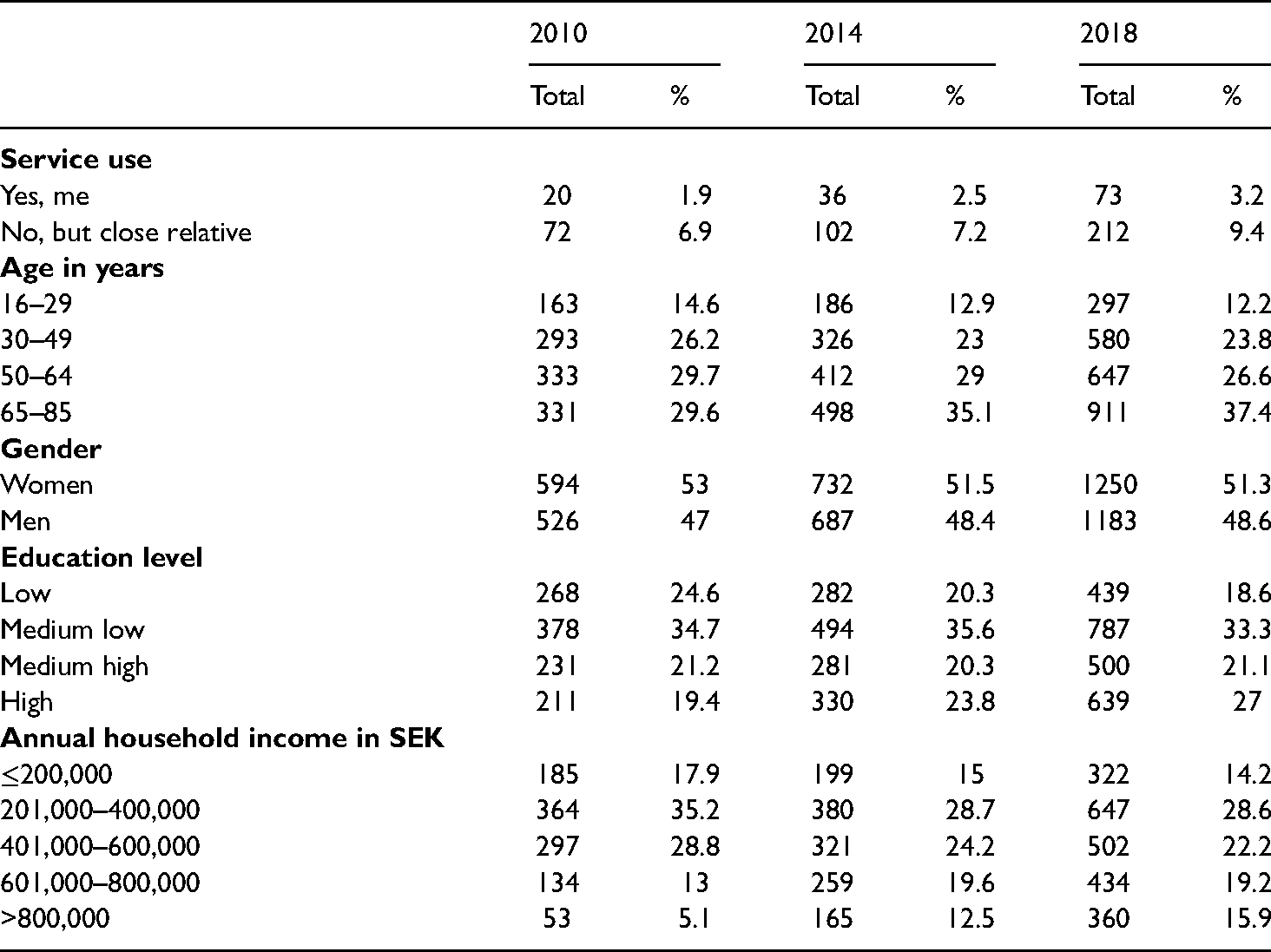
A description of the sample is given in Table 1. Service use in the past year was reported by 1.9 percent of respondents in 2010, 2.5 percent in 2014, and 3.2 percent in 2018. The proportion of those with a close relative who had been in contact with the social services was approximately 8 percent in all three years. There was a slight overrepresentation of individuals over the age of 50, while the gender distribution was fairly equal. Approximately 50 percent of the respondents had a medium low or medium high level of education, and almost 51 percent had annual earnings between SEK 201,000 and 600,000.
Description of the sample, divided by year (2010, 2014, and 2018).
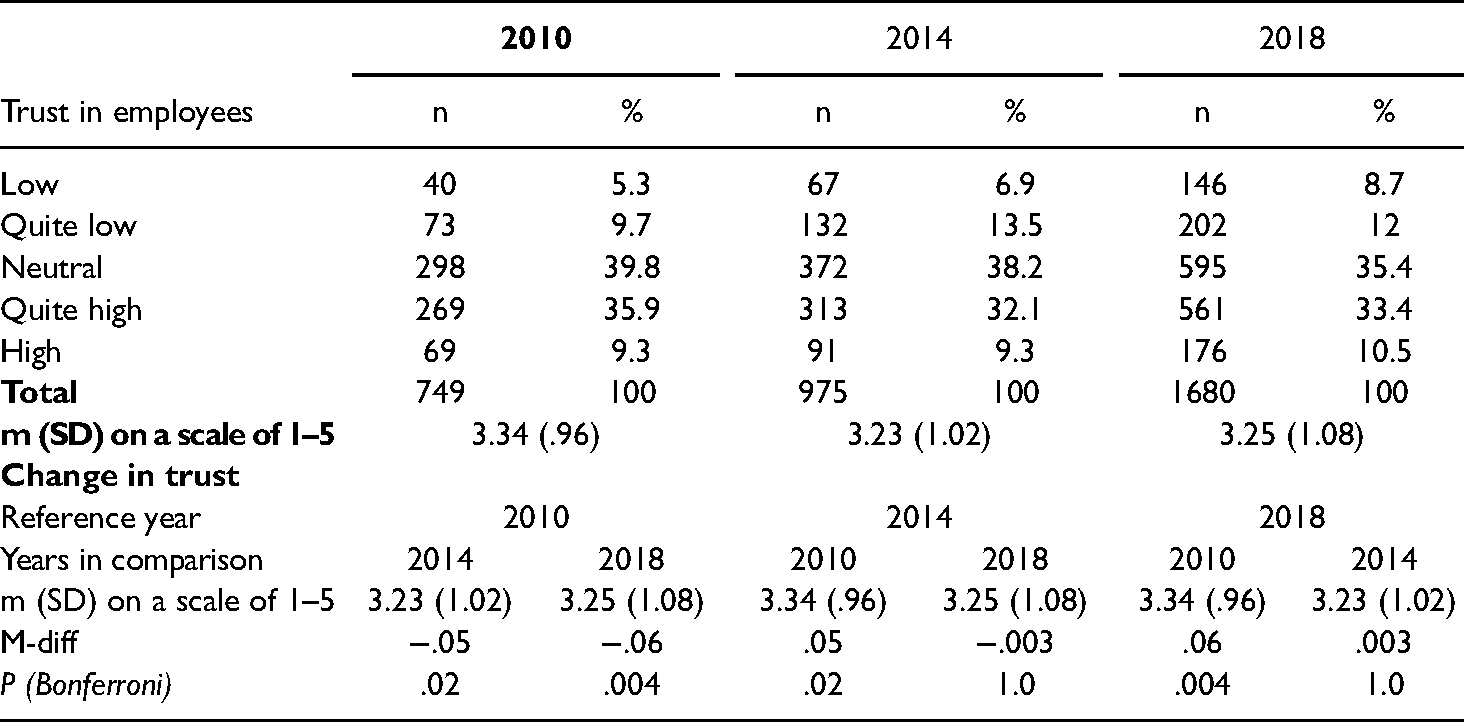
As shown in Table 2, between 41 percent and 45 percent of respondents in each year reported a high or quite high sense of trust in social services employees, whereas between 15 and 21 percent reported a low or quite low sense of trust. In all three years, approximately 28 percent of respondents stated that they had no opinion on the matter. Moreover, the most frequently reported answer was neutral, which was also reflected in the mean level of trust (approximately 3.25). Comparison of the mean level of trust showed that trust decreased between 2010 and 2014/2018 and then remained stable between 2014 and 2018 (Table 2).
Trust in social services employees during 2010, 2014, and 2018, in absolute and relative numbers and change in central tendency between years.
Patterns of trust
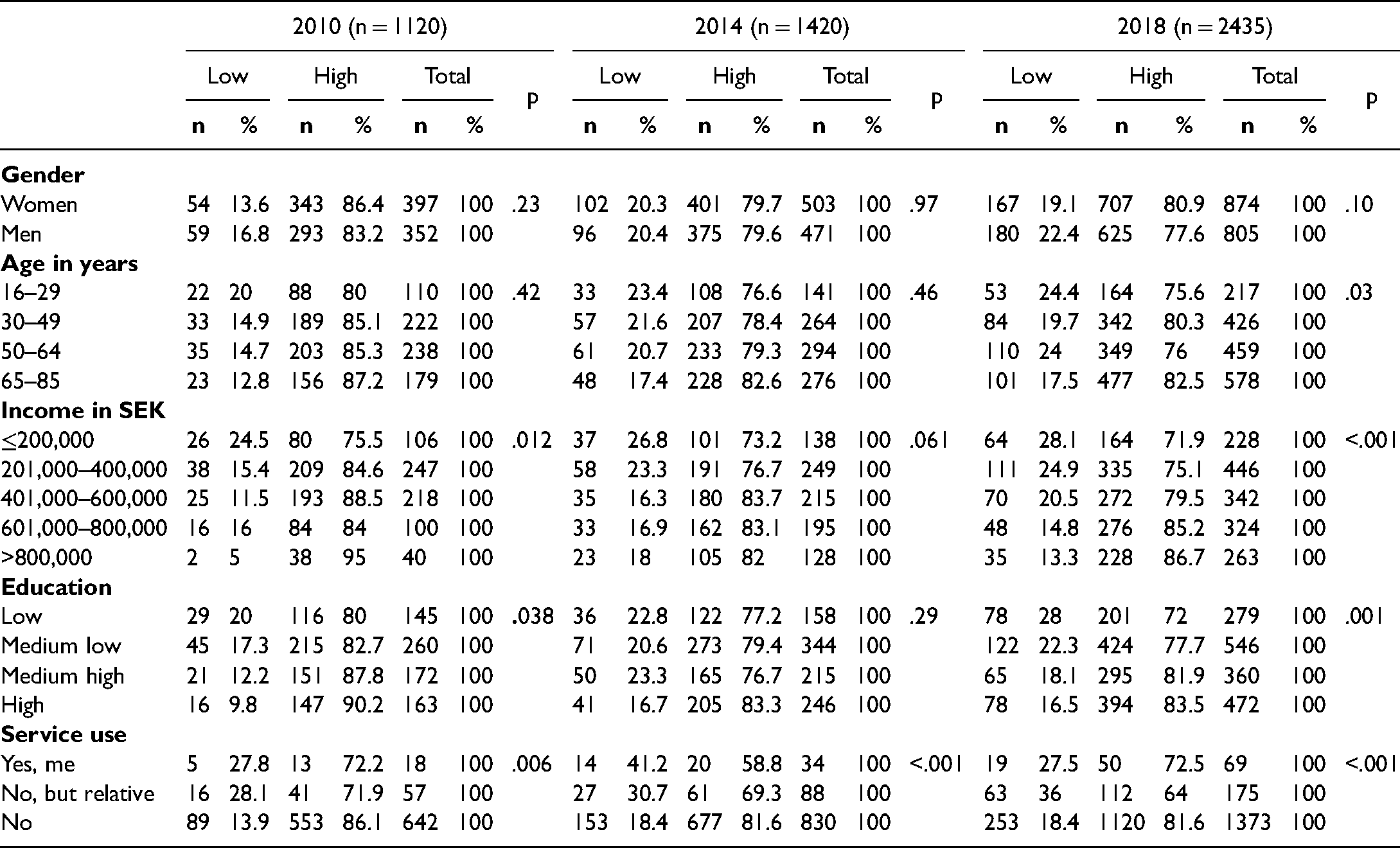
As shown in Table 3, there were no gender differences in level of trust in any of the studied years. However, in terms of age, there were differences between the age groups in 2018, with those in the oldest age group being least likely to report low trust. Table 3 further shows that in 2010 and 2018, the lower the income and level of education, the greater the proportion of reports of low trust. Across all years, the greatest differences in trust were found between the service-use groups. Reports of low trust were approximately twice as common among those who were service users personally or were close relatives of service users.
Trust in social services employees divided by gender, age, annual household income level, education level, and service use.
To further assess the association between the demographic factors and trust, unadjusted and adjusted logistic regression were performed for each year (Table 4) 3 .
Logistic regression for the years 2010, 2014, and 2018 with low trust in social services employees as dependent variable and service use, age, annual household income, education level, and gender as predictors.
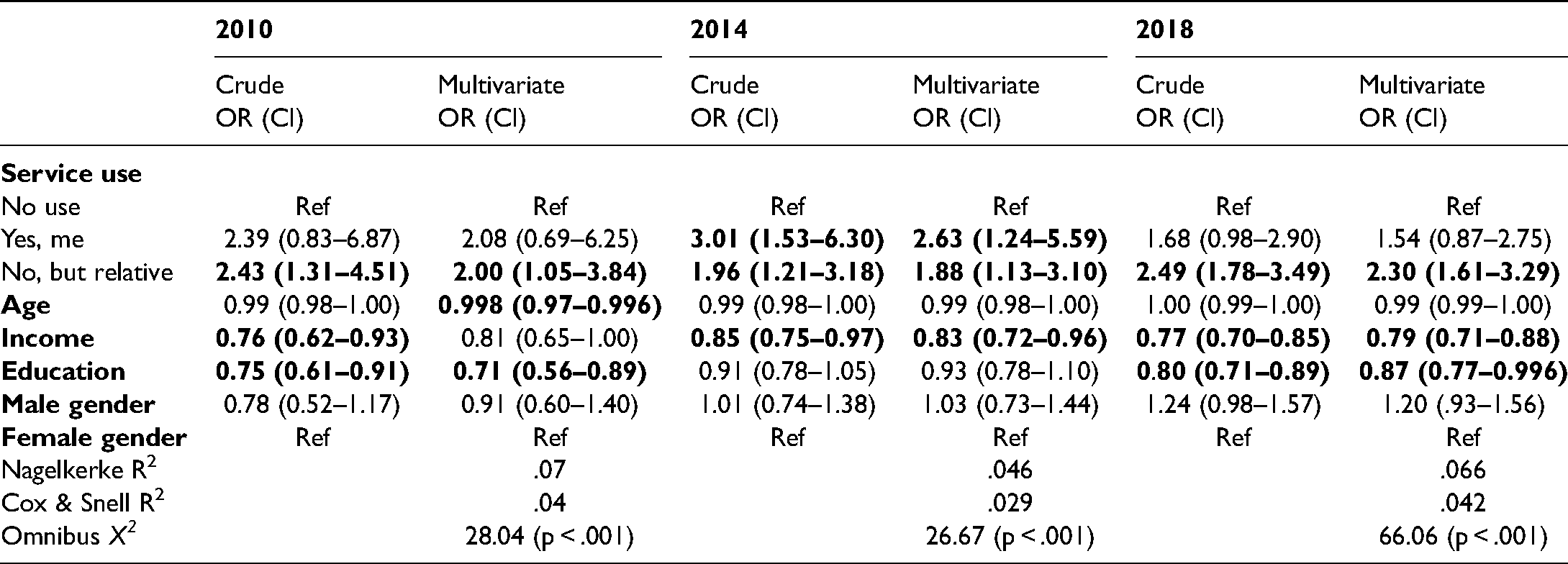
As shown in Table 4, being a relative of a service user was more strongly associated with low trust than personally being a service user, at least when the time factor was accounted for. Age remained negatively associated with low trust in the adjusted models; the higher the age, the lower the likelihood of reporting low trust. However, this result needs to be interpreted with caution, as the association was relatively weak, and age was not significantly associated with trust in 2014 and 2018. The opposite was true with regard to annual household income and education, as analyses for 2014, 2018, and the model including all years showed that the lower their income or educational level, the more likely a respondent was to report a low sense of trust.
Comparison between years
To assess the time factor, an additional logistic regression (Table 5) was performed with a combined trust variable including the values for each year as dependent variable. A combined year variable as well as combined variables for service use, age, annual household income, gender, and education including the values for each year were used as covariates. The results showed that there was a decrease in trust between 2010 and 2014, and that trust remained stable at the lower level between 2014 and 2018. The time factor had no statistically significant influence on the predictor variables, indicating the feasibility of making comparisons between the three models and/or treating the data as independent of the time factor (cf. Sanders & Ward, 1994; Steel, 2008).
Logistic regression with low trust in social services employees (including the values for all years) as dependent variable and service use, age, annual household income, and education level (for all years) as predictors.
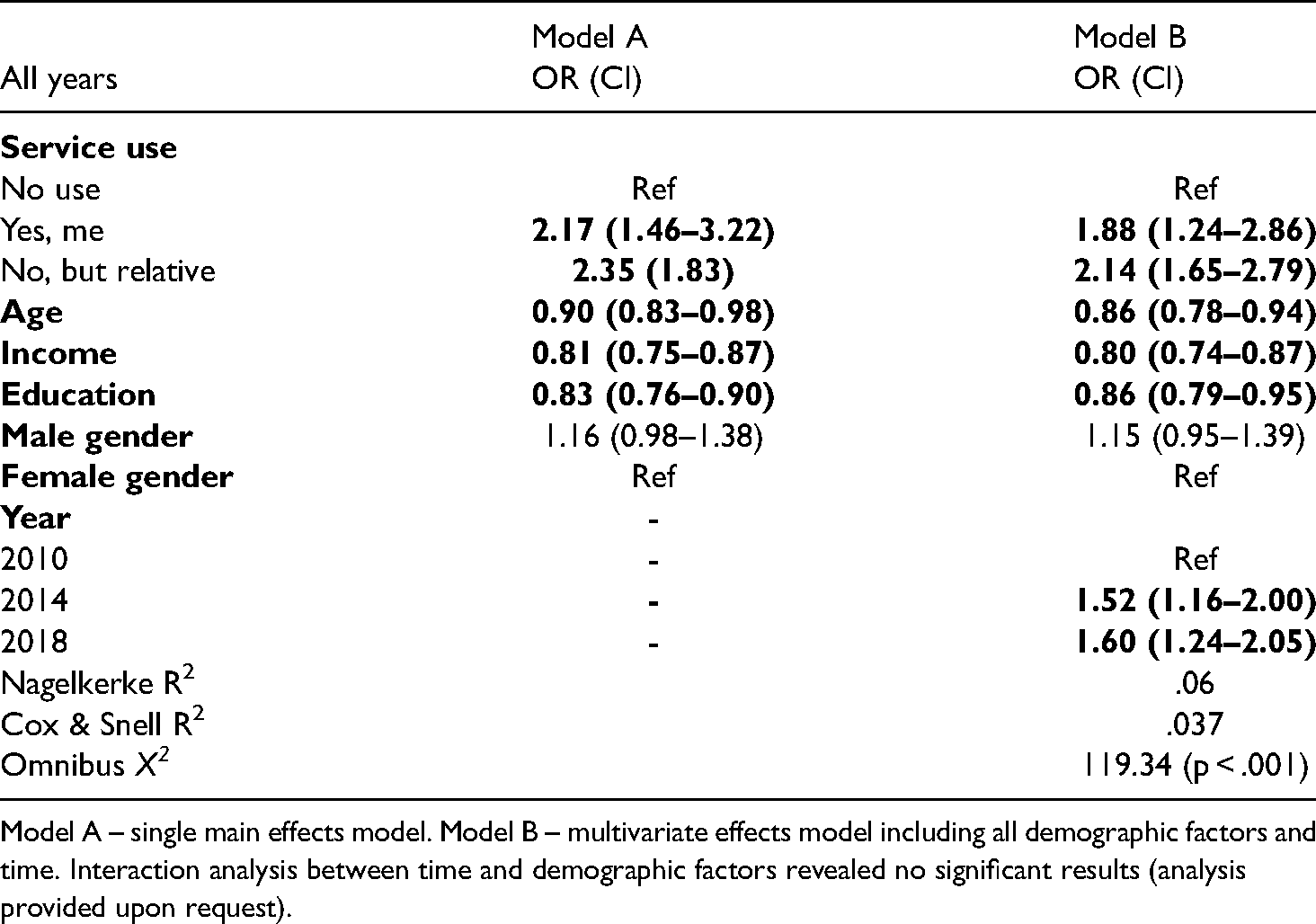
Model A – single main effects model. Model B – multivariate effects model including all demographic factors and time. Interaction analysis between time and demographic factors revealed no significant results (analysis provided upon request).
Discussion
The results of this study show that between 14 and 20.7 percent of respondents in the county of Värmland, Sweden, expressed a low sense of trust regarding how the social services employees do their job. However, more than 40 percent reported a high level of trust. Compared to other Swedish government institutions, this is a smaller proportion than those with high trust in the health care sector and the police (68 and 67 percent respectively) (Holmberg & Weibull, 2018), but larger than the 20 percent with high trust in the Swedish social insurance agency (Weissenbilder, 2019).
General trust and the importance of context
Our results show both similarities and differences with previous studies regarding perceptions and public trust in social workers (see e.g., LeCroy & Stinson, 2004; McCulloch & Webb, 2020; Staniforth et al., 2014). For instance, the level of trust reported in this study was higher than that reported by McCulloch and Webb (2020), and the ambivalence in perceived effectiveness shown by LeCroy and Stinson (2004) was not as distinct in relation to trust. Context is likely to play a crucial role in understanding these differences, for example how social work is organised and performed in different countries (Park, 2015; Van de Walle et al., 2008). The Swedish welfare state differs from the systems in the US, the UK, Israel, and New Zealand, where previous research on public trust and public perceptions of social work has been conducted. For example, all welfare in Sweden is funded by taxes, which minimises the need for private funds and/or personal investments to get access. Most welfare services are universal, and the Swedish social services is the main provider of means-tested social support. Consequently, the social welfare provision is not reliant on private and non-profit organisations. Furthermore, in contrast to countries where the work of government funded social workers is focused on control, social workers in Sweden have a dual role of providing practical and emotional support as well as implementing controlling measures (Morales et al., 2012). Overall, variations in types of welfare regimes (Esping-Andersen, 1990) need to be acknowledged when comparing trust of social workers across countries.
This social-democratic welfare regime (also known as the Nordic welfare regime) has been shown to handle welfare issues better than other regimes (see e.g. Fouarge & Layte, 2005; Gornick & Meyers, 2003; Morales et al., 2012; Tracey et al., 2010). According to global comparison, Sweden also ranks high in trust in public administration in general (OECD, 2017c). Given that provision of high-quality welfare services is a strong determinant for trust (Christensen & LÆGreid, 2005; OECD, 2017c), it is likely that the high levels of trust reported in our study can be attributed to the Swedish welfare regime, since social services employees can be considered as representatives of the regime (Morales et al., 2012). However, it is worth noting that the proportion of GDP spent on social issues has decreased in Sweden since 2010 (OECD, 2019) and income inequality is increasing faster in Sweden than in any other OECD country (OECD, 2017a). It is possible that that this will influence public trust in the welfare state in general and the social services in particular.
Our findings also indicate a slight decrease in trust since 2010. However, trust in public administration does fluctuate over time (Van de Walle et al., 2008), which might be the case here as well. Also, although the difference between 2010 and 2014/2018 was statistically significant, the difference between 2014 and 2018 was not. The indicated change in trust across time should therefore be interpreted with caution.
Education, income, and general trust
This study showed associations between low income and low level of education and low sense of trust. Given previous findings on general trust in governance and public administration (Bjørnskov, 2007; Christensen & LÆGreid, 2005; Rothstein & Uslaner, 2005), these results are not surprising. This does not imply that the results are less important. We argue that it is especially problematic that educationally and economically disadvantaged individuals report a low sense of trust in social services employees. One of the most important functions for the social services is to prevent social vulnerability and exclusion, and low income and low education level are strongly correlated with social risk situations such as poverty (DeNavas-Walt & Proctor, 2015), homelessness (Braver & Jenvey, 2012; Thompson et al., 2013), substance abuse (Farmer & Hanratty, 2012; Thompson et al., 2013), and domestic violence (Golu, 2014). Consequently, the likelihood for a need of assistance from the social services increases with lower income and lower education level. Given that individuals are prone to avoid professionals that they perceive as incapable and/or untrustworthy (cf. de Winter & Noom, 2003; Kagan & Zychlinski, 2016; Krumer-Nevo & Barak, 2007; Schreiber et al., 2013), these results represent a considerable challenge. Individuals with low income and/or education level not only have an increased risk of needing support; they might also refrain from seeking help.
Indirect experience and particular trust
The final, and perhaps most significant, aspect associated with low trust was being closely related to a service user. Apart from showing stronger associations with low trust than personally being a service user, being closely related to a service user was associated with a low level of trust in all three years. However, in contrast to the patterns in trust identified regarding education and income, where trust can be considered as general (Rothstein & Uslaner, 2005; Trägårdh et al., 2013), trust based on the experiences of one's relatives brings particular trust (Trägårdh et al., 2013) to the fore. It is likely that relatives’ sense of trust is influenced by contacts with service users, service users’ experiences, and/or their own personal experiences of social workers. Interestingly, these experiences seem to affect sense of trust more negatively than personal experiences as a service user. Close relatives are in many cases valuable sources of support for service users (Levälahti, 2007; Whittaker & Tracy, 1990), but so are social workers. This can create a predicament where one of the important parties for the welfare of the service user might not trust another. The risk is that this second-hand distrust will influence the service user as well, thus damaging the relationship between service user and social worker. However, to fully know if this is the case, further research concerning aspects of service users’ trust or distrust is needed.
Implications for social work practice
Although most respondents in this study expressed trust in how the social services employees do their job, around one in five reported a low level of trust. This can be considered a threat to legitimacy for the social services, and might contribute to a resistance among clients and other individuals (Cordoba, 2017), complicate recruitment, lower workforce morale, and enhance negative public perceptions (Gibelman, 2004; Social work task force, 2009). People with low income and low level of education were least likely to report high trust. Although this finding is not surprising, it calls for efforts to increase trust in the social services among disadvantaged groups. The same applies to service users. Apart from maintaining a high-quality service, which affects trust positively, the social services would benefit from implementing methods to measure trust across time in order to gain some advance warning if distrust were to increase. Our findings also indicate which groups need special attention. Additionally, trust-enhancing efforts such as information campaigns specifically targeting these groups could enhance knowledge about the social services’ helping agenda (SFS 2001:453), and thereby increase trust.
Implications for future research
This study has shown that only a small proportion of the general population have had first-hand or second-hand contact with the social services. Consequently, the sense of trust must stem from other experiences. Mass media could be of importance here. In previous studies on public perceptions, it has been argued that mass media representations are essential for the public's understanding of the social services and social workers (see e.g. Ayre, 2001; Brunnberg, 2001; Gaughan & Garrett, 2012; Reid & Misener, 2003). However, such statements are rarely supported by research findings. We therefore encourage further research on the relationship between mass media use and trust in the social services. To gain deeper knowledge regarding the causes of distrust among economically and educationally disadvantaged groups and among service users and their relatives, further qualitative investigations concerning trust within these groups would also be beneficial.
The focus in this study was on the social services and their employees in general terms. However, since the social services are divided into multiple organisational branches handling different social issues and needs, we concur with McCulloch and Webb (2020) in advocating for further research on trust across specific branches.
Limitations
One limitation of this study was the inconsistent wording of questions across time. In 2010, the question on trust in social services employees used the term “social workers” whereas in 2014 and 2018 the phrasing was “trust in social services employees”. Although social workers typically constitute the majority of those employed by the social services, a social worker can work in other organisations. Furthermore, “social services employees” include professional groups other than social workers, such as administrators or managers. However, when studying public trust, one needs to consider how the public might interpret the concepts rather than how they are defined (OECD, 2017b). It is reasonable that social workers and social services employees are perceived as equivalent, firstly because a majority of Swedish social workers are employed by the social services (Sveriges kommuner och regioner, 2019) and secondly because social workers are the core profession of the social services (Svensson, 2008). Another limitation is the non-response rate of more than 30 percent for the survey question regarding sense of trust towards the social services employees. Unfortunately, we have no information on why the non-response rate was so high for this question. It is possible that non-service users found it unnecessary to respond.
Eldercare and disability care were measured separately from the social services in the survey, even though these two areas are a part of the social services together with individual and family care. However, in Swedish public debates (e.g., in the mass media) it is common for “the social services” to be used as an equivalent to individual and family care. As in the survey, elder care and disability care are often discussed separately. It is thus possible that the findings are most valid for individual and family care. Finally, the importance of context might make it hard to generalise the results outside of the Nordic countries.
Conclusions
A majority of the general public reported a neutral or high sense of trust towards local authorities’ social workers over time. However, there were also groups where trust was lower. The most central factors related to low sense of trust were low annual household income level, low level of education, and being related to a service user. Given that sense of trust constitutes an essential part of legitimacy, it is of importance to gain further knowledge regarding trust of the social services, and to implement efforts to increase such trust. These efforts should target current and potentially future service users and people close to them.
Footnotes
Ethical considerations
In accordance with the guidelines of the  , all respondents received information about the survey, were informed that participation was voluntary, and gave their written consent before participation. Ethical approval for all research based on data from the regional Värmland SOM survey, including this project, was given by the Regional Ethical Vetting Board in Gothenburg (ref: Göteborg 130–15).
Acknowledgements
The authors would like to thank Prof Marie Nordfelt and Dr Maria Scheffer Lindgren for helpful and useful comments on earlier drafts of the article. We would also like to thank the Swedish National Data Service for the provision of data.