



Abstract
Summary
It is reported that parents with intellectual disability are generally more likely to have depleted social networks and a lack of meaningful friendships. The aim of this study is to explore parents’ descriptions of the relationships in their networks and their reflections on support and what makes the relationships in their networks a valuable resource in their parenting. Semi-structured interviews were conducted with 15 mothers and 6 fathers. The data were analysed using content analysis and theoretical perspectives of social relations and social capital.
Findings
Three different network types were identified, including formal, informal, and formal/informal relations. Different types of support were identified as well as bonding, bridging and linking social capital, and strong and weak ties. A diversity of support and strong ties together with trustful relations seem to be the most important factors in building social capital for parents.
Applications
The study increases recognition of how parents reflect on their networks and what supports their social capital. The findings highlight the importance of professional awareness of the existence of social capital and how this is reflected among parents and can be used to improve social work practice.
Introduction
This study explores aspects of parents with intellectual disabilities (hereafter parents) experiences who live in Sweden: in particular, their descriptions of who they include in their networks as well their reflections on relationships, available support and the factors that they perceive to improve their social capital. The rationale for studying support among parents originated in research indicating that they are generally more likely to have depleted social networks, lack meaningful friendships and report low levels of social support (Darbyshire & Stenfert Kroese, 2012; Emerson & Brigham, 2013; McVilly et al., 2006). Mithen et al. (2015) measured social capital across informal and formal networks and found that individuals with intellectual disability were worse off than those with other disabilities or without disabilities with regard to the social support they received from their networks. Harrison et al. (2021) reported that the networks of persons with intellectual disability were significantly smaller and less diverse than those of non-disabled persons, which could influence the amount of support and resources available to them. This is in line with results from Hindmarsh et al. (2015), who reported that parents had less social support and were less likely to have other parents to talk to and someone to share their feelings with compared with a control group. Another study (Emerson et al., 2015) reported that parents have lower rates of neighbourhood social capital and intergenerational support. Earlier studies highlight what can be described in terms of social exclusion and a lack of access to social capital among parents with intellectual disability. The consequences of this are serious; the marginalisation these parents experience is associated with high levels of stress, which in turn may have a negative effect on their children (McConnell et al., 2009; Stenfert Kroese et al., 2002) and make their parenting an area of relevance for social work.
Studies have also reported that parents are dissatisfied with the support they receive from professionals, including social workers (Feldman et al., 2002; Lightfoot et al., 2018; Llewellyn & McConnell, 2002; McConnell et al., 2009; Stenfert Kroese et al., 2002). A possible explanation for this is that services lack the resources to provide support that is adapted to fit their needs. This is in line with the findings of a study by Theodore et al. (2018), in which parents describe that support is not always adapted to meet their needs or to focus on their strengths rather than just their weaknesses. This may further explain results from other studies that parents do not feel comfortable seeking help from, for example, social services and therefore rely on support from their informal networks (Lightfoot et al., 2018; Meppelder et al., 2014). Parents describe their informal relationships as being more available and flexible, providing them with emotional support. Further to this (Llewellyn et al., 1999), it is reported that mothers living in single-parent households rely on support from professionals more than those living with a partner or parent(s) (Meppelder et al., 2014) and parents with limited access to an informal network seek support from professionals. It was also reported (Starke, 2011) that parents expressed a need for support from professionals to improve their parenting, understanding that they formed an important part of their everyday lives, even if not always in an exclusively positive fashion. Others who have noted parents’ need for support from their formal networks (Strnadová et al., 2017) have also identified barriers, such as a lack of involvement, necessary knowledge and skills amongst professionals. Findings such as these highlight that there are several factors that affect parents’ support-seeking and the relations they define as supportive. Moreover, it is reported that parents use different strategies when they seek support within their networks by focusing on individuals they perceive to be most important to them (Mayes et al., 2008). Llewellyn (1997) found that mothers created routines and strategies for parenthood by interacting with, observing or having conversations with other parents.
When it comes to parents’ experiences of what they consider meaningful support, they say that they wish to be supported by someone they can trust (Tarleton & Ward, 2007). Trust has been reported as an important factor in receiving support and includes the ability to listen to parents’ needs (Stenfert Kroese et al., 2002; Tarleton & Ward, 2007) and belief in their ability to parent and develop necessary parenting skills (Tucker & Johnson, 1989).
Even though there have been studies about parents and support, Koolen et al. (2020) conclude in their systematic review that studies mostly focus on instrumental and emotional support. This implies a need to improve our understanding of parents’ perceptions of other forms of support and what they perceive to promote their social capital. Based on earlier research in the field, this study aims to fill a knowledge gap of parental resources in what they define as their networks and how this can be understood as social capital.
Theoretical perspective
According to Bourdieu (1986), social capital accrues as a result of accumulated work, actions and strategic investments that need to be kept alive. Such investments provide long-lasting relationships that also entail commitments, rights and recognition. The concept is useful on a micro level, where it can help us to better understand how resources are provided to individuals through sharing, caring and investing in relationships with others and is constructed through mutual interest of individuals in a shared context, which can be defined as a network (Coleman, 1990; Portes, 1998, 2000; Putnam, 2000). However, social capital can also be weakened, for example when an individual's abilities are diminished because a network is reduced or even entirely lost during or following a separation or leaving a social context. This is known to have potentially adverse effects on individuals’ resources (Morrow, 2001).
Social capital is a complex concept, with various definitions, perspectives and dimensions (Woolcock & Narayan, 2000). However, despite the differences in understandings, the description of the concept made by Portes (1998) is useful: “the ability to secure benefits through memberships in networks and other social structures” (Portes, 1998, p. 8). Social networks, and the social norms of obligations, reciprocity and trustworthiness, arise from these relationships. Further social relationships provide social capital by establishing responsibilities, expectations and obligations between actors based on reciprocity and trust. Trust is defined as socially learned and confirmed expectations among individuals. It is based on the ability to rely on individuals and linked to a sense of predictability, which in turn is based on an understanding of the prevailing rules in a specific context. To develop trust and feel comfortable and safe, the degree of unpredictability needs to be reduced. This necessitates the creation of mutual relationships, reciprocity and positive emotions, as well as feelings of obligation between individuals as key dimensions of social capital, highlighting the importance of the quality of a relationship in its construction. In other words, the size of the network is not always important, and not all social relations provide social capital. Relations have been described in terms of strong and weak ties by Granovetter (1983). A person who is known well and shares someone's everyday life can be a strong tie that provides social capital. On the contrary, a weak tie is a more tenuous relationship. However, the concepts of strong or weak ties might not necessarily reflect whether a relationship adds to a person's social capital, and therefore the concepts of social bonding, bridging and linking are used to further understand parents’ social capital (Putnam, 2000; Woolcock, 2001). Social bonding connections are strong and close social ties among family members. Social bridging is understood as a horizontal metaphor, implying that there are looser and weaker social ties between friends and neighbours who share broadly similar demographic characteristics within a social context. Thus, the relative homogeneity in an individual's informal network may undermine opportunities to acquire additional social capital. Social linking is a vertical metaphor that connects individuals in higher and lower social strata. Social linking situates parents with a more heterogeneous network, such as professionals (Woolcock, 2001). In particular, the distinctions between the metaphors are outlined in literature relating to persons who are the focus of social work, such as those who are socioeconomically disadvantaged, which includes persons with intellectual disability (Cleaver & Nicholson, 2007; Emerson, 2007). The concepts have particular significance for social work and for understanding the difficulty of those who typically have a close-knit and intensive stock of bonding social capital and a modest stock of the more diffuse bridging and linking social capital (Narayan et al., 2000). Therefore, access to different relationships in the network is important for understanding the quality of the network and the social capital available.
Aim and research questions
The aim of this study is to analyse parents’ descriptions of the relationships in their networks, their reflections on support and what makes their relationships a valuable resource in their parenting, as well as how their networks can be understood as adding to their social capital. These findings may have implications for how social workers apply their practice to these parents. Research questions:
- How do parents describe their networks, relationships and support, and how can support be understood in terms of instrumental, informal, emotional and appraisal support? - How do parents describe the relationships within their networks, and how can this be understood in terms of weak and strong ties and bonding, bridging and linking social capital? - How do parents describe the relationships within their networks, and how can this be understood in terms of trust, obligations and reciprocity?
Materials and methods
Procedures and participants
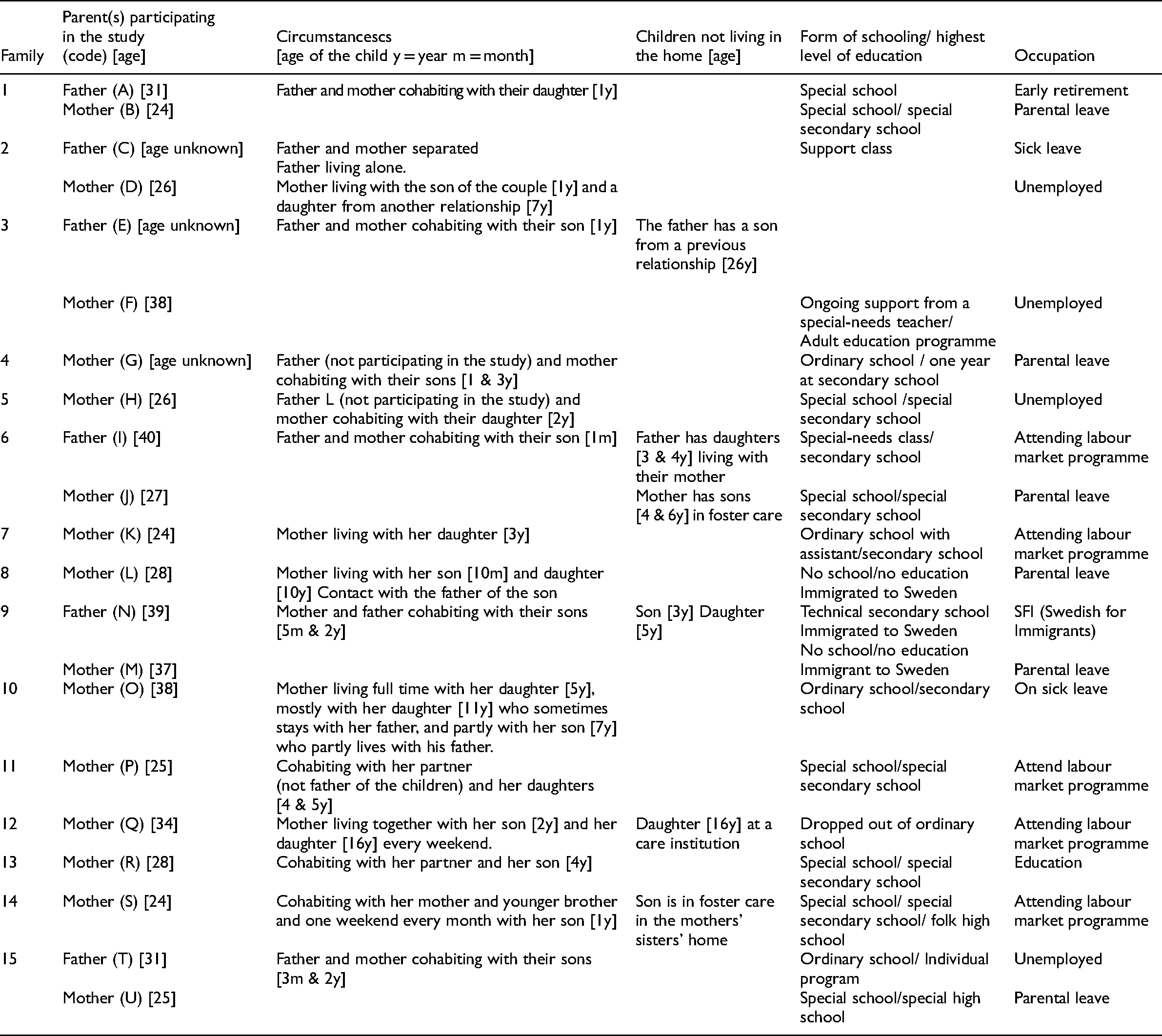
In total, 21 parents were included (15 mothers and 6 fathers) representing 15 families; these are presented in Table 1.
The parents participating in the study.
The inclusion criteria for this study were that parents had an intellectual disability (American Psychiatric Association) and lived with or shared the care of at least one child. The parents were contacted through four different social service agencies in Sweden. Professionals informed parents about the study and asked those who had support according to the Swedish Act (1993:387) concerning Support and Service for Persons with Certain Functional Impairments to participate. As the act only guarantees support to persons with a certain diagnosis, such as intellectual disability, it was used in combination with professional assessments as an inclusion criterion. The parents also received support based on the Swedish Social Services Act and the Social Insurance Code. Altogether, the participants had the legal right to receive residential, financial and practical support from municipal social services, county-based health care and the Swedish Social Insurance Agency.
Data collection
Individual interviews were conducted with the parents in their homes. Each interview lasted approximately two hours including breaks, and the interviews were digitally recorded. Four interviewers conducted the interviews, three social workers and one psychologist, all of whom had specialist knowledge and experience of both intellectual disability and interview techniques. The interviewers met the parents only for the purpose of the research and were not involved in any professional work with them or their child/children.
The interviews were based on a Swedish translation and adaptation of the Support Interview Guide (SIG), which uses a semi-structured interview format to provide an understanding of the participants’ social networks. The SIG was chosen as it was developed from research on social support and personal network theory (House et al., 1988; Tracey & Whittaker, 1990) and designed for persons with intellectual disabilities (Llewellyn & McConnell, 2002). Since several interviewers were involved in the study, the SIG was chosen to ensure that the same procedures were used and questions asked.
The SIG uses simplified language, coloured response cards and graphics to illustrate support dimensions. The design provides a visual format to facilitate conversation with interviewees about who is available to them from their networks, the frequency and type of contact in each case, the duration and geographical distance of the relationship and how comfortable they felt asking for or receiving support.
The study was approved by the Swedish Ethical Review Authority, which covers principles embodied in the Singapore Statement on Research Integrity. The approval includes information about the study, informed consent from the parents and the ability to withdraw. The parents were informed about confidentiality and, to protect their anonymity, their names were changed in the results. In the article, the parents’ names have been replaced by a letter, and persons mentioned by the parents have been given new names. No places or information that could be used to identify participants are included in the article.
Analytical phases
The analysis was conducted in multiple phases. In the first phase, interview records for each parent were transcribed and read through and a content analysis was applied (see Graneheim & Lundman, 2004). The meaning units were sought for each interview. These units were condensed and interpreted to understand the underlying meaning of the parents’ descriptions and generate sub-themes, which in turn were grouped into main themes. After this, the work of comparing the interviews began. The analysis revealed the parents’ descriptions of and reflections on their networks, such as the individuals included, the relations and their choices in this regard. Here, the concepts of informal (family, friends) and formal relations, including professionals or persons who have an assignment from an agency (contact person, trustee), were used. Furthermore, the analysis revealed the parents’ perceptions of what and who constituted a supportive resource. The structure provided by the content analysis was then used together with the theoretical concepts to deepen the understanding of the parents’ descriptions of support. Here, the analysis was first guided by Berkman et al. (2000), using the categories of instrumental, informational, emotional and appraisal support. Instrumental support refers to practical help; informational support is sharing knowledge, such as giving advice; emotional support is related to caring, sympathy and understanding; and appraisal is defined as help with decisions and giving appropriate feedback. In the last phase, the parents’ descriptions were analysed by applying the theoretical concepts of strong or weak ties (Granovetter, 1983), social bonding, bridging and linking (Woolcock, 2001), and obligations, reciprocity and trustworthiness (Coleman, 1990).
The results are first presented through the different categories of networks identified in the parents’ descriptions and their perceptions of the kinds of support they receive and how this can be understood in terms of bonding, bridging and linking social capital and strong and weak ties. The next part of the results includes parents’ reflections on their relationships, which can be understood as obligation and reciprocity.
The quotes were chosen to highlight the participants’ reasoning and identify their networks and supportive relationships as they see them. The quotes included descriptions that appeared in parents’ reflections or represented unusual statements. For the sake of brevity, digressions from the subject have been removed, with omissions indicated by ellipses and slashes and clarifications presented in brackets. When translating the quotes from their original Swedish into English, particular care was exercised to preserve the original character and content of the participants’ words.
Results
The different networks
Parents who include formal relationships in their networks
Aside from their family members, mother L and father N only include professionals in their networks. Both parents migrated to Sweden as adults, and both stated that they have problems making themselves understood in Swedish and understanding Swedish culture. In their descriptions, informational support is lacking. According to father N, he has not received enough information from the social workers at social services and does not understand why some of his children are in foster care and what is required to get them back. Mother L lacks information about why she could not keep her contact person and why no one has replaced her. According to the mother, her contact person was important, including providing instrumental, informational and emotional support: … she's the only one I can talk to. Happy, when I talk to her I’m always happy and I feel oh, now I’m not alone in Sweden. I feel safe and not so worried … (participant/mother L) .… when I met him [social worker from social services] he was hard, he did not want [to support me], he didn't care about me … // … He was bad, he didn't care about me, he didn't want to listen to me … (participant/mother L)
These parents’ descriptions reflect depleted social networks, a lack meaningful friendships and low levels of social support. Their ties to others are weak, and although there are professionals around them, their descriptions could suggest that they have no access to bonding, bridging or linking social capital.
Parents who include only informal relationships in their networks
Some of the participants only included informal relationships in their networks. The parents’ reflections on supportive relations and why they turn to informal relations can be understood as them either having negative experiences of professionals or being satisfied with their informal support.
Negative experiences of professionals
Even though mother L and father N only included professionals in their networks, they had negative experiences of professionals. This was also true of mother M, married to father N, who excluded professionals from her network. However, she included relatives in her home country and three friends in Sweden in her network. These friends live in a different part of Sweden, so their contact is usually by telephone once a week, and sometimes just once a month. The mother finds these conversations emotionally supportive, however, she also finds that they do not have enough time to talk. Distance and lack of contact make it difficult to maintain the friendship and contact with her family, which means the ties become weaker and as does the social capital. Furthermore, she finds it difficult to make new friends and establish contact with others. This can be understood as a lack of bonding and bridging as well as linking social capital.
Father I and mother J also have negative experiences of professionals, especially those when they turned to social services for parenting support. Father I says: … I think they [support workers] interfere and bother us. Some of them have interfered a bit too much, those so-called “support workers”, they have interfered in things they are not allowed to get involved in. Because they have nothing to do with him [the child] but they get involved, and that's very tough …(participant/father I).
The descriptions from these parents (M, I, J) can be understood as the parents’ opportunities to access linking social capital being diminished as a result of mistrust of professionals.
Satisfaction with the informal network
Mothers O and B describe having access to the support they need among their informal relations and that the persons who are available to them are important; this can be understood as them having strong ties. The support received can be understood to add to the mothers’ bonding social capital. As an example, mother O says: She [sister] tells me about things I need to know and answers questions, always gives me good advice and we often meet to talk. She is a child-minder and drives me to different places. (participant/mother O)
Father C also states that the persons included in his network are available. He mentions his former partner (mother D), his brother and his friends. The father indicates that he is given different types of support by the different people in his network. His former partner supports him in his parenting and helps him with cooking and household work, sometimes lends him money, completes forms and gives him information and advice. The support from his brother and friends is related to his interest in sports; they join competitions together and they drive him and update him about sports events. The support that father C describes can be understood as instrumental, informational, emotional and appraisal. It also reflects that he has strong ties to his network; this adds to his bonding and bridging capital, by which it is assumed that his friends share similar demographic characteristics and social context to him.
Parents including informal and formal relationships in their networks
Even though parents include both informal and formal relationships in their networks, they describe the support in different ways.
Different support from formal and informal relationships
Some of the parents describe receiving different support from informal and formal relationships. Mother D says that she can always turn to her grandmother and close friends to share feelings, personal difficulties and problems. They listen, reflect and give her advice, which can be understood in terms of different types of support, strong ties and bonding capital. When describing support from professionals and less close friends, she mentions child-minding and help with completing forms, which can be understood as instrumental support but also adds to her bridging and linking social capital. Mother U also gives examples of important support from the pre-school teacher, such as giving ‘good advice’ useful in her motherhood. She and father T meet the pre-school teacher several times each week when they attend a municipality-based parental group. They believe this is important as they can raise whatever questions they have about their children and parenting with the other parents and professionals. This can be understood as the group strengthening informational and appraisal support for parents, which adds to their bridging and linking social capital.
Similar support from formal and informal relationships
Two of the mothers (R & S) describe receiving similar support from their informal and formal relations. Mother R says that she receives the same type of support from her sister, friends and boyfriend as she does from her support workers. She appreciates it, as they explain and describe things in a way she can understand. Mother S includes her mother, brother, sisters, friends, two contact persons from social services and one psychiatrist in her network. According to mother S, they all provide her with knowledge and ‘know-how’ that is helpful in her parenting. She also perceives them all to be important as she can share and talk about feelings and problems with them, which can be understood as her receiving emotional and appraisal support from them. The mother's descriptions can be understood as her having strong ties to everyone in her network and that access to persons from different social strata adds to bridging and linking social capital.
Reflections on different support from professionals
Mother H reflects on the importance of the formal relationships in her network and the different support professionals provide her with. She explains that one of the professionals in her network helps her fill in forms and in her contact with authorities, another provides her with information and good advice and a third supports her with practicalities such as driving her to places. However, she only shares and talks about her feelings with two of them. Her description can be understood to mean that professionals add to her linking social capital.
Mother R also distinguish between the support she receives from professionals, even though she states that she receives the same type of support from her informal and formal relations. In the following quotes, she first describes what type of support she gets from her trustee and what she does not share with her: No, she is only my trustee, she only takes care of my finances, so I think that's enough. Well, I’m careful not to talk to [trustee] about how I feel, have a headache now and don't feel so well … (participant/mother R)
Professionals as friends
As described above, some of the parents describe close relations to professionals in their networks, which can be understood as strong ties, and some describe them as friends. Mother H, for example, says: I never met anyone. I would have liked to. But I have my contact person. It's…she is like a friend but like a professional friend, can you put it like that? (participant/mother H)
What appears in the parents’ narratives as descriptions of trust, obligation and reciprocity?
Trust
A recurrent reflection in the parents’ descriptions of the persons in their networks is that trustful relationships are valuable resources. Mother B, for example, says that her father always cares about her and her child and that she sometimes feels “a bit spoiled”. She also appreciates that her father is available. A similar reflection is made by mother O, who describes her sister as trustful in terms of being supportive, listening to problems, caring about feelings and being someone who can be relied on.
However, there are parents who include informal relations in their networks who they do not perceive as trustworthy. Mothers R, H and G included persons such as their mother, mother-in-law and father in their networks, even though they do not trust them. These mothers report that these persons lack interest in their lives, are not committed and do not provide them with help.
A notable feature is that the parents only included non-trustworthy people from their closest family, relatives or friends in their networks. If the parents perceived professionals as non-trustworthy, they did not include them in their networks.
Reciprocity
The parents’ descriptions of what can be understood as reciprocal are apparent when they refer to their informal relationships. One exception when referring to informal relationships is mother K, who reported that she and her contact person help and support each other. The other parents refer to mutual support between them and family members, relatives, partners and friends. Mother S, for example, mentions one of her friends in particular: She's not just there as support but more like company, and we help each other. We go out together and have a cup of coffee and do things together. (participant/mother S) Yes, but we [a friend] always help each other, we support each other come rain or shine. As a relationship, almost. If she feels bad, I’m there for her and if I feel bad she's there for me. (participant/mother B)
However, there were parents who had had other experiences. Mother R, for example, said that there was mutual support between her and her partner and her and her friends. She reported that not all of her informal relationships are reciprocal and feels that she helps her close family more than they help her. In a similar way, mother G reflected that even if she helps those with whom she has informal relationships, only a few of them help each other. Mother O said that she and some of those with whom she has informal relationships are committed to, loyal to and supportive of each other.
Obligations
The parents’ descriptions of the relationships in their networks include reflections on spoken and unspoken responsibilities between them, what they expect of others in their networks and what others can expect from them. The parents described obligations between each other and with those with whom they have informal relationships, and they did not feel that they had any obligations in their formal relationships. However, the parents reflected that professionals have obligations towards them.
Mother J and father I said that they expect themselves and those in their networks to be available for each other. Father A reflected that there are more obligations in some of his relationships than others, and mother H said that she and her father have commitments between each other. Parents, such as mother B, also reflected on what they do when they need support and expect someone to support them.
Some of the mothers (D, G, R) reflected on the fact that being a family member, partner or friend required different commitments and obligations to each other. These mothers had experienced situations in which these had been broken. As an example, mother R reported that her mother asks her for help and expects to receive it, but she does not receive help in return: … sometimes I feel like I might want to be free of my child a little as I’m always with him. It might be nice to ask someone, but I have no one to ask… If she [mother of R] had been normal, she could have said to me “yes, I can take [son] tonight and he can sleep here” … I have looked after her dog when she was away … So, it would have been nice to have something in return, but I never get any help in return. (participant/mother R)
From the parents’ reflections, when obligations were met these were described in terms of equal support, commitment to one another, being available and fulfilling the expectation of support from others.
Discussion
The aim of this study was to explore parents with intellectual disability and their descriptions of the relationships in their networks and reflections about support and what makes the relationships in their networks a valuable resource in their parenting. The study uses the framework of social capital, referring to networks and the relational resources provided within them. Different concepts are used to identify social capital, such as bonding, bridging and linking, derived from different networks. Concepts of trust, reciprocity and obligation are used to reveal the values of relationships between parents.
Support derived from networks
The parents’ descriptions of the relationships within their networks were mostly expressed in positive terms; they felt that they received the support they needed, which can be understood as them gaining social capital through the relationships in their networks. The parents’ descriptions of support seemed mostly to focus on the quality of their relationships, rather than the number of individuals in the networks. In earlier studies, the conclusion that has often been drawn is that a lack of persons in a parent's network implies that they do not have enough support or that support is not available. The present study does not support these findings as all the parents, except those who migrated to Sweden, reported that they lack support. However, the fact that the parents who migrated perceived a lack of support can be understood in terms of social exclusion and marginalisation in the new context. As earlier research points out (McConnell et al., 2009), the consequences of this can be high levels of stress that can have a negative effect on parenting and children. The descriptions given by these parents can be understood in terms of their social capital having been weakened and their new context providing them with less access to resources, having had difficulty establishing new relationships and contacts in Sweden (Morrow, 2001). This is important for social work; these parents need further attention and new forms of professional support might need to be developed.
The findings of the present study do, to some extent, support what was reported by Llewellyn et al. (1999) that informal relationships more often provide parents with emotional and instrumental support and formal relationships deliver information and knowledge. However, the findings also reveal the opposite, that parents perceive that they receive the same type of support from both informal and formal relationships.
Furthermore, some parents expressed negative experiences of professionals, which corresponds with previous studies (see Lightfoot et al., 2018). Parents being dissatisfied with the support that they receive from professionals may lead to uncertainty, distrust and to them avoiding support from professionals. The present study does not provide data concerning all the professional contacts of the parents, however most of them included professionals in their networks. Some of the parents also described professionals as being friends, which has also been noted in previous studies (Llewellyn & McConnell, 2002). Describing professionals as friends has been interpreted in previous studies as an example of participants having a hard time making friends. Whilst the findings in the present study do support this, they could also be understood as an expression of trust (see Tarleton & Ward, 2007).
Relationships in networks in terms of trust, reciprocity and obligation
Trust has been defined as an important factor in earlier studies (Stenfert Kroese et al., 2002; Tarleton & Ward, 2007) and seems to be an important factor in parents accepting and receiving support and collaborating with professionals in this study. This has implications for social work as collaboration between professionals and parents is important for developing different forms of support (see Koolen et al., 2020). The importance of trust was also revealed in the parents’ descriptions of informal relationships, as shown by the inclusion of family members in their networks who were not regarded as trustful. When parents reflected on relationships that they did not consider trustful, they revealed the belief that a trustful relationship should include obligation as well as reciprocity. For most parents, the inclusion of professionals in their networks might not be perceived as recognition of a relationship that is equal to those with family or friends. The results reveal that parents reflect differently on obligations and reciprocity when it comes to their formal and informal relations. None of the parents reported that they had obligations towards professionals, but they did describe obligations that professionals had towards them. Near identical results are found when it comes to reciprocity. Formal relationships seem to differ in character, and the parents expected different things from professionals than from their informal relations.
The relations in the networks as weak and strong ties and their contribution to bonding, bridging and linking social capital
The parents did not always describe strong ties to their informal relations. There were several descriptions of rather weak ties to family. Whether these weak ties add to the bonding social capital of the parents is a matter for discussion. There are some examples of weak ties to friends as well as social bridging implying weak ties. In the parents’ descriptions however, they revealed that they need to trust and rely on friends to receive support. Whether this adds to the bridging social capital of these parents is another question for discussion. The findings also show that there are parents with strong ties to professionals that add to their linking social capital. Even if most parents in this study describe that they are satisfied with professionals, there are parents who are dissatisfied and can be understood as having weak ties. However, weak ties could add to the linking capital of the parents in the case that professionals provide them with additional social capital. This is especially prominent in literature on socioeconomically disadvantaged persons (Cleaver & Nicholson, 2007; Emerson, 2007), which includes the parents in the study. However, according to the parents who are dissatisfied with the professionals, they find it hard to interact with them, which makes it impossible for these parents to increase their linking social capital. This has implications for social work and the importance of social workers’ interactions with this group of parents.
Limitations of the study
In this study, fathers (n = 6) are underrepresented compared with mothers (n = 15), which is a major concern in the research of parents with intellectual disability. Furthermore, only a few parents (n = 3) who had migrated were included. The participants might also represent a group of parents that are more interested in receiving support as, with a few exceptions, most of them live with their children. This might indicate that they have access to more informal and formal support compared with other parents, as earlier studies report that these parents are more likely to have children in foster care than others (McConnell & Llewellyn, 2002). Furthermore, the study lacked information from persons who are included in the networks of the parents, and further studies need to be conducted to understand what constitutes social capital for these parents.
Conclusion
This study identified three different network types described by parents. Those parents who have migrated to Sweden describe what can be understood as a lack of social relationships and social capital, whereas those parents who are native to Sweden more often describe their networks, or parts of them, as supportive and providing them with social capital. The support they receive could be defined in terms of instrumental, informational, emotional and appraisal from both informal and formal relationships. Trust seems to be one of the most important factors for parents to give and receive support. With regard to reflections on what can be understood as obligations and reciprocity, the parents reported that they had expectations and that mutual responsibility should be included in their informal relationships. The parents only expected professionals to have obligations towards them and did not feel that there was reciprocity between parents and professionals. The parents included family and friends in their networks with whom they had both weak and strong ties. The professionals included in their networks were described in terms of strong ties. The findings also support that parents have bonding, bridging and linking social capital, which means that they receive social capital from those with similar demographic characteristics and those from higher social sections.
The study findings contribute to our understanding of the interaction between parents and their networks of both formal and informal relationships. In particular, it contributes to the understanding of parents’ contact with social work through references to their experience of interacting with social services, including contact persons, support workers and social workers. The results can therefore be used to improve social work practice. The results can clarify the importance of mapping parents’ networks. The method used in the study might inspire professionals in social work to use a network map that is adapted for the target group. Furthermore, the results may improve the understanding by professionals, including social workers, of how social capital is expressed by a group of parents that are perceived as socially disadvantaged.
Footnotes
Acknowledgements
The author would like to thank the parents who participated in the study and the professionals who conducted the interviews.
Ethics
The study was approved by the Swedish Ethical Review Authority (Dnr 055-12).
Funding
The author(s) disclosed receipt of the following financial support for the research, authorship, and/or publication of this article: This work was supported by the The Swedish Research Council for Health, Working life and Welfare, (grant number 2012-0740).
