



Abstract
This study examines the impact of tourism on regional development in Portugal from 2012 to 2019, focusing on NUTS-III regions to reduce aggregation bias and capture intra-regional disparities. Particular attention is given to Low-Density Territories (LDTs), marked by demographic fragility and structural disadvantages. Using multidimensional indices of Cohesion and Competitiveness and Spatial Durbin Models with spatial fixed effects, the analysis reveals that international tourism emerges as an effective driver of GDP growth, both locally and through spillovers, but its contribution to cohesion is ambiguous. In contrast, tourism in LDTs did not stimulate economic growth or social cohesion, although it strengthened competitiveness. The findings highlight a persistent decoupling between economic growth and development, challenging linear tourism-led growth assumptions and underscoring the need for place-based policies tailored to peripheral regions. Tourism should not be conceived as an inherent catalyst of convergence; instead, it represents a contingent and context-dependent process, conditioned by territorially embedded structures and differentiated institutional capacities.
Keywords
Introduction
Between 2012 and 2019, Portugal underwent a profound economic transformation. In the aftermath of the sovereign debt crisis and subsequent austerity measures, the country pursued a recovery strategy heavily reliant on external demand. Within this context, tourism emerged as a pivotal sector, rapidly expanding and recording sustained increases in international arrivals. Yet, this growth was profoundly uneven: coastal regions such as the Algarve and the Lisbon and Porto metropolitan areas absorbed a disproportionate share of tourism-related benefits, while low-density interior regions continued to experience economic stagnation and demographic decline. This spatial imbalance raises critical questions about tourism’s purported capacity to promote equitable and cohesive regional development, challenging the linear assumptions of the tourism-led growth hypothesis (TLGH).
The analytical complexity of tourism’s role in regional economic performance continues to challenge scholars and policymakers. While the TLGH emphasizes tourism’s potential to generate income, employment, and infrastructure investment (Balaguer and Cantavella-Jordá, 2002; Wong et al., 2024), mounting evidence indicates that these benefits are highly unevenly distributed (Toivonen, 2002), often exacerbating, rather than mitigating, core-periphery divides (Alcalá-Ordóñez et al., 2024; Llorca-Rodríguez et al., 2020; Wu and Wu, 2016). Portugal provides a critical case study: its rapid tourism expansion coincided with persistent and even deepening regional disparities, making it an ideal setting for examining the spatially differentiated outcomes of tourism-led growth. These dynamics are not unique to Portugal: analogous patterns of uneven tourism-led development have been documented across European peripheral regions, from Southern Italy (Bronzini et al., 2022) to Swedish rural areas (Bohlin et al., 2016) and Eastern European peripheries (Keryan et al., 2025), underscoring the broader relevance of the analytical framework developed here.
The theoretical innovation of this study lies in reconceptualizing the TLGH from a universal, linear relationship to a threshold-based, spatially contingent process. By operationalizing a multidimensional development lens that elevates cohesion and competitiveness to equal analytical status with GDP growth, disaggregating tourism into international and domestic flows, and deploying Spatial Durbin Models to capture spillover effects and spatial dependence structures, this study advances beyond existing spatial econometric applications (e.g., Paci and Marrocu, 2014; Yang and Fik, 2014). The contribution is not merely methodological but fundamentally conceptual: tourism’s developmental role is revealed as relationally embedded, territorially differentiated, and institutionally mediated rather than mechanistically determined by tourism intensity alone. The findings challenge TLGH narratives and provide critical insights for designing place-based policies tailored to the specific structural constraints and opportunities of Portugal’s diverse regions, particularly its LDTs.
This study seeks to advance the understanding of the gap between universal TLGH predictions and the spatially contingent, threshold-dependent processes observed empirically by addressing two significant limitations in the existing literature. First, prevailing research often relies on GDP-centric indicators, which offer only a partial view of tourism’s broader socioeconomic contributions. A singular focus on economic growth fails to capture essential dimensions of territorial cohesion, such as social equity, demographic sustainability, and service accessibility – areas where low-density territories (LDTs)
1
systematically underperform. To overcome this limitation, this study employs a multidimensional analytical framework. We use the Cohesion Index and Competitiveness Index from the Índice Sintético de Desenvolvimento Regional (ISDR), published annually by INE for NUTS-III regions. The Cohesion Index captures aspects of territorial equity and well-being, aligning with literature that stresses development beyond mere economic output (Bartolini and Sarracino, 2014). The Competitiveness Index reflects economic dynamism, including productivity and innovation. Together, these indices provide a more holistic and balanced framework for assessing tourism’s dual and potentially divergent role in fostering economic growth and social cohesion. Second, much empirical research on Portugal relies on NUTS-II level data, which introduces substantial aggregation bias and obscures crucial intraregional heterogeneities. For instance, while the NUTS-II Norte region accounted for 18% of national overnight stays in 2019, five of its eight NUTS-III subregions each registered less than 1% (Figure 1). This pattern, where metropolitan cores dominate regional totals while interior territories, like Terras de Trás-os-Montes or Beira Baixa, remain marginalized, underscores the necessity of a finer-grained, NUTS-III-level analysis. This is particularly vital for examining LDTs – regions characterized by demographic fragility, geographic peripherality, and infrastructural deficits – which are often rendered invisible in aggregate analyses (Andraz et al., 2009; Bronzini et al., 2022). Overnight stays (% of the national total) by NUT II and NUT III (2019).
To model the complex spatial interdependencies between regions, we employ a Spatial Durbin Model (SDM) with spatial fixed effects. This methodology is explicitly chosen to account for and quantify spatial spillovers – the effects that tourism activity in one region has on the development outcomes of its neighbors. This is a crucial advancement, as it allows us to test whether tourism growth in core regions creates positive spillovers for peripheries or, conversely, intensifies backwash effects that further drain resources from LDTs.
Against this background, the present study examines the following main research questions: Does tourism stimulate economic competitiveness and socioeconomic cohesion in Portuguese regions, and do these effects differ between core and LDTs? To what extent do spatial spillovers influence these outcomes? What is the distinct impact of international versus domestic tourism flows? These questions are formalized into four testable hypotheses:
(Tourism – Development Hypothesis): Tourism intensity has a positive and statistically significant effect on regional GDP per capita growth, cohesion, and competitiveness.
(International vs. Domestic Tourism Hypothesis): International tourism intensity (proxied by non-resident overnight stays per capita) exerts stronger positive effects on GDP growth, cohesion, and competitiveness than domestic tourism intensity (proxied by resident overnight stays per capita), reflecting higher spending intensity and larger local multipliers.
(Asymmetric Spatial Spillovers Hypothesis): Tourism intensity in neighboring regions generates positive spatial spillovers for GDP growth, reflecting interregional demand linkages and mobility networks; however, spatial spillovers are weak or statistically insignificant for cohesion and competitiveness, where tourism benefits are expected to be more locally captured and less transmissible across space.
(Low-Density Attenuation Hypothesis): The positive effects of are weaker in low-density territories (LDTs) than in non-LDT regions, reflecting lower absorptive capacity, thinner markets, and more limited infrastructure and complementary services.
These hypotheses will be tested using panel data analysis with spatial econometric models or fixed effects models, allowing us to assess the impact of tourism on regional development outcomes. The findings challenge reductive, linear TLGH narratives and provide critical insights for designing place-based policies tailored to the specific structural constraints and opportunities of Portugal’s diverse regions, particularly its LDTs.
The remainder of the paper is structured as follows: the next section reviews the literature on tourism-led growth and spatial disparities, with special attention to low-density regions. The data and empirical framework are then presented, followed by the results and their discussion. The paper concludes with the main findings and their policy implications.
Literature review
Rethinking the tourism-led growth hypothesis
The Tourism-Led Growth Hypothesis (TLGH), first formalized by Balaguer and Cantavella-Jordà (2002), has become a central framework for examining the ways in which tourism expansion stimulates economic growth. It conceptualizes tourism as a distinctive form of export capable of generating foreign exchange earnings, fostering infrastructure investment, and creating employment opportunities. Building upon the Export-Led Growth Hypothesis, the TLGH highlights tourism’s potential to generate productivity gains, economies of scale, and intersectoral linkages (Brida et al., 2016). Its theoretical foundations lie in neoclassical growth theory (Balassa, 1978), which emphasizes efficient factor allocation and capital accumulation, while later refinements incorporate natural resource endowments, institutional quality, and technological capacity to explain variation across tourism-specialized economies (Alcalá-Ordóñez et al., 2024). Critically, the empirical literature does not yield a uniform verdict on the direction of this causal relationship. Wu and Wu (2016) demonstrate, through a bootstrap panel Granger causality approach applied to China’s eight central provinces, that the nature of the tourism–growth nexus is highly heterogeneous even within a single national context: some provinces exhibit tourism-led growth, others show that economic expansion precedes tourism development, others display reciprocal causality, and one province shows no significant relationship at all. This heterogeneity underscores that the TLGH cannot be treated as a universal regularity and that province- or region-specific structural characteristics, including the degree of tourism dependence and openness – are decisive in shaping causal dynamics.
Empirical research consistently demonstrates that tourism’s economic effects are mediated by regional characteristics. For instance, Andraz et al. (2009) showed that Portuguese coastal regions, supported by stronger infrastructure and more diversified economies, captured substantially greater benefits than inland areas. Their findings highlighted that tourism is not merely a sectoral activity but is embedded within regional economic systems, where pre-existing structural conditions shape developmental outcomes. Subsequent theoretical contributions have reinforced this perspective, stressing tourism’s potential to foster structural transformation by reallocating resources from low-productivity sectors, such as agriculture, to higher-productivity services and manufacturing (Li et al., 2016). However, the reliance of Andraz et al. (2009) on NUTS-II data limited their ability to capture intraregional heterogeneity. In Portugal, NUTS-II regions encompass both coastal and inland areas, obscuring the structural disadvantages of low-density territories. This limitation underscores the importance of adopting a NUTS-III perspective, where demographic fragility, peripherality, and weak agglomeration economies are more visible (Santos and Vieira, 2020).
Portugal provides a particularly relevant case study considering its post-sovereign debt crisis recovery strategy (2012–2019), which heavily relied on external demand and positioned tourism at the core of economic adjustment. While international arrivals grew significantly, their benefits accrued disproportionately to metropolitan and coastal areas, reinforcing core–periphery divides. In contrast, domestic tourism has been shown to generate more balanced regional spillovers by circulating income within the national economy and supporting peripheral regions through local multipliers and supply chain linkages (Andraz et al., 2009; Llorca-Rodríguez et al., 2020). These contrasting patterns challenge the assumption of linear or automatic tourism-led growth and underscore the importance of context-specific mediating factors. This spatial concentration of tourism benefits mirrors findings from other European contexts: Toivonen’s (2002) analysis of Finnish tourism during a period of strong public financial support similarly revealed that growth was fastest in the Helsinki metropolitan region and south-western urban areas, while rural and peripheral regions – despite receiving the lion’s share of regional development funds – consistently underperformed the national average. Crucially, Toivonen (2002) found that financial support for rural tourism and economic growth were negatively correlated, raising fundamental questions about the efficacy of supply-side interventions in contexts where structural demand conditions favor urban agglomeration. This cautionary lesson resonates strongly with the Portuguese case examined here.
Beyond aggregate expansion, the literature increasingly recognizes the limitations of GDP-centric indicators for assessing tourism’s developmental contribution – particularly over the long run – as such indicators fail to capture distributive outcomes, social cohesion, and long-term sustainability (Bartolini and Sarracino, 2014). In this regard, multidimensional frameworks that incorporate cohesion reflecting income distribution, service accessibility, and demographic sustainability – and competitiveness – capturing productivity, innovation, and market integration – offer a more comprehensive perspective (Bartolini and Sarracino, 2014). These indicators facilitate a deeper understanding of tourism’s capacity to contribute to economic growth and balanced territorial development.
Methodological advances in spatial econometrics further strengthen this perspective. Tools such as local Moran’s I have revealed pronounced clustering patterns, with coastal “hot spots” benefiting from positive spillovers while inland areas remain “cold spots” (Santos and Vieira, 2020). Moreover, tourism’s developmental outcomes are highly dependent on institutional capacity and the local economic base (Li et al., 2016), reinforcing the case for a spatially explicit TLGH framework. Such an approach enables a more precise assessment of spillovers and provides an empirical foundation for designing place-based policies, including investments in infrastructure, support for domestic tourism, and governance reforms tailored to peripheral territories.
In sum, the literature demonstrates that tourism’s development contribution is neither automatic nor evenly distributed. Rather, it is conditioned by economic cycles, institutional contexts, and territorial structures. By integrating spatial econometrics with multidimensional indicators of cohesion and competitiveness, recent approaches provide a more nuanced understanding of tourism’s heterogeneous impacts and support the design of policies aimed at simultaneously enhancing competitiveness and reducing regional disparities in structurally disadvantaged areas.
Structural constraints and peripheral dynamics in low-density territories
Low-density territories (LDTs) present complex spatial contexts where structural constraints systematically mediate tourism’s potential to catalyse development. In Portugal, these territories have been formally codified within national and European cohesion frameworks, notably under Portugal 2020, which designates regions marked by low population density, geographic peripherality, limited connectivity, and subcritical levels of economic agglomeration (Keryan et al., 2025). Such conditions often overlap with rural landscapes, where sparse populations and remoteness intersect with socioeconomic vulnerabilities – ranging from infrastructural deficits and demographic decline to weak human capital accumulation – creating persistent obstacles to capturing the benefits of tourism-led development (Bassil et al., 2023; Santos and Vieira, 2020).
These dynamics are not unique to Portugal. Comparative evidence from Southern Italy (Bronzini et al., 2022) and Eastern Europe (Keryan et al., 2025) highlights how peripherality and institutional thinness constrain tourism’s contribution to regional transformation. The notion of “institutional thinness” – characterized by fragmented governance and underdeveloped innovation ecosystems, is particularly relevant in LDTs, as it limits the capacity to articulate coherent tourism strategies and cross-sectoral synergies (Bronzini et al., 2022). Such structural disadvantages reinforce negative path dependencies, in which historically weak economic bases perpetuate underinvestment and limited participation in high-value tourism circuits (Calero and Turner, 2019).
More broadly, the challenges of LDTs resonate with debates on peripherality in economic geography. Pugh and Dubois (2021) identified four key recurring problems that are highly pertinent to the Portuguese case. The first is the use of “fuzzy language” where terms such as “peripheral”, “rural” or “lagging” are employed interchangeably, obscuring distinct realities and developmental trajectories. For instance, the challenges of sparsity (micro-remoteness affecting everyday service access) differ significantly from those of peripherality (macro-remoteness from major urban and economic centers), according to Dubois and Roto (2013).
The second problem concerns the tendency to frame peripheries through “bad talking”, portraying them as inherently deficient. This deficit perspective neglects instances of adaptive capacity and endogenous development, as seen in Nordic regions, where firms mitigate local agglomeration deficits through global pipelines and distant collaborations (Bathelt et al., 2004; Grillitsch and Nilsson, 2015), or in Finnish Lapland, where remoteness coexists with locally embedded innovative capacity (Hautala, 2015). Such examples align with calls to examine “positive peripheries” rather than relying on deterministic deficit models (Pugh and Dubois, 2021).
A third issue lies in the relative and relational nature of peripherality. Rather than fixed core–periphery binaries, peripheries contain internal hierarchies, including “cores within peripheries” such as dynamic university towns within otherwise declining regions (Pugh and Dubois, 2021). This underscores the need for a relational approach to space (Massey, 1999), recognizing that peripherality is not simply a matter of geographic distance but is actively produced through asymmetric power relations, network exclusions, and governance dependencies (Kühn, 2014). Applied to the Portuguese context, persistent agglomeration deficits and institutional thinness in less developed territories can be understood as manifestations of these relational peripheralization processes.
The fourth problem emphasizes the unevenness of peripheral experiences. Pugh and Dubois (2021) argue that socioeconomic development in peripheral regions is asymmetric, as it tends to be a highly gendered, raced, and classed issue, with those such as women, people of color, indigenous communities, the elderly, the disabled, and the poor being further overlooked or peripheralized within peripheral locations. This means that structural constraints shape opportunities and benefits unevenly across social groups, and that conceptualizing any homogeneity around the people who inhabit peripheral regions risks erasing the complexity of the power dynamics existing within those societies.
These critiques converge in the “new peripherality” paradigm (Danson et al., 2013; Rae, 2017), which redefines peripherality beyond simple geographic remoteness to encompass social, economic, political, and institutional dimensions of marginality. As Rodríguez-Pose (2017) demonstrates, persistent territorial inequalities and the failure of traditional supply-led development interventions have created “places that don’t matter” – regions experiencing prolonged decline, outward migration, and diminished faith in their future prospects. This resonates with Christaller’s (1964) insight that tourism often develops in “marginal” or underutilized landscapes – an underexploited asset for LDTs – but one that remains contingent on overcoming what Rae (2017) identifies as key barriers: governance fragmentation, limited capital retention, and the need for strengthened “cross-boundary social participation” to facilitate bidirectional flows of knowledge, talent, and resources between peripheral areas and economic centers.
Empirical evidence suggests that LDTs face pronounced threshold effects and diminishing returns from tourism investments, as they rarely attain the critical mass required for agglomeration economies or sustained demand (Narayan et al., 2010; Siano et al., 2022). In contexts of limited market thickness and fragmented supply chains, tourism inflows often fail to generate significant multipliers, while seasonal, low-wage employment, and high-value leakages further undermine developmental impact (Narayan et al., 2010; Sharpley, 2009). The resulting heterogeneity of tourism’s impacts challenges the assumptions of linearity embedded in conventional tourism-led growth models, pointing instead to non-linear and context-contingent outcomes (Alcalá-Ordóñez et al., 2024; Hazari and Nowak, 2003).
For policymaking, these insights underscore the need for territorially differentiated responses that recognize both constraints and latent assets of LDTs. Place-based tourism policies, which emphasize local embeddedness, networked governance, and endogenous resource mobilization, emerge as critical instruments for promoting inclusive regional development (Bassil et al., 2023; Majdak and De Almeida, 2022). Madeira’s success in redistributing tourism to rural hinterlands (Majdak and De Almeida, 2022) exemplifies how proactive measures, such as infrastructure investments and product diversification, can mitigate urban congestion while fostering rural resilience. Similarly, Keryan et al. (2025) argue for redefining LDTs as a cohesive territorial category within EU cohesion policy, leveraging their unique assets while addressing systemic disadvantages.
By incorporating structural constraints and spatial heterogeneity into tourism research, the literature moves toward a more realistic and policy-relevant understanding of tourism’s role in regional transformation. Santos and Vieira’s (2020) spatial econometric analysis of Portugal highlights the potential of tourism to drive growth but also its limitations in bridging core-periphery divides without targeted interventions. Calero and Turner (2019) emphasize that the theoretical and empirical integration of tourism into regional development frameworks must account for these complexities to avoid deterministic policy prescriptions. Building on the framework of Pugh and Dubois (2021), future research must explore how LDTs can strategically leverage tourism while reconciling trade-offs between growth, cohesion, and sustainability.
Data and empirical framework
This study uses a balanced panel dataset comprising 23 NUTS-III regions in mainland Portugal, based on the 2013 administrative classification, with annual observations from 2012 to 2019, retrieved from the Instituto Nacional de Estatística (INE), Portugal’s official statistical agency, ensuring consistency and reliability. The selected timeframe covers a crucial period in Portugal’s economic history. It includes the aftermath of the sovereign debt crisis and part of the implementation of the economic and financial assistance program (2011–2014), which coincided with the implementation of fiscal consolidation policies that had profound socioeconomic consequences. The exceptional nature of this period is evident when considering that the Lisbon Metropolitan Area (AML) recorded the lowest average real GDP per capita growth during these years, reflecting the vulnerability of crisis-sensitive sectors such as construction and tourism, which experienced significant contractions during the austerity years. Centralized public expenditure and the concentration of public services in the capital (Lisbon) further limited the resilience of other regions to economic shocks. Additionally, the region’s heavy reliance on public investment, which was sharply reduced during the crisis, adversely The research timeframe also ensures methodological consistency in tourism data reporting. Throughout the study period, Portugal maintained stable NUTS-III boundaries under the 2013 classification, eliminating the need for spatial harmonization adjustments. However, we verified consistency in variable definitions across years, particularly for tourism metrics. INE revised its methodology for overnight stays reporting in 2014 to align with Eurostat standards; we confirmed that this revision did not introduce discontinuities in the time series. Our dataset contains no missing values. INE’s comprehensive coverage of Portuguese municipalities and mandatory reporting requirements for tourism establishments ensure complete data availability for all variables across all regions and years. This completeness is explicitly verified in INE’s annual statistical quality reports (INE, 2020).
The empirical framework incorporates three dependent variables to capture the impact of tourism on economic growth and development. First, annual real GDP per capita growth rates (GDP) are computed from INE current GDP data, which are deflated, divided by population, and expressed as a percentage growth rate; full details of this procedure are provided in Appendix A. This variable serves as the primary metric for economic performance, reflecting regional economic dynamism. Second, the Cohesion Index (Coh) and Competitiveness Index (Comp), derived from the INE’s Índice Sintético de Desenvolvimento Regional (ISDR), assess multidimensional development. Figure 2 illustrates the disparities between the average of these metrics, revealing cases where high GDP growth coexists with low cohesion or competitiveness, a phenomenon observed in tourism-dependent regions where economic gains do not automatically translate into balanced development. For example, coastal regions like the Algarve may exhibit strong GDP growth driven by tourism but lag in cohesion due to seasonal labor markets or uneven service access. Average Real GDP per Capita Rate vs. Average Cohesion Index and Average Competitiveness Index: 2012–2019.
By including all three variables, this study addresses critical gaps in regional development analysis by integrating spatial and socioeconomic dimensions (Bristow, 2005; Paci and Marrocu, 2014). The framework assesses the impact of tourism on economic performance and its effects on social and territorial cohesion and competitiveness.
Descriptive statistics.

Note. T = 8 years (2012–2019). N = 184 (23 NUTS-III regions × 8 years). SD = standard deviation. LDT = 1 identifies the 13 regions classified as Low-Density Territories under Portugal 2020; LDT = 0 identifies the remaining 10 non-LDT regions. GDP growth rate calculated as annual percentage change in real GDP per capita (constant 2016 prices). Cohesion and Competitiveness Indices are composite indicators published by INE, normalized to a 0-100 scale where higher values indicate better performance. Tourism variables (OS_NR, OS_Res) measure annual overnight stays divided by resident population. BOR represents average annual bed occupancy across all tourism establishments. Invest = gross fixed capital formation as % of GDP; Cov_Ratio = exports/imports ratio (%); Cap = local government capital expenditure as % of GDP. All monetary variables are expressed in real terms. Control variables sourced from INE regional accounts.
Source. INE (2012-2019), own calculations.
To isolate tourism-specific effects, the model controls for key macroeconomic variables: gross fixed capital formation as % of GDP (Invest); exports/imports ratio in % (Cov_Ratio); and local government capital expenditure as % of GDP (Cap). The investment-to-GDP ratio is a conventional key indicator of potential growth, the coverage ratio describes international trade dynamics, and the capital expenditure of local governments-to-GDP ratio determines the public infrastructure, which is crucial for the quality of life of the population.
Regional heterogeneity is accounted for through a typology of low-density territories, which required aggregation from the municipal to NUTS-III level. For the operationalization of this classification, we used the official list of low-density municipalities established under the Portugal 2020 program 2 (CIC Portugal, 2020, 2015), which assigns each municipality a classification score based on demographic density, aging index, and purchasing power. For each NUTS-III region, we computed the weighted average classification score of constituent municipalities (weighted by population) and then applied a threshold: regions with average scores exceeding 0.50 were classified as predominantly low-density (LDT = 1). This procedure identified 13 of 23 regions as LDTs, consistent with policy classifications and previous research (Keryan et al., 2025; Santos and Vieira, 2020). A dummy variable (LDT) was constructed, assuming the value of one for the 13 NUTS-III regions classified as predominantly low-density: Alentejo Central, Alentejo Litoral, Alto Alentejo, Alto Tâmega, Ave, Baixo Alentejo, Beira Baixa, Beiras e Serra da Estrela, Douro, Médio Tejo, Região de Coimbra, Terras de Trás-os-Montes, and Viseu Dão Lafões.
Descriptive statistics for all variables, presented in Tables 1, 3 reveal marked coastal-interior disparities in tourism metrics. Notably, the average international tourism rate was 0.94 per capita in LDT compared to 4.07 in non-LDT, further underscoring the need for spatially disaggregated analysis.
Econometric framework
This study adopts a dual econometric approach. The baseline specification uses a fixed effects panel regression model with region and year fixed effects to control for unobserved heterogeneity. To account for both endogenous and exogenous spatial interactions, a Spatial Durbin Model with spatial fixed effects is estimated. This model incorporates spatially lagged-dependent and independent variables, enabling a more comprehensive assessment of spatial spillovers.
The SDM generalizes other spatial models (e.g., Spatial Autoregressive Model or Spatial Error Model) as nested forms and remains robust when omitted variables are spatially correlated with included regressors (Elhorst, 2010; LeSage and Pace, 2009; Sardadvar, 2012). Crucially, LeSage and Fischer (2008) demonstrate that the SDM’s inclusion of spatially lagged independent variables mitigates bias from omitted variables, which is empirically validated by the rejection of the common factor restriction. By integrating spatial lags and a contiguity-based weighting scheme, the SDM accounts for complex interdependencies that conventional panel models might overlook.
The SDM specification is formalized as follows:
The model includes tourism-related variables (OS_Res, OS_NR, BOR) and additional covariates (Invest, Cov_Ratio, Cap), while μ i captures spatial fixed effects.
Spatial autocorrelation diagnostics and model selection
Global Moran´s I test.
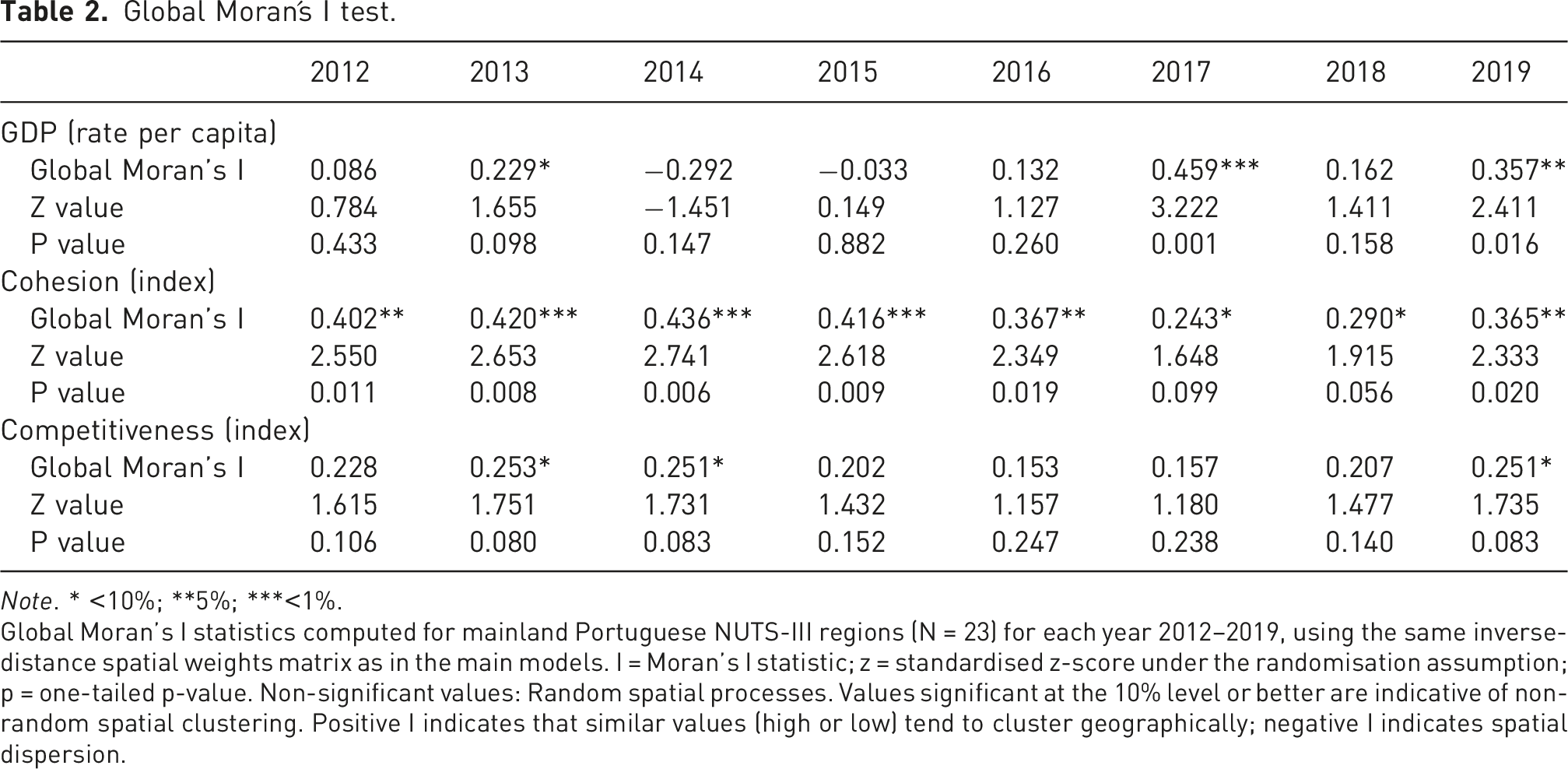
Note. * <10%; **5%; ***<1%.
Global Moran’s I statistics computed for mainland Portuguese NUTS-III regions (N = 23) for each year 2012–2019, using the same inverse-distance spatial weights matrix as in the main models. I = Moran’s I statistic; z = standardised z-score under the randomisation assumption; p = one-tailed p-value. Non-significant values: Random spatial processes. Values significant at the 10% level or better are indicative of non-random spatial clustering. Positive I indicates that similar values (high or low) tend to cluster geographically; negative I indicates spatial dispersion.
GDP per capita growth exhibits positive and statistically significant spatial autocorrelation in three of the 8 years: 2013 (I = 0.229, z = 1.655, p = 0.098), 2017 (I = 0.459, z = 3.222, p = 0.001), and 2019 (I = 0.357, z = 2.411, p = 0.016). The remaining years yielded non-significant and, in some cases, negative Moran’s I values (ranging from −0.292 in 2014 to 0.162 in 2018), indicating the absence of systematic spatial clustering in those periods. Notably, the 2017 estimate is the strongest across all three outcomes and years, indicating that the convergence shock of that year had a particularly pronounced cross-regional spatial dimension. This intermittent but recurring pattern of spatial dependence in GDP growth provides motivation for a spatial econometric specification.
For cohesion, Moran’s I is positive and statistically significant in all 8 years of the sample, with values ranging from I = 0.243 (z = 1.648, p = 0.099) in 2017 to I = 0.436 (z = 2.741, p = 0.006) in 2014. This unbroken sequence of significant statistics across the full 2012–2019 period indicates strong and persistent geographic clustering of the cohesion index. The strong and consistent spatial autocorrelation in cohesion levels indicates that high- and low-cohesion regions are not randomly distributed but form stable geographic patterns over time. For competitiveness, spatial autocorrelation is intermittent and relatively weak. Statistically significant values were observed only in 2013 (I = 0.253, z = 1.751, p = 0.080), 2014 (I = 0.251, z = 1.731, p = 0.083), and 2019 (I = 0.251, z = 1.735, p = 0.083), all at the 10% level. In the remaining 5 years, Moran’s I values are positive but modest (ranging from 0.153 to 0.228) and statistically non-significant, indicating no systematic spatial clustering. This limited and non-persistent pattern supports a more parsimonious spatial specification for this outcome.
Wald tests and common factor restriction test.
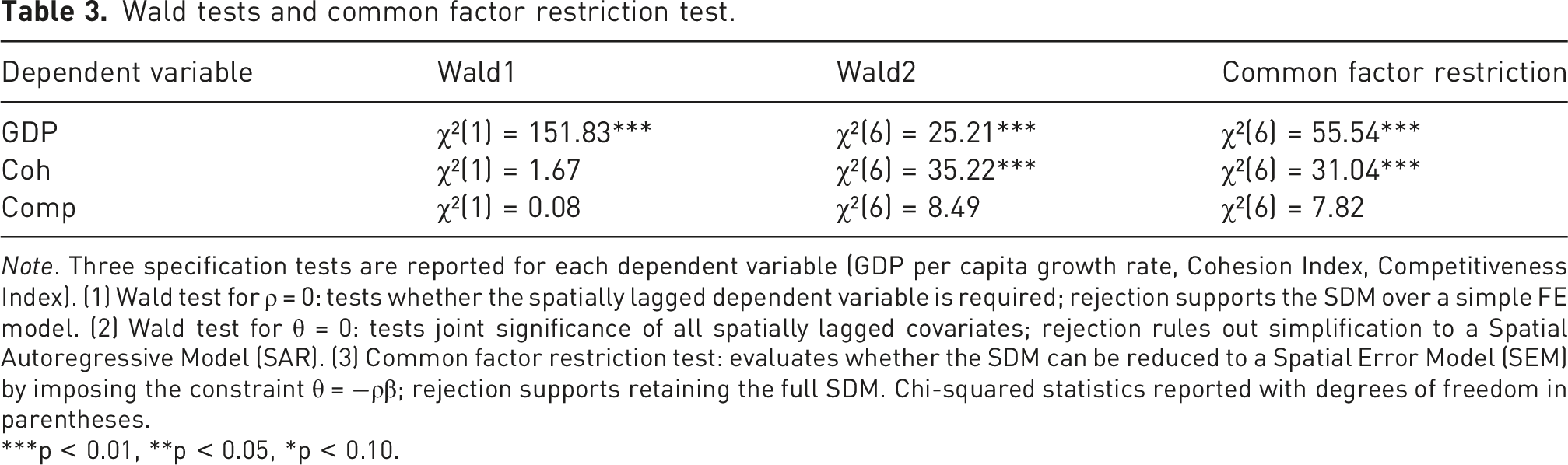
Note. Three specification tests are reported for each dependent variable (GDP per capita growth rate, Cohesion Index, Competitiveness Index). (1) Wald test for ρ = 0: tests whether the spatially lagged dependent variable is required; rejection supports the SDM over a simple FE model. (2) Wald test for θ = 0: tests joint significance of all spatially lagged covariates; rejection rules out simplification to a Spatial Autoregressive Model (SAR). (3) Common factor restriction test: evaluates whether the SDM can be reduced to a Spatial Error Model (SEM) by imposing the constraint θ = −ρβ; rejection supports retaining the full SDM. Chi-squared statistics reported with degrees of freedom in parentheses.
***p < 0.01, **p < 0.05, *p < 0.10.
For GDP growth, all null hypotheses are strongly rejected, supporting the full SDM specification and ruling out SAR and SEM simplifications. For cohesion, the spatial lag parameter is not significant (χ2 (1) = 1.67), whereas spatially lagged covariates are jointly significant (χ2 (6) = 35.22***), indicating that spatial interactions operate primarily through covariate spillovers rather than through autocorrelation in the dependent variable. For competitiveness, neither test rejects the null hypotheses, providing no evidence that an SDM is required relative to the FE baseline.
To assess the sensitivity of our findings to the choice of spatial weight matrix, we re-estimate the SDM using five alternative specifications: first-order queen contiguity, second-order queen contiguity, distance-band matrix, inverse distance-band matrix, and k-nearest neighbors matrix (k = 4) with inverse distance weights (Anselin and Bera, 1998). Full results are reported in Appendix B.
As discussed above, the baseline weight matrix, constructed using inverse distance weights, where spatial interaction decreases continuously with geographic distance – was chosen to reflect the nature of tourism-related cross-regional dynamics, including destination substitution, territorial complementarity, and multi-destination itineraries. This distance-decay specification aligns with established spatial interaction theory (Fotheringham, 1981) and is better suited to capturing these mechanisms than administrative contiguity alone.
The robustness checks broadly support the baseline results. Direct effects of non-resident overnight stays are stable in sign and significance across all weighting schemes for all three dependent variables. Spillover effects are more sensitive to matrix choice – a pattern commonly observed in spatial econometrics (LeSage and Pace, 2014), but the key findings hold. For GDP growth, the spatial autoregressive parameter remains positive and highly significant across all matrices, and the direct effect of non-resident tourism is consistently robust; spillover effects from international tourism are significant primarily under the baseline, second-order queen, and distance-based matrices. For cohesion and competitiveness, the direct effects of non-resident overnight stays remain positive and statistically significant across specifications. Indirect effects on competitiveness are consistently non-significant, whereas for cohesion they are significant under the baseline and distance-based matrices. Overall, the main conclusions are robust to the choice of spatial weight matrix.
Variance inflation factors (VIF).
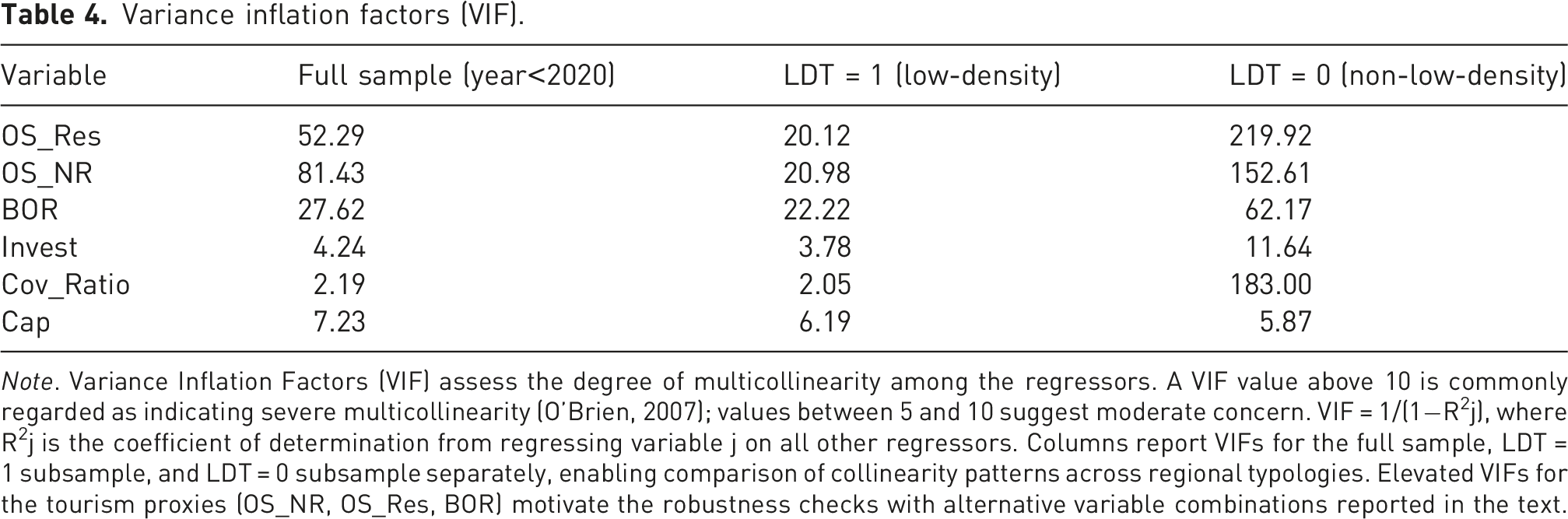
Note. Variance Inflation Factors (VIF) assess the degree of multicollinearity among the regressors. A VIF value above 10 is commonly regarded as indicating severe multicollinearity (O’Brien, 2007); values between 5 and 10 suggest moderate concern. VIF = 1/(1−R2j), where R2j is the coefficient of determination from regressing variable j on all other regressors. Columns report VIFs for the full sample, LDT = 1 subsample, and LDT = 0 subsample separately, enabling comparison of collinearity patterns across regional typologies. Elevated VIFs for the tourism proxies (OS_NR, OS_Res, BOR) motivate the robustness checks with alternative variable combinations reported in the text.
Results and discussion
The empirical analysis is structured in two stages. First, we examine the role of tourism in shaping regional economic growth, cohesion, and competitiveness across all Portuguese NUTS-III regions, with particular emphasis on the presence of spatial spillovers. This allows us to test whether the benefits of tourism extend beyond the regions where activity is concentrated or whether they reinforce existing core-periphery divides. Second, we disaggregate the results by low-density territories (LDTs) and non-LDTs to identify threshold effects and structural constraints that condition tourism’s developmental role.
Tourism spillovers
Spatial durbin model (GDP; Coh); fixed effects (Comp).
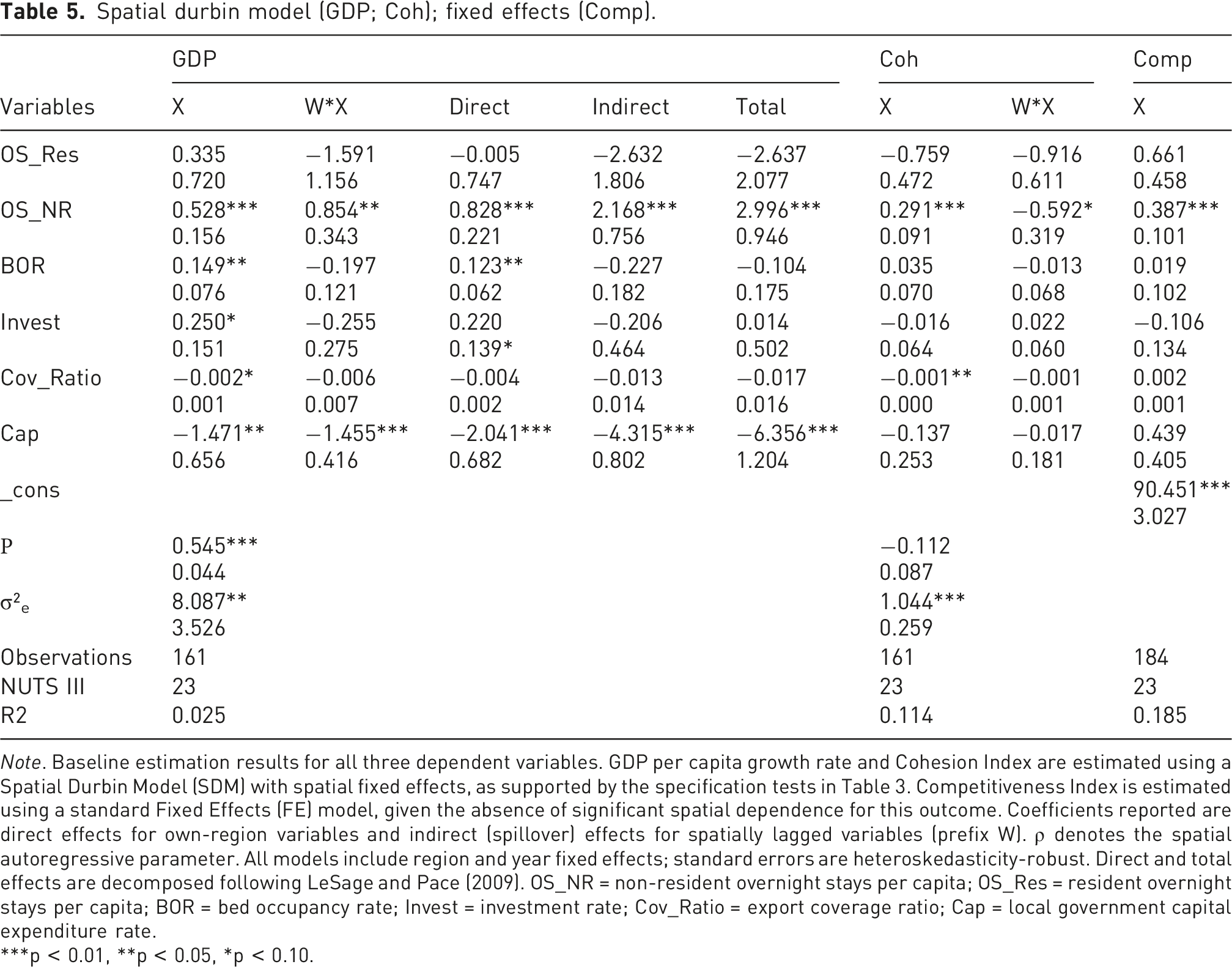
Note. Baseline estimation results for all three dependent variables. GDP per capita growth rate and Cohesion Index are estimated using a Spatial Durbin Model (SDM) with spatial fixed effects, as supported by the specification tests in Table 3. Competitiveness Index is estimated using a standard Fixed Effects (FE) model, given the absence of significant spatial dependence for this outcome. Coefficients reported are direct effects for own-region variables and indirect (spillover) effects for spatially lagged variables (prefix W). ρ denotes the spatial autoregressive parameter. All models include region and year fixed effects; standard errors are heteroskedasticity-robust. Direct and total effects are decomposed following LeSage and Pace (2009). OS_NR = non-resident overnight stays per capita; OS_Res = resident overnight stays per capita; BOR = bed occupancy rate; Invest = investment rate; Cov_Ratio = export coverage ratio; Cap = local government capital expenditure rate.
***p < 0.01, **p < 0.05, *p < 0.10.
Regarding GDP growth, the spatial autoregressive parameter (ρ = 0.545, p < 0.01) confirms the presence of statistically significant spatial spillovers. This finding reinforces the spatial dimension of the tourism-led growth hypothesis (Balaguer and Cantavella-Jordá, 2002), demonstrating that tourism’s impacts are mediated by inter-regional dependencies. This aligns with Paci and Marrocu (2014) and Yang and Fik (2014), who argue that tourism-related gains transcend administrative boundaries. The strong positive spatial dependence indicates that regional GDP growth is influenced by neighboring regions’ economic growth, likely due to shared infrastructures, labor mobility, and cross-regional demand synergies.
In contrast, cohesion outcomes do not exhibit significant spatial dependence (ρ = −0.112, p > 0.10). This result is conceptually innovative, as it attempts to measure the reduction of social and territorial disparities directly rather than inferring cohesion through GDP, as done in studies like Llorca-Rodríguez et al. (2020).
The SDM decomposition enables disaggregation into direct, indirect, and total effects (LeSage and Pace, 2014). Where ρ is significant (e.g., GDP), direct and indirect effects are essential to fully capture the feedback and spillover mechanisms, respectively. For cohesion, where ρ is not significant, the interpretation focuses on the effects of covariates and their spatial lags without feedback loops.
The results reveal that international tourism (OS_NR) exerts a substantial total effect on GDP (2.996, p < 0.01), with a meaningful direct effect (0.828, p < 0.01) and a more pronounced indirect effect (2.168, p < 0.01). This highlights international tourism’s role as a spatial multiplier, generating significant spillovers to neighboring regions. This finding aligns with the spatial analysis of Siano et al. (2022), who demonstrated that tourism flows in one Italian province positively impact economic growth in adjacent provinces. The significant indirect effects indicate that tourism’s economic benefits propagate through regional networks, even when activity is geographically concentrated. These findings align with Llorca-Rodríguez et al. (2020) assertion that, with effective governance, inbound tourism can function as a catalyst for broader regional development despite its localized spatial footprint.
Non-resident overnight stays (OS_NR) exhibit a positive direct effect on cohesion (β = 0.291, p < 0.01) while generating a negative spatial spillover from neighboring regions (β = −0.592, p < 0.10). This spatial asymmetry, whereby international tourism in neighboring regions positively affects local GDP growth (β = 2.168, p < 0.01) while negatively affecting local cohesion, warrants careful interpretation given the marginally significant cohesion spillover and its sensitivity to alternative spatial weighting schemes (see Appendix B).
Two mechanisms consistent with uneven development theory (Massey, 1999; Myrdal, 1964) may explain this pattern. First, labor mobility between regions generates divergent outcomes: while inter-regional flows contribute to GDP through remittances and consumption linkages, outmigration from peripheral areas may erode demographic sustainability and social capital, particularly where tourism development remains concentrated in core regions (Bohlin et al., 2016). Second, asymmetric value capture through tourism supply chains may perpetuate spatial inequality, as peripheral regions supply inputs and labor while core regions retain disproportionate shares of tourism receipts – a dynamic consistent with cumulative causation (Myrdal, 1964), though direct supply chain data were unavailable for verification.
These findings contribute to the tourism-led growth literature by documenting growth-cohesion decoupling in the presence of positive aggregate spillovers, challenging linear assumptions underlying the tourism-led growth hypothesis. However, the marginal statistical significance (p < 0.10) and model sensitivity to spatial weighting specifications indicate that these spillover effects may be scale-dependent or reflect specification uncertainty. Further research employing alternative identification strategies and direct measurement of labor flows, fiscal competition, and value chain structures would strengthen causal inference. From a policy perspective, the results reveal that coordinated governance mechanisms may be necessary to internalize spatial externalities and ensure a more balanced distribution of tourism benefits across regions (Martin, 2015).
Competitiveness, analyzed without spatial lags, presents a localized nature. International tourism (OS_NR) significantly enhances regional competitiveness in the region itself (0.387, p < 0.01). However, in contrast with GDP, tourism-driven competitiveness gains remain region-bound, indicating that competitive advantages are territorially entrenched.
The empirical results reveal a dual reality: while international tourism in the core region positively affects economic growth, social cohesion, and competitiveness – with regional GDP growth benefiting from positive feedback and spillover effects from neighboring regions – domestic tourism does not contribute to either economic growth or development in the core region, and neither feedback nor spillover mechanisms are present. This conclusion is highly significant, as the geographic distribution of overnight stays per capita by residents and non-residents differs considerably, as demonstrated by Figure 3. Domestic tourism exhibits some importance in LDTs, identified by diagonal lines. However, international tourism remains minimal in these areas, meaning these territories have not benefited from the positive impacts of tourism on economic growth and development. Overnight Stays per capita by Non-Residents and Residents.
The bed occupancy rate (BOR) shows a small but significant direct effect on GDP (0.123, p < 0.05), with no meaningful impact on cohesion and competitiveness. This indicates that increased use of tourism infrastructure contributes to economic growth in the respective regions but not to its cohesion and competitiveness. These findings align with Masson and Petiot’s (2009) critique that infrastructure-driven tourism growth, if not anchored in local value chains, can intensify inequality.
Turning to control variables, the analysis highlights notable contrasts between tourism and the usual economic determinants of development. Investment (Invest) shows a weakly significant positive effect on GDP in the region (0.250, p < 0.10), but its spatial diffusion is negligible. These findings indicate that domestic capital formation contributes only modestly to the economic growth of the core region and is not associated with significant regional spillovers. These outcomes are related to the persistently low investment-to-GDP ratio during the period analyzed. Indeed, in the context of austerity policies and financial deleveraging, average investment represented 7.5% of GDP, rising from less than 6% in 2012 to 9% in 2019.
International trade performance, as measured by the coverage ratio (Cov_Ratio), exhibits only a weak, negative association with both GDP and cohesion within the region itself. The average coverage ratio decreased between 2012 and 2019 (Table 1), likely because economic recovery was accompanied by an increase in imports. This explains the negative relationship between the coverage ratio and GDP growth, revealing that exports have driven economic growth mainly in the early years analyzed, when austerity policies were implemented.
Local government capital expenditure (Cap) exhibits a large and statistically significant negative total effect on GDP (−6.356, p < 0.01), with both direct and indirect effects contributing to this outcome. Given that the Economic and Financial Assistance Program imposed strict fiscal consolidation requirements and prompted a major revision of the Local Finances Law (2013), measures designed to curb regional indebtedness, these findings suggest that reduced local public investment coincided with higher growth in core regions and their neighbors. The counterintuitive result may reflect how fiscal constraints forced regions to pivot toward more productive growth mechanisms, such as tourism rather than public investment. This aligns with Paci and Marrocu’s (2014) spatial econometric analysis of European regions, which found no significant growth effects from physical capital stock and emphasized tourism-driven spillovers as alternative growth drivers.
The main conclusion is that during the period under analysis, only international tourism was able to positively contribute to economic growth, cohesion, and competitiveness within the region itself. The variables related to international trade and domestic demand (which encompasses both total and local public investment, as well as domestic tourism) were either not statistically significant or exhibited coefficients with negative signs. Thus, at the regional level, the engine of economic growth shifted away from domestic demand but did not transition to international trade as a whole; rather, GDP growth became specifically driven by tourism exports. These findings also confirm the exceptional nature of the period studied.
These findings underscore the complex nature of tourism: while it presents significant opportunities for regional economic growth and development – particularly through international tourism – it also exacerbates regional disparities by promoting GDP growth in neighboring areas while simultaneously undermining social and territorial cohesion within those regions. Conversely, domestic tourism fails to act as a catalyst for either economic growth or broader economic development.
Low-density territories
Descriptive Statistics - Low-density territories (LDT).

Note. Comparative descriptive statistics for the LDT = 1 (N = 13 regions) and LDT = 0 (N = 10 regions) subsamples over 2012–2019. Variables as defined in Table 1. Mean and standard deviation (SD) reported for each group. The competitiveness gap between LDTs (mean 88.41) and non-LDTs (mean 97.96) is notably wider than the cohesion gap (95.54 vs. 99.29), suggesting that structural disadvantages in LDTs are more acute in economic dynamism than in social and territorial equity. The large difference in OS_NR (0.94 vs. 4.07) reflects the strong spatial concentration of international tourism in metropolitan and coastal regions, while BOR differences (26.92% vs. 35.16%) indicate substantially lower tourism infrastructure utilization in LDTs. These descriptive contrasts motivate the subsample Fixed Effects estimations reported in Table 7.
Low-density territories (LDT).
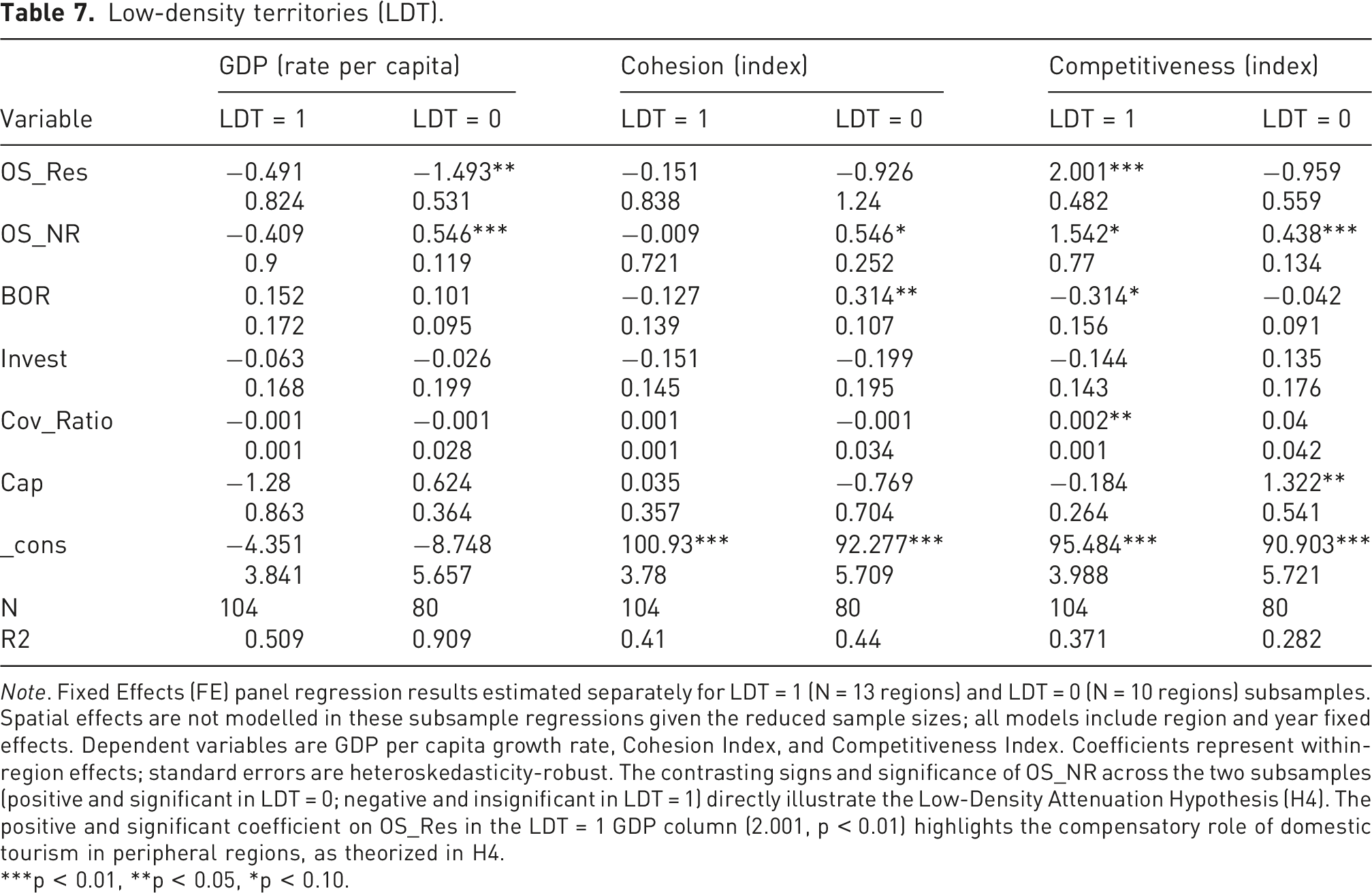
Note. Fixed Effects (FE) panel regression results estimated separately for LDT = 1 (N = 13 regions) and LDT = 0 (N = 10 regions) subsamples. Spatial effects are not modelled in these subsample regressions given the reduced sample sizes; all models include region and year fixed effects. Dependent variables are GDP per capita growth rate, Cohesion Index, and Competitiveness Index. Coefficients represent within-region effects; standard errors are heteroskedasticity-robust. The contrasting signs and significance of OS_NR across the two subsamples (positive and significant in LDT = 0; negative and insignificant in LDT = 1) directly illustrate the Low-Density Attenuation Hypothesis (H4). The positive and significant coefficient on OS_Res in the LDT = 1 GDP column (2.001, p < 0.01) highlights the compensatory role of domestic tourism in peripheral regions, as theorized in H4.
***p < 0.01, **p < 0.05, *p < 0.10.
Bed occupancy rates of LDTs have an insignificant economic impact (0.152, p > 0.10), reinforcing Masson and Petiot’s (2009) critique of supply-side expansions unsupported by institutional or infrastructural investments. While higher occupancy enhances cohesion in non-LDTs, it may penalize LDT competitiveness, possibly due to a mismatch between mass-tourism infrastructure and LDT tourists’ preference for tranquil experiences. Table 7 confirms that tourism variables have no significant effect on economic growth and cohesion in LDT areas, implying that broader institutional and demographic factors can be more influential – a finding consistent with Llorca-Rodríguez et al.’s (2020) spatial analysis of EU regions.
Regarding the control variables, coefficients are only statistically significant in two cases. First, a higher coverage ratio led to a slight improvement in the competitiveness of LDT areas. Second, increased local public capital expenditure in non-LDT regions was associated with a marked increase in their competitiveness, further widening the competitiveness gap between these territories. Thus, the cohesion gap between LDTs and non-LDTs (95.54 vs. 99.29) is narrower than the competitiveness gap, suggesting that social cohesion in LDTs, as noted by Santos and Vieira (2020), does not translate into economic dynamism. Similarly, investment (Invest) and public capital expenditure (Cap) – though comparable across regions – fail to stimulate growth in LDTs, reflecting Andraz et al.’s (2009) observations on institutional thinness.
The outcomes in Table 7 demonstrate that tourism’s impact on LDTs is mediated by structural thresholds, necessitating context-sensitive policies. As theorized by Yang and Fik (2014) and Dinis et al. (2019), the results may suggest the existence of three structural barriers in LDTs: agglomeration deficits due to fragmented value chains, institutional thinness reducing policy coherence, and connectivity gaps perpetuating peripherality. To overcome these challenges, place-based strategies, such as niche tourism development and governance innovation, are critical. In this regard, Chim-Miki et al. (2025) offer relevant evidence from the Douro River region of Portugal, itself a designated LDT, demonstrating that coopetition networks among tourism stakeholders function as a necessary condition for translating regional tourism development into broader social value. Their findings suggest that cooperative structures, such as business associations and Destination Management Organizations (DMOs), act as institutional intermediaries that reduce resource dependence, distribute tourism benefits more equitably, and strengthen the social fabric of peripheral communities. This underscores that strengthening associationism and inter-stakeholder collaboration within LDTs may be as important as supply-side infrastructure investments. Future research should explore community-based models to align tourism development with the unique spatial and institutional realities of low-density territories.
Assessed against the four testable hypotheses described in the introduction, the findings yield the following appraisal. H1 (Tourism–Development Hypothesis) receives partial support: international tourism intensity exerts a positive and statistically significant effect on GDP per capita growth, cohesion, and competitiveness, whereas domestic tourism does not produce consistent positive effects across outcomes. H2 (International vs. Domestic Tourism Hypothesis) is confirmed: non-resident overnight stays per capita exert stronger positive effects on all three outcomes than resident overnight stays, consistent with higher spending intensity and larger local multipliers. H3 (Asymmetric Spatial Spillovers Hypothesis) receives partial support: positive GDP spillovers from international tourism (OS_NR: β = 2.168, p < 0.01) are consistent with interregional demand linkages and mobility networks; however, cohesion spillovers are negative (β = −0.592, p < 0.10), indicating backwash effects rather than spatial convergence; and competitiveness spillovers are statistically insignificant, consistent with tourism benefits being more locally captured in this dimension. H4 (Low-Density Attenuation Hypothesis) is substantiated: in non-LDT regions, international tourism generates significant positive effects on all three outcomes; in LDTs, tourism effects are markedly attenuated, with only competitiveness reaching significance, driven primarily by domestic tourism (OS_Res: β = 2.001, p < 0.01), reflecting lower absorptive capacity, thinner markets, and more limited infrastructure in peripheral territories.
Portugal in comparative perspective: Lessons from the European peripheries
The patterns observed in Portugal resonate with broader dynamics across European peripheral regions while also exhibiting distinctive features that inform both theory and policy. Situating our findings within this comparative context enhances their generalizability and clarifies which mechanisms are context-specific versus structurally embedded in peripheral development trajectories.
First, the finding that international tourism generates positive GDP spillovers while exerting a negative – albeit marginally significant – effect on cohesion in neighboring regions is consistent with backwash mechanisms documented in European peripheral contexts (Bohlin et al., 2016; Llorca-Rodríguez et al., 2020), where tourism-driven growth in core areas has been associated with limited or adverse distributional outcomes in adjacent territories. Bohlin et al. (2016) documented how tourism growth in Swedish peripheral regions concentrates in urban centers rather than spreading to rural areas, suggesting that tourism policy may reinforce rather than alleviate spatial disparities – a pattern consistent with our finding that tourism strengthens competitiveness without improving cohesion in LDTs. The capacity to translate tourism activity into broader territorial development is mediated by governance quality and institutional innovation (Grillitsch and Nilsson, 2015; Rodríguez-Pose, 2013), suggesting that the growth–cohesion decoupling observed in Portugal reflects not only the scale of tourism flows but also the structural conditions under which they operate.
Second, the threshold effects identified in Portuguese LDTs find partial support in evidence from Southern Italy, where Bronzini et al. (2022) demonstrated that tourism’s growth effects are larger in less developed provinces but null in already high-tourism areas, suggesting that congestion effects may limit further gains in established destinations while leaving open questions about whether peripheral regions can achieve the critical mass necessary for sustained tourism-led development. Notably, the fixed-effects estimates presented above reveal that the positive effect of international tourism on competitiveness is actually larger in LDTs than in non-LDTs (OS_NR: β = 0.387 in non-LDTs vs. a comparatively stronger marginal effect in LDTs), suggesting that where tourism diffuses into peripheral areas, its competitive returns may be proportionally higher – a pattern consistent with the diminishing-returns logic underlying threshold theories. Similarly, our finding that international tourism strengthens competitiveness but not cohesion in LDTs aligns with evidence from EU regions more broadly, where Llorca-Rodríguez et al. (2020) demonstrated that inbound tourism hinders territorial convergence in less developed and transition regions despite positive GDP effects, and where Romão and Nijkamp (2019) found that tourism specialization raises regional value added while generating no equivalent gains in employment or social welfare. These broadly consistent findings across distinct national contexts suggest that institutional thinness and agglomeration deficits represent structural barriers that transcend specific policy frameworks – what Rodríguez-Pose (2017) characterizes as the plight of “places that don’t matter”.
Third, Portugal’s pronounced coastal-interior divide – with population and tourism infrastructure heavily concentrated along the Atlantic coast while interior regions face severe depopulation (INE, 2022) – represents a structural constraint on tourism diffusion to LDTs. While Spanish regions exhibit similar asymmetries (Llorca-Rodríguez et al., 2020), this geographic specificity suggests that connectivity investments may be necessary but not sufficient, as improved accessibility risks reinforcing agglomeration in already dominant coastal destinations at the expense of peripheral interiors (Masson and Petiot, 2009).
Finally, the compensatory role of domestic tourism in Portuguese LDTs offers policy-relevant insights for regions beyond Iberia. Evidence from multiple peripheral contexts suggests that domestic tourism can partially offset international tourism’s agglomerative tendencies by redistributing income toward less-developed territories (Li et al., 2016; Llorca-Rodríguez et al., 2020). However, this compensatory potential is conditional: tourism’s positive effects on resilience in peripheral areas are contingent on accessibility, governance capacity, and targeted public investment – conditions not uniformly present across European peripheries (Pugh and Dubois, 2021).
In sum, while Portugal exemplifies structural patterns consistent with broader European evidence – growth–cohesion decoupling, threshold effects, and the compensatory potential of domestic demand – its specific geography and institutional context shape how these mechanisms operate. This comparative perspective strengthens the threshold-based reconceptualization of the TLGH advanced in this study: tourism’s developmental role is neither automatic nor deterministic but is contingent on territorially embedded capacities and relationally constituted interdependencies. Our findings are thus consistent with evidence from European peripheries facing similar structural constraints, with the precise mechanisms contingent on local governance quality and geographic context.
Conclusion
This study reassesses the Tourism-Led Growth Hypothesis (TLGH) by combining a multidimensional framework of development with a spatially disaggregated (NUTS-III) perspective and the application of Spatial Durbin models. By explicitly incorporating cohesion and competitiveness alongside GDP growth and distinguishing between low-density territories (LDTs) and non-LDTs, the analysis moves beyond the linear assumptions that still dominate much of the literature. The findings show that tourism’s developmental role is both multidimensionally complex and territorially uneven, challenging any universalist reading of the TLGH.
Empirical insights
Three central conclusions emerge. First, international tourism operates as a powerful spatial multiplier, generating strong effects on GDP growth in core regions and positive spillovers for neighboring territories. Yet these same flows undermine cohesion in adjacent regions, revealing a paradox whereby tourism simultaneously stimulates growth and erodes cohesion. This demonstrates that the TLGH, while empirically valid in terms of growth, is theoretically incomplete if it neglects the distributive dimensions of development. The model must therefore be reconceptualized as a conditional, rather than universal, framework, sensitive to institutional quality and the relational geographies of interregional spillovers.
Second, the comparative analysis of international and domestic tourism highlights important asymmetries. International tourism enhances competitiveness across all types of regions but has little transformative capacity in LDTs, where structural deficits constrain its economic and social effects. Domestic tourism, though inert or negative in aggregate, emerges as an important compensatory mechanism in LDTs, reinforcing competitiveness and offering a pathway to resilience under conditions of institutional thinness and peripherality. This finding advances the theoretical debate by showing that tourism’s contribution to development cannot be reduced to a dichotomy between international and domestic flows. Rather, the type of tourism interacts with the structural characteristics of territories, pointing to a relational model of tourism-led development where the same form of demand produces divergent outcomes across different contexts.
Third, the persistent decoupling of growth, cohesion, and competitiveness reflects structural thresholds that conventional tourism-led growth models cannot capture. In LDTs, demographic fragility, geographic isolation, and fragmented value chains limit the diffusion of tourism’s benefits, ensuring that positive competitiveness effects do not translate into broader development. Theoretically, this calls for a shift from viewing the TLGH as a linear progression to conceiving it as a threshold-based process. Tourism may trigger growth only when a critical mass of institutional, infrastructural, and demographic conditions is present. Where these thresholds are absent, tourism risks reinforcing path dependencies and deepening core–periphery divides.
From a theoretical standpoint, this study contributes to repositioning the TLGH within contemporary debates on uneven development, relational economic geography, and new peripherality. Tourism is shown not as an automatic driver of convergence but as a contingent process embedded in territorial structures and institutional capacities. Recognizing these contingencies strengthens the explanatory power of the TLGH and enhances its relevance for academic and policy debates.
The empirical evidence, taken as a whole, confirms that tourism’s contribution to regional development is neither linear nor universal. All four hypotheses find support – partial or full – and collectively point to a consistent overarching conclusion: the developmental effects of tourism are asymmetric, territorially contingent, and mediated by the structural characteristics of receiving regions. These patterns resonate with the comparative European evidence reviewed in the discussion above – from Italian provinces (Bronzini et al., 2022) to Swedish peripheral regions (Bohlin et al., 2016) and EU cohesion regions (Llorca-Rodríguez et al., 2020) – reinforcing the conclusion that tourism operates as a threshold-dependent, spatially differentiated process whose developmental potential is realized only where the requisite institutional, infrastructural, and demographic conditions are in place, and that this diagnosis has generalizability beyond the Portuguese case.
Policy recommendations
From a policy perspective, the study demonstrates that territorially undifferentiated strategies are unlikely to succeed and supports its central hypothesis that the developmental impact of tourism is contingent upon the type of tourism and the spatial configuration of regional assets. The strong spatial dependence of tourism outcomes calls for coordinated, place-based approaches that enhance inter-regional synergies while addressing LDT-specific constraints. These findings point to several critical policy implications. First, territorially differentiated strategies are critical to maximize tourism’s economic benefits while mitigating its exclusionary effects. Second, integrated regional planning should prioritize enhancing connectivity between peripheral destinations, which often coincide with lagging regions, and core tourism hubs. Third, in LDTs, targeted investments in connectivity, digital and human capital, and governance capacity are essential to translate competitiveness into sustainable development; institutional innovations, such as regional public-private partnerships, can help root tourism gains locally. Finally, a broader implication is that cohesion policy must evolve from compensatory transfers to structural empowerment. It cannot be understood as exogenous compensation for lagging regions but must be reframed as a constitutive element of tourism development, investing in local capacity and sustainable, place-based models. In this sense, cohesion and competitiveness are not secondary outcomes but co-determinants of how and whether tourism stimulates sustainable growth. These findings also highlight the risks of austerity-era policies, where reduced public investment coincided with tourism-driven expansion but further deepened structural divides. Policymakers should additionally guard against tourism-led crowding-out effects – including rising housing costs, displacement of local residents, and reallocation of labor away from tradeable sectors – and against demand displacement between regions, whereby the growth of dominant coastal destinations may suppress tourism flows and investment in peripheral LDTs. The place-based, differentiated strategies advocated in this study are designed to mitigate these risks by strengthening local absorptive capacity, diversifying regional tourism products, and embedding governance mechanisms that retain tourism benefits within local economies.
Finally, the research underscores the methodological value of integrating multidimensional indicators, territorial disaggregation, and spatial econometrics. Future studies should extend this approach to capture digitalization and recent transformations, explore sectoral differentiation within tourism, and engage in systematic comparative analyses across European peripheries. This approach should extend the cross-national benchmarking initiated in this study to contexts such as Eastern Europe, the Mediterranean rim, and Nordic peripheries, where analogous structural constraints and institutional configurations may condition tourism’s developmental role in comparable ways. Incorporating well-being and climate vulnerability indicators would further enrich our understanding of sustainable tourism trajectories.
Supplemental material
Supplemental Material - Tourism, growth, cohesion and competitiveness: Effects in Portugal’s regions and low-density territories
Supplemental Material for Tourism, growth, cohesion and competitiveness: Effects in Portugal’s regions and low-density territories by Patrícia Martins, Alexandre Guedes in Tourism and Hospitality Research.
Supplemental material
Supplemental Material - Tourism, growth, cohesion and competitiveness: Effects in Portugal’s regions and low-density territories
Supplemental Material for Tourism, growth, cohesion and competitiveness: Effects in Portugal’s regions and low-density territories by Patrícia Martins, Alexandre Guedes in Tourism and Hospitality Research.
Footnotes

Funding
The authors disclosed receipt of the following financial support for the research, authorship, and/or publication of this article: This work was supported by the FCT – Portuguese Foundation for Science and Technology under grant UID/04011: CETRAD – Centro de Estudos Transdisciplinares para o Desenvolvimento and CEECINST/00127/2018/CP1501/CT0001.
Declaration of conflicting interests
The authors declared no potential conflicts of interest with respect to the research, authorship, and/or publication of this article.
Supplemental material
Supplemental material for this article is available online.
Notes
Author biographies
References
Supplementary Material
Please find the following supplemental material available below.
For Open Access articles published under a Creative Commons License, all supplemental material carries the same license as the article it is associated with.
For non-Open Access articles published, all supplemental material carries a non-exclusive license, and permission requests for re-use of supplemental material or any part of supplemental material shall be sent directly to the copyright owner as specified in the copyright notice associated with the article.
