



Abstract
This study asks why some domestic tourists move from interest in local food to buying it, while others stop short. Local cuisine is treated here as intangible cultural heritage rather than a routine travel purchase, which shifts the question toward identity. Drawing on Self-Image Congruence Theory and the Theory of Planned Behavior, the analysis examines how the fit between a tourist’s self-image and the cultural meaning of local food shapes the path to purchase. Data were collected from 512 domestic tourists in Türkiye and tested through structural equation modeling in AMOS, with preliminary analyses in SPSS. The results indicate that self-image congruence significantly influences tourists’ attitudes, subjective norms, perceived behavioral control, and purchasing behavior. Additionally, attitude, subjective norm, and perceived behavioral control positively affect purchase intention, which in turn significantly predicts actual purchasing behavior. The contribution lies in bringing heritage value into a behavioral model usually built around utility or pleasure. Once local food is read as cultural inheritance, the link between self-image and that inheritance becomes a working mechanism rather than a background sentiment. The findings are useful for destination managers and policymakers who treat local cuisine as a cultural asset, and they point toward identity-based communication rather than generic culinary promotion.
Keywords
Introduction
In recent years, there has been a heightened global interest in the role of local food in enhancing tourism experiences, with some suggesting it exceeds other tourism motivators (Stalmirska, 2024). This trend aligns with the growing recognition of Intangible Cultural Heritage, where local cuisine serves as a key cultural marker (Qiu and Zuo, 2023). For many tourists, local food offers an immersive cultural experience that reflects a destination’s heritage and identity (Adongo et al., 2015; Gálvez et al., 2017). As such, food has become a vital part of the tourism value chain.
Despite this growing interest, research on tourists’ actual consumption behavior of local food remains limited (Baah et al., 2020; Cohen and Avieli, 2004). Several studies have examined food-related tourist behavior (e.g., Beltramo et al., 2024; Rozenkowska, 2023; Wani et al., 2024), yet there has been little synthesis across findings, and many focus on general attitudes rather than the motivations behind purchasing decisions. The World Food Travel Association (2024) has called for more targeted research in this area, emphasizing that food-focused travelers focus on unique, authentic dining experiences tied to local heritage. However, most existing studies emphasize cognitive or affective aspects of decision-making (Baah et al., 2020; Choe and Kim, 2018), and few explore the symbolic or identity-driven dimensions. This signals a significant gap in understanding how factors like self-image influence local food consumption. Currently, there is a lack of integrated models that examine both rational (e.g., intention, attitude) and symbolic (e.g., self-image) motivations behind domestic tourists’ local food purchases. This study aims to address that gap.
The Theory of Planned Behavior (TPB) has been widely adopted to explain food-related consumer intentions (Rozenkowska, 2023; Shin and Hancer, 2016), focusing on attitudes, subjective norms, and perceived behavioral control (Ajzen, 1991). However, this rational-choice model may not fully account for the emotional and symbolic factors involved in food tourism (Gravelines et al., 2022).
To address this limitation, we incorporate the Self-Image Congruity Theory (Sirgy, 1986), which posits that individuals prefer products that align with their self-concept. This symbolic perspective is underexplored in the context of local food purchases but is crucial for understanding deeper motivational factors (Shin et al., 2016). By combining the TPB with self-image congruence, this study provides a more holistic framework to explain domestic tourists’ motivations for purchasing local foods.
This study aims to investigate domestic tourists’ purchasing behavior of local foods by integrating TPB and Self-Image Congruence Theory. In doing so, it responds to recent calls for research (e.g., Rozenkowska, 2023; Stalmirska, 2024) and contributes to the cultural heritage literature by examining both rational and symbolic motivations. By doing this theoretical integration, the current study makes the following three contributions: (1) it advances theoretical understanding by combining rational and symbolic perspectives on local food consumption; (2) it extends the literature by focusing on domestic tourists, an understudied population in food tourism research; and (3) it provides practical insights for the food tourism industry regarding how to appeal to consumers’ self-image in marketing local cuisine as cultural heritage.
Theoretical framework
Self-image congruence theory
Self-Image Congruence Theory posits that consumers are more likely to be attracted to products that align with their self-concept—whether that self-concept reflects their actual, ideal, or social self (Sirgy, 1986, 2018; Sirgy and Su, 2000). This theoretical perspective builds on earlier work by Levy (1959), who emphasized the symbolic role of products in consumer identity, and by Grubb and Grathwohl (1967), who argued that individuals buy products to express and enhance their identity. For local food, self-image congruence explains why consumers may be drawn to local products, as they symbolize cultural authenticity, environmental responsibility, or support for local economies—values that align with the consumer’s self-perception (Sirgy, 1986, 2018; Sirgy and Su, 2000). For example, a consumer who sees themselves as environmentally conscious may feel that local food validates and expresses that identity. This symbolic alignment not only drives emotional satisfaction but can also influence cognitive appraisals (e.g., attitudes) and social perceptions (e.g., norms).
Building on this, the model hypothesizes that self-image congruence influences TPB constructs—attitude (H1), subjective norms (H2), perceived behavioral control (H3)—as well as purchasing behavior directly (H4). These links position self-image congruence as a symbolic and identity-based antecedent within the integrated framework (Shin et al., 2016).
The theory of planned behavior
TPB explains behavior through three primary cognitive constructs: attitude, subjective norms, and perceived behavioral control (Ajzen, 1991, 2020). These components shape behavioral intentions, which, in turn predict actual behavior (Ibrahim et al., 2025). TPB builds on the earlier Theory of Reasoned Action (TRA) by incorporating perceived behavioral control to account for situations in which individuals may not have complete volitional control over their actions (Ajzen and Fishbein, 2005; Fishbein and Ajzen, 1975; Velaoras et al., 2025). In the context of local food purchasing, the TPB offers a rational–cognitive lens for understanding consumer decision-making. For instance, attitudes toward local food may reflect beliefs about freshness, safety, or environmental benefits; subjective norms may involve social expectations from family, friends, or the community; and perceived behavioral control may relate to the accessibility, affordability, or availability of local food products. Accordingly, this study hypothesizes that these three TPB constructs positively influence consumers’ intention to purchase local food (H5–H7), thereby providing the cognitive foundation for the proposed model. In addition, the model hypothesizes that purchase intention influences individuals’ purchasing behavior for local food (H8).
Theoretical integration: The theory of planned behavior and the self-image congruence theory
Integrating Self-Image Congruence Theory with the TPB offers a more comprehensive, theoretically grounded explanation of local food purchasing behavior, as each framework captures distinct yet complementary psychological mechanisms. TPB primarily addresses the deliberate, rational–cognitive antecedents of intention—attitude, subjective norm, and perceived behavioral control—on the assumption that individuals process information systematically when forming behavioral intentions (Ajzen, 1991; Velaoras et al., 2025). Despite extensive empirical research on the topic, scholars have noted that the TPB may not adequately account for symbolic, affective, and identity-driven determinants of consumption, underscoring the value of incorporating additional constructs, such as self-identity, moral norms, and affective beliefs (Armitage and Conner, 2001; Conner and Armitage, 1998). Self-Image Congruence Theory complements these limitations by positing that consumer behavior is strongly influenced by the degree of congruence between an individual’s self-concept and the symbolic meanings embedded in products, brands, or experiences (Klára, 2020; Sirgy et al., 1997). Considering that local foods are imbued with cultural heritage, authenticity, and regional identity (Duman and Avcıkurt, 2023), consumers’ purchasing decisions extend beyond rational evaluations to include motivations related to self-expression, cultural alignment, and affirmation of social identity (Kılıç and Buzlukçu, 2024). Consequently, synthesizing Self-Image Congruence Theory with the TPB facilitates a comprehensive analytical framework that bridges cognitive-normative determinants with symbolic, identity-based drivers. This theoretical integration enhances predictive validity, offering a more robust explication of local food purchasing behavior than either model can achieve in isolation.
Accordingly, the research model is depicted in Figure 1. Research model.
Literature review and hypotheses development
Local foods as intangible cultural value
Local foods reflect culinary practices shaped by long-term coexistence, traditions, and shared cultural experiences within communities (Akhoondnejad, 2025). As components of intangible cultural heritage, they encompass preparation techniques, symbolic meanings, consumption rituals, and community-based knowledge systems that collectively reflect a society’s identity and cultural continuity (Duman and Avcıkurt, 2023). Beyond their cultural significance, local foods contribute to the historical, economic, and social structures of a region and serve as a critical element of destination attractiveness (Lin et al., 2021). Their role in tourism has gained prominence with developments in gastronomic tourism and increasing consumer demand for authentic and sustainable food experiences (Magdy, 2026). In this sense, local foods function simultaneously as cultural heritage assets, tourism marketing tools, and drivers of regional economic development (Tikkanen, 2007). Building on the cultural and symbolic importance of local foods, understanding the psychological mechanisms that underlie consumers’ decisions becomes essential.
The integration of self-image congruence theory and the theory of planned behavior
Self-Image Congruence Theory posits that individuals tend to prefer products, services, and experiences aligned with their self-concept, thereby increasing psychological consistency and satisfaction (Sirgy et al., 1997). As an identity-based construct, self-image congruence has been applied in various consumption contexts (Anand and Kaur, 2018; Ericksen and Sirgy, 1992; He and Mukherjee, 2007). In tourism, self-concept alignment has been found to shape destination preferences, experience evaluations, and consumption behaviors (Klára, 2020; Sirgy and Su, 2000). When applied to food-related behaviors, self-image congruence can influence how individuals perceive culturally embedded products such as local foods (Boley et al., 2022).
Building on this, Shin et al. (2016) demonstrated that self-image congruence acts as an antecedent to the three determinants of the TPB, such as attitude, subjective norm, and perceived behavioral control, ultimately shaping behavioral intentions and subsequent actions. Drawing on this synthesized model, self-image congruence is expected to function as a dual determinant, shaping cognitive and normative antecedents while directly influencing domestic tourists’ local food choices. Accordingly, the following hypotheses are proposed:
Self-image congruence positively influences domestic tourists’ attitudes toward local food.
Self-image congruence positively influences domestic tourists’ subjective norms regarding local food.
Self-image congruence positively influences domestic tourists’ perceived behavioral control regarding local food.
Self-image congruence positively influences domestic tourists’ local food purchasing behavior.
Theory of planned behavior variables
The TPB conceptualizes behavioral intention as a function of attitude, subjective norm, and perceived behavioral control (Ajzen, 1991). These determinants have been widely validated in consumer and tourism research as key predictors of intention and behavior (Ibrahim et al., 2025). Attitude reflects individuals’ overall evaluation of a behavior and has consistently been shown to positively affect intention in food-related decision-making across diverse cultural contexts (e.g., Alam and Sayuti, 2011; Ibrahim, 2023; Verbeke and Vackier, 2005). Empirical studies on local food consumption demonstrate that favorable attitudes significantly enhance consumers’ intentions to purchase local products (Bianchi and Mortimer, 2015; Zhang et al., 2020). Therefore, the following hypothesis is proposed:
Attitude positively influences domestic tourists’ purchase intentions regarding local food.
Subjective norms capture the perceived expectations or social influences of significant others (Ajzen, 1991). Prior research confirms that social pressures play a critical role in shaping food consumption and purchasing behaviors (Perri et al., 2020; White Baker et al., 2007). In the context of local foods, perceived social approval has been found to strengthen consumers’ intentions to purchase locally produced food products (Kumar and Smith, 2017). Hence, the following hypothesis is proposed:
Subjective norms positively influence domestic tourists’ purchase intentions regarding local food.
Perceived behavioral control reflects individuals’ perceptions of their capability to perform a behavior, including access to resources and perceived ease (Ajzen, 1991; Ibrahim, 2025). Extensive evidence from tourism and food consumption studies shows that higher perceived control increases consumers’ likelihood of forming intentions (Abbasi et al., 2021; Boguszewicz-Kreft et al., 2020; Shin and Hancer, 2016). Therefore, the following hypothesis is proposed:
Perceived behavioral control positively influences domestic tourists’ purchase intentions regarding local food.
Within the TPB structure, intention is the most immediate predictor of actual behavior (Ajzen, 2020). Stronger intentions indicate greater motivation to engage in target behavior and have been consistently shown to predict local food purchasing in various consumer contexts (Raygor, 2016). Based on the above, the following hypothesis is proposed:
Purchase intention positively influences domestic tourists’ purchasing behavior regarding local food.
Research methodology
Research sampling and data collection
The primary purpose of this research is to examine local tourists’ purchasing behavior toward local foods as an intangible cultural heritage value within the framework of Self-Image Congruence Theory and the TPB. Domestic tourists who purchase local foods in the Balikesir Edremit Gulf region (Ayvalık, Burhaniye, Gömeç, Edremit) constitute the study population. A convenience sampling method was preferred due to the practical challenges of obtaining a complete sampling frame and the high levels of tourist mobility in the region during the data collection period. Although convenience sampling may limit the generalizability of the findings because participants are not selected randomly (Etikan et al., 2016), it is widely considered acceptable in tourism and consumer behavior research, where reaching the entire population is difficult, costly, or logistically constrained. Moreover, the approach is particularly suitable for exploratory or theory-testing studies in real-world settings with heterogeneous, transient populations, such as tourists. When calculating the sample size, a 95% confidence level and the assumption of population heterogeneity were considered, and at least 384 participants were deemed sufficient for the study (Çoşkun et al., 2015). Data was collected between 15 August and 30 September 2022 through face-to-face interviews with 650 domestic tourists. Surveys containing missing data or printing errors were excluded from the analysis, and the final sample consisted of 512 valid questionnaires.
Socio-demographic characteristics of domestic tourists.

As indicated in Table 1, 52,9% of domestic tourists are male, while 47.1% are female. Most domestic tourists (30.5%) are aged 25-34. 53.5% of domestic tourists are married, whereas 46.5% are single. Among local tourists participating in the research, most (36.7%) reside in the Marmara Region. Regarding income level, most domestic tourists (49.2%) have a medium income. Regarding education level, most domestic tourists have a bachelor’s degree.
Survey instrument
The survey used in the research is divided into three parts. The first part includes six variables (gender, age, marital status, educational status, income status, and region of residence) to characterize the participants’ socio-demographic characteristics. The second section includes the “self-image congruence theory Scale,” and the third section consists of the “TPB Scale.” A 5-point Likert-type scale was used to measure the scale items in the second and third sections of the survey. The scales used in the research are explained in detail below. The self-image congruence scale, developed by Kim and Hyun in 2012, is used to assess self-image congruence among domestic tourists. This scale comprises 12 statements across four dimensions: actual self-image congruence, ideal self-image congruence, social self-image congruence, and ideal social self-image congruence. Kim and Hyun surveyed two groups to evaluate the scale’s reliability. The scale’s reliability was α = .80 for the first group and α = .84 for the second group. All items of TPB were adapted from established scales in the literature (Ajzen, 1991; Hsu, 2014; Shin and Hancer, 2016). In the study, the version developed by Ajzen (1991) and adapted to food consumption by Hsu (2014) and Shin and Hancer (2016) was used to assess TPB of domestic tourists. The scale in question consists of five dimensions and 22 statements. The dimensions are attitude, subjective norm, perceived behavioral control, intention to purchase local food, and local food buying behavior.
Analysis of research data
During the data analysis phase, the responses were analyzed using SPSS and AMOS. Confirmatory factor analysis (CFA) was conducted to assess the measurement model. In line with methodological recommendations, model fit was evaluated using commonly reported fit indices, including χ2/df, CFI, TLI, NFI, RMSEA, SRMR, GFI, and AGFI (Bayram, 2016; Kline, 2011; Kılıç et al., 2026). These indices were selected because they collectively capture absolute, incremental, and parsimonious model fit.
To assess construct reliability and validity, Composite Reliability (CR), Average Variance Extracted (AVE), and Cronbach’s alpha values were calculated. Consistent with Fornell and Larcker (1981) and Hair et al. (2010), CR and Cronbach’s alpha values above .70 and AVE values above .50 were used as benchmarks to confirm internal consistency and convergent validity. These criteria were applied to ensure that the latent constructs were measured reliably and adequately represented by their indicators.
Results
Study measurements.

Note. *Items dropped from the study. FL: Factor loadings.
As indicated in Table 2, the measurement model created has a valid and reliable structure. Although the AVE value for the Self-Image Congruence construct (.522) is slightly lower than those of the other variables, it still meets the minimum threshold of .50 recommended by Fornell and Larcker (1981) for establishing convergent validity. AVE values above .50 indicate that the construct explains more than half of the variance in its indicators, which is considered acceptable in applied behavioral research (Hair et al., 2010). Moreover, the construct demonstrates strong internal consistency with a Cronbach’s Alpha (α = .910) that significantly exceeds the .70 criterion. Although the Composite Reliability (CR = .686) falls marginally below the threshold, the high Alpha value supports the construct’s reliability despite the relatively lower AVE (Hair et al., 2019). Therefore, the convergent validity of the self-image congruence construct is adequate and theoretically justified within the measurement model.
The purchasing behavior construct contains two items, yielding extremely high reliability values (α = .981; AVE = .962). Although such coefficients confirm strong internal consistency, psychometric literature cautions that very high reliability (α > .95) may indicate redundancy among items, especially in two-item constructs (Kline, 2011; Tavakol and Dennick, 2011). The high AVE suggests that the two indicators capture a particular and narrow behavioral domain. In the present study, this expectation is justified because the items were crafted to measure the frequency of the same behavioral outcome, local food purchasing, across various time points (Kline, 2011; Tavakol and Dennick, 2011). Therefore, while the values may imply conceptual closeness among items, they remain acceptable for a narrowly defined behavioral construct; however, future research could expand the item pool to enhance content breadth.
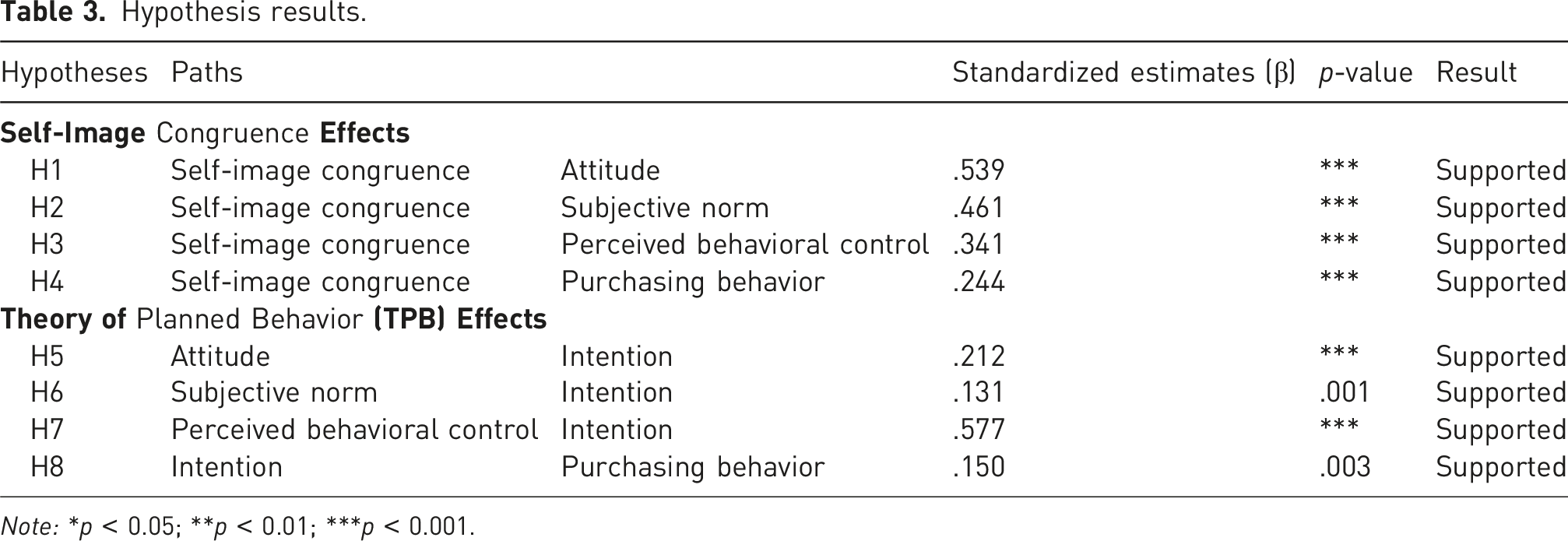
Hypothesis results.
Note: *p < 0.05; **p < 0.01; ***p < 0.001.
The results in Table 3 showed how the constructs were interpreted together. The effects of Self-Image Congruence (H1-H4) show a consistent pattern, with the strongest influence on attitude (H1: β = .539, p < .001), followed by subjective norm (H2: β = .461, p < .001) and perceived behavioral control (H3: β = .341, p < .001). Conversely, the direct effect of self-image congruence on purchasing behavior, while significant, was of lower magnitude (H4: β = .244, p < .001). Regarding the determinants of intention (H5–H7), perceived behavioral control emerged as the dominant predictor (H7: β = .577, p < .001), underscoring its pivotal role in shaping domestic tourists’ decision-making. Attitude (H5: β = .212, p < .001) and subjective norms (H6: β = .131, p < .001) also contributed significantly, albeit to a lesser degree. Finally, purchase intention demonstrated a significant yet modest influence on actual purchasing behavior (H8: β = .150, p < .01). This suggests that while intention is a prerequisite for action, situational or contextual barriers may attenuate the translation of intention into actual behavior.
Discussion and implications
General discussion
This study developed and tested an integrated model that combines Self-Image Congruence Theory and the TPB to explain domestic tourists’ purchasing behavior toward local foods. Structural equation modeling supported all eight hypothesized relationships, demonstrating the robustness of the proposed framework. Consistent with Shin (2014), the findings indicate that self-image congruence significantly enhances attitudes, subjective norms, and perceived behavioral control. When individuals perceive alignment between their self-concept and the prototypical image of local food consumers, they evaluate local foods more positively, report stronger social support, and perceive greater capability to purchase local food. These results highlight the importance of identity-related mechanisms in shaping tourists’ psychological readiness to consume culturally meaningful foods.
Within the TPB framework, attitude, subjective norm, and perceived behavioral control each emerged as significant predictors of purchase intention, consistent with established findings in the food consumption area (Alam and Sayuti, 2011; Hsu, 2014). Notably, perceived behavioral control exerted the strongest influence on intention, suggesting that domestic tourists’ decisions are primarily governed by practical constraints—such as availability and convenience—rather than solely by attitudinal factors. In addition, purchase intention significantly predicted actual purchasing behavior, confirming the core tenet of TPB and aligning with earlier local food studies (Raygor, 2016; Bissonnette and Contento, 2001; Shin, 2014; Velaoras et al., 2025). The direct effect of self-image congruence on purchasing behavior further demonstrates that tourists’ choices extend beyond rational evaluation and are partly driven by symbolic motives: products that reflect or reinforce personal identity are more likely to be selected (Sirgy et al., 1997).
Compared with previous studies, this study’s findings both corroborate and extend existing knowledge of traditional and local food consumption. As in Hsu’s (2014) examination of traditional Taiwanese food choices, this study confirms the central role of TPB variables in predicting intention. Similarly, in parallel to Ibrahim’s (2025) work in the tourism field, tourists’ positive attitudes play a crucial role in shaping their actual behavior. However, the present research extends these findings by showing that self-image congruence not only shapes cognition and intention but also directly influences behavior—an effect not previously documented in these studies. This suggests that, in the Turkish domestic tourism context, local food consumption is not solely about taste, convenience, or environmental concerns but also an expression of cultural identity and personal relevance.
Furthermore, the findings reveal that local foods in Balikesir Gulf serve as both heritage symbols and identity markers. While Raygor (2016) emphasized proximity-based and environmental motivations, the current study shows that, in culturally rich destinations, symbolic and identity-expressive motives gain prominence. This adds a novel dimension to the literature by highlighting that, in emerging gastronomy tourism markets such as Türkiye, identity congruence plays a more central, culturally embedded role in shaping consumption behavior than previously observed in international settings (Magdy, 2026).
Overall, integrating Self-Image Congruence Theory with TPB provides a more comprehensive and nuanced understanding of local food purchasing behavior. The results demonstrate that culturally grounded consumption decisions are shaped by the joint effects of cognitive evaluations, social influences, perceived control, and self-concept alignment. This integrated perspective offers a more holistic explanation of tourists’ purchasing behavior and contributes necessary empirical evidence from a non-Western, culturally rich tourism context.
Theoretical implications
This study addresses a notable gap in the literature by exploring the intersection of identity-driven and rational decision-making processes in the context of cultural heritage food consumption. Existing research in tourism and hospitality has often examined TPB or Self-Image Congruence Theory separately (Rozenkowska, 2023; Shin and Hancer, 2016), but rarely together, especially in the domain of intangible cultural heritage and local food tourism.
To address this gap, we introduce an integrated theoretical framework that combines the TPB with self-image congruence. While the TPB explains the rational and intention-based components of behavior—attitude, subjective norm, and perceived behavioral control—self-image congruence accounts for the symbolic, emotional, and identity-related motivations that are particularly relevant to cultural consumption. By integrating these two perspectives, the model offers a more comprehensive explanation of domestic tourists’ behavior, capturing both cognitive and affective drivers of local food purchasing.
This theoretical integration is novel in the context of food and cultural heritage tourism. To our knowledge, this is the first study to apply Self-Image Congruence Theory alongside TPB in the context of intangible cultural heritage within hospitality and tourism research. The study demonstrates that self-image congruence significantly influences the core components of TPB, suggesting that identity-related constructs can enhance traditional behavioral models.
This contribution not only extends the theoretical boundaries of TPB but also introduces new opportunities for future research to explore how identity, symbolism, and rationality interact in cultural tourism experiences. It builds on earlier studies that focused solely on specific outcomes, such as purchase intention or destination image, by applying the integrated model to a richer, more culturally embedded context. Thus, the study advances theory in tourism, hospitality, consumer behavior, and cultural heritage by showing that identity-driven and planned behaviors are complementary in explaining tourist decision-making.
Practical implications
This study has several practical implications for tourism businesses and destination managers. First, local foods should not be promoted solely based on functional attributes such as taste or price; instead, they should be positioned as identity-expressive products. To do this effectively, marketers should focus on symbolic branding strategies that integrate storytelling, image creation, and culturally relevant spokespersons. Understanding the target tourist’s values and identity is key—what symbols, images, and aspirations matter to them, and how does consuming local food enhance their self-image?. Promotional content should reflect how local foods align with personal identity and cultural authenticity. Spokespersons such as local chefs or residents can reinforce this symbolic value by representing tradition and trust. Also, storytelling about the origin, preparation, and cultural relevance of local foods can deepen emotional connection and make the experience more meaningful. In addition to brand communication, experience-based marketing should be prioritized. Organizing participatory activities—such as cooking classes, local market tours, and tasting events—can enhance symbolic value and create memorable tourist experiences. These hands-on experiences help tourists feel connected to the local culture and reinforce the personal meaning of their consumption. Second, digital and social media platforms should be used strategically to support symbolic consumption. Content marketing campaigns encouraging tourists to share their local food experiences online can increase engagement, generate word-of-mouth promotion, and extend cultural narratives to broader audiences. These integrated strategies can help tourism practitioners inspire deeper connections between consumers and regional food culture.
Alongside symbolic approaches, this study also highlights TPB’s practical value in promoting rational purchasing behavior. Tourism marketers can influence tourists’ intentions by shaping positive attitudes, increasing perceived behavioral control, and strengthening subjective norms. Emphasizing the appealing features of local foods such as taste, health benefits, and authenticity can help foster favorable attitudes. Providing clear information about where and how to access local foods, including local markets, restaurants, and online platforms, can improve perceived behavioral control and reduce barriers to action. Furthermore, incorporating reference groups into marketing campaigns such as well-known chefs, local cooks, or culinary influencers can help reinforce social norms and positively influence tourists’ behavior intentions. By integrating both symbolic and rational strategies, destination managers and tourism marketers can more effectively promote local food consumption and enhance the overall cultural tourism experience.
Tourism boards, local food producers, and destination marketers can further utilize these insights to design campaigns that intentionally strengthen tourists’ self-image congruence with local food consumption. Positioning local foods as symbols of cultural authenticity, sustainability, and regional pride can help tourists perceive a closer match between their self-concept and the act of buying local foods. Campaign themes that highlight aspirational identities such as being a culturally aware traveler, a supporter of heritage gastronomy, or an explorer of authentic traditions—may enhance emotional resonance and purchase motivation. Moreover, co-creation experiences (e.g., cooking workshops, farm visits, narrative-driven tasting events) enable tourists to internalize local food culture and express their identities through consumption. By aligning promotional messages and experiential offerings with tourists’ desired self-images, tourism organizations can achieve more compelling, persuasive, and identity-driven marketing outcomes.
Limitations and future research
This study has several limitations that should be acknowledged. First, the research focused solely on domestic tourists visiting the Balikesir Edremit Gulf region in Türkiye, which may limit the cultural and behavioral applicability of the findings to other areas. The Balikesir Edremit Gulf has its own regional food identity and tourist profile, which may not reflect visitors’ behavior across different types of destinations.
Future research should consider a more diverse range of destinations, including urban centers, heritage cities, and international tourist hubs, and explore different tourist segments, such as international travelers, culinary tourists, and eco-conscious visitors.
Second, the study used convenience sampling, which may introduce sampling bias. To enhance representativeness, future studies could adopt alternative sampling strategies, such as stratified random sampling or multi-site data collection, to ensure demographic diversity or to compare behavioral patterns across different locations.
Third, while this study examined the direct effects of self-image congruence on attitude, subjective norm, perceived behavioral control, and purchasing behavior, future research could explore indirect and mediating effects among these variables. Additionally, incorporating moderator variables such as gender, age, education level, and income could reveal how different demographic factors influence local food purchasing behavior.
Fourth, although this study was grounded in Self-Image Congruence Theory and the TPB, future research could integrate other relevant frameworks to gain deeper insights. For example, the Value-Attitude-Behavior (VAB) model could help explain how tourists’ personal values translate into food-related attitudes and behaviors. Sustainable consumption theory may offer insights into how environmental or ethical concerns influence food choices. In contrast, consumer culture theory could uncover the symbolic and identity-based meanings tourists associate with local food experiences.
Finally, this study focused specifically on local foods. Future studies may test the model in different culinary contexts—such as fast food, gourmet or fusion cuisines, and international food experiences—to assess the generalizability of the findings across food types.
Footnotes
Acknowledgements
This article is derived from a doctoral dissertation. The authors gratefully acknowledge the valuable support and contributions of Prof. Dr. Ahmet Köroğlu and Prof. Dr. Mehmet Sarıoğlan during the development of the doctoral dissertation.

Funding
The author(s) received no financial support for the research, authorship, and/or publication of this article.
Declaration of conflicting interests
The author(s) declared no potential conflicts of interest with respect to the research, authorship, and/or publication of this article.
Data Availability Statement
Data is available upon request.
Author biographies
Appendix
Appendix A provides the measurement items used in the study. Participants evaluated all constructs—including Self-Image Congruence (SIC), Attitude (ATT), Perceived Behavioral Control (PBC), Subjective Norm (SN), and Intention (INT)—using a five-point Likert scale ranging from 1 (strongly disagree) to 5 (strongly agree). All items were adapted from established scales in the literature (Ajzen, 1991; Hsu, 2014; Kim and Hyun, 2012; Shin and Hancer, 2016). For the Purchasing Behavior (PB) construct, participants were provided with a separate response format and were asked to select the option that best described their behavior by marking: (1) Never, (2) Rarely, (3) Sometimes, (4) Often, or (5) At every opportunity, reflecting their past and current frequency of purchasing local foods during vacation.
Study measurements. Note. *Items dropped from the study.
Variables
Item
I perceive myself as closer to individuals who consume local foods.
SIC1
I identify more strongly with individuals who prefer local foods.
SIC2
I find my self-image to be highly consistent with the image of a typical local food consumer.
SIC3
People who consume local foods are closer to the person I aspire to be.
SIC4
Individuals who prefer local foods better reflect the image of the person I want to become.
SIC5
I find the image of a typical local food consumer to be highly compatible with how I ideally want to see myself.
SIC6
I am more often perceived by others as similar to those who consume local foods.
SIC7
I am more often perceived by others as someone who identifies with individuals who prefer local foods.
SIC8
My image in the eyes of others is highly consistent with that of a typical local food consumer.
SIC9
I would like to be perceived by others as more similar to individuals who consume local foods.
SIC10
Individuals who prefer local foods more closely reflect the image I want to project in the eyes of others.
SIC11
I find my desired image in the eyes of others to be highly consistent with that of a typical local food consumer.
SIC12
Purchasing local foods during my vacation is enjoyable.
ATT1
Purchasing local foods during my vacation is beneficial.
ATT2
Purchasing local foods during my vacation is satisfying.
ATT3
Purchasing local foods during my vacation is fun.
ATT4
Purchasing local foods during my vacation is good.
ATT5
Purchasing local foods during my vacation is reasonable.
ATT6
Purchasing local foods during my vacation is important.
ATT7
If I want to, I can purchase local foods during my vacation.
PBC1
Purchasing local foods during my vacation is easy for me.
PBC2
The decision to purchase local foods during my vacation is under my control.
PBC3
Whether or not I purchase local foods during my vacation is entirely up to me.
PBC4
I have enough money to purchase local foods during my vacation.
*PBC5
I have enough time to purchase local foods during my vacation.
*PBC6
I have sufficient knowledge to purchase local foods during my vacation.
*PBC7
Most people who are important to me think that I should purchase local foods during my vacation.
SN1
It is expected of me to purchase local foods during my vacation.
SN2
People whose opinions I value prefer that I purchase local foods during my vacation.
SN3
I hope to purchase local foods on my next vacation.
INT1
I want to purchase local foods on my next vacation.
INT2
I intend to purchase local foods on my next vacation.
INT3
How frequently did you purchase local foods during your last vacation?
PB1
How frequently do you purchase local foods during your current vacation?
PB2