




Abstract
The UAE is targeting the tourism sector as part of its drive to diversify away from an overdependence on oil and is seeking to attract more nationals to the tour guide profession. The purpose of this research is to assess what factors influence the likelihood of Emirati tourism students considering this vocation. A model that incorporates Career Decision-Making Profile and Arabian Gulf Social Contract dimensions was developed. Survey results (n = 186) show that the nature of the job is considered attractive and, traits like ‘willingness to compromise’ and ‘independent decision making’, increased the likelihood of choosing the profession. Yet, “classic public sector” job preferences and perceptions on societal sentiment toward the ‘appropriacy’ of nonconventional vocations acted as deterrents. Recommendations are to make higher education internship programs more tailored to the individual student and modify the remit of the tour guide role at government-owned sites and venues.
Keywords
Introduction
The UAE is the Middle East’s most popular destination be it as a conference location, convention centre or indeed holiday destination. Some 21.5 m tourists visited in 2019 (UNWTO, 2023), a striking number considering that there are only around 1.1 m Emirati citizens (UAE Government, 2024). The meteoric growth in visitors is largely due to a proactive government strategy of infrastructural investment and destination brand-building (see, e.g., Chen and Dwyer, 2018). As Thani and Heenan (2017) state, in order to attract tourists the UAE has undergone some, “eye-catching transformations.” Notable amongst the cultural zones and theme park hubs are the world’s tallest structure (Burj Khalifa), biggest mall (The Dubai Mall), only seven-star hotel (The Burj Al Arab) and a satellite branch of France’s Louvre museum (Wippel, 2023). State controlled oil rent has facilitated the creation of two of the world’s largest airlines and airport hubs—Emirates and Etihad (DXB and AUH). In terms of marketing the UAE as an “escape to the sun” location, London’s English Premier League football club Arsenal, wear Emirates shirts and play home games at “Emirates stadium;” Manchester City wear Etihad shirts and play their home games at “ Etihad stadium” (Millington et al., 2021).
Demographics and labour market characteristics
Oil rent has profoundly shaped the economic and sociopolitical structures of the UAE and its resource-rich neighbours (Davidson, 2011; Kamrava, 2018). As contended by Rutledge (2017, 2023)—via the Arabian Gulf Social Contract (AGSC) thesis—while classic Rentier State theory (e.g., Beblawi, 1990) is now considered ahistoric, dated and too deterministic, hydrocarbons have nonetheless shaped the economic trajectories of these countries. The provision of government jobs to citizens, in lieu of political participation (and oftentimes irrespective of educational attainment) has led to serious labour market distortions and inefficiencies (Hertog, 2022).
The “classic public sector” which encompasses bureaucratic, deskbound roles—as opposed to hands-on roles (e.g., tour guides)—is now dominated by nationals while many areas of the private sector continue to be dominated by expatriates (Rutledge and Al Kaabi, 2023). It has been argued by Al Waqfi and Forstenlechner (2012) that the Gulf’s private sector, as a consequence, is geared towards hiring both skilled and unskilled expatriate labour at volume as opposed to investing in the upskilling of national jobseekers. To date, the workforces of many Gulf countries are dominated by expatriate labour. In Kuwait, Qatar and the UAE they make up a clear majority (International Labour Organisation, 2021). The Kafala system, a key AGSC tenant, permits Gulf nationals to recruit overseas labour relatively cost-free—e.g., no minimum wage requirements and almost no limitations on the length of the working day (Al-Salim, 2023). These labour market distortions have for some time been resulting in uncomfortably high national youth unemployment rates (Poplavskaya et al., 2023), yet, public sector preferences remain stubbornly entrenched (AFP, 2022; Al Nowais, 2017; Fattah, 2021). An overreliance on expatriate labour in all but the classic public sector not only results in large sums of wealth being repatriated out of the Arabian Gulf, but also, the ‘creation’ of yet more state-funded sinecures (The Economist, 2020).
All this being said, the region has largely defied the “resource curse” with its oil endowments constituting, at the very least, a “mixed blessing” (Friedman, 2006; Ross, 2012). On the up side, there have been impressive leaps up the UN’s Human Development Index and free first-class education and health care provision for all nationals (Rutledge, 2017). And, in the past two decades most Gulf states have invested large sums of their oil rent into projects that seek to fast-track non-oil based sustainable economic activity (Al Naimi, 2022; Luciani, 2013).
Tourism as a means of economic diversification
The UAE’s tourism sector has been prioritised as one of several sectors to diversify away from oil in to (Kabbani and Mimoune, 2021; Moukhallati, 2015).
Critically, for the region’s strategic visions to come to fruition, nascent knowledge-based economic sectors will need to absorb more national graduates gainfully and productively (Rutledge, 2017). As it stands, around 99% of those working in the UAE’s tourism sector are expatriates (Abu Dhabi Tourism and Culture Authority, 2017). Further, turnover rates amongst the small number of nationals working in this sector is particularly high (Salama, 2014). Various studies suggest that some nationals, newly recruited to the private sector, will leave if and when they are able to secure a government job (see, e.g., Rutledge and Al Kaabi, 2023).
One factor behind the low participation rates of nationals within the tourism sector is that many jobs-types, such as those in front-facing retail, restaurants and resorts, are considered by some elements of Gulf society to be ‘inappropriate’ for nationals to pursue (Rutledge and Al Kaabi, 2023). This impediment, named “cultural blocs” by Griffin et al. (2021), is especially acute for female nationals—as evidenced in applied research on female labour force participation in Oman (e.g., Alsawafi, 2016; Atef and Al Balushi, 2017; Bontenbal and Aziz, 2013) and, the UAE (e.g., Marmenout and Lirio, 2013; Williams et al., 2013). Indeed, neighbouring Oman can offer some insight as it has been focusing on building a cultural tourism industry for some time now (Feighery, 2012). Works by Bontenbal and Aziz (2013), Alsawafi (2016) all report on the sentiments of students at Omani higher education institutions (HEIs) toward career-paths in the tourism sector. In sum, most of those canvased preferred positions in government tourist departments or, failing that, managerial roles in hotels or at travel agencies (i.e., not ‘hands-on,’ ‘front-facing’ roles).
Within the UAE, two studies to date consider the views of national tourism students towards pursuing careers in this sector—those of Mannaa and Abou-Shouk (2020) and Griffin et al. (2021)—both underscore the negative impact vocationally-related societal sentiment has on their willingness to consider many of this sector’s job-types. It is the contention here that the tour guide profession may be one mode of hands-on, front-facing role that would be seen as more appealing. A recent study examining the sentiments of the small number of Emirati tour guides did find that the role had less vocationally-linked “social stigma” attached to it than did many other roles outside of the conventional classic public sector (Rutledge, 2023). Logically, it is within this field that most tour guides will in fact be operating. As Boniface (1995, p. vii) puts it, “culture is very much tourism’s main attraction,” for without it, “every place would seem blandly the same.”
The tour guide profession
In the past decade, several UAE government initiatives have attempted to recruit and retain more national tour guides (Salama, 2014). A recent paper by Rutledge (2023) presents the perspectives of the small number of UAE national tour guides currently operating. Many see the role as ambassadorial and one that champions the UAE’s heritage and traditions. It should be noted though that most fulltime Emirati tour guides are in fact government employees as they mainly carry out their guiding work at sites such as the government-owned Shiekh Zayed Grand Mosque. This is in distinction to many of the tour guides working in say Jordan (Alrawadieh et al., 2020) or Turkey (Yilmaz and Eser, 2022). This means that many Emirati tour guides receive salaries similar to the classic public sector. However, there are some arguable comparative drawbacks. UAE tour guides do not receive quite the same ‘benefits’ that their compatriots with “comfy government jobs” are believed to be afforded—e.g., leniency toward punctuality, the ability to leave work at short notice to attend to family affairs and not having to leave their cultural and linguistic comfort zones (see, e.g., Al-Salim, 2023; The Economist, 2021). It is widely recognised that the tour guide role, while rewarding in many regards, can be stressful (Min, 2013; Yilmaz and Eser, 2022) and fraught with cultural faux pas (Lugosi and Bray, 2008).
This study examines the sentiments of national students majoring, or ‘concentrating,’ in tourism toward the tour guide profession. It asks, what exactly do students studying an aligned subject think of the tour guide role? And, what is the likelihood of them considering it as a potential career path?
Vocational interventions in higher education
Within the higher education context, ensuring graduates are employable is both a key part of the given institution’s purpose and increasingly, a way in which they will be assessed against other HEIs, be it for funding or international ranking position (Small et al., 2018). The importance of vocationally-oriented interventions, be this in the guise of internship programs or employability workshops, have thus grown in recent times (Pitan and Atiku, 2017). “Intention” is a state of mind leading an individual towards a specific path of behaviour (Ajzen, 1991, 2020). While, a multitude of factors will impact an individuals vocational plans, some variables that drive intentions will be individualistic and personality dependent, others will be linked to the context within which such choices are made. Within the Gulf context, dimensions thought likely to impact on the vocational decision-making process are twofold. The first is the classic public sector’s pragmatic pull, its pay, benefits and associated prestige (Rutledge and Al Kaabi, 2023). The second is societal sentiment toward nationals pursuing nonconventional career paths. Linked to the second and arguably sustained by the AGSC’s largesse, is the entrenched conservative and patriarchal nature of some elements of Gulf society (Marmenout and Lirio, 2013; Williams et al., 2013).
As prophetic crystal balls do not exist in HEI career guidance offices, an individual’s planned behaviour—their intentions—is the researcher and practitioner’s best tool with which to forecast future behaviour (Ulker-Demirel and Ciftci, 2020). It follows that certain career-paths will be comparatively more attractive and suitable for a given individual depending on their personality traits (Ebner et al., 2018; Gati and Levin, 2012). This logic and reasoning underpins the Career Decision-Making Profile (CDMP) construct; a set of 11 dimensions linked to individualistic characteristics of the vocational decision-making process (Gati et al., 2010; Gati and Levin, 2012). It follows that knowledge of an individual student’s CDMP traits has the potential to assist those tasked with vocationally-oriented interventions at HEIs.
Literature review
This review will sketch out the works that help formulate this study’s four hypotheses. Together, they seek to assess what internal and external factors make a given individual more or less likely to consider the tour guide role. The impact of one’s CDMP characteristics, the pull of the classic public sector, societal sentiment on vocational appropriacy and, the nature of the day-to-day role of the tour guide are factored into this study’s research instrument.
The career decision-making process
As set out by Ajzen (1991, p. 181) in the Theory of Planned Behaviour, intentions capture the motivational factors that influence a behaviour. It follows that the stronger one’s intention to engage in a given behaviour is, the more likely will be the actualisation of that. In the context of vocationally-oriented interventions in HEIs, Gati et al. (2010) found 11 dimensions were capable of characterising an individual’s CDMP. It was observed that some of the dimensions are “fixed across circumstances” whilst others are more “situation specific” (Gati et al., 2010; Gati and Levin, 2012). Dimensions include: Information gathering (comprehensive vs minimal; the degree to which individuals are meticulous and thorough in collecting and organising information), Effort invested in the process (much vs little; the amount of time and mental effort individuals invest) and, one’s ‘Aspiration for an ideal occupation’ (high vs low; the degree to which one strives to attain their perfect occupation) (Gati et al., 2010: p. 280). It follows that a given tourism student’s self-reported CDMP may suggest they are more or less suited to the tour guide profession. Knowledge of this can for instance assist practitioner decision-making on what type of job role on an internship program would be the more suitable and useful.
Public sector preferences
The tour guide role, even if at a government-owned attractions, is considered a nonconventional career choice (Rutledge, 2023). This may be due to the role’s front-end nature which necessitates the need to interact with tourists from all walks of life. While this makes the job interesting (and, ‘attractive’) and provides employees with opportunities to utilise the skills and knowledge acquired whilst studying tourism, it also renders it more onerous than the archetypal “comfy” government job (Al Nowais, 2017; The Economist, 2020; 2021). This begs the question: why do a fair few nationals enrol on tourism majors in the first place? A partial answer is that this sector does have Ministries and dedicated government departments so, not all of the job types within it are front-facing. In neighbouring Oman, Bontenbal and Aziz (2013) conclude, that the majority of Omani nationals majoring in tourism saw conventional public sector positions as the most appropriate and desirable (n = 80; 75% female). Atef and Al Balushi (2017) report that the undergraduates they canvased felt overall that the tourism sector did not provide job security nor make combining work and family life easy (n = 88; 67% female). Alsawafi (2016, p. 249) found key deterrents for national students with respect to working in the tourism sector include, “the long hours and the need to work night shifts [and] working during holidays” (n = 290; 89% female). Broadly, this ties in with the qualitative research conducted in the UAE by Williams et al. (2013) in which a “patriarchal bargain” is described: although university education for females is encouraged but, working anywhere other than the classic public sector is not.
Sociocultural influences
Societal sentiment impacts on notions of vocational ‘appropriacy’ and pushes many Gulf nationals towards positions that will ordinarily use Arabic (not English), offer gender segregated workplaces (atypical of the private sector and the tour guide remit) and allow flexible timekeeping so that family matters can be dealt with at short notice (Rutledge and Al Kaabi, 2023). As the literature clearly indicates, the sentiments of Arabian Gulf society in relation to ‘pride’ and ‘shame,’ coupled with the usage of ‘Wasta’ (the mechanism by which individuals use their positions of influence to help others who are from the same family or tribe to secure e.g., a government position) has considerable labour market implications (Kabbani and Mimoune, 2021). It has been argued that if most of today’s graduates see that their family heads (fathers, uncles and older brothers) have well remunerated government positions, they too are likely to seek the same—indeed, not being able to secure such a position may result in feelings of job-related social stigma (Rutledge and Al Kaabi, 2023).
In neighbouring Oman, nationals majoring in tourism felt many positions in the travel and tourism sector would conflict with the Gulf’s cultural and religious values. The applied research by Bontenbal and Aziz (2013) reports that Omanis in higher education believed that expatriates were “better suited” for working in hotels and restaurants (80% of that study’s sample felt that Omani society would consider expatriates to be more suitable for such positions). Atef and Al Balushi (2017, p. 452) report that conservative families object to their children working in hotels because, such establishments, “do not have a good reputation” and are places for “drinking and serving alcohol and doing unethical things that cannot be done elsewhere.” The study by Alsawafi (2016, pp. 249–250)—which canvased almost 300 tourism major students, nine in 10 of which were female—concluded that a range of traditional unwritten rules would render many types of job within this sector off limits to all but women from the more liberal families. For example, it was reported that conservative Gulf society considers female nationals should only take jobs “suited to their nature,” that in the given workplace “there should be no mixing with non-mahram men”—a Mahram man would be a brother, son, father or husband—should cover their hair whilst at work, “should not travel for work without a mahram,” and “work should not be at the expense of their family responsibilities.”
Mannaa and Abou-Shouk (2020) carried out research on UAE national undergraduates (n = 227; 87% female) and focused on their intention of working in the tourism sector at some point after graduating. Few thought they would because work in this sector would entail long irregular hours and that “society does not find working in tourism to be a respectable career, particularly [so] for women.” Another recent survey-based study (n = 247; all female business majors) by Griffin et al. (2021), also explored the perceptions of national students toward this sector. They concluded that while these students are not unwilling to consider tourism as a career, “cultural blocks”—which their instrument specified as: “working in tourism clashes with Emirati cultural and religious values”—ultimately outweigh all “other perceptions about tourism” and thus “impede the entry and participation” (Griffin et al., 2021: p. 492).
The tour guide profession
It is clear from the literature that the tour guide profession is varied in nature (Lugosi and Bray, 2008; Min, 2013) and, the role is seen as both challenging and exciting for the individual and of considerable economic and reputational importance from the given country’s perspective (e.g., Alrawadieh et al., 2020; Yilmaz and Eser, 2022). The role is economically and reputationally important because tour guides interact directly with tourists and thus represent the host country as ‘cultural ambassadors’ and contribute to the perceptions tourists take back home with them and then, go on to convey. Yet, the tour guide profession requires individuals to be engaging educators capable of presenting the given attraction in an interesting and positive light (Alrawadieh et al., 2020). As Yilmaz and Eser (2022) write, tour guides usually “face higher levels of job stress than many other professions, which can weaken their vocational commitment.” Tour guides must also manage the expectations of tourists at the same time as their line managers and convey the correct emotions to satisfy both parties (Min, 2013; Yilmaz and Eser, 2022), thus, having the capacity to cause vocationally-related stress and impact on the quality of one’s working life. The role’s coal-face nature is also physically demanding at least that is, if compared to a desk-bound comfy government jobs (Yilmaz and Eser, 2022). On balance however, it may be assumed that the activities of the tour guide are more interesting and satisfying than a purely administrative role (e.g., a classic public sector position). Indeed, such sentiments were clearly expressed by a number of UAE national tour guides—alongside some reported challenges like working outside in hot temperatures—who felt the role was interesting and of significant importance (Rutledge, 2023).
Research methods
Survey items and factor loadings.
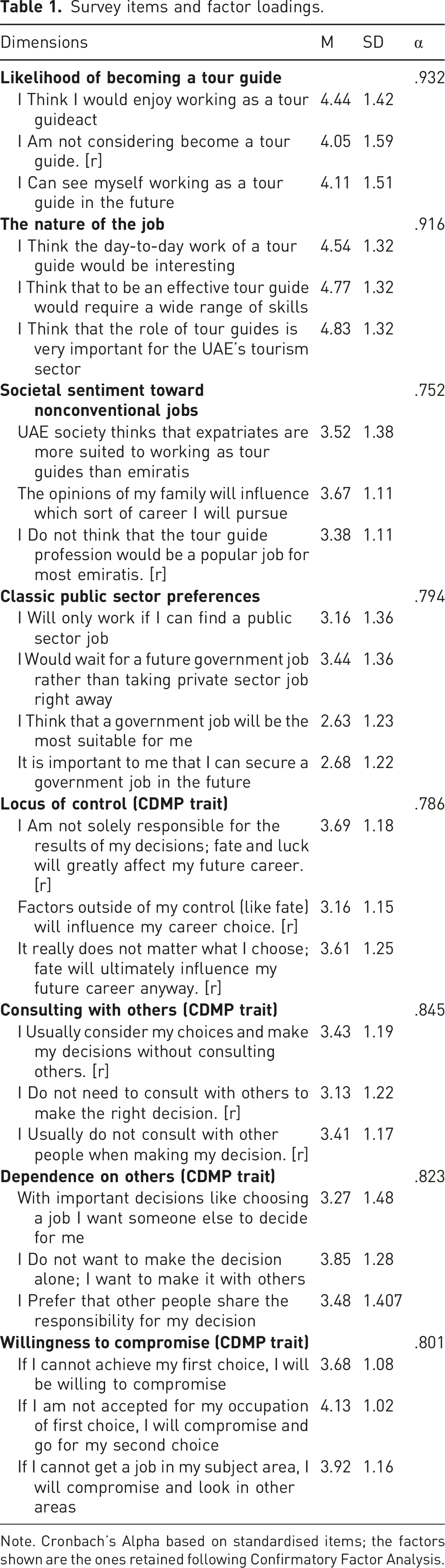
Note. Cronbach’s Alpha based on standardised items; the factors shown are the ones retained following Confirmatory Factor Analysis.
Sample
The target population for this study was national undergraduates majoring (or ‘concentrating’) in tourism. It was considered advantageous to draw upon a sample who, all other things being equal, would be more likely to consider the tour guide role. By contacting the three government HEIs offering tourism studies— the Higher Colleges of Technology, UAEU, Zayed University—it was determined that the approximate number for total enrolment at the time of the study was 250 (HCT, 2020; UAEU, 2020; Zayed University, 2020). Federal public HEIs tend mostly to cater for nationals while the UAE’s expatriate population tend to enrol at one of the vast array of private HEIs thar now operate in the UAE (Ashour, 2020a). One reason is that some of the campuses operated by Federal institutions are still gender-segregated and are run mostly by Emirati administrative staff (so linguistically at least, life is easier). The vast majority of the sample were female which was not unexpected, given that female enrolment in higher education is much higher than that of males (Ashour, 2020b). These numbers were also reflective of nationals enrolled on the target courses at the time of the study. For instance, enrolment figures at HCT in 2019 were 32 females and 0 males, at UAEU the figures were 193 females and 0 males (UAEU, 2020), at Zayed University, there is not a tourism major but, those at the College of Communication and Media Sciences—where 1,120 females and 43 males were enrolled at that time—could take courses on culture and tourism (Zayed University, 2020). In total, 186 completed and usable survey responses were collected, which given the population size, meets a 95% confidence level (more than sufficient, see Grande, 2016).
Instrument
The survey instrument included eight demographic questions followed by 58 statements with a six-point Likert scale response option ranging from “strongly agree” to “strongly disagree.” As CDMP dimensions have already been tested and found to be generalisable (e.g., Ebner et al., 2018; Gati and Levin, 2012), these were incorporated into the instrument as they are considered a valuable metric in terms of vocationally-orientated HEI interventions. Factors relating to the AGSC, were based primarily on previous works conducted in the same context, i.e., gauging the sentiments of UAE students in higher education toward labour market participation (e.g., Griffin et al., 2021; Mannaa and Abou-Shouk, 2020; Rutledge and Madi, 2017) and, nationals working in the private sector (e.g., Farrell, 2008; Marmenout and Lirio, 2013; Rutledge and Al Kaabi, 2023; Williams et al., 2013).
Procedure
Firstly, a pilot study was undertaken (n = 25) at one HEI with the purpose of ensuring that the survey items (and Arabic translations) were unambiguous and logical. As is considered standard practice (Miles et al., 2018), the survey statements were reviewed and refined further by discussions with a number of academics, experienced in labour market studies, at one of the three targeted federal HEIs. As per convention (Creswell, 2018), the survey cover letter informed potential respondents that their participation was voluntary and that responses would be anonymised, participants were also provided with an information sheet explaining the objectives of the research and details of the study’s ethical consent approval. The final survey distributed to tourism students at three Federal HEIs—HCT, UAEU and Zayed University—took approximately 25 min to complete.
Results
Student survey sample demographics.
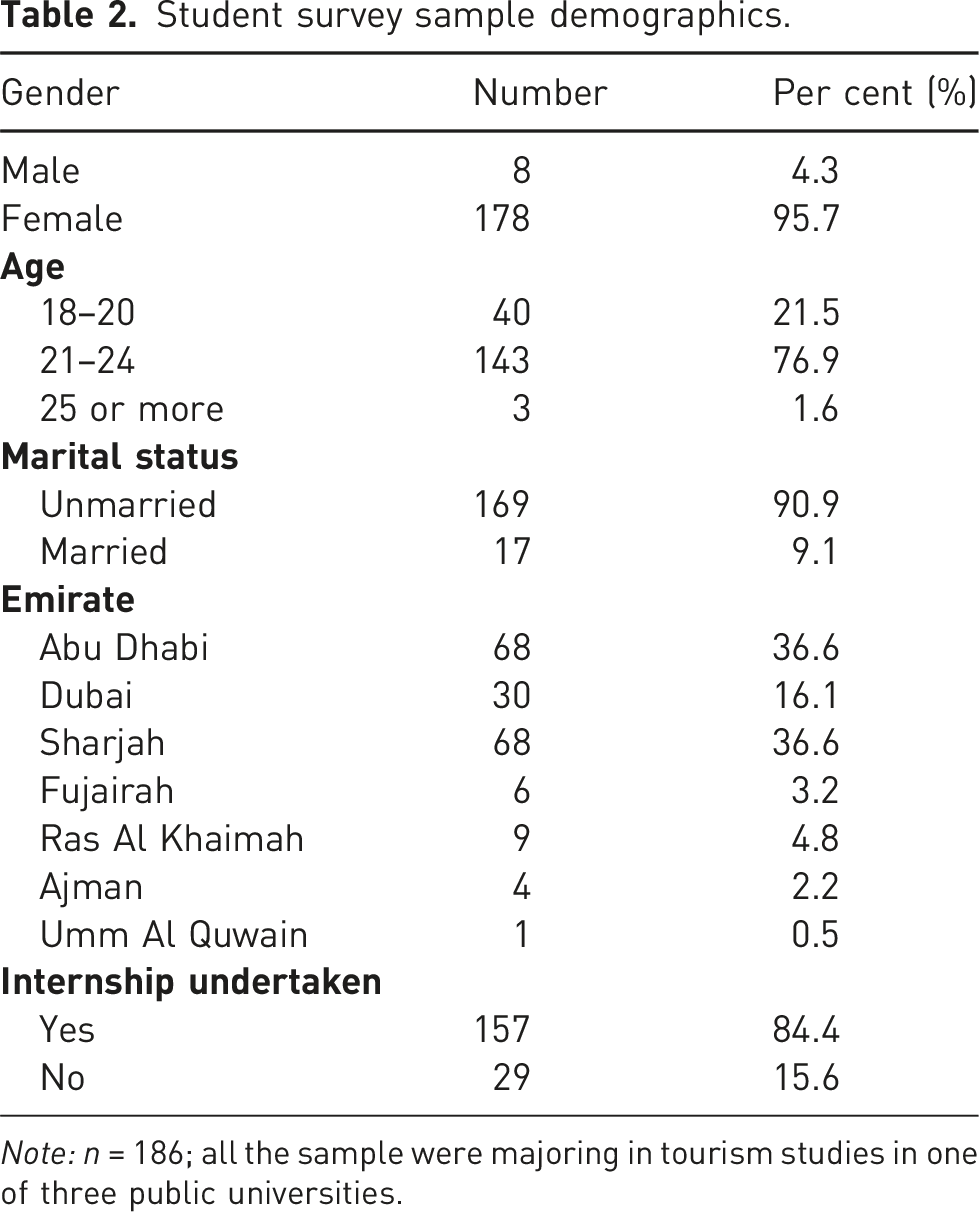
Note: n = 186; all the sample were majoring in tourism studies in one of three public universities.
Multiple regression (coefficients).
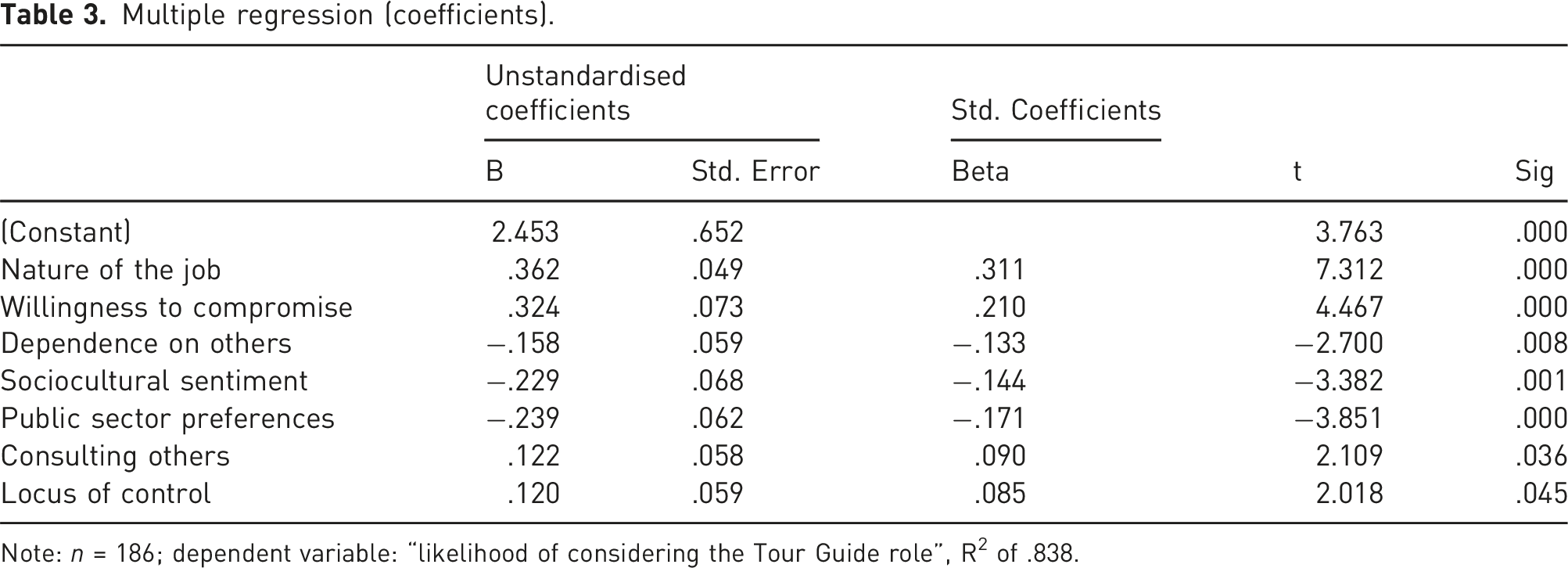
Note: n = 186; dependent variable: “likelihood of considering the Tour Guide role”, R2 of .838.
Discussion
As illustrated in Figure 1, a number of significant relationships were found between the various dimensions tested and the dependent variable. Likelihood of considering the Tour Guide role.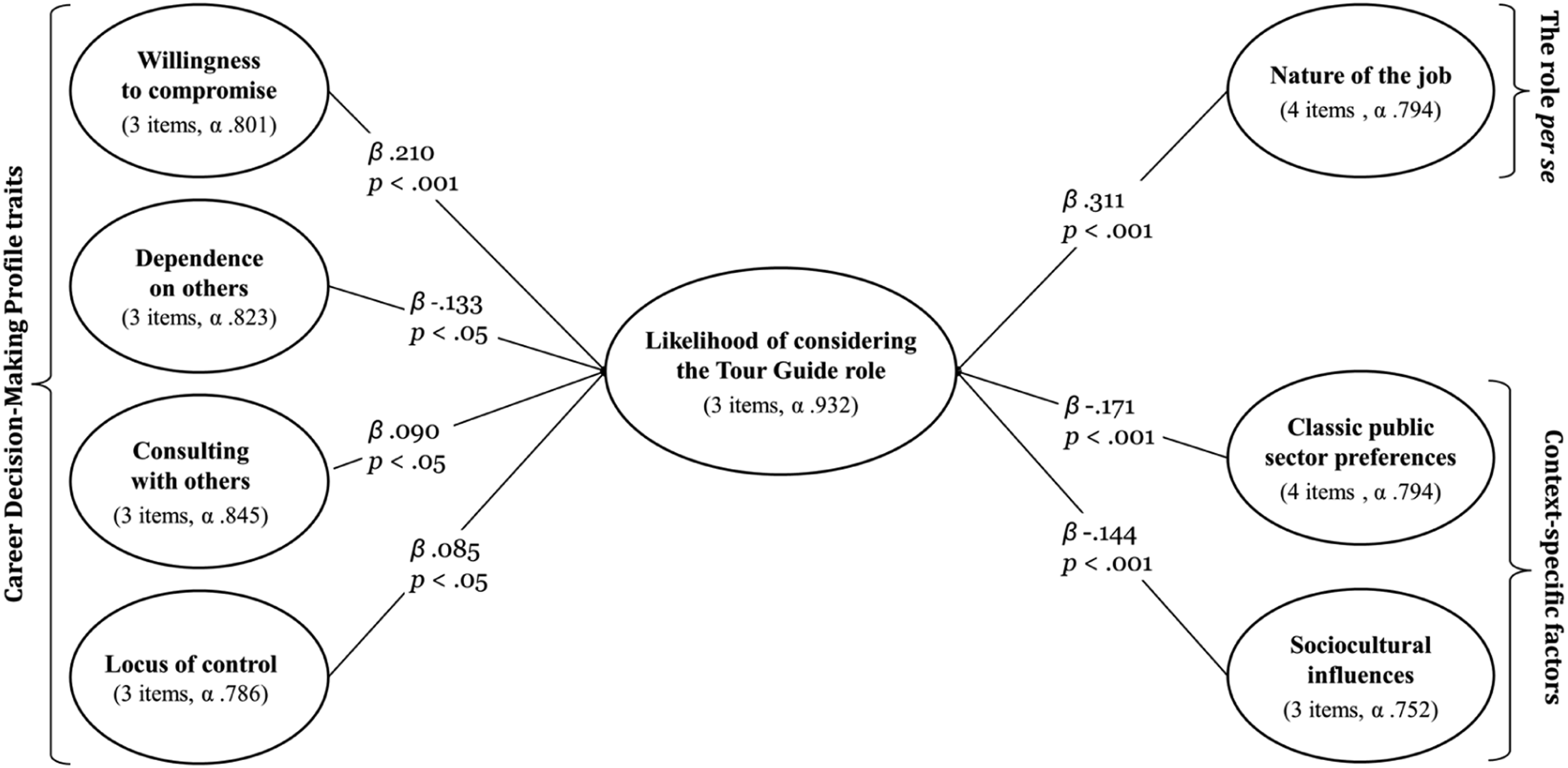
H1
Hypothesis one was confirmed in that four of the 11 CDMP traits were found to significantly impact on this sample’s likelihood of considering the tour guide role. Willingness to compromise, Consulting with others and Locus of control, all had a significant and positive impact (β = .210 p = < .001, β = .090 p = < .05 and β = .085 p = < .05, respectively) whereas, Dependence on others was observed to have a negative impact (β = −0.133 p = < .05). Willingness to compromise (high vs low) measures the extent to which individuals are willing to be flexible in considering alternatives to their initial career choice or preference. Such flexibility is of utility in the Gulf today for whilst classic public sector preferences remain pronounced (e.g., Fattah, 2021; Tolley, 2021), securing such positions is no longer as easy as it once was (Al Nowais, 2017; Swan, 2017). Consulting with others (frequent vs rare) measures to what degree a person confers with others during the various stages of their career decision-making process. This observation offers scope for more focused HEI vocationally-orientated interventions. Locus of control (internal vs external) measures the extent to which a person feels they are in control of their future career and believe that their decisions impact their career opportunities, or that these are mainly influenced by external forces outside of their control. It may be said that those of a more individualistic nature (i.e., less likely to conform to collectivist expectations) and thus, less willing to let fate play its hand, will opt for roles that are considered by themselves to be attractive irrespective of whether they are frowned upon by society. However, individuals who reported a high level of Dependence on others were less likely to consider the tour guide role. Dependence on others (high vs low) gauges the extent to which one takes responsibility for their decision-making. Those that are more dependent on others (e.g., members of their family) are more likely to consider only conventional jobs.
H2
The pull of the classic public sector was found to make tourism students less likely to consider the tour guide role (β = −0.171 p = < .001) thus confirming hypothesis two. The classic public sector’s pull remains as pronounced as it was back when UAE labour nationalisation policies first emerged in the mid-1990s (Gardner, 1995; The Economist, 1997); a time before most of this study’s sample were born. Nonetheless, Emiratisation continues to be a policy priority as attested by a raft of government announcements in 2021 (Fattah, 2021; Government of the UAE, 2021) and as such, the drive to recruit and retain more national tour guides looks set to continue being a government priority within the UAE’s tourism sector.
H3
Societal sentiment toward nonconventional career paths was also found to make tourism students less likely to consider the tour guide role (β = −0.144 p = < .001). This finding ties in with the bulk of the discourse on the subject, be it the gendered research of Marmenout and Lirio (2013) and Williams et al. (2013) or the more recent findings of Mannaa and Abou-Shouk (2020) and Griffin et al. (2021). It also ties in with observations made in two recent studies, one canvasing the views of UAE nationals working in the private sector (Rutledge and Al Kaabi, 2023) and one focused on active Emirati tour guides (Rutledge, 2023).
H4
It is evident that the tour guide profession is viewed by the tourism student sample as an attractive and interesting one. ‘The nature of the job’ (β = .311 p = < .001) was a positive determining factor in the likelihood of choosing the tour guide role. Recent research finds the nature of the tour guide profession to be interesting and rewarding as well as being a role that required varied skills sets putting what was learnt at university in to practice (Rutledge, 2023). However, according to Min (2013), some tour guides consider the profession to lack a well-defined career path; a sentiment also expressed by tour guides in the UAE (Rutledge, 2023). Of direct relevance, Yilmaz and Eser (2022) report that tour guides with high levels of job satisfaction are more emotionally attached to their profession. Therefore, responsible agencies can positively affect the job satisfaction of tour guides by, for example, providing job security and critically, “creating educational opportunities” (Yilmaz and Eser, 2022).
Recommendations
Two recommendations are put forward, one is linked to vocationally-oriented interventions at HEIs, the other is to redefine the tour guide role within the regional context (at least at government venues and sites).
Firstly, careers advisors at UAE federal institutions could consider using the CDMP construct as part of their student support service. It is considered likely that this will help better inform decision in terms of what internship placements to recommend. As Gati et al. (2010, p. 288) contend, a multidimensional assessment tool such as CDMP allows for “a more accurate, sensitive and comprehensive approach.” Some candidates may be more suited to the tour guide role that others. The CDMP traits of tourism students will be useful in informing the decision of whether or not to give a tourism student work experience in a government tourism authority or in the tour guide role. Griffin et al. (2021, p. 489) point out, that after completing work experience, “students perceived a career in tourism as more culturally appropriate” than they had done beforehand. While internships are now mandatory, too many are still being conducted in bureaucratic environments, not front-facing, more challenging ones. This was reported on by Malek (2017) and seen in this study’s demographic observations. It could be advantageous to stagger such programs and ensure a far greater number are undertaken at front-facing professions. Having two periods of internship would enable experiences in the first to inform and guide the choices made for the final period of internship.
Secondly, it is considered likely that, to enhance national tour guide retention, reducing the physical demands of the job by combining it with some desk-based element would be wise (Rutledge, 2023). In terms of both recruitment and retention rates, there would be merit in combining the front-facing element with some more academic aspects. Degree-educated tour guides could pair guiding with being an archivist, curator and indeed a researcher. Such a move, while costly in some respects, would be more efficient for governments to consider (i.e., the recruiting of more guides overall to cover others whilst they are carrying out their office duties) than to further overstaff the classic public sector with individuals quite capable of acting as tour guides for some part of their working week.
Conclusion
The findings of this research are something of a mixed blessing. Yes, the tour guide role is seen as attractive and interesting in the eyes of Emirati students studying tourism, but the very nature of this role, an active front-facing job in a multicultural environment, renders it unconventional within the AGSC framework. That some nationals are more willing than others to consider this role—contingent partly on their CDMP traits—suggests that a redefined tour guide role would transform it into one with less vocationally-related social stigma attached. Into one more ‘acceptable’ to the region’s sociocultural job-related sensibilities. From the UAE tourism board’s perspective, as the Middle East’s most popular destination, it would appear odd if few tour guides were in fact locals. This would especially be so at cultural attractions like the inland mud fortresses and palaces that surround the oasis town of Al Ain, itself set within the sand dunes of the Empty Quarter, the Arabian peninsula’s largest desert.
Limitations and future research
There are various limitations with this study. First, it only focused on national students, there would have been utility in also sampling non-national students. In the UAE there are likely to be adequate numbers of expatriate students studying tourism at private-sector HEIs, so as to be able to identify differences between these two groupings. Second, and more generally, as has been called for by Yilmaz and Eser (2022), due to the nature of the tour guide role and its economic and reputational importance, there would be merit in developing research instrument scales specifically designed and developed for the tour guide profession. Ideally such a research tool would be of two parts, one to gauge the sentiments of prospective tour guides and one for assessing the continuance intentions of active tour guides. There would also be considerable comparative merit in conducting survey-based research on the tour guide profession, in both Oman and Saudi Arabia as both of these UAE neighbours are seeking to offer visitors cultural tourism experiences, in competition with those of the UAE.
Footnotes
Declaration of conflicting interests
The author(s) declared no potential conflicts of interest with respect to the research, authorship, and/or publication of this article.
Funding
The author(s) received no financial support for the research, authorship, and/or publication of this article.
