




Abstract
Farmers’ markets can enhance local food tourism experiences, as well as benefit regions and businesses that operate within these markets. With the impact of COVID-19 reducing international travel, domestic and local tourism is predicted to increase due to a desire to support local economies. While it has been established that visitors who shop at farmers’ markets do so for pro-social reasons, the current study examines the unintended consequences of these pro-social behaviors. We apply ‘moral licensing’ and regulatory focus theory to explain how a person’s pro-social behavior gives a temporary boost to their positive self-image which subsequently gives them a ‘licence’ to act in a deviant manner. We examine the effect of licensing and consider individual differences in promotion focus to test whether some visitors are more prone to deviant behavior than others. This research assists in identifying the unintended outcomes for the local food tourism sector through licensing and provides suggestions on how to diminish this behavior.
Introduction
An ever-increasing interest in food tourism and need to provide diverse tourism experiences, has provided an opportunity for farmers' markets to evolve from community events into tourist attractions (Garner and Ayala, 2019; Thompson, 2020). With limits on international travel, it has been predicted that tourists will be drawn to domestic destinations to increase support for local economies (Zenker and Kock, 2020). With this shift, tourism researchers have been encouraged to examine deeper underlying relationships, hence a richer appreciation of local tourist attractions such as farmers’ markets is timely (Zenker and Kock, 2020). For example, recent research has examined the role of food in the formation of destination brand image (Lai et al., 2019) and the growth in popularity of food tourism (Levitt et al., 2019). In food destinations, it is not uncommon to see farmers' markets promoted as food tourism experiences (Lin et al., 2011; Fusté-Forné, 2020; Thompson, 2020). Hence, farmers’ markets and local food can enhance tourism experiences as well as benefit local regions and businesses as travel restrictions have narrowed options to generate revenues (Alonso and O'Neill, 2011; Garner and Ayala, 2019; OECD, 2020).
In the United States, farmers’ markets have grown to over 8700 locations, contributing over $1.2 billion to the economy (Abelló et al., 2014; Madigan, 2017; USDA, 2018b). In the United Kingdom, Australia and parts of Europe, similar growth has been observed (AFMA, 2020; Bavorova et al., 2016). To date, research has largely been limited to the drivers of growth and found that visitors who shop at farmers’ markets are driven by pro-social motives such as their desire to support the local economy (Le et al., 2015; Skallerud and Wien, 2019). However, research has now begun to examine the unintended consequences of successful farmers’ markets, such as the tensions that arise when small community farmers’ markets evolve into food tourism destinations (Thompson, 2020). While it has been established that visitors who shop at farmers’ markets do so for pro-social reasons, this study examines the unplanned outcomes of these pro-social consumption behaviors through a moral licensing lens.
Communities can form around a consumption ideal, such as ecotourism (Le et al., 2015; Lim et al., 2020), as much as around brands and services. Therefore, shopping at a farmers’ market assists in forming an ‘in-group’ based around mutual pro-social community goals, such as supporting the local economy (Spielmann and Bernelin, 2015). Moral licensing explains whether a person’s pro-social behavior leads to a boost in moral self-image, thus allowing for future non-pro-social behavior without negatively affecting the perception of their moral self (Khan and Dhar, 2006). For example, ‘while taking a day trip to visit a farmers’ market, I’ve supported local growers and the local community by purchasing $80 of local food, so I shouldn’t feel guilty when I buy imported wine later today’. Therefore, the same visitors who attend farmers’ markets for pro-social reasons may also engage in non-pro-social behavior that may negatively impact their in-group – economically or socially (Pikkemaat et al., 2009).
It is also important to note that there has been considerable variance with regards to the size of the moral licensing effect and a lack of research on potential moderators (Blanken et al., 2015). Arguably, part of this variance might be due to individual differences between people, that can be examined from the perspective of regulatory focus theory, which introduces two independent motivations that affect goal pursuit: promotion and prevention (Higgins, 1997, 1998; Higgins and Cornwell, 2016). Promotion focus refers to a focus on hopes, ideals, aspirations and gains, whereas prevention focus is concerned with safety, security and maintaining the status quo (Higgins, 2002). In a farmers’ market context, supporting the local community may lead visitors with a high (vs. low) promotion focus to be motivated by their moral ideals, and therefore engage in less licensing behavior. Prevention on the other hand is not related to ideals, and thus not predicted to impact licensing. However, little is known about how these elements play out, hence the present study addresses this gap (Joosten et al., 2014) by investigating the moderating effects of promotion focus. Overall, this current study thus seeks to address three research gaps by: (1) exploring behavior outcomes of visiting farmers’ markets; (2) investigating the licensing that negatively effects in-group members; and (3) testing if individual differences in promotion focus explain variance in licensing.
Literature review
Farmers’ markets
Farmers’ markets provide diverse food tourism experiences (Kemkes and Akerman, 2019). Previous research has shown that depending on the market location, tourists account for up to 81% of visitors to a farmers’ market (Dodds and Holmes, 2017). For tourists and visitors, shopping at farmers’ markets contributes to supporting the local farmers, community and economy (Kemkes and Akerman, 2019; Lombardi et al., 2015). Extant research has investigated antecedents of farmers’ market patronage, finding that the popularity of farmers’ markets can be attributed to drivers such as support for the local community and economy (Leiper and Clarke-Sather, 2017), emergence in desire for local food (Bianchi and Mortimer, 2015; Kumar and Smith, 2018), quality and freshness of produce sold at farmers’ markets (Dodds et al., 2014), as well as increased traceability and authenticity-seeking (Autio et al., 2013).
Importantly, farmers’ markets stimulate local communities through connecting producers and visitors in their common ideals of local food consumption, indicating a sense of moral economy based on “principles such as fairness, justice, and reciprocity” in farmers’ market participation (Leiper and Clarke-Sather, 2017: p. 841). Visitors are motivated to purchase local foods while witnessing the direct social and economic impact they make within local communities, thus forming common bonds on consumption ideals (Parrish and Downing, 2020). This support for local community and creating a connection with the food producer enhances the destination experience for tourists (Garner and Ayala, 2019), with research identifying that 89% of visitors attend to strengthen the local economy ties (Carson et al., 2016). Perceived sustainability in relation to alternative food networks is well-researched and provides an altruistic motivation for visitors to attend markets (Birch et al., 2018). There is a consensus that ethical consumption values are aligned with supporting the local community and consumption of local food (Williams et al., 2015). Hence, an ethical self-identity can be achieved through pro-social consumption and thus ethical motivations drive farmers’ market patronage (Birch et al., 2018). That is, visitors attend farmers’ markets for pro-social reasons, such as supporting the local community, but it is unknown how this pro-social behavior of supporting the local community subsequently affects visitor behavior and whether there are unintended consequences in terms of licensing.
Licensing
Licensing, also known as moral licensing, describes a behavior where a person acts in a pro-social manner, which helps them to assert an altruistic self-image but leads to subsequent deviant behavior because they gain a ‘licence’ to act in a non-pro-social manner through their previous moral actions (Dunning, 2007). Licensing takes place when a decision with a positive moral consequence is paired with a subsequent negative moral consequence – resulting in a deviant outcome (Simbrunner and Schlegelmilch, 2017). Licensing has been investigated in a wide variety of contexts, ranging from self-control (Khan and Dhar, 2006) to racial bias (Monin and Miller, 2001) and health goals (Chen, 2016). We propose that licensing may also take place after the pro-social act of visiting a farmers’ market. Tourists shopping at a farmers’ market may elevate their moral credentials and self-image. This elevated self-image as a ‘good person’ may then lead to subsequent non-pro-social behavior that goes against the basic value of supporting a local community.
A review of the existing licensing literature presents a major gap in investigating licensing within an in-group context. We argue that licensing can also occur in situations where visitors act in a deviant manner against a group, local business or sector they initially support and bond with – in this case, a local destination, economy and community. The literature provides evidence that licensing effects hold in an ‘in-group vs. out-group’ context, such as when heterosexual individuals agree with in-group members’ (i.e. other heterosexuals) discriminatory statements about out-group members (i.e. homosexuals) (Krumm and Corning, 2008). So, a tourist who visits a farmers’ market is more likely to concur with in-group members (other visitors, stall holders, growers) that supporting local economies is more important, than supporting global brands (out-group). However, existing literature has not investigated licensing within ‘in-group vs. in-group’ situations. Specifically, we test whether a pro-social in-group membership based on mutual consumption ideals of attending a farmers’ market would first provide an elevated positive self-image and subsequently lead to deviant behavior against members’ own in-group (Mazar and Zhong, 2010). Therefore, the following hypothesis is proposed:
Individual differences in promotion and licensing
Another key issue in the licensing literature is the inconsistent effect sizes and lack of research on potential moderators (Blanken et al., 2015), like individual differences, which have been noted as a key area for future research due to effect size variance in extant findings (Blanken et al., 2015; Simbrunner and Schlegelmilch, 2017). The current study addresses this research gap by considering visitors’ promotion regulatory focus. Regulatory focus theory (Higgins et al., 1997, 1998, 2002) is concerned with goal attainment strategies via two distinctive motivations: promotion and prevention focus. Promotion focus as a motivation emphasises gaining positive outcomes (Higgins, 2002; Higgins et al., 1997). For example, people who align with a promotion focus tend to be creative and innovative, not afraid to take intellectual risks and see their goals as opportunities for gain or advancement. In contrast, prevention focus is related to an absence and avoidance of negative outcomes (Higgins et al., 1997). People who align with a prevention focus tend to be conservative, sceptical, risk averse, more thorough, accurate, and aim to uphold their responsibilities and minimise possible losses.
Promotion and prevention are independent motivations for pursuing goals, which means that an individual can have a high promotion focus and a low prevention focus, a low promotion focus and a high prevention focus, or even be low or high in both at the same time (Higgins et al., 2002). This is relevant for the current research because, in the present study, we have a hypothesis for high (vs. low) promotion, but not high (vs. low) prevention. Prevention focus (as opposed to promotion focus) refers to safety and security concerns (Cornwell and Higgins, 2015; Nakkawita et al., 2020). In contrast to promotion focus, we do not expect visitors’ prevention focus to affect licensing given that it does not involve the same emphasis on ideals as promotion that intersects the relationship between farmers’ market attendance and positive self-image. Whereas with a promotion focus, a person could be making decisions based on their high promotion focus that motivate them to increase their local food purchases to promote local economic and social prosperity. Given high (vs. low) promotors focus on ideals and the motivation to achieve them, doing good (i.e. frequenting farmers’ markets) may not be enough to warrant a positive self-image; that is, individuals with a high (vs. low) promotion focus do not think of their support of the local economy as sufficient to increase perceptions of themselves as good people. This, in turn, should come with the consequence that for individuals with a high (vs. low) promotion focus licensing effects should be reduced. Previous research supports this argument; for instance, Cornwell and Higgins (2015) argue that moral excellence and ideals should be uniquely associated with the promotion focus. Thus, individual differences in promotion focus need to be accounted for in licensing. It is hypothesised that a pro-social act such as supporting the local community by shopping at a farmers’ market is not sufficient to improve a visitor’s self-image because of their focus on ideals:
Method
Sample
Sample characteristics.
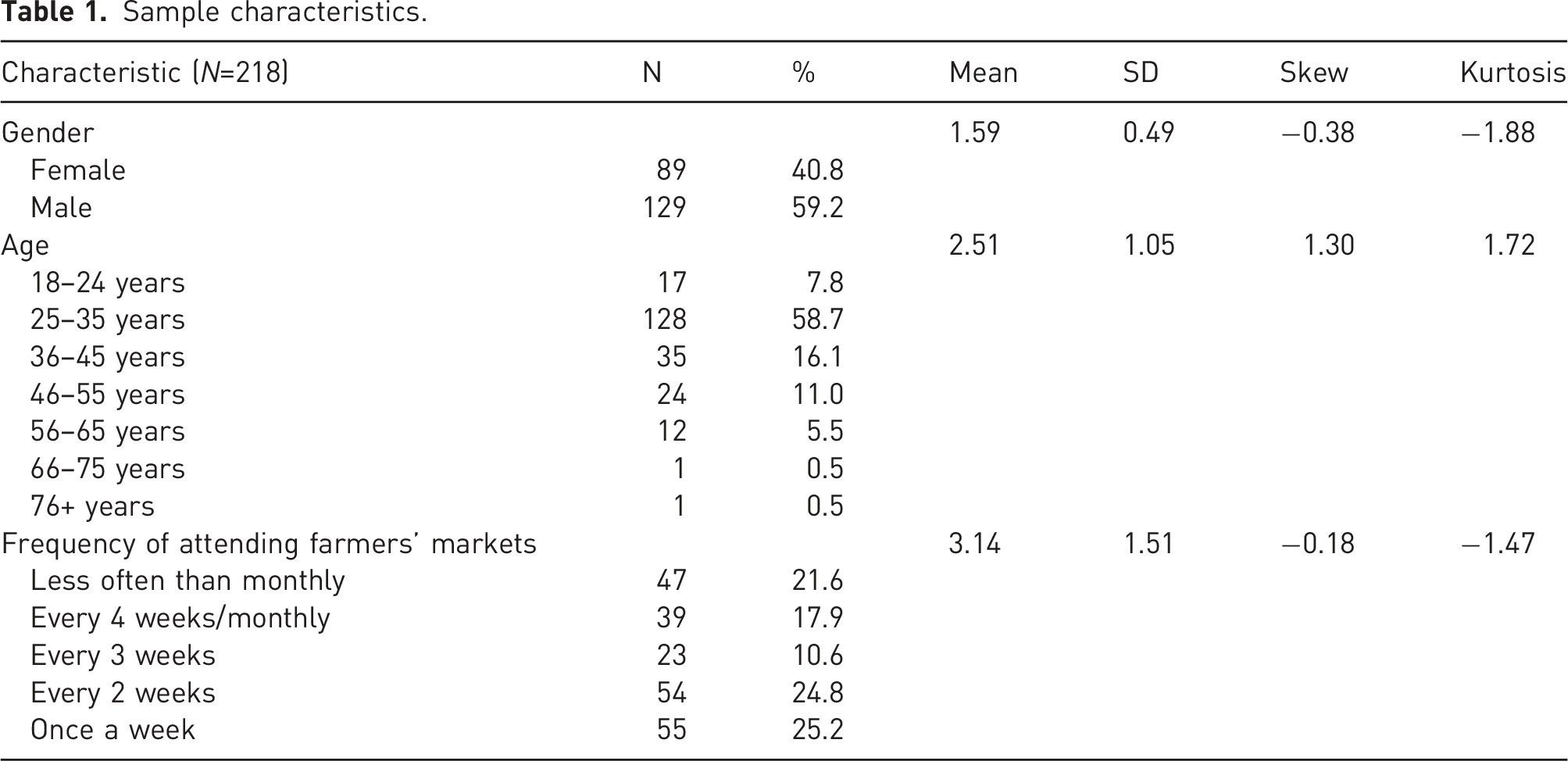
To ensure we had a relevant sample of farmers’ markets visitors, a screening question was included at the start of the survey. Participants were first presented with a short definition of farmers’ markets: “According to USDA, a farmers’ market is a place where two or more farmer-producers sell their own agricultural products directly to the general public at a fixed location. These products include fruits and vegetables, meat, fish, poultry, dairy products, and grains” (USDA, 2018a). This was followed with a question: “Have you made a purchase at a farmers’ market in the past 12 months?” Participants who answered “No” were screened out of the survey.
Measures
To collect data on our independent variable (IV), we measured frequency of visit (1 = Less often than monthly to 5 = Once a week). A standard self-image scale was employed to measure the proposed mediator (Crocker and Canevello, 2008). In this study, the participants were asked to review statements that started with this sentence: “Through the purchases that I made at a farmers' market, I tried to...”. Statements included items such as: “…get others to recognize or acknowledge your positive qualities” and “…avoid the possibility of being wrong” (not at all – always) (Crocker and Canevello, 2008).
Our dependent variable (DV), cheating, was measured following an established, incentive compatible procedure (Gino et al., 2009). First, participants were requested to “Please write six reviews of your most recent visits to your local farmers’ market. Each review must be no less than three full sentences.” Participants were then advised that their responses would be anonymous, so the researcher could not connect responses to any specific participants. Instructions advised them that for every review they completed in full, they would receive an extra $0.15. After submitting their reviews, they had no option to return to the previous window. Following the submission of their reviews, participants received an instruction advising that due to the reviews being anonymous, they needed to indicate how many reviews they had completed in full so that they could be accurately compensated. Participants were advised that their ‘honesty was important’ since, should they give an inaccurate answer, another participant (also a farmers’ market visitor) would not receive their reward. This measured their willingness to cheat in-group members (i.e. indicating a higher number of reviews to increase compensation) after being made aware of the consequences of any dishonesty. Cheating behavior was determined on the basis of completing three full sentences in each review as per the instruction. A ‘sentence’ was defined with the Oxford English Dictionary definition of the word (Oxford English Dictionary, 2018). Any review that did not meet the requirements of a sentence or was plagiarised from online sources was categorised as cheating behavior. Cheating behavior thus was operationalized by subtracting the number of reviews a participant indicated they had completed from their actual reviews. A “1” meant that the participant overreported the number of reviews they had completed to receive a payment for work they did not do. A “0”, on the other hand, meant that the participant honestly reported the number of reviews they had completed.
Following this, the standard promotion and prevention regulatory focus scale (Higgins et al., 2001) was employed which included questions such as, “I feel like I have made progress toward being successful in my life” (Promotion) and “How often did you obey rules and regulations that were established by your parents?” (Prevention) measured on a scale from 1 (never or seldom/never true/certainly false) to 5 (very often/very often true/certainly true). The survey concluded with demographic questions. The supplemental appendix below provides an overview of all items.
Descriptive data for focal variables in logistic regression.
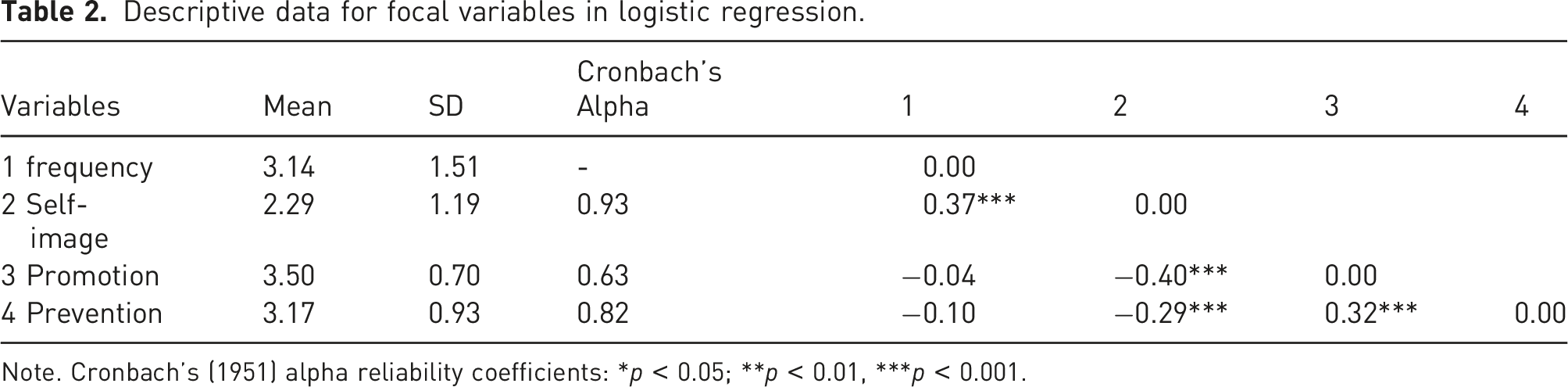
Note. Cronbach’s (1951) alpha reliability coefficients: *p < 0.05; **p < 0.01, ***p < 0.001.
Results
H1 states that participants who attended farmers’ markets would indicate a higher positive self-image and consequently engage in cheating behavior due to this elevated self-image. To test H1, a logistic regression analysis with a dichotomous outcome variable (cheating: 1 = ‘yes’, 0 = ‘no’) was conducted utilising the PROCESS Macro for SPSS 25, Model 4 (Hayes, 2018). The effect of farmers’ market patronage frequency (IV) on cheating behavior (DV) through positive self-image (mediator) was analysed to test for a licensing effect. Results from the analysis indicated a significant licensing effect. Firstly, frequency of visitation to a farmers’ market was a significant predictor of self-image, β = 0.29; SE = 0.05, t (216) = 5.77, p < 0.001. An R2 score of 0.13 indicates that frequency of attending explains 13% of the variation in self-image. Secondly, positive self-image was a significant positive predictor of cheating behavior, β = 0.66; Z = 4.71, SE = 0.14, p < 0.001. Ninety-five per cent bootstrapped CIs to test the indirect effect of the mediator for the IV and DV did not include a 0 and were therefore significant [0.0978, 0.3199]. Thus, H1 is supported. Figure 1 presents the path effect sizes within the mediation model. Path effect sizes (β) for mediation model testing licensing (H1).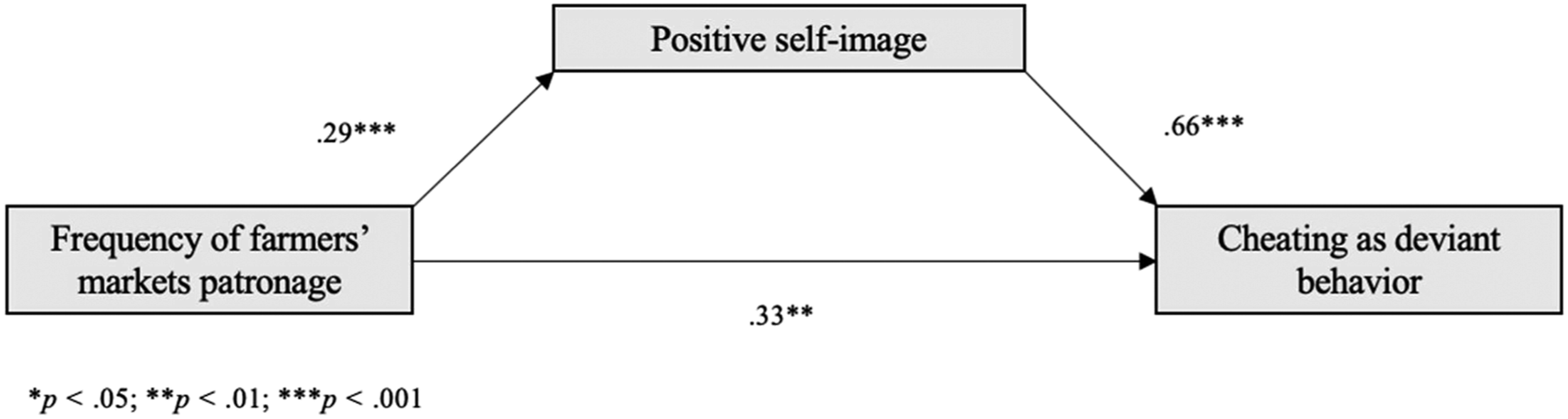
It was also expected that promotion focus would moderate the relationship between farmers’ market patronage frequency and positive self-image (H2). To test promotion as a moderator, we employed a logistic regression using PROCESS Model 8 (Hayes, 2018) that included the IV (X) farmers’ market patronage frequency, the DV (Y) cheating (1 = ‘yes’, 0 = ‘no’), and mediator (M) positive self-image. Promotion was used as the moderator (W). The results were analysed with a component approach that is the most effective analysis technique to reduce Type I errors when compared to only observing a single index of moderated mediation; for example, a bias corrected bootstrap (Yzerbyt et al., 2018). Thus, results from all relevant paths are included along with the bootstrap index of moderated mediation outcomes.
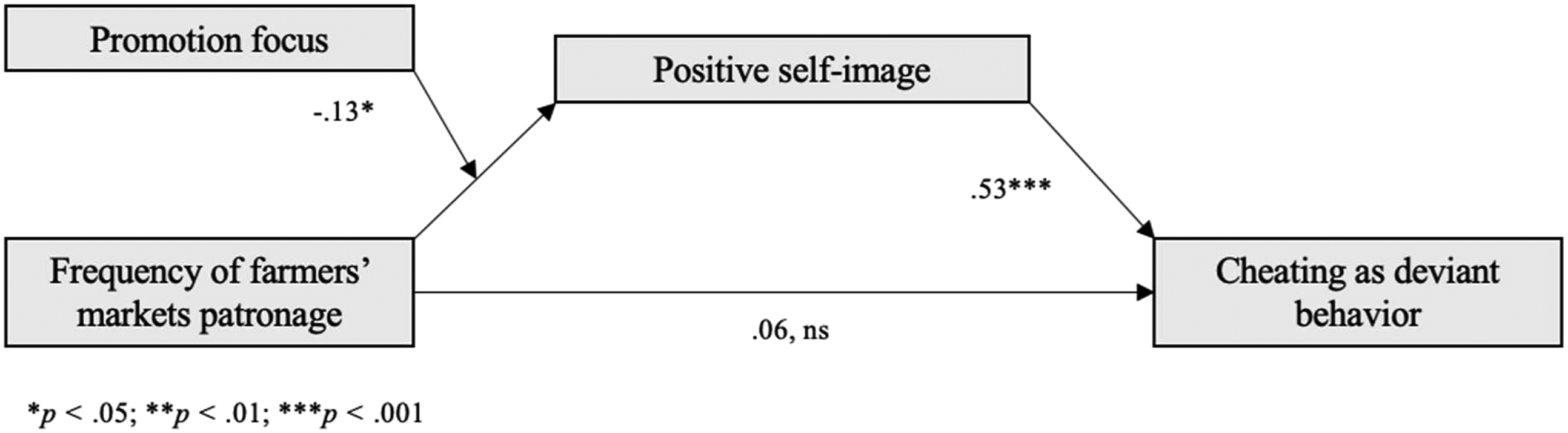
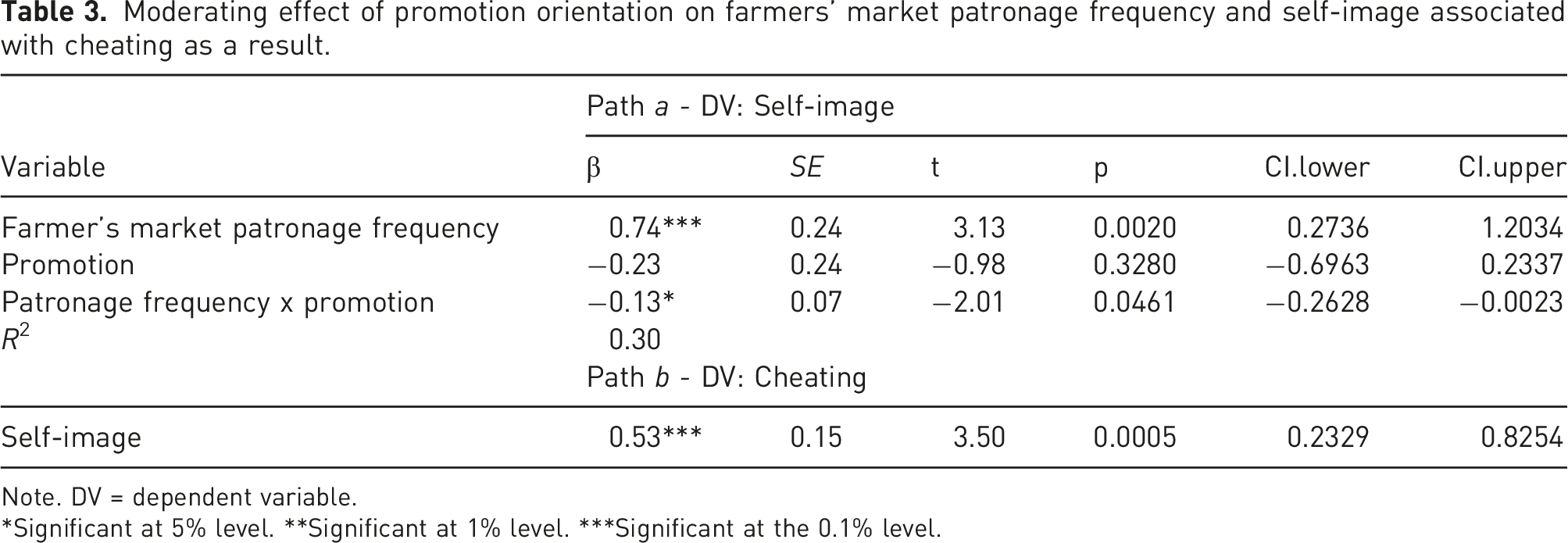
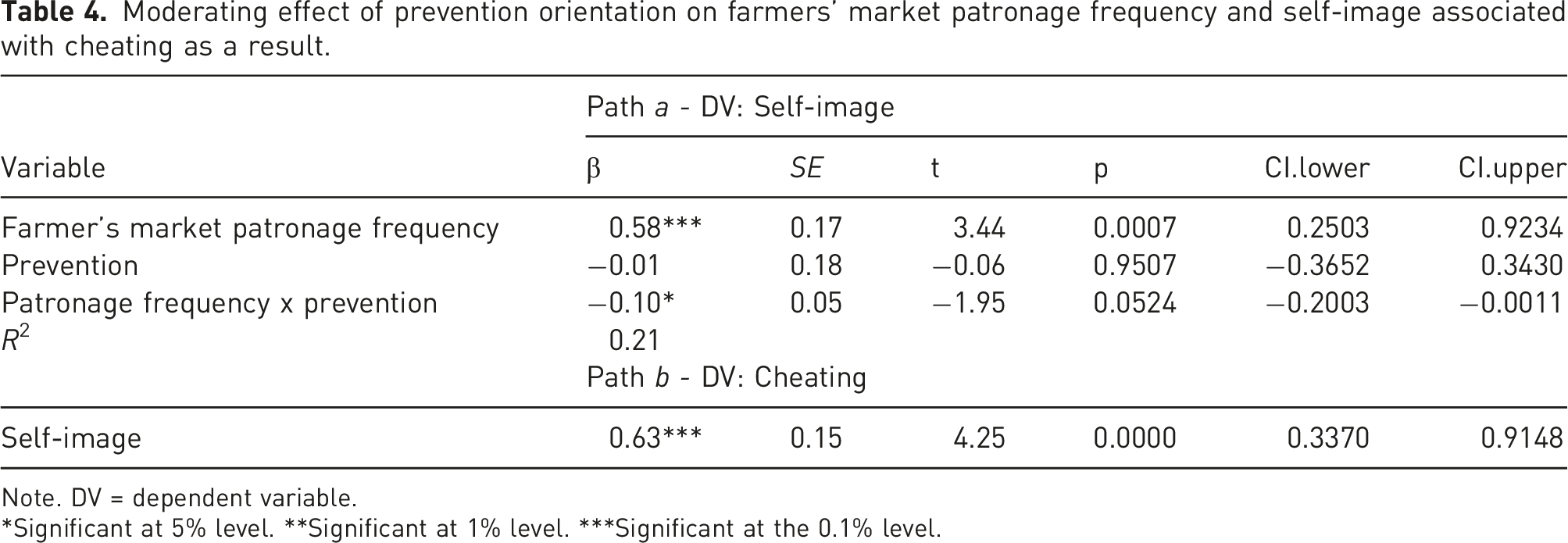
Hence, in addition to support licensing as stated in H1, we tested the moderation effect by promotion as stated in H2. We used bootstrapping in the Process macro for SPSS 25 (Model 8; 10,000 samples; Hayes, 2018). First, the results of path a, X (farmers’ market patronage frequency) to M (positive self-image) with moderator W (promotion) showed a significant interaction effect, β = −0.13; SE = 0.07, t (214) = −2.01, p = 0.046. This indicates that promotion moderates the relationship between farmers’ market patronage frequency and positive self-image and the direction is negative – therefore supporting H2 in that promotion weakens this relationship. Results are presented in Table 2 and Table 3 below. An inspection of path b, M (self-image) to Y (cheating) also reveals a significant result, β = 0.53; SE = 0.15, Z = 3.50, p < 0.001. The positive direction of path b reveals that a higher self-image leads to more cheating behavior. This confirms that both paths of the moderated mediation model are significant. Additionally, the 95% bootstrapped CIs do not include a 0 [-0.1572, −0.0083], which supports that the predicted moderated mediation model is significant. Repeating this analysis with prevention instead of promotion yielded only a marginally significant interaction effect of farmers’ markets attendance and prevention, β = −0.10; SE = 0.05, t (214) = −1.95, p = 0.052, supporting our account for promotion, while offering no support for prevention (See Table 4). 1
To understand the nature of the moderating effect of promotion orientation, the Johnson-Neyman technique was used and path a was inspected (Hayes, 2018). The use of Johnson-Neyman technique has been advocated to identify exact regions on the continuum where a variable is significant or not (Spiller et al., 2013). Licensing is significant up to a promotion value of 4.44 (on a 5-point scale) (β = 0.15; SE = 0.08, t = 1.97, p = 0.05) but not above. Most respondents, 88.5% had a promotion value of up to 4.44 with a mean score of 3.50 and 2.80 at one standard deviation below and 4.20 at one standard deviation above the mean. Additionally, the indirect effect was significant at different levels of promotion (MPromotion = 2.83; β = 0.19; SE = 0.07, bootstrapped confidence interval [CI] [0.0793, 0.3567]; MPromotion = 3.33; β = 0.16; SE = 0.06, bootstrapped CI [0.0675, 0.2890]; MPromotion = 4.33; β = 0.09; SE = 0.04, bootstrapped CI [0.0169, 0.1928]; index of moderated mediation = −0.07, SE = 0.04, CI [-0.1572, −0.0083]. Therefore, H2 is supported: licensing only occurred for low to medium promotion-focused participants, and the effect weakened for high promotion-focused participants who did not engage in deviant behavior as a result of farmers’ market patronage. Figure 2 illustrates these findings graphically and Figure 3 presents the path effect sizes of the mediated moderation model. Johnson-Neyman – promotion value. Path effect sizes (β) for mediation model testing the regulatory focus of promotion.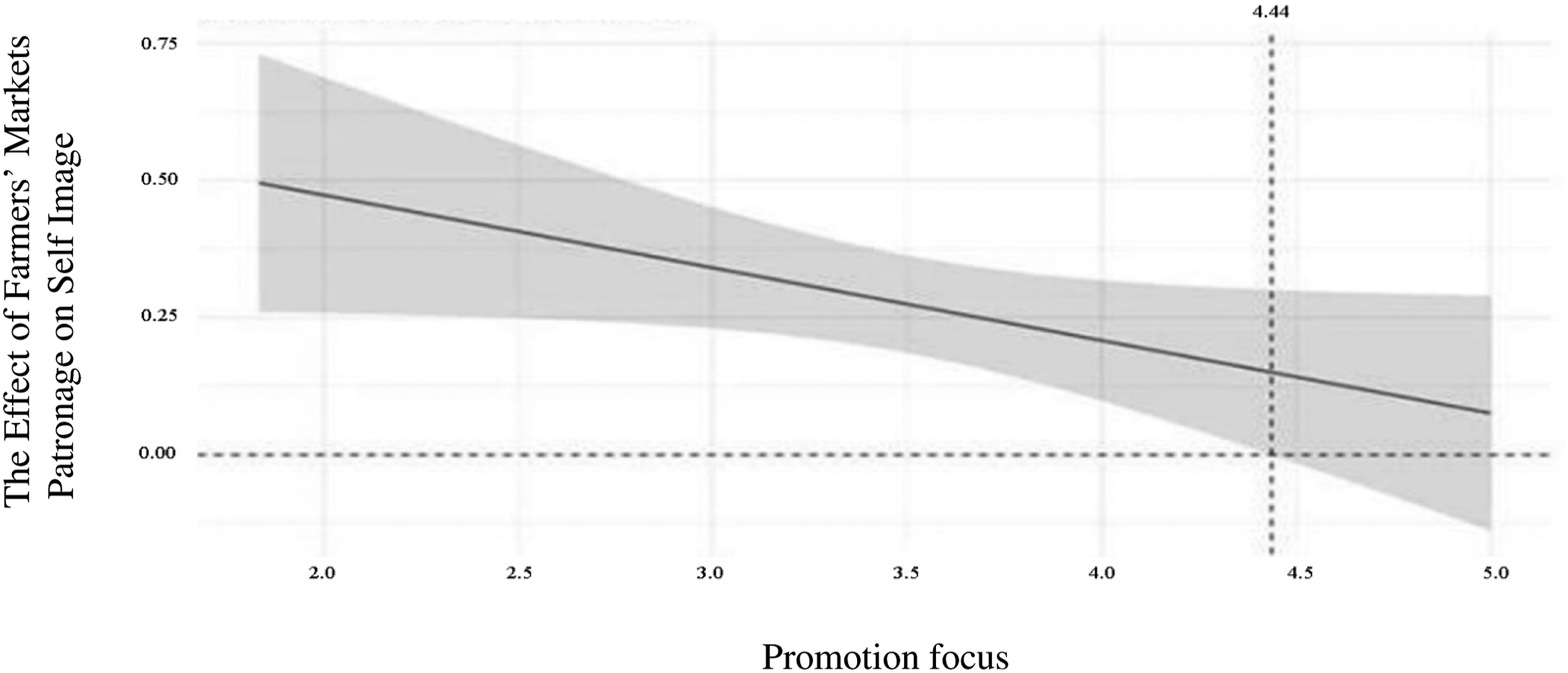
Discussion
This research offers several theoretical and practical contributions for tourism and destination marketing, and licensing literature. First, it provides new insights into behavioral outcomes of local tourism experiences, specifically visiting farmers’ markets, which despite the scale and growth in farmers’ markets, is not yet well represented in the current body of tourism literature. Second, existing research in the licensing literature has focused on whether licensing is evident across differing settings (Simbrunner and Schlegelmilch, 2017) but is yet to assess how a person’s pro-social and subsequently deviant behavior generalises to settings where deviant behavior negatively effects in-group members. Third, visitors’ individual differences in promotion focus were investigated as a potential moderator. Individual differences have not been thoroughly investigated in licensing (Blanken et al., 2015), and this study adds to the existing body of research by introducing promotion focus.
For operators within the tourism sector, and especially for the local food and rural tourism sectors currently facing international travel restrictions (OECD, 2020), this study demonstrates that frequenting farmers’ markets to purchase local food is associated with licensing effects. Visitors who frequent farmers’ markets gained a positive self-image, which gave them a licence to cheat their own in-group members. The mediation model highlights how pro-social behavior at farmers’ markets can lead to unintended consequences. Farmers’ market patronage is associated with a positive self-image, and moral transgressions are motivated due to visitors gaining a self-image as a ‘good person’. Additionally, their in-group membership as a farmers’ market patron did not stop them from cheating – even when they knew that it could negatively impact other members of their in-group. These results support H1, and the implications of this effect are discussed in the theoretical and practical contributions below. Our investigation of promotion focus as a moderator for licensing also supports H2. A visitor with a promotion motivation is focused on ideals (Higgins et al., 1997). It was found that promotion focus reduces the positive effect of farmers’ market patronage on positive self-image, which weakens deviant outcomes in terms of cheating. It was discovered that only visitors who have a low to medium promotion focus exhibited a licensing effect, with the effect becoming non-significant for individuals with a high promotion focus.
Theoretical implications
The findings from this study offer a theoretical contribution to local destination management and food tourism literature and two theoretical extensions of licensing theory. Antecedents of farmers’ market patronage are well investigated in the existing literature; however, outcomes that derive from visitors shopping at farmers’ markets are relatively unknown. Licensing has been found to impact travel decision-making in sustainable tourism (Mamula Nikolić et al., 2021) and the findings of this current study affirm the negative impact that licensing can have on the local and food tourism industry. The first finding of this research contributes to the literature on farmers’ markets as local food tourism destinations by introducing licensing as an outcome. The results from our study indicate that attending farmers’ markets leads to a boost in positive self-image, which is subsequently followed by deviant behavior in terms of cheating. In other words, attending farmers’ markets may give visitors a licence to act in a deviant manner due to gaining a moral self-image that allows for future transgressions. Consequences of deviant behavior, for example, if visitors are littering due to the positive self-image gained, may make farmers’ markets less attractive as a destination, which threatens their role as an important local tourist attraction.
In terms of contributing to licensing literature, it is important to note that there have been inconsistencies with regards to the size of the licensing effect (for a meta-analysis see Blanken et al., 2015). We address these inconsistencies by demonstrating that the impact of licensing is moderated by individual differences in promotion focus. For individuals with a high promotion focus, ideals and aspirations are important (Higgins et al., 1997; Park and Ryu, 2018). Results from the study provide support for the notion that promotion focus weakens licensing. The effect of farmers’ markets on self-image was significant for participants low to medium in promotion focus but not for the participants highest in this tendency (licensing is significant up to a promotion value of 4.44 on a 5-point scale).
Our second theoretical contribution is the clear demonstration of negative effects of licensing on in-group members. Consumption ideals that form around a pro-social local destination, such as a farmers’ market, can give the in-group a sense of belonging and support for their values of local community and economy, integrating not only the visitors but also the producers in the community (Spielmann and Bernelin, 2015). These have been shown to be important values for tourists visiting farmers’ markets and the sense of local community can enhance local tourism experiences (Garner and Ayala, 2019). Investigating licensing in farmers’ markets offers a unique context to consider a pro-social local destination that is based on the support of the local community and economy, which forms an in-group that includes visitors and producers and is based on mutual pro-social values of supporting the in-group. The results from this study indicate that this support for the local community assists visitors in developing a positive self-image from their pro-social behavior that subsequently leads to cheating. This cheating can occur at the expense of their in-group. Therefore, licensing takes place even within communities of in-groups, and this is an important theoretical addition to the current body of licensing literature that has so far investigated immoral behavior, predominantly in in-group versus out-group scenarios.
Practical implications
Firstly, licensing in farmers’ markets occurs for visitors who are low to medium in promotion focus. With this increased desire to support local economies and local tourism, the unintended consequences of attending farmers’ markets in the form of licensing may become even more relevant than previously since this research shows that support for local economies can drive licensing behavior. In response, stakeholders such as government or state tourism agencies can segment visitors unable to travel to far destinations based on their promotion focus. They can also cater high promotion inducing messages to encourage local food tourism and mitigate the licensing effect. Regulatory focus can be a chronic trait and it can be induced by situational primes (Higgins 1997, 1998). Thus, messaging can be used to match or induce a visitor’s regulatory focus (Bhatnagar and McKay-Nesbitt, 2015; Chang et al., 2019; Lechner and Mathmann, 2021). Marketing messages that are related to promotion should focus on positive outcomes and ideals, such as content about how shopping at a farmers’ market supports local destinations. Alternatively, key stakeholders could reduce licensing effects in this market segment by presenting this segment with tailored messages that emphasise benefits other than supporting the local economy, such as getting fresh produce. Irrespective of the strategy, reducing licensing is important since the implications of licensing can extend to deviant behaviors in other contexts, with consequences not only to farmers’ markets but also to the broader community, including tourism operators, and destinations. Secondly, it is evident that visitors to farmers’ markets high in promotion focus do not engage in licensing behavior. Therefore, for this visitor segment, destination marketers and managers should continue to position attending farmers’ markets as a pro-social behavior because this is a key motivation for attendance. By tailoring communication to specific individuals, the marketing appeals should be successful in discouraging licensing without undermining pro-social shopping motivations for visitor segments that don’t exhibit licensing effects.
Limitations and future research directions
The first limitation to this study is that our online survey does not allow for making causal claims since the results can only provide correlational insights about behavior (Babbie, 2015). However, the results from this study can be used as input for future experimental designs that can provide further evidence of the impact of licensing in farmers’ markets. Secondly, our dependent variable (cheating) was measured as behavior with real monetary incentives by testing the impact on other survey participants. However, this does not include a direct measurement of other in-group participants such as stallholders. Moreover, it only measured one kind of deviant behavior, in this case “cheating”, so this is not a comprehensive picture of all possible deviant behaviors that could be present. These become limitations in the study. Thirdly, we considered farmers’ market patronage frequency as our independent variable. Future research could compare consumers who attend farmers markets, with those that do not attend farmers markets at all, to get a comparison that is more representative of the general population. Fourth, using an MTurk sample is an accepted, but somewhat contested, practice in the literature. It is evident that using a sample from MTurk is more representative than using a sample that consists of undergraduate students (Hulland and Miller, 2018).
Moderating effect of promotion orientation on farmers’ market patronage frequency and self-image associated with cheating as a result.
Note. DV = dependent variable.
*Significant at 5% level. **Significant at 1% level. ***Significant at the 0.1% level.
Moderating effect of prevention orientation on farmers’ market patronage frequency and self-image associated with cheating as a result.
Note. DV = dependent variable.
*Significant at 5% level. **Significant at 1% level. ***Significant at the 0.1% level.
Conclusion
This study investigated farmers’ market patronage outcomes in the context of local tourism and in terms of deviant behaviors as explained by licensing. Additionally, individual differences in promotion focus were considered as a moderator, which weakens licensing effects. Firstly, it was found that visiting farmers’ markets led to an elevated positive self-image due to visitors’ pro-social actions, which subsequently licensed deviant behavior (H1). Secondly, individual differences in promotion focus were considered as a moderator for the licensing effect. More specifically, promotion focus was found to weaken the effect of farmers’ market attendance on self-image (H2). This research offers several important contributions to the destination management, local and food tourism literature as well as licensing literature. We highlight the outcomes of farmers’ market patronage which, to date, have been largely neglected in tourism literature, address inconsistencies with regards to the effect size of licensing by considering individual differences (Blanken et al., 2015), and extend licensing effects to deviant behaviors against one’s own in-group. With the impact of COVID-19 predicted to increase local tourism and farmers’ markets representing a growing aspect in many regional destinations, these results can assist in curbing future licensing behavior with marketing communications tailored to visitors with a low to medium promotion focus. This will assist in diminishing licensing behavior that can have far-reaching effects on farmers’ markets, the broader community, tourism operators, and destinations.
Supplemental Material
Supplemental Material - Can attending farmers’ markets lead to unplanned deviant visitor behavior?
Supplemental Material for Can attending farmers’ markets lead to unplanned deviant visitor behavior? by Emma Joenpolvi, Gary Mortimer, Frank Mathmann in Tourism and Hospitality Research
Footnotes
Declaration of conflicting interests
The author(s) declared no potential conflicts of interest with respect to the research, authorship, and/or publication of this article.
Funding
The author(s) received no financial support for the research, authorship, and/or publication of this article.

Supplemental Material
Supplemental material for this article is available online.
Note
Author Biographies
References
Supplementary Material
Please find the following supplemental material available below.
For Open Access articles published under a Creative Commons License, all supplemental material carries the same license as the article it is associated with.
For non-Open Access articles published, all supplemental material carries a non-exclusive license, and permission requests for re-use of supplemental material or any part of supplemental material shall be sent directly to the copyright owner as specified in the copyright notice associated with the article.
