



Abstract
Consumer satisfaction plays a critical role in the success and survival of tourism organizations, including wine tourism. This study aims to identify the determinants of satisfaction and dissatisfaction in wine tourism experiences using a customer-centric approach and analyzing user-generated content. The analysis reveals that satisfaction and dissatisfaction in wine tourism are influenced by different factors, supporting the two- and three-factor theories. Common themes among satisfied and dissatisfied tourists include wine, visits, and related circuits. The study validates online reviews as a valuable source of information and introduces a qualitative content analysis methodology for wine tourism research. Theoretical implications demonstrate that satisfaction in wine tourism is multidimensional, reinforcing existing theories and expanding knowledge of sensory experiences and motivating factors. Managerially, the findings highlight the critical success factors of wine and related activities, emphasizing the need for continuous improvement. Dissatisfiers, such as waiting time and employee performance, can lead to a competitive disadvantage, while satisfiers like wine tastings and aesthetics present opportunities for enhancing customer satisfaction and gaining a competitive advantage. This research contributes to the body of knowledge by shedding light on the specific determinants of satisfaction and dissatisfaction in wine tourism experiences. It underscores the importance of a customer-centric perspective, validates online reviews as a data source, and enhances understanding of the multidimensional nature of satisfaction in wine tourism. The study offers insights for researchers and managers, suggesting alternative measurement tools and encouraging further exploration of sensory aspects and motivations.
Keywords
Introduction
Consumer satisfaction in tourism is a critical issue for any tourism organization (Brandano et al., 2019; Ekinci et al., 2008), as it is a critical success factor for the survival of most businesses (Mafi et al., 2019). Given the importance of satisfaction, researchers have studied the attributes that affect it. There are two major complementary currents of thought. The first intends to perceive satisfaction as a result of multi-attributes, while the second highlights the non-linear nature of satisfaction. The latter, although considering satisfaction as a result of the performance of different attributes, considers that the achievement of improved performance on all attributes may not necessarily translate into the same increase in satisfaction (Mittal et al., 1998; Anderson and Mittal, 2000). This stream of research was initially developed by Herzberg et al., (1959) to measure job satisfaction and later adapted to the study of consumer satisfaction (Maddox, 1981; Zhang and Von Dran, 2000). According to these authors, each attribute affects satisfaction and dissatisfaction in different ways. There are several studies in the literature that highlight these asymmetric relationships amongst the different attributes and satisfaction within diverse tourism activities: in the airline industry (Shin and Elliot, 2001), museums (Huo and Miller, 2007), festivals (Cole and Chancelor, 2009), wellness (Rodrigues et al., 2020) and hotels (Albayrak, 2018).
Wine tourism has been standing out for being especially prone to generate multi-sensory experiences (Kotur, 2023). It is perceived as a holistic experience that extends to a territory and not only to the bundle of services provided by the wineries (Correia and Rodrigues, 2020). Indeed, San Martín and Del Bosque (2008) draw attention to the fact that some factors that also influence experiences in the tourism field – such as the trip, the attributes of the destination, the nature of the attractions or personal aspects – are out of the scope of control of the service providers (Baker and Crompton, 2000).
Considering the territorial embeddedness of wine tourism, research on satisfaction and dissatisfaction must be broad enough to freely include the manifestations of tourists in several dimensions of their holistic experience in the territory (Bruwer and Rueger-Muck, 2019). Nevertheless, the studies about satisfaction in wine tourism are mostly focused on dimensions circumscribed to a particular tourist actor: typically, the winery. On the other hand, the various studies on these main wine tourism actors’ satisfaction attributes have predominantly adopted a manager-centric perspective (Dodd and Bigotte, 1997; O’Neill and Charters, 2000) rather than embracing a customer-centric view of marketing (Shin and Nicolau, 2022).
To gain a comprehensive understanding of satisfaction and dissatisfaction in wine tourism, it is crucial to consider the holistic experiences of tourists within the territory. Yet, the majority of studies in this field have narrowly examined dimensions specific to individual wine tourism actors, neglecting the broader perspective of tourists’ holistic experiences (Shin and Nicolau, 2022). Furthermore, while user-generated content (hereafter referred as UGC) such as photos, videos, texts and online reviews (hereafter referred as OR), has proven valuable in understanding consumer perceptions and evaluations (Zhang and Cole, 2016; Lupu, et al., 2017; Hausmann et al., 2018), its utilization as a data source in wine tourism research remains limited (Hsieh et al., 2019; Gunasekar et al., 2021; Shin and Nicolau, 2022). Traditional survey data still dominates the current studies in this domain (Shapiro and Gómez, 2014).
Therefore, this study aims to fill these gaps by identifying the key determinants of satisfaction and dissatisfaction in wine tourism experiences, adopting a holistic perspective and a customer-centric approach. Specifically, the analysis will be based on user-generated content on TripAdvisor’s travel review platform, encompassing reports of both satisfactory and dissatisfactory experiences.
By embracing the holistic dimension of wine tourism and considering the customers’ voice through online reviews, this research brings forth several significant contributions. Firstly, it extends the understanding of satisfaction and dissatisfaction beyond the winery’s realm and considers the broader experiences within the territory. Secondly, it shifts the focus from a managerial viewpoint to a customer-centric perspective, offering insights into tourists’ perspectives, preferences, and evaluative criteria. Lastly, by utilizing user-generated content, this study taps into a rich source of information that provides real-world, consumer-oriented insights into the factors influencing tourist satisfaction and dissatisfaction.
Literature Review
Wine Tourism
Hall et al., (2000) define wine tourism as visits to vineyards, wineries, and wine festivals, experiencing in practice the characteristics of the wine region. Wine production and tourism associated with it are normally a strong territorial phenomenon, described by Dickenson and Salt (1982, p. 184) as the “territory’s experience”. Indeed, the experiences and attributes of a wine-producing region can be so varied and of so diverse interest, that many of the so-called wine tourism actors cannot be collected into such a label or denomination (Correia and Brito, 2016; Charters and Ali-Knight, 2002).
For Jones et al., (2013) the success of wine tourism destinations is related to the ability of the destinations to develop this product and highlight the lifestyle that it induces, which implies partnerships, involvement of the local community, and multiple tourism stakeholders. In fact, wine tourism is considered an experiential consumption (Kotur, 2023; Brandano et al., 2019; Back et al., 2021; Bruwer and Rueger-Muck, 2019) and the reasons behind a visit to a wine region can be diverse according to the visitor’s profile (Bruwer et al., 2017).
The definition of wine tourism may suggest that visits may be specifically motivated by the wine itself, but more broadly, they are also motivated by the attributes of the wine regions (Brochado et al., 2021). Bruwer et al., (2017) note that the motivations directing the visitor’ behavior are different but predominantly of a hedonic nature. For some visitors, motivations revolve around the destination and the wine region, while for others motivations revolve around the activities, where the opportunity to participate in a wine tasting is the main reason for the visit. Although the main motivation of wine tourists is related to wine, there are several other activities that are essential to the total wine tourism experience, including gastronomic events, socializing, tours, cultural shows, vineyards, learning about wine and production, food, and meeting winemakers (Brandano et al., 2019; Chiodo et al., 2020).
In order to develop wine tourism and adapt their offer to the wishes and interests of tourists, several regions have created routes with defined attractions: visits, tastings, typical dishes, contact with residents and culture, among others, thus transforming the region itself into a tourism product (Chiodo et al., 2020; Correia and Brito, 2016). In addition to linking tourism and wine-producing activities, wine routes serve as one of the best ways to publicize and market the region’s tourism (Correia and Brito 2016; Hashimoto and Telfer, 2003).
For such connections to occur and be positive, it is necessary that the experience of the surrounding environment, including facilities, vineyards, and secondary tourism resources, result in positive emotions and that relationships with wine tourism service providers, other resources, and residents, is also enjoyable to reinforce the positive emotions of the wine experience (Brandano et al., 2019; Brochado et al., 2021). It is critical to recognize that the wine customer experience is not limited to the interaction at the point of purchase, but rather the entire combination of experiences that evolve over time while in the wine region (Brochado et al., 2021; Correia and Brito 2016)
Consumer Satisfaction and Dissatisfaction
Service quality results from the comparison between the consumer’s perception of the service received and the service initially expected or desired (Oliver, 1980; Zeithaml et al., 1996). If reality exceeds expectations, the service is understood as being of high quality, but if, on the contrary, reality falls short of expectations, the service will be associated with low quality. In case there is a balance between reality and expectation, the service is considered satisfactory (Zeithaml et al., 1996).
Some studies point to the understanding of satisfaction as an affective rather than cognitive construct (Oliver, 1997; Olsen, 2002). Woodruff et al., (1983) mentioned, however, that consumer satisfaction should be conceptualized to accommodate the relationship between cognitive and emotional processes. The authors also added that feelings of satisfaction or dissatisfaction result from an emotional state developed in reaction to a cognitive process of confirmation or disconfirmation (Woodruff et al., 1983).
In tourism, satisfaction is generally understood as the total sum of satisfaction with the attributes that customers consider important (Pizam and Ellis, 1999) often referred to as the multi-attribute model. According to this understanding, several studies have sought to identify the multiple attributes that could influence customer satisfaction. What is also consensually accepted is that these different attributes have an asymmetric relationship with satisfaction, which is precisely what the two-factor theory developed by Herzberg et al., (1959) states. According to this theory, widely applied to consumer satisfaction, the multiple attributes that influence satisfaction may be differentiated into two large groups or factors: the satisfiers and the dissatisfiers. The satisfiers are not normally expected attributes and even if not provided they will not negatively affect satisfaction. However, if they are provided and perform well, will have a good chance of generating satisfaction. Dissatisfiers, on the other hand, are attributes that are taken for granted by consumers. Regular performance of these attributes will not significantly increase satisfaction, but poor performance will lead to high dissatisfaction. There is also another more recent theory so-called the three-factor theory (Kano, 1984) that adds another type of attribute group: the hybrids. These have a symmetrical and linear influence on consumer satisfaction. That is, for these attributes a high performance will lead to satisfaction while a poor performance will lead to dissatisfaction.
Regarding customer dissatisfaction, it shouldn’t be considered only the opposite of satisfaction. Several studies have highlighted that the determinants of satisfaction are different from those of dissatisfaction (Li et al., 2020; Albayrak and Caber, 2013; Alegre and Garau, 2011; Füller and Matzler, 2008). “Specifically, one unit of positive performance of an (…) attribute could have a much greater impact on customer satisfaction than a corresponding unit of negative performance, and similarly negative performance of an (…) attribute could outweigh the effect of its positive performance on customer satisfaction.” (Li et al., 2020, p. 1714).
Despite the relevance of the multi-attribute model and the asymmetric nature that inspires the two-factor and three-factor theory, this approach has not been applied to wine tourism (the work of Shin and Nicolau (2022), is a notable exception). At the same time although wineries are one of the essential pillars of the wine tourism experience, this is holistic and the overall satisfaction may depend on factors not directly influenced by the owners. In fact, sight and taste are the most mentioned senses in wine tourists’ evaluations (Brochado et al., 2021) and wine tasting is the central motivation and activity of wine tourism (Hall et al., 2000), so it has a strong influence on the satisfaction, of tourists. And, regarding sight, this is mainly associated with descriptions of local environments, with regional and local environments (i.e., landscapes) being a motivating factor for wine tourism (Quadri-Felitti and Fiore, 2013), and in this way an influencing factor on their satisfaction. This has been associated in previous studies with visual consumption of the beauty of wine landscapes, local scenery, vineyards, or architecture (Brandano et al., 2019; Bruwer and Alant, 2009; Getz and Brown, 2006).
Synopsis
The literature review emphasizes the experiential nature of wine tourism and the diverse motivations of visitors. It discusses the development of wine tourism destinations through partnerships and stakeholder involvement. The concept of wine routes as a marketing strategy is explored. The review highlights the importance of positive emotions and enjoyable relationships in enhancing the wine tourism experience. It introduces the multi-attribute model of satisfaction, categorizing attributes as satisfiers, dissatisfiers, and hybrids. The influence of sight and taste on satisfaction is emphasized, particularly in relation to wine landscapes and regional environments. Overall, the review calls for further research on applying the multi-attribute model to wine tourism, specifically focusing on wineries and sensory experiences.
Methodology
Netnographic Approach
This study aims to understand the main determinants of satisfaction and dissatisfaction in wine tourism experiences. It assumes a totally exploratory character, thus opting for the use of a qualitative methodological approach. In this research, netnography is used, defined by Kozinets (2002) as “a new qualitative research methodology that adapts ethnographic research techniques to the study of online communities” (p. 62).
The continuous transfer of everyday activities to the online environment has precipitated an increase in the popularity of this qualitative research method among researchers and practitioners (Kozinets, 2015). Netnography, which was originally developed for marketing and consumer research is now an established field in services (Heinonen and Medberg, 2018) and tourism (Shin and Nicolau 2022; An and Alarcón 2021; Brochado et al., 2021; Pearce and Wu 2018; Mkono and Markwell, 2014)
Netnography has several advantages over other research approaches such as personal interviews and focus groups, which can cause respondents’ inhibition (Elliot and Jankel-Elliot, 2003), and allows for overcoming geographical, time, and cost constraints. The data collected is perceived as richer and more natural in terms of information and enables a more accurate and refined portrayal of realities experienced by consumers. This is, therefore, a method adjusted to the analysis of consumers’ experiences since, under normal conditions, they write the evaluations only after the end of the visit, which means that the experience is not affected by the observation (Kozinets, 2002).
In this research, the methodology is assumed as a relevant approach, considering that online platforms such as TripAdvisor are becoming social communities with their own values and beliefs exposed by the participants. In this context, netnography allows an understanding of the visitor experiences in wine tourism, described through online reviews written by tourists, reflecting what they experienced and whether it was in accordance with their expectations (Shin and Nicolau 2022).
Research Context
Wine Tourism is an extremely relevant activity in Portugal being defined in the Portuguese Tourism Strategic Plan as a priority for the country’s tourism development (Turismo De Portugal, 2017). Portugal is the 3rd country in the world with the largest variety of indigenous grape varieties (over 250), has the oldest denomination of origin in the world (Região Demarcada do Douro), and over 500 private wine tourism players (Turismo De Portugal, 2019). It was also considered in 2022 by the consultancy company Bounce as the best country for wine tourism tours and the second-best country in the world (after Italy) for wine tourism (Bouce, 2022).
Wine tourism offer is present throughout the Portuguese territory. Similarly, to what happens in other countries several Portuguese wine regions organize and promote diverse wine routes being “the most visible face of wine tourism” (Simões, 2008, p. 269). Today there are 13 wine routes in Portugal (ARVP, 2020): Vinhos Verdes, Douro and Porto, Dao, Beira Interior, Bairrada, Tejo, Lisbon, Bucelas Carcavelos and Colares, Setúbal Peninsula, Alentejo, Algarve, Azores Region, and Madeira Region.
In this study, the satisfaction of wine tourists represents the overall diagnosis made by them regarding a visit experience, involving functional and emotional aspects related to the attractions of wine tourism units in Portugal. This diagnosis is reflected, for example, through the ORs, which are defined as the comments published on the internet by consumers about the products, services, and brands they have experienced (Filieri and McLeay, 2014). Thus, if consumer expectations are met or even exceeded by organizations related to tourism, it can be expected that the customer will give good references of it. However, when expectations are not met and tourists are dissatisfied, they write a negative OR, which will be harmful in terms of the image and reputation of a tourism unit (Browning et al., 2013).
Unit of Analysis
The source of the data collected was the TripAdvisor website. The tourist units included in the study were selected taking into consideration the following process: • As mentioned before, there are 13 Wine Routes in Portugal; • For each Wine Route, a Wine Tourism Unit from that region with more than 50 publicly available reviews on 20 October 2020 written in English on TripAdvisor was selected. • For each selected Wine Tourism Unit, the 50 most recent evaluations written in English were analyzed; • In cases where there were no Wine Tourism Units with more than 50 written assessments in English on a given Wine Route, no units from that region were analyzed.
Selected wine tourism units.
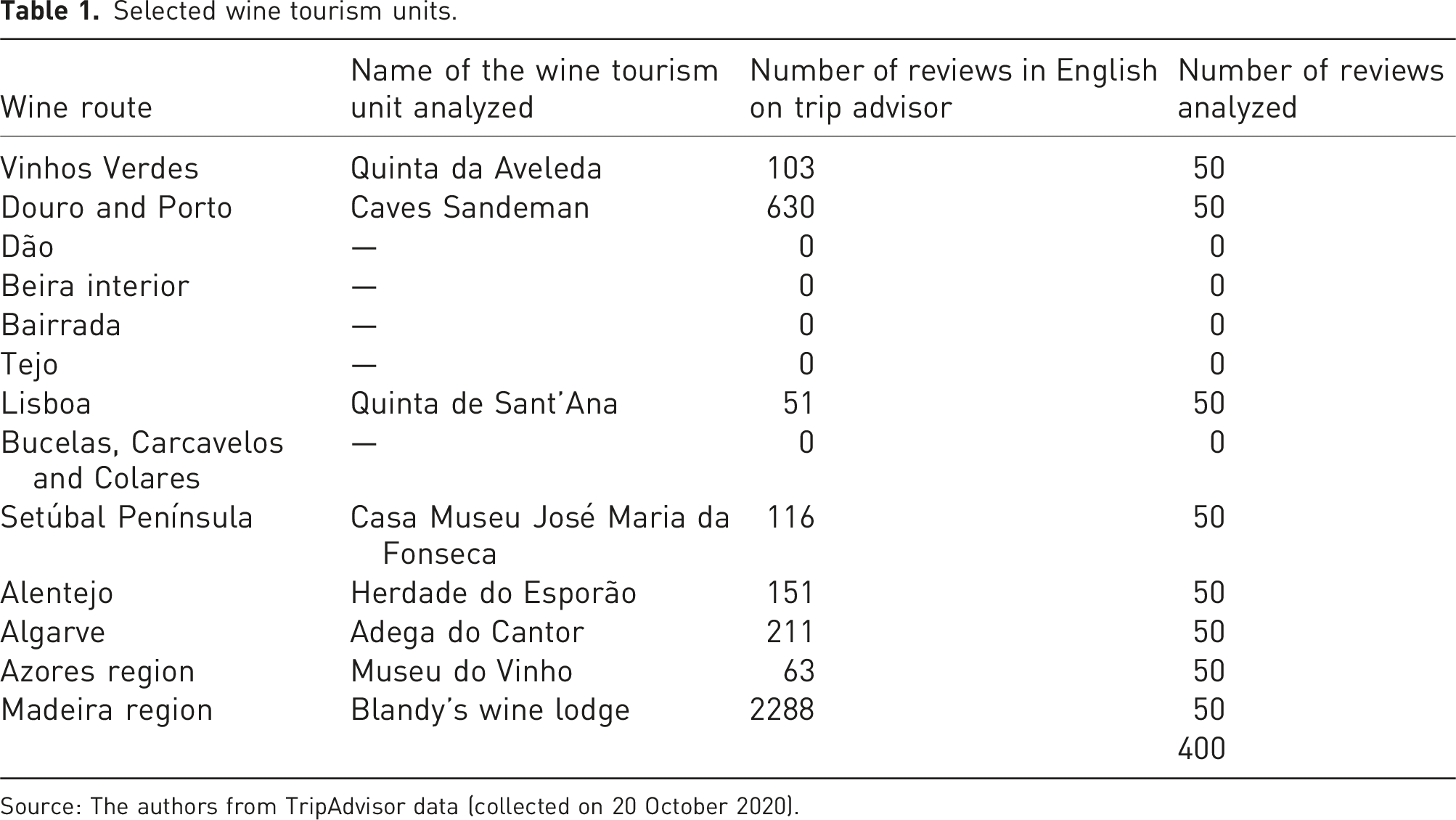
Source: The authors from TripAdvisor data (collected on 20 October 2020).
Data Collection and Sampling
The data from all selected reviews were collected and assembled in an Excel file where the following columns were created: Wine Route, Name of the Wine Tourism Unit, Tourist Origin, Continent, Evaluation Title, Evaluation, Rating (1 to 5), Date of Visit, Tourist Type. A total of 400 evaluations, consisting of 35,011 words, were selected.
Sample data.
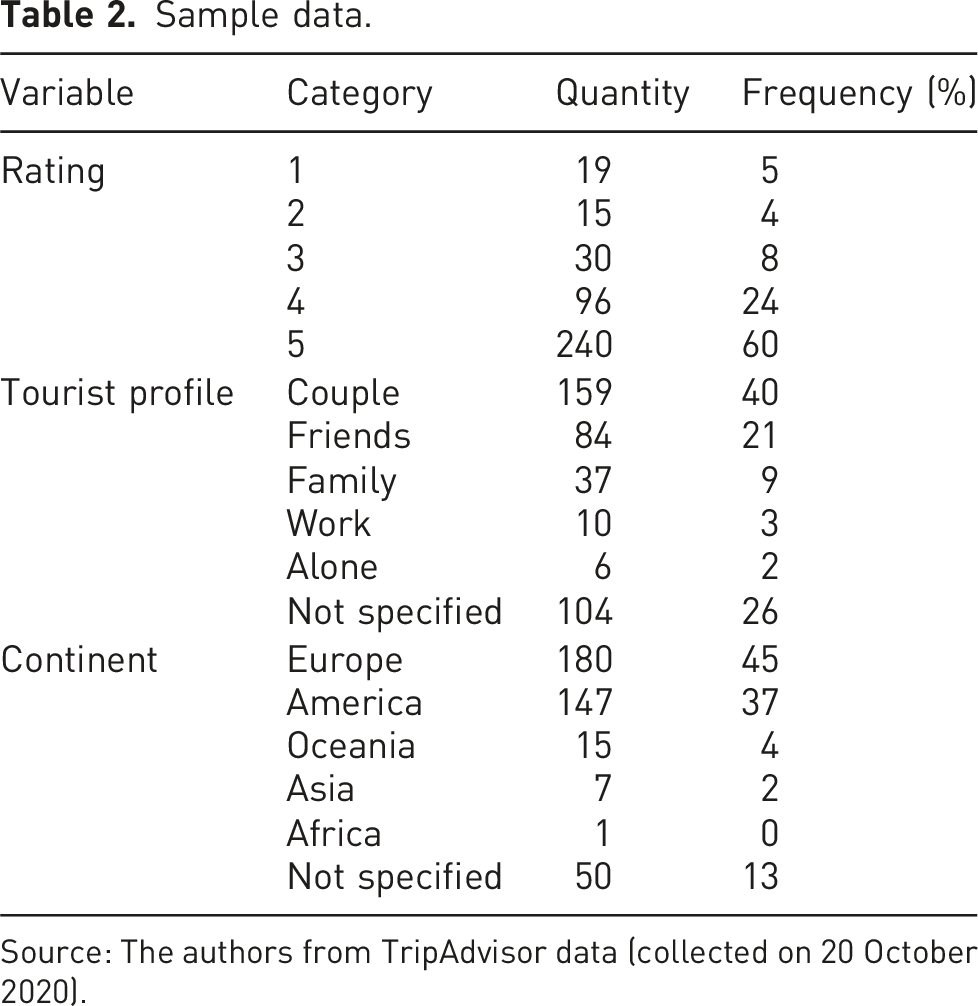
Source: The authors from TripAdvisor data (collected on 20 October 2020).
Data Analysis
The collected content (400 ratings, consisting of 35,011 words) was analyzed with Leximancer, an analysis software, which has also been recently used in other tourism research (Brochado, 2019; Brochado et al., 2017; Pearce and Wu, 2016; Wu et al., 2014). Leximancer is a text analysis software that can be used to understand the content of text sets and to visually display the extracted information (Leximancer, 2020). The information is presented through a concept map that provides an overview of the material, representing the main concepts contained in the text and how they relate to each other.
This software provides inductive identification of themes with minimal need for manual intervention by the researcher when compared to other content analysis techniques that require the researcher to develop a list of codes and rules prior to analysis (Tkaczynski et al., 2015). Leximancer uses word association information to identify sets of words that appear together frequently in the data and suggests these words as potential concepts for the researcher (Smith and Humphreys, 2006).
In the semantic pattern extraction process performed, the most important units are ‘word’, ‘concept’, and ‘theme’. The extracted words and concepts are linked together, and analysis is performed using word occurrence and co-occurrence frequency to produce a matrix from which concepts are identified. Leximancer then organizes and groups these concepts into themes, based on how often they appear together in the texts.
After Leximancer determines the set of concepts, the software attaches concept codes to individual segments of the text (Tkaczynski et al., 2015). Additionally, it is possible to examine blocks of text that correspond to each theme using Leximancer’s query feature. As in previous tourism studies (Brochado, 2019; Brochado et al., 2018; Lupu et al., 2017; Pearce and Wu, 2016; Wu et al., 2014; Scott and Smith, 2005), each theme can be described and illustrated with a set of narratives extracted from the web reviews analyzed.
Leximancer also provides a diagram view of the data, i.e., a concept map that visually shows how the different concepts and themes are related, demonstrating the relationships between them.
To understand how the various attributes impact satisfaction and dissatisfaction, two separate analyses were performed - one for the evaluations whose ratings were 1 and 2; and another for those that had ratings of 4 and 5.
Findings and Results
Main Reasons for Satisfaction
Figure 1 illustrates the conceptual map concerning the experience of satisfied tourists with their visits to wine tourism units in Portugal. Concept map of satisfied tourist ratings. Source: Prepared using Leximancer software.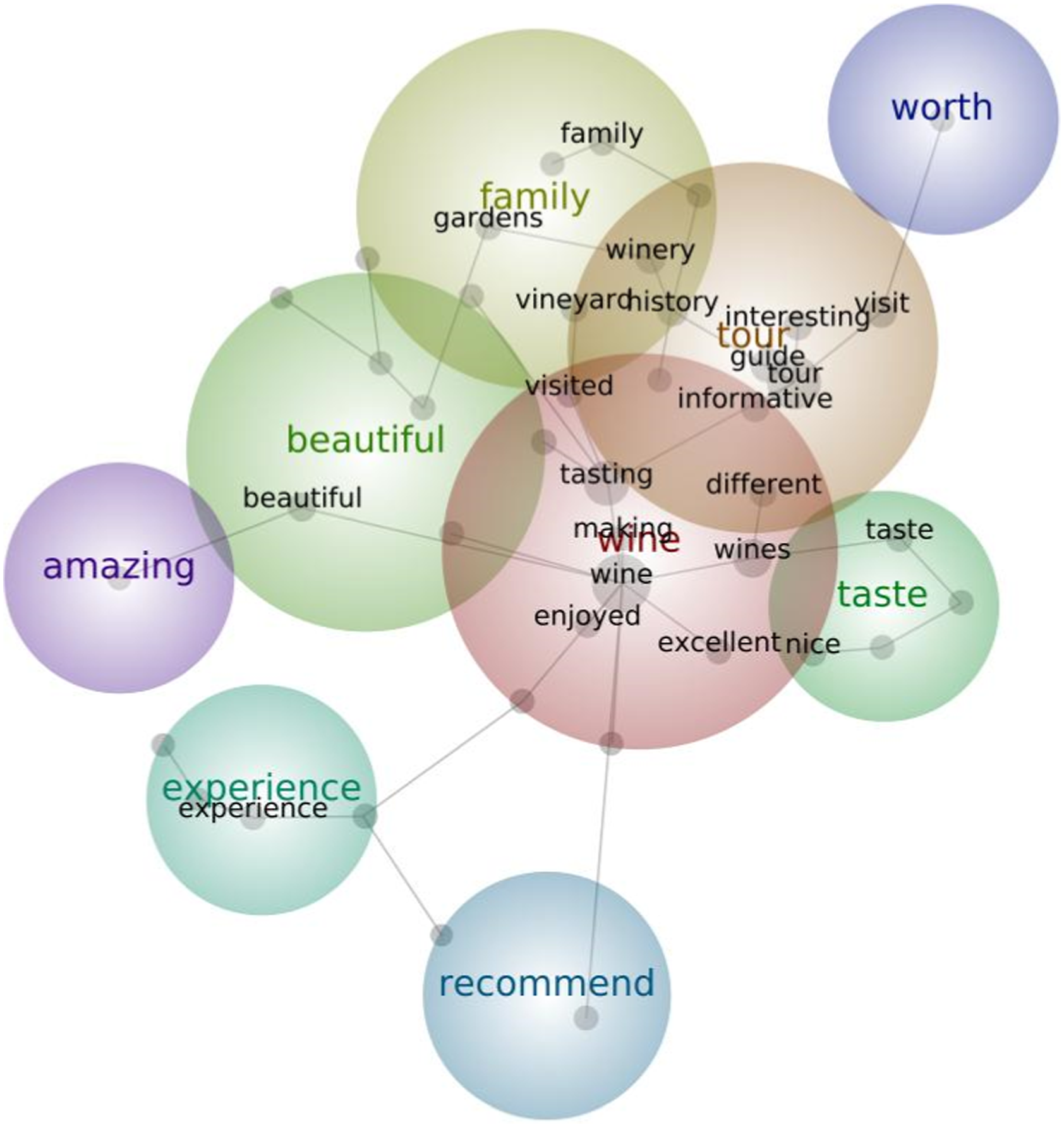
Satisfied tourists were all those who gave ratings of 4 and 5. The analysis of the experience allowed the Leximancer software to identify nine themes (theme size 40%): “wine”, “tour”, “taste”, “family”, “beautiful”, “recommend”, “experience”, “worth”, and “amazing” (Figure 1). The software also highlighted 43 concepts.
The larger circles represent the strongest and most frequently used concepts, which are usually also the most interconnected. The circles are overlapped to capture groups of concepts that represent the major themes in the content, and the darker circles on the map indicate the increasing importance of these themes (Campbell et al., 2011). The proximity or distance between concepts indicates the strength of the relationship between them, meaning that concepts that are mentioned together in the text are also closer or overlapping on the concept map.
A detailed analysis of each theme is presented below.
“Wine”
“Wine” was the most significant theme identified by Leximancer in the evaluations of tourists who visited wine tourism units in Portugal and were satisfied. This theme includes the concepts “wine” (frequency = 331, relevance = 100%), “tasting” (180%), “wines” (134%), “different” (39%), “making” (34%), “enjoyed” (41%), “excellent” (38%), “visited” (35%). The tourists are satisfied not only with the wine tasted and its variety but also with the various activities that are possible to do in the wine tourism units, such as wine tastings, walks through the vineyards, and learning about the wine production process. In this regard a tourist mentioned: We then went through to the actual factory and learned about the process of winemaking, then the good bits .... the tasting each of the wines we tasted was quite high in alcohol content and all very different Another tourist remarked: “The wine tasting was excellent.”
“Tour”
“Tour” was the second most significant theme, according to the software, and appears related to the concepts: “tour” (frequency = 263, relevance = 79%), “guide” (98%), “history” (68%), “visit” (87%), “winery” (71%), “interesting” (54%), “informative” (47%) and “vineyard” (52%). It is related to the program and circuit of the visit, but also to the moments of leisure and relaxation provided by the walks along the vineyards. The tourists also value the fact that the guides pass on interesting information about the history of the wineries, as well as about the owner’s families. In this regard a tourist shared: “Tour guide was very informative and provided some history on the family’s winery and in the production of the different wines.” Another tourist mentioned: “It was such an interesting tour with not only the history of the winery but winemaking in the region.”
“Taste”
The theme “Taste” includes the concepts “taste” (frequency = 46, relevance = 14%) and “nice” (47%). Wine tasting is often mentioned by wine tourists in their online evaluations, being this one of the most frequent activities when visiting wine tourism units. This term is often associated with the adjective “nice”, thus demonstrating the satisfaction of visitors, both in relation to wine tasting, as well as the wines themselves. A tourist wrote, regarding the wine tasting: “Informative tour with some nice tour taste at the end.” Another tourist mentioned: “They allow you to taste some of their wines which are nice.”
“Family”
The theme “Family” includes the concepts “family” (frequency = 45, relevance = 14%) and “gardens” (43%). Several wine tourism units in Portugal are owned by families who live there and whose history in wine production goes back many years. Visiting the gardens of these same family houses is something that quite a few tourists value, as well as knowing their history. In this regard, one tourist shared: “We were met by Renata, she took us for a thorough tour of the gardens giving us a great overview of the history of the family, Quinta, and property.” Another tourist mentioned: “Lovely house and gardens.”
“Beautiful”
The theme “Beautiful” is associated with the same concept, “beautiful” (frequency = 69, relevance = 21%). This adjective is used by several tourists to describe essentially the places they visited, but also in relation to the experience itself, leaving implicit the satisfaction of many wine tourists in their online evaluations. Some tourists shared, regarding the places they visited: “Friends are still talking about how beautiful the Quinta was and how much fun they had.” “Will remember our time at this beautiful spot for many years to come.” Another tourist said, regarding his experience: “Our friend got us tickets and what a beautiful fall harvest adventure.”
“Recommend”
Associated with the theme “recommend” appears the concept with the same designation (frequency = 56, relevance = 17%). It is related to the post-experience phase and can be seen as an indicator of the tourists’ high satisfaction with the visit, such that they would recommend it to other people, as illustrated by the content of the comments that follow: “Sandeman is defined worthy seeing! The Caves in Porto are a must see and I recommend this one!” “Can highly recommend.”
“Experience”
The theme “Experience” includes only the concept “experience” (frequency = 54, relevance = 16%). The experience is evoked in the visitors’ narratives for different reasons that go through the evaluation of the experience, the content, or even the scheduling phase. Thus, these tourists consider that, overall, their experience was positive. One visitor mentioned about his experience: “We started with the lunch. What a great experience!” Another tourist shared: “We then called Esporao. Amazing experience.”
“Worth”
The “worth” theme includes the concept “worth” (frequency = 42, relevance = 13%). Many tourists who made the visit were surrendered to its attributes and validated the experience, stressing that it was “worth it”, contributing to the positive word-of-mouth. The following evaluations are examples of this satisfaction: “It is so worth it, so make a reservation well in advance of your trip” “Quinta de Sant’Ana was roughly a half-hour ride from Lisbon and well worth the trek.”
“Amazing”
The concept “amazing” includes only the concept “amazing” (frequency = 34, relevance = 10%). “Amazing” is an adjective used by several tourists to describe their experience in wine tourism units and its different attributes. It translates the emotional involvement of visitors and leaves implicit their satisfaction, as perceived by the following comments: “I had the most amazing day at Quinta de Sant’Ana. It is an amazing peaceful place on this earth.” “I cannot put into words just how amazing Quinta de Sant’Ana is.”
Main Reasons for Dissatisfaction
Figure 2 illustrates the concept map concerning the evaluations of tourists dissatisfied with their visits to wine tourism units in Portugal. Concept map of unsatisfied tourists’ evaluations. Source: Prepared using Leximancer software.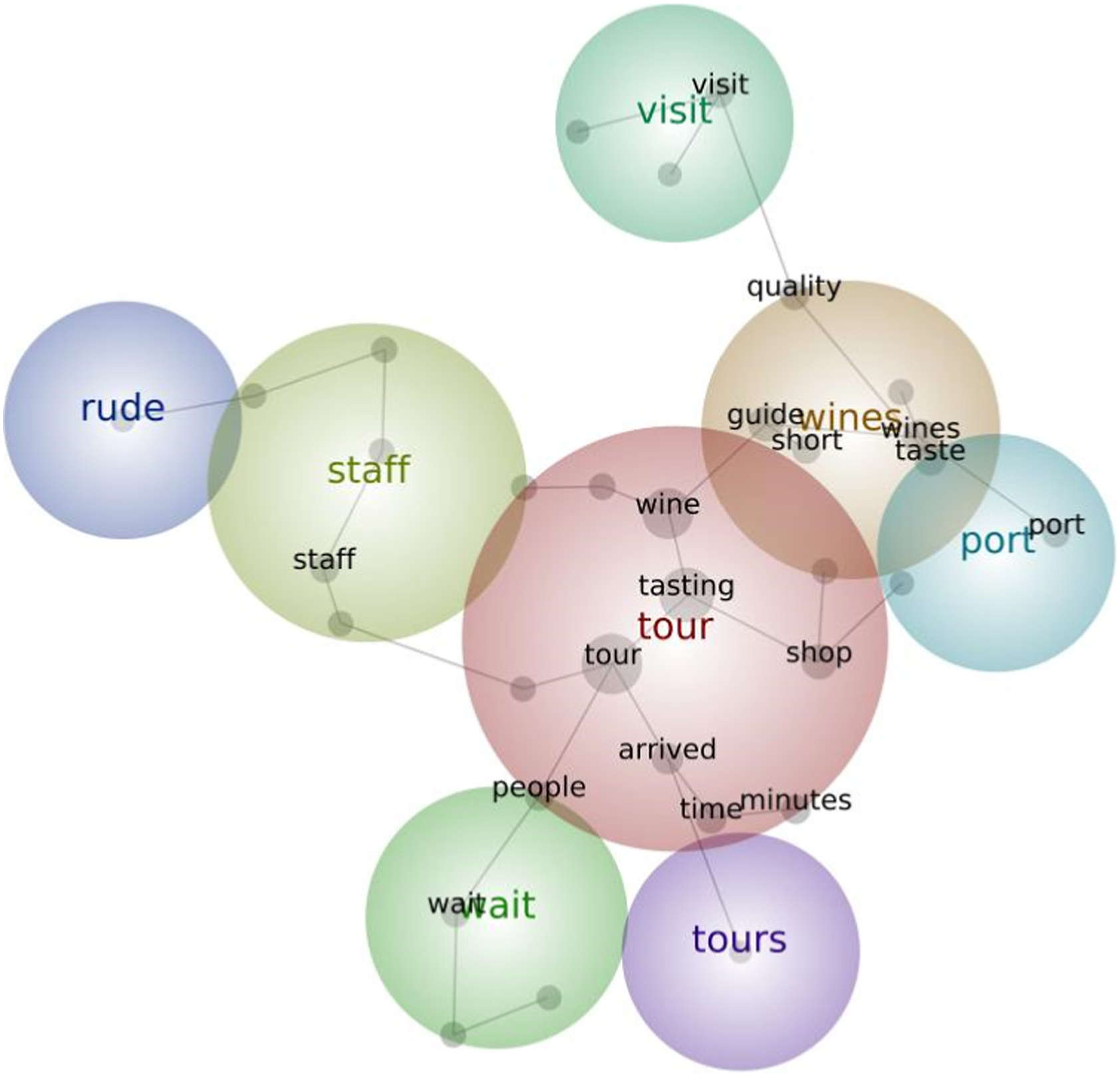
Unsatisfied tourists were all those who gave ratings of 1 and 2. The analysis of the experience allowed the Leximancer software to identify the existence of eight themes (theme size 40%): “tour”, “wines”, “wait”, “visit”, “port”, “staff”, “rude” and “tours”. The software also highlighted 33 concepts.
“Tour”/“Tours”
The themes “Tour”/”Tours” include the concepts “tour” (frequency = 33, relevance = 100%), “tours” (4%), “tasting” (30%), “wine” (25%), “shop” (9%), “arrived” (8%), “time” (11%) and “minutes” (9%). This theme is related to the program and circuit of the visit, but most of the time what caused visitors’ dissatisfaction was not the lack of quality of the circuit itself, but rather the various problems experienced around the visit. Some tourists report that they waited a long time before starting the tour, leading in some cases to the tour being rushed to make up for this time, and others report that they didn’t even get a chance to do the tour. All these situations lead to the dissatisfaction of the wine tourists, as evidenced by the following evaluations: “Was misled by positive reviews. When arrived we were told there are no tours available but wine shop and wine tasting was still on.” “The need to hurry might be the result of the Tour starting 45 minutes after the time we were told to arrive at the cellar. The tour was booked for 16 h 45, and we were told to arrive 15 minutes early.”
“Wines”
The theme “Wines” is equally relevant for wine tourists. It involves concepts such as “wines” (frequency = 13, relevance = 39%), “guide” (11%), “taste” (7%), “quality” (8%), and “short” (6%). Wine is a fundamental component of the experience provided by wine tourism units. As an extension of the visit, there are wine tastings that many recognize and identify in online reviews. However, some tourists consider that the quality of certain wines, as well as the tastings and the guides that accompany them, fall short of expectations. On this topic, a tourist shared: “The prices went up recently while the quality decreased greatly and the wines they give you to taste are pretty bad.” Another tourist mentioned: “I booked the English Tour and paid 27 euros to tour the cellar and taste 5 port wines. What I did not expect was a gum-chewing guide who literally raced us round the cellar with short explanations of what goes on there.”
“Wait”
The theme “Wait” includes the concepts “wait” (frequency = 9, relevance = 27%) and “people” (8%). One of the reasons for visitors’ dissatisfaction is the long waiting period they had to go through, and which ends up impacting the rest of the experience. This term appears associated with “people” in the sense that they consider that there might be a lack of employees to attend to all visitors. This understanding can be perceived in the comments of these tourists, who are notoriously unhappy: “The incredibly long wait for our meal and service, in general, was awful. If you don’t have enough staff to cover lunch patronage, you shouldn’t be calling in people off the street to fill seats,” “The ‘tasting’ at the end was a disaster. We had to wait 5 min to enter the tasting room, after we were seated and then nothing happened for another 10 min.”
“Visit”
The theme “Visit” includes the concept “visit” (frequency = 10, relevance = 30%). Many tourists, who have had visit experiences were not surrendered to its attributes and would not recommend it. Sometimes the dissatisfaction is relative since the visitors in question have already had, in the past, wine tourism experiences in other units, which they considered better than the one they are currently commenting on. In other cases, we have visitors who, when evaluating the value for money of the visit, consider it to be unsatisfactory. In this regard a visitor shared: “It was an ok visit, but their ports are not as good as many others” Other tourists mentioned, regarding quality-price: “Overall, I thought it was an expensive visit for nothing.”
“Port”
The theme “Port” includes only the concept “Port” (frequency = 7, relevance = 21%), and it refers to Port Wine. In this case, the dissatisfaction of tourists is not revealed specifically in relation to this wine, but rather in relation to the surrounding experience, as illustrated by the content of the evaluations that follow: “During the port tasting at the end there was very little explanation of what you were tasting.” “I wanted to purchase some Sandeman’s port, but we had to leave to get to the second tasting, and missed the shop at Sandeman’s which closed at 6.30 pm.”
“Staff”
The theme “Staff” includes the concept “staff” (frequency = 7, relevance = 21%). This term translates visitors’ impressions of dissatisfaction regarding the staff who guide the experience throughout the visit, from reception to the end. On this issue, one tourist shared: “Super rude staff at the reception.” Another tourist said: “My partner fainted at the start of our tour inside the cave (...) I explained to the girl that was there what had happened and asked for water to give to her. She was no help, didn’t really care, and told me that they didn’t provide water...”
“Rude”
The theme “Rude” includes the concept “rude” (frequency = 5, relevance = 15%). This term appears once again associated with the employees of the wine tourism units, as analyzed in the previous section. Several tourists report having been received by “rude” employees and that they were not treated in the best way, as illustrated in the following evaluations: “Unfortunately, were met by unaccommodating employees. Almost rude.” “Would not recommend this place, very rude staff!”
Although the two previous themes appear individually, it is possible to join them, resulting in the expression “Rude Staff”. From the analysis of this theme, it is important to highlight that many tourists refer to the rudeness with which they were treated and the unavailability of staff members to answer requests, these situations end up being associated with the lack of quality service and harming the whole experience.
Discussion
Summary of Conclusions
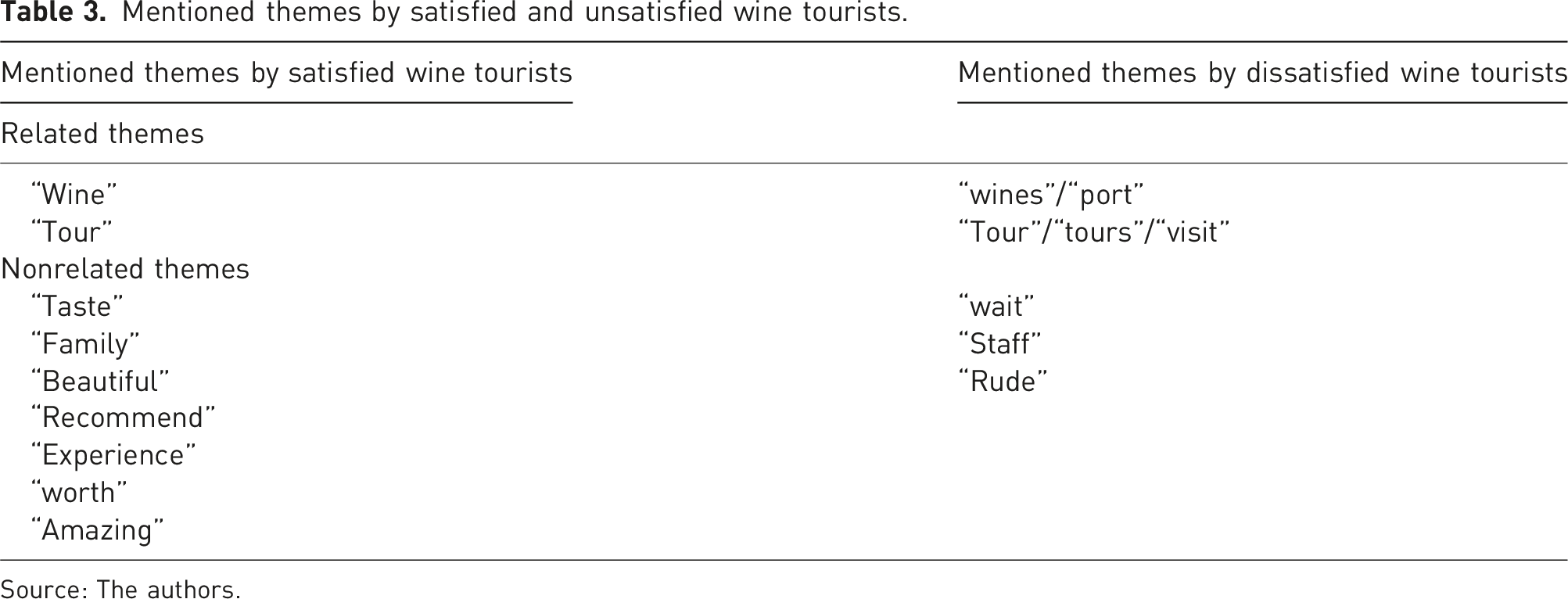
Mentioned themes by satisfied and unsatisfied wine tourists.
Source: The authors.
On the one hand, there are the hybrid attributes of service, which are recurrently highlighted in the evaluations, whether they were perceived in a positive or negative way since it is where customers put all their attention, and where they created the main expectations before the experience. Specifically for the case of wine tourism, wine and related activities such as sightseeing tours are the hybrid attributes of this segment and, for that reason, it is where customers put their focus. Thus, whether these points stand out positively or negatively, they have an influence on the level of customer satisfaction, as shown in Table 3.
On the other hand, there are dissatisfying attributes that are only highlighted when they go less well, since they are considered trivial, and therefore it would be absolutely expected that they do not raise problems and go naturally well, being points on which customers unconsciously end up not directing their attention when they go as expected. Specifically for this study, it is not expected by the customers that there are long waiting times, so in cases where the waiting time is short or moderate, this is not a point of emphasis in customer satisfaction; however, when the waiting time becomes too long, it goes against the expectation of the wine tourists, generating their dissatisfaction and becoming a point of emphasis in their post-experience evaluation. The same happens in relation to the employee’s performance since it is expected that they have a good attitude and are helpful to customers. Thus, as shown in Table 3, when employees are “rude”, impolite or unhelpful, this is a negative highlight, causing customer dissatisfaction; however, when employees are helpful, as expected, this is not a positive highlight by customers and is not often mentioned by them in their post-experience evaluations.
Finally, there are also the satisfiers elements only highlighted positively, as verified through Table 3. In this case, the wine tourists positively value the wine tastings and the beauty of the surrounding spaces to the experience, namely the producers’ family houses, referring to them whenever they exceed their expectations. However, when their perceived quality is not so high, these do not often represent a dissatisfaction factor.
Theoretical Contributions
Although not disruptive, the qualitative content analysis methodology used is relatively new and, to the best of our knowledge, had not yet been applied to studies about wine tourism units. By placing customer comments at the center of the analysis and without any influence or coding by the researcher this research followed a completely customer-centric approach validating online reviews as an important source of information (Zhang and Cole, 2016).
Studies on the impact of different factors or attributes of a product or service on satisfaction (Fuller & Matzler, 2008; Fuchs and Weiermair, 2003; Matzler and Sauerwein, 2002) reveal that understanding the concept of satisfaction in a unidimensional way may be insufficient, which was also found to be the case in wine tourism, where satisfaction and dissatisfaction are clearly determined by different factors. Thus, the two-factor theory developed by Herzberg et al., (1959) and the three-factor theory proposed by Kano (1984) were strengthened and validated in wine tourism, corroborating the study of Shin and Nicolau (2022) who recently validated these theories in the context of wineries. The validation of these theories in the wine tourism context contributes to their broader applicability and provides a theoretical framework for understanding and analyzing customer satisfaction and dissatisfaction in this specific domain.
In parallel, this research contributes to the existing literature on wine tourism by identifying determinants of satisfaction and dissatisfaction, through the main themes associated with the evaluations and ratings of the experiences that were studied, allowing researchers to identify alternative measurement tools. The findings allow researchers to identify alternative measurement tools and contribute to the existing literature on wine tourism by enhancing the understanding of customer satisfaction and dissatisfaction drivers in this domain.
In line with Brochado et al., (2021), this study further confirms that sight and taste are the most mentioned senses in wine tourists’ evaluations, with wine tasting being the central motivation and activity of wine tourism (Hall et al., 2000), reinforcing the importance of sensory experiences, in shaping wine tourists’ evaluations and overall satisfaction.
When considering the wine tourism experience a hedonic one that is guided by multiple factors, wine cellars have a responsibility not only in enhancing their own locations within wine routes but also in contributing to the attractiveness of surrounding areas and other wine destinations. This is aligned with Brandano et al., (2019), who highlight the interconnectedness of wine tourism experiences across different geographical locations emphasizing the role of wine cellars in promoting destination appeal.
Managerial Implications
Considering that managers of wine tourism units need to know well their audience for the continuous improvement of their business, this study also has practical implications and contributions that can be equally inspiring for the tourism sector in general.
Wine and related activities such as sightseeing tours are the hybrid attributes of this segment and should be understood as the critical success factors without which it will not be possible to have a lasting presence in the wine tourism market. The analysis shows that tourists who were satisfied with their visit emphasized the importance of wine tasting. Considering that high-quality wines and diverse tasting options should be offered to tourists. Wine tourism units should also develop well-structured tours that cover the history of the wineries, vineyards, and wine-making process. Visitors appreciate hedonistic experiences generated by engaging narratives and a relaxed atmosphere during the tours.
According to this study, the waiting time and the performance of the employees emerge as dissatisfiers that can easily represent a competitive disadvantage, so it is suggested that wine tourism managers should prioritize customer service training for all staff members, emphasizing the significance of positive interactions and providing a welcoming atmosphere, avoiding at all costs delays in the scheduled activities. Implementing a reservation system and managing tour timings effectively can help reduce waiting times and enhance the overall visitor experience.
The wine tasting and the beauty of the spaces surrounding the experience that emerged as satisfiers tend to have a more positive impact on the satisfaction of wine tourists, not only putting the wine tourism units in competitive parity but also representing a competitive advantage, thus suggesting that managers should invest in maintaining the spaces surrounding the visits, keeping them careful and appealing as well as an exemplary tasting process and ritual.
Satisfied tourists frequently mentioned the theme of “Recommend” in their reviews, indicating their willingness to recommend the wine tourism units to others. Managers should leverage satisfied visitors by implementing strategies to encourage positive recommendations, such as offering incentives for referrals or implementing a guest feedback program.
Managers should treat satisfaction and dissatisfaction in a way that is not completely related, realizing that actions to be taken to avoid dissatisfaction will not necessarily lead to increased satisfaction and vice versa.
Limitations and Directions for Future Research
This study presents some limitations that should be mentioned, such as the fact that the research focuses on experiences lived in wine tourism units only located in Portugal. In future studies, the analysis of visit experiences in several countries will allow a wider range of perceptions resulting from the observation of wine tourism units in countries with different cultures.
Secondly, the sample of this study is also limiting, in the sense that only the reviews written in English on TripAdvisor were analyzed, thus ignoring the experiences of wine tourists who wrote their ORs in other languages, which could provide additional insight based on associated cultural differences. This research could be a starting point for further analyses related to the consumer experience. Future research may include evaluations in more than one language, whether or not using Leximancer software, in order to understand the attributes of visit experiences sought by wine tourists from many different cultures.
Additionally, it may be interesting to further study whether the attributes that impact the satisfaction of wine tourists are maintained when changing some variables mentioned in the literature review, such as the type of wine tourists who visit - i.e., whether the experiences are experienced as a family, a couple, with friends, alone, or on business - as well as whether it is the first time in a wine tourism experience or not, or the motivation for the visit.
Footnotes
Declaration of Conflicting Interests
The author(s) declared no potential conflicts of interest with respect to the research, authorship, and/or publication of this article.
Funding
The author(s) received no financial support for the research, authorship, and/or publication of this article.
