




Abstract
Transformative tourism experiences are gaining increasing attention due to a shift in research towards longer-lasting experiences that have a greater impact on tourists' happiness. However, the existing body of knowledge on this topic remains disjointed, with different approaches appearing to be disconnected. Therefore, the purpose of this conceptual paper is to further clarify and integrate various theories and lines of research on transformative tourist experiences. It proposes a managerial approach, as an offering, within the framework of the experience economy, and a consumer approach, as an inner-oriented product, within the scope of transformation experiences theories. Although these perspectives may seem quite dissimilar, they are complementary, as inner changes in tourists must occur for any offer to be truly transformative. This paper aims to provide a more coherent and comprehensive conceptualization of transformative experiences by incorporating both managerial and consumer perspectives. It also pretends to support tourism stakeholders and destination planners in designing and developing more impactful and potentially transformative tourism experiences.
Keywords
Introduction
Research on tourism experiences has been evolving over time, starting with a focus on peak experiences (Maslow, 1964), which refer to extraordinary moments. It then move towards the study of flow experiences (Csikszentmihalyi, 1975), a state of mind where individuals are completely absorbed in an activity, and of optimal experiences (Csikszentmihalyi, 1990), characterized, as flow experiences, by a sense of control and mastery but also by a sense of meaning and purpose. Later on, research focused on the study of co-creative experiences (Prahalad and Ramaswamy, 2004) where both the provider and the consumer actively participate in shaping the experience, and memorable experiences (Kim et al., 2012), which refer to experiences that are easily remembered and recalled and may influence future travel decisions. More recently, the concept of transformative experiences (Kirillova et al., 2016; Soulard et al., 2019; Tasci and Godovykh, 2021; Teoh et al., 2021) has been gaining increasing attention (Nandasena et al., 2022; Tasci and Godovykh, 2021), considered to have a lasting impact on an individual’s attitudes, values, and behaviours.
Academics are also advocating for a shift in the focus of tourism research towards outcomes related to happiness, self-actualization, and self-fulfilment after returning home (Chhabra, 2021). They are also calling for a focus on the entire human experience of tourists (Cavender et al., 2020; Sheldon, 2020; Teoh et al., 2021) instead of mainly studying tourist experience outcomes related to travel satisfaction, behavioural intentions, and positive emotions (Chhabra, 2021; Kirillova et al., 2016).
Based on the influential work of Packer and Ballantyne (2016), two research perspectives can be distinguished: as expressed in their conceptual scheme (p. 134), the subjective lived experience is at the interplay of the experience as an offering (related to the management of environments and external elements) and the experience as a product (translated in outcomes that may be beneficial for the individual). Accordingly, transformative experiences have been studied mainly in two different lines of research: i) within the framework of the experience economy (Pine and Gilmore, 1998) from a managerial perspective (Custódio Santos et al., 2020), and ii) as subjective experiences, within the scope of transformation experiences theories, giving rise to individual benefits as a result of their consumption. Thus, despite the existent research on transformative experiences in tourism (Kirillova et al., 2016; Nandasena et al., 2022; Soulard et al., 2019; Tasci and Godovykh, 2021; Teoh et al., 2021; Zhao and Agyeiwaah, 2023), different approaches appear to remain disjointed.
As these two lines of research - transformative tourist experiences as offerings and as subjectively consumed products - need to be put together and looked at to see how they complement each other, this paper aims to propose a conceptual framework that ties together the triggers, the process, and the outcomes of transformative tourism experiences, from both the consumer and the managerial perspectives.
This conceptual paper is structured as follows. Firstly, the literature review focuses on transformative experiences from a management perspective and subsequently from a consumer perspective. After the discussion and integration of these two perspectives, a comprehensive conceptual framework is proposed and described. Finally, conclusions and implications are drawn.
The managerial perspective on transformative experiences
From the experience economy to the transformation economy
We are currently living in an era marked by experiences, where consumers are looking for a deeper and more personal engagement when purchasing a good or service – such as travel, entertainment, or leisure, during their customer journey (Lemon and Verhoef, 2016; Rather, 2019). Marketers often refer to this market trend as the “experience economy”, which Pine and Gilmore (1998) first introduced. In an increasingly competitive world, companies must seek differentiation. Before, businesses attempted to customize a service turning it into an experience; now, “customizing an experience turns it into a transformation” (Pine and Gilmore, 2000, p. 19). This new economic offer infers a change from the experience economy to the emerging transformation economy (Pine and Gilmore, 2014) and suggests a change from creating memorable experiences designed for many, to experiences that have the ability to change someone’s life (Chirakranont and Sakdiyakorn, 2022; Neuhofer et al., 2020; Soulard et al., 2019).
When a company provides exactly what an individual needs in a particular moment, that experience can automatically become transformative (Pine and Gilmore, 2014). Consequently, companies should focus on the customers and providing them greater value through memorable and transformational experiences (Coelho and Gosling, 2018; Escobar Rivera et al., 2019). As “transformations change us inside” (Pine, 2019 p. 24), when a company is focused on transformations, its offering is the person; the customer itself is the product.
In order to design innovative offerings and meaningful experiences, a three-step process was proposed by Bettencourt et al. (2022): companies must first understand what customers want to achieve; then, define success along the way through the interaction with customers; and, finally, identify and help the customers to overcome barriers, related to resources, customer readiness, and context. According to the authors, to translate that knowledge into a transformation, it is necessary to integrate solutions, engage each customer, provide customized support and, finally, charge for transformational outcomes.
The transformation economy in tourism
In tourism, which is one of the most experience-driven sectors (Binkhorst and Den Dekker, 2009), transformative experiences are playing a prominent role, taking the experience economy to the “third generation” (Kirillova et al., 2016) where a tourism experience meaningfully transforms a consumer (Boswijk et al., 2013) and promotes tourists' existential authenticity (Kirillova et al., 2016).
This third-generation experience economy (3.0) follows from two other generation experience economies: the first-generation experience economy (1.0), based on the experience economy model of Pine and Gilmore (1998) that characterised the realms of experience along a horizontal axis ranging from passive to active and a vertical axis from absorption to immersion, creating four realms of experiences, namely, education, entertainment, aesthetics, and escapism (Kirillova et al., 2016). Numerous studies have been conducted in the context of experience economy applied to the travel and tourism sector (Chan and Saikim, 2022; Zhang et al, 2021). However, this model, considered commercial and superficial (Binkhorst and Den Dekker, 2009), was mainly criticised for delivering staged experiences to tourists, with little consideration of self-creation, co-creation, and shaping of experiences by the tourists (Kirillova et al., 2017a). In the second-generation experience economy (2.0) unique and personally meaningful experiences are co-created by a firm and a consumer (Prahalad and Ramaswamy, 2004; Tussyadiah, 2014), meaning that tourists generate their own unique experiences, often using creativity and innovation (Binkhorst and Den Dekker, 2009). This implies, however, tourist providers should be receptive to new ideas, suggestions, and viewpoints proposed by tourists (Pröbstl-Haider and Lampl, 2017).
Thus, in practice, as most tourists are likely to engage in some form of staged experiences rather than co-creative or transformative experiences (Neuhofer et al., 2020), tourism stakeholders should not only incorporate the values of the three generations of the experience economy, i.e. staged experiences, co-creative experiences, and transformative experiences (Chirakranont and Sakdiyakorn, 2022) but also move beyond staged experiences, designed for many tourists, towards the promotion of the role of tourists in co-creating experiences, and the role of tourism in supporting life-changing transformation and self-actualization among tourists, intended for few tourists (Boswijk et al., 2013; Chirakranont and Sakdiyakorn, 2022; Kirillova et al., 2016; Neuhofer et al., 2020; Soulard et al., 2019).
The consumer perspective on transformative experiences
Theoretical perspectives of transformative experiences
From the consumer point of view, transformative experiences have been mainly underpinned by transformative learning theory and existential transformation theory (Zhao and Agyeiwaah, 2023). Transformative learning theory primarily focuses on changing perspectives and comprehension while existential transformation theory focuses on changes in self-identity and existence.
The transformative learning theory is one of the most widely used theories to conceptualize the transformative experience (Pung et al., 2020), and is defined as learning that alters negative frames of thought to make them more empathetic, open-minded, discriminating, and reflective (Mezirow, 2003). Originally, Mezirow (1994) developed a ten-stage transformative learning process which involves a critical examination of one’s assumptions and a shift in viewpoints. Individuals would change their beliefs and assumptions by going through a process that included a disorienting dilemma, critical self-reflection, perspective exploration, perspective transformation, conceptualization, application, internalization, and action. Among these, “disorienting dilemma”, seen as personal crises or life difficulties (Mezirow, 2000), is fundamentally important and is usually produced naturally or by invisible individual/social factors (i.e., values, beliefs). Although some authors considered the disorienting dilemma as the first step toward transformation (Coghlan and Gooch, 2011; Wolf et al. 2017), other authors suggest that it might occur at different points in time (Coghlan and Weiler, 2018; Robledo and Battle 2015; Soulard et al., 2020). In turn, critical reflection is generally seen as an essential element of the transformative process, even though there is a dispute regarding the definition and implementation of these ideas (Jones, 2015). Mezirow (1991) recognizes that there is a tendency for individuals to reject ideas that go against their worldview, making it difficult for individuals to change what they know and how they relate to others (Coghlan and Weiler, 2018). The ability to engage in reflection can be the main trigger to question their assumptions (Phillips, 2019). Mezirow’s theory has been applied in a range of disciplines (e.g., education, business, communication, and tourism) but, even though Mezirow has proposed diverse revisions over the years, there is little consensus on its operationalization (Jones, 2015).
Existential authenticity theory was proposed by Wang (1999) and considers the transformative experience through an existential lens where people transform through an epiphanic moment, characterised by deep emotions and a sense of transcendence (Kirillova et al., 2017a). Unlike transformative learning, existential transformation requires a huge revaluation of existential values, allowing the beginning of a different life direction (Kirillova et al., 2016). Peak experiences often follow challenging situations (for instance, high adventure travel, and intense exposure to natural environments) or come from deep cultural immersion and human interaction (Sheldon, 2020). They also tend to occur when consumers connect with the unexpected, with strange locations, people, and their activities” (Reisinger, 2013).
Transformative experiences in tourism
Tourists are increasingly seeking experiences that offer meaning, purpose, and personal fulfilment (Kirillova et al., 2017b; Pung et al., 2020; Sheldon, 2020) and are more open to change during their travel experiences (Fu et al., 2015; UNWTO, 2019) to cope with daily challenges and uncertainties (Soulard et al., 2020). Transformative tourism experiences are defined as travel that throws the person in a new environment that requires them to learn new skills and adapt creatively to difficult situations, which eventually modifies their previously held viewpoints, behaviours, lifestyles, and relationships with others (Phillips, 2019). Such experiences have the ability to increase customer satisfaction and create life-changing benefits for consumers (Pung et al., 2019).
Indeed, travel is considered transformative (Walker and Ngara Manyamba, 2019), especially when it allows contact with new ideas and perspectives and deepens the awareness of other people and the natural environment. Thus, what sets transformative travel apart from other types of tourism experiences is its focus on triggering attitudinal and behavioural changes in our consumption patterns and interactions with others (Smith, 2017; Wolf et al., 2017).
This growing attention has been mostly focused on conceptual nature studies (Matteucci, 2021; Pung et al., 2020; Sheldon, 2020; Soulard et al., 2019; Teoh et al., 2021; Wolf et al., 2017), as well as triggers and transformation processes studies (Kirillova et al., 2017b) facilitators and inhibitors (Pung et al., 2020), outcomes (Soulard et al., 2020), or key dimensions (Pung et al., 2020).
A growing body of literature in tourism is also being connected to transformative learning theory (Coghlan and Gooch, 2011; Coghlan and Weiler, 2018; Reisinger, 2013; Robledo and Batle, 2015; Walter, 2016; Wolf et al., 2017), and has been related to the acquisition of new knowledge, in light of challenges and the development of new skills by tourists (Pearce and Foster, 2007; Wolf et al., 2017), that produces long-term outcomes as it holds the potential to inspire and alter the tourists’ behaviour upon return home (Coghlan and Weiler, 2018; Pung and Chiappa, 2020). Examples of those outcomes could be self-fulfilling, career changes, pleasant workplace relationships, or behavioural changes towards issues associated with the social, cultural, and natural environment (Chhabra, 2021). It could also be also an opportunity to question their attitude toward tolerance, equity, and consumerism (Smith, 2017). However, according to this theory, tourists can only change their worldview if they actively examine their prejudices and reflect on their beliefs, feelings, and values (Mezirow, 2003). Otherwise, the transformative experience will fail because they refuse to question their assumptions. In turn, existential transformation has been applied to define transformative moments in the form of peak experiences (Kirillova et al., 2016, 2017a). These processes, considered separate, may or may not be present or included in a trip (Pung et al., 2019).
Furthermore, tourism has been pointed out as a significant catalyst for transformation, particularly if it occurs within the context of alternative tourism, rather than mass tourism or business tourism (Reisinger, 2013).
Indeed, previous studies have described transformative experiences and their benefits and outcomes in various types of tourism. Specifically, these studies have emerged in ecotourism/nature-based tourism (Richardson and Insch, 2021; Walter, 2016; Wielenga, 2021; Wolf et al., 2017), volunteer tourism (Coghlan and Gooch, 2011; Coghlan and Weiler, 2018; Magrizos et al., 2020), study abroad (Brown, 2009; Cavender et al., 2020; Grabowski et al., 2017; Young et al., 2017), health tourism (Dillette et al., 2019; Prayag et al., 2016; Voigt et al., 2011), independent travels (Decrop et al., 2017; Pearce and Foster, 2007), cultural tourism (Chirakranont and Sakdiyakorn, 2022; Neuhofer et al., 2020), and backpacking (Noy, 2004; Kanning, 2013).
Triggers and outcomes of transformation in tourism
Some triggers for transformational experiences have been identified in the literature, even though not all tourism experiences may lead to transformation (Brown, 2013; Pung & Del Chiappa, 2020) and not all tourists may feel the need to change (Brown, 2013).
For example, Brown (2013) reported that “exposure to a new culture” can be the trigger for transformation regarding backpacker tourists (p. 184). Within the scope of volunteer tourists, Coghlan and Weiler (2018) found that confronting suffering and overcoming adversity were triggers for cathartic voluntourism experiences. For Ulusoy (2016) six factors were identified, namely, natural community, simple enjoyment, acceptance of the other, acquiring and using skills, facing challenges, and reflecting on oneself. From the viewpoint of existential-humanistic philosophy, Kirillova et al. (2017b) listed six aspects of transformative episodes, namely timing, the valence and intensity of emotional responses, enhanced cognition, transience and demarcation, and a link to a lofty ideal. These characteristics promote transformative experiences, along with some external elements such as: nature, wildlife, culture, and meaningful networks and connections with others. However, it should be noted that the transformative potential of an experience lies in the way tourists interpret these unexpected moments instead of the nature of its triggers or environmental settings. Also, through semi-structured interviews, Pung and Del Chiappa (2020) identified facilitating transformation factors (e.g., contact between locals and tourists, experiencing a sense of location, overcoming obstacles, long stays, and reflection after travel) and transformation inhibitors factors (e.g., short stays, monotonous activities and the reduced contact to the residents' lifestyle), confirming that not all travel experiences are transformative.
According to Teoh et al. (2021), and based on a systematic review, the outcomes of transformative experiences are known as changes or gains, which can be major (profound psychological changes in beliefs and attitudes) or minor (physical body changes or skill development), varying in endurance (permanency) or transiency (durability). Those changes can also be characterised as tangible (external bodily appearance changes or skill gains) or intangible (psychological changes in beliefs or attitudes) (Fu et al., 2015).
Teoh et al. (2021) address the outcomes of transformative experiences from a psychological and physical change perspective, considered as internal personal changes, and from a knowledge and social change perspective, which have external societal implications (Teoh et al., 2021). Psychological and physical changes include self-belief and self-perspective improvement (Brown, 2009), a sense of peace, freedom, and empowerment (Yang et al., 2018) or even changes to identity (McWha et al., 2018), particularly the enduring identity which is seen as a life-changing moment that compels not only consumers to change their life priorities (Willson et al., 2013) but also to change lifestyles to support their new realisations (Lukoff, 2018). These changes also include physical change and/or skill development, such as learning to hike, snorkel, kayak, fish, or cooking (Walter, 2016). Social change, which includes developing civic attitudes, openness, altruism, friendship, trust, and cross-cultural understanding (Becker, 2018), is related to consumers' attitudes toward others and their impact on social environments while developing tolerance and open-mindedness toward others (Teoh et al., 2021). Knowledge change consists of epistemic changes that allow consumers to motivate advancement in either their own self or society (Teoh et al., 2021). Thus, through experiences, consumers can develop new knowledge regarding better lifestyles or skills (Laing and Frost, 2017).
Conceptual framework of the transformative experiences
Based on the literature review of transformative experiences, a significant number of key topics were analysed from the managerial and consumer perspective, as well as different conceptual frameworks developed in recent years (Chirakranont and Kirillova et al., 2016; Pine and Gilmore, 2011; Pung et al., 2020; Sheldon, 2020; Soulard et al., 2019; Teoh et al., 2021; Wolf et al., 2017).
For instance, based on the shift from an experience economy to a transformation economy, Pine and Gilmore (2011, 2019) developed a conceptual framework that provides an understanding of the progression of economic value proposing a new economic offer, named transformational experiences (Pine and Gilmore, 2014).
Additionally, Kirillova et al. (2016) developed a framework for transformative tourism experiences, identifying nine chronologically ordered existential themes associated with such experiences based on the principles of existential philosophy and humanistic psychology. Their findings suggest that highly meaningful tourist experiences drive a gradual process of after-trip transformations.
Wolf et al. (2017) also developed two frameworks for sustainable experience development, marketing, and monitoring in parks. One described the inter-relationships between participant and experience characteristics that trigger a transformation process as well as the experience benefits and outcomes for parks. Based on the work of Mezirow (1991) on transformative learning, this conceptual model also suggested four transformative dimensions: 1) disorienting dilemma, 2) reflection of the self, 3) overcoming by looking for new options, and 4) acquiring new knowledge, abilities, and viewpoints (Wolf et al., 2017). The other one was related to the transformative travel market niches for protected areas and synthesized the five transformative travel typologies and their associated experience which should be designed based on the participants' personal profiles, motivations, and benefits.
Soulard et al. (2019) provided a glocalization framework of strategies for transformative tourism, that may be used by tourism practitioners. Within specific objectives and presupposing that some travellers only start to face a disorienting dilemma after they return home, their framework revealed three strategies: 1) choosing collaboration over competition (community legitimacy); 2) recognising employees as agents of change, breaking down cultural barriers within the organization and increasing their consciousness of the transformative process; and 3) establish post-trip contact (stage encounters).
Based on the literature review, Pung et al. (2019) introduced a tourist transformation model, by adopting a double duo ethnographic approach in youth travel. In this model, three constructs were identified: transformative learning, existential transformation, and behavioural change, which are related to the changes in interpersonal relationships, improvements in job prospects, encouragement of pro-environmental behaviours, and impacts on society.
In turn, based on the main theories employed by existing transformative tourism research, Pung et al. (2020) concluded that liminality, problems confronted at the destination, and cultural shock (that arise from the perception of difference) initiate transformation through stimuli in the form of peak episodes (as antecedents of existential transformation), and disorienting dilemmas (as antecedents of transformative learning), including performance dilemma.
Sheldon (2020) described elements of transformative experiences and discussed tourism scenarios that encourage changing tourists' worldviews and themselves: i) profound human connectivity, particularly in cultural contexts (for example, between tourists and locals or long-term relations with employees); ii) deep environmental interconnection in natural sceneries; iii) self-inquiry, self-reflection, self-knowledge, learning and creativity; and iv) involved contribution to the destination by tourists, where experiences co-exist in two or more scenarios. According to Sheldon (2020), transformations in these scenarios, that are linked to moments of surprise, challenges, flow experiences, and mindfulness, may be temporary, demanding integration, or they may be more lasting.
After a systematic review related to transformative experiences in travel and tourism, Teoh et al. (2021) identified three dimensions: i) Experience, focused on place characteristics (landscapes, social dynamics, and properties); ii) Experience consumer, related to any person consuming a tourism experience. This dimension has three aspects: the consumers’ pre-trip factors, cognition, widely known as critical reflections in transformative learning theory (Mezirow, 1991), and emotion, referring to peak experiences); iii) Experience-facilitator, focused on experience providers and their respective facilitators. Four different outcomes were also identified to both the experience-consumer and experience-facilitator, based on the inter-relations between those dimensions: from the internal personal changes perspectives: i) psychological change; ii) physical change and from the external societal implications perspectives: iii) knowledge change; iv) social change.
Based on a case study of a small brewery in Thailand, Chirakranont and Sakdiyakorn (2022) provided a conceptual framework for meaningful tourism experiences of craft beer tourism. Their framework revealed how a combination of staged experiences, co-creative experiences, and transformative experiences, and certain pre-conditions namely motivations of the tourists and characteristics of the providers can result in a meaningful tourism experience.
Given the previous discussions and the conceptual frameworks mentioned, as well as the important work by Packer and Ballantyne (2016) and the review of relevant literature, a new conceptual framework has been developed. This framework aims to provide a better understanding of transformative experiences by identifying two lines of research: the managerial perspective and the consumer perspective. The framework, illustrated in Figure 1, highlights how the combination of these two perspectives can be complementary and lead to a more comprehensive understanding of transformative tourism experiences. Conceptual framework for transformative tourism experiences from the managerial and consumer perspective.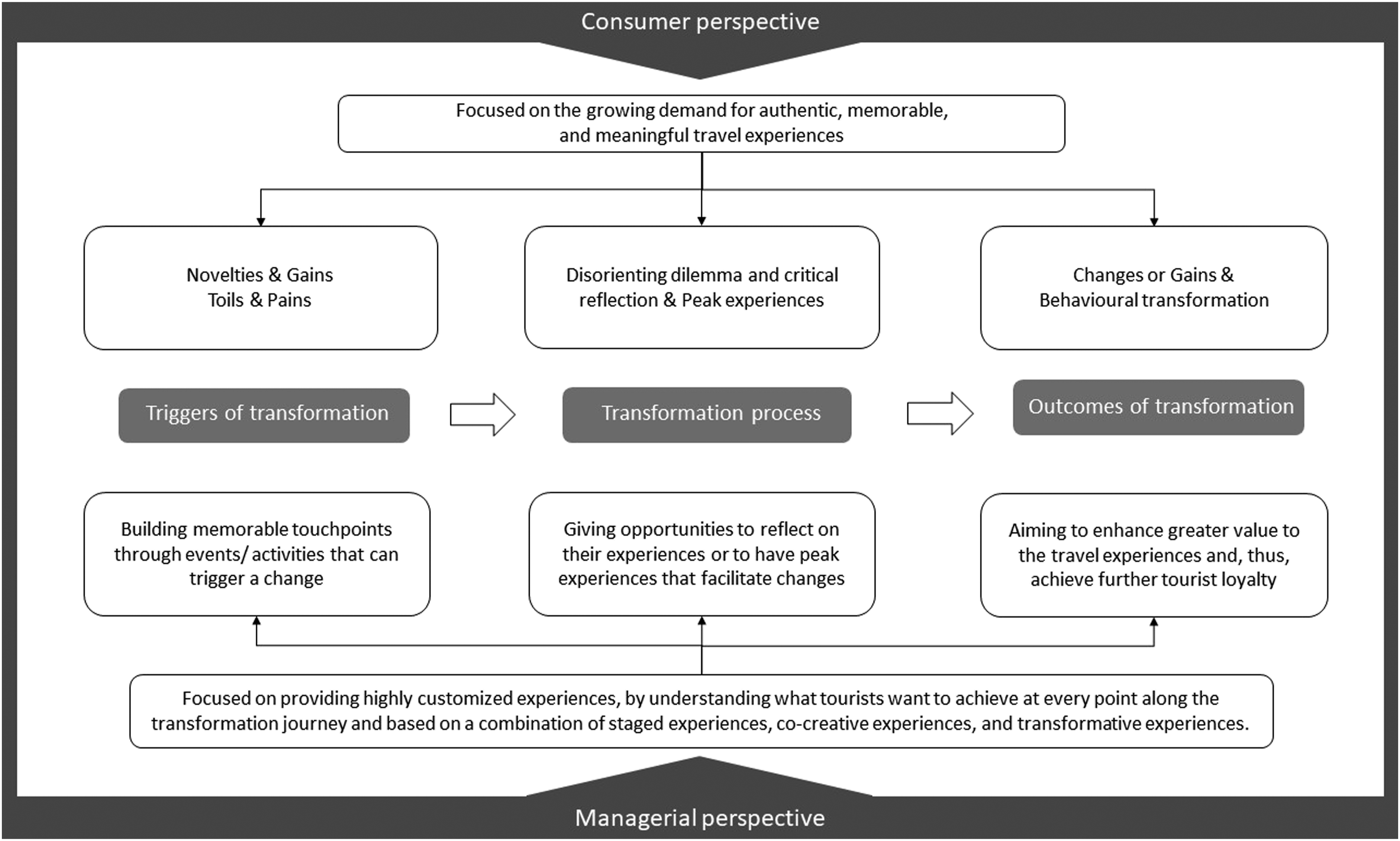
Therefore, from the consumer perspective, the last years have seen a growing demand for deeper and more meaningful experiences (Otgaar, 2012) that can be a catalyst for significant internal change (Brown, 2013; Kirillova et al., 2017b).
Thus, as an inner-oriented transformation experience, different triggers were identified in the literature, categorized into positive ones related to Novelties and Gains and negative ones in Toils and Pains (Tasci et al., 2021). For instance, the novel cultural context (Brown, 2013; Lean, 2009; Pung et al., 2020; Kirillova et al., 2016), meaningful connections to others (Kirillova et al., 2016; Pung & Del Chiappa, 2020), acquisition of new knowledge about the residents’ lifestyle (Brown, 2009), liminality (Pung et al., 2019, 2020), environmental factors (Kirillova et al., 2017a; 2017b), long stays (Pung et al., 2020) and travel reflection (Coghlan and Weiler, 2018; Fu et al., 2015; Pung et al., 2020) are considered as positive triggers, i.e, novelties and gains. Experiencing cultural shock (Lean, 2009) or challenges faced at the destination, arising from the perception of difference (Coghlan and Weiler, 2018; Pung et al., 2020), are negative triggers, i.e, toils and pains.
This transformative tourism experience may occur through a disorienting dilemma, a reflection of the self, overcoming by looking for new options, and acquiring new knowledge, abilities, and viewpoints (Wolf et al., 2017), which is related to the transformative learning theory (Mezirow, 1994; Soulard et al., 2019; Wolf et al., 2017). Alternatively, it can manifest as peak experiences (Kirillova et al., 2016; 2017a; 2017b), and is associated with the existential authenticity theory.
Related to the outcomes of transformation, known as changes or gains, four different outcomes were identified from the internal personal changes perspectives: i) psychological change; ii) physical change and from the external societal implications perspectives: iii) knowledge change; iv) social change (Teoh et al., 2021). These outcomes can be recognized immediately (in situ cognition) or may require post-experience cognition to identify impacts on tourists’ lives (Teoh et al., 2021). In turn, behavioural transformation arises as a consequence of this transformation process through the adoption of new practices namely the change of dynamics in interpersonal relationships, the improvement of job prospects, the encourage pro-environmental behaviours, and the impact on society (Pung et al., 2019).
From the managerial perspective and based on the economy of experiences and the transformation economy of Pine and Gilmore (2011, 2014, 2019), this framework reflects how tourism companies and tourism stakeholders can design and provide highly customized experiences that can be transformative for tourists.
A combination of staged experiences, co-creative experiences, and transformative experiences, designated by first, second and third generation experience economy, respectively (Kirillova et al., 2016) is proposed taking into consideration that: i) the staged experiences are characterised by a commercial set of experiences supplied by tourism providers (Binkhorst and Den Dekker, 2009), based on four realms of experience, namely, education, entertainment, aesthetics and escapism (Kirillova et al., 2016, 2017a); ii) The co-creative experiences are personally meaningful experiences co-created by tourists and tourism providers; iii) the transformative experiences presupposes a change from creating memorable experiences designed for many, to experiences that are potentially life-changing for one (Boswijk et al., 2013; Chirakranont and Sakdiyakorn, 2022; Kirillova et al., 2016; Neuhofer et al., 2020; Soulard et al., 2019).
Also, a three-step process created by Bettencourt et al. (2022) should be considered by tourist providers: i) What tourists want to achieve; ii) A way to understand and define what tourists' success looks like at every point along the transformation journey; iii) Which tourist barriers need to be identified and how to assist in overcoming them.
Furthermore, in order to provide highly customized experiences, and based on the consumer perspective, tourist providers should help tourists create memorable touchpoints through events or activities that can trigger a change. As these changes may occur through a disorienting dilemma and critical reflection (Mezirow, 1994; Soulard et al., 2019; Wolf et al., 2017) or in the form of peak experiences (Kirillova et al., 2016; 2017a; 2017b), tourist providers should also provide moments of reflection to tourists of their experiences or enable peak experiences that facilitate changes.
By offering tourists the opportunity to have a transformative travel experience that can be a catalyst for significant internal change (Brown, 2013; Kirillova et al., 2017b), tourist providers and marketers can increase tourist loyalty and enhance the competitiveness of their destination.
Discussion and conclusions
Significant paradigm shifts in consumer demands, which are increasingly driven by the need for self-fulfilment and self-actualization when selecting and consuming products and experiences, are impacting the tourism sector, challenging researchers, tourism stakeholders and marketeers not only to focus on a more holistic approach towards wellness and happiness of tourists but also to provide highly customized experiences, also known as transformative experiences, that should be more meaningful and potentially life-changing.
Furthermore, in this post-pandemic era of thinking, new forms of tourism should be fostered (Goel et al., 2021; Seabra and Bhatt, 2022) toward one that promotes happiness, sustainability, and transformational tourism (Sigala, 2020), instead of one that encourages consumerism (Sigala, 2020).
Thus, several authors have been researching transformative experiences in tourism (Chirakranont and Sakdiyakorn, 2022; Kirillova et al., 2016; Nandasena et al., 2022; Neuhofer et al., 2020; Soulard et al., 2019; Tasci and Godovykh, 2021; Teoh et al., 2021; Zhao and Agyeiwaah, 2023), however, more research and a deeper understanding of transformative experiences are still needed (Kirillova et al., 2017a; Nandasena et al., 2022), to become a competitive and sustainable advantage for destinations.
Therefore, the present study was carried out with the main goal to review the most relevant literature published in recent years regarding transformative tourist experiences, by seeking to better clarify the different lines of research that seem to remain disjointed and analyse how they may in practice be complementary.
Indeed, as has been shown in this study and based on secondary data available on a wide range of topics concerning transformative experiences, researched on Scopus, different approaches of transformative experiences were identified. On the one hand, transformative experiences have arisen within the framework of the experience economy and the transformation economy, first introduced by Pine and Gilmore, reflecting on how tourist companies, and tourism stakeholders, can design and provide highly customized experiences that can be transformative for tourists (Pine and Gilmore, 1999, 2014, 2019). On the other hand, transformative experiences have been analysed within the scope of transformation experiences theories, such as transformative learning theory or existential authenticity theory, considered to be an inner-oriented experience approach.
The various approaches of transformative experiences seem to be quite different. However, they may also be complementary since, for any offer to be transformative, within the perspective of the economy of experience, inner changes in the individuals should occur (Pine and Gilmore, 2000). Thus, experiences designed and provided by tourism managers or destination planners can act as a catalyst for transformation (Fu et al., 2015), leading to the discovery of the true “self” or personal transformation (Boswijk et al., 2013); Soulard et al. (2019); Wolf et al. (2017) or through transformative moments in the form of peak experiences (Kirillova et al., 2016, 2017a) related to the existential authenticity theory.
From the point of view of the theoretical contributions to the tourism literature, to clarify and bring deep knowledge to transformative tourist experiences, a conceptual framework based on the existing body of knowledge, was developed in the light of both approaches. It was intended, thus, to be the first study proposing a transformation experience model in its entirety and to contribute to the existing frameworks by embodying the managerial and consumer perspective and providing a more coherent and comprehensive approach to transformative tourist experiences, which remains unexplored within this area of research.
On the practical side, this conceptual framework is expected to be helpful for tourism stakeholders, and destination planners to design and develop new strategies for transformative experiences. Thus, tourism providers and destination managers have here a framework that can help them to consider both approaches when designing or providing transformative experiences. That means that, from the managerial perspective, they should focus on understanding what tourists want to achieve, which way needs to be defined to understand what tourists' success looks like at every point along the transformation journey and which tourists' barriers need to be identified and how to assist in overcoming them (Bettencourt et al., 2022), in order to provide a highly customized experience that will turn it into a transformation” (Pine and Gilmore, 2000). Furthermore, they also should focus on a combination of staged experiences, co-creative experiences, and transformative experiences (Kirillova et al., 2016). Moreover, from the consumer perspective, tourism providers, and destination managers should understand which triggers and how the transformative process could work as an inner-oriented tourist experience, to support tourists in achieving the outcomes of transformation, known as changes or gains (Teoh et al., 2021), as well as the behavioural transformation that will arise as a consequence of this transformation process, through the adoption of new practices (Pung et al., 2019). Some initiatives that can be taken include: recognising their workforces as enablers of change or establishing post-trip contact with tourists once some of them only start to face a disorienting dilemma after their home return (Soulard et al., 2019), facilitating volunteer work with a non-profit organization, promoting deep environmental connectivity in natural settings (Sheldon, 2020), providing some personal reflection or meditation moments, or even challenging tourists to engage with the local community (Lehto et al., 2020; Sheldon, 2020).
Finally, despite the findings of some authors, it is important to bear in mind that not all tourists will be permanently affected by transformative experiences, nor will all actively seek them (Voigt et al., 2011). While the outcomes of transformation can be temporarily achieved during travel, tourists may revert to their previous patterns of behaviour and beliefs upon returning home.
Nevertheless, truly transformative experiences can contribute to responsible and sustainable tourism (Nandasena et al., 2022) and promote meaningful happiness, self-actualization, and self-fulfilment for tourists (Chhabra, 2021). As such, they can provide a competitive advantage for destinations.
Limitations and suggestions for future research
This conceptual study is bound by certain limitations. First, the conceptual framework proposed is based on the two main theoretical perspectives in current research on transformative experiences, the transformative learning theory and existential transformation theory (Zhao and Agyeiwaah, 2023). However, other theories were also identified in the literature (Pung et al., 2020; Zhao and Agyeiwaah, 2023). Future conceptual frameworks may also explore those theories, enriching the comprehensive study of transformative experiences.
Second, and based on recent neuroscientific findings, techniques from neuroscience should be used in future studies to better understand the transformational tourist experiences in a more global way.
Third, this conceptual study does not specify which types of tourism are more likely to result in a transformative experience or what specific triggers and outcomes are associated with them, such as volunteer tourism, educational tourism, and ecotourism, among others (Reisinger, 2013). Thus, additional studies are needed to embrace the special features of each of them.
Finally, another limitation is related to the lack of practical validation of the conceptual framework proposed. Accordingly, further research in transformational tourism experiences should empirically explore: i) how different approaches identified in this conceptual paper can be complementary and integrated; ii) how tourism stakeholders, and destination planners may improve the design of transformative experiences and the development of new strategies to reach an increasing number of tourists; iii) how transformative experiences can address the growing search for meaningful experiences that bring authentic happiness and self-fulfilment; iv) how transformative experiences can make a valuable contribution to further responsible and sustainable tourism.
Footnotes
Declaration of conflicting interests
The author(s) declared no potential conflicts of interest with respect to the research, authorship, and/or publication of this article.
Funding
The author(s) received no financial support for the research, authorship, and/or publication of this article.
