



Abstract
Exploring the relationship between sexual harassment and service work in hospitality has long been considered a complex issue, due to the blurred and sometimes invisible line between flirting, harassment and the very nature of close contact hospitality service work. Little research has examined how mutual flirtations (when they are conducted in an appropriate manner and within safe boundaries) between customer and staff can play a positive role in the co-creation of hospitable experiences. This paper presents the findings of one theme from a wider PhD study which sought to explore the role of staff, customers and managers in the co-creation and performance of natural hospitable experiences. The focus of this paper is an exploration of the relationship between flirtatious encounters and the co-creation of hospitable experiences. In the wider study, three research phases were conducted. Semi-structured interviews were undertaken with service staff and managers from a range of hospitality servicescapes and data was gathered from customers through a number of focus groups, and the findings suggest that harmless and appropriate flirtatious encounters between customers and staff which are initiated in a natural and safe manner can have a positive influence on the co-creation of hospitable experiences.
Introduction
Academics have previously sought to explore the blurred line between sexual harassment, the nature of service work, the traditional working practices within hospitality and the amount of close customer contact prevalent in all forms of hospitality service work (Aslan, 2016; Gilbert et al., 1998; Guerrier and Adib, 2000; Lu et al., 2001; Poulston, 2008; Salvaggio et al., 2011). The social skills of emotional labour work have frequently been viewed as naturally feminine. Indeed, due to the gendered and sexualised nature of emotional and aesthetic labour, these skills are often undervalued by men (Nickson, 2009). Warhurst and Nickson (2009) suggest that the level of current empirical research in this area still remains sparse and thereby warrants further research and analysis. Furthermore, it has been observed that service staff are the ones deemed particularly vulnerable to sexual harassment in the workplace as they are often encouraged to ‘sell the service’ through covert flirting (Lu et al., 2001). This flirting is often seen to blur the line between work and social interaction. (Lu et al., 2001). This blurred and sometimes invisible line between flirting and service work adds to the complex nature of the two-fold relationship between service work and harassment in the hospitality servicescape (Gilbert et al., 1998). Despite this, no research has examined how natural harmless flirtations between customer and staff can play a positive role in the co-creation of hospitable experiences.
In order to provide clarification at the outset, the author offers some definitions and context for a number of key terms used in this paper. Naturalness is defined as, ‘the quality of being real and not influenced by other people’ (Cambridge Dictionary, 2021, online), and further defined as, ‘the quality or state of being natural, and in accordance with the nature of the surrounding circumstances’ (Lexico Dictionary, 2021, online). Throughout this paper, the author will apply these dictionary definitions in order to contextualise naturalness to the hospitable experience. Hospitableness is the quality or state of being hospitable alongside the willingness to be hospitable for its own sake, without any expectation of recompense or reciprocity (Heal, 1990; Telfer, 1995, 1996; Derrida, 2000; Hemmington, 2007; Lashley, 2007, 2014; O’Gorman, 2007; Ariffin, 2013; Lugosi, 2014; Tasci et al., 2016; Lynch, 2017; Pijls et al., 2017; Filimoanu and Brown, 2018). Co-creation is seen by an initiative, or form of strategy, that brings different parties together (in this instance – staff, customers and managers of hospitality servicescapes), in order to jointly produce a hospitable experience (Marques et al., 2015; Chathoth et al., 2016; Dimitrios and Yeyen, 2019; Kim et al., 2019; Lin et al., 2019; Shulgar and Busser, 2020).
The wider study comprised a number of phases of data collection. Phase one consisted of eleven semi-structured interviews with a sample of service staff from different hospitality servicescapes. Phase two consisted of five aged based customer focus groups and the third phase consisted of five semi-structured interviews with managers of the same hospitality servicescapes used in phase one. This paper focuses on one theme that emerged from the qualitative data gathered across these phases.
This paper therefore presents one set of findings from a wider PhD study which sought to explore the role of staff, customers and managers in the co-creation and performance of natural hospitable experiences, namely, an exploration of the relationship between flirtatious encounters and the co-creation of hospitable experiences. In exploring this complex relationship, it is hoped that this paper will add to the existing body of literature which seeks to explore the blurred line between sexual harassment, the nature of service work, the traditional working practices within hospitality and the amount of close customer contact prevalent in all forms of hospitality service work. The paper therefore attempts to address the gap in exploring how mutual appropriate flirtations between customers and staff can play a positive role in the co-creation of hospitable experiences.
Review of literature
A wealth of evidence attests the absence of a broad feminist perspective on hospitality seems a curious oversight given that many ‘host-guest’ relationships are overlain by the social relations of gender (Adkins, 1995; Aitchinson, 1999; Darke and Gurney, 2000; McIntosh, 1996). Adkins (1995) focused on the gendering of the then contemporary labour market in the mid-1990s and found that in order to get a job, most women (regardless of occupation) were required to fulfil conditions which related to the production of an ‘attractive’ female work-force, which included expecting and dealing with forms of ‘sexual objectification from men customers and men co-workers’ (Adkins 1995:145). To be workers, it was found that women had to be ‘attractive’ and carry out forms of sexualised work, whereas men did not have to do this. Women not only had to take orders, serve food and drinks and clear tables, they also had to provide what Adkins (1995) sees as ‘sexual services’ for men, both customers and co-workers. The research of McIntosh (1996) demonstrated that hospitality roles have traditionally been assigned to the ‘feminine’ roles of nurturing and caring.
Fischer et al. (1997) undertook research in which they described two possible gender-related expectations or stereotypes in the customer service setting. The first they classified as “a stereotype as to what the sex of the service provider will be and ‘should’ be in certain service environments” (p.363); this was defined as a ‘server gender stereotype’. The second is a stereotype that ‘women expect to receive better service from women and men from men’ (p. 363) and was termed as ‘in-group bias’. Further studies reveal that employment within the hospitality industry is synonymous with a lower quality of employment opportunities comparable with other industries (García-Pozo et al., 2012; Lacher and Oh, 2012). This is partly due to a mix of lower salaries together with more part-time, flexible, temporary, seasonal work (Blake et al., 2008; Lacher and Oh, 2012). Some authors (e.g. Santero-Sanchez et al., 2015) argue that this associated low job quality is due to gender differences in employment patterns within the hospitality and tourism industry. Although women’s participation in both the tourism and hospitality industry has improved, arguably women continue to encounter barriers and discrimination in these industries due to their gender (Ramos et al., 2002). Furthermore, whilst it can be argued that women’s rate of participation is growing, their working conditions (with regard to pay, conditions, hours, part-time work and discrimination) are far less favourable than their male colleagues (Segovia-Perez and Figueroa-Domecq, 2014 cited by Santero-Sanchez et al., 2015).
Research conducted by Santero-Sanchez et al. (2015) found that female hospitality employees held lower quality jobs than their male colleagues. Furthermore, they discovered that women experienced a lower job quality in management positions and a wider job quality gap than in traditionally associated ‘feminised, lower skilled positions’ (Santero-Sanchez et al., 2015: 234) such as kitchen staff, waitressing and room service staff. Their findings also reveal that although women are well positioned in the hospitality industry in their early years, it is by no means guaranteed that women will achieve labour market equality with their male colleagues. More recent research carried out by Liu et al. (2017) concurs with the findings of Santero-Sanchez et al. (2015) and indicate that pressure and stress arising from managing a work/life balance and family/work conflict for female restaurant employees leads to a ‘low self-efficacy’ (Liu et al., 2017: 633) emphasising the significance of self-efficacy for women employed in the restaurant sector.
Fischer et al.’s (1997) research specifically focused on whether the gender of the service provider should be counted as an element of the ‘servicescape’. The findings are interesting from a customer perspective insofar that male customers perceived male waiters to provide high quality service and similarly, female customers perceived female waitresses to provide high quality service. Throughout the study of Fischer et al. (1997), server stereotypes were found to consistently interact with the sex of the server and/or customer, thereby affecting the experience and consistency of service quality from both genders.
It has been observed that waitresses are the ones deemed particularly vulnerable to sexual harassment in the workplace as they are often encouraged to ‘sell the service’ through covert flirting (Lu et al., 2001). This flirting is often seen to blur the line between work and social interaction, which has the double-edged sword of making the monitoring and reporting of this harassment much more problematic (Lu et al., 2001). The combined issues of age and gender, coupled with the blurred and sometimes invisible line between flirting and service work, add to the complex nature of the two-fold relationship between service work and harassment in the tourism and hospitality servicescape (Gilbert et al., 1998).
Poulston (2008) explored this idea of ‘harassment’ in the hospitality servicescape by seeking to examine the widespread practice of harassment in the hospitality workplace in order to understand its root causes. Her findings revealed some interesting reflections on the nature of service work, the traditional working practices within hospitality and the amount of close customer contact prevalent in all forms of hospitality service work. Salvaggio et al. (2011) sought to investigate any associated relationship between observing sexual behaviour at work (in the form of flirting, joking and banter) and the employees’ job satisfaction and impact on turnover. The authors argued this was the first piece of research ever conducted which aimed to explicitly link sexual behaviour in the workplace with job satisfaction levels. The findings were interesting as they revealed that the workers who frequently observed more sexual behaviour at work reported overall lower job satisfaction levels. The authors offered recommendations to the industry about the risk of such sexual behaviour and the impact of flirting between staff ‘on formulating policies regarding sexual behaviour at work to guide mangers in handling potentially difficult situations’ (Salvaggio et al., 2011: 604). The authors state that the results of this research ‘add to the growing scientific literature that questions the independence of our sexual and professional lives’ (Salvaggio et al., 2011: 617). Their work adds to the voice of Nickson (2009) who argued that emotional and aesthetic labour are both gendered and often sexualised forms of labour. The work of Salvaggio et al. (2011) adds an additional unique contribution to the existing body of academic literature as it looks at sexual behaviour and flirting at work between co-worker and co-worker, and not between staff and customers. This paper aims to fill this gap in the literature by building on the existing work of Salvaggio et al. (2011) which looked at flirting only between co-workers, by exploring flirtatious encounters between staff and customers which help aid the mutual co-creation of hospitable experiences.
Aslan (2016) study aimed to examine levels of sexual intimacy between male hotel workers and female tourists, whereby they make the distinction ‘between “playful” and “non-playful” service interactions’ (Aslan, 2016:107). Hospitality interactions between staff and customers have previously been classified as playful and non-playful (Guerrier and Adib, 2000). The findings of Aslan (2016) further indicate that ‘playful’ service encounters allow for a degree of spontaneity in interactions between workers and tourists, in stark contrast to scripted interactions which allow no form of spontaneity or interaction to naturally occur. The research of Aslan (2016) makes links between the level of the prescribed or less prescribed scripting of hospitable experiences and the associated flirting and levels of sexual interaction appropriate between staff and guest; ‘…sexual humour was part of the work of all Food and Beverage workers…the difference depends on the nature of service interaction’ (Aslan, 2016: 114). The research found that ‘playful’ service interactions enabled, and indeed encouraged, workers and tourists to build a level of consensual sexual intimacy as part of the co-creation of hospitable experiences.
Luoh and Tsaur (2009) research was concerned with perceived stereotypes of physical attractiveness in waiting staff, and it was found that the major concerns of hiring waiting staff were enthusiasm, smile, good looks and friendliness (Luoh and Tsaur, 2009). Koernig (2000) previously indicated that the physical attractiveness of an employee has a significant impact upon consumers’ attitudes and intended behaviours towards both the service and the service provider.
Furthermore, it has been argued that the concept of sexuality has traditionally received very little attention in hospitality research and literature with regard to the discussion on the nature of sexualised labour prevalent in hospitality service work (Laffin, 1999; Lugosi, 2007a, 2007b; Markwell and Waitt, 2009; Vorobjovas-Pinta, 2018; Vorobjovas-Pinta and Dalla-Fontana, 2019; Ong et al., 2020). The research of Laffin (1999) indicated many ways in which openly gay staff had experienced forms of sexuality discrimination and homophobia, both in their working lives in the industry and also in their experience as consumers of the industry. Examples of discrimination that were cited included being passed over for promotion, impact of legislation, discrimination and treatment from guests and also their experience of being discriminated against as gay consumers in hotels. An interesting revelation in the study of Laffin (1999) revealed the extent to which gay men discriminate (albeit consciously or subconsciously) against other gay men in the workplace. This research has important implications for the ways in which gay men working in the hospitality service roles might supress their natural desire to engage in flirtatious encounters and co-create experiences for the fear of any discriminatory backlash they might encounter from either their fellow workers, customers or their managers.
Lugosi (2007a) carried out research which examined the role of ‘queer’ customers in the co-creation of hospitable experiences. Drawing on a study of ‘queer consumers’ – that is, lesbian, gay, bisexual and transgender individuals (Lugosi, 2007a: 227), he considered the ways in which frequently circulated understandings, or myths, shaped consumers’ actions. Lugosi (2009) further clarifies how hospitable spaces are used as ‘space’ in which to produce and co-create hospitality and hospitable experiences. Furthermore, Ineson et al. (2013) conducted research with hospitality management students immediately following their 12-month internship examined issues which led both to sexual discrimination and sexual harassment encountered during their time on internships in the hospitality industry. During the interviews, the researchers identified eight officially reported incidents of homophobic harassment. These incidents included a gay employee being referred to as a ‘gay twat’ (Ineson et al., 2013: 5) for delivering an incorrect drink order to a male customer. A further homophobic incident was recalled involving very personal inappropriate comments made by a restaurant manager about a gay employee, with regard to the way he spoke and dressed. The research of Ineson et al. (2013) found that such behaviour of discrimination and harassment was a regular occurrence for not only gay male and female workers, but also for their heterosexual female colleagues. This is an example of how flirtation is not always harmless, and how the fine line between harmless flirtatious encounters and harassment needs to be treaded carefully.
The paper aims to fill the gap in the academic literature which has been discussed regarding the blurred line between sexual harassment, the nature of service work, the traditional working practices within hospitality and the amount of close customer contact prevalent in all forms of hospitality service work. It is evident that this blurred and sometimes invisible line between flirting and service work adds to the complex nature of the two-fold relationship between service work and harassment in the hospitality servicescape This paper builds on the existing work which looked at flirting only between co-workers, by exploring how mutual flirtatious encounters between staff and customers can play a positive role in the mutual co-creation of hospitable experiences.
Research methodology
Denzin and Lincoln (2005) identified that the researcher is inevitably influenced by a set of personal beliefs and values. They argue that for the qualitative researcher, these personal beliefs and values hugely influence both the research approach and position of that research. It has been as suggested that is as important to the work of the qualitative researcher as their epistemology, methodology or analysis (Denzin and Lincoln, 2005; Finn et al., 2000; Jordan and Gibson, 2004). In addition, some authors go so far as to suggest that it is the researcher’s understanding of themselves and their ‘self’ with the research that directs the position and direction of the overall research process (Hertz, 1997).
Positionality
In qualitative research, it is well documented that the researcher as a human being is a key instrument in the research (Reinharz, 1997; Patton, 2015). Furthermore, some authors have stated that understanding the positionality of the researcher is key to understanding the research (Ateljevic et al., 2005; Tribe, 2005). It Is important at this juncture of the paper that I aim to tell my ‘story’ and provide the context for the positionality of myself as researcher in order to give some context of my story to the wider research story.
From an early age, I have always had a love of the theatre and arts and all things dramatic. My love and appreciation for performing continued when I went to University for the first time to study Education, when I joined the student drama society. My time at University was a formative time in so many ways, none less so than it allowed me to explore who I was when coming to terms with my sexual orientation and identity as a gay man. I began to take an active role in the student LGBT network, and it was here that my previously conflicting identities were coming together and connections made when reconciling my sexuality with my spirituality.
I then decided to pursue studies in Theology, during which time my theological studies reawakened within myself an appreciation of the impact of my own spirituality and Christian faith on my understanding of hospitality. I began to understand how my own personal belief system and moral compass impacts my understanding of hospitality as ‘welcome’, and how this frames my own experience as being ‘Host’ and offering welcome to those I perceive as ‘Guest’. My theological studies were a seminal time in forming my ‘theology of hospitality’. a framework I continue to apply and a lens I continue to wear which impacts how I perceive the role and function of hospitality and natural hospitableness. My previously conflicting identities as an academic, a theologian, a Christian, an actor and a gay man were now forming a complementary rather than divisive part of my identity.
I later embarked upon the beginning of the journey which led me to where I am today. I enrolled on a 4-year sandwich degree in Hospitality Management (as a very mature student). During my sandwich year, I worked as Duty Manager at a Boutique Spa Hotel. Upon graduation, I embarked upon the start of a PhD journey and began some part time teaching which led to full time teaching. This time was truly a personal time of consolidation and development, as my identities and life stories came together and found themselves a natural home in the person I am today.
As a result of telling the story of my own life journey, I hope that the reader of this paper will thus appreciate the lens(es) which I wear to view the world as these experiences have inevitably helped shape the way I view not only hospitality, but the wider social world(s) of which I am a part. I wear the lenses of a gay man, a teacher, a former hospitality manager, a theologian, an academic and an actor. It is these lenses that I sometimes wear separately, and sometimes concurrently, that impact my view of the social world. In the words of Denzin and Lincoln (2005: 21), this ‘personal biography’ inevitably shapes the way in which I conduct research and position myself as part of the social world to be examined, none less so than when exploring the role of flirtatious encounters in hospitable experiences.
Because of these lens(es) I wear and the impact they have on both this research and the way I see hospitality, I cannot stand back and write this paper in the third person. Therefore, I write this paper in the first person as this research, my story and my lens(es) are intrinsically linked.
Three phases of research
The qualitative data was gathered as part of a wider PhD study which comprised of three phases. Phase one consisted of semi-structured interviews with a sample of service staff from a range of differing hospitality servicescapes. The following table clarifies in more detail the nature of the chosen servicescapes, sampling choices and coding of participants for the first phase of research:
Phase one staff interview sample
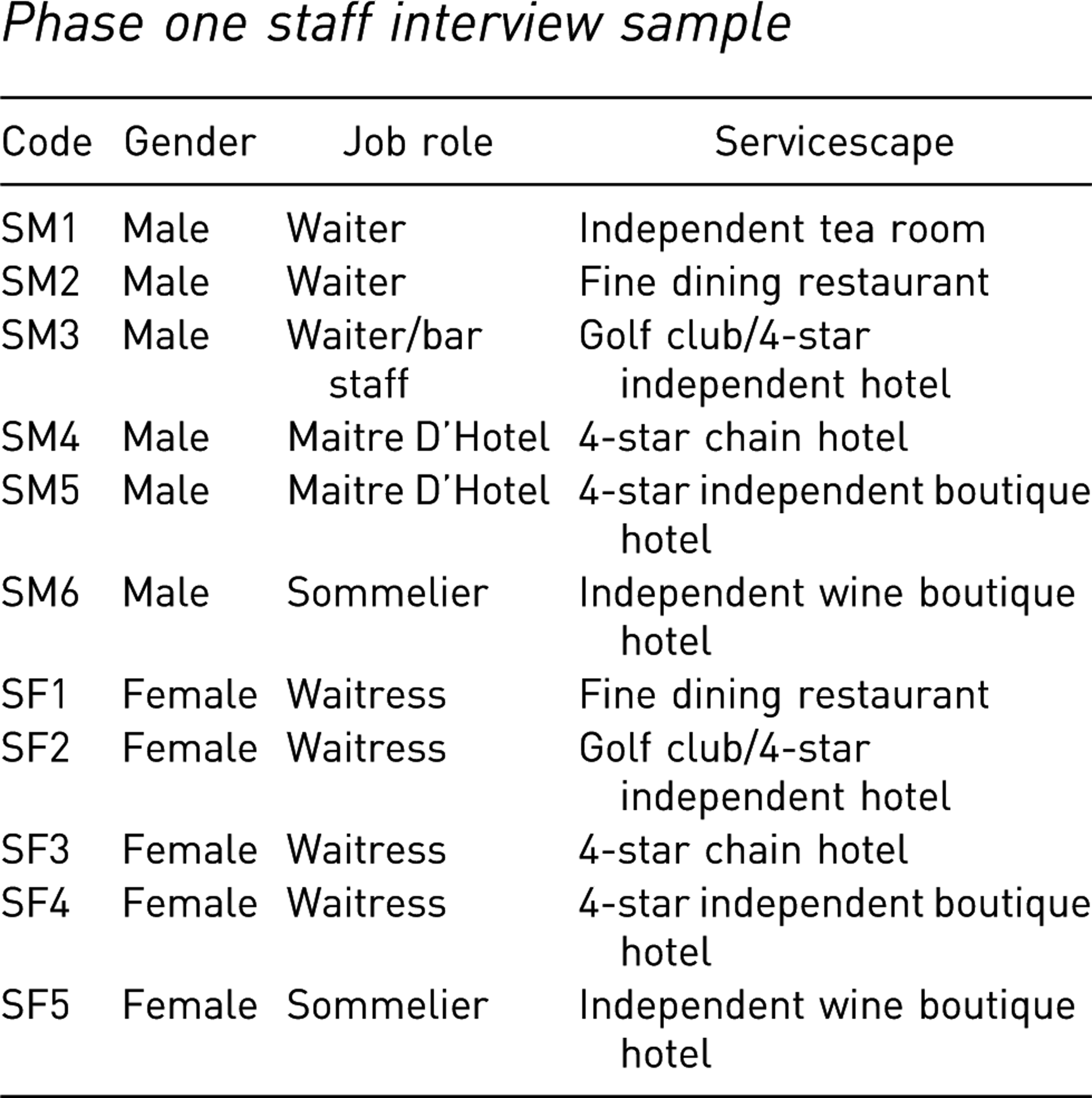
During phase one with service staff, the staff were asked the questions which are presented in Appendix 1.
Phase two consisted of five aged based customer focus groups. Research has shown (Meiselmann, 2006; Ritchie, 2009) that focus groups are most successful when they replicate a natural phenomenon. Since most people eat out with others, discussions concerned with the eating experience with others can be seen as the best way to replicate (as far as possible) and so stimulate an accurate recall of meal experiences, particularly from the customer perspective. Taking this multitude of qualitative literature into consideration, pragmatic limitations of time and resources meant that focus groups were an ideal research method tool for fulfilling the aim and objectives of this research. Focus groups can collect data from a group of people more quickly and at less cost than would be the case if each individual were interviewed separately (Stewart et al., 2009).
The following table clarifies in more detail the coding of participants for the second phase of research:
Phase two customer focus group sample
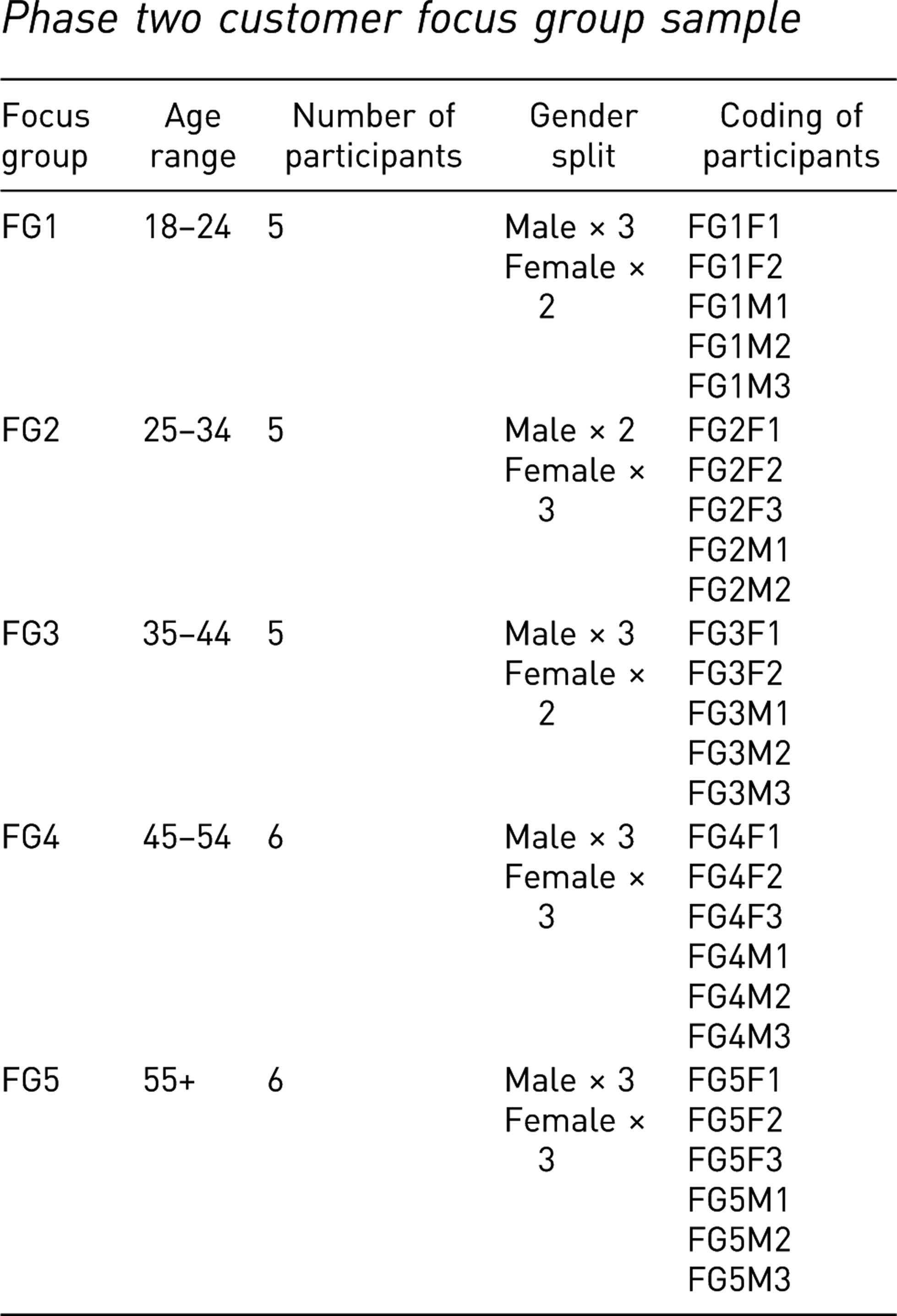
During phase two with customers, the customers were asked the questions which are presented in Appendix 2.
Phase three consisted of semi-structured interviews with managers of the same hospitality servicescapes used in phase one. The rationale for this was that comparisons could be made between the views of the operative staff and managers in the same servicescape. However, some practical and pragmatic issues arose regarding the long timescales involved in this research. Thirty months elapsed between the end of the data collection of phase one and the beginning of the data collection of phase three. In the light of this timescale and the inevitable turnover of staff contacts and networks established in phase one, sampling choices had to be made for the semi-structured interviews with managers. Whilst it was possible to return to a number of the same servicescapes from phase one, where this was no longer possible, new contacts were made in similar servicescapes to those in phase one and managers interviewed.
The following table clarifies in more detail the nature of the chosen case study servicescapes which mirrored the first phase of research, the sampling choices and the coding of participants for this final phase of research:
Phase three manager interview sample
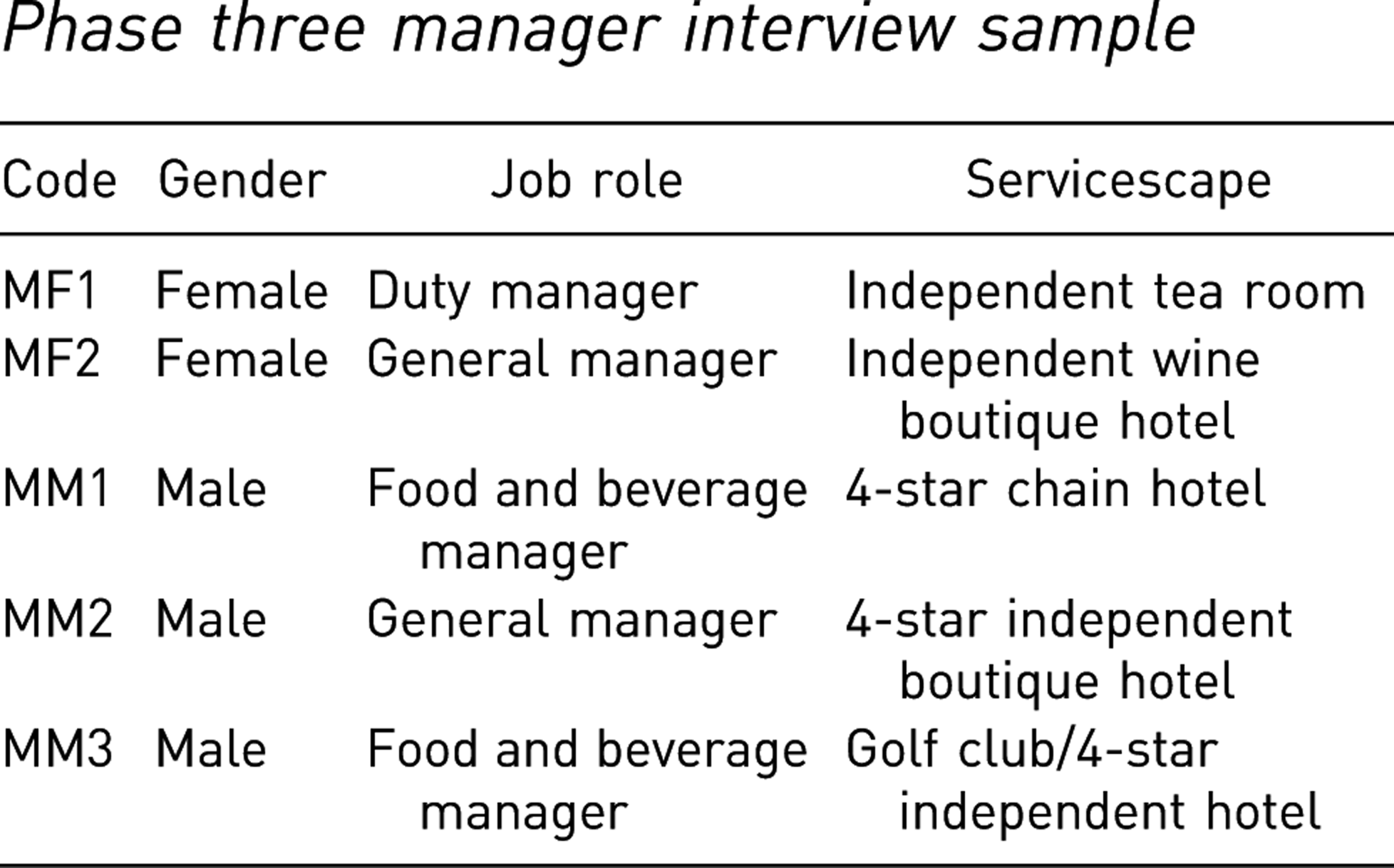
During this third phase, the managers were asked the questions which are presented in Appendix 3.
These research phases consisted of a total of sixteen semi-structured interviews and five focus groups of six to eight people. Thematic analysis is a widely used approach to analysing qualitative data. Patton (2015) proposes that the thematic analysis of transcribed material follows an inductive approach, where themes are strongly linked to the research material which is collected and then analysed. During this analysis process, key words, themes, concepts, phrases, sentences, language and terminologies were identified. Following the identification of the main themes, these themes were then listed separately in order to begin identifying and analysing the sub-themes which emerged from the key themes as a result of the topics and questions for each phase which have been outlined above. It was at this stage of the identification of the sub-themes that it began to become clear that the interplay between flirtation, service work and the co-creation of hospitable experiences was first delineated.
Findings and discussion
As previously discussed, the academic literature pays particular attention to the blurred/confused line between sexual harassment, the nature of service work, the traditional working practices within hospitality and the amount of close customer contact prevalent in all forms of hospitality service work (Aslan, 2016; Gilbert et al., 1998; Guerrier and Adib, 2000; Lu et al., 2001; Poulston, 2008; Salvaggio et al., 2011). Despite this, little research has examined how mutual and appropriate flirtations between customer and staff can play a positive role in the co-creation of hospitable experiences.
A female staff interviewee stated categorically that she never has, and never would, flirt with a customer. Another male staff interviewee reflected on how his experience of flirtation in service encounters has always been initiated from the customer. This issue was later expanded upon by another female staff interviewee, ‘…there’s a very fine line.....between a little bit of banter and a little bit of back-and-forth…I don’t flirt with customers; I’ll have a bit of banter if they want to’ (SF3).
The role that the customer plays in the co-creation and mutual flirtations as part of the hospitable experience was discussed in a number of customer focus groups, ‘I think the customer is more likely to do it with the waitress or the waiter rather than the other way round’ (FG2F3). This was later supported by another customer participant who commented thus, ‘but you flirting with them is different from them flirting with you’ (FG4M2). This finding is an interesting angle from a customer comment on the co-creation of the hospitable experience from a customer perspective. This element of the co-creation of the flirtatious experience from a customer perspective or mutually between customer and staff was commented on by a number of participants in FG1 as they reflected collectively on a recent shared dining experience: “When we were at X we had a waiter......we had a joke with him but he took it too far, and because we flirted with him slightly, I think he got embarrassed at first........ there were so many girls......we realised he was younger and he was interacting with the flirtiness, so he thought he’d see if he could get one of our numbers..at the same time we were definitely egging it all on, I feel if you want to be flirty, you need to have the customer who wants to be flirted with” (FG1F2)
The implication of these results from a customer perspective suggests that it is the customer who has to initiate the flirting – the customer takes the flirting initiative and the server follows.
In one staff interview, a male waiter was reflecting on the impact of the demographic of his servicescape on his flirting, ‘I guess here I can get away with a lot. We have a lot of old ladies in here due to the demographic and I get away with a lot’ (SM1). SM1 also commented on the impact of his flirting on the service he provides to his older female demographic: “I was just recalling how one of my team members gave me a new perspective on flirting recently .... we do get a lot of older demographic coming in - old ladies who come for afternoon tea.....I was joking with this group of ladies and I guess I was camping it up a bit and laughing and flirting and being generally camp and I wandered back over and one of my team said to me ‘You’re like cat nip to old people’” (SM1)
This result adds an interesting perspective to the discussion on the role and impact that the gender, sexuality and age of the server has on the co-creation of the flirtatious experience. The combined elements of the servicescape, the demographic of ‘old ladies’, and the sexuality and age of the server suggest a safe environment in which to flirt and thereby enable the mutual co-creation of the hospitable experience.
This adds an interesting perspective to the discussion on the co-creation of the flirtatious experience, despite its potential limitation of being one single example of old ladies being flirted explicitly with by an openly gay waiter. It was evident that the older ladies found the openly gay waiter to be a safe and non-threatening person to flirt with. The waiter is allowed to be who he naturally is. Furthermore, the naturalness of the expression of his sexuality together with the naturalness of his flirtatious encounter combined positively in this instance in the co-creation of a natural hospitable experience. However, this contested subject area needs further research and clarification regarding the mutual flirtations between staff and different customer demographics in a number of differing hospitality settings in order to clarify both the appropriateness and safety of flirtations as part of the co-creation of natural hospitable experiences, as opposed to a hospitable experience.
One female customer participant reflected on her experience of working with male and female colleagues and how she perceived the waiting staff to see flirting as part of the hospitable experience. This finding builds on the earlier work of Lu et al. (2001) who found that waiting staff often used flirting as part of the overall hospitable experience. A male customer participant, who self-identified as openly gay, provided an interesting angle on the customers’ perception of his sexuality and the impact this has on the experience, ‘......a person would have a different perception if they knew what type of waiter they were getting. If they thought in their mind that they were getting ‘a gay waiter’ they would have these instant thoughts of what this person would be like; which is wrong, but it could happen’ (FG1M3). This is an interesting comment about what might happen and needs to be linked to actual experiences (in the research of Laffin (1999), for example) of when such stereotyping has occurred or may occur in these settings in order to be consolidate how this flirtatious encounter and possible stereotyping or discrimination of staff might impact the co-creation of hospitable experiences.
The impact that the gender of the server has on their intentions to flirt with customers was commented upon by one female customer in FG1 who stated, ‘I think it’s a real shame to say this, but there is a massive stereotype that on the flirting thing a guy is much more likely to take it a bit too far, as opposed to a girl having a flirt kind of thing’ (FG1F1). The relationship between repeat customers and the flirtatious experience was also reflected upon by a female customer focus group participant, ‘I think if you get regular customers too, they’re more inclined to flirt......I’ve seen it when you go to a restaurant and serve a group of older women and it’s someone’s birthday or a hen party and they’ve got a really good-looking waiter and you always see them flirting with the waiter, because they’re being cheeky to him’ (FG2F1).
A recurring theme which echoed throughout each of the customer focus groups was the relationship between fellow dining companions and flirtatious encounters with a server. ‘I think it’s perhaps who you’re with. If you’re with a boyfriend, people generally don’t. But if you’re with a big group of girls or something and there are male waiters, then I think they’d be more inclined to flirt with you’ (FG2F2). FG2F1 went on to say, ‘...if you’re with your family or something, it feels really inappropriate or if you’re with a group of girls or a load of mates it just feels a bit less dodgy’ (FG2F1). This builds on earlier findings regarding the importance of creating a safe environment for flirtatious encounters to aid the co-creation of the hospitable experiences.
In a staff interview, a female server reflected on her experiences when she worked a shift together with her boyfriend in the same servicescape. This provided a unique perspective on the relationship between servers as boyfriend and girlfriend and the way in which this relationship may impact upon the level of service provided. She confessed that, ‘I think I’d naturally, if a table of women came in, try to have X (her boyfriend) perhaps more involved with them. And I’d take more responsibility if a table of golfers came in – men, especially if they were older’ (SF2). These results build on the previous work of Salvaggio et al. (2011) which looked at flirting between co-workers, and this finding again indicates the safety in the age difference between customer/server as being important to note in co-creation of hospitable experiences.
One female server discussed very honestly the fine balance between flirting and sexual harassment at work in her recollection of a particularly awkward service encounter between her and a male customer, during which the customer offered her his room key in a misunderstanding between the two. ‘....at the end of the day, part of what I’m being paid to do is interact with customers.’ But there is a very, very fine line and sometimes it’s not the girls who work here who cross the line, it’s the people who stay here or the people who are in the pub or whatever, it’s they who cross the line because they think they can get away with it’ (SF3). This supports the previous work of Lu et al. (2001) and Poulston (2008) which explored the blurred lines between flirting, service work and sexual harassment and is a somewhat extreme, yet illuminating, example of the impact that differing tolerance levels of both staff and customers may bring to the hospitable experience. This again highlights an occasion where the customer initiated the flirting, albeit to an inappropriate level in this context, and provides some insight regarding the importance of the mutuality of flirtatious encounters between customers and staff for the co-creation of a natural hospitable experience.
Parallels were drawn in some of the staff interviews regarding the connection between a server naturally possessing the skills and traits necessary to be hospitable, and the servers’ natural ability to be flirtatious. These results provide some interesting insights for Industry practice and highlight a suggested link between those who are natural hosts and those who are also natural flirts, and how these naturally flirtatious encounters contribute to the co-creation of the hospitable experience. One staff interviewee succinctly summed this up by stating, ‘It’s charm... I think they’re “
In the final phase of primary research, the managers were asked to reflect on the role and position, if any, that flirtations at work between their staff and customers plays in both the co-creation of hospitable experiences. This view of the co-creation of the flirtatious hospitable experience was summed up by MF1 who said, ‘I think the whole flirting thing comes with people being confident and just enjoying conversation’ (MF1). These findings highlight the importance of naturalness and suggest that those who possess natural confidence and natural enjoyment in whatever environment they are in become the natural hosts who have empathy and are also able to demonstrate natural flirtation and natural hospitableness concurrently.
MM2 reflected on how he changes his level of flirting dependent upon the level of chemistry evident between staff and customer when co-creating the hospitable experience, ‘...you have to put a blob in depending on what the chemistry is, so if there are two old ladies, you’re going to flirt with them, make them feel like they’re 21’ (MM2). He went on to describe his ‘unnatural’ (MM2) attempts at flirting and the techniques he employs when attempting to flirt with customers, ‘...maybe a wink, a smile or whatever, I’m laughing, so it’s kind of a deadpan smiley kind of’ (MM2). One manager was reflecting on the change in his confidence levels as a result of promotion from operative staff to a managerial position, and the associated link that this change in status has had on his performance levels, ‘....now it’s just something I enjoy, getting that rapport’ (MM3). These findings challenge the existing academic literature on naturalness by proposing that this is not something which is natural, but instead is something which has changed as a result of time and experience.
Discussions took place in the staff interviewees regarding the extent to which servers consciously or indeed sub-consciously flirted in order to receive bigger tips from their customers. This topic provides a pertinent contribution to the discussions on co-creating the flirtatious experience between server and customer, and the degree to which servers ‘perform’ their flirtations in order to receive greater tips. In the words of SF1: “I personally always feel if you’re nice to me and pleasant to me as a customer, I’m really going to be nice and pleasant to you as a waitress.........I’m really not doing it for your money because you’re already paying for your food, you’re already paying for you drinks, you are here to have a nice experience and I’m here to give you that. If you leave a tip for me, that’s a nice touch for me, and actually you are complimenting my service” (SF1)
She went on to explain, ‘.......as long as I’m happy and pleased with myself in the way I was and I did the job, that’s all that counts and I don’t think it’s all down to tips, because recently I received two or three compliments and obviously I don’t remember how much tip they left’ (SF1). She concluded her comments on flirting and tipping thus, ‘......it’s nothing to do with money. But obviously, I must say that there are some people out there who are doing it for larger tips’ (SF1). These results suggest that if the server is a natural host, then customers will tip the naturalness and genuineness they see and appreciate. A male server openly admitted that, ‘if you’re actually nice and you flirt with them, often they will leave a bigger tip’ (SM2). This opinion was slightly contradicted by a later interview with SF3 who stated that she was happy to receive monetary rewards based on her level of service, but not for any extra hidden agenda on the part of the customer. ‘....for me the tip thing, if someone wants to give me money I want them to give me money because they think I’ve provided a good service, not because they’re expecting anything else’ (SF3). This finding illustrates her understanding of how the blurred line surrounding the sexualised aspect of the hospitable experience might be misconstrued. She went on to sum up her thoughts and experience in this area, ‘I think it’s very wrong, people’s perception “Well, if I chuck down some money are you going to give me a bit extra?”’ (SF3). The thoughts on overtly flirting in order to receive a larger tip were summarised succinctly by one male staff interviewee thus, ‘....it enriches their experience, that’s what it’s about. An enriched experience means they come back, they spend more and they give you a bigger tip! And that’s it!’ (SM5). This finding provides an interesting perspective on the contribution that flirtatious encounters between staff and repeat customers play in the co-creation of hospitable experiences, and offers some implications for managers in their quest to secure repeat customers and footfall in order to allow this natural co-creation to happen.
During each of the customer focus groups, the participants were asked to recall their experience of being flirted with, or indeed flirting with, food and beverage servers. The flirtation was motivated by a desire for greater tips on the part of the server. In the first focus group, a male customer participant noted, ‘......if the boy goes along with it then it can lead to a bigger tip, couldn’t it?’ (FG1M2). He went on to reflect that the sole reason that servers flirt, ‘....it’s probably because they’ll probably get more of a tip’ (FG1M2). In FG3, one participant was reflecting on the increased tip levels as they get older, ‘I think we tip much more now, don’t we? We wouldn’t have tipped much when we were younger, but we do tip much more, probably around 10% and we try to leave it in cash, especially if we’ve had a little banter’ (FG3F1).
Here, the customers are reflecting on two points worthy of note – firstly that they might not have had enough money to tip when they were younger, and secondly, the stories and banter that they choose to share with staff is not necessarily perceived (by customers or staff) as flirting. Rather, the results indicate that the customer believed that the server flirted with them in order to make them believe that the service was both personal and unique to them. In one focus group, a customer participant reflected on the link between tipping and the relationship she has built up with her server during the dining experience, ‘....what determines my tip is the story that they’ve told me about where they’re from and how they’ve come here and why they’ve come here’ (FG4F1). The findings here suggest that the hospitable experience is co-created through the narrative of the server – the more interesting and compelling the server’s story, the greater the tip as the server has built up a relationship with the customer as part of the mutual co-creation of the hospitable experience.
Conclusion and implications
This paper has explored the current body of research surrounding the blurred and sometimes invisible line between flirting, service work and harassment in the hospitality servicescape. This paper has demonstrated that the current empirical research in this area still remains sparse and thereby warrants further research and analysis. Furthermore, this paper has shown that there has been very little research specifically into how mutual flirtations between customer and staff can aid the co-creation of hospitable experiences. This paper attempted to address this gap in exploring how mutual flirtations between customers and staff can play a positive role in the co-creation of hospitable experiences.
The findings of this paper pose some insights and implications for current and future industry practice. The findings of this research suggest that those who possess natural confidence and natural enjoyment in whatever environment they are in become the natural hosts who have empathy and are also able to demonstrate natural flirtation and natural hospitableness concurrently, as the natural hosts are also natural flirts. This has implications for the industry regarding the way in which it attempts to both recruit and retain those who are natural hosts and natural flirts, in order to develop naturally flirtatious encounters in order to aid the co-creation of hospitable experiences. This paper suggests that it is the combined elements of the hospitality servicescape together with a perceived safe age and gender difference between customer/server that provides a safe environment in which to flirt and thereby enable the mutual co-creation of the hospitable experience. The findings revealed that were a number of occasions where comments and interactions from female servers were misconstrued. This therefore has important implications for industry practice in so far that managers need to take this into account creating a safe servicescape for the customer and their female staff to safely engage in flirtatious encounters which positively aid the co-creation of the hospitable experience.
This paper adds an important contribution to the discussions on co-creating the flirtatious experience between server and customer, and the degree to which servers ‘perform’ their flirtations in order to receive greater tips. These results suggest that if the server is a natural host, then customers will tip the naturalness and genuineness they see and appreciate. This finding provides an interesting perspective for the industry on the contribution that receiving a tip plays in the co-creation of hospitable experiences. A further finding of this paper which has important implications for industry practice is the demonstrated relationship between repeat customers and the likelihood of mutual flirtatious encounters between staff and repeat customers in the co-creation of hospitable experiences. This has implications for managers in their quest to secure repeat customers and footfall in order to allow this natural co-creation to happen.
As already outlined, this paper has explored the current body of research surrounding the blurred and sometimes invisible line between flirting, service work and harassment in the hospitality servicescape. The findings of this research reveal one instance where a female server discussed very honestly the fine balance between flirting and sexual harassment at work in her recollection of a particularly awkward service encounter between her and a male customer, during which the customer offered her his room key in a misunderstanding between the two. This is a somewhat extreme, yet illuminating, example of the impact that differing tolerance levels of both staff and customers may bring to the hospitable experience, and furthermore, how this fine line needs to treaded carefully and managed appropriately in distinguishing between natural flirtatious encounters which lead to co-creation, and blatant harassment towards service staff. Linked to this discussion, there is another blurred distinction between customers’ perception of a server sexuality and impact that this stereotyping might have on both the server and the customer. One male customer participant, who self-identified as openly gay, provided an interesting angle on when such stereotyping has occurred or may occur in these settings in order to be consolidate how this flirtatious encounter might impact the co-creation of hospitable experiences. The implication of this for both appropriate training of staff and the creation of a safe working environment is evident for future industry practice.
As well as providing important implications for current and future industry practice, this paper also offers some perspectives on future research in this area. Further research and clarification regarding the mutual flirtations between staff and different customer demographics in a number of differing hospitality settings in order to clarify both the appropriateness and safety of flirtations as part of the co-creation of natural hospitable experiences. Future research could explore more explicitly the changing/contested notions of current thinking surrounding both gender identity and sexuality, and the influence that the gender identity and the sexuality of the server, customer and manager has on the flirtatious encounter and the co-creation of natural hospitable experiences.
Footnotes
Declaration of Conflicting Interests
The authors declared no potential conflicts of interest with respect to the research, authorship, and/or publication of this article.
Funding
The authors received no financial support for the research, authorship, and/or publication of this article.

Phase one staff interviews
Any previous experience of working in hospitality? – Where? Role(s)? Why did you enter the hospitality industry? How long have you been in current role? Has your role changed since you started the job? If so, how? Did you receive any induction/training when you started this current post? If so, what format did this take? Have you received any ongoing training during your current role – if so, what does this training entail? Do you feel that any form of training in the art of service makes service work more or less genuine and authentic? Do you feel that you can actually train someone with the skills needed to be hospitable? Or is it something that is naturally inherent? How have you learned and acquired the skills necessary to perform your job? How have you learned to cope with the pressures and demands of the environment of the particular servicescape in which you perform? Is training needed for service work is it a restriction when performing your role? Are you given any form of script that you have to deliver to customers? If so, do you ever deviate and speak off script? If you are not given a formal script, have you written and developed your own script? If so, how have you done this and what has influenced the development and production of your own script? To what extent do you feel that you are acting on a stage and performing during service? Do you treat the servicescape like a stage? Where do you go when you want to be ‘off stage’? How do you behave differently between back of house and front of house? How do you prepare yourself for being on stage? Does performing require conscious effort on your part? If so, does this have emotional consequences or do you relish the performance? What, if any, emotional hazards does your job have? What types of people and personalities are best suited to working in the food and beverage sector? Does personality type have an effect on the way in which hospitality is performed? What skills are needed by front of house staff in hospitality? Are these skills that need training or are they inherent? To what extent do you help construct and deliver an experience for customers? What do you think is your role/function in the construction of this experience? When you are a customer yourself, what type of experience are you looking for? Do you behave differently when you are a customer to friends/family/peers who do not work in hospitality? Do you ever, naturally or subconsciously, flirt with customers when you are performing on stage and delivering an experience? Do you flirt for better tips or do you flirt as part of the scripted experience? Have you ever received any training in flirting as part of service work? How do friends and family perceive your job/role and hospitality jobs in general? How does this perception impact upon you and your perception of work/job roles and a career in hospitality? Are you going to stay in the industry? What motivates you to want to stay in the industry? If so, in what capacity/role/sector?
Phase two customer focus groups
How many have worked previously in the hospitality industry? How did their perception and attitude change when they started working in the industry and become a consumer as well as a worker? Training received? Form of training? Do hospitality workers behave differently when they eat or drink out to non-hospitality workers? If worked in hospitality previously, what perception did friends/family/peers have of your job role? Perception of those who work in the hospitality industry? Why did you and why do people work in industry? Do people do it as a career or a stop gap? Difference in perceptions of the roles of male and female f&b workers when you eat out? – gender play any part/difference? Can you tell when a f&b worker is being naturally hospitable? How easy to tell difference between genuine and authentic and false? Is it possible to train someone to be hospitable? What personality types best suited to working in f&b? What skills do you look for in a f&b worker when you eat out? Are these skills that can be trained or are they inherent? Hard and soft skills – most important to you as a consumer? Can you tell when someone is delivering a prepared script? Do you like staff to deliver a prepared script or speak off script? Why do you go out to eat? Social function of hospitality – what role do staff play in this social function? Do you consider yourself to be part of a performance when you eat out? Do you view staff as being on stage and performing a role? Do you play a part in that performance or experience? Types of meals and types of performances Ever felt as though a f&b worker was flirting with you when they were performing their role? How did you feel? What was their motivation behind the flirting? – Tips?
Phase three staff interviews
Where do you recruit staff from? What do you look for in application/interview process? What personality types are best suited to working in f and b? What reasons do new staff give for applying for a job and entering the industry? What motivates them to start working in your establishment and what motivates them to stay? How do you retain your staff? Is retention an issue for you and your business? Is it a career choice or a stop gap? What form of training/induction do your new staff receive? Training in hard and soft skills – which is easiest for trainer and trainee? Are these soft and hard skills inherent or do they need to be trained? Is it possible to train someone to be naturally hospitable? difference between authentic genuine altruistic hospitality and scripted Do you have a script to train your staff to deliver and perform? Can you spot this trait of hospitableness in new and existing staff? Are they naturally hospitable or can they/do they turn it on when necessary? How do you view yourself in the matter of natural hospitableness as a manager? How does your perception of yourself and your personality and hospitableness impact upon what you look for in your staff? Do you train your staff in the performance of being on stage? How do your staff cope with the emotional demands of the job? emotional labour and emotional performance Aesthetic labour and flirting/sexualisation of hospitality and hospitableness – explicit in training or an undercurrent in generating tips? How important are tips as a motivating factor for your staff? Is the commercial hospitality relationship incompatible with genuine hospitality? Are commercial hospitality businesses seen as lacking authenticity? Can the commercial domain be the context in which consumers can receive genuine hospitality? Does employing and nurturing genuine hospitableness in the industry give competitive advantage? Host/guest transaction as core of competitive advantage. Is this at paradox with commercial hospitality industry where financial agenda drives agenda not people? Is the hospitality industry accountable for finance/profit or people? Does it depend on type of business and type of customer or reason and occasion for customers visit?