




Abstract
This study examines the assumption that tendencies to dissociate oneself from other tourists relate to the desire to position own characteristics (using travel motives as an example) in a positive light. Results suggest that tourists tend to perceive themselves to be different to other tourists (referred as typical or average tourists) concerning most measured travel motives; yet, the direction of perceived differences between oneself and other tourists was not systematically related to levels of desirability associated with each motive. Implications for studying tourist experiences are being discussed whilst methodological limitations of the present study are acknowledged.
Introduction
There is an increasing body of literature indicating that people are inclined to dissociate themselves from others when entering tourism environments. For example, Jacobsen (2000) studied role perceptions among charter tourists. While a majority expressed positive or neutral views about their roles as tourists, some explicitly distanced themselves from such roles, holding mainly negative views about those who fall within that category. Prebensen et al. (2003) investigated self-perceptions among German mobile home tourists and found that most of them perceived themselves as non-typical tourists. Interestingly, these participants hold similar perceptions about what being typical means in this context, what their own travel motives are, and what their own travel activities are as those who perceived themselves as typical tourists. Doran et al. (2015) were the first to examine such tendencies also in regards to different forms of tourism. They found that tendencies to dissociate oneself from others seem to generalize across different forms of tourism (e.g. backpackers, cruise ship passengers).
One explanation for these findings centres on the idea that tourism in itself has built up a negative reputation (e.g. Bowen and Clarke, 2009; Week, 2012). Prebensen et al. (2003), for instance, speculated that being a typical tourist evokes negative attributes and that tendencies to dissociate oneself from other tourists are thus likely to generalize across nationalities. Similarly, McCabe (2005) argued that people actively seek to position themselves in a way dissimilar to the concept of being a tourist in order to avoid being linked to some of its associated negative characteristics. In line with these views, studies have shown that contrasting own leisure activities to those of others can help tourists to position themselves in a morally superior manner (Holloway and Green, 2011; McCabe and Stokoe, 2004) and that tourists may criticize others’ behaviour even when behaving similarly themselves (Gillespie, 2006, 2007). In a different context, Doran and Larsen (2014, Study 1) demonstrated that people tend to judge themselves to hold more positive attitudes towards the issue of environmental sustainability than other tourists (measured as judgments of either an average or a typical tourist). Interestingly, people not only viewed themselves more favourably than others but they also judged their own attitudes to be in line with what seems desirable.
Research aims
Motivation is often seen as a key aspect in regards to understanding the behaviour of tourists (Fodness, 1994; Pearce and Lee, 2005). The specific goal of this study was to scrutinize the assumption that tendencies to dissociate oneself from other tourists relate to the desire to positively distinguish own characteristics (taking travel motives as an example) to those in the mainstream tourist population. Following up on suggestions made by Doran et al. (2015), and in line with the research findings outlined above, we formulated and tested two hypotheses: Hypothesis 1: People perceive themselves (compared to other tourists) as being more motivated by desirable travel motives. Hypothesis 2: People perceive themselves (compared to other tourists) as being less motivated by undesirable travel motives.
Method
Participants
This study analyses data from questionnaires returned by N = 1607 individuals (Mdnage = 39, Minage = 18, Maxage = 88) that visited the region of Western Norway as tourists. Additional information about recruitment strategies and sample characteristics is provided in Doran and Larsen (2014, Study 1).
Materials and procedure
Items to measure own travel motives.
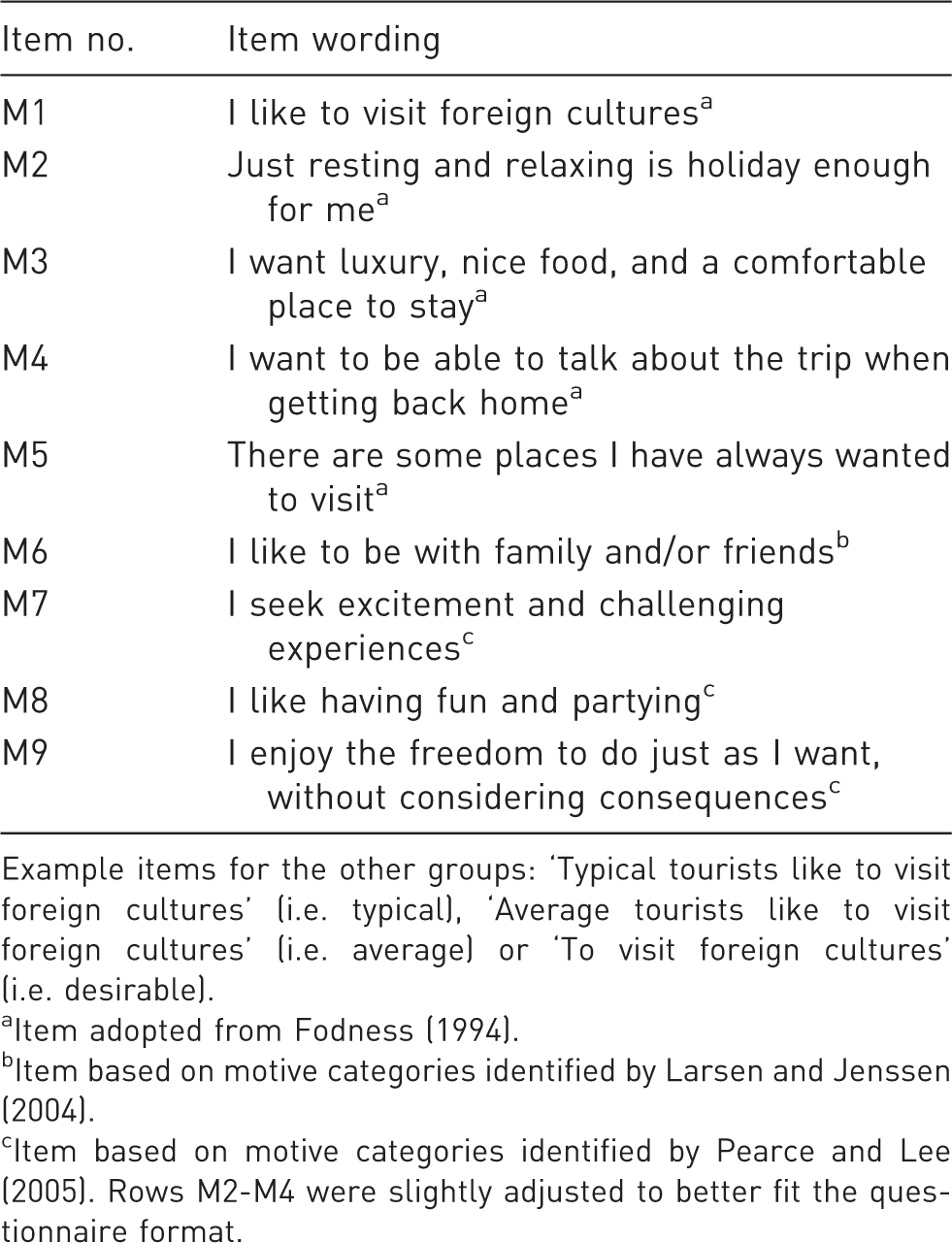
Example items for the other groups: ‘Typical tourists like to visit foreign cultures’ (i.e. typical), ‘Average tourists like to visit foreign cultures’ (i.e. average) or ‘To visit foreign cultures’ (i.e. desirable).
Item adopted from Fodness (1994).
Item based on motive categories identified by Larsen and Jenssen (2004).
Item based on motive categories identified by Pearce and Lee (2005). Rows M2-M4 were slightly adjusted to better fit the questionnaire format.
Comparisons between oneself and other tourists were measured using a between-subjects design (for similar procedures, see Doran and Larsen, 2014; Larsen and Brun, 2011). Participants in the present study were grouped into responding either to questions about their personal travel motives, about the travel motives of a typical tourist, about the travel motives of an average tourist, or about what they judge to be good reasons for travelling. Instructions for each group of participants were as follows:
Below are some reasons why people travel on tourist trips. Please indicate how much you agree with the following statements. When on holiday … Below are some reasons why people travel on tourist trips. Think of a typical tourist, and indicate to what degree you think a typical tourist is motivated by the following … Below are some reasons why people travel on tourist trips. Think of an average tourist, and indicate to what degree you think an average tourist is motivated by the following … We would like to know what you think are good reasons (easy to justify/desirable) for people to go on a vacation. Please look at the following statements – Rate the reasons from 1 (not good reason) to 7 (very good reason).
Results
One-way independent analysis of variance yielded significant main effects for most measured travel motives. The assumption of homogeneity of variance was violated in all but one case; therefore, the Welch F-ratio was used. A summary of these results including means and standard deviations is reported in Table 2. Post hoc analysis using the Games-Howell test was then conducted to compare each pair of groups (see below). As there were no significant differences between ratings of typical or average tourists for any of the measured travel motives (all p > .05), participants in these groups will be jointly referred to as those who judged other tourists (for similar findings, see Doran and Larsen, 2014, Study 1; Larsen and Brun, 2011). Figure 1 illustrates the pattern of results found in the different groups.
The bars show means for groups answering items about travel motives considering themselves, typical tourists, or average tourists (1 = Don’t agree, 7 = Agree very much). The square dotted line shows means for the group answering items about the desirability of each travel motive (1 = Not good reason, 7 = Very good reason). Means, standard deviations, and group differences for travel motives. M: mean; SD: standard deviation. Means in a row sharing superscripts are significantly different from each other at p < .05. N (listwise) = 1548. p < .05; ***p < .001.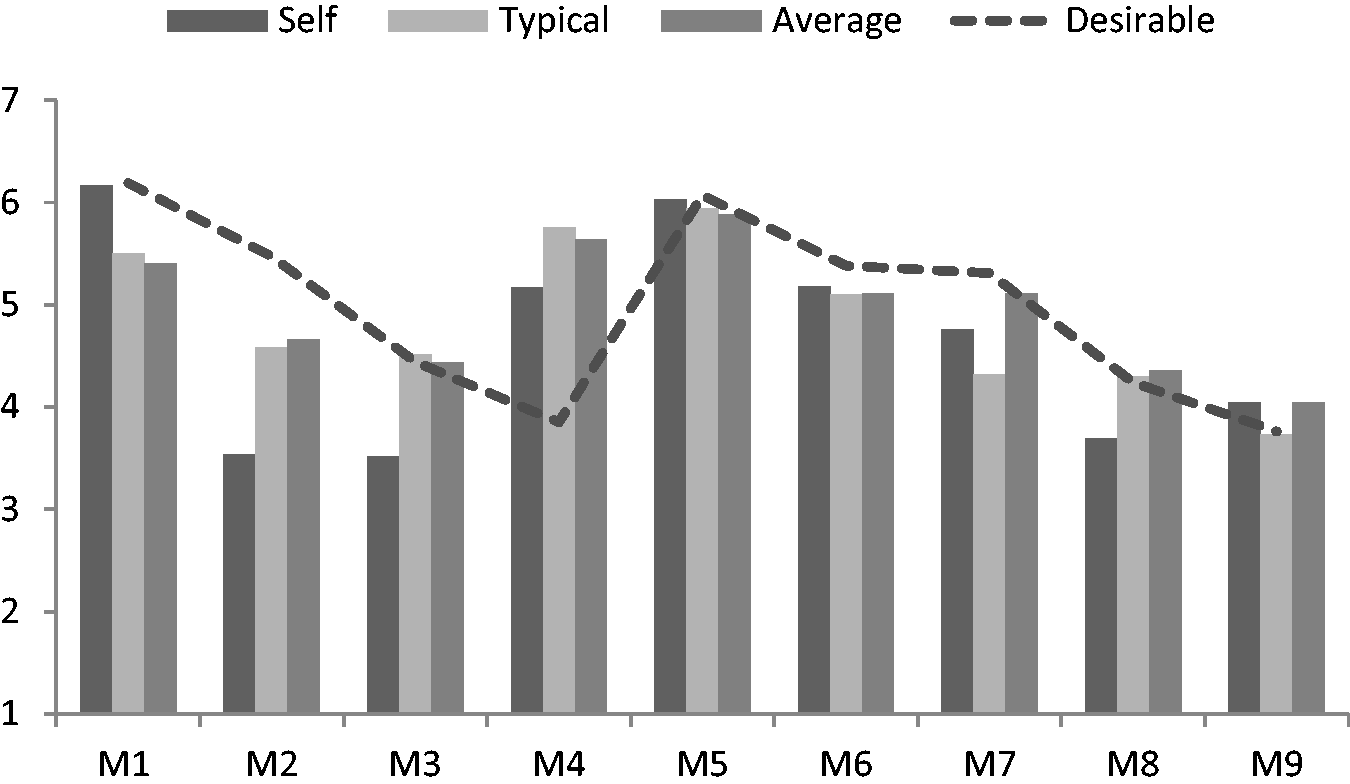
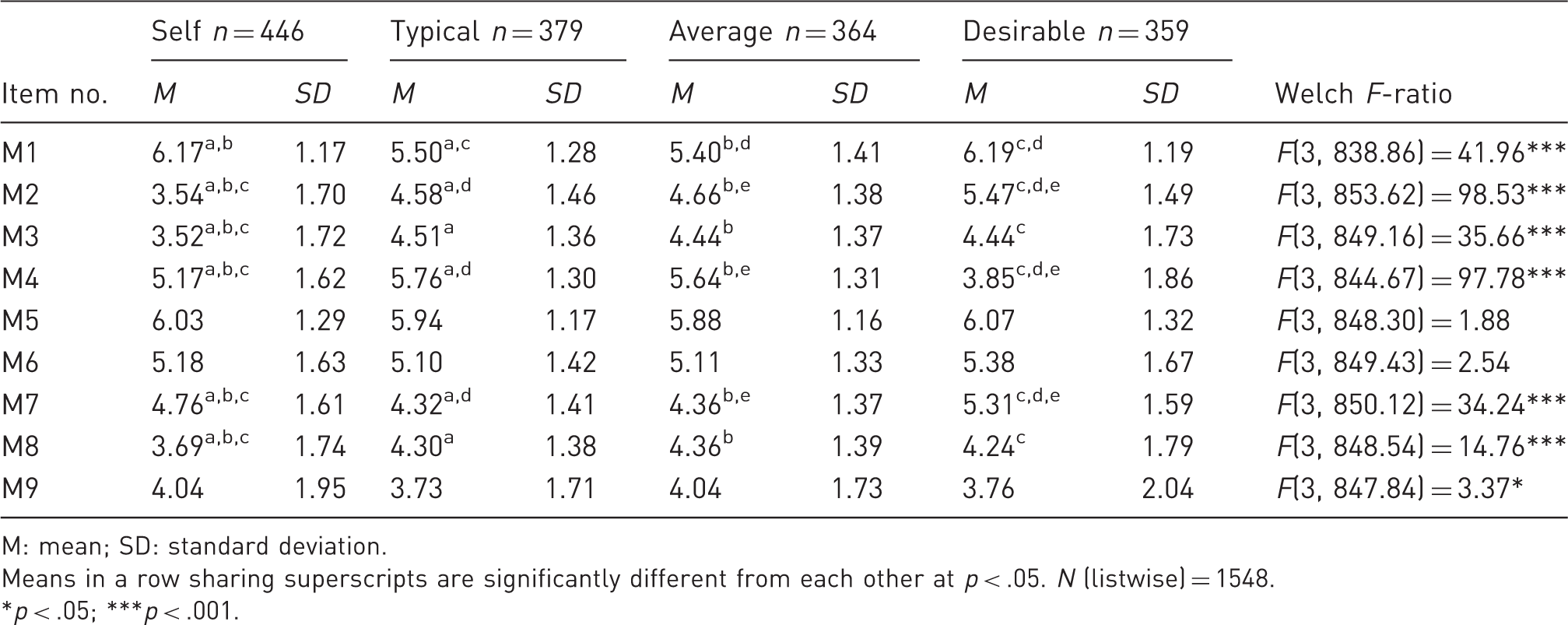
Compared to those who judged other tourists (i.e. typical or average), participants who judged their personal travel motives (i.e. self) reported significantly (p < .01) stronger preferences for visiting foreign cultures (M1) and seeking excitement and challenging experiences (M7). The same participants (i.e. self) reported significantly (p < .001) weaker preferences for resting and relaxing as essential aspects of holidaymaking (M2), wanting luxury, nice food, and a comfortable place to stay (M3), being able to talk about the trip in retrospect (M4), as well as having fun and partying (M8). There were no significant differences (all p > .05) concerning the other motive categories.
Compared to those who judged associated levels of desirability (i.e. desirable), participants who judged their personal travel motives (i.e. self) reported significantly (p < .001) stronger preferences for being able to talk about the trip in retrospect (M4) and wanting luxury etc. (M3). Participants (i.e. self) also reported significantly (p < .001) weaker preferences for resting and relaxing as essential aspects of holidaymaking (M2), seeking excitement and challenging experiences (M7), and having fun and partying (M8). No significant differences (all p > .05) were reported for the remaining travel motives.
Discussion
We hypothesized that people would perceive themselves (compared to other tourists) as being more motivated by travel motives that are viewed as desirable (Hypothesis 1) and less motivated by travel motives that are viewed as undesirable (Hypothesis 2). Similar to earlier studies (e.g. Doran et al., 2015), participants generally judged themselves as being different from other tourists concerning most measured travel motives. However, and contrary to our initial hypotheses, there was no systematic pattern concerning the direction of these contrasts. Participants did not necessarily judge themselves (compared to other tourists) as being more motivated by desirable travel motives and less motivated by undesirable travel motives. Taken together, these findings call into question whether maintaining a positive self-perception is the primary force underlying tendencies to dissociate oneself from other tourists, and on a more general note, whether social comparison is more strongly embedded with the process of constructing the tourist experience than previously thought. 2
Social comparison is a vital part of human functioning that helps us to make sense of ourselves along with the social world we live in (Buunk and Gibbons, 2006). One perspective on the role of social comparisons in tourism environments has recently been discussed by Doran et al. (2015). They speculated that these may not simply be a matter of maintaining a positive self-perception but also a way of coping with situations in which personal involvement in institutionalized forms of tourism causes a threat to people’s quest for authenticity. Their argument reflects two basic ideas: that perceptions of authenticity (as one aspect of the tourist experience) are subjectively constructed within the situation at hand (Uriely, 2005) and that people are more likely to compare themselves with others when they face uncertainties about the self (Festinger, 1954). Forthcoming studies may follow up on these thoughts and investigate whether social comparison is indeed related to a more generic desire to perceive own tourist experiences as authentic while travelling.
Another topic for future research is to further scrutinize whether the aforementioned tendencies are stable across different tourism environments. While there is theoretical reason to assume that tendencies to dissociate one from other tourists are particularly articulated in tourism environments with high degrees of institutionalization (as discussed above), research in this respect is somewhat inconclusive. While the empirical findings from Doran et al. (2015) suggest otherwise, Larsen et al. (2011) provided some support for this view in a study that compared backpackers and other tourists on various travel-related dimensions, one of which was self-reported tourist role orientation. One finding was that backpackers reported preferences for role orientations that are more individualistic and less group-oriented, and that they in this respect differed from other tourists. Gaining additional knowledge on social comparison processes and its correlates would potentially inform the tourism industry with respect to the design and distribution of products that fulfil people’s need for individualism (see also Lauring, 2013; Prebensen et al., 2003).
Conclusions
This study falls within the realm of research focusing on when and how monitoring other tourists relates to own tourist experiences (e.g. Gillespie, 2007; Holloway and Green, 2011). We believe that it adds further insights into psychological processes that may influence people’s perception in their roles as tourists, and thus it furthers our understanding of the tourist experience. At the same time, we see the need for additional research that attempts to replicate the reported findings with regard to measures similar to those used in the present study and/or measures of dimensions other than travel motives.
One limitation was that overall levels of desirability associated with each travel motive were relatively high (see Table 2). It suggests that none of the measured travel motives were rated as very bad reasons for travelling. Future studies may overcome this limitation by asking participants to compare themselves with other tourists concerning aspects of travelling that could vary more strongly in terms of their appropriateness or inappropriateness (e.g. deviant behaviours such as drinking or littering in public).
Another limitation was that the present study cannot (and does not) claim to cover the full range of possible travel motives. In fact, the number of motives addressed in this study was limited due to space restrictions in the questionnaires. Using more comprehensive models of travel motivation (e.g. travel career approach; Pearce and Lee, 2005) would provide a more sophisticated starting point for future studies scrutinizing the generalizability of our findings.
Footnotes
Acknowledgements
Preliminary findings were presented at the 23rd Annual CAUTHE conference, 11–14 February 2013, Christchurch, New Zealand. We thank the Meltzer Foundation for partially funding the research presented in this article.
Declaration of conflicting interests
The author(s) declared no potential conflicts of interest with respect to the research, authorship, and/or publication of this article.
Funding
The author(s) disclosed receipt of the following financial support for the research, authorship, and/or publication of this article: The University of Bergen provided funds to make this article open access.