



Abstract
This paper introduces a methodological approach we call “composite ethnography,” a practice of lab-based qualitative research that focuses on collaboration, materiality and multiplicity. Drawing on a series of experiments running a collaborative project on urban waterways with graduate students, we argue that composite ethnography offers a way to think about the emergent research objects associated with what is increasingly referred to as the “Anthropocene,” while also addressing some longstanding problems of ethnographic method. Loosely based in the ontological openness of STS, the method offers an open-ended attunement to emergent objects, and invites the formation of new relations. By building methods around trust in one’s peers, we suggest that composite ethnography is a way to tackle four long-standing issues in ethnographic research around temporality, disqualification, collaboration and form.
Ethnography is going through an experimental moment. This is due in part to the sudden popularity of ethnographic methods across disciplines as disparate as design and art history, and in part to the way the objects of our research have multiplied, incorporating non-humans and complex material processes alongside traditional cultural and social phenomena. This essay explores some of the opportunities of this moment by proposing a practice that we have come to call “composite ethnography,” a method focussing on collaboration, materiality and multiplicity, and an ethic of provisional construction towards a more habitable world. We argue that this approach offers a particularly useful way to think about the emergent research objects associated with what is increasingly referred to as the Anthropocene. Just as importantly, we have found that doing research in this way gives us an opportunity to reflect back on our favourite methods, updating them to fit our novel institutional and environmental conditions.
By calling our approach “composite,” we are first and foremost drawing attention to the process of composition, to the craft of ethnography. As such, we join a long line of ethnographers who are self-conscious about the constructedness of their craft, and the unendingly complex negotiations over meaning that their methods entail. In addition, though, we draw attention to the materiality and multiplicity of our methods. A composite refers to material that is more or less held together, without entirely dissolving the ingredients that went into its composition; it retains traces of the heterogeneous material elements that went into composing it in the first place. To call something composite is therefore to evoke a thingness that is irreducibly multiple. Composite ethnography is militates against all forms of purity and essentialism, assembling research from unlike and sometimes ill-fitting ingredients, always in collaboration, and always with a healthy mistrust of programmatic statements. We argue that it enables a particularly open-ended attunement to emergent objects, and invites the formation of new relations, both within research collaborations and between researchers and the worlds. 1
What follows is not a program so much as an offering, a reflection on many years of methodological tinkering at the Concordia Ethnography Lab, 2 alongside a growing ecosystem of similar institutional experiments. 3 Taking examples from our longest-running project, we argue that composite ethnography offers a response to a set of problems that have long dogged ethnographic practice: the problem of collaboration, the problem of disqualification, the problem of time, and the problem of form. All of these come down to learning to trust the kinds of interpretive multiplicity that necessarily emerge when working in a team. The essay is also a call for institutional renewal around new ethnographic objects. Composite ethnography is both a proposition about method and an invitation to the disciplines of anthropology and sociology to extend these experiments laterally across the academy, the meet the distributed effects of the Anthropocene through more collaboration between our various sites and institutions.
Denizens of the anthropocene
First, a word about the “Anthropocene.” We call this scenario of change the Anthropocene not to name a geological era (though that of course is where the term originates) but rather to mark an epistemological moment in which previously hegemonic theories about the separation between nature and human action have begun to break down (see Hetherington, 2019). The Anthropocene is the changed world one must inhabit to accept that human society has become a geological force. If “nature” was always the western name for a single, unitary existence, and culture the name for the multiplicities of human experience, the Anthropocene marks the breakdown of what John Law helpfully calls the “one world world” (2015). 4 In breaking down the distinction between nature and culture, the Anthropocene unleashes a host of new actors into our midst that are “weird” in the sense that they can’t be understood without reconsidering the frame of one’s expectations. 5 Atmospheric carbon, acidifying oceans, climate migration are the best known phenomena, but at more intimate ethnographic scales we find other surprising creatures, such as untimely storms, zoonotic diseases, migrating insects and green infrastructure that may seem as foreign to some residents as the flash floods and heat islands they are meant to mitigate.
This way of describing the Anthropocene necessarily situates our discussion as a modern Euro-American epistemological problem, separate from (though connected to) the geophysical effects of climate change which are felt everywhere. For anyone educated outside of what Latour called this “modern constitution” dividing nature and culture (2012), this proliferation of natures may not seem like anything particularly new (e.g. Todd, 2015). But for recovering moderns in the humanities and social sciences, the Anthropocene hits like a new Devonian age, in which we are swamped with new presences that had previously been disqualified from social or political action: from the relatively staid but suddenly responsive “non-humans” populating the social sciences (Braun and Whatmore, 2010), to ghosts and monsters (Tsing et al., 2020), hyperobjects (Morton, 2013), animacies (Weston, 2017), earth-beings (De la Cadena, 2015) and objects that elude calculation or demand political participation (Law, 2004).
The point here is not to wade into the theoretical battles about the ontological implications of this moment. Composite ethnography is not a way to articulate new theories of the real, but a technique for encountering the weird. The core questions we seek to address are not about laying down new critical foundations, but about how to address ourselves to new phenomena while trying to avoid the more harmful practices we’ve inherited from prior academic traditions (see Liboiron, 2021: 113). By focusing on practice (and also on the aspirational “trying to”), we move away from a project of replacing exhausted paradigms with new, fresh ones, and toward a valuation of the doing of positive ethnographic encounters. That practice starts with what Anna Tsing called the “arts of attention” (2010), training our senses on the curious denizens of a changing ecology whose presence isn’t easily accounted for in dominant narratives of change.
In 2018, with this prompt in mind, a group of students at the Ethnography Lab began what we called the “Montreal Waterways Project.” We chose water as our topic because it was visibly changing all around us in Montreal. Water had been in the news in previous years due to some surprising spring floods, a sewage dumping controversy in 2015, and a series of public proposals to bring water back to parks (Hetherington and Jalbert, 2023; Jalbert et al., 2024). Water was quotidian and accessible and obviously vital to our daily lives. 6 And yet as we read reports about the city’s changing water regime, we realized we knew shockingly little about how water behaved in the city, or what the consequences of these changes might be.
A key text by environmental historian Michelle Dagenais (2017) helped us understand the primary reason for our ignorance: water in the city was particularly ordinary. If in other places the lack or over abundance of water is one of the clearest problems of global warming, in Montreal we don’t have too much or too little, and, at least historically, water has tended to stay where planners asked it to stay. Indeed, colonial engineers over the centuries were impressed with Montreal for the abundance of water from the St-Lawrence River, and for the city's cone shape, which made waterflow easier to control. By the mid-20th century, Dagenais argues that water had become invisible in Montreal, ceased to be of interest to residents, who no longer had to struggle with it, or even see it except as it emerged from their taps. That invisibility was part of a long process of infrastructuralization of water, which itself is settler-colonial accomplishment: the moment water was tamed, such that it was available when needed but invisible when not, was the moment that the city adopted its modern form (Hetherington forthcoming). So as water re-emerges in the Anthropocene, it does so in the cracks and margins of this success, as a kind of pervasive weirdness, a basic substrate of life that has started acting differently. Montreal’s contemporary waterways emerge not in the singular, but as a loosely affiliated tribe of different “things,” from fountains to canals, seasonal creeks and snowbanks, sewers and pumps, that gather publics and politics around themselves in distinct ways (Marres, 2016).
The project began as an experiment in pedagogy, a chance to explore methods other than those students were using for their theses. We invited members of the group to create collaborative mini-ethnographies of what we came to think of as “water objects,” stipulating only that they had to work together, to try things that were novel to them, and to share their process and results with the rest of the group. Projects were kept low-stakes so that groups felt they could take big risks. As each academic year began the composition of the groups changed, we became increasingly interdisciplinary, pitching the same idea with different results.
Within a few years, we had amassed a dozen or so of these studies, some more successful than others. But the cumulative effect of these projects was a nuanced and constantly changing ethnographic portrait of the city. Meanwhile it also helped us reflect on the nature of ethnography itself, and how our novel approach to it highlighted some of the affordances and limitations of the method. In this paper we focus on the way that specific water objects addressed some longstanding problems in the history of ethnography. In each of the four sections, we explore a different methodological problem, and the water object that most brought it to the surface for us.
Four ethnographic problems
The problem of collaboration (along the ghost river)
The most obvious of the problems we confronted in this project was simply how to find ways to work together. Anthropology has, since the early 20th century, taught ethnography as a practice carried out primarily by lone anthropologists immersed in someone else’s context. While the place of the “other” in this story has changed somewhat, most graduate pedagogy still trains people in the same practice, conferring degrees on singular people doing singular projects. But there’s a deep irony here. Ethnography always begins with a practice of epistemic exchange, a dialogue between people who recognize that they think differently but come to understand each other, however incompletely (Viveiros de Castro, 2004). In its classic form, anthropology translates this rich dialog into a flattened portrait of a culture or way of life. It’s perhaps not surprising then, that a tradition that has had trouble recognizing the fundamentally collaborative nature of its production also tends to shy away from teamwork, where the messiness of exchange is always on the surface (see Choy et al., 2009). Composite ethnography proposes that, for all the practical difficulty of working in teams, forcing oneself into an explicitly collaborative mode is one of easiest ways to open the researcher to more creative conversations with the world one is studying.
We should clarify here that by collaboration we don’t mean fostering formally participatory research encounters with participants, a practice which comes with its own rich history and difficulties. We're arguing for a much more humble challenge: that ethnographers learn to work better with other ethnographers. Collaboration of this sort offers some obvious advantages for addressing distributed objects, for scaling up research across multiple sites, and for gleaning different perspectives on complex phenomena. What we want to highlight below is how the practice of working together creates a bulwark against close-mindedness. By multiplying the identities of the researchers, it makes room for multiplicity in the world to emerge as well.
Our approach to collaboration starts in a lab. Creating a lab is not the only way to do this, but it does offer some advantages. The well-known Matsutake Worlds Research Group built a similar approach, putting the collaborative emphasis on “co-labouring” (see Faier and Matsutake Worlds Research, 2021). Labs add another layer to this by devoting a space for work on process, and for the surprise interaction of disparate projects. By taking the research focus away from the “field” the approach upends the naturalistic predilections of classical ethnography (Stavrianakis et al., 2017). The conversations between researchers, as well as the noisy interstices between distinct research projects happening in a given space, produce their own kind of creative potential for mutual aid and technical play that can be separated from the specific objects of research. We’ve been inspired by Max Liboiron’s (2021) model of lab-based scholarship, that begins from a commitment to finding anti-colonial ways of doing science rather than focusing on outcomes. Caring for process over outcome, in Liboiron’s practice, leads to a striking form of writing that continuously acknowledges collective messiness and tension, consistently positions voices in the community, and values compromises and obligations rather than considering them impediments to science. 7
Of course, some aspects of lab culture can create other problems. Our approach to collaboration depends on an open and horizontal form of dialog, but labs embedded in universities and the scarce economies of academic credit and resources are always rife with hierarchies. Mentorship, responsibility, and an equitable distribution of labor all depend not on creating artificial equality within a collaboration that necessarily involves differences of power. It would be disingenuous to suggest collaboration could be free from this. Instead, we recognize the constant interruption of institutional hierarchy, while doing our best with the resources at hand. For our purposes, the aspect of this we most push back against is the concentration of epistemological authority. One of the first principles in keeping the dialog open in this way is to foster research questions that are naïve. That is, we try to avoid beginning projects with questions that are unnecessarily abstruse and therefore exclusionary of team members with different forms of expertise. Second principle: the questions should allow us to begin answering them in a way that doesn’t require any special skills.
For instance, one of our most successful projects began with the simplest question. We had heard about a river that used to run through the city, but which had been buried in the early 20th century. Could we figure out where it was? We borrowed the method of “walking ethnography” from Christina Moretti (2011) and set off with a deceptively simple goal: to see if we could walk the length of the river that was no longer there. From there it was the river that did the theorizing, making it clear early on that it was not an underground river so much as a ghost, simultaneously “dead and buried,” and also strangely present in the neighborhoods in which it had once run freely. Traces of the river in urban infrastructure, along with the sound and sometimes smell of the sewer below, inspired the design of parks, public art and the musings of local historical societies. Over the next 2 years we deconstructed maps, read about ghosts, and learned about hydrology and park design, even while uncovering a large network of sewer hunters, gentrifiers and enthusiasts of weird heritage, all on adjacent quests. We learned about how ghost rivers change with climate change, as they create new relations, just as they had created a new set of relations with and through us (Toso et al., 2020). Indeed, we came to recognize our own project and curiosity as an effect of these changes. The ghost river we followed was not only many things to many people, it was also becoming more, as we and others conjured it into the landscape anew (Hetherington forthcoming).
Over the course of the project, we learned two key lessons about collaboration. The first is that working together like this entails different sets of relations and responsibilities than one usually has a chance to explore in graduate school. So much of our pedagogical experience happens in a set of vertically-structured relationships in which students are trained by submitting them to a series of disciplining practices. In this kind of work, the price of entry into a discussion isn’t some submission to pre-establish norms (or supervisor), but a willingness to make propositions in good faith and to meet others in dialogue. Isabelle Stengers (2010) refers to this kind of conversation as “diplomacy,” a practice that’s not without its challenges and tensions, but that has very different stakes in the way in constructs knowledge. “What is at stake in the practice of the diplomat or the affective conditions of an encounter, not the recognition of submission” (2010: 382). This made of the project a pedagogical experience that was less competitive and anxiety provoking than so many other aspects of graduate school.
The second lesson is that in caring for a research collective one also opens differently to the objects of research. Diplomacy, we found, begets more diplomacy. We had begun with a set of seemingly naïve question and immediately found that we were not alone in asking these questions. Throughout the city we found engineers, city planners, activists, artists, museum curators and amateur historians asking the same questions about our ghost river. This is a knock-on effect of collaboration in the spirit of mutual curiosity: that by generating a situation where trust in one’s peers is the only way to proceed, one can more easily expand the conversation to others. Collaboration within the lab generated a widening community of potential collaborators. We, along with our ghost river, became part of a community of curiosity as much as we created the possibility for community.
The problem of disqualification (in an island park)
The infectious quality of trust brings us to the second benefit of composite research as a way to combat ingrained habits of disqualification. We take the term “disqualification” from its articulation in feminist science studies, in particular the work of Stengers (2010), who sees knowledge politics as proceeding through the exclusion of marginal voices and outlier opinions. 8 For Stengers (2010), the “one world world” was and is produced from this constant work of weeding out dissonance in the construction of a unitary view of nature. The humanities and social sciences traditionally participated in this monism by respecting the distinction between the social and the natural – ethnographers’ celebration of pluralism could be safely stowed away on the social side of this great divide, leaving the “hard” sciences to describe a universal nature. Stengers’ answer to this is to see states of the world not as foundational but as propositions in an unending cosmopolitical conversation. Not all propositions are created equally, but it is in the humility of the encounter between various versions of the cosmos that our knowledge of the world is enriched.
Composite ethnography is designed to produce this kind of cosmopolitical richness, and to militate against some of the habits of thought of the one world world. It begins from the recognition that it is impossible to completely do away with disqualification: all propositions operate in conversations where disqualification is a feature (Hetherington, 2013). At the Lab, we’ve cultivated two related attitudes toward research that keep these dynamics front of mine. The first is what Martin Savransky (2021) usefully calls the “mistrust of mistrust”. This is just about cultivating an awareness of disqualification in knowledge controversies and moving toward them as a way of asking questions.
An example of this is the water object our group took on in the fall of 2021 when we noticed a controversy surrounding a new park on an island in the Montreal archipelago known as Île Sainte-Thérèse. According to the city, the island occupied a privileged place for river biodiversity, and turning it into a park would help the cities to meet their climate targets for protected greenspaces. The park plans also included some archeological details about the islands early French settlement. But if the island had a deep colonial history in this plan, it seemed to have no recent history. And the city’s announcements made no mention of 53 cottages that owned by families who claimed they were being unfairly evicted from land they had been visiting for generations.
Residents argued that their presence was not an obstacle to the park and could even be considered a benefit. Occupying only a small fringe of the coastline around the island, they had spent years hunting and fishing, planting trees, controlling the beaver population, and fighting rampant erosion caused by shipping traffic. But their potential presence in the park was disqualified at the outset. Their cottages, long maintained without plumbing or electricity by working-class tinkerers, sported exposed insulation, DIY water towers, and heaps of rusted iron bound for recycling. They didn’t fit the vision of pristine boardwalks covered in birdwatchers imagined by the city. And conveniently, residents didn’t have clear property title, because the church that had granted them the land did so, as they said, with a handshake. Residents recognized very clearly that they were being subjected to a double-disqualification: their poverty made them aesthetically undesirable for city planners and also rendered their legal claims precarious.
When we made it to the island, one of our team members, Melina Campos, tried to ask residents about the pictures they’d been holding up at the protest. She wrote: Emotions were running high, and I was too self-aware of my difficulties in French. “Why did you decide to use your family pictures on the placards?” I shyly offered. “Because we wanted to convey emotions, and pictures convey emotions,” they replied. “Because we are not squatters,” they continued, with a certainty that contrasted my original hesitation. “We protested because we didn’t want to leave, but most of all, we protested because we didn’t want people to believe we didn't belong here.” (Campos: 15)
There are many layers of injustice in this story, and after years of arguing them in court, residents could recount them fluently for hours. But by far the most charged of these injustices was being called squatters, a word full of disdain that disqualified their legal claims and hollowed out their right to exist.
When we encountered them, residents had run out of money to pay lawyers and had just bitterly accepted a small settlement from the city, giving them 7 years to pack up their houses and leave. Residents were clear that they considered the legal fight over, that they had lost, and that they didn't expect us to help in their material cause. But they wanted us to tell a story that took them seriously. So how could we tell our ethnographic story of an island in a fraught landscape where the telling of such stories is already disqualifying, and where the people who most care about that island feel themselves losing their grip? After pitching ideas, we settled on writing a short book of stories, none of which parroted residents’ point of view back to them, but that placed them in a richer, less linear, composite narrative than the one about boardwalks a kayak rentals proposed by the city (see Montreal Waterways, 2023).
We began from the perspective of radical openness: anyone could bring any proposition to the table, no matter how seemingly unrelated. One of the stories is written by Gurung (2023), a Nepalese PhD student who went to the island with us to study erosion that was a source of bitter tension between the city and the residents. Amrita’s conversational French was not great, and she found it hard to engage in some of the ethnographic banter, but she found herself profoundly moved by a massive poplar that had recently fallen off one of the eroded banks. The poplar reminded Amrita of another poplar she had visited in a north end Montreal Park throughout her first winter in Montreal. That winter, as a new PhD student in forced isolation due to the COVID pandemic, she had found solace in that park and in one tree, whose distant cousin she now saw drowning at the edge of Île Sainte-Thérèse.
And so Amrita wrote an ode to trees and to belonging, to feelings of loss and displacement. This is not an obvious way of affirming residents’ experiences, but it adds to them in a way that resonates orthogonally with them. Amrita was understandably shy about presenting this as her contribution to the group, as was El Mir (2023), who wrote a short story from the perspective of Cartouche, a hunting dog we met there. She was not sure about how it “fit.” But in the spirit of disqualifying only disqualification, it emerged as a great moment to think about what islands can be, to think about different ways of experiencing environmental loss, and to think about all the wonder that is made possible up by simply being open to the surprise ethnographic encounter. 9 As it turned out, these two chapters were the ones that most resonated with residents, who could easily identify the tree and dog as elements of their increasingly precarious community there. When we returned the following year, one of the residents was most excited to show us an old apple tree dying in the forest. Without Amrita’s poplar as an example, she might not have considered her deep affection for this single tree significant (and in fact her husband tried to dissuade her, thinking it was unimportant). But the conversation not only brought us to a very unusual site, it also highlighted her extraordinary ecological knowledge of the island.
We might think of this anti-disqualifying principle of composite ethnography as the improvisational imperative, taken from the classic technique known as “yes, and”, in which improvisers can only respond to each other by first affirming what the other one has said. Put another way, composite ethnography begins by looking for instances of subtraction and approaches them in a spirit of addition. It can’t go on forever – eventually the group has to exercise some editorial judgement over the project, leave some aspects out and try to harmonize others. But by keeping this element at the front, making sure that each stage of the research process allows for interruptions of the unexpected or the ill-fitting, composite ethnography creates the conditions for further composition.
The problem of ethnographic Temporality (with an urban glacier)
Amrita and Hanine moved on from the Waterways project after our initial Île Sainte-Thérèse publication, and most of us considered that project to be closed. But because there was still a group around, some of us were interpellated a year later when the first stage of evictions began to occur. By then, Amrita’s tree had washed away, Cartouche the dog had died, some residents had reconciled with politicians they had previously vilified. John Neufeld, one member of the group, was keeping track of all of this on Facebook. It turned out they were watching us too, and remembered us fondly for the book we had made. And so when the evictions began to heat up the next year, we were invited back to the island with to make a short film about the evictions. In short, the relationship between the research group and the object being researched had spilled out of the temporal slot we had initially imagined for it, changing both in the process.
Other approaches to collaborative methodology have often pointed to the way that working in groups can help address a spatial limitation of solo work. For instance, the Matsutake Worlds group made excellent use of their team for addressing multi-sited phenomena distributed over very distant places (Faier et al., 2023). Our waterways group initially took advantage of the same quality of collaboration, by focusing on different objects dispersed around the city. But we soon found that collaboration also afforded us a different approach to the temporality of research than traditional ethnography. And just as the spatial multiplication of the objects allowed us to see the ontological multiplicity of certain anthropocenic presences in the city, so were we able to see the multiple and sometimes weird temporality of objects in ways that would have been less accessible without collaborators.
Along with all of the weird new actors it brings to our cities, Michelle Bastian describes the Anthropocene as a moment in which time itself becomes weird (Bastian, 2012). The very notion of climate change holds a challenge to modern conception of time, since historically the concept of “climate” was meant to denote a spatially variable but temporally stable counterpoint to temporally volatile “weather” (Hulme, 2009). At a more mundane level, it has uncovered the arbitrariness of many of the time-based tools we use for managing the natural world. For instance, in Montreal, as in so many other cities, the changing character of flood events has made visible the degree to which we rely on probabilistic models that are expressed in temporal units. In both 2017 and 2019, Montreal experienced floods that, according to previous flood maps, had been categorized as 100-year floods, referring to the likely interval between floods of this severity. Experts were quick to point out that a “100-year flood” is simply their way of expressing that in any given year, there is a 1% chance that a flood like this might happen. But then they also need to admit that this isn’t entirely true, since the 1% comes in part from an analysis of historical records that assumes stable probability across time. It became impossible to talk about these events using expert language, since the events themselves undermined the temporality in which the expertise was couched. Flood experts, urban planners and actuaries were therefore scrambling to find new ways to describe events, often doubling down on technocratic rhetoric the allows the Anthropocene itself to frame time. Composite ethnography goes in the opposite direction, not trying to tame objects through a coherent linear description of the Anthropocene, but to describe them in their moment of emergence when their temporality has become multiple and indeterminate. 10
Ethnography has also always had its own time problems. Classical anthropology had a well-known problem acknowledging change in the social objects it studied, and developed a whole language for eradicating history from its observations, including static concepts like “tradition” and “the field,” and the habit of writing in the “ethnographic present” (Fabian, 2014). This was part of a Euro-American obsession with ideal forms, and a colonial habit of collecting people and territories (Asad, 1973; Wolf, 1982), all of which has been thoroughly critiqued. And yet despite how much ethnographers are now required to situate their studies in history, our fieldwork practices continually recreate a kind of presentism that is hard to shake. The practice of individual research, usually involving travel to an identifiable “field” for a bounded period of time, are excellent for rendering static portraits, or for exaggerating the eventfulness of particular moments the researcher has witnessed. Students I’ve supervised consistently worry about the inevitable temporal cut that happens at the end of their research, understanding that the phenomena they are researching are not similarly cut. 11
Composite ethnography invites researchers to think about these two problems together, keeping open temporal questions by seeking out objects that challenge modern time in their presentation. We build on a tradition in science and technology studies that considers phenomena to be “occasions” in which new forms of relations become possible. 12 That “occasionalism” forces one to consider how ethnographic objects are not merely assemblages of relations in space but are also dynamic temporal associations that needn’t adhere to any particular linear progress, or fit easily into an event-focused fieldowk window. It is then incumbent on the researchers to orient themselves as observers in equally complex ways.
An example of this is how our group approached the topic of urban snow removal, a massive yearly undertaking often compared to a military deployment against the weather. Snow removal is a relatively recent practice in Montreal. It builds on the temporal proposition that slowed-down water as an impediment to the movement of cars and therefore to the rhythm of the capitalist work day and the economy as a whole (McKelvey, 1995). From a topological perspective, snow removal is mostly just pushing or hauling snow into piles, banks, dumps, slush puddles or rivers. So we approached this snow removal as a series of questions about these temporary forms that pop up every year in the city, either because they are ignored by the removers, recast as a waste, or gathered for recreation. The strangest of all are the perpetual “urban glaciers” that form in Montreal’s snow dumps, so filthy they are often unrecognizable as snow, especially later in the season when partial melting has allowed a cap of dirt and garbage to form over the surface of the hard pack (Tremblay and Toso, 2021). As a team, we visited several of these dumps, struggling with weather and infrastructure as we went, and talking to the people managing them, the nighttime workers who bring snow together, the people in the neighborhoods disrupted by constant dumping, the bureaucrats who decide where it all goes.
The glaciers inhabit multiple times simultaneously, none of which is reducible to the other. They are of course inseparable from the city’s specific seasonal rhythms, and also from the way that those rhythms are changing unpredictably. But they’re also part of a larger temporal game, a project of making snow into waste in order to benefit the mobility of cars and workers, answering a set of imperatives that suddenly seem more stable than the coming and going of seasons. Beyond that, the strategic placement of snow dumps in empty lots also tells other colonial and settler histories: they tend to inhabit abandoned railyards and quarries, scars from an early period of colonial extraction and transportation, and therefore waves of destruction and dispossession. They live alongside other infrastructural nuisances like highways, that either come to inhabit, or eventually cause, spaces of disempowerment like immigrant and racialized neighbourhoods. The urban glaciers don’t tell us anything conclusive about climate change or living in the city, but they resonate with any number of questions we might ask how about our changing relationships with the natural world and with each other.
Meanwhile, the glaciers’ strange temporality stretches the ethnographic encounter in curious ways. The year we spent exploring snow dumps generated an elegiac photo-essay of dirty snow from Toso and Tremblay (2021). But as soon as summer came around, the project lost its form, and the students moved onto other projects. Since then, it’s been interesting to see how each winter someone brings up snow removal as a possible project, only to find that we have an archive already assembled to get them started. But it also created other archives, like a folder about the abandoned Francon Quarry, which serves as a snow dump but also has many other social lives, and itself became the focus of another summer project (The Pit 2023). Like any emergent object, the glacier turned out to be more complex than it initially appeared. Though Tricia and Pier-Olivier were initially drawn to the affective quality of its ephemerality, its recursivity generated other problems and possibilities, just as their own brief collaboration ended up nourishing other collaborations.
The problem of form (and a return to the ghost river)
The final problem we have found ourselves dealing with constantly relates to the published form of our projects. Academic production is still governed by longstanding conventions that are extremely hard to shift. In anthropology and adjacent disciplines, the intellectual infrastructure of our careers still retains its greatest supports and rewards for the production of single-authored textual monographs, prizing the originality of analytic voice. There are wonderful things about these disciplinary forms, not least of which is the way they support textual and epistemological creativity. But they also serve as a conservative element standing in the way of certain projects to diversify the academy, pluralized research practices, or address emergent entities of the Anthropocene.
Anthropology does have a long history of formal experiments with textual form, and at the beginning of this project, we were inspired by Hugh Raffles’ Insectopedia (2010), Anna Tsing’s Mushroom at the End of the World (2015), and Mike Fortun’s Promising Genomics (2011). 13 But as innovative as they might be, all of these examples are books distributed by university presses for 40 dollars apiece. Peer review, and the publishing monopoly of a handful of publishers necessarily tends toward formal conservatism. With only a few institutional exceptions, credentials in our discipline require students to mimic these textual forms in their theses and dissertations. The question isn’t just whether these forms are always the most appropriate ones for addressing an audience interested in urban glaciers or ghost rivers, but also whether we might be shortchanging students by training them in a skill whose reach doesn’t extend far beyond our disciplines. So as our project matured, we took more inspiration from more innovative multi-modal projects such as Kim Fortun’s Asthma Files 14 or Anna Tsing’s Feral Atlas. 15 From the beginning, we’ve proposed that the outcome of composite research ought to find its own form rather than assuming that the peer-reviewed article or book is always the best way to express things: audio and video productions, websites and zines often feel truer to the research objects and the publics they might appeal to. 16
One of the most formally ambitious projects of our projects emerged from the ghost river project mentioned above. Walking along the ghost river had raised a series of conceptual problems, because in we had a lot of trouble figuring out what exactly we were tracking: the sewer pipe that had swallowed the river? The historical riverbed which we could sometimes glean from the topography or in the suggestive monuments of past river hunters? Old colonial maps dug out of the Montreal archives which didn’t all agree with each other? The stories told to us by amateur historians we encountered along the way? The historical river had moved around, precisely around the time that the mapping got better, the water was diverted and canalized, split and averted again for small industries and failed navigation projects. As the potential paths of the river multiplied, the project began to produce strange archives, what we called Frankenmaps. The first of these were just bricolages, pieces of maps glued to each other and then pinned to the wall, followed by digital versions (Image 1). Frankenmap of a ghost river. Credit: Montreal Waterways project.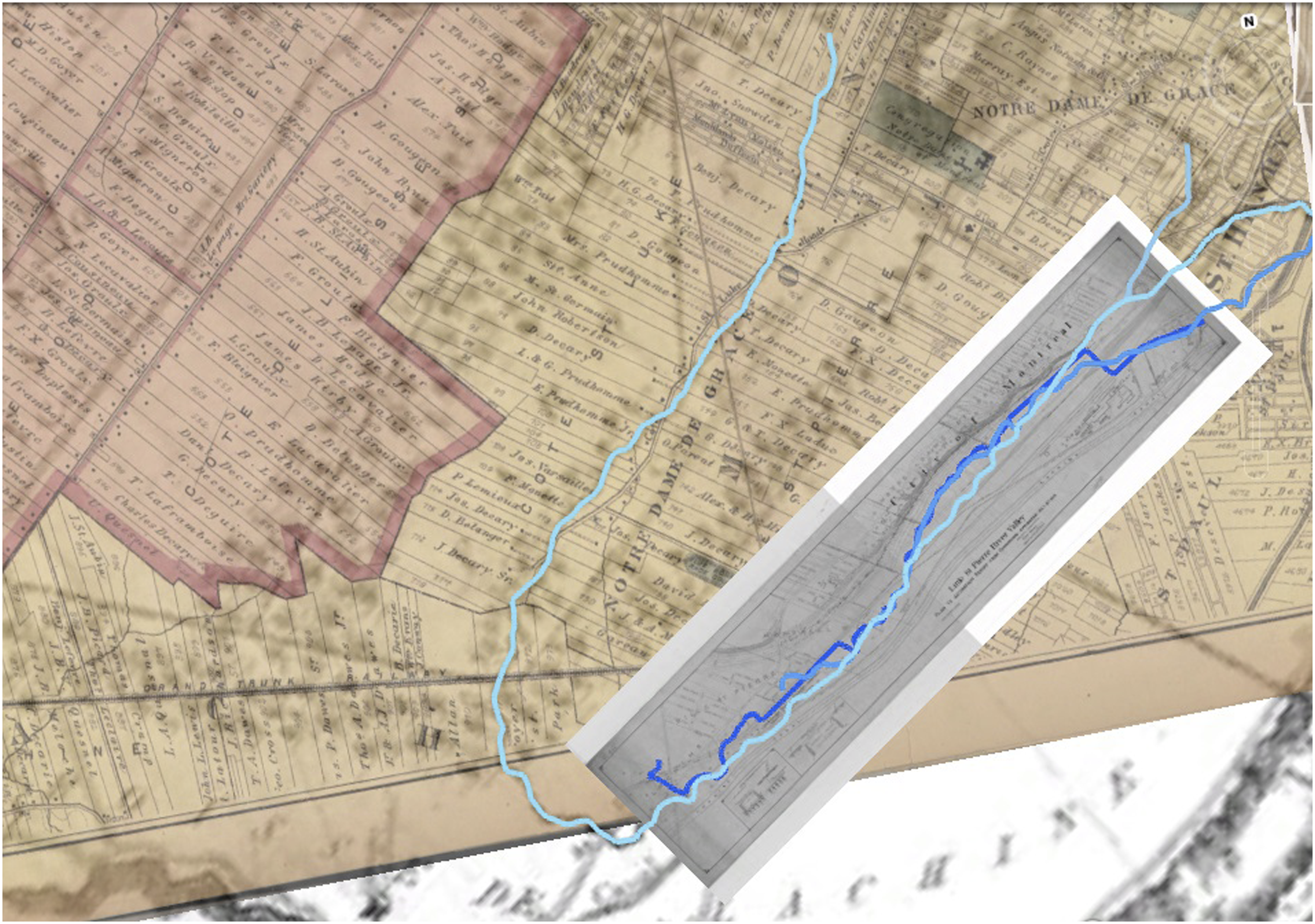
Eventually, students built a website that traced out the river in different ways. 17 Depending what version of the river one followed, one could click on distinct “nodes” that brought up information about the social and environmental history of specific places along its course(s). The site could be considered what Corsín Jiménez (2014) calls a “wild archive,” a kind of public draft that pulled together material in a provisional form, and served as the basis for future writing. As such, it did several things at once: it created an interactive tool for organizing academic analyses, it presented work in a way that made the research process more transparent to readers, and it represented the findings in a form that felt responsive to the object than to academic convention. Instead of a disembodied translation of the river, it was an extension of it, an addition to what the object was in the world. 18 More intentionally then our island book or the glacier photo-essay, it disrupted the standard temporality of the field, which closes with finished publication: instead, it created a lively intermediate form that invited others to collaborate and continually work with.
These kinds of formal experiments are still a bit hard to place in academic career paths. While the Ghost River webpage attracted the interest of many journalists and led to more formal publications for some of its creators, 19 the work doesn’t have a clear academic value, and it only really circulates in as much as we cite it in presentations and papers like this one. The formal experiments create alternative intellectual communities, and for many of our students who will not continue in academia, the skills they gain making an interactive website may be more valuable than a peer-reviewed article. But all of this is institutionally risky, tricky for graduate students and junior scholars to navigate in a time of increasingly uncertain academic career paths. Like the problem of collaboration, the problem of ethnographic form is ultimately infrastructural. Building new economies of academic credit and recognition depends on collective, distributed efforts to circulate knowledge beyond the confines in which the collaboration takes place, a commitment not only to diversifying the academy but to loosening its entire form. Ultimately, then, our proposition is that composite ethnography not only helps us address new objects and communities in the Anthropocene, but also provides one way to think about disciplinary renewal in a time of university upheaval.
Conclusion: Composing worlds of trust
You can now see the reason I’m writing this: it’s an invitation for you to imagine yourself in such a composite research community. The riskiness of these sorts of projects only holds so long as they remain rare, and the work and skill that goes into them is only recognized in a handful of institutions dedicated to similar experiments. At our lab we’ve actively tried to expand our network to others doing similar work, 20 but we’re only a small part of an expansive community rethinking what our disciplines can do and what our institutions reward. For some readers, accepting the call of composite ethnography might just mean bringing more play into projects with students, loosening up the expectations of a project. For others it might mean rethinking how they read the CVs of potential job applicants or submissions for peer review. Or it might mean actively seeking ways to distribute research activities differently, becoming a little more distrustful of distrust in academic performances, leaving more room for the world to interfere in unexpected ways. Whatever piece of it appeals, the idea is to broaden the collective of researchers who embrace the collective aspects of research, of encountering the world and of composing it anew.
The ethnographic problem of the Anthropocene is not just about finding methods that describe emergent realities more fully or faithfully. Instead, it’s about fulfilling an old ethnographic goal: creating the possibility of better relations. For all of its problematic colonial pretensions, there was always one element of ethnographic work, sometimes glossed as translation or mutual understanding, that aimed at making relations possible across emerging global encounters. Often rendered implicit, or even disavowed by a kind of residual positivism in the discipline, ethnography was always about making it possible to respond situationally to an “other” encountered in the unfolding of life. The Anthropocene makes it clear that we need to find ways to respond to the emergent nonhumans in ways that don’t treat them merely as inanimate commodities or resources. Whether we want to conceptualize these new relations as kin (Van Dooren and Churlew, 2022) or as yet to be defined mode of imagining partial connections (Strathern, 2005), ethnography has the ability to forge new kinds of responsibility (Hetherington, 2013).
The proposal of composite ethnography is a modest attempt at recomposing qualitative research that nonetheless builds on ethnography’s traditional openness to the new. We’ve outlined four weaknesses in the ethnographic tradition. To wrap up though, the answers to all of these issues derive from a singular proposition: that we need to find ways to engage with the world based in trust. Working collaboratively is, crudely, a way of forcing trust into the scene of research and experimenting with form evades channels guarded by distrustful gatekeepers. Avoiding disqualification is to commit to distrusting only distrust. Engaging with the multiple temporalities of our new anthropocenic cohabitants, and taking institutional risks even as our institutions are increasingly fragile is, to paraphrase Martin Savransky, itself a practice in trusting what the world is telling you. In the end, these practices promote what Savransky calls a “runaway metaphysics” that is “unhinged from first principles and apocalyptic endings, permanently ongoing and unfinished.” (2021: 19) but instead aims to add to the possible. In no way should this be taken as an argument for abandoning other ways of doing things, particularly the deep critical work of questioning power. After all, it begins with a yes/and proposition, an invitation. It’s a way of acting locally on our respective realities, making our disciplinary homes a little more inviting, and moving away from extractive knowledge-making practices to practices that, at the very least, are intentionally geared toward making our worlds a little more horizontal, a little more hospitable.
Footnotes
Acknowledgements
While the writing in this paper is mine, the experimenting and thinking behind it was entirely collaborative, and involved dozens of students at the Concordia Ethnography Lab and the Montreal Waterways Collective. Journal guidelines made it impossible to list everyone as an author, but I kept the royal “we” in the text to acknowledge this collective. My thanks for all these conversations goes out in particular to Carlos Araya, Melina Campos Ortiz, Marie-Eve Drouin-Gagné, Hanine El Mir, Amrita Gurung, Maya Lamothe-Katrapani, John Neufeld, Derek Pasborg, Camila Patiño, Bart Simon, Aryana Soliz, Kassandra Spooner-Lockyer, Manoj Suji, Tricia Toso, Pier-Olivier Tremblay and Ava Weinstein-Wright.
Declaration of Conflicting Interests
The author(s) declared no potential conflicts of interest with respect to the research, authorship, and/or publication of this article.
Funding
The author(s) disclosed receipt of the following financial support for the research, authorship, and/or publication of this article: This work was supported by the Social Sciences and Humanities Research Council of Canada, (890-2021-0994).
