




Abstract
Coming as a collection of observations from the field, I used this article to reflect on 9 months of fieldwork in Al Wehdat camp in Amman, Jordan. Using feminist research methodologies that make transparent the process of knowledge production, primarily ethnographic field visits and focus group discussions, I relied on the bodies of the camp inhabitants as sites of knowledge to learn more about life in the camp, with all what their embodied knowledge encompasses of ambiguity and the messiness of everyday life, aiming to challenge some of the power structures that otherwise control the process of knowledge production about and in the camp. I also brought myself into the frame of inquiry and used my own body as a tool of investigation, reflecting on my own position as a female researcher that is both an outsider and an insider to the camp context.
Keywords
I felt like I was intruding. I was aware of; the fact that I was the only woman in a room of half a dozen men, taking the stage in front of a sea of bodies and eyes; that were staring at me. I felt like I wanted to slide under the table and hide. 24 eyes to be exact. They were closely examining me in an attempt to figure out why I was there. 12 men were seated in front of me, around that rectangular table, waiting for me to start talking. I was there as a researcher, but at that moment, I could not remember, what I was there in search of?
Introduction: The body as a site of knowledge production
For my doctoral dissertation, I studied the relationship between the body, movement, territory, and knowledge. More specifically, for the scope of this paper, I am asking, how does one get to know a territory by physically being it, moving around it, and engaging with the flows of its everyday; life? How much can researchers know about the field once they are physically in it, and how much does that enrich their field of knowledge?
The field in my study is a Palestinian refugee camp in Amman, known as Al Wehdat camp in Amman, which exists today in a state of permanent temporariness, a term used by architects Sandi Hilal and Alessandro Hilal and Petti (2018) to describe the protracted state of “refugeehood” that the Palestinian refugees have been in since Al Nakba of 1948. Established in 1955 in response to Al Nakba of 1948, Al Wehdat camp was the fourth official Palestinian Refugee camp in Jordan, constructed by the Jordanian State in coordination with UNRWA, The United Nations Relief and Works Agency for Palestine Refugees in the Near East (UNRWA, 2023). Palestinian Refugee Camps at their core are political, having been established as temporary spaces of refuge, awaiting a political resolution to the political crisis which produced them. The existence of the Palestinian camps testifies to the existence of Palestinian Refugees, standing as a custodian to their Right to Return (Abourahme and Hilal, 2009; Ramadan, 2009).
During Al Nakba of 1948, 750,000 Palestinians were ethnically cleansed from their villages and hometowns in Palestine, setting the foundations to the establishment of the State of Israel (Pappe, 2007). Al Nakba was fashioned to become one of the largest “refugee problems” in history, pertaining to be resolved through negotiations between what was announced as the victorious Israeli government and the defeated Arab states, awaiting a moment that never came (Abourahme, 2014).
For Palestinians, Al Nakba is considered a defining moment in modern Palestinian History, for the way its aftermath still persists and continues to shape the lives of Palestinians everywhere. Al Nakba is not a historical event, but is rather a moment of dislocation from the time and space of life in Palestine pre-1948. Its aftermath still persists, with four generations of Palestinian refugees still awaiting their return, not just to the homeland, but also to a life that was so abruptly interrupted (Sa’di and Abu-Lughod, 2007).
In my research, I conceptualize Al Wehdat camp as a point that exists along many paths of displacement that have led to it, and moved beyond it, conceptualizing the camp as a point of arrival and also departure, whose boundaries can only be understood in relation to the paths of displacement and flows of settlement and activity that produce its socio-spatial setting. As such, I argue that the territory of Al Wehdat camp is one that is continually transformed, both on a social, spatial, political and economic levels, in relation to the movement of bodies into it, around it and out of it. By doing so, I aim to emphasize the dynamic nature of Palestinian refugee camps and the different socio-spatial networks each has with its context, despite the unchanged legal status of the camps since their establishment. Shaped by a tension between their material reality and the legal frameworks that govern their spaces, Palestinian refugee camps have been transforming in the spillovers between these two binaries, as Palestinian scholar Nasser Abourahmeh (2014) argues.
Figure 1 In the first phase of my research, I used participatory observation and ethnographic fieldwork to get a better grasp of what Al Wehdat camp was, where it was, where were its boundaries, and what produced those boundaries. During that phase, I conducted a series of unstructured interviews with the camp inhabitants during my field visits. In the second phase of my research, I used focus group discussions to learn more about the camp in more collective settings, observing the power dynamics underlying the process of knowledge production. The urban setting of Al Wehdat camp, southeast of the Jordanian capital amman. Photo by author.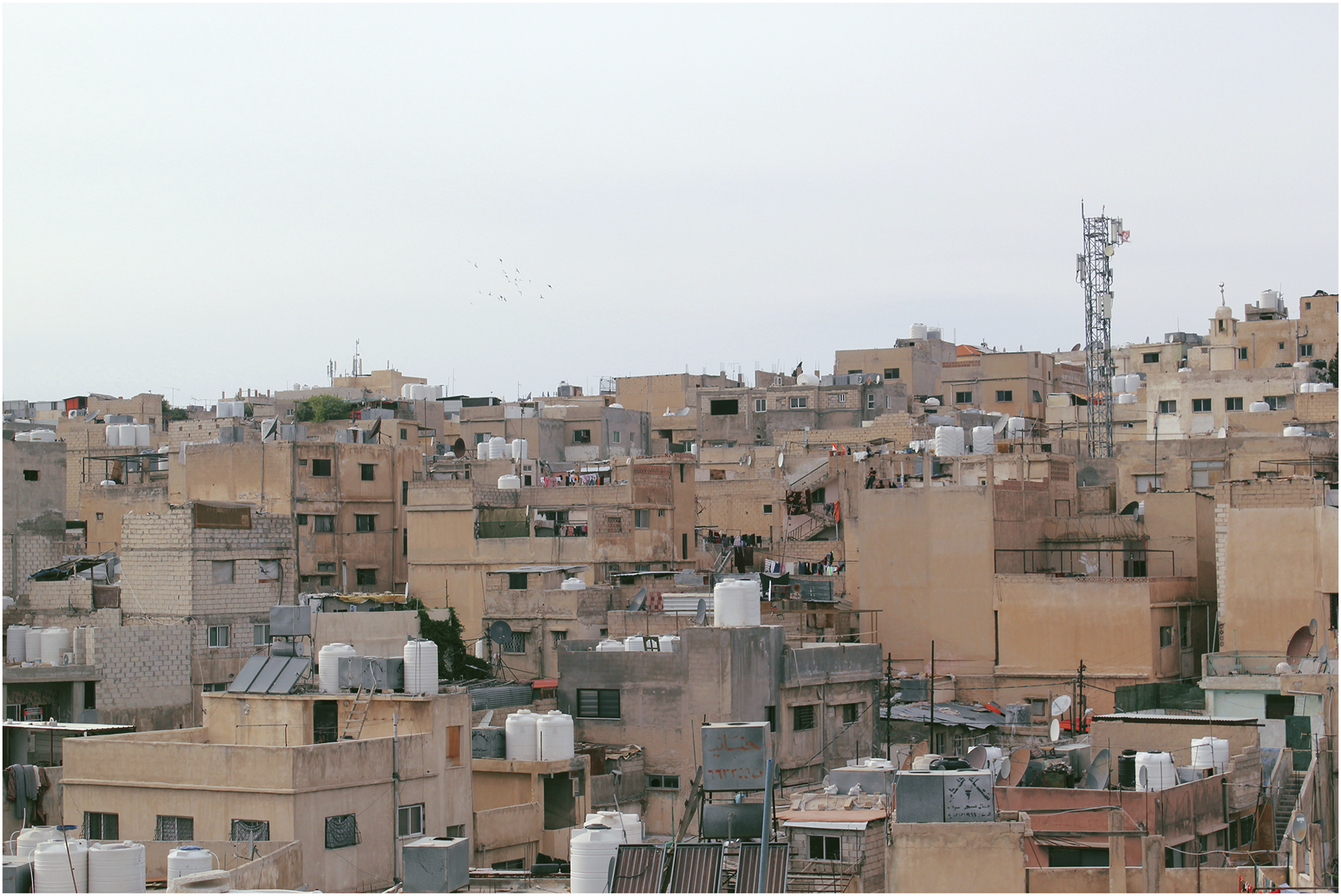
In relation to my framework, I have depended on the camp inhabitants and their ways of knowing the camp to produce this research, ones that were accumulated through lived and situated experiences in the inhabitants’ everyday spaces and territory.
More specifically, I relied on the bodies of the camp inhabitants as sites of knowledge, trying to understand how they knew the camp by moving around its territory and how that movement continued to reproduce the space of the camp and its boundaries over time. By focusing on the bodily practices of the camp inhabitants, predominantly movement, the relation between the body-movement-knowledge is highlighted, allowing me to learn about Al Wehdat camp through the embodied knowledge of its inhabitants, which is a way of knowing that is personal, diverse, heterogenous and inherently subjective, as argued by Laura L. Ellingson (2012) as I choose to celebrate the complexities of knowledge production with all the contradictions and the tensions they encompass, instead of trying to gloss them over in favor of glorified objectivity and disembodied epistemology.
At the same time, I used my own body as a tool of inquiry, drawing insights and reflections from my personal experiences in the camp, and for that reason, I decided to write this paper using “I”, acknowledging my own positionality and subjectivity and the role they play in the knowledge that is produced. In doing so, I am offering observations from my own position as a female researchr, trying to overcome some of the biases that control the process of knowledge production. For that, I choose to be political, situated in time and place, aligning my approach with that of Australian architect and researcher Naomi Stead (2022) who writes: “This is an ethical stance – making transparent the construction of knowledge, its specificity and individuation. But it also implies a mode of connection with a reader or audience: a collapsing of the cold disembodied distance of the third person universal, deliberately inhabiting the live body of the author, projecting the timbre and tone of a particular human voice, narrating its own experience.” (Stead, 2022, p.70).
I also made use of Donna Haraway’s writings on Situated Knowledge by adopting a view from the body, my body, and bringing myself into the frame of inquiry instead of staying outside it, to better understand Al Wehdat camp and get closer to the everyday life of its inhabitants (Haraway, 1988). By positioning and situating myself on the ground and that is the field of the camp, I will be using my partial perspective to write about and research Al Wehdat camp.
Being, seeing and knowing: Visual engagement and epistemological intersections
In this section, I will discuss the relationship between being in a territory, seeing and experiencing a territory on a sensory level, both inherently bodily, and the knowledge that gets produced about it. More specifically, I will discuss the relationship between the distance that separates the body from the territory and the knowledge that gets produced about that territory, which are distinctions that played a role in the epistemological buildup of this paper. The distance in this instance is twofold: the physical distance and the experiential distance. The physical distance is what separates the person from the territory, related to one’s physical position in the place. The experiential distance, on the other hand, is what separates the person from the experiences and the realities they are studying, related to one’s own positionality and background.
The relation between seeing and knowing and between position and epistemology was also a theme that was discussed in the work of Palestinian author Ibrahim Nasrallah (2009), who reflected on his own childhood in Al Wehdat camp in a book titled Birds of Caution, and said:
“A long period of time had passed before he knew that you cannot see the reality of something while you are away from it, then he learnt that seeing it from the outside is not enough at all to know it.” (Nasrallah, 2009, p. 25).
I found that I had started this research by viewing the camp through a bird’s eye-view, viewing it as an abstract concept, a static idea, an idealistic place that stood unchanged or transformed within its context. Hovering above it from afar, from the sky, as a researcher who studied it from behind her desk in Delft, the Netherlands, I was looking at Al Wehdat camp through an endless series of aerial photographs and maps, with a huge distance that separated me from it and its reality, too far from the flows of its everyday life.
In time, I began to slowly move closer to the ground, to allow my body to enter the third dimension, bringing my body into the frame of inquiry, reflecting on my own experiences and background and landing on the ground, like a bird that was landing in caution. Reflecting on that process, and on Nasrallah’s quote, I can say that being physically distant from the field, seeing it from the outside, did not allow me, as a researcher, to know it or study it thoroughly.
Another way of interpreting the outside in that quote could be related to one’s own positionality, the experiential distance between the person and life in that place, particularly whether one is an outsider or an insider to the reality that is to be seen and known. Nasrallah is someone who grew up in Al Wehdat camp and experienced life in it, in a manner that gave him insight and knowledge that an outsider would have never had access to. Lived experiences, in this instance, becomes the interior, where knowledge is produced. For someone who did not have these experiences, that knowledge will be limited, and will not be as easily accessed.
Personally, I could say that the distance that separated me from knowing Al Wehdat camp was two fold: my physical distance from Al Wehdat camp territory, related to my physical position and where I was in relation to its territory, and the experiential distance that separated me from the lived experiences of the camp inhabitants, related to my own positionality, as someone who had never lived in the camp nor personally experienced displacement. That distance, decreased the further I advanced in my studies, as I felt myself lose a sense of romanticism with every visit to the camp. It was a gradual process, relational to time and my willingness to let go of that transcendent understanding of both the camp and its inhabitants.
Double Vision: Outsider and insider: The observer and the observed
Another Palestinian author who wrote on the relation between one’s position and the knowledge they accumalte, is the renowned philosopher Edward Said’s (1999) through the notion of Double Vision which he had introduced in his book After the Last Sky: Palestinian Lives. To write the book, Edward Said collaborated with Swiss Photographer Jean Mohr, who according to Said, managed to see Palestinians the way they saw themselves “At once inside and outside our world” (Said, 1999, p.6).
That state of liminality, standing at the border between being inside and outside one’s own world, is the core of what Double Vision is for Said. What might be perceived as a contradiction, is the persisting condition for Palestinians, making it the most suitable position to take, when trying to study Palestinian lives and write about them. Their collaboration was also driven by political reasons, because at the time of writing the book in 1983, Edward Said who was living and working in the United States was not allowed to return to Palestine, from which he was displaced with his family in 1951. As per Edward Said’s recommendation, the UN commissioned Jean Mohr to travel to Palestine, given that his Swiss nationality allowed enter, to take photographs of Palestinians in Palestine and the Palestinian refugee camps in Lebanon, Syria and Jordan. Upon his return, Said worked with Mohr to write the book, discussing themes of borders, migrations, displacement and memory (Said, 1999).
Double vision, in the book, was also achieved through a hybrid format of text and image, where Said was using text to reflect on his personal memories of living in Palestine before being displaced before Al Nakba, while Jean Mohr was sharing the photographs he had taken, to visually share different aspects of Palestinian’s lives, in the present (Kauffmann, 2012).
In my research, the representation of both Al Wehdat Camp and the camp inhabitants comes through a hybrid format that combines text and image, aiming to similarly achieve Double Vision through the interplay between both. The text is a combination of two things, the reflections and experiences of the camp inhabitants, collected through interviews and focus groups, in addition to my own field reflections through the 9 months of ethnographic fieldwork I have done in the camp between the years 2019-2021.
Figure 2 Another way of interpreting the notion of Double Vision in the book and for this research, is also related to position and positionality. Edward Said was an insider to many of the experiences of Palestinians, being a Palestinian himself, but was outside Palestine when he wrote the book, while Jean Mohr was an outsider to the experiences of the Palestinians he was photographing, despite being physically inside Palestine and the Palestinian camps while taking the pictures. Overview of Al Wehdat Market with its street vendors, kiosks and accelerating bodies. Photo by author.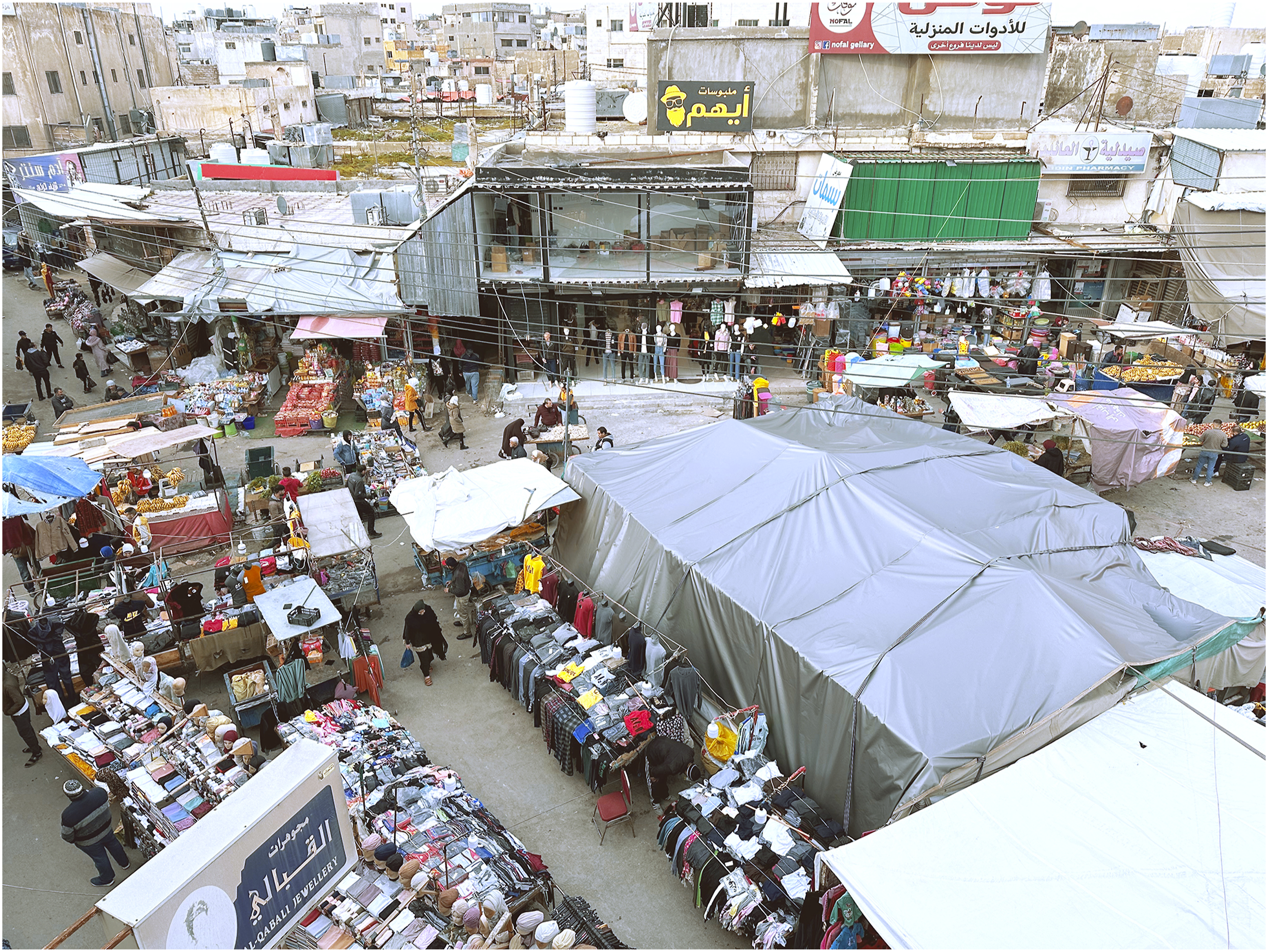
Reflecting that notion on myself and my research, I can say that while conducting this research, I was both an insider and an outsider to the experiences of the camp inhabitants, in terms of my own positionality and position in relation to the camp context. I felt as both an outsider and an insider, being an observer and a participant. Among the experiences I had, I found myself relating to some of the experiences of the female camp inhabitants for example, which, to a male camp inhabitant, might be parts of an interior they cannot inhabit, which is the way Edward Said described his feelings about his mother’s experience with displacement as a Palestinian woman and said: “Because I am separated from those experiences by time, by gender, by distance – they are, after experiences of an interior I cannot inhabit – I am reconfirmed in my outsider’s role. This in turn leads me, defensively perhaps, to protect the integrity of exile by noting the compromises of life in the Palestinian interior.” (Said, 1999, p. 83-84).
As a female researcher fluent in Arabic who spoke the local dialect, I gained access to the female camp residents in a manner that would have been inaccessible to a male researcher in a conservative community like Al Wehdat camp. Additionally, my gender rendered me less threatening, paving the way for numerous opportunities, both in the literal and figurative sense.
Figure 3 That being said, I am very aware of the limits that will never make me a total insider, nor will it make me a total outsider, but I identify as someone who has a foot at both sides of the line simultaneously, characterized with a doubleness of position, a liminality, that produces a a doubleness of vision, where each side of the line needs to exist for the other to persist. I have never lived in the camp. I have never personally experienced displacement, nor have I experienced the challenges of living in Al Wehdat camp or any other camp. Residential alley in the camp. Photo by author.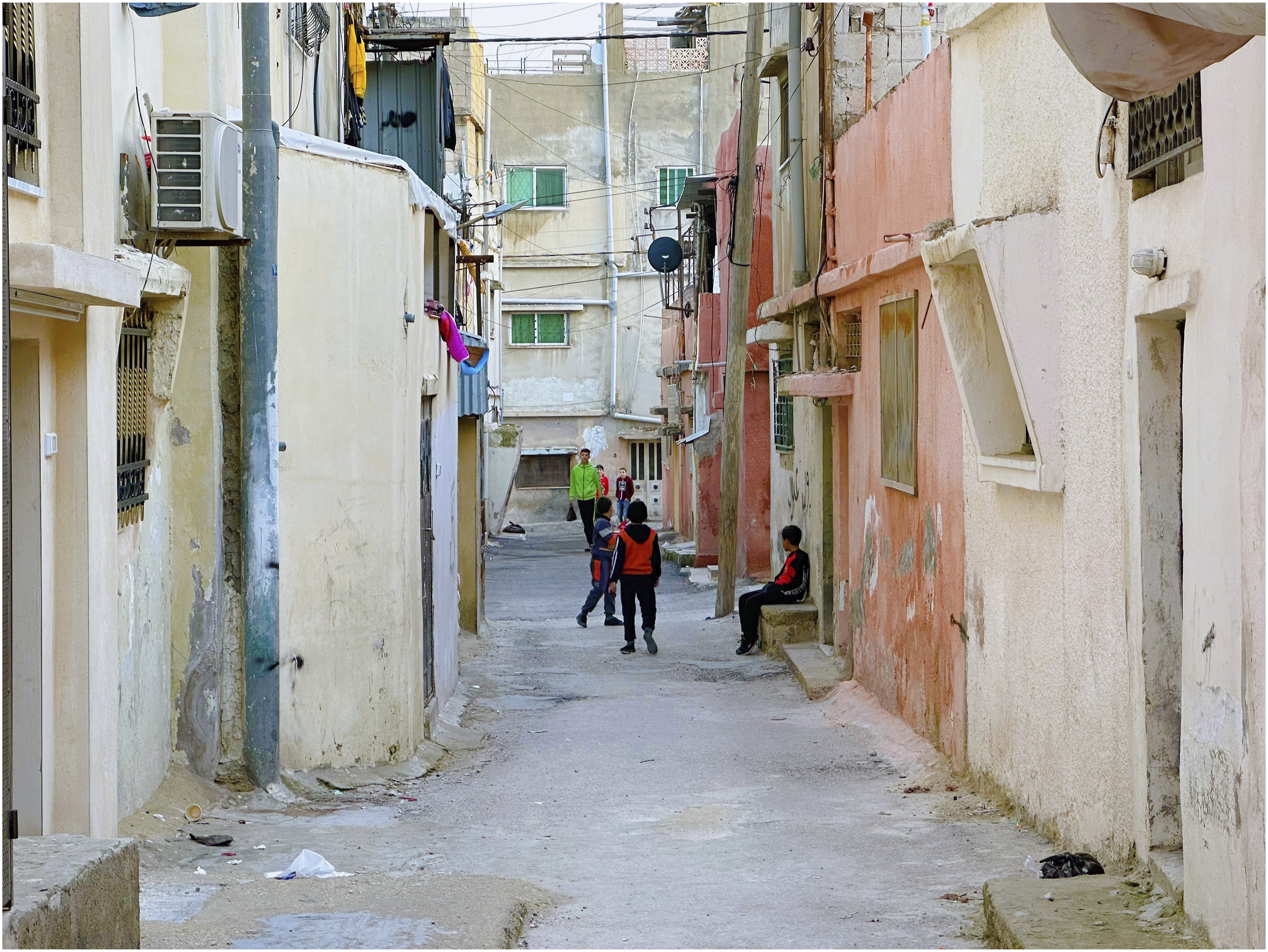
On the other hand, my maternal grandparents are first generation Palestinian refugees, who have never lived in a Palestinian refugee camp, but who have identified as refugees all their lives. My late grandfather was a first generation Palestinian Refugee, and so was my grandmother. I grew up listening to their stories about Palestine, and how much they had longed to return. I grew up around their stories, and using them, I built my own understanding of a land I have never visited, but felt I knew and belonged to.
My mother, who is a second generation Palestinian Refugee, also continued to transmit that connection with Palestine through her own version of the stories, her home cooked Palestinian dishes, her love and celebration of traditional Palestinian embroidery, and photographs and maps of Palestine we had around every corner in our house. Because of that, this research has stemmed from a personal interest in unraveling notions of belonging, homeland, and memory.
“Where in Palestine are you from?” was a question that I was always asked at the beginning of every encounter in the camp, whether during a coincidental conversation, an interview, or a focus group. That question would come up so spontaneously, right after asking about my name, in a way that to me felt comforting, making me feel closer to the camp inhabitants and more connected to Palestine.
This tendency, to want to pinpoint a Palestinian inside Palestine, was something Palestinian scholar Ghada Karmi (1999) also reflected on,
“It took me years to realize that after 1948, establishing a person’s origin became for Palestinians a kind of mapping, a surrogate repopulation of Palestine in negation of the Nakba. It was their way of recreating the lost homeland, as if the families and the villages and the relations they had once known were all still there, waiting to be reclaimed.” (Karmi, 1999, p. 40).
“From Biddu, a village between Ramallah and Al Quds.” Would be my answer. It was where my mother was from in Palestine, and from where I was, too.
In Jordan, it was more common for people to speak about their father’s origins and introduce themselves using their paternal family name which the one used for identification in all official records. In that sense, I would be typically considered as strictly Jordanian in Jordan, not Palestinian and Jordanian for example, because my father and family name were Jordanian, which is one of the implications of the patriarchal system on many aspects of civic life in Jordan, a topic also discussed in the work of Amal Al Kharouf and David Weir (2008), and Muhammad M. Haj-Yahia (2005).
That being said, identifying as only Jordanian and erasing the Palestinian part of my identity was something that contradicted my own sense of belonging and the strong connection that I have always felt with Palestine, through and because of my mother and her family.
When I started this research, I was in the camp in search of the Palestine that I have never visited or been in. Engaging with and talking to the camp inhabitants whose identity strongly evolved around the loss of Palestine (Farah, 1999; Ramadan, 2009; Suleiman, 2016) made me feel closer to Palestine in its own way. Moreover, identifying as only Jordanian contradicts my values as a feminist researcher, because I refuse to adhere to violent limitations set up by a patriarchal system.
Along those lines, it was remarkable for me to read about the experience of Palestinian anthropologist Dina Zbeidy (2020) in Al Wehdat camp, whose doctoral dissertation studied and had the title of “Marriage and displacement among Palestinian and Syrian refugees in Jordan”.
Zbeidy reflected on her experience conducting research in the camp, noting how excited she was to be meeting Palestinians who were living in Jordan, an experience she did not have before, having been born and raised in Palestine, on the other side of the border. Looking back, Zbeidy realized that she had unexpectedly felt more comfortable conducting her research with the Syrian refugees, who had begun to seek refuge in Jordan and in Al Wehdat camp after the war started in Syria in 2011, than she did with the Palestinian refugees in the camp.
During her encounters with the Palestinian refugees, Dina noticed how the Palestine that she knew was different from the Palestine that the Palestinian refugees in Al Wehdat camp spoke of, because to her, Palestine was home, a space of everyday life, where her memories and experiences have taken place. To the Palestinian refugees, Palestine was an idealistic and symbol of all what was lost, and for those reasons, the Palestinian refugees expected her, the Palestinian coming from the homeland, to represent the quintessential Palestinian, to behave in a certain way, to wear the Hijab and lead a certain lifestyle they approved of, producing tension and long discussions where Zbeidy had to explain her life and herself. The Syrian refugees on the other hand had fewer expectations of what it meant to be Palestinian, making their encounters more relaxed with less judgment.
In that sense, if the question“Where in Palestine are you from?” manages to connect Palestinians together and make them feel closer to Palestine and to each other, as I have previously mentioned and as Ghada Karmi (1999) and also Dina Zbeidy (2020) have both noted, then I believe that there needs to be the followup question of “Where in Palestine, are you now?” that will help paint a clearer image about the lived reality of each Palestinian in the present.
Displacement has pushed Palestinians to move elsewhere, dispersed everywhere, after being uprooted from their villages and hometowns, in a manner that produced drastically different experiences for Palestinians today, between those still inside Palestine, whether in Al Quds, the West Bank, the Gaza Strip or inside historical Palestine, and between those who have been displaced outside Palestine. Together, these different life experiences inside Palestine constitute an interior that Palestinians outside Palestine know so little about, and in the same way, the experiences of Palestinians outside Palestine, each in their own location in the world, are unfamiliar and different to the Palestinians inside Palestine. In that sense, it could be understood how the political fragmentation of Palestine, through long decades of settler colonization, which is what had initially produced the refugee camps and turned Palestinians into Palestinian refugees, as elaborated by Palestinian scholars Nasser Abourahme (2019) and Elia Zureik (2003), has also fragmented the Palestinian society and disconnected its members from one another, drawing lines that did not only isolate villages from one another but also produced an abundance of unrecognizable life experiences and interiors that are inhabitable to Palestinians, everywhere else.
The focus group design: Observing power dynamics
Before conducting the focus group discussions, I used interviews to ask inhabitants about their everyday lives in the camp, asking them to describe their daily routes of walking in the camp, the neighborhoods they tended to avoid and the different spots they frequented. To some of the camp inhabitants, the answers to such questions were too simple and mundane, wondering why I was not interested in knowing more about more politically significant events? About Al Nakba of 1948? For those reasons, I decided to move the questions to a more collective setting and to open up the space for more comprehensive discussions to take place, allowing inhabitants to engage in group discussions and think together, with me reassuring them that that mundanity was exactly what I was seeking. As a method, I also used the focus group setup to observe the interactions between the participants, with what they included of arguments, points of conflict, and othering practices (Smithson, 2000).
In particular, I was keen on observing the power dynamics between the inhabitants, taking note of factors such as age and gender, noting how they played a role in distributing power among inhabitants and the knowledge that was produced. By doing so, I was also learning more about the interplay of power relations in the larger camp context, because of the relevance of the micro dynamics to the macro dynamics, a conclusion drawn by Rachel Ayrton (2019) after utilizing focus group discussions in her research with the South Sudanese population in the UK. Additionally, focus group discussions as a method provided me with a beneficial opportunity to shift the power relations with the participants and handover some of the power that I had previously kept between my hands. In doing so, I would be avoiding exploiting the inhabitants and making the process of knowledge production less hierarchical and more in line with the aims of feminist methodologies (Munday, 2014; Wilkinson, 1999).
In the summer of 2021, I conducted a total of two focus group sessions, each with 12 inhabitants. The first focus group was for male camp inhabitants above the age of 21. The second focus group was with female camp inhabitants above the age of 21. The inhabitants in that focus group were sampled through Omar, my research assistant, who was a camp inhabitant that was quite knowledgeable about the place and the people. I asked Omar to sample inhabitants with different social, economic, and political backgrounds, to be able to engage with and reflect on a variety of experiences and perspectives. Each session was divided into two parts, running for 2 hours, with each taking 1 hour. I asked the same questions two times, asking the participants to respond verbally in the first part, then in writing in the second part.
I was aware that different bodily practices might play a role in producing different answers, and that group dynamics also played a role in what was being shared and said, which is why the first part was a verbal group discussion, the second part were written individual answers. I kept the voice recorder running through the session, changing my position around the group table and between being a participant and an observer.
The first session: Eyes and Ears
Returning to that small 17 m square room I was standing in in the opening of this paper, whose area I was not very sure of, but the habit of quantifying things always helped me better deal with the uncertainties they contained, I found myself anxious to start my focus group session with the male camp inhabitants. Before starting the session, I was approached by a man with a camera who introduced himself as the community center photographer, who asked me whether it was alright for him to take my photos. I agreed, I felt it was only fair given how closely I was observing the participants. I wanted to flatten the hierarchy that had placed me at the top of the pyramid, as the leader of the session and the expert who came to study the camp from abroad.
During the session I could not help but notice how performative some of the inhabitants were being, whether it was through the tone of voice, their body language, and the answers they were giving, particularly the 3 Makhateer from Al Wehdat camp that were so keen on emphasizing their social status and title.
In Arabic, Makhateer is the plural form of the word Mukhtar, which roughly translates to the Mayor. In Palestine, before Al Nakba of 1948, the Mukhtar was the social leader of the village, working as the social and political mediator between the villagers and the Ottoman government that was in power at the time. In the camps, after Al Nakba of 1948, the Mukhtar became the mediator between the camp inhabitants and the Jordanian Government, representing the people and speaking on their behalf. In Al Wehdat camp, there were a number of Makhateer, three of which were present in that session. In the first part of that session, the Makhateer were taking the lead in answering the questions and were successful in monopolizing the conversation.
They tried to tell me, in many ways, that the experience of living in the camp was rather positive and that despite the challenges the camp inhabitants were facing, the Jordanian Government was trying its best to improve the living conditions. In that room, the government was closely listening, in a manner that reminded me that there were not only 24 eyes closely examining me, but also a huge number of ears that were taking note of everything that was being said.
It was remarkable to observe how the conversation was handed from one Mukhtar to another, with the remaining inhabitants fading into the background, listening and nodding. Occasionally, some inhabitants would comment on an issue or disagree, but that would directly cause the Makhateer to interupt to rephrase what was said to make it sound less critical. The Makhateer were acting like gatekeepers of the information. Towards the end of the first half of the session, I realized that the Makhateer were not the only government representatives present. A participant raised his hand and introduced himself as a police officer from the police station, who also lived in the camp, and was there to share his experiences and reflections. As someone who has lived and studied in Amman, I was familiar with the different ways the government policed and controlled public expression, I understood that the officer was demarcating the space of the conversation, drawing a boundary around what was allowed and what was not, subtly telling me to be cautious with what we were criticizing.
After the first part concluded, we took a short break during which the Makhateer chose to leave without saying anything. With the Makhateer gone, the discussion seemed to become more relaxed and spontaneous, with different inhabitants more candidly sharing their experiences and reflections.
“Some guys like to gather inside Al Wehdat Sports Club- Al Nadi. There is a pool table there and a few other things. It’s only for males of course, girls would not dare go in there. It’s not that it is not allowed, it is just socially. unacceptable?” Said a young school teacher.
“Even for males, there are unsafe neighborhoods that we would not want to walk in at night. We know what kind of people reside there, we would not want to get in trouble.” Said a middle aged shop owner.
“The only reason my sister would leave the house would be to visit my grandparents living a few houses away from us. She does not even need to go to the market because I buy all the groceries for the house. I feel it is safer for her to visit places outside the camp than inside it.” Said a young construction worker.
After concluding that session, I was reminded of how different the experience of living and being in a place was in relation to gender, among other things. The camp was not different in that aspect from the rest of the city, but in the camp, things tended to be concentrated and amplified, with the high level of population density, in a way that made it feel like it exemplified the entirety of the city, within its area of 0.48 square kilometers.
The second session: Hands and feet
In my second focus group session, also conducted in the summer of 2021, for female camp inhabitants aged 21 and above, I asked the same questions that I asked the male inhabitants in my first session. Before starting the session, a female elderly inhabitant asked me whether she could take my photos. When I asked her why, she told me that she wanted to share photos from today’s event on her social media accounts. I once again agreed. Everyone seemed to want to take photos of me, and as much as I understood the reason behind it, I could not help but feel uncomfortable.
For the women in the session, the answer was simple, “We only go to the places that we know, heading to a specific destination, from point A to point B.” “When we leave the house, we do not wander, nor do we take routes we do not know. It is dangerous to walk in unfamiliar neighborhoods” Said a young NGO employee.
“We know that we need to avoid the narrow alleyways, the roofed passages, the vegetable market, the street vendors, the busy streets, the sports club, the gypsy neighborhoods, the drug neighborhoods, the school youngsters, and a lot more. We all know the risky areas.” Said a young university student.
“We have to return home before the dark. Many of the residential neighborhoods do not have lights. If you are out after dark, that could be dangerous.” Said a middle aged housewife.
After listening to their reflections, I felt that a woman in the camp moved around like she was Super Mario, jumping over barriers and avoiding dangerous objects and moving bodies accelerating in her direction. With two racing feet, the movement of women was much faster and rushed, with each very aware of where she was going and what routes she had to take.
“You are exaggerating, the camp is not that bad. We have been living here for a very long time, having raised our boys well. They have never harassed anyone nor hurt any females. They have sisters that they are very protective of, they would not harm someone else’s sister.” Said an older housewife.
“Are you sure you girls live in the camp? It is like you are talking about another place. Where is all this coming from?” Said another, also an older public employee.
During the second session, a group of the older women assumed the position of the gatekeepers, sitting at the top of the power pyramid. The position of power that was previously assumed due to the Makhateers’ governmental position was assumed this time due to the women’s older age, exercising their control over the younger female inhabitants that were the ones most bothered and affected by the harassment.
Even in that space that the female inhabitants have occupied away from male inhabitants and their dominance, there was once again a group that wanted to control the narrative, and the overall image. In those moments, I felt that a handful of hands were fighting over the metaphorical camera that I was using to frame the reality of living in the camp, trying to determine the angle from which I was filming.
The older female inhabitants were trying to turn the camera away from the younger female inhabitants who were sharing their experiences with harassment and the unsafe neighborhoods, hoping to instead focus that camera and my attention on a much safer and polished reality they tried to paint. In the men’s session, the Makhateer jerked the camera away from any kind of criticism or negative experiences, fixing it on the government’s narrative about the government attempting to do its best to help the Palestinian refugees and gives them access to services.
During the male inhabitants session, the Makhateers’ decision to leave the session halfway had actually worked in my favor because it opened up the space for the other men to speak more comfortably, with less restrictions with less ears present. During the females session, I used my position and authority as the session coordinator to fix the camera on the younger women. I stopped the session several times and asked the older female inhabitants to stop speaking over the younger female inhabitants, and to allow each inhabitant to share her experience without interruption or judgment.
“I do not know what the camp looks like at night. I was never out after dark.” Said a university student.
“The deeper you go into the residential neighborhoods, away from the commercial streets, the more dangerous it gets. Also, streets closer to vehicular streets tend to be safer, the movement of cars stops troublemakers from loitering.” Said a young housewife.
“Do not walk in the gypsy neighborhoods, you could get a bad reputation, people might start thinking you are one of them, and that you engage in their illicit activities. Be careful.” Said a school teacher.
As an architect, I could not help but notice how the spatial descriptions varied drastically for the male and the female inhabitants, presenting the camp as a compact and crowded space for the women, bustling with street vendors, kiosks, shoppers and moving bodies and carts, while presenting it as an open field for the men, one that was more spatially connected with the rest of the city.
Figure 4 Through the focus group discussions, I started to know the camp through the inhabitants’ different lived experiences, ones that produced different realities and everyday journeys in the same camp. As such, the body as a site of knowledge, produced different and heterogeneous ways of knowing the camp. I also learnt a few things about the power relations that dominated some of the camp’s spaces and spaces of knowledge exchange, among which gender and age were the most prominent, in addition to the presence of the State as eyes and ears in the different spaces of the camp and as part of the different public discussions. Al Wehdat camp from the top. Photo by author.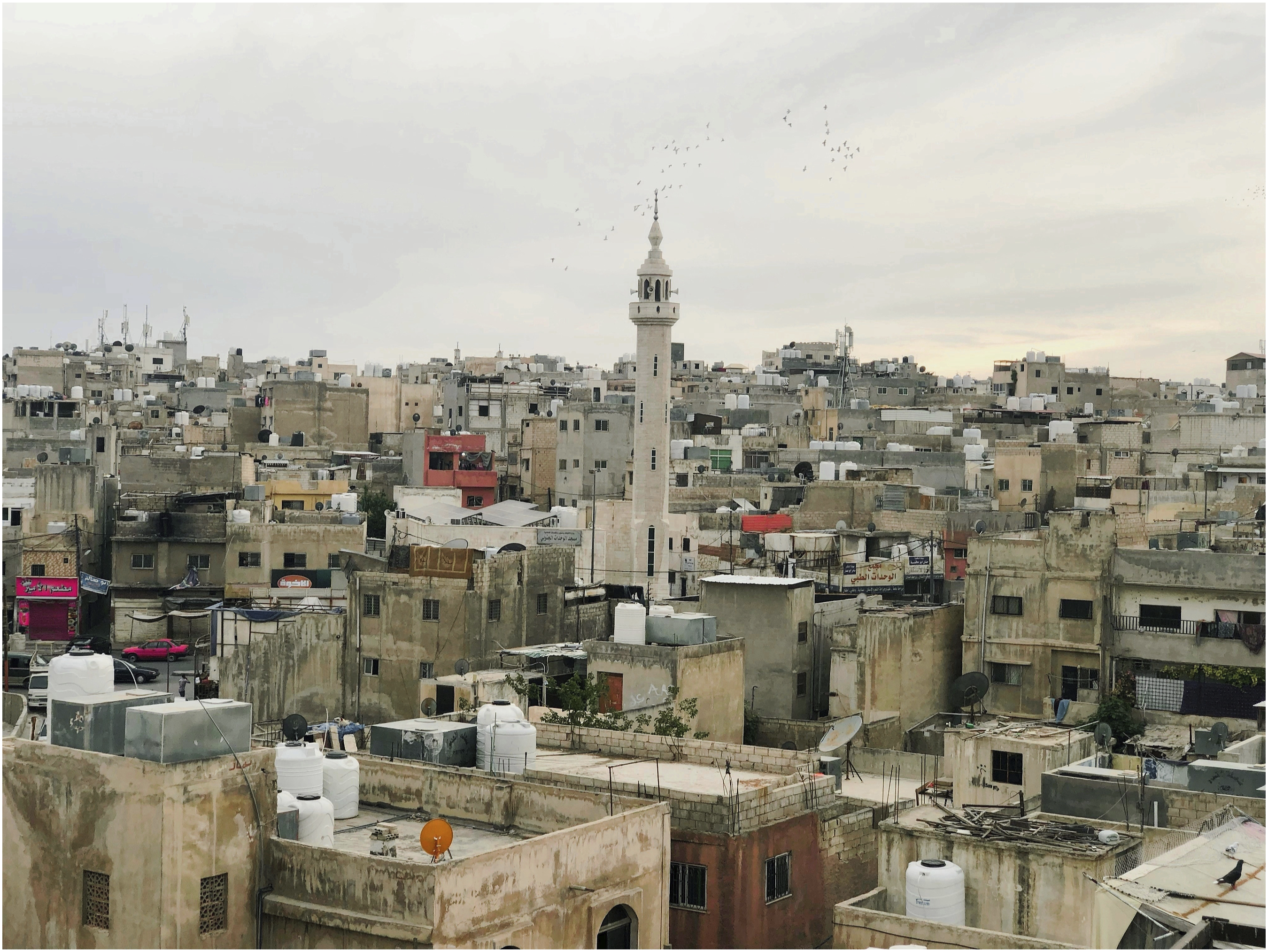
Eyes, everywhere: my own experience of moving in the camp
Reflecting on my own experience of visiting the camp as a female researcher for 3 years, I did understand what the younger female inhabitants meant when they described their movement patterns in the camp. A female inhabitant did have to avoid collisions and certain hotspots for her own safety. The remarkable thing was that, according to Omar, it was not likely for anyone to harass me in the camp because I was seen walking around with him. For that, the inhabitants knew that they cannot bother me because I am an acquaintance of his, under his protection.
I wanted to explain to him that this was not exactly the definition of a safe neighborhood, because I was still under the protection of a man, from other men, but I did not. He also added that this safety shield worked in other camps as well, he just needed to spread out the word that this new visitor, me, was someone he knew, and no one would dare bother me. It was like a social contract between camp communities. When I told him that I did not experience much harassment before having known him or before gaining the protection of his safety shield, he told me that it might be because
I was easy to spot as an outsider and that my camera I was carrying around my neck gave me the appearance of a journalist or a state official or a social worker.
No one wanted to get in trouble with someone of that status. With time, and after a number of visits. I realized that Omar was right. The camp inhabitants knew that I was an outsider, I realized that when I noticed how closely observed I was when I walked around the camp, especially the deeper I went into the residential neighborhoods and away from the commercial streets. It made sense for an outsider to be shopping in one of the markets, but it was unusual for an outsider to be wandering in the residential neighborhoods, especially with a camera.
There, eyes followed me everywhere. Stacked eyes, divided vertically along windows, and horizontally, along entrances and streets. Eyes in the balconies, eyes behind curtains, eyes in front of shops. I noticed how aware the camp inhabitants were of their surroundings, quickly noticing movement, activity, and outsiders from meters away. Just like I was observed during the focus groups, I was also closely observed on the streets, framed and inspected. The camera did play a role in attracting attention.
“What are you photographing? Take a photo of us while you are here!”
“Who are you? What are you doing?”
“Are you a reporter? Who do you work with? Why are you here?”
“Photograph me! Photograph me!”
These were some of the phrases that I got used to hearing every time I walked around the camp. I also got used to kids following me around asking me to take photos of them, they would also call their siblings and friends to join for a group photo.
Among the things that I got to experience during my walks around the camp were the different sounds, smells, colors and textures that characterized the different neighborhoods of the camp. I enjoyed walking between residential allies trying to guess what families were having for lunch, relying on the cooking smells that escaped small windows. Sound also traveled more easily in residential neighborhoods, with intimate family conversations easily heard on the streets. The compactness of the buildings almost dismantled the walls that separated the units from one another, turning some neighborhoods to what felt like one big space that different families unwillingly shared.
Smell, in particular, was a significant way of knowing and identifying the camp, coming up in a number of encounters. Describing her sense of attachment to the camp, a woman from the camp told me in one interview, “On my way back to the camp in the taxi cab, I can easily recognize the smell of the camp as we approach it from elsewhere. Once I smell that smell, I feel myself begin to relax, knowing that I have come back home”.
“How would you describe that smell?” I asked, amused.
“It is a combination of many things, it travels beyond the camp’s neighborhoods and welcomes me home after every trip I make to the city.” She said with a content smile.
Al Wehdat camp was nested in the southeast of the Jordanian capital of Amman, having undergone high levels of socio-spatial integration with the surrounding context since its establishment, but in that friendly woman’s mind, the camp was a distinguished territory from the city, one she recognized through its distinctive smell, which to me sounded more metaphorical then real.
Smell, as a sensory expression of a sense of belonging to place, was mentioned again in a graffiti that I spotted on a rooftop of a building 1 day in the summer of 2021, that said: “The camp will continue to remind us of the smell of Palestine. We will return”.
Figure 5 On that day, I was overwhelmed and tired. I needed to see that graffiti to revive a sense of hope amidst a sea of exhaustion, exhausted buildings and exhausted bodies. Graffiti art in the camp spotted on one of the roofs with the statement: “The camp will continue to remind us of the smell of Palestine. We will return”. Photo by author.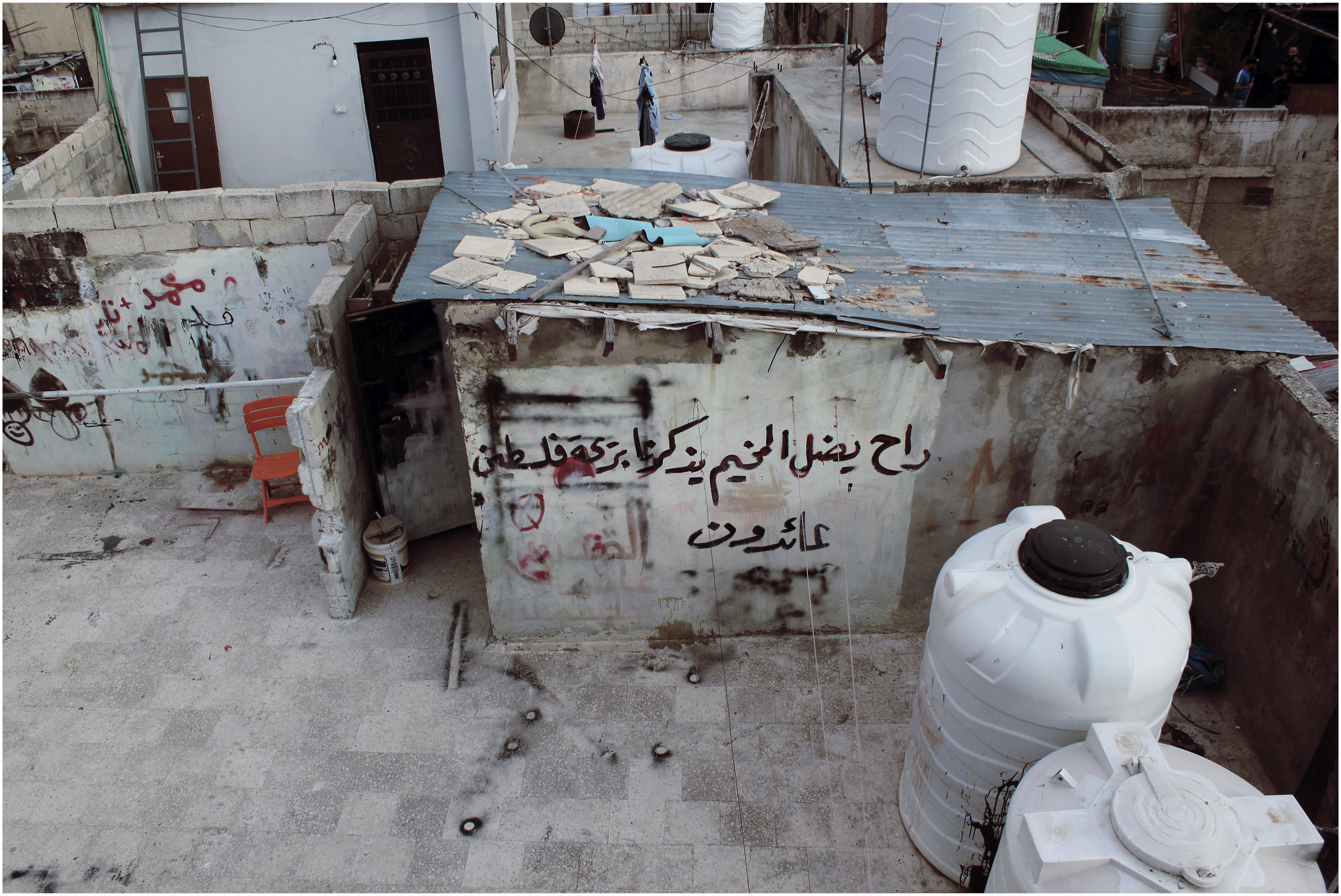
After seeing that graffiti, I was reminded that there was still some truth to that statement, believed by at least one camp inhabitant that cared enough to write it on their roof, big enough for me to see from across, while standing at the neighboring rooftop, at the verge of losing hope.
Conclusion: Visual engagements and epistemological intersections
My research began with me hovering above Al Wehdat camp as a disembodied figure that presumed that position to remain objective, scientific, and apolitical. I had believed that in order to conduct good research, I had to presume a critical distance that necessitated I refrain from using I, and that I remove my body and self from the process of the research’s production.
That distance from the field decreased the further I advanced in my studies, but overstepping it did not happen all at once, and wasn’t always easy nor smooth. I needed to keep repeating that process multiple times. I found myself constantly driven by the need to visit the camp to keep my research in check, using the field as the compass that guided its development and arguments. Some visits to the camp turned out to be significantly harder than others.
The level of intensity and the weight of the visit, what I took home after, and the amount of time I needed to process what I have experienced, what I have seen, heard, smelt, said and touched, varied each time. It was hard for me to accept that in addition to it being a space of resistance and a custodian of the Palestinian refugees’ right of return, the camp was also a space where people felt unsafe, struggled daily to make ends meet, and were suspended in a state of indefinite waiting. The camp was many things, not all of which were positive nor revolutionary. The real challenge was for me to accept the presence of these contradicting realities and accept that the presence of one did not negate the others. Being the one who was putting my research together, I had to keep pushing the boundaries of the camp in my mind so that space was big enough for it to contain the multiplicity that characterized its inhabitants and the everyday experiences they had in it.
In the field, I did feel that it was fair for me to be closely observed, through a series of visual engagements and epistemological intersections, creating an entanglement of what I knew and what the inhabitants knew and what we were learning from each other. I was holding the camera trying to capture frames and stories, putting the people under the spotlight with my questions and discussions and for that it was fair that I too was put under the spotlight. Through my fieldwork and the encounters I had with the inhabiatnts, I was able to trace some of the power structures that were governing the camp and producing its spaces, with their interplay manifesting across different scales and in relation to several social, economic, and political dimensions.
As a researcher, I was more used to being the ones asking questions, observing, framing and collecting data. It was fair for the roles to be reversed, for me to realize that there is an underlying degree of violence accompanying the process of observing and looking, knocking on people’s doors and asking for their time and engagement.
That process of being observed contained a form of visual dominance over the body, whether that practice of observation was done through the human eyes or through the lens of a camera, attempting to squeeze a person inside a frame while shining a metaphorical light in their face to ask.
Through my research in the camp, my observations from the field, being an observer and being observed, after trying to flatten the hierarchal pyramid while adopting a feminist approach, I learnt a few things about Al Wehdat camp and about being in the field and I found some of what I have came searching for, as part of my embodied experiences about the body, gender and the camp.
Footnotes
Declaration of Conflicting Interests
The author(s) declared no potential conflicts of interest with respect to the research, authorship, and/or publication of this article.
Funding
The author(s) disclosed receipt of the following financial support for the research, authorship, and/or publication of this article: This work was supported by the Zeit-Stiftung Ebelin und Gerd Bucerius (Beyond Borders).
