




Abstract
This paper revisits discussions about the pursuit of a singular location for ethnographic research. Citing challenges to the fixity of location, from circulation of people to the impossibility of containing digital worlds, scholars have proposed multi-sited, multi-scalar, multi-modal and multi-sensorial ethnographies, advocating that the researcher ‘follow the actor’. Drawing upon these innovations, this paper traces the affects generated in the process of following the actors as well as the consequent blurring of the division between the researcher and the researched so that they together constitute the category of ‘actors’ who co-produce the field. Using the example of an ethnography with young lower middle class women in Delhi, this paper deploys the researcher’s experience of dislocation or unexpected shuttling in the field to develop ‘dislocation’ as a methodological and analytical strategy for studying marginalisation in the context of socio-economic change by embracing intersubjective relations, affects and partiality of knowledge in ethnographic research.
Keywords
Introduction
From August 2016 to May 2017, I conducted fieldwork in Delhi for a project on the experiences of young women workers in the new economy of urban India. During early days of fieldwork, when I was still in the crucial stage of identifying potential participants, I met Prachi, a 20-year-old worker at a café in South Delhi. Over the next few weeks, I frequented the café and struck up conversations with her. I told her that I am a researcher; I hoped that I could conduct observations in the café with Prachi and her colleagues. However, a couple of months later, Prachi quit her job without any notice. When I made enquiries with her colleagues, I found out that she had resigned over an argument with her manager. Curious about why she had left, I texted Prachi and she suggested that we meet up at the Select City shopping mall.
In the coming months, although no longer in a workplace, Prachi became one of my key contacts. The decision to follow Prachi out of the café into Select City and eventually into Dakshinpuri, her residential neighbourhood, proved to be crucial for my research. However, it came at the cost of ‘dislocating’ my ethnography, disregarding the rules for classic ethnographies of work, whereby researchers embed themselves in workplaces (Brannan et al., 2007; Platt et al., 2013; Smith, 2001). While all ethnographers have to ‘run around’ to varying degrees as they attempt to establish research contacts in early stages of the ethnography, there is still a tendency to seek located-ness. In this paper, I specifically identify ‘dislocation’ as a method for contemporary ethnographies of everyday lives and livelihoods in contexts of change. That is, rather than offer ways to mitigate, I argue for the value of dislocating ethnographies.
The critique of ethnographic location – both a ‘physical space as well as an epistemological space of investigation’ (Berry et al., 2017: 537) – is not new, with ethnographers questioning the extent to which location can be constituted in a singular and coherent manner, particularly in an increasingly globalised and digital world (Abu-Lughod, 2000; Burawoy et al., 2000; Marcus, 1995). Researchers have also identified value in disregarding conventions of ethnographic located-ness when researching contexts of dramatic change, such as migration, social upheavals and natural disasters (Greenhouse et al., 2002; Xiang, 2013) that lead to displacement of people. They have proposed multi-sited (Marcus, 1995), multi-scalar (Xiang, 2013) and multi-modal and multi-sensorial (Pink, 2011) ethnographies, among others, as ways to account for the plurality of actors, activities and sites of action.
In this paper, I extend the challenge to the ethnographic principle of located-ness to the study of non-dramatic, everyday contexts of socio-economic change, whereby people are not necessarily displaced but rather experience the slow attrition of marginalisation. In particular, I think through the scholarship that explores the uncertainty of meaning-making among young people living on the margins of neoliberal development in the Global South (Auyero, 2012; Jeffrey, 2010; Mains, 2007). Further, rather than adopt the ‘multi’ approach (multi-sited, multi-modal and multi-scalar), I suggest ‘dislocation’ as a strategy that captures not merely the multiplicity of locations but also the affects circulating in the ethnographic field. As such, my argument for practicing dislocation as a method not only challenges the fixedness of ethnographic location it also offers a way to empathise with and analyse the everyday experiences of those marginalised in socio-economic change.
Drawing upon my research with young women in the new economy of Delhi, I show that ‘dislocation’ is an appropriate affective metaphor to capture such disruptions. Dislocation may imply displacement, getting lost and not knowing. Following participants at multiple locations as they search for meaning in their lives may generate a similar bewilderment among researchers. I argue for the value of delving into such research dislocation drawing upon feminist methodological emphasis on recognising partiality and vulnerability of knowledge as ethical research practice (Gunaratnam and Hamilton, 2017; Page, 2017; Visweswaran, 1994). Thus, this paper brings disparate sets of literature – on ethnographic practice, feminist standpoint theory and youth marginalisation in the Global South – into dialogue with one another to offer ‘dislocation’ as an innovative ethnographic strategy.
The paper is structured as follows – I first discuss the issue of ‘location’ in ethnographies, emphasising that the ‘field’ is, rather than being pre-determined, generated through the process of research. Next, I draw upon feminist research methodology, in particular feminist standpoint theory, to explore the field as comprised of not only the locations of the ‘researched’ but as produced through intersubjective practices of various actors, including the researcher. Deploying this understanding of the field as a product of the research, I offer the example of my ethnography with young women workers in the service economy of Delhi, India. I show how, as a researcher, I initially attempted to establish access to specific sites. However, in following my respondents, my ‘ethnographic commute’ (Akdeniz, 2019) took me from one location to another. These ‘dislocations’ were significant for understanding young women’s experiences of navigating emerging work and family dynamics in the context of rapid socio-economic change. I conclude by offering lessons from my retrospective reflections on engagement with dislocation as a method and analysis for ethnographies of change.
The role of location in ethnographies
If repudiation of its colonial roots was the first significant conjecture in the revision of ethnographic methods, the recognition of dispersal of ‘location’ has been the second one. Given the shape of the contemporary world – global flow of capital, displacement of people and circulation of cultures – the move from intense single-site studies to expansive multi-sited ethnographies is only a natural one. More recently, the limits of ethnographies have been tested by scholars studying the media or the digital – the dispersed nature of these studies makes it impossible to contain them in a singular site (Abu-Lughod, 2000; Burawoy et al., 2000). Whereas previously ethnographies may have been dictated by the fetish of ‘…confinement of fieldwork, the enclosure of the village, the isolation of the tribe’ (Burawoy et al., 2000: 1), researchers now increasingly highlight the need to follow ‘the circulation of cultural meanings, objects and identities in diffuse time-space’ (Marcus, 1995: 96) across multiple sites.
It is then compelling to understand the ‘field’, spanning various sites, not as a given but as constituted through the research process. Gupta and Ferguson (1997) challenge the taken-for-granted space of the ‘field’ that assumes the fixedness of ‘culture’ and ‘people’ in specific locations, whereby the Other to be observed is sedentary, ‘waiting to be observed and written’ (Gupta and Ferguson, 1997: 102), while the researcher is a mobile observer, usually going ‘elsewhere’ to go to the ‘field’ (Gupta and Ferguson, 1997: 108) (also see, Appadurai, 1996). Indeed, it ‘bespeaks a world that all the time stays in place and is wandered across, mapped, extracted from and calibrated by privileged groups of men’ (Gunaratnam and Hamilton, 2017: 2). Further, the fixedness of the field is detrimental to studies of social, economic and political transformations that are characterised by circulation of people, objects and ideas.
A number of sociologists and anthropologists offer alternative approaches to research that account for such circulations. Touraine (1980) and Latour (2005), for example, emphasise ‘society’ as something that is produced, rather than pre-existing, leading to calls to drop the concept of society altogether. Through the ‘actor network theory’, Latour (2005) proposes a sociology of associations, whereby the researcher ‘follows the actor’ and Touraine (1980) suggests following the contexts and relations important to the actors. Similarly, in his often-cited paper on multi-sited ethnographies, Marcus (1995) identifies the various ‘objects’ that a researcher could follow – people, things, metaphors, plot, biography and conflict. More recently, ethnographers of migration have made a compelling case for ethnographies that redirect attention from location to scale. Addressing the question of ‘how multi-sited is multi-sited enough?’ Xiang (2013: 284) proposes multi-scalar ethnographies, whereby scale ‘[provides] us with a vantage point to understand how multi-sited connections actually work, and what the sites mean to each other’. Similarly, advocating for the role of the ethnographer as apprentice, Pink (2011: 270) encourages ethnographic engagement through various modes and senses (multi-modal and multi-sensorial ethnographies) to ‘[seek] routes to understanding the experiences and meanings of other people’s lives through different variations of being with, and doing things with them’.
I build upon these ethnographic experiments, drawing attention to the need for fuller engagement with the (dis) locations of the researcher.1 Researchers may encounter mobilities of various kinds and intensities – a neighbourhood gentrified over the last 5 years, a slum dwelling bulldozed in a day, gradual trickling away of educated youth from rural to urban areas, a military coup and so on. Here I am most interested in the study of contexts where researchers do not anticipate the need for multi-sited or multi-scalar ethnographies. For example, a migration researcher would expect to move from one location to another in the process of pursuing actors in the field. But in scenarios where there is no prior indication of the need for multi-site and multi-scale fieldwork, how do researchers engage with unexpected mobility? Further, what are the intersections between the dislocations of the researcher and dislocations of the researched? I suggest that it is not adequate to merely ‘follow the actor’. Rather, critical engagement with change requires attention to the affective registers of all the actors in the research, whereby the category ‘actors’ includes not only the respondents but also the ethnographer. In other words, it requires openness to processes of co-constitution of affect in the field. In the following section, I borrow from feminist methodological perspectives on location to parse out the significance of affects in the field for processes of knowledge production.
Ethnography as a journey into the unknown
The recognition of the ethnographer as an actor in research has been a central concern in feminist research methodologies. Feminist standpoint theory, in particular, emphasises the role of social and political locations of the researcher and the researched in the production of knowledge (Collins, 1990; Harding, 2004). This understanding helps to conceptualise the field not just as an amalgamation of multiple sites but as a collective generated through research sites, researcher and research respondents. The field as a synthesis of physical, social and cultural locations further destabilises the conventional ethnographic pursuit of ‘complete’ knowledge of a single site (Abu-Lughod, 2000). Rather than an erasure of location, feminist methodologies call for careful engagement with and reflection on the various locations through and at which research is conducted. They further contest the assumption of the mobile and objective researcher and fixed and particular subjects, compelling researchers to conduct research in a manner that accounts for their own position, its relation to that of their respondents and the implications of such power structures for the method and analysis of the research.
Drawing upon feminist standpoint theory, researchers seek to critically engage with the knowledge generated by their respondents, rather than impose pre-conceived frameworks upon their lives. In other words, rather than confining respondents to the role of ‘subjects’ and their narratives to the category of ‘data’, feminist researchers understand that the respondents are the ‘true experts on their life experiences’ (Sosulski et al., 2010: 36). Recognition of this expertise leads to a process of knowledge exchange rather than knowledge extraction. It may allow the respondents, as Cairns (2013) notes, to raise questions about the research location, asking ‘why here, why now’. In responding to such crucial questions over an extended period of time, the ethnographer may reflect on the shifts in their own location within research practice, highlighting the intersubjective nature of fieldwork (Cairns, 2013; Finlay, 2002). The recognition of intersubjective practices in the production of the field offers a way to overcome the divide between the researcher and the researched in actor-centric approaches.
While ethnographers can begin research with the acknowledgement that they are implicated in the process, insights into how the researcher is part of the story may only unfold in and through the process of conducting research. As Behar (2003: 24) writes, ‘Curiously, in these situations, you yourself, the knower, didn’t know fully what you knew until you wrote it down, until you told the story with you yourself included in it.’ This drawn-out process of knowledge generation, whereby the researcher is attentive to their location while also critically engaging with the location of their respondents, implies that the researcher cannot pre-emptively know the field and indeed ‘Isn’t that the reason why we still go to the field – even as we question where the field is located – in the 21st century? We go to find the stories we didn’t know we were looking for in the first place’ (Behar, 2003: 16). In contrast to ethnographic tradition of carefully and systematically documenting the minutiae of the lives of the ‘unknown’ in order to make them knowable, feminist practice finds value in ‘a holding open of interpretation and staying with not knowing…The partiality of knowledge production in this regard is simultaneously recognised and respected as an ethical stance, while all the time it is also imposed by conditions outside of the researcher’s control’ (Gunaratnam and Hamilton, 2017: 9; also see, Page, 2017).
The experience of ‘not knowing’ is one that most ethnographers are familiar with, but it is commonly associated with early days of fieldwork, with perseverance ultimately rewarding the researcher with knowledge. However, not knowing can also be an enduring experience of ethnographic research, particularly in settings that may be undergoing change. How does one shape a study of people who are ‘…in the midst of their efforts to manage their everyday lives against the palpable transformation of the world that they thought they knew but now feel pressed to reassess through the lens of their everyday circumstances?’ (Greenhouse, 2002: 3). Further, how does the researcher reassess the framework of their study when not knowing is the dominant theme of fieldwork? Ethnographers have attempted to translate their respondents’ experiences of feeling lost into concepts that signify spatial and temporal disruption, such as, boredom (Mains, 2007), timepass (Jeffrey, 2010), waiting (Auyero, 2012) and killing time (Musharbash, 2007).
Based on his long-term ethnography with young men in the small town of Meerut in India, Jeffrey (2010) uses the term ‘timepass’ to connote the politics of waiting that his respondents engaged in. Otherwise understood as doing nothing, whiling away time or hanging around, Jeffrey (2010) elevates his respondents’ use of the term ‘timepass’ to understand the conditions of their existence in a neoliberal context that promised them but did not deliver opportunities to improve their lives. By closely following the feelings of worthlessness and despair among his respondents, Jeffrey (2010) is able to offer insights into their strategies to make meaning of their lives. Importantly, the respondents’ feelings of worthlessness and despair were replicated in Jeffrey’s (2010: 29) fieldwork experience – I often experienced fieldwork not as the steady accretion of perspectives and information but as long periods of relative inertia…My fieldwork sometimes felt like a species of waiting in the double sense that I had to spend long periods in enforced idleness and in that my research seemed slow relative to that of many colleagues in the UK and US who are not carrying out long-term ethnographic studies.
These feelings of ineptitude among ethnographers are not uncommon but there is a natural tendency to wish them away in the search for knowledge. In this paper, I ask – what do we lose by imposing a sense of coherence and completeness on our fieldwork? Jeffrey (2010) had to be immersed in and led by the dislocation of his respondents through long phases of idleness and inertia to be able to offer insights into youth culture and politics. The movement of his respondents – whether from one form of activity to another or into inactivity – are distinct from the mobility anticipated in contexts of migration or natural disasters or political transformation. Rather, such movements are undramatic and unpredictable; hence, they require flexible and innovative methods of study. I explore the value of inhabiting the affective registers of our respondents as they search for and attempt to make meaning in and of their lives. I also reflect on how this may blur the boundaries between the researcher and the researched and challenge the role of the researcher as the sole expert engaged in knowledge production.
Ethnography of contemporary socio-economic change in Delhi, India
Following the economic restructuring of the 1990s, which opened up the Indian economy to global trade, the country has experienced significant socio-economic change. The terms ‘post-liberalisation’ and ‘post-1990’ are now commonly used as shorthand to refer to the ‘new’ India that has rejected state-led development in favour of market efficiency, heralding India and young Indians at the global stage (Fernandes, 2000; Lukose, 2009). This growth, led by the service sector, is credited with the emergence and expansion of a ‘New Middle Class’. However, various economists, sociologists, geographers and anthropologists have highlighted the discrepancies between the imagination/discourse and realities of the so-called New Middle Class (see, e.g. Baviskar and Ray, 2012; Desai, 2001; Dickey, 2012; Fernandes, 2006; Ganguly-Scrase and Scrase, 2009; Nayyar, 2017). The unevenness of development has widened inequalities, further marginalising those already at the margins, unable to reap the benefits of the growth of the new economy, leading to significant distinction between the secure middle class and those in the tentative category of lower middle class. Claims about the emergence and expansion of a New Middle Class, as such, may refer to changing social, economic and cultural habits, particularly of the youth, but do not reflect the precarious nature of lower middle class livelihoods.
In the context of the ‘modernisation’ of India, young women are particularly significant both as symbol and resource. Ganguly-Scrase (2003: 553–554) notes that ‘Public visibility of women and their participation in employment have occupied centre stage in…postcolonial developmentalist narratives of nation building in India’ as well as become a crucial marker of emerging middle class identity (also see Oza, 2006; Radhakrishnan, 2011). Further, young women may serve as latent capital for the bourgeoning service economy.2 But despite the desirability of women in employment, statistics raise concern over low and even declining rate of women’s participation in the labour force.3 Informed by but recognising the limitations of statistical analyses of women’s work, namely, that these fail to capture the complexities of patterns of and decision-making over employment (Mazumdar and Neetha, 2011; Sudarshan and Bhattacharya, 2008), I planned to conduct an ethnography of young women’s experiences in the new economy of urban India. In particular, I was interested in understanding how young lower middle class women,4 who may be the first in their families to enter work in the new economy, navigate this rapidly changing scenario. I hoped that the study would offer insights into emerging gendered and classed subjectivities in post-liberalisation urban India.
Initial locations
I developed initial plans for the ethnography while based in a university in the UK. Ensconced in an environment far away from the field, I decided to situate the ethnography in Delhi. My selection of this first location was based on both expectations of rich data collection as well as route of access. As the capital city, Delhi offers a sprawling urban landscape, which in recent years has been the site of extensive discourse on gender and class, particularly following the gang rape of a young woman, Jyoti, in 2012 (Raychowdhry, 2013). Further, in Delhi, I had the advantage of shared language – Hindi – even though it was a city I was previously not intimate with. Recognising the challenges of setting out to research a tentative class category – lower middle class – I attempted to narrow down the field by identifying a single site to base myself in. Unfamiliar with the city of Delhi, I sought advice from colleagues who knew the city well, and decided to explore access in the neighbourhood of Khirki in South Delhi.
Khirki Extension is a mixed neighbourhood – its residents include immigrants from Afghanistan, Uganda, Somalia, students and workers from north eastern states of India, as well as ‘locals’ who have resided there for several generations. Khirki occupies a prime spot in South Delhi, opposite the gleaming and expansive Select Citywalk, Metropolitan and DLF malls. Although it was relatively easy to gain initial access into Khirki through arts and non-government organisations, it was much more difficult to get access to workplaces in its small-scale economy. After failed attempts to gain access to a beauty parlour and a day care centre in Khirki, I decided to cast my net wider.
Without entirely abandoning Khirki, but with a clearer focus on employment in the new economy, I reoriented my efforts to secure a site by identifying workplaces that are part of the growing service economy in the city. I established contact at the office of a cab company that trains and employs women drivers. I started visiting them at lunch times once or twice a week, getting to know the women drivers, many of whom were married and had children. Alongside, I also started frequenting a café, not far from the cab office. On my first day in the café, a young worker – Sheela – came up to me and said – ‘Ma’am, you’re very nice, come again tomorrow.’ And so I did—through my regular visits to the café, I got to know Sheela and Prachi, both unmarried, thus offering me a different ‘sample’ as compared to the mostly married women I had been in touch with until then. I became interested in how these young women were acquiring education and training to enter café employment, which is typical of work in the new economy, requiring skills in English speaking, customer management, retail management, etc. I understood this to be the next turning point in my fieldwork – by situating myself in a café, I could conduct non-participant observation, eventually expanding access to workers in other cafés in South Delhi. However, this visage of ethnographic coherence was temporary.
As noted in the introduction to this paper, Prachi quit work a couple of months after I first met her. Following her impulsive resignation, over several meetings in the food court of Select City mall, Prachi shared the frustrations she had felt at work, including low pay, long working hours and disrespectful treatment from the manager. She attributed the manager’s condescending attitude to his judgement of her as a ‘working woman’ whose family has sent her to work because of financial difficulties. She suggested that he expected her to ‘work silently’, assuming that the work was indispensable for her, but not the other way around. Prachi mentioned several friends who had similarly quit work in the recent past, moving from call centres to cafés to offices, without any significant pay rise. This was the next critical point of making decisions about location – I could either persevere with situating my study in the café, carrying out observations with the employees who come and go, or I could follow Prachi and her friends’ lives which would take me into unknown locations, or perhaps simply into the unknown. This question of location is, of course, not merely an issue of where I would be physically based but one of determining analytical significance, and therefore, methods for the research. While confining my research to the café (or other workplaces for that matter) may have given me insights into the dynamics of the new workplaces of urban India, it would have limited my interaction with the employees who may work there for only a short period of time. Following workers’ lives, on the other hand, could offer an understanding of lived experiences in the new economy of urban India. The choice of location, as such, could have generated two very different kinds of fields, and thus, knowledge.
Dislocations of the researched
Prachi offered to introduce me to her friends in Dakshinpuri, her residential neighbourhood. Simultaneously, I gained access to literacy classes for young women run by a non-government organisation in Khanpur, another residential neighbourhood in South Delhi, adjacent to Dakshinpuri. Aradhna, a 30 year old, who ran these classes, helped to facilitate my contact with some young women in the area. Together, Khanpur and Dakshinpuri comprise a low-income area in South Delhi, functioning as ‘service neighbourhoods’ by providing labour for surrounding high income neighbourhoods of South Delhi. In this manner, through varied efforts, I was finally able to establish an ethnographic group of young women, unmarried, between the ages of 19 and 23 years, living with their families in Dakshinpuri and Khanpur. However, I did not abandon my earlier leads in Khirki and at the cab office. In the later stages of fieldwork, I interviewed some women drivers. I also visited my early contacts in their residential neighbourhoods of Sarita Vihar, Maidangarhi and Badarpur, where they introduced me to their networks and enabled further interviews with women, most of whom were working as community workers or teachers. The insights from these interviews complemented the core ethnography with young women in Dakshinpuri and Khanpur (henceforth, respondents for this research), as illustrated in Figure 1.
At the time of first meetings, all of my respondents were employed or had been employed in the last 6 months in the private service sector across cafés, call centres, malls and offices. They had managed to secure this employment through investment into higher levels of education than that of the previous generation in their families. All of them had studied to Class XII (equivalent to pre-university level) and most were enrolled in undergraduate study through distance learning programmes at Delhi University and IGNOU (Indira Gandhi National Open University). They had further gained skills in computers, data management and financial software, English speaking, retail and customer management through short-term courses at skills training centres (also see Nambiar, 2013). Following concerted efforts to become service professionals, these young women were able to secure low-level service employment, which entailed long working hours at low pay. Their salaries, while carrying the reassurance of monthly income, were between Rs. 8000 and 12,000 (GBP 80-120) per month, close to minimum wage for workers in Delhi at the time. My ethnographic locations roughly indicated on a map of South Delhi.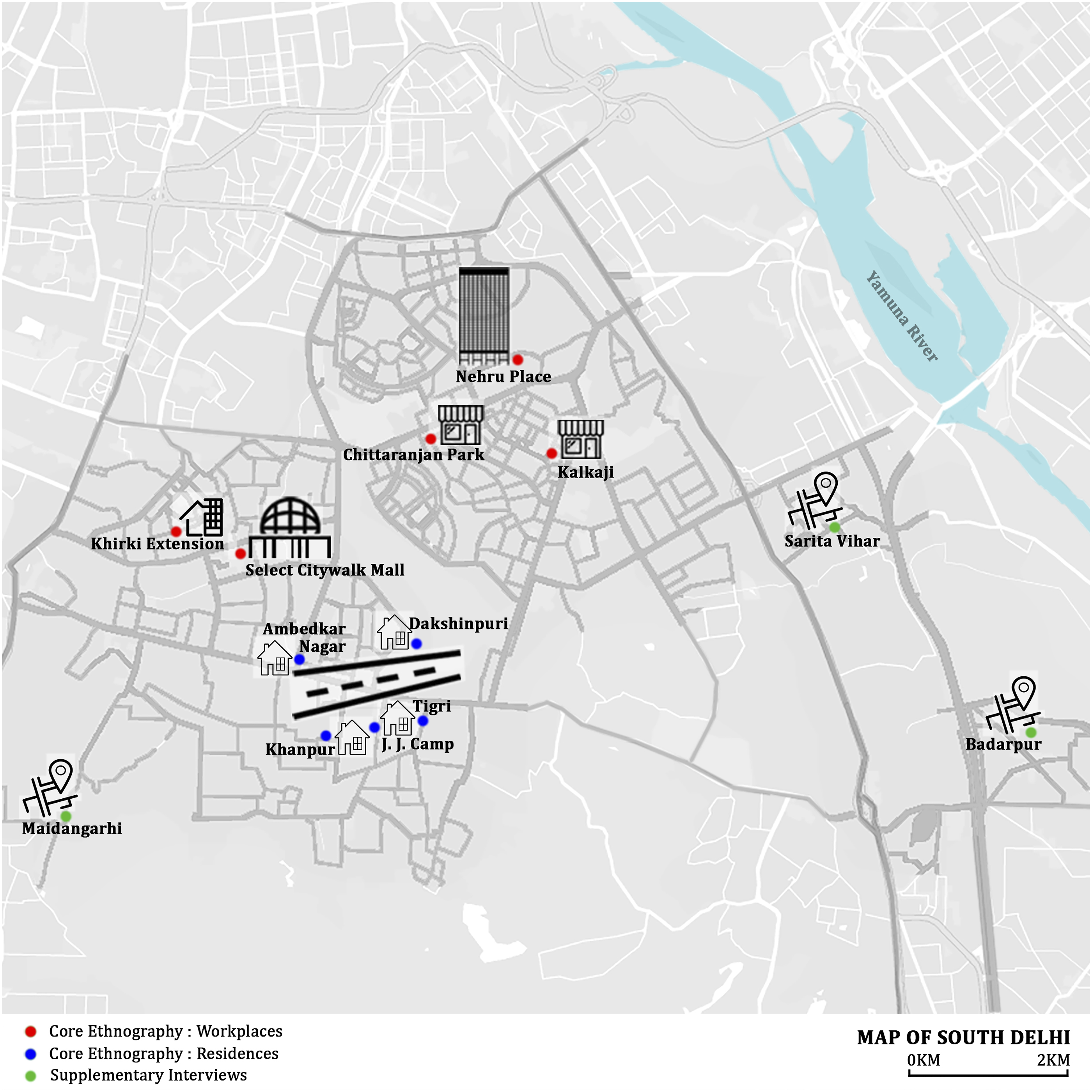
My interactions with this group over time confirmed the pattern that Prachi had suggested – young women did not stay in one job for very long. Instead, they switched every few months from call centres to cafés to offices, thus, not gaining specialism in any particular field. These jobs were interspersed with periods of unemployment; they invested this time into studies and skills training as well as fulfilling familial and domestic obligations. In this weaving in and out of employment, education and domesticity, young women suggested they were marginalised in their workplaces as well as families by virtue of their gender and class. They contrasted their circumstances against their managers, the majority of whom were men, from secure middle class backgrounds, earning higher salaries. They did not entertain the possibility of progressing to managerial levels since they had rarely seen women managers in their workplaces. Within families, even though they tried to resist domesticity, they were compelled into household chores and ‘status-production’ work or ‘activities explicitly linked to family status that require a woman’s time, energy and organisational skills’ (Papanek, 1979: 778), such as preparation of feasts, participation in religious and social ceremonies, visits to paternal villages, etc.
In this context, they tended resignations impulsively in response to a range of issues – argument with a colleague or manager over work tasks, manager refusing time-off for festivals, weddings, or sickness and in some cases, sexual harassment. In the absence of other avenues of resistance, such as trade unions or formal complaints, they registered protest against unfair treatment by repudiating employment. Importantly, they asserted their resignations as a way to establish their respectability (Islam, 2021). In some cases, this briefly afforded them the upper hand, with managers requesting them to return to work. But it was eventually young women who felt the impact of their loss of employment, not only in the loss of income but also in the loss of mobility. Without employment, they did not have sufficient reason to provide to their families to go out (see Phadke et al., 2011 on gendered loitering in urban India). As such, the sites they navigated changed based on their employment status. These sites were closely connected to their subjective locations – through work, they asserted themselves as urban professional women, whereas in their periods of unemployment, they were compelled into increased participation in housework. They complained about having to ‘stay at home’, arguing that they did not study to become ‘just housewives’, posing employment as an alternative to domesticity (Islam, 2020).
As neophyte workers in the bourgeoning service economy of Delhi, my respondents were straddling the spaces of home and work, navigating the evolving dynamics in their workplaces and with their families. Although work offered them an alternative to domesticity, the conditions were poor and frustrating, with little hope for career progression. Further, while they asserted themselves as urban professional women, they were also conscious of social aspersions cast on ‘working women’ from their backgrounds (see Dhawan, 2010; Patel, 2010; Vijayakumar, 2013). They sought to distance themselves from homes (and, thus, homeliness) but were not able to establish belonging in workplaces (and, thus, as professionals) either. This non-belonging manifested in the form of ‘dislocations’ – through their ambivalent movements between home and work, they expressed dissatisfaction with their lives, which did not match up the investments they made into their education and training.
Dislocations of the researcher
As a researcher, I started out with awareness that while I shared some features with my respondents – proximity in age, gender, language and nationality – we were separated by several degrees on account of my higher class position, evident through my appearance, intonations and, particularly, my residence in the UK. My initial respondents and I already entered a relation of power at our first meetings. At the café, I was a customer who could buy the coffee that the café workers could not afford. The imbalance in power is strongly reflected in the way all of my respondents addressed (and continue to address) me – ‘Ma’am’, and occasionally, ‘London wali Ma’am’ or the ‘Ma’am from London’. Acknowledging the impossibility of erasing power differentials in the research process (Oakley, 2016), I was respectful of my respondents’ time and space. I asked them if, when, and where they would like to meet. After I had met some of Prachi’s contacts and invitations to homes were still not forthcoming, I became concerned that my fieldwork was neither able to follow the prescriptions of ethnographies of workplaces nor able to access women’s ‘inner’ or domestic spaces (Donner, 2012).
My respondents preferred to meet at sites of leisure – malls, parks and monuments. Prachi told me that it would help if we planned these meetings as ‘outings’, that is, as time for leisure for young women. Over the next few months, these spaces figured prominently in the ‘field’. As we spent time together, they talked about how they like pizzas, how they go to parks on dates, how they enjoy taking ‘selfies’ and so on. Their descriptions of these distinctly urban and modern activities assigned these spaces significance in terms of allowing them time away from home, and thus, from their families. As such, these sites were closely related to my respondents’ emerging subjectivities as modern urban women. However, suggesting that the decision about sites was made by my respondents and I simply ‘followed the actors’ would be misleading. Meeting me – a young female researcher – provided young women a reason to stay out after work or to step out on Sundays, without objection from their families. Moreover, at least initially, my respondents may have been conscious of our class difference in the same way as I was, and thus, we were reluctant to invite each other into the intimate spaces of our homes. It is, therefore, important to recognise that the field is a production of intersubjective practices, rather than generated only through the respondents’ strategies.
Looping through these leisure sites that were different and distant from my respondents’ homes, I spent time in their residential neighbourhoods only in the final stages of my fieldwork. This was partly a result of my respondents becoming more comfortable with introducing me to their families. But it was also a consequence of some of my respondents becoming unemployed and, therefore, spending more time in the vicinity of their neighbourhoods even as they expressed dislike for neighbourhood culture of gossip and idleness. In this manner, I had initially sought to locate myself in a neighbourhood – Khirki, then moved to workplaces – café and cab office, and was ultimately drawn back into residential neighbourhoods – Khanpur and Dakshinpuri. But this did not grant me straightforward access into the respondents’ homes. Instead, together with my respondents, I visited markets, food stalls and skills training centres in these neighbourhoods, eventually getting invitations to some of their homes. All this while, I felt anxious that I had only managed to gain partial understanding of these young women’s worlds – I had seen them briefly at work, I had spent time with them hanging out and I had walked around their neighbourhoods. In other words, I had not been able to situate myself in a location for long enough to completely understand it.
It was through writing that I retrospectively constructed the ‘field’ of research, taking into account the various physical and subjective locations I had to navigate – my own locations and the locations of my respondents. Through this retrospective reflection, I realised that my sense of incoherence during fieldwork emerged through my respondents’ efforts to make meaning in and of their lives in the midst of socio-economic change, whereby even as they adapt to the changing needs of the market, family structures remain relatively rigid. Indeed, my journey between workplaces, neighbourhoods and leisure spots mirrored young women’s journeys between and intermittent participation in their work and homes, as they navigated a rapidly changing economic scenario in which the promise of improved lives is alluring but elusive. As the young women felt frustration and despair at their inability to ‘settle’ into a life path, always traversing from one livelihood strategy to another, so I felt that I did not have control over my fieldwork, commuting from one site to another. This is not to suggest that my fieldwork experience is equivalent to young women’s life experiences, but that a researcher may absorb and reflect what is best described as an affective sense of their respondents’ everyday lives.
Dislocation: Method and analysis
As illustrated above, young women’s movement from employment to unemployment, education and domesticity was unexpected for me. I had aimed to conduct a study of young women’s experiences of the new economy, with focus on the emerging work I expected them to be engaged in. While this expectation was not ill-informed, and indeed, I selected respondents who were engaged in the new economy, I had to adapt my research strategies when I encountered young women’s frequent mobility from one kind of activity to another in search for better futures. Interestingly, distinct from Xiang (2013) ethnographies which followed actors’ strategies that generated capacity, young women themselves described their mobility as incapacitating since it implied that they could not build careers, gain progression and settle into a life. That is, their movement from one location to another, even if it appeared to be wilful, was compelled by a set of frustrating circumstances. Further, these locations were more than physical in that these sites were closely connected to their subjectivities. The travel between neighbourhoods, workplaces and leisure sites was reflected in their distancing from the role of ‘housewives’, inability to fully inhabit the status of ‘professionals’ in their workplaces, and tentative forays into urban and modern consumptive leisure.
Following young women across various sites was a methodological choice but it also had analytical implications. Rather than retaining a focus on work in the workplaces, I argue for a broader conceptualisation of ‘labouring lives’, which encompasses young women’s multiple forms of labour – pursuing education and training, participating in domestic and status-production work and engaging in employment – for sustenance of their livelihoods. Scully (2016) argues that with increasing precariousness of waged work, households acquire importance as a site for aggregation of incomes and livelihoods. Indeed, historically women have had a precarious relation to waged employment (Betti, 2016; Federici, 2006). Even so, contemporary scholarship on precarity is largely restricted to various forms of paid work (e.g., Kalleberg, 2009; Standing, 2011). Following women’s intermittent and frequent exits from employment, I demonstrate the need to modify approaches to contemporary studies of work to understand labouring lives, rather than employment in isolation. In this, I extend the work of social reproduction theorists, who suggest that ‘…in fact it is waged work that serves reproductive labour and reproductive labour that is the over-arching mode of all economic activity’ (Bhattacharya, 2018: 52).
I understand these young women’s movements as a series of ‘dislocations’, distinct from migration or mobility, which imply a certain degree of capacity, intention, and progress. Dislocation is unexpected and is not necessarily a preferred strategy for the respondents. This is not to eliminate agency from the respondents’ decisions, rather dislocation provides a way to encapsulate respondents’ own reflections on their movements. Similarly, a researcher may encounter a sense of being lost in the field and, contrary to conventional prescriptions of ethnography, may not be rewarded with the unknown becoming known at the end of the research process. As a research strategy, engaging with, rather than mitigating dislocation, offers researchers a way to be flexible in adapting to the contingencies of the field. This is not to suggest that a researcher can simply do away with anxieties of fieldwork (Berry et al., 2017; Pollard, 2009) by being open to the possibility of not-knowing. Rather, by drawing upon dislocations in the field, researchers can reflect on their own ‘sense’ that guides research decisions while ‘holding open of interpretation’ (Gunaratnam and Hamilton, 2017: 9). Finally, the strategy of engaging with ‘dislocation’ provides a bridge between respondents and the researcher in understanding the field as produced through multi-dimensional intersubjective practices, rather than simply as a conglomeration of multiple actors, sites or modes.
Conclusion: From locations to dislocations
This paper discusses the issue of ‘location’ in ethnographies, particularly engaging with proposals for multi-sited, multi-scalar, multi-modal and multi-sensorial ethnographies that account for plurality of actors, actions and activities. Advocating for actor-centric approaches to research, these proposals challenge the ethnographic ideal of the researcher establishing themselves in a single location for the pursuit of deep and complete knowledge. Instead they demonstrate the value of ethnographic research in multiple locations by offering examples of insights generated through following the actors at different sites and scales, through the use of multiple modes and senses. This paper draws upon these ethnographic experiments but rather than adopt the ‘multi’ strategy that accommodates for multiplicity in the field, it argues for a strategy of ‘dislocation’. The term ‘dislocation’, in its first iteration, refers to unexpected shuttling in the field. As further developed in the paper, ‘dislocation’ is an ethnographic strategy that acknowledges and embraces the co-production of affect and consequent knowledge by various actors, including interlocutors/respondents and ethnographer, in the field. It is a method and analysis for the study of ordinary everyday lives caught amidst socio-economic change.
Through the example of the ethnography with young lower middle class women in the context of rapid socio-economic change in urban India, the paper highlights the heightened need for flexibility for ethnographies in and of the contemporary world. My research exposes the gaps left by ethnographies of work that place a focus on workplaces, neglecting multiple strategies that people engage in to sustain livelihoods. To a certain extent, this could be achieved by actor-centric approaches that compel researchers to traverse multiple locations in following the actors. However, the simple call to ‘follow the actors’ does not account for intersubjective relations in the field that blur the boundaries between the researched and the researcher. Drawing upon my ethnographic experience, I show that the field is generated not only through following the interlocutors/respondents but also by the concurrent decision-making of the ethnographer, qualifying both the researched and the researcher for the category of ‘actors’. As actors co-constitute the ethnographic field, they generate and engage with a range of affects. It is only through (unknowingly at the time) pursuing dislocations that I was able to develop an understanding of young women’s ambivalent meaning-making of their lives vis-à-vis employment, education and domesticity. The strategy of dislocations is as such not only a practice of flexibility in the field but also a frame for analysis of the respondents’ attempts to make meaning in and of their lives in contexts of change.
By building upon feminist methodological practices that place ethical value on partiality of knowledge, this paper offers dislocation as a navigational strategy for ethnographers who find themselves traversing the unknown. The ongoing COVID-19 pandemic has thrown a set of challenges to ethnographic practice, further compelling an engagement with questions of ethnographic locations and access. With restrictions on international travel and meeting people, ethnographers are experimenting with alternative means of doing research, in particular using digital tools, that offer an inroad into ethnographic practices that are critical of ethnography’s colonial and patriarchal roots. In response to current challenges, a manifesto for ‘patchwork ethnography’ (Günel et al., 2020) draws on feminist and decolonial insights to advocate for long-term research commitment that may involve short-term field visits, fragmentary collection of data and varied objects of analyses. The manifesto notes that ethnographic innovations have ‘largely been based on the needs of research subjects’, with little attention to ‘how ethnographic practices are being shaped by researchers’ own lives’ (Günel et al., 2020). While recognising that methodology is commonly constructed, and always narrated, in retrospect, this article outlines the strategy of dislocation with the hope that ethnographers grappling with the circumstances of the COVID-19 pandemic find it useful as a way for developing and articulating the value of such alternative methods. Importantly, in engaging with a revision of ethnographic convention of located-ness that has been critiqued from feminist and decolonial perspectives, dislocation may serve as a long-term strategy for embracing the unknown in response to the uncertainties of ethnographic research.
Footnotes
Declaration of Conflicting Interests
The author declared no potential conflicts of interest with respect to the research, authorship, and/or publication of this article.
Funding
The author disclosed receipt of the following financial support for the research, authorship, and/or publication of this article: This work was supported by the Gates Cambridge Trust.
