




Abstract
Ethnographers’ concerns about institutional ethics review are by now well-known and several hypotheses have been advanced to explain their complaints. Many have highlighted the lack of epistemological fit between ethnographic methods and ethics review paradigms. Others point to the existence of a “victim narrative” and suggest that circulating horror stories are unrepresentative of ethnographers’ experiences, or argue that ethnographers’ complaints disguise a self-interested and un-reflexive desire to avoid oversight. A final explanation suggests that resistance is restricted to an ageing cohort of scholars raised in an era before ethics review became the norm. Drawing on two surveys of ethnographers conducted a decade apart, we conclude that the most convincing explanation for the longstanding “chorus of complaint” is the fundamental epistemological conflict between ethnographic methods and the way ethics review is currently constituted. We conclude that the time has come to radically reframe and restructure ethics review regimes.
Keywords
Introduction
In 2010, the first author attended a Canadian conference aimed at members of the academic community involved in human research ethics – primarily administrators and academic members of ethics review boards. Consisting of a variety of workshops and presentations, the subject matter of such conferences tends to be eclectic, including talks from academics specializing in the area of research ethics, sessions on new national and international policy developments, along with discussions of local activities and initiatives. In a session on the latter topic, one presentation provided an overview of the results of a university survey soliciting opinions on what sort of educational activities researchers would like to see their institution carry out in relation to research ethics. However, it soon became clear that the survey respondents had taken the opportunity to anonymously vent their frustrations with the university’s ethics review process and its emphasis on form over substance.
At the end of the presentation, a dispirited member of the audience commented that the lack of faith in research ethics review on the part of the survey respondents was a real issue for those involved in research ethics administration. “How can we think of ways of dealing with this?” he asked the assembled panel. He concluded with the observation that, “We need to make research ethics about more than research ethics applications.” The point was soon lost in the discussion that followed, with audience members and panelists reassuring each other that it was only a minority of researchers who felt this way. In aid of illustration, an administrator in the audience raised the topic of seat belts. Her grandmother, she noted, refused to wear a safety harness; her son, on the other hand, refused not to wear one. Although she didn’t explicitly spell it out, the implication was clear to the assembled audience: those resistant to ethical oversight were archaic holdovers, and such expressions of frustration and dissent would presumably vanish upon their retirement. The session ended with assurances from the panel that cynicism regarding institutional ethical oversight was limited to a minority of researchers, rather than representing any wider crisis of faith on the part of academics as a whole.
A decade later, the cynicism and rumbles of dissatisfaction have not abated; however, a key change has been a growing recognition of problems with regulation itself on the part of policy makers, including efforts to address longstanding concerns regarding the biomedical orientation of ethics review. For example, in December 2010, Canada’s Interagency Panel on Research Ethics released revised national human ethics research guidelines that aimed to be more social science “friendly,” although the extent to which they have improved the review of social science research is questionable (Bell, 2016). Likewise, in 2015-2017, Australia’s National Health and Medical Research Council undertook to revise the section of its National Statement on Ethical Conduct in Human Research (“the National Statement”) pertaining to qualitative research, convening a working group that included an anthropologist and criminologist as representatives from two disciplines that had heavily criticized previous versions of the National Statement for bias toward clinical and quantitative research. In the US context, the Office of Human Research Protections also revised its Federal Policy for the Protection of Human Subjects (“the Common Rule”) in 2018, partly in response to longstanding criticisms regarding the over-regulation of social and behavioral research, although many social scientists – and anthropologists, in particular – were disappointed with the extent to which the problems with the original legislation have been addressed (Schrag, 2019).
Although these changes are generally viewed as a step in the right direction, the capacity of research ethics bureaucracies to accommodate plural methodologies and epistemologies remains the focus of much debate. Three interconnected hypotheses have been presented to explain the ongoing avalanche of criticism from social scientists in general, and qualitative researchers in particular. First, some suggest that criticisms are based on a tendency to tar all committees with the same brush, regardless of their institutional or national jurisdiction (e.g., Hedgecoe, 2008). Such accounts often draw attention to a “social science victim narrative” (Bosk, 2007: 205; Stark, 2007: 785) and argue that the victimization of social scientists in the review process is more imagined than real. Thus, from this perspective, the horror stories that circulate about some of the more egregious examples of regulatory excess represent exceptions to a process that is otherwise reasonably benign – or at least open to a kind of bottom-up education from researchers about what constitutes appropriate review.
A second explanation (often presented in tandem with the first) is the suspicion that disciplinary critiques of institutional ethics review stem from less-than-noble impulses: namely, researchers’ desire to avoid external scrutiny. For example, discussing sociologists’ objections to ethical oversight, Adam Hedgecoe (2008) writes: My central claim is that traditional sociological discussions of REC [research ethics committee] review have tended to misrepresent what RECs do and how they treat qualitative research… Most importantly, they have over-emphasized the difference between sociologists and other, mainly biomedical, researchers in an attempt to distance sociological research from the need for ethics review. While there are differences between different kinds of research, they are differences of degree, and do not exclude sociologists from the belief underpinning the REC system that, however well intentioned researchers (of whatever kind) are, they are not the best people to decide on the risks and benefits of their research (p. 874).
As Hedgecoe’s comments suggest, such arguments typically hinge on the notion that the differences between research paradigms aren’t significant enough to warrant exclusions for some disciplines or approaches, and that external review prior to research is an important means of ensuring ethical research conduct. Writing specifically about ethnographic sociologists, Charles Bosk (2007) is similarly critical of their “chorus of complaint” regarding institutional ethics review – although he acknowledges the validity of some of the frustrations expressed. In his words, The chorus of complaint has a theoretical tightness and coherence, a surface plausibility that is difficult to disentangle from our shared convictions about the absolute harmlessness of our poking and probing into the lives of others, the purity of our intentions, our belief that ethnographic research provides knowledge not attainable through other methods, and our certainty that oversight has a potential chilling effect upon whatever critical impulse social scientists still possess (Bosk, 2007: 197).
Bosk argues that the complainers often lack self-reflexivity regarding the ethical dangers of ethnographic research, and that at least some of the objections are motivated by a desire to return to a simpler past when “the fetters of the current regime did not exist” (2007: 201).
A third hypothesis assumes that the objections are not merely disciplinary, but generational, with older scholars more likely to be dismissive of the need for ethical oversight based on their nostalgia for an earlier era of “unfettered” research. As the vignette at the beginning of this paper illustrates, this assumption is widespread – although it has been the focus of relatively little study. The primary empirical support can be found in Taylor and Patterson’s (2010) interview-based study of 21 qualitative sociologists in Canada. They found that responses to ethics regulation fell into three primary categories: overt opposition, apparent accommodation, and active engagement, and noted that attitudes were clustered into distinct cohorts that were bunched institutionally, demographically and ideologically. Taylor and Patterson concluded, based on this small sample size, that it was primarily senior male researchers who actively resisted ethics bureaucracies, seeing them as an encroachment on their personal power and academic freedom. Junior women researchers, on the other hand, saw power not in autonomy but in alliances within the institution, and thus advocated working cooperatively with ethics review boards. Thus, Taylor and Patterson argue that orientations towards ethical review are likely to change over time as “the generation of opposers retires and engagers increase in prevalence and power” (p. 181).
In what follows, we are interested in further exploring the “chorus of complaint” that Bosk (2007) identifies amongst ethnographers. Like many of those before us (e.g., Bledsoe et al., 2007; Haggerty, 2004; Lederman, 2006; McMurphy et al., 2013; Simpson, 2011), the arguments we present are informed by our roles as long-term participant observers in the ethics review process: as applicants who have submitted dozens of proposals for ethics review; as former and current members of ethics committees in Australia, Canada and the UK who have actively intervened into these regimes; and as anthropologists with a longstanding research interest in this subject matter and who have been in dialogue about it for more than a decade. However, our starting point is two online surveys we conducted a decade apart on ethnographers’ experiences of institutional ethical oversight. As anthropologists, our choice of surveys to further explore this topic was both pragmatic and political. First, there have been few large-scale, systematic attempts to quantify ethnographers’ experiences of and attitudes towards ethical review. Thus, despite decades of ethnographic research and commentary, the devaluing of such accounts in contemporary evidence hierarchies (see Lambert, 2009) mean that ethnographic studies are often relegated to the realm of “anecdote.” For us, the surveys provided an opportunity to gain – at scale – a distinct vantage point on experiences we have been documenting for a number of years, especially as we anticipated that responses would include extensive qualitative commentary. Second, the surveys also provided a check on our assumptions – a means of “triangulating” our observations to ensure that we weren’t inadvertently ignoring alternative viewpoints or merely seeking narratives that reinforced our own views.
Author 2’s 2009 1 survey was international in scope, primarily targeted participants in the USA, the UK, Canada, Australia and New Zealand, and elicited 315 responses. Author 1’s 2019 survey was based largely on Author 2’s original survey but specifically targeted members of the UK Association of Social Anthropologists and garnered 87 responses, 24 (28%) of which were from respondents based in Europe, the USA, Australia and elsewhere. Both surveys combined Likert-scale responses with a balance of positively, negatively and neutrally-framed questions that allowed respondents to write long reflections on their experiences with ethics committees, providing a wealth of both qualitative and quantitative data. We have reported on each survey elsewhere (Wynn, 2011, 2018; Bell, 2020) and refer interested readers to these publications for a more detailed overview of their methods and results. Here, our goal is to put the two nearly identical surveys in dialogue in order to examine how ethnographers’ narratives about institutional ethics review have changed – if at all – during the past decade.
In the face of the various hypotheses that have been advanced to explain why ethnographers seem to be enduringly in conflict with ethics review bureaucracies, we believe that our data provide additional evidence to evaluate them. While we readily acknowledge the limitations of respondent-driven surveys (and go on to discuss these in some detail below), we nevertheless believe they provide a useful complement to the extensive body of ethnographic research and commentary on this topic. If the source of the conflict is the horror stories of ethics review that we ethnographers whisper to each other in corridors and on social media, then we should expect to find our survey respondents telling stories about bad things that happened to other people, rather than stories about their own personal conflicts with research ethics committees. Similarly, if ethnographers are un-self-reflexive complainers who embrace a victim narrative, then we would expect to primarily see arguments about how ethics review is threatening our own research, rather than concerns about ethics review failing to protect research participants. If the conflict between ethnographers and ethics review bureaucracies is a matter of generational change, then we would expect to see evidence of attitudinal shifts over the past decade, as younger researchers trained in an era of ethics review supersede those older researchers who have resisted ethics review regimes. However, what we find is that ethnographers’ attitudes toward ethics review have not significantly changed over a decade (as indeed evidence in the wider literature suggests they haven’t changed over an even longer period of time). We also find evidence that ethnographers’ conflicts with ethics review regimes go beyond the circulation of horror stories and victim narratives. Ethnographers continue to make persuasive arguments that not only is bureaucratic ethics review as currently constituted a threat to certain research methodologies, it also is not particularly good at protecting research participants. We propose, therefore, that the most convincing explanation for the “chorus of complaint” is the fundamental epistemological conflict between ethnographic research methods and the way ethnographers conceptualize ethics and the structures of ethics review.
Perception, reality and the question of harm
Although the surveys were conducted a decade apart and in different national settings, there were remarkable similarities in respondents’ attitudes towards institutional ethical oversight. In particular, we see little evidence that the normalization of ethics review processes has reduced longstanding concerns about “a lack of fit between ethnography and the mechanism that exists to vouchsafe its ethical probity” (Simpson, 2011: 380). In both surveys, there was a strong degree of overlap in how participants responded to a series of statements on this topic (see Figure 1), with only a minority of respondents agreeing with the assertion that the review procedure improves the quality of ethnographic research, and a slight majority seeing it as actively impeding it. Importantly, such concerns don’t appear to have stemmed from some sort of in-principle objection to the idea of ethical oversight, as the majority of respondents in both surveys disagreed that the review process was an unwarranted intrusion on the researcher’s autonomy. A UK-based mid-career academic in Author 1’s survey seemed to summarize the prevailing sentiment in the observation that, “I don’t mind being required to demonstrate the ethical value of my work, but the ways in which I am asked to do it are onerous and non-productive.” It’s worth bearing in mind that approximately two thirds of participants in both surveys had received their highest degree after the turn of the millennium, with almost half of the respondents in Author 1’s survey receiving their highest degree after 2009, belying the assumption that such sentiments are restricted to an ageing cohort of scholars.
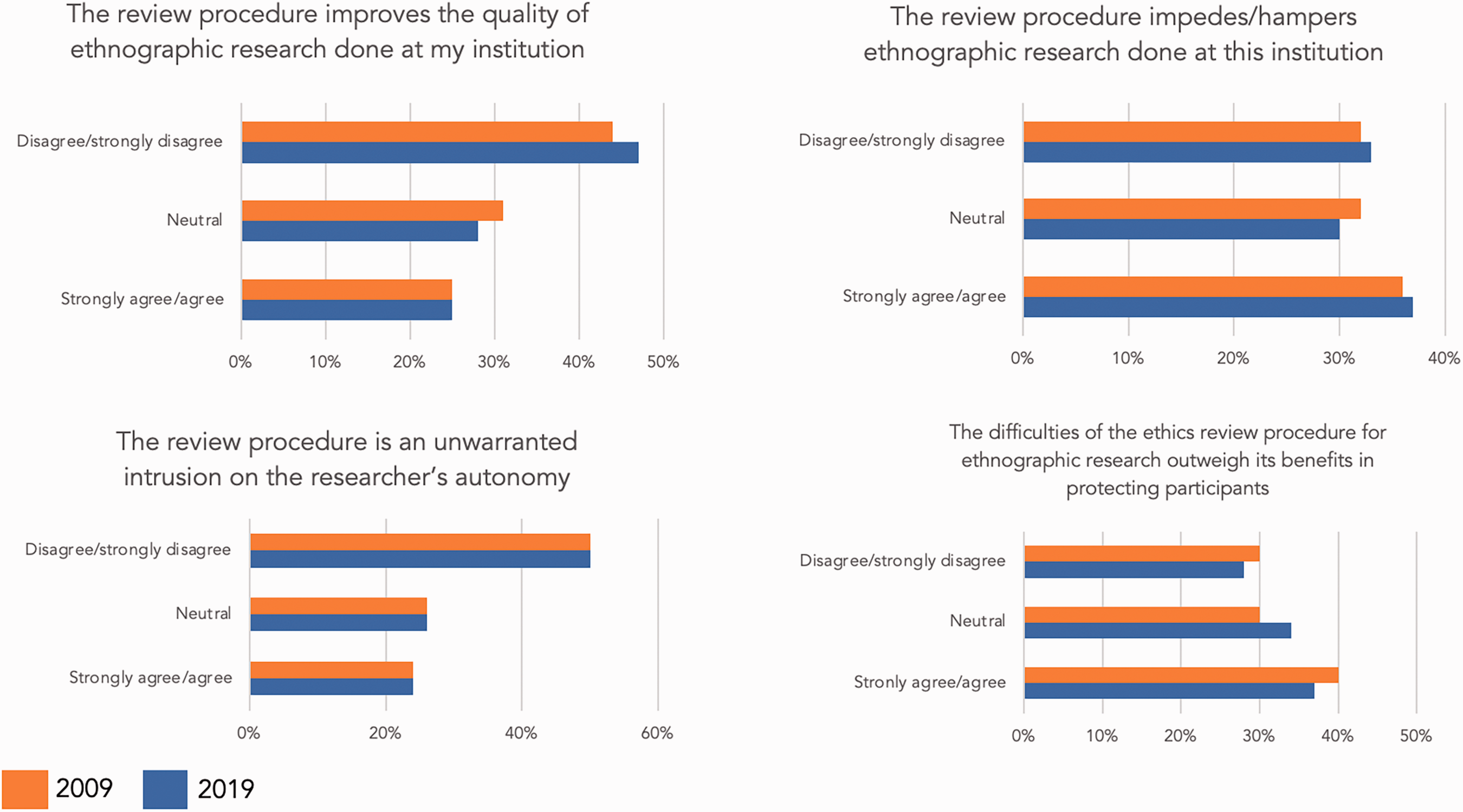
Visual comparison of key results from the 2009 and 2019 surveys.
Significantly, unease regarding the negative impacts of institutional ethics review was not based on the extent of the changes that respondents were required to make to their own ethics applications but the nature of these modifications. This is not an idiosyncratic finding. For example, Bob Simpson (2011) notes that for the UK-based anthropologists he interviewed regarding their experiences of ethical review, although approval was typically granted with only minor modifications required at the submission stage, this did little to quell concerns about the process. These findings suggest that the focus on whether horror stories are representative and attendant calls for an “evidence-based case supported by empirical research” (Bosk, 2007: 205) may, to some extent, miss the point. To date, this has been a key thrust in discussions of research ethics oversight. For example, it was a clear part of the impetus for the Journal of Empirical Research on Human Research Ethics. In the inaugural editorial, the founding editor noted: “Just as evidence-based medicine evaluates time-honored medical practices, evidence-based ethics evaluates whether ethical principles are applied intelligently. Such research improves ethical decision making and hastens the evolution of best practices” (Sieber, 2006: 1). In keeping with this aim, an overview of research agendas in the same issue emphasizes the importance of understanding how the research process actually occurs (JEHRE, 2006).
While such studies clearly have practical value, these calls typically invoke a distinction between perception and reality that assumes that the two can be neatly disentangled. A similar assumption is evident in various attempts to dispel “myths” regarding ethics committees’ openness to qualitative research (e.g., Ells and Gutfreund, 2006; Hedgecoe, 2008). In our view, there are two problems with this approach. First, it does little to account for the social reality of horror stories: they are social facts because they circulate in a community, and in that circulation have rippling social effects (Wynn, 2011). As McMurphy et al. (2013) found in their study of qualitative researchers’ experiences of institutional ethics review in North America and Australia, “The ‘horror stories’ of others noted by many of the respondents appeared to influence the interpretation they had of their own experience and contributed to their unease of the review process” (p. 32). Thus, the assumption that rumors can be treated as problems to be proven and validated or disproven then discarded is to misunderstand their nature and effects. Second, it assumes that harm is only caused by regulatory excesses – clearly outlandish and nonsensical demands. But as we go on to discuss, it is the assumptions built into the process – often manifested in seemingly minor requests that betray a fundamental lack of understanding of ethnographic research – that our respondents repeatedly highlighted. Thus, the stories they primarily focused on were not the outrageous demands that ethics committees placed on nameless others but the quotidian indignities and injustices it inflicted upon themselves.
For McMurphy and colleagues (2013), the remedy for qualitative researchers’ “distrust” of institutional ethics review is greater dialogue between researchers and committee members. Bosk (2007) likewise advocates the need for “mutual understanding” in order for constructive change to occur. Others, however, appear to have lost faith that dialogue and education will resolve the core issues. For example, in 2007 Rena Lederman advocated that ethnographers “train” ethics committees to understand their fringe methodologies, colonizing ethics committees from within to educate committees and developing boilerplate language to explain our methods for those who are unfamiliar with ethnography (see Lederman, 2007a). Less than a decade later, she was writing about the ways in which regulatory compliance inevitably “mutes” disciplinary values (see Lederman, 2016). Like Lederman, we are not optimistic that more dialogue and education is the answer – especially in light of our own efforts over the past fifteen years to “colonize” our ethics committees from within. After all, regardless of how open any individual committee is to ethnographic research or other related methodologies, these encounters are structured by an intensely prefigured and highly bureaucratized process (Kohn and Shore, 2017). Thus, such pleas for reconciliation elide the ways in which institutional ethics review is embedded in imaginations of risk on every level. It is to these imaginations we now turn.
Ethics committees’ imaginations of risk
In most research ethics frameworks, research is treated as an intrinsically risky enterprise (Kohn and Shore, 2017; Lederman, 2007a; van den Hoonaard, 2011; Bell, 2016). To quote from the Canadian research ethics guidelines, which are often lauded for their inclusive approach to social science research:
2
Research is a step into the unknown. Because it seeks to understand something not yet revealed, research often entails risks to participants and others. These risks can be trivial or profound, physical or psychological, individual or social. History offers unfortunate examples where research participants have been needlessly, and at times profoundly, harmed by research, sometimes even dying as a result (CIHR et al., 2018: 7).
Statements of this kind treat research risks as differing in degree rather than in kind, with psychological and social risks mentioned in the same breath as physical ones and trivial and profound risks likewise placed on a continuum. In such a framework, ethnographers’ objections regarding the epistemological inappropriateness of the “Standard Model” (Lederman, 2016) fall on largely deaf ears. The case in point here is the debate between the ethicist Chris Herrera (1996) and the anthropologist Murray Wax (1996) regarding the applicability of the informed consent doctrine to anthropological fieldwork. In response to Wax’s objections regarding its relevance for anthropology, Herrera admonished that “the risk of comparing apples and oranges does not obscure that both are fruits” (1996: 236).
In a now decades-old complaint, respondents in both surveys reported that ethics committees were predisposed to seeing risk and danger in ethnographic observation based on generalizations from a tradition of medical and psychological experimentation. Three respondents in Author 2’s survey described being required to hire psychologists to debrief research participants or be on call in case of distress: “We are often asked whether our participants will be ‘upset’ by talking to us. This medicalization/psychologization is really creepy,” commented one researcher. This paradigm of research review, another argued, was based on fantasies of risk and worst-case scenarios that seem based on committee members’ stereotypes about specific research populations or their indoctrination with ethical concerns from the medical-psychological clinical trial. According to a Canadian-based postgraduate student: What angered me most was their inability to understand ethnographic research and to treat it as equivalent to injecting teenagers with substances. Prior to attending that university, I spent 5 years doing outreach with at-risk populations and was extremely aware of the potential psychological challenges of doing research. Instead of being able to leverage this experience, I felt as though I was treated like a sadist out to harm people. I ended up not doing research with the most marginalized populations because of the perceived risks for the university.
Likewise, in Author 1’s survey, respondents frequently highlighted the risk-averse nature of ethics committees, with a UK-based early-career academic complaining that it “makes doing any sort of meaningful ethnographic fieldwork virtually impossible.” While several respondents indicated that the suggestions helped them to reflect on how their research would impact participants, an Australian-based postdoctoral fellow noted that, “I had to resort to very Western-centric notions of risk management and ‘counselling’ to obtain approval, which I know would not be feasible within the research context.” Another UK-based postdoc observed: Most of our committee are from disciplines which work integrally with ‘vulnerable participants’ and apply unreasonable safeguarding standards to any activity that might be slightly distressing, e.g. asking participants to remember complex times in the past creating unnecessary bureaucratic processes, that may in protecting the researcher deprive the subject of agency.
As respondents’ reflections illustrate, research ethics paradigms are based on the premise that the risks of research are clearly separable from those of everyday life. A key goal of ethics review is to ensure that the risks of the research are justified by its benefits (the principle of “beneficence”) – making it somewhat akin to a risk management exercise (Tolich and Fitzgerald, 2006). However, this means that it can only approve known risks, which creates particular issues if the research problem is emergent and the research risks are not separable from those of everyday life. Ironically, when the study is unbounded, the potential risks themselves are perceived to be unbounded – no limits are placed on them in the manner that happens for, say, a clinical trial. As Kohn and Shore (2017: 239) note, under this logic,“If researchers should not inject members of the public or prisoners for experimental medical research, then they also cannot observe individuals in public spaces or even speak to prisoners about their experiences without encountering risks that should be avoided.” However, the focus on subjective risks introduces an expansionist dynamic into the review process: in light of the fact that reflecting on one’s opinions and experiences might be stressful or upsetting to someone, researchers are often required to establish protocols to manage an array of highly speculative harms (Haggerty, 2004).
For respondents in both our surveys, these problems were compounded by the mandate of ethics committees to assess the legal risks of research for the institution. Although committees vary in the extent to which they are expected to focus on this, reputational risk management is a widely perceived function of the ethic review process (Kohn and Shore, 2017). The specific objection amongst our respondents was not that institutions were apprehensive about legal risks; instead, their concern was with the “conflation of ethics and liability” it produced. As an Australian-based postgraduate student in Author 2’s survey reflected, Ultimately, I think that what institutions really care about (and should care about) is legal liability. I would be much happier if they called these ERBs [ethics review boards] Legal Liability Review Boards and had proper attorneys sitting on them rather than paranoid social scientists who have too much time on their hands and sit around fantasizing about the worst possible cases that could arise despite any consideration of the probabilities of such cases occurring.
A senior UK-based academic in Author 1’s survey put it even more bluntly: “The problem is the review is not about ethics, but about legal risk and compliance… so ethical issues are not raised or challenged appropriately.”
Although our respondents explicitly highlighted two kinds of imaginations of risk in ethics committees’ accounts – that posed by the research and that posed to the institution – a third kind of imagination of risk was evident in their descriptions of their interactions with their ethics committees: the risk posed by the researcher. This comes across in the complaint of the respondent quoted above that their committee had treated them as “a sadist out to harm people”, which captures a pervasive but diffuse sense of indignation evident in both surveys about how respondents were perceived in the review process. Importantly, this suspicion regarding the researcher’s motives is not a side effect of institutionalization but is built into the epistemology of ethics review itself. As Kohn and Shore (2017: 237), among others, have observed, “the behaviour of university ethics committees is often based on a set of assumptions framed within a discourse of ‘risk’ that tends to position the researcher as the powerful agent against whom research participants need ‘protection’.” This opposition between the interests of researchers and participants is explicitly written into research ethics frameworks, which typically assert a tension between the goals of “providing the necessary protection of participants and serving the legitimate requirements of research” (Bell, 2016: 193). Indeed, in this bureaucratic imagination of risk, the real risk is the conditional reason possessed by the researcher (Bell, 2014; Wynn, 2018). This is, in part, why ethnographers’ criticisms of the distortions introduced by ethics review never get very far: the assumption of an intrinsic tension between the interests of the participants and the researcher is so foundational to ethics review that researchers’ concerns are always treated as self-interested.
Ethnographers’ imaginations of risk
Based on the aforementioned disconnect between the extent of the revisions typically demanded and the sense of threat ethnographers experience, it is clear that ethnographers also imagine a variety of risks entailed in the process of ethical review. The greatest perceived risk is to their own research methods and epistemologies: the ways they are dismembered as a result of institutional ethics review, and the damage that results. This is something that has been repeatedly highlighted in ethnographers’ accounts of institutional ethics review over the past 30 years and was reiterated at a variety of points in our surveys. According to an American-based postgraduate student in Author 2’s survey who had witnessed the transition to the current era of ethical oversight: I thought it was a very good idea, as I’d worked by then with or around marginalized peoples (indigenous, rural, poor, and/or devalued gender) and saw not only much potential for abuse, but actual instances of it. I was pleased there was a process beginning to be established, which would act to prevent such abuses. However, as I heard more and more accounts of how IRBs [institutional review boards] worked and were constituted – often of people with little experience themselves, or who wanted to impose ‘one size fits all’ rules across a highly textured and variable research landscape – I became very disillusioned.
This sense that ethical review processes simultaneously fail to improve research ethics whilst eroding the capacity of ethnographers to carry out fieldwork came across strongly in an open response to Author 1’s survey by a French-based early-career academic: I don’t feel like it is sufficient to go through ethics review to protect participants. Different researchers have different ethics, and I’ve seen very unethical practice take place under impeccably Ethics Reviewed projects. I also see ethically sensitive research conducted without any ethical review; I do think it is important to be sensitized and to think ahead, and ethics reviews can help to do this. But I have often found them purely façade and highly normative, and very detrimental to anthropological work.
What is repeatedly highlighted these accounts is the epistemological violence of processes of anticipatory ethics review. As Simpson (2011: 381) observes, “Feeding ethnography into this kind of review process involve[s] pulling apart and specifying elements such that a method designed to deal with the open-endedness of contingency and dialogue becomes an ensemble of closed ones. Parsing ethnography in this way, I would argue, results in damage of a kind” (p. 381). However, adding insult to injury, the concern is that it undermines disciplinary training and knowledge production without actually improving ethical practice (Kohn and Shore, 2017; Lederman, 2016; Simpson, 2011; van den Hoonaard, 2011). Ethics review, for these respondents, was an epistemological assault on ethnographic research methods as open-ended and responsive to the interests and concerns of our research participants. By insisting on up-front assessment, ethics review actually closes off some of the core aspects of our research methods that ethnographers consider to be most ethical. Thus, the process of institutional ethics review entails not just epistemological violence but an epistemological clash.
For many respondents, the epistemological risks entailed in the process of institutional ethics review were tied to the risks it posed for research participants themselves. This is starkly reflected in the responses of the minority of participants in both surveys who had been asked to make significant changes to their proposals. In most cases, respondents indicated that they had found the modifications requested by ethics committees to be more detrimental than helpful to either the quality of the research or the welfare of participants. Indeed, throughout both surveys, respondents pointed to the ways in which their committee’s exaggerated concerns about risks ironically made the research less ethical for participants. Unsurprisingly, these concerns crystalized especially in the context of consent requirements – a longstanding focus of anthropologists’ criticisms of institutional ethical oversight (Bell, 2014; Wynn and Israel, 2018). For example, one US-based anthropologist in Author 2’s survey described being asked by an ethics committee to get signed consent from a research participant for whom signing a form could have put him at significant risk: I was once asked to tell a person I was interviewing, a former guerrilla, that his responses were completely anonymous, now please could you sign this form with your name. Which made no sense at all, especially since I was only interviewing one person – although his actions were years ago he could still end up on a no fly list or something. I ended up just ‘forgetting’ to bring the ethics form so he couldn’t sign his name on it.
A UK-based postdoctoral fellow in Author 1’s survey described a similar degree of intractability on the part of their ethics committee in the context of a project involving dementia care: We worked closely with people living with dementia, including activists in this field. They regularly pointed out to us that ethical requirements were: 1) wrongly presuming the automatic vulnerability of anyone diagnosed with dementia; 2) consequently causing researchers to avoid working with people with dementia or to change their research plans to reduce contact (this was the case with our research at the time); 3) resulting in the voices of people with dementia not being adequately heard or included in research.
These examples illustrate the radical disjuncture between how ethnographers and ethics committees typically apply the core principles underpinning contemporary research ethics (“respect for persons”, “beneficence” and “justice”). According to Kohn and Shore (2017), the key problem resides in ethics committees’ application of the principles in a deontological or duty-based fashion. Uncoupled from their consequences, this approach assumes that “people have a duty to do the ‘right thing’, even if it produces a bad result” (Kohn and Shore, 2017: 241). This, they suggest, serves to explain why committees so often insist on actions that seem silly, absurd and downright unethical to ethnographers themselves – such as requiring signed consent forms in contexts that might actively cause harm to participants (as in the case of the former guerilla mentioned above), or prescribing actions to “protect” vulnerable groups that adversely impact their welfare (as in the case of the dementia study). Alternatively, we would suggest that it is the attempt to wed deontological and consequentialist principles in the process of ethical review that creates the disconnect with how ethnographers themselves understand ethical practice, because of the way it naively assumes that positive consequences (namely, greater “benefits” than “risks”) will automatically stem from the application of the principles – which are treated as essentially complementary rather than potentially in conflict. Thus, it’s not necessarily that ethics committees prioritize duties over consequences, but that they often fail to perceive any distinction between them. The result, as Didier Fassin (2006: 524) observes, is that in its “lazy responses” to real needs, institutional ethics review often discourages the painful moral and political questions that anthropologists and sociologists must deal with in their research.
The violence of simplification
Viewed in such a light, the harms of institutional ethics review do not need to take the form of significant modifications or outright refusals in order to cause harm – this is more of a “death by a thousand cuts” than an outright beheading. Instead, it stems from the accumulation of minor indignities and frustrations as ethnographers grapple with forms and processes that betray, at every turn, an incapacity to incorporate their methodologies, epistemologies, and genuine ethical quandaries. As Lederman (2016) observes, ethnographers thus are cast in the role of subalterns in the academy, forced to shoulder the burden of translation when undergoing formal ethics review, requiring them to either adopt the language of the Standard Model, in the process mispresenting their research philosophies, or they must “abandon the foundational methodological and ethical values of their professional competence to comply with those encoded in human-subjects regulations” (p. 44). The result is that whatever path they take, “ethnographers are blocked from describing their actual research plans and therefore rarely receive genuinely useful guidance” (Lederman, 2016: 58; see also Kohn and Shore, 2017).
Interestingly, our surveys suggest that compliance with ethical oversight is generally high, despite the concerns repeatedly raised. For those who indicated uniform compliance, responses were broadly similar in both surveys. Most said they did so because it was required, either by their university, in order to get funding, or by a country or organization in which they were doing research. Some elaborated that they feared that they could not get published or that they would be denied tenure if they did not comply. For example, an Australian-based academic in Author 2’s survey noted, “I am pretty sure I would be fired if I was caught doing research without ethics approval.” Indeed, it was clear from free-form comments in both surveys that many respondents did not consider non-compliance to be a possibility – variants of “it’s mandatory” and “it is a requirement” were common. Certainly, in our own experience of running workshops in the area of research ethics (and how to navigate the review process), a key question we have repeatedly been asked, especially by postgraduate students, is “what is the penalty for failure to comply?” As the respondents in our surveys were acutely aware, there are potential material consequences to non-compliance: charges of academic misconduct, failure to be awarded a degree, losing one’s job. The threat is distant, but real; indeed, the first author has seen several attempts to wield ethical clearance in this way – each time on political grounds rather than ethical concerns regarding the conduct of the research itself.
This threat remains backgrounded in most discussions of institutional ethical oversight; however, we would suggest that ethics review is best conceptualized as an area of violent simplification in the sense that David Graeber (2012) defines. For Graeber, this is a key attribute of administrative procedures. As he observes, “Paperwork… is designed to be maximally simple and self-contained. Even when forms are complex, even bafflingly complex, it’s by an endless accretion of very simple yet apparently contradictory components” (p. 109). This very simplicity, Graeber argues, disguises the violence inherent in bureaucratic processes. According to Graeber, bureaucratic institutions are founded on violence not merely in an epistemic sense but in a concrete one, because they are embedded in a system that ultimately – if very distantly – rests on the threat of force. The effects of this “violent simplification” are, of course, not equally distributed (across either populations or disciplines). In the context of institutional ethics oversight, the filtering of research through the lens of the Standard Model thus results in a form of epistemological violence backed up by the threat of concrete force. This context is entirely missed in some of the critical discussions of social scientists’ responses to ethical oversight, including those attentive to the bureaucratic imperatives that guide institutional ethics review. For example, Bosk (2007) writes, If the chorus of complaint is taken at face value, the presence of any new ethnographic research is a testament to the doggedness and persistence of researchers who refuse to allow bureaucratic silliness to deter them. We know that IRBs and their acronymic counterparts in other national systems are a bother, but we lack systematic detail about the various forms that this bother takes and how much effort is required to tame it (p. 205).
Conceptualized as an area of violent simplification, the stakes are clearly much higher than the issue of “bureaucratic silliness” and the “bother” it causes.
Nevertheless, it’s clear that the hold of institutional ethical review over ethnographic research is far from complete. After all, people confronted with standards soon develop workarounds (c.f. Star and Lampland, 2009) – what Jack Katz (2006) terms “ethical escape routes” in the context of institutional oversight. While the majority of the respondents in our survey indicated uniform compliance, a substantial minority indicated that they did not always – or, in some cases, ever – seek ethical approval for their research. In Author 2’s survey, those respondents who chose not to comply either said that they did not submit their research for ethics review because it was too daunting, tedious, inconvenient or unreasonable, or that formal review would not make their research more ethical. In Author 1’s survey, those who seldom or never seek approval typically noted that they were retired or worked in national contexts where ethics committees did not operate. Respondents who usually or sometimes sought clearance generally indicated that this was determined by whether the research was funded. Thus, it’s clear that in contexts where ethnographers feel they can fly under the radar, some do avoid obtaining approval. However, in such instances, there was also evidence of careful thought and reflection on ethical issues – as the following response to Author 1’s survey from an Australian-based senior academic indicates: I sometimes work with people who are controlled by institutions that are punitively silencing them and don’t permit ‘researcher’ access or even letter contact. I have built relationships through letters and occasional ‘friend’ visits over many years. My university won’t give approval without other ‘gatekeeper’ approval. I see the resultant writing I do as reflexive, intersubjectively produced celebrations of individual and creative human spirits… IRBs [institutional review boards] have a model of research as ‘extractive’ (using tools of interview, survey, etc.) and hence I choose not to (extract, nor seek approval).
Overall, what both surveys reveal is a profound ambivalence amongst ethnographers regarding institutional ethics review – something that has been reported in other literature, especially that on experiences of qualitative researchers more generally (e.g., Babb et al., 2017). This ambivalence, we argue, is produced in the contradiction between the label – ethical research practice is an undisputed good, and thus many researchers are reluctant to overtly assert opposition to any institution with the label “ethics” attached – and their lurking sense that ethics review bureaucracies may not only not achieve the goal of making research more ethical, they also epistemologically close off aspects of our methodologies that we consider to be the most ethical. At the same time, they convert a moral obligation toward research participants and the discipline in general into a ritual obligation toward institutional bureaucrats.
Caveats and conclusions
Although we have so far treated the two surveys as speaking directly to each other, in light of their different populations, questions can legitimately be raised regarding how comparable they are. How valid is it to speak in general terms about the experiences of ethnographers in Anglophone countries, given the significant differences between the national systems of ethical oversight in place? For example, institutional ethics oversight is federally regulated in the USA by the Office of Human Research Protections (OHRP) and institutional review boards are subject to regular audits to ensure compliance with the federal legislation. In contrast, Canadian, Australian and British research ethics committees are guided by national research ethics frameworks to varying degrees: 3 the Tri-Council Policy Statement – Ethical Conduct for Research Involving Humans, the National Statement on Ethical Conduct in Human Research and the Framework for Research Ethics, respectively, which were jointly developed by the key national funders of health, social science and science research in each country. In all three contexts, institutions wishing to be eligible for funding from these agencies are expected to set up local policies and processes that adhere to the national frameworks, although there is variation in the extent of national registration and oversight they receive. New Zealand differs again. There is no national ethics statement jointly developed by social science and health research funders; instead, health research is monitored by the Health Research Council of New Zealand Ethics Committee (Tolich and Smith, 2014). Thus, university ethics committees, which must be accredited by the Health Research Council, have an explicit biomedical orientation – unlike, for example, Canada and Australia, where specialized ethics committees for the review of social science research are reasonably common.
As academics who have worked in four of the five aforementioned countries and held appointments on ethics committees in three (Australia, Canada and the UK), we have directly experienced the differences between them, as well as some of the local variability from one committee to the next. Thus, we agree that the national differences in ethics cultures (Fassin, 2006) and structural differences between regulated and unregulated contexts (Hedgecoe, 2008) can’t be discounted in considering ethnographers’ experiences of institutional ethics review. Nevertheless, like others before us (e.g., Kohn and Shore, 2017; Tolich and Fitzgerald, 2006), we do think it’s possible to assert a common ground between ethnographers’ experiences, despite such regional variability. This is, in part, due to the direct crossover between these systems – especially the role of the United States in stimulating the development of institutional ethics review in countries where researchers received US funding (see Hedgecoe, 2009). Indeed, the link between institutional ethics review and funding requirements is common to many of the countries in question, with funders demanding evidence of ethical oversight for the research they fund, and such oversight typically extended to unfunded research by local “administrative fiat” (cf. Katz, 2006; Shweder, 2006). Moreover, in each instance, oversight was initially instigated by medical research funders based on a biomedical model of ethics which was later transposed to social science research as well (see Israel, 2014). For example, in Australia, the first National Statement on Ethical Conduct in Human Research was developed in accordance with the 1992 National Health and Medical Research Council Act; in the US, OHRP was created to support the Department of Health and Human Services and the research it funds; in New Zealand, university ethics committees are overseen by the Health Research Council, and so on. Even where the Standard Model has been moderated to a greater rather than lesser degree – as in Canada – social science research, and ethnographic research in particular, is still conceptualized as an exception to the norm (Bell, 2016).
Beyond the issue of how comparable the study populations are, questions can also be raised regarding the generalizability of the results. Obviously, neither survey is representative in any statistical sense; indeed, there is little doubt that respondents were more likely to be those with strong views on the subject matter. However, we believe that a degree of generalization is possible from the research that has been conducted to date – especially when taken as a collective whole. Kirsten Hastrup (2004) makes a distinction between “vertical” and “horizontal” generalization, with the latter focused on “wall-to-wall” generalization of the kind found in representative samples, and the former concerned with the processes by which meanings are established, challenged and altered. In our view, the consistency of the accounts are akin to “dipping into a river repeatedly at different locations to determine whether the water is of the same quality with the same kind of sediments and minerals on a consistent basis” (Csordas, 2004: 475). After thirty-odd years of research and commentary, it’s abundantly clear that current ethics regimes pose distinctive problems for ethnographers and those issues have not dissipated as institutional ethical oversight has become normalized or “accommodations” have been made for ethnographic studies. The problem exceeds the issue of bureaucratic silliness or academic recalcitrance or any of the other ways that is often described by those insisting that further research is required in order to understand the “real” impacts of ethical oversight.
However, we are not suggesting that ethnographic research should be devoid of any external ethical scrutiny. A common complaint amongst ethnographers working in European countries, where institutional ethical review of social science research remains uncommon, is the lack of ethical dialogue in the fields of anthropology and sociology (e.g., Fassin, 2006; von Unger et al., 2016). In such contexts, it’s understandable that some might see institutional oversight as a solution to the question of how to encourage such dialogue. Indeed, there were respondents in both of our surveys who felt that the application form had prompted them to reflect on possible ethical dilemmas before embarking on fieldwork, although the review process itself was procedural, the feedback was unhelpful, and so on. But it’s also clear that discussions of the process of obtaining ethics approval tend to crowd out “real” conversations about ethics (Kohn and Shore, 2017; Lederman, 2007b; van den Hoonaard, 2011) – even at a disciplinary level. Indeed, Author 1’s survey suggests that training in ethnographic research ethics is highly variable in the UK and is typically left to the discretion of the individual lecturer or supervisor. As von Unger et al. (2016: 4) point out, the bottom line is “how reflections about ethics and values can be integrated far more inclusively into the everyday work of sociologists and anthropologists.”
There are now three decades’ worth of commentaries on how ethics review might be improved for social scientists and ethnographers. The fact that these suggestions still need to be made after so many years of ethics review indicate that the problem may be more intractable than we think. Kohn and Shore (2017) provide an illustration of the core problem in recounting the response to a series of lectures by Kohn on how anthropological research is often badly served by institutional ethics review. Afterwards, a committee member came up to say how much he had enjoyed the presentation, adding, “Another anthropologist gave us a talk about five or six years ago and your talk reminded me of all the points he raised!” As Kohn and Shore (2017) wryly note, “Clearly action points and shifts in process and understanding are not being implemented” (p. 241). Our two surveys, conducted over an interval of a decade, show that the problems aren’t a question of generational differences in attitudes toward ethics review or a discipline-specific demand of exceptionalism driven by un-self-reflective complainers who are more worried about their own research than about the welfare of their research participants. Rather, the problems that ethnographers describe with ethics review bureaucracies hinge on epistemological differences in how both imagine research ethics and how to inculcate cultures of ethical research practice in the academy. (Indeed, this may explain why horror stories of ethnographers’ conflicts with ethics bureaucracies continue to have traction: not just because such conflicts repeat themselves again and again, but because the stories we tell about these conflicts resonate with our fundamental understandings of incommensurate epistemological difference.)
These epistemological differences, we argue, emerge in lingering framings of social science research in terms of biomedical and clinical research models, in different ways of imagining risk and agency, in the framing of review in terms of punitive bureaucracy instead of a habitus oriented toward ethics, and in the conflict between prior review and emergent methods. Not only is ethics review completed prior to the start of research incapable of assessing a research method framed in terms of ongoing elaboration of the research topic and methods in dialogue with our research participants, but it also forecloses certain types of dialogic research practice that are core to our disciplinary ways of conceptualizing ethical research. While the overt legacy of clinical research models in shaping the review of social science research may be changing as national ethics codes and institutional review boards evolve and adapt, this does not resolve underlying conflicts that are deeply embedded into the structures of review. This explains why ethnographers’ attitudes toward ethics review have scarcely changed over time, and suggests that in the now-decades-long conflict between ethnographers and ethics review committees, things aren’t going to get better unless there is a radical reframing and restructuring of ethics review.
Footnotes
Acknowledgements
The surveys drawn on in this paper received institutional ethics approval from the University of Roehampton and Macquarie University, respectively. We gratefully acknowledge the contributions of Zach Schrag, who helped to design Wynn’s original survey instrument, and the members of the ASA Ethics Guidelines Group (Jude Robinson, David Zeitlyn, Heike Schaumberg, Garry Marvin and Sarah Bourke), who provided input on Bell’s survey and provided permission for her to draw on the results in this publication. We are also indebted to the journal editor and two anonymous reviewers, whose helpful feedback encouraged us to clarify and expand on our arguments.
Declaration of conflicting interests
The author(s) declared no potential conflicts of interest with respect to the research, authorship, and/or publication of this article.
Funding
The author(s) received no financial support for the research, authorship, and/or publication of this article.
